The nuclear bombing of Hiroshima and Nagasaki did NOT save lives and shorten World War 2

This article disputes the “Stimson narrative”, – the story that the atomic bombing was necessary, and therefore acceptable.
What Europeans believe about Hiroshima and Nagasaki—and why it matters , Bulletin of the Atomic Scientists Benoît Pelopidas Benoît Pelopidas is the founder of the Nuclear Knowledges program at the Center for International Studies at Sciences Po in Paris (formerly chair of excellence in security studies). Kjølv Egeland, Kjølv Egeland is Marie Skłodowska-Curie Postdoctoral Fellow in Security Studies at Sciences Po, focusing on strategic narratives and global nuclear order.
By Benoît Pelopidas, Kjølv Egeland, August 3, 2020 Did the atomic bombings of Hiroshima and Nagasaki shorten the war, and were they necessary to force the Japanese surrender? Many people believe the answer to both questions is yes: In dropping the Bomb, America chose the lesser of two evils.
Although historians have long challenged this narrative as wrong or misleading, a significant number of Europeans still believe it. That is the primary result of a recent survey of European views on nuclear affairs generally and the atomic bombings of Japan specifically. The survey, carried out in October 2019, involved approximately 7,000 respondents aged 18 and upward, carefully selected to ensure representative samples from Belgium, France, Germany, Italy, the Netherlands, Poland, Sweden, Turkey, and the United Kingdom.
The survey also shows that those who believe the bombings were necessary and effective at significantly shortening the war are more likely to harbor skepticism toward nuclear disarmament than those who do not. That being said, European publics remain on the whole staunch in their support for the elimination of nuclear weapons. Even in nuclear-armed France and the United Kingdom, large majorities reject the idea that nuclear weapons could ever be used morally. Although others across the world may hold similar views, to date there has been no broad survey posing these questions in the United States or elsewhere. Future surveys could investigate whether the same pattern exists beyond Europe…………
it does not appear that the US executive spent much time deliberating whether atomic weapons should be used or not. Discussions instead focused on how, when, and where they would be employed. ………….
According to declassified documents, the US military estimated in June 1945 that a full-scale invasion of the Japanese home islands, in the worst-case scenario, could be expected to incur up to 220,000 casualties—quite far from Stimson’s “over a million.” Moreover, of the 220,000 casualties, only 46,000 were projected as fatalities. The number of people killed in Hiroshima and Nagasaki, on the other hand, was probably at least twice as high as the “over a hundred thousand Japanese” reported by Stimson in 1947………
the idea that the US government was faced with only two options in August 1945—full invasion or atomic bombing of Japanese population centers—has little basis in reality. Alternative courses of action, not mutually exclusive, would have included negotiations, a demonstration of the atomic bomb in an uninhabited area, continued strategic bombing short of the use of atomic weapons, continued economic blockade, and waiting for the Soviets to declare war against the Japanese empire.
it is not clear that the atomic bombs were in fact responsible for the Japanese surrender. The Japanese war cabinet had over an extended period of time been divided between a “peace party,” which argued that Japan should seek an end to the war as quickly as possible, and a “war party,” which argued the war should be continued as Japan sought good offices from the Soviet Union to negotiate a peace deal with the United States and Britain. In the view of the acclaimed historian Tsuyoshi Hasegawa, who consulted primary sources in Japanese, it was the Soviet Union’s breach of the Soviet–Japanese Neutrality Pact and attack against Japan on August 9, 1945 that tipped the scale and forced the emperor’s decision to surrender the very next day (the final decision was formalized a few days later, following discussions within the Japanese executive). In the absence of the Soviet invasion, Hasegawa concludes, the two atomic bombs would “most likely not have prompted the Japanese to surrender, so long as they still had hope that Moscow would mediate.”
The historian John Dower concurs: The Soviet entry into war was more important than the atomic bombing in producing Japanese surrender. Once the Soviets intervened, the Japanese appear to have favored surrendering to Washington over allowing Moscow to conquer their country. At the same time, from the perspective of the Japanese government, the atomic bombings provided an opportunity to frame the Japanese military’s shattering defeat as a result not of its own incompetence, but as an outcome of the introduction of a new and revolutionary weapon by the enemy. In Dower’s words, the atomic bombings allowed the Japanese emperor to spin the capitulation as “nothing less than a magnanimous act that might save humanity itself from annihilation by an atrocious adversary.”
In fact, according to the US Air Force’s own review, finalized not long after the end of the war, Japan would likely have surrendered that same autumn even in the absence of atomic bombings or an invasion. Similarly, the Joint Chiefs of Staff expressed skepticism about the use of atomic bombs both before and after the fact.
In summary, many of the central claims on which the official story about Hiroshima and Nagasaki is founded—that the atomic bombings were necessary to end the war, that they ended a conflict that otherwise would have slogged on, and that they saved a large number of American soldiers’ lives—appear to rest on shaky ground. While certain aspects of the story stand up to scrutiny, others have been proven plain wrong, and others remain contested by scholarship. But have people caught up with the historiography?
European views on the atomic bombings of Japan. Asked to note their agreement or disagreement with the statement that “the atomic bombings of Japan in World War II shortened the war significantly,” 23 percent of respondents to the October 2019 survey “strongly” agreed, 29 percent “somewhat” agreed, 31 percent reported no opinion, 9 percent “somewhat” disagreed, and 8 percent “strongly” disagreed. In other words, while 52 percent of respondents expressed support for the idea that the war was significantly shortened by the atomic bombings, only 17 percent pushed back against that idea.
Regarding the question of whether “the atomic bombings of Japan in World War II were necessary to bring Japan to surrender,” the survey results were more balanced. 12 percent of respondents “strongly” agreed, 19 percent “somewhat” agreed, 33 percent reported no opinion, 15 percent “somewhat” disagreed, and 21 percent “strongly” disagreed.
On the statement, “The atomic bombings of Japan in World War II saved American soldiers’ lives,” 14 percent of respondents expressed that they “strongly” agreed, 25 percent that they “somewhat” agreed, 38 percent reported no opinion, 11 percent expressed that they “somewhat” disagreed, and 13 percent expressed that they “strongly” disagreed.
Finally, asked to note their agreement or disagreement with the statement that “the atomic bombings of Japan in World War II killed innocent civilians,” 71 percent of respondents to the 2019 survey “strongly” agreed, 14 percent “somewhat” agreed, 12 percent expressed no opinion, and less than 5 percent “strongly” or “somewhat” disagreed.
The results suggest that the Stimson narrative still holds sway among Europeans, but that support might be weakening over time. On each statement, older respondents were slightly more likely than younger respondents to express agreement with Stimson’s interpretation of the atomic bombings.
Finally, it bears mentioning that British respondents stand out among the nine European populations sampled as the greatest believers in the Stimson narrative. The results unfortunately do not give further insight into the causes of this tendency, but three mutually reinforcing hypotheses are plausible. First, the shared language of the United States and the United Kingdom allows narratives and talking points to travel relatively frictionless across borders. Second, the United Kingdom was directly involved in the building of the atomic bomb through the Manhattan Project and, by extension, partly responsible for the fates of the people of Hiroshima and Nagasaki……..
Attitudes toward nuclear disarmament. European publics have long offered strong support for arms control and the elimination of nuclear weapons. This pattern is further corroborated by the survey data, which show consistent support for nuclear disarmament. ……..
The support for disarmament is robust and consistent: 81 percent of respondents who strongly agreed with the goal of eliminating nuclear weapons within 25 years also offered strong support for an agreement to eliminate nuclear weapons. …….
However, there is clear relationship between degree of faith in the Stimson narrative and support for the abolition of nuclear weapons. Respondents who said the atomic bombings shortened the war significantly, were necessary to bring about the Japanese surrender, or saved American soldiers’ lives were significantly more likely to believe that the abolition of nuclear weapons would “make the world less safe” compared to those who did not express such views. ………..
However, there is clear relationship between degree of faith in the Stimson narrative and support for the abolition of nuclear weapons. Respondents who said the atomic bombings shortened the war significantly, were necessary to bring about the Japanese surrender, or saved American soldiers’ lives were significantly more likely to believe that the abolition of nuclear weapons would “make the world less safe” compared to those who did not express such views. ……….
It is the responsibility of scholars and educators to work against such epistemic vulnerability to expose citizens to the latest advances of knowledge so that they can independently form their political views. https://thebulletin.org/2020/08/what-europeans-believe-about-hiroshima-and-nagasaki-and-why-it-matters/?utm_source=Newsletter&utm_medium=Email&utm_campaign=MondayNewsletter08032020&utm_content=NuclearRisk_WhatEuropeansBelieve_08032020#
Arms control, the new arms race, and some reasons for optimism

|
“The end of arms control as we know it”
The last agreement limiting America’s and Russia’s nuclear arsenals is months away from expiring. Vox, By Alex Ward@AlexWardVoxalex.ward@vox.com Aug 3, 2020, In December 2019, a secretive group of elite Americans and Russians gathered around a large square table. It was chilly outside, as Dayton, Ohio, can get in the winter, but the mood inside was just as frosty.
The 147th meeting of the Dartmouth Conference, a biannual gathering of citizens from both nations to improve ties between Washington and Moscow, had convened. Former ambassadors and military generals, journalists, business leaders, and other experts came together to discuss the core challenges to the two countries’ delicate relationship, as members had since 1960. In recent years, that has included everything from election interference to the war in Ukraine. But now the prospect of an old danger worried them most, just as it had the group’s quiet supporters President Dwight Eisenhower and Soviet Chairman Nikita Khrushchev decades before: nuclear catastrophe. Proceedings typically start with a lengthy summary of the relationship, touching on security, medical, societal, political, and religious issues up for discussion. This time, the synopsis was unnervingly short. “We went right into the nuclear issue,” said a conference member, speaking on condition of anonymity because they were not authorized to speak openly about the event. “There was a belief we were in serious danger because it’s the end of arms control as we know it.” “It was dramatic and sobering,” the member added. The US and Russia were then barely over a year away from losing the last major arms control agreement between them: New START, short for the Strategic Arms Reduction Treaty. That agreement limits the size of the two countries’ nuclear arsenals, which together account for 93 percent of all nuclear warheads on earth. The deal expires on February 5, 2021, and those sitting around the table feared its demise. The trepidation inspired the group’s four co-chairs to do something the Dartmouth Conference hadn’t done in its 60-year existence: release a statement. “Given the deep concerns we share about the security of our peoples, for the first time in our history we are compelled by the urgency of the situation to issue this public appeal to our governments,” they wrote, calling for the US and Russia to invoke the treaty’s five-year extension. Today, roughly half a year before New START stops, the group’s members continue to stress the consequences. “We’re at a decisive point,” said retired US Army Brig. Gen. Peter Zwack, who was at the December meetings. “The entire arms control regime of the past 50 years is about to pass.” Seventy-five years ago this week, the US dropped atomic bombs on Hiroshima and Nagasaki in Japan, unleashing a weapon of mass destruction on the world. Decades of painstaking diplomacy between the world’s two greatest nuclear powers, the US and Russia, helped keep both nations from unleashing that destructive power on each other ever since. But now the US and Russia are mere months from throwing it all away. New START may soon join other defunct arms control agreements, including one prohibiting ground-based intermediate-range missiles scrapped in 2019 and another allowing overflights of nuclear facilities likely to end this year. One reason for all of this: President Donald Trump wants to put his own stamp on arms control history, one way or another…….. “The president has directed us to think more broadly than the current arms control construct and pursue an agreement that reflects current geopolitical dynamics and includes both Russia and China,” a senior administration official told me on the condition of anonymity. “We’re continuing to evaluate whether New START can be used to achieve that objective.” That evaluation has turned into a delicate process with Russia, with high-level and working-level meetings taking place in Vienna to see if New START can be salvaged. Officials from both countries met again at the end of July in Austria’s capital, while China — which the US wants involved to discuss limiting its nuclear and missile capabilities, even though it isn’t a party to New START — didn’t show up……… If New START ends, then, the general animosity between the US and Russia could lead to a nuclear arms race and prompt China to keep building up its forces — a situation unlike anything we’ve seen since the Cold War. “We’re creating the greater threat of a conflict that could literally destroy each country and perhaps even our planet,” Leon Panetta, the former CIA director and defense secretary, told me. The following account of the looming death of US-Russia arms control is based on conversations with over 20 current and former US officials, lawmakers, and experts on three continents. It traces the story of arms control from its origins to its possible end in the coming years, and what that end could mean for all of us. The long and dangerous road to arms control……………..Trump takes control, and trashes arms controlNuclear war is a threat Donald Trump has often talked about over the years, and he has sometimes seemed genuinely concerned about it…….. When Trump took office on January 20, 2017, three major arms control-related agreements were in force: the INF Treaty, a confidence-building measure known as Open Skies, and New START, the agreement Obama had negotiated just a few years earlier. Yet, rather than continue the progress his predecessors made toward making the world safer from the threat of nuclear war, Trump decided to tear it all down, while pursuing an exit from the Iran nuclear deal and ineffective nuclear diplomacy with North Korea. Of those three US-Russia agreements, one is gone, another is almost gone, and the last, it seems, is on the way out. That’s not all bad, some experts say, as Russia did cheat on some of the agreements and the US showed those actions would have consequences. But most experts I spoke to are concerned that Trump is tearing down an artifice with no new blueprints to make it better, or even rebuild what exists. “The whole arms control regime is under considerable stress,” former Energy Secretary Ernest Moniz, who now leads the Nuclear Threat Initiative, told me. “It’s badly frayed.” Let’s take each deal in turn. The INF Treaty The Intermediate-Range Nuclear Forces (INF) Treaty was signed by President Ronald Reagan and Soviet leader Mikhail Gorbachev in December 1987. It prohibited Washington and Moscow from fielding ground-launched cruise missiles that could fly between 310 and 3,400 miles.Both countries signed the deal as a way to improve relations toward the end of the Cold War. However, the two nations still could — and since have — built up cruise missiles that can be fired from the air or sea……… Ultimately….. “the president made the decision to leave” the deal. That officially happened in August 2019. Open SkiesOriginally an idea by Eisenhower and made a reality in 2002, the Open Skies Treaty allows nations to conduct unarmed flights over another country’s military installations and other areas of concern. Entering into effect 10 years later, it has since helped the 34 North American and European signatories, including the US and Russia, gain confidence that others weren’t developing advanced weapons in secret or planning big attacks…….. In May 2020, Trump decided America would withdraw from the Open Skies Treaty, kicking off a six-month clock before the US could officially leave the deal. …………. New STARTAs a reminder, the New START arms control deal became effective in 2011 during the Obama administration. The treaty’s goal, essentially, is to limit the size of the American and Russian nuclear arsenals, the two largest in the world. To ensure those limits are met and kept, the treaty also allows Washington and Moscow to keep tabs on the other’s nuclear programs through stringent inspections and data sharing, thereby curbing mistrust about each other’s nuclear and military plans. At the time, it was heralded as a major achievement and is still considered such by top lawmakers………… As of mid-July 2020, the two nations had exchanged more than 20,400 total notifications about the state of their arsenals. Rose Gottemoeller, who led the New START negotiations for the US at the State Department, told me all that goes away if Trump decides not to stay in the agreement. “The Russians won’t allow for verifications and inspections without a legal basis,” she said. And without the ability to get deep insight into Russia’s nuclear forces, trust would surely erode. “The exact thing which gives us an excellent understanding of Russian strategic forces is all going to break down,” said Gottemoeller, who in 2019 stepped down as NATO’s deputy secretary. “Unless you have access to verify what’s going on with the warheads on missiles or submarines, you don’t really understand what’s going on.” Putin, Russia’s president, says he sees value in the deal. “Russia is not interested in starting an arms race and deploying missiles where they are not present now,” he told Russian officials in December. “Russia is ready to immediately, as soon as possible, by the end of this year, without any preconditions, extend the START Treaty so that there would be no further double or triple interpretation of our position.” Trump hasn’t taken up Putin on his offer yet, even though those two could extend the agreement for up to five years without anyone else’s input………….. So why get out of a deal that almost everyone says is vital to keeping US-Russia relations stable? The answer is China…….. In July, top US arms control negotiator Marshall Billingslea extended an “open invitation” to Chinese officials to join the US and Russia in Austria for New START talks, even though Beijing has long said it won’t sign on to New START since its arsenal is so much smaller than Washington’s and Moscow’s. …………… The new arms race“Arms control creates an additional layer of insurance between states not getting along well and a possible hot war,” Samuel Charap, who served as a senior adviser to Gottemoeller after New START entered into force, told me. “If you remove the failsafe, you create more risk.” Without the longstanding architecture in place, Washington and Moscow would enter a dangerous arms control hiatus and could see already poor relations spiral out of control. The US and Russia have many nuclear-tipped missiles already pointed at each other, but it would be even worse if both sides try to one-up their adversary by creating more deadly and usable weapons. That, unfortunately, is exactly what’s happening. Welcome to the new arms race. ……………….. A review conference for the treaty was supposed to take place in April but was postponed due to the coronavirus. Whenever it meets, the lack of US-Russia arms control commitment could make it the testiest gathering in decades. Some may seriously push for the NPT to be dissolved. And if that’s the case, what’s to stop nations like Iran, Saudi Arabia, or others from sprinting toward the bomb? Second, the end of an important era in global security fades away with nothing to replace or build on it. “The good old days when arms control was going hand-in-hand with a cooperative security relationship — which basically ties my security to your security — those days are gone, and I don’t see them coming back,” said the University of Hamburg’s Kühn. The only chance of a return to that time, he added, would likely be after Trump, Putin, and Chinese President Xi Jinping leave their offices………………. There are reasons for optimism. Washington and Moscow are having conversations now, including a working-level meeting in July in Vienna. Even though the administration is skeptical of arms control, and Billingslea is not a fan of the concept, Trump’s team at least hasn’t outright rejected negotiations. However unlikely now, the two powers could come to an agreement before New START’s expiration on February 5. If they don’t, a newly elected Joe Biden could quickly reach a deal with Putin before the deadline, though he’d have limited time since his term would start in late January. “The election in November will be a major inflection point for New START specifically,” Moniz, the former energy secretary who helped strike the Iran nuclear deal, told me. “If Biden wins, I can’t imagine that he wouldn’t extend New START.”……… https://www.vox.com/world/21131449/trump-putin-nuclear-usa-russia-arms-control-new-start |
|
Ballooning by $billions – UK’s costs for its nuclear weapons
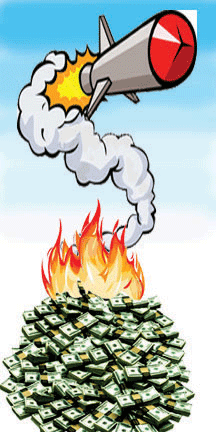 The Ferret 2nd Aug 2020 The cost of UK programmes to replace Trident and nuclear submarines on the
Clyde increased by over £1 billion in a year, according to data released
by the Ministry of Defence (MoD).
The construction of new reactor cores,
replacement submarines and major new facilities at the Faslane and Coulport
bases in Argyll are also facing prolonged delays, with growing doubts over
whether some projects can be successfully delivered.
Most of the delays are
unrelated to the coronavirus pandemic. Four major nuclear projects have
been officially rated as “amber” or worse, meaning that they have
“significant issues”. Two have been “rebaselined” by the MoD,
meaning that costs have risen significantly and timescales lengthened.
https://theferret.scot/trident-nuclear-submarine-costs-1bn-delays/
Never mind about Hiroshima – a nuclear arms race is on – in space!

|
A nuclear arms race in space? It seems we’ve learned nothing from Hiroshima https://www.theguardian.com/commentisfree/2020/aug/02/a-nuclear-arms-race-in-space-it-seems-weve-learned-nothing-from-hiroshima
Simon Tisdall As the world marks the 75th anniversary of the dropping of the atom bomb on Japan, it must wake up to the new rearmament.Russia’s apparent test-firing of an anti-satellite weapon in outer space on 15 July, as alleged by the US and Britain, could be dismissed as another of Vladimir Putin’s annoying provocations. That would be a mistake. The alleged new space weapon should be seen in the broader context of a rapidly evolving, hi-tech, high-risk international arms race involving all the major nuclear powers that, largely undiscussed, is spinning out of control. This week sees the 75th anniversary of the atomic bomb attacks on Hiroshima and Nagasaki that killed over 200,000 people, but the absence of public debate or a sense of alarm about the grim advent of sophisticated new nuclear, hypersonic, cyber and space weapons is striking. In the decades after Hiroshima, noisy anti-nuclear “ban the bomb” protests by CND and others spanned the globe. Today, by comparison, an eerie silence reigns. The battle for outer space is only getting going – yet deserves immediate attention. Russia’s alleged development of anti-satellite weapons is almost certainly matched by the US and China, and undermines past undertakings about the peaceful use of space. Christopher Ford, US assistant secretary of state for international security and non-proliferation, warned last week that Russia and China had already turned space into a “war-fighting domain”. “What [the Russians] are doing is signalling to the world that they’re able to destroy satellites in orbit with other satellites,” Ford said. “This is the sort of thing that could get out of hand and go very badly rather quickly.” The UK called the alleged test “a threat to space systems on which the world depends” – meaning use of such weapons could, in theory, produce an instant global security and communications blackout. Yet in relaunching US space command last year, Donald Trump also pointed to space as the next great-power battlefield. Nato secretary-general Jens Stoltenberg says the alliance will not deploy weapons in space but is obliged to defend its interests, which include 2,000 orbiting satellites. For Nato, too, space is now an “operational domain”. New and “improved” nuclear weapons are proliferating in parallel with the race for space. According to the Stockholm International Peace Research Institute (Sipri), nine states – the US, Russia, China, Israel, the UK, France, India, Pakistan and North Korea – together possess about 13,400 weapons. While the overall total is falling, “retired” warheads and bombs are being replaced by more powerful, versatile devices, such as smaller, “use-able” US battlefield nukes. “All these states are either developing or deploying new weapon systems or have announced their intention to do so,” Sipri’s annual report said. The US and Russia each possessed about 1,550 deployed, long-range weapons, while China had about 300. Both the US and Russia were spending more and placing greater reliance on nuclear weapons in future military planning, it said, while China was rushing to catch up. “China is in the middle of a significant modernisation of its nuclear arsenal. It is developing a so-called nuclear triad for the first time, made up of new land- and sea-based missiles and nuclear-capable aircraft. India and Pakistan are slowly increasing the size and diversity of their nuclear forces,” Sipri reported. Meanwhile, North Korea continued to prioritise its military nuclear programme, while conducting “multiple” ballistic missile tests. “Instead of planning for nuclear disarmament, the nuclear-armed states appear to plan to retain large arsenals for the indefinite future, are adding new nuclear weapons, and are increasing the role such weapons play in their national strategies,” a Federation of American Scientists survey said. It estimated about 1,800 warheads were kept on high alert, ready for use at short notice. Russia claims to lead the world in developing hi-tech weaponry. Speaking in July, Putin boasted that Russia’s navy was being equipped with nuclear-powered hypersonic cruise missiles, which supposedly have unlimited range, and submarine-launched underwater nuclear drones. Despite celebrated speeches supporting a nuclear-free world, Barack Obama authorised a $1.2tn plan to upgrade America’s nuclear triad while pursuing strategic arms reductions via the 2010 New Start treaty with Russia. Trump has doubled down, at the same time abandoning arms control pacts. His 2018 nuclear posture review proposed an extra $500bn in spending, including $17bn for low-yield, battlefield weapons. Trump looks set to scupper New Start, which expires in February, on the spurious ground that it does not reduce China’s much smaller arsenal (which it was never intended to do). He has previously reneged on the 2015 Iran nuclear treaty, the 1987 Intermediate-range Nuclear Forces treaty, and is said to favour resumed nuclear testing in Nevada in defiance of the 1996 Comprehensive Nuclear-Test-Ban treaty. Like Britain and other signatories, the US continues to fail to fulfil its obligation under the 1970 Nuclear Non-Proliferation treaty “to pursue nuclear disarmament aimed at the ultimate elimination of nuclear arsenals”. Despite its acute financial situation, Britain remains committed to replacing its Trident missile system at an estimated cost of £205bn over 30 years. While nuclear weapons have not been used since 1945, great-power military flashpoints are increasing the risk that they might be. These potential triggers include the South China Sea, Taiwan, the India-Pakistan and India-China borders, the US-Israel-Iran conflict, North Korea and Ukraine. Heightened international tensions and collapsing arms-control regimes only partly explain the accelerating pace of nuclear rearmament. Resurgent nationalism, authoritarian rightwing populism, revived or new territorial rivalries (as in space), the bypassing of the UN and multilateral institutions, and a shifting economic and geopolitical power balance are all aggravating factors. But so, too, is amnesia. Seventy-five years after Armageddon was visited upon the people of Japan, the world seems to have forgotten the truly existential horror of that moment. A history lesson, and a renewed debate, are urgently needed.
|
|
|
UK is lobbying USA for a controversial new warhead for Trident missiles
UK lobbies US to support controversial new nuclear warheads
Letter from defence secretary seen by Guardian draws Britain into debate pitting Trump administration against many Democrats, Guardian, Julian Borger in Washington, 2 Aug 20,
The UK has been lobbying the US Congress in support of a controversial new warhead for Trident missiles, claiming it is critical for “the future of Nato as a nuclear alliance”.
A letter from Britain’s defence secretary, Ben Wallace, seen by the Guardian, urged Congress to support initial spending on the warhead, the W93.
The letter, sent in April but not previously reported, draws the UK into a US political debate, pitting the Trump administration against many Democrats and arms control groups over whether the the $14bn W93 programme is necessary. The US navy already has two warheads to choose from for its submarine-launched Trident missiles.
The close cooperation on the W93 casts further doubt on the genuine independence of the UK deterrent – parliament first heard about it when US officials accidentally disclosed Britain’s involvement in February – and the commitment of both countries to disarmament.
The UK is also supporting the administration’s efforts to speed up work on the warhead and its surprise $53m request for initial weapon design work in the 2021 budget, two years ahead of the previous schedule.
Sceptics believe the rush is intended to lock in funding before the election. A Biden administration would be likely to review or even cancel the W93 programme……..
The demand for funding for the W93 is particularly controversial in the US as the W76 and a higher-yield submarine-launched ballistic missile (SLBM) warhead, the W88, have already been subject to multibillion-dollar upgrades.
“This is excess on top of excess,” Kingston Reif, director for disarmament and threat reduction policy at the Arms Control Association, said. “We already have two SBLM warheads. The W76 just went through a major life extension programme and is slated to be good into the early 2040s, and the W88 is going through a major alteration.
“The US can continue to assist the UK’s arsenal without rushing the development of an unnecessary, at least $14bn new-design, third SLBM warhead,” Reif added.
The total cost of the US nuclear weapons modernisation programme is expected to be far in excess of $1tn.
The US and Russia, which is also upgrading its arsenal and developing new weapons, together account for more than 90% of all the nuclear warheads on the planet, and both countries are putting increasing emphasis on them in their rhetoric and defence postures.
Under Donald Trump, the US has now left three nuclear agreements and his administration is reluctant to extend the last major arms control deal with Russia, the 2010 New Start treaty, which is due to expire in February.
The bonfire of nuclear accords, combined with the huge amounts spent on weapons like the W93, are a threat to the 1968 nuclear non-proliferation treaty, the fundamental bargain by which countries without nuclear arms pledged not to acquire them on condition the recognised nuclear powers (the US, UK, France, Russia and China) took steps to disarm, under article six of the treaty………
Alexandra Bell, a former state department official and now senior policy director at the Center for Arms Control and Non-Proliferation, said the US-UK special relationship had shown greater solidarity in promoting new weapons than in arms control. ………. https://www.theguardian.com/world/2020/aug/01/uk-trident-missile-warhead-w93-us-lobbySun
BOOKS on The New Nuclear Threat
|
|



Marshall Islands leaders hope for better help over radioactively polluted weapons tests sites
This week leaders of four nuclear test-affected atolls spoke of the building movement movement to issues surrounding the actions of the US from 1946 to 1958.
Elected leaders from Bikini and Enewetak, the ground zeroes for 67 nuclear weapons tests, and Rongelap and Utrok, two atolls heavily contaminated with radioactive fallout from the 1954 Bravo hydrogen bomb test, described separate meetings in the past few days with US Ambassador to the Marshall Islands, Roxanne Cabral, and Marshall Islands President, David Kabua, as “productive and positive.”
The push for action on compensation, health care and cleanups of radioactive islands comes against the backdrop of negotiations between the Marshall Islands and US governments to extend expiring grant funding in a Compact of Free Association.
Island leaders said nuclear test legacy issues had languished for years and they wanted the Marshall Islands to pursue them during the upcoming talks.
It was preferred that a solution was found that benefitted both the Marshall Islands and the United States…….
US-provided compensation fell far short of funds needed to meet compensation awards for this nuclear test-affected nation……
Utrok Mayor Tobin Kaiko said he personally, as well as other nuclear test-affected islanders, continued living with health problems caused by exposure to radioactive fallout.
He said their suffering had been exacerbated by US authorities consistently downplaying the hazards of radiation and the potential for health problems among affected islanders………. https://www.rnz.co.nz/international/pacific-news/422407/nuclear-affected-atolls-in-marshalls-see-promise-in-us-talks
USA’s budget for nuclear weapons goes up and up
 NATIONAL NUCLEAR SECURITY ADMINISTRATION:
Information on the Fiscal Year 2021 Budget Request and Affordability of Nuclear Modernization Activities, Government Accountability Office
GAO-20-573R: Published: Jul 30, 2020. The Department of Energy’s National Nuclear Security Administration is in the middle of a long-term effort to modernize the U.S. nuclear weapons stockpile.
DOE’s 2021 budget estimate for nuclear modernization activities for FYs 2021-2025 is $81 billion—$15 billion more than its 2020 budget estimate for the same period.
Such an increase may require cuts in other national defense programs to keep the defense budget within spending limits.
What GAO Found
The Department of Energy’s (DOE) National Nuclear Security Administration (NNSA) is in the midst of a long-term effort to modernize the U.S. nuclear weapon stockpile and its supporting production infrastructure. NNSA’s modernization plans and budgets are communicated to Congress on an annual basis primarily through two key documents—the Stockpile Stewardship and Management Plan (SSMP) and DOE’s budget justification—together referred to as NNSA’s nuclear security budget materials. GAO reviewed four areas related to the affordability of NNSA’s modernization activities as described in these budget materials:
Funding for nuclear modernization activities. Congress funds NNSA’s nuclear modernization activities through the Weapons Activities appropriation account, which falls under the National Defense budget function along with other NNSA, DOE, and Department of Defense (DOD) appropriations related to the common defense and security of the United States. Discretionary defense spending for fiscal year 2021 may not exceed a certain statutory limit, or else a sequestration—a cancellation of budgetary resources—would be triggered. Therefore, a proposed increase for a given program under the National Defense budget function may need to be offset by reductions in other defense programs to keep the defense budget within statutory spending limits………https://www.gao.gov/products/gao-20-573r#summary
Union of Concerned Scientists, nuclear watchdogs and environmentalists urge against funding for nuclear tests
Groups Push to Remove Proposed Funding for Nuclear Testing https://www.manufacturing.net/home/news/21141496/groups-push-to-remove-proposed-funding-for-nuclear-testing Jul 28th, 2020 ALBUQUERQUE, N.M. (AP) A Senate defense bill includes funding to resume live testing for the first time in nearly three decades.
Deep within a multibillion-dollar defense spending measure pending in Congress is an apology to New Mexico, Nevada, Utah and other states affected by radiation from nuclear testing over the decades.
But communities downwind from the first atomic test in the New Mexico desert on July 16, 1945, are still holding out for compensation for health effects that they say have been ongoing for generations due to fallout from the historic blast.
So far, their pleas for Congress to extend and expand a federal radiation compensation program have gone unanswered. The program currently covers workers who became sick as a result of the radiation hazards of their jobs and those who lived downwind of the Nevada Test Site.
“When you talk about enhancing plutonium pit production and defense spending in the trillions, you can’t tell us there’s not enough money to do this,” she told The Associated Press. “You can’t expect us to accept that any longer and that adds insult to injury. It’s as if we count for nothing.”
U.S. Rep. Ben Ray Lujan, the New Mexico Democrat who advocated for the apology, continues to push for amendments to the radiation compensation program. His office recently convened a meeting among downwinders, uranium miners, tribal members, other advocates and staff in House Speaker Nancy Pelosi’s office.
“The congressman believes that the need for medical and monetary compensation has never been more urgent,” said Monica Garcia, a spokeswoman for the congressman.
The concerns of Cordova and other advocates are growing amid rumblings about reported discussions within the Trump administration about whether to conduct live nuclear weapons testing.
The discussions come as the New START treaty between the U.S. and Russia nears expiration in 2021. Russia has offered to extend the nuclear arms control agreement while the Trump administration has pushed for a new pact that would also include China.
While the U.S. House has adopted language that would prohibit spending to conduct or make preparations for any live nuclear weapons tests, a group of senators has included $10 million for such an effort in that chamber’s version of the bill.
The Union of Concerned Scientists, nuclear watchdogs and environmentalists all are pushing for the funding to be eliminated. They sent letters this week in opposition and plan to lobby lawmakers.
“A U.S. resumption of nuclear testing would set off an unpredictable and destabilizing international chain reaction that would undermine U.S. security,” reads one letter.
Kevin Davis with the Union of Concerned Scientists’ global security program said resuming live testing would be unnecessary because the U.S. has been able to do sub-critical experiments and use its super computers along with data from past testing to run simulations on the nation’s nuclear stockpile.
The last full-scale underground test was done Sept. 23, 1992, by scientists with Los Alamos National Laboratory at the Nevada Test Site northwest of Las Vegas. Less than two weeks later, then President George H.W. Bush signed legislation mandating a moratorium on U.S. underground nuclear testing.
Democrat Rep. Ben McAdams of Utah is among those leading the effort to ban spending for testing. He said thousands of residents in his state are still dealing with trauma and illness as a result of previous testing.
Dozens of groups also signed on to a letter sent to congressional leaders in May advocating for the expansion of the radiation compensation program.
“We can’t continue to allow the government to walk away from their responsibility,” Cordova said.
Kim Jong Un says that North Korea’s nuclear weapons guarantee its freedom from attack, and war
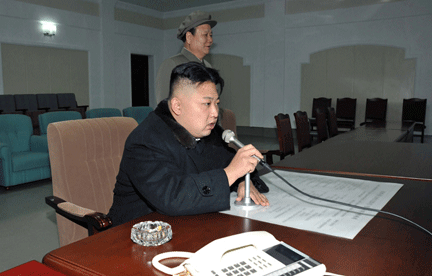 North Korea’s Kim Says No More War Thanks to Nuclear Weapons, VOA, By Reuters July 27, 2020 SEOUL, SOUTH KOREA – North Korean leader Kim Jong Un has said there will be no more war as the country’s nuclear weapons guarantee its safety and future despite unabated outside pressure and military threats, state media said Tuesday.
Kim made the remarks as he celebrated the 67th anniversary of the end of the 1950-53 Korean War, which fell on July 27, with a reception for veterans, the official KCNA news agency said.
The country developed nuclear weapons to win “absolute strength” to stave off another armed conflict, Kim said in a speech carried by KCNA, emphasizing the defensive nature of the programs. ………
The speech came amid stalled talks aimed at dismantling Pyongyang’s nuclear and missile programs in exchange for sanctions relief from Washington. ……https://www.voanews.com/east-asia-pacific/north-koreas-kim-says-no-more-war-thanks-nuclear-weapon
Plan for Scotland to be free of nuclear weapons
The National 26th July 2020, SCOTLAND could see the end of nuclear weapons on the Clyde within three
years of a Yes vote under radical new plans be put to the SNP annual
conference. A resolution is to be submitted to the event this October
setting out the time frame for the first time.
https://www.thenational.scot/news/18607658.snp-debate-three-year-timetable-axe-trident-yes-vote/
Union of Concerned Scientists, nuclear watchdogs and environmentalists push for elimination of funding for nuclear testing
|
Groups push to remove proposed funding for nuclear testing https://www.standard.net/news/groups-push-to-remove-proposed-funding-for-nuclear-testing/article_dc69a416-87e2-53cc-b7bd-3cc447ccd8da.html, By SUSAN MONTOYA BRYAN, Associated Press, Jul 25, 2020 ALBUQUERQUE, N.M. — Deep within a multibillion-dollar defense spending measure pending in Congress is an apology to New Mexico, Nevada, Utah and other states affected by radiation from nuclear testing over the decades.
But communities downwind from the first atomic test in the New Mexico desert on July 16, 1945, are still holding out for compensation for health effects that they say have been ongoing for generations due to fallout from the historic blast. So far, their pleas for Congress to extend and expand a federal radiation compensation program have gone unanswered. The program currently covers workers who became sick as a result of the radiation hazards of their jobs and those who lived downwind of the Nevada Test Site. Those excluded from the program include residents downwind of the Trinity Site in New Mexico, additional downwinders in Nevada, veterans who cleaned up radioactive waste in the Marshall Islands and others.
Tina Cordova, a cancer survivor and co-founder of the Tularosa Basin Downwinders Consortium, said the excuse always has been that the federal government doesn’t have enough money to take care of those affected. She said the need is even greater now since the coronavirus is disproportionately affecting those with underlying health conditions and downwinders fall into the category because of their compromised health “When you talk about enhancing plutonium pit production and defense spending in the trillions, you can’t tell us there’s not enough money to do this,” she told The Associated Press. “You can’t expect us to accept that any longer and that adds insult to injury. It’s as if we count for nothing.” U.S. Rep. Ben Ray Lujan, the New Mexico Democrat who advocated for the apology, continues to push for amendments to the radiation compensation program. His office recently convened a meeting among downwinders, uranium miners, tribal members, other advocates and staff in House Speaker Nancy Pelosi’s office. “The congressman believes that the need for medical and monetary compensation has never been more urgent,” said Monica Garcia, a spokeswoman for the congressman. The concerns of Cordova and other advocates are growing amid rumblings about reported discussions within the Trump administration about whether to conduct live nuclear weapons testing. The discussions come as the New START treaty between the U.S. and Russia nears expiration in 2021. Russia has offered to extend the nuclear arms control agreement while the Trump administration has pushed for a new pact that would also include China. While the U.S. House has adopted language that would prohibit spending to conduct or make preparations for any live nuclear weapons tests, a group of senators has included $10 million for such an effort in that chamber’s version of the bill. The Union of Concerned Scientists, nuclear watchdogs and environmentalists all are pushing for the funding to be eliminated. They sent letters this week in opposition and plan to lobby lawmakers. “A U.S. resumption of nuclear testing would set off an unpredictable and destabilizing international chain reaction that would undermine U.S. security,” reads one letter. Kevin Davis with the Union of Concerned Scientists’ global security program said resuming live testing would be unnecessary because the U.S. has been able to do sub-critical experiments and use its super computers along with data from past testing to run simulations on the nation’s nuclear stockpile. The last full-scale underground test was done Sept. 23, 1992, by scientists with Los Alamos National Laboratory at the Nevada Test Site northwest of Las Vegas. Less than two weeks later, then President George H.W. Bush signed legislation mandating a moratorium on U.S. underground nuclear testing. Democrat Rep. Ben McAdams of Utah is among those leading the effort to ban spending for testing. He said thousands of residents in his state are still dealing with trauma and illness as a result of previous testing. Dozens of groups also signed on to a letter sent to congressional leaders in May advocating for the expansion of the radiation compensation program. “We can’t continue to allow the government to walk away from their responsibility,” Cordova said. |
|
Does Iran Really Want to Build Nuclear Weapons at Any Cost? Maybe Not
Does Iran Really Want to Build Nuclear Weapons at Any Cost? Maybe Not
In the past it took nations three to 10 years to build nuclear bombs, yet 30 years since re-launching its nuclear program, Iran hasn’t assembled a bomb. It aspires to be on the threshold, Haaretz,Yossi Melman 26 Jul 20
July 13 marked the fifth anniversary of the nuclear accord between Iran and the major powers, which remains in effect until 2025. At about the same time, Iran experienced explosions and fires at missile sites, power stations, industrial plants and, most significantly, at the uranium enrichment plant in Natanz.
The blasts at several of the Natanz buildings were very powerful, badly damaging the advanced centrifuges. The sabotage has been attributed to a secret operation by Israeli intelligence, perhaps in tandem with American intelligence. Various reports say the damage to the centrifuges will delay their development and set back Iran’s nuclear program by about a year.
If the Mossad and Israeli Military Intelligence are responsible for the explosion as well as for other acts of sabotage and fires that may have originated in operations by underground organizations working with them, it is definitely an accomplishment for Israel. But it is a tactical, not a strategic, accomplishment.
Yet perhaps it’s time to change the concept that Iran aspires to assemble nuclear weapons at all costs. A glance at the history of nuclear weapons manufacture shows that all 11 countries that wished to build bombs did so within three to 10 years. These include the five major powers; Israel (according to foreign reports); India; Pakistan; and North Korea. Two countries, South Africa and Ukraine, voluntarily dismantled their nuclear weapons. It’s hard to work out why Iran, which has extensive scientific knowhow, which surreptitiously obtained nuclear technology and whose scientists and universities are high level, has not been able to build a bomb in 30 years.
Since President Donald Trump withdrew the United States from the accord in May 2018 (the other signatories all still adhere to it) and forcefully renewed the sanctions, Iran has made some measured counter-moves, such as resuming development of advanced centrifuges. These are disturbing violations, but Iran has not withdrawn from the accord and is not “breaking through” and rushing to a bomb.
While the international and economic pressure, as well as the covert campaign, against Iran should continue, we must also acknowledge that Iran wants to become a nuclear threshold state, and for now is still extremely mixed over whether to build a nuclear bomb. ,……..
And this Iranian uncertainty translates into a policy of walking on the brink: Staying a few months to a year away from building a nuclear bomb, but not actually assembling it.
Yet for Israel even a nuclear threshold is a nightmare and this is the reason why Israeli and U.S. intelligence will continue to try to sabotage Tehran’s program. https://www.haaretz.com/middle-east-news/iran/.premium-does-iran-really-want-to-build-nuclear-weapons-at-any-cost-maybe-not-1.9022348
Russian navy to get hypersonic nuclear weapons: Putin
Russian navy to get hypersonic nuclear weapons: Putin, Aljazeera, 26 July 20, The combination of speed and altitude of hypersonic missiles makes them difficult to track and intercept. Russian President Vladimir Putin has said the Russian navy will be armed with hypersonic nuclear weapons and underwater nuclear drones.
The weapons, some of which have yet to be deployed, include the Poseidon underwater nuclear drone, designed to be carried by submarines, and the Tsirkon (Zircon) hypersonic cruise missile, which can be deployed on surface ships.
The combination of speed, manoeuvrability, and altitude of hypersonic missiles, capable of travelling at more than five times the speed of sound, makes them difficult to track and intercept.
Putin, who said he does not want an arms race, has ften spoken of a new generation of Russian nuclear weapons he says are unequalled and can hit almost anywhere in the world. Some Western experts have questioned how advanced they are……..https://www.aljazeera.com/news/2020/07/russian-navy-hypersonic-nuclear-weapons-putin-200726160351237.htm
-
Archives
- October 2026 (104)
- September 2026 (339)
- August 2026 (330)
- July 2026 (355)
- June 2026 (287)
- May 2026 (306)
- April 2026 (356)
- March 2026 (251)
- February 2026 (267)
- January 2026 (308)
- December 2025 (358)
- November 2025 (359)
-
Categories
- 1
- 1 NUCLEAR ISSUES
- business and costs
- climate change
- culture and arts
- ENERGY
- environment
- health
- history
- indigenous issues
- Legal
- marketing of nuclear
- media
- opposition to nuclear
- PERSONAL STORIES
- politics
- politics international
- Religion and ethics
- safety
- secrets,lies and civil liberties
- spinbuster
- technology
- Uranium
- wastes
- weapons and war
- Women
- 2 WORLD
- ACTION
- AFRICA
- Atrocities
- AUSTRALIA
- Christina's notes
- Christina's themes
- culture and arts
- Events
- Fuk 2022
- Fuk 2023
- Fukushima 2017
- Fukushima 2018
- fukushima 2019
- Fukushima 2020
- Fukushima 2021
- general
- global warming
- Humour (God we need it)
- Nuclear
- RARE EARTHS
- Reference
- resources – print
- Resources -audiovicual
- Weekly Newsletter
- World
- World Nuclear
- YouTube
-
RSS
Entries RSS
Comments RSS

