Purpose of nuclear bombing of Nagasaki? to test a new weapon – an immoral purpose
 Harry Truman and the nuclear bombs dropped on Hiroshima and Nagasaki, Frank Jackson, 9 Aug 20 Whether the bombing of Hiroshima or the entry of the Soviet Union into the war was the crucial event in causing the Japanese surrender can never be conclusively settled (Hiroshima at 75: bitter row persists over US decision to drop the bomb, 5 August). However, very little is said about the motives for the second bomb, on Nagasaki three days later. Few argued that it was necessary to reinforce the message of Hiroshima. Rather, the military and scientific imperative was to test a different bomb design – “Fat Man”, an implosion type using plutonium, as opposed to the uranium of Hiroshima’s “Little Boy”. To my mind that, destroying a mainly civilian city for such reasons, makes it even more of a war crime, if that is possible, than the bombing of Hiroshim.a
Former co-chair, World Disarmament Campaign https://www.theguardian.com/world/2020/aug/07/harry-truman-and-the-nuclear-bombs-dropped-on-hiroshima-and-nagasaki
Nuclear bomb devastation killed ove 90% of the doctors and nurses in Hiroshima
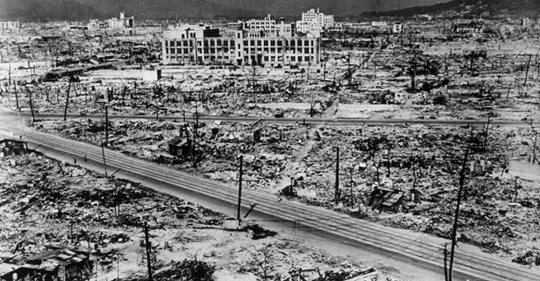
The horrific impact of the bomb was exacerbated by the fact that more than 90 percent of Hiroshima’s doctors and nurses were killed or injured by the bomb, while the blast left 42 out of 45 of the city’s civilian hospitals and two large army hospitals non-functional, according to the The International Campaign to Abolish Nuclear Weapons (ICAN).
This meant it was nearly impossible for the scores of injured to access aid, and most died without any care to ease their suffering from severe burns and radiation poisoning.
Before the attack Hiroshima had around 200 doctors, but the vast majority perished leaving only about 30 physicians who were able to perform their normal duties, according to a report created by the United States Strategic Bombing Survey.
Furthermore, more than 1,600 nurses out of nearly 1,800 were also killed, while medical stocks and supplies were also mostly destroyed.
Any hospitals within around 3,000 feet of ground zero were completely destroyed with almost everyone in them dying.
Two other large hospitals made from reinforced concrete that were located nearly 5,000 feet from the blast’s epicenter remained standing. However, the interiors suffered severe damage and around 90 percent of the occupants died, with many killed due to falling plaster, flying glass and fire.
Several medical centers that were located more than 7,000 feet away from ground zero also remained standing, although many were so badly damaged that they were not able to function.
The lack of medical facilities and staff only served to exacerbate the situation, as one eyewitness to the aftermath, Father Siemes, a German-born Jesuit professor who was in Hiroshima when the bomb fell, described, recounting the scene at an improvised first aid station.
“Iodine is applied to the wounds but they are left uncleansed. Neither ointment nor therapeutic agents are available. Those that have been brought in are laid on the floor and no one can give them any further care. What could one do when all means are lacking? Among the passersby, there are many who are uninjured,” he wrote.
“In the official aid stations and hospitals, a good third or half of those that had been brought in died. Everything was lacking, doctors, assistants, dressings, drugs, etcetera.”
Medical help had to be sent into the city from the outside, however, this took some time to arrive and several individuals who came to assist also ended up dying due to the high levels of lingering radiation.
On the 75th anniversary of the bombing, the International Physicians for the Prevention of Nuclear War (IPPNW), the only international medical organization dedicated to the abolition of nuclear weapons, told Newsweek that there can be “no useful medical response” to even a single nuclear attack on one city in their view.
“The infrastructure necessary would be destroyed and the personnel needed would be killed or badly wounded,” Chuck Johnson, IPPNW Director of Nuclear Programs, said. “Even a relatively small nuclear war would have atmospheric effects beyond the immediate blast, fire, and radiation, which could threaten billions of people with starvation due to crop failure. An all out nuclear war between the U.S. and Russia would end civilization and threaten to extinguish all human life.”
“We agree with President Reagan’s statement that ‘nuclear war can never be won and must never be fought,’ and are greatly concerned by the growing development of a new nuclear arms race among the nine nuclear weapons states.”
However, Johnson said the organization was “greatly encouraged” on the 75th anniversary of the first nuclear weapons attack on a human population, that three more nations—Nigeria, Ireland, and Niue—have become states parties to the UN Treaty on the Prohibition of Nuclear Weapons. This leaves only seven more states to submit ratification papers for the nuclear ban treaty to enter into force.”
“We look forward to the day when the UN declares that rogue nations which persist in developing and possessing nuclear weapons must listen to the world community and cease their activities which threaten all of us.”
Ways to get rid of nuclear weapons – ideas from Africa

Lessons from two pan-African giants on how to achieve genuine nuclear disarmament, The Conversation August 6, 2020 Joelien Pretorius, Associate Professor in Political Studies, University of the Western Cape “…………There are at least two traditions of African thought on nuclear weapons, traceable to their most vocal exponents: Kwame Nkrumah, the scholarly first president of independent Ghana, and Ali Mazrui, the renowned Kenyan scholar.
Both Nkrumah and Mazrui associated nuclear weapons with imperialism and racism, but proposed different approaches to address the problem they present. Nkrumah’s was an abolitionist non-violent approach. He argued for nuclear non-proliferation and disarmament and saw nuclear imperialism as the exploitation of smaller states and indigenous people and territory for nuclear tests and uranium mining.
Mazrui, on the other hand, argued for nuclear proliferation before nuclear disarmament could take place. His view was that the dominant policy towards nuclear weapons afforded some states the political privilege of having them, while denying this right to others. What he called nuclear imperialism.
Nkrumah’s approach arguably became the African approach to nuclear weapons. As a leading member of the Non Aligned Movement, Africa’s participation in the global nuclear order was directed through the organisation in the pursuit of nuclear disarmament. Closer to home, the achievement of an Africa Nuclear Free Zone treaty in 2009 was a direct outflow of Nkrumah’s approach.
Mazrui’s approach never had much official traction.
I argue that to end nuclear imperialism, African states have to reconcile Nkrumah’s and Mazrui’s approaches to nuclear weapons.
Reconciling the two approaches
Tackling nuclear imperialism would require African countries to sign up to the Treaty on the Prohibition of Nuclear Weapons, or the Ban Treaty, of 2017. This treaty is a first step toward eliminating the weapons themselves and the systems of control and exploitation they make possible. African states participated in the treaty process. More than 20 have signed the treaty and five have so far ratified it.
It would also require African states to withdraw from the Nuclear Non Proliferation Treaty. All African states are currently members of this treaty. But, after 50 years in existence, there is little hope that it will deliver genuine nuclear disarmament.
Reconciling Nkrumah’s idealism and Mazrui’s realism helps us see these treaties for what they are: the Ban Treaty is based on humanitarian concerns and the equality of states; the Non Proliferation Treaty legalises a few states’ nuclear hegemony indefinitely.
It is time for African states to lead in creating a new non-nuclear order.
Where both of them stood
An internationalist and pan-Africanist, Nkrumah saw abolition as the answer to nuclear weapons. He saw them as the “sword of Damocles” hanging over humanity. Embedded in the global peace movement of the time, he advocated for “positive action” – an outflow of Gandhiist non-violence. He attended and hosted several conferences with an anti-nuclear agenda, including an assembly in 1962 on the theme “A world without the bomb”.
Although many Africans lost faith in the value of non-violence and preferred a military solution to imperialism, Nkrumah’s approach to nuclear weapons did not fade. It was enmeshed with the position espoused by the Non Aligned Movement, and was the position adopted by the African National Congress in South Africa in 1994.
For his part, Mazrui believed African states should not pursue a nuclear weapon free zone and should leave the 1970 Nuclear Non Proliferation Treaty……
Mazrui saw the Non Proliferation Treaty as a trap that smacked of racism, where major powers got to say “such and such a weapon is not for Africans and children under 16”.
Mazrui was thus “advocating nuclear proliferation as the only realistic path to nuclear disarmament. This was a total inversion of the Western consensus.”
Wasted opportunities
The five nuclear powers have wasted many opportunities to negotiate the nuclear disarmament that the 50-year-old Non Proliferation Treaty binds them to. Instead, key nuclear arms control treaties have been discarded and all the nuclear weapon states are modernising their arsenals.
The treaty has also not stopped proliferation: four other states have since acquired nuclear weapons – Israel, India, Pakistan and North Korea.
Mazrui was right. In practice, the treaty is at most a status quo treaty that has come to legalise a small club being able to wield nuclear weapons – what India calls nuclear apartheid.
The treaty is not just about separating states into haves and have nots; it is also a stick to beat the have nots into submission.
In the Iraq War of 2003 the US used stopping nuclear proliferation as a false premise to justify making war on that country and is today doing the same to sanction Iran. States without nuclear weapons accepted the Non Proliferation Treaty in the hope that it would deliver a world without nuclear weapons, but that hasn’t happened and their patience is running out.
The efforts of the majority of states that went outside the Non Proliferation Treaty forum to negotiate the Treaty on the Prohibition of Nuclear Weapons three years ago, to make nuclear weapons illegal for all, without exception, need to succeed. The Ban Treaty will enter into force when 50 states have ratified it. The number currently stands at 40.
The Ban Treaty was only possible because of a broad international coalition emphasising the unacceptable humanitarian consequences of nuclear weapons.
To end nuclear imperialism, African states have to reconcile Nkrumah and Mazrui’s approaches by not only joining the Ban Treaty, but also withdrawing from the Non Proliferation Treaty. This will signal that African states will only take part as equals in global nuclear governance where these weapons are illegal for all. https://theconversation.com/lessons-from-two-pan-african-giants-on-how-to-achieve-genuine-nuclear-disarmament-144009
Australia’s ICAN and Conservation Council of Western Australia commemorate Hiroshima Day


On August 5th, people from across Australia gathered, via Zoom, to commemorate the nuclear bombing of Hiroshima, and to hear speakers from ICAN Autralia (International Campaign to Abolish Nucleat Weapons).
Medlissa Clarke spoke of the human effects of this catastrophe, and of the efforts over time, towards disarmament. The biggest leap forward in this has been, in 2017, the U.N. Treaty on the Prohibition of Nuclear Weapons. The Treaty now has over 200 nations signed up, with 40 ratifications – not far from the 50 required to make it international law.
Most Australians want a nuclear weapons free world.But Australia’s policy does endorse nuclear weapons. A future Labor government might change that.
Dimity Hawkins described the misery experienced by the Japanese, the agonising stories of the survivors. Since Hiroshima, the nuclear bombs developed are greatly stronger, and have been tested over many years, on the Marshall Islands, on Maralinga, South Australia, and on other Pacific Islands, in nuclear colonialism that has never properly been cleaned up. Australia is part of that nuclear chain. But now,the survivors are speaking out. Red Cross and Red Crescent, the world’s greatest non government emergency service is strongly behind the Treaty movement, and the indigenous people, particularly Australia’s Aboriginals .
Former Senator Scott Ludlam commemorated the Hibakusha, and the impact of the nuclear weapons industry on indigenous people world-wide. He drew attention to the ?proud statement of U.S. Strategic Command – that their nuclear weapons are to be used in a “safe, secure and lethal way”.
The Treaty was an Australian initiative, brought about by the work of, at first, a few, who by-passed official systems, and went out getting signatures, setting up ICAN, which became an international movement.-, – showing that people can do this, have an effect and an influence. As cities will be the places to bear the catastrophe of nuclear annihilation, many Mayors of many have City Councils have signed up to the Treaty. The Treaty shows that no-one can now claim that nuclear weapons are acceptable, in the same way as biological and chemical warfare are unacceptable.
For information on the continuing CCWA webinar series go to http://www.ccwa.org.au/yellowcake_country_webinar_series
Russia will regard any incoming missile as a nuclear attack
|
Russia warns it will see any incoming missile as nuclear VLADIMIR ISACHENKOV
MOSCOW (AP) 7 Aug 20, — Russia will perceive any ballistic missile launched at its territory as a nuclear attack that warrants a nuclear retaliation, the military warned in an article published Friday. The harsh warning in the official military newspaper Krasnaya Zvezda (Red Star) is directed at the United States, which has worked to develop long-range non-nuclear weapons. The article follows the publication in June of Russia’s nuclear deterrent policy that envisages the use of atomic weapons in response to what could be a conventional strike targeting the nation’s critical government and military infrastructure. In the Krasnaya Zvezda article, senior officers of the Russian military’s General Staff, Maj.-Gen. Andrei Sterlin and Col. Alexander Khryapin, noted that there will be no way to determine if an incoming ballistic missile is fitted with a nuclear or a conventional warhead, and so the military will see it as a nuclear attack. “Any attacking missile will be perceived as carrying a nuclear warhead,” the article said. “The information about the missile launch will be automatically relayed to the Russian military-political leadership, which will determine the scope of retaliatory action by nuclear forces depending on the evolving situation.”……….https://apnews.com/888e0816c6fa7f58b9ad4f1e97993643 |
|
|
What can a pandemic teach us about nuclear threats?
 What can a pandemic teach us about nuclear threats? Bulletin of the Atomic Scientists, By Ted Lieu, August 7, 2020 “……. Over 700,000 people worldwide have died from COVID-19, including over 160,000 in the United States. SARS-CoV-2 spread like wildfire in part due to global and domestic travel made far easier by technological progress. At the same time, failures in human institutions allowed the virus to escalate out of control in numerous places. What can a pandemic teach us about nuclear threats? Bulletin of the Atomic Scientists, By Ted Lieu, August 7, 2020 “……. Over 700,000 people worldwide have died from COVID-19, including over 160,000 in the United States. SARS-CoV-2 spread like wildfire in part due to global and domestic travel made far easier by technological progress. At the same time, failures in human institutions allowed the virus to escalate out of control in numerous places.
The lessons learned from this pandemic make the case for re-thinking the United States’ national security framework to decide which investments truly improve US national security and which seek to win yesterday’s wars. Who would have thought that the equipment needed to fight an enemy that has already killed far more Americans than died in World War I was not the Trident missile or B-1 Bomber, but face masks and ventilators? Or that the heroes risking their lives this year are health care workers and grocery store employees? The United States has already learned three important lessons from its failed pandemic response that should inform its nuclear strategy, so it doesn’t repeat similar mistakes in the future: investing in prevention is key; experts matter; and America needs to adjust to a new communications environment. Investing in catastrophe prevention. Until 2017, both Democratic and Republican administrations understood the importance of preventing a pandemic. Before leaving office, the Obama administration set up the White House National Security Council Directorate for Global Health Security and Biodefense. In 2005, President George Bush spoke at the National Institutes of Health and said, “If we wait for a pandemic to appear, it will be too late to prepare.” Indeed, one of the principal reasons for the existence of the Centers for Disease Control and Prevention, which was created in 1946, is “detecting and confronting new germs and diseases around the globe to increase our national security.” Unfortunately, the Trump administration eliminated the NSC Directorate for Global Health Security and Biodefense in 2018. The administration declined to renew funding for a federal pandemic detection program in 2019. The administration also proposed budget cuts to the CDC. And the Trump Administration ignored a step-by-step guide the Obama administration created on how to prevent a pandemic. … … the budgets under the Trump administration have prioritized military spending over all other instruments of national power. We can already destroy the world several times over with our nuclear and conventional weapons. It is time to invest in our other instruments of national power. Unfortunately, in the last few years, our diplomatic capacity has withered. As a member of the House Foreign Affairs Committee, I have seen how, under the Trump Administration, the US State Department has been gutted, as employees depart and positions go unfilled; morale has fallen; and several ambassadors and the Secretary of State have come under investigation for inappropriate or illegal behavior. We need to reverse course and re-invest in a large, professional, and ethical diplomatic corps. We have also seen an unfortunate shift towards go-it-alone US nuclear policy that expands the risk of miscalculation and escalation. Withdrawing from nuclear arms control treaties and expanding the capabilities of our nuclear arsenal are destabilizing. The Trump administration’s decisions to withdraw from Intermediate-Range Nuclear Forces (INF) Treaty last year, to announce its formal intent to withdraw from the Open Skies Treaty this year, and to lay the groundwork for allowing the New START Treaty to expire early next year all amount to a regressive policy that increases the chances of a nuclear conflict. Similarly, the Trump administration’s decision to produce new low-yield warheads increases the risk that nuclear weapons will be used. And the use of a low-yield nuclear weapon can easily escalate a conflict to an all-out nuclear war that cannot be won. That’s one reason I and other members of Congress introduced the bicameral “Hold the LYNE Act” to prohibit low-yield nuclear weapons for submarine-launched ballistic missiles. nstead of moving away from a prevention strategy, the United States needs to move toward one. Among the more obvious ways a catastrophic nuclear war could start is if a president launched a nuclear first strike. In October 2016, Sen. Ed Markey and I introduced the “Restricting First Use of Nuclear Weapons Act” to mitigate that possibility and to reassert the war making authority that the framers of the Constitution gave to Congress alone. The current nuclear launch approval process gives the president the sole authority to decide whether and when to launch a nuclear first strike. No member of the cabinet, the judiciary, or Congress is required to be involved in that decision. And once the President orders the launch, the execution of the order would occur frighteningly fast……….. The value of expertise. Another reason America leads the world in COVID-19 cases and deaths involves the failure of far too many people, including government officials, to listen to experts. ……. In many ways, this pandemic has taught us exactly what not to do in a nuclear-armed world where the Doomsday Clock says it is 100 seconds to midnight. We need to stop rejecting science,,……….https://thebulletin.org/2020/08/what-can-a-pandemic-teach-us-about-nuclear-threats/# |
|
Problems with Russia’s hype about “super weapons”- and risk of escalating war
|
The Hypersonic Hype and Russia’s Diminished Nuclear Threshold, Jamestown Foundation, Eurasia Daily Monitor Volume: 17 Issue: 116, By: Pavel Felgenhauer, August 6, 2020 President Vladimir Putin used the July 26, 2020, Navy Day and the Main Navy Parade in St. Petersburg to once again promote Russia’s “superweapons,” which will ostensibly give the Russian Military-Maritime Fleet (Voyenno-Morskoy Flot—VMF) “a unique advantage” over its Western counterparts. According to Putin, “The deployment of advanced technologies that have no equals in the world, including hypersonic strike systems and underwater drones, will increase naval combat capabilities” (Interfax, July 26). The Main Navy Parade displayed some 46 vessels. Smaller, satellite parades were also held in six other Russian naval base cities as well as at Russia’s foreign naval base in Tartus, Syria (Militarynews.ru, July 26).
The Ministry of Defense used the Navy Day festivities to announce that the nuclear-powered super-torpedo “Poseidon” is now in its final stages of development and will be soon tested using the specially designed nuclear submarine Belgorod—a modified Oscar II–class cruise missile submarine……… Together with the Poseidon, Russia’s president has been touting the Zircon hypersonic missile, which is also reportedly in its final stages of development. The Zircon, according to Putin, can fly at speeds exceeding Mach 9, with a range of up to 1,000 kilometers. …… The Zircon has been in development since the 1970s and 1980s. It is apparently a weapon specifically designed to strike US carriers or other large, high-value seaborne assets. Aiming the hypersonic missile at land targets would be impractical since its radar is apparently only able to distinguish large-contrast targets on the open sea. ……. its chances of hitting a moving ship directly seem to be remote—a carrier would have moved a mile or two away while the Russian hypersonic missile blindly traverses its distance to the original target (Vpk-news, March 24). The extended-range Zircon thus makes sense only as a nuclear weapon with a 200+ kiloton warhead—an underwater massive nuclear explosion would disable a carrier with shockwave even from a mile or two away. The Russian VMF had not received a new destroyer in 30 years, and it is presently struggling to build frigates like the Gorshkov because Ukraine stopped selling it frigate engines after 2014…….. The main problem with Putin’s superweapons is that they are truly doomsday devices, valuable only for deterrence. The Kremlin is constantly plying the deterrence game by trying to scare the West. But this situation has two dangerous ramifications. First, the nuclear threshold is becoming lower: in any serious skirmish, the Russian navy would either need to go nuclear or risk being sunk. And second, while the Russian leadership believes it has surpassed the West militarily thanks to its dazzling superweapons, Moscow’s threshold for employing military force in conflict situations may also drop further. https://jamestown.org/program/the-hypersonic-hype-and-russias-diminished-nuclear-threshold/ |
|
Another Hiroshima is Coming…Unless We Stop It Now
Today, an unprecedented campaign of propaganda is shooing us all off like rabbits. We are not meant to question the daily torrent of anti-Chinese rhetoric, which is rapidly overtaking the torrent of anti-Russia rhetoric. Anything Chinese is bad, anathema, a threat: Wuhan …. Huawei. How confusing it is when “our” most reviled leader says so.
The target is China. Today, more than 400 American military bases almost encircle China with missiles, bombers, warships and nuclear weapons. From Australia north through the Pacific to South-East Asia, Japan and Korea and across Eurasia to Afghanistan and India, the bases form, as one US strategist told me, “the perfect noose”.
In the Sydney Morning Herald, tireless China-basher Peter Hartcher described those who spread Chinese influence in Australia as “rats, flies, mosquitoes and sparrows”. Hartcher, who favourably quotes the American demagogue Steve Bannon, likes to interpret the “dreams” of the current Chinese elite, to which he is apparently privy. These are inspired by yearnings for the “Mandate of Heaven” of 2,000 years ago. Ad nausea.
To combat this “mandate”, the Australian government of Scott Morrison has committed one of the most secure countries on earth, whose major trading partner is China, to hundreds of billions of dollars’ worth of American missiles that can be fired at China.
At a quarter past eight on the morning of August 6, 1945, she and her silhouette were burned into the granite.
I stared at the shadow for an hour or more, then I walked down to the river where the survivors still lived in shanties.
I met a man called Yukio, whose chest was etched with the pattern of the shirt he was wearing when the atomic bomb was dropped.
He described a huge flash over the city, “a bluish light, something like an electrical short”, after which wind blew like a tornado and black rain fell. “I was thrown on the ground and noticed only the stalks of my flowers were left. Everything was still and quiet, and when I got up, there were people naked, not saying anything. Some of them had no skin or hair. I was certain I was dead.”
Nine years later, I returned to look for him and he was dead from leukaemia.
“No radioactivity in Hiroshima ruin” said The New York Times front page on 13 September, 1945, a classic of planted disinformation. “General Farrell,” reported William H. Lawrence, “denied categorically that [the atomic bomb] produced a dangerous, lingering radioactivity.”
Only one reporter, Wilfred Burchett, an Australian, had braved the perilous journey to Hiroshima in the immediate aftermath of the atomic bombing, in defiance of the Allied occupation authorities, which controlled the “press pack”.
“I write this as a warning to the world,” reported Burchett in the London Daily Express of September 5,1945. Sitting in the rubble with his Baby Hermes typewriter, he described hospital wards filled with people with no visible injuries who were dying from what he called “an atomic plague”.
For this, his press accreditation was withdrawn, he was pilloried and smeared. His witness to the truth was never forgiven.
The atomic bombing of Hiroshima and Nagasaki was an act of premeditated mass murder that unleashed a weapon of intrinsic criminality. It was justified by lies that form the bedrock of America’s war propaganda in the 21st century, casting a new enemy, and target – China.
During the 75 years since Hiroshima, the most enduring lie is that the atomic bomb was dropped to end the war in the Pacific and to save lives.
“Even without the atomic bombing attacks,” concluded the United States Strategic Bombing Survey of 1946, “air supremacy over Japan could have exerted sufficient pressure to bring about unconditional surrender and obviate the need for invasion. “Based on a detailed investigation of all the facts, and supported by the testimony of the surviving Japanese leaders involved, it is the Survey’s opinion that … Japan would have surrendered even if the atomic bombs had not been dropped, even if Russia had not entered the war [against Japan] and even if no invasion had been planned or contemplated.”
The National Archives in Washington contains documented Japanese peace overtures as early as 1943. None was pursued. A cable sent on May 5, 1945 by the German ambassador in Tokyo and intercepted by the US made clear the Japanese were desperate to sue for peace, including “capitulation even if the terms were hard”. Nothing was done.
The US Secretary of War, Henry Stimson, told President Truman he was “fearful” that the US Air Force would have Japan so “bombed out” that the new weapon would not be able “to show its strength”. Stimson later admitted that “no effort was made, and none was seriously considered, to achieve surrender merely in order not to have to use the [atomic] bomb”.
Stimson’s foreign policy colleagues — looking ahead to the post-war era they were then shaping “in our image”, as Cold War planner George Kennan famously put it — made clear they were eager “to browbeat the Russians with the [atomic] bomb held rather ostentatiously on our hip”. General Leslie Groves, director of the Manhattan Project that made the atomic bomb, testified: “There was never any illusion on my part that Russia was our enemy, and that the project was conducted on that basis.”
The day after Hiroshima was obliterated, President Harry Truman voiced his satisfaction with the “overwhelming success” of “the experiment”.
The “experiment” continued long after the war was over. Between 1946 and 1958, the United States exploded 67 nuclear bombs in the Marshall Islands in the Pacific: the equivalent of more than one Hiroshima every day for 12 years. Continue reading
Hiroshima survivor Koko Kondo met the man who dropped that atomic bomb
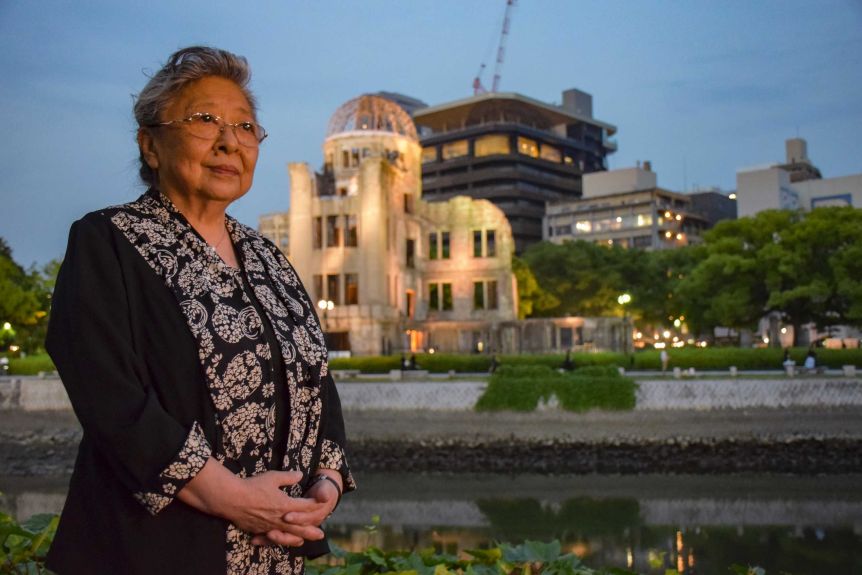
Hiroshima’s atomic bomb changed Koko Kondo’s life, but so did meeting the man who dropped it, ABC News,By Tracey Shelton, 6 August, 20, Eight-month-old Koko was in her mother’s arms the day the world’s first nuclear weapon was dropped on Hiroshima, bringing their family home crashing down on them on this day 75 years ago.
Key points:
Between 90,000 and 166,000 victims died within months of the Hiroshima bombing
Koko Kondo met pilot Robert Lewis on the set of This is Your Life
More than 150 denshosha volunteers are carrying on the memories of survivors
She was almost 40 years old before her mother finally sat her down and told her the full story of how she had inched through the rubble in darkness, with little Koko wrapped in her arms, towards a small pocket of dusty sunlight.
“She first pushed me out [through the opening], then next, she was able to get out … but the fire was all over the place according to my mother,” said Koko Kondo, who is now 75.
Ms Kondo’s father — Methodist minister Kiyoshi Tanimoto, who was visiting a parishioner across town — said in a US television interview “the whole city was on fire” as he ran through the streets to find his family.
He described people running in silence with skin hanging from their bodies “like a procession of ghosts”
In the sky above, pilot Robert Lewis was part of the United States Air Force crew who dropped the atomic bomb known as Little Boy that day, unleashing around 13 kilotons of force on the city below, where Ms Kondo’s family and about 290,000 other civilians lived, according to the Atomic Heritage Foundation.
Estimates on how many people died from the bomb either instantly or in the following months range between 90,000 and 166,000, but the Little Boy would go on to claim the lives of thousands more as the effects of radiation took their toll.
After looking back to see the once-flourishing city “disappear”, Captain Lewis wrote in his log book “My God, what have we done?”…….
While Ms Kondo said most people avoided speaking of the bombing in the decades that followed, her father made it his mission to help the injured, rebuild the city and ensure the world never forgot.
Her family had suffered from radiation sickness and Ms Kondo was subjected to years of tests and examinations to study the effects of radiation exposure.
One of Ms Kondo’s earliest memories — at around two or three years old — was of a group of teenage girls attending a sermon at her father’s church.
“Some girls could not close their eyes. Some girls — their lips were all melted with their chins so they could not close [their mouths],” she told the ABC.
While her manners did not permit her to ask questions, she would listen to her parents’ conversations and learned that the destruction and pain that surrounded her was caused by a single US B-29 bomber.
Ms Kondo said her childhood became consumed by hatred and thoughts of revenge.
“Someday when I grow up, I am definitely going to find the people who were on that B-29 bomber to do the revenge,” she said.
“That was my plan, that was my thinking. But life is interesting.”
When Koko was 10, her mother and siblings received a phone call from the then popular US television program This is Your Life.
They were immediately flown to the United States for an episode featuring the work of her father, who had taken a group of young survivors to the US for plastic surgery……
As Hiroshima mission pilot Robert Lewis was introduced, Koko glared at him with all the hatred a 10-year-old could muster.
“I was so shocked!” she recalled.
“What could I do? I wanted to run to the middle of the stage and give him a punch, a bite or a kick.”
But as he recalled his memories of that day, she saw tears begin to well in his eyes.
“I thought he was a monster, but monsters don’t have tears.”
Ms Kondo said she realised she had lived her short life full of hate for a man she knew nothing about……..
the life of this man was not easy, she said, and he “suffered greatly” not only with the weight of his involvement in the bombing, but he was also “harassed” for speaking about it publicly.at 75, she is among the youngest of a dwindling number of survivors who can tell the world first hand of the horrors these weapons unleashed……….
“My concern is today nuclear weapons are much, much stronger. We have to abolish them now,” urged Ms Kondo. ….
If these stories were lost, “probably our planet would be gone”, she said.
Doctoral candidate Tomoko Kubota is one of more than 150 denshosha — a designated keeper of the memories of a Hiroshima or Nagasaki survivor.
As a denshosha volunteer, she spent three years training and learning from survivor Sadae Kasaoka, so in the future she can “give testimony” on her behalf by sharing her “experiences, the reality of the atomic bombing, and desires for peace”.
That story includes how, at 12 years of age, Ms Kasaoka lost her mother and watched her father die — within days of the blast — in agony from horrific burns and wounds that became infested with maggots.
For other survivors, the memories were too painful to talk about, Ms Kasaoka said, while discrimination against those who did speak out had silenced many over the years…………. https://www.abc.net.au/news/2020-08-06/atomic-bomb-survivors-75-years-after-hiroshima-nuclear-attack/12501636
Russia plans removal of its nuclear trash from Arctic waters
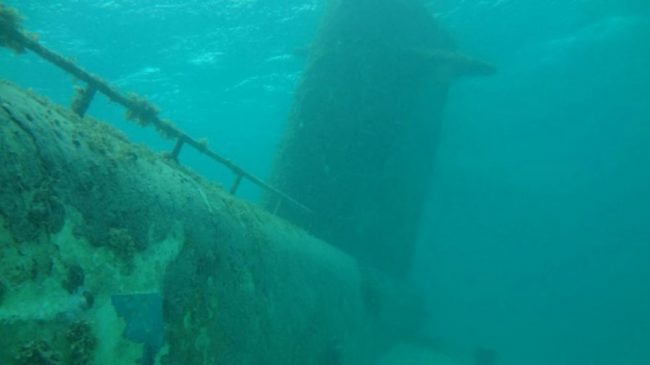
Russia to Remove Hazardous Nuclear Objects Dumped in Its Arctic Waters,
The country’s nuclear energy company will over the next eight years lift two submarines and four reactor compartments from the bottom of the Barents and Kara Seas. By The Barents Observer 5 Aug 20, Russia’s state nuclear agency plans to remove several nuclear objects from the depths of Russia’s Arctic waters in an effort to reduce environmental hazards, Rosatom said this week as it presented a clean-up plan for the region.
Russia’s state nuclear agency plans to remove several nuclear objects from the depths of Russia’s Arctic waters in an effort to reduce environmental hazards, Rosatom said this week as it presented a clean-up plan for the region.
From the late 1960s to the late 1980s, about 18,000 radioactive objects were dumped into Russia’s remote northern waters. Most of them present little environmental risk. But some are increasingly seen as a hazard to Arctic ecosystems.
“Rosatom over the next eight years intends to lift from the bottom of Russia’s Arctic waters six objects that are most dangerous in terms of radioactive pollution,” the company’s spokesperson told the state-run TASS news agency.
The company plans to lift the reactors from the K-11, K-19 and K-140 submarines as well as spent nuclear fuel from the reactor that served the Lenin icebreaker.
In addition, two entire submarines will be lifted: the K-27 from the Kara Sea and K-159 from the Barents Sea. While the former was deliberately dumped by Soviet authorities in 1982, the latter sank during a towing operation in 2003.
The K-27 is located in 33-meter depths east of the Novaya Zemlya archipelago. It has been described by experts as a potential radioactive “time bomb.” The K-159 is located in 200-meter depths off the coast of the Kola Peninsula.
These six objects represent more than 90% of radioactive sources dumped at sea, Rosatom said………
Lifting the six hazardous nuclear objects will not only be technically difficult, but also very expensive.
A recent report made for Rosatom and the European Commission estimated the costs of lifting these six objects at 278 million euros. That includes the cost of bringing them safely to a yard for decommissioning and long-term storage.
Lifting the K-159 alone is estimated to cost 57.5 million euros. Lifting the K-27 and transporting it to a shipyard for decommissioning and long-term storage in Saida Bay will carry a price tag of 47.7 million euros, the report said.
It’s unlikely that Russia’s increasingly cash-strapped treasury will have the 278 million euros needed for the cleanup.
Several countries have previously allocated billions to assist Russia’s post-Soviet efforts to cope with nuclear waste.
Norway has since the mid-90s granted about 1.5 billion kroner (140 million euros) to nuclear safety projects in the Russian part of the Barents region. https://www.themoscowtimes.com/2020/08/05/russia-to-remove-hazardous-nuclear-objects-dumped-in-its-arctic-waters-a71060
Vatican signed up to the U.N. Nuclear Weapons Ban Treaty, provides moral guidance
 75 years after Hiroshima and Nagasaki, the Vatican is providing moral guidance on nuclear weapons The Conversation, Drew Christiansen,Distinguished Professor of Ethics and Human Development, Georgetown University, Carole Sargent
At a solemn event at the Hiroshima Peace Park in November 2019, Francis declared the use of atomic energy for war to be “a crime not only against the dignity of human beings but against any possible future for our common home.” “How,” he asked, “can we speak of peace even as we build terrifying new weapons of war?”
His comments came nearly 40 years after John Paul II became the first pope to visit the site of the atomic bomb attacks, which pulverized the two cities on Aug. 6 and 9, 1945 and killed in excess of 200,000 in the process.
Deterrence to abolition
During his visit, Francis reiterated what he previously told assembled Nobel Peace Prize laureates, diplomats and civil society representatives at a Vatican symposium in 2017, that nuclear weapons, along with chemical weapons and landmines, were impermissible. “The threat of their use, as well as their very possession, is to be firmly condemned,” he said…………
In 2017, the Holy See became one of the first signers of the U.N. Treaty on the Prohibition of Nuclear Weapons. Article 1 prohibits signers to “develop, test, produce, manufacture, otherwise acquire, possess or stockpile nuclear weapons…” This was the backdrop for Pope Francis’ historic condemnation of deterrence and call for disarmament later that fall.
One hundred and twenty-two nations voted for the Treaty on the Prohibition of Nuclear Weapons. For its labors on behalf of the treaty, ICAN, the International Campaign Against Nuclear Weapons, an umbrella group of civil society opponents of nuclear weapons, won the 2017 Nobel Peace Prize.
Beyond the hierarchy
But the guidance provided by the Catholic Church is not simply through official statements and positions from the top.
Across the church, various groups have long campaigned for abolition of nuclear weapons. Catholic nuns have often been at the forefront of this work. In Japan, several activist hibakusha – survivors of Hiroshima and Nagasaki – are sisters of Notre Dame de Namur and the Society of the Helper of Holy Souls, among other congregations.
In the U.S., Sister Jennifer Kane was a nuclear engineer before realizing, in the words of her congregation in 2019, “that God was calling her to a more spiritual combat” as an antinuclear activist.
And Dominicans, Religious of the Sacred Heart, and Society of the Holy Child Jesus have participated in the grassroots anti-nuclear direct-action movement Plowshares, at times resulting in prison time for activist nuns……….
Courage of conscience
Church teaching demands that conscientious officials and nuclear workers resist orders they deem to be immoral.
The Second Vatican Council of the early 1960s taught that obeying orders is no excuse for participating in atrocities, and urged anyone, whether top military leader or rank-and-file citizen, to display “the courage of those who openly and fearlessly resist.”
Indeed, in 2018 two chiefs of the U.S. Strategic Air Command testified in a Senate hearing that they would not comply with illegal orders to deploy nuclear weapons, and that they would offer civilian authorities alternative courses of action to pursue. …….https://theconversation.com/75-years-after-hiroshima-and-nagasaki-the-vatican-is-providing-moral-guidance-on-nuclear-weapons-140615
The illusion that nuclear weapons are under control
T aking nuclear vulnerabilities seriously, The Hindu, M.V. Ramana, Benoît Pelopidas, 5 Aug 20,
All nuclear weapon states have admitted to the possibility that deterrence could fail
Seventy-five years ago, the Japanese city of Hiroshima was destroyed by one single atomic bomb. Three days later, a second bomb destroyed Nagasaki. Those two bombs killed over 2,00,000 people, some of them instantaneously, and others within five months. Another 2,00,000 people or more who survived the bombings of these two cities, most of them injured, have been called the hibakusha. Because of the long-lasting effects of radiation exposure as well as the mental trauma they underwent, the plight of these survivors has been difficult. As Akihiro Takahashi, a hibakusha, testified: “I’ve been living on dragging my body full of sickness and from time to time I question myself. I wonder if it is worth living in such hardship and pain.” But Takahashi and other hibakusha lived on and talked about their experiences in the hope that their plight would never befall anyone…else
Damage and vulnerability
Over 1,26,000 nuclear weapons have been built since the beginning of the atomic age. Over 2,000 of them have been used in nuclear tests, above and below the ground, to demonstrate their explosive power, causing grave and long-lasting damage to the environment and public health. But this damage is nothing compared to what might happen if some of the existing weapons are used against civilian populations……..
To appreciate why we are vulnerable, we should start by realising that there is no realistic way to protect ourselves against nuclear weapons, whether they are used deliberately, inadvertently, or accidentally. The invention of ballistic missiles at the end of the 1950s, with their great speed of delivery, has made it impossible to intercept nuclear weapons once they are launched. Neither fallout shelters nor ballistic missile defence systems have succeeded in negating this vulnerability. Nuclear weapon states are targets of other nuclear weapon states, of course, but non-nuclear weapon states are vulnerable as well.
The problems of deterrence
……. Deterrence enthusiasts claim that nuclear weapons do not just protect countries against use of nuclear weapons by others, but even prevent war and promote stability. These claims do not hold up to evidence. Nuclear threats have not always produced fear and, in turn, fear has not always induced caution. To the contrary, nuclear threats in some cases have produced anger, and anger can trigger a drive to escalate, as was the case with Fidel Castro during the Cuban Missile Crisis.
After years of having the top operational responsibility for all U.S. strategic nuclear forces, General Lee Butler, former Commander-in-Chief of the United States Strategic Command. observed: “The goal — the wish, really — might be to prevent nuclear war, but the operational plan had to be to wage war.” It is thus an illusion to think that nuclear war is impossible.
The illusion of control
A related illusion concerns the controllability of nuclear weapons. In the real world, it is not possible for planners to have complete control. However, the desire to believe in the perfect controllability and safety of nuclear weapons creates overconfidence, which is dangerous. Overconfidence, as many scholars studying safety will testify, is more likely to lead to accidents and possibly to the use of nuclear weapons.
In several historical instances, what prevented the use of nuclear weapons was not control practices but either their failure or factors outside institutional control. The most famous of these cases is the 1962 Cuban Missile Crisis. There are likely many more cases during which the world came close to nuclear war but because of the secrecy that surrounds nuclear weapons, we might never know.
If deterrence has not prevented nuclear war so far, what has? While a comprehensive answer to this question will necessarily involve diverse and contingent factors, one essential element in key episodes is just plain luck. This is, again, best illustrated by the case of the Cuban Missile Crisis, where nearly four decades of scholarship attest to the crucial role of luck. The consequences of bad luck, then or later, could make the COVID-19 pandemic seem benign by comparison.
While humanity has luckily survived 75 years without experiencing nuclear war, can one expect luck to last indefinitely?
Hosting nuclear weapons is a danger to Germany
Nuclear bomb in Germany would kill hundreds of thousands, Greenpeace warns, euronews, By Alice Tidey 05/08/2020 – A nuclear bomb detonating in Germany would instantly kill hundreds of thousands of people, Greenpeace has said, calling on the US to withdraw the small arsenal of atomic weapons it currently has in the country.
The environmental non-profit released a study it had commissioned simulating the impact of a nuclear weapon exploding in Germany on the eve of the 75th anniversary of the Hiroshima bombing.
“The Federal Government must ensure that US atomic bombs are withdrawn from Buchel with the US soldiers,” he added.
Washington announced last week that it would start withdrawing nearly 12,000 of the 36,000 US troops currently stationed in Germany over the coming weeks.
A threat to Germany’s security
Greenpeace’s NUKEMAP study calculated the impact of various strengths of nuclear bombs in several locations: Berlin, the seat of the country’s political power; Frankfurt, the country’s financial centre; and Buchel, a municipality in south-west Germany where several US atomic bombs are stored at an airbase.
The strength of an atomic bomb is measured in kilotons (kt) and megatons (mt) which means that a nuclear weapon with a detonation energy of one kiloton generates the same amount of energy as 1,000 tons (1 Kt) of TNT.
NUKEMAP found that a 20 kt bomb exploding in Berlin would instantly kill 145,000 people, with an additional 120,000 dying from the radioactive fallout and a further 50,000 passing away from cancer.
A 550 kt bomb — commonly found in Russia’s nuclear arsenal — dropped over Frankfurt would instantly kill half a million people, while 300,000 more would die from radioactive fallout and 160,000 would succumb to cancer at a later date.
Von Lieven argued that “the bombs in Buchel threaten the security of people in Germany and Eastern Europe.”
“Germany must no longer be a potential aggressor and a possible target for a nuclear attack,” he went on.
In another Greenpeace study conducted by pollster Kantar and released last month, 83 per cent of the 1,008 German respondents said they favoured the US withdrawing the bombs kept in Buchel.
Nine countries, 13,800 warheads
Between 90,000 and 160,000 people are believed to have died int he first few months following the Hiroshima bombing, according to the Centre for Nuclear Studies at Columbia University. Another 60,000 to 80,000 are thought to have died in Nagasaki.
Most figures are best estimates as the devastation unleashed by the explosions and uncertainty over the actual population before the bombings make it difficult to have an accurate estimate.
The world’s arsenal of nuclear weapons was estimated at 13,865 at the beginning of 2019 by the Stockholm International Peace Research Institute (SIPRI).
Only nice countries have atomic warheads. These are China, France, India, Israel, North Korea, Pakistan, Russia, the UK, the US. Washington and Moscow each have more than 6,000 nuclear warheads.
Between 90,000 and 160,000 people are believed to have died int he first few months following the Hiroshima bombing, according to the Centre for Nuclear Studies at Columbia University. Another 60,000 to 80,000 are thought to have died in Nagasaki.
Most figures are best estimates as the devastation unleashed by the explosions and uncertainty over the actual population before the bombings make it difficult to have an accurate estimate.
The world’s arsenal of nuclear weapons was estimated at 13,865 at the beginning of 2019 by the Stockholm International Peace Research Institute (SIPRI). https://www.euronews.com/2020/08/05/nuclear-bomb-in-germany-would-kill-hundreds-of-thousands-greenpeace-warns
Grim financial news for weapons maker Magnox/Babcock
Times 5th Aug 2020, One of Britain’s main defence contractors has delivered more grim news
for investors after axing its dividend for last year. Babcock said that it
was cancelling the payout for the financial year that ended in March in an
attempt to preserve cash.
In June the company suspended the final dividend
until it had “greater certainty” on the impact of the pandemic.
Yesterday it laid bare the cost of the Covid-19 slump, revealing that
underlying revenues in the three months to the end of June had fallen by 11
per cent.
Underlying operating profit for the first quarter fell by 40 per
cent from last year’s level. Babcock attributed half of the lost profits
to a slide in productivity as the coronavirus outbreak forced it to change
working practices. The remainder was down to the loss of a contract with
Britain’s Nuclear Decommissioning Authority to clean up 12 Magnox reactor
sites and weakness in South Africa and at its land division. Shares in
Babcock fell by 29p, or 10 per cent, to 260p last night.
https://www.thetimes.co.uk/edition/business/dividend-sunk-by-babcocks-profit-woes-dz6qc872f
Racism in nuclear bomb testing, bombing of Japanese people, and nuclear waste dumping

Langston Hughes voiced the opinion that until racial injustice on home ground in the United States ceases, “it is going to be very hard for some Americans not to think the easiest way to settle the problems of Asia is simply dropping an atom bomb on colored heads there.”[25] While his statement was made in 1953, near the eighth anniversary of the Hiroshima and Nagasaki bombings, it remains equally relevant today, as we approach the 75th anniversary
Memorial Days: the racial underpinnings of the Hiroshima and Nagasaki bombings , Bulletin of the Atomic Scientists, Elaine Scarry, Elaine Scarry is the author of Thermonuclear Monarchy: Choosing between Democracy and Doom and The Body in Pain: the Making and Unmaking of the World. She is Cabot Profess… By Elaine Scarry, August 3, 2020
This past Memorial Day, a Minneapolis police officer knelt on the throat of an African-American, George Floyd, for 8 minutes and 46 seconds. Seventy-five years ago, an American pilot dropped an atomic bomb on the civilian population of Hiroshima. Worlds apart in time, space, and scale, the two events share three key features. Each was an act of state violence. Each was an act carried out against a defenseless opponent. Each was an act of naked racism. ……….
Self-defense was not an option for any one of the 300,000 civilian inhabitants of the city of Hiroshima, nor for any one of the 250,000 civilians in Nagasaki three days later. We know from John Hersey’s classic Hiroshima that as day dawned on that August morning, the city was full of courageous undertakings meant to increase the town’s collective capacity for self-defense against conventional warfare, such as the clearing of fire lanes by hundreds of young school girls, many of whom would instantly vanish in the 6,000° C temperature of the initial flash, and others of whom, more distant from the center, would retain their lives but lose their faces.[2] The bombing of Hiroshima and Nagasaki initiated an era in which—for the first time on Earth and now continuing for seven and a half decades—humankind collectively and summarily lost the right self-defense. No one on Earth—or almost no one on Earth[3]—has the means to outlive a blast that is four times the heat of the sun or withstand the hurricane winds and raging fires that follow………
Centuries of political philosophers have asked, “What kind of political arrangements will create a noble and generous people?” Surely such arrangements cannot be ones where a handful of men control the means for destroying at will everyone on Earth from whom the means of self-defense have been eliminated……..
When Americans first learned that the people of Hiroshima and Nagasaki had been collectively vaporized in less time than it takes for the heart to beat, many cheered. But not all. Black poet Langston Hughes at once recognized the moral depravity of executing 100,000 people and discerned racism as the phenomenon that had licensed the depravity: “How come we did not try them [atomic bombs] on Germany… . They just did not want to use them on white folks.”[4] Although the building of the weapon was completed only after Germany surrendered on May 7, 1945, Japan had been designated the target on September 18, 1944, and training for the mission had already been initiated in that same month.[5] Black journalist George Schuyler wrote: “The atom bomb puts the Anglo-Saxons definitely on top where they will remain for decades”; the country, in its “racial arrogance,” has “achieved the supreme triumph of being able to slaughter whole cities at a time.”[6]
Still within the first year (and still before John Hersey had begun to awaken Americans to the horrible aversiveness of the injuries), novelist and anthropologist Zora Neale Hurston denounced the US president as a “butcher” and scorned the public’s silent compliance, asking, “Is it that we are so devoted to a ‘good Massa’ that we feel we ought not to even protest such crimes?”[7] Silence—whether practiced by whites or people of color—was, she saw, a cowardly act of moral enslavement to a white supremacist. Continue reading
-
Archives
- October 2026 (104)
- September 2026 (339)
- August 2026 (330)
- July 2026 (355)
- June 2026 (287)
- May 2026 (306)
- April 2026 (356)
- March 2026 (251)
- February 2026 (267)
- January 2026 (308)
- December 2025 (358)
- November 2025 (359)
-
Categories
- 1
- 1 NUCLEAR ISSUES
- business and costs
- climate change
- culture and arts
- ENERGY
- environment
- health
- history
- indigenous issues
- Legal
- marketing of nuclear
- media
- opposition to nuclear
- PERSONAL STORIES
- politics
- politics international
- Religion and ethics
- safety
- secrets,lies and civil liberties
- spinbuster
- technology
- Uranium
- wastes
- weapons and war
- Women
- 2 WORLD
- ACTION
- AFRICA
- Atrocities
- AUSTRALIA
- Christina's notes
- Christina's themes
- culture and arts
- Events
- Fuk 2022
- Fuk 2023
- Fukushima 2017
- Fukushima 2018
- fukushima 2019
- Fukushima 2020
- Fukushima 2021
- general
- global warming
- Humour (God we need it)
- Nuclear
- RARE EARTHS
- Reference
- resources – print
- Resources -audiovicual
- Weekly Newsletter
- World
- World Nuclear
- YouTube
-
RSS
Entries RSS
Comments RSS

