Putin’s proposal for 12 month renewal of NewSTART arms control treaty is rejected by USA
US rejects Putin’s proposal on nuclear disarmament treaty as ‘nonstarter’ American Military News, 18 Oct 20, The United States says Russian President Vladimir Putin’s proposal to extend the New START nuclear disarmament treaty without freezing nuclear warheads is a “nonstarter.”
Putin proposed extending the bilateral treaty for one year without preconditions to keep it from expiring and to allow talks to revive it to continue.
Putin also instructed Foreign Minister Sergei Lavrov at a meeting with permanent members of Russia’s Security Council on October 16 to work out Russia’s position on New START and inform the United States of developments.
The issue of the New START treaty comes less than three weeks before the U.S. presidential election.
Democratic challenger Joe Biden supports extending New START “to use that as a foundation for new arms-control arrangements.” If Biden wins, the treaty will expire just weeks after he is inaugurated.
Biden calls the treaty — which was negotiated when he was vice president under President Barack Obama — an “anchor of strategic stability between the United States and Russia.”……..
On October 13, more than 75 lawmakers across Europe called on the United States to extend New START before its expiration.
Elimination of nuclear weapons is vital to the “survival of life on this planet”
Secretary-General António Guterres told delegates gathered to commemorate the International Day for the Total Elimination of Nuclear Weapons, it was the only way “to completely eliminate nuclear risk.”
And although nuclear disarmament has been a UN priority since its founding 75 years ago, he reminded the plenary meeting that “the world continues to live in the shadow of nuclear catastrophe”.
For security’s sake
Progress towards the total elimination of nuclear weapons has “stalled and is at risk of backsliding”, the UN chief warned.
Against the backdrop of growing distrust and tension between Nuclear Weapon States (NWS) – and programmes that modernize arsenals for faster, stealthier and more accurate weapons, with costs Mr. Guterres called “simply staggering” – he said, pointedly, that the only treaty restricting the size of the world’s largest nuclear arsenals is set to expire early next year – threatening a return to “unconstrained strategic competition”.
“For the sake of all of our security, the world must return to a common path towards nuclear disarmament”, he underscored, adding that it is “imperative” for Russia and the United States to extend, “without delay”, the new Strategic Arms Reduction Treaty (START) for the maximum duration of five years.
Among other things, START calls for halving the number of strategic nuclear missile launchers and establishing a new inspection and verification regime within seven years from the date the treaty enters into force.
The Secretary-General upheld that NWS “have a responsibility to lead”, including by honouring their existing commitments and taking steps to reduce nuclear risks.
“Especially in today’s tense international security environment, with rising friction between major powers, such steps are more necessary than ever”, he spelled out.
n conclusion, the Secretary-General advocated for “a strengthened, inclusive and renewed multilateralism built on trust” with human security at its centre, to “guide us to our shared goal of a world free of nuclear weapons”.
Stop wasting time
Meanwhile, Volkan Bozkir, President of the 75th session of the General Assembly, noted that amidst rising global tensions, the disarmament architecture is “under significant strain”.
“Parties have withdrawn from nuclear-related agreements and others are set to expire”, he elaborated, adding that “some Member States have threatened to restart nuclear testing”.
Mr. Bozkir stressed the need to return to “the common goal” of a nuclear-weapons free world weapons and flagged the cornerstone Treaty on the Non-Proliferation of Nuclear Weapons (NPT) and Secretary-General’s Agenda for Disarmament, as the right tools to achieve it.
Noting that this year marks the 50th anniversary of the NPT, the Assembly president urged its States’ Parties to use the postponed 2020 NPT Review Conference next year, to renew their commitments and discuss “practical steps in nuclear disarmament”.
“Nuclear disarmament must remain a priority to all of us”, he underscored. “We cannot afford to waste any more time”.
Policy of no uranium enrichment, no reprocessing, essential for Middle East to prevent nuclear arms proliferation
 To Prevent Proliferation, Stop Enrichment and Reprocessing in the Middle EastThere is a risk of a nuclear cascade across the region. The United States can stop it by enforcing the gold standard of nonproliferation. Foreign Policy, BY VICTOR GILINSKY, HENRY SOKOLSKI, OCTOBER 15, 2020,
If Washington is serious about blocking the further spread of nuclear weapons in the Middle East, it must apply a firm rule: no spent reactor fuel reprocessing or uranium enrichment—by anyone in the region. Uranium enrichment allows production of bomb-grade uranium, and spent fuel reprocessing extracts plutonium, the other important nuclear explosive.
Washington insiders, including nuclear lobbyists and nuclear enthusiasts within the Trump administration, oppose such a restriction. The nuclear power industry is still dangling deals before receptive Middle Eastern rulers, notably the Saudi crown prince, Mohammed bin Salman, and pressing Congress to allow accommodative “agreements for cooperation” with Middle Eastern countries to make the deals more attractive. Although the United Arab Emirates accepted the gold standard—obligating it to forgo enriching or reprocessing—Saudi Arabia, with more on its mind than the generation of electricity, detests this condition. Middle East experts claim it is offensive to Riyadh’s pride, and Washington should therefore take a softer approach.
Washington will soon face other decisions: U.S. agreements for civilian nuclear cooperation are coming up for renewal with Egypt and Morocco in 2021, and with Turkey in 2023. The nuclear industry will try to keep Congress from imposing strict rules—industry seldom has to worry about the executive branch, as both Democratic and Republican administrations traditionally support U.S. nuclear exports—but it is vital to maintain the of the gold standard for all three.
Ideally, it should be U.S. policy to eliminate fuel facilities that can produce nuclear explosives from Morocco to Iran. This would have to include Israel. It would not affect Israel’s existing nuclear arsenal but would cap it and point the way for its security to depend less on nuclear weapons.
Enforcing the gold standard for the region would signal a serious effort to end the spread of nuclear weapons there as opposed to the standing policy of minimizing proliferation—in effect, acquiescing to it so long as it proceeds at a slow pace. In past Middle East agreements (with the exception of the one with the UAE), the United States controlled reprocessing and enrichment, but only of U.S.-origin nuclear materials. That’s not good enough. Washington must insist on a ban covering nuclear materials from any source……
Westinghouse, which is often put in this category, hasn’t been U.S.-owned for 20 years. Its last two nuclear construction projects drove it into bankruptcy and almost bankrupted its Japanese owners. A Canadian firm, Brookfield Asset Management, bought what remained of it.
In fact, nuclear power is no longer a pathbreaking technology that defines a country’s scientific status, nor is it commercially competitive. For example, large light-water reactors will never be built again in the United States—they’re simply too expensive. Small reactors have some advantages, but they will likely be even more expensive per unit of energy. The Middle East’s energy future lies in investments in renewables, natural gas, and the integration of pipelines and electric grids. That should be part of Washington’s message.
The main U.S. objective, however, should be to make the Middle East’s security consistent with the Nuclear Non-Proliferation Treaty. Earlier this month, Egypt’s Foreign Minister Sameh Shoukry called for a nuclear weapon-free zone in the Middle East to help bolster the treaty.
Our proposal for a no-enrichment and no-reprocessing zone for all countries in the area may be more feasible, and if achieved, have more lasting significance—it would preclude the possibility of non-nuclear states making nuclear weapons and would thereby undercut the argument for any state in the region to possess such weapons to defend itself. https://foreignpolicy.com/2020/10/15/to-prevent-proliferation-stop-enrichment-and-reprocessing-in-the-middle-east/
Putin suggests extending the START nuclear weapons control treaty for another year
 Russia’s Vladimir Putin proposes yearlong extension of New START nuclear treaty with U.S. “It would be extremely sad if the treaty ceases to exist without being replaced by another fundamental document of the kind,” Putin said. Oct. 17, 2020, NBC News, By The Associated Press, MOSCOW — Russian President Vladimir Putin on Friday made a strong call to save the last existing nuclear arms control pact between his country and the United States, proposing to extend it at least for one year.Putin’s statement comes amid conflicting signals from Russian and U.S. diplomats about the fate of the New START treaty that is set to expire in February unless Moscow and Washington agree on its extension.
Speaking at a meeting of his Security Council, Putin said that “it would be extremely sad if the treaty ceases to exist without being replaced by another fundamental document of the kind.”
“All those years, the New START has worked, playing its fundamental role of limiting and containing an arms race,” he noted.
The New START treaty was signed in 2010 by U.S. President Barack Obama and Russian President Dmitry Medvedev. The pact limits each country to no more than 1,550 deployed nuclear warheads and 700 deployed missiles and bombers, and envisages sweeping on-site inspections to verify compliance.
After both Moscow and Washington withdrew from the 1987 Intermediate-range Nuclear Forces Treaty last year, New START is the only nuclear arms control deal between the two countries still standing.
Russia previously offered its extension for five years without any conditions, while the U.S. administration pushed for a new arms control agreement that would also include China. Moscow has described that idea as unfeasible, pointing at Beijing’s refusal to negotiate any deal that would reduce its much-smaller nuclear arsenal.
Putin on Friday proposed to “extend the existing treaty without any conditions for at least one year” to allow for “substantive talks,” instructing Russian Foreign Minister Sergey Lavrov to get a quick U.S. answer to the offer. He emphasized that Russia is ready to discuss the new weapons it deployed in future arms talks with the United States.
Earlier this week, Lavrov voiced skepticism about reaching a deal on New START, noting that Russia can’t accept the conditions put forward by the United States for its extension.
Lavrov specified that Russia can’t agree to the U.S. proposal to limit battlefield nuclear weapons alongside nuclear warheads that arm strategic missiles and bombers until the U.S. agrees to withdraw its tactical nuclear weapons from Europe.
He also noted that Moscow wouldn’t accept the U.S. demand to have intrusive verification measures like those that existed in the 1990s when inspectors were positioned at missile factories……… https://www.nbcnews.com/news/world/russia-s-vladimir-putin-proposes-yearlong-extension-new-start-nuclear-n1243741
Tuvalu – the 47th nation to ratify the Treaty on the Prohibition of Nuclear Weapons


|
|
Tuvalu ratifies the Treaty on the Prohibition of Nuclear Weapons, https://www.rnz.co.nz/international/pacific-news/428354/tuvalu-ratifies-the-treaty-on-the-prohibition-of-nuclear-weapons
7:20 pm on 14 October 2020 Tuvalu has ratified the Treaty on the Prohibition of Nuclear Weapons, bringing it closer to being in force.
Tuvalu was the 47th nation to make the move, meaning only three more ratifications are needed to empower the treaty. The treaty establishes a comprehensive ban on the weapons of mass destruction and aims to help pave the way to their elimination. Earlier this month, Tuvalu and 11 other Pacific small island developing states delivered a joint statement to the UN on the occasion of the International Day for the Total Elimination of Nuclear Weapons. They noted their region has suffered from the effects of decades of nuclear testing by the United States, the United Kingdom and France.
The 12 nations appealed to all nations that have not yet done so to ratify the Treaty on the Prohibition of Nuclear Weapons, as well as the Comprehensive Nuclear-Test-Ban Treaty of 1996. “We Pacific small island developing states say no to nuclear weapons, and we reiterate our commitment to the elimination of nuclear weapons everywhere.” Tuvalu is the ninth Pacific island nation to join the nuclear weapon ban treaty so far, following Palau, New Zealand, the Cook Islands, Samoa, Vanuatu, Kiribati, Fiji and Niue. Nauru has signed but not yet ratified the treaty.
|
|
Donald Trump’s pre-election plan for nuclear deal with Russia has fizzled out badly
 Trump Thought He Had a Nuclear Deal With Putin. Not So Fast, Russia Said.
Trump administration officials want to broaden the New START accord and warn that the price of a new deal will rise after the election. Joe Biden supports a straight five-year extension of the deal. NYT, By David E. Sanger and Andrew E. Kramer 14 Oct 20, President Trump had a pre-election plan to show he had gotten something out of his mysteriously friendly relationship with President Vladimir V. Putin of Russia.
In the weeks before the election, the two men would announce that they had reached an agreement in principle to extend New START, the last remaining major arms control agreement between the two countries. It expires on Feb. 5, two weeks after the next presidential inauguration.
Mr. Trump has long refused to sign off on a clean five-year extension of the agreement, a step both leaders could take without Senate approval. He has described the Obama-era treaty as deeply flawed — the same thing he said about the North American Free Trade Agreement and the Iran nuclear accord — because it did not cover all of Russia’s nuclear arms, or any of China’s….
On Tuesday, Marshall Billingslea, Mr. Trump’s lead negotiator, announced that the two leaders had an “agreement in principle, at the highest levels of our two governments, to extend the treaty.” Mr. Billingslea described an added “gentleman’s agreement” to cap each country’s stockpile of weapons not currently deployed on missiles, submarines or bombers. Details needed to be worked out, he cautioned, including the tricky work of verifying compliance.
It sounded like a promising solution, for a few hours.
Then the Russian deputy foreign minister, Sergei A. Ryabkov, shot back that this was a figment of someone’s election-season imagination. “Washington is describing what is desired, not what is real,” he said in a statement.
With less than three weeks to Election Day, it seems no agreement is in the offing, and Trump administration officials are saying that, after the election, the price will go up. Former Vice President Joseph R. Biden Jr., the Democratic nominee who was involved in the negotiation of the original agreement in 2010, has indicated that, if elected, he will agree to a straightforward, immediate extension of the accord for five years, the maximum allowed under the current terms, and then work to expand its scope. ……..
Russia’s foreign minister, Sergey V. Lavrov, joined the Kremlin’s dismissal of prospects for an agreement before the election, saying the Trump administration’s one-sided announcement of a nuclear limitation deal was an “unclean” diplomatic maneuver…….https://www.nytimes.com/2020/10/14/us/politics/trump-russia-nuclear-deal.html
North Korea, with its new intercontinental-range ballistic missile makes it clear that it is a nuclear weapons nation
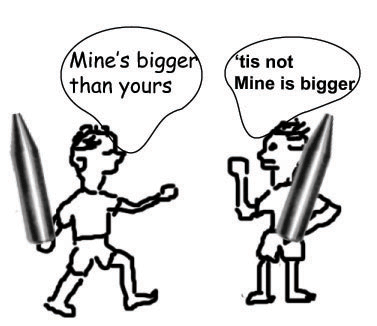 A Nuclear North Korea’s Wake-up Call, A spectacular pre-dawn parade on Saturday served to remind the world of North Korea’s continuing missile progress. The Diplomat, By Ankit Panda, October 13, 2020 On Saturday, October 10, North Korea celebrated the 75th anniversary of the founding of the Workers’ Party of Korea (WPK), the country’s ruling party. The occasion was celebrated in a grand way, with an unprecedented pre-dawn military parade. Thousands of uniformed military personnel marched through Pyongyang’s renovated Kim Il Sung Square in perfect unison, trailed by scores of heavy military vehicles……..
The parade reached its climax with the reveal of an all-new intercontinental-range ballistic missile (ICBM) design. Prior to the parade, North Korea’s largest known nuclear-capable ballistic missile was the Hwasong-15, the ICBM that was tested for the first (and so far only) time in November 2017. After four Hwasong-15s rolled through Kim Il Sung Square, an even larger missile appeared in its wake. Four of these super-large ICBMs followed in the wake of the Hwasong-15s, in a single file formation. Not only were these missiles the largest ever to be seen in North Korea, they were the largest road-mobile missiles on integrated launchers seen anywhere in the world……….
For the United States, this missile is not good news. Not only does it underscore the failure of the Trump administration’s diplomatic attempts to constrain North Korea’s nuclear and missile programs; it also emphasizes the continuing growth of Pyongyang’s qualitative capabilities. A lot remains unknown about the precise capabilities of this new missile, but its sheer size certainly implies that it would be capable of carrying and delivering multiple nuclear reentry vehicles to likely the entire continental U.S. As North Korea’s weapons-grade fissile material stocks continue to grow, it likely will have enough fissile material on hand to justify allocating resources toward a multiple reentry vehicle capability. ………
By adding warheads to its ICBMs, North Korea will improve the probability that at least one of its thermonuclear reentry vehicles successfully penetrates U.S. missile defenses. To keep up with changes in North Korea’s growing force, the U.S. will have to spend hundreds of millions adding interceptors. North Korea, meanwhile, even under economic sanctions, appears fully capable of continuing to expand its ICBM capabilities………
Despite the nighttime setting, Kim’s reveal of his new ICBM made it clear as day that North Korea remained a capable and growing nuclear state………
What the parade does in the end is clarify the big picture about North Korea’s status as a nuclear weapons possessor: its nuclear forces grow larger and more refined with every passing week. Having largely crossed the qualitative thresholds it felt were needed for a rudimentary and minimally credible deterrent in 2017, Pyongyang is continuing to evolve its force.
Ankit Panda is editor-at-large at The Diplomat, the Stanton senior fellow in the Nuclear Policy Program at the Carnegie Endowment for International Peace, and author of ‘Kim Jong Un and the Bomb: Survival and Deterrence in North Korea’ (Hurst/Oxford University Press, 2020). Follow him on Twitter at @nktpnd. https://thediplomat.com/2020/10/a-nuclear-north-koreas-wake-up-call/
Book review: GAMBLING WITH ARMAGEDDON

Coming Close to Nuclear Holocaust, NYT, By Talmage Boston, GAMBLING WITH ARMAGEDDON, Nuclear Roulette From Hiroshima to the Cuban Missile Crisis, 1945-1962, By Martin J. Sherwin On Aug. 6, 1945, after Hiroshima was destroyed, President Truman declared the atomic bomb “the greatest thing in history.” On Oct. 21, 1962, during the Cuban missile crisis, President Kennedy confided to a friend, “The world really is impossible to manage so long as we have nuclear weapons.” The two statements sum up the changes in thinking between those two dates.
Benefiting from more than a half century of hindsight, the Pulitzer-winning historian Martin J. Sherwin delivers a well-researched and reasoned analysis of nuclear weapons’ impact from 1945 to 1962 in “Gambling With Armageddon.” The book should become the definitive account of its subject.
Sherwin has three themes. First, history proves that the disadvantages of nuclear weapons outweigh their advantages. Yes, the A-bomb brought a quick end to World War II, but Dwight Eisenhower and Robert Oppenheimer both believed Japan’s defeat was imminent without the bomb. And while it tipped the balance of power until the Soviets developed their own nuclear weapon in 1949, this brief American advantage produced no geopolitical gains…….
The book’s final lesson is the unsettling one that regardless of how many wise decisions get made by prudent leaders,
Donald Trump’s erratic behaviour revives the debate on the President’s unchecked nuclear authority
 Trump’s Virus Treatment Revives Questions About Unchecked Nuclear Authority
Even before the president was given mood-altering drugs, there was a movement to end the commander in chief’s sole authority to launch nuclear weapons. NYT, 12 Oct 20, By David E. Sanger and William J. Broad,
President Trump’s long rants and seemingly erratic behavior last week — which some doctors believe might have been fueled by his use of dexamethasone, a steroid, to treat Covid-19 — renewed a long-simmering debate among national security experts about whether it is time to retire one of the early inventions of the Cold War: the unchecked authority of the president to launch nuclear weapons.
Mr. Trump has publicly threatened the use of those weapons only once in his presidency, during his first collision with North Korea in 2017. But it was his decision not to invoke the 25th Amendment and turn control over to Vice President Mike Pence last week that has prompted concern inside and outside the government.
Among those who have long argued for the need to rethink presidents’ “sole authority” powers are former Defense Secretary William J. Perry, considered the dean of American nuclear strategists, who has cited the fragility of a nuclear-weapons control chain and the fear that it can be subject to errors of judgment or failure to ask the right questions under the pressure of a warning of an incoming attack.
Mr. Trump’s critics have long questioned whether his unpredictable statements and contradictions pose a nuclear danger. But the concerns raised last week were somewhat different: whether a president taking mood-altering drugs could determine whether a nuclear alert was a false alarm.
That question is a new one. The military’s Strategic Command often conducts drills that simulate actual but inconclusive evidence that the United States may be under nuclear attack. Such simulations drive home the reality that even a president asking all the right questions could make a mistake. But they rarely simulate what would happen if the president’s judgment was impaired.
“A nuclear crisis can happen at any time,” Tom Z. Collina, the policy director at the Ploughshares Fund, a private group that seeks to defuse nuclear threats, noted last week in an opinion piece. “If such a crisis takes place when a president’s thinking is compromised for any reason,” he added, “the results could be catastrophic.”
Traditionally, presidents have temporarily conveyed authority — including nuclear launch authority — to the vice president when they anticipated being under anesthesia. Ronald Reagan took that step in 1985, and George W. Bush did so in 2002 and 2007. There was no indication that Mr. Trump was unconscious, but there was reason to be concerned that the cocktail of drugs he was given could impair his judgment to make the most critical decisions entrusted to a president.
Last week in telephone interviews with Fox News and Fox Business Network, Mr. Trump said he was no longer taking experimental medications but was still on dexamethasone, which doctors say can produce euphoria, bursts of energy and even a sense of invulnerability. On Friday, he told Fox News he was off the drug, which he appears to have taken for less than a week.
But during that week, his prolific Twitter activity and rambling interviews led many to question whether the drugs had accentuated his erratic tendencies. His doctors’ refusal to describe with any specificity his condition or treatment only played up the concern.
“The history of obfuscating the medical condition of presidents is as old as the Republic,” said Vipin Narang, a professor at the Massachusetts Institute of Technology who has studied the nuclear command-and-control chain. “The issue here is that the dex” — shorthand for dexamethasone — “can make you paranoid and delusional.”
“We don’t know how much he was given,” Mr. Narang said. “And if he gives an order in the middle of the night, and no one is there to stop him, we are dependent on his military aide not to transmit the order or the duty officer at the national military command center to stop it.”………….
The “sole authority” tradition is unusual among the world’s nine nuclear powers; even Russia requires two out of three designated officials to sign off on a nuclear launch. While the Constitution says that only Congress can declare war, the speed of bombers and missiles made clear during the Cold War that there would be no time to convene Congress or mount a defense. As a result, Congress began delegating to the president all powers to use nuclear weapons during Harry S. Truman’s administration. He is the only president who has ordered a nuclear strike……..
“The last finger I would want on the nuclear button,” said Hans M. Kristensen, the director of the Nuclear Information Project at the Federation of American Scientists, a private group in Washington, “is that of a president on drugs.”……… https://www.nytimes.com/2020/10/11/us/politics/trump-nuclear-weapons-coronavirus.html
What to do about the USA President’s sole authority to launch a nuclear pre-emptive strike?
|
Quote of the week: “Ours is a world of nuclear giants and ethical infants… We have grasped the mystery of the atom and rejected the Sermon on the Mount.” The President of the United States has unrestricted powers to use nuclear weapons first if he or she deems this necessary. Concerns about the absence of checks and balances on the first use of nuclear weapons have spiked because of Donald Trump’s bellicose temperament and shallow understanding of nuclear flash points. They have been exacerbated by his erratic behavior and remarks while recovering from the COVID virus. What to do? Some on Capitol Hill have introduced legislation that would prohibit the president from launching a nuclear first strike without a declaration of war by the Congress. In my view, this is the wrong remedy. Instead, I propose a three person rule for crossing the nuclear threshold first that can be enacted by executive order and reaffirmed by the Congress………… https://www.armscontrolwonk.com/archive/1210154/the-presidents-sole-authority-for-first-use/ |

Reopening of a Cold-War era submarine base, as USA struggles to beat Russia to control the Arctic.
Olavsvern will also be used to house submarines for NATO amid increased concerns over Russia’s activity in the region.
The base is located 220 miles from the Russia border and thus offers an ideal outpost for Western allies to quickly contain, and defend against any aggression from the state.
Modifications will now be made to the base in order for it to house America’s nuclear attack submarine, the USS Jimmy Carter.
The announcement of the base comes as the UK’s First Sea Lord, Admiral Tony Radakin, warned China and Russia could soon exploit the Arctic Sea.
Due to climate change, he claimed the once-frozen passages are now thawing thus opening up potential naval routes.
With these routes now appearing, Chinese and Russian ships could now have gateways through to the UK.
He added the Royal Navy was essential in stopping these ships from trespassing in the UK’s waters but also policing the vital global trade routes………..
The undersea world matters. “Because this one remaining stealth medium is also the home to our nuclear deterrent. ”…… https://www.express.co.uk/news/world/1346694/world-war-3-russia-cold-war-Norway-submarine-base-arctic-Vladimir-Putin
New North Korean missile will prove a big diplomatic headache for US, expert warns
|
New North Korean missile will prove a big diplomatic headache for US, expert warns, 9 News, By Richard Wood • Senior JournalistOct 12, 2020 North Korea’s unveiling of a new intercontinental ballistic nuclear missile (ICBM) will impact global security in the months ahead, according to one expert.
The massive weapon was carried by an 11-axle truck during a military parade in the capital of Pyongyang to mark the 75th birthday of the isolated state’s ruling party on the weekend.
Malcolm Davis, senior analyst at the Australian Strategic Policy Institute, told Nine.com.au the display of the new ICBM shows that the Trump Administration’s talks with North Korean leader Kim Jong-un had failed…….. https://www.9news.com.au/world/north-korea-nuclear-missile-will-test-next-us-president/8c1ee861-4b14-47f9-93c4-e9466d06dfb9
|
|

U.S. and Russian negotiators try tosalvage arms control pact
their nuclear warhead stockpiles in a bid to salvage their last remaining
arms control pact before it expires next year, a source has said.
https://www.thenational.scot/news/18785398.us-russia-agree-freeze-nuke-stockpile/
Kim Jong Un showcases North Korea’s biggest intercontinental missile
Pyongyang advances its weapons technology despite impact of sanctions and coronavirus, Edward White, 11 Oct 20,
New Zoom link for Oct 11 Festival of Hope, Two to be Sentenced Oct 15, Four Others Continued Until Nov 12 & 13
 New Zoom link for Oct 11 Festival of Hope, Two to be Sentenced Oct 15, Four Others Continued Until Nov 12 & 13 Bill Ofenloch, October 9, 2020/, Kings Bay Plowshares 7, Father Steve Kelly and Patrick O’Neill are scheduled to be sentenced in Brunswick, GA on October 15 & 16 in the early afternoon. It is expected that the two will be combined on October 15. The remaining four defendants, Carmen Trotta, Martha Hennessy, Mark Colville, and Clare Grady, were granted continuances yesterday by Judge Wood to Nov. 12 & 13 because of COVID-19.
The defendants ask, “In the interest of public safety, and out of love for our supporters during this Covid 19 pandemic, the seven Kings Bay Plowshares members request that no one come to Brunswick for the sentencing hearings scheduled for Oct. 15-16. We do, however, encourage you all to join the Oct. 11 pre-sentencing Zoom meeting. Thank you all for your love and support, which sustains us.”
There is expected to be an audio link from the court to listen to the proceedings as was done with Liz McAlister in June. The call-in number and times will be posted on the website when we get them.
A virtual Festival of Hope is planned for Sunday, October 11, at 5pm EDT prior to the sentencing of Fr. Steve Kelly and Patrick O’Neill. It will now be hosted on the Code Pink Zoom channel. It will also be on the Code Pink YouTube channel and on the KBP Facebook page. Patrick and several of the defendants will appear. Fr. Steve Kelly will send a message from jail. Marcia Timmel, Susan Crane and Steve Baggarly, plowshares activists, will speak. There will also be a slideshow and music and a blessing.
The new Zoom link:
-
Archives
- October 2026 (104)
- September 2026 (339)
- August 2026 (330)
- July 2026 (355)
- June 2026 (287)
- May 2026 (306)
- April 2026 (356)
- March 2026 (251)
- February 2026 (267)
- January 2026 (308)
- December 2025 (358)
- November 2025 (359)
-
Categories
- 1
- 1 NUCLEAR ISSUES
- business and costs
- climate change
- culture and arts
- ENERGY
- environment
- health
- history
- indigenous issues
- Legal
- marketing of nuclear
- media
- opposition to nuclear
- PERSONAL STORIES
- politics
- politics international
- Religion and ethics
- safety
- secrets,lies and civil liberties
- spinbuster
- technology
- Uranium
- wastes
- weapons and war
- Women
- 2 WORLD
- ACTION
- AFRICA
- Atrocities
- AUSTRALIA
- Christina's notes
- Christina's themes
- culture and arts
- Events
- Fuk 2022
- Fuk 2023
- Fukushima 2017
- Fukushima 2018
- fukushima 2019
- Fukushima 2020
- Fukushima 2021
- general
- global warming
- Humour (God we need it)
- Nuclear
- RARE EARTHS
- Reference
- resources – print
- Resources -audiovicual
- Weekly Newsletter
- World
- World Nuclear
- YouTube
-
RSS
Entries RSS
Comments RSS

