Citizens express opposition to dangerous increased plutonium pit production
 Citizens’ Hearing Held at New Mexico Capitol about Increased Plutonium Pit Production at LANL, http://nuclearactive.org/
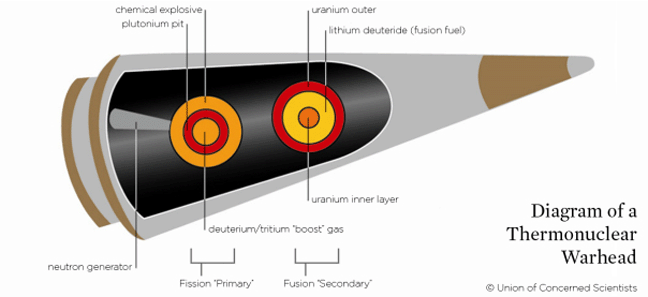
The Pentagon has stated it needs annual production of 80 plutonium pits, the triggers for nuclear weapons. T The DOE has approved its Supplement Analyses for four possible ways to execute thisapproved its Supplement Analyses for four possible ways to execute this.
At LANL, DOE proposes upgrades to both LANL’s Plutonium Facility and the Radiological Laboratory Utility and Office Building which is part of the Chemistry and Metallurgy Research Replacement (CMRR) Project.
Despite a mission that has been re-directed and an expansion involving about $15 billion in upgrades for two major buildings and related infrastructure, DOE has decided not to undertake a new Site-Wide Environmental Impact Statement (SWEIS) for LANL. https://www.energy.gov/nepa/downloads/doeeis-0380-sa-06-final-supplement-analysis and https://www.energy.gov/nepa/downloads/doeeis-0380-amended-record-decision Neither our congressional delegation nor our Governor has voiced disapproval of bypassing the SWEIS.
On Wednesday afternoon, October 7th, a citizens’ hearing was held outside the New Mexico State Capitol Building. Testimony was taken about DOE’s dramatic expansion plans for LANL that involve an installation of the size and importance and with the attendant dangers of the closed nuclear weapons plant at Rocky Flats, Colorado. The event, which provided a place for dozens of citizens to express their opposition to DOE’s plans in Northern New Mexico, was sponsored by the Los Alamos Study Group. http://www.lasg.org/
The DOE proposals are too broad and too expensive to go forward without an SWEIS with public review and comment opportunities.
Every day, new information is released about the increased hazards at LANL. This week the Defense Nuclear Facilities Safety Board issued a new report about the inconsistent and inappropriate consideration of potential energetic chemical reactions, or explosions, involving transuranic waste stored at LANL. The Board conducted an analysis of transuranic, or plutonium-contaminated, wastes stored at the Plutonium Facility, the old Chemistry and Metallurgy Research Facility, the Transuranic Waste Facility, and Area G and the potential for explosions. It found that LANL has not fully analyzed for possible explosions involving transuranic waste stored at these facilities that would result in high exposures to workers and the public. https://www.dnfsb.gov/documents/reports/technical-reports/potential-energetic-chemical-reaction-events-involving
The Board asked DOE to respond within 120 days.
Utah congressman takes action to stop future nuclear weapons testing in U.S.
|
Utah congressman takes action to stop future nuclear weapons testing in U.S. The Daily Universe, By Kaela Cleary, October 9, 2020 With all of the chaos surrounding the U.S. presidential election, word of the Trump administration and Senate Republicans creating legislation to prepare to resume nuclear weapons testing at the Nevada Test Site hasn’t received much public attention.
|
|
Kim Jong Un Set to Show Off Nuclear Advances in Message to Trump
|
Kim Jong Un Set to Show Off Nuclear Advances in Message to Trump, By Jon Herskovitz and Jeong-Ho Lee
10 October 2020, North Korean leader Kim Jong Un is expected to hold his biggest military parade in at least two years and show off a nuclear arsenal that poses one of the most daunting security challenges for the winner of the U.S. presidential election.
The event — part of festivities Saturday to mark the 75th anniversary the Workers’ Party of Korea — could showcase the “new strategic weapon” Kim pledged to unveil at the start of the year. ….. https://www.bloomberg.com/news/articles/2020-10-09/kim-jong-un-set-to-show-off-nuclear-advances-in-message-to-trump |
|
USA-Russia talks continue on bid to salvage nuclear arms control agreement
U.S. and Russian negotiators have agreed in principle to freeze their nuclear warhead stockpiles in a bid to salvage their last remaining arms control pact before it expires next year
The person said it’s not yet clear if the agreement for a freeze will succeed or translate into an extension of the New START treaty expires in February.
An announcement ahead of the election could raise eyebrows, coming as U.S. intelligence officials say Russia favors Trump and has been working to denigrate Biden…….
Russia has had a more skeptical view of the talks, with Russian Foreign Minister Sergey Lavrov on Monday accusing Washington of “unilateralism.” He said the New START treaty would likely cease to exist because the conditions the U.S. has put forward for extending it “don’t take into account our interests or the experience of many decades when arms control has existed to mutual satisfaction.”
Russian diplomats have repeatedly emphasized that Moscow considers the limits on launch platforms — missiles, bombers and submarines — much more important than the restrictions on the number of warheads. Russia likely would be unwilling to accept a separate freeze on the number of warheads unless it is part of a full-fledged deal. https://abcnews.go.com/Politics/wireStory/us-russia-close-deal-nuclear-warhead-freeze-73522231
Trump’s COVID infection shows why it’s time to retire the nuclear football
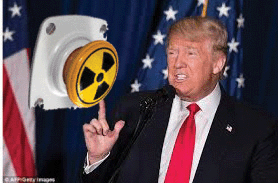 Trump’s COVID infection shows why it’s time to retire the nuclear football, Bulletin of the Atomic Scientists , By Tom Z. Collina, October 6, 2020 President John Kennedy took powerful pain medications. President Richard Nixon was a heavy drinker. President Ronald Reagan had dementia. And now President Donald Trump has the coronavirus. These conditions can significantly impair one’s ability to think clearly. And yet, as president, each had—or, in Trump’s case, still has–the unilateral authority to launch US nuclear weapons within minutes.
President Trump is followed 24/7 by a military aide that carries the “football,” the briefcase that holds all he would need to order the immediate launch of up to 1,000 nuclear weapons, more than enough megatonnage to blow the world back into the stone age. He does not need the approval of Congress or the secretary of defense. Shockingly, there are no checks and balances on this ultimate executive power.
President Trump took the nuclear football with him to Walter Reed Medical Center, where he received treatment for COVID-19. According to Trump’s doctor, the president’s blood oxygen levels had dipped. And this, according to independent health experts, can impair decision-making ability. He is taking dexamethasone, which can cause mood swings and “frank psychotic manifestations.” Yet as far as we know, at no point did the president transfer his powers to the vice president, as allowed under the 25th Amendment.
To state the obvious, we should not entrust nuclear launch authority to someone who is not fully lucid. (Reagan transferred authority temporarily before planned surgery, as did President George W. Bush before a medical procedure that required his sedation.) A nuclear crisis can happen at any time, including at the worst possible time. If such a crisis takes place when a president’s thinking is compromised for any reason, the results could be catastrophic. ……..
If the president or his advisors have reason to believe that Trump’s thinking may be compromised, nuclear launch authority should be transferred to the vice president, Mike Pence. If Pence also gets COVID, the football could then be passed to House Speaker Nancy Pelosi, President Pro Tempore of the Senate Chuck Grassley, and the secretaries of State, Treasury and Defense, in that order.
But kicking the football down the line does not solve the problem—and in fact shows why the system is broken. Does anyone really believe that the president pro tem of the Senate or the Treasury Secretary has spent much time preparing for nuclear war? And even if they had prepared, the central dilemma remains: All humans are imperfect, and we should not trust the fate of the world to any one person.
The whole concept of giving the president unilateral nuclear authority is built on the false assumption that Russia might launch a surprise first strike. In fact, Russia has never seriously considered a first strike against the United States for a simple reason: It would be national suicide. Both sides have to assume that an attack would provoke an unacceptable nuclear retaliation. Both nations, and much of the rest of the globe, would be obliterated. Starting such a war would be insanity………
It is time to retire the nuclear football. The only thing standing between us and nuclear holocaust is one man with COVID on heavy meds. That is the plan? Ending sole authority is better than entrusting it to any individual. In a vibrant democracy, no one person should have the unchecked power to destroy the world. https://thebulletin.org/2020/10/trumps-covid-infection-shows-why-its-time-to-retire-the-nuclear-football/
Too much power to USA president, to control nuclear war strategy: what if he is ill?
Why The President Is The Weakest Link In U.S. Nuclear Strategy, Forbes, Loren Thompson 7 Oct 20 President Trump’s hospitalization after testing positive for Covid-19 is one of many instances in which the performance of the nation’s chief executive has been impaired by medical issues.
Eisenhower had a massive heart attack in 1955. His successor, John F. Kennedy, was afflicted by Addison’s disease and various other maladies that required heavy use of painkillers. Kennedy’s successor, Lyndon Johnson, was hospitalized during the Hong Kong flu pandemic of 1968.
Other presidents have seen their performance compromised by psychological issues.
Richard Nixon became clinically depressed during the Watergate controversy and took to drinking heavily. Ronald Reagan may have exhibited early symptoms of Alzheimer’s disease during the closing years of his presidency.
Such frailties have long been a part of the human condition, but the advent of nuclear weapons raised alarming possibilities about where presidential disability might lead. You see, the president has unilateral authority to launch nuclear weapons, and that power is one of the few places in the federal system where no checks and balances exist.
Thus, the prosect that a president might be physically or mentally impaired is alarming………
Mr. Trump’s recent hospitalization highlights some of the things that might go wrong. A report released this week by the Northwestern Medicine healthcare system found that a third of the patients hospitalized for Covid-19 in the system’s Chicago-area facilities developed altered mental states, including confusion and delirium.
In addition, President Trump’s doctors administered a heavy regimen of drugs aimed at mitigating the health consequences of his infection. Unfortunately, one of those drugs was a steroid, and steroids are known to cause psychological symptoms in some patients such as anxiety, agitation and mood swings.
When you consider the awesome nuclear authorities vested in the president, it is unsettling to contemplate how impaired judgment or medical disability might impact decision-making in a crisis……… https://www.forbes.com/sites/lorenthompson/2020/10/07/why-the-president-is-the-weakest-link-in-us-nuclear-strategy/#7f5796d76aee

Boukadoum: Algeria to ratify Treaty on the Prohibition of Nuclear Weapons “as soon as possible”
Boukadoum: Algeria to ratify Treaty on the Prohibition of Nuclear Weapons “as soon as possible” http://www.aps.dz/en/algeria/36012-boukadoum-algeria-to-ratify-treaty-on-the-prohibition-of-nuclear-weapons-as-soon-as-possible
Pacific Island Nations determined to say NO to nuclear weapons, and support UN Treaty Ban

|
Pacific will continue to say no to nuclear weapons, UN told, https://www.rnz.co.nz/international/pacific-news/427663/pacific-will-continue-to-say-no-to-nuclear-weapons-un-told 5 Oct 20, Marking International Day Against Nuclear Explosions last weekend, the island nations agreed they had all suffered the effects of nuclear testing in the region.Presenting a joint statement from 12 Pacific countries to the United Nations General Assembly, Fiji’s Prime Minister said more than 300 nuclear tests were carried out in the Pacific from 1946 to 1996 – in the atmosphere, underground and underwater.
Frank Bainimarama told the online event communities living close to ‘ground zero’ were relocated from their ancestral homes and restricted from using the ocean resources for their livelihoods. Mr Bainimarama says those impacted also faced an increase in related health problems. “At the end of these nuclear tests, radioactive waste and machinery were either buried or dumped into the Pacific Ocean. Today, we still do not know the full impact of these nuclear tests on our environment and communities,” Frank Bainimarama said. Bainimarama said Pacific islanders considered themselves the custodians of the vast blue Pacific Ocean. “The Pacific Ocean defines who we are; it serves as the foundation of our economies, our environment, and the well-being of our communities,” he said. “We have a vision that the blue Pacific Ocean will become an ocean of peace and prosperity for our people and the world.” Bainimarama said protecting the blue Pacific continent was of paramount importance to the islanders’ future. He said it could only become an ocean of peace if it was nuclear-free. He said stopping the development of nuclear weapons and eliminating them altogether would free up much-needed global resources to assist vulnerable communities, and those around the world, in fighting the effects of climate change. “The world does not need nuclear weapons,” Bainimarama said. The challenges of nuclear disarmament can only be resolved by a strengthened multilateral system that sets the conditions for transparency, confidence-building, and co-operation.” The Fijian leader said the Treaty on the Non-Proliferation of Nuclear Weapons (NPT), the Comprehensive Nuclear Test Ban Treaty (CTBT) and the Treaty on the Prohibition of Nuclear Weapons (TPNW) were crucial if Pacific islands, which he refers to as PSIDS, were to further reduce and eliminate nuclear weapons. “Today, we PSIDS say no to nuclear weapons and we reiterate our commitment to the elimination of nuclear weapons everywhere,” Bainimarama said. “We encourage member states to ratify the Comprehensive Nuclear Test Ban Treaty (CTBT) and the Treaty on the Prohibition of Nuclear Weapons (TPNW). “It is morally right, and we owe it to ourselves and our future generations.” The Fijian leader presented a joint statement to the UN Assembly from the PSIDS’ members including the Federated States of Micronesia (FSM), Fiji, Kiribati, Nauru, Palau, Papua New Guinea, Marshall Islands, Samoa, Solomon Islands, Tonga, Tuvalu and Vanuatu. Bainimarama said their statement was also aligned with the message sent by the Tuvalu Mission at the UN on behalf of the Pacific Islands Forum. The online event was hosted by UN President Tijjani Muhammad-Bande from Nigeria. |
|
China-Saudi nuclear pact can trigger an arms race in West Asia
|
China-Saudi nuclear pact can trigger an arms race in West Asia. Saudi Arabia’s acquisition of nuclear capability would draw Turkey and Egypt to join the regional nuclear race, which might turn conflict-torn West Asia even more volatile. The Print ADIL RASHEED 5 October, 2020 At a time when the world was expecting Saudi Arabia to join the UAE and Bahrain in normalising relations with Israel, a noted British daily published a news story that has since raised Israeli concerns over the kingdom’s nascent nuclear programme. On 17 September 2020, an article in The Guardian reported that Chinese geologists have prepared a report for Saudi Arabia — as part of their nuclear energy cooperation agreement — which names locations having large reserves of uranium ore in the kingdom that could be sufficient for its domestic production of nuclear fuel. This news comes on the heels of an earlier Wall Street Journal report that the kingdom has also already constructed a facility with Chinese assistance for extracting uranium yellowcake from uranium ore, a major development in Riyadh’s avowedly peaceful nuclear programme. The report states that the facility is being built far away from the eastern borders close to Iran, with the help of two Chinese companies near the Saudi city of Ula, midway between Medina and Tabuk. …….. By supporting Iran when it has restarted uranium enrichment and by helping Saudi Arabia extract and process its indigenous fissile raw material, Beijing seems to be setting up and weaponising the two arch-rivals of the Gulf, thereby catalysing a nuclear arms race in West Asia, so that US military is never able to pivot effectively to China’s backyard in the Indo-Pacific. https://theprint.in/opinion/china-saudi-nuclear-pact-can-trigger-an-arms-race-in-west-asia/516781/ |
|
India test-fires new version of nuclear capable Shaurya missile
India test-fires new version of nuclear capable Shaurya missile, DECCAN CHRONICLE. | AKSHAY KUMAR SAHOO
Oct 4, 2020, Bhubaneswar: India on Saturday successfully test-fired indigenously developed hypersonic nuclear-capable Shaurya missile, an advanced version of Submarine Launched Ballistic Missile (SLBM) K-15 (B-05).
The test was carried out by the Defence Research and Development Organisation (DRDO) from a defence facility off Odisha coast, said reports…..
”Peaceful” nuclear powerr for nuclear weaponry in space
 US military eyes nuclear thermal rocket for missions in Earth-moon space, Space.com, By Mike Wall 1 Oct 20,
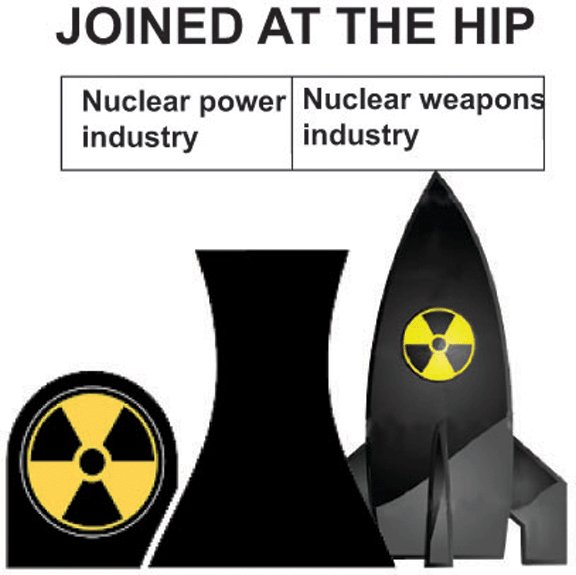
DARPA awarded a $14 million task order to help make it happen. The U.S. military aims to get a nuclear thermal rocket up and running, to boost its ability to monitor the goings-on in Earth-moon space.
The Defense Advanced Research Projects Agency (DARPA) just awarded a $14 million task order to Gryphon Technologies, a company in Washington, D.C., that provides engineering and technical solutions to national security organizations.
The money will support DARPA’s Demonstration Rocket for Agile Cislunar Operations (DRACO) program, whose main goal is to demonstrate a nuclear thermal propulsion (NTP) system in Earth orbit. ……. https://www.space.com/darpa-nuclear-thermal-rocket-for-moon-contract
Trump with Covid-19 – a potential power vacuum. E-6B Mercury nuclear war command posts in flight on each coast
Covid 19 coronavirus: Why ‘doomsday’ nuclear planes have taken to the skies in the US, https://www.nzherald.co.nz/world/news/article.cfm?c_id=2&objectid=12369993 By: Jamie Seidel, 2 Oct 20, America’s doomsday planes are in the air following news that the nation’s commander-in-chief, President Donald Trump, has Covid-19.
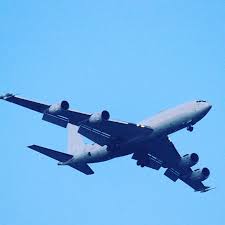
 Two US Navy E-6B Mercury nuclear war command posts were observed in flight Friday, one on each coast of the United States. They were initiating the “Take Charge and Move Out” (TACAMO) defence protocol – essentially dispersing the command and communications facilities needed to control the US nuclear arsenal.
These aircraft are activated by the Pentagon when it is deemed necessary to communicate with the US Navy’s secretive nuclear missile submarines, stealth bombers and missile silos.
The move underscores the potential severity of the situation.
The President of the United States is also the commander-in-chief of the nation’s armed forces, including its nuclear forces. The incapacitation of whoever holds this position could be seen as an opportunity by potential belligerents.
Covid-19, which has so far killed 200,000 US citizens, is particularly deadly among older sufferers. President Trump is 74 years old.
It was announced this morning that he is already experiencing “mild symptoms”.
The two E-6Bs appeared on flight tracking systems 30 minutes before Trump announced his condition.
It’s no accident the aircraft were seen.
Military aircraft and ships usually fly with their radio identification transponders turned off in order to avoid being tracked and identified.
 Doomsday Planes
Based on Boeing 707 airliner airframes, the E-6B aircraft have been built to be particularly resistant to electronic warfare and the electromagnetic-pulse generated by nuclear bursts.
About 16 of the aircraft were delivered from 1986. The fleet underwent a major upgrade in 2006.
Their job is to get into the air in the time of crisis. But an unknown number is also maintained aloft at any one time.
In the event of war, their job is to relay commands from the president and defense secretary directly to the deterrent nuclear force. The heart of this force are the Ohio-class nuclear ballistic-missile submarines hiding deep in the world’s oceans. Their immense payloads of nuclear missiles constantly threaten the prospect of a devastating retaliatory blow.
I would expect them to pop up if he tests positive,” US open-source intelligence hobbyist Tim Hogan tweeted with flight tracking maps identifying the flights.
“It’s the plane that has the ability to order the killing of everyone on earth if someone attacks the US with nukes in a first strike. It can talk to our missile subs under water even if DC is gone.”
Talking to submarines deep underwater is no easy task.
Very Low Frequency (VLF) radio can reach about 20m beneath the ocean’s surface. But its transmission speed is very slow and require large, high powered emitters for broadcast. In order to operate this equipment, the E-6B must unspool a kilometres-long wire to act as an aerial.
Command and Control
The US Constitution deals with the prospect of a president who is physically or mentally unable to discharge his duties. The role “shall devolve on the vice president”, it states.
What it doesn’t make clear is how the judgement to “devolve” should be made, or by whom.
The 25th Amendment, enacted in 1967, is supposed to provide a framework for this decision. But it was not initiated in 1981 when President Ronald Reagan was shot. For 10 days Reagan lay near death. But his key powers were not transferred to Vice President George H. W. Bush.
This has raised further questions about how presidential powers would be divested in an emergency. The 25th Amendment calls for a signed statement from the serving President, or if “the vice president and a majority of either the principal officers of the executive departments or of such other body as Congress may by law provide” a similar statement.
The resulting power vacuum, especially in the role of US Commander-in-Chief, potentially poses a strategic risk in times of international – and internal – crisis.
As Donald Trump gets coronavirus, USA’s ”doomsday” planes take flight
 Donald Trump Tests Positive For COVID—And America’s Nuclear Doomsday Planes Launch Controversy, Forbes,
David AxeContributor 2 Sept 20, U.S. president Donald Trump tested positive for the novel-
coronavirus on Friday morning. Shortly before the news broke, the U.S. Navy’s doomsday planes launched on both American coasts.
Some observers asserted that the two things were related. But military spokespeople and some experts explained it was coincidence.
The Navy has 16 Mercuries. One often is in the air, and it’s not unheard-of for two or more to be airborne at the same time. But the timing of Friday’s twin sorties seemed noteworthy to some.
In an atomic war, the E-6s would relay orders to the Ohio boomers, helping the boats’ crews to target enemy cities and military bases with nuclear-tipped Trident submarine-launched ballistic missiles, or SLBMs.
It could be no accident that E-6s were airborne over both coasts in the minutes before Trump’s announcement that he was infected, tweeted Tim Hogan, an American open-source intelligence practitioner. “I would expect them to pop up if he tests positive.”………. https://www.forbes.com/sites/davidaxe/2020/10/02/donald-trump-tests-positive-for-covid-and-americas-nuclear-doomsday-planes-launch/#3022db8658ba
Call to Indonesia to ratify UN Nuclear Weapons Ban Treaty
 “Indonesia running in circles in bid to ratify anti-nuclear weapons treaty”. Dian Septiari The Jakarta Post Jakarta / Fri, October 2, 2020
Indonesia is still dragging its feet in the ratification of an international treaty to prohibit nuclear weapons that it signed more than three years ago, even as its neighbors have one by one made good on their commitments. Malaysia was the latest to submit its instrument of ratification of the Treaty on the Prohibition of Nuclear Weapons (TPNW) on Wednesday, making it the 46th country to pass the treaty into law. Malaysian Foreign Minister Hishammuddin Hussein said the country’s ratification brought the international community one step closer to amassing the 50 national endorsements needed to bring the treaty into force, Bernama reports.
Adopted on July 7, 2017, the treaty prohibits all activities related to nuclear weapons, including their development, testing, manufacturing, acquisition, possession, stockpiling, use and stationing. In Southeast Asia, Thailand was the first nation to sign and ratify the treaty, only a few months after it was adopted. Vietnam ratified it the following year, followed by Laos in 2019. Indonesian Foreign Ministry spokesperson Teuku Faizasyah said Indonesia was one of the first 50 countries to sign the treaty in 2017, but the ratification itself was still ongoing. “Of course, ratification cannot be done instantly, because it involves many stakeholders and progress is currently a bit constrained by the COVID-19 pandemic,” he said on Wednesday.
………. As the de facto leader of ASEAN, Indonesia is expected to shore up resources against global nuclear proliferation, which the bloc collectively agrees to oppose through the Southeast Asia Nuclear Weapon-Free Zone (SEANWFZ) treaty. As a member of the Non-Aligned Movement (NAM) and a coordinator of its working group on disarmament and nonproliferation since 1994, Indonesia was among cosponsors of the 2017 United Nations General Assembly resolution to enforce the Nuclear Weapons Ban Treaty. Various observers have since called on Indonesia to make good on its
The American election- what will the nuclear order look like after this?

image from MENAFN.COM
THE U.S. ELECTION AND NUCLEAR ORDER IN THE POST-PANDEMIC WORLD Limitless Life, LEON V. SIGAL, SEPTEMBER 29 2020Abstract
U.S. power and prestige may have diminished in recent years, but the United States still plays a pivotal role in international institutions, alliances, and mass media, so who becomes its president and which party controls Congress matter a lot for the global nuclear order. However unlikely it is that Donald Trump’s expressed desire to contest the election’s outcome could succeed, whether the nation can avert a violent backlash among disappointed partisans is less clear.
Nuclear weapons are often thought to be the esoteric domain of experts. Yet one need only recall that although mass activism does not guarantee policy change, three of the most significant developments in recent decades – the ban on above-ground nuclear tests, the INF
Treaty, and the collapse of the Berlin Wall – would not have happened without mass protests in many countries. And citizen involvement, organized by NGOs, can even facilitate monitoring of arms agreements and nuclear developments in some countries.
positive change to the global nuclear order will continue to be marginal and fitful. This makes the international milieu critical for the nuclear future – a milieu that a president can influence but not determine.
President Trump’s reelection is likely to have a pernicious effect on that milieu, hindering international cooperation to limit nuclear weapons and accelerating a qualitative arms race that could endanger crisis stability. Yet two of Trump’s more positive impulses are likely to continue. He is unlikely to increase the risk of an intense crisis leading to nuclear war because he wants to avoid U.S. involvement in any wars, not start new ones. He will also try to sustain negotiations
with North Korea to curb nuclear developments there, though whether he is prepared to satisfy Pyongyang’s stiffer demands remains in doubt.His opponent, Joseph Biden, will face those same demands. Personnel is policy, and the Biden administration will likely be staffed with officials who served under President Obama. That means a return to shoring up alliances and international cooperation. It also means continuity with Obama’s nuclear policies. Whether he will curtail Obama’s modernization plans is not clear, but in contrast to Trump, he will try his best to restore the JCPOA, which could head off nuclear weapons development not only in Iran but also in Saudi Arabia. He will also strive to save START, seek technical talks with China, and not abandon the Open Skies accord……….. https://wordpress.com/read/feeds/2663585/posts/2938659215
-
Archives
- October 2026 (104)
- September 2026 (339)
- August 2026 (330)
- July 2026 (355)
- June 2026 (287)
- May 2026 (306)
- April 2026 (356)
- March 2026 (251)
- February 2026 (267)
- January 2026 (308)
- December 2025 (358)
- November 2025 (359)
-
Categories
- 1
- 1 NUCLEAR ISSUES
- business and costs
- climate change
- culture and arts
- ENERGY
- environment
- health
- history
- indigenous issues
- Legal
- marketing of nuclear
- media
- opposition to nuclear
- PERSONAL STORIES
- politics
- politics international
- Religion and ethics
- safety
- secrets,lies and civil liberties
- spinbuster
- technology
- Uranium
- wastes
- weapons and war
- Women
- 2 WORLD
- ACTION
- AFRICA
- Atrocities
- AUSTRALIA
- Christina's notes
- Christina's themes
- culture and arts
- Events
- Fuk 2022
- Fuk 2023
- Fukushima 2017
- Fukushima 2018
- fukushima 2019
- Fukushima 2020
- Fukushima 2021
- general
- global warming
- Humour (God we need it)
- Nuclear
- RARE EARTHS
- Reference
- resources – print
- Resources -audiovicual
- Weekly Newsletter
- World
- World Nuclear
- YouTube
-
RSS
Entries RSS
Comments RSS

