Buddhist leader urges international co-operation in further steps on the Nuclear Ban Treaty
 Buddhist Leader Welcomes Entry into Force of Nuclear Ban Treaty, Urges
  International Cooperation to CombatPandemic in 39th Annual Peace Proposal, Soka Gakkai , Jan 26, 2021, TOKYO, Jan. 26, 2021 /PRNewswire/ — On January 26, 2021, the 39th annual peace proposal by Daisaku Ikeda, president of the Soka Gakkai International (SGI) Buddhist association, titled “Value Creation in a Time of Crisis” was released, marking the anniversary of the founding of the SGI.
Ikeda calls for further global cooperation to address the key issues of our time: the COVID-19 pandemic, the climate crisis, and the need to rid the world of nuclear weapons. These issues are not constrained by national borders and cannot be solved by any one government or organization alone……….
Consistent with his decades of action toward the abolition of nuclear weapons, Ikeda welcomes the UN Treaty on the Prohibition of Nuclear Weapons (TPNW), which entered into force on January 22, 2021, as a “pivotal event ushering in a new era” that will spur a paradigm shift in approaches to security. He calls on Japan to participate in the first meeting of the States Parties to the TPNW, to begin to create the conditions in which future ratification can become possible.
He proposes that a forum for discussing the relationship between nuclear weapons and the UN Sustainable Development Goals (SDGs) be held during the first meeting of States Parties to the TPNW.
At the Nuclear Non-Proliferation Treaty (NPT) Review Conference scheduled for August 2021, Ikeda also urges discussion on the true meaning of security in the light of crises such as the climate emergency and the pandemic.
He calls for the final document of the Review Conference to include a pledge of non-use of nuclear weapons and the freezing of all nuclear weapon development until 2025.
A statement from Soka Gakkai President Minoru Harada welcoming the entry into force of the TPNW issued on January 22 can be found at: https://www.sokaglobal.org/contact-us/media-room/statements/tpnw-entry-into-force.html. The SGI has also cosigned an interfaith statement together with more than 170 other religious groups. See: https://sgi-ouna.org/tpnw-eif-interfaith-statement ………..https://www.prnewswire.com/news-releases/buddhist-leader-welcomes-entry-into-force-of-nuclear-ban-treaty-urges-international-cooperation-to-combat-pandemic-in-39th-annual-peace-proposal-301214677.html
Russia and USA exchange documents to extend the NEW START nuclear weapons agreement

 Russia, US Exchange Documents to Extend Nuclear Pact
The Kremlin says Russia and the United States have exchanged documents to extend their last remaining nuclear arms control pact days before it is set to expire. U.S. News, BY VLADIMIR ISACHENKOV, Associated Press, MOSCOW (AP) 26 Jan 21 — Russia and the United States traded documents Tuesday to extend their last remaining nuclear arms control treaty days before it is due to expire, the Kremlin said.
A Kremlin readout of a phone call between U.S. President Joe Biden and Russian President Vladimir Putin said the two leaders voiced satisfaction with the exchange of diplomatic notes about extending the New START treaty.
“In the nearest days, the parties will complete the necessary procedures that will ensure further functioning of this important international legal nuclear arms control tool,” the Kremlin said.
The pact’s extension doesn’t require congressional approval in the U.S., but Russian lawmakers must ratify the move. Top members of the Kremlin-controlled parliament said they would fast-track the issue and complete the necessary steps to extend the treaty this week.
New START expires on Feb. 5. After taking office last week, Biden proposed extending the treaty for five years, and the Kremlin quickly welcomed the offer………. https://www.usnews.com/news/world/articles/2021-01-26/russia-diplomat-hails-progress-in-nuclear-pact-talks-with-us
Iran urges Biden to make haste to rejoin the nuclear deal
 Iran warns Biden over nuclear deal, Canberra Times Nasser Karimi 26 Jan 21, Iran has warned the Biden administration it will not have an indefinite time period to rejoin the 2015 nuclear deal between Tehran and world powers.
Iran also said it expects Washington to swiftly lift crippling economic sanctions that Donald Trump imposed after pulling America out of the atomic accord in 2018, as part of what he called maximum pressure against Tehran.
Biden has pledged to return to the nuclear deal, but Iran’s cabinet spokesman Ali Rabiei said there has yet to be any communication between the two sides on the subject……..https://www.canberratimes.com.au/story/7101356/iran-warns-biden-over-nuclear-deal/?cs=14264
A dangerous out-dated ”zombie” U.S. Navy policy on ballistic missile submarines
Failure to consider new technology may result in a situation where a nuclear first strike is seen as the only way to guarantee “winning” a war, despite the almost incomprehensible levels of destruction involved. As the situation gets complex with China developing its own submarine-based deterrent force, such instability will be dangerous to everyone.
Dismukes argues that to reduce this danger we have to recognize the two factors it stems from: advances in submarine detection technology; and a dubious, outdated U.S. policy on strategic ASW. The new administration should tackle that policy ASAP.
This seems to be the result of the inertia of a strategy laid down in a different era, one which is becoming increasingly precarious as technology advances.
Previous administrations have failed to spell out the actual policy, preferring to keep it under wraps. Continuing this lack of clarity could prove catastrophic.
Bradford Dismukes is a strategy expert with thirty years’ experience at the Center for Naval Analyses or CNA, having headed a group which supported and developed U.S. Navy strategy. His new blog challenges ideas which have, as he says, “marched zombie-like out of the Cold War,” without being questioned. One such idea is the policy of Strategic Anti-Submarine Warfare (ASW), which Dismukes says makes nuclear escalation more likely, not less, if threatened in time of crisis or executed in war.
ASW is all about finding, tracking and destroying enemy submarines. Strategic ASW targets the submarines carrying nuclear missiles. During the Cold War, Strategic ASW was about tying up enemy forces and affecting the war on the ground, but now the situation is quite different.
“Today, the Russians would have every reason to see the mission primarily as preparation for a U.S. first strike,” says Dismukes. Continue reading
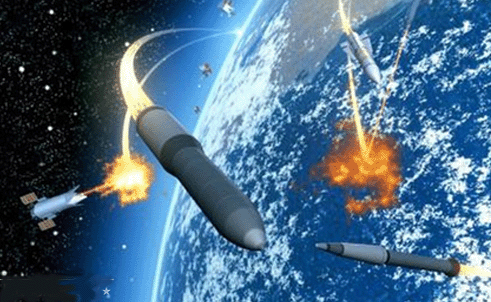
The aerospace industry – the goal is weaponry and global dominance
|
Keep Space for Peace! Save the Heavens fro!m Hegemony https://www.womenagainstmilitarymadness.org/articles/2020/12/22/keep-space-for-peace-save-the-heavens-from-hegemony Bruce K. Gagnon
Recently we learned that the aerospace industry is pushing to turn a former naval air station in Brunswick, Maine, into a spaceport. Promising lots of “high tech” jobs, a bill is being pushed in Augusta, our capital, by some of the most “progressive” legislators in the state. Similarly, we are hearing from many other states where launch complexes are being promoted – from Hawaii to New Mexico to Alaska – that the industry wants some of the most pristine places on Earth to become spaceports. Why? A spaceport in Kodiak Island, Alaska (locals call it “Spacepork”), was built some years ago in spite of overwhelming opposition by local residents. They were promised that it would be used only for civilian launches. So far, all the launches at Kodiak have actually been for Pentagon (and Israeli) space-weapons technology tests. We’ve been hearing for several years now that new companies formed by tech-industry billionaires Elon Musk (whose projects include Tesla and SpaceX) and Jeff Bezos (Amazon, Blue Orbit) plan to launch as many as 35,000 mini-sats (satellites) into orbit. Imagine the enormous hole these polluting launches will punch into the ozone layer. The plan is to have a satellite orbiting over the head of every person on Earth 24 hours a day, making it possible for the new 5G wireless technology system to be profitable. Many questions are being raised about the military (dual-use) applications of these satellites as well. Space Force Earlier this year, Trump was able to “stand up” his new high-tech legacy branch of the military, called the Space Force. Congress was overwhelmingly in favor – that means both parties supported it; the only thing the Democrats (who could have stopped it cold in the House of Representatives) wanted to change was the name ¾ to “Space Corps.” They surrendered on that as well. When the new leaders of the Space Force speak about it, they keep using the word “lean” to describe the new service branch. They want to make it sound as though it won’t be a “fiscal burden” to the nation, especially at a time when we have more unemployment than during the Great Depression. But facts are facts, and I can testify that the aerospace-industry publications have been bragging about since the 1980s when Ronald Reagan first proposed Star Wars, that this would be the largest industrial project in the history of the planet. So $15 billion is just the foot in the door. Where will the funds come from to pay for this? Our entitlement programs ¾ Social Security, Medicare, Medicaid, and what little is left of the social safety net –– are on the chopping block to be sacrificed to the aerospace industry. During his presidency, Trump announced that the U.S. rejects the United Nations Outer Space and Moon Treaties that declare the planetary bodies are the “province of all humankind” – meaning that no nation, corporation, or individual can claim ownership of them. Thus the way is open for a new gold rush to grab the planets for resource extraction. And, if Biden were to continue Obama’s legacy, the way will be paved. The Real Missions of Space Force In 2015, Obama signed the U.S. Commercial Space Launch Competitiveness Act into law. The act grants companies the rights to whatever they manage to pluck out of these extraterrestrial bodies. Effectively an extension of capitalism into space, the bill is one of the few during Obama’s presidency that received widespread support from the GOP as well as from the Democrats, because apparently nothing screams bipartisanship louder than asteroid mining. (Asteroids are rocky and metallic objects that orbit the sun but are smaller than planets.)[1] “This is the single greatest recognition of property rights in history,” said Eric Anderson, a founder of Planetary Resources, Inc., a company whose mission it is to mine asteroids. “This legislation establishes the same supportive framework that created the great economies of history, and will encourage the sustained development of space.” I’ve long believed that the Space Force (and before that the Space Command) will have two primary missions: first, to give the U.S. and its Western capitalist allies “control and domination” of Earth; and secondly, the Space Force will be given the task to create the technologies to “control and dominate” the pathway on and off our sacred Mother Earth. In 1989, the U.S. Congress published an internal study called “Military Space Forces: The Next 50 Years.” In this study, the congressional staffer who wrote it explained the need to control the pathway between the Earth and the Moon. He suggested that armed space stations on either side of the Moon would allow the Pentagon to seize the “Earth-Moon gravity well.” He wrote: “Armed forces might lie in wait at that location to hijack rival shipments on return.” So this plan has been in the works for many years – in fact, since a former Nazis first briefed Congress back in 1958. From Nazi Rocket Science to the U.S. Militarizing Space Program Walter Dornberger was Hitler’s head man in charge of his World War II era V-1 and V-2 rocket program. He was the staff link between rocket scientist Wernher von Braun and Hitler. Dornberger, like von Braun and 1,600 other Germans, was smuggled into the U.S. after the war in the secret military program called Operation Paperclip. Speaking at a congressional hearing in 1958, Dornberger insisted that America’s first space priority ought to be to “conquer, occupy, keep and utilize space between the Earth and the Moon.” There has been unanimity in the halls of Congress since Dornberger’s testimony – both parties have faithfully kept the funding for the militarized space program alive and growing. Dornberger would be happy today to see that his Nazi prophecy has largely come to fruition. International Treaties and an Achilles Heel The U.S. has been leading the way to militarize and weaponize space since the beginning of WW II. For a while the former Soviet Union was in the game – until its collapse in 1991. Neither Russia nor China could keep up with the U.S. in the ensuing years, and they continually begged the U.S. to join them in negotiating a treaty to ban all weapons in space – in other words, close the door to the barn before the horse gets out. During Republican and Democrat administrations since Bill Clinton, the response to Moscow and Beijing was the same from Washington – NO. So Russia and China slowly but steadily have moved forward since the early 1990s and have begun to close the space gap – always continuing to urge the creation of a space-weapons ban treaty. But Washington still refuses to even consider it. In fact, the U.S. has gone in the opposite direction of international treaties under Trump – pulling out of the Anti-Ballistic Missile Treaty (ABM), Intermediate-Range Nuclear Forces Treaty (INF), and the Iran Nuclear Deal. Will the U.S. under Biden renew the Strategic Arms Reduction Talks (START), which run out in 2021? It’s all really quite simple – the U.S. has not wanted to be bound by any treaties that limit its goal for “control and domination.” One could say the U.S. has become a renegade or pirate nation controlled by the soulless corporate agenda, which is all about power and greed. This all makes the job of the Global Network[2] terribly difficult. Since our founding in 1992 we’ve been working hard to build an international constituency to keep space for peace. The corporate agenda is determined to block any progress toward that goal. But I’ve always maintained that like everything else, the aerospace industry and its Star Wars project has an Achilles heel. It’s money. The current global virus pandemic is only bringing this reality to bear as never before. We Must Stop an Arms Race in Space! If we hope to beat this insane and provocative plan, then we must starve the beast. We can do that by bringing our national priorities down to earth and fighting for social progress – for programs like Medicare for All and funding to deal with our real problem today: climate crisis. Please help us beat the expensive and dangerous Space Force by demanding our government provide programs that honor life on this lovely planet. Best wishes to all of you. Keep your spirit strong! ~ Bruce K. Gagnon is coordinator of the Global Network Against Weapons & Nuclear Power in Space (keepspace4peace.org) and lives in Bath, Maine. He began working on space issues in 1982. Endnotes [1] Definition from solarviews.com [2] Global Network Against Weapons & Nuclear Power in Space |
|
|
Nuclear Ban Treaty obligates countries to assist nuclear victims and remediate environments
Policy Approaches Addressing the Ongoing Humanitarian and Environmental Consequences of Nuclear Weapons: A Commentary, Wiley Online Library Nate Van Duzer Alicia Sanders‐Zakre 20 January 2021 https://doi.org/10.1111/1758-5899.12870
Abstract
The 2017 Treaty on the Prohibition of Nuclear Weapons (TPNW) not only bans nuclear weapons, it obligates its states parties to engage in assisting victims and remediating contaminated environments (Articles 6 and 7). As states and civil society consider the best methods to implement these provisions, it is important to take stock and review existing policy approaches addressing the ongoing humanitarian and environmental consequences of nuclear weapons. This practitioner commentary, written by members of the International Campaign to Abolish Nuclear Weapons (ICAN), which was awarded the 2017 Nobel Peace Prize for its advocacy for the TPNW, reviews existing programs of victim assistance and environmental remediation. It highlights key considerations for policy makers seeking to improve on the existing mechanisms.
……….. Key takeaways
Dozens of identified sites around the world remain contaminated by nuclear weapons use, production and testing, and there is no one standard for their remediation. Notably, there is no widely accepted standard to determine how clean is clean, or how to monitor radiation levels over time. Speed and thoroughness of cleanup vary widely as well, and the cost to remediate each site ranges from millions of US$ to billions. Even remediated sites are often still somewhat closed to the public. The nuclear‐armed states have historically done the most to direct and carry out the cleanup of sites, even if the test site is not under those states’ jurisdiction. However, nuclear‐armed states do not always respond to local requests for action. https://onlinelibrary.wiley.com/doi/10.1111/1758-5899.12870
5 nuclear activities that are now Illegal under international law
 Here are five examples of the type of activities that will be Illegal under international law on 22 January 2021 https://nukewatch.org/new-and-updated-item/here-are-five-examples-of-the-type-of-activities-that-will-be-illegal-under-international-law-on-22-january-2021/
One of the main problems with talking about nuclear weapons is that it often becomes abstract and hypothetical. Most people barely know which countries have nuclear weapons and do not know to what extent other actors are involved in maintaining and upholding nuclear weapons.
WHAT THE TREATY PROHIBITS
Article 1 of the treaty prohibits states parties from developing, testing, producing, manufacturing, transferring, possessing, stockpiling, using or threatening to use nuclear weapons, or allowing nuclear weapons to be stationed on their territory. It also prohibits them from assisting, encouraging or inducing anyone to engage in any of these activities.
#1: THE TREATY BANS THE DEVELOPMENT OF NEW NUCLEAR WEAPONS SYSTEMS
Right now, all nuclear armed states are quantitatively or qualitatively advancing their nuclear arsenals, to the tune of nearly $73 billion in 2019 alone. Developing nuclear weapons is banned for states parties in Article 1(a) of the treaty. So activities like India’s Agni-V intercontinental ballistic missile? Banned under international law. Pakistan’s Babur-3 submarine-launched ballistic missile? Banned under international law. North Korea’s’ growing nuclear warhead arsenal? Banned under international law. Nuclear-armed states may not be legally obligated to comply with a treaty they haven’t joined. But their behavior contradicts this new instrument of international law and the growing norm it represents.
#2: THE TREATY BANS ASSISTING WITH DEVELOPING NUCLEAR WEAPONS
Dozens of U.S. universities are involved in the U.S. nuclear weapons complex, including through direct management and research partnerships with the laboratories that design and can produce nuclear weapons components. The University of California, Texas A&M University, Johns Hopkins University, the Massachusetts Institute of Technology, and the University of Rochester receive billions in contracts to directly manage laboratories that work on nuclear weapons. The University of California and Texas A&M University are both operators of the Los Alamos National Laboratory, which provides design and engineering for several nuclear warhead types, conducts simulated experiments to evaluate warheads, and has the capacity to produce plutonium pits, the core material for nuclear warheads. An average-sized U.S. nuclear weapon, that could be designed and developed at Los Alamos overseen by the University of California and Texas A&M University, detonated over the center of Paris would immediately kill over 500,000 civilians, and injure more than one million, causing third-degree burns all the way out to the suburbs.
From 22 January 2021, these universities, and others that are participating in the development and production of nuclear weapons, are carrying out activities that are banned under international law. Students should demand their universities focus on research to save lives, not end them.
#3: THE TREATY BANS THE HOSTING OF NUCLEAR WEAPONS
Article 1(g) of the TPNW explicitly prohibits allowing the stationing, installation or deployment of nuclear weapons.
|
There are five countries in the world that are currently engaged in this soon to be banned behaviour: Belgium, Germany, the Netherlands, Italy, and Turkey.These five countries currently host collectively about 150 U.S. nuclear weapons at bases on their territory. The fact is, there are likely more nuclear weapons in Italy than in North Korea. Not only does the continued hosting of U.S. nuclear weapons run contrary to international law, it also flies in the face of public opinion. Less than one-third of the public in most nuclear hosting states support the continued existence of weapons of mass destruction on their soil. A recent poll in Belgium shows that 77% of Belgians want their government to join the TPNW. #4: THE TREATY BANS THE MANUFACTURING OF NUCLEAR WEAPONSEven outside of nuclear-armed states companies contribute to the development and production of nuclear weapons. Belarus’ Minsk Automotive Factory manufactures mobile launchers for a Russian intercontinental ballistic missile. The multinational Airbus Group, headquartered in the Netherlands, contributes through a German-headquarted subdivision to the development and production of the French submarine-launched ballistic missiles. These companies are engaging in activities outlawed under international law. There is a growing trend for financial institutions to divest from companies producing weapons banned under international law. If these companies do not choose to adhere to the new norm on nuclear weapons, they may pay the price. #5: THE TREATY BANS ENCOURAGING THE USE OF NUCLEAR WEAPONSNuclear-armed states are always ready to use nuclear weapons. They regularly prepare to use nuclear weapons through joint exercises, where many states contribute to nuclear attack exercises. One example is the annual NATO Steadfast Noon nuclear exercise. Non-nuclear-armed states that participate in these mass murder trial runs would be acting contrary to Article 1(e), the prohibition against encouraging prohibited behaviour. This year, countries like the Czech Republic and Poland contributed conventional aircraft to the Steadfast Noon nuclear strike exercise – something that will be illegal under international law when the TPNW enters into force. CONCLUSIONThe entry into force of the TPNW is the perfect opportunity for all countries, companies, universities and other entities to re-evaluate their relationship to this new international legal standard. Countries producing or hosting nuclear weapons or participating in nuclear strike exercises, as well as the companies manufacturing them and universities helping to design them are acting against international law. All entities should end these illegal activities and join the international community in renouncing nuclear weapons entirely. When the Treaty on the Prohibition of Nuclear Weapons (TPNW) enters into force on 22 January 2021, that will need to change. |
|
|
Protest rally against University of Arkansas’ involvement with nuclear weapons corporation
 Group protests UA involvement with nuclear corporation, https://www.nwahomepage.com/news/group-protests-ua-involvement-with-nuclear-corporation/ by: Megan Wilson, Jan 22, 2021, FAYETTEVILLE, Ark. (KNWA/KFTA) – Northwest Arkansans join peace groups around the world celebrating an international treaty on prohibiting nuclear weapons.
A group gathered at the University of Arkansas to protest its contract with the nuclear weapons corporation Honeywell International.
Abel Tomlinson is the founder of Arkansas Non-Violence Alliance.
He said the University contradicts its mission statement by building non-nuclear components for the bombs.
“Its mission statement says that they’re ‘determined to build a better world.’ and we belive that building nuclear bombs is the complete opposite of that. Nobody should be having them. They’re endangering everyone, it’s unacceptable,” Tomlinson said.
The University of Arkansas was aware of today’s protest, but did not wish to comment.
Arab League hails passing of Treaty on Prohibition of Nuclear Weapons
 Arab League hails passing of Treaty on Prohibition of Nuclear Weapons, Business Standard, 24 Jan 21, The Treaty on the Prohibition of Nuclear Weapons was adopted in July 2017 and was opened for signature in September 2017
The Arab League has welcomed the Treaty on the Prohibition of Nuclear Weapons, commonly known as the Nuclear Weapon Ban Treaty’s coming into force and urged for intensifying international efforts to establish a nuclear-weapon-free zone in the Middle East.
In a statement on Friday, AL Secretary-General Ahmed Aboul-Gheit descibed the move as an important step towards the disarmament and the non-proliferation of nuclear weapons in the world, reports Xinhua news agency.
He explained that the Arab countries were supportive of international efforts during the negotiation process for this treaty, “despite Israel’s boycott of this path as an extension of its anti-nuclear disarmament policies and its stances opposing international efforts aimed at getting rid of nuclear weapons, especially in the Middle East”.
“It is time to intensify efforts to establish a nuclear-weapon-free zone in the Middle East, which is fully consistent with the objectives of this treaty,” the AL chief said… https://www.business-standard.com/article/international/arab-league-hails-passing-of-treaty-on-prohibition-of-nuclear-weapons-121012300306_1.html
The nuclear weapons ban treaty is groundbreaking, even if the nuclear powers haven’t signed
 The nuclear weapons ban treaty is groundbreaking, even if the nuclear powers haven’t signed https://theconversation.com/the-nuclear-weapons-ban-treaty-is-groundbreaking-even-if-the-nuclear-powers-havent-signed-153197January 22, 2021 Tilman Ruff, Honorary Principal Fellow, School of Population and Global Health, University of Melbourne, Today, many around the world will celebrate the first multilateral nuclear disarmament treaty to enter into force in 50 years.The UN Treaty on the Prohibition of Nuclear Weapons (TPNW) was adopted at the United Nations in 2017 and finally reached the milestone of 50 ratifications in October. The countries that have signed and ratified include Austria, Ireland, Mexico, New Zealand, South Africa, Nigeria and Thailand. The nuclear weapons ban treaty is groundbreaking, even if the nuclear powers haven’t signed https://theconversation.com/the-nuclear-weapons-ban-treaty-is-groundbreaking-even-if-the-nuclear-powers-havent-signed-153197January 22, 2021 Tilman Ruff, Honorary Principal Fellow, School of Population and Global Health, University of Melbourne, Today, many around the world will celebrate the first multilateral nuclear disarmament treaty to enter into force in 50 years.The UN Treaty on the Prohibition of Nuclear Weapons (TPNW) was adopted at the United Nations in 2017 and finally reached the milestone of 50 ratifications in October. The countries that have signed and ratified include Austria, Ireland, Mexico, New Zealand, South Africa, Nigeria and Thailand.
The treaty completes the suite of international bans on all major weapons considered unacceptable because of their indiscriminate and inhumane effects, including anti-personnel landmines, cluster munitions, biological and chemical weapons. The countries that have signed the TPNW were fed up with over half a century of the nuclear-armed states flouting their obligation to rid the world of their weapons. They have asserted the interests of humanity and global democracy in a way the nuclear-armed states were powerless to stop. It is certainly long overdue for the most cruel and destructive weapons of all — nuclear weapons — to be banned. But this treaty is a sign of hope — a necessary and important step toward a less destructive planet. What will the treaty do?The aim of the treaty is a comprehensive and categorical ban of nuclear weapons. It binds signatories not to develop, test, produce, acquire, have control of, use or threaten to use nuclear weapons. States also cannot “assist, encourage or induce” anyone to engage in any activity prohibited under the treaty — essentially anything to do with nuclear weapons. The TPNW strengthens the current nuclear safeguards found in the 1970 Treaty on the Non-Proliferation of Nuclear Weapons by requiring all states that join to have comprehensive provisions in place and not allowing states to weaken their existing safeguards. The treaty provides the first legally binding multilateral framework for a process by which all nations can work toward eliminating nuclear weapons. For instance, states with another nation’s nuclear weapons stationed on their territory must remove them. States with nuclear weapons can “destroy then join” the treaty, or “join then destroy”. They must irreversibly dismantle their weapons, as well as the programs and facilities to produce them, subject to agreed timelines and verification by an international authority. Further, the TPNW is the first treaty to commit member nations to provide long-neglected assistance for the victims of atomic bombs and weapon testing. It also calls for nations to clean up environments contaminated by nuclear weapons use and testing, where feasible. Nuclear-armed states have been put on noticeCurrently, 86 nations have signed the TPNW, and 51 have ratified it (meaning they are bound by its provisions). The treaty now becomes part of international law, and the number of signatories and ratifications will continue to grow. However, none of the nine nuclear powers — the US, China, Russia, France, the UK, India, Pakistan, Israel and North Korea — have yet signed or ratified the treaty. Many other countries that rely on other nations’ nuclear weapons for their security, such as the 27 members of NATO, Australia, Japan and South Korea, have also not signed. So, why does the treaty matter given these states currently oppose it? And what effect can we expect the treaty to have on them? While any treaty is technically only binding on the states that join it, the TPNW establishes a new international legal standard against which all nuclear policies will now be judged. The treaty, in short, is a game-changer, and the nuclear-armed and dependent countries have been put on notice. They know the treaty jeopardises their claimed right to continue to threaten the planet with their weapons, as well as their plans to modernise and maintain their nuclear arsenals indefinitely. The strength of their opposition is a measure of the treaty’s importance. It will have implications for everything from defence policies and military plans to weapons manufacturing to financial investments in the companies that profit from making now illegal nuclear weapons. For example, a growing number of banks, pension funds and insurance companies around the world are now divesting from companies that build nuclear weapons. These include the Norwegian Pension Fund (the world’s largest sovereign wealth fund), ABP (Europe’s largest pension fund), Deutsche Bank, Belgium’s largest bank KBC, Resona Holdings, Kyushu Financial Group and Mitsubishi UFJ Financial Group in Japan, and the Japanese insurance companies Nippon Life, Dai-ichi Life, Meiji-Yasuda and Fukoku Mutual. A ‘dangerous’ belief nuclear weapons enhance securityWould joining the treaty mean nations like Australia, Japan, South Korea and NATO members would have to end their military cooperation with nuclear-armed states like the US? No. There is nothing in the TPNW that prevents military cooperation with a nuclear-armed state, provided nuclear weapons activities are excluded. Countries like New Zealand and Kazakhstan have already demonstrated that joining the treaty is fully compatible with ongoing military cooperation with, respectively, the US and Russia. In a recent letter urging their governments to join the treaty, 56 former presidents, prime ministers and defence and foreign ministers from these nations said
The signatories include two former NATO secretaries-general, Willy Claes and Javier Solana. Ban treaties have been proven to work with other outlawed weapons — landmines, cluster munitions and biological and chemical weapons. They have provided the basis and motivation for progressive efforts to control and eliminate these weapons. They are now significantly less produced, deployed and used, even by states that haven’t joined the treaties. We can achieve the same result with nuclear weapons. As Hiroshima survivor Setsuko Thurlow said at the UN after the treaty was adopted, This is the beginning of the end of nuclear weapons. |
|
|
Russia welcomes US proposal to extend New Start nuclear treaty
Russia welcomes US proposal to extend nuclear treaty, 9 News, By Associated Press
More than half of public supports UK joining UN ban on nuclear weapons.
The National 22nd Jan 2021, More than half of public supports UK joining UN ban on nuclear weapons.
https://www.thenational.scot/news/19029821.half-public-supports-uk-joining-un-ban-nuclear-weapons/
Despite Covid regulations, 22 nuclear bombs delivered to Scotland

As many as 22 nuclear warheads were transported from England to Scotland in eight road convoys during 2020 despite coronavirus restrictions, according to a new report by campaigners.
Another bomb convoy arrived at the Royal Naval Armaments Depot at Coulport in Argyll on 15 January and set off south to the nuclear weapons factory at Burghfield in Berkshire on 20 January during a ban on non-essential travel.
Nukewatch, which monitors the convoys, accused the UK Ministry of Defence (MoD) of taking “disregard for public safety to a new low”. Critics and politicians questioned whether the convoys were essential…..
A historic United Nations treaty banning nuclear weapons came into force on 22 January 2021 after being signed by 51 countries. It is supported by the Scottish Government, but opposed by the UK Government.
Convoys comprising 20 or more vehicles regularly transport Trident nuclear warheads by road between Coulport and Burghfield for maintenance and upgrades. They are tracked and filmed by activists, and often travel close to Glasgow, Edinburgh, Newcastle, Manchester and Birmingham.
The Ferret reported in May 2018 that safety problems plaguing the convoys had risen to a record high. The total number of incidents logged by the MoD over ten years was 179.
A historic United Nations treaty banning nuclear weapons came into force on 22 January 2021 after being signed by 51 countries. It is supported by the Scottish Government, but opposed by the UK Government.
Convoys comprising 20 or more vehicles regularly transport Trident nuclear warheads by road between Coulport and Burghfield for maintenance and upgrades. They are tracked and filmed by activists, and often travel close to Glasgow, Edinburgh, Newcastle, Manchester and Birmingham.
The Ferret reported in May 2018 that safety problems plaguing the convoys had risen to a record high. The total number of incidents logged by the MoD over ten years was 179……..
Jane Tallents from Nukewatch criticised the MoD for ignoring lockdown travel bans. “We call on the MoD to suspend these non-essential movements at least while the Covid restrictions are at this high level,” she told The Ferret.
“The emergency plans for dealing with a serious accident while transporting nuclear weapons always looked inadequate to us. But travelling while all our hospitals are near to being overwhelmed by the pandemic is taking the MoDs disregard for public safety to a new low.
“The resources are just not available to organise an evacuation and tell people to take shelter near to the site of a radiation leak from a damaged warhead in transit especially in any of the high population areas they travel through.”
Tallents pointed to evidence that the warhead convoy often broke down. “We are told to trust their safety record with nuclear weapons but it appears they can’t even manage to keep their vehicles roadworthy,” she said.
The Nuclear Information Service, which researches nuclear weapons, also urged the MoD to stop bomb convoys during Covid restrictions. “I can’t see any reason for the convoys to happen during lockdown,” said the group’s director, David Cullen.
“I’m sure there’s enough leeway in the programme to work around the restrictions if they wanted to. There’s no way drivers and security staff can maintain safe distances within the convoy vehicles.”
He added: “The government owes Scotland an explanation, and I’d like to see them release the risk assessment they used to justify this.”
The Scottish Greens also disputed whether the bomb convoys were essential. “It is deeply irresponsible to have weapons of mass destruction on our roads, especially at the moment,” said Green MSP, Mark Ruskell.
“They increase the risk of being targeted by terrorist groups, and although the likelihood of a catastrophic incident remains slim, the implications of a safety breach would be horrific and impossible to contain.” https://theferret.scot/22-nuclear-bombs-scotland-covid/
The 70-year nuclear gloom begins to lift on January 22
Abolishing Nuclear Weapons: A New Chance, https://portside.org/2021-01-19/abolishing-nuclear-weapons-new-chance– 20 Jan 21,
The 70-year nuclear gloom begins to lift on January 22, 2021. The nine countries that have held the world captive to the threat of nuclear war are losing moral ground to 122 smaller countries that approved the world’s first nuclear weapons ban.
The 70-year nuclear gloom begins to lift on January 22, 2021. The nine countries that have held the world captive to the threat of nuclear war are losing moral ground to 122 smaller countries that approved the world’s first nuclear weapons ban in July 2017. Once 50 of those 122 approving countries completed the ratification process of the UN Treaty for the Prohibition of Nuclear Weapons in their legislatures, it became international law in October 2020.
The law goes into effect January 22, 2021 to the profound relief of most people of the world. Those now 51 “freedom fighter” countries commit to having nothing to do with nuclear weapons – no design, testing, manufacturing, storage, transport, use or threat of use. Consider this a marathon for disarmament to outpace the current nuclear arms race in which all nuclear-armed countries are, in lockstep, upgrading their weapons.
And this is only the beginning. Thirty five additional countries are in the process of ratifying the Treaty; 50 more support the Treaty; a dozen more have immense popular support, among them Canada, and are one election away from signing the Treaty. If the United States, where a majority of citizens does not want to use nuclear weapons, signed the Treaty, the rest would follow.
Actions of note:
- The General Electric Company stopped production of nuclear weapons in 1993.
- Two of the world’s largest pension funds have divested from nuclear weapons.
- Mitsubishi UFG Financial Group, 1 of the 5 largest banks in the world, has excluded nuclear weapons production from its portfolio, labeling them “inhumane.”
- Kennedy and Khrushchev were working toward the abolition of nuclear weapons when Kennedy was assassinated.
- Reagan and Gorbachev agreed to a radical dismantling of their nuclear weapons.
- Our goal must be a world “without nuclear weapons… “nuclear war cannot be won and must never be fought:” Former Republican Secretary of State George Schultz and former Democrat Secretary of Defense William Perry.
- Mayors for Peace: 7675 cities in 163 countries support the total abolition of nuclear weapons.
- 56 former presidents, prime ministers, foreign and defense ministers from 20 NATO countries and Japan and South Korea recently signed an open letter in support of the UN treaty to ban nuclear weapons. “Sooner or later our luck will run out – unless we act…There is no cure for a nuclear war,” they asserted. “Prevention is our only option.”
- Pope Francis: “The use of atomic energy for purposes of war is immoral. As is the possession of atomic weapons.”
A limited nuclear war could trigger a global famine that would likely end billions of lives. A full scale nuclear war would end human and most other life on Earth, reminding us of the classical depiction of total war: they had to destroy the village to save it. A nuclear war, whether by accident, misjudgment or intention to destroy the enemy would destroy the rest of us as well – how insane is that?
What then can President-elect Biden do?
Open dialogue with and renew nuclear agreements and diplomacy with Russia immediately.
Change US policy in 3 key ways: No first use of nuclear weapons; take weapons off of hair trigger alert; and select another senior official to share decision-making about “pressing the button.”
Revive the agreement with Iran: they do not develop nuclear weapons, we lift sanctions.
With South Korea, engage in diplomacy with North Korea to freeze and roll back their nuclear weapons program.
Stop the new program of upgrading nuclear weapons.
Listen to the world’s majority and lead the United States toward signing the new UN Treaty and the others will follow. It is our only solution to exit a dead-end system that permits a single human being, in the words of national security analyst Joseph Cirincione, “to destroy in minutes all that humanity has constructed over millennia.”
Pat Hynes, retired from Boston University, is on the board of the Traprock Center for Peace and Justice https://traprock.org.
Biden can’t ignore that continuing crisis -the danger of nuclear annihilation.
|
Biden can’t lose sight of the nuclear crisis, https://www.washingtonpost.com/opinions/2021/01/19/biden-cant-lose-sight-nuclear-crisis/ by Katrina vanden Heuvel, Columnist, Jan. 20, 2021 At Wednesday’s inauguration, President-elect Joe Biden is likely to address the “four historic crises” he has repeatedly identified as confronting our country: a global pandemic, a severe recession, climate change and systemic racism. Yet even as so many challenges compete for our attention, we can’t afford to lose sight of a fifth crisis: the continued danger of nuclear annihilation. Overlooking the nuclear crisis might feel unthinkable for Americans who came of age during the Cold War, when nuclear destruction preoccupied our collective imagination. In 1983, for instance, 100 million Americans watched “The Day After,” a made-for-TV movie that depicted a potential nuclear holocaust. As detailed in a recent documentary, its haunting images — which included a mushroom cloud erupting over the plains of Kansas and scorching bodies in its blast radius — terrified viewers, including President Ronald Reagan. And it spurred our political leaders to join millions of grass-roots activists around the globe in taking action to prevent nuclear war. While nuclear conflict has largely faded from public consciousness, it still poses a clear and present danger. America is now locked in a new Cold War with Russia, with multiple direct engagements between the two countries’ forces and rising tensions between Russia and the United States’ NATO allies. Meanwhile, the United States and Russia still maintain nearly 2,000 atomic bombs on hair-trigger alert. It’s no wonder that, last year, the Bulletin of the Atomic Scientists adjusted its Doomsday Clock to reflect an increased likelihood of global annihilation. It is high time to step back from the brink of catastrophe. Fortunately, Biden has long championed stronger nuclear arms controls. And his administration can act immediately to make our world safer. Biden will have just two weeks to complete the first move, as the New Strategic Arms Reduction Treaty (New START) between the United States and Russia is set to expire on February 5. Negotiated by the Obama administration, the pact limits the capabilities of the two countries’ respective nuclear arsenals. Allowing it to lapse would represent yet another blow to the international arms control framework that protected us for decades and is being systematically dismantled. President George W. Bush, for instance, ended America’s Anti-Ballistic Missile Treaty with Russia. And President Trump pulled us from the Open Skies Treaty despite the pleas of our allies. The good news is that both Biden and Russian President Vladimir Putin have expressed willingness to reverse that dangerous trend and extend New START — which can be accomplished through a simple exchange of diplomatic letters. The Biden administration should make this goal an immediate priority. Preserving New START, while an important step, should also be exactly what it sounds like: a start. There are many other actions Biden should take to reduce the likelihood of nuclear conflict — and move our nation further toward the ultimate goal of abolishing all nuclear weapons. Former defense secretary William Perry and nuclear scholar Tom Collina outline a series of strong steps in their recent book, “The Button.” One key suggestion is retiring the nuclear football that gives presidents the sole discretion to launch atomic attacks. Even after Trump was banned from tweeting, he still wielded unfettered power to destroy the world. We can’t ever allow that situation to repeat itself. All subsequent presidents should have to share this authority with a select group from Congress. Biden should also scrap the Trump administration’s plans to spend $264 billion on a new generation of intercontinental ballistic missiles (ICBMs). These land-based weapons offer little military value, since our nuclear-armed submarines can already retaliate against another country’s first strike. And building more ICBMs only heightens our very real risk of accidentally launching a nuclear war. These actions should be accompanied by a broader reimagining of our national security. America is poised to spend $2 trillion over the next 30 years replacing every Cold War submarine, bomber, missile and warhead. These expenditures aren’t driven by military necessity or grand strategic plan, but they do have the support of hundreds of defense industry lobbyists. Protracted cold wars with powers like Russia and China aren’t just dangerous — they’re also expensive and distracting. And as America confronts multiple crises, we simply can’t afford to engage in them. We can prevent future conflicts by balancing sober realism with well-measured diplomacy — including reestablishing bonds with the many long-standing allies Trump spurned. As former governor Jerry Brown (D-Calif.) argued in a just-released open letter to Biden, reopening dialogue with Russia around the nuclear crisis would allow us to end the arms race and free up resources to enact the core elements of Biden’s agenda — from delivering covid-19 relief to combating climate change to advancing racial justice. While the destruction portrayed in “The Day After” no longer dominates our public consciousness, the threat of nuclear war remains a vital issue. Today, those who understand what is at stake should recapture the energy of previous generations and ensure our new administration understands the danger we face. In the words of Perry and Collina: “We need to bring the bomb into the new mass movement.” The president-elect must recognize both the danger — and the opportunity — at hand. |
|
|
1 This Month





PLEASE OPPOSE HR 8255 AND S.3639 – bills would accelerate satellite deployment, with no environmental review or safeguards – https://ncstd5li.quorum.us/campaign/169331/
To see nuclear-related stories in greater depth and intensity – go to https://nuclearinformation.wordpress.com
-
Archives
- October 2026 (74)
- September 2026 (339)
- August 2026 (330)
- July 2026 (355)
- June 2026 (287)
- May 2026 (306)
- April 2026 (356)
- March 2026 (251)
- February 2026 (267)
- January 2026 (308)
- December 2025 (358)
- November 2025 (359)
-
Categories
- 1
- 1 NUCLEAR ISSUES
- business and costs
- climate change
- culture and arts
- ENERGY
- environment
- health
- history
- indigenous issues
- Legal
- marketing of nuclear
- media
- opposition to nuclear
- PERSONAL STORIES
- politics
- politics international
- Religion and ethics
- safety
- secrets,lies and civil liberties
- spinbuster
- technology
- Uranium
- wastes
- weapons and war
- Women
- 2 WORLD
- ACTION
- AFRICA
- Atrocities
- AUSTRALIA
- Christina's notes
- Christina's themes
- culture and arts
- Events
- Fuk 2022
- Fuk 2023
- Fukushima 2017
- Fukushima 2018
- fukushima 2019
- Fukushima 2020
- Fukushima 2021
- general
- global warming
- Humour (God we need it)
- Nuclear
- RARE EARTHS
- Reference
- resources – print
- Resources -audiovicual
- Weekly Newsletter
- World
- World Nuclear
- YouTube
-
RSS
Entries RSS
Comments RSS

