According to the Cuban Foreign Ministry’s website, the country’s ratification expresses its support for the complete and effective prohibition of all explosive tests, other sophisticated methods and subcritical trials.
With the action, Cuba also confirms its condemnation of the rise in expenditures to enhance such experiments, while calling for the closure of the facilities used for such purposes and their associated infrastructure.
Cuba is a State Party to the Treaty on the Prohibition of Nuclear Weapons, the Treaty on the Non-Proliferation of Nuclear Weapons, and the Chemical and Biological Weapons Conventions.
The CTBT, once in force, will contribute along with those deals to the efforts for the total, transparent and irreversible eradication of those artifacts, the source referred.
Cuba belongs to the first densely populated zone in the world to be declared a Nuclear-Weapon-Free Zone.
In addition, Cuba reaffirms the validity of the Proclamation of Latin America and the Caribbean as a Zone of Peace, adopted at the 2nd Summit of Heads of State and Government of the Community of Latin American and Caribbean States, held in Havana in 2014.
Trident nuclear submarine replacement delayed by another year
Announcement raises new questions as to whether UK’s current ageing fleet can be relied on, Guardian, Dan Sabbagh Defence and security editor. Fri 5 Feb 2021
Britain’s £31bn replacement for its ageing Trident nuclear submarines has been delayed by another year owing the pandemic, raising fresh questions about whether the UK can rely on the existing fleet.
Official documents released at the end of last year quietly confirmed that the current phase of the Dreadnought programme had been put back to March 2022, although the update was not highlighted and it was only spotted by a pressure group.
An SNP member of the defence select committee has now called for it to hold an inquiry into the Trident replacement programme, complaining about a lack of transparency.
An annual update on nuclear replacement, released to MPs before Christmas, said that “recognising the high levels of uncertainty caused by the pandemic” and its impact on supply chains, “delivery phase 2 will continue until March 2022”.
It did not say that this amounted to a one-year delay to the sprawling programme. This was spotted by David Cullen, of the Nuclear Information Service, who recalled a promise made a year earlier to conclude the work in March 2021.
“Covid is going to be with us for a while, and nobody will be surprised if there are other delays to Dreadnought,” Cullen said, arguing that the relative secrecy suggested “this isn’t the behaviour of a department that is confident it can deliver on its promises”.
The Dreadnought programme, first approved by Labour in 2007, has been repeatedly delayed by governments since. The first submarine was initially due to come into service in 2024, then 2028, and now the “early 2030s”, the Ministry of Defence (MoD) says……….
Britain prefers to shroud its nuclear programme in secrecy, but there have been accidents in the past. In 1998 HMS Vanguard, carrying 96 nuclear warheads and 135 crew, plunged into a deep dive following a power failure between Cornwall and the south of Ireland. The crew only managed to regain control through a backup power system.
In February 2009, Vanguard collided with a French nuclear submarine, Le Triomphant, in a freak accident in the Atlantic. Details were initially hushed up, before it was leaked to a newspaper. Fortunately the accident happened at a relatively low speed. Ministers were told that at the time that nuclear safety had not been compromised.
Martin Docherty-Hughes, an SNP member of the defence select committee, said: “It is simply unacceptable that we need to parse UK government statements for half phrases and words which the MoD could be using to cover its own backside.” He said he would be writing to the chair of the committee to demand an inquiry…… https://www.theguardian.com/uk-news/2021/feb/04/trident-nuclear-submarine-replacement-delayed-by-year
US and Russia extend nuclear arms control treaty to 2026 Aljazeera,
Both Washington and Moscow cast the extension as a victory, saying it would provide stability and transparency. 3 Feb 2021
The United States and Russia have finalised an agreement to extend until 2026 a treaty limiting their stockpiles of nuclear weapons.
The New Strategic Arms Reduction Treaty (New START Treaty), which was due to expire on Friday, imposes limits on Russian and US intercontinental missiles and bombers, but does not cover new types of weapons.
Both Washington and Moscow cast the extension as a victory, saying it would provide stability and transparency on nuclear issues while acknowledging some of their disagreements. ………….
Tom Collina of Ploughshares Fund, which advocates for the elimination of nuclear weapons, said Russia’s priority in any new accord would be dealing with the threat it sees to its long-range strategic nuclear arsenal from US missile defences.
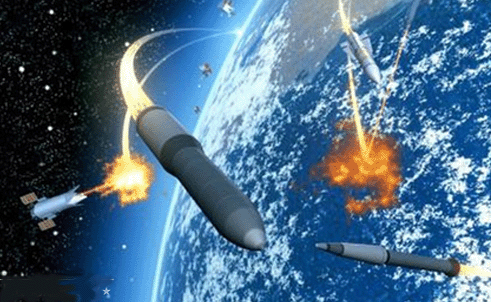
“We must have fully integrated offensive and defensive operations across all of our services, as well as our partners,” says Army Gen. James Dickinson, SPACECOM commander.
Breaking Defense, By THERESAHITCHENSon January 28, 2021 “……… “The intended audience is both internal and external,” Army Gen. James Dickinson told me in an interview yesterday. “Internally, the objective is to set the stage for SPACECOM personnel to develop and sustain a warfighting mindset necessary for our mission challenges in this new warfighting domain.”………
Space Superiority and Warfighting
Dickinson’s eight-page manifesto, “Never A Day Without Space: Commander’s Vision” — provided to Breaking D — was briefed to SPACECOM today. It will be the “baseline” for future development of subordinate SPACECOM planning guidance, campaign plans, operational plans and other organizational documents required to running the 18-month-old Combatant Command, Dickinson explained.
The general’s stress on the need for both ‘offensive and defensive’ operations to achieve space superiority is not new, even if it makes some US security experts — including some Democrats in Congress — a bit queasy. It is one of the first things his predecessor, Air Force Gen. Jay Raymond who now heads the Space Force, made clear when SPACECOM was stood up in August 2019……..
Unified Command Plan and Missions
As Breaking D readers were first to learn, the revised UCP sent by Chairman of the Joint Chiefs of Staff Gen. Mark Milley to President Trump included a number of changes designed to delineate the role of SPACECOM — designated as a new geographic command with an area of responsibility (AOR) from 100 kilometers above the Earth to, well, infinity and beyond in theory — vice the 10 other Combatant Commands. These include giving SPACECOM the lead in deciding who gets priority use of communications satellites during combat, and what targets missile warning and space surveillance sensors are tasked to monitor. Trump signed the revised 2020 UCP Jan. 13, a spokesperson for the Joint Staff confirmed……..
Dickison elaborated during his conversation with Mitchell Institute Dean Dave Deptula that SPACECOM now has three primary missions: “One, our enduring, no-fail mission to enable warfighting operations in other domains. Two, our future mission as global SATCOM manager and global sensor manager. And three, our current new mission set compelling us to fight and win in the space domain in order to protect and defend our interests there.
“Additionally, this warfighting domain is growing, and this AOR is by far the biggest and is getting bigger, each day,” he added………
The ‘protect and defend’ mission, which would include any offensive action in a conflict, is carried out by the Joint Task Force Space Defense, commanded by Brig. Gen. Tom James. ………
Despite the new UCP, however, Dickinson was coy with me about how exactly the decisions about who supports whom when are actually made, and at what level of the US military hierarchy. “Command decisions reside with the Combatant Commander,” he said, although “many of those decisions may be made well above us depending on the situation.”
Some of this, he said, is because such details remain classified. However, a number of sources intimately familiar with these issues tell me that a big problem is that there simply hasn’t yet been any agreements codified on how those decisions will be made. The hope is that the impending Joint Warfighting Concept, in which space plays a central role, will go some ways toward clarifying those questions………… https://breakingdefense.com/2021/01/spacecoms-new-vision-targets-space-superiority/
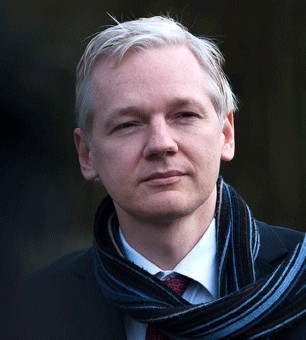
A Nobel Peace Prize for Julian Assange! https://melenchon.fr/2021/01/28/un-prix-nobel-de-la-paix-pour-julien-assange/Thursday 28 January 2021, I decided to nominate journalist Julian Assange for the Nobel Peace Prize, as I have the power to do as a parliamentarian. Julian Assange is a hero of freedom. The WikiLeaks initiative has raised awareness of war crimes and serious human rights abuses. It is right that the peoples of the world express their gratitude to him.
On January 4, 2021, British justice refused his extradition to the United States, but maintained his imprisonment. More than ever, Julian Assange needs the protection of the peoples of the world. Granting him the Nobel Peace Prize would allow that.
Several other rebellious parliamentarians will share this process with me. I thus continue my fight for Assange’s freedom. After going to see him in London in 2012, after having held a videoconference meeting with him in 2013, I asked for political asylum in France in 2019 then 2020. At the time, the Minister of Justice Dupont- Moretti made the same request. Julian Assange served France, including revealing the spying on three Presidents by the United States.
I call on all French parliamentarians to in turn commit to having the Nobel Peace Prize awarded to Julian Assange.
The US and Russia have extended the treaty, but it’s not about disarmament
This story was prepared by Linda Pentz Gunter largely derived from information provided by ICAN
The United States and Russia have agreed on extending New START for another five years.
Extending New START is an important action by these two countries after four years that saw both countries undermining arms control agreements. However, it is important to remember that it is not a disarmament step, but rather an extension of the current levels of nuclear arsenals.
Nevertheless, it is a welcome development to see the new US administration and Russia return to where they left off four years ago rather than escalate. It also comes at an auspicious time, as the world has just witnessed the entry into force on January 22, 2021 of the first global treaty to ban nuclear weapons, the Treaty on the Prohibition of Nuclear Weapons (TPNW).
The United States and the Russian Federation agreed on January 26, 2021 to extend the bilateral cap on U.S. and Russian nuclear arsenals, the New Strategic Arms Reduction Treaty (New START) for five additional years. …………
New START is important for a number of reasons:
The extension of New START prevents backsliding on nuclear disarmament. However, additional steps will now be needed to make progress on disarmament.
Since the United States and Russia first agreed to this current cap on nuclear arsenals in 2010, the international community has negotiated, adopted and brought into force a treaty banning nuclear weapons: nuclear weapons are illegal under international law. So, even as the US and Russia may cap nuclear weapons expansion, they remain outlaw pariah states in the eyes of the world as long as they continue to hold onto nuclear weapons.
Throughout the time the New START agreement has been in place, Russia and the United States have spent billions each year to build new nuclear weapons systems. This is now banned under international law (although non-parties to the TPNW are not bound by it). Under current global pandemic conditions, this kind of spending is even more immoral and obscene.
With the New START quickly extended and the TPNW in force, the groundwork has been laid for significant disarmament advances in the coming four years. The nine nuclear armed states have no excuses not to walk that path. Nuclear disarmament need not seem daring but simply adherence to international law.
Simply staying at the current nuclear weapon levels will not be enough to protect the world from this catastrophic threat. One nuclear missile is one weapon too many. As studies have shown, even unleashing just 100 nuclear weapons (as India and Pakistan could do against each other) would result in global devastation, suffering and famine. Therefore, New START must be seen as just that; a start. But not enough until all nuclear weapons are abolished.
With the TPNW in force, there is a new international standard. Russia, the United States and all nuclear-armed nations must take active steps to move towards compliance with this international treaty and join it.
Even though we have a new presidential administration, the risk of nuclear and climate destruction is the same as it was last year, according to an organization that tracks threats to the survival of humanity.
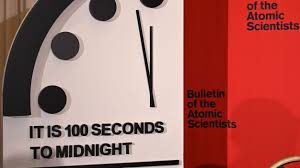
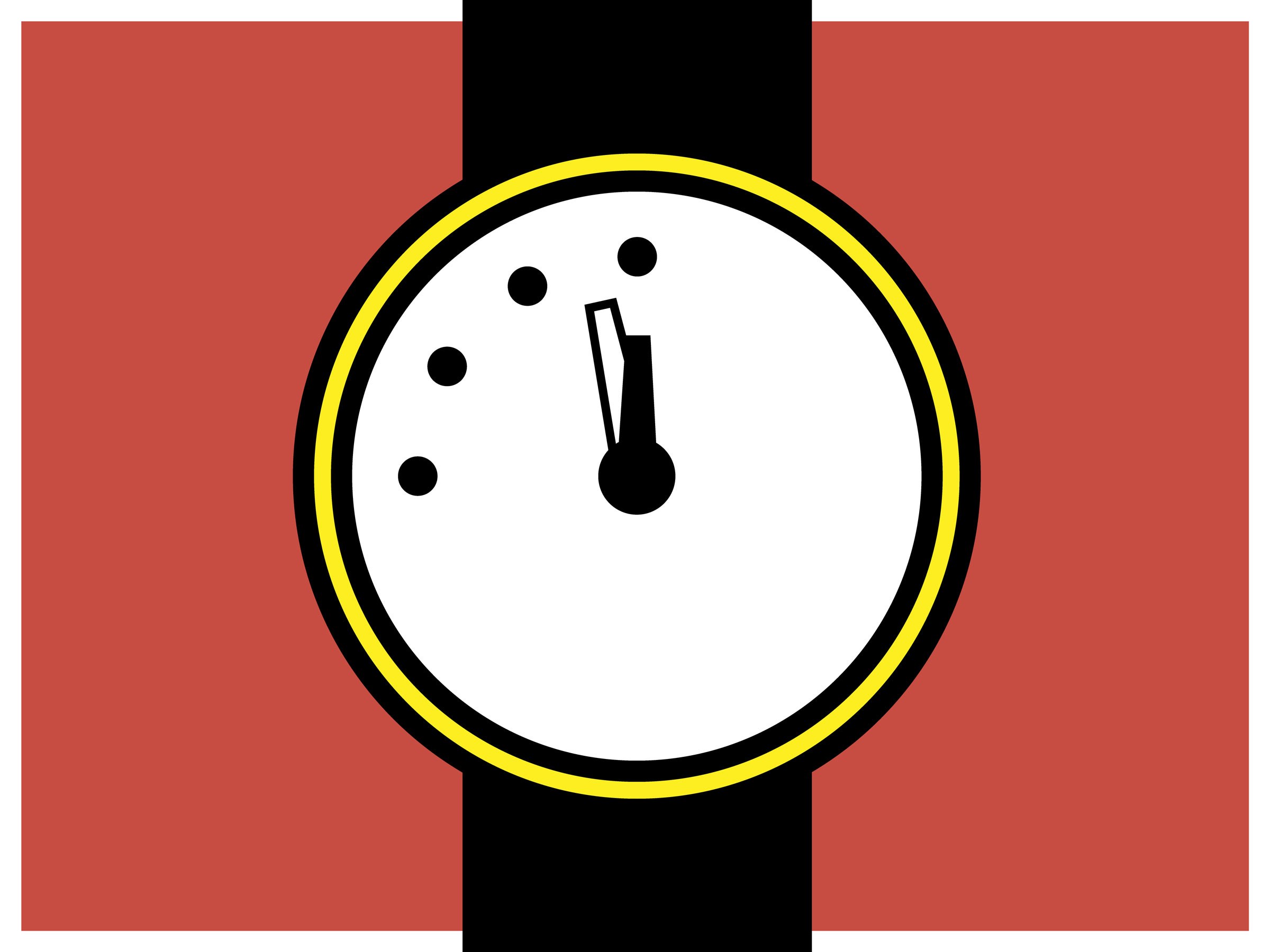
A “Doomsday Clock” has been used by the Bulletin of Atomic Scientists since 1947 to signal how close we are to nuclear war. The closer to midnight, the closer to nuclear winter. The clock also symbolizes other threats, like climate change.
“The hands of the Doomsday Clock remain at 100 seconds to midnight, as close to midnight as ever,” Dr. Rachel Bronson, president and CEO, Bulletin of the Atomic Scientists, said this week. “The lethal and fear-inspiring COVID-19 pandemic serves as a historic ‘wake-up call,’ a vivid illustration that national governments and international organizations are unprepared to manage the truly civilization-ending threats of nuclear weapons and climate change.”
Brian Hesse, a professor of political science at Northwest Missouri State University, said the clock represents the threat of grave disaster. While the clock itself is theoretical, the threats have real-world consequences.
“For example, from an American standpoint the Department of Defense is already seeing rising sea levels are affecting the infrastructure of the largest naval base,” Hesse said. “What they thought they could spend on defending America now has to be diverted to dealing with infrastructure.”
Jerry Brown, the former governor of California, said the United States and Russia must stop “shouting at” each other.
This is the essence of why the time we’re living in is an insane one, of why we’ve reached 100 seconds to midnight: the system can only think to react to the emergence of destabilizing factors by creating even more potential for destabilization. Whether it’s engaging in provocations against rival powers in reaction to the loss of a unipolar world, or driving down the population’s living standards even further in reaction to an economic crash, or reacting to the climate crisis by further engaging in military buildup even though the U.S. military is the world’s largest polluter, the system’s only solution is to move us even further towards our doom while telling us that these decisions are nothing but rational. It’s madness that’s presented to us as the only sensible path forward.
Something feels bizarre about living in the current era, the era in which the Bulletin of the Atomic Scientists just concluded that we’re metaphorically 100 seconds away from the extinction of humanity. This strange feeling has been present for a while now, going back to when the Bulletin’s “Doomsday Clock” reached 2 minutes to midnight in January of 2018 for the first time since 1953.
The Bulletin’s statement from this year on why we’re just 100 seconds away from annihilation cites the fact that “An extremely dangerous global failure to address existential threats”–“-what we called ‘the new abnormal’ in 2019”–“-tightened its grip in the nuclear realm in the past year, increasing the likelihood of catastrophe.” The new abnormal began creeping up in the middle of the last decade, when the U.S. empire reacted to its dwindling hegemony and the rise of its geopolitical rivals by effectively restarting the cold war. Following the beginning of Obama’s pivot to Asia at the beginning of the 2010s, where Washington began a campaign of military buildup against China in the Indo-Pacific, in 2014 Washington installed a fascist regime in Ukraine that started a proxy war with Russia.
Nuclear tensions between the great powers once again flared up, and in January of 2015 the Doomsday Clock was set at 3 minutes to midnight for the first time since 1984. As the threat of World War III continued to escalate during the next few years, with alarming skirmishes breaking out between the U.S. and Russia in Syria and Washington engaging in wild provocations against China and Iran, the clock was for the first time moved to 100 seconds to midnight in January of last year. Given the great risks of further geopolitical tensions the Eurasia Group anticipates for this next year, which will be spurred on by the projected2021 crash of the dollar, it will surprise me if the clock gets further away from midnight next year.
Of course, the clock is only an arbitrary marker of where the global conditions are perceived to be at, one which can give us a kind of comfort purely because of how it provides our psyches with such a simplistic numerical assessment. What more reliably creates psychological horror is examining the practical details behind why the risk of a third world war is now unprecedented. We can intellectually understand the great-power conflict risk estimates that I’ve mentioned and the surface-level causes behind them that I’ve described, but we can’t grasp what they mean without looking at exactly which forces are shaping this historical nightmare. Continue reading →
By Fr. Benedict Mayaki, SJ The first-ever Treaty on the Prohibition of Nuclear Weapons (TPNW) came into force on 22 January 2021 after years of negotiations. The Treaty, welcomed by many as a step towards ridding the world of nuclear weapons, was signed four years after it was adopted by the UN in 2017.
Hailing this recent development, the All-Africa Conference of Churches (AACC), in a statement on Tuesday, expressed its support, together with the rest of the ecumenical community, for the Treaty which now becomes international law.
The ecumenical body said that the Treaty “ushers in the possibilities of heralding a new world free of the threats and tensions that have been characterized by the battle to develop and hold nuclear weapons.”
No safe hands for nuclear weapons
In the Tuesday statement, AACC stated its belief “that the very holding and potential threat of use of nuclear weapons is immoral,” adding that it looks forward to the day “when the world will be freed of these weapons permanently.”
“There are no safe hands for these weapons,” added AACC. “The accidental or deliberate detonation of a nuclear weapon would cause severe, long-lasting and far-reaching harm on all aspects of our lives and our environment throughout the world.”
At the same time, these technologies are “part of structures and systems that bring about great suffering and destruction” and have been the cause of “major tensions and threats of widespread devastation.”
TPNW: inspiration for a nuclear-weapon-free world
In the wake of the entry into force of the Treaty, AACC said that at a time when the world desperately needs fresh hope, the TPNW inspires us to work towards fully eliminating “the threat of nuclear weapons, and to create conditions for peace, justice and well-being.”
AACC also pointed out that the treaty addresses the disproportionate impact of nuclear weapons on women and indigenous peoples, as well as the “importance of victim assistance and healing environmental harms in a groundbreaking way.”
Citing the example of the hibakusha – survivors of the two nuclear attacks launched at Hiroshima and Nagasaki at the end of World War II – AACC noted that their courage and perseverance serve as “the inspiration, guidance and moral foundation” in the quest for a world without nuclear weapons.
Appeal to States
Highlighting that none of the nine nuclear global powers, and many countries with defense pacts with them have signed or ratified the Treaty, AACC pointed out that a lot of work still remains to be done. As at its entry into force, the TPNW was signed by 86 countries and ratified by 51.
n this regard, AACC appealed to the ecumenical global community to make its contribution, in whichever way possible, to participate in the global work for peace, justice and respect for life.
Concretely, the ecumenical body is urging all States to sign and ratify the TPNW, as well as join the first meeting of the State parties scheduled for next year. AACC further calls for decisive action “to strengthen the power of the TPNW upon its entry into force, and to work for peace, cooperation and common security.”
“We must not be discouraged at the slow pace, but become even more determined to push for a better world,” AACC said. “This is part of our mission and we know God is on our side.”
AACC
Founded in Kampala, Uganda, in 1963, the AAAC is an ecumenical association that today has 173 member churches present in 40 African countries, representing over 120 million Christians on the continent. Its headquarters is in Nairobi, Kenya.
Russia extends key New START nuclear treaty, DW, 29 Jan 21, With only days to spare, Russian President Vladimir Putin signed off on the law that would keep the Obama-era nuclear treaty in place. The move follows a phone call with US President Joe Biden.
Moscow agreed to extend the only remaining nuclear arms treaty with the United States for another five years, with Russian President Vladimir Putin signing the move into law on Friday. The decision was previously approved by Russian lawmakers.
The New START treaty limits the number of deployed nuclear warheads for both the US and Russia. Both sides can only have up to 1,550 ready for use on intercontinental missiles and heavy bomber bases. It also imposes various other restrictions on the two countries’ respective arsenals. According to US data cited by the Bulletin of Atomic Scientists last year, the US had 1,373 deployed warheads to Russia’s 1,326. The deal was set to expire next week.
Last November, the Trump administration said it was pulling the US out of the “Open Skies” treaty. The accord, which involves 34 states, is a trust-building measure that allows countries to fly unarmed aircraft over military facilities of other signatories for surveillance purposes. Earlier this month, Moscow said they would also abandon the deal.
Economist 30th Jan 2021, Thirty-one countries, from Brazil to Sweden, have flirted with nuclear weapons at one time or another. Seventeen launched a formal weapons programme. Just ten produced a deliverable bomb.
Today nine states possess nuclear arms, no more than a quarter-century ago. Yet the long struggle to stop the world’s deadliest weapons from spreading is about to get harder.
In the past 20 years most countries with nuclear ambitions have been geopolitical minnows, like Libya and Syria. In the next decade the threat is likely to include economic and diplomatic heavyweights whose ambitions would be harder to restrain.
China’s rapidly increasing regional dominance and North Korea’s growing nuclear arsenal haunt South Korea and Japan, two of Asia’s largest powers. Iran’s belligerence and its nuclear programme loom over the likes of Saudi Arabia and Turkey (see article).
Proliferation is not a chain reaction, but it is contagious. Once the restraints start to weaken they can fail rapidly…
From January 18 to February 14, four large billboards are going up around Seattle that proclaim “Nuclear Weapons Are Now Illegal. Get them out of Puget Sound!”
What can this possibly mean? Nuclear weapons may be unpleasant, but what is illegal about them, and how can they be in Puget Sound?
Since 1970, under the Nuclear Nonproliferation Treaty, most nations have been forbidden to acquire nuclear weapons, and those already possessing them or at least those party to the treaty, such as the United States have been obliged to “pursue negotiations in good faith on effective measures relating to cessation of the nuclear arms race at an early date and to nuclear disarmament, and on a treaty on general and complete disarmament under strict and effective international control.”
Needless to say, the U.S. and other nuclear-armed governments have spent 50 years not doing this, and in recent years the U.S. government has torn up treaties limiting nuclear weapons, and invested heavily in building more of them.
Under the same treaty, for 50 years, the U.S. government has been obliged “not to transfer to any recipient whatsoever nuclear weapons or other nuclear explosive devices or control over such weapons or explosive devices directly, or indirectly.” Yet, the U.S. military keeps nuclear weapons in Belgium, the Netherlands, Germany, Italy, and Turkey. We can dispute whether that state of affairs violates the treaty, but not whether it outrages millions of people.
Three years ago, 122 nations voted to create a new treaty to ban the very possession or sale of nuclear weapons, and the International Campaign to Abolish Nuclear Weapons won the Nobel Peace Prize. On January 22, 2021, this new treaty becomes law in over 50 nations that have formally ratified it, a number that is rising steadily and is widely expected to reach a majority of the world’s nations in the near future.
What difference does it make for nations with no nuclear weapons to ban them? What does it have to do with the United States? Well, most nations banned landmines and cluster bombs. The United States did not. But the weapons were stigmatized. Global investors took their funding away. U.S. companies stopped making them, and the U.S. military reduced and may have finally ceased its use of them. Divestment from nuclear weapons by major financial institutions has taken off in recent years, and can safely be expected to accelerate.
Change, including on such practices as slavery and child labor, has always been far more global than one might infer from the typical U.S. history text. Globally, nuclear weapons possession is becoming thought of as the behavior of a rogue state. One of those rogue states keeps some of its stigmatized weaponry in Puget Sound.
The Naval Base Kitsap-Bangor hosts eight Trident submarines and arguably the largest concentration of deployed nuclear weapons in the world. Former Seattle Archbishop Raymond Hunthausen famously characterized Kitsap-Bangor as “the Auschwitz of Puget Sound.” New nuclear-armed submarines are now planned for deployment to Kitsap-Bangor. The relatively tiny nuclear weapons on these submarines, horrifyingly characterized by U.S. military planners as “more usable” are two to three times as powerful as what was dropped on Hiroshima.
Do the people of the Seattle area support this? Certainly we have never been consulted. Keeping nuclear weapons in Puget Sound is not democratic. It’s also not sustainable. It takes funding badly needed for people and our environment and puts it into environmentally destructive weaponry that increases the risk of nuclear holocaust. Scientists’ Doomsday Clock is closer to midnight than ever before. If you want to help dial it back, or even eliminate it, you can get involved with the Ground Zero Center for Nonviolent Action and with World BEYOND War.
Get the Nuclear Weapons Out of Germany , Let’s Try Democracy, By David Swanson, Executive Director of World BEYOND War, and Heinrich Buecker, der World BEYOND War Landeskoordinator in Berlin-27 Jan 21, Billboards are going up in Berlin that proclaim “Nuclear Weapons Are Now Illegal. Get Them Out of Germany!”
What can this possibly mean? Nuclear weapons may be unpleasant, but what exactly is newly illegal about them, and what do they have to do with Germany?
Since 1970, under the Nuclear Nonproliferation Treaty, most nations have been forbidden to acquire nuclear weapons, and those already possessing them — or at least those party to the treaty, such as the United States — have been obliged to “pursue negotiations in good faith on effective measures relating to cessation of the nuclear arms race at an early date and to nuclear disarmament, and on a treaty on general and complete disarmament under strict and effective international control.”……….
Change, including on such practices as slavery and child labor, has always been far more global than one might infer from the typical self-centered U.S. history text. Globally, nuclear weapons possession is becoming thought of as the behavior of a rogue state — well, a rogue state and its collaborators.
Can the German government be brought up to international standards? Belgium has already come very close to evicting its nuclear weapons. Sooner rather than later, a nation with U.S. nukes will become the first to toss them out and to ratify the new treaty on the prohibition of nuclear weapons. Even sooner, some other member of NATO will probably sign onto the new treaty, putting it at odds with NATO’s involvement in the hosting of nuclear weapons in Europe. Eventually Europe as a whole will find its way to the anti-apocalypse position. Does Germany want to lead the way to progress or bring up the rear?
New nuclear weapons that could be deployed in Germany, if Germany allows it, are horrifyingly characterized by U.S. military planners as “more usable,” despite being far more powerful than what destroyed Hiroshima or Nagasaki.
Do the people of Germany support this? Certainly we have never been consulted. Keeping nuclear weapons in Germany is not democratic. It is also not sustainable. It takes funding badly needed for people and environmental protection and puts it into environmentally destructive weaponry that increases the risk of nuclear holocaust. Scientists’ Doomsday Clock is closer to midnight than ever before. If you want to help dial it back, or even eliminate it, you can get involved with World BEYOND War. ……….. https://davidswanson.org/get-the-nuclear-weapons-out-of-germany/
The most dangerous situation humanity has ever faced, by Edmund G. Brown Jr. and Robert Rosner January 27, 2021 (CNN) For a year now, the world has been ravaged by the horrors of Covid-19. It has caused millions to lose their jobs, overwhelmed health care systems and dramatically changed how we live. The disease has killed more than 2 million people and infected 100 million around the globe.Even so, we face fundamentally greater threats to humanity than this pandemic. We refer to the catastrophic dangers which nuclear weapons and climate change pose — dangers that preceded this pandemic and will persist long after it ends. Unfortunately, and unlike the priority given to developing a vaccine against the virus, little progress was made to reduce the danger of the world’s nuclear weapons arsenal or to effectively slow the carbon emissions warming our planet in 2020. The sudden appearance and confused response to the virus makes all too clear how ill-prepared the world can be when it has to deal with an unprecedented threat of global magnitude.
This is why the Bulletin of the Atomic Scientists announced Wednesday that the hands of the iconic Doomsday Clock remain at 100 seconds to midnight — as close to the end of humanity as the clock has ever been. The temptation, of course, in a dark hour is to cling to even the faintest signs of light and hope. And the truth is that there are some encouraging signs now emerging. However, we continue to teeter at the brink and moving the Clock away from midnight would provide false hope at a time when urgent action is what is needed.
n 2020, the nuclear powers continued their blind and bellicose march toward catastrophe — with the recklessness of spending to “modernize” weapons systems matched only by recklessness of world leaders’ rhetoric. As we see it, the potential for the world to stumble into nuclear war increased last year. Despite this looming danger, there is little dialogue, but lots of accusation and blame shifting………….
As we noted in the 2020 Doomsday Clock statement, the existential threats of nuclear weapons and climate change have intensified in recent years because of a threat multiplier: the continuing corruption of the information ecosphere on which democracy and public decision-making depend. This “infodemic” came into even greater focus as governments struggled to contain and confront the pandemic.
The now widespread and wanton disregard for science and the large-scale embrace of conspiratorial nonsense — often driven by political figures and partisan media — undermined the ability of responsible national and global leaders to protect the security of their constituents in 2020.
Nonetheless, we do see some positive developments that could turn back the hands of the Doomsday Clock next year. The election of a US President who respects science, acknowledges climate change as a profound threat and supports international cooperation puts the world on a better footing to address global problems. And the new administration has already taken two meaningful steps: The US is rejoining the Paris climate accord and agreed to extend the New START arms control agreement with Russia for another five years. In the context of a post-pandemic return to relative stability, more action rooted in science and multilateral cooperation could create the basis for a safer and saner world.,,,,
We remain perilously close to catastrophe. The pandemic laid bare our shared vulnerability. Now, the question is whether we choose to recognize that vulnerability with respect to the climate and nuclear threats. The imperative must be to rise above narrow nationalism and embrace planetary realism, recognizing that nations, no matter how different, share profoundly common interests.
Russian lawmakers approve New START nuclear treaty extension, PBS, Jan 27, 2021, MOSCOW (AP)— Russian lawmakers on Wednesday quickly approved the extension of the last remaining nuclear Russia-U.S. arms control treaty, a fast-track action that comes just days before it’s due to expire.
Both houses of parliament voted unanimously to extend the New START treaty for five years, a day after a phone call between U.S. President Joe Biden and Russian President Vladimir Putin. The Kremlin said they agreed to complete the necessary extension procedures in the next few days………… https://www.pbs.org/newshour/world/russian-lawmakers-approve-new-start-nuclear-treaty-extension