Deadly strike by Ukraine at Europe’s biggest nuclear power plant as chilling warning issued

An employee has been killed in a drone attack carried out by the Ukrainian Armed Forces at the Zaporizhzhia Nuclear Power Plant, Russia’s State Atomic Energy Corporation has said.
Mirror Joe Smith News Reporter, 27 Apr 2026,
The International Atomic Energy Agency (IAEA) has issued an urgent warning after a deadly attack at the Zaporizhzhia Nuclear Power Plant in Ukraine.
Russia’s State Atomic Energy Corporation said a driver was killed by a drone strike in an operation carried out by the Ukrainian Armed Forces.
The Rosatom corporation said an employee at the Zaporizhzhia Nuclear Power Plant died this morning. The Russian agency said the strike was a “great tragedy” and added that attacks on the nuclear plant “pose a threat not only to people but also to security as a whole”.
Meanwhile the IAEA’s Director General said in a statement today that strikes on or near nuclear power plants (NPPs) can endanger nuclear safety and “must not take place”.
The IAEA statement said: “IAEA has been informed by the Zaporizhzhia Nuclear Power Plant that a drone strike this morning killed a driver at its transport workshop in the vicinity of the plant site.
“Director General Rafael Mariano Grossi reiterates that strikes on or near NPPs can endanger nuclear safety and must not take place. The IAEA’s team on the site will look into the incident and continue to monitor the situation.”
In a separate statement Russian agency Rosatom, which has controlled the plant since it was captured by Russian forces, said: “A Zaporizhzhia Nuclear Power Plant employee has been killed in a strike by the Ukrainian Armed Forces
“Today, a driver was killed as a result of a strike by a Ukrainian Armed Forces drone on the premises of the transport workshop at the Zaporizhzhia Nuclear Power Plant.”
The plant bosses called the man’s death “a terrible and irreplaceable loss,” adding that “employees of the nuclear industry must not be targeted.” They continued: “Any attacks on the Zaporizhzhia NPP pose a threat not only to people but also to security as a whole. It is a blow to life and to the future……………………. https://www.mirror.co.uk/news/world-news/zaporizhzhia-nuclear-power-plant-ukraine-37074915
UK parliament’s AUKUS inquiry report questions if Britain can keep nuclear submarine promises.

By Riley Stuart and Europe correspondent Elias Clure in London, Tue 28 Apr, 26, https://www.abc.net.au/news/2026-04-28/aukus-report-released-by-house-of-commons-defence-committee/106613750
In short:
The House of Commons Defence Committee has released its report on the AUKUS defence pact after launching an inquiry last year.
While the report was broadly supportive of AUKUS, it also “laid bare the scale of the endeavour that will be required to deliver it”.
What’s next?
There have been calls to hold a public inquiry into AUKUS in Australia too, although right now one has not been announced.
British politicians have cast doubt on their country’s ability to develop and deliver nuclear submarines promised as part of the AUKUS defence pact.
The House of Commons Defence Committee on Tuesday released the findings of its year-long review into the trilateral partnership.
While the report was broadly supportive of AUKUS, it also “laid bare the scale of the endeavour that will be required to deliver it”.
As part of the deal, the United Kingdom and Australia are working together to design and build a new class of nuclear-powered attack submarine, known as SSN-AUKUS, scheduled to enter service in the late 2030s and the early 2040s.
“For the UK, delivering SSN-AUKUS will be a lengthy and complex undertaking requiring a sustained financial commitment from government across several electoral cycles,” the report noted.
“It is deeply concerning that there are signs that the investment pipeline that underpins that commitment has already faltered.”
The report urged the UK government to devote more money to the partnership.
“Shortfalls or delays in funding risk a failure to deliver SSN-AUKUS on time, with potentially severe consequences for UK and wider Euro-Atlantic security, and our standing with our trilateral partners,” it read.
While the White House has reiterated its commitment to the partnership, and Australia has already given the United States $US500 million ($798 million) to try to reinvigorate the country’s shipbuilding industry, critics contend the AUKUS deal’s fine print means nothing is guaranteed.
Australia is expected to invest a total of $US3 billion in US submarine manufacturing capabilities as part of the deal.
It has been estimated AUKUS could cost Australia about $368 billion by the mid-2050s.
“For Australia, AUKUS is an unprecedented undertaking to be delivered to ambitious timescales,” the House of Commons report noted.
“The UK will need to work closely with Australia at both industry and government level to share expertise and support Australia in meeting its own milestones.”
Trump ‘an unreliable ally’, submission says
US President Donald Trump has expressed his support for the trilateral pact, but the House of Commons inquiry received submissions saying the president’s “America First” approach to foreign policy, Russia’s full-scale invasion of Ukraine, and other geopolitical factors “had undermined the case for AUKUS and its chances of successful delivery”.
The Australian Peace and Security Forum — a not-for-profit that has been calling for a public inquiry into AUKUS to be held in Australia — gave a written submission to the inquiry in which it contended the US under Mr Trump was “an unreliable ally”.
The group also claimed that “geopolitical circumstances have changed for both the UK and Australia since AUKUS was conceived in 2021”.
“Strategic priorities for both countries do not align,” the submission read, adding “the UK should not proceed with AUKUS if it cannot guarantee delivery of its commitments on time and on budget”.
But the inquiry also heard from the UK’s minister for defence readiness, Luke Pollard, who said the changing geopolitical context and increasing threats meant “the importance of making sure that AUKUS delivers is even more prominent than it was when the original initiative was launched all those years ago”.
The House of Commons report highlighted difficulties in staff movement between the AUKUS partner countries due to the security clearances required to work in the defence sector.
A consultancy company involved in AUKUS told the inquiry that moving employees between its UK and Australian businesses was a “time-consuming and administratively burdensome” process.
While AUKUS enjoys significant support from both major political parties in Australia, the deal has also attracted criticism, notably from former prime ministers Malcolm Turnbull and Paul Keating.
Tan Dhesi, the Labour MP for Slough and chair of the House of Commons Defence Committee, told the ABC the inquiry was designed to review the UK government’s progress with regard to AUKUS.
“Many of us had concerns that things were perhaps not progressing at the pace they should be, but we wanted to gain expert advice as well as evidence,” he said.
Mr Dhesi said as part of the inquiry, representatives of the defence committee visited locations in the UK, US and Australia.
“Our key recommendation is that the UK government needs to do much more and it needs to do it faster in order to reap the full benefits of this once-in-a-generation, long-term strategic partnership with Australia and the US,” he said.
Links to Full Report –
https://committees.parliament.uk/work/9068/aukus/publications/ and https://committees.parliament.uk/publications/52831/documents/294641/default/
Iran didn’t have a nuclear weapon before this war. But you can see why it would develop one now
Simon Tisdall, 26 Apr 26, https://www.theguardian.com/commentisfree/2026/apr/26/iran-nuclear-weapon-war-develop-one-now
If lawless aggression by ‘might is right’ nuclear-armed powers spreads unchecked, what other option do middle-ranking countries have?
With every bomb dropped, ship seized and blood-curdling threat of annihilation, Donald Trump increases Iran’s incentive to reject his “grand bargain” peace deal and sprint instead to acquire nuclear weapons for future self-defence. Justifying his declaration of war on 28 February, Trump claimed that Iran – and primarily its nuclear programme – posed an “imminent threat”. But Iran does not possess nukes. The US and Israel do.
US intelligence chiefs and UN inspectors agree there’s no firm evidence that the regime, while developing its technical capabilities and keeping political options open, has built, or ever tried to build, a nuclear weapon since at least 2003, when a covert scheme was exposed. But after Trump’s second unprovoked attack in a year, and his vow to bomb Iranian civilisation back to the “stone ages”, that is very likely to change.
It’s increasingly difficult to argue with the view, attributed to the hardline Islamic Revolutionary Guard Corps generals now running Iran, that nukes are the only sure way of deterring future onslaughts. The US and Israel have twice struck without warning, in the middle of diplomatic negotiations. Even if a peace deal were agreed, Iranians know the ever-vengeful Trump and Benjamin Netanyahu cannot be trusted. The US-Israel axis could sustain its aggression for years to come.
Trump’s focus on “obliterating” Iran’s nuclear programme is as woefully wide of the mark as any misdirected US Tomahawk cruise missile. Indigenous nuclear knowhow cannot be easily bombed away, no matter how many scientists Israel kills. And in any case, Tehran does not necessarily need to reconstitute the capacity and skills required to build nuclear weapons at home. It may be able to buy them off the shelf abroad.
North Korea, a longtime ally, would be the most likely source, while help from Vladimir Putin’s Russia (already collaborating on nuclear energy projects) cannot be entirely ruled out. Kim Jong-un, Pyongyang’s dictator, has steered clear of the war so far. But just as he covertly sent troops to assist Putin in Ukraine, he could yet secretly step in to arm Tehran. On nuclear proliferation, Kim has form.
Iran has joined a growing number of non-nuclear armed countries that have suffered grievously at the hands of domineering nuclear powers. In 1994, Ukraine surrendered its nukes in return for what turned out, when Russia first attacked it in 2014, to be valueless western security assurances. Iraq’s regime, lacking a nuclear deterrent, succumbed to US invasion in 2003. Would Trump have attacked Venezuela in January had it been nuclear-armed?
If the acknowledged nuclear weapons states honoured their 1968 Nuclear Non-Proliferation treaty (NPT) obligation to reduce and ultimately eliminate their nukes, others might feel less need of a nuclear shield. But they persistently break their word. Increasingly, the US and Russia abuse their dominant position – abuses that the NPT was specifically designed to prevent. Israel (unlike Iran) never signed the treaty.
Trump’s alarmingly irrational, impulsive and threatening behaviour creates uncertainty and insecurity by itself. But his militarism also fuels global nuclear weapons proliferation. The US is spending billions modernising its arsenal. Russia, North Korea, France and the UK are doing likewise, while China is rapidly, hugely expanding its forces. Yet Trump has refused to renew a series of cold war arms control treaties.
He trashed Barack Obama’s European-backed 2015 nuclear deal with Iran, a foolish decision that has led directly to today’s confrontation. On the first day of the war, Iran’s supreme leader, Ayatollah Ali Khamenei, was targeted and killed. His binding fatwa expressly forbidding development of an Iranian bomb probably died with him.
Regarding Iran, Trump and Netanyahu labour under two fundamental misconceptions. Even if some form of cold peace is eventually established, Iranians will neither forgive nor forget atrocities such as the Minab school massacre, the wanton destruction visited on their country, and Washington’s diplomatic betrayals – whether or not the current regime remains in power. The “Iran threat” will persist. Second, Tehran still has options over which the US and Israel, despite military superiority, have no control.
Sanctioned, ostracised North Korea offers a possible template for Tehran. The Pyongyang regime originally developed its own atomic weapons using hidden market technology obtained from Pakistan. The Kim dynasty later made nuclear-related transfers to Bashar al-Assad’s Syria. It currently sells ballistic missiles to, among others, Iran and Russia.
It’s speculation at this point, but who’s to say Kim will not provide Iran with complete nuclear warheads? Or if that is too risky, he could supply highly enriched uranium, warhead designs and expertise in return for oil, suggested Mark Fitzpatrick, an International Institute for Strategic Studies non-proliferation expert and former senior US diplomat. If Kim did so, who would know and who could stop him?
Kim has grown increasingly emboldened since the failure of Trump’s embarrassing first-term charm offensive. Ignoring White House signals about renewed contacts when Trump visits Beijing next month, the North Korean leader ostentatiously test-fires new missiles, taunts South Korea and Japan, and stresses closer ties with China, Russia and Belarus. Speaking in March, he said US aggression in Iran “proved” North Korea was right to develop a nuclear deterrent. Tehran has surely heard that message.
If Kim is wrong, then why exactly does Trump treat North Korea so differently from Iran? After all, both countries menace their neighbours and embrace anti-western alliances, both are authoritarian regimes oppressing their citizens, and the North Korean nuclear threat is demonstrably genuine. The reason for the double standard seems obvious. Even Trump is not stupid enough to attack a nuclear-armed state.
The way Trump’s and Putin’s bellicose behaviour is legitimising arguments favouring the possession of nuclear weapons is prospectively disastrous for global non-proliferation efforts. If Iran does seek to acquire nukes to defend itself, will Saudi Arabia, Egypt and Turkey follow? And that’s just in the Middle East. Like Ukraine, the Iran war also provides cover and precedent for other nuclear weapons states if they, too, decide to attack non-nuclear-armed countries. Might China follow suit in Taiwan? Given Iran’s fate, should Taipei rush to acquire nukes? Should Japan and South Korea?
Little wonder that an air of gloom hangs over the five-yearly NPT review conference, which opens in New York on Monday. Its challenges include ubiquitous nuclear weapons modernisation and expansion programmes; the collapse of arms control diplomacy; resumed nuclear testing; and what the Arms Control Association calls “rising nuclear dangers” and proliferation risks. “The idea of ‘global zero’, or a world without nuclear weapons, is seen to be steadily eroding,” a House of Commons Library research briefing warned this month.
This is no made-up story with which to scare the children. It’s real. Since invading Ukraine, Russia has repeatedly threatened to use nuclear weapons. So far, fortunately, it has not. In recent weeks, as Trump flailed in Iran, there was a flurry of reports, later denied, that the US, too, might resort to nukes. Sabre-rattling or not, such threats are becoming way too familiar. If a just and reasonable negotiated path can be found out of the present morass, Iran and similarly vulnerable middle-ranking countries may be persuaded to continue to forego nuclear weapons. But if lawless aggression by domineering “might is right” nuclear-armed powers spreads unchecked, the old cold war nightmare of mutually assured destruction will become today’s waking reality.
- Simon Tisdall is a Guardian foreign affairs commentator
Antisemitism and Israel: A challenge to the Australian narrative (Part 1)
UN Special Rapporteur Francesca Albanese has delivered the 21-page report, ‘Torture and genocide: Report of the Special Rapporteur on the situation of human rights in the Palestinian territories occupied since 1967’, dated 19 February 2026. Albanese’s team outline the depths of depravity and inhumanity to which the Israeli regime has now sunk in its attempted destruction of the Palestinian people.
By Evan Jones | 27 April 2026, https://independentaustralia.net/politics/politics-display/antisemitism-and-israel-a-challenge-to-the-australian-narrative,20974
A provocative Royal Commission submission by Dr Evan Jones argues that Australia’s antisemitism debate cannot be separated from Israel, Zionism and their political influence.
Submission to the Royal Commission on Antisemitism and Social Cohesion
Part 1
General
This submission can be reduced to one word — Israel.
There you have the answer to your inquiry. Dismantle apartheid Israel and see so-called “antisemitism” disappear overnight, save for a small ineradicable but prosecutable fringe
There is really no reason for this Royal Commission at all, as the problem is self-evident. The Commission will not solve the problem that it was formally established to resolve because its agenda is diversionary. Indeed, it will compound the problem because it will, in all probability (as it is seemingly intended to do), reinforce the influence of the Australian Zionist lobby and thus the ongoing impunity of Israel.
The problem arises from the conflation of two forces.
One: Israel is a nation founded on terrorism and wilfully sustained on deep-seated racism.
We know that nation-states are perennially born of violence, expropriation and repression (Australia as a case study), but Israel is a pronounced variation on a common colonialist theme. Israel was born of naked terrorism against an entire (non-Jewish) indigenous population. It was explicitly created and has been sustained as a racist apartheid state. Its borders have never been determined, envisaging ongoing expansion (lebensraum) — “from the river to the sea” (and beyond).
Palestinian Israelis (descendants of those whom the Zionist terrorist gangs failed to expel) are second-class citizens. Palestinian non-Israelis, under Occupation and under martial law, are denied the most basic human rights. Gaza has been a concentration camp since Sharon supposedly “disengaged” from Gaza in 2005.
The sadistic murder of Gazans since October 2023 is reminiscent of the Germans’ feverish pursuit of Jews and Bolsheviks after Operation Barbarossa in June 1941. Israel has long undermined United Nations Relief and Works Agency for Palestine Refugees in the Near East (UNRWA) personnel and facilities, which attempt to instil a modicum of humanity into a population long starving from Israeli blockages. Israel endorses carnage by fanatical settlers on West Bank Palestinians, murdering and destroying Palestinian livelihoods at will — for which they enjoy absolute immunity.
The Israel Defence Forces (IDF) murder children with pleasure. Children are imprisoned indefinitely for throwing stones. Adult prisoners are tortured and murdered. Israel wilfully murders foreign dignitaries (most recently, the Iranian National Security Council chief Ali Larijani, reputed “moderate” and skilled negotiator), which highlights that mass murderer Benjamin Netanyahu has put to words what has been the manifesto of all Israeli leadership: there will never be a Palestinian state (September 2025).
Long-term ethnic cleansing has now turned to genocide, ongoing in defiance of the formal “ceasefire”. Israel destroys essential infrastructure, murders aid workers and journalists — because it can. The journalist murder count is now further “totting up” in southern Lebanon.
Representative — this month (March 2026) marks the 23rd anniversary of the crushing of American Rachel Corrie by an Israeli bulldozer.
UN Special Rapporteur Francesca Albanese has delivered the 21-page report, ‘Torture and genocide: Report of the Special Rapporteur on the situation of human rights in the Palestinian territories occupied since 1967’, dated 19 February 2026. Albanese’s team outline the depths of depravity and inhumanity to which the Israeli regime has now sunk in its attempted destruction of the Palestinian people.
Some excerpts:
Torture has always been a central feature of Israel’s dispossession of Palestinians. Yet, since October 2023, Israel has employed it on a scale that suggests collective vengeance and destructive intent.
Torture is not confined to cells and interrogation rooms. Through the cumulative impact of mass displacement, siege, denial of aid and food, unrestrained military and settler violence and pervasive surveillance and terror, the occupied Palestinian territory (oPt) has become a space of collective punishment, where the destruction of the conditions of life turns genocidal violence into a tool of collective torture with long-term mental and physical consequences for the occupied population.
During its Mandate in Palestine, Britain used torture as one of the counterinsurgency tactics honed in Ireland and later imparted to Zionist militias; such practices, a colonial legacy, were then absorbed into the Israeli security apparatus before and after 1948 as a tool of repression and a preventive measure against Palestinian resistance. From early State-building and through decades of occupation, Israel has practised and condoned coercive violence as a structural component of its apparatus of domination.
An ecosystem of discriminatory legal frameworks and abusive operational practices has metastasized, encompassing Israeli military detention sites and prisons.
Since October 2023, torture in detention has, been used on an unprecedented scale as punitive collective vengeance — a clear feature of genocide. All Palestinians have been treated collectively as “terrorists” and “security threats”.
For her luminous competence, commitment and courage, Albanese was subject to comprehensive oppressive sanctions by the unhinged U.S. Trump Administration in July 2025.
Israel defies all international institutions and laws that proscribe the abuse of state power. Israel’s lobbying and propaganda regime (hasbara) is probably the most extensive of any state in history. Israeli authorities lie about the state’s forces’ actions without remorse.
The Israeli state is a parasite, receiving over US$300 billion (AU$418.7 billion) in aid from U.S. governments since 1950 (a great deal of which flows back to U.S. weapons manufacturers), supplemented by an estimated US$2 billion (AU$2.8 billion) per annum in donations from overseas Jewish “charities”, propped up at the country taxpayers’ expense. In particular, the Jewish National Fund directs funds to obliterating indigenous history in historic Palestine.
In short, the state of Israel is a pariah state, a barbaric regime, an abomination.
Two: All self-described “official” Jewish representative organisations in Australia support and lobby for Israel unreservedly. It is a full-time occupation.
Such “representative” organisations oppose basic human rights for Palestinians under Israeli control. They socialise their children into “a love of Israel” in Jewish “faith” schools. Some of their children are currently enrolled with the IDF to kill Palestinians.
Such organisations lobby Australian governments to support Israel, inhibiting Australian governments from adopting a principled stance towards Israeli criminality. They harass media management and editorial, thus gaining privileged access to and biased coverage from media outlets that the public relies on for supposedly unbiased information and opinion. Their ridiculous defences of Israel (op-eds, letters, buying off journalists) are published with great regularity. Anti-Zionist Australian Jews (vide Louise Adler and so on) and their organisations (the recently formed Jewish Council of Australia) are pilloried, indeed “excommunicated”.
In essence, Australian Jewish “representative” organisations act as a fifth column for a foreign state against Australian national interests – naturally antagonistic to ‘social cohesion’.
One and two in combination.
The Australian Jewish community, by virtue of its “official” representatives, courageous dissenters excepted, is complicit in Israeli genocide. And not just passively but actively. There has been no mea culpa on the part of executives of the key Jewish organisations (such as ECAJ, ZFA, AIJAC). Nobody in the Jewish community that underpins these organisations has sought to overturn the leadership of these key organisations in order to reorient their agenda and priorities.
In short, Israel and the “official” Australian Jewish community are joined at the hip.
It is not unrealistic to infer that the Bondi attack (and multiple incidents simply labelled “antisemitic”) is blowback for Israel’s character and actions and its local support network. The Israeli machine thus puts the security of global Jewry at risk (indeed, its own Jewish population) and doesn’t care.
A Zionist foot soldier is published in The Sydney Morning Herald (22 March), in denial regarding the intimate connection:
‘While David Leser’s article (SMH & Melbourne Age, 20 March [2026]) raises some thought-provoking points, it falls into the trap of attributing antisemitism in Australia to the actions of the Israeli Government. No other national or ethnic group in Australia is held to account for the actions of governments in countries overseas. So why is it considered reasonable for Jews in Australia to be relentlessly discriminated against for the actions of the Netanyahu Government?’
After the Bondi Beach murders, Israeli flags were well represented among the flower collections and mourners. Israel is apparently seen as the mother ship, the source of solace for those suffering, yet it is the ultimate cause of that suffering.
This bizarre anomaly is enhanced when the Zionist Federation of Australia (as befits its name) initiated the idea of inviting the Israeli President, Isaac Herzog, to Australia, subsequently legitimised and authorised by Prime Minister Anthony Albanese and dragging the Governor-General into the sordid process.
Another foot soldier grasps the connection but declines to understand the implications (SMH, 9 January 2026):
‘President Herzog is the legitimate head of state of the internationally recognised democratic state of Israel, rightfully invited to commiserate with Australians after the appalling terrorist atrocity at Bondi, in which predominantly Jewish people were murdered and injured.’
One notes in passing that Israel is not a democracy but an ethnocracy — no amount of affirmation is going to change the lie and the blind spot in the letter writer’s eye. To repeat, Israel is apparently seen as the mother ship, the source of solace for those suffering, yet it is the ultimate cause of that suffering. ‘Rightfully invited’ — really?
Herzog is not a passive head of state but an active participant in Israeli barbarism. Herzog comes to Australia, spends a token moment with victim families and survivors, declines to visit the fire-bombed Orthodox (non-Zionist) Adass Israel synagogue (“for reasons of security”) and spends the bulk of his time playing Israeli politician (‘not the time for a two-state solution’, meets with ASIO and so on).
The implication is ugly. Those murdered at Bondi are being instrumentalised (as with Netanyahu’s treatment of Hamas’ Israeli hostages) in the defence of the state of Israel and its current genocidal agenda. Appalling, no?
Antisemitism and Israel: A challenge to the Australian narrative (Part 2)
By Evan Jones | 27 April 2026, https://independentaustralia.net/politics/politics-display/antisemitism-and-israel-a-challenge-to-the-australian-narrative,20974
Part 2
The Commission’s Terms of Reference
‘AND the determination of the Australian Government to respond to the attack, and the factors leading up to the attack, as a matter of urgency by addressing antisemitism within the Australian community, including since 7 October 2023.’
Investigating the factors leading up to the attack could and should have been the responsibility of the mooted and more suited Richardson review. A royal commission is not the most appropriate vehicle towards this end.
Any investigation regarding “antisemitism” in Australia has to put Israel front and centre. The “official” Jewish community, AKA the Zionist lobby, naturally wants to exclude it.
The appalling Segal Report contains no substantive reference to Israel (my dissection here and here), thus being not merely worthless but disingenuous (vide Gwenaël Velge’s summary of the counter-Segal Greenslade and Briskman report, Not in Our Name: Jewish Australians Speak Out) and dangerous. Ditto the absence of any substantive reference to Israel in the most recent annual report (December 2025) of the Executive Council of Australian Jewry (sic) (dissected here).
‘AND that the Australian Government has adopted the International Holocaust Remembrance Alliance’s working definition of antisemitism.’
This submitter is frankly gobsmacked to find that this fraudulent “definition” has been officially adopted. The definition has been widely criticised, including by one of its originators, Kenneth Stern. The International Holocaust Remembrance Alliance (IHRA) definition is essentially about demonising criticism of Israel. Any proposed definition of antisemitism that attempts to delineate the terms on which one is allowed to criticise Israel without censure is automatically illegitimate.
The adoption of the IHRA definition nullifies any legitimacy that the paraphernalia of a royal commission might have and destroys any prospect of an honest analysis and a substantive functional prognosis. This adoption of the IHRA definition gives the impression that the Royal Commission, even inadvertently, will serve as yet another front for the pro-Israel lobby.
With the Royal Commission proceeding based on the IHRA definition, it can only turn into an inquisition. It can have nothing intelligent or ethical to offer about real antisemitism and can have nothing to offer in terms of genuinely dealing with it. It will be remembered as a squandering of the significant money that funds it and for the farcical theatre that is its essence.
‘AND recognising that strengthening the national consensus in support of democracy, freedom and the rule of law (social cohesion) provides the strongest defence against antisemitism and other forms of religious and ideologically motivated extremism.’
This sentence reads like it was written by AI. Who wrote this rubbish? One cannot have social cohesion as long as a particular Australian community coheres and operates actively as a fifth column in support of a foreign rogue state and influences Australian politics, both foreign and domestic, and media towards that end.
AND that hearing from the Jewish Australian community will be important to informing the recommendations of your inquiry and recognising concerns relating to educational and cultural institutions, and other sections of Australian society.’
Which ‘Jewish Australian community’? Is this obscurantism a product of naivete or of cynical contempt? Is the pro-Israel lobby running this show? Will anti-Zionist Jews and their organisations be consulted? Will anti-Zionist non-Jewish organisations (which have Jewish membership), such as the Australia Palestine Advocacy Network, be consulted?
‘…and recognising concerns relating to educational and cultural institutions…’ Meaning? Which and whose concerns? Is this an oblique reference to forthcoming censorship, sackings, institutional defunding and hasbara implants as foreshadowed in the Segal Report?
To the Honourable Virginia Bell AC
We do… appoint you to be a Commission of inquiry, and require and authorise you to inquire into the following matters:
(a) tackling antisemitism by:…
This section is at the heart of the Commission’s Terms of Reference misdirection. Misdiagnosed symptoms are highlighted rather than causes.
The authorities need to cut the umbilical cord between the Australian Jewish community (including demolishing the pernicious influence of its Zionist leadership) and the criminal state of Israel.
In particular, (a)(iv) deserves comment. The ‘mental health and wellbeing of Jewish Australians’? No doubt the Commission hearings will consider the mental health of anti-Zionist Australian Jews who experience the mental anguish of seeing Jewish Israelis acting like Nazis (and supposedly in the name of global Jewry), but who also suffer the obloquy of abuse by the Australian Zionist Jewish establishment for their ethical stance.
As for the mental health of Australian Zionist Jews, tied inexplicably to a racially supremacist Israel, it is a psychopathology and to their own account — save that their aberrant mental state has the Palestinians (and now the Iranians and, once again, the Lebanese) as its ongoing victims.
Zionist Jewish University students, fresh from their “faith” schools with their “love of Israel” and now nurtured in the bosom of the Zionist Australasian Union of Jewish Students, find their “sensitivities” affected by campus protests against Israeli genocide. So as not to upset these sensitive souls, inured to the genocide of lesser ethnicities, campus protests have to be shut down.
If the Commission is concerned with shoring up the ‘mental health and wellbeing of [Zionist] Jewish Australians’, it is not an agenda that any Australian imbued with ethical sympathies (which includes anti-Zionist Jewish Australians) could have any tolerance for.
‘(b) making any recommendations to assist law enforcement, border control, immigration and security agencies…’
Is this code for inhibiting access to refugee status of people escaping Israeli onslaughts and who naturally take a dim view of Israel’s modus operandi?
‘(c) examine the circumstances surrounding the antisemitic Bondi terrorist attack…’
This was supposed to be the focus of the Richardson review, but that was merged inappropriately into the Royal Commission’s framework. Now Richardson has retired, recognising the Commission’s structured dysfunctionality. The most important subject for investigation is now without a suitable home and personnel to proceed.
‘(d) make any other recommendations… that would contribute to strengthening social cohesion…’
The means to strengthening social cohesion is to dismantle the pro-Israel lobby in Australia and for the Albanese Government to develop and sustain a principled foreign policy. By contrast, the Terms of Reference of this Commission appear to direct the Commission’s operations to enhance that lobby’s influence and to ignore and to implicitly condone the Government’s cowardice.
Methinks that the Royal Commission’s slip is showing. One gets the strong impression that one is in for more than farce. Rather, the Australian public is in for an authoritarian state run in the interests of an Australian Zionist mafia, with which the current Australian Labor Government is already in cahoots (and the Liberal Opposition even more craven).
NBC News Drops Bombshell Report on Trump War Battle Damage: ‘Far Worse’ Than Trump Team Said
Tommy Christopher Apr 25th, 2026, https://www.mediaite.com/media/news/nbc-news-drops-bombshell-report-on-trump-war-battle-damage-far-worse-than-trump-team-said/
NBC News dropped a bombshell report on Saturday that multiple government officials say damage to U.S. military bases was much more extensive than President Donald Trump’s officials have publicly disclosed.
The president is preparing to speak at his first White House Correspondents’ Dinner (WHCD) in office on Saturday night, as will frequent press attackers like Secretary of Defense Pete Hegseth and FCC Chair Brendan Carr.
Pentagon reporting has been in the administration’s crosshairs, but a parade of anonymous government sources nevertheless contributed to the reporting by NBC’s Gordon Lubold, Courtney Kube, Mosheh Gains, and Natasha Lebedeva.
The team attributed six sources for their report, which revealed that repairs from the Iran War damage will cost billions:
American military bases and other equipment in the Persian Gulf region suffered extensive damage from Iranian strikes that is far worse than publicly acknowledged and is expected to cost billions of dollars to repair, according to three U.S. officials, two congressional aides and another person familiar with the damage.
The Iranian regime swiftly retaliated after the Trump administration attacked on Feb. 28, hitting dozens of targets across U.S. military bases in seven Middle East countries. Those attacks struck warehouses, command headquarters, aircraft hangars, satellite communications infrastructure, runways, high-end radar systems and dozens of aircraft, according to the U.S. officials and an assessment by the American Enterprise Institute, a conservative think tank in Washington, D.C.
In the initial days of the war, an Iranian F-5 fighter jet bombed the U.S. base Camp Buehring in Kuwait, despite the base having air defenses, a rare breach that marked the first time an enemy fixed-wing aircraft has struck an American military base in years, according to two of the U.S. officials.
The U.S. bases that came under attack are home to thousands of American troops, and in some cases their families, though they were largely cleared out in the days and hours before the U.S. and Israeli went to war with Iran.
Read the full report here.
Nuclear War at Ukraine-Russia border could trigger years of global climate disruption and radioactive fallout, research suggests.
Duncan Sandes, 23 April 26, https://news.exeter.ac.uk/faculty-of-environment-science-and-economy/nuclear-war-at-ukraine-russia-border-could-trigger-years-of-global-climate-disruption-and-radioactive-fallout-research-suggests/
Geopolitical tensions in Eastern Europe underscore the urgency of addressing the climate and radiological consequences of a regional nuclear conflict.
Even a small-scale nuclear conflict at the Ukraine–Russia border could cause years of severe global climate disruption and radioactive fallout across much of the world, new research suggests.
In the study, published in npj Clean Air, researchers at the University of Exeter used the UK Earth System Model to simulate a hypothetical regional nuclear conflict at the Ukraine-Russia border. The results shows that the soot emitted after nuclear detonation would rapidly spread through the atmosphere, block sunlight and disrupt climate across the Northern Hemisphere.
In the first year after the conflict, the Northern Hemisphere cools by about 1°C on average, with much larger regional drops of around 5°C in Russia and 4°C in the United States. Surface sunlight declines sharply, and precipitation falls substantially across key mid-latitude agricultural regions.
The researchers also found that the climate effects would not be short-lived, lasting for approximately 6 years. Stratospheric warming caused by the soot alters major atmospheric circulation patterns, including the jet streams and the Intertropical Convergence Zone.
Alongside the climate impacts, the study examined the long-term dispersion of radioactive material attached to the black carbon particles. The results suggest that long-lived radionuclides could be transported globally, with around 40% eventually depositing in the Southern Hemisphere. This means the consequences of a regional nuclear conflict would not remain confined to the war zone but would instead become a global humanitarian and environmental issue.
Lead author Dr Ananth Ranjithkumar, Post-Doctoral Research Fellow at the University of Exeter, said: “Even a small-scale regional nuclear conflict would not remain a regional catastrophe for long. Our simulations show that its effects could reverberate across the planet for years, disrupting climate systems and spreading radioactive fallout far beyond the detonation zone, turning a regional war into a global crisis.”
Co-Author Professor Jim Haywood, also of the University of Exeter added: “This study confirms the global impact of regional nuclear conflicts upon climate, and emphasises that the New Strategic Arms Reduction Treaty that ended February 5, 2026 urgently needs to be extended.”
Co-Author Professor Nathan Mayne, also from the University of Exeter said “This is an excellent example of how our studies of other planets can contribute to understanding Earth’s climate.
“From planet wide dust storms on Mars, to kilometre per second winds in the atmospheres of extremely hot gas giant planets, our adaptations lead to improvements in how we capture climate and weather phenomena for Earth itself both in `normal’ and, in this case, extreme situations.”
The study, Nuclear Conflict in Eastern Europe: Climate disruption and Radiological fallout, is available to read here .
‘Worst investment ever’: Expert fumes as first $4.2billion taxpayer-funded payment for nuclear subs paid to US

We keep forking out money for submarines I’m definitely not going to live to see, and I don’t know if young people will live to see them ever arrive,’ he told the Daily Mail.
‘It is doubling down on something that was a bad idea to start with.
If and when submarines ever did arrive, they would be undoubtedly redundant, overtaken by cheap and cheerful anti-submarine drone technology.
‘If we build this base, it will undoubtedly be a prime nuclear target, because who wouldn’t want to take out a couple of nuclear-armed submarines from America.’
- US announces the first AUKUS contract
- But experts raise the alarm about the deal
By CAITLIN POWELL – NEWS REPORTER and TESS IKONOMOU FOR AUSTRALIAN ASSOCIATED PRESS, 24 April 2026 https://www.dailymail.com/news/article-15761031/AUKUS-contract-Mark-Beeson.html
The Trump administration has signed off on the first AUKUS submarine contract, funded by a hefty taxpayer-funded payment from the Albanese government.
The Pentagon confirmed on Friday that nuclear-powered submarine capabilities would be transferred from the United States to Australia.
The contract, worth $276million ($US197million), will be covered by the Labor government’s first down payment of $4.2billion ($US3billion), the ABC reports.
The US Navy has set targets to almost double construction to 2.33 boats per year to build up its fleet, the ABC reports.
But, during a series of congressional hearings this week, data revealed the pace of production has dropped to 1.1 boats per year due to construction delays.
An Australian Submarine Agency spokesperson told the Daily Mail they welcomed the announcement of the new contract.
‘(It) strengthens the United States’ ability to deliver Foreign Military Sales commitments to partners, including Australia,’ they said.
‘This represents further momentum and commitment by AUKUS partners to deliver on the Optimal Pathway.’
Professor Beeson has made no secret of his concerns about the trilateral deal between Australia, the US and the United Kingdom.
‘I think it’s possibly the worst investment Australia’s ever made in anything, but particularly in defence material,’ he said.
‘It is doubling down on something that was a bad idea to start with
The 2021 AUKUS pact is designed to counter China’s growing influence in the Indo-Pacific and involves Australia acquiring Virginia-class nuclear-powered submarines from the US by 2032.
However, the alliance relies on the US building enough defence vessels itself before some are sent to Australia.
International politics expert and AUKUS critic, Professor Mark Beeson, said the contract epitomised Australia’s dependence on American productivity.
‘We keep forking out money for submarines I’m definitely not going to live to see, and I don’t know if young people will live to see them ever arrive,’ he told the Daily Mail.
‘It’s because, famously, the Americans can’t build as many as they would like, or consider they need. There’s going to be no spare capacity for these submarines.’
‘The only way to get a more credible-looking outcome for AUKUS is by continuing to supply the Americans and eventually the British with lots of loot to rebuild shipyards and increase the production line for these submarines.
‘If and when submarines ever did arrive, they would be undoubtedly redundant, overtaken by cheap and cheerful anti-submarine drone technology.
‘If we build this base, it will undoubtedly be a prime nuclear target, because who wouldn’t want to take out a couple of nuclear-armed submarines from America.’
The Australian-funded contract has been awarded to US Navy contractor General Dynamics Electric Boat, which will see construction take place on American soil at a Connecticut shipyard.
As such it is between the US Government and industry to support Foreign Military Sales requirements and activities.
While that policy includes AUKUS, Australia is not party to the contract itself and this investment does not relate to Australia’s contribution to the construction of the US Submarine Industrial Base.
The announcement comes just hours after opposition industry spokesman Andrew Hastie said Australia incurred ‘strategic trade-offs’ in doubling down on its alliance with Washington.
‘We forgot the hard lessons of war, and outsourced our security to the United States,’ he said at the Robert Menzies Institute in Melbourne on Thursday.
‘It has cost us sovereign capabilities like a robust defence industry, and our strategic freedom of action in ways that we are now discovering.’
A former special forces officer, Hastie pointed to the fuel crisis triggered by the Middle East conflict and Australia’s de-industrialisation as examples of the nation betting too much on the dominance of the US.

COMMENT. Andrew Hastie conveniently forgetting that it was his own party, theLiberal-National Coalition, that signed up tp AUKUS in the first placde
He warned that, if the security alliance with the US was to endure for another 75 years, Australia needed to urgently invest in its industrial base and defence force.
‘We must grow our industrial might and hard power,’ he said.
War Chokes the Food Chain: Hormuz Crisis Threatens Global Hunger Shock
April 23, 2026, SCHEERPOST,
UN officials warn that the U.S.–Iran conflict and the shutdown of the Strait of Hormuz are triggering a fertilizer collapse that could ripple into food shortages, soaring prices, and mass hardship worldwide.
A farmer stands in a field outside Amritsar, India, scattering fertilizer across green crops—an ordinary act that now sits at the edge of a global emergency. What should be routine agricultural labor has become a symbol of a system under strain, where the most basic input to grow food is increasingly uncertain.
That uncertainty is not accidental. It is the direct consequence of war.
A top United Nations official has issued a stark warning: if the Strait of Hormuz remains disrupted, the world could face a “significant and severe” food crisis. Roughly one-third of global fertilizer shipments pass through this narrow maritime chokepoint. Now, amid escalating conflict between the United States and Iran, that flow is breaking down.
This is how modern war works. It doesn’t just destroy cities—it strangles systems.
With tanker traffic through the Strait of Hormuz frozen by the widening Persian Gulf crisis, the UN is warning that the world is sleepwalking into a preventable famine. One‑third of global fertilizer trade has been choked off, and Jorge Moreira da Silva — tapped by Secretary‑General António Guterres to lead an emergency task force — says the world’s poorest farmers are now racing against a biological clock that diplomacy can’t match. “The planting season has already started…So if we don’t get some solution immediately the crisis will be very significant and severe, particularly for the poorest countries and for the poorest citizens,” he told UN News. Countries already battered by conflict and climate shocks — Sudan, Somalia, Mozambique, Kenya, Sri Lanka — face catastrophic yield collapses if fertilizers don’t move within days, not weeks. The UN’s proposed workaround is a seven‑day “one‑stop platform” to shepherd fertilizer shipments through the blocked corridor, a stopgap da Silva insists is not a challenge to freedom of navigation but a last‑ditch effort to prevent what the World Food Programme warns could push 45 million more people into hunger and starvation. In a region where political will is scarcer than ammonia, the UN says the real commodity running out is time.
From Oil Shock to Food Shock
The Strait of Hormuz is not just about النفط and geopolitics—it is the artery through which the global agricultural system breathes. Fertilizers, particularly nitrogen-based ones tied to natural gas, are essential to maintaining crop yields. When those inputs stall, the consequences cascade:
- Farmers reduce planting or cut fertilizer use
- Crop yields decline
- Food supplies tighten
- Prices surge
UN officials are clear: the timeline is brutally short.
As negotiations drag on with no guarantee of reopening the Strait of Hormuz, UN officials are warning that the world is running out of buffer time. Fertilizer isn’t just another commodity stuck behind a geopolitical choke point — it’s the backbone of global food production, and its absence hits fragile states first and hardest. UNOPS chief Jorge Moreira da Silva says the organization is prepared to deploy monitors, verification teams and a fast‑track approval system within a week, but only if the parties blocking the corridor agree to let humanitarian shipments through. Until then, farmers from East Africa to South Asia are being forced into a planting season without the basic inputs needed to keep yields from collapsing. Agencies like the World Food Programme have already warned that the disruption could push tens of millions toward hunger, a cascading crisis born not of drought or disaster but of political paralysis at one of the world’s most vital maritime arteries.
“We can’t wait… the planting season has already started… if we don’t get some solution immediately, the crisis will be very significant and severe.”
The clock isn’t theoretical—it’s agricultural………………………………………………………………………………………………………………………………………………………………………………………………………………
The Politics of Consequence
This crisis is not an abstract market fluctuation. It is a political outcome.
The decision to escalate war with Iran—and the resulting instability in the Strait of Hormuz—has triggered a chain reaction that now threatens global food security.
And like most global crises, the burden will not be shared equally.
Vulnerable populations face hunge
Wealthy nations absorb higher prices
Poor nations face scarcity
What begins as a geopolitical strategy ends as a humanitarian emergency.
As “Food prices will definitely rise in the coming months, making it more difficult for many people around the world to afford adequate and healthy diets,” Matin Qaim, executive director of the Center for Development Research at the University of Bonn in Germany, told Al Jazeera.
“Poor people in Africa and Asia will be hurt the most because they have to spend a high share of their income on food anyway,” Qaim said.
“Hunger and undernutrition will very likely rise.”
A Narrow Window
The UN is blunt: the situation is not yet irreversible—but the window is closing.
Avoid trade restrictions. Stabilize supply chains. Restore flow through Hormuz. Support farmers before planting decisions are locked in.
Or don’t—and watch a preventable crisis unfold.
Because by the time empty shelves appear, it will already be too late. https://scheerpost.com/2026/04/23/war-chokes-the-food-chain-hormuz-crisis-threatens-global-hunger-shock/
Staggering amount for guns, bullets, bombs, space superiority
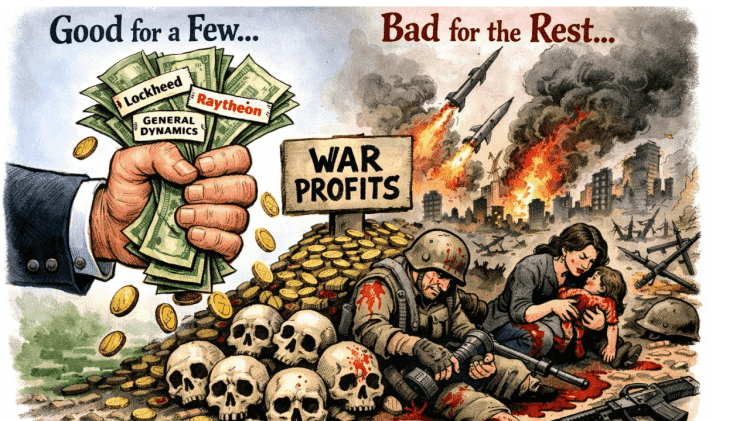
$1.5 Trillion Budget Request Prioritizes Service Members, Modernization
U.S. Department of War, April 21, 2026
“We are delivering on President [Donald J.] Trump’s commitment to expand American military dominance for decades to come,” said Secretary of War Pete Hegseth. “Previous administrations underinvested in our military while our enemies grew stronger and more dangerous, so we are now changing the game. This budget builds this arsenal without compromising readiness that will ensure we remain the world’s premier fighting force, we protect the homeland, and we create peace through strength now and into the future.”
The FY27 budget request represents a sizable increase over last year’s budget, said Jules W. Hurst III, performing the duties of the War Department comptroller.
“This is a generational investment in the United States military— the arsenal of freedom,” Hurst said. “This 42% increase will supercharge our defense industrial base by expanding production of major weapon systems, while strengthening supply chains and supporting tens of thousands of small and medium-sized businesses. It secures our homeland and military advantage through investments in the Golden Dome missile defense system, drone dominance and space superiority.”
This year’s budget request puts a huge focus on buying and investing in actual hardware, Hurst said. About 52% of the total budget request is aimed at buying munitions, planes, tanks and ships.
“The FY27 defense budget will be the largest investment in military capabilities in over a generation,” Hurst said. “This budget allocates over $750 billion … just in capability development and procuring weapons systems.”……………………………………………………………………………………………………………………………………………………………………………………………….. https://www.war.gov/News/News-Stories/Article/Article/4465551/15-trillion-budget-request-prioritizes-service-members-modernization/
No Peace, Only Escalation: The Push Toward Total War With Iran
April 22, 2026 , https://scheerpost.com/2026/04/22/no-peace-only-escalation-the-push-toward-total-war-with-iran/
As ceasefire talks collapse, retired Col. Douglas Macgregor warns that Washington is not negotiating—it’s preparing for a devastating, infrastructure-targeting war that could reshape the global order.
The language of peace still lingers in official statements—but on the ground, the machinery of war is accelerating.
In this stark and deeply unsettling conversation, retired U.S. Colonel Douglas Macgregor joins Glenn Diesen to dismantle the illusion of diplomacy surrounding the Iran conflict. What’s being sold as negotiation, he argues, is little more than theater—designed to calm markets, not stop bombs.
Behind the headlines, a far more dangerous reality is taking shape: a coordinated buildup for what Macgregor describes as a potential “total war” scenario, one that moves beyond military targets and toward the destruction of an entire state’s infrastructure.
If he’s right, the question is no longer whether the war will escalate—but how far it will go, and how much of the world it will drag with it.
A cause for major concern—one that cannot be repeated enough—is this warning from Macgregor:
“There was no real path to an agreeable solution—because there was no real negotiation. When the vice president steps out mid-meeting to take a call from Netanyahu, it tells you everything. These aren’t negotiations. It suggests that Netanyahu—not Trump—is effectively calling the shots on whether we go to war.”
Highlights
- “There were no real negotiations.”
Macgregor argues the so-called peace talks were never genuine, describing them as political theater meant to project stability while preparing escalation. - Power behind the scenes:
He suggests decision-making is not fully in Washington’s hands, pointing to Israeli influence shaping U.S. military direction. - From war to state destruction:
The next phase, he warns, targets not just military assets—but bridges, power plants, oil infrastructure, and civilian systems—a shift toward dismantling Iran as a functioning state. - A global economic shockwave:
Disruptions in the Persian Gulf could trigger fuel shortages, fertilizer collapse, and famine risks across the Global South. - The limits of U.S. power:
Fighting thousands of miles from supply lines while Iran operates defensively at home creates what he calls a “home court advantage” that undermines U.S. strategy. - End of the old order:
Macgregor frames the conflict as part of a larger collapse of U.S. dominance—warning that the petrodollar system and global unipolarity may already be breaking down. - No clear path to victory:
Even with overwhelming force, he sees no realistic military outcome that delivers control—only deeper instability.
We are one crisis away from a nuclear point of no return
As global stability erodes, the greatest danger now comes not from rogue states, but from stable nations driven to the brink by fear
David BlairChief Foreign Affairs Commentator
Of all the branches of the United Nations, none has a higher calling than
the International Atomic Energy Agency (IAEA). In the end, its job is to
preserve humanity from nuclear destruction and embody the survival instinct
of our species.
Yet the whole intricate system designed to prevent calamity
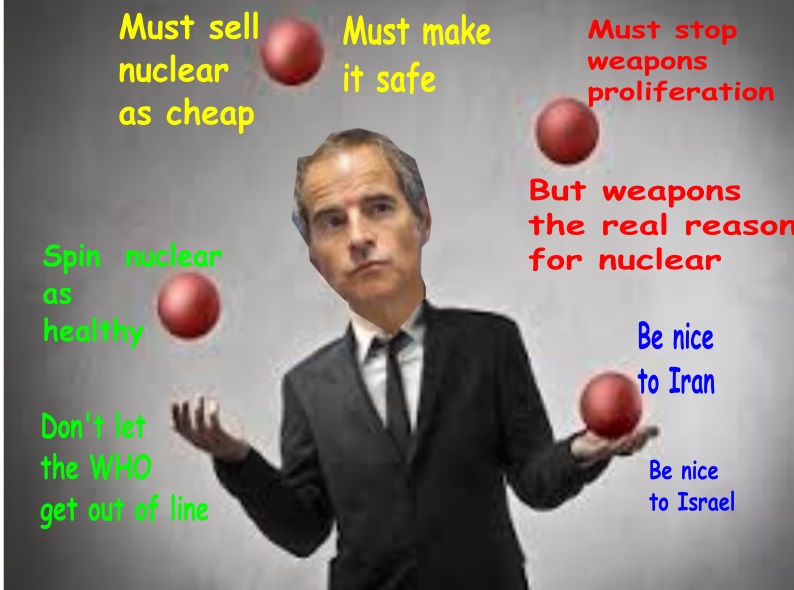
is crumbling before our eyes. Rafael Grossi, the director general of the
IAEA, describes in his Telegraph interview how “important countries in
Europe, in Asia minor and in the Far East” are publicly debating whether
to build nuclear weapons, despite having promised never to do so.
America and Russia have allowed all their nuclear disarmament treaties either to
collapse or expire without replacement. After invading Ukraine in 2022,
Vladimir Putin took another step towards the brink by suspending the
“strategic stability” arrangements with the US, under which the
world’s biggest nuclear powers had previously reassured one another by
sharing information about exercises and missile deployments.
One by one, the risk-reduction measures have fallen away, even as more countries
consider building nuclear arsenals. That leaves only one question: Have we
already passed the point of no return, or does humanity retain its survival
instinct?
Telegraph 20th April 2026, https://www.telegraph.co.uk/news/2026/04/20/one-crisis-away-nuclear-point-no-return/
PATRICK LAWRENCE: Iran & Ukraine — Two Theaters in the Non–West’s Single War for Parity
At that gathering of European officials in Berlin Wednesday, immediate pledges of new weapons supplies came to $4.7 billion, and there is more, much more, coming as Volodymyr Zelensky, Ukraine’s president, mooches his way around the European capitals.
Are the Western powers aware of the magnitude of the moment? I do not see how this can be anything other than so. Setting aside the Zionists’ obsessions and the visceral hatred Ukraine’s neo–Nazi regime nurses toward Russia and Russians, these conflicts are, when viewed broadly, about the defense of Western hegemony in its declining years.
In Iran and Ukraine, what is at stake — what is fought for and against — is a rebalancing of power that will prove of world-historical magnitude when it is at last accomplished.‘
By Patrick Lawrence, Consortium News, April 18, 2026, https://consortiumnews.com/2026/04/18/patrick-lawrence-iran-ukraine-two-theaters-of-non-wests-single-war-for-parity/
First came news that, on April 8, Israeli jets bombed what is known as the China–Iran railway, a key component of Beijing’s ambitious Belt and Road Initiative. Of all the targets the Zionist terror machine might have hit, why a Chinese-sponsored infrastructure project, you had to wonder.
Then on Wednesday came reports that officials from nearly 50 nations — I would love a list of these 50 — met in Berlin to make sure the fires of war against Russia do not flicker out. “We cannot lose sight of Ukraine,” Mark Rutte, NATO’s new secretary-general, declared a little forlornly.
There are other reports such as these of late. Dan Caine, chairman of the Joint Chiefs of Staff, announced Thursday that the Pentagon has authorized the Pacific Fleet to interdict ships in the Indian and Pacific oceans if they are deemed to be carrying Iranian oil to Asian ports or “material support” from Asia — read China — to the Islamic Republic.
It is time for a stock-take.
The war in Ukraine drones (literally) on and on, the West showing no inclination whatsoever to take the Russian position seriously. In West Asia we find a variant: The United States and the rabid dog that Bibi Netanyahu has made of Israel have no intention of considering the 10–point document wherein Iran states its conditions for ending a war it appears perfectly willing to continue waging.
What are we looking at? What animates these two confrontations such that to understand our moment we must see Ukraine and Iran as two theaters of a single war?
I do not care for self-referencing commentators, but an exception to my rule is the swiftest way to my reply to these questions.
I have argued since the turn of the millennium that parity between the West and the non–West is the foundational imperative of the 21st century. Any given nation or bloc may favor or oppose this eventuality, but there will be no stopping the turn of history’s wheel: This was my take at the opening of the era that announced itself with the events of Sept. 11, 2001.
And it is the painful birth of this new time we witness as the wars in Europe and West Asia grind on. In each case what is at stake, what is fought for and against, is a rebalancing of power that will prove of world-historical magnitude when it is at last accomplished.
What have the Russians sought since Donald Trump began his second term and declared his intention to end the war in Ukraine and restore relations with Moscow to some kind of equilibrium?
It is the same thing Moscow hoped for at the Cold War’s end, and the same thing they proposed when, in December 2021, they sent draft treaties, one to Washington and one to NATO headquarters in Brussels, as the basis of negotiations for a comprehensive settlement between the Russian Federation and the West.
Moscow’s Push for Equal Standing
Moscow has been clear on this point the whole of the post–Soviet era: It seeks a security architecture that takes cognizance of its interests and, so, recognizes Russia as an equal partner in its relations with the West.
President Putin and Sergei Lavrov, his able foreign minister, speak of the “root causes” of the war in Ukraine and insist these must be addressed if any kind of enduring settlement between East and West is to be achieved. This is merely another way of saying what the Russians have said for the past 30–odd years. [See: Ukraine Timeline Tells the Tale]
Neither has the West’s reply been any different: It amounts to one long list of refusals, however directly, dishonestly or incompetently these have been conveyed.
Last November the Trump regime issued a 28–point peace plan that was not less than shocking when cast against the past three and some decades of history. It called for a nonaggression pact Russia, Europe and Ukraine were to negotiate and sign. “All ambiguities of the last 30 years will be considered settled,” it read in part.
And further in this line:
“A dialogue will be held between Russia and NATO… to resolve all security issues and create conditions for de-escalation in order to ensure global security…”
These 28 provisions proved too good to be true. The Americans who developed this document, Secretary of State Marco Rubio and Steve Witkoff, the incompetent Trump insists must act as his “peace envoy,” simply did not know where the fence posts lie: While they almost certainly did not understand this, implicit in their 28 points was an East–West relationship based on parity.
Out of the question, as was immediately evident.
The Trump regime quickly abandoned its plan, despite its favorable reception in Moscow, and seems to have dropped all thought of “a deal” with Russia. The Europeans, freaked out at the very thought of a negotiated settlement, now resort to upside-down versions of reality I find it hard to believe they even try on.
At that gathering of European officials in Berlin Wednesday, immediate pledges of new weapons supplies came to $4.7 billion, and there is more, much more, coming as Volodymyr Zelensky, Ukraine’s president, mooches his way around the European capitals.
Boris Pistorius seems to have spoken for the group when the subject of peace talks arose. “The truth is, anyway, Russia has never taken them seriously,” the German defense minister declared. “This is why it is all the more important to support Ukraine.”
Russia has never taken negotiations seriously: Can you imagine how this kind of talk lands in Moscow? Can you imagine how low are the Russians’ expectations that the West will take their legitimate interests seriously until events on the battlefield force them to do so?
Tehran’s Conditions
The Iranians, it seems to me, are in a similar predicament.
Read the text of the 10–point plan wherein Tehran advances its demands for ending the war with the United States and Israel. An end to U.S. and Israeli attacks is merely the Iranians’ opener. The withdrawal of all U.S. forces from the region, a nonaggression pact with the United States, recognition of Iran’s rights on the nuclear side, war reparations: To borrow from the Russians, this is a demand to address root causes, a demand for “a new security architecture,” a demand — returning to my principal point — for parity as a non–Western power.
There is a lot in the press these days about a return to negotiations after Vice–President J.D. Vance’s debacle in Islamabad last weekend. I have no trouble imagining the Iranians are eager to avoid more of the savage, indiscriminate bombing their civilian population suffered prior to the two-week ceasefire that went into effect April 8. But I do not think, at the horizon, they will abandon the 10 demands they have advanced any more than the Russian will abandon theirs.
Both nations appear to have concluded it is time to confront the West in the name of that 21st century imperative I noted earlier. Two reasons. One, Russia and Iran have both gathered strength as non–Western powers in recent years, forged in the heat of incessant confrontations. This, indeed, is what history’s wheel looks like as it turns.
Declining Coherence & Power
Two, it is not difficult to recognize the declining coherence and power — and so the creeping desperation — of the United States and its European allies.
Are the Western powers aware of the magnitude of the moment? I do not see how this can be anything other than so. Setting aside the Zionists’ obsessions and the visceral hatred Ukraine’s neo–Nazi regime nurses toward Russia and Russians, these conflicts are, when viewed broadly, about the defense of Western hegemony in its declining years.
This is how I read that attack on the China–Iran railway. O.K., the Israelis did the wet work, as they say, but the bombing of a significant Chinese asset was not without intent: It reflects the United States’ mounting anxiety as the non–West’s premier power advances an imaginative global agenda that has the policy cliques in Washington, now that they belatedly recognize its significance, quaking.
Look at the map in this link. This rail line is key to China’s long-term plan to build efficient connections through southeastern Europe and on to the European capitals. To date, Beijing has reportedly spent 40 billion yuan, about $6 billion, on the project. This is part of the $400 billion investment agreement Beijing and Tehran signed in June 2020.
A little to my surprise, the Chinese have not reacted since the Israelis bombed their asset. There are several considerations at work here, but the most operative appears to be Beijing’s desire to assist in diplomatic mediations while presenting itself as a responsible world power in the face of the Trump regime’s serial insanities.
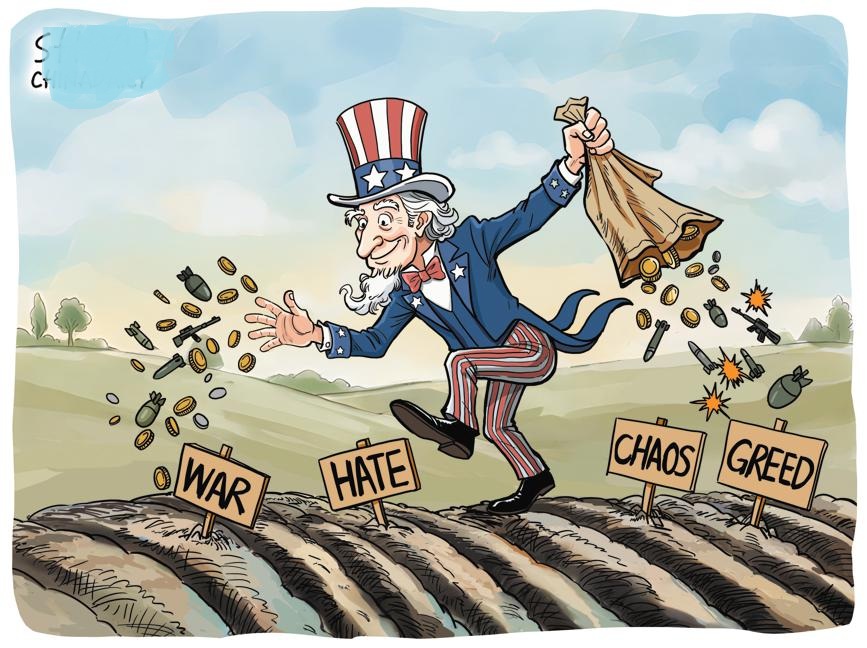
China Daily ran an editorial cartoon in its Tuesday editions that sheds useful light on Beijing’s perspective. It shows Uncle Sam profligately scattering money and weapons as he bounds through a field marked “War, Hate, Chaos and Greed.” The headline at the top is “The U.S. Reaps What It Sows.”
It is a darkly humorous reminder that Beijing knows very well what the war against Iran is fundamentally about and what time it is on history’s clock. You can always count on the Chinese to take the long view.
Patrick Lawrence, a correspondent abroad for many years, chiefly for the International Herald Tribune, is a columnist, essayist, lecturer and author, most recently of Journalists and Their Shadows, available from Clarity Press or via Amazon. Other books include Time No Longer: Americans After the American Century. His Twitter account, @thefloutist, has been restored after years of being censored.
Nuclear weapons may be the sane choice for the world’s maddest regime
For North Korea’s Kim Jong-un, the lesson from Iran shows that if your
goal is survival the more dangerous the arsenal the better.
Times 19th April 2026, https://www.thetimes.com/world/asia/article/kim-north-korea-nuclear-trump-iran-6s7gjkqns
THE US HAS NO ROUTE TO VICTORY IN IRAN WHICH WILL LIKELY EMERGE STRONGER
THIS ADVENTURE MAY DO TO AMERICAN COLONIALISM WHAT SUEZ DID TO THE BRITISH AND THE FRENCH
Ian Proud, Apr 19, 2026, https://thepeacemonger.substack.com/p/the-us-has-no-route-to-victory-in?utm_source=post-email-title&publication_id=3221990&post_id=194637482&utm_campaign=email-post-title&isFreemail=true&r=1ise1&triedRedirect=true&utm_medium=email
I was pleased to meet Laith Marouf, a War Correspondent and Executive Director of Free Palestine TV for the first time.
As Laith is based in Lebanon, we discussed the recently announced 10 day ceasefire with Israel, and whether it might endure. This ceasefire had clearly been imposed on Netanyahu by Trump, but what was the prevent Israel from returning to position normal after any putative peace deal over Iran? Laith laid out the historical and religious reasons why Iran would never abandon Lebanon purely to obtain a peace deal with the USA. Other people I have spoken to talk about the muti-confessional nature of Lebanon but that, come what may, Hezbollah remains a powerful force in politics, that won’t be eradicated by air strikes.
So, Israeli conquest of Lebanon will likely never be possible for as long as Iran remains a powerful force in the region.
We therefore discussed the US and Israel’s inability to inflict a defeat on Iran. There is no evidence that the US has the capability or the political capital at home to endure an extended military engagement with a country, thousands of miles from the US, geographically and by population size far bigger than any adversary confronted in the twenty first century, and with the support of the two big regional military and economic powers, Russia and China.
The only way that the US can impose a defeat on Iran is to precipitate regime change and despite Trump’s ramblings about regime change equating to a change of leader (sic!) the proposition that a modern-day Shah can be returned to the throne in Tehran have never looked possible or remotely likely.
That leaves the US militarily stuck in a conflict that is causing global economic shocks that are mobilising both the developing world and parts of the western world against American hegemony. Iran may be to US colonialism what Suez was to the British and French.
Laith situated this latest war in the context of what he describes as the 100 years of humiliation for the Muslim world.
Iran differs from the Arab world in having civilisational integrity and history that will endure this latest attempt at subjugation by western powers. War in the other hand is putting significant pressure on the smaller more fragmented governments across the Arab world which are reliant for survival on the umbrella of US hegemony which is collapsing.
We briefly considered the risk of nuclear escalation in Iran and the likelihood that this, ultimately, would backfire spectacularly on the west with a potentially enormous flood of refugees heading west, not to mention the intense ecological damage and the impact that would have on the global economy. Lots of people pontificate about Israel using tactical nukes, which, while I consider Netanyahu desperate to cling to power, I consider unlikely if only because it would likely sever the hitherto ironclad relationship with the US and lead to more immediate and existential risks to the functioning and integrity of Israel as a state.
We discussed Israel’s nuclear capability and how it can coexist in a more peaceable way with other countries in the region. Laith drew on the example of Apartheid South Africa which was also nuclear armed but which gave up its nuclear programme and completely shifted its model of governance to abandon the rule of white supremacists.
In the completely hypothetical scenario of Israel doing the same – which looks wholly unlikely anytime soon – I asked about the position of Jewish people in Israel under theoretical Palestinian rule. We considered the outlier role of the Jewish community in Iran which is the only major subset of Judaism that isn’t hardwired into the ecosystem of Zionism as a potential model.
In the final analysis, whenever the war against Iran ends, however it ends, Iran appears likely to emerge in a stronger position as a regional superpower than it held before the war started, indeed, before Donald Trump abandoned the JCPOA deal. US power and influence, on the other hand, continues to shatter, ushering in a multipolar world with greater clarity.
A genuinely thought-provoking discussion which I’d encourage you to watch via the link above. I had a microphone problem so my audio is terrible, though still audible.
1 This Month
19 November – Webinar – The Reality of Reprocessing
Time: 11:00 AM Pacific Time (US & Canada) / 2:00 PM Eastern / 7:00 PM UK / 8:00 PM CET
Register for the Zoom Event Here

Tell Congress: Prevent Nuclear Catastrophe in Iran

Tell Congress: Prevent Nuclear Catastrophe in Iran

Read the Public Inquiry Report, the Commissioners’ report, Surrendering Australia: The AUKUS Deception is available to download for free at aukuspublicinquiry.com. Or just watch the replay of the National Press Club Luncheon.


Shut down the radiation-damaged Heysham nuclear reactors now
To see nuclear-related stories in greater depth and intensity – go to https://nuclearinformation.wordpress.com

Say No to NASA’s Reckless Nuclear Reactor on the Moon
Say No to NASA’s Reckless Nuclear Reactor on the Moon
-
Archives
- November 2026 (178)
- October 2026 (302)
- September 2026 (339)
- August 2026 (330)
- July 2026 (355)
- June 2026 (287)
- May 2026 (306)
- April 2026 (356)
- March 2026 (251)
- February 2026 (267)
- January 2026 (308)
- December 2025 (358)
-
Categories
- 1
- 1 NUCLEAR ISSUES
- business and costs
- climate change
- culture and arts
- ENERGY
- environment
- health
- history
- indigenous issues
- Legal
- marketing of nuclear
- media
- opposition to nuclear
- PERSONAL STORIES
- politics
- politics international
- Religion and ethics
- safety
- secrets,lies and civil liberties
- spinbuster
- technology
- Uranium
- wastes
- weapons and war
- Women
- 2 WORLD
- ACTION
- AFRICA
- Atrocities
- AUSTRALIA
- Christina's notes
- Christina's themes
- culture and arts
- Events
- Fuk 2022
- Fuk 2023
- Fukushima 2017
- Fukushima 2018
- fukushima 2019
- Fukushima 2020
- Fukushima 2021
- general
- global warming
- Humour (God we need it)
- Nuclear
- RARE EARTHS
- Reference
- resources – print
- Resources -audiovicual
- Weekly Newsletter
- World
- World Nuclear
- YouTube
-
RSS
Entries RSS
Comments RSS

