Urgent need to correct exaggerated claims about China’s nuclear arsenal and its intentions.

In the months ahead, as the Biden administration attempts to draft a new Nuclear Posture Review and Congress votes on a proposed $715 defense bill for FY 2022, we can expect to hear a lot more about China’s “breathtaking” nuclear buildup. If we are to reduce the risks of nuclear war and lower the costs of nuclear weapons procurement, we must challenge such assertions and provide a balanced, realistic assessment of Chinese developments. We must also urge Biden to work with Xi in developing the “guardrails” that both agree are necessary to avert catastrophe.
Placing “Guardrails” on the US-China Nuclear Competition, A failure to challenge inflated claims about China’s nuclear arsenal will have serious and painful consequences. The Nation By Michael T. Klare , 1 Dec 21,
With the United States and China both speeding up the acquisition of new nuclear weapons, some analysts predicted that Presidents Joe Biden and Xi Jinping would discuss limits on those munitions during their virtual summit on November 15. However, they barely touched on the matter, agreeing only that both sides should take steps to prevent the unintended escalation of future crises. As Biden told Xi during their three-hour exchange, the two sides need “commonsense guardrails to ensure that competition does not veer into conflict.” Yet no plans were made for negotiations leading to the adoption of such measures, so the US-China arms race will only gain further momentum.
Historically, talk of nuclear arms racing has applied almost exclusively to the United States and the Soviet Union, and now Russia. Indeed, the US and Russia still possess the overwhelming majority of the world’s nuclear warheads, along with its most advanced nuclear delivery systems. But now China—long a minor player in the nuclear arena—appears to be bolstering its capabilities, while the United States is developing new weapons with the Chinese, as well as the Russians, in mind. The risk of a war between the US and China has also been growing, especially due to tensions over Taiwan, increasing the danger of nuclear weapons use.
Fueling these dangerous trends is a steady stream of alarmist pronouncements by US officials about China’s nuclear buildup. The Chinese are engaged in a “remarkable expansion of [their] nuclear and strategic capabilities,” Adm. Charles A. Richard, commander of the US Strategic Command, told the House Armed Services Committee last April. As a result of these initiatives, “China is capable of executing any plausible nuclear employment strategy regionally now, and soon will be able to do so at intercontinental ranges.”
But while China is certainly undertaking the modernization of its relatively old and meager nuclear arsenal—as compared to those of Russia and the United States—it can hardly be described as undertaking a “remarkable expansion” of its arsenal nor is it capable of “executing any plausible nuclear employment strategy” in a US-China war. Yet these inflated claims by senior Pentagon officials are helping spur Congress—which doesn’t really require much nudging—to finance a vast expansion of America’s own nuclear capabilities.
A failure to challenge these inflated claims and to slow the burgeoning US-China nuclear competition will have serious and painful consequences for both sides. If nothing else, it will lead to the massive allocation of resources for nuclear weapons procurement, with no end in sight. Any hope of trimming the Pentagon’s proposed $1.7 trillion modernization of all three “legs” of the nuclear “triad”—intercontinental ballistic missiles (ICBMs), submarine-launched ballistic missiles (SLBMs), and long-range strategic bombers—will disappear. And the emphasis on ever-more-capable conventional weapons, combined with new developments in cyber, space, and surveillance technology, will increase the likelihood that future crises trigger an unrestrained escalatory spiral terminating in nuclear annihilation.
Fortunately, the US-China nuclear arms race is still at a relatively early stage, at least when compared to the long-running US-Soviet/Russian competition. It is possible, then, to conceive of measures that might constrain this contest before it gathers additional momentum. Before considering such measures, however, we must possess a clear understanding of this dynamic and dispel various misconceptions regarding China’s nuclear capabilities.
UNDERSTANDING CHINA’S NUCLEAR POSTURE
For starters, bear in mind that China currently maintains a relatively modest nuclear arsenal. In its latest tally of world nuclear stockpiles, the Stockholm International Peace Research Institute (SIPRI) calculated that China possessed approximately 350 nuclear warheads—a bit more than the number deployed by France (290), but a very small fraction of the 5,550 warheads possessed by the US and the 6,375 by Russia. China has also chosen to limit its arsenal of nuclear delivery systems. According to the Federation of American Scientists (FAS), it has deployed only about 100 ICBMs and 48 SLBMs, compared to 400 ICBMs and 336 SLBMs in the US inventory. China also has a few dozen heavy bombers, but none with a range or nuclear payload comparable to the US B-2 and B-52 bombers.
That China maintains such a modest strategic arsenal has long provided confirmation for Beijing’s claim that it seeks nuclear armaments solely to implement a “minimum deterrence” posture—one that requires sufficient weapons to survive an enemy first strike and deliver intolerable damage on the attacker but not enough to conduct a disarming first strike on an adversary.
China’s arsenal has remained relatively unchanged for several decades, but now is being substantially modernized—allowing US military officials to claim that it is engaged in a major expansion along with a shift in its weapons employment doctrine. China’s nuclear arsenal is expanding at a“breathtaking” rate, Admiral Richard declared in August, and will soon achieve a “strategic breakout,” allowing Beijing to execute “any plausible nuclear strategy” it wishes to pursue……………
In sum, the evidence for a vast and rapid buildup in Chinese nuclear capabilities is underwhelming, to say the least. Also lacking is any indication that Beijing has abandoned its “minimum deterrence” strategy. What recent Chinese developments do suggest, however, is that Chinese officials fear that their existing nuclear force is becoming increasingly vulnerable to a first strike—sometimes called a “counterforce” strike—and so must be strengthened in order to safeguard its retaliatory capability.
US NUCLEAR INITIATIVES AND CHINA’S RESPONSE
In contrast to China, the United States has long maintained that its nuclear forces should be capable of many functions beyond just “minimum deterrence.” Current doctrine, as encapsulated in the Nuclear Posture Review (NPR) of 2018, states that nuclear weapons could be employed in response to an overwhelming conventional, as well as a nuclear, attack on the United States; even a major cyber assault on the United States might justify such usage…………….
| Under these circumstances, China’s nuclear buildup can largely be viewed as an attempt to overcome the vulnerabilities of its deterrence force, ensuring that enough of its weapons can survive an enemy first-strike assault and penetrate enemy defenses. This would explain both of the developments noted above: the replacement of single-warhead missiles with multiple-warhead variants and the construction of multiple silo holes in the desert. By equipping their ICBMs and SLBMs with a number of independently targetable reentry vehicles (MIRVed missiles, in Pentagon-speak), the Chinese evidently hope to ensure that even if only a few of their weapons escape American missile defenses, those survivors will still be able to launch multiple warheads against US targets; likewise, by constructing hundreds of additional silos and moving their ICBMs from one to the other on a random basis, they can circumvent a US first strike. None of this, however, suggests an intent to acquire a US-style counterforce capability. TAKING ACTION NOW As suggested by this analysis, China’s nuclear modernization does not pose the same sort of threat to the United States as US nuclear and conventional initiatives pose to China. True, China is capable of inflicting catastrophic damage on this country in the event of a nuclear war, but it does not appear to be seeking a first-strike or damage-limiting capacity akin to that possessed by the United States. Nevertheless, the danger of a US-China war is growing, and any major confrontation between US and Chinese forces could result in colossal losses on one or both sides, precipitating the early use of nuclear weapons. This is the perfect time, then, for the Biden administration to seek talks with Beijing aimed at eliminating or curtailing weapons developments that are placing both countries at greater risk. The goal—at least in the early stages of such engagement—should not be the adoption of conventional arms control agreements, like those signed between the US and the USSR during the Cold War era. Rather, the two sides should engage in high-level talks aimed at identifying the greatest risks of precipitous or unintended escalation, and in devising strategies for minimizing those dangers. (Reportedly, the Biden administration has been considering the initiation of such talks with China, but there is no indication that formal plans have yet been made to proceed with this.) Such high-level conversations—sometimes called “strategic stability” talks—could focus, for example, on the expected deployment on both sides of numerous hypersonic missiles aimed at each other’s high-value targets, and pursue ways to curtail their numbers or mode of employment, to minimize the risk of rapid escalation. Both sides could also agree to eschew cyberattacks on each other’s nuclear command-and-control systems, with the same goal in mind. Mutual restraints could also be crafted to reduce the danger of escalation during a crisis, for example through limitations on the scale of air and naval maneuvers in the area surrounding Taiwan. In the months ahead, as the Biden administration attempts to draft a new Nuclear Posture Review and Congress votes on a proposed $715 defense bill for FY 2022, we can expect to hear a lot more about China’s “breathtaking” nuclear buildup. If we are to reduce the risks of nuclear war and lower the costs of nuclear weapons procurement, we must challenge such assertions and provide a balanced, realistic assessment of Chinese developments. We must also urge Biden to work with Xi in developing the “guardrails” that both agree are necessary to avert catastrophe. https://www.thenation.com/article/world/china-nuclear-competition/ Michael T. Klare, The Nation’s defense correspondent, is professor emeritus of peace and world-security studies at Hampshire College and senior visiting fellow at the Arms Control Association in Washington, D.C. Most recently, he is the author of All Hell Breaking Loose: The Pentagon’s Perspective on Climate Change. |
9 top US nuclear no-proliferation experts write to Prime Minister Trudeau requesting a review of Canada’s planned nuclear reprocessing to recover plutonium.

| The latest of three open letters to Prime Minister Justin Trudeau from US non-proliferation. experts is copied below [on original] . The previous two letters are linked in footnotes #1 and #2. [on original] In these three letters, a group of nine distinguished nuclear policy experts are asking for a top level Canadian government review of the nuclear weapons proliferation dangers associated with the planned reprocessing of Canadian used nuclear fuel to recover the plutonium for use in a proposed new reactor in New Brunswick. These nine experts have worked under six U.S. presidents: John F. Kennedy, Lyndon B. Johnson, Richard Nixon, George H.W. Bush, Bill Clinton, and Barack Obama; and hold professorships at the Harvard Kennedy School, University of Maryland, Georgetown University, University of Texas at Austin, George Washington University, and Princeton University. CCNR 30th Nov 2021 http://www.ccnr.org/request_plute_nov_24_2021.pdf |
President of Belarus – ready to host Russian nuclear weapons if NATO moves atomic bombs to Eastern Europe.
The longtime president of Belarus said Tuesday that his country would be
ready to host Russian nuclear weapons if NATO moves U.S. atomic bombs from
Germany to Eastern Europe.
Independent 30th Nov 2021
At the Global Alliance of Leaders for Nuclear Security and Nuclear-Weapons-Free World (GAL) meeting, Nursultan Nazarbayev proposes Global Forum on Nuclear Nonproliferation and Disarmament

Nazarbayev proposed to launch the Global Forum on Nuclear Nonproliferation and Disarmamenthttps://www.prnewswire.com/news-releases/nazarbayev-proposed-to-launch-the-global-forum-on-nuclear-nonproliferation-and-disarmament-301433017.html
Astana Club , Nov 29, 2021, NUR-SULTAN, Kazakhstan, Nov. 29, 2021 /PRNewswire/ — The Global Alliance of Leaders for Nuclear Security and Nuclear-Weapons-Free World (GAL) was held on the platform of the VI meeting of the Astana Club in the capital of Kazakhstan.
Addressing the members of the GAL, Nursultan Nazarbayev noted that negotiations on nuclear strategic stability on inter-state level are facing a stalemate, and there is a strong need for an alternative form of dialogue on this issue.
To break this deadlock, Mr. Nazarbayev proposed to set up the Global Forum on Nuclear Nonproliferation and Disarmament in the capital of Kazakhstan.
Forum should bring together all key international NGOs and world moral authorities in the anti-nuclear field to forge a unified global agenda.
In his statement Nazarbayev also called on the world community to develop a step-by-step Plan for a comprehensive reduction of strategic offensive arms with the participation of all nuclear states under the auspices of the UN.
Nazarbayev expressed confidence that the GAL can become the central platform and driving force in the development of this document.
Former UN Secretary-General Ban Ki-moon also addressed the Alliance members with the support of the Nazarbayev’s initiative and noted that without the elimination of the nuclear threat, the world community will never be able to guarantee its security.
The address of the former President of the USSR, Nobel Peace Prize laureate Mikhail Gorbachev to Nursultan Nazarbayev and members of the Alliance became a significant moment at the GAL session.
Mr. Gorbachev expressed his full support for the initiative of the First President of Kazakhstan to establish GAL, noting that “there can be no other final goal than a world without nuclear weapons.”
He also noted that the meeting of Joe Biden and Vladimir Putin in June this year in Geneva marked a positive trend. According to Gorbachev, it is extremely important that the meeting of two presidents reiterated the idea that “there will be no winners in a nuclear war,” which was first voiced in 1985 at his meeting with US President Ronald Reagan.
The meeting of GAL was also attended by the leaders of the global anti-nuclear movement such as Nobel Peace Prize laureates Mohamed ElBaradei and ICAN Executive Director, Beatrice Fihn, as well as former UN High Representative for Disarmament Affairs and UN Under-Secretary-General Angela Kane, and many others.
All the meeting participants unanimously acknowledged that Kazakhstan, which voluntarily renounced the world’s fourth largest nuclear military arsenal of 1,200 atomic warheads in 1990s, has the full moral right to undertake such global anti-nuclear initiatives.
This year’s GAL meeting refers to the Doomsday Clock, the symbol of likelihood of nuclear war – One Minute to Midnight: Time for Action for the Nuclear Dialogue. This is because at the beginning of 2021, the Doomsday Clock moved the closest it has ever been in its history since 1947: 100 seconds to midnight.
Nursultan Nazarbayev.
GAL’s mission is to provide impetus to the anti-nuclear agenda through the joint efforts of the leaders of major international NGOs, well-known politicians, and world moral authorities in the anti-nuclear field.
In 2020, GAL’s Open Call to world leaders to demand the need for strengthening joint efforts on nuclear safety, non-proliferation and disarmament was registered as an official document of the UN and the IAEA.
To date, the GAL is supported by over seventy prominent international figures, including politicians, experts, and Nobel Peace Prize laureates..
France’s Foreign Minister in Indonesia, raises concerns about AUKUS, nuclear submarines, and risks of weapons proliferation.
the theme of ‘betrayal’ in terms of both being ‘cheated’ out of a deal and being deceived by NATO allies and, in Australia’s case, a historical ally.

AUKUS was about ‘pressing a sense of confrontation with China’
if tomorrow Australia has some nuclear-powered submarines, why not, some other countries could ask for similar technology, it could be Indonesia, why not?’
Australia needs an entente cordiale with Indonesia over nuclear propulsion and non-proliferation, The Strategist, 29 Nov 2021, |David Engel However relaxed and comfortable Indonesian Defence Minister Prabowo Subianto might be about Australia’s plans to acquire nuclear-powered submarines (SSNs), the visit to Jakarta of French Foreign Minister Jean-Yves Le Drian has probably validated the very different view of Le Drian’s counterpart, Retno Marsudi.
……………………………………………. the most striking moment of the visit came during Le Drian’s address to Indonesia’s leading international affairs think tank, the Centre for Strategic and International Studies (CSIS). While his speech focused on issues such as multilateralism and the EU’s position on the Indo-Pacific, his response to a question on ‘minilateralism’—specifically, AUKUS and the Quad—took on a very different tone.
Ignoring the Quad, he levelled his remarks at AUKUS, stressing four points. The first two reiterated the theme of ‘betrayal’ in terms of both being ‘cheated’ out of a deal and being deceived by NATO allies and, in Australia’s case, a historical ally. He talked about American efforts to restore trust through various US commitments to France. He didn’t mention Australia in this context.
More significantly, his third point was that AUKUS was about ‘pressing a sense of confrontation with China’ (as the simultaneous translation put it). He said that, while France was not oblivious to China’s military threats and risks, he believed that the best way to respond to these threats was to ‘develop an alternative model rather than to first of all oppose’.
Perhaps his most significant point for Australian interests was his fourth, which went to the transfer of nuclear technology for submarine propulsion. He pointed out that until now no nuclear-weapon state had done this. But ‘if tomorrow Australia has some nuclear-powered submarines, why not, some other countries could ask for similar technology, it could be Indonesia, why not?’ He continued that, even though this technology was not covered by the Nuclear Non-Proliferation Treaty (NPT), the risk the arrangement posed of starting a trend was nonetheless of concern.
Irrespective of Le Drian’s intentions in answering the question in this manner—and it’s noteworthy that he didn’t cover AUKUS in his formal address—he would surely have known that his words would resonate powerfully with his audience, both at CSIS and more generally among Indonesia’s foreign policy establishment. While his depiction of Australia as duplicitous was evidently personal and heartfelt, it would also have struck a chord with those Indonesians who have characterised Canberra the same way over such issues as East Timor, Papua and spying allegations, irrespective of how justified that judgement might be.
Le Drian’s last point went directly to concerns about nuclear proliferation—issues that Indonesia highlighted in its official statement on AUKUS and the planned submarines. It corresponds closely ‘in spirit’ with subsequent official commentary to the effect that Indonesia was considering advocating a change to the NPT aimed at preventing non-nuclear-weapon states from acquiring SSNs………
whoever governs in Canberra now and into the future should at least make a priority of assuaging Jakarta’s worries on this subject, however overstated and unbalanced they are. While Indonesia’s prospects of changing the NPT and precluding Australia from having SSNs look remote at best—not least because several of its ASEAN colleagues do not share its views of Australia’s ambitions—the sooner the two countries can put this latest irritant to rest the better.
In the circumstances, the onus for doing so must primarily rest with Canberra………https://www.aspistrategist.org.au/australia-needs-an-entente-cordiale-with-indonesia-over-nuclear-propulsion-and-non-proliferation/
Australian government using a loophole to evade international non-proliferation treaties, to get nuclear submarines?

“interesting interpretation” that the government would try to qualify for an exemption from the International Atomic Energy Agency’s inspection regime by claiming military submarines, which will be fuelled with weapons grade uranium, are for peaceful purposes.”
Labor questions whether nuclear subs breach international law, AFR, Andrew Tillett, Political correspondent, 30 Nov 21, Labor MPs have raised concerns about Australia breaching its non-proliferation obligations under the Morrison government’s plan to acquire nuclear-powered submarines from Britain and the United States.
Parliament’s Treaties Committee has begun a snap inquiry into the first element under the AUKUS deal, an agreement between the three countries to allow the sharing of highly classified nuclear technology with Australian officials.
The nuclear agreement also covers training opportunities for Australian submariners and technicians with the British and American programs.
Under the AUKUS pact, the government will acquire up to eight nuclear-powered submarines, promising they will be built in Adelaide. The first is due to be delivered sometime before 2040.
The government is adamant the nuclear submarine deal will not be a precursor to acquiring nuclear weapons.
The inquiry is due to report by December 17 but at its first hearing on Monday, Labor MP Josh Wilson highlighted significant uncertainty over the government’s plan to use a loophole in the international nuclear safety regime, which had never been used before, to acquire the submarines.
Mr Wilson and fellow Labor MP Peter Khalil grilled officials from the Defence, Foreign Affairs and Attorney-General’s departments over how Australia could acquire nuclear-powered submarines while still complying with its obligations under the nuclear non-proliferation treaty.
Training ‘needs to start now’
Mr Wilson said it was an “interesting interpretation” that the government would try to qualify for an exemption from the International Atomic Energy Agency’s inspection regime by claiming military submarines, which will be fuelled with weapons grade uranium, are for peaceful purposes.
“If it was determined that was acceptable, we will have broken new ground in weakening the existing non-proliferation regime,” Mr Wilson observed……….. https://www.afr.com/politics/federal/questions-over-whether-nuclear-subs-breach-international-law-20211129-p59d0h
UN chief calls for nuclear weapons-free Middle East
UN chief calls for nuclear weapons-free Middle East, UN News, The UN Secretary-General on Monday called on all Middle East States to transform the vision of a region with no nuclear weapons, or other weapons of mass destruction, into a working reality.
Antonio Guterres was speaking in New York at the second session of the Conference on the Establishment of a Middle East Zone Free of Nuclear Weapons and Other Weapons of Mass Destruction.
Since 1967, five such zones have been established around the world: Latin America and the Caribbean, the South Pacific, Southeast Asia, Africa and Central Asia. They include 60 per cent of all UN Member States and cover almost all of the Southern Hemisphere.
For the Secretary-General, expanding such zones would help build a safer world.
“That is particularly the case in the Middle East, where concerns over nuclear programmes persist, and where conflicts and civil wars are causing widespread civilian casualties and suffering, undermining stability and disrupting social and economic development”, Mr. Guterres explained.
The UN chief also reiterated his call for all parties to exercise restraint and avoid escalation.
In this context, he highlighted the Joint Comprehensive Plan of Action (JCPOA), known commonly as Iran Nuclear Deal, saying that the return to dialogue is “an important step.” ………. https://news.un.org/en/story/2021/11/1106732
26 UK investment funds pouring money into nuclear weapons companies: some have links to UK government.
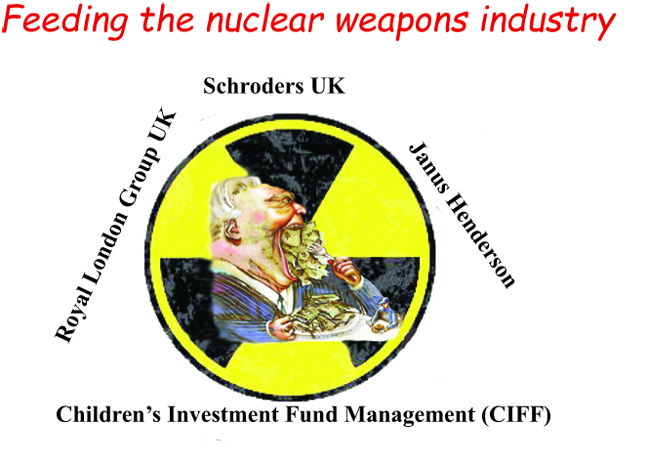
“It is unsurprising that the same financial institutions who continue to pour funding into companies like BAE Systems also have close links with senior Conservative party members and is yet another example of the cosy relationship between the arms industry and the UK government,”
The Ferret, November 28, 2021 Twenty-six financial firms in London have been accused of funding a “new nuclear arms race” including investment funds with links to the UK Government, The Ferret can reveal.
The Ferret found that 26 were based in London and six have links to the Conservative Party, which plans to increase Britain’s nuclear weapons arsenal.
They include Schroders UK which holds shares in the arms giant, BAE Systems. Schroders chair is Lord Geidt, who was an advisor to BAE Systems until April this year. He is now an advisor to Prime Minister Boris Johnson, whose plan to produce more nuclear weapons has been condemned by peace organisations.
Netherlands-based peace group, PAX, produced the study with the International Campaign to Abolish Nuclear Weapons (ICAN). Their report warns that financial institutions continuing to invest in companies involved with the nuclear weapons industry could face “regulatory risks” because of the Treaty on the Prohibition of Nuclear Weapons, which came into force in January 2021.
The treaty – which the UK has not ratified – bans nuclear weapons and has been signed by 86 states so far.
The UK Government — which claims it is “committed to the long-term goal of a world without nuclear weapons” — said in March it would lift the cap on its nuclear arsenal by 40 per cent, from 180 to 260 warheads. In a statement in November the government claimed it had “played a leading role by pioneering work in nuclear disarmament”.
Perilous Profiteering says that Schroders UK had investments in 2020 worth $125.3 million (£93.97m) in BAE Systems which is building new Dreadnought submarines that will be armed with nuclear missiles. The company also provides logistics support for the US Trident and Minuteman missiles. BAE Systems stressed that it does not make nuclear warheads.
The report also names Royal London Group UK which had shares in 2020 worth $98.6m (£74m) in BAE Systems. In June the insurance company appointed Ruth Davidson, former leader of the Scottish Tories , as a non-executive director. Davidson is now a peer.
Others with links to the Tories include the Children’s Investment Fund Management (CIFF) which has shares in Safran, a French firm. Safran owns 50 per cent of ArianeGroup which has contracts for French nuclear weapon production.
Emma Cockburn, Scotland co-ordinator for Campaign Against Arms Trade
CIFF’s investment assets are managed by TCI Fund Management, where Rishi Sunak MP, chancellor of the exchequer, was a partner from 2006 to 2009.
Investment firm Janus Henderson, which has shares in General Dynamics, L3 Harris and Leidos, gave the Tories £3,500 in 2018, a payment which was registered in the House of Commons as required. General Dynamics, L3 Harris and Leidos all operate within the nuclear sector, says the new report.
According to the new report, the entry into force of the Treaty on the Prohibition of Nuclear Weapons in January 2021, is an “historic shift” in the way the world “deals with nuclear weapons”. It points out that while nuclear weapons are controlled by governments, their production is often contracted to private companies. “They (nuclear weapons) are now comprehensively outlawed, as is any assistance with producing, manufacturing or developing them,” the report says.
“Financial institutions that continue investing in companies building nuclear weapons face regulatory risks as more countries join the treaty. They also face an increased reputational risk as clients learn of their support for weapons of mass destruction and terminate their relationships.”
The report also reveals that 338 institutions have financing or investment relationships with the 25 nuclear weapon producing companies, down from 390 the previous year – a fall of 52, which the authors welcomed……….
Other critics of the nuclear weapons industry include Emma Cockburn, Scotland co-ordinator for Campaign Against Arms Trade (CAAT). She said the report provides a “damning insight to the endless billions available for the nuclear and arms manufacturers.”
“It is unsurprising that the same financial institutions who continue to pour funding into companies like BAE Systems also have close links with senior Conservative party members and is yet another example of the cosy relationship between the arms industry and the UK government,” she added……………………….. https://theferret.scot/revealed-27-london-companies-funding-nuclear/
British military moving closer and closer to, nuclear bombers 12 miles from Russian border: envoy — Anti-bellum
Deployment of British troops in Germany doesn’t alleviate tension with Moscow – ambassador The deployment of British Armed Forces in Germany won’t reduce tension between NATO countries and Russia, Russian Ambassador to the UK Andrey Kelin said in an interview with the Times Radio station. “NATO is stepping up its presence along the borders of […]
British military moving closer and closer to, nuclear bombers 12 miles from Russian border: envoy — Anti-bellum
Guest Post from Gordon Frederick Coggon – a Nuclear Test Veteran’s Experience — RADIATION FREE LAKELAND

Gordon Frederick Coggon ·26 Nov 21,
Guest Post from Gordon Frederick Coggon – a Nuclear Test Veteran’s Experience — RADIATION FREE LAKELAND
https://wordpress.com/read/feeds/331643/posts/3682558618 During 1957 and 1958 I was one of 20,000 British serviceman sent to the central Pacific testing ground of British Hydrogen bomb tests which in my own case involved being at Christmas Island.(now named Kiritimati). During my year there I was subjected to radiation contamination. I witnessed two hydrogen bombs, the first being Operation Grapple X with a 1.8 megaton yield on Nov 8th. 1957 and the second bomb being on 28th. April 1958. Which had a yield of 3 megatons.( Both these devices were dropped by a Valient ‘V’ bomber about 20 miles off the southern tip of the Island.)
After the Grapple X test I was sent to hand wash a Canberra Aircraft,s engine nacelles after it had flown through the cloud of the hydrogen bomb collecting samples. I was set to work using a small bore hosepipe and a scrubbing brush, (the Aircraft had been hosed down with high pressure jets of water before I was employed on a gantry cleaning where the jets of water were not directed at the intakes of the engines.) Initially, I was given a pair of denims, wellingtons, rubber gloves and a remote breathing apparatus (which consisted of a face mask attached to 38 feet of corrugated rubber hose and connected to a fresh air filter which was fastened down as far away as possible from the aircraft. The face mask head straps were broken so the man in the white suit and gas mask said it was useless for the job in hand so I was given a crude homemade mask made from cotton wool sandwiched between a silver paper foil.
Whilst working on the gantry the mask got wet through and I wasnt able to breathe, so I had to move it from my mouth and nose to enable myself to breathe. I continued to work for between 20 to 30 minutes before I was replaced by someone else and I was then sent to the decontamination tent where I showered several times until the man in the white suit and Geiger counter said I was ok to get dressed in the clean side of the tent and was given a new set of kd shorts and shirt. This showering and decontamination took at least one and a half hours, My contaminated clothing was put in a yellow barrel marked with radiation signs in the dirty side of the facility. I have to say also that some of us were given other dangerous tasks like picking up dead fish and birds after the tests and some guys had to dump contaminated equipment in the ocean or bulldoze contaminated earth. After the Grapple Y bomb on 28th.April 1958, there was a massive downpour of rain, which came from the bomb cloud, a lot of the young innocent troops stood outside bathing in it like one normally did during the rain showers, but unlike the normal rain this was said to be contaminated because there was no other clouds in the sky at the time.
At that time I was 18 years old (picture of me above whilst there) and most of us had no idea what radiation was. Nor was I told anything about it until later in my career when I remustered into the Fire, Crash and rescue trade, where I was trained up to an advanced stage about radiation and biological warfare and every Monday I was teaching an induction course to new arrivals on the station that I was posted too. That was when I began to worry about my own health. Had I been put at an high risk of radiation whilst on Christmas Island ??. The Aircraft that I had helped to decontaminate was still emitting Gamma radiation, to what extent?? Also, did I swallow, inhale Alpha particles.?? ( Alpha radiation cannot penetrate human skin but they can be swallowed in water droplets, eaten if on food, or more commonly inhaled.)
These Alpha particles may remain inside your body for your whole life, attacking cells of your body for decades and could take many years before irrepairable damage becomes apparent. Recently it has been associated with radiation caused diseases and malformities in new born descendants of nuclear test veterans. I have had Cancer and several other illnesses which most lightly have been caused by atomic radiation, so far, even after seventy years, the successive British Governments have continued to deny that their troops were subjected to radiation during their atomic and hydrogen tests in the fifties and sixties. And yet, many of the nuclear armed countries have acknowledged the troops that was sent to take part in their experiments with nuclear fission and have been recognised by being given a medal and/or compensation.
I have only mentioned my own experience at Christmas Island (Kiritimati) but during a period 1952 – 1968 there have been many such tests in Australia, other testing areas of the Pacific where a lot of fellow veterans were irradiated by atomic fallout and nuclear poisoning from various clean-up operations after the tests, many of these young men never got to grow old because of their contamination from the tests. Many test sites were carried out where local people lived, these same people have since lost their homes and way of life by the poisoning effects of radiation . Since; atomic radiation contamination illnesses have continually been killing test veterans and clean-up veterans nothing has been done so far to help the families of these brave innocent troops and civilians by the British Government, who were subjected to experiments during the trials.
It is now becoming more alarming by the number of offspring who have also inherited their veteran father’ s damaged cells genetically. * reference to these tests are also available in two books that I have published on Amazon. The first one is titled :- ‘ Christmas Island 1957-1958 ‘ an Ebook on Kindle. The other is a paperback, titled:-‘ The Life of a Yorkshire Lad’ on Amazon and an ebook on kindle.
All royalties for the (latter paperback/ebook have been donated to LABRATS INTERNATIONAL for their continued valuable work in helping test veterans and their descendants come together from all over the world in their fight for justice.
USA rehearsed dropping nuclear weapons 20km from Russian border
 | |||
US rehearsed dropping nuclear weapons 20km from Russian border – Moscow
US rehearsed dropping nuclear weapons 20km from Russian border – Moscow, Rt.com23 Nov, 2021 , American nuclear-capable bombers have flown dozens of sorties across Eastern Europe in the past few weeks as part of drills designed to probe Russian readiness in case of an atomic war, Russia’s defense minister has claimed.
Speaking after a meeting his Chinese counterpart, Wei Fenghe, in Moscow on Tuesday, Sergey Shoigu said that there has been “a significant intensification of activity from US strategic bomber aviation near the borders of Russia.”
According to him, “over the past month, around 30 missions have been flown near the borders of the Russian federation, around two and a half times more than in the same time period last year.”
Shoigu added that recent American exercises, codenamed Global Thunder, saw “ten strategic bombers practicing their ability to use nuclear weapons against Russia at almost the same time from the west and the east. The minimum distance from our border was 20km.”
……….. Both Russia and NATO have accused each other of stepping up warplane flights close to the border, and last year Moscow blasted a “provocative” move from Washington to dispatch American B-1B nuclear bombers into Ukrainian airspace for the first time in history. Russian fighter jets and anti-air rockets were scrambled in response. https://www.rt.com/russia/541089-us-testing-ability-nuclear-attack-moscow/
UK’s Ministry of Defence makes unprecedented attempt to dismantle dead nuclear submarines
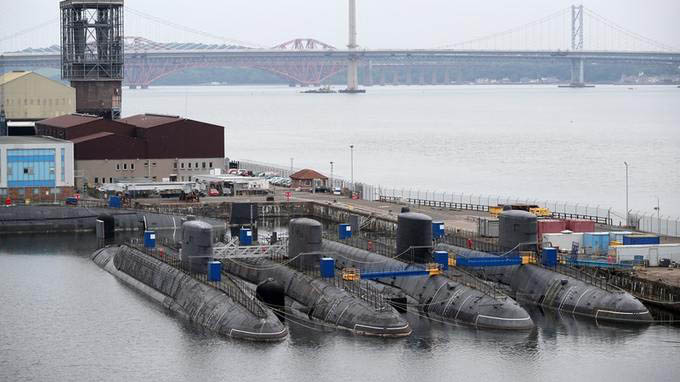
SafeEnergy E Journal No.92. December 21 , Submarine Dismantling The UK’s Submarine Dismantling Project hopes to dismantle 27 of the UK’s de-fuelled, nuclearpowered submarines after they have left service with the Royal Navy.
A demonstrator submarine is being used to define and refine the dismantling process. At Rosyth, the removal of low-level radioactive waste from the first two submarines, Swiftsure and Resolution, has been successfully and safely completed. As the unique approach is developed, work continues with the removal of low-level radioactive waste from a third submarine, Revenge. A fully developed process for steady state submarine dismantling should be ready by 2026. As the demonstrator programme progresses, the outcomes will provide more certainty in the future costs to dismantle the Devonport-based submarines. It is not MoD policy to pre-announce the funding of its projects for reasons of protecting commercial interests.”
REVENGE, entered the dry dock in Rosyth in late March 2020 to commence its LLW removal. The intent is to remove all LLW including large components such as steam generators and pressurisers. No nation has yet attempted this complex and challenging undertaking, so the MoD is currently putting in place the techniques necessary to remove all LLW for the first time to comply with safety and sustainability standards. https://www.no2nuclearpower.org.uk/wp/wp-content/uploads/2021/11/SafeEnergy_No92.pdf
USA rehearsing launching nuclear attack on Russia
US rehearsing nuclear strike: Russia, 7 News,
Andrew Osborn and Phil StewartReuters Wednesday, 24 November 2021 The US has been criticised for rehearsing a nuclear strike on Russia from two different directions earlier this month, with the planes coming within 20km of the Russian border.
The Pentagon responded by saying its drills were announced publicly at the time and adhered to international protocols.
Moscow’s accusation comes at a time of high tension with Washington over Ukraine, with US officials voicing concerns about a possible Russian attack on its southern neighbour – a suggestion the Kremlin has dismissed.
Moscow has in turn accused the United States, NATO and Ukraine of provocative and irresponsible behaviour, pointing to US arms supplies to Ukraine, Kiev’s use of Turkish strike drones against Russian-backed separatists in the east of Ukraine, and NATO military exercises close to its borders.
Russian Defence Minister Sergei Shoigu said Moscow had noted a significant increase in the activity by US strategic bombers, which he said had carried out 30 flights close to Russia this month.
That, he said, was more than twice as many as over the same period last year.
Shoigu complained in particular of what he said was a simulated US nuclear strike against Russia earlier this month.
“The defence minister underlined that during the US military exercises ‘Global Thunder’, 10 American strategic bombers rehearsed launching nuclear weapons against Russia from the western and eastern directions,” Shoigu was quoted as saying in a defence ministry statement.
………………………… https://7news.com.au/politics/security/us-rehearsing-nuclear-strike-russia-c-4681215
This world of pandemic and climate change can no longer afford the luxury of nuclear weapons proliferation
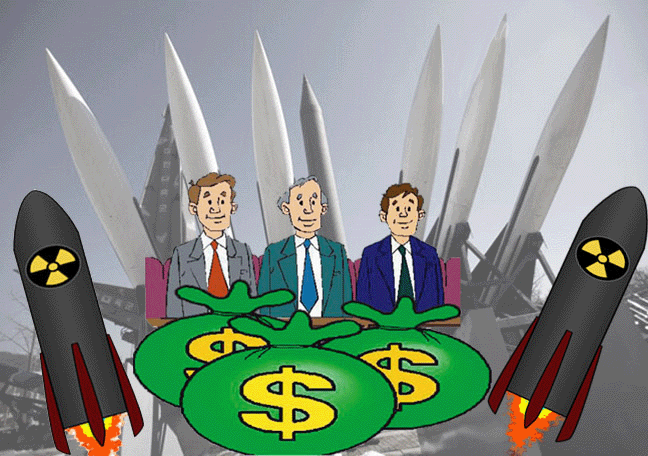
Aotearoa must stand apart as others amass nuclear weapons https://www.stuff.co.nz/national/politics/opinion/127065066/aotearoa-must-stand-apart-as-others-amass-nuclear-weapons, Nov 23 2021 EDITORIAL You’d be forgiven for not thinking about the threat of nuclear war during the past couple of years.
The pandemic, climate change – it seems there are enough dangers threatening our existence, without adding a nuclear holocaust to the list.
Unfortunately, ignoring the steady proliferation of nuclear weapons is a luxury we can no longer afford.
As geopolitical tensions rise, many of them centred on our own Indo-Pacific region, so do nuclear arsenals
Russia and the US continue to own more than 90 per cent of the world’s nuclear weapons, and it seems they have no plan to give those up. Earlier this month, the Pentagon estimated China will have up to 700 deliverable nuclear warheads by 2027. Estimates currently put its arsenal at about 350.
Meanwhile, the UK has reversed a policy of reducing the country’s nuclear arsenal, increasing the planned cap on nuclear warheads. There are reports that India, Pakistan and North Korea are also expanding their capabilities
At the same time, our traditional allies, Australia, the US and the UK, have a new strategic agreement enabling Australia to build nuclear-powered submarines. While they won’t carry nuclear arms, they are not without risk/
It’s no wonder Phil Twyford, Minister for Disarmament and Arms Control, says the risk of nuclear warfare is as bad – if not worse – now than at vany time since the Cuban Missile Crisis. In a recent speech, he was blunt in his criticism of nuclear states the US, France, China, Russia and the UK for their lack of efforts to work towards disarmament. But one speech does not a meaningful security policy make.
Aotearoa has long prided itself on its independent foreign policy, and nuclear-free stance. Lest we forget the great Lange speech from the 1985 Oxford Union debate.
Aside from his memorable uranium comment, the late prime minister was clear in communicating the position of the New Zealand people: the nuclear weapons which would defend us caused more alarm, and accordingly, we deemed it pointless to be defended by them.
Over the years, Kiwis have become disconnected from this element of our foreign policy. We assume we are safe, and that with the end of the Cold War came the end of the imminent threat of nuclear war.
But with the threat on our doorstep, thanks to the US, North Korea and China, now is the time to start caring again.
Will Germany’s Next Government Ditch U.S. Nuclear Bombs?
Explainer: Will Germany’s Next Government Ditch U.S. Nuclear Bombs? U.S. News, By Reuters|Reporting by Sabine Siebold, Editing by William Maclean, Nov. 22, 2021, BERLIN (Reuters) – NATO allies will be scouring the policies of Germany’s next federal government for one crucial detail: Will Berlin remain part of NATO’s nuclear sharing agreement?
Or will it drop out and ask the United States to remove its nuclear bombs from German soil?
While such a move might be popular among some Germans, it would reveal a rift within NATO at a time when the alliance’s relations with Russia are at their lowest since the end of the Cold War.
WHAT IS NATO’S NUCLEAR SHARING?
As part of NATO’s deterrence, the United States has deployed nuclear weapons in Belgium, Germany, Italy, the Netherlands and Turkey – all NATO allies that do not have their own nuclear weapons. In the case of a conflict, the air forces of these countries are meant to carry the American nuclear bombs.
WHAT EXACTLY IS GERMANY’S ROLE?
Around 20 U.S. nuclear bombs are estimated to be stored at the German air base of Buechel, in a remote area of the state of Rhineland-Palatinate. The base is also home to a squadron of Tornado fighter jets belonging to the German air force, the only German jets fitted to carry the nuclear bombs.
WHAT IS THE PROBLEM WITH THE TORNADO FIGHTER JETS?
The German air force has been flying the Tornado jets since the 1980s, and it has become increasingly expensive to maintain them and difficult to find spare parts to keep the plane in the air. The German defence ministry plans to phase out the jet between 2025 and 2030. Should Berlin not purchase new jets fitted for the task of carrying U.S. nuclear weapons, Germany would simply drop out of nuclear sharing when the last Tornado retires around 2030.
WHAT CHANGES MAY THE NEW GERMAN GOVERNMENT BRING?
In spring 2020, Defence Minister Annegret Kramp-Karrenbauer, a member of Chancellor Angela Merkel’s conservatives, proposed replacing the Tornado jets in Buechel with F-18s made by Boeing, but the decision was later pushed into 2022.
Now, the likely new German government will be led by the Social Democrats, a party that has some lawmakers who would like to get rid of U.S. nuclear weapons on German soil. The Greens, who are expected to be part of the coalition, also have some lawmakers who take that view………https://www.usnews.com/news/world/articles/2021-11-22/explainer-will-germanys-next-government-ditch-u-s-nuclear-bombs
1 This Month





PLEASE OPPOSE HR 8255 AND S.3639 – bills would accelerate satellite deployment, with no environmental review or safeguards – https://ncstd5li.quorum.us/campaign/169331/
To see nuclear-related stories in greater depth and intensity – go to https://nuclearinformation.wordpress.com
-
Archives
- October 2026 (49)
- September 2026 (339)
- August 2026 (330)
- July 2026 (355)
- June 2026 (287)
- May 2026 (306)
- April 2026 (356)
- March 2026 (251)
- February 2026 (267)
- January 2026 (308)
- December 2025 (358)
- November 2025 (359)
-
Categories
- 1
- 1 NUCLEAR ISSUES
- business and costs
- climate change
- culture and arts
- ENERGY
- environment
- health
- history
- indigenous issues
- Legal
- marketing of nuclear
- media
- opposition to nuclear
- PERSONAL STORIES
- politics
- politics international
- Religion and ethics
- safety
- secrets,lies and civil liberties
- spinbuster
- technology
- Uranium
- wastes
- weapons and war
- Women
- 2 WORLD
- ACTION
- AFRICA
- Atrocities
- AUSTRALIA
- Christina's notes
- Christina's themes
- culture and arts
- Events
- Fuk 2022
- Fuk 2023
- Fukushima 2017
- Fukushima 2018
- fukushima 2019
- Fukushima 2020
- Fukushima 2021
- general
- global warming
- Humour (God we need it)
- Nuclear
- RARE EARTHS
- Reference
- resources – print
- Resources -audiovicual
- Weekly Newsletter
- World
- World Nuclear
- YouTube
-
RSS
Entries RSS
Comments RSS

