China calls on the Association of Southeast Asian Nations (ASEAN) to make Southeast Asia a nuclear-weapons-free zone
China pushes for nuclear-weapon-free Southeast Asia, KhmerTimes, Aandolu Agency ISTANBUL 22 Nov 1 – China on Monday said it is ready to work with the members of the Association of Southeast Asian Nations (ASEAN) towards a nuclear-weapon-free region besides ensuring stability in the disputed South China Sea.
“China supports ASEAN’s efforts to build a nuclear-weapon-free zone, and is prepared to sign the Protocol to the Treaty on the Southeast Asia Nuclear-Weapon-Free Zone as early as possible,” President Xi Jinping told the China-Asia summit marking 30 years of the relations between two sides.
Beijing’s demand for a nuclear-free Southeast Asia comes as the US and UK empower their ally Australia with nuclear-armed submarines under a deal called AUKUS signed in September………..
The bilateral trade between China and ASEAN has skyrocketed by 85 times to $684.6 billion in 2020 from less than $8 billion in 1991, making the two sides each other’s largest trading partners. https://www.khmertimeskh.com/50975461/china-pushes-for-nuclear-weapon-free-southeast-asia/
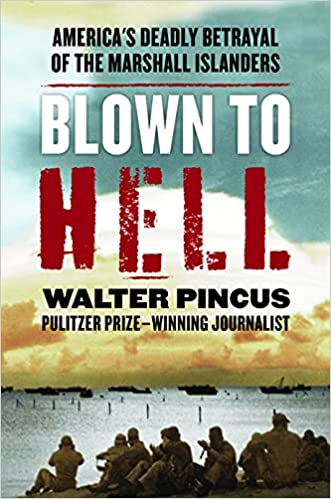
“Blown to Hell: America’s Deadly Betrayal of the Marshall Islanders”
Biggest US nuclear bomb test destroyed an island—and this man’s life, https://nypost.com/2021/11/20/biggest-us-nuclear-bomb-test-destroyed-an-island-and-lives/ By Eric Spitznagel The US bomb tested near John Anjain’s (right) home in the Marshall Islands in 1954 was 1,000 times stronger than at Hiroshima, and left his wife and kids with debilitating and deadly health problems, as detailed in a new book. November 20, 2021
Just before dawn on March 1, 1954, John Anjain was enjoying coffee on the beach in the South Pacific when he heard a thunderous blast, and saw something in the sky that he said “looked like a second sun was rising in the west.”
Later that day, “something began falling upon our island,” said Anjain, who at the time was 32 and chief magistrate of the Rongelap atoll, part of the Marshall Islands. “It looked like ash from a fire. It fell on me, it fell on my wife, it fell on our infant son.”
It wasn’t a paranormal experience. Anjain and his five young sons, along with the 82 other inhabitants of Rongelap, were collateral damage from a “deadly radioactive fallout from a hydrogen bomb test… detonated by American scientists and military personnel,” writes Walter Pincus in his new book, “Blown to Hell: America’s Deadly Betrayal of the Marshall Islanders” (Diversion Books), out now.
In 1946, the US started testing atomic weapons began in Bikini Atoll, 125 miles west of Rongelap. Known as Operation Crossroads, the tests were moved to the islands from the US because officials feared “radioactive fallout could not be safely contained at
any site in the United States,” writes Pincus.
During those early tests, the Rongelapians were relocated to another island a safe distance away.
But the 1954 test was different. Not only were there no evacuations, but “Castle
Bravo,” as it was dubbed, was also the largest of the thermonuclear devices detonated during the military’s 67 tests, “a thousand times as large as the bomb that destroyed Hiroshima,” writes Pincus.
It took just hours for fallout to reach the shores of Rongelap, where it blanketed the island with radioactive material, covering houses and coconut palm trees. On some parts of the isle, the white radioactive ash was “an inch and a half deep on the ground,” writes Pincus.
The natives, who often went barefoot and shirtless, were covered in the toxic debris. It stuck to their hair and bodies and even between their toes.
“Some people put it in their mouths and tasted it,” Anjain recalled at a Washington DC hearing run by the Senate Energy and Natural Resources Committee to investigate the incident in 1977. “One man rubbed it into his eye to see if it would cure an old ailment. People walked in it, and children played with it.”
Rain followed, which dissolved the ash and carried it “down drains and into the barrels that provided water for each household,” writes Pincus.
It took three days before American officials finally evacuated the island, taking the natives to nearby Kwajalein for medical tests. Many Rongelapians were already suffering health effects, like vomiting, hair loss, and all-over body burns and blisters. Tests showed their white blood cell counts plummeting, and high levels of radioactive strontium in their systems. No one died, at least not immediately. That would come later.
After three years, the Rongelapians were allowed to return home, assured by officials that conditions were safe. But by 1957, the rate of miscarriages and stillbirths on the island doubled, and by 1963 the first residents began to develop thyroid tumors.
Though they continued to conduct annual medical tests, the US military admitted no culpability, other than awarding each islander $10,800 in 1964 as compensation for the inconvenience.
In fact, some — including the islanders — have speculated that the US government had used the Rongelapians as “convenient guinea pigs” to study the effects of high-level radiation.
For Anjain and his family, the effects were devastating. His wife and four of his children developed cancer. A sixth child, born after the fallout, developed poliomyelitis and had to use a crutch after one of his legs became paralyzed.
But the biggest tragedy befell his fifth child Lekoj, who was just one year old when Castle Bravo covered their island in nuclear dust. As a child, he was mostly healthy, other than the occasional mysterious bruise. Soon after his 18th birthday, Lekoj was flown to an American hospital, where doctors discovered he had acute myelogenous leukemia.
Anjain stayed at his son’s bedside for weeks as he underwent chemo, holding his dying son’s hand and watching him disappear.
He recounted Lekoj’s final days in a letter to the Friends of Micronesia newsletter in 1973. “Bleeding started in his ears, mouth and nose and he seemed to be losing his mind,” Anjain wrote of his son. “When I would ask him questions he gave me no
answer except ‘Bad Luck.’”
Lekoj passed away on November 15, 1972, at just 19. Newsweek called him “the first, and so far only leukemia victim of an H-bomb,” and said his death was proof that nuclear fallout “could be even more lethal to human life than the great fireball itself.”
After burying his son at a spot overlooking Rongelap Lagoon, Anjain continued to battle for financial restitution for his family and other Rongelapian survivors. In 2004, just months before his death (of undisclosed causes) at 81, he marched with 2,000 people in Japan to commemorate the 50th anniversary of the 1954 hydrogen bomb test that slowly killed his son.
In 2007, a Nuclear Claims Tribunal awarded Rongelap more than $1 billion in damages, but not a penny of it has yet been paid. And according to a 2019 Columbia University study, radiation levels on Rongelap are still higher than Chernobyl or Fukushima.
For Anjain, it was never really about the money. “I know that money cannot bring back my son,” he once said. “It cannot give me back 23 years of my life. It cannot take the poison from the coconut crabs. It cannot make us stop being afraid.”
New film: The ‘Mothers of the Revolution’ Who Stared Down Nuclear Weapons
The ‘Mothers of the Revolution’ Who Stared Down Nuclear Weapons, The doc ‘Mothers of the Revolution’ chronicles the women who spent years protesting the nukes at RAF Greenham Common. One of those brave women, Rebecca Johnson, tells their story. Daily Beast, Rebecca Johnson Nov. 21, 2021 In September 1981, a ten-day walk from Wales under the banner of Women for Life on Earth arrived at the main gate of RAF Greenham Common, sixty miles west of London. Home to the 501st Tactical Missile Wing of the U.S. Air Force, this nuclear base was designated by NATO to deploy nuclear-armed cruise missiles in Europe. We called for this decision to be publicly debated.
When ignored, Women for Life on Earth grew into the Greenham Common Women’s Peace Camp. I began living there in 1982 and stayed until the 1987 U.S.-Soviet Intermediate-Range Nuclear Forces (INF) Treaty banned and eliminated all land-based medium-range nuclear weapons from Europe, including Cruise, Pershing and SS20s.
After years of being airbrushed out of histories of the Cold War, Greenham’s actions, struggles and legacy are being spotlighted in a new film, Mothers of the Revolution, from acclaimed New Zealand director Briar March. Showing contemporaneous news footage from the 1980s along with dramatized vignettes and reflections from women who got involved with the Greenham Women’s Peace Camp in the 1980s, the film weaves an illustrative narrative from the experiences of a small cross section of activists—not only from Britain, but Russia, East and West Europe, the United States, and the Pacific.
Though it’s taken a long time for our contribution to the INF Treaty to be publicly recognized, other treaties have been influenced by Greenham’s feminist-humanitarian activism and strategies, most notably the U.N. Treaty on the Prohibition of Nuclear Weapons, which entered into international law in January 2021.
While living at Greenham for five years I came to understand what we really need: Not weapons and power over others, but communities that are empowered to love, question and create. We took forward new theories and practices of nonviolence that were feminist and assertive. We didn’t suppress deep human emotions like fear, love and anger, but channelled them into power for change. We needed to be activist and analytical, passionate and diplomatic, stubborn and flexible, courageous and truthful—no matter who tried to silence us.
The cruise missiles arrived in November 1983, which felt like a bitter defeat at first. Yet we refused to give up. …………….
Were we mothers of a revolution? If anything, I think we were part of a long continuum of struggles for women’s rights and safety, following in the footsteps of the women who fought so hard to vote and live free from oppression, slavery, and misogyny. Not mothers but daughters—of all those brave feminist revolutionaries.
I’m so glad Mothers of the Revolution ends with such an inspiring call to action showing the faces and voices of a new generation of fierce Daughters who are campaigning for girls’ education, climate justice, peace, and women’s rights to live free of patriarchal perpetrators and their greedy, oppressive systems of violence. Together we can stop the destroyers and strengthen the naturally diverse, interdependent lives that share and protect our beautiful Mother Earth. That’s our revolution, and we are not finished yet. https://www.thedailybeast.com/the-mothers-of-the-revolution-who-stared-down-nuclear-weapons?ref=scroll
The global nuclear weapons race is back on: New Zealand needs to continue its stance for disarmament.

Nuclear weapons back ‘in’ as countries up stakes in complex global tussle, Stuff, Lucy Craymer, Nov 22 2021 China is believed to be building missile silos and accelerating its nuclear programme; the UK has increased the cap on its overall nuclear weapon stockpile; and the US is undertaking a multibillion-dollar nuclear modernisation programme. Are we seeing a new weapons race, and what is nuclear-free New Zealand doing to cool the situation? National Correspondent Lucy Craymer reports.
A worrying global trend is emerging that indicates disarmament is stalling and in some cases countries are now accumulating more weapons. In 2020, despite an overall decline in the number of nuclear warheads, more have been deployed with operational forces, according to the Stockholm International Peace Research Institute (SIPRI) year book.
Furthermore, earlier this month a US Pentagon report found China was accelerating its nuclear armament programme and is on track to have 1000 warheads by 2030. This follows the release of satellite imagery of north-central China that shows, according to analysts, the appearance of at least three vast missile silo fields under construction. China has not confirmed the facilities or increases in arsenal.
The build-up is against a backdrop of geopolitical competition. Rivalry between the US and China continues to simmer; tensions between China and India are getting worse, with skirmishes reported at their border; and the relationship between India and Pakistan remains volatile.
“The risk of nuclear warfare is as bad – if not worse – now than at any time since the Cuban Missile crisis,” says Phil Twyford, Minister for Disarmament and Arms Control.
Renewed interest in nuclear weapons heralds a shift away from a period little more than a decade ago when US President Barack Obama spoke publicly about his deep interest in reducing nuclear arms, and broadly there was an appetite for disarmament.
Maria Rost Rublee, associate professor in international relations at Monash University says in the past decade geopolitics have shifted. Now, the likes of Russia are relying more heavily on their nuclear stockpiles for military security.
“What’s different today [from during the Cold War] is that we don’t just have two countries facing off, we have a lot more countries with nuclear weapons, including countries that might be more willing to use them,” Rublee says.
Earlier this month, the Pentagon estimated China will have up to 700 deliverable nuclear warheads by 2027. It currently has around 350, according to the Pentagon estimates.
However, Russia and the US continue to own over 90 per cent of the world’s nuclear weapons.
The US and Russia had more warheads in operation in January 2021 than a year earlier, even though they had reduced the overall number of weapons they had, according to SIPRI, an independent institute that does research in disarmament.
This year, the UK reversed a policy of reducing the country’s nuclear arsenal and increased the planned cap on nuclear warheads; and there are reports that India, Pakistan and North Korea are expanding their capabilities……………..
Tanya Ogilvie-White, senior research adviser at the Asia-Pacific Leadership Network, says China’s decision to expand its nuclear arsenal is a worrying development. But, she says, it’s partly a response to the nuclear modernisation going on in the likes of the US and Russia. Beijing has refrained from fielding some of the riskiest nuclear weapons, such as nuclear-capable cruise missiles, even though it has the capability to do so.
Ogilvie-White adds there has been a shift recently in the thinking of some decision makers globally, who now think actually firing a small nuclear weapon could de-escalate a situation as it would show a willingness to use such weapons.
“It’s deeply troubling,” says Ogilvie-White, who studies nuclear deterrence. “You don’t need many nuclear weapons to cause total havoc and kill millions of people. The idea that you could use them to win wars is a dangerous fallacy.”…….
How does Aukus fit within this?
Australia, the US and the UK have announced a new strategic partnership. As part of the agreement, Australia will get the technology required to build nuclear-powered submarines.
These are not nuclear weapons. However, it does raise concerns. Accidents happen. An increase in nuclear-propelled submarines boosts the risk that something could go wrong. It also raises questions about whether other countries could reach agreements for similar types of hardware.
It’s not all bad news
In January, a United Nations treaty banning nuclear weapons came into force. The treaty has been ratified by more than 55 countries – none of the nuclear powers have signed it.
Angela Woodward, who is deputy executive director of non-profit Verification Research, Training and Information Centre (Vertic), says while the treaty applies only to those who sign it, it makes nuclear weapons less acceptable and will hopefully create pressure in the same way treaty bans on chemical weapons and cluster munitions did.
According to an ICAN report, 127 financial institutions stopped investing in nuclear weapons this year, many due to the pressure that came about as a result of the treaty.
“The power of this treaty is only just starting to be realised,” says Woodward, who specialises in arms control and disarmament………………..
But is there more New Zealand can do?
New Zealand remains globally respected on nuclear issues due to its strong, and long-standing, stance against such weapons. Analysts say that New Zealand needs to continue to add its voice to concerns about non-proliferation and to speak out against activities by all nuclear-powered countries.
Twyford says he also believes New Zealand needs to continue to call out the nuclear weapon states for what they’re doing and not allow the diplomatic niceties or friendships and alliances to mute our voice. We do this, he says, in both multinational and bilateral forums.
“We are trying to build a renewed commitment to disarm. We’ve got to get out of this downward spiral.” https://www.stuff.co.nz/national/explained/127039453/nuclear-weapons-back-in-as-countries-up-stakes-in-complex-global-tu
Voices for a World Free of Nuclear Weapons Takes a New Approach With Informative Videos for Children and Young Adults
Voices for a World Free of Nuclear Weapons Takes a New Approach With Informative Videos for Children and Young Adults, https://www.prnewswire.com/news-releases/voices-for-a-world-free-of-nuclear-weapons-takes-a-new-approach-with-informative-videos-for-children-and-young-adults-301412004.htmlNov 01, 2021,
SAN FRANCISCO, Nov. 1, 2021 /PRNewswire/ — Voices for a World Free of Nuclear Weapons, a Cooperation Circle of the United Religions Initiative, recently launched three nuclear disarmament videos for children and young adults. They are inviting educational institutions, religious communities, nuclear disarmament groups, and other grassroots organizations to post these videos on their websites and social media platforms.
“We realized there was a lack of educational videos about the threats of nuclear weapons for children and young adults. So, the Education Team at Voices decided to take it on. We produced videos that would inform children in an age-appropriate manner, as well as the general public, on this important topic.” said Carolyn MacKenzie, Voices Education Team Lead.
“Many children and young adults know nothing about nuclear weapons. Yet, they pose one of the greatest threats to all life on earth. We wanted to inform youth about nuclear weapons, and also inspire them to get involved by taking simple actions that will allow them to be the change that is needed,” said MacKenzie.
Voices’ goal is for these videos to be widely shared around the world. We recognize we cannot do this alone which is why we are inviting other nuclear disarmament and grassroots groups to give these videos a permanent home on their websites.
The Threat of Nuclear Weapons – A Call to Action Video = 10:54 minutes
Appropriate for young adults and the public.
Description: Brief summary of nuclear weapons history and why we all need to work to eliminate these weapons. Also includes a call to action and a description of what interested individuals can do help the cause.
Captain No-NukesAnimation = 3 minutes
Appropriate for children ages 8 and under.
Description: Short animation of Captain No-Nukes working to rid the world of nuclear weapons with concrete suggestions about how children can help.
The Evolution of Weapons in the World Animation = 1:15 minute
Appropriate for children of all ages.
Description: Brief animation on the history of conflicts and how to solve problems non-violently.
Voices for a World Free of Nuclear Weapons is part of United Religions Initiative (URI), the largest grassroots interfaith network in the world. URI builds bridges by encouraging members to work together on practical projects that enhance civil communities and promote understanding between people of different religious and cultural traditions.
Contact : Julie Schelling
322397@email4pr.com
P: 347.719.1518
Australian TV blatantly advertises weapons sales, in absurd claims about China invading Australia

Australian War Propaganda Goes Off the Rails https://consortiumnews.com/2021/11/17/australian-war-propaganda-goes-off-the-rails/ November 17, 2021 In a blatant advert for arms sales masquerading as news, 60 Minutes tries to tie Taiwan to the fantasy of China randomly invading a continent of white foreigners thousands of miles away, writes Caity Johnstone. By Caitlin Johnstone
CaitlinJohnstone.com
60 Minutes Australia has churned out yet another fear-mongering war propaganda piece on China, this one so ham-fisted in its call to beef up military spending that it goes so far as to run a brazen advertisement for an actual Australian weapons manufacturer disguised as news reporting.
This round of psychological conformity-making features Australian former major general Jim “The Butcher of Fallujah” Molan saying that in three to ten years a war will be fought against China over Taiwan and that Australians are going to have to fight in that war to prevent a future Chinese invasion of the land down under.
He argues Australia will need to greatly increase its military spending in order to accomplish this, because it can’t be certain the United States will protect it from Chinese aggression.
“Australia is monstrously vulnerable at the moment; we have this naive faith that American military power is infinite, and it’s not,” says Molan, who is a contributor to government/arms industry-funded think tanks Lowy Institute and Australian Strategic Policy Institute.
Decrying what he calls “panda huggers” (meaning people who aren’t China hawks), Molan claims that “the Chinese Communist Party’s aim is to be dominant in this region and perhaps dominant in the world.” Asked when war might break out, he claims “Given the power that they have in their military they could act any time from now on, and that’s what frightens me more than anything.”
“The next war is not going to be ten or twenty years away, it’s going to be in the next three to ten years,” Molan asserts.
“My estimate is that in a serious fight the Australian Defense Force only has enough missiles for days. This is not going to be resolved in days. And of course we’re not big enough. We should expand the defense force significantly… We should fund defense now based on our assessment of the national security strategy which is based on the war that we want to win.”
“In short do you think Australia needs to prepare for war tomorrow?” the interviewer asks Molan.
“Absolutely,” he replies.
Molan makes the ridiculous argument that if Australia does not to commit to defending Taiwan from the mainland then it won’t be long before they can expect a Chinese invasion at home, as though there’s any line that could be drawn between the resolution to a decades-old Chinese civil war and China deciding to invade a random continent full of white foreigners thousands of miles away.
Suppose we said okay Taiwan you’re on your own up there and the Chinese snapped it up, and the Chinese started looking around the world and they might snap up other liberal democracies like Australia,” Molan argues. “And we might then turn to America and say America well could you give us a bit of a hand here? And the Americans might say what we said to Taiwan. Where do you draw the line? This situation that is developing now is an existential threat to Australia as a liberal democracy.”
Incredibly, the 60 Minutes segment then plunges into several minutes of blatant advertising for Australian defense technology company Defendtex which manufactures weaponized drones designed to be used in clusters, saying such systems could handily be used to defeat China militarily in a cost-effective manner.
The segment also promotes bare-faced lies which have become commonplace in anti-China propaganda, repeating the false claim that Chinese fighter planes have been “breaching Taiwanese airspace” and repeating a mistranslation of comments by Xi Jinping which it used in a previous anti-China segment made to sound more aggressive than they actually were.
This segment follows a cartoonishly hysterical fear porn piece on China put out by the same program this past September which featured Australian Strategic Policy Institute ghouls insisting that Australians must be prepared to fight and die in defense of Taiwan and that a Chinese invasion of Australia is a very real threat. That 60 Minutes segment was preceded by an equally crazy one in May which branded New Zealand “New Xi-Land” for refusing to perfectly align with U.S. dictates on one small foreign policy issue.
To be perfectly clear, there is no evidence of any kind that China will ever have any interest in an unprovoked attack on Australia, much less an invasion, and attempts to tie that imaginary nonsense threat to Beijing’s interest in an island right off its coast which calls itself the Republic of China are absurd.
As we’ve discussed previously, anyone who’d support entering into a war against China over Taiwan is a crazy idiot. In the unfortunate event that tensions between Beijing and Taipei cannot be resolved peacefully in the future there is no justification whatsoever for the U.S. and its allies to enter into a world war between nuclear powers to determine who governs Taiwan.
The cost-to-benefit ratio in a conflict which would easily kill tens of millions and could lead to the deaths of billions if it goes nuclear makes such a war very, very, very far from being worth entering into, especially since there’s no actual evidence that Beijing has any interest in attacking nations it doesn’t see as Chinese territory.
There’s so much propaganda going toward generating China hysteria in westerners generally and Australians in particular, and it’s been depressingly successful toward that end.
Watching these mass-scale psyops take control of people’s minds one after another has been like watching a zombie outbreak in real time; people’s critical thinking faculties just fall out their ears and then all of a sudden they’re all about cranking up military spending and sending other people’s kids off to die defending U.S. interests in some island.
Please don’t become a zombie. Keep your brain. Stay conscious.
The British public wants NATO to renounce the “first use” of nuclear weapons
The British public wants NATO to renounce the “first use” of nuclear weapons, Bulletin 19 Nov 21,
A recent survey of British public opinion revealed a two-thirds opposition to NATO retaining the first-use option for nuclear weapons. These responses are in direct opposition to official UK policy…………..https://thebulletin.org/2021/11/the-british-public-wants-nato-to-renounce-the-first-use-of-nuclear-weapons/?utm_source=Newsletter&utm_medium=Email&utm_campaign=ThursdayNewsletter11182021&utm_content=NuclearRisk_NATOrenounce_11182021
Russian diplomat calls for coordinated global efforts to enact Nuclear-Test-Ban Treaty
Russian diplomat calls for coordinated global efforts to enact Nuclear-Test-Ban Treaty
According to Maria Zakharova, the Preparatory Commission has been taking effective steps to create conditions and infrastructure facilities necessary for the treaty’s effective operation
MOSCOW, November 19. /TASS/. The international community needs to coordinate its steps to make sure that the Comprehensive Nuclear-Test-Ban Treaty becomes an effective legal tool, Russian Foreign Ministry Spokeswoman Maria Zakharova said in a statement on Friday.
“Unfortunately, despite some undeniable achievements, the Comprehensive Nuclear-Test-Ban Treaty has not yet become an effective international legal tool. Well-coordinated steps by the international community are crucial for achieving this goal. Another eight nations from the so-called list of 44 need to ratify the treaty for it to come into force,” she pointed out. “We expect that the Preparatory Commission for the Comprehensive Nuclear-Test-Ban Treaty Organization will continue large-scale activities aimed at facilitating the early achievement of this goal based on a mandate enshrined in a resolution on the commission’s establishment and the treaty itself,” she added…………….
The United Nations General Assembly adopted the Comprehensive Nuclear-Test-Ban Treaty on September 10, 1996. On September 24, 1996, the document was opened for signing, but it still hasn’t taken effect as it needs to be ratified by the 44 countries listed in the treaty’s annex. The United States, China, Egypt, Israel and Iran have signed the treaty but haven’t ratified it yet, while three new nuclear powers – India, North Korea and Pakistan – have not signed the document. https://tass.com/politics/1363719
Australian Parliament should urgently review the potentially dangerous AUKUS deal
 | |||

Australian Federal Parliament Should Urgently Review the Potentially Dangerous AUKUS Deal https://worldbeyondwar.org/australian-federal-parliament-should-urgently-review-the-potentially-dangerous-aukus-deal/
By Australians for War Powers Reform, November 17, 2021
On September 15 2021, with no public consultation, Australia entered into a trilateral security arrangement with Britain and the United States, known as the AUKUS Partnership. This is expected to become a Treaty in 2022.
At short notice, Australia cancelled its contract with France to purchase and build 12 submarines on 16 September 2021 and replaced it with an arrangement to buy eight nuclear submarines from either Britain or the United States or both. The first of these submarines is unlikely to be available until 2040 at the earliest, with major uncertainties in relation to cost, delivery schedule and the ability of Australia to support such a capability.
Australians for War Powers Reform sees the public announcement of AUKUS as a smokescreen for other undertakings between Australia and the United States, the details of which are vague but which have major implications for Australia’s security and Independence.
Australia said the United States had requested increased use of Australian defence facilities. The US would like to base more bomber and escort aircraft in the north of Australia, presumably at Tindale. The US wants to increase the number of marines deployed in Darwin, which would see numbers rise to around 6,000. The US wants greater home porting of its vessels in Darwin and Fremantle, including nuclear-powered and armed submarines.
Pine Gap is in the process of significantly expanding its listening and war directing capabilities.
Acquiescing to these requests or demands considerably undermines Australian sovereignty.
The US is likely to want oversight, amounting to control, of northern air space and shipping lanes.
If the US deploys Cold War tactics against China, for that is what this military build-up is all about, it is likely to conduct aggressive flight missions up to the edge of Chinese air space with nuclear armed bombers, just as it did against the USSR. The US will patrol shipping lanes with greater frequency and intensity, knowing it has secure home bases only a short distance away, protected by surface-to-surface and surface-to-air missiles which are soon to be installed.
Any one of these flights or naval patrols could trigger a warlike response directed against Australian and US defence facilities and other assets of strategic value, such as oil, fresh water and infrastructure, or a cyber-attack on Australian communications and infrastructure.
Australia could be at war before most Australian politicians are aware of what is happening. In such an event, Parliament will have no say on going to war nor on the conduct of hostilities. Australia will be on a war footing as soon as these arrangements are in place.
AUKUS will be detrimental to national security. The ADF will lose its capacity to act independently.
Australians for War Power Reform believes these arrangements should not come into force, and that AUKUS should not become a Treaty.
We deplore the lack of consultation with neighbours, friends and allies, particularly relating to the storage and home porting of nuclear weapons and other US arms, ammunition and materiel.
We deplore the hostile profile adopted against our recent friend and major trading partner China.
We deplore the activities of the Australian Strategic Policy Institute (ASPI), funded by foreign arms manufacturers and the US State Department, in blind-siding the Australian people with its advocacy for such a deleterious outcome.
No North Korea nuclear, ICBM tests for the time being
Unification minister predicts no North Korea nuclear, ICBM test ‘for time being’South Korea’s Lee In-young also frames end-of-war declaration as starting point for denuclearization, NK news Jeongmin Kim November 17, 2021 North Korea is unlikely to test any nuclear weapons or long-range missiles in the immediate future, South Korea’s Minister of Unification Lee In-young said on Wednesday, as the country’s March 2022 presidential election fast approaches.
Speaking at an international symposium in Busan, South Korea’s second-largest city, Lee also once again pitched the idea of formally ending the Korean War, an initiative that the Moon Jae-in administration continues to push in its last months in office.
“North Korea is testing short-range missiles [these days] but it appears that there is a high possibility that it won’t test nuclear weapons or long-range missiles — as known as ‘strategic provocation’ — for the time being,” Lee said, without providing further explanation.
North Korea last tested an intercontinental ballistic missile (ICBM) in Nov. 2017, and its sixth and last nuclear test was in September that year. Leader Kim Jong Un announced a self-imposed moratorium on weapons of mass destruction (WMD) tests the following year, but he has made ambiguous remarks about whether to continue the test ban over the past two years.
Lee on Wednesday remained hopeful that inter-Korean relations will improve, alluding to “possibilities of step-by-step, simultaneous corresponding measures” by Washington should North Korea make progress in denuclearization steps……..
“Denuclearization and the completion of a peace regime [on the Korean Peninsula] will need a lot of time … but the end-of-war declaration could become a formal starting point for such a process,” he said. https://www.nknews.org/2021/11/unification-minister-predicts-no-north-korea-nuclear-icbm-test-for-time-being/
Targeting Trident: how divestment is impacting the nuclear weapons industry

investors are adhering to the international norm against nuclear weapons that was established by the Treaty on the Prohibition of Nuclear Weapons, despite that the fact that the UK is not party to the treaty.
More than 100 financial institutions have divested from the nuclear weapon industry since the treaty entered into force in January this year.
Targeting Trident: how divestment is impacting the nuclear weapons industry, https://bellacaledonia.org.uk/2021/11/15/targeting-trident-how-divestment-is-impacting-the-nuclear-weapons-industry/ Every year, the Don’t Bank on the Bomb report profiles the world’s largest nuclear weapons producers and reveals the financial institutions that invest in them. The latest report, published on Thursday, shows that investors around the world made a total of £510 billion available to nuclear weapons companies between January 2019 and July 2021.
UK-headquartered financial institutions account for £23 billion of this total. Scotland’s largest bank, NatWest Group (RBS), provided financing worth £2.2 billion to eight major nuclear arms manufacturers during the period, including BAE Systems, General Dynamics and Raytheon.
The DBOTB report is published by PAX, a Netherlands-based organisation that works to persuade financial institutions to divest from the nuclear weapons industry. Here, the campaign is led by Don’t Bank on the Bomb Scotland. The group focus on Scottish local authority pension funds and universities, as well as financial institutions.
Every year, the Don’t Bank on the Bomb report profiles the world’s largest nuclear weapons producers and reveals the financial institutions that invest in them. The latest report, published on Thursday, shows that investors around the world made a total of £510 billion available to nuclear weapons companies between January 2019 and July 2021.
UK-headquartered financial institutions account for £23 billion of this total. Scotland’s largest bank, NatWest Group (RBS), provided financing worth £2.2 billion to eight major nuclear arms manufacturers during the period, including BAE Systems, General Dynamics and Raytheon.
The DBOTB report is published by PAX, a Netherlands-based organisation that works to persuade financial institutions to divest from the nuclear weapons industry. Here, the campaign is led by Don’t Bank on the Bomb Scotland. The group focus on Scottish local authority pension funds and universities, as well as financial institutions.
Fund managers warned Serco that “working with nuclear weapons might force them to dump Serco shares as a result of non-compliance with Environmental, Social and Governance (ESG) Standards”, the Telegraph says. The fund managers are not named, but Serco has increasingly appeared on investor blacklists in recent years due to its role in the consortium.
Impact of the nuclear ban treaty
The article reports that fund managers rejected Serco’s argument that investing in a Trident contractor is “ethically no different to owning UK sovereign debt, as both are functions of a democratically elected government”. This detail is significant, as it suggests that investors are adhering to the international norm against nuclear weapons that was established by the Treaty on the Prohibition of Nuclear Weapons, despite that the fact that the UK is not party to the treaty.
The ban treaty has made investors increasingly wary of nuclear weapons producers, as the new Don’t Bank on the Bomb Report explains: “[nuclear weapons] are now comprehensively outlawed, as is any assistance with producing, manufacturing or developing them. Financial institutions that continue investing in companies building nuclear weapons face regulatory risks as more countries join the treaty. They also face an increased reputational risk as clients learn of their support for weapons of mass destruction and terminate their relationships.”
More than 100 financial institutions have divested from the nuclear weapon industry since the treaty entered into force in January this year. This includes Bank of Ireland and AIB (Ireland), and South African firm, Investec. The total amount of financing made available to nuclear weapons producing companies has dropped by £47 billion since 2019.
More trouble for Trident
It appears that the prospect of losing investors was enough to persuade Serco – which previously held long-term nuclear weapons contracts as part of AWE Management Ltd – to pull out of the competition for future nuclear-weapons related work. This provides a clear example of how divestment, or the threat of divestment, can change company behaviour.
Furthermore, the story shows how investor action has the potential to undermine the viability of Britain’s nuclear weapons programme. The Telegraph notes that Serco’s decision “leaves defences chiefs with fewer options as they seek to restructure the management of Britain’s nuclear stockpile”. This could hinder the MoD’s ability to complete the Trident renewal project, which is already in serious trouble.
Join the movement
As the Serco story illustrates, divestment is a powerful tool that we can use to advance the goal of a nuclear-weapons-free world. Don’t Bank on the Bomb Scotland is encouraging individuals to contact NatWest Group about its investment policy, as well as their own bank and pension fund. The group has also created a model resolution targeting local authority pension funds that can be sent to local councillors.
The more financial institutions that divest, the more companies will be forced to withdraw from nuclear weapons work like Serco. This will make it harder for nuclear-armed nations to maintain their nuclear arsenals in the long-run.
N. Korea replaces, punishes 14 cadres and technicians working on nuclear-powered submarine programThe Central Committee criticized the technicians for failing to follow party policy to “localize” production
N. Korea replaces, punishes 14 cadres and technicians working on nuclear-powered submarine program
The Central Committee criticized the technicians for failing to follow party policy to “localize” production https://www.dailynk.com/english/north-korea-replaces-punishes-14-cadres-and-technicians-working-on-nuclear-powered-submarine-program/ By Jeong Tae Joo – 2021.11.15
North Korea recently replaced or punished 14 cadres and technicians tasked with designing small nuclear reactors for nuclear-powered submarines, apparently for failing to meet party criterion. The authorities will likely now face difficulties in their plan to acquire the capability of stealthily striking enemies.
According to multiple Daily NK sources in North Korea on Thursday, the Central Committee’s Military Industries Department began screening designs for nuclear-powered submarines on Nov. 5.
Work on the designs has been ongoing since October of last year.
North Korean leader Kim Jong Un said during the Eighth Party Congress in January that “new planning research for a nuclear-powered submarine has been completed and is to enter the final examination process.”
Nuclear-powered submarines are highly stealthy as they need not surface for long periods of time, making them the most likely weapon to survive an enemy’s preemptive strike.
Focusing on advancing the country’s arsenal of asymmetrical strategic weapons, North Korea has assigned its top researchers to the project.
In particular, the authorities reportedly put experts on the task of producing small nuclear reactors, the key to building the submarines, imploring them to “exercise their top abilities, given their rich experience built up over six nuclear tests.”
However, the Central Committee apparently criticized the screening report, which included analysis of design flaws.
Firstly, the Central Committee reportedly said it would “take 10 more years” to build nuclear-powered submarines according to current designs, even though the goal is to complete them by 2025.
The Central Committee also criticized the designs for failing to meet three criteria put forth by the party to achieve its goals.
Though party leadership had stressed 1) improving the capabilities of conventionally powered mini-submarines that are currently deployed, 2) building a new class of submarines capable of carrying North Korea’s existing SLBMs and 3) building nuclear-powered submarines capable of carrying several nuclear launch systems, the Central Committee reportedly judged that these criteria had not been met on the ground.
The Central Committee also criticized technicians for failing to follow party policy to “localize” production. That is to say, the committee took serious issue with designers handing over for final screening a complete comprehensive blueprint that called for large-scale imports of foreign technology and parts during the entire shipbuilding process.
Several basic errors were discovered as well, including a failure by designers to make the technical descriptions in the partial plans and assembly plans match when they drew the blueprints for the small nuclear reactors.
The Central Committee responded by excluding from the research team 14 cadres, researchers and technicians who took part in drawing up the plan. Six of them were kicked out of the party or disciplined.
One of the sources said the six who took responsibility for the failure were exiled with their families to remote areas. He added that the authorities now face snags in their plans, including the need to completely revise the designs for nuclear-powered submarines.
Japan’s PM Kishida resolved to achieve nuclear-free world
Kishida resolved to achieve nuclear-free world, https://www.japantimes.co.jp/news/2021/11/15/national/kishida-un-disarmament-chief/ Prime Minister Fumio Kishida on Monday voiced his commitment to leading efforts to realize a world free of nuclear weapons in a meeting with the U.N. disarmament chief, ahead of next year’s U.N. conference on nuclear nonproliferation.
In a 15-minute meeting in Tokyo with Izumi Nakamitsu, U.N. undersecretary general and high representative for disarmament affairs, the two agreed on the importance of meaningful results at the review conference on the Nuclear Non-Proliferation Treaty, to be held in New York from Jan. 4 to 28, according to the Foreign Ministry.
As the leader of the only country to have suffered atomic bombings, in Hiroshima and Nagasaki in 1945, Kishida voiced his “determination to lead international efforts to realize a world without nuclear weapons” during the meeting, the ministry said. The prime minister’s family hails from Hiroshima Prefecture and he represents a constituency in the prefecture.
Nakamitsu expressed hope Japan will play a proactive role as a bridge between nations with differing stances.
Nakamitsu also met with Foreign Minister Yoshimasa Hayashi later in the day and invited him to attend the NPT review conference. Hayashi told her that “as the only country in the world to have suffered wartime atomic bombings, Japan has a very important responsibility” to push forward nuclear disarmament.
Industrial action from Tuesday could ‘cripple’ Clyde nuclear base.
Industrial action from Tuesday could ‘cripple’ Clyde nuclear base, The Herald, By Martin Williams @Martin1Williams, Senior News Reporter, 15 Nov 21, SPECIALIST staff are to down tools on Tuesday in an industrial dispute a union says is expected to “cripple” the effective running of UK’s nuclear submarine base on the Clyde.
The Unite Scotland union has confirmed that around 70 of its members who provide specialist services for the UK’s nuclear deterrent submarines will start an overtime at the Royal Naval Armaments Depot (RNAD) Coulport.
The union has severely criticised the “delay tactics” employed by the ABL Alliance after the workers voted to take industrial action in September in what was then described as a “final warning shot” to ABL Alliance, a joint venture which won a 15-year contract from the Ministry of Defence in 2013 to maintain the weapons systems at Coulport.
Unite Scotland said the specialist staff who provide care and maintenance services for the weapons systems on the Royal Navy nuclear armed submarine fleet took the “historic” decision in a dispute over pay that it says will leave the base severely debilitated.
Since then, the union say the ABL Alliance refused to meet over what it called an RPI inflation annual pay claim of 3.8%.
Some 90.5% of Unite members at RNAD Coulport voted in support of strike action, and 95.3% supporting action short of a strike.
The ABL Alliance, made up of AWE plc, Babcock Marine (Clyde) Ltd, and Lockheed Martin UK Strategic Systems Ltd, previously state it was “disappointed” at the industrial action vote………………….
The union is concerned that all the companies could afford the pay rise as they were profitable. AWE Plc had an after tax profit of £17.7m in the year to December, 2020, Babcock Marine (Clyde) Ltd turned a £7.3m profit in 2019/20, while Lockheed Martin UK Strategic Systems Ltd was £41m in the black in 2019.
Babcock have been approached for comment. https://www.heraldscotland.com/news/homenews/19716968.industrial-action-tuesday-cripple-clyde-nuclear-base/
Gorbachev: claims that nuclear weapons guarantee peace are a delusion
Gorbachev: claims that nuclear weapons guarantee peace are a delusion https://tass.com/world/1361675Mikhail Gorbachev expressed the hope for “real results” of the Geneva talks, where the Russian and US presidents discussed nuclear affairs
MOSCOW, November 15. /TASS/. The Soviet Union’s first president, Mikhail Gorbachev, has called for demilitarization of world politics. He dismissed as a myth all speculations to the effect nuclear weapons are a safeguard of peace and security. Gorbachev reiterated his opinion in a message of greeting to Kazakhstan’s first president, Nursultan Nazarbayev and participants in the conference of the Global Alliance of Leaders for Nuclear Security and a Nuclear Weapons Free World, uploaded to the website of the Gorbachev Foundation on Monday.
The Global Alliance’s conference opened in Kazakhstan’s capital on Monday. Nazarbayev’s initiative has received wide support from political leaders in many countries.
As he dwelt on the global threats (pandemic, poverty, water shortages and global warming) Gorbachev suggested fundamentally reconsidering the understanding of security, which has so far been confined to the military aspect. He said that all efforts to give people better security would be doomed, if governments continue to “throw mammoth amounts of cash into the furnace of the arms race, in the first place, nuclear arms race.”
“The proponents of nuclear deterrence argue that it is a safeguard of peace and security. I reply to them: to say that nuclear weapons saved peace is tantamount to repeating a dangerous myth in a dangerous world,” Gorbachev said. He recalled that nuclear weapons were the root cause of the Caribbean crisis in 1962.
In his message Gorbachev expressed the certainty that “there should be demilitarization of world politics, international relations and political thinking in order to save them from the nuclear sword of Damocles.”
Also, Gorbachev expressed the hope for “real results” of the Geneva talks, where the Russian and US presidents discussed nuclear affairs.
1 This Month





PLEASE OPPOSE HR 8255 AND S.3639 – bills would accelerate satellite deployment, with no environmental review or safeguards – https://ncstd5li.quorum.us/campaign/169331/
To see nuclear-related stories in greater depth and intensity – go to https://nuclearinformation.wordpress.com
-
Archives
- October 2026 (49)
- September 2026 (339)
- August 2026 (330)
- July 2026 (355)
- June 2026 (287)
- May 2026 (306)
- April 2026 (356)
- March 2026 (251)
- February 2026 (267)
- January 2026 (308)
- December 2025 (358)
- November 2025 (359)
-
Categories
- 1
- 1 NUCLEAR ISSUES
- business and costs
- climate change
- culture and arts
- ENERGY
- environment
- health
- history
- indigenous issues
- Legal
- marketing of nuclear
- media
- opposition to nuclear
- PERSONAL STORIES
- politics
- politics international
- Religion and ethics
- safety
- secrets,lies and civil liberties
- spinbuster
- technology
- Uranium
- wastes
- weapons and war
- Women
- 2 WORLD
- ACTION
- AFRICA
- Atrocities
- AUSTRALIA
- Christina's notes
- Christina's themes
- culture and arts
- Events
- Fuk 2022
- Fuk 2023
- Fukushima 2017
- Fukushima 2018
- fukushima 2019
- Fukushima 2020
- Fukushima 2021
- general
- global warming
- Humour (God we need it)
- Nuclear
- RARE EARTHS
- Reference
- resources – print
- Resources -audiovicual
- Weekly Newsletter
- World
- World Nuclear
- YouTube
-
RSS
Entries RSS
Comments RSS

