Allegations fly about plans to use “dirty bomb” and nuclear weapons in Ukraine war
The warning from the United States comes as Russia alleges Ukraine is in the “final stage” of plans to deploy a “dirty bomb”, with Western nations accusing Moscow of using the claim as a pretext to escalate the war.
Russia warned nuclear weapons use would bring ‘severe consequences’ amid allegations of war escalation plot SBS News 25 Oct 22,
The United States has warned there would be severe consequences if Russia used a nuclear weapon in Ukraine, as Western countries accused Moscow of plotting to escalate the war on the pretext that Ukraine was planning to deploy a so-called “dirty bomb” laced with nuclear material.
With Ukrainian forces advancing into Russian-occupied Kherson province, top Russian officials phoned Western counterparts on Sunday and Monday to tell them of Moscow’s suspicions. Russia plans to raise the issue at the United Nations Security Council on Tuesday, diplomats said
The foreign ministers of France, Britain and the United States rejected the allegations and reaffirmed their support for Ukraine.
“Our countries made clear that we all reject Russia’s transparently false allegations that Ukraine is preparing to use a dirty bomb on its own territory,” they said in a joint statement. “The world would see through any attempt to use this allegation as a pretext for escalation.”
……………………………… Russian military Chief of General Staff Valery Gerasimov spoke to the chairman of the US Joint Chiefs of Staff, Mark Milley, on Monday, Russia’s RIA news agency reported. The call was the first between the top generals since May, a US military official said, and came eight months to the day since Russia invaded Ukraine.
US officials said there was no indication Moscow had made the decision to use nuclear weapons.
“We continue to see nothing in the way of preparations by the Russian side for the use of nuclear weapons,” White House national security spokesman John Kirby told reporters. “And nothing with respect to the potential use for a dirty bomb at this point.”
Russia’s defence ministry said the aim of a “dirty bomb” attack by Ukraine would be to blame Russia for the resulting radioactive contamination. The ministry has begun preparing for such a scenario, it said, readying forces and resources “to perform tasks in conditions of radioactive contamination.”
In a statement on Monday, Russian Lieutenant General Igor Kirillov said: “According to the information we have, two organisations in Ukraine have specific instructions to create a so-called ‘dirty bomb’. This work is in its final stage.”
Russia’s Foreign Minister Sergei Lavrov insisted the threat was real and that Russia had a “keen interest in preventing such a terrible provocation.”
But Ukrainian President Volodymyr Zelenskyy had said the Russian accusation was a sign Moscow was planning such an attack itself and would blame Ukraine.
“If Russia calls and says that Ukraine is allegedly preparing something, it means one thing: Russia has already prepared all this,” Mr Zelenskyy said in an overnight address.
The UN’s nuclear watchdog said on Monday it was preparing to send inspectors in the coming days to two Ukrainian sites at Kyiv’s request, in an apparent reaction to the Russian “dirty bomb” claims.
What is a dirty bomb?
At its most basic, a “dirty bomb” is a conventional bomb laced with radioactive, biological or chemical materials which get disseminated in an explosion.
Using radioactive materials would make it a type of radiological dispersal device, a term often used interchangeably with “dirty bomb”.
Nobody has ever exploded a “dirty bomb”, but there is suspicion that extremists may have tried to build one……………………. https://www.sbs.com.au/news/article/russia-warned-nuclear-weapons-use-would-bring-severe-consequences-amid-allegations-of-war-escalation-plot/q19cw4ou2
‘The nuclear bomb was so bright I could see the bones in my fingers’: The atomic veterans fighting for justice
https://inews.co.uk/inews-lifestyle/nuclear-bomb-bright-bones-fingers-atomic-veterans-2-1930293 24 Oct 22, Veterans of British nuclear testing in the Cold War say they – and their children and grandchildren – are still living with the health effects. And 70 years on, they want to see recognition of their part in the missions
RAF veteran John Lax is about to describe what it’s like seeing a nuclear bomb being detonated. “Even if I tell you what it was like,” he tells i, “you probably can’t really imagine it unless you’ve witnessed it yourself.”
Now 81, Lax was a 20-year-old air wireless mechanic when he was sent to take part in Britain’s nuclear testing programme in the Pacific in 1962.
Like many servicemen, he didn’t know there would be bomb tests when he arrived on Christmas Island, then a British territory, now a republic named Kiribati.
“We were told to put on long trousers and a long-sleeved shirt,” he says, “and we had these dark goggles which meant you couldn’t see your hand in front of you. Then we had to go and sit on the football pitch with our backs to the detonation, because if we’d faced it, the fireball would have burned our eyes.
“When the bomb went off, it was so bright that I could see the spine and ribs of the guy sitting a metre in front of me, like an X-ray. I put my hands over my eyes and could see the bones in my fingers, and could see the blood pumping around my hands. It was 4am but the sky turned blue, like it was daytime. The blast was like the sound of a pistol, except 1,000 times louder. After the fireball, a couple of minutes later, you feel the blast and a strong gust of very hot wind – if you had no shirt on it feels like it would burn through your back – then once the fireball starts to dissipate you get the mushroom cloud.”
This month it is 70 years since Britain first began developing and testing nuclear weapons, becoming the world’s third nuclear power (after the United States and the Soviet Union).
Between 1952 and 1965, detonations were carried out in Australia and the Pacific, in a series of operations involving the participation of more than 20,000 British service personnel, as well as some Fijian and New Zealand soldiers. Inhabitants of the test areas were moved offshore or to protected areas.
Read more: ‘The nuclear bomb was so bright I could see the bones in my fingers’: The atomic veterans fighting for justiceLax, who bore witness to 24 nuclear detonations over 75 days, was at the time given a “film badge”, containing photographic material that was intended to measure the levels of radiation the young men had been exposed to.
“They weren’t much good,” he says, “nobody kept a record of who had which badge, and you’d just put it in a box with all the other badges. These badges are pretty much useless in humid conditions, and Christmas Island was a tropical monsoon climate and very humid. So we had no record of radiation exposure.”
There were no long-term health studies of nuclear test veterans. Those who were there during the tests at Christmas Island were not given medical examinations when they left, and their health was not studied after they finished their service. Many servicemen – and many islanders – later reported severe health problems, which they believed where due to the radioactive fallout from nuclear bomb tests – from rare cancers to organ failure.
Some said they had fertility issues and difficulty conceiving, and many of those who did have children and grandchildren reported high incidences of birth defects, hip deformities, autoimmune diseases, skeletal abnormalities, spina bifida, scoliosis and limb abnormalities. Lax’s own health has been OK, but he does wonder about his children, who have both undergone surgery for a series of tumours, one at 14 years old.
Lax’s nuclear veteran friend has three types of cancer, which he says the specialist attributes “100 per cent to exposure to radiation”.
Another veteran, Doug Hern, who witnessed five thermonuclear explosions, says his skeleton is “crumbling” and has skin problems and bone spurs. His daughter died aged 13 from a cancer so rare that doctors didn’t have a name for it, and he believes all of this is due to the genetic effects of radiation exposure.
The Ministry of Defence (MoD) says it is grateful to Britain’s nuclear test veterans for their service, but maintains there is no valid evidence to link participation in these tests to ill health.
In 1983, the MoD did commission a study of more than 21,000 veterans, but – while the study found a slightly elevated risk of leukaemia – it concluded that the veterans had experienced no ill health as a result of their nuclear exposure. But nuclear veterans and their advocates have questioned the accuracy of the study.
For years, UK veterans have been campaigning with The British Nuclear Test Veterans Association, and Labrats – an organisation for nuclear test survivors – to be formally recognised, urging the Government to honour the nuclear test veterans’ service and sacrifice with an official recognition medal.
“I was a guinea pig,” says Lax, who believes he was placed there to see what would happen to people when the bomb went off.
The UK is the only nuclear power to deny special recognition and compensation to its bomb test veterans, of which there are estimated to be 1,500 surviving today.
In 2015, Fiji compensated all its veterans of British nuclear tests in the Pacific, with prime minister Frank Bainimarama announcing: “Fiji is not prepared to wait for Britain to do the right thing. We owe it to these men to help them now, not wait for the British politicians and bureaucrats.”
The United States Radiation Exposure Compensation Act has been providing compensation to its nuclear veterans since 1990.
Ed McGrath, 84, who was based at RAF Mildenhall in Suffolk, was 18 when he was sent to Australia and then flown to Maralinga to witness a test explosion.
At the Australian base camp we had good food and we had sunshine,” he tells i.
“As an 18 year-old, you’re travelling to places you can only imagine, but then when we were flown to witness the bombs, that’s where it went dark and nasty. They had the scientists and the engineers there, but I did nothing except stand there being told to put my hands over my eyes and turn my back to the blast. You were going up there to stand in the vicinity of a very powerful bomb 1,000 times more powerful than Hiroshima or Nagasaki.”
Despite persistent allegations by veterans that they had been used as guinea pigs in the tests, the Ministry of Defence denies this. McGrath is not convinced.
“There was no reason for us to be there, and I think the politicians who are responsible for sending us there must have come to the conclusion that, ‘Well, these lads are the price we’ve got to pay to find out what on earth is going on in the future.’
Veterans say that Boris Johnson recently at least gave them some hope of recognition, because as one of his last outings as Prime Minister, he met a group of veterans and campaigners and wrote in an open letter: “I’m determined that your achievements will never be forgotten. I have asked that we look again at the case for medallic recognition because it is my firm belief that you all deserve such an honour.”
Campaigners also showed the Prime Minister evidence that servicemen’s medical records from their time at the tests were missing from archives. Former prime minister Liz Truss, who promised to support their fight when she entered No 10, had not acted to put these promises into action. After she took office, she dismissed the veterans’ minister Johnny Mercer.
The Government’s Office for Veterans’ Affairs has this month announced it will launch a £250,000 oral history project to chronicle the voices and experiences of those who supported the UK’s effort to develop a nuclear deterrent. However, Lax says this is “too little, too late” and nowhere near what nuclear veterans should have.
McGrath has spent time worrying and feeling guilty that his family may face health problems because of his exposure to nuclear tests. His granddaughter had a brain tumour when she was a child but he says: “It’s very difficult to link the two directly and it’s not something you want to think about, to be honest.”
A Brunel University study found in 2021 that nuclear test veterans have double the normal levels of psychological stress for their age.
A survey and interviews by the Centre for Health Effects of Radiological and Chemical Agents found that most of the veterans report having become anxious in the mid-80s, when evidence first emerged of cancers, rare blood disorders, miscarriages in wives and birth defects in their children.
Yet this July, researchers at Brunel University published a study that showed “no significant increases in the frequency of newly arising genetic changes in the offspring of nuclear test veteran fathers. This result should reassure the study participants and the wider nuclear test veteran community.”
However, it seems that the legacy of nuclear testing has taken its toll in ways that we perhaps don’t yet fully understand, because there are communities of people across the world who feel their lives have been hugely affected by their nuclear veteran fathers and grandfathers.
Susan Musselwhite, 42, was eight when her father walked out on the family. When she saw him once again in her twenties, he said his leaving had all been down to the mental and physical anguish of being a test veteran on Christmas Island. Musslewhite lives with chronic migraines and Grave’s disease, sometimes barely being able to lift her head off the pillow, spending 90 per cent of her time indoors. “Sometimes I’m like an 80-year-old woman with dementia,” she says. She started to talk to other descendants and discovered that they were saying similar things about their mental and physical health. “I realised I wasn’t going through this alone. I truly believe that if my dad wasn’t at the test site, I wouldn’t be like this.”
Elin Doyle, an actress who has written a semi-autobiographical new play called Guinea Pigs about the tests’ generational effect, spent her early years witnessing her nuclear veteran father’s fight for justice. He had a rare form of cardiac sarcoidosis, an inflammatory condition that can result in heart rhythm abnormalities, in his forties. “Many years later,” says Doyle, “he was asked by a specialist whether he’d ever worked with radiation. So somebody else made the link and that was a bit of a shock for him. At that point I’d already had a sibling who was born with a birth defect.”
Doyle’s father died of heart failure in his sixties. “You can argue it’s because of radiation or not, but he didn’t have the sort of morbidities that would expose him to young heart disease, and we don’t have a history of it in the family, so the belief was that it was linked.”
Doyle also talks about the many of the veterans’ feelings of betrayal.
“Sending a bunch of 19-year-olds off in the 1950s to work on nuclear tests and assuring them that it’s perfectly safe, and then to find out actually, they probably weren’t safe and quite possibly, the powers that be knew that that was the case – that has an impact on the rest of a veteran’s life.”
Steve Purse, 47, from Denbighshire, Wales, remembers how his father David, an RAF flight lieutenant, was too scared to talk about his experience of being posted to test nuclear weapons in 1962 because of the Government secrecy around the nuclear mission.
He did, however, open up about it years later when he developed a skin condition over his arms and legs and the dermatologist asked whether he’d spent most of his life exposed to intense sunlight in the tropics. He said no, he had spent one year in Australia with nuclear tests. The dermatologist said that this was severe radiation damage to the skin.
Steve has a form of short stature, which doctors don’t know how to diagnose. “All they say is that I’m unique,” he says, “but my dad was exposed to alpha-radiation which causes mutation in DNA, so I believe it’s down to that. It feels like nuclear tests have left a legacy of genetic Russian roulette.”
For veteran McGrath, it feels as though the nuclear tests, and the men who were exposed to them, are a forgotten part of Cold War history. “It’s encouraging, though, that young people are beginning to take notice,” he says.
He did, however, open up about it years later when he developed a skin condition over his arms and legs and the dermatologist asked whether he’d spent most of his life exposed to intense sunlight in the tropics. He said no, he had spent one year in Australia with nuclear tests. The dermatologist said that this was severe radiation damage to the skin.
Steve has a form of short stature, which doctors don’t know how to diagnose. “All they say is that I’m unique,” he says, “but my dad was exposed to alpha-radiation which causes mutation in DNA, so I believe it’s down to that. It feels like nuclear tests have left a legacy of genetic Russian roulette.”
For veteran McGrath, it feels as though the nuclear tests, and the men who were exposed to them, are a forgotten part of Cold War history. “It’s encouraging, though, that young people are beginning to take notice,” he says.
Spokane poised to declare city a nuclear free zone
https://www.thecentersquare.com/washington/spokane-poised-to-declare-city-a-nuclear-free-zone/article_08df369e-53ba-11ed-b3bc-dfdc7a56a890.html By RaeLynn Ricarte | The Center Square 25 Oct 22, (The Center Square) – The Spokane City Council was poised Monday to declare the municipality a nuclear free zone, which would prohibit local resources or facilities from being used to manufacture weapons.
The proposal to add a new chapter to city code has been brought forward by Council President Breean Beggs and Councilor Karen Stratton.
Beggs was asked by The Center Square on Monday whether the ordinance was being considered due to escalating fears about nuclear weapons being deployed in the Ukraine and Russian war.
“This has been in the works far longer than Russia’s invasion of Ukraine (several years), but that crisis does underline the dangers,” Beggs said in a statement.
The draft ordinance outlines that the “nuclear arms race has been accelerating for more than three-quarters of a century, draining the world’s resources and presenting humanity with the ever-mounting threat of nuclear holocaust.”
Because there is no adequate method to protect Spokane residents in the event of a nuclear war, which destroys most higher life forms on the planet, Stratton and Beggs want protection rules in place for local residents and businesses.
They also contend that resources used to develop new nuclear weapons are taken away from other human needs, including jobs, housing, education, health care, public transportation and services for youth, the elderly and disabled.
“The United States already has a sufficient stockpile of nuclear weapons to defend itself and destroy the world several times over,” states the proposed ordinance.
As a leading producer of these weapons, Beggs and Stratton say the U.S. should take the lead in the process of a global slowdown of the arms race and the negotiated elimination “of the threat of a pending holocaust.”
“An emphatic expression of the feelings on the part of private residents and local governments can help initiate such steps by the U.S. and the other nuclear weapons powers,” states the proposal. “Spokane is on record in support of a bilateral nuclear weapons freeze and has expressed its opposition to civil-defense crisis relocation planning for nuclear war.”
Because the governments of nuclear nations have failed to adequately reduce or eliminate the risk of nuclear attack, the people and their local representatives must take action, states the ordinance. It notes that nearby Fairchild Air Force Base no longer utilizes nuclear weapons.
If adopted, the new code prohibits work on nuclear weapons, or manufacture of any component, within the city limits.
If city officials determine that a good or service cannot reasonably be obtained from any source other than a nuclear weapons producer, a waiver to the ordinance may be sought. Documented evidence must be provided that the sought-after resource is vital to the health or safety of residents or employees of the city.
The ordinance would allow city residents to seek a court injunction against any perceived violation. If successful, the plaintiff is to be reimbursed attorney fees and court costs.
According to the agenda, the ordinance will not infringe on First Amendment rights, attempt to constrain Congress, or prevent the city council or mayor from addressing an emergency that poses a clear and present danger to the community.
Meetings scheduled on compensation for Utah’s ‘downwinders’ affected by nuclear testing
https://www.thespectrum.com/story/news/2022/10/24/meetings-scheduled-compensation-utahs-nuclear-downwinders/10588294002/ David DeMille, St. George Spectrum & Daily News,
Southern Utah’s thousands of “downwinders” — people whose families suffered high rates of cancer attributed to U.S. nuclear weapons testing in the Nevada desert in the 1950s and ’60s — could be eligible for federal compensation.
An estimated 60,000 people were exposed to radioactive fallout in southern Utah during the testing programs that took place at the Nevada Test Site, where nuclear weapons were tested and much of the radiation was sent “downwind” to the east via the prevailing winds.
For years, the federal government has issued money to those affected via the Radiation Exposure Compensation Act, which was set to expire this summer but was extended by Congress for another two years.
Qualifying downwinders, or spouses and/or children of deceased loved ones, may apply for up to $50,000 in compensation.
To help residents learn more about the program and whether they may be eligible for some of the compensation funds, St. George area medical officials are set to host a series of meetings this week in rural communities. Representatives from Intermountain Healthcare are also taking questions via phone from anyone interested.
The act allows qualifying downwinders to receive a one-time payout of $50,000, said Becky Barlow, project director and nurse practitioner at the Radiation Exposure Screening and Education Program (RESEP) Clinic at Intermountain St. George Regional Hospital. Test site workers can apply for $75,000, and certain uranium workers can apply for $100,000.
“We are pleased that the president and Congress would continue to support downwinders and uranium workers that were unknowingly exposed because of nuclear testing or jobs in uranium mining and refinement,” Barlow said.
Applications and information are available by calling 435-251-4760.
The Radiation Exposure Compensation Act was first passed in 1990 as an alternative to costly litigation to ensure the federal government met its financial responsibilities to workers who became sick as a result of the radiation hazards of their jobs. Coverage was broadened a decade later.
There was some question about whether the program might end this year, but the two-year extension takes it through summer 2024. It also covers some different cancers and includes different stipulations, so people who were denied in past attempts might be eligible under the new rules.
If possible, the Department of Justice prefers to award the money directly to the person impacted by the testing. However, if that person is already deceased, their legal spouse can apply for the money, and in some cases the person’s children or grandchildren can also apply.
“If you had a family member impacted and you don’t know if they filed, you can contact us to check,” Barlow said.
Anyone with questions regarding the Radiation Exposure Compensation Act, or in need of screenings, should call 435-251-4670.
David DeMille writes about southwestern Utah for The Spectrum & Daily News, a USA TODAY Network newsroom based in St. George. Follow him at @SpectrumDeMille or contact him at ddemille@thespectrum.com.
Would the use of a tactical nuclear weapon in Ukraine lead to all-out nuclear war?

The idea of using a single tactical nuclear weapon is starting to be dangerously downplayed as maybe not all that bad, thus normalizing something that should instead be outlawed. Just hide in your basement for a few days while the radiation dissipates and it’ll be OK.
“tactical” is a term that covers a whole panoply of so-called “short range” weapons armed with a nuclear warhead. Such weapons can be launched from the ground, air, or sea, and even from a truck bed. A single weapon has a typical explosive yield of between 10 and 100 kilotons. The Hiroshima bomb was 15 kilotons. So that’s not exactly small.
Our fears would vanish if nuclear weapons did too
Edging toward Armageddon? — Beyond Nuclear International By Linda Pentz Gunter, 23 Oct 22, https://beyondnuclearinternational.org/2022/10/23/edging-toward-armageddon/
As we mark 60 years since the Cuban Missile Crisis, it’s truly horrifying to realize that our present times are considered to be the closest to nuclear war we have been since those 13 terrifying days in 1962.
What saved us then was cooler heads prevailing, as our stories last week described. But can we be assured that those with the power to press the proverbial button — whether at the pinnacle of leadership or lower down the chain of command — will act with similar sense and restraint?
With Kennedy and Khrushchev in command, there was a willingness on both sides to pull back from the brink, not only rhetorically, but through meaningful actions. Khrushchev removed his nuclear missiles from Cuba while the US publicly declared it would not invade the island. Privately, the US also agreed to dismantle its ballistic missiles stationed in Turkey.
And, as we have seen over the years — and in last week’s article by Angelo Baracca — sometimes it takes a person of more humble position to restore rationality and act with restraint. These near-misses ought to have put the halt on nuclear weapons development many decades ago
Instead, that most obvious of lessons was never learned: that nuclear weapons serve only one purpose; the mutual destruction of all of us. Instead, the nuclear arms race escalated to obscene heights and there are still at least 13,000 nuclear weapons in the world, leaving us perpetually on the edge of Armageddon.
And it was that word, “Armageddon,” that current US President Joe Biden used recently when he said at a Democratic gathering, “We have not faced the prospect of Armageddon since Kennedy and the Cuban Missile Crisis.”
Kennedy had met Khrushchev prior to the 1962 standoff and Biden described Russian president, Vladimir Putin, as “a guy I know fairly well”. But so far, that familiarity hasn’t relieved the current atomic tensions around Russia’s ongoing invasion of Ukraine. Instead, the news is full of alarm bells, warning that yes, Putin might just be mad enough to push the nuclear button and take us all down with him.
Pundits have cautioned that we are “not there yet,” which should not be taken as comfort. It should be taken as an opportunity to ensure that we never, ever get there. And it’s certainly not encouraging that Russia’s new top commander of the war in Ukraine. General Sergei Surovikin, is nicknamed “General Armageddon” for his command of Russia’s Syria bombardments. But, in the meantime, when we talk about Russia “using” nuclear weapons, what could happen?
Russia could use a single tactical nuclear weapon in Ukraine, although “tactical” is a term that covers a whole panoply of so-called “short range” weapons armed with a nuclear warhead. Such weapons can be launched from the ground, air, or sea, and even from a truck bed. A single weapon has a typical explosive yield of between 10 and 100 kilotons. The Hiroshima bomb was 15 kilotons. So that’s not exactly small.
The idea of using a single tactical nuclear weapon is starting to be dangerously downplayed as maybe not all that bad, thus normalizing something that should instead be outlawed. Just hide in your basement for a few days while the radiation dissipates and it’ll be OK.
But it’s that kind of thinking that prompted Biden to use the word “Armageddon” in the first place. “I don’t think there is any such thing as the ability to easily use a tactical nuclear weapon and not end up with Armageddon,” Biden said.
Because of course it wouldn’t be OK at all. Even after the radiation levels drop, the soil and water, and therefore food sources, would be contaminated. Essential infrastructure would be destroyed. There would be countless fatalities and many sick and dying. To use any nuclear weapon would be an abomination.
The White House has also said it would deliver what it described as a “decisive response”, should Russia use nuclear weapons. Again, it’s unclear what this means. Would the US reply with a nuclear attack of its own?
But what all of this does prove is that the possession of nuclear weapons isn’t deterring anything. What we are most frightened of right now is the possibility that Russia will use nuclear weapons and the US and/or NATO might retaliate.
Those fears would vanish if nuclear weapons did too.
That is why continuing to push for signatures and ratifications of the UN Treaty on the Prohibition of Nuclear Weapons is so important, because it’s the one treaty that spells out the immorality of nuclear weapons and the devastating humanitarian impacts that would result even from their so-called limited use.
Linda Pentz Gunter is the international specialist at Beyond Nuclear and writes for and curates Beyond Nuclear International.
US could directly intervene in Ukraine – ex-CIA chief
Rt.com 23 Oct 22, The US and its allies may join the conflict between Moscow and Kiev even if there is no threat to NATO, David Petraeus believes.
The US and its allies might directly intervene in the ongoing conflict between Moscow and Kiev, even if there is no threat to any NATO member states, retired US Army general David Petraeus told France’s L’Express weekly on Saturday.
Washington might form a new coalition of the willing in such a scenario and use it instead of NATO, Petraeus, who also briefly served as the CIA director, believes.
Russia could take some actions in Ukraine that would be “so shocking and so horrific” that it would prompt a response from the US and other nations, he said, adding that they “might react in one way or another, but as a multinational force led by the US and not as a NATO force.”
The military alliance would still likely be bound by its treaty and would only join the conflict if Article 5 is invoked, i.e. if one of its members is attacked, the general believes. Petraeus also said that Moscow is not interested in escalating the conflict and turning it into a global war. A wider conflict is “the last thing” Russian President Vladimir Putin needs right now, he added……………………………. https://www.rt.com/news/565160-petraeus-us-intervene-ukraine-conflict/
NOWHERE TO HIDE -How a nuclear war would kill you — and almost everyone else.
Bulletin of the Atomic Scientists , 20 Oct 22, François Diaz-Maurin (@francoisdm) is the associate editor for nuclear affairs at the Bulletin of the Atomic Scientists.Thomas Gaulkin (@ThomasGaulkin) is multimedia editor of the Bulletin of the Atomic Scientists.
By François Diaz-Maurin, This summer, the New York City Emergency Management department released a new public service announcement on nuclear preparedness, instructing New Yorkers about what to do during a nuclear attack. The 90-second video starts with a woman nonchalantly announcing the catastrophic news: “So there’s been a nuclear attack. Don’t ask me how or why, just know that the big one has hit.” Then the PSA video advises New Yorkers on what to do in case of a nuclear attack: Get inside, stay inside, and stay tuned to media and governmental updates.
But nuclear preparedness works better if you are not in the blast radius of a nuclear attack. Otherwise, there’s no going into your house and closing your doors because the house will be gone. Now imagine there have been hundreds of those “big ones.” That’s what even a “small” nuclear war would include. If you are lucky not to be within the blast radius of one of those, it may not ruin your day, but soon enough, it will ruin your whole life.
Direct radiation is the most immediate effect of the detonation of a nuclear weapon. It is produced by the nuclear reactions inside the bomb and comes mainly in the form of gamma rays and neutrons. Direct radiation lasts less than a second, but its lethal level can extend over a mile in all directions from the detonation point of a modern-day nuclear weapon with an explosive yield equal to the effect of several hundred kilotons of TNT.
Microseconds into the explosion of a nuclear weapon, energy released in the form of X-rays heats the surrounding environment, forming a fireball of superheated air. Inside the fireball, the temperature and pressure are so extreme that all matter is rendered into a hot plasma of bare nuclei and subatomic particles, as is the case in the Sun’s multi-million-degree core.
The fireball following the airburst explosion of a 300-kiloton nuclear weapon—like the W87 thermonuclear warhead deployed on the Minuteman III missiles currently in service in the US nuclear arsenal—can grow to more than 600 meters (2,000 feet) in diameter and stays blindingly luminous for several seconds, before its surface cools.
The light radiated by the fireball’s heat—accounting for more than one-third of the thermonuclear weapon’s explosive energy—will be so intense that it ignites fires and causes severe burns at great distances. The thermal flash from a 300-kiloton nuclear weapon could cause first-degree burns as far as 13 kilometers (8 miles) from ground zero.
Then comes the blast wave.…………………………………….
Radioactive fallout…………………..
Immediate effects of nuclear war
In a nuclear war, hundreds or thousands of detonations would occur within minutes of each other.
Regional nuclear war between India and Pakistan that involved about 100 15-kiloton nuclear weapons launched at urban areas would result in 27 million direct deaths.
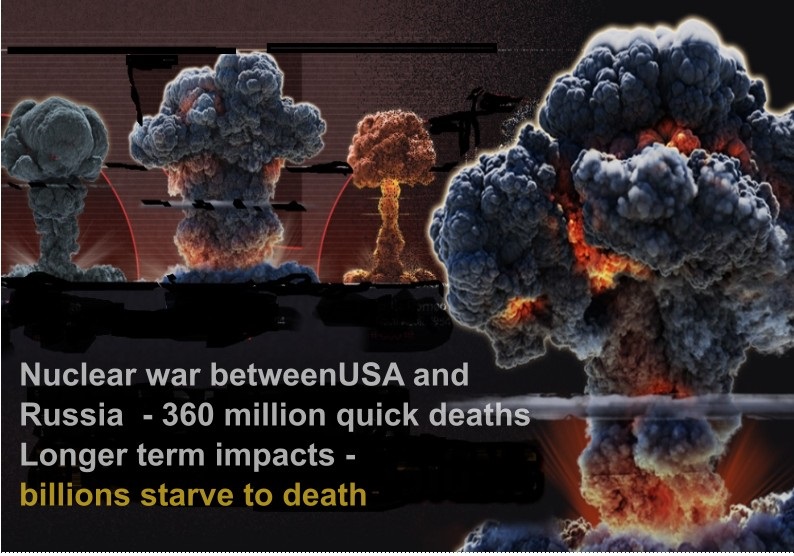
A global all-out nuclear war between the United States and Russia with over four thousand 100-kiloton nuclear warheads would lead, at minimum, to 360 million quick deaths.* That’s about 30 million people more than the entire US population…………………………..
As horrific as those statistics are, the tens to hundreds of millions of people dead and injured within the first few days of a nuclear conflict would only be the beginnings of a catastrophe that eventually will encompass the whole world.
Global climatic changes, widespread radioactive contamination, and societal collapse virtually everywhere could be the reality that survivors of a nuclear war would contend with for many decades.
The longer-term consequences of nuclear war
In recent years, in some US military and policy circles, there has been a growing perception that a limited nuclear war can be fought and won. Many experts believe, however, that a limited nuclear war is unlikely to remain limited. What starts with one tactical nuclear strike or a tit-for-tat nuclear exchange between two countries could escalate to an all-out nuclear war ending with the immediate and utter destruction of both countries.
But the catastrophe will not be limited to those two belligerents and their allies.
The long-term regional and global effects of nuclear explosions have been overshadowed in public discussions by the horrific, obvious, local consequences of nuclear explosions. Military planners have also focused on the short-term effects of nuclear explosions……………………..
widespread fires and other global climatic changes resulting from many nuclear explosions may not be accounted for in war plans and nuclear doctrines. These collateral effects are difficult to predict; assessing them requires scientific knowledge that most military planners don’t possess or take into account.
Global climatic changes……………………………………………..
Stratospheric soot injection………………………………
Changes in the atmosphere…………………………………
Changes on land…………………….
Changes in the ocean……………………….
Impacts on food production……………………………………….
Nowhere to hide
The impacts of nuclear war on agricultural food systems would have dire consequences for most humans who survive the war and its immediate effects.
The overall global consequences of nuclear war—including both short-term and long-term impacts—would be even more horrific causing hundreds of millions—even billions—of people to starve to death………………………………………………………
References & Acknowledgments…………………………
https://thebulletin.org/2022/10/nowhere-to-hide-how-a-nuclear-war-would-kill-you-and-almost-everyone-else/
“Present Danger: Nuclear Power Plants in War,” The US Army War College Quarterly: Parameters
what is still lacking, is a Pentagon assessment of what all this means militarily.
https://npolicy.org/present-danger-nuclear-power-plants-in-war-the-us-army-war-college-quarterly-parameters/ October 19, 2022, Author: Henry Sokolski
As the war in Ukraine drags on, daily developments at the Zaporizhzhia nuclear plant explode on our Google News screens. Last week, external power needed to prevent a core meltdown at the plant was cut off repeatedly, forcing reliance on emergency diesel generators.
Meanwhile, Russians have tortured, kidnapped, and killed Ukrainian staff at the plant to force them to renounce their loyalty to Ukraine and sign employment contracts with Rosatom, Russia’s electrical utility. Poland, Romania, Ukraine, Moldova, and Finland have all begun distributing iodine pills to reduce thyroid cancers if there is a loss of coolant accident at Zaporizhzhia and a radiological release that drifts their way.
And Washington’s response? Several senior US officials have condemned Russia’s assaults on Zaporizhzhia as being “irresponsible” and “dangerous.” Yet, well after Russia’s military assault on the plant, Westinghouse, the Energy and State Departments, and the President announced plans to construct nuclear power plants in Poland, Romania, and even Ukraine. No one has yet explained how or if these plants can be defended.
This is weird. Plants in Central Europe, like Zaporizhzhia, are not just electrical generators, they are stationary, potential slow-burning nuclear dispersal weapons that could conceivably trigger or even force a NATO response. Plants and such war zones present a real and present danger.
Late last month, the U.S. Army War College asked me to write a short piece on the military risks nuclear plants in war zones present. Attached, “Present Danger: Nuclear Plants in War,” is that analysis. It lays out a basic set of recommendations for the Pentagon.
Present Danger: Nuclear Power Plants in War
Zaporizhzhya’s nuclear plant, as of this writing, has been placed on cold shutdown. The plant and its military vulnerabilities, however, have generated some of the world’s most sensational headlines.1 Earlier this summer, online reports featured photographs of the plant’s damaged transformer, a system critical to assuring a steady supply of electricity to the plant’s all-important reactor coolant and safety systems. Throughout August and September, news organizations detailed how the plant’s external main power lines—built to keep electricity flowing to its reactors—had been cut. Some days, some of the plant’s six reactors were operating. Other days, none were. Repeatedly, the viability of the plant’s emergency diesel fuel electrical generators was “Topic A.”
Each of these stories raised the specter of a military-induced Fukushima: strikes against the plant or the power lines feeding into it that could cut off the electricity needed to run the reactors’ coolant pumps and safety equipment followed by nuclear fuel failures and a massive radiological release over Ukraine and its neighbors. Add to this firsthand accounts of Russian torture, the murder of “disloyal” Ukrainian reactor staff, and an emergency International Atomic Energy Agency visit, and you have everything needed for a Netflix docudrama.
What you would not have, however, and what is still lacking, is a Pentagon assessment of what all this means militarily.
Close friends have offered hints. Japanese Prime Minister Fumio Kishida called for stationing security forces at each of Japan’s nuclear plants, and his administration also suggested the possibility of deploying dedicated missile defense systems (as Belarus has done at its nuclear plant since 2019).2 Seoul crafted military exercises this year with US forces that included explosives detonating at one or more of South Korea’s civilian reactor sites.3 Ukrainian President Volodymyr Zelensky accused Russia of turning Zaporizhzhya into a prepositioned, slow-burning, radiation-dispersing “nuclear weapon.”4 Meanwhile, Tobias M. Ellwood, the British House of Common’s Select Committee on Defense chairman, insisted that if Russia intentionally struck Zaporizhzhya and spread harmful radioactivity to Poland or Romania, it would trigger NATO’s Article 5.5 Moldova, Romania, and Ukraine did more than talk. All three countries prepared to distribute iodine pills to their citizens (to reduce the thyroid cancers radiation might induce if Zaporizhzhya leaked radiation).6
Wikipedia, s.v. “Crisis at the Zaporizhizhia Nuclear Power Plant,” last modified September 14, 2022, https://en.m.wikipedia.org/wiki/Crisis_at_the_Zaporizhzhia_Nuclear_Power_Plant.- Eric Johnston, “Japan to Discuss Creating New Police Unit to Guard Nuclear Plants,” Japan Times (website), March 14, 2022, https://www.japantimes.co.jp/news/2022/03/14/national/nuclear-plant-police -unit/; and “TOR-M2 Air Defense Missile Systems to Protect Belarus Nuclear Power Plant,” Army Recognition (website), December 8, 2018, https://www.armyrecognition.com/december_2018_global_defense_security_army _news_industry/tor-m2_air_defense_missile_systems_to_protect_belarus_nuclear_power_plant.html.
- Sang-ho Song, “Upcoming S. Korea-U.S. Training Involves Drills on Repelling Attacks, Staging Counterattacks,” Yonhap News Agency (website), August 1, 2022, https://en.yna.co.kr/view /AEN20220801004000325.
- Rebecca Falconer, “Zelensky Says Russian Forces Using Zaporizhzhia Plant as ‘Nuclear Weapon,’ ” Axios (website), September 4, 2022, https://www.axios.com/2022/09/05/zelensky-russia-zaporizhzhia-plant -nuclear-weapon.
- Article 5 requires NATO members come to the defense of any other member that suffers a military attack. See Tobias M. Ellwood (@Tobias_Ellwood), “Let’s make it clear: ANY deliberate damage causing potential radiation leak to a Ukrainian nuclear reactor would be a breach of NATO’s Article 5. @thetimes,” Twitter, August 19, 2022, 1:55 a.m., https://twitter.com/Tobias_Ellwood/status/1560505699179925509?s=20& t=FYfhPvuxW0pHm8lwXfe99w.
- Josh Lederman, “Radiation Tablets Are Handed out near Ukrainian Nuclear Plants as Fears of a Leak Mount,” NBC News (website), August 26, 2022, https://www.nbcnews.com/news/world/russia-ukraine-war -zaporizhzhia-nuclear-plant-radiation-fears-iodine-rcna45041; Ben Turner, “Ukraine War: Moldova Ships in One Million Iodine Pills amid Fears of Nuclear Disaster,” Euronews (website), August 16, 2022, https: // www.euronews.com /2022 /08 /15 /moldova-ships-in-radiation-pills-as-fighting-rages-near-zaporizhzhia -nuclear-power-plant-i; and Helen Collis, “Romania to Issue Iodine Tablets as Russian War Continues in Neighboring Ukraine,” Politico (website), April 3, 2022, https://www.politico.eu/article/romania-to-issue -iodine-tablets-as-russian-aggression-continues-in-bordering-ukraine/.
Click here to read the full article.
SCOTT RITTER: Nuclear High Noon in Europe

Enter Volodymyr Zelensky, stage left. Speaking to the Lowy Institute, a nonpartisan international policy think tank in Australia, the Ukrainian president called for the international community to undertake “preventative strikes, preventive action” against Russia to deter the potential use of nuclear weapons by Russia against Ukraine
First and foremost, there has been zero talk about the employment of tactical nuclear weapons from the Kremlin.
The risk isn’t that Russia would start a pre-emptive nuclear war over Ukraine.
The risk is that America would.
https://consortiumnews.com/2022/10/19/scott-ritter-nuclear-high-noon-in-europe/ By Scott Ritter Consortium News 19 Oct 22, Now is the time for Biden to clarify U.S. nuclear doctrine. But he remains silent.
On Monday, Oct. 17, the North Atlantic Treaty Organization kicked off Operation STEADFAST NOON, its annual exercise of its ability to wage nuclear conflict. Given that NATO’s nuclear umbrella extends exclusively over Europe, the indisputable fact is that STEADFAST NOON is nothing more than NATO training to wage nuclear war against Russia.
Nuclear war against Russia.
Enter Joe Biden, center stage. Speaking at a fund raiser on Oct. 6, the president of the United States said that, “For the first time since the Cuban missile crisis, we have a direct threat of the use of a nuclear weapon if in fact things continue down the path they are going.”
Biden went on: “We’ve got a guy I know fairly well. He’s not joking when he talks about potential use of tactical nuclear weapons or biological or chemical weapons because his military is, you might say, significantly underperforming.”
Biden concluded: “I don’t think there’s any such thing as the ability to easily use a tactical nuclear weapon and not end up with Armageddon.”
The reader should let that sink in for a moment.
Don’t worry, NATO spokesperson Oana Lungscu reassured the rest of the world, the purpose of STEADFAST NOON is to ensure that NATO’s nuclear war-fighting capability “remains safe and effective.” It is a “routine” exercise, not linked to any current world events. Moreover, no “real” nuclear weapons will be used — just “fake” ones.
Nothing to worry about here.
Enter Jens Stoltenberg, NATO secretary general, stage right in the nuclear theater. In a statement to the press on Oct. 11, Stoltenberg declared that, “Russia’s victory in the war against Ukraine will be a defeat of NATO,” before ominously announcing, “This cannot be allowed.”
To that end, Stoltenberg stated, the STEADFAST NOON nuclear drills would continue as scheduled. These drills, Stoltenberg said, were an important deterrence mechanism in the face of Russian “veiled: nuclear threats.”
But they weren’t related to any current world events.
Enter Volodymyr Zelensky, stage left. Speaking to the Lowy Institute, a nonpartisan international policy think tank in Australia, the Ukrainian president called for the international community to undertake “preventative strikes, preventive action” against Russia to deter the potential use of nuclear weapons by Russia against Ukraine.
While many observers interpreted Zelensky’s words to imply a request for NATO to carry out a preemptive nuclear strike against Russia, Zelensky’s aides were quick to try and correct the record, saying he was simply asking for more sanctions.
Enter Joe Biden, center stage. Speaking at a fund raiser on Oct. 6, the president of the United States said that, “For the first time since the Cuban missile crisis, we have a direct threat of the use of a nuclear weapon if in fact things continue down the path they are going.”
Biden went on: “We’ve got a guy I know fairly well. He’s not joking when he talks about potential use of tactical nuclear weapons or biological or chemical weapons because his military is, you might say, significantly underperforming.”
Biden concluded: “I don’t think there’s any such thing as the ability to easily use a tactical nuclear weapon and not end up with Armageddon.”
While it has been made abundantly clear by the White House that Biden’s comments were his personal view, and not based on any new intelligence regarding Russian nuclear posture, the fact that a sitting U.S. president was speaking about the possibility of a nuclear “Armageddon” should send chills down the spine of every sane individual in the world.
No Kremlin Talk of Tactical Nuclear Weapons
First and foremost, there has been zero talk about the employment of tactical nuclear weapons from the Kremlin.
Zero.
Russian President Vladimir Putin has indicated that Russia would use “all the means at its disposal” to protect Russia. He said this most recently on Sept. 21, when in a televised address announcing partial mobilization, he accused the West of engaging in “nuclear blackmail,” citing “statements of some high-ranking representatives of the leading NATO states about the possibility of using nuclear weapons of mass destruction against Russia.”
Putin was alluding to a statement that Liz Truss made prior to her election as British prime minister, when, in response to a question on whether she was ready to undertake the responsibility of ordering the use of the U.K.’s nuclear arsenal, she replied, “I think it’s an important duty of the prime minister and I’m ready to do that.”
“I want to remind you,” Putin said,
“that our country also has various means of destruction and in some components more modern than those of the NATO countries. And if the territorial integrity of our country is threatened, we will certainly use all the means at our disposal to protect Russia and our people.”
Putin’s statements were consistent with that of Russian Defense Minister Sergei Shoigu, who in an address to the 10th Moscow Conference on International Security delivered on Aug. 16, asserted that Russia would not use nuclear weapons in Ukraine. According to Shoigu, Russian nuclear weapons are authorized for use under “exceptional circumstances” as described in published Russian doctrine, none of which apply to the Ukraine situation. Any talk of the use of nuclear weapons by Russia in Ukraine, Shoigu said, was “absurd.”
Apparently not to Biden, who despite his claim to know Putin “fairly well,” got it all wrong when talking about the potential for nuclear conflict.
The risk isn’t that Russia would start a pre-emptive nuclear war over Ukraine.
The risk is that America would.
Biden’s Pledge of ‘Sole Purpose Policy’
Biden came into office in February 2021 promising to enshrine in U.S. nuclear doctrine a “sole purpose policy,” under which “the sole purpose of our nuclear arsenal should be to deter — and, if necessary, retaliate against — a nuclear attack.”
It is now the middle of October 2022, and America finds itself in a situation where the president himself fears for a potential nuclear “Armageddon.”
If ever there was a time for Biden to make good on his pledge, now is it.
But he remains silent.
The danger inherent in Biden’s silence is that Putin and other Russian officials who are concerned about Russian national security must rely upon existing published U.S. nuclear doctrine, which continues to enshrine a policy of nuclear pre-emption promulgated during the administration of President George W. Bush. Under this doctrine, nuclear weapons are but another tool in the military’s toolbox, to be used as and when needed, including occasions where the destruction of battlefield targets for the simple purpose of gaining an operational advantage is the objective.
One can argue that this sort of non-nuclear preemption has its own inherent deterrence value, a sort of “madman” kind of vibe that makes an opponent question whether the president could act in such an irrational manner…………….
Former President Donald Trump breathed new life into Nixon’s “madman theory,” telling North Korea that if it continued to threaten the United States “[t]hey will be met with fire, fury and frankly power the likes of which this world has never seen before.” Trump went on to have three face-to-face meetings with North Korean leader Kim Jung-Un in a failed effort to bring about the denuclearization of the Korean peninsula.
It was under the Trump administration that the U.S. Navy deployed the W-76-2 low-yield nuclear warhead on its Trident submarine-launched ballistic missiles, giving the president a greater range of options when it came to the employment of nuclear weapons………………………………………………
As this article is being written, U.S. nuclear-capable B-52 bombers are flying to Europe from their U.S. bases, where they will practice delivering nuclear weapons against a Russian target. Dozens more aircraft, flying from Volkel Air Force Base in the Netherlands (home to an arsenal of U.S. B-61 nuclear bombs), will practice employing NATO nuclear weapons against…Russia.
Russia has responded to the NATO nuclear drill by going forward with its own annual nuclear exercise, “Grom” (Thunder). ………………….
Now is not the time for drama, or theatrically inflammatory rhetoric. Now is the time for maturity, sanity…restraint. A sage leader would have recognized the possibility of misperception on the part of Russia when NATO, a mere week after being encouraged by the Ukrainian president to initiate a preemptive nuclear strike on Russia, carries out a major exercise where NATO practices dropping nuclear bombs on Russia. A sober leader would have postponed these drills and encouraged similar action from Russia regarding its nuclear exercises.
Instead, America gets an unscripted, off-the-cuff reference to a nuclear Armageddon from a narcissistic egomaniac who uses the horror of nuclear annihilation as a fund-raising mantra.
It would take but one miscalculation, a single misunderstanding to turn STEADFAST NOON into “High Noon,” and “Grom” (Thunder) into “Molnya” (Lightening).
We’ve seen this scenario before. In November 1983 NATO carried out a command post exercise, codenamed ABLE ARCHER ’83, designed to test “nuclear weapons release procedures.” The Soviets were so alarmed by this exercise, which they believed could be used to mask a preemptive nuclear strike by NATO against the Soviet Union, that they loaded nuclear warheads onto bombers, bringing NATO and the Soviet Union to the brink of a nuclear war.
NATO Chief Raises Nuclear War Fever
Eurasia Review, By Patial RC 22 Oct 22, The world fails to learn lessons from the past Cuban Missile Crisis of October 1962 and the NATO Exercise ‘Able Archer’ in November 1983 that almost triggered a Nuclear War.Soviet intelligence was suspicious that the US might carry out a nuclear strike under the guise of a drill. “In response to this exercise, the Soviets readied their forces, including their nuclear weapons for launch and that in a way scared the NATO.The Able Archer was designed to simulate the start of a nuclear war, and many argue that it almost did.
Putin told reporters following a summit of ex-Soviet nations in Kazakhstan. “We do not set ourselves the task of destroying Ukraine and does not plan more massive strikes against Ukraine for now.”
Putin has repeatedly signalled he could use nuclear weapons to defend his country. Russia’s nuclear doctrine envisions “exclusively retaliatory measures intended to prevent the destruction of the Russian Federation as a result of direct nuclear strikes or the use of other weapons that raise the threat for the very existence of the Russian state.”
NATO Chief Creates Nuclear War Hysteria
NATO Secretary General Stoltenberg having been the Prime Minister of Norway twice amid rising tensions with Russia over the war in Ukraine went ahead with the Western military alliance annual routine nuclear deterrent exercises “Steadfast Noon” from 17 October 2022. Fourteen NATO countries without France are taking part in this exercise led by the major headquarters of the Allied Powers in Europe, based in Mons. Some 60 combat aircraft, including Tornado and F-16s, are being used, as well as surveillance aircraft and tankers mobilized for this exercise organized more than 1,000 kilometers from the Russian border.
NATO Chief Jens Stoltenberg instead of canceling or postponing the NATO Nuclear Exercises ‘Steadfast Noon’ amid rising tensions with Russia said on the eve of a meeting of NATO defence ministers in Brussels “It would send a very wrong signal if we suddenly now canceled a routine, long-time planned exercise because of the war in Ukraine.
……………………………… Why could not the UN take the initiative to stop the NATO Nuclear Exercises ‘Steadfast Noon’ to avoid misunderstandings, miscalculations to increase the risk of escalation and mistakenly trigger a Nuclear War Hysteria!NATO Chief Stoltenberg through his actions and decisions is responsible for raising the Nuclear War Fever.This rash decision was not expected from the NATO Chief Stoltenberg who has been twice the Prime Minister of Norway. Appears his decisions come from the White House who looks to weaken Europe and Russia.US President Joe Biden has labeled Putin as a ‘War Criminal’ and has declared that Putin “Cannot remain in power.” https://www.eurasiareview.com/22102022-nato-chief-raises-nuclear-war-fever-oped/
Golden Rule sails for peace to Burlington: ‘If we do nothing, we go nowhere’

Michaele Niehaus, The Hawk Eye, 21 Oct 22,
A group of about 20 southeast Iowa residents and city officials gathered Thursday near the Port of Burlington to welcome the Golden Rule and its crew, as well as recognize the importance of activism and kindness.
The refurbished, 64-year-old, 34-foot wooden sailboat has been navigating the shallowing waters of the Upper Mississippi River for the past month to spread a message of peaceful activism. It is carrying on its mission of worldwide nuclear disarmament that began in 1958, when a group of Quakers set sail from Hawaii to the Marshall Islands in protest of the nuclear weapons testing that was taking place there.
The sailboat never made it there, and the crew were arrested while en route.
Their mission and arrests spurred an attempt to sail a 50-foot boat there by Earle Reynolds, a doctor who was investigating the effects of ionizing material on the children of Hiroshima.
“So (Reynolds and his family) sailed down there and this guy got arrested. So between the two trials, his trial and the Golden Rule trial, there was enough national press to reach the president’s attention, and in the year that his family sailed, the president stopped testing under the provision that the USSR would stop testing. And so eventually things carried on and it ended up with John F. Kennedy signing the test ban treaty,” first mate Stephen Buck told The Hawk Eye from inside the cabin while holding a copy of Reynolds’ book, “The Forbidden Voyage.”
While the trials received much attention, the Golden Rule itself did not. It wasn’t until it sunk in Northern California’s Humbolt Bay in 2010 that its mission was resumed by Veterans for Peace, who were instrumental in the five-year effort to refurbish the ketch.
“We’re carrying on the original mission, which was an urgent need to stop bomb testing in the Pacific, above ground, in the air. And they were sending significant pollution of radioactive material to people who populated the Pacific, poisoning the land, poisoning the food, and those people are still here,” Buck said………………………………………………………….
Captain Kiko Johnston-Kitazawa noted the progress made on lessening the number of nuclear weapons and nuclear testing, but said the problem has not gone away.
“The last few years, all the bigger countries are bragging about, oh, we’ve got a bigger, more destructive (weapons) and we’re going to use it, so it’s time to pay attention again,” he said, noting that progress can be made through activism, such as with the Golden Rule, as well as on an individual level. “If we all continuously try to be the kind of people who treat every other person kindly, that grows into communities and countries likewise, and that is how you eliminate the root causes of war, so both are important.”…………………………………………………………..
The Golden Rule’s progress can be followed by visiting share.garmin.com/goldenrule, and those wishing to join its crew for a day or longer can apply by visiting vfpgoldenrule.org/crew-application/. https://www.thehawkeye.com/story/news/local/2022/10/21/golden-rule-sailboat-brings-nuclear-disarmament-message-to-burlington/69569236007/
Why the US must press for a ceasefire in Ukraine

The war might have been prevented — probably would have been prevented — if Ukraine had been willing to abide by the Minsk agreement, recognize the Donbas as an autonomous entity within Ukraine, avoid NATO military advisors, and pledge not to enter NATO. Nevertheless, what was possible even as late as January 2022 may not be possible now. The Russian annexation of additional territory raises the stakes. But the longer the war continues the harder it is going to be to avoid the utter destruction of Ukraine.
As a key player in Kyiv’s defense and the leader of sanctions against Russia, Washington is obligated to help find a way out.
Responsible Statecraft, OCTOBER 17, 2022, Jack F. Matlock Jr.
Four recent events have put the war in Ukraine on a distinctly more dangerous course.
— The Russian annexation of four additional Ukrainian provinces blocks compromise solutions that were feasible earlier.
— The disabling attacks on both North Stream pipelines make it impossible in the near term to restore Russia as the principal energy supplier to Germany, even if the war in Ukraine should be miraculously ended.
— The Ukrainian attack on the bridge to Crimea gave Russia a pretext to escalate attacks on Ukrainian civilian targets.
— The Russian retaliatory attacks on civilian targets are certain to do more damage to Ukraine than Ukraine can do to Russia.
The leaders of both Russia and Ukraine have set impossible goals. In fact, not a single participant in the war in Ukraine has espoused a goal that can restore peace in the area. Russia’s recent incorporation of four Ukrainian provinces into the Russian Federation will not be accepted by Russia’s neighbors or by most European powers.
Given the passions aroused by the war and its atrocities, Ukraine, even with NATO support, cannot create a stable, functioning state within all the borders it inherited in 1991. If Ukraine tries to regain these territories by force and is encouraged and empowered by the U.S. and NATO to do so, Russia (and not just President Putin) will very likely demolish Ukraine in retaliation. Reality trumps illusion whenever the two conflict.
And if war should stop with the destruction of Ukraine — Kyiv and Lviv leveled as Grozny once was — that would assume that escalation does not involve the use of nuclear weapons. If the Russian leader feels convinced that the U.S. and “Western” goal is to take him out, what is to prevent him taking out others as he goes?
What Went Wrong
It did not have to happen. When the Cold War ended (by negotiation, not by victory) and the USSR fragmented into 15 separate countries (because of pressures from the inside, not from without), Europe was suddenly whole and free, the goal of U.S. and NATO policy during the Cold War. If the future stability and prosperity of Europe were to be ensured, the principal task was to build a security system covering all the countries of Europe.
But a succession of American presidents, from Clinton to Trump, chose instead to enlarge NATO, to trash arms control treaties that ended the Cold War, and to enlist former Soviet republics in a military alliance that excluded Russia. Benjamin Abelow summarized the portentous events in his insightful How the West Brought War to Ukraine.
The war might have been prevented — probably would have been prevented — if Ukraine had been willing to abide by the Minsk agreement, recognize the Donbas as an autonomous entity within Ukraine, avoid NATO military advisors, and pledge not to enter NATO. Nevertheless, what was possible even as late as January 2022 may not be possible now. The Russian annexation of additional territory raises the stakes. But the longer the war continues the harder it is going to be to avoid the utter destruction of Ukraine.
America’s Security
We Americans can only admire the valiant resistance Ukrainians have mounted to the Russian invasion and should be proud that we have been able to support their defense. Everything possible should be done to make sure that Ukraine survives as an independent state. But that does not mean that Ukraine has to recover all the territory it inherited in 1991. In fact, given all the passions aroused by the war and what preceded it (the violent change of government in 2014 that many Russians considered a coup d’etat organized by the United States), the population in some areas is likely to resist a return to Kyiv’s control.

Some will argue that the United States has a moral obligation to support whatever the Ukrainian leaders demand since “they know best.”
No, they do not know best what is in the security interests of the American people, and that should be the primary concern of any American government. They also, under the stress of war, may not be the best judges of their own ultimate security interests.
…………………………………………………………………………….The issue with Ukraine and Russia of course is not recognition of independence but whether the U.S. should support the Ukrainian goal to restore its control over all the territory it received when the Soviet Union broke up. If pursuit of that goal precipitates the progressive destruction of Ukraine, it is obviously not in Ukraine’s interest.
Effect on the World
The fighting in Ukraine continues and intensifies while the world is still struggling with the covid-19 pandemic and remains vulnerable to mutations and new pathogens, while global warming is producing ever more destructive effects. Meanwhile, migrations caused by famine, flood, war, and misgovernment are overwhelming the capacity of even the richest countries to absorb the afflicted. And to all of that one must add the threat of Armageddon, a nuclear holocaust — something no rational leader would risk. But rationality cannot be assumed in either domestic or international politics today.
………………………………………………………………. What all the parties to the conflict in Ukraine seem to have forgotten is that the future of mankind will not be determined by where international borders are drawn — these have never been static in history and doubtless will continue to change from time to time. The future of mankind will be determined by whether nations learn to settle their differences peacefully.
Is There a Way to Stop the War?
There may not be, given the passions aroused by the conflict. Both Ukraine and Russia have lost enough blood that their populations are likely to oppose any effort to give the other side any portion of what it wants. Their presidents hate each other and see any concession as a personal defeat. But the more the war continues, the more Ukrainian lives will be lost, property destroyed, and the probability of a wider conflict increased.
The only practical way to stop the actual fighting would be to agree on a ceasefire. This is difficult for the Ukrainians since they are liberating some of the occupied territories, but the reality is that if the war continues Russia is capable of damaging Ukraine more than Ukraine can damage Russia without risking a wider war.
As principal arms supplier to Ukraine, the U.S. should encourage the Ukrainians to agree to a ceasefire. As the sponsor of the most punitive sanctions on Russia, the U.S. should use its leverage to induce Russia to agree to genuine negotiations during a ceasefire.
Negotiations must be conducted in private to be successful, which would require a revival of U.S.-Russia diplomacy. Over the past few years, tit-for-tat expulsions have reduced both countries to skeleton diplomatic staffs. Nevertheless, if there is a will to talk and negotiate, ways can be found. So far, it is the will that seems to be lacking.
At present, none of the relevant parties to the conflict in Ukraine seem to be willing to stop fighting and enter into genuine negotiations to bring peace in Ukraine. Until this changes, the fighting stops, and serious negotiations get underway, the world is headed for an outcome where we all are losers. https://responsiblestatecraft.org/2022/10/17/on-ukraine-the-us-is-on-the-hook-to-find-a-way-out/
—
Terror on Crimea Bridge and Russia unleashing shock’n awe.
Pearls and Irritations, By P&I Guest Writers, Oct 18, 2022
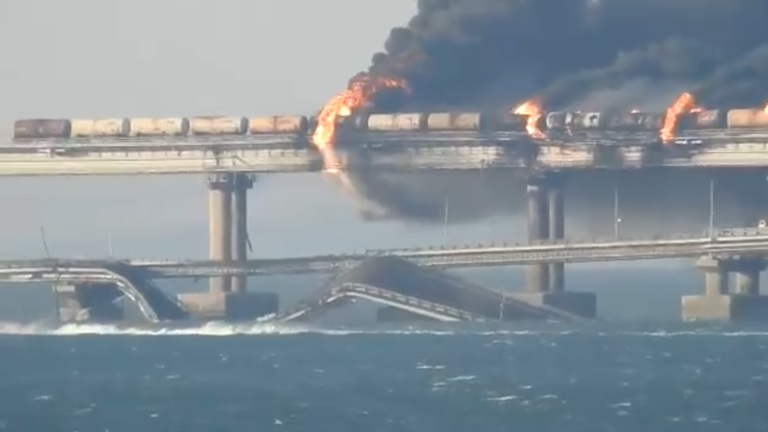
The terror attack on Krymskiy Most – the Crimea Bridge – was the proverbial straw that broke the Eurasian camel’s back.
Russian President Vladimir Putin neatly summarised it: “This is a terrorist attack aimed at destroying the critical civilian infrastructure of the Russian Federation.”
The head of the Russian Investigative Committee, Alexander Bastrykin, confirmed face-to-face with Putin that Terror on the Bridge was carried out by the SBU – Ukrainian special services.
Bastrykin told Putin, “we have already established the route of the truck, where the explosion took place. Bulgaria, Georgia, Armenia, North Ossetia, Krasnodar… The carriers have been identified. With the help of operatives of the FSB, we managed to identify suspects.”
Russian intel leaked crucial info to military correspondent Alexander Kots. The cargo was ordered by a Ukrainian citizen: explosives packed in 22 pallets, in rolls of film under plastic wrap, were shipped from Bulgaria to the Georgian port of Poti. Afterwards, the cargo was loaded onto a truck with foreign license plates and proceeded overland to Armenia………………………………………………………………
The driver of the first truck is already testifying. Yusubov, the driver of the second truck – which exploded on the bridge – was “blind:” he had no idea what he was carrying, and is dead.
At this stage, two conclusions are paramount.
First: This was not a standard ISIS-style truck suicide bombing – the preferred interpretation in the aftermath of the terror attack.
Second: The packaging most certainly took place in Bulgaria. That, as Russian intel has cryptically implied, indicates the involvement of “foreign special services.”
‘A mirage of cause and effect’
What has been revealed in public by Russian intelligence tells only part of the story. An incandescent assessment received by The Cradle from another Russian intel source is way more intriguing.
At least 450 kg of explosives were employed in the blast. Not on the truck, but mounted inside the Crimea Bridge span itself. The white truck was just a decoy by the terrorists “to create a mirage of cause and effect.” When the truck reached the point on the bridge where the explosives were mounted, the explosion took place.
According to the source, railroad employees told investigators that there was a form of electronic hijacking; the terror operators took control of the railway so the train carrying fuel received a command to stop because of a false signal that the road ahead was busy.
Bombs mounted on the bridge spans were a working hypothesis largely debated in Russian military channels over the weekend, as well as the use of underwater drones.
In the end, the quite sophisticated plan could not follow the necessarily rigid timing. There was no alignment by the millimeter between the mounted explosive charges, the passing truck and the fuel train stopped in its tracks. Damage was limited, and easily contained. The charges/truck combo exploded on the outer right lane of the road. Damage was only on two sections of the outer lane, and not much on the railway bridge.
In the end, Terror on the Bridge yielded a short, Pyrrhic PR victory – duly celebrated across the collective West – with negligible practical success: transfer of Russian military cargo by railway resumed in roughly 14 hours.
And that brings us to the key information in the Russian intel source assessment: the whodunnit.
It was a plan by the British MI6, says this source, without offering further details. Which, he elaborates, Russian intel, for a number of reasons, is shadow-playing as “foreign special services.”
It’s quite telling that the Americans rushed to establish plausible deniability. The proverbial “Ukrainian government official” told CIA mouthpiece The Washington Post that the SBU did it. That was a straight confirmation of an Ukrainska Pravda report based on an “unidentified law enforcement official.”
The perfect red line trifecta
Already, over the weekend, it was clear the ultimate red line had been crossed. Russian public opinion and media were furious. For all its status as an engineering marvel, Krymsky Most represents not only critical infrastructure; it is the visual symbol of the return of Crimea to Russia.
Moreover, this was a personal terror attack on Putin and the whole Russian security apparatus.
So we had, in sequence, Ukrainian terrorists blowing up Darya Dugina’s car in a Moscow suburb (they admitted it); US/UK special forces (partially) blowing Nord Stream and Nord Stream 2 (they admitted and then retracted); and the terror attack on Krymsky Most (once again: admitted then retracted).
Not to mention the shelling of Russian villages in Belgorod, NATO supplying long-range weapons to Kiev, and the routine execution of Russian soldiers.
Darya Dugina, Nord Streams and Crimea Bridge make it an Act of War trifecta. So this time the response was inevitable – not even waiting for the first meeting since February of the Russian Security Council scheduled for the afternoon of 10 October.
Moscow launched the first wave of a Russian Shock’n Awe without even changing the status of the Special Military Operation (SMO) to Counter-Terrorist Operation (CTO), with all its serious military/legal implications.
After all, even before the UN Security Council meeting, Russian public opinion was massively behind taking the gloves off. Putin had not even scheduled bilateral meetings with any of the members. Diplomatic sources hint that the decision to let the hammer come down had already been taken over the weekend.
Shock’n Awe did not wait for the announcement of an ultimatum to Ukraine (that may come in a few days); an official declaration of war (not necessary); or even announcing which ‘”decision-making centers” in Ukraine would be hit.
The lightning strike de facto metastasising of SMO into CTO means that the regime in Kiev and those supporting it are now considered as legitimate targets, just like ISIS and Jabhat al-Nusra during the Anti-Terror Operation (ATO) in Syria.
And the change of status – now this is a real war on terror – means that terminating all strands of terrorism, physical, cultural, ideological, are the absolute priority, and not the safety of Ukrainian civilians. During the SMO, safety of civilians was paramount. Even the UN has been forced to admit that in over seven months of SMO the number of civilian casualties in Ukraine has been relatively low.
Enter ‘Commander Armageddon’
The face of Russian Shock’n Awe is Russian Commander of the Aerospace Forces, Army General Sergey Surovikin: the new commander-in-chief of the now totally centralised SMO/CTO………………………………..
Surovikin is Dr. Shock’n Awe with full carte blanche. That even rendered idle speculations that Defense Minister Sergei Shoigu and Chief of the General Staff Valery Gerasimov were removed or forced to resign, as speculated by the Wagner group Telegram channel Grey Zone.
It is still possible that Shoigu – widely criticised for recent Russian military setbacks – could be eventually replaced by Tula Governor Alexei Dyumin, and Gerasimov by the Deputy Commander-in-Chief of the Ground Forces, Lieutenant General Alexander Matovnikov.
That’s almost irrevelant: all eyes are on Surovikin.
MI6 does have some well-placed moles in Moscow, relatively speaking. The Brits had warned Ukrainian President Volodymyr Zelensky and the General Staff that the Russians would be launching a “warning strike” this Monday.
What happened was no “warning strike,” but a massive offensive of over 100 cruise missiles launched “from the air, sea and land,” as Putin noted, against Ukrainian “energy, military command and communications facilities.”
MI6 also noted “the next step” will be the complete destruction of Ukraine’s energy infrastructure. That’s not a “next step:” it’s already happening. Power supply is completely gone in five regions, including Lviv and Kharkov, and there are serious interruptions in other five, including Kiev.
Over 60 percent of Ukrainian power grids are already knocked out. Over 75 percent of internet traffic is gone. Elon Musk’s Starlink netcentric warfare has been “disconnected” by the Ministry of Defence.
Shock’n Awe will likely progress in three stages.
First: Overload of the Ukrainian air defence system (already on).
Second: Plunging Ukraine into the Dark Ages (already in progress).
Third: Destruction of all major military installations (the next wave).
Ukraine is about to embrace nearly total darkness in the next few days. Politically, that opens a completely new ball game. Considering Moscow’s trademark “strategic ambiguity,” this could be a sort of Desert Storm remixed (massive air strikes preparing a ground offensive); or, more likely, an ‘incentive’ to force NATO to negotiate; or just a relentless, systematic missile offensive mixed with Electronic Warfare (EW) to shatter for good Kiev’s capacity to wage war.
Or it could be all of the above.
How a humiliated western Empire can possibly raise the stakes now, short of going nuclear, remains a key question. Moscow has shown admirable restraint for too long. No one should ever forget that in the real Great Game – how to coordinate the emergence of the multipolar world – Ukraine is just a mere sideshow. But now the sideshow runners better run for cover, because General Armageddon is on the loose.
Pepe Escobar is a columnist at The Cradle, editor-at-large at Asia Times and an independent geopolitical analyst focused on Eurasia. Since the mid-1980s he has lived and worked as a foreign correspondent in London, Paris, Milan, Los Angeles, Singapore and Bangkok. He is the author of countless books; his latest one is Raging Twenties.
A US billionaire proposes peace plan for Ukraine and Russia

https://www.rt.com/news/564960-bill-ackman-ukraine-peace/ 17 Oct 22,
Hedge fund manager Bill Ackman says Kiev should make concessions to Moscow.
Ukraine should recognize Crimea as part of Russia and renounce its bid to join NATO for the sake of peace, US billionaire hedge fund manager Bill Ackman has said. As with SpaceX and Tesla CEO Elon Musk before him, Ackman was immediately criticized online for suggesting that Kiev should be ready to make concessions in order to end the hostilities.
“Crimea was part of Russia until 1954 and is largely comprised of ethnic Russians, which was apparently why the world did little when Russia annexed it back in 2014,” Ackman, the CEO of Pershing Square Capital Management, tweeted on Monday.
He added that the borders should return to where they were prior to February 24, when Russia launched its military operation in the neighboring country and before four former Ukrainian regions voted to join Russia. He added that the West should then help Kiev with its recovery, while the country should stay outside NATO.
“Thousands of lives will be saved and resources can be invested to rebuild [Ukraine] rather than in a war that will only lead to more destruction and death,” the billionaire wrote. “If there is a viable path to peace, we should pursue it. Each day the conflict continues, the risk to the world rises.”
After receiving criticism online, Ackman clarified his stance on Tuesday. “Yesterday, I suggested that a reasonable peace settlement might be a return to the borders as of [February 24], a Marshall Plan to rebuild [Ukraine], and [Ukraine’s] decision to not join NATO. Then the knives came out. I was accused of being an appeaser and worse,” he wrote.
I ask: is [Ukraine] better off in a continued prolonged war that leads to 1,000s more [Ukrainian] deaths and the leveling of the country or does some kind of negotiated settlement make sense? … I am by no means an expert. It just saddens me to see death and destruction with no apparent end date or opportunity for resolution.
I”n a negotiated settlement, both parties must concede something or there is no opportunity for resolution. What is the least that both parties can concede that is acceptable for both? What am I missing in my analysis? What better ideas do you have?” Ackman argued.
Ackman’s comments came as more public figures in the West have been making suggestions for a possible peace deal between Russia and Ukraine. Venture capitalist and tech entrepreneur David Sacks tweeted on Sunday that the US should propose a ceasefire based on the February 23 lines and guarantee that Ukraine will not join NATO.
Musk offered his own vision of a peace settlement this month, which includes Ukraine recognizing Crimea as Russian territory. Kiev and Western officials quickly blasted Musk for what they considered to be a plan that heavily favors Moscow.
Rehearsal for ‘Armageddon’ Underway as NATO and Russia Hold Nuclear Exercises
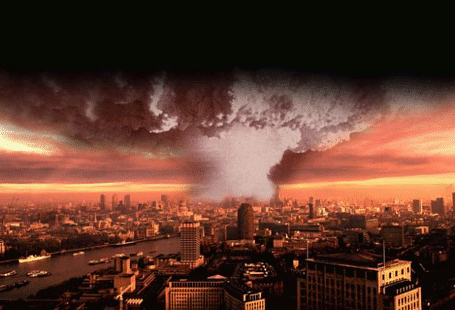
While drills like Steadfast Noon and Grom don’t involve live nuclear warheads, they do have the potential for catastrophic escalation.
“All nuclear exercises imply willingness to mass murder civilians, wipe out entire cities, and risk all-out nuclear war,” said ICAN. “They also risk accidents and escalation, and will legitimize Russia’s dangerous nuclear rhetoric.”
Common Dreams, BRETT WILKINS, October 17, 2022, As NATO on Monday began its annual rehearsal for nuclear war in Europe and Russia prepared to conduct its own nuclear drill amid Cold War-like tensions inflamed by the invasion of Ukraine, peace advocates underscored the imperative for de-escalation in order to avert catastrophe.
“All nuclear exercises imply willingness to mass murder civilians, wipe out entire cities, and risk all-out nuclear war,” the International Campaign to Abolish Nuclear Weapons (ICAN) warned ahead of the NATO drill. “They also risk accidents and escalation, and will legitimize Russia’s dangerous nuclear rhetoric.”
NATO said the exercise—operation name Steadfast Noon—involves up to 60 warplanes from 14 members of the alliance, and is being carried out from Kleine Brogel air base in northeastern Belgium.
The U.S. military stockpiles dozens of B61-12 tactical nuclear warheads at Kleine Brogel, each up to 30 times as powerful as the atomic bomb that the United States dropped on Hiroshima, Japan in 1945, killing over 100,000 people.
According to Belgium’s VRT News, Belgian F-16 pilots will train how to drop the bombs, while ground crews will practice transporting the weapons from underground bunkers and loading them on warplanes.
U.S. B-52 bombers based at Minot Air Force Base in North Dakota will also fly to Europe to participate in the drill, which will take place over Belgium, the North Sea, and the United Kingdom, according to NATO.
Russia has been informed of the exercise, which is scheduled to last until October 30.
While NATO spokesperson Oana Lungescu explained that Steadfast Noon “helps ensure that the alliance’s nuclear deterrent remains safe, secure and effective,” Ludo Debrabander of the Belgian peace group Vrede vzw told VRT News that “in a nuclear escalation military bases equipped with nuclear weapons like Kleine Brogel form the first potential targets. They don’t make us safer.”…………………………………..
Russian forces are expected to carry out their own annual large-scale nuclear exercise—called Grom, or “Thunder”—along Russia’s northwestern coast in the coming days or weeks, its second of the year.
While drills like Steadfast Noon and Grom don’t involve live nuclear warheads, they do have the potential for catastrophic escalation.
In November 1983, an extremely tense period of the Cold War, Soviet military officials initially mistook NATO’s Able Archer 83 war game for a possible preemptive strike and prepared their own nuclear missiles for launch.
“It was a vicious circle,” wrote Francine Uenuma for Smithsonian Magazine. “The Soviets refused to believe the Americans were bluffing; the Americans, meanwhile, suspected the Soviets were bluffing about not thinking the Americans were bluffing.”…………………………………………….. more https://www.commondreams.org/news/2022/10/17/rehearsal-armageddon-underway-nato-and-russia-hold-nuclear-exercises
1 This Month





PLEASE OPPOSE HR 8255 AND S.3639 – bills would accelerate satellite deployment, with no environmental review or safeguards – https://ncstd5li.quorum.us/campaign/169331/
To see nuclear-related stories in greater depth and intensity – go to https://nuclearinformation.wordpress.com
-
Archives
- October 2026 (10)
- September 2026 (339)
- August 2026 (330)
- July 2026 (355)
- June 2026 (287)
- May 2026 (306)
- April 2026 (356)
- March 2026 (251)
- February 2026 (267)
- January 2026 (308)
- December 2025 (358)
- November 2025 (359)
-
Categories
- 1
- 1 NUCLEAR ISSUES
- business and costs
- climate change
- culture and arts
- ENERGY
- environment
- health
- history
- indigenous issues
- Legal
- marketing of nuclear
- media
- opposition to nuclear
- PERSONAL STORIES
- politics
- politics international
- Religion and ethics
- safety
- secrets,lies and civil liberties
- spinbuster
- technology
- Uranium
- wastes
- weapons and war
- Women
- 2 WORLD
- ACTION
- AFRICA
- Atrocities
- AUSTRALIA
- Christina's notes
- Christina's themes
- culture and arts
- Events
- Fuk 2022
- Fuk 2023
- Fukushima 2017
- Fukushima 2018
- fukushima 2019
- Fukushima 2020
- Fukushima 2021
- general
- global warming
- Humour (God we need it)
- Nuclear
- RARE EARTHS
- Reference
- resources – print
- Resources -audiovicual
- Weekly Newsletter
- World
- World Nuclear
- YouTube
-
RSS
Entries RSS
Comments RSS

