Former US Secretary of State says Pakistan’s 2019 conflict with India almost sparked nuclear war
A former high-ranking US official has revealed he will “never forget the night” when the world witnessed what almost became a nuclear catastrophe.
Alex Blair news.com.au 25 Jan 23
Former US Secretary of State Mike Pompeo has detailed just how close the world came to nuclear war in 2019.
In February 2019, the relationship between rival nuclear powers India and Pakistan came dangerously close to escalating into a full-blown conflict, Pompeo writes in his memoir.
It all kicked off when India launched a military operation against militants within Pakistani territory, in response to an attack on its own troops in the disputed region of Kashmir that left 40 Indian soldiers dead.
Pakistan retaliated by shooting down two Indian aircraft and capturing a fighter pilot.
Both nations lay claim to Kashmir, but currently control only portions of the region. India has long accused Pakistan of supporting separatist militants in the Kashmir Valley, a claim that Pakistan denies.
The two nations, both nuclear powers, have engaged in multiple conflicts throughout their history, with the majority of these conflicts centred around the disputed region.
In his memoir, Never Give An Inch: Fighting for the America I Love, Pompeo emphasises that the world was unaware of the sheer gravity of the situation……………………………………………………….. more https://www.news.com.au/technology/innovation/military/former-us-secretary-of-state-says-pakistans-2019-conflict-with-india-almost-sparked-nuclear-war/news-story/75da26ebea96f1064d024205c6108bc2
NASA partners with the military to test nuclear fission-powered spacecraft engine by 2027
The technological advancement has long been seen as critical to long-haul missions, including a manned trip to Mars.
Aljazeera 24 Jan 2023
The top official at the United States space agency NASA has said the country plans to test a spacecraft engine powered with nuclear fission by 2027, an advancement seen as key to long-haul missions including a manned journey to Mars.
NASA will partner with the US military’s Defense Advanced Research Projects Agency (DARPA) to develop the nuclear thermal propulsion engine and launch it into space, NASA administrator Bill Nelson said on Tuesday. The project has been named the Demonstration Rocket for Agile Cislunar Operations or DRACO……………………..
Under the NASA-DARPA agreement, NASA’s Space Technology Mission Directorate will lead technical development of the nuclear thermal engine, which will eventually be integrated with an experimental spacecraft created by the military.
The agency said the last US nuclear thermal rocket engine tests were discontinued in the 1970s… https://www.aljazeera.com/news/2023/1/24/nasa-to-test-nuclear-fission-powered-spacecraft-engine-by-2027
Military offensives increase nuclear accident odds in Ukraine, warns atomic safety chief

Earlier this month, Petro Kotin, president of Ukraine’s state-run Energoatom nuclear operator, said a U.N. security buffer was not “realistic” and instead called for Ukraine’s forces to take the facility back by force.
But Grossi warned that any attack “puts the installation at great risk.”
Rafael Mariano Grossi wants ‘every’ EU country to push for a security buffer around the occupied Zaporizhzhia plant.
POLITICO, BY VICTOR JACK, JANUARY 25, 2023
The risk of an accident at Ukraine’s Russia-occupied Zaporizhzhia nuclear power plant will “undoubtedly” increase as both Kyiv and Moscow prepare for military offensives in the coming months, warned the chief of the U.N.’s nuclear watchdog.
“There is a lot of talk about bigger, larger maneuvers and action in the early spring or late winter,” Rafael Mariano Grossi, the International Atomic Energy Agency (IAEA) director general, told POLITICO, “which makes me think that any increase in bombing and shelling will undoubtedly increase the possibility of a nuclear accident.”
Russia is likely to launch a fresh push to take Ukrainian territory this spring, a top NATO official said last week, while Ukraine also says it is readying a major counter-offensive……………………………………….
Earlier this month, Petro Kotin, president of Ukraine’s state-run Energoatom nuclear operator, said a U.N. security buffer was not “realistic” and instead called for Ukraine’s forces to take the facility back by force.
But Grossi warned that any attack “puts the installation at great risk.”
He’s pressing for EU foreign ministers to get involved and use their “own channels of communication” with Ukraine and Russia to “pass the message … that avoiding a nuclear accident is a must” and a security zone is needed.
Grossi also addressed the increasingly frequent calls from Russian propagandists and some politicians that Moscow should respond to its battlefield setbacks by unleashing its nuclear weapons.
“I don’t see how a conventional war — no matter how dramatic it is — between a non-nuclear weapon state and a nuclear weapon state could … justify the use of nuclear weapons,” he said. https://www.politico.eu/article/ukraine-war-military-nuclear-accident-atomic-safety-chief-rafael-mariano-grossi/
Doomsday Clock reset to 90 seconds to midnight

Humanity is closer to Armageddon than ever, according to a team of
scientists, who said global conflict had helped to push the world towards
calamity.
The Doomsday Clock, a symbolic measure of the threats facing the
world, has been set at 90 seconds to midnight, the Bulletin of the Atomic
Scientists said. The organisation has been adjusting the clock since it was
created in 1947, set at seven minutes to midnight. Since 2020 the clock had
been set at 100 seconds to midnight but yesterday the hands were moved as
scientists weighed the danger of the war in Ukraine, climate change and
Covid.
Times 25th Jan 2023
https://www.thetimes.co.uk/article/world-10-seconds-closer-doomsday-clock-8fckkk792
The Nightmare of NATO Equipment Being Sent to Ukraine
By Scott Ritter, Consortium News 24 Jan 23“…………………………………………………………………………… What the West is Giving
Operational training, no matter how competently delivered and absorbed, does not paint an accurate picture of the true combat capability being turned over to Ukraine by the West. The reality is most of this equipment won’t last a month under combat conditions; even if the Russians don’t destroy them, maintenance issues will.
Take, for instance, the 59 M-2 Bradley vehicles being supplied by the United States. According to anecdotal information obtained from Reddit, the Bradley is, to quote, “a maintenance NIGHTMARE.”
“I can’t even begin to commiserate how f***ing awful maintenance on a Bradley is,” the author, a self-described U.S. Army veteran who served in a Bradley unit in Iraq, declared.
“Two experienced crews MIGHT be able to change one Brad’s track in 3 or 4 hours, if nothing goes wrong (something always goes wrong). Then you got the track adjuster arms, the shock arms, the roadwheels, the sprocket itself, that all need maintained and replaced as needed. I haven’t even started talking about the engine/transmission pack yet. When you do services on that, it’s not like you just raise the engine deck lid. You got to take the armor OFF the Bradley so an M88 Wrecker vehicle can use its crane to LIFT the engine/tranny out of the hull.”
The Stryker isn’t any better. According to a recent article in Responsible Statecraft, U.S. soldiers who used the vehicle in both Iraq and Afghanistan called the Stryker “a very good combat vehicle, so long as it traveled on roads, it wasn’t raining — and didn’t have to fight.”
The Stryker is also a difficult system to maintain properly. One of the critical features of the Stryker is the “height management system,” or HMS. In short, it is what keeps the hull from riding on the tires. A failure to constantly maintain and monitor the HMS system will result in the hull rubbing up against the tires, causing tire failure and a non-operable vehicle.
The HMS is complex, and a failure to maintain or operate one component will result in the failure of the entire system. The likelihood of the future Ukrainian operators of the Stryker properly maintaining the HMS under combat conditions is near-zero — they will lack the training as well as the “logistical support” necessary (such as spare parts).
The German Marder IFV appears to represent a similar maintenance headache for the Ukrainians: according to a 2021 article in The National Interest, “The vehicle was considered unreliable from the outset: Tracks rapidly wore out, transmissions often failed, and soldiers could not easily remove the vehicle’s engine for field maintenance.”
While Germany is preparing to invest a significant amount of money to upgrade the Marder, this hasn’t yet been done. Ukraine is inheriting an old weapons system that brings with it a considerable maintenance problem Ukraine is not prepared to properly handle.
The German Marder IFV appears to represent a similar maintenance headache for the Ukrainians: according to a 2021 article in The National Interest, “The vehicle was considered unreliable from the outset: Tracks rapidly wore out, transmissions often failed, and soldiers could not easily remove the vehicle’s engine for field maintenance.”
While Germany is preparing to invest a significant amount of money to upgrade the Marder, this hasn’t yet been done. Ukraine is inheriting an old weapons system that brings with it a considerable maintenance problem Ukraine is not prepared to properly handle.
The Swedish CV 90 saw some limited combat in Afghanistan when deployed with the Norwegian Army. While there is not enough publicly available data about the maintainability of this system, one only needs to note that even if the SV 90 proves easy to maintain, it represents a completely different maintenance problem from that of the Bradly, Stryker, or Marder.
In short, to properly operate the five battalion-equivalents of infantry fighting vehicles being supplied their NATO partners, Ukraine will need to train its maintenance troops on four completely different systems, each with its own unique set of problems and separate logistical/spare part support requirements.
It is, literally, a logistical nightmare that will ultimately prove to be the Achilles heel of the Ramstein tranche of heavy equipment.
But even here, neither NATO nor Ukraine seems able to see the forest for the trees. Rather than acknowledging that the material being provided is inadequate to the task of empowering Ukraine to carry out large-scale offensive operations against Russia, the two sides began haranguing each other over the issue of tanks, namely the failure of Germany to step up to the plate in Ramstein and clear the way for the provision to Ukraine of hundreds of modern Leopard 2 main battle tanks.
German History & Optics
The Ramstein meeting was hampered by concern within the German Parliament over the optics associated with Germany providing tanks which would be used to fight Russians in Ukraine……………………………………………………………………….
The Consequences for Ukraine
The reality is, however, that the consequences of the Ramstein Contact Group’s work will be far more detrimental to Ukraine than Russia.
The reality is, however, that the consequences of the Ramstein Contact Group’s work will be far more detrimental to Ukraine than Russia.
Under pressure from the West to carry out a major offensive designed to expel Russian forces from the territories captured last year, General Zaluzhnyi will be compelled to sacrifice whatever reserves he would be able to assemble in the aftermath of Ramstein for the purpose of engaging in fruitless attacks against a Russian opponent that is far different from the one Ukraine faced in September and October of last year……………….
Today, Russia’s military presence in Ukraine is a far cry from what it was in the autumn of 2022. In the aftermath of Putin’s September 2022 decision to mobilize 300,000 reservists, Russia has not only consolidated the frontline in eastern Ukraine, assuming a more defensible posture, but also reinforced its forces with some 80,000 mobilized troops, allowing for Russia to sustain offensive operations in the Donetsk regions while solidifying its defenses in Kherson and Lugansk.
……….. Moving forward, Russia will be waging war by the book. Defensive positions will be laid in a manner designed to defeat concerted NATO attack, both in terms of troop density along the frontline, but also in depth………………………………………………..
While the modern-day soldiers of the 8th Guards Army may not be mounting a new generation of tanks on display in the Berlin Tiergarten, rest assured they know fully well their historical legacy and what is expected of them.
This, more than anything else, is the true expression of the Ramstein effect, a cause-effect relationship that the West does not seem either able or willing to discern before it is too late for the tens of thousands of Ukrainian soldiers whose lives are about to be sacrificed on an altar of national hubris and ignorance.
Scott Ritter is a former U.S. Marine Corps intelligence officer who served in the former Soviet Union implementing arms control treaties, in the Persian Gulf during Operation Desert Storm and in Iraq overseeing the disarmament of WMD. His most recent book is Disarmament in the Time of Perestroika, published by Clarity Press. https://consortiumnews.com/2023/01/24/scott-ritter-the-nightmare-of-nato-equipment-being-sent-to-ukraine/
Doomsday Clock set to 90 seconds to midnight, here’s the plan – ICAN

Doomsday Clock set to 90 seconds to midnight, here’s the plan. ICAN has
a roadmap for ridding the world of nuclear weapons in four steps:
prohibition, stigmatisation, negotiation, elimination.
ICAN 24th Jan 2023
https://www.icanw.org/doomsday_clock_no_more_excuses_the_plan
New documentary film ‘Downwind’ explores why testing, using nuclear weapons are deadly mistakes
St George News, by Stephanie DeGraw, January 25, 2023
PARK CITY — The tragedies of nuclear testing are not over, advocates and directors with the world premiere of the film “Downwind” told the audience at the Slamdance Film Festival in Park City Monday evening.
“Subsequent generations may suffer more than the original exposed generation,” Dr. Brian Moench, founder and president of the Utah Physicians for a Healthy Environment, said. “The faces behind the statistics we’ve heard are real human beings, but there will be more who you don’t see because they haven’t been born yet.”
The Slamdance Spotlight documentary film is still relevant today, locally and globally. The film exposes an often-forgotten chapter of U.S. history and the ongoing health consequences for Americans living downwind.
Some 928 nuclear detonations took place from 1951 to 1992 near Las Vegas, Nevada. These included the 100 atmospheric tests residents of Southern Utah could watch. Research shows St. George has above-average rates of radioactivity compared with the nationwide average.
The West Shoshone is also profoundly affected by the government’s testing. Ian Zabarte, principal man of the West Bands of the Shoshone Nation, said their sacred land continues to be cordoned off as a nuclear test site.
For 40 years, large-scale atomic weapons obliterated the landscape. It exposed people, the environment, livestock and agriculture across the country to deadly fallout. Zabarte said despite a moratorium on testing, the Nevada Test Site remains operational with the possibility of resumed testing.
“The film ‘Downwind’ is important because it provides us with an understanding of the past,” Zabarte said. “Awareness is key. If we’re going to protect future generations, we need to know what happened in the past and not repeat those mistakes.
“Testing, developing and using nuclear weapons is a mistake. America is the only nation that’s ever killed people with nuclear weapons.”
Zabarte said that atomic weapons are illegal under the new international law, the Treaty on the Prohibition of Nuclear Weapons, which was enacted on Jan. 22, 2021.
“We can protect our environment, our Mother Earth, by ending our obsession with nuclear weapons of mass destruction,” Zabarte said. “We can join the Treaty on Prohibition of Nuclear Weapons,.”………………………………………………………………………….. more https://www.stgeorgeutah.com/news/archive/2023/01/25/sdw-new-documentary-film-downwind-explores-why-testing-using-nuclear-weapons-are-deadly-mistakes/#.Y9I1onZBy5c
Cost Estimate for Plutonium Pit Project at Savannah River Site Hits $16.5 Billion, $5 Billion above Current Estimate
“Given the myriad of cost and schedule threats facing the SRS pit facility, it’s simply not acceptable that DOE will for four years hide updated costs estimate and technical updates for this daunting project,”
“The shocking cost jumps and continuous delays underscore questions about the need for the redundant SRS pit plant,
NEWS PROVIDED BY Savannah River Site Watch, January 25, 2023,
Public Interest Group Obtains and Releases DOE Assessment of the SRS Plutonium Processing Facility, to make Plutonium Pits for Provocative New Nuclear Warheads
Given the myriad of cost and schedule threats facing the SRS pit facility, it’s simply not acceptable that DOE is hiding updated cost estimates and technical information for this daunting project.”
— Tom Clements, Director, Savannah River Site Watch
COLUMBIA, SC, US, January 25, 2023 /EINPresswire.com/ — A key U.S. Department of Energy document assessing the progress of planning for the proposed plutonium pit project at the Savannah River Site reveals a cost range billions of dollars higher than what has been previously known. DOE has not made the document public and it is only now being released by a non-profit organization tracking the costly project.
The document prepared in 2021 by the DOE’s National Nuclear Security Administration (NNSA) – the nuclear weapons agency inside DOE – estimates that the controversial project to fabricate plutonium pits (cores) for new nuclear warheads could range from $8.7 billion to $16.5 billion, far higher than the currently known cost range of $6.9 billion to $11.1 billion.
The cost estimate for the SRS Plutonium Processing Facility (SRPPF) – also known as the SRS Plutonium Bomb Plant (SRS) PBP) – is presented in a report by a NNSA team that analyzed the SRS pit project in March 2021, three months before the current cost estimate was released and the project given the go-ahead. The review of the documentation to move ahead with the pit project is titled “Critical Decision (CD)-1 Independent Project Review (IPR) – Savanah River Plutonium Processing Facility (SRPPF).” [Correct spelling is “Savannah.”]
The SRS pit “project review,” requested by the acting administrator of the NNSA, was obtained on January 9, 2023 by the public interest organization Savannah River Site Watch via a Freedom of Information Act (FOIA) request. (Key documents are linked here, in SRS Watch news release.)
The document affirms that the congressionally mandated 2030 date to fabricate 50 or more plutonium pits at SRS, in the shell of the partially finished plutonium fuel (MOX) building, cannot be met and makes the startling revelation that the facility would not produce pits until February 2036, a full 2 years after the anticipated 2034 approval to operate, in so-called Critical Decsion-4.
That 2036 start date for the SRS nuclear bomb facility is beyond the 2032-2035 start date presented in congressional testimony by NNSA. The Critical Decision-1 go-ahead decision and rough cost estimate came in June 2021 but a more refined cost estimate might not be available for four years, when Critical Decision-2 is reached in mid-2025, with a new project cost baseline and a supposed 90% design completion. The just-revealed cost estimate includes CD-1 costs.
“Given the myriad of cost and schedule threats facing the SRS pit facility, it’s simply not acceptable that DOE will for four years hide updated costs estimate and technical updates for this daunting project,” said Tom Clements, director of SRS Watch, in Columbia, SC. “The shocking cost jumps and continuous delays underscore questions about the need for the redundant SRS pit plant, which is being pursued at SRS to fill the funding hole when the MOX boondoggle was terminated in 2018,” added Clements.
This significantly higher cost estimate of the program to make new plutonium pits for questionable new nuclear warheads is actually higher as “it does not include Fee or NNSA Other Direct Cost (ODC), both of which are still being developed, typically they are 4% and 2% respectively.”
SRS Watch is a non-profit, public-interest organization working on sound policies and projects by the U.S. Department of Energy, with a focus on the Savannah River Site in South Carolina.
Abandoned plutonium fuel (MOX) building at DOE’s Savannah River Site in South Carolina, coutersy High Flyer to SRS Watch; DOE aims to turn the building into the SRS Plutonium Bomb Plant.
Diagram of nuclear warhead, with plutonium pit. Image by South Carolina Environmental Law Project (SCELP).
Public Interest Group Obtains and Releases DOE Assessment of the SRS Plutonium Processing Facility, to make Plutonium Pits for Provocative New Nuclear Warheads
Given the myriad of cost and schedule threats facing the SRS pit facility, it’s simply not acceptable that DOE is hiding updated cost estimates and technical information for this daunting project.”
— Tom Clements, Director, Savannah River Site Watch
COLUMBIA, SC, US, January 25, 2023 /EINPresswire.com/ — A key U.S. Department of Energy document assessing the progress of planning for the proposed plutonium pit project at the Savannah River Site reveals a cost range billions of dollars higher than what has been previously known. DOE has not made the document public and it is only now being released by a non-profit organization tracking the costly project.
The document prepared in 2021 by the DOE’s National Nuclear Security Administration (NNSA) – the nuclear weapons agency inside DOE – estimates that the controversial project to fabricate plutonium pits (cores) for new nuclear warheads could range from $8.7 billion to $16.5 billion, far higher than the currently known cost range of $6.9 billion to $11.1 billion.
The cost estimate for the SRS Plutonium Processing Facility (SRPPF) – also known as the SRS Plutonium Bomb Plant (SRS PBP) – is presented in a report by a NNSA team that analyzed the SRS pit project in March 2021, three months before the current cost estimate was released and the project given the go-ahead. The review of the documentation to move ahead with the pit project is titled “Critical Decision (CD)-1 Independent Project Review (IPR) – Savanah River Plutonium Processing Facility (SRPPF).” [Correct spelling is “Savannah.”]
The SRS pit “project review,” requested by the acting administrator of the NNSA, was obtained on January 9, 2023 by the public interest organization Savannah River Site Watch via a Freedom of Information Act (FOIA) request. (Key documents are linked here, in SRS Watch news release.)
The document affirms that the congressionally mandated 2030 date to fabricate 50 or more plutonium pits at SRS, in the shell of the partially finished plutonium fuel (MOX) building, cannot be met and makes the startling revelation that the facility would not produce pits until February 2036, a full 2 years after the anticipated 2034 approval to operate, in so-called Critical Decsion-4.
That 2036 start date for the SRS nuclear bomb facility is beyond the 2032-2035 start date presented in congressional testimony by NNSA. The Critical Decision-1 go-ahead decision and rough cost estimate came in June 2021 but a more refined cost estimate might not be available for four years, when Critical Decision-2 is reached in mid-2025, with a new project cost baseline and a supposed 90% design completion. The just-revealed cost estimate includes CD-1 costs.
“Given the myriad of cost and schedule threats facing the SRS pit facility, it’s simply not acceptable that DOE will for four years hide updated costs estimate and technical updates for this daunting project,” said Tom Clements, director of SRS Watch, in Columbia, SC. “The shocking cost jumps and continuous delays underscore questions about the need for the redundant SRS pit plant, which is being pursued at SRS to fill the funding hole when the MOX boondoggle was terminated in 2018,” added Clements.
This significantly higher cost estimate of the program to make new plutonium pits for questionable new nuclear warheads is actually higher as “it does not include Fee or NNSA Other Direct Cost (ODC), both of which are still being developed, typically they are 4% and 2% respectively.”
The document is mentioned in a footnote (on page 3) in a report issued on January 13, 2023 by the Governmental Accountability Office – “NNSA Does Not Have a Comprehensive Schedule or Cost Estimate for Pit Production Capability” (https://www.gao.gov/products/gao-23-104661) but the cost information in the just-released NNSA report was not mentioned or analyzed by the GAO. Rather, GAO reported the NNSA’s cost figures from the Fiscal Year 2023 budget justification – $6.9 billion to $11.1 billion. – and cited NNSA’s “concerns that publicizing preliminary or uncertain information would lead to misinterpretation over increasing costs if preliminary numbers rise.”
The GAO also said that “using NNSA’s fiscal year 2023 budget justification GAO identified at least $18 billion to $24 billion in potential costs for the 80-pit-per-year” pit production construction costs at the Savannah River Site and the Los Alamos National Lab (LANL), where NNSA is aiming for production of 30 or more pits per year………………………………..
The just-revealed $8.7 billion to $16.5 billion SRS pit plant cost could increase the range of the cost of the two pit facilities to a staggering $19.8 billion to $29.4 billion. ………………………………..
“NNSA must immediately implement transparency about the challenging SRS pit project and regularly release cost and technical information but it appears they are choosing the path of needless secrecy and obfuscation, a sure sign the project isn’t healthy,” said Clements. “The clock is ticking on this project and it sadly looks like we could have another MOX debacle in the making by an inflexible bureaucracy that urgently needs an education in openness,” added Clements. https://www.einnews.com/pr_news/613279071/cost-estimate-for-plutonium-pit-project-at-savannah-river-site-hits-16-5-billion-5-billion-above-current-estimate
As the war rages on and military spending booms, the US arms industry is a big winner in Ukraine
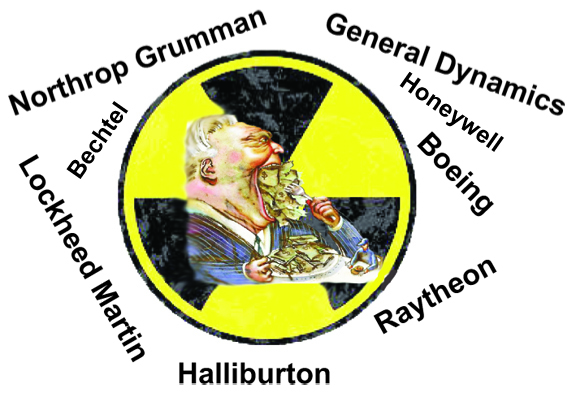
ABC News, By Annika Burgess 21 Jan 23
As the war in Ukraine heads towards the one-year mark, so far there has been only one clear winner — the US arms industry.
There is no way Ukraine would have been able to hold out against Russia without American weapons.
But as the conflict rages on, there have been accusations from some EU officials that the US is profiting from the war through weapons sales and gas prices.
Meanwhile, analysts have warned of excessive spending and the US military-industrial complex (MIC) expanding beyond what is needed in response to Ukraine.
Defence budgets are also booming worldwide as countries replenish stocks sent to Ukraine and try to boost military capabilities in the face of mounting security threats.
Ultimately, the US defence contractors are set for a bonanza. ……..
What are the issues with the MIC?
The military-industrial complex is a term coined during the Cold War to describe the relationship between a government and defence industry contractors that lobby for increased military spending.
A country’s MIC has the potential to exert influence over government policy, especially if there are legislators who can benefit from the partnerships.
In the US, there is a wider vested interest in keeping the industry thriving, especially for local economies that are highly dependant on defence contractors for jobs.
Charles Miller, senior lecturer at the ANU’s school of politics and international relations, said about 800,000 jobs are directly tied to the sector.
“The local economy is highly dependent on defence contractors for its economic wellbeing,” Mr Miller told the ABC.
“And that’s not the Raytheons or the Boeings themselves, but what’s called the secondary contractors — that is, the people and the companies that make a living by servicing them.”
Former US president Dwight Eisenhower warned of the rise of the MIC and its threat to democracy in his 1961 farewell address.
“He viewed it as a huge problem,” Bill Hartung, a defence analyst at the US Quincy Institute for Responsible Statecraft, told the ABC.
“Although, he did say in the Cold War-era large military sales were necessary, but the question was how to control it, and what democratic guardrails could be put in place.”
Today, there doesn’t seem to be the same level of concern.
The MIC was already a “powerful force”, and in response to Ukraine the US has stripped away many safeguards to protect against waste and price gouging, Mr Hartung said.
He added that a lot of changes being discussed will last far beyond the war in Ukraine.
“The United States is kind of seizing this moment to try to get out a bunch of things that have been on their wish list for years, like committing to multi-year procurement of weapons,” Mr Hartung said.
“All of which will probably make it easier for those companies to rip off the government, because there will be less negotiation over prices and the inclination to just push things out the door.”………………………………….
Who are the biggest winners?
Since Russia’s full-scale invasion in February 2022, the US and its NATO allies have been throwing tens of billions of dollars worth of military aid Ukraine’s way.
The United States alone sent around $US21.3 billion ($30 billion) in security assistance to Kyiv last year.
Contracts have been rolled out thick and fast to speed up weapons production and fill supply gaps.
And there are a small number of companies in the highly consolidated industry that are reaping the rewards.
Lockheed Martin, Raytheon, Boeing and Northrop Grumman — all from the US — are among the top contractors.
They also produce some of the most in-demand and expensive weapons being sent to Ukraine.
The conflict has sent their stocks surging, with the share price of Northrop Grumman increasing 40 per cent by the end of 2022, while Lockheed Martin’s was up by 37 per cent.
In October, the Pentagon announced $US1.2 billion in contracts were underway to replenish US military stocks for weapons sent to the battlefield.
Production for Lockheed Martin’s popular Javelin anti-tank missiles — dubbed “Saint Javelin”, the protector of Ukraine — increased from 2,100 to nearly 4,000 per year.
While production for its High Mobility Artillery Rocket Systems (HIMARS) shot up from 60 to 96 units a year.
The US upped the ante further in November, awarding Raytheon — which also co-produces Javelins — a $US1.2 billion contract for another six National Advanced Surface-to-Air Missile Systems (NASAMS) for Ukraine.
Soon after, Lockheed Martin won a $US7.8 billion contract modification for F-35 aircraft, and $US431 million to deliver new HIMARS and support services for the US Army and its foreign allies.
Australia this month also announced it was purchasing 20 HIMARS and associated hardware for $558 million.
Global defence spending boom
Last month, the US Senate passed a funding bill that included a record $US858 billion in annual defence spending — up from $US740 billion the previous year.
It was $US45 billion more than what was proposed by President Joe Biden.
The bill includes funding for Taiwan and Ukraine, allowing the Pentagon to buy massive amounts of high-priority munitions using multi-year contracts — both to help Kyiv fight Russia and to refill US stockpiles.
“It’s surprising how much it has gone up,” Mr Hartung said.
Hanna Homestead, a policy associate from the Center for International Policy (CIP) — a US-based group monitoring military spending and weapons — said contractors were already receiving a staggering amount.
“In 2020, Lockheed Martin got more money through federal contracts than the Department of State and USAID combined,” she told the ABC.
Allies like Japan have also announced historic surges in defence spending.
Last month, Prime Minister Fumio Kishida said he was boosting Japan’s 2023 defence budget by 20 per cent in the face of regional security concerns and threats posed by China and North Korea.
It includes around 250 billion yen ($3.16 billion) to buy Lockheed Martin fighter jets.
Japan’s major military reform plan will see it double defence spending to 2 per cent of GDP by 2027, using a spending target that follows the NATO standard.
Meanwhile, some NATO countries are pushing for a greater defence commitment in response to the Ukraine conflict, saying the benchmark of 2 per cent of GDP should be the bare minimum.
‘That’s just the way it is’
Many believe the US arms industry doesn’t have a great reputation.
“They continue to arm repressive regimes like Saudi Arabia, Egypt, the Philippines and Algeria that have horrific human rights records and have engaged in destabilising activities,” Mr Hartung said.
He also accused companies of “pure profiteering” when it came to Ukraine, saying they are buying back their own share market stocks to boost the prices at a time when they claim they need more money.
“[This] has nothing to do with making anyone safer,” Mr Hartung said.
“In general, the chaos of war makes profiteering easier.
The European Union’s chief diplomat Josep Borrell has accused the US of profiting from high gas prices, weapons and trade while its allies suffer.
However, Ms Homestead said it was still a small amount of companies getting the bulk of the benefits, which doesn’t necessarily trickle down.
“It’s really the private companies that are profiting, I wouldn’t say the US government is profiting,” she said. …………………………………………. https://www.abc.net.au/news/2023-01-21/us-arms-industry-military-spending-profits-ukraine-war-russia/101843752
U.S. officials advise Ukraine to wait on offensive, official says
By Steve Holland Reuters 20 Jan 23
Senior U.S. officials are advising Ukraine to hold off on launching a major offensive against Russian forces until the latest supply of U.S. weaponry is in place and training has been provided, a senior Biden administration official said on Friday.
The official, speaking to a small group of reporters on condition of anonymity, said the United States was holding fast to its decision not to provide Abrams tanks to Ukraine at this time, amid a controversy with Germany over tanks.
President Joe Biden, who approved a new $2.5 billion weapons package for Ukraine this week, told reporters at the White House, “Ukraine is going to get all the help they need,” when asked if he supports Poland’s intention to send German-made Leopard tanks to Ukraine. https://www.reuters.com/world/europe/us-officials-advise-ukraine-wait-offensive-official-says-2023-01-20/
Comment: US advises Ukraine not to squander scarce resources.
The US believes that Ukraine should “refocus” on preparations for a new offensive, suggesting fierce battles for the eastern city of Artyomovsk (called Bakhmut by Ukraine) may be “hampering” Kiev. The comments cut against months of Western media reports that described the town as a key, strategic area.
The aid includes a large number of artillery rounds, munitions for the US-supplied HIMARS multi-launch rocket platform, and, for the first time, Stryker combat vehicles – but no tanks. A small number of Ukrainian troops are also undergoing training at a US base in Germany, with some learning how to operate the Patriot missile defense battery authorized for Kiev in December.
The official allegedly said that Western weapons that will be needed for a “mobile offensive force” for future battles are currently “pouring into Ukraine,” adding that Kiev should not waste its limited resources on the “strategically unimportant target,” according to Reuters.
 | |||
Ukraine storing weapons at nuclear plants.
https://www.rt.com/russia/570349-ukraine-stockpiling-ammo-plants/ 23 Jan 23
Kiev is using the facilities as cover for stockpiles of Western-made munitions, Moscow’s foreign intelligence chief says.
Ukrainian forces are storing Western-supplied missiles and artillery shells in nuclear power plants, Russian Foreign Intelligence Service Director Sergey Naryshkin said on Monday. He claimed that Kiev has been using the plants as cover for ammunition stockpiles..
There is credible information that Ukrainian troops are stockpiling the Western-supplied weapons and ammunition on the territory of nuclear power plants,” Naryshkin said, according to a statement on the intelligence service’s website. He added that the armaments include rockets for US-made HIMARS launchers and missiles used by foreign air defense systems, as well as “large-caliber artillery shells.”
According to Naryshkin, several cars loaded with “lethal cargo” were delivered by rail to the Rovno Nuclear Power Plant in western Ukraine during the last week of December alone. “They rely on the calculation that the Russian Armed Forces would not strike nuclear power plants because they realize the danger of a nuclear disaster,” the intelligence chief said.
Both sides have raised concerns over the safety of power plants since the conflict between Russia and Ukraine broke out in late February. The International Atomic Energy Agency (IAEA) deployed a monitoring mission to the Rovno plant last week and promised to station experts in other facilities in Ukraine.
Russia has accused Ukrainian forces of shelling the Zaporozhye Nuclear Power Plant, which is Europe’s largest. It is located in the eponymous region which, along with three other former Ukrainian territories, joined Russia following referendums in September.
Kiev denied targeting the facility and claimed that Russia was using the plant as a base and cover for its soldiers. Russian officials said that heavy weapons have never been deployed to the site, and that a select number of armed security personnel were maintaining the safety of the plant, as it is located near the frontline.
It comes down to weapons

NewAge, by Richard Moser , Jan 22,2023
THE deep divisions in the US left over the Ukraine war can be reduced to a single practical question: Do you support sending weapons to Ukraine?
The answer to that question depends on whether or not you accept the idea that we’re the cops of the world. The two parties accept this without question but the pro-weapons left? Behind a facade of left-sounding words, political practice tells the tale……………..
The pro-weapons left hides their collaboration with NATO behind the seemingly simple idea that ‘Ukraine has the right to get weapons or seek aid from anywhere they see fit.’ Except that ‘anywhere’ does not exist in the real world. Ukraine is not a customer in some free market for weapons. There is a highly structured supply chain for weapons that is a long-standing feature of the US empire and it is directed by the US war machine. The US has dominated the weapons trade since its rise to global power after WWII. Yes, Russia was often in second or third place, but Ukraine will sure not get its weapons from Russia. The only ‘anywhere’ that actually exists is the US government, which is the primary source for weapons transfers to Ukraine.
The other flaw in the ‘from anywhere they see fit’ formula is the assumption that weapons given from the US to Ukraine are simply an exercise in Ukrainian self-determination — not one way it’s incorporated into the US-dominated global order. Self-determination is not a by-product of the world’s largest military alliance, whose standard operating procedure is to turn allies into pawns and proxies. The drill begins with the mandatory weapons trade demanded of all NATO members. The Ukrainian defense minister recently admitted that Ukraine is a NATO proxy trading blood for weapons.
No, the existing international order is not some normal, natural state of affairs whose peace and harmony was disrupted by the ‘unprovoked’ Russian invasion. To believe that, you’d have to ignore decades of historical context, including the obvious expansion of NATO that put missiles and troops on Russia’s borders, military advisers inside Ukraine and the less obvious policy of ‘full spectrum dominance’ by which the US seeks to dominate ‘everyone, everywhere, all at once.’ The neoliberal world order is no more based on free markets than self-determination or peace.
Instead, Ukraine found itself between two great powers with a long history of hostility and rivalry. Its only hope for self-determination would have been to maintain the balancing act of neutrality and diplomacy, playing one power off the other. …………………………………………………….. more https://www.newagebd.net/article/192295/it-comes-down-to-weapons
Ukraine Narrative Fraying, But Weapons Will Continue To Flow
/ WENT2THEBRIDGE
Some truth from official sources has begun leaking out: Ukraine is losing in the NATO proxy war against Russia. Two Polish officials said so, Condoleeza Rice in the Washington Post said so, and the mainstream/lamestream press began admitting it as well. The wrong conclusion is that more weapons will ensure Ukrainian victory, but that did not stop the U.S. and NATO from pledging more weapons.
Ukraine’s government has come a bit unraveled this week with key advisor Oleksiy Arestovych resigning and then being arrested and put on the Mirotvorets kill list for (accidentally?) admitting that Ukraine caused a Russian missile to go off course and fall on an apartment building killing 44 civilians in Dnipro.
Then there was the mysterious crash of a helicopter carrying all the top officials of the Ministry of the Interior, an accident which killed all aboard plus some children from the kindergarten it fell on.
Next, the president of Ukraine addressed the World Economic Forum at Davos looking pale and strained and claiming to be uncertain whether the president of Russia is actually alive……
But some things remain unchanged. Western cheerleaders of the war effort are falling all over themselves to pledge their support for “democracy” in a country that banned opposition parties and “free speech” in a country that banned the use of Russian, the first language spoken by many of its citizens. …..
So, as part of a week of anti-imperialist and anti-war actions organized by members of UNAC for Martin Luther King, Jr. week (see the full list here) a hardy band of the unconfused stood in Portland, Maine yesterday at the evening commute.
We were on the second shift after a mid-day vigil in nearby Brunswick that occurs weekly. At that event a surprising number of passersby had expressed agreement with our anti-NATO stance remarking “Ukraine is the most corrupt country in Europe” or “Ukraine is full of Nazis” before the light changed and they drove away. This felt like a shift in public opinion, barely discernible but distinct from our past experiences with the public around this issue…………….
I’m not sure when we’ll be back in Portland, but the hour-long vigil at 11:30am in front of the Tontine Mall in Brunswick will continue weekly for now. https://went2thebridge.org/2023/01/20/ukraine-narrative-fraying-but-weapons-will-continue-to-flow/
US may assist Ukrainian strikes on Crimea – NYT
https://www.rt.com/news/570108-us-ukraine-crimea-strikes/ 20 Jan 23, Publicly, Washington has so far avoided endorsing Kiev’s attacks inside Russian territory
The US government is weighing whether to supply Ukraine with the capability to attack the strategically important Crimean Peninsula, according to the New York Times. The discussions highlight a gradual shift among US officials toward more brazen support for Kiev, even as Washington insists it does not seek confrontation with Moscow.
Following months of hesitation, the White House is now warming to the idea that Ukraine may “need the power” for strikes deep inside Russian territory, namely military targets in Crimea, the Times reported on Wednesday, citing several unnamed US officials.
“American officials are discussing with their Ukrainian counterparts the use of American-supplied weapons, from HIMARS rocket systems to Bradley fighting vehicles, to possibly target … Crimea,” the outlet said, adding that Washington “has come to believe that if the Ukrainian military can show Russia that its control of Crimea can be threatened, that would strengthen Kiev’s position in any future negotiations.”
Despite Moscow’s heavy fortifications on the peninsula, which hosts Russia’s Black Sea Fleet and other military bases, Crimea remains a “major focus” of Ukrainian battleplans, according to the Times. It is unclear exactly how Washington hopes to assist attacks on the region, but the outlet suggested the decision to supply Kiev with Bradley infantry fighting vehicles showed willingness to help Ukraine “go on the offense – including targeting Crimea.”
Alongside troop transports provided by France and Germany, the military vehicles “could be the vanguard of an armored force that Ukraine could employ in a counteroffensive this winter or spring,” unnamed “government and independent analysts” told the Times.
However, even as the White House allegedly considers supporting attacks on Russian soil, President Joe Biden continues to refuse Ukrainian requests for longer-range missiles and heavy battle tanks that could be used in a future offensive. He has previously warned that such aid could provoke direct hostilities with Moscow and even kick off a nuclear war, though such concerns appear to be slowly waning as the conflict drags on.
“The fear of escalation has changed since the beginning,” an unnamed US defense source told a British newspaper last month, suggesting the Pentagon had “given a tacit endorsement of Ukraine’s long-range attacks on targets inside Russia.”
While State Department spokesman Ned Price insisted on Wednesday that the US is not placing any “limits” on Ukrainian strikes or “making targeting decisions” on Kiev’s behalf, the latest discussions at the White House may indicate a shift in opinion among some officials.
Historically a Russian territory from the late 18th century until its transfer to Ukraine under Soviet authorities in 1954, Crimea held a referendum to reunify with Russia following the Euromaidan coup of 2014. Kiev and its Western backers have refused to recognize the vote, however, and say the peninsula is still rightfully Ukrainian land, with President Vladimir Zelensky reiterating hopes for the “reconquest” of the region last month.
Russian officials have repeatedly stated that the goals of the military operation in Ukraine would be completed no matter how long it takes. Amid Kiev’s repeated requests for longer-range weapons, Moscow warned Washington and other NATO states that such supplies would cross a “red line” and make them “a direct party to the conflict.”
President Vladimir Putin made it clear, following referendums in Donetsk, Lugansk, Kherson and Zaporozhye regions in September, that Moscow would defend not only Crimea but all new territories “with full force and all means at our disposal.”
The Disastrous Downsides of South Korea Building Nuclear Weapons
38 North BY: SIEGFRIED S. HECKER, JANUARY 20, 2023
Is South Korea Willing to Lose Its World-leading Nuclear Power Program to Build the Bomb?
In a wide-ranging interview on January 11, South Korean President Yoon Suk-yeol warned Pyongyang that if North Korea’s nuclear threat continues to advance, South Korea would consider building nuclear weapons of its own or ask the United States to redeploy them on the Korean Peninsula. Although President Yoon walked back these comments at the World Economic Forum in Davos, they were published in the South Korean press and reinforced by some Republic of Korea (ROK) defense analysts. Cheon Seong-whun said, “President Yoon’s comment could turn out to be a watershed moment in the history of South Korea’s national security.”
A South Korean decision to build its own bomb could, indeed, be a watershed. Threatening Pyongyang does little besides give it a stronger justification to enhance its own nuclear arsenal. I believe that such a move would trigger a tsunami that would wipe out Seoul’s remarkable economic miracle and destroy the soft power it has established around the world……………………….
The National Burden of a Nuclear Arsenal
Whereas President Yoon’s comment, “…we can have our own nuclear weapons pretty quickly, given our scientific and technological capabilities” is true, it doesn’t come close to capturing the national redirection, expense, and immense burden that Seoul would have to shoulder to field not just one bomb, but a nuclear arsenal to counter Pyongyang’s.
It is true that with its advanced technological capabilities, South Korea could probably build the bomb quickly. But a few bombs don’t make a nuclear deterrent, particularly if Seoul will have to go it alone. And let’s be clear, if Seoul were to go down this path, Washington could, and likely would, withdraw its nuclear umbrella. Building a nuclear arsenal to counter Pyongyang’s would require a major national redirection of its economy and diplomacy that would negatively affect nearly all facets of South Korean life for decades.
For nearly fifty years, South Korea has pursued a civilian nuclear energy program. It wisely focused on the middle of the fuel cycle—that is, reactor fuel fabrication, reactor construction and operation, and electricity production. It has built neither enrichment nor reprocessing facilities. Consequently, South Korea has no inventory of bomb-grade plutonium or uranium currently stockpiled. To build nuclear weapons, it would have to repurpose some of its civilian reactors to produce the plutonium bomb fuel (combined with using its laboratory-scale pyroprocessing facilities to extract plutonium) or construct a centrifuge facility to make highly enriched uranium. Either path would take at least two years to produce enough bomb fuel for even a few bombs. In the longer term, an effective nuclear deterrent would require new, dedicated nuclear weapons facilities, requiring substantial time and financial commitments.
The next step in building a bomb is weaponization—that is, designing, building and testing the nuclear devices. South Korea could surely master all scientific and engineering challenges of building a bomb—as it has demonstrated so convincingly in mastering civilian nuclear power generation. Some of the purely military aspects could be accomplished in concert with its conventional military technical complex. But to prove the design and fabrication, there would need to be nuclear testing, but where? Neighboring countries—China and Japan—would certainly object strongly, and there would undoubtedly be strong domestic opposition to tests from every South Korean province.
The nuclear warheads will also have to be integrated into delivery vehicles—such as ballistic missiles, cruise missiles, submarine-launched missiles or bombers. South Korea has all the basic building blocks, but it would still have substantial work to do to integrate the nuclear warheads into the delivery systems. Moreover, these requirements will continue to evolve as North Korea upgrades its offensive and defensive capabilities. The assembly, disassembly and fielding of nuclear devices pose serious safety and security risks and would have to be learned without help or advice from current nuclear powers. Seoul will also have to develop a command-and-control structure that is more stringent than anything it has done so far for its conventional military.
Another consequence of building a nuclear arsenal is that it will compete for resources—financial, personnel, and technical—with the South’s conventional military…………………………………………………………………………
Seoul Would Deal a Serious Blow to the Nonproliferation Regime
South Korea would be the first democratic country to withdraw from the NPT, dealing a blow to decades of US leadership in preventing nuclear proliferation. As serious as the North Korean nuclear threat is, I believe Washington would have no choice but to condemn and counter the South’s decision to build the bomb. The nonproliferation regime is a complex fabric of treaties, agreements, assurances, practices, and international organizations. North Korea’s bomb and Iran’s pursuit of the bomb have already stressed the regime. The negative impacts of Russia’s invasion of Ukraine are playing out now. South Korea should not join these countries in undermining the regime……………………………………………………………
Shooting Itself in the Foot
South Korea’s decision to build the bomb will be widely condemned…………………………..
The irony is that an indigenous nuclear arsenal will make South Korea less secure. It is likely to draw an escalatory response from the North, and Seoul may then have to face that threat on its own. ………………………………. more https://www.38north.org/2023/01/the-disastrous-downsides-of-south-korea-building-nuclear-weapons/
1 This Month




PLEASE OPPOSE HR 8255 AND S.3639 – bills would accelerate satellite deployment, with no environmental review or safeguards – https://ncstd5li.quorum.us/campaign/169331/
To see nuclear-related stories in greater depth and intensity – go to https://nuclearinformation.wordpress.com
-
Archives
- September 2026 (330)
- August 2026 (330)
- July 2026 (355)
- June 2026 (287)
- May 2026 (306)
- April 2026 (356)
- March 2026 (251)
- February 2026 (267)
- January 2026 (308)
- December 2025 (358)
- November 2025 (359)
- October 2025 (375)
-
Categories
- 1
- 1 NUCLEAR ISSUES
- business and costs
- climate change
- culture and arts
- ENERGY
- environment
- health
- history
- indigenous issues
- Legal
- marketing of nuclear
- media
- opposition to nuclear
- PERSONAL STORIES
- politics
- politics international
- Religion and ethics
- safety
- secrets,lies and civil liberties
- spinbuster
- technology
- Uranium
- wastes
- weapons and war
- Women
- 2 WORLD
- ACTION
- AFRICA
- Atrocities
- AUSTRALIA
- Christina's notes
- Christina's themes
- culture and arts
- Events
- Fuk 2022
- Fuk 2023
- Fukushima 2017
- Fukushima 2018
- fukushima 2019
- Fukushima 2020
- Fukushima 2021
- general
- global warming
- Humour (God we need it)
- Nuclear
- RARE EARTHS
- Reference
- resources – print
- Resources -audiovicual
- Weekly Newsletter
- World
- World Nuclear
- YouTube
-
RSS
Entries RSS
Comments RSS

