The Unwarranted Ukraine Proxy War: A Year Later
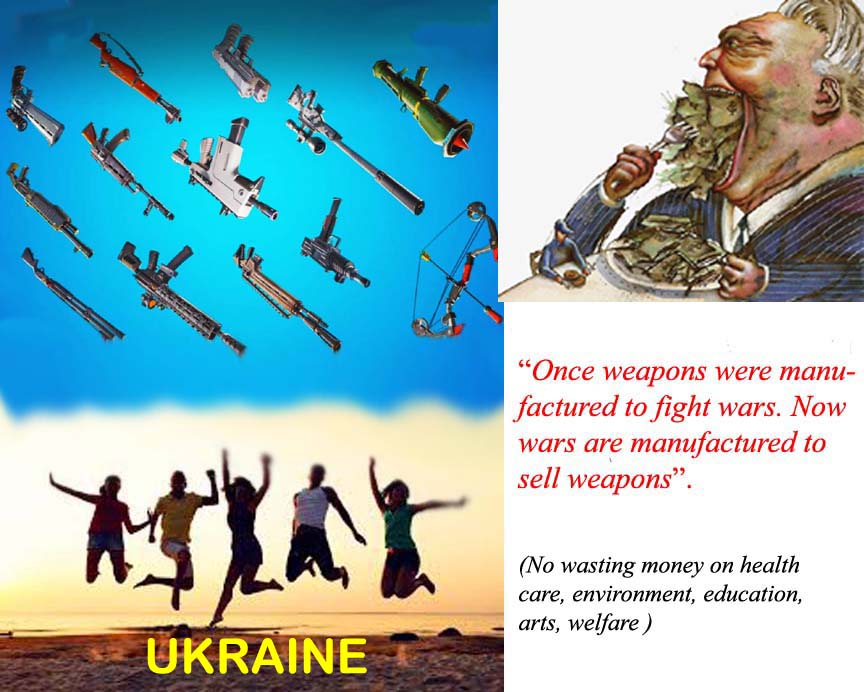
US Big Defence will be the only winner of the proxy war in Ukraine. Not only do these global military contractors arm Ukraine, but they stand to benefit from the re-militarisation of Western European countries, Japan, and new NATO members.
In the view of Big Defence, peace is just a bad business proposition. There’s no money in it.
The World Financial Review, By Dr Dan Steinbock, 27 Jan 23
To Russia and Ukraine, the crisis is an existential issue. To the US and NATO, it’s a regime-change game. To Europe, it means the demise of stability – in the world economy, lost years (and that’s the benign scenario).
That’s how I characterised the US/NATO-led proxy war against Russia in Ukraine back in early March 2022. I argued that it was an “avoidable war that will penalise severely Ukraine, Russia, the US and the NATO, Europe, developing countries and the global economy”.[1]
At the time, the prediction was seen as contrarian. But it has prevailed. However, on January 25 the Ukraine proxy war entered a new, still more dangerous phase. The commitment of some 70 US, German, UK and Polish battle tanks herald lethal escalation, although hundreds more are needed to defeat Russia. For the first time since World War II, German tanks will be sent to the “Eastern front.” In Moscow, it will foster those voices who see the stakes of the war as existential.
Not only will economic and human costs climb even further, but strategic risks, including the potential of nuclear confrontation, will soar. With such escalation in high-tech arms sales to Ukraine, regional and military spillovers are no longer a matter of principle, but a matter of time.
Russia’s economic resilience
In early 2022, Western observers, with rare exceptions, predicted that the Russian economy would default within months as a net effect of sanctions. “Putin’s war” was doomed, they said. Obviously, the sanctions, which have been fuelled by might and economic coercion, have not been inconsequential. But nor were they new.
Already in February 2014, following the Russian annexation of Crimea, international sanctions were imposed against Russia and Crimea by the US, Canada, the EU, and the international organisations they dominate. While the West’s sanctions contributed to the fall of the Russian ruble, they also caused significant economic damage to the EU economy, with total losses at €100 billion in 2015. By mid-2016, Russia had lost an estimated $170 billion due to financial sanctions and another $400 billion in revenues from oil and gas.[2]………………………….
In fact, the Russian economy plunged 3.5 per cent in 2022, whereas inflation amounted to 5.4 per cent. In other words, Western institutions dramatically overestimated the GDP impact. Discrepancies of such magnitude are hard to explain away as simple prediction errors (figure 1 on original).
Proxy war united Russia
Officially, the invasion of Ukraine began as Russia’s “special military operation”. Unofficially, it soon morphed into a US/NATO-led proxy war against Russia in Ukraine. The true political objective of this war has been regime change. Hence the goal “to weaken Russia”, as Secretary of Defence Lloyd Austin acknowledged later. Hence, too, the international media predictions that the Russian economy would “inevitably” default and Putin be overthrown……………………
Today, in the view of ordinary Russians, Russia’s invasion of Ukraine is a defensive response to NATO’s offensive eastward enlargement. They see their country fighting for survival. That’s why the war caused Putin’s ratings to soar to the low 80s. That’s also why over 60 to 70 per cent of Russians support their government and believe the country is on the right track, despite extraordinary hardships. ……………………………………..
Amid this collapse of trust in the US and the EU, it certainly did not help that the Minsk peace process proved to be another Western ruse. Last December, German ex-Chancellor Angela Merkel disclosed in the Zeit newspaper that “the 2014 Minsk agreement was an attempt to give time to Ukraine.” That is, to make Ukraine stronger and for NATO to increase its support to the country in the face of Russia.[4]……………………
In the view of ordinary Russians, there is now a long continuum of betrayals from the pledge that NATO would never expand eastward in the early 1990s to Minsk today. In their view, the West’s recent arms escalation only confirms their worst suspicions.
Contradictory realities
Right before Christmas, President Volodymyr Zelenskyy delivered an emotional wartime appeal to a joint meeting of US Congress, pleading for more military assistance from the lawmakers, who were about to approve $45 billion in additional aid. It was necessary for “eventual victory”.[6]
Yet, there was a huge disconnect between the triumphant declaration and the realities. Earlier in the month, European Commission President Ursula von der Leyen had acknowledged that Ukraine’s losses in the war amounted to 100,000 soldiers and 20,000 civilians, though her tweet was quickly deleted and a new one was released without the true death count (figure 3 on original).[7
Behind the choreographed photo ops and bold sound bites, devastation had been expansive, progressive, and relentless…………..
In September 2022, a month before the Russian winter offensive, a World Bank report estimated that Russia’s invasion had caused over $97 billion in direct damage to Ukraine and it could cost $350 billion to rebuild the country. Worse, Ukraine had also suffered $252 billion in losses through disruptions to its economic flows and production, as well as extra expenses linked to the war.[8] (The report was quiet about the economic and human costs on the Russian side.)
In other words, what Zelenskyy asked in the Congress was less than one-tenth of what is actually needed to rebuild Ukraine.
Ukrainian nightmare
In effect, even as the international media was touting the mirage of Ukraine’s military triumph, the country’s real GDP declined over 35 per cent on an annual basis in the third quarter of 2022; that is, before Russia’s massive infrastructure attack.
Starting on 10 October, Russia’s waves of missile and drone attacks opened a new phase of the war.
The direct physical damage to infrastructure soared to $127 billion already in September; that’s over 60 per cent of Ukraine’s pre-war GDP. The impact on the productive capacity of key sectors, due to damage or occupation, is substantial and long-lasting.[9]
The population share with income below the national poverty line in Ukraine may more than triple, reaching nearly 60 per cent in 2022. Poverty will increase from 5.5 per cent in 2021 to 25 per cent in 2022, with major downside risks if the war and energy security situations worsen.[10] As casualties continue to mount, over a third of the population has been displaced and over half of all Ukrainian children have been forced to leave their homes. The nine months of war have caused massive population displacement. As of October 2022, the number of Ukrainian refugees recorded in Europe was over 7.8 million, and the number of internally displaced people was 6.5 million (figure 4 on original).[11]
As former Pentagon adviser Col. (ret.) Douglas Macgregor has argued, “Washington’s refusal to acknowledge Russia’s legitimate security interests in Ukraine and negotiate an end to this war is the path to protracted conflict and human suffering.”[12]
As former Pentagon adviser Col. (ret.) Douglas Macgregor has argued, “Washington’s refusal to acknowledge Russia’s legitimate security interests in Ukraine and negotiate an end to this war is the path to protracted conflict and human suffering.”[12]
West’s tough 2022 and darker 2023
Currently, the risk of recession casts a dark shadow over the US economy, ……………………………………………..
US and international war funding
In the proxy war, economic and humanitarian aid to Ukraine has been abundant………………………..
Internationally, the US provides the bulk of total aid to Ukraine (62 per cent). Aid from non-US sources amounts to $41.4 billion. The international total of more than $110 billion accounts for more than half of Ukraine’s pre-war GDP ($200 billion).[17] Effectively, these funding arrangements aim to sustain the hostilities and destruction not just in 2023, but at least until the late 2020s.[18] A scenario the West’s recent arms sales escalation could reinforce.
Ailing and indebted, the West cannot afford the proxy war in Ukraine. Hence, the frantic debt-taking. In the Eurozone, government debt to GDP remains close to 100 per cent. Ironically, that’s 40 percentage points higher than the region’s own debt limit. In the UK, the figure has doubled since 2008 to almost 100 per cent. In Japan, it is the worst among all high-income economies – close to 265 per cent, thanks to over two decades of secular stagnation. In the US, the debt ratio has also doubled and is inching toward 140 per cent. (That’s over 20 percentage points higher than that of Italy amid Rome’s 2010 debt crisis.) The rising debt as a percentage of the GDP will slow economic growth, push up interest payments to foreign holders of US debt, and heighten the risk of a fiscal crisis. The periodic debt-limit debacle in the US is just a minor political sideshow to the West’s future debt crisis, which will leave no economy, not even the major ones, unscathed (figure 5 on original).
The post-9/11 wars: the Big Defence bonanza
Ukraine is “absolutely a weapons lab in every sense because none of this equipment has ever actually been used in a war between two industrially developed nations,” said one source familiar with Western intelligence to CNN. “This is real-world battle testing.” Or as Zelenskyy put it more recently, arming Ukraine is a “‘big business opportunity,” as evidenced by his government’s new ties with Blackrock, Goldman Sachs and JP Morgan. In December 2022, he revealed that Ukraine had hired Blackrock to “advice” Kyiv on how to use the West’s reconstruction funds, which he then estimated would have to increase at least to $1 trillion.[19]
As I predicted in March 2022, US Big Defence will be the only winner of the proxy war in Ukraine. Not only do these global military contractors arm Ukraine, but they stand to benefit from the re-militarisation of Western European countries, Japan, and new NATO members. Washington has a great economic interest in such geopolitics. Brussels’ incentives are harder to fathom, especially as the euro area will pay a hefty premium on energy and food, which will also benefit Washington…………………………..
Military Keynesianism to rescue
From the economic standpoint, these military expenditures, including US Ukrainian aid, should be seen as massive, recurrent, multi-year bastard Keynesianism. That is, as a series of military stimulus packages to prop up the American economy (not Ukraine’s). Unlike Keynesian stimuli that can have an accelerator effect in the civilian economy, these packages benefit mainly the Pentagon and Big Defence; that is, the military industrial complex and its revolving-door elites.
Take, for instance, President Biden, Secretary of State Antony Blinken, National Security advisor Jake Sullivan and Blinken’s right-hand, Victoria Nuland. All four were key actors already in the 2014 Ukraine crisis. In one way or another, all are also linked with the Center for a New National Security (CNAS) and its consulting arm WestExec Advisors, which in turn is funded particularly by Big Defence. The same goes for Secretary of Defence Lloyd Austin, a veteran of the US Army and ex-board member of Raytheon, one of the largest defence giants and a big beneficiary of the Ukraine devastation.[22]
what’s good for Big Defence is not necessarily good for either the American people or the global economy. It aggravates income polarisation in America and between the high-income West and the developing Global South, while escalating geopolitical risks worldwide…………………………………
Plunging global growth
Unsurprisingly, global growth is now expected to decelerate sharply to 1.7 per cent in 2023…………………………
The unwarranted war
A year ago, I characterised the Ukraine conflict as an “unwarranted war” because it was avoidable. As declassified files show, a series of security assurances were given to Mikhail Gorbachev and other Soviet leaders against NATO’s eastward expansion at the turn of the 1990s, starting with President George H.W. Bush, followed by a cascade of assurances by German, French, British, and NATO leaders. The betrayal of these pledges was widely condemned already in 1997 by 50 US foreign policy authorities, including the leading Cold War hawks, in an open letter to President Clinton. What has ensued is three decades of NATO eastward expansion, which has made the world poorer and less secure, just as these US experts predicted over 25 years ago.[28]
If in 2022 the proxy war’s costs were disastrous in the West and Russia, 2023 will be worse…………………………….
- The year 2022 turned the Ukrainians’ dream of peace and development to ashes, as over a third of their economy disappeared, perhaps a quarter of the population fled and a generation of young men was sacrificed for the West’s geopolitics. What’s ahead in 2023 will be worse. Reconstruction will require a lot more than $1 trillion, according to Zelenskyy. That’s over five times Ukraine’s pre-war GDP.
- US Big Defence is the big winner of 2022 and, thanks to the military aid arrangements, could reap war profits well into the late 2020s. By then, new big “weapons labs” will be needed elsewhere – North Korea, Taiwan, Iran, perhaps even China, where there’s a will, there’s a way – to ensure new wars that will generate adequate returns.
…………………………………….. In the view of Big Defence, peace is just a bad business proposition. There’s no money in it.
………………………………….. Even in April 2022, after a month of hostilities, Russia and Ukraine tentatively agreed to end the war. Yet, that decision was undermined by former British Prime Minister Boris Johnson. His carefully timed Ukraine visit was designed to stop the talks, which were not acceptable to the US and its allies.[30] Today, in Pentagon, Defense Secretary Lloyd Austin sees the escalation as “a window of opportunity here, between now and the spring.”[31]
Only a year ago, Ukraine, under Zelenskyy’s leadership, was still positioned to play a constructive role as a bridge between Eastern and Western Europe, thanks to its vital position in China’s Bridge and Belt Initiative. Had that future prevailed, Ukraine might today be peaceful. Its GDP would be a third bigger. As a neutral country, its trading relationships would have thrived and it would have attracted investment from Russia and both Western and Eastern Europe. Young men would have good jobs. And Ukrainian refugees would be returning for new opportunities at home. When old sectarian conflicts dissipate, escaping abroad is no longer a necessity and even little children sleep their nights rather than being haunted by nightmares, overshadowed by post-traumatic stress.
Today, all those dreams, too, are in ashes. The proxy war is aimed against Russia. The Ukrainians’ role is to die in it. The puppet masters are the primary beneficiaries.
Chris Hedges: Ukraine: The War That Went Wrong

A state of permanent war creates complex bureaucracies, sustained by compliant politicians, journalists, scientists, technocrats and academics, who obsequiously serve the war machine.
This militarism needs mortal enemies — the latest are Russia and China — even when those demonized have no intention or capability, as was the case with Iraq, of harming the U.S. We are hostage to these incestuous institutional structures.
byEDITORJanuary 29, 2023
NATO support for the war in Ukraine, designed to degrade the Russian military and drive Vladimir Putin from power, is not going according to plan. The new sophisticated military hardware won’t help.
By Chris Hedges / Original to ScheerPost
Empires in terminal decline leap from one military fiasco to the next. The war in Ukraine, another bungled attempt to reassert U.S. global hegemony, fits this pattern. The danger is that the more dire things look, the more the U.S. will escalate the conflict, potentially provoking open confrontation with Russia. If Russia carries out retaliatory attacks on supply and training bases in neighboring NATO countries, or uses tactical nuclear weapons, NATO will almost certainly respond by attacking Russian forces. We will have ignited World War III, which could result in a nuclear holocaust.
U.S. military support for Ukraine began with the basics — ammunition and assault weapons. The Biden administration, however, soon crossed several self-imposed red lines to provide a tidal wave of lethal war machinery: Stinger anti-aircraft systems; Javelin anti-armor systems; M777 towed Howitzers; 122mm GRAD rockets; M142 multiple rocket launchers, or HIMARS; Tube-Launched, Optically-Tracked, Wire-Guided (TOW) missiles; Patriot air defense batteries; National Advanced Surface-to-Air Missile Systems (NASAMS); M113 Armored Personnel Carriers; and now 31 M1 Abrams, as part of a new $400 million package. These tanks will be supplemented by 14 German Leopard 2A6 tanks, 14 British Challenger 2 tanks, as well as tanks from other NATO members, including Poland. Next on the list are armor-piercing depleted uranium (DU) ammunition and F-15 and F-16 fighter jets.
Since Russia invaded on February 24, 2022, Congress has approved more than $113 billion in aid to Ukraine and allied nations supporting the war in Ukraine. Three-fifths of this aid, $67 billion, has been allocated for military expenditures. There are 28 countries transferring weapons to Ukraine. All of them, with the exception of Australia, Canada and the U.S., are in Europe.
The rapid upgrade of sophisticated military hardware and aid provided to Ukraine is not a good sign for the NATO alliance. It takes many months, if not years, of training to operate and coordinate these weapons systems………………….
NATO military commanders understand that the infusion of these weapons systems into the war will not alter what is, at best, a stalemate, defined largely by artillery duels over hundreds of miles of front lines. The purchase of these weapons systems — one M1 Abrams tank costs $10 million when training and sustainment are included — increases the profits of the arms manufacturers. The use of these weapons in Ukraine allows them to be tested in battlefield conditions, making the war a laboratory for weapons manufacturers such as Lockheed Martin. All this is useful to NATO and to the arms industry. But it is not very useful to Ukraine.
The other problem with advanced weapons systems such as the M1 Abrams, which have 1,500-horsepower turbine engines that run on jet fuel, is that they are temperamental and require highly skilled and near constant maintenance. They are not forgiving to those operating them who make mistakes; indeed, mistakes can be lethal.
The most optimistic scenario for deploying M1-Abrams tanks in Ukraine is six to eight months, more likely longer. If Russia launches a major offensive in the spring, as expected, the M1 Abrams will not be part of the Ukrainian arsenal. Even when they do arrive, they will not significantly alter the balance of power, especially if the Russians are able to turn the tanks, manned by inexperienced crews, into charred hulks.
So why all this infusion of high-tech weaponry? We can sum it up in one word: panic.
Having declared a de facto war on Russia and openly calling for the removal of Vladimir Putin, the neoconservative pimps of war watch with dread as Ukraine is being pummeled by a relentless Russian war of attrition. Ukraine has suffered nearly 18,000 civilian casualties (6,919 killed and 11,075 injured). It has also seen around 8 percent of its total housing destroyed or damaged and 50 percent of its energy infrastructure directly impacted with frequent power cuts. Ukraine requires at least $3 billion a month in outside support to keep its economy afloat, the International Monetary Fund’s managing director recently said. Nearly 14 million Ukrainians have been displaced — 8 million in Europe and 6 million internally — and up to 18 million people, or 40 percent of Ukraine’s population, will soon require humanitarian assistance. Ukraine’s economy contracted by 35 percent in 2022, and 60 percent of Ukrainians are now poised to live on less than $5.5 a day, according to World Bank estimates. Nine million Ukrainians are without electricity and water in sub-zero temperatures, the Ukrainian president says. According to estimates from the U.S. Joint Chiefs of Staff, 100,000 Ukrainian and 100,000 Russian soldiers have been killed in the war as of last November. …………………………
In desperation, the empire pumps ever greater sums into its war machine. The most recent $1.7 trillion spending bill included $847 billion for the military; the total is boosted to $858 billion when factoring in accounts that don’t fall under the Armed Services committees’ jurisdiction, such as the Department of Energy, which oversees nuclear weapons maintenance and the infrastructure that develops them. In 2021, when the U.S. had a military budget of $801 billion, it constituted nearly 40 percent of all global military expenditures, more than the next nine countries, including Russia and China, spent on their militaries combined.
A state of permanent war creates complex bureaucracies, sustained by compliant politicians, journalists, scientists, technocrats and academics, who obsequiously serve the war machine. This militarism needs mortal enemies — the latest are Russia and China — even when those demonized have no intention or capability, as was the case with Iraq, of harming the U.S. We are hostage to these incestuous institutional structures.
Earlier this month, the House and Senate Armed Services Committees, for example, appointed eight commissioners to review Biden’s National Defense Strategy (NDS) to “examine the assumptions, objectives, defense investments, force posture and structure, operational concepts, and military risks of the NDS.” The commission, as Eli Clifton writes at the Quincy Institute for Responsible Statecraft, is “largely comprised of individuals with financial ties to the weapons industry and U.S. government contractors, raising questions about whether the commission will take a critical eye to contractors who receive $400 billion of the $858 billion FY2023 defense budget.” The chair of the commission, Clifton notes, is former Rep. Jane Harman (D-CA), who “sits on the board of Iridium Communications, a satellite communications firm that was awarded a seven-year $738.5 million contract with the Department of Defense in 2019.”…………………………..
America’s two ruling parties depend on campaign funds from the war industry and are pressured by weapons manufacturers in their state or districts, who employ constituents, to pass gargantuan military budgets. Politicians are acutely aware that to challenge the permanent war economy is to be attacked as unpatriotic and is usually an act of political suicide.
……………………………………………………………………………………………………………….. The plan to reshape Europe and the global balance of power by degrading Russia is turning out to resemble the failed plan to reshape the Middle East. It is fueling a global food crisis and devastating Europe with near double-digit inflation. It is exposing the impotency, once again, of the United States, and the bankruptcy of its ruling oligarchs. As a counterweight to the United States, nations such as China, Russia, India, Brazil and Iran are severing themselves from the tyranny of the dollar as the world’s reserve currency, a move that will trigger economic and social catastrophe in the United States. Washington is giving Ukraine ever more sophisticated weapons systems and billions upon billions in aid in a futile bid to save Ukraine but, more importantly, to save itself. https://scheerpost.com/2023/01/29/chris-hedges-ukraine-the-war-that-went-wrong/
The Last Existing U.S.-Russia Nuclear Treaty Could Soon Fail
New START is on the ropes after years of neglect and abuse from Moscow and Washington. VICE, By Matthew Gault 30 Jan 23
Russia signaled to the U.S. on Monday that the world may soon see the end of nuclear-arms control, decades long agreements between nations that have helped limit the production of weapons that can end civilization. New START, an Obama-era treaty that limits the number of nuclear missiles Moscow and Washington can deploy, will expire in 2026. According to Russia, renewing that treaty will depend on whether or not the U.S. seeks the strategic defeat of Russia in Ukraine.
“The entire situation in the sphere of security, including arms control, has been held hostage by the U.S. line of inflicting strategic defeat on Russia,” Deputy Foreign Minister Sergei Ryabkov told state-owned news agency RIA Novosti. “We will resist this in the strongest possible way using all the methods and means at our disposal.”
Part of that resistance might mean holding enforcement of the New START treaty hostage. Signed in 2010, the treaty limits Russia and America’s deployment of strategic nuclear warheads to 1,550 each and deployed missiles and bombers to 700 each. As part of the treaty, each country agreed to inspections to verify that they’re abiding by the treaty.
America and Russia control 90% of the world’s nuclear arsenal and have used treaties to control and limit the deployment of those nukes for decades. The Partial Test Ban Treaty of 1963 ended above ground nuclear testing, the Interim Agreement on Offensive Arms of 1972 stopped both countries from deploying new nukes, a revision of this treaty in 1979 further limited each country’s deployed arsenal.
New START is a sequel, of sorts, to a treaty that began negotiations under Ronald Reagan called Strategic Arms Reduction Treaty (START). Reagan was famous for pursuing an arms build up and antagonizing Russia, but nuclear weapons frightened him. After watching the TV movie The Day After, he became depressed. “My own reaction was one of our having to do all we can to have a deterrent and to see there is never a nuclear war,” he wrote in his diary.
………………………………………………….. The crumbling of international nuclear arms treaties is another sign that the world is closer to nuclear war than it’s been in decades. Russia is building new nuclear weapons and threatens nuclear annihilation as it wars in Ukraine. The U.S. is modernizing its nuclear forces, updating old systems, and signaling to the world that it’s ready to drop the bomb too. https://www.vice.com/en/article/5d3xkz/the-last-existing-us-russia-nuclear-treaty-could-soon-fail
African states meet in South Africa to discuss UN Nuclear Ban Treaty
https://www.icanw.org/african_states_meet_in_south_africa_to_discuss_un_nuclear_weapon_ban_treaty 30 Jan 23
Representatives from 37 African states have gathered in Pretoria at the African Regional Seminar on the Universalisation of the Treaty on the Prohibition of Nuclear Weapons (TPNW) to discuss how to get every African state to sign and ratify the UN nuclear ban treaty as soon as possible.
The two day Seminar, co-hosted by South Africa’s Department of International Relations and Cooperation (DIRCO), ICAN, and the International Committee of the Red Cross, will serve to take stock of the TPNW from a regional perspective and consider the need for further progress towards universalisation of the treaty on the continent.
African countries have been long-time leaders on nuclear disarmament. The continent is a nuclear-weapon-free zone under the Treaty of Pelindaba, and the TPNW enjoys strong support from all the countries in the region. So far 33 African UN member states out of 54 have signed the TPNW and 15 have ratified it.
While opening the Seminar, Deputy Minister of DIRCO, Mr Alvin Botes, highlighted South Africa’s history as one of the few states to start developing and then fully dismantle its nuclear arsenals to being an active supporter of the TPNW. “South Africa’s own experience has shown that neither the possession nor the pursuit of nuclear weapons can enhance international peace and security. The continued retention of nuclear weapons based on the perceived security interests of some states comes at the expense of the rest of humanity.”
He also called on all African states “to sign and ratify the TPNW at the earliest possible opportunity and thus reassert Africa’s leadership in nuclear disarmament and contributing to international peace and security.”
ICAN’s Executive Director Beatrice Fihn also highlighted this leadership during the opening speeches:“African states are rightly proud of the role they played in the TPNW’s negotiation and adoption. Support for the treaty in this region is universal, even if much work remains to be done to bring all states on board as parties,” calling on the 21 states that had not yet done so to sign and ratify the treaty. She also celebrated African civil society for their tireless efforts to raise public awareness of the TPNW and promote its universalisation.
A number of ICAN partner organisations are represented at the meeting, and ICAN campaigners have been delivering presentations about the TPNW’s status, and campaign activities throughout Africa, as well as engaging with representatives of the countries that have yet to sign the treaty to make it a priority.
A Costly and Prolonged Cold War Now Seems a Certainty

a “new golden age” for military contractors.
https://www.counterpunch.org/2023/01/30/a-costly-and-prolonged-cold-war-now-seems-a-certainty/ BY MELVIN GOODMAN 30 Jan 23
No one knows how the war in Ukraine will end, but there is one post-war certainty: there will be a prolonged and costly Cold War between the United States and Russia. In an interview with David Ignatius of the Washington Post, who has been doing the bidding of the Pentagon and the Central Intelligence Agency for several decades, Secretary of State Antony Blinken emphasized the importance of a “long-term goal of deterrence.” Ignatius took this to mean that the Biden administration will make sure that Russia “should not be able to rest, regroup and reattack.”
Ignatius is joining the likes of such Cold Warriors as former secretary of state Condi Rice, former secretary of defense Bob Gates, journalists such as Max Boot and scholars such as Angela Stent and Leon Aron who believe that Russia’s war is not directed only against Ukraine, but against the larger idea that European states can peacefully cooperate. Yale historian Timothy Snyder goes further, arguing that the rule of law can have a chance in Russia only if “Russia loses this war,” and that Russia’s defeat will reverse the “trend…towards authoritarianism, with Putinism as a force and a model.” It is naive to think in terms of “rule of law” coming to Russia.
The Biden administration’s gift to the military-industrial complex rivals what the Reagan administration provided in the 1980s and ensures the country’s rich market for weapons sales. Nearly half of the record defense spending of $858 billion goes to military contractors. The House and Senate Armed Services Committees made sure that these spending spigots remain open by naming individuals with ties to the weapons industry to a commission that will review the Biden National Defense Strategy.
The chairwoman of the commission, former Representative Jane Harman, protected Lockheed-Martin when she served on the Hill and currently is on the board of a military contractor that recently received a seven-year $800 million contract from the Pentagon.
We have been accustomed to politicians who blithely talk about the “war to end all wars,” but it is unusual to have a distinguished historian argue that the “Ukrainians have given us a chance to turn this century around, a chance for freedom and security that we could not have achieved by our own efforts, no matter who we happen to be.” Snyder argues that “if Russia loses” it would mark an “end to an era of empire,” marking the “last war fought on the colonial logic that another state and people do not exist.” According to Snyder, a Ukrainian victory would “teach Beijing that such an offensive operation [against Taiwan] is costly and likely to fail.” Snyder believes that “this is a once-in-lifetime conjuncture, not to be wasted.”
In addition to this year’s record defense budget that found the Congress providing $45 billion more than the Pentagon requested, a so-called “emergency” provision will lay the foundation for adding scarce resources to defense spending in the coming year. This provision will allow multiyear, noncompetitive agreements to produce such ordinary weaponry as rockets and munitions. According to the Washington Post, the Pentagon will now have a way to replenish its stockpiles that will provide a “new golden age” for military contractors.
The Biden administration’s gift to the military-industrial complex rivals what the Reagan administration provided in the 1980s and ensures the country’s rich market for weapons sales. Nearly half of the record defense spending of $858 billion goes to military contractors. The House and Senate Armed Services Committees made sure that these spending spigots remain open by naming individuals with ties to the weapons industry to a commission that will review the Biden National Defense Strategy. The chairwoman of the commission, former Representative Jane Harman, protected Lockheed-Martin when she served on the Hill and currently is on the board of a military contractor that recently received a seven-year $800 million contract from the Pentagon.
The increased defense spending and the new emergency provision coincide with House Speaker Kevin McCarthy’s creation of a new committee—the House Select Committee on Strategic Competition Between the United States and the Chinese Communist Party! McCarthy appointed the requisite number of China hawks, including its chairman, Mike Gallagher. George Will, writing in the Post, predictably praised the creation of the committee, and lauded a new book by scholars from Johns Hopkins University and Tufts titled “Danger Zone: The Coming Conflict with China,” which may become a tragic self-fulfilling prophecy. In view of the recent rise in anti-Asian violence in the United States, It can only be hoped that Democrats appoint members to the committee who understand the domestic consequences of hyping the threat from China at this particular time.
Our China policy is not working, and the exaggeration of the China threat comes just in time for the hawks in the political aviary who fear that the severe deficiencies of the Russian military in Ukraine is making it more difficult to exaggerate the Russia threat. I’ve been calling attention to the exaggeration of the Russian threat for the past 50 years, and the collapse of the Soviet Union, which included the implosion of the Red Army, should have provided political ammunition to downplay the Russian threat. I had a distinct advantage from 1966 to 1990 as a Soviet analyst at the Central Intelligence Agency, which had intelligence that documented Soviet deficiencies.
But the policy community, the bipartisan congressional community, and the pundit community can’t let go of the idea that the Soviet Union and Russia present a threat to the national security of the United States. The dysfunctional, but superficially successful, Russian military performances in Georgia (2008); Crimea (2014); and Syria (2015) were misread as a demonstration of a strong Russian military. It took the unsuccessful Russian efforts against Kyiv, Kharkiv, and Kherson to fully demonstrate the deeply rooted dysfunction of the “new” Red Army and its inability to sustain offensive and combined arms operations. Instead, Russia must rely on a campaign of military terrorism to hold its own against Ukrainian forces.
The Biden policy ensures a robust military presence on the Russian border that will worsen Cold War 2.0. There will be prolonged and unnecessary increases in defense spending, and the absence of a diplomatic dialogue in those important areas where there is Russian-American agreement.
These areas include a variety of arms control and disarmament issues, such as stopping the proliferation of nuclear weaponry and limiting the use of space in the military competition as well as dealing with insurgencies and terrorism; environmental degradation; and future pandemics. It is hard to imagine any Russian regime willing to pursue diplomatic solutions with a United States that has sponsored a NATO with more than 30 members; a military base in Poland; a regional missile defense in Poland and Romania; and the use of Romanian military facilities close by Russian forces and the Black Sea. This serious turning point is being ignored by the policy community as well as the pundit and academic communities.
Melvin A. Goodman is a senior fellow at the Center for International Policy and a professor of government at Johns Hopkins University. A former CIA analyst, Goodman is the author of Failure of Intelligence: The Decline and Fall of the CIA and National Insecurity: The Cost of American Militarism. and A Whistleblower at the CIA. His most recent books are “American Carnage: The Wars of Donald Trump” (Opus Publishing, 2019) and “Containing the National Security State” (Opus Publishing, 2021). Goodman is the national security columnist for counterpunch.org.
Putin ready for war with NATO and U.S.? Russia plans renewed offensive in Feb over tanks aid.
27 Jan 2023 Russia has warned U.S.-led West and NATO against escalating the conflict in Ukraine. Russian Deputy Ambassador to the OSCE Maxim Buyakevich said that the U.S. and NATO have approached a dangerous line on the way to a full-scale military conflict in Europe after the U.S. and Germany agreed to send modern battle tanks to Ukraine. “Their deliberate actions to escalate the military confrontation in Ukraine, provoking the regime to military action against the population of Russia with the use of Western heavy weapons and targeting based on NATO intelligence is a direct path to a full-scale military conflict in Europe, from which absolutely all residents of our continent will definitely lose.” said Buyakevich at the meeting of the OSCE Post Council. Meanwhile, Bloomberg reported that Russian President Vladimir Putin is preparing for a new offensive in Ukraine, which will be launched next month. Watch this video for more.
‘The day the desert wind cried’: French nuclear tests cast long shadow in Libyan Sahara

Middle East Eye, By Samira Elsaidi, 29 January 2023
Between 1960 and 1966, France detonated 17 bombs in the Algerian Sahara. In neighbouring Libya, the deadly effects are felt to this day
“I search for words that do not exist. My father passed away on the day the desert wind cried, and his absence is still there, like a loud mute cry, like a void that words cannot fill.”
Abed Alfitory is 64-years old now. But he still remembers his father’s death and the events that led to it.
Alfitory is from Fezzan, the largely desert region of southwestern Libya. It is here, deep in the Sahara, that he spent 20 years collecting material for his book Desert Cry, motivated by the loss of his father’s sight in 1960 and his death a few years later.
Speaking to Middle East Eye from his home in al-Zighan, the professor of philosophy at Sabha university told Middle East Eye that his childhood had come at a great cost, that he struggled amidst hard conditions and that he had been haunted by his father’s blindness.
Later, Alfitory discovered what had caused his father’s condition. He learnt, too, that he was not alone.
Many people in Fezzan had been struck down by respiratory diseases and ophthalmia in 1960. The acute eye infection was so prevalent then that it became known as the “year of ophthalmia”.
This was followed by the “year of smallpox”, the “year of the yellow wind” and the “year of gnawing”. The people of the Fezzan began to get cancer in greater numbers. Acid rain fell. The land was afflicted. What had happened?
Explosions in the Sahara
On 13 February 1960, France conducted its first nuclear test at Reggane, an oasis town in southern Algeria. The war for the North African country’s independence had been ongoing since 1954 and French President Charles de Gaulle was keen to show the world that France belonged at the top table of military powers.
To that end, the first French atomic bomb, named Gerboise Bleue after the blue of the tricolour flag and a small desert animal in the Sahara, was detonated in the Algerian desert. It released over four times the amount of energy as that of the US bomb dropped on Hiroshima.
A few months later, as Soviet leader Nikita Khrushchev was in France for an official visit, a second French bomb was detonated in the Sahara.
Between 1960 and 1966, four years after Algeria gained its independence, France detonated 17 bombs in the Sahara, including four in the atmosphere near Reggane. Witnesses to the tests described them as the most brutal thing they’d ever seen in their lives.
Four underground explosions in the Algerian Sahara “were not totally contained or confined”, according to a French parliamentary report.
Most famous of these was the Beryl incident, during which nine soldiers and a number of local Tuareg villagers were heavily contaminated by radioactivity.
The impact of France’s nuclear testing programme in Algeria was immediate and has been ongoing.
Following the first explosion in 1960, radioactive fallout landed in newly independent Ghana and in Nigeria, which was in its last days as a British colony.
Secret defence documents cited by Le Parisien in 2014 revealed that much larger areas than had been claimed by the government had been affected.
In fact, contrary to Paris’s assertions, radiation from the first bomb alone had covered a region that ran from Algeria to Libya to Mauritania and on to Mali and Nigeria. The impact even reached as far north as Spain and Italy…………………………………… more https://www.middleeasteye.net/news/france-libya-algeria-nuclear-tests-still-haunt-desert-cried
NATO’s ‘war against Russia’ inches ‘closer to direct conflict’

After all, it is mainly Ukrainians paying the price of the “war against Russia” fueled from afar.
“We are fighting a war against Russia,” the German Foreign Minister says, as the US and Germany authorize tank shipments, and new dangers, in the Ukraine proxy war.
Aaron Mate Substack 29 Jan 23
Since the first week of Russia’s invasion of Ukraine, French President Emmanuel Macron has repeated a mantra on behalf of his NATO partners: “We are not at war with Russia.”
Nearly one year in, that notion has officially been dispelled.
“We are fighting a war against Russia,” German Foreign Minister Annalena Baerbock said this week.
Baerbock was trying to assuage NATO allies’ frustration over German reluctance to send Leopard 2 tanks into Ukraine. She can now claim vindication. In a reversal of its initial position, the German government has announced it that will deliver Leopard 2 tanks to the Ukrainian army.
To overcome German Chancellor Olaf Scholz’s jitters, the White House engaged in an about-face of its own, approving the shipment of 31 US-made M1 Abrams tanks to Ukraine. …………………………………………………..
As Gen. Mark Milley learned when he came out in favor of diplomacy with Russia to end the fighting, the Pentagon’s outlook is no match for Washington’s proxy war fever. The White House reversed course, Politico notes, after “a parade of Democrats and Republicans” in Congress “pressured the Biden administration to grant Berlin’s request to send U.S. tanks first.” ……………………………
When President Biden overruled the Pentagon and unveiled the M1 approval, Austin stood by his side. “These tanks are further evidence of our enduring, unflagging commitment to Ukraine and our confidence in the skill of Ukrainian forces,” Biden declared.
Yet the publicly trumpeted US tank shipment comes with a quietly disclosed delay.
The M1s are “probably not for the near fight,” and in fact “are not likely to arrive for many months, if not years,” a US official told the Washington Post………………..
At this stage, NATO has pledged at least 105 tanks for Ukraine, well short of the 300 tanks that the head of Ukraine’s armed forces, Valerii Zaluzhnyi, has said are “urgent needs” to turn the tide………………………………………..

The F-16’s manufacturer, Lockheed Martin, is happy to oblige. Lockheed will be “ramping production on F-16s… to get to the place where we will be able to backfill pretty capably any countries that choose to do third party transfers to help with the current conflict,” Frank St. John, the military giant’s chief contracting officer, told the Financial Times. According to European officials, talks on such transfers are at an “early stage.”
Just as the prospect of diplomacy with Moscow is off-limits to Western policymakers, so is serious consideration of Russia’s response. The more advanced NATO weaponry pours in, the more that Russia will play its part in “permanent escalation”
Whatever the impact of the German tank shipments on the battlefield, their utility is not strictly military. By convincing Germany to send tanks for battle with Russian forces, the White House is advancing a goal that long predates the February 2022 invasion of Ukraine: undermine ties between Germany, Western Europe’s biggest power, and neighboring Russia, the United States’ biggest adversary.
……………………………………………………………………………………… “maintaining a powerful wedge between Germany and Russia is of overwhelming interest to the United States.”
………………………… Before Scholz caved to their pressure campaign, US officials noted that the German Chancellor “does not believe the world is ready to see German tanks near the borders of Russia, a reminder of the Nazi invasion in World War II,” according to the New York Times. Although the Times no longer allows itself to acknowledge it, there is another fraught historical irony: Germany is now sending tanks to a Ukrainian military that has formally incorporated what the Paper of Record once described as the “openly neo-Nazi” Azov Battalion.
……………………………. In seeking to force Germany to send its tanks into battle with Russia, the US wants Germany “to draw Russia’s counterfire,” German parliamentarian Sevim Dağdelen writes. “One cannot escape the impression that it is hoped a possible counterstrike would hit Berlin first and foremost. The United States would thus have achieved one of its long-term strategic objectives, namely to prevent cooperation between Germany and Russia for ever.” US officials, Dağdelen warns, are “forcing their ally, like a vassal, to sacrifice itself.”
Dağdelen’s characterization of the US use of Germany applies to Ukraine as well. According to Der Spiegel, Germany’s Federal Intelligence Service (BND) is “alarmed by the high losses of the Ukrainian army in the battle for the strategically important city of Bakhmut,” where a “three-digit number” of Ukrainian soldiers are losing their lives daily. Russia’s capture of Bakhmut, the BND warns, “would have significant consequences, as it would allow Russia to make further forays into the interior of the country.” Russian advances on Bakhmut follow a 300,000-plus troop mobilization that has “appeared to tilt the calculus of attrition in Moscow’s favor,” the Wall Street Journal notes.
Perhaps the coming influx of NATO tanks will reverse that trend. If not, the proxy war’s NATO architects can point to other victories: Russian forces depleted, Berlin-Moscow ties severed, and US dominance of NATO strengthened. After all, it is mainly Ukrainians paying the price of the “war against Russia” fueled from afar. https://mate.substack.com/p/natos-war-against-russia-inches-closer?utm_source=post-email-title&publication_id=100118&post_id=98811692&isFreemail=true&utm_medium=email
Israel appears to have been behind drone strike on Iran factory, U.S. official says
By Parisa Hafezi and Phil Stewart Reuters 2023-01-28
A loud blast was heard at a military plant in Iran’s central city of Isfahan, but a security official said there were no casualties, Iranian state broadcaster IRIB said on its website early on Sunday.
“The explosion took place in one of the munitions manufacturing centres of the Defence Ministry and according to an announcement by the political and security deputy head of Isfahan Governorate there were no casualties,” IRIB reported, without giving further details……. https://www.reuters.com/world/middle-east/blast-heard-military-plant-irans-central-city-isfahan-state-media-2023-01-28/
USA tries to prevent a Russian offensive in Ukraine by offering a sort of war endgame deal with Russia
Crimea is a particular point of discussion. There is a widespread view in Washington and Kyiv that regaining Crimea by military force may be impossible. Any Ukrainian military advances this year in Zaporizhzhia oblast, the land bridge that connects Crimea and Russia, could threaten Russian control. But an all-out Ukrainian campaign to seize the Crimean Peninsula is unrealistic, many U.S. and Ukrainian officials believe. That’s partly because Putin has indicated that an assault on Crimea would be a tripwire for nuclear escalation.

By John Helmer, Moscow,26 Jan 23 http://johnhelmer.org/blinken-concedes-war-is-lost-offers-kremlin-ukrainian-demilitarization-crimea-donbass-zaporozhe-and-restriction-of-new-tanks-to-western-ukraine-if-there-is-no-russian-offensive/#more-70535
David Ignatius has been a career-long mouthpiece for the US State Department. He has just been called in by the current Secretary of State Antony Blinken to convey an urgent new message to President Vladimir Putin, the Security Council, and the General Staff in Moscow.
For the first time since the special military operation began last year, the war party in Washington is offering terms of concession to Russia’s security objectives explicitly and directly, without the Ukrainians in the way.
The terms Blinken has told Ignatius to print appeared in the January 25 edition of the Washington Post. The paywall can be avoided by reading on.
The territorial concessions Blinken is tabling include Crimea, the Donbass, and the Zaporozhye, Kherson “land bridge that connects Crimea and Russia”. West of the Dnieper River, north around Kharkov, and south around Odessa and Nikolaev, Blinken has tabled for the first time US acceptance of “a demilitarized status” for the Ukraine. Also, US agreement to restrict the deployment of HIMARS, US and NATO infantry fighting vehicles, and the Abrams and Leopard tanks to a point in western Ukraine from which they can “manoeuvre…as a deterrent against future Russian attacks.”
This is an offer for a tradeoff – partition through a demilitarized zone (DMZ) in the east of the Ukraine in exchange for a halt to the planned Russian offensive destroying the fortifications, rail hubs, troop cantonments, and airfields in the west, between the Polish and Romanian borders, Kiev and Lvov, and an outcome Blinken proposes for both sides to call “a just and durable peace that upholds Ukraine’s territorial integrity”.
Also in the proposed Blinken deal there is the offer of a direct US-Russian agreement on “an eventual postwar military balance”; “no World War III”; and no Ukrainian membership of NATO with “security guarantees similar to NATO’s Article 5.”
Blinken has also told the Washington Post to announce the US will respect “Putin’s tripwire for nuclear escalation”, and accept the Russian “reserve force includ[ing] strategic bombers, certain precision-guided weapons and, of course, tactical and strategic nuclear weapons.”
President Putin has offered a hint of the Russian reply he discussed with the Stavka and the Security Council last week.
Putin told a meeting with university students on Wednesday, hours after Blinken’s publication. “I think that people like you,” the president said, “most clearly and most accurately understand the need for what Russia is now doing to support our citizens in these territories, including Lugansk, Donetsk, the Donbass area as a whole, and Kherson and Zaporozhye. The goal, as I have explained many times, is primarily to protect the people and Russia from the threats that they are trying to create for us in our own historical territories that are adjacent to us. We cannot allow this. So, it is extremely important when young people like you defend the interests of their small and large Motherland with arms in their hands and do so consciously.”
Read on, very carefully, understanding that nothing a US official says, least of all through the mouths of Blinken, Ignatius, and the Washington Post is trusted by the Russians; and understanding that what Putin and the Stavka say they mean by Russia’s “adjacent historical territories” and the “small and large Motherland” has been quite clear.
Follow what Blinken told Ignatius to print, before Putin issued his reply. The propaganda terms have been highlighted in bold to mean the opposite — the public positions from which Blinken is trying to retreat and keep face.
January 25, 2023
Blinken ponders the post-Ukraine-war order
By David Ignatius
The Biden administration, convinced that Vladimir Putin has failed in his attempt to erase Ukraine, has begun planning for an eventual postwar military balance that will help Kyiv deter any repetition of Russia’s brutal invasion.
Secretary of State Antony Blinken outlined his strategy for the Ukrainian endgame and postwar deterrence during an interview on Monday at the State Department. The conversation offered an unusual exploration of some of the trickiest issues surrounding resolution of a Ukraine conflict that has threatened the global order.
Blinken explicitly commended Germany’s military backing for Ukraine at a time when Berlin is getting hammered by some other NATO allies for not providing Leopard tanks quickly to Kyiv. “Nobody would have predicted the extent of Germany’s military support” when the war began, Blinken said. “This is a sea change we should recognize.”
He also underlined President Biden’s determination to avoid direct military conflict with Russia, even as U.S. weapons help pulverize Putin’s invasion force. “Biden has always been emphatic that one of his requirements in Ukraine is that there be no World War III,” Blinken said.
Russia’s colossal failure to achieve its military goals, Blinken believes, should now spur the United States and its allies to begin thinking about the shape of postwar Ukraine — and how to create a just and durable peace that upholds Ukraine’s territorial integrity and allows it to deter and, if necessary, defend against any future aggression. In other words, Russia should not be able to rest, regroup and reattack.
Blinken’s deterrence framework is somewhat different from last year’s discussions with Kyiv about security guarantees similar to NATO’s Article 5. Rather than such a formal treaty pledge, some U.S. officials increasingly believe the key is to give Ukraine the tools it needs to defend itself. Security will be ensured by potent weapons systems — especially armor and air defense — along with a strong, noncorrupt economy and membership in the European Union.
The Pentagon’s current stress on providing Kyiv with weapons and training for maneuver warfare reflects this long-term goal of deterrence. “The importance of maneuver weapons isn’t just to give Ukraine strength now to regain territory but as a deterrent against future Russian attacks,” explained a State Department official familiar with Blinken’s thinking. “Maneuver is the future.”
The conversation with Blinken offered some hints about the intense discussions that have gone on for months within the administration about how the war in Ukraine can be ended and future peace maintained. The administration’s standard formula is that all decisions must ultimately be made by Ukraine, and Blinken reiterated that line. He also backs Ukraine’s desire for significant battlefield gains this year. But the State Department, Pentagon and National Security Council are also thinking ahead.
Crimea is a particular point of discussion. There is a widespread view in Washington and Kyiv that regaining Crimea by military force may be impossible. Any Ukrainian military advances this year in Zaporizhzhia oblast, the land bridge that connects Crimea and Russia, could threaten Russian control. But an all-out Ukrainian campaign to seize the Crimean Peninsula is unrealistic, many U.S. and Ukrainian officials believe. That’s partly because Putin has indicated that an assault on Crimea would be a tripwire for nuclear escalation.
The administration shares Ukraine’s insistence that Crimea, which was seized by Russia in 2014, must eventually be returned. But in the short run, what’s crucial for Kyiv is that Crimea no longer serve as a base for attacks against Ukraine. One formula that interests me would be a demilitarized status, with questions of final political control deferred. Ukrainian officials told me last year that they had discussed such possibilities with the administration.
As Blinken weighs options in Ukraine, he has been less worried about escalation risks than some observers. That’s partly because he believes Russia is checked by NATO’s overwhelming power. “Putin continues to hold some things in reserve because of his misplaced fear that NATO might attack Russia,” explained the official familiar with Blinken’s thinking. This Russian reserve force includes strategic bombers, certain precision-guided weapons and, of course, tactical and strategic nuclear weapons.
Blinken’s refusal to criticize Germany on the issue of releasing Leopard tanks illustrates what has been more than a year of alliance management to keep the pro-Ukraine coalition from fracturing. Blinken has logged hundreds of hours — on the phone, in video meetings and in trips abroad — to keep this coalition intact.
This cohesiveness will become even more important as the Ukraine war moves toward an endgame. This year, Ukraine and its allies will keep fighting to expel Russian invaders. But as in the final years of World War II, planning has already begun for the postwar order — and construction of a system of military and political alliances that can restore and maintain the peace that Russia shattered.
Click to follow Putin’s remarks in the official Kremlin translation.
Highlighted in bold type in Blinken’s text is the phrase, “a strong, noncorrupt economy and membership in the European Union”. This is Blinken’s message to the Kremlin that the US wants to preserve Ukraine’s agricultural economy, its grain export ports, and the trade terms agreed with the European Union before the war. It is also Blinken’s acknowledgement that Vladimir Zelensky’s move early this week to force the resignations and dismissals of senior officials means the US is calling the shots in Kiev and Lvov.
Nothing is revealed in Blinken’s offer “for the Ukrainian endgame and postwar deterrence” of how, and who on the US and Russian sides, to negotiate directly on the particulars. Instead, there is the hint that if the Russians agree to trust the Americans and delay the planned offensive, and if they allow the rail lines to remain open between Poland and Lvov, the Americans will reciprocate by keeping the Abrams and Leopard tank deliveries in verifiable laagers west of Kiev.
As Russian officials have been making clear for months, no US terms of agreement can be trusted on paper, and nothing at all which Blinken says. A well-informed independent military analyst comments on the Russian options: “The best response is continue the special military operation, destroy the Ukrainian military in their present pockets, complete de-electrification and destruction of the logistics, then either take everything east of the Dnieper or establish a de facto DMZ, including Kharkov. Blinken and the others cannot be trusted to follow through if they think they have a chance to stall for time. The Ukrainian Nazis are conspicuously absent from this proposal – and they remain to be dealt with. We know there will be no end to trouble if the Russian de-nazification objective against them stops now.”
Can Talks with China about Nuclear Weapons Be Constructive?
January 26, 2023 Gregory Kulacki https://blog.ucsusa.org/gregory-kulacki/can-talks-with-china-about-nuclear-weapons-be-constructive/
Politico reported US Secretary of State Antony Blinken is “under pressure” to “raise administration concerns” about the size of China’s nuclear arsenal when he travels to Beijing in early February.
Constructive conversations on nuclear weapons policy are urgently needed. Both governments are upgrading their nuclear capabilities. Chinese military planners worry about US preparations to use nuclear weapons first to forestall defeat in a conventional war, as well as US efforts to undermine China’s ability to retaliate. US military planners are concerned about the construction of new Chinese missile silos, which will significantly increase the probability and magnitude of Chinese nuclear retaliation if the United States uses nuclear weapons first.
The nuclear aspect of what some US observers describe as a new Cold War with China is different than the US nuclear contest with the Soviet Union. It’s not about numbers. Chinese leaders don’t express interest in numerical parity. President Biden’s remarks on China’s nuclear weapons policy suggest he thinks they do. That’s unfortunate. If a desired outcome of Blinken’s visit is to start a dialogue on nuclear weapons, he will need to focus less on the numbers and more on why Chinese leaders built the silos.
What Chinese leaders want – what they have wanted since they decided to develop nuclear weapons in 1955 – is to be able to use conventional military force without undue concern the United States will use nuclear weapons to stop them. Being able to credibly threaten to use nuclear weapons to prevent or defeat Chinese conventional military initiatives has been a cornerstone of US defense policy in East Asia since the Korean War.
Chinese efforts to negate US first use threats are an important part of Chinese nuclear strategy. Chinese leaders believe if they can convince US decision-makers they will retaliate, then they can safely ignore US threats to use nuclear weapons first.
Chinese military planners have always been concerned their comparatively small nuclear force could tempt US decision makers to try to wipe it out at the beginning of a war. Continued US investment in ballistic missile defense creates additional doubt about US respect for China’s ability to retaliate.
The bulk of China’s current nuclear force consists of missiles launched from trucks. Recent technological advances increase the possibility the United States could destroy or disable those missiles with conventional munitions. Switching to silos makes that far less likely.
Current US projections of a large increase in the size of China’s nuclear force assume the new silos are an addition, not a replacement. They also assume everyone of those silos will contain a new missile and every one of those missiles will carry multiple warheads. But China does not need that many warheads to achieve its strategic objective. Even if the silos sit empty, US military planners must assume they’re not, and US decision-makers must assume China can retaliate if the United States uses nuclear weapons first.
If Secretary Blinken’s only objective is to talk about numbers, his Chinese interlocutor can tell China’s leaders their decision to build the silos was a strategic success. It is hard to see how that makes the United States or its Asian allies safer.
It would be wiser if Blinken said the United States no longer needs to threaten to use nuclear weapons first to keep the peace. Instead of handing Chinese leaders a strategic victory, he would convey a surprising US confidence in its conventional forces. That’s more likely to restrain Chinese leaders than what they continue to see as empty US threats to start a nuclear war; threats revolutionary leader Mao Zedong famously described as a “paper tiger.”
As paradoxical as it may seem to a US strategic culture obsessed with size, forgoing the option to use nuclear weapons first may be the best way to get Chinese leaders to respect the ability of the United States to defend its allies, and to begin a constructive conversation about nuclear weapons.
France promises to speed up handover of colonial archives and clean up nuclear test sites in Algeria
https://www.middleeastmonitor.com/20230126-france-promises-to-speed-up-handover-of-colonial-archives-and-clean-up-nuclear-test-sites-in-algeria/ January 26, 2023
France has promised to speed up the handover of its colonial archives to Algeria, and to clean up the sites where it conducted nuclear tests in the Sahara Desert in the 1960s, the ministry of foreign affairs in Algiers has announced.
The announcement was made at the end of a meeting on Wednesday of the 9th session of the Algeria-France political consultations in the Algerian capital. The meeting was chaired by the Secretaries General of the Algerian and French Ministries of Foreign Affairs, Amar Belani and Anne-Marie Descotes, with the participation of representatives from several sectors in each country.
The consultations were in preparation for the upcoming visit of Algerian President Abdelmadjid Tebboune to Paris in May, at the invitation of his French counterpart, Emmanuel Macron.
There was no immediate French comment on the Algerian announcement.
According to Algerian officials, France still holds 98 per cent of their country’s archives, which date back to the colonial era which lasted from 1830 to 1962, and inevitably go back to the Ottoman era that preceded it.
Between 1960 and 1966, the French colonial authorities conducted a series of nuclear explosions in the Algerian Sahara, four of which were in the atmosphere and thirteen were underground, according to French officials. Algerian historians and officials insist that the number is greater and that the effects still threaten the health of the regional population and the safety of the environment.
At the end of December, Tebboune called on France to clean up its nuclear waste at the test sites in Tamanrasset and Reggane, and to take care of the victims of the tests in the area.
Nuclear strike chief seeks cancer review of launch officers
Midland Daily News. TARA COPP, Associated Press, Jan. 27, 2023
WASHINGTON (AP) — The top Air Force general in charge of the nation’s air- and ground-launched nuclear missiles has requested an official investigation into the number of officers who are reporting blood cancer diagnoses after serving at Malmstrom Air Force Base in Montana.
The illnesses became publicly known this week after The Associated Press obtained a military brief that at least nine missileers — those officers serving in underground bunkers near silo-based Minuteman III intercontinental ballistic missiles and responsible for turning launch keys if ordered — were reporting diagnoses of non-Hodgkin lymphoma. One of the officers has died.
Gen. Thomas A. Bussiere, commander of Air Force Global Strike Command, which is responsible for all of the silo-based and aircraft-launched nuclear warheads, said in a statement to the AP Friday that he has requested that the U.S. Air Force School of Aerospace Medicine conduct a formal assessment into the reported cancers.
It was not immediately clear if that assessment would be limited to Malmstrom, or if it would include similar nuclear missile facilities at Minot Air Force Base in North Dakota and F.E. Warren Air Force Base in Wyoming.
“Air Force Global Strike Command and our Air Force takes the responsibility to protect airmen and Guardians incredibly seriously, and their safety and health is always my top priority,” Bussiere said. “While we continue to work through this process, service members and their dependents as well as former service members who may have concerns or have questions are encouraged to speak with their healthcare providers.”…………..
Over the last week, more missileers who served at Malmstrom or their families have reached out to the AP to share their experiences with diagnoses of blood cancer and other types of cancer……………………..
nly about 3,300 troops are based at Malmstrom at a time, and only about 400 of those are assigned either as missileers or as support for those operators. The three bases control a total of 400 siloed Minuteman III ICBMs. https://www.ourmidland.com/news/article/nuclear-strike-chief-seeks-cancer-review-of-17747375.php
Zelenskyy demands more sanctions, as Ukraine reels from Russian bombardment; explosions heard near nuclear power plant
https://www.cnbc.com/2023/01/27/russia-ukraine-live-updates.html Ukraine is reeling from the most recent wave of Russian drone and missile strikes Thursday that killed at least 11 people and triggered emergency power outages in 10 regions of the country.
President Volodymyr Zelenskyy called for more sanctions on Russia in his nightly video address, and for a tribunal to address Russian war crimes.
The attacks came a day after Ukraine’s Western allies pledged to send the country battle tanks, opening up a new front in the types of weapons they are willing to provide in the fight against Russian forces.
A clear signal to the US leadership that there will be no survivors in any nuclear exchange between the US and Russia
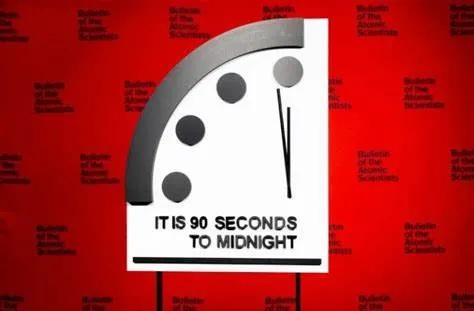
90 Seconds to Midnight? https://www.scottritterextra.com/p/90-seconds-to-midnig Scott Ritter, Jan 25
A clear signal to the US leadership that there will be no survivors in any nuclear exchange between the US and Russia
A quick history lesson for the Bulletin of Atomic Scientists:
- It was the US, not Russia, that withdrew from the Anti-Ballistic Missile and Intermediate Nuclear Forces treaties.
- It is the US, not Russia, that has frozen talks on the extension of the New Strategic Arms Treaty.
- It is the US, not Russia, that has recently promulgated a nuclear posture policy which allows for the preemptive use of nuclear weapons in a non-nuclear scenario.
- It is the US, not Russia, that has deployed a low-yield (i.e., “usable) nuclear warhead (the W-76-2) on Trident submarine launched ballistic missiles, and conducted war games where the Secretary of Defense has practiced the communications procedures necessary to launch this weapon where Russia was the named target of the missile.
- It is the US, not Russia, that is building a Ukrainian proxy army designed by intent to be able to capture territory Russia claims as its own (the four former Ukrainian provinces annexed by Russia in September 2022, and Crimea), knowing full well that one of the triggers for release of Russian nuclear weapons is any conventional military force that threatens the existential survival of Russia.
https://www.scottritterextra.com/p/90-seconds-to-midnig Scott Ritter, Jan 25
The Russian guided missile frigate, the Admiral Gorshkov, is in the middle of the Atlantic Ocean, ostensibly heading toward the east coast of the United States, part of a planned journey which began on 4 January 2023 and is expected to transit the Atlantic and Indian Oceans, as well as the Mediterranean Sea. The Admiral Gorshkov is outfitted with 16 vertical launch tubes, each of which, in theory, could be armed with nuclear-capable Zircon hypersonic missiles capable of covering 1,000 kilometers in less than 10 minutes.
To put it bluntly, soon Russia will be in a position where a single ship could, in a matter of minutes, fire 16 nuclear armed hypersonic missiles at the United States which not only cannot be intercepted by anything in the US arsenal, but also would impact their respective targets before any meaningful evacuation could be conducted. It is, literally, a decapitation weapon.
Current Russian nuclear doctrine does not allow for a nuclear first strike; indeed, Russian President Vladimir Putin has made it clear that Russia would not be the first nation to use nuclear weapons in any future nuclear conflict. But he also emphasized that Russia would not be the second, either, meaning that Russia would release its nuclear arsenal without waiting for any US first strike to impact Russian soil.
The Admiral Gorshkov is sending a clear signal to the US leadership that there will be no survivors in any nuclear exchange between the US and Russia.
Amid this muscle flexing, the Science and Security Board of the Bulletin of the Atomic Scientists, a disarmament advocacy group founded in 1945 by Albert Einstein and University of Chicago scientists who helped develop the first atomic weapons in the Manhattan Project, and which currently maintains what is known as the “Doomsday Clock” that reflects the risk of nuclear conflict, decided to move the hands of the clock ten seconds forward from the current 100 seconds to midnight. In a statement announcing this decision, “A time of unprecedented danger: It is 90 seconds to midnight,” the board declared the following:
“The war in Ukraine may enter a second horrifying year, with both sides convinced they can win. Ukraine’s sovereignty and broader European security arrangements that have largely held since the end of World War II are at stake. Also, Russia’s war on Ukraine has raised profound questions about how states interact, eroding norms of international conduct that underpin successful responses to a variety of global risks.
“And worst of all, Russia’s thinly veiled threats to use nuclear weapons remind the world that escalation of the conflict—by accident, intention, or miscalculation—is a terrible risk. The possibility that the conflict could spin out of anyone’s control remains high.”
The ignorance of this statement is manifest. What the Board calls “Russia’s war on Ukraine” ignores the fact-based historical truth that the Ukraine conflict was, and is, solely the byproduct of a concerted plan by the United States and NATO to use Ukraine as a foil to generate conflict designed to bring down the government of Russian President Vladimir Putin.
This plan has been in place since at least 2008, when the former US Ambassador to Russia (and current Director of the CIA), William Burns, warned that any effort by NATO to bring Ukraine into its ranks would precipitate an eventual Russian military intervention. Despite this stark warning, NATO extended an invitation to Ukraine in November 2008, clearly initiating a known cause-effect relationship that defined NATO’s policy toward Russia as being one which sought a proxy conflict using Ukraine as a stand-in for NATO.
This policy as furthered by the US, EU and NATO all acting in concert to precipitate a coup in Ukraine in February 2014 designed to oust the constitutionally elected president, Victor Yanukovych, and replace him with a new, ultra-nationalist government dominated by adherents of the odious ideology of Stepan Bandera. The coup succeeded, and in April the new Ukrainian government declared war on the ethnic Russian population of the Donbas. This action triggered the Russian annexation of Crimea and the provision of military support by Russia to the Donbas, triggering the very military intervention William Burns had warned about six years prior.
Ukraine and its NATO allies then sued for peace, initiating negotiations that led to the adoption of the Minsk Agreement, which put in place a ceasefire in exchange for guarantees regarding Ukrainian sovereignty over the Donbas as well as relative autonomy for the ethnic Russians of the Donbas, protecting their language, religion, culture, and traditions.
The Minsk Accords floundered for eight years, with Ukraine failing to implement the required constitutional changes necessary to secure the rights of the ethnic Russians of the Donbas. The reasons for this delay are today well known, thanks to the public confessions of former Ukrainian President Petro Poroshenko, former German Chancellor Angela Merkel, and former French President Francois Hollande, all three signatories to the accords. These three national leaders have acknowledged that the Minsk Accords were simply a sham designed by Ukraine to buy time to build a NATO proxy military capable of reclaiming both the Donbas and Crimea.
Russia’s decision to invade Ukraine on February 24, 2022 was not an unprovoked act of aggression, but rather a legitimate exercise of its right, together with the newly independent republics of Lugansk and Donetsk, of preemptive collective self-defense in the face of the imminent threat of aggression by Ukraine’s newly trained army which was, by design, little more than a NATO proxy.
The fact that the esteemed members of the Bulletin of Atomic Scientists – which includes among its ranks ten Nobel laureates – seem ignorant of this history, colors their ability to comprehend the true nature of the threat facing the world today, and from whence that threat comes.
The United States, having deliberately provoked a pre-meditated conflict with Russia, is now trying to implement a two-tracked policy designed to trigger a Maidan-like moment in Moscow (named after Maidan Square, in Kiev, where US-backed neo-Nazi’s staged a violent coup against former Ukrainian President Victor Yanukovych) where the Russian population would rise up against the government of President Vadimir Putin, overthrowing him and installing a pro-western leader who would return Russia to the colonial-like existence of the 1990’s, when Boris Yeltsin allowed the collective west to rape Russia economically and dominate Russia politically.
The two-tracks of this policy involve the imposition of economic sanctions linked to Russia’s decision to militarily intervene in Ukraine, and the prosecution of a proxy conflict in Ukraine designed to bleed Russia white. The goal of this policy is to engender massive unrest among a demoralized Russian population which would in turn rise and remove President Putin from power.
The insanity of such a plan is incomprehensible. Imagine for a moment that Russia embarked on a plan of action designed to strip away Mexico from the US sphere of influence and, in doing so, promulgated a conflict the goal of which was to have Mexico re-take by force the territory encompassing the states of California, Arizona, New Mexico, and Texas. The idea that the United States would sit idly in the face of such a threat is ludicrous. So, too, is any concept that Russia should do the same.
A quick history lesson for the Bulletin of Atomic Scientists:
- It was the US, not Russia, that withdrew from the Anti-Ballistic Missile and Intermediate Nuclear Forces treaties.
- It is the US, not Russia, that has frozen talks on the extension of the New Strategic Arms Treaty.
- It is the US, not Russia, that has recently promulgated a nuclear posture policy which allows for the preemptive use of nuclear weapons in a non-nuclear scenario.
- It is the US, not Russia, that has deployed a low-yield (i.e., “usable) nuclear warhead (the W-76-2) on Trident submarine launched ballistic missiles, and conducted war games where the Secretary of Defense has practiced the communications procedures necessary to launch this weapon where Russia was the named target of the missile.
- It is the US, not Russia, that is building a Ukrainian proxy army designed by intent to be able to capture territory Russia claims as its own (the four former Ukrainian provinces annexed by Russia in September 2022, and Crimea), knowing full well that one of the triggers for release of Russian nuclear weapons is any conventional military force that threatens the existential survival of Russia.
1 This Month




PLEASE OPPOSE HR 8255 AND S.3639 – bills would accelerate satellite deployment, with no environmental review or safeguards – https://ncstd5li.quorum.us/campaign/169331/
To see nuclear-related stories in greater depth and intensity – go to https://nuclearinformation.wordpress.com
-
Archives
- September 2026 (330)
- August 2026 (330)
- July 2026 (355)
- June 2026 (287)
- May 2026 (306)
- April 2026 (356)
- March 2026 (251)
- February 2026 (267)
- January 2026 (308)
- December 2025 (358)
- November 2025 (359)
- October 2025 (375)
-
Categories
- 1
- 1 NUCLEAR ISSUES
- business and costs
- climate change
- culture and arts
- ENERGY
- environment
- health
- history
- indigenous issues
- Legal
- marketing of nuclear
- media
- opposition to nuclear
- PERSONAL STORIES
- politics
- politics international
- Religion and ethics
- safety
- secrets,lies and civil liberties
- spinbuster
- technology
- Uranium
- wastes
- weapons and war
- Women
- 2 WORLD
- ACTION
- AFRICA
- Atrocities
- AUSTRALIA
- Christina's notes
- Christina's themes
- culture and arts
- Events
- Fuk 2022
- Fuk 2023
- Fukushima 2017
- Fukushima 2018
- fukushima 2019
- Fukushima 2020
- Fukushima 2021
- general
- global warming
- Humour (God we need it)
- Nuclear
- RARE EARTHS
- Reference
- resources – print
- Resources -audiovicual
- Weekly Newsletter
- World
- World Nuclear
- YouTube
-
RSS
Entries RSS
Comments RSS

