The Disastrous Downsides of South Korea Building Nuclear Weapons
38 North BY: SIEGFRIED S. HECKER, JANUARY 20, 2023
Is South Korea Willing to Lose Its World-leading Nuclear Power Program to Build the Bomb?
In a wide-ranging interview on January 11, South Korean President Yoon Suk-yeol warned Pyongyang that if North Korea’s nuclear threat continues to advance, South Korea would consider building nuclear weapons of its own or ask the United States to redeploy them on the Korean Peninsula. Although President Yoon walked back these comments at the World Economic Forum in Davos, they were published in the South Korean press and reinforced by some Republic of Korea (ROK) defense analysts. Cheon Seong-whun said, “President Yoon’s comment could turn out to be a watershed moment in the history of South Korea’s national security.”
A South Korean decision to build its own bomb could, indeed, be a watershed. Threatening Pyongyang does little besides give it a stronger justification to enhance its own nuclear arsenal. I believe that such a move would trigger a tsunami that would wipe out Seoul’s remarkable economic miracle and destroy the soft power it has established around the world……………………….
The National Burden of a Nuclear Arsenal
Whereas President Yoon’s comment, “…we can have our own nuclear weapons pretty quickly, given our scientific and technological capabilities” is true, it doesn’t come close to capturing the national redirection, expense, and immense burden that Seoul would have to shoulder to field not just one bomb, but a nuclear arsenal to counter Pyongyang’s.
It is true that with its advanced technological capabilities, South Korea could probably build the bomb quickly. But a few bombs don’t make a nuclear deterrent, particularly if Seoul will have to go it alone. And let’s be clear, if Seoul were to go down this path, Washington could, and likely would, withdraw its nuclear umbrella. Building a nuclear arsenal to counter Pyongyang’s would require a major national redirection of its economy and diplomacy that would negatively affect nearly all facets of South Korean life for decades.
For nearly fifty years, South Korea has pursued a civilian nuclear energy program. It wisely focused on the middle of the fuel cycle—that is, reactor fuel fabrication, reactor construction and operation, and electricity production. It has built neither enrichment nor reprocessing facilities. Consequently, South Korea has no inventory of bomb-grade plutonium or uranium currently stockpiled. To build nuclear weapons, it would have to repurpose some of its civilian reactors to produce the plutonium bomb fuel (combined with using its laboratory-scale pyroprocessing facilities to extract plutonium) or construct a centrifuge facility to make highly enriched uranium. Either path would take at least two years to produce enough bomb fuel for even a few bombs. In the longer term, an effective nuclear deterrent would require new, dedicated nuclear weapons facilities, requiring substantial time and financial commitments.
The next step in building a bomb is weaponization—that is, designing, building and testing the nuclear devices. South Korea could surely master all scientific and engineering challenges of building a bomb—as it has demonstrated so convincingly in mastering civilian nuclear power generation. Some of the purely military aspects could be accomplished in concert with its conventional military technical complex. But to prove the design and fabrication, there would need to be nuclear testing, but where? Neighboring countries—China and Japan—would certainly object strongly, and there would undoubtedly be strong domestic opposition to tests from every South Korean province.
The nuclear warheads will also have to be integrated into delivery vehicles—such as ballistic missiles, cruise missiles, submarine-launched missiles or bombers. South Korea has all the basic building blocks, but it would still have substantial work to do to integrate the nuclear warheads into the delivery systems. Moreover, these requirements will continue to evolve as North Korea upgrades its offensive and defensive capabilities. The assembly, disassembly and fielding of nuclear devices pose serious safety and security risks and would have to be learned without help or advice from current nuclear powers. Seoul will also have to develop a command-and-control structure that is more stringent than anything it has done so far for its conventional military.
Another consequence of building a nuclear arsenal is that it will compete for resources—financial, personnel, and technical—with the South’s conventional military…………………………………………………………………………
Seoul Would Deal a Serious Blow to the Nonproliferation Regime
South Korea would be the first democratic country to withdraw from the NPT, dealing a blow to decades of US leadership in preventing nuclear proliferation. As serious as the North Korean nuclear threat is, I believe Washington would have no choice but to condemn and counter the South’s decision to build the bomb. The nonproliferation regime is a complex fabric of treaties, agreements, assurances, practices, and international organizations. North Korea’s bomb and Iran’s pursuit of the bomb have already stressed the regime. The negative impacts of Russia’s invasion of Ukraine are playing out now. South Korea should not join these countries in undermining the regime……………………………………………………………
Shooting Itself in the Foot
South Korea’s decision to build the bomb will be widely condemned…………………………..
The irony is that an indigenous nuclear arsenal will make South Korea less secure. It is likely to draw an escalatory response from the North, and Seoul may then have to face that threat on its own. ………………………………. more https://www.38north.org/2023/01/the-disastrous-downsides-of-south-korea-building-nuclear-weapons/
Ukraine war boon/boondoggle for U.S. arms makers, Pentagon’s warfighting capabilities

Anti-Bellum January 20, 2023 Author: Rick Rozoff
Stocking Ukraine could generate foreign military sales boom
Replacing the military equipment transferred to Ukraine by the United States’ NATO allies could lead to roughly $21.7 billion in foreign military sales or direct commercial sales for American industry, according to research by the Foundation for Defense of Democracies’ Center on Military and Political Power.
….It would also enhance the quality of the weapons U.S. warfighters wield and strengthen U.S. defense industrial base capacity.
In addition to the $24.2 billion worth of security assistance the United States has committed (as of Jan. 6) to Ukraine since Russia’s Feb. 24 invasion, other NATO members have contributed billions of dollars’ worth of equipment. It is difficult to calculate precisely the cumulative value because many countries, unlike the United States, do not publish detailed lists.
NATO countries (not including the United States) have cumulatively increased their real defense spending each year since 2015, and those levels of defense spending are likely to increase further….Poland, for example, is raising its defense spending from 2.2% of its gross domestic product to 3%, which will help Warsaw purchase more military equipment………….. https://antibellum679354512.wordpress.com/2023/01/20/ukraine-war-boon-boondoggle-for-u-s-arms-makers-pentagons-warfighting-capabilities/
The US has a new nuclear proliferation problem: South Korea
The US has a new nuclear proliferation problem: South Korea. Last week,
Seoul officially put its nuclear option on the table, for the first time
since 1991. South Korean President Yoon Suk-yeol declared the country would
consider building its own arsenal of nuclear weapons if the threat it faces
from nuclear-armed North Korea continues to grow. It will.
Bulletin of Atomic Scientists 19th Jan 2023
Ukraine: Is the Hammer About to Fall?
The UNZ REview MIKE WHITNEY • JANUARY 17, 2023
The plan to engage Russia militarily is a tacit admission that the United States can no longer maintain its global dominance through economic or political means alone. After exhaustive analysis and debate, western elites have settled on a course of action aimed at dividing the world into warring blocs in order to prosecute a war on Russia and China. The ultimate strategic objective of the current policy, is to tighten the grip of western elites on the levers of global power and to prevent the dissolution of the “rules-based international order.”
But after 11 months of nonstop warfare in Ukraine, the US-backed western coalition finds itself in a worse position than when it began. Aside from the fact that the economic sanctions have severely impacted Washington’s closest European allies, the West’s control of Ukraine has plunged the economy into a protracted slump, destroyed much of the country’s critical infrastructure and annihilated a sizable portion of the Ukrainian Army.
More importantly, Ukrainian forces are now suffering unsustainable casualties on the battlefield which is laying the groundwork for the inevitable splintering of the state. Whatever the outcome of the conflict may be, one thing is certain: Ukraine will no longer exist as a viable, independent, contiguous state.……………………………………………………………….
The level of incompetence in the planning of this war is beyond anything we’ve ever seen before. It appears that all the preparation was focused on provoking a Russian invasion, not on the developments that would happen soon afterwards. What’s clear, is that the Pentagon never “gamed out” the actual war itself or the conflict as it is presently unfolding. Otherwise, how does one explain these glaring errors in judgement:
- They never thought the sanctions would backfire
- They never thought they’d run out of weapons and ammo
- They never thought Russia’s oil receipts would skyrocket
- They never thought that the majority of countries would maintain normal relations with Russia
- They never figured they’d actually need a coherent military strategy for fighting a ground war in eastern Europe.
Is there anything they got right?
Not that we can see…………………………………………………………………………………………
Let’s summarize:
- The media is “overestimating the (effect of) Ukrainians’ regionally limited offensives”. In short, the Ukrainians are losing the war.
- The Russians are winning the war. (“The Russians are clearly advancing. They will probably have completely conquered the Donbass before long.”)
- Weapons alone will not change the outcome of the war. (“the martens and leopards are not enough.”)
- There is no evidence that the west has clearly defined strategic objectives. (“Do you want to achieve a willingness to negotiate with the deliveries of the tanks? Do you want to reconquer Donbas or Crimea? Or do you want to defeat Russia completely? There is no realistic end state definition. And without an overall political and strategic concept, arms deliveries are pure militarism…Military operations must always be coupled with attempts to bring about political solutions.”)
This is not just an indictment of the way the war is being conducted, but of the strategic objectives which remain murky and poorly-defined. NATO is being led around by the nose by Washington, but Washington has no idea what it wants to achieve. “Weakening Russia” is not a coherent military strategy. It is, in fact, an aspirational phantasm nurtured by hawkish neocons playing armchair generals. But that is why we are in the predicament we are today, because the policy is in the hands of deranged fantasists. Does anyone seriously believe that the Ukrainian army will recover the territories in east Ukraine that have been annexed by Russia?
No, no serious person believes that. And, yet, the illusion that the “plucky Ukrainians are winning” persists, even while the casualties mount, the carnage increases and millions of Ukrainians flee the country. It’s beyond belief…………………………………………
Remember the Powell Doctrine? “The Powell Doctrine states that a list of questions all have to be answered affirmatively before military action is taken by the United States:
- Is a vital national security interest threatened?
- Do we have a clear attainable objective?
- Have the risks and costs been fully and frankly analyzed?
- Have all other non-violent policy means been fully exhausted?
- Is there a plausible exit strategy to avoid endless entanglement?
- Have the consequences of our action been fully considered?
- Is the action supported by the American people?
- Do we have genuine broad international support?
The former Secretary of Defense Colin Powell developed his Doctrine to avoid any future Vietnams. And while the Biden administration has not yet committed US combat troops to Ukraine, we think it’s only a matter of time. After all, the media is already beating the war drums while demonizing all-things Russia. That is traditionally how they prepare the public for war. (“Russophobia … is all about dehumanizing one’s opponents to make killing more acceptable (and destroying) all the mental restraints that keep men from barbarism.” Gilbert Doctorow)
Meanwhile, the US continues to pump Ukraine full of weapons while the Pentagon has begun training Ukrainian servicemen in Germany and Oklahoma. It looks like the decision has already been made to embroil the US in another conflict for which there is no vital national security interest and no clear path to victory. In other words, the Powell Doctrine has been shrugged off and replaced with another lunatic neocon plan aimed at dragging Russia into a bloody “Afghanistan-type” quagmire that will drain its resources and prevent it from blocking US expansion into Central Asia.
And how is the neocon plan working so far?
Here’s what Colonel Douglas MacGregor said in a recent interview:
“There are now 540,000 Russian troops stationed around the outskirts of Ukraine preparing to launch a major offensive that I think will probably end the war in Ukraine. 540,000 Russian troops, 1,000 rocket artillery systems, 5000 armored fighting vehicles including at least 1,5000 tanks, hundreds and hundreds of tactical ballistic missiles. Ukraine is now going to experience war on a scale we haven’t seen since 1945.”
And if that wasn’t bleak enough, here’s more from a recent video with Alexander Mercouris and Alex Christoforou:……………………………..more https://www.unz.com/mwhitney/ukraine-is-the-hammer-about-to-fall/
—
US Installs New Nukes in Europe: As Destructive as 83 Hiroshima Bombs
By Baher Kamal http://ipsnews.net/2023/01/us-installs-new-nukes-europe-destructive-83-hiroshima-bombs
MADRID, Jan 20 2023 (IPS) – As if the 100 billion dollars that the United States has so far provided to Ukraine in both weapons and aid were not enough, the US has now started to install in Europe its brand new, more destructive nuclear warheads.
The US 100 billion dollars are to be added to all the weapons and aid that 40 Washington’s ‘allies’ –Europe in particular– have been sending to Ukraine since it was invaded by Russia in February 2022.
The US spending on the Ukrainian war in less than a year amounts to the desperately needed funding that the United Nations require to partially alleviate some of the horrifying suffering of over one billion human beings over two long years.
n a further escalation, the United States began in December 2022 to ship new nuclear warheads to Europe: “the B61-12 warhead is a more advanced warhead from the ones currently deployed in Belgium, Germany, Italy, the Netherlands and Turkey,” according to the International Campaign to Abolish Nuclear Weapons (ICAN).
Boeing designed the bomb’s new guided-tail kit, giving it additional manoeuvrability and the appearance of more precision.But, it’s a nuclear weapon, and has different yields, from 0.3kt to 50kt, ICAN reports.
Much more destructive
\
These bombs can detonate beneath the Earth’s surface, increasing their destructiveness against underground targets to the equivalent of a surface-burst weapon with a yield of 1,250 kilotons––the equivalent of 83 Hiroshima bombs.”
Even if the bombs are American and the US retains launch authority, they would most likely be dropped by Europeans. If the US decides to use its nuclear weapons located in Germany, the warheads are loaded onto German planes and a German pilot drops them, ICAN further explains.
This Geneva-based coalition of 652 non-governmental partner organisations in 107 countries, promoting adherence to and implementation of the UN Treaty on the Prohibition of Nuclear Weapons, received the 2017 Nobel Peace Prize.
The ‘brutal struggle for power’
The production, testing, and use of nukes is one of the reasons why the biggest powers are now pushing the world into the abyss of lawlessness. In fact, the UN chief has once more sounded the alarm bell.
“From illegally developing nuclear weapons to non-sanctioned use of force, States continue to flout international law with impunity”, said the UN Secretary-General, António Guterres.
The rule of law stands between peace and ‘brutal struggle for power,’ he warned in his 12 January message to the UN Security Council – where five countries: US, Russia, China, UK and France– hold a self attributed authority to override the well of over 190 states, members of the UN.
‘Grave risk’ of lawlessness
The UN chief painted a grim picture of civilians around the world suffering from devastating conflicts, rising poverty, and surging hunger, warning that “we are at grave risk of the Rule of Lawlessness”.
The rule of law “protects the vulnerable; prevents discrimination; bolsters trust in institutions; supports inclusive economies and societies; and is the first line of defence against atrocity crimes.”
Guterres cited Russia’s invasion of Ukraine; unlawful killings of both Palestinians and Israelis; gender-based apartheid in Afghanistan; the Democratic People’s Republic of Korea’s unlawful nuclear weapons programme; violence and severe human rights violations in Myanmar; and a deep institutional crisis in Haiti.
Meanwhile…
Meanwhile, the world is falling apart, witnessing an “ongoing collision of crises for which traditional response and recovery are not enough,” warns the UN Development Programme (UNDP).
“Our future is at stake, as wars, epidemics, the climate emergency and economic upheaval leave almost no country untouched.
From the war in Ukraine that sparked a global cost of living crisis to the climate emergency, the floods in Pakistan, the global pandemic, hunger in the Horn of Africa, to the crisis in Yemen — we face never before seen challenges to our future, adds UNDP.
Developing economies accounting for more than half of the world’s poorest people need urgent debt relief as a result of “cascading global crises. Without action, poverty will spiral and desperately needed investments in climate adaptation and mitigation will not happen.”
Also meanwhile, millions of children under armed conflicts
The UN Children Fund (UNICEF) reports that more than 400 million children live in areas under conflict; an estimated 1 billion children – nearly half the world’s children – live in countries at extreme vulnerability to the impacts of climate change…
… And at least 36.5 million children have been displaced from their homes; and 8 million children under age 5 across 15 crisis-hit countries are at risk of death from severe wasting.
Today, there are more children in need of humanitarian assistance than at any other time since the Second World War. Across the globe, “children are facing a historic confluence of crises – from conflict and displacement to infectious disease outbreaks and soaring rates of malnutrition.”
UNICEF has appealed for 10.3 billion US dollars to reach more than 110 million children with humanitarian assistance across 155 countries and territories.
Pentagon can’t account for $220 billion in govt property, fails fifth audit
Pentagon can’t account for $220 billion in gov’t property, fails fifth audit | 18 Jan 2023 | A Tuesday report by the Government Accountability Office revealed that the Department of Defense failed its fifth audit in a row after it could not account for at least 220 billion in government-furnished property, the Daily Caller News Foundation reported.
The DOD has been mandated by federal law to complete audits since 1994; however, the mandate was ignored for decades due to the agency’s massive size, according to Military dot com. Since launching its first independent audit, in 2017 the Pentagon has never passed.
The Pentagon failed its fifth audit in November after the agency could not prove expenditures for 61% of its 3.5 trillion in assets. To perform this year’s overall audit of the DOD, which was expected to cost 218 million, the agency aggregated 27 separate audits conducted by approximately 1,600 auditors. According to Military.com, the auditors performed 220 in-person site visits and 750 virtual site visits.
MICAELA BURROW, January 17, 2023
he Department of Defense (DOD) has neglected to address its inability to keep track of at least 220 billion in equipment provided to government contractors, according to a Tuesday report by the Government Accountability Office (GAO).
Auditors first reported the Pentagon’s failure to account for government-owned equipment or material offered up for use to contracting agencies, also called government furnished property, in 2001, according to the report. DOD has made little improvement since then, increasing the risk that the Pentagon could accidentally overlook errors in the books.
“This long-standing issue affects the accounting and reporting of GFP and is one of the reasons DOD is unable to produce auditable financial statements,” GAO said. Of all the major federal agencies GAO is obligated to review, DOD is the only one unable to receive an opinion on its financial statements. https://dailycaller.com/2023/01/17/watchdog-pentagon-billions-equipment-contractors/
Germany Says US Must Lead Way On Tanks For Ukraine, As Republican Party Also Piles On Pressure
https://www.zerohedge.com/geopolitical/germany-says-us-must-lead-way-tanks-ukraine-gop-also-piles-pressureBY TYLER DURDEN, THURSDAY, JAN 19, 2023 –
Germany just upped the pressure on the Biden administration regarding growing calls to send Ukraine M1 Abrams tanks, which the White House has thus far resisted, fearing further escalation with Russia.
It comes as Germany just appointed a new defense minister, Boris Pistorius, after scandal-plagued Christine Lambrecht resigned the day prior, after also long being accused of representing weakness on arming Ukraine. The Scholz government said it will be up for the new defense minister to mull the question of tanks for Ukraine, as Kiev’s pleas grow louder.
“Germany won’t allow allies to ship German-made tanks to Ukraine to help its defense against Russia nor send its own systems unless the U.S. agrees to send American-made battle tanks, senior German officials said on Wednesday,” according to fresh Wall Street Journal reporting.
The timing of the WSJ’s German tank story is interesting, also given the same day top Republican committee chairs in Congress are ramping up the pressure on Biden, demanding that the US approve what are widely seen as ‘weapons needed to win’ against Russia.
Leopard 2 tanks, ATACMS, and other long-range precision munitions should be approved without delay,” House Foreign Affairs Committee Chairman Michael McCaul and House Armed Services Committee Chairman Mike Rogers said in a statement reported by Bloomberg. The pair of lawmakers at the same time criticized the “current indecision and self-deterrence” which they say will only prolong the conflict.
But Germany’s Scholz has consistently expressed a desire to avoid potential direct military escalation with Russia at all costs. Approving tanks would likely plunge Germany deeper in right alongside the US as things continue sliding toward direct confrontation.
Meanwhile, sabotage from Scholz?…
The Treaty on the Prohibition of Nuclear Weapons is a good step towards a nuclear-free world
https://www.canberratimes.com.au/story/8054916/nuclear-danger-is-strong-but-landmark-agreement-offers-hope/ By Marianne Hanson, Margaret Beavis, January 21 2023
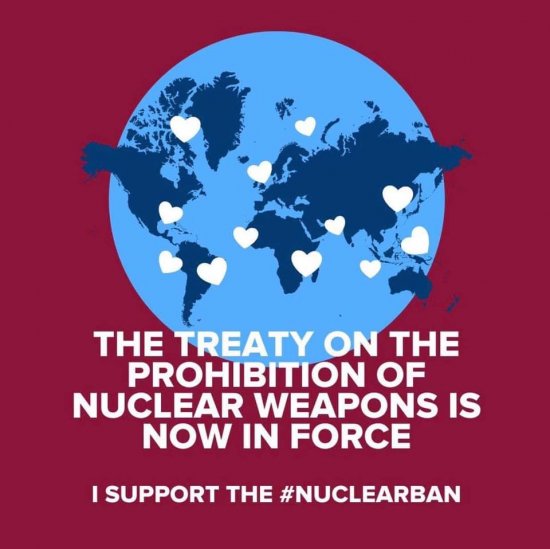
January 22 marks the two-year anniversary of the entry into force of the United Nations Treaty on the Prohibition of Nuclear Weapons (TPNW), a landmark agreement that made nuclear weapons illegal on the basis of international humanitarian law.
Yet the potential for nuclear war remains as great as ever.
Fears that the unthinkable might happen were raised most clearly last year when President Vladimir Putin implied that Russia would consider using ‘all forces and means’ necessary in its fight against Ukraine.
It reminded us of the Cuban missile crisis 60 years earlier, once again bringing to the fore the prospect that nuclear war was in fact quite thinkable.
Thankfully, no nuclear weapons have been used in this war, but we cannot be complacent. Deterrence cannot be relied on forever. If Russia (or the United States) were to use even one small “tactical” nuclear weapon, a greater conflagration could easily follow.
It is not only Putin who has threatened to use nuclear weapons; nor is it the case that nuclear dangers vanished after the Cuban crisis or even after the end of the Cold War.
The leaders of every one of the nine states which possess these weapons of mass destruction – Russia, the US, France, China, Britain, India, Pakistan, Israel and North Korea – regularly signal that they would indeed use these weapons.
Their nuclear doctrines, the ongoing modernisation of their nuclear arsenals, their war-fighting practices and nuclear targeting all threaten the use of weapons which have the potential to kill millions and devastate the planet.
The end of the Cold War did nothing to reduce these dangers. While there was a period when goodwill between the major powers prevailed, and the US and Russia embarked on a program of reduction via the Strategic Arms Reduction Treaties, in truth a window of opportunity was lost when the nuclear-armed states refused to move seriously to eliminate their nuclear arsenals completely.
At the time, Australia was at the forefront of calls for the total elimination of nuclear weapons; the Labor government’s Canberra Commission in 1996 put forward a sober and considered assessment of the utility of nuclear weapons.
Nineteen commissioners from around the world, including several military leaders from the US, Britain and elsewhere, concluded that nuclear arsenals had very little military utility, that their existence continued to threaten the world – via deliberate or accidental use – and that as long as any one state possessed nuclear weapons, other states would want them too.
As predicted, three more states have acquired these WMDs since the Cold War ended.
The Canberra Commission set out a comprehensive program to encourage the phased, balanced, mutual, and verified elimination of nuclear weapons. It did not call for unilateral disarmament, nor did it insist that this should happen overnight. But it did warn that dangers would increase if the world did not act to eliminate these most destructive of all weapons.
Several other organisations and think tanks around the world added to the Canberra Commission’s message in subsequent decades and the nuclear states made clear promises to disarm. But they have stalled in the process of disarmament and are, instead, making their existing arsenals even more destructive than they were before.
Thoroughly fed-up with this intransigence, more than 120 states at the United Nations in 2017 voted to adopt a treaty outlawing nuclear weapons. The TPNW entered into force two years ago, and now has 92 state signatures.
Formed in Melbourne, the International Campaign for the Abolition of Nuclear weapons (ICAN) was awarded the Nobel peace prize for its work in raising awareness of nuclear dangers and its contribution towards the new treaty. This was the first and only time that an Australian-born group has been awarded the Nobel peace prize.
ICAN’s work was premised on the history of banning other weapons considered to be inhumane, unjust, and uncivilised. Landmines have been banned and are hardly used at all today, a far cry from a few decades ago. Chemical and biological weapons have been banned, and any state that attempts to use them is immediately stigmatised and reprimanded.
In the same way, the TPNW is designed to stigmatise, delegitimise, and in time lead to the elimination of nuclear weapons. ICAN, the 92 governments which have signed, and people around the world who support nuclear disarmament understand that a legal instrument banning nuclear weapons is a necessary step in the move to a nuclear weapons-free world.
It might surprise readers to know that several prominent politicians and military leaders also support this goal; Henry Kissinger and William Perry from the US are notable advocates of disarmament; so too were Ronald Reagan and Mikhail Gorbachev. Here in Australia, Labor promised at its 2018 and 2021 National Conferences that it will sign the TPNW when in government.
More than 100 federal parliamentarians have called on Canberra to fulfil this promise, as have hundreds more from around Australia, including in local government.
The call to eliminate nuclear weapons also finds strong support at the grassroots level in Australia; doctors and other health practitioners, environmental groups, trade unions, faith-based leaders, lawyers and others are calling on the government to sign the TPNW.
This is because banning and abolishing nuclear weapons is seen as a public health and humanitarian imperative. Our planet is worth preserving and human life should be valued. The Australian Red Cross as well as prominent Rotarians around the world are calling for the elimination of nuclear weapons, in the same way that they are working to eliminate polio and malaria.
On this second anniversary of the Treaty on the Prohibition of Nuclear Weapons’ entry into force, Australia must again take up the message of the Canberra Commissioners. Indeed, while Australia’s high-risk nuclear propelled submarine proposal clearly creates global proliferation concerns, by signing the TPNW Australia can demonstrate its non-proliferation commitments.
A nuclear-free world requires visionary and bold leadership. It is a global public good. Signing the TPNW, and playing an active role internationally for balanced, phased and verified disarmament will be an excellent start.
- Associate Professor Marianne Hanson and Dr Margaret Beavis are co-chairs of the International Campaign to Abolish Nuclear Weapons (Nobel peace prize 2017) Australia.
CNN: Ukraine Has Become a ‘Weapons Lab’ for Western Arms

“We are interested in testing modern systems in the fight against the enemy and we are inviting arms manufacturers to test the new products here,”
Ukraine’s defense minister previously offered his country as a ‘testing ground’ for Western weapons makers https://news.antiwar.com/2023/01/16/cnn-ukraine-has-become-a-weapons-lab-for-western-arms/ by Dave DeCamp ,
Ukraine has turned into a “lab” for Western arms as the war has given the US and its allies an opportunity to see how their weapons fare in a conflict with a major military power like Russia, CNN reported on Monday.
A source familiar with Western intelligence on the war told CNN that Ukraine is “absolutely a weapons lab in every sense because none of this equipment has ever actually been used in a war between two industrially developed nations.” The source described it as “real-world battle testing.”
Back in July, Ukrainian Defense Minister Oleksii Reznikov offered his country as a “testing ground” for Western arms makers. “We are interested in testing modern systems in the fight against the enemy and we are inviting arms manufacturers to test the new products here,” he said.
Reznikov got his wish as the US, and its allies have significantly stepped up military aid since then, and the war has escalated as Russia began large-scale strikes on Ukrainian infrastructure in October. Russia’s success in its use of cheap kamikaze drones in the infrastructure attacks has influenced plans for Western arms makers.
The British arms maker BAE Systems has announced that it’s developing a new armored vehicle with added protection to defend it from kamikaze drone attacks from above. Multiple intelligence and military officials told CNN that making cheap single-use drones has become a priority of many defense contractors.
The CNN report said that for the US military, the war has become an “incredible source of data on the utility of its own systems.” For example, the US has seen that its HIMARS rocket launch system has been effective against Russian forces, while the
M777 howitzer has become less effective and less accurate over time.
The war in Ukraine has also created a demand for weapons that were beginning to become obsolete, such as the Stinger shoulder-fired anti-aircraft missiles. Raytheon stopped producing Stingers for years but now has been asked by the Pentagon to ramp up production as thousands have been shipped to Ukraine.
Nuclear Notebook: United States nuclear weapons, 2023

The United States is modernizing its nuclear bomber force by upgrading nuclear command-and-control capabilities on existing bombers, developing improved nuclear weapons (the B61-12 and the new AGM-181 Long-Range Standoff Weapon (LRSO), and designing a new heavy bomber (the B-21 Raider).
Bulletin of the Atomic Scientists By Hans M. Kristensen, Matt Korda, January 16, 2023
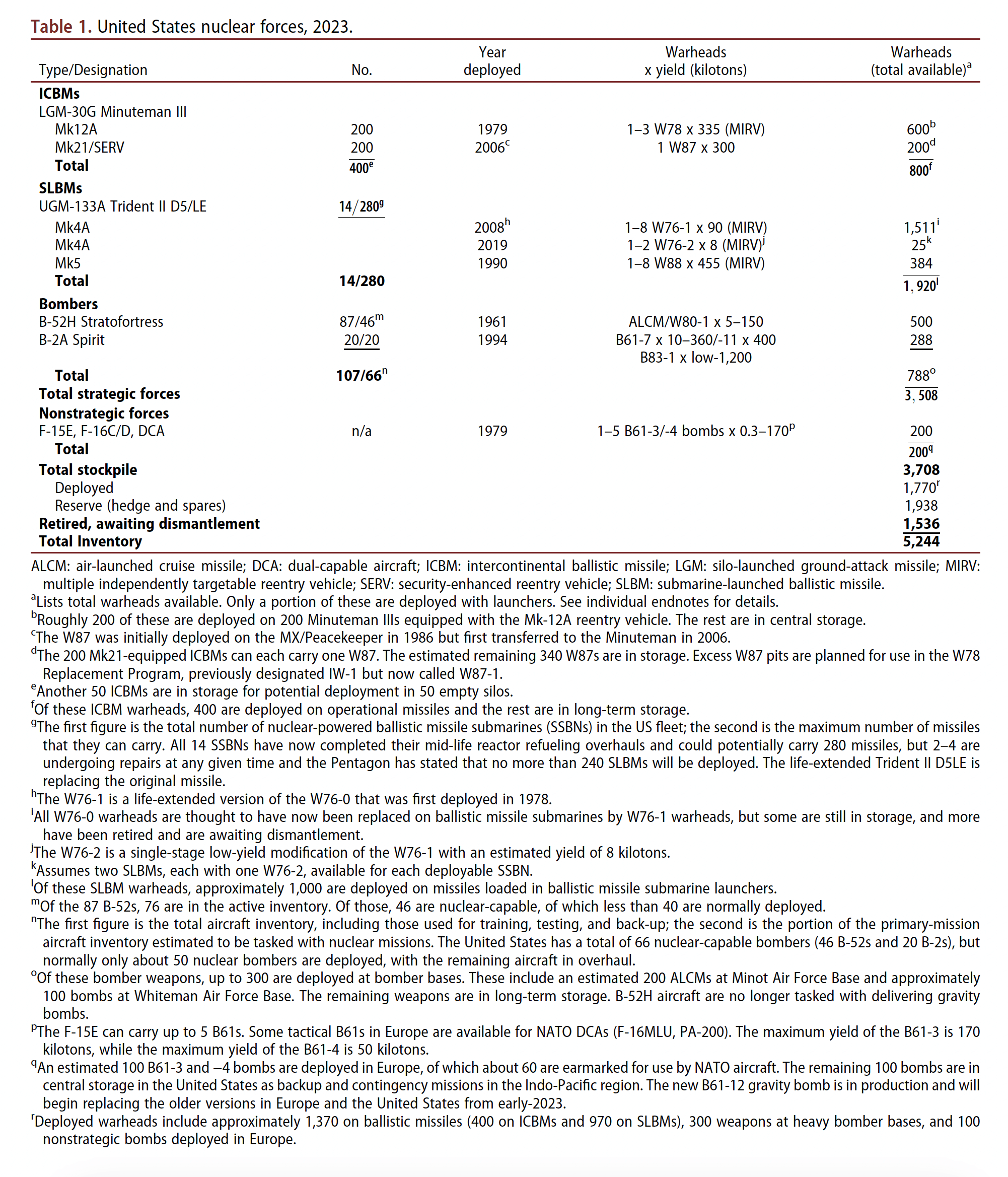
t the beginning of 2023, the US Department of Defense maintained an estimated stockpile of approximately 3,708 nuclear warheads for delivery by ballistic missiles and aircraft. Most of the warheads in the stockpile are not deployed but rather stored for potential upload onto missiles and aircraft as necessary. We estimate that approximately 1,770 warheads are currently deployed, of which roughly 1,370 strategic warheads are deployed on ballistic missiles and another 300 at strategic bomber bases in the United States. An additional 100 tactical bombs are deployed at air bases in Europe. The remaining warheads — approximately 1,938 — are in storage as a so-called hedge against technical or geopolitical surprises. Several hundred of those warheads are scheduled to be retired before 2030. (See Table 1. on original)
In addition to the warheads in the Department of Defense stockpile, approximately 1,536 retired — but still intact — warheads are stored under the custody of the Department of Energy and are awaiting dismantlement, giving a total US inventory of an estimated 5,244 warheads. Between 2010 and 2018, the US government publicly disclosed the size of the nuclear weapons stockpile; however, in 2019 and 2020, the Trump administration rejected requests from the Federation of American Scientists to declassify the latest stockpile numbers (Aftergood 2019; Kristensen 2019a, 2020d). In 2021, the Biden administration restored the United States’ previous transparency levels by declassifying both numbers for the entire history of the US nuclear arsenal until September 2020 — including the missing years of the Trump administration.
This effort revealed that the United States’ nuclear stockpile consisted of 3,750 warheads in September 2020 — only 72 warheads fewer than the last number made available in September 2017 before the Trump administration reduced the US government’s transparency efforts (US State Department 2021a). We estimate that the stockpile will continue to decline over the next decade-and-a-half as modernization programs consolidate the remaining warheads.
The Biden administration’s declassification also revealed that the pace of warhead dismantlement has slowed significantly in recent years. While the United States dismantled on average more than 1,000 warheads per year during the 1990s, in 2020 it dismantled only 184 warheads (US State Department 2021a). …………………
In the past, the Obama and Biden administrations often declassified the warhead stockpile and dismantlement numbers around the time of major arms control conferences. That did not happen in 2022, however, and the Biden administration has so far not acted on requests from the Federation of American Scientists to disclose the numbers for 2021 or 2022. A decision to no longer declassify these numbers would not only contradict the Biden administration’s own practice from 2020, but also represent a return to Trump-era levels of nuclear opacity. Such increased nuclear secrecy undermines US calls for Russia and China to increase transparency of their nuclear forces.
The US nuclear weapons are thought to be stored at an estimated 24 geographical locations in 11 US states and five European countries (Kristensen and Korda 2019, 124). The location with the most nuclear weapons by far is the large Kirtland Underground Munitions and Maintenance Storage Complex (KUMMSC) south of Albuquerque, New Mexico. Most of the weapons in this location are retired weapons awaiting dismantlement at the Pantex Plant in Texas. The state with the second-largest inventory is Washington, which is home to the Strategic Weapons Facility Pacific and the ballistic missile submarines at Naval Submarine Base Kitsap. The submarines operating from this base carry more deployed nuclear weapons than any other base in the United States.
Implementing the New START treaty
The United States appears to be in compliance with the New Strategic Arms Reduction Treaty (New START) limits. ………………………………
If New START expired without a follow-on treaty in place, both the United States and Russia could upload several hundred extra warheads onto their launchers. This means that the treaty has proven useful thus far in keeping a lid on both countries’ deployed strategic forces. Additionally, both countries would lose a critical node of transparency into each other’s nuclear forces. As of December 8, 2022, the United States and Russia had completed a combined 328 on-site inspections and exchanged 25,017 notifications (US State Department 2022b)……………………………….
The Nuclear Posture Review and nuclear modernization…………
Just like previous NPRs, the Biden administration’s NPR rejected policies of nuclear “no-first-use” or “sole purpose,” instead preferring to leave the option open for nuclear weapons to be used under “extreme circumstances to defend the vital interests of the United States or its allies and partners” (US Department of Defense 2022b, 9)…………………….
The most significant change between the Biden and Trump NPRs was the walking back of two Trump-era commitments — specifically, canceling the new sea-launched cruise missile and retiring the B83-1 gravity bomb……………………………………….
The complete nuclear modernization (and maintenance) program will continue well beyond 2039 and, based on the Congressional Budget Office’s estimate, will cost $1.2 trillion over the next three decades. Notably, although the estimate accounts for inflation (Congressional Budget Office 2017), other estimates forecast that the total cost will be closer to $1.7 trillion (Arms Control Association 2017). Whatever the actual price tag will be, it is likely to increase over time, resulting in increased competition with conventional modernization programs planned for the same period. …………
The National Nuclear Security Administration (NNSA) and the Department of Defense have also proposed developing several other new nuclear warheads, including the W93 navy warhead. The NNSA’s Stockpile Stewardship and Management Plan (SSMP) of December 2020 doubled the number of new nuclear warhead projects for the next 20 years compared to its 2019 plan (National Nuclear Security Administration (NNSA) 2020b).
Nuclear planning and nuclear exercises
In addition to the Nuclear Posture Review, the nuclear arsenal and the role it plays is shaped by plans and exercises that create the strike plans and practice how to carry them out…………….
OPLAN 8010–12 consists of “a family of plans” directed against four identified adversaries: Russia, China, North Korea, and Iran. Known as “Strategic Deterrence and Force Employment,” OPLAN 8010–12 first entered into effect in July 2012 in response to Operations Order Global Citadel signed by the defense secretary. ……………………
OPLAN 8010–12 is a whole-of-government plan that includes the full spectrum of national power to affect potential adversaries. ……………………………..
This year’s Global Thunder exercise was delayed but will probably happen in early-2023.
These exercises coincide with steadily increasing US bomber operations in Europe since Russia’s invasion of Ukraine in 2014 and again in 2022…………………………………………….
the mission of the Bomber Task Force is to move a fully combat-ready bomber force into the European theater. “It’s no longer just to go partner with our NATO allies or to go over and have a visible presence of American air power,” according to the commander of the 2nd Bomb Wing. “That’s part of it, but we are also there to drop weapons if called to do so” (Wrightsman 2019). These changes are evident in the types of increasingly provocative bombers operations over Europe, in some cases very close to the Russian border (Kristensen 2022a)……………………………..
The close integration of nuclear and conventional bombers into the same task force can have significant implications for crisis stability, misunderstandings, and the risk of nuclear escalation because it could result in misperceptions about what is being signaled and result in overreactions…………………………………
Land-based ballistic missiles
The US Air Force operates a force of 400 silo-based Minuteman III ICBMs split across three wings: the 90th Missile Wing at F. E. Warren Air Force Base in Colorado, Nebraska, and Wyoming; the 91st Missile Wing at Minot Air Force Base in North Dakota; and the 341st Missile Wing at Malmstrom Air Force Base in Montana………………………………
The Minuteman III missiles completed a multibillion-dollar, decade-long modernization program in 2015 to extend their service life until 2030. Although the United States did not officially deploy a new ICBM, the upgraded Minuteman III missiles “are basically new missiles except for the shell,” according to Air Force personnel (Pampe 2012)………………………………………………………………….
To produce the new W87-1 warhead in time to meet the Sentinel’s planned deployment schedule, the NNSA has set an extremely ambitious production rate of at least 80 plutonium pits per year by 2030.
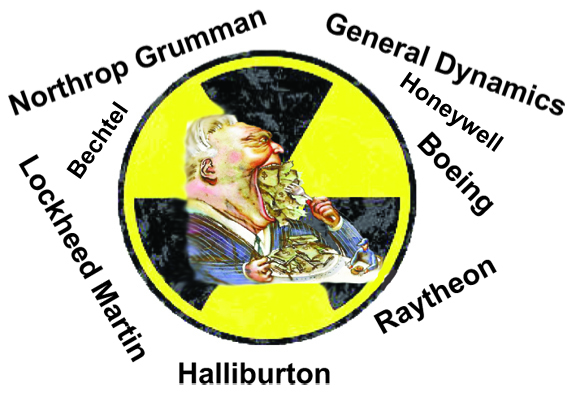
In October 2019, Lockheed Martin was awarded a $138 million contract to integrate the Mk21 reentry vehicle into the Sentinel, beating out rivals Boeing, Raytheon, Northrop Grumman, and Orbital ATK (which Northrop Grumman now owns and has been renamed to Northrop Grumman Innovation Systems) (Lockheed Martin 2019
………………………………………………….. In May 2021, the US Congressional Budget Office estimated that the cost of acquiring and maintaining the Sentinel would total approximately $82 billion over the 2021–2030 period — approximately $20 billion more than the Congressional Budget Office had previously estimated for the 2019–2028 period (Congressional Budget Office 2021, 2019)……………………………………
Nuclear-powered ballistic missile submarines
The US Navy operates a fleet of 14 Ohio-class ballistic missile submarines (SSBNs), of which eight operate in the Pacific from their base near Bangor, Washington, and six operate in the Atlantic from their base at Kings Bay,…………………………………………………….
Design of the next generation of ballistic missile submarines, known as the Columbia-class, is well under way……………………………………
Strategic bombers
The US Air Force currently operates a fleet of 20 B-2A bombers (all of which are nuclear-capable) and 87 B-52H bombers (46 of which are nuclear-capable)……………………
Each B-2 can carry up to 16 nuclear bombs (the B61-7, B61-11, and B83-1 gravity bombs), and each B-52 H can carry up to 20 air-launched cruise missiles (the AGM-86B)……………………..
The United States is modernizing its nuclear bomber force by upgrading nuclear command-and-control capabilities on existing bombers, developing improved nuclear weapons (the B61-12 and the new AGM-181 Long-Range Standoff Weapon (LRSO), and designing a new heavy bomber (the B-21 Raider).
Upgrades to the nuclear command-and-control systems that the bombers use to plan and conduct nuclear strikes include the Global Aircrew Strategic Network Terminal. This is a new, high-altitude, electromagnetic pulse-hardened network of fixed and mobile nuclear command-and-control terminals………………
Another command-and-control upgrade involves a program known as Family of Advanced Beyond Line-of-Sight Terminals, which replaces existing terminals designed to communicate with the MILSTAR military satellite constellation operated by the US Space Force. …………………………………………….
The missile itself is expected to be entirely new, with significantly improved military capabilities compared with the air-launched cruise missile, including longer range, greater accuracy, and enhanced stealth (Young 2016). This violates the 2010 White House pledge (White House 2010) that the “United States will not … pursue … new capabilities for nuclear weapons,” though the 2018 NPR and 2022 NPR eliminated such constraints……………………..
Upgrades to the nuclear command-and-control systems that the bombers use to plan and conduct nuclear strikes include the Global Aircrew Strategic Network Terminal. This is a new, high-altitude, electromagnetic pulse-hardened network of fixed and mobile nuclear command-and-control terminals. ………..
Another command-and-control upgrade involves a program known as Family of Advanced Beyond Line-of-Sight Terminals, which replaces existing terminals designed to communicate with the MILSTAR military satellite constellation operated by the US Space Force. ……………….
The heavy bombers are also being upgraded with improved nuclear weapons. This effort includes development of the first guided, standoff nuclear gravity bomb, known as the B61-12, which is ultimately intended to replace all existing gravity bombs……………………………… The Air Force is also developing a new nuclear air-launched cruise missile known as the AGM-181 Long-Range Standoff Weapon (LRSO).
……………………………………………………… The conversion of the non-nuclear B-1 host bases to receive the nuclear B-21 bomber will increase the overall number of bomber bases with nuclear weapons storage facilities from two bases today (Minot AFB and Whiteman AFB) to five bases by the 2030s (Barksdale AFB will also regain nuclear storage capability) (Kristensen 2020c).
Nonstrategic nuclear weapons
The United States has only one type of nonstrategic nuclear weapon in its stockpile: the B61 gravity bomb……………………
The Belgian, Dutch, German, and Italian air forces are currently assigned an active nuclear strike role with US nuclear weapons……………………………….
NATO is working on a broad modernization of the nuclear posture in Europe that involves upgrading bombs, aircraft, and the weapons storage system (Kristensen 2022c)……………………………
NATO is life-extending the weapons storage security system, which involves upgrading command and control, as well as security, at the six active bases (Aviano, Büchel, Ghedi, Kleine Brogel, Incirlik, and Volkel) and one training base (Ramstein). ……………………… it appears that an air base in the United Kingdom — believed to be RAF Lakenheath — has been quietly added to the list of bases receiving nuclear weapon storage site upgrades (US Department of Defense 2022e). …………………………….. more https://thebulletin.org/premium/2023-01/nuclear-notebook-united-states-nuclear-weapons-2023/
The Ukraine War Should Alert Us to The Need to Ban Nuclear Weapons
It is not entirely the Pentagon’s fault. The web of civilian experts that stretches from inside the bureaucracy to the Senate to the universities to the specialist think tanks to the arms manufacturers to the leading news media produces a hardened force of opinion, almost immune to any counterstrike.
There is no rational argument for their possession apart from some vaguely thought-out military philosophy about the benign use of deterrence. Frankly, we don’t know if deterrence works. It only works until the moment it doesn’t
In Depth News, Viewpoint by Jonathan Power 15 Jan 23
LUND, Sweden (IDN) — In the year 2000, President Vladimir Putin, having just won his first election, made his own contribution to solving the nuclear weapons imbroglio. He said in a speech that Moscow was prepared to drastically reduce its stockpile of nuclear missiles. Putin’s call was not just for further cuts than the US suggested ceiling of 2,500 for each side but for reductions far below Moscow’s previous target of 1,500. (At present, Russia has around 6,000 warheads and the US 5,400.)
Indeed, from the way Putin put it and the terms and phrases he used, commentators at the time suggested that Putin may well have had in mind the same kind of deal that Mikhail Gorbachev and Ronald Reagan hatched at their summit in Reykjavik back in 1986—a stockpile approaching zero.
That momentous unconsummated plan at Reykjavik was Reagan’s brainchild—he foresaw a world with perfect missile defences (the so-called Star Wars concept), side by side with the abolition of nuclear weapons by the superpowers.
But the moment Reagan’s advisors got wind of what he was spontaneously hatching with Gorbachev, they moved to squelch it, arguing its lack of feasibility and rubbishing its practicality, as they did- and still do—regularly with any creative proposal that has wound its way through the labyrinth of inter-agency review.
The only time a major initiative of a unilateral nature did win through was when President George Bush, very strongly placed after the demise of the Cold War, secretly hatched a plan to take US nuclear bombers off alert and remove tactical nuclear weapons from service. No one in the bureaucracy or the Senate had time to try and outmanoeuvre him.
According to George Perkovich, writing in an issue of Foreign Affairs, 1961 was the last time that the US government—led then by John F. Kennedy—took nuclear disarmament seriously enough to explore how to make it feasible.
Although the Clinton Administration called for a “fundamental re-examination” of nuclear doctrine, the initiative suffered from presidential inattention and Clinton’s “reluctance to challenge Washington’s odd couple of Pentagon bureaucrats and myopic and doctrinaire senators”. Indeed, Clinton went the other way by provocatively initiating the expansion of NATO towards Russia’s boundaries.
It is not entirely the Pentagon’s fault. The web of civilian experts that stretches from inside the bureaucracy to the Senate to the universities to the specialist think tanks to the arms manufacturers to the leading news media produces a hardened force of opinion, almost immune to any counterstrike.
As General Eugene Habiger, a retired commander in chief of all US strategic nuclear forces, put it, “We have reached the point where the senior military generals responsible for nuclear forces are advocating more vocally, more vehemently, than our politicians to get down to lower and lower weapons”.
His predecessor General George Lee Butler has gone even further both in wanting to totally eliminate nuclear weapons and in highlighting the savage tactics used by the pro-nuclear lobby to publicly destroy the image and credibility of any high-profile anti-nuclear campaigner.
Public opinion throughout the western world appears to be in a state of serendipity when it comes to nuclear weapons. Something will come along from somewhere and make the world safe from nuclear war. But the reality is far different. Russian nuclear weapons are being flaunted by Putin. There is always the chance of an unauthorised or mistaken launch. There have been well-documented, unchallenged cases of near launches.
The Chinese-Taiwan situation could sometime in the next few years erupt into a major military crisis, pushing the U.S. to confront China, a situation that could lead to two nuclear-armed powers firing missiles at each other.
Nuclear proliferation is becoming more and more likely, and Kashmir and the Middle East remain nuclear tinderboxes. The president of South Korea has already talked about his country building tactical nuclear weapons. (US tactical nuclear weapons were removed from South Korea by President Jimmy Carter.) As for North Korea, the regime continues to push forward, testing ever more sophisticated rockets…………………………………………….
During every minute of 2021, the world spent $156,841 on nuclear weapons, according to the International Campaign to Abolish Nuclear Weapons (ICAN). In just one year, nine nuclear-armed nations—China, the US, Russia, the UK, North Korea, India, Pakistan, Israel and France- spent a total of $82.4 billion on upgrading and maintaining their estimated total of around 13,000 nuclear weapons. (Russia and the US hold 90%.)
The world, by and large, is not short of money. It is a question of how it spends it. With a different outlook, money could easily be found to fund what is needed for climate control, aid for Africa’s development, malaria eradication, medical research for cancer, diabetes and dementia and poverty elimination wherever it is needed. Why should we be investing in weapons that are too dangerous to use?
There is no rational argument for their possession apart from some vaguely thought-out military philosophy about the benign use of deterrence. Frankly, we don’t know if deterrence works. It only works until the moment it doesn’t. As Putin, the erstwhile nuclear bomb cutter, has reminded us, they can be used by Russia if NATO missteps in Ukraine. Moreover, we are as much beholden to mistakes and accidents as we have always been, and the longer things go on, the likelier it is that a mistake or accident will happen.
Somewhere, deep in Putin’s brain, he knows this. So does Biden, who knows he could not avoid the testing teachings of his Catholic faith if his military and national security staff were putting him on the spot by advising him to use them.
So, what is the point of pushing things to that point?
Presidents George W. Bush and Donald Trump did a terrible job in pulling the US out of important nuclear arms control agreements. Putin, when Biden was elected, quickly moved his and the now more forward-thinking American side to renew the big arms-cutting initiative of the Obama and Medvedev years. The cuts took the two sides’ long-range intercontinental warheads down to 1,550 each.
Maybe the messy Ukrainian war will go on for months more, even years. But there is nothing to stop the two biggest nuclear powers from initiating some bold steps towards to elimination of nuclear weapons right now. Otherwise, the unthinkable might happen because we have not been thinking. [IDN-InDepthNews — 15 January 2023]
Jonathan Power was for 17 years a foreign affairs columnist and commentator for the International Herald Tribune, now the New York Times. He has also written dozens of columns for the New York Times, the Washington Post, the Boston Globe and the Los Angeles Times. He is the European who has appeared most on the opinion pages of these papers. https://indepthnews.net/index.php/opinion/5874-the-ukraine-war-should-alert-us-to-the-need-to-ban-nuclear-weapons
Savannah River Site, Los Alamos plutonium pit production plan could cost over $30 billion

Matthew Christian, Aiken Standard, S.C. Sat, January 14, 2023 https://news.yahoo.com/savannah-river-los-alamos-plutonium-005900374.html?guccounter=1&guce_referrer=aHR0cHM6Ly9uZXdzLmdvb2dsZS5jb20v&guce_referrer_sig=AQAAADJqdcGm_qX6CdNLQ8_g7p81OistELVP4KvAUR1PfQl-0Q2SBtdSRa8GwdKyTIcwvX8aofXxou_a1DmL9axGTUu9S4o5f35bRYrwMTXGG5ZaoooE2PgjQaFWi5uLyJbf3gg8EShjtVi5A26UqvyJcSYMPWp9GQCX2T9NlsjflzJW
Jan. 13—It could cost over $30 billion for the National Nuclear Security Administration to reestablish plutonium pit production, according to recently released report.
Allison Bawden, director of natural resources and environment at the Government Accountability Office, wrote Thursday the Government Accounting Office has identified between $18-$24 billion in potential costs to begin production of 80 plutonium pits per year by 2036 at the Savannah River Site and Los Alamos National Laboratory.
Plutonium pits are the core of a nuclear weapon into which a neutron is injected to begin an uncontrolled reaction.
The United States has been without a permanent capability for plutonium pit production since 1989 after a combination of environmental mismanagement — the EPA and the FBI raided the facility in 1989 after receiving reports of numerous environmental violations from employees — and the end of the Cold War stopped pit production at the Rocky Flats facility in Colorado.
From 2007-2012, around 10 pits per year were made at the Los Alamos National Laboratory.
Trying to restart plutonium pit production and modernizing the Los Alamos National Laboratory for production has cost $8.6 billion since 2005 according to the report.
NNSA plans to produce 50 pits per year at the Savannah River Site beginning in 2036 and 30 pit per year at the Los Alamos National Laboratory beginning in 2027.
At the Savannah River Site, the plans call for the failed Mixed-Oxide Fuel Fabrication Facility to be converted into the Savannah River Plutonium Production Facility.
Bawden says the NNSA estimates through 2035 a cost of between $6.9-$11.1 billion to make the conversion, which is in three steps: getting the main building ready, providing utilities and other infrastructure to the area and constructing an administration building, security facilities and a training area.
Other costs include $6.94 billion for plutonium modernization program at the Savannah River Site and the Los Alamos National Laboratory .
At the Savannah River Site, Bawden says costs include preparing employees to produce pits and learning from the Los Alamos National Laboratory how to produce pits more efficiently. She says at Los Alamos the costs include designing a pit production line, getting equipment, hiring and training staff and making sure the production line is working and checking the quality of the produced pits.
She adds other costs at the Los Alamos National Laboratory include between $4.17-$5.61 billion for capital projects, $240-244 million for support buildings and $45-46 million for maintenance and recapitalization.
Bawden spends a few pages in the 84-page report discussing activities at other Department of Energy-owned sites that are not included in the NNSA cost estimates.
Those activities include design of a warhead at Lawrence Livermore National Laboratory and the lab making sure the produced pits meet the specifications of the warhead, experimental facilities at the Nevada National Security Site, production of non-nuclear pit components at the Kansas City National Security Campus, disassembling pits at the Pantex Plant in Texas and storing produced waste at the Waste Isolation Pilot Plant in New Mexico.
Including these costs and developing more thorough estimates of the costs at the Savannah River Site and Los Alamos is one of two recommendations the GAO makes in the report.
The other is for the NNSA to develop a more complete schedule of activities and when they’re supposed to happen.
Bawden notes NNSA decision-makers said both recommendations will be implemented later in the process when firm construction plans for the Savannah River Plutonium Production Facility are set in 2024 or 2025. She adds the NNSA decision-makers said they are hesitant to make more thorough cost estimates because of a concern of making an estimate, then paying a higher cost and having the public concerned about rising costs for the project.
In a first, South Korea declares nuclear weapons a policy option
Japan Times, BY CHOE SANG-HUN, THE NEW YORK TIMES 13 Jan 23,
SEOUL – South Korean President Yoon Suk-yeol said for the first time Wednesday that if North Korea’s nuclear threat grows, South Korea would consider building nuclear weapons of its own or ask the United States to redeploy them on the Korean Peninsula.
Speaking during a joint policy briefing by his defense and foreign ministries Wednesday, Yoon was quick to add that building nuclear weapons was not yet an official policy. He stressed that South Korea would for now deal with North Korea’s nuclear threat by strengthening its alliance with the United States………………….
“It’s possible that the problem gets worse and our country will introduce tactical nuclear weapons or build them on our own,” said Yoon, according to a transcript of his comments released by his office. “If that’s the case, we can have our own nuclear weapons pretty quickly, given our scientific and technological capabilities.”
South Korea is a signatory of the Nuclear Nonproliferation Treaty, or NPT, which bans the country from seeking nuclear weapons. It also signed a joint declaration with North Korea in 1991 in which both Koreas agreed not to “test, manufacture, produce, receive, possess, store, deploy or use nuclear weapons.”
But North Korea has reneged on the agreement by conducting six nuclear tests since 2006. …………………………………..
“If South Korea possesses nuclear weapons, the United States will not need to ask whether it should use its own nuclear weapons to defend its ally, and the alliance will never be put to a test,” said Cheong Seong-chang, a senior analyst at the Sejong Institute in South Korea. “If South Korea owns nuclear weapons, the U.S. will actually become safer.”……………………….
South Korea would need to quit the NPT to build its own arsenal. Analysts said that quitting the NPT would be too risky for the South because it could trigger international sanctions.
Some lawmakers affiliated with Yoon’s party and analysts like Cheon want the United States to reintroduce U.S. nuclear weapons to the South and forge a nuclear-sharing agreement with Seoul, similar to the one in which NATO aircraft would be allowed to carry U.S. nuclear weapons in wartime……………………………….
more https://www.japantimes.co.jp/news/2023/01/13/asia-pacific/south-korea-nuclear-weapons-policy/—
The U.S. Can’t Make Enough Plutonium Triggers for Its Nuclear Warheads
The Pentagon wants 80 new plutonium pits per year by 2030. It doesn’t look like that’s possible.
VICE, By Matthew Gault 13 Jan 23,
American power relies on the constant threat of nuclear annihilation. One of the reasons the U.S. military is so powerful is that the country is sitting on more than 5,000 potential world-ending nuclear weapons. But those nukes are aging and America hasn’t been building more. The Pentagon’s goal is to spin up production and make 80 plutonium pits—the trigger mechanism for nukes—a year by 2030. A new report from federal investigators said that’s a pipe dream.
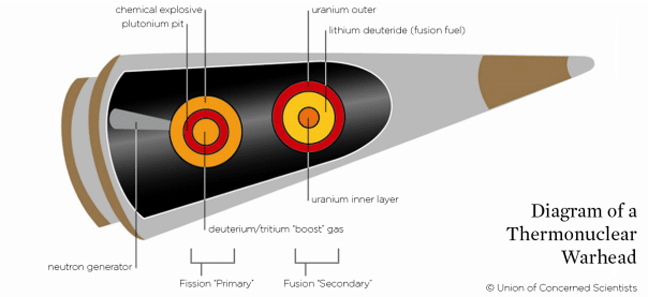
A nuclear pit is a hollow ball of plutonium. On a basic level, nuclear weapons work by surrounding one of these balls with high explosives. When the high explosives go off, they apply uniform pressure to the plutonium pit and cause a nuclear explosion. They are a key ingredient in nuclear weapons, but America hasn’t made a new one since 1989.
America’s nuclear infrastructure is crumbling and in desperate need of modernization, according to the Pentagon. To keep America’s nukes running, the Pentagon wants to start production again. According to a new report from the Government Accountability Office (GAO), it’s not going well.
This isn’t shocking. The National Nuclear Safety Administration (NNSA) warned Congress in 2022 that the official plan to meet a deadline of 80 pits produced per year by 2030 wasn’t going to happen. According to the GAO, the NNSA doesn’t even know how much it will cost to create the infrastructure to build these pits, what resources it will need, or how long the project will take. “According to officials, such a life cycle cost estimate has not been completed because of concerns about releasing preliminary or uncertain information,” the report said.
For a brief period after the end of the Cold War it seemed like broad nuclear disarmament might be possible. That didn’t happen and now the U.S. is falling behind on modernization goals it set for itself. …………………….
America has pushed to modernize its nuclear forces. The U.S. Air Force is building a new intercontinental-ballistic missile and revealed a new stealth bomber last year with the fanfare of a Super Bowl halftime show. But these fancy new weapons require plutonium cores, and it doesn’t look like the U.S. can build them fast enough. https://www.vice.com/en/article/88qp5k/the-us-cant-make-enough-plutonium-triggers-for-its-nuclear-warheads
Biden Administration Tramples on Japan’s Post-World War II Pacifist Constitution By Pushing Country’s Rearmament
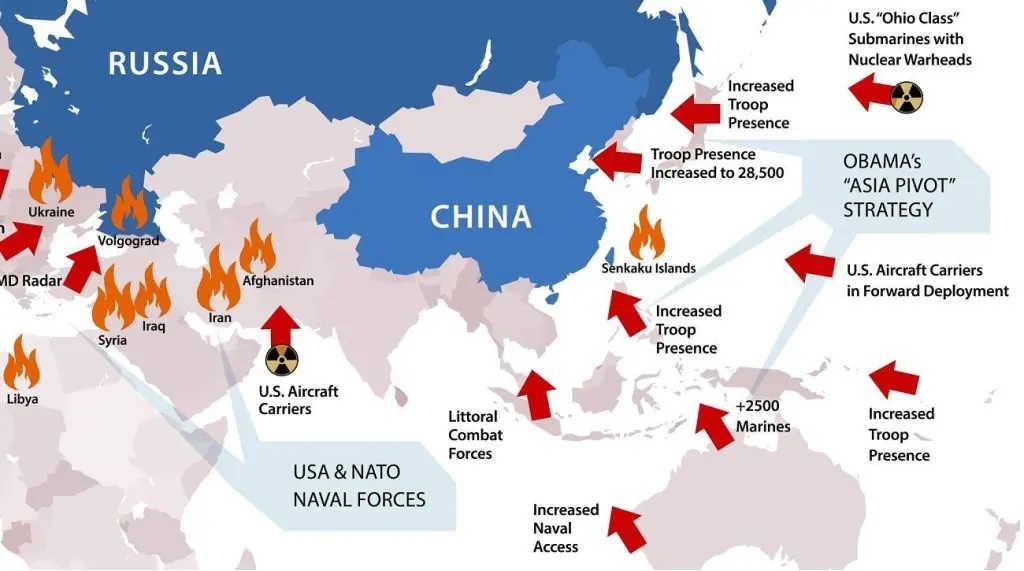
Covert Action magazine, By Sara Flounders, January 9, 2023
Main target is China in dangerously provocative policy that faces no visible domestic opposition in the U.S.
On December 16, Japan’s Prime Minister Fumio Kishida announced a new defense strategy that doubled Japan’s military spending by 2027. Japan further agreed to acquire offensive weapons and reshape its military command structure for its expanded armed forces.
On December 23, the draft budget was approved by Kishida’s cabinet.
Japan’s dangerous military expansion should set off international alarm bells. This major escalation is taking place based on intense U.S. imperialist pressure. It is the next step in the “Pivot to Asia,” aimed at threatening and surrounding China and attempting to reassert U.S. dominance in the Asia Pacific.
The movements opposing endless U.S. wars must begin to prepare material and draw mass attention to this ominous threat.
The plan to double military spending will add $315 billion to Japan’s defense budget over the next five years and make Japan’s military the world’s third largest, after the U.S. and China. Defense spending will escalate to 2% of gross domestic product, equal to the goal the U.S. sets for its NATO allies. Japan’s economy is the world’s third largest.
The Japanese government plans to buy up to 500 Lockheed Martin Tomahawk missiles and Joint Air-to-Surface Standoff Missiles (JASSM), procure more naval vessels and fighter aircraft, increase cyber-warfare capabilities, manufacture its own hypersonic guided missiles and produce its own advanced fighter jets, along with other weapons. The plan shifts from relying solely on missile defense to also embracing “counter strike” capabilities.
………………………………………………… Although the U.S. occupation force, after defeating Japan’s military in World War II, imposed a “pacifist” constitution on Japan, for decades U.S. strategists have pressured Japan’s government to aggressively rearm, to buy U.S.-made weapons, and to act as a junior partner to U.S. efforts to dominate the Asia-Pacific region.
Article 9 of the imposed Japanese constitution prohibits Japan from maintaining an army, navy and air force. To get around this, the “Japanese Self-Defense Forces” (JSDF) have since 1952 been treated as a legal extension of the police and prison system. The U.S. occupiers considered the JSDF an essential repressive tool defending capitalist property relations against the workers’ movement.
The decision for aggressive military expansion is in open violation of Japan’s supposedly pacifist constitution………………………………………….
The present doubling of the defense budget will be funded by raising taxes. A huge military budget will inevitably mean severe cuts to the country’s limited social spending. ………………….
Targeting China
Japan’s military expansion fits in with Washington’s aggression aimed at China, the DPRK and Russia. U.S. strategists’ goal is to use the U.S. alliance with Japan, South Korea and Australia, just as it uses the U.S.-led NATO alliance in Europe……………………………..
China is Japan’s largest trading partner in both imports and exports. Previous National Strategy Documents said Japan was seeking a “mutually beneficial strategic partnership” with China. Suddenly Japanese strategists started labeling China “the greatest strategic challenge in ensuring the peace and security of Japan.” (U.S. Institute of Peace, December 19)………….,………
A U.S.-Japan alliance is now defined as a “cornerstone” of Japan’s security policy. (Japan Times, December 17)
U.S. Praise of Japan’s Rising Militarism
The U.S. media praised Japan’s new security strategy document as a “bold and historic step.” U.S. National Security Adviser Jake Sullivan praised the defense spending hike, which “will strengthen and modernize the U.S.-Japan alliance.” U.S. Secretary of State Antony Blinken called Japan an “indispensable partner” and cheered that the changed security documents reshape the ability to “protect the rules-based order in the Indo-Pacific region and around the world.” (quotes, whitehouse.gov, December 16)
U.S. corporate power is the immediate beneficiary of this sharp turn in policy, built on military threats and economic sanctions. …………………………………………………… more https://covertactionmagazine.com/2023/01/09/biden-administration-tramples-on-japans-post-world-war-ii-pacifist-constitution-by-pushing-countrys-rearmament/?mc_cid=8da2f4a668&mc_eid=65917fb94b
1 This Month




PLEASE OPPOSE HR 8255 AND S.3639 – bills would accelerate satellite deployment, with no environmental review or safeguards – https://ncstd5li.quorum.us/campaign/169331/
To see nuclear-related stories in greater depth and intensity – go to https://nuclearinformation.wordpress.com
-
Archives
- September 2026 (339)
- August 2026 (330)
- July 2026 (355)
- June 2026 (287)
- May 2026 (306)
- April 2026 (356)
- March 2026 (251)
- February 2026 (267)
- January 2026 (308)
- December 2025 (358)
- November 2025 (359)
- October 2025 (375)
-
Categories
- 1
- 1 NUCLEAR ISSUES
- business and costs
- climate change
- culture and arts
- ENERGY
- environment
- health
- history
- indigenous issues
- Legal
- marketing of nuclear
- media
- opposition to nuclear
- PERSONAL STORIES
- politics
- politics international
- Religion and ethics
- safety
- secrets,lies and civil liberties
- spinbuster
- technology
- Uranium
- wastes
- weapons and war
- Women
- 2 WORLD
- ACTION
- AFRICA
- Atrocities
- AUSTRALIA
- Christina's notes
- Christina's themes
- culture and arts
- Events
- Fuk 2022
- Fuk 2023
- Fukushima 2017
- Fukushima 2018
- fukushima 2019
- Fukushima 2020
- Fukushima 2021
- general
- global warming
- Humour (God we need it)
- Nuclear
- RARE EARTHS
- Reference
- resources – print
- Resources -audiovicual
- Weekly Newsletter
- World
- World Nuclear
- YouTube
-
RSS
Entries RSS
Comments RSS