‘We need a plan B’: Australian Unions have ‘deep concerns’ about AUKUS pact

The shipbuilding federation – which represents unions including the AMWU, Electrical Trades Union and the Australian Workers Union – is urging the government to build an additional six conventionally powered submarines in Australia before the arrival of a fleet of nuclear-powered submarines.
The shipbuilding federation – which represents unions including the AMWU, Electrical Trades Union and the Australian Workers Union – is urging the government to build an additional six conventionally powered submarines in Australia before the arrival of a fleet of nuclear-powered submarines.
Matthew Knott, February 7, 2023 https://www.theage.com.au/politics/federal/we-need-a-plan-b-unions-have-deep-concerns-about-aukus-pact-20230206-p5ciaf.html
Labor’s traditional union allies say they harbour deep concerns about Australia’s plan to acquire a fleet of nuclear-powered submarines and fear the AUKUS pact will not deliver the promised bonanza of Australian manufacturing jobs.
The federal government is preparing to announce the details of its nuclear-powered submarine plan in March, with preparation under way for Prime Minister Anthony Albanese to travel to Washington for a possible joint press conference with US President Joe Biden and British Prime Minister Rishi Sunak
During a visit to Washington over the weekend, Defence Minister Richard Marles said AUKUS would create “thousands” of new local jobs and expressed confidence Australia would not be left with a capability gap between the retirement of the current Collins class fleet and the arrival of nuclear-powered vessels.
Despite Marles’ assurances, Australian Shipbuilding Federation of Unions national convener Glenn Thompson said he remained “apprehensive” about a possible capability gap and urged the government to develop a backup plan in case AUKUS falls over.
“It’s one thing to say that this is going to create thousands of jobs, but you actually have to be able to build something well in advance of whatever AUKUS comes up with,” said Thompson, an assistant national secretary of the Australian Manufacturing Workers Union (AMWU).
“It’s of great concern to us about where the workforce is coming from and how are we addressing the issue of Australia’s sovereignty.”
Thompson noted there had been no pledge from the government that AUKUS would create as many local jobs as the 5000 positions promised under the cancelled contract with French company Naval Group.
The shipbuilding federation – which represents unions including the AMWU, Electrical Trades Union and the Australian Workers Union – is urging the government to build an additional six conventionally powered submarines in Australia before the arrival of a fleet of nuclear-powered submarines.
Marles last week stated definitively that the government “has no plans for any conventionally powered interim submarine capability, as we move towards gaining the nuclear-powered submarine capability”. Senior defence figures, including in the Navy, have fiercely resisted the idea of an interim conventional submarine.
“There’s a whole lot of uncertainties,” Thompson said of the AUKUS pact. “I just think from a capability perspective the country needs to have a plan B.”
Thompson said he feared local construction of the nuclear-powered submarines would not begin until the late 2040s or early 2050s, a decade after the Collins-class vessels begin being decommissioned.
“It’s very rare that these defence projects deliver on time,” he said. “By the mid-2040s you could have two-thirds of the existing fleet retired, so there could be a substantial capability gap.”
Marles told The Sydney Morning Herald and The Age last month that AUKUS would be “a genuine three-country collaboration”, raising expectations Australia will acquire a joint next-generation submarine model combining American and British technology.

While not specifying what proportion of the submarines would be built in Australia, Marles said the Osborne Naval Shipyard in Adelaide would play a major role in the project.
“We must develop an industrial capability in Australia,” he said. “That’s the only way this can work, and that’s what will be expected of us by both the UK and the US.”
Marles told parliament on Monday the government was “on track” to make its AUKUS announcement in the very near future.
He said while there had been a “very real potential of a capability gap opening up with our submarines, I am confident that the pathway we announced will provide a solution to this”.
Endgame is going on in Ukraine crisis

When studying today’s daily AFU troop losses and considering Ukraine’s recent presidential order, according to which even underage children at 16-17 aged can be called for armed service, the overall military situation of Ukraine appears to be catastrophic. Anyway, the situation is totally opposite to the picture the western MSM is propagating “Ukraine is winning … Ukraine is winning”. No doubt, Ukraine has already lost the war and by the same token, the NATO as well.
The US ending its financial, humanitarian and particularly military support promptly would cause Ukraine to completely collapse and RAND cites several reasons, why doing so would be sensible, not least because a Ukrainian victory is regarded as both “improbable” and “unlikely,” due to Russian “resolve,” and its military mobilization having “rectified the manpower deficit that enabled Ukraine’s success in the Kharkiv counteroffensive.”
Great Power Relations, February 7, 2023 | Seppo Niemi
Basically, great power competition and the fight for hegemonic control between America on the one side and Russia and China on the other, is being fought on two fronts.
The one is Ukraine war with enlarging NATO engagement, the other front is financial with America facing a coordinated attack by Russia and China on its dollar hegemony. The Russians are planning a replacement trade settlement currency, which could unleash a flood of foreign-owned dollars onto the foreign exchange markets. In fact, the second front encases also the third front, the formation of global alliances. Ultimately, there is a competition of new world order and fight for global power (world hegemon).
All these topics have been analysed in various articles on this website and will be analysed also in the future but this article focuses again on military side of this subject, because there is, as the title indicates, endgame currently going. Some fundamental factors are now emerging for further analysis.
Frontline news
The Biden administration as well as Pentagon know that Ukraine’s army is not able to hold the current defense line in its east part. The big fear is that the Ukrainian army will totally collapse and run away, when the frontline is breached in Ugledar, Bakhmut, Seversk and Krasny-Liman.
Russia’s winter offensive is going in full speed but in another way than western “experts” assumed. No “Big Arrows” so far but slowly accelerating pressure along the whole frontline and when break-points emerge, they will be utilized immediately throwing more reserves in those places from back-areas. Due to autumn mobilizations and very low KIA-rate, Russia has plenty of trained reserves available.
The reason for this kind of warfare is the fact that western spy satellites follow the ground situation 24/7 covering the whole theatre of operations. Russia fully knows and understands that and therefore hide their military operations to the latest possible point, thus holding a surprise moment. However, 1-2 massive, “Big Arrow” Russian offensives are probable during February-April period.
A new wave of activity is expected for the Russian side during February. The recent changes in the command of the operation appear to have been carefully planned in order to elevate the combat to a new level and several of Moscow’s strategic objectives may soon be achieved, radically changing the course of the conflict. Valery Gerasimov, Chief of the General Staff of the Russian Armed Forces, was promoted to the position of Commander of the Joint Forces of the Russian Federation in the Special Military Operation Zone. Gerasimov’s arrival to power seems to have been a move towards the final stage of the special military operation.
Obviously, a major offensive (Big Arrow) is being prepared for February with the probable aims: 1) Reaching the borders of the regions recently reintegrated into the Russian Federation, pacifying the new oblasts. 2) capturing Nikolaev, Odessa, as well as the entire Black Sea coast, reaching Transnistria. 3) seizing/blocking Kiev, forcing a political capitulation of the Zelensky regime until early March.
The territory of Belarus will become the main springboard for the upcoming strike. In parallel to Belarus, Zaporozhye and Lugansk are also key zones for the Russian strategy. It is expected that massive attacks will come from these regions during the offensive, destroying enemy units in a short period of time which will allow a rapid Russian advance on the battlefield, reaching the zones listed in the above-mentioned objectives. For the offensive to be successful, Russian forces will focus on blocking all enemy’s supply lines. The main route of arrival of supplies to Ukraine is the border with Poland, where there is the transit of NATO’s ammunition and military equipment.
Some days ago, Washington announced preparing a new package of military aid worth $2.2 billion that is expected to include longer-range rockets for the first time. Soon thereafter, in a televised interview, Sergei Lavrov said an important principle of policy: “We’re now seeking to push back Ukrainian army artillery to a distance that will not pose a threat to our territories. The greater the range of the weapons supplied to the Kiev regime, the more we will have to push them back from territories which are part of our country.”
Latest statistics of losses
A Turkish newspaper, Hurseda Haber, published January 25, 2023, an article of military losses by parties in Ukraine war with the data, allegedly produced by the Israeli Secret Service Mossad. Here is this highly interesting statistical comparison: [graph on original]….
Russian Ministry of Defense (RMOD) statistics since February 24, 2022 up to December 31, 2022. Ukrainian losses: 355 aircraft, 199 helicopters, 2779 UAV, 7350 tanks and armoured vehicles, 4713 artillery & MLRS systems (as well as 7859 units of special military equipment)………….
Late January 2023, the well-informed American Col.(ret.) Doug Macgregor put the numbers of dead on the Ukrainian side (video) at 122,000 killed plus 35,000 missed in action (presumed dead). The number of dead Russians (including Wagner forces and Donbas militia) is at 16,000 to 25,000 with 20 to 40,000 additionally wounded. The numbers are in good consistency with those figures of Mossad.
When studying today’s daily AFU troop losses and considering Ukraine’s recent presidential order, according to which even underage children at 16-17 aged can be called for armed service, the overall military situation of Ukraine appears to be catastrophic. Anyway, the situation is totally opposite to the picture the western MSM is propagating “Ukraine is winning … Ukraine is winning”. No doubt, Ukraine has already lost the war and by the same token, the NATO as well.
Statistics of January 2023 [graph on original]
Please, note that just in January 2023, Russia has destroyed more than 300 AFU tanks and armoured vehicles, nearly three times more than what the West has promised to deliver to Ukraine over next half of year and all those western tanks are old models with old technology.
NATO tank deliveries – Leopard hunting begins
Promises of tank deliveries by models and countries: Leopard 2 totalling about 50 (Germany, Poland, others), Abrams M1 up to 31 (the US) and Challenger 2 up to 14 (the UK); totalling approx. 100 tanks. None of those models, now in delivery plan, are in production or are produced in last 15-20 years.
Germany has issued a permit to export Leopard 1 main battle tanks to Ukraine, on February 3. Berlin had approved German arms-maker Rheinmetall’s plans to sell 88 of the older Leopards to Kyiv, once these are repaired, for a total cost of more than €100 million. The Leopard 1, which first entered service in the 1960s, is the forerunner of the more advanced Leopard 2. The tank is armed with a 105 mm Royal Ordnance L7A3 L/52 rifled gun.
The big problem is and will be, how to obtain the required 105 mm ammunition for the Leopard 1 tanks. The tank features moderate armor, only effective against low caliber autocannons and heavy machine guns. This makes it vulnerable to most, if not all second and third generation anti-tank weapons.
These decisions regarding western tank deliveries to Ukraine disclose that all possible old scrapping equipment has been dug up now.
Modern tank warfare
Technological innovations have made main battle tanks (MBT) more survivable but anti-tank weapons have become even more effective outstripping MBT’s protective capabilities…………………………………………..
Western optics, media hype
Western MSM debated in “hothead” mood about the deliveries of tanks to Ukraine, suddenly dozens of “tank experts” came to public and demanded vociferously “express delivery of Leopards”.
When considering the matter in light of the analytical background, stated above, it appears once again how “mass hysteria” or “herd stupidity” is a rapidly contagious disease. In addition, it easily causes an anti-action, which is already happened on the frontlines. Leopard hunting begins.
Russia’s state tech corporation Rostec has already warned that existing Russian anti-tank missiles and shells are more than capable of destroying Western-made tanks, specifically the German Leopard 2. Pro-Russian military Telegram channels are already sharing posters pointing out the weak points of Challenger 2, Abrams and Leopard 2 tanks………………….
Report of RAND Corporation
RAND Report: Avoiding a Long War; U.S. Policy and the Trajectory of the Russia-Ukraine Conflict; January 2023.
The RAND Corporation, a highly influential American security think tank funded directly by the Pentagon, has published a landmark report stating that prolonging the proxy war is actively harming the US and its allies and warning Washington that it should avoid “a protracted conflict” in Ukraine. The war, Report says, represents “the most significant interstate conflict in decades, and its evolution will have major consequences” for Washington, which includes US “interests” being actively harmed. “The costs and risks of a long war in Ukraine are significant and outweigh the possible benefits of such a trajectory for the United States.”
The US ending its financial, humanitarian and particularly military support promptly would cause Ukraine to completely collapse and RAND cites several reasons, why doing so would be sensible, not least because a Ukrainian victory is regarded as both “improbable” and “unlikely,” due to Russian “resolve,” and its military mobilization having “rectified the manpower deficit that enabled Ukraine’s success in the Kharkiv counteroffensive.”
It is so funny that the top Pentagon thinkers just say publicly these facts, while the entire US mainstream media, which also represents the US government, is out there saying the precise opposite. They are still literally saying that Russia is losing and Ukraine winning as their colleagues in the UK and elsewhere in Europe. The US media is just not even mentioning this RAND report at all.
What makes the RAND Report on Ukraine so significant, is not the quality of the analysis but the fact that the US’s most prestigious national security think-tank has taken an opposite position on the war than the Washington political elite and their globalist allies. This is a very big deal.
Keep in mind, wars end when a critical split emerges between ruling elites that eventually leads to a change in policy. RAND report represents just such a split. It indicates that powerful elites have broken, one part thinks the current policy is hurting the United States. This shift is going to gain momentum until it triggers a more-assertive demand for negotiations. Thus, the RAND report is the first step towards ending the war.
Biden administration has told repeatedly that the US will support Ukraine “for as long as it takes.” The United States should not undermine its own interests to pursue the unachievable dream of expelling Russia from Ukraine. The US plan to reshape Europe and the global balance of power by degrading Russia is turning out to fail badly and backfiring worse. Rational members of the foreign policy establishment should evaluate Ukraine’s prospects for success and weigh them against the growing likelihood that the conflict could unexpectedly spiral out-of-control.
The RAND report seems to represent the views of the Pentagon and the US Military establishment, who believe the United States is racing headlong towards a direct conflagration with Russia. In other words, the report may be the first ideological broadsides against the neocons, who run the State Department and the White House. It appears now this split between “War Department” and “State Department” will become more visible in the days ahead.
RAND report is just the first in a long line of falling dominoes. As Ukraine’s battlefield losses mount, the flaws in Washington’s strategy will become more apparent and will be more sharply criticized. American people will question the wisdom of economic sanctions that hurt US closest allies while helping Russia. Why the United States is following a policy that has precipitated a strong move away from the dollar and US debt? Why the US deliberately sabotaged a peace deal in March 2022, when the probability of a Ukrainian victory is near zero. The Rand report seems to anticipate all these questions as well as the “shift in mood” they will generate. This is why the authors are pushing for negotiations and a swift end to the conflict.
Peace talks … or not
There have been some peace talks between the US and Russia in last couple of months. William Burns, the CIA’s director was to meet his opposite Russian intelligence chief Naryshkin in Ankara in November 2022. This back-channel meeting was to explore compromises before America finds itself to sacrifice the Ukrainian population in a proxy war……………………………….
Militarily, the consensus of western expert opinion within the US and allied countries has changed from Russia’s losing the war in 2022 (Russian forces pulled back from Kharkiv and Kherson), to the Ukrainian forces losing the war, while NATO runs out of weapons and ammunition to send there and yet Russia unrelentingly continues to supply new weaponry and ammunition and slowly to take new ground in Ukraine. This war of attrition is going very badly now against the West (the US and its foreign allies, especially the ones in Europe: EU and NATO).
Economically, expert opinion in the west is increasingly saying their sanctions that were meant to strangle Russia’s economy have been by now a massive failure, which has probably been doing more damage to America’s European allies than to Russia. If this turns out to be true also in the mid-term (highly likely), then the entire belief-system that has been standing behind the West’s anti-Russia sanctions is going to collapse.
In addition, being deeply disappointed with all agreements with the West, Russia’s distrust on any deal with the west is huge. Thus, it is highly likely that the war will go to the bitter end, to the unconditional surrender of Ukraine.
EU – Ukraine summit in conjunction with EU – NATO declaration
European public attention was on Ukraine as the EU’s top officials visit Kyiv for a historic summit, February 2-3, the first to be held in an active war zone. Kyiv wants to join the bloc within two years but Ukraine got cold shoulder on rapid EU entry……………………..
By this summit, once again, the EU publicly and officially engaged closely and tightly with the destiny of Ukraine. Similar engagement was made with the NATO by “Joint Declaration on EU-NATO Cooperation, 10 January 2023”.
From this on, the destinies of the EU, the NATO and Ukraine have been combined and tied so closely that one part collapsing will make a domino effect to the rest.
Final look over the situation
As to the NATO, it is a good reason to take a look at the real and practical track record: military operations in Iraq, Libya, Afghanistan, which all ended in total defeat, debacle and turmoil.
Afghanistan and Ukraine are almost the same size in terms of land mass and the US/NATO failed to defeat a bunch of Afghani goat herders, who had no air power or artillery. The US and NATO poured billions of dollars into Afghanistan and failed to vanquish the Taliban, who easily took control of Kabul in August 2021, causing NATO troops to escape in total disarray.
In Ukraine, NATO is continuing its disarmament mission, more and more heavy weapons and other military material are poured in the black hole of Ukraine; Russia destroys them and NATO’s warehouse alert limits show red. Military material is simply finished in Europe and there is no military-industrial capacity to produce required quantities in next few years.
War fighting is a messy, complicated, resource intensive activity. “War is dirty business” as a British General said in Falkland operation. The conflict in Ukraine is exposing NATO as an impotent anachronism. If/when Russia wins militarily in Ukraine, the “raison d’etre” for NATO will be in question, in fact it disappears. Why any country is interested in applying the membership in such impotent alliance with such a failure track record?
If the reader can set aside emotion and consider the current situation unfolding in Ukraine, the evidence shows that Kiev’s army (AFU) is moving backwards on all frontlines. Without support from the United States and NATO, Ukraine does not have the manpower, munitions, tanks, artillery, air craft, financial resources and industrial capability to stop Russia. Even with more Western support flowing in, Ukraine will still lack the manpower to block the Russian advance.
Western analysts and MSM are downplaying the Russian offense in the Donbass along the Ukrainian defensive line that stretches from Bakhmut to Seversk in the north and to Ugledar in the south as some sort of sideshow with no strategic importance. That is nonsense. As said above, Russian winter offensive is underway on multiple fronts and Ukraine is paying a heavy toll. https://greatpowerrelations.com/endgame-is-going-in-ukraine-crisis/
New Report Unpacks Dangers of Emerging Military Tech, From AI Nukes to Killer Robots

“While the media and the U.S. Congress have devoted much attention to the purported benefits of exploiting cutting-edge technologies for military use, far less has been said about the risks involved.”
Emerging technologies including artificial intelligence, lethal autonomous weapons systems, and hypersonic missiles pose a potentially existential threat that underscores the imperative of arms control measures to slow the pace of weaponization, according to a new report published Tuesday.
The Arms Control Association report – entitled Assessing the Dangers: Emerging Military Technologies and Nuclear (In)Stability – “unpacks the concept of ’emerging technologies’ and summarizes the debate over their utilization for military purposes and their impact on strategic stability.”
The publication notes that the world’s military powers “have sought to exploit advanced technologies – artificial intelligence, autonomy, cyber, and hypersonics, among others – to gain battlefield advantages” but warns too little has been said about the dangers these weapons represent.
“Some officials and analysts posit that such emerging technologies will revolutionize warfare, making obsolete the weapons and strategies of the past,” the report states. “Yet, before the major powers move quickly ahead with the weaponization of these technologies, there is a great need for policymakers, defense officials, diplomats, journalists, educators, and members of the public to better understand the unintended and hazardous outcomes of these technologies.”
Lethal autonomous weapons systems – defined by the Campaign to Stop Killer Robots as armaments that operate independent of “meaningful human control” – are being developed by nations including China, Israel, Russia, South Korea, the United Kingdom, and the United States. The US Air Force’s sci-fi-sounding Skyborg Autonomous Control System, currently under development, is, according to the report, “intended to control multiple drone aircraft simultaneously and allow them to operate in ‘swarms,’ coordinating their actions with one another with minimum oversight by human pilots.”
“Although the rapid deployment of such systems appears highly desirable to many military officials, their development has generated considerable alarm among diplomats, human rights campaigners, arms control advocates, and others who fear that deploying fully autonomous weapons in battle would severely reduce human oversight of combat operations, possibly resulting in violations of international law, and could weaken barriers that restrain escalation from conventional to nuclear war,” the report notes…………………….
The report also warns of the escalatory potential of cyberwarfare and automated battlefield decision-making.
“As was the case during World Wars I and II, the major powers are rushing ahead with the weaponization of advanced technologies before they have fully considered – let alone attempted to mitigate – the consequences of doing so, including the risk of significant civilian casualties and the accidental or inadvertent escalation of conflict,” Michael Klare, a board member at the Arms Control Association and the report’s lead author, said in a statement.
“While the media and the US Congress have devoted much attention to the purported benefits of exploiting cutting-edge technologies for military use, far less has been said about the risks involved,” he added. https://www.antiwar.com/blog/2023/02/08/new-report-unpacks-dangers-of-emerging-military-tech-from-ai-nukes-to-killer-robots/
The US shooting down a Chinese spy balloon is a risk for Australia
Michael West Media, by Rex Patrick | Feb 6, 2023 |
For many Australians watching the events over the past week, where the United States Air Force tracked a Chinese balloon overflying US territory and then shot it down, might seem to be of indirect significance to our security. Former senator and submariner, Rex Patrick suggests that it is of direct significance to Australia, increasing the risk we might be drawn into war in South East Asia.
Over the weekend the US Air Force shot down a Chinese balloon. The United States have said that the balloon was carrying out intelligence gathering. The Chinese Government has said it wasn’t. They claim it was just a wandering weather balloon. That’s important for reasons I’ll come back to, but I first need to provide some background – not about balloons, but about another surveillance platform.
What submarines do
Submarines can perform a whole range of different tasks in time of war……………………….
In preparing for war they train, they engage in tactical development and they conduct intelligence gathering. It is the latter which is their most important and challenging tasks………………….
Balloons and ballast tanks
…. Imagine a South Korean, Japanese or Australian submarine operating very close to (or perhaps inside) China’s territorial waters conducting intelligence gathering. China might now be inclined to treat that submarine the same way the United States treated a balloon purported to be conducting intelligence collection.
If detected, even if just outside of their territorial waters, the Chinese will just say they were inside their waters when, or in the minutes before, they were engaged. We’ll say, just as the US has for the balloon, that we weren’t spying and they’ll say we were.
And getting detected in our newest Australian submarine, the 20 year old HMAS Rankin, is far more likely than is the case for South Korea’s newest submarine, the 1 year old ROKS Dosan Ahn Changho, or Japan’s newest submarine, the 1 year old Tōryū.
The stakes are greater for us because Australian governments of various political flavours have left us with ageing Collins Class submarines to carry out this most serious and complex of peace time tasks.
One option would be to eventually withdraw our ageing Collins class submarines from surveillance operations anywhere close to Chinese waters, but that’s unlikely. Our Navy and our government will be anxious to continue to do all they can to assist the United States Navy in the Northern Pacific, in the Sea of Japan and the South China Sea.
Alliances are not just pieces of paper, they are dynamic relationships in which there’s a strong obligation to contribute and share risk.
The China risk
The risks are likely to increase in the years ahead, as China continues to ramp up military tensions in an effort to coerce Taiwan into some form of political subordination to Beijing.
The possibility that China will choose a vessel of a US ally to make an example of cannot be dismissed.
And that risk will be disproportionately carried by our Navy as it operates a submarine force with decreasing relative capability across the next two decades or longer. Thanks to government spending $170bn pursuing a distant nuclear-powered capability, our submariners will be at greater risk in less capable vessels than our so-called ‘great and powerful’ friend.
For a long time, we’ve been able to see Defence procurement failures and kick ourselves on account of cost to the taxpayer. Now, as the balloon goes up in the South China Sea, the lack of capability may well cost us many lives.
It’s not just about a war before the arrival of new submarines in 2040, its all the peace time intelligence operations between now and then. https://michaelwest.com.au/the-us-shooting-down-a-chinese-spy-balloon-is-a-risk-for-australias-tired-submarine-fleet/—
Dr. Helen Caldicott Says The World Is Closer To Nuclear Annihilation Than Ever Before
In Interview Released Today Famed Peace Activist, Dr. Helen Caldicott, says the World is Closer to Nuclear Annihilation than Ever Before
Caldicott believes the Doomsday Clock should be at 20 seconds to midnight.
Dr. Helen Caldicott is concerned that we are the closest we have ever been to nuclear annihilation and that citizens are no longer informed as to the incomprehensible destruction and suffering that it would bring.
Caldicott told Breaking Green, “I think we are in an extremely invidious position where nuclear war could occur tonight, by accident or design. “She added that “it is the first time since the Cuban Missile Crisis, that the two huge nuclear behemoths are facing each other militarily.”
Dr. Caldicott described to Breaking Green the nightmarish effects of a nuclear war, as she had described to worldwide audiences during the Cold War. As cofounder of Physicians for Social Responsibility in the USA, her talks awakened a generation.
Caldicott believes that many people are engaging in “psychic numbing” or blocking out the reality of the threat as the Doomsday Clock is now set at 90 seconds to midnight.
Video of Caldicott’s description of nuclear war to Breaking Green can be viewed at https://globaljusticeecology.org/helen-caldicott/ .
The interview is available at https://www.buzzsprout.com/1785184/12121153 .
Breaking Green is produced by Global Justice Ecology Project.
If Arms Control Collapses, US and Russian Strategic Nuclear Arsenals Could Double In Size
Federation of American Scientists, Matt Korda and Hans Kristensen • February 7, 2023
On January 31st, the State Department issued its annual Report to Congress on the Implementation of the New START Treaty, with a notable––yet unsurprising––conclusion:
“Based on the information available as of December 31, 2022, the United States cannot certify the Russian Federation to be in compliance with the terms of the New START Treaty.”
This finding was not unexpected. In August 2022, in response to a US treaty notification expressing an intent to conduct an inspection, Russia invoked an infrequently used treaty clause “temporarily exempting” all of its facilities from inspection. At the time, Russia attempted to justify its actions by citing “incomplete” work regarding Covid-19 inspection protocols and perceived “unilateral advantages” created by US sanctions; however, the State Department’s report assesses that this is “false:”
Contrary to Russia’s claim that Russian inspectors cannot travel to the United States to conduct inspections, Russian inspectors can in fact travel to the United States via commercial flights or authorized inspection airplanes. There are no impediments arising from U.S. sanctions that would prevent Russia’s full exercise of its inspection rights under the Treaty. The United States has been extremely clear with the Russian Federation on this point.”
Instead, the report suggests that the primary reason for suspending inspections “centered on Russian grievances regarding U.S. and other countries’ measures imposed on Russia in response to its unprovoked, full-scale invasion of Ukraine.”
Echoing the findings of the report, on February 1st, Cara Abercrombie, deputy assistant to the president and coordinator for defense policy and arms control for the White House National Security Council, stated in a briefing at the Arms Control Association that the United States had done everything in its power to remove pandemic- and sanctions-related limitations for Russian inspectors, and that “[t]here are absolutely no barriers, as far as we’re concerned, to facilitating Russian inspections.”
Nonetheless, Russia has still not rescinded its exemption and also indefinitely postponed a scheduled meeting of the Bilateral Consultative Commission in November. In a similar vein, this is believed to be tied to US support for Ukraine, as indicated by Deputy Foreign Minister Sergei Ryabkov who said that arms control “has been held hostage by the U.S. line of inflicting strategic defeat on Russia,” and that Russia was “ready for such a scenario” if New START expired without a replacement.
These two actions, according to the United States, constitute a state of “noncompliance” with specific clauses of New START. It is crucial to note, however, the distinction between findings of “noncompliance” (serious, yet informal assessments, often with a clear path to reestablishing compliance), “violation” (requiring a formal determination), and “material breach” (where a violation rises to the level of contravening the object or purpose of the treaty).
It is also important to note that the United States’ findings of Russian noncompliance are not related to the actual number of deployed Russian warheads and launchers. While the report notes that the lack of inspections means that “the United States has less confidence in the accuracy of Russia’s declarations,” the report is careful to note that “While this is a serious concern, it is not a determination of noncompliance.” The report also assesses that “Russia was likely under the New START warhead limit at the end of 2022” and that Russia’s noncompliance does not threaten the national security interests of the United States.
The high stakes of failure: worst-case force projections after New START’s expiry
Both the US and Russia have meticulously planned their respective nuclear modernization programs based on the assumption that neither country will exceed the force levels currently dictated by New START. Without a deal after 2026, that assumption immediately disappears; both sides would likely default to mutual distrust amid fewer verifiable data points, and our discourse would be dominated by worst case thinking about how both countries’ arsenals would grow in the future……………………………………………………….
Pentagon will allow Ukraine to fire long-range missiles at will.
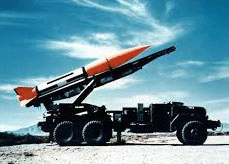
Munitions with 150-kilometer range are part of the newest weapons gift package. https://www.rt.com/news/570935-pentagon-ukraine-glsdb-missiles/ 5 Feb 23,
It is up to the government in Kiev to decide how to use new rockets being delivered for the US-supplied HIMARS launchers, the Pentagon said on Friday. The statement is a confirmation that the latest batch of munitions the American taxpayers are funding will include Ground Launched Small Diameter Bombs (GLSDB).
The Boeing-manufactured munitions consist of a rocket motor mated with an airplane bomb, with an estimated range of up to 150 kilometers. While Friday’s announcement listed “additional ammunition” for the HIMARS and “precision-guided rockets,” Brigadier-General Patrick Ryder told reporters that this indeed included the GLSDB, confirming the information leaked to Reuters earlier this week.
Ryder also confirmed that the US won’t stand in the way of Ukrainians using the missiles to strike deep inside Russia.
“When it comes to Ukrainian plans on operations, clearly that is their decision. They are in the lead for those,” he said on Friday. “So, I’m not going to talk about or speculate about potential future operations, but again, all along, we’ve been working with them to provide them with capabilities that will enable them to be effective on the battlefield.”
The GLDSB are produced by Boeing in cooperation with Sweden’s Saab AB, and combine the GBU-39 small-diameter bomb with the M26 rocket motor. It was unclear how many of the munitions the Pentagon intended to send, or whether they would come from the US military stockpile or need to be freshly produced.
Reuters claimed to have seen a Boeing document saying the first deliveries could be “as early as spring 2023.” Meanwhile, Bloomberg cited unnamed officials who said the timeline could be as long as nine months, depending on when the US Air Force issues the contract. Bloomberg also reported the GLSDB order would account for $200 million of the $1.75 billion in the Ukraine Security Assistance Initiative funding, referring to contracts for weapons and ammunition not coming out of the Pentagon stockpile.
Whenever the missiles actually arrive, Russia has already hinted at how it will respond. On Wednesday, President Vladimir Putin tasked the military with “eliminating any possibility” of Ukrainian artillery strikes on Russian territory. Foreign Minister Sergey Lavrov said in an interview on Thursday that Moscow will “push back” the Ukrainian troops to a range at which they will not be a threat.
“The longer range the weapons supplied to the Kiev regime have, the further the troops will need to be moved,” Lavrov said.
Ukraine has used the US-supplied HIMARS launchers against both military targets and civilians in Donbass, Kherson and Zaporozhye. Kiev has repeatedly asked for the MGM-140 Army Tactical Missile System (ATACMS) rockets, which have a range of some 300 kilometers.
Moscow has repeatedly warned Washington that providing heavy weapons to Ukraine risks crossing Russia’s “red lines” and involving the US and NATO in the conflict directly. The US and its allies insist they are not parties to the hostilities, but continue to arm Kiev. By the Pentagon’s own admission, the US has committed $32 billion in military aid to Ukraine.
Budget cuts have left UK’s military’s stores bare: General says Britain would run out of ammo in a day if it fought Russia. Britain buying ammo from South Asia to support Ukraine.
- General Sir Richard Barrons said years of cuts have left cupboards almost bare
- Meanwhile, Ben Wallace said military spending may have to rise for two decades
Daily Mail, By KATHERINE LAWTON 3 Feb 23,
Britain’s ammo stocks would run out in a day if it fought Russia – as a top former General said years of cuts have left military’s stores bare.
The warning from General Sir Richard Barrons comes a day after Defence Secretary Ben Wallace said the UK’s forces have been ‘hollowed out’, adding that military spending may have to rise for two decades, owing to global threats.
According to The Sun, Britain is buying ammo from South Asia to support Ukraine.
Dr Jack Watling, at military think tank Rusi, said Ukraine had been firing around 6,000 shells a day, but we rely on imported explosives for tank and artillery shells.
Our ammo plants, run by defence contractor BAE, would take a year to make a day’s shells for Ukraine, sources said.
Meanwhile, it was also revealed that Britain has no working heavy artillery guns after giving all serviceable AS90 self-propelled items to Ukraine.
General Barrons said the Army requires £3 billion more a year to rejoin Nato’s top tier.
In his column for The Sun, he wrote: ‘This is truly shocking. But it is true. And we must fix it.
‘The UK spends more on defence than any EU ally and our brave Armed Forces have long been one of Britain’s most influential levers around the world.
‘Yet for decades they have been hollowed out by spending cuts.’
…………………………… Mr Wallace also responded to urgent calls from former Prime Minister Boris Johnson to send fighter jets to Ukraine.
‘I’m open to examining all systems, not just jets. But these things don’t always happen overnight,’ he added.
Of Ukraine’s fighters he said: ‘Even if tomorrow we announced we were going to put them in fast jets, that would take months.
‘You’re suddenly having to learn to pilot a fast jet, so there is no magic wand.’
Prime Minister Rishi Sunak and Mr Wallace want to send a squadron of tanks to the country, which could arrive by the end of next month.
The MoD said it was boosting ammo stockpiles to ‘more than pre-invasion levels’ with an extra £560 million from the Treasury.
Defence chiefs have pledged all 30 working AS90s to Kyiv and are now urgently seeking K9 Thunders and Archer guns to replenish their stocks, it was recently reported. ……….
https://www.dailymail.co.uk/news/article-11708161/Britain-run-ammo-day-fought-Russia-Cuts-left-militarys-stores-bare.html
Morocco committed to elimination of nuclear weapons – Envoy speaks at African seminar on the Treaty on the Prohibition of Nuclear Weapons, in Pretoria
05.02.2023 by APA News https://www.journalducameroun.com/en/morocco-committed-to-elimination-of-nuclear-weapons-wmds-envoy/—
Morocco supports “serious, efficient and joint actions” for the total elimination of nuclear weapons and weapons of mass destruction (WMDs) around the world, the kingdom’s top envoy in South Africa has said.Speaking during an African regional seminar on the universalisation of the Treaty on the Prohibition of Nuclear Weapons in Pretoria, Moroccan ambassador Youssef Amrani said his country is “firmly committed to the total elimination of nuclear weapons and weapons of mass destruction”, noting that the recent resurgence of the nuclear threat was “a challenge that requires serious, efficient and joint actions.”
“Morocco reaffirms its unwavering support for multilateral initiatives aimed at combating the arms race, promoting the strengthening of disarmament agreements aimed at limiting weapons of mass destruction, as well as promoting the efforts of the international community to prevent the proliferation of nuclear weapons and the elimination of weapons of mass destruction,” Amrani said.
The ambassador’s comments come against the backdrop of heightened global tensions over the threat of a nuclear war in the aftermath of the Russia-Ukraine war.
Ambassador Amrani said Morocco was committed to the complete general and irreversible disarmament, stressing that multilateralism and regional and international cooperation remained the key to providing effective responses to the global threats of proliferation of WMDs.
He stressed that, as a promoter and provider of international peace and security, Morocco is convinced that global peace and stability can only be achieved on the basis of peaceful coexistence, constructive and sincere dialogue on the basis of mutual respect.
He said Morocco considered the existence of WMDs as a permanent threat with devastating risks that have “a continuous impact on the future of the world and future generations.”
He noted that the kingdom remained convinced that nuclear weapons and WMDs do not guarantee effective peace and security at the regional and international levels.
US set to boost military presence near China
Washington and the Philippines have announced plans for four more American bases. 5 Feb 23, https://www.rt.com/news/570878-us-philippines-military-bases/
The US military will be deployed to four new bases in “strategic areas” of the Philippines, the two countries announced on Thursday. The agreement was reached during the ongoing visit of US Defense Secretary Lloyd Austin, who met Philippine President Ferdinand ‘Bongbong’ Marcos Jr in Manila.
The two nations are set to “accelerate the full implementation” of the Enhanced Defense Cooperation Agreement (EDCA), a framework regulating the deployment of US troops to the Philippines, which is listed among Washington’s “major” non-NATO allies.
“The United States has allocated over $82 million toward infrastructure investments at the existing five sites under the EDCA, and is proud that these investments are supporting economic growth and job creation in local Philippine communities,” the Pentagon said in a statement.
Apart from further development of the existing bases, the US military will be deployed to four new sites in unspecified “strategic areas of the country.”
“The United States and the Philippines have committed to moving quickly in agreeing to the necessary plans and investments for the new and existing EDCA locations. The Philippine-US Alliance has stood the test of time and remains ironclad. We look forward to the opportunities these new sites will create to expand our cooperation together,” the Pentagon added.
The move comes amid mounting tensions in the region, namely around Taiwan and the South China Sea, a busy waterway subject to overlapping maritime and territorial claims by multiple nations, including China. The Philippines, a former US colony and long-standing Washington ally, has maintained close economic ties with Beijing.
China has already condemned the US-Philippines plan, accusing Washington of stirring up further tension. The Chinese Embassy in the Philippines expressed hope that Manila would be “vigilant and resists from being taken advantage of.”
“The United States, out of its self interests and zero-sum game mentality, continues to step up military posture in this region. Its actions escalate regional tension and undermine regional peace and stability,” the embassy said in a statement.
“Such moves contradict the common aspiration of regional countries to seek peace, cooperation and development, and run counter to the common aspiration of the Filipino people to pursue sound economic recovery and a better life in cooperation with China,” it added.
The logic behind the terror: Why does Ukraine keep attacking civilian areas in Donetsk?
Rockets have hit peaceful neighborhoods once again. Why does Kiev continue its policy, if not purely out of hate?
By Vladislav Ugolny, a Russian journalist based in Donetsk 4 Feb 23 https://www.rt.com/russia/570954-logic-behind-ukrainian-terrorism/
At least ten rockets hit central areas of Donetsk on Saturday morning, damaging three residential buildings, a local Russian official has reported in his Telegram channel.
One of the projectiles fired by Ukrainian forces hit an apartment building in the Kievsky district. While rescuers continue to search for survivors under the rubble, preliminary information suggests that there were three people in one of the apartments.
There was no information on casualties at the time of writing, but the absence of victims would be unusual; indeed, Ukrainian shelling of the capital of the Donetsk People’s Republic intensified weeks before the Russian attack in February 2022, and has taken a heavy toll ever since.
The suffering of Donbass residents
According to the human rights commissioner of the DPR, Daria Morozova, at least 1,091 civilians were killed and another 3,533 were recorded as injured last year as a result of combat operations. The figures do not include places such as Mariupol, where the full scale of the tragedy has yet to be assessed.
The 4,624 people mentioned above were victims of regular artillery strikes on urban areas of Donetsk and Gorlovka.
When Donetsk residents are asked why the Ukrainian Armed Forces continue to attack civilians, people usually have no explanation other than the desire of the Ukrainian government and military to destroy Donbass and its people. This is supported by a massive campaign to dehumanize local residents and a number of hateful statements by Ukrainian politicians. “We will kill them with nuclear weapons,” warned former Prime Minister Yulia Timoshenko, while ex-president Pyotr Poroshenko has vowed: “Our children will go to school, while their children will go sit in basements. That’s how we will win this war.”
Ukrainian forces continue to bomb Donbass despite the shortage of shells experienced by both sides of the conflict. However, while Russia can solve this issue by activating its military-industrial complex, Ukraine is entirely dependent on foreign supplies.
It should make a lot more sense for Ukraine to use scarce ammunition on military targets rather than on peaceful residential areas. Even if a lot of the time, Kiev’s forces misfire. A typical example is a Ukrainian shell landing in the frozen Kalmius River that divides Donetsk.
How Ukraine explains the attacks
Whenever Ukrainian artillery hits a civilian object – for example, a flower market – or kills civilians, officials in Kiev deny it. Unofficial voices resort to false claims that no such thing ever happened. Over the past eight years, the latter have come up with several memes allegedly proving that the Ukrainian Army wasn’t involved – with explanations such as “the air conditioner exploded.” Even if Ukrainian forces manage to hit a military facility, such as a warehouse, they usually deny involvement, claiming that “someone smoked in the wrong place” and that the explosion wasn’t related to the conflict. Thus, an information environment is created that denies the fact that Kiev attacks cities.
The Ukrainian side claims the attacks on civilians are “self-inflicted” – implying that the Russian Army attacks cities under its control, supposedly to blame Ukrainian forces and demonize them in the eyes of the population, as well as for propaganda purposes. This kind of post-truth has given rise to a whole area of fact-checking, where journalists collaborate with open-source intelligence to calculate the trajectory of the strikes.
For Donbass residents, all this is extremely painful. Discussions of terrorist attacks on civilian infrastructure often end in profanities. According to Donbass locals, Ukrainians keep on attacking Donetsk simply because they can. Meanwhile, people are just trying to survive and are waiting for the front to move away from the area. Other details don’t concern them.
However, this is a distorted view of the situation; there is every reason to believe that the regular shelling of cities in Donbass is part of Ukrainian strategy and follows military logic. Perhaps Kiev’s “hybrid war” era military doctrine has adopted terrorist methods. So, how do these attacks on the civilian population help Ukraine?
Psychological pressure
Let’s take a clear example. In June 2022, the units of the first corps of the People’s Militia of the DPR were dislodged from their permanent locations because of the battle for Lisichansk – they had to storm a huge section of the front from Popasnaya to Verkhnekamenka, moving from south to north. The Russian Armed Forces then lacked personnel and had to use troops from Donetsk. Ukraine intensified strikes on the city to force the leadership to return the units back to their locations.
A similar thing is happening now. Some areas are under pressure – in particular, the fighters of the Wagner Group are pressing in Soledar and Artyomovsk (known in Ukraine as Bakhmut). They are advancing backed by the artillery of the Russian Armed Forces. Ukrainians use civilian strikes to provoke politicians, hoping that they will influence the military and interfere with the army’s plans. In June, this plan failed and the Ukrainians, taking advantage of the lack of counter-battery fire in the Donetsk region, committed a number of atrocities.
Commenting on the situation in a private conversation, one fighter explained why the army didn’t take the bait: “Normally, no military man – from simple soldier to general – suffers if the enemy attacks the city. This sounds harsh, but it’s better for the enemy to attack the city than the army’s manpower. This would be the usual military logic, but there is one key detail: 95% of our corps are made up of local residents who are worried about their cities. So, after completing the mission in Lisichansk, our soldiers were very angry when they got back to Donetsk.”
This is all very close to home for fighters from Donbass. In the case of a fast-paced conflict without a stable front line, such attacks would have motivated the soldiers, by enraging them. Perhaps this explains the near-complete silence of the Ukrainian artillery in the first month of the Russian military campaign. In those days, when the front line was mobile, it was better not to further motivate the enemy.
However, in positional warfare, fighters are conscious of a permanent threat to their relatives and other civilians in their hometowns. Motivated warriors who identify themselves as “defenders” feel as if they don’t have enough strength to break through. This acts to discourage. Concern for those who are not on the front line returns the soldier to his other life, behind the front lines, and distracts him from battle. By itself, this does not break morale, but soldiers are also affected by constant adrenaline swings, a risk of death or injury to themselves or their brothers in arms, the cold and damp conditions, the monotony of their work (for example, a good soldier digs more often than shoots), and numerous other factors.
Russia doesn’t have a strong memory of World War I – it has been replaced by that of World War II. However, the current fighting resembles the trench warfare of the early 20th century. With the possibility to adjust and fine-tune firing using Chinese drones and the chance to search the internet for how to repair military equipment. The rest of it – mud, trenches, the frozen front line – is like World War I, including politicians demanding a large-scale and ambitious offensive.
Why can’t the strikes be stopped?
At the end of July 2022, such an event began in the Donetsk region. Its main goal was to free the city from artillery strikes. The Donetsk corps were successful for several days, but then became stuck in positional battles. By the end of January, six months into the operation, the army had barely advanced 10km (6 miles).
The fighters were unable to break through the pre-established line of defense, and the forces only managed to wedge and slowly push through the three lines of fortifications near the villages of Vodianoye and Opitnoe, north of Donetsk airport. However, the fighters cannot give up on storming these fortifications – the strikes on Donetsk and Makeyevka must end for good.
As a result, there have been signs of an emerging contradiction. On the one hand, military leaders who are interested in achieving military goals and saving manpower, and on the other, politicians who express the interests of the civilian population and want to put a swift end to the artillery terror. Politicians want the public to like them. They don’t want to deal with the consequences of hostilities, hoping for things to return to normal so they can receive funding to restore the affected regions. As a result, they view the situation quite differently from the military.
Through manipulation, propaganda and informational and psychological influence, Ukrainians have made cunning use of the differences between civilian and military interests. This comes down to a grotesque choice between “killing the army in Avdeevka” and “allowing the Ukrainian Armed Forces to wipe Donetsk off the face of the Earth.” If politicians push the army to force the assault, the latter will make more mistakes, which will reduce their power. This, in turn, favors Kiev.
Perhaps seeking rational reasons behind the artillery strikes in Donbass is pointless – maybe it’s just the manifestation of rage on behalf of Ukrainian nationalists. However, if we ask ourselves “who benefits from this,” there is a creeping suspicion that terrorizing the population with NATO ammunition is a strategy initiated by Ukraine’s top military leadership. Firstly, these attacks tie up the forces of the Russian Army and distract it from concentrating on other areas. Secondly, they negatively affect the combat spirit of the fighters from Donbass. And finally, they allow political factors to intervene in military strategy, dealing a serious blow to its quality.
Avoiding a Long War- the RAND corporation report
U.S. Policy and the Trajectory of the Russia-Ukraine Conflict. by Samuel Charap, Miranda Priebe https://www.rand.org/pubs/perspectives/PEA2510-1.html
Discussion of the Russia-Ukraine war in Washington is increasingly dominated by the question of how it might end. To inform this discussion, this Perspective identifies ways in which the war could evolve and how alternative trajectories would affect U.S. interests. The authors argue that, in addition to minimizing the risks of major escalation, U.S. interests would be best served by avoiding a protracted conflict.
The costs and risks of a long war in Ukraine are significant and outweigh the possible benefits of such a trajectory for the United States. Although Washington cannot by itself determine the war’s duration, it can take steps that make an eventual negotiated end to the conflict more likely. Drawing on the literature on war termination, the authors identify key impediments to Russia-Ukraine talks, such as mutual optimism about the future of the war and mutual pessimism about the implications of peace.
. The Perspective highlights four policy instruments the United States could use to mitigate these impediments: clarifying plans for future support to Ukraine, making commitments to Ukraine’s security, issuing assurances regarding the country’s neutrality, and setting conditions for sanctions relief for Russia.
Read report online. https://www.rand.org/pubs/perspectives/PEA2510-1.html
Ukraine is sinking. Is the West about to bail out?

Ukraine Is Sinking. Are Western Elites Bailing Out? The UNZ REview, MIKE WHITNEY • FEBRUARY 1, 2023
What makes the RAND Corporation’s latest report on Ukraine so significant, is not the quality of the analysis, but the fact that the nation’s most prestigious national security think-tank has taken an opposite position on the war than the Washington political class and their globalist allies. This is a very big deal.
…………… The RAND Corporation’s new report, “Avoiding a long war: US policy and the trajectory of the Russia-Ukraine conflict”, represents just such a split. It indicates that powerful elites have broken with the majority opinion because they think the current policy is hurting the United States. We believe this shift in perspective is going to gain momentum until it triggers a more-assertive demand for negotiations. In other words, the RAND report is the first step towards ending the war.
Consider, for a minute, this excerpt from the preamble of the report:
“The costs and risks of a long war in Ukraine are significant and outweigh the possible benefits of such a trajectory for the United States.”
This quote effectively sumarizes the entire document. Think about it: For the last 11 months we have been told repeatedly that the US will support Ukraine “for as long as it takes.” The above quote assures us that that’s not going to happen. The United States is not going to undermine its own interests to pursue the unachievable dream of expelling Russia from Ukraine. (Even the hawks no longer believe that is possible.)
Rational members of the foreign policy establishment are going to evaluate Ukraine’s prospects for success and weigh them against the growing likelihood that the conflict could unexpectedly spiral out-of-control. That, of course, would serve no one’s interest and could ignite a direct clash between Russia and the United States. Also, US policymakers will decide whether the ballooning collateral damage is worth the expense. In other words, are the ruptured supplylines, the rising inflation, the increasing energy and food shortages, and the declining weapons stockpiles a fair trade-off for “weakening Russia”. Many would say, “No.”
In some respects, the RAND report is just the first in a long line of falling dominoes. As Ukraine’s battlefield losses mount –and it becomes more evident that Russia will control all the territory east of the Dnieper River– the flaws in Washington’s strategy will become more apparent and will be more sharply criticized. People will question the wisdom of economic sanctions that hurt our closest allies while helping Russia. They will ask why the United States is following a policy that has precipitated a strong move away from the dollar and US debt? And, they will wonder why the US deliberately sabotaged a peace deal in March when the probability of a Ukrainian victory is near zero. The Rand report seems to anticipate all these questions as well as the ‘shift in mood’ they will generate. This is why the authors are pushing for negotiations and a swift end to the conflict. This is an excerpt from an article at RT:
The RAND Corporation, a highly influential elite national security think tank funded directly by the Pentagon, has published a landmark report stating that prolonging the proxy war is actively harming the US and its allies and warning Washington that it should avoid “a protracted conflict” in Ukraine…
(The report) starts by stating that the fighting represents “the most significant interstate conflict in decades, and its evolution will have major consequences” for Washington, which includes US “interests” being actively harmed. The report makes it very clear that while Ukrainians have been doing the fighting, and their cities have been “flattened” and “economy decimated,” these “interests” are “not synonymous” with Kiev’s.” (“Rand calls for swift end to war“, RT)
While the report does not explicitly state that ‘US interests (are) being harmed’, it certainly infers that that is the case. Not surprisingly, the report doesn’t mention any of the collateral damage from Washington’s war on Russia, but, surely, that must have been foremost on the minds of the authors. After all, it is not the $100 billion or the provision of lethal weapons that is costing the US so dearly. It is the accelerating emergence of international coalitions and alternate institutions that has put the US empire on the fasttrack to ruin. We assume that the analysts at RAND see the same things that every other sentient being sees, that Washington’s misguided conflagration with Moscow is a ‘bridge-too-far’ and that the blowback is going to be immense and excruciating. Hence, the urgency to end the war quickly. Here’s a excerpt from the report that was posted in bold print halfway through the text:
“Since avoiding a long war is the highest priority after minimizing escalation risks, the United States should take steps that make an end to the conflict over the medium term more likely.”
…………………………….. Washington’s foolish intervention is clearing the way for the greatest strategic catastrophe in US history. And yet, even now, the vast majority of corporate and banking elites resolutely back the existing policy while shrugging off the obvious signs of failure. Case in point: The World Economic Forum posted a blanket statement of support for Ukraine on its website. Here it is: [on original]
……………………………….. the RAND report may represent the views of the Pentagon and the US Military establishment who believe the United States is racing headlong towards a direct conflagration with Russia. In other words, the report may be the first ideological broadsides against the neocons who run the State Department and the White House. We suspect this split between the War Department and ‘State’ will become more visible in the days ahead. We can only hope that the more judicious faction at the Pentagon prevails.
Ukraine’s Tank Problem – a “game changer” – REALLY?
It is impossible to see how the provision of such weapons, against a larger enemy with no evident sign of capitulation and determined to maintain the fight in the field, however slapdash and ailing, will be a “gamechanger”. That word ought to be scrapped from any credible analysis, but we see it used repeatedly in the tabloid certitude of final victory.
Australian Independent Media February 1, 2023: Dr Binoy Kampmark https://theaimn.com/ukraines-tank-problem/
It seems to be a case of little provision for so much supposed effect. The debates, the squabbles, the to-and-fro about supplying Ukraine with tanks from Western arsenals has served to confirm one thing: this is an ever-broadening war between the West against Russia with Ukraine an experimental proxy convinced it will win through. Efforts to limit the deepening conflict continue to be seen as the quailing sentiments of appeasers, the wobbly types who find democracy a less than lovable thing.
So far, promises have been made to ship the US M1A2 Abrams, Germany’s Leopard 2 and the UK’s Challenger. Others have alluded to doing the same thing – including France regarding its Leclerc tanks – but tardiness fills the ranks, and logistics will make the provision of such weapons a long affair. Re-export licenses will have to be issued, notably regarding the Leopard 2; training Ukrainian tank crews will also need to be undertaken.
All in all, the picture is not as rosy as those in Kyiv think, despite the confident assessment from Ukraine’s Deputy Foreign Minister, Andriy Melnyk that his country’s defence forces would have access to “at least a hundred tanks” within three months.
The US tanks are, for the most part, still grounded in their country of origin, with their deployment potentially delayed for months, if not years. Pentagon deputy spokesperson Sabrina Singh was frank in admitting that, “We just don’t have these tanks available in excess in our US stocks, which is why it is going to take months to transfer these M1A2 Abrams to Ukraine.” Singh, it should also be remembered, expressed the department’s view earlier this month that the tank was hardly suitable for Ukrainian needs, given how its jet turbine engine hungers for JP-8 jet fuel, unlike the diesel engine used by the Leopard and Challenger counterparts.
The engine is also rather tricky to maintain for crews, leaving it susceptible to blowing in the event of error. No less an authority than the Pentagon press secretary US Air Force brigadier general Pat Ryder, admitted that the M-1 “is a complex weapons system that is challenging to maintain, as we’ve talked about. That was true yesterday; it’s true today; it will be true in the future.”
There is also a backlog of orders for the tank. The Lima facility in Ohio, operated by General Dynamics, is the only facility that assembles the Abrams. It can produce a mere 12 tanks per month and must fulfill orders to supply 250 A2 tanks for Poland starting in 2025 to replace the same number of Soviet-era T-72 tanks Warsaw supplied to Kyiv last year. Taiwan also put in an order for 108 M1A2 tanks in 2019. Even getting to work on the 31 units promised by the Biden administration for Ukraine looks to be ambitious.
The wrangling over supplying Ukraine with tanks has been an at times acrimonious affair. This is hardly surprising. European states have their own specific readings, however dark or cautious, about how to approach the supply issue. The magic number being sought by Kyiv is 300. After initial resistance, German Chancellor Olaf Scholz gave in to his peers, both in his coalition outside, to send a company of Leopard 2 tanks and permit countries with the same tanks in their inventories to supply them to Kyiv. A fortnight of aggressive chatter at a number of venues, including Ramstein Air Base, pressing the flesh and breathing down various necks, saw a change of heart and, it has to be said, weak will on the part of the Chancellor.
It is impossible to see how the provision of such weapons, against a larger enemy with no evident sign of capitulation and determined to maintain the fight in the field, however slapdash and ailing, will be a “gamechanger”. That word ought to be scrapped from any credible analysis, but we see it used repeatedly in the tabloid certitude of final victory.
There is Ed Arnold of the Royal United Services Institute, who is confident that this tank transfer “will make a real difference.” But even Arnold attaches a few caveats, noting that much will depend on how Ukraine uses them. “Do they put them straight into the fight as soon as they’re available? Or do they integrate them into larger formations, train and rehearse those larger formations, and spend a bit more time integrating them into the way that they fight to then potentially use in the summer?”
Whatever the answer to such questions, this is a war that will yield no victors and will, in guaranteed fashion, make a mockery of victory. And the only cruel reality here, short of needless oblivion through imbecilic error of judgment, is to get the warring parties to the table to reach an agreement that is bound to cause despair as much as relief. It might, as unpalatable as it seems, require Ukraine to surrender a portion of devastated earth in the east. The unthinkable will have to be entertained.
This Time It’s Different
This time it’s different. Washington and its NATO allies are advocating a full-blown war against Russia, the devastation and breakup of the Russian Federation, as well as the destruction of millions of lives in Russia and Ukraine.
Neither we nor our allies are prepared to fight all-out war with Russia, regionally or globally.
Douglas Macgregor, Jan 26, 2023 https://www.theamericanconservative.com/this-time-its-different/
Until it decided to confront Moscow with an existential military threat in Ukraine, Washington confined the use of American military power to conflicts that Americans could afford to lose, wars with weak opponents in the developing world from Saigon to Baghdad that did not present an existential threat to U.S. forces or American territory. This time—a proxy war with Russia—is different.
Contrary to early Beltway hopes and expectations, Russia neither collapsed internally nor capitulated to the collective West’s demands for regime change in Moscow. Washington underestimated Russia’s societal cohesion, its latent military potential, and its relative immunity to Western economic sanctions.
As a result, Washington’s proxy war against Russia is failing. U.S. Defense Secretary Lloyd Austin was unusually candid about the situation in Ukraine when he told the allies in Germany at Ramstein Air Base on January 20, “We have a window of opportunity here, between now and the spring,” admitting, “That’s not a long time.”
Alexei Arestovich, President Zelensky’s recently fired advisor and unofficial “Spinmeister,” was more direct. He expressed his own doubts that Ukraine can win its war with Russia and he now questions whether Ukraine will even survive the war. Ukrainian losses—at least 150,000 dead including 35,000 missing in action and presumed dead—have fatally weakened Ukrainian forces resulting in a fragile Ukrainian defensive posture that will likely shatter under the crushing weight of attacking Russian forces in the next few weeks.
Ukraine’s materiel losses are equally severe. These include thousands of tanks and armored infantry fighting vehicles, artillery systems, air defense platforms, and weapons of all calibers. These totals include the equivalent of seven years of Javelin missile production. In a setting where Russian artillery systems can fire nearly 60,000 rounds of all types—rockets, missiles, drones, and hard-shell ammunition—a day, Ukrainian forces are hard-pressed to answer these Russian salvos with 6,000 rounds daily. New platform and ammunition packages for Ukraine may enrich the Washington community, but they cannot change these conditions.
Predictably, Washington’s frustration with the collective West’s failure to stem the tide of Ukrainian defeat is growing. In fact, the frustration is rapidly giving way to desperation.
Michael Rubin, a former Bush appointee and avid supporter of America’s permanent conflicts in the Middle East and Afghanistan, vented his frustration in a 1945 article asserting that, “if the world allows Russia to remain a unitary state, and if it allows Putinism to survive Putin, then, Ukraine should be allowed to maintain its own nuclear deterrence, whether it joins NATO or not.” On its face, the suggestion is reckless, but the statement does accurately reflect the anxiety in Washington circles that Ukrainian defeat is inevitable.
ADVERTISEMENT
NATO’s members were never strongly united behind Washington’s crusade to fatally weaken Russia. The governments of Hungary and Croatia are simply acknowledging the wider European public’s opposition to war with Russia and lack of support for Washington’s desire to postpone Ukraine’s foreseeable defeat.
Though sympathetic to the Ukrainian people, Berlin did not support all-out war with Russia on Ukraine’s behalf. Now, Germans are also uneasy with the catastrophic condition of the German armed forces.
Retired German Air Force General (four-star equivalent) Harald Kujat, former chairman of the NATO Military Committee, severely criticized Berlin for allowing Washington to railroad Germany into conflict with Russia, noting that several decades of German political leaders actively disarmed Germany and thus deprived Berlin of authority or credibility in Europe. Though actively suppressed by the German government and media, his comments are resonating strongly with the German electorate.
The blunt fact is that in its efforts to secure victory in its proxy war with Russia, Washington ignores historical reality. From the 13th century onward, Ukraine was a region dominated by larger, more powerful national powers, whether Lithuanian, Polish, Swedish, Austrian, or Russian.
In the aftermath of the First World War, abortive Polish designs for an independent Ukrainian State were conceived to weaken Bolshevik Russia. Today, Russia is not communist, nor does Moscow seek the destruction of the Polish State as Trotsky, Lenin, Stalin, and their followers did in 1920.
So where is Washington headed with its proxy war against Russia? The question deserves an answer.
On Sunday December 7, 1941, U.S. Ambassador Averell Harriman was with Prime Minister Sir Winston Churchill having dinner at Churchill’s home when the BBC broadcast the news that the Japanese had attacked the U.S. Naval Base at Pearl Harbor. Harriman was visibly shocked. He simply repeated the words, “The Japanese have raided Pearl Harbor.”
Subscribe Today
Get weekly emails in your inbox
Email Address:
Harriman need not have been surprised. The Roosevelt administration had practically done everything in its power to goad Tokyo into attacking U.S. forces in the Pacific with a series of hostile policy decisions culminating in Washington’s oil embargo during the summer of 1941.
In the Second World War, Washington was lucky with timing and allies. This time it’s different. Washington and its NATO allies are advocating a full-blown war against Russia, the devastation and breakup of the Russian Federation, as well as the destruction of millions of lives in Russia and Ukraine.
Washington emotes. Washington does not think, and it is also overtly hostile to empiricism and truth. Neither we nor our allies are prepared to fight all-out war with Russia, regionally or globally. The point is, if war breaks out between Russia and the United States, Americans should not be surprised. The Biden administration and its bipartisan supporters in Washington are doing all they possibly can to make it happen.
NATO’s members were never strongly united behind Washington’s crusade to fatally weaken Russia. The governments of Hungary and Croatia are simply acknowledging the wider European public’s opposition to war with Russia and lack of support for Washington’s desire to postpone Ukraine’s foreseeable defeat.
Though sympathetic to the Ukrainian people, Berlin did not support all-out war with Russia on Ukraine’s behalf. Now, Germans are also uneasy with the catastrophic condition of the German armed forces.
Retired German Air Force General (four-star equivalent) Harald Kujat, former chairman of the NATO Military Committee, severely criticized Berlin for allowing Washington to railroad Germany into conflict with Russia, noting that several decades of German political leaders actively disarmed Germany and thus deprived Berlin of authority or credibility in Europe. Though actively suppressed by the German government and media, his comments are resonating strongly with the German electorate.
The blunt fact is that in its efforts to secure victory in its proxy war with Russia, Washington ignores historical reality. From the 13th century onward, Ukraine was a region dominated by larger, more powerful national powers, whether Lithuanian, Polish, Swedish, Austrian, or Russian.
In the aftermath of the First World War, abortive Polish designs for an independent Ukrainian State were conceived to weaken Bolshevik Russia. Today, Russia is not communist, nor does Moscow seek the destruction of the Polish State as Trotsky, Lenin, Stalin, and their followers did in 1920.
So where is Washington headed with its proxy war against Russia? The question deserves an answer.
On Sunday December 7, 1941, U.S. Ambassador Averell Harriman was with Prime Minister Sir Winston Churchill having dinner at Churchill’s home when the BBC broadcast the news that the Japanese had attacked the U.S. Naval Base at Pearl Harbor. Harriman was visibly shocked. He simply repeated the words, “The Japanese have raided Pearl Harbor.”
Harriman need not have been surprised. The Roosevelt administration had practically done everything in its power to goad Tokyo into attacking U.S. forces in the Pacific with a series of hostile policy decisions culminating in Washington’s oil embargo during the summer of 1941.
In the Second World War, Washington was lucky with timing and allies. This time it’s different. Washington and its NATO allies are advocating a full-blown war against Russia, the devastation and breakup of the Russian Federation, as well as the destruction of millions of lives in Russia and Ukraine.
Washington emotes. Washington does not think, and it is also overtly hostile to empiricism and truth. Neither we nor our allies are prepared to fight all-out war with Russia, regionally or globally. The point is, if war breaks out between Russia and the United States, Americans should not be surprised. The Biden administration and its bipartisan supporters in Washington are doing all they possibly can to make it happen.
1 This Month




PLEASE OPPOSE HR 8255 AND S.3639 – bills would accelerate satellite deployment, with no environmental review or safeguards – https://ncstd5li.quorum.us/campaign/169331/
To see nuclear-related stories in greater depth and intensity – go to https://nuclearinformation.wordpress.com
-
Archives
- September 2026 (330)
- August 2026 (330)
- July 2026 (355)
- June 2026 (287)
- May 2026 (306)
- April 2026 (356)
- March 2026 (251)
- February 2026 (267)
- January 2026 (308)
- December 2025 (358)
- November 2025 (359)
- October 2025 (375)
-
Categories
- 1
- 1 NUCLEAR ISSUES
- business and costs
- climate change
- culture and arts
- ENERGY
- environment
- health
- history
- indigenous issues
- Legal
- marketing of nuclear
- media
- opposition to nuclear
- PERSONAL STORIES
- politics
- politics international
- Religion and ethics
- safety
- secrets,lies and civil liberties
- spinbuster
- technology
- Uranium
- wastes
- weapons and war
- Women
- 2 WORLD
- ACTION
- AFRICA
- Atrocities
- AUSTRALIA
- Christina's notes
- Christina's themes
- culture and arts
- Events
- Fuk 2022
- Fuk 2023
- Fukushima 2017
- Fukushima 2018
- fukushima 2019
- Fukushima 2020
- Fukushima 2021
- general
- global warming
- Humour (God we need it)
- Nuclear
- RARE EARTHS
- Reference
- resources – print
- Resources -audiovicual
- Weekly Newsletter
- World
- World Nuclear
- YouTube
-
RSS
Entries RSS
Comments RSS

