Worst places in Australia to be if World War Three hits

For Australia, the question isn’t where to hide in the event of a nuclear war. It’s where not to be — and this is the top of the list.
news.com.au Jamie Seidel Jamie Seidel is a freelance writer | @JamieSeidel 12 Feb 24
For Australia, the question isn’t where to hide in the event of a nuclear war. It’s where not to be. And how to cope afterwards.
………………………………………the bomb is back.
And international analysts fear there’s a growing will to use them…………………………………………………………………………….
The Bulletin of the Atomic Scientists chose to keep their “Doomsday Clock” at 90 seconds to midnight late last month – the closest it has ever been to an apocalypse.
They cited the danger of the Russia-Ukraine war, the slaughter in Gaza, and the worldwide diplomatic, economic and environmental toll associated with 2023 being the hottest year in recorded history.
All it takes is one “incident”. Then the domino effect of “Mutually Assured Destruction” kicks into play.
Those with the largest arsenals – China, Russia and the United States – are still likely to hit strategic targets. At least in the first wave of a nuclear exchange.
Australia in the firing line
……………………………………………………“Once we enter the slippery slope of even limited nuclear exchanges, the end result will be escalation to mutual annihilation — something about which both Vladimir Putin and Xi Jinping may need reminding,” says ANU emeritus strategic studies professor Paul Dibb.
PINE GAP has long been known to top the list. This highly secret US military installation exists to detect and track nuclear missiles. Removing it early in any war would degrade the ability of the US to defend its own soil.
“In the late 1970s, it was made quite clear to me during talks in Moscow that Pine Gap was a priority Soviet nuclear target,” Professor Dibb said in a recent ASPI critique.
“And in 2016, I was warned: ‘In the event of nuclear war between Russia and America, you Australians will find that nuclear missiles fly in every direction.
HAROLD E HOLT Naval Communications Station at Northwest Cape, near Exmouth, Western Australia, is in a similar category. This enormous communications facility has been built to communicate with submarines at depths of up to 30 metres. Eliminating it would sow confusion among US attack and ballistic missile submarine commanders.
From here, the list gets more controversial.
RAAF TINDAL near Katherine in the Northern Territory has recently been adapted to host nuclear-capable US B-52 bombers. Any nuclear-capable delivery system is a likely nuclear target…………………….
HMAS STIRLING, the naval base in Perth’s southern suburbs, is slated to become a regular pitstop call for US and UK nuclear-powered submarines. Eventually, it is hoped to also house Australia’s own. But such submarines are incredibly high-value targets because they combine immense firepower, globe-circling range and virtual invisibility.
OSBORNE NAVAL SHIPYARD in Port Adelaide could potentially join its US and UK cousins on a nuclear warhead list. The nuclear-powered submarines it is expected to begin assembling are among the most lethal ships in the sea. But also the hardest to build, maintain and repair.
“Armed with nuclear submarines, Australia itself will be a target for possible nuclear attacks in the future,” Communist Party mouthpiece Victor Gao threatened shortly after then Prime Minister Malcolm Turnbull dropped the AUKUS nuclear submarine pact bombshell in 2021.
“Do you really want to be a target in a possible nuclear war, or do you want to be free from nuclear menace,” he menaced. [ Ed note – “menaced” – I thought it was a fair question]
MARINE ROTATIONAL FORCE – DARWIN is a rotating force of 2500 US Marine troops, aircrew and sailors based in and around Darwin and at RAAF Base Darwin. While small, it does represent the core upon which a much larger force can be built. And it’s a high-profile US presence far from home shores.
RAAF BASE WILLIAMTOWN, 40km north of Newcastle, NSW, is home base to Australia’s small fleet of F-35 Lightning II stealth fighters. But the one thing these aircraft were explicitly designed to do – be invisible to radar – makes attacking their undefended airfields an obvious shortcut.
GARDEN ISLAND NAVAL BASE, Sydney, is already home to a disproportionately large number of Australia’s otherwise limited number of major surface (and subsurface) combat vessels. And while there are no plans for US or UK nuclear attack submarines to visit, Australia’s own will likely operate from this centralised hub. https://www.news.com.au/national/worst-places-in-australia-to-be-if-world-war-three-hits/news-story/1c0180b0a5f8652b024bfc1fe9444313
Putin ‘tried everything possible’ to make peace – Ukrainian diplomat

One thing is clear: Kiev has chosen to see itself as literally unable to make peace without Western permission.
Fri, 29 Dec 2023, Rt, https://www.sott.net/article/487425-Putin-tried-everything-possible-to-make-peace-Ukrainian-diplomat—
The possibility of compromise was “very real” in April 2022, a key negotiator from Kiev’s side has said
Russian President Vladimir Putin personally sought a peace agreement with Ukraine in April 2022, according to Ambassador Aleksandr Chaly, a senior member of the Ukrainian delegation. Chaly expressed this perspective during an event at the Geneva Center for Security Policy (GCSP) in early December, where he dissected the ongoing conflict in Ukraine. The ex-deputy foreign minister is an associate fellow at the Swiss government-funded foundation. His remarks drew media attention after a video of the event was released on YouTube last week.
Chaly analyzed the roots of the ongoing conflict, which he described as “hard competition” for Ukraine that the US and the EU have with Russia, as well as Kiev’s intention to join the EU and NATO. He stressed that “Russian aggression” was not inevitable since the parties had sufficient tools to resolve their differences.
The diplomat called Putin’s decision to launch the special military operation against Ukraine in February 2022 “a crime” and “a mistake” and claimed that the Russian leader had been misled by “his own propaganda and his intelligence services.”
Approximately a week into hostilities, Chaly believes Putin recognized the unrealistic nature of his expectations and actively pursued a negotiated resolution. He based his analysis on his personal involvement in the peace talks, which were first hosted by Minsk and culminated in Istanbul in late March with a draft truce approved by both sides.
“Putin … tried to do everything possible to conclude [the] agreement with Ukraine,” the diplomat told the audience. The text made concessions to Kiev, compared to Russia’s initial position, and it was Putin’s “personal decision” to accept it, he claimed.
“We’ve managed to find a very real compromise. Putin really wanted to reach some peaceful agreement with Ukraine.”
Chaly mused that “for some reason,” the Istanbul communique did not transform into an actual treaty.
The Ukrainian delegation’s leader, MP David Arakhamia, said in late November that then-British Prime Minister Boris Johnson advised Ukrainians to “just continue fighting” during his visit to Kiev after the conclusion of the talks.
Remarks made by senior Russian officials, including Putin, partially back Chaly’s account. The president said during his year-end press conference this month that Russia’s stated goals of demilitarization and “de-Nazification” of Ukraine would have been addressed under the pre-approved treaty.
“Options remain to either achieve them through an agreement or by force,” Putin stressed.
Comment: The article adds to the list of articles that document what the Ukrainians and Russians tried to achieve. Putin talks about de-Nazification. Does that translate to de-NATOification, if what Russia wanted most of all, was for Ukraine to stay neutral and give up on NATO membership?
See also:
November 27, 2023 The Jews and Boris Johnson: Zelensky’s top political ally looking for scapegoats as Ukrainian elites begin to accept the war is lost In this article Tarik Cyril Amar writes:
Regarding the peace negotiations that took place in Belarus at the end of February and the beginning of March 2022, Arakhamia tells Moseichuk that the Russian delegation had one “key aim”: to make Ukraine accept neutrality and give up on NATO membership. In Arakhamia’s own words, “everything else” Russia talked about, such as demands regarding “denazification, Russian-speaking populations, and blah-blah-blah” was merely “cosmetic political seasoning.”
Let that sink in: Here is a prime negotiator for Ukraine and one of the Zelensky regime’s top men stating explicitly that all that peace really required at that very early stage in the large-scale war was Kiev committing to neutrality and giving up on its NATO ambitions. The war could have stopped in the spring of 2022; that is, one-and-a-half very bloody years ago. And for Kiev, this would have come at the price of giving up on a NATO ambition that is based on a false promise encapsulated in the foul compromise of the 2008 Bucharest summit. A pledge which the West has no intention of keeping, as demonstrated again at the 2023 Vilnius summit.
Arakhamia’s admission proves, once more, that there have always been viable alternatives to war. Western information warriors still denying this empirically established fact simply refuse to face their own terrible responsibility for stonewalling negotiations throughout. Likewise, Arakhamia demonstrates that everyone in Ukraine and the West who insisted that Moscow’s war aims were maximalist (whether to obliterate Ukraine as a state or to march right through it to, at least, Berlin) were flat out wrong, whether by mistake or on purpose. At least, that’s if we believe Arakhamia, who had direct experience with real representatives of Russia and not the fantasy creatures populating the minds of all too many Westerners, from Yale to Berlin. And note: Arakhamia has absolutely no reason to embellish Moscow’s record.
[…]
One thing is clear: Kiev has chosen to see itself as literally unable to make peace without Western permission.
After Belarus there were talks in Türkiye:
November 22, 2023 Boris Johnson derailed Ukraine peace deal – key Zelensky ally The article has many links to articles that describe how the peace negotiations were derailed. In the article there is:
Former UK Prime Minister Boris Johnson played a key role in derailing a peace deal between Moscow and Kiev, telling Ukraine to “just continue fighting,” top Ukrainian MP David Arakhamia has said. Arakhamia, the head of President Vladimir Zelensky’s parliamentary faction, was the chief negotiator at the botched peace talks in Istanbul, held early into the ongoing conflict.
The MP made the bombshell revelation on Friday in an interview with the Ukrainian 1+1 TV channel. “Russia’s goal was to put pressure on us so that we would take neutrality. This was the main thing for them,” he said. “And that we would give an obligation that we would not join NATO. This was the main thing.”
However, Kiev did not actually trust Moscow to keep its word and did not want to reach such a deal without third-party “security guarantees,” Arakhamia claimed, while revealing the lead role in derailing the agreement was played by Johnson.
When we returned from Istanbul, Boris Johnson came to Kiev and said that we would not sign anything with [the Russians] at all. And [said] ‘let’s just continue fighting.’
The pivotal role played by Johnson in Ukraine’s decision to scrap the draft agreement with Russia – signed by Arakhamia personally in Istanbul – has long been rumored, with initial reports on the matter emerging in Ukrainian media as early as May 2022. Until now, however, it was neither denied nor confirmed by any of the parties involved.
Ukraine’s new commander-in-chief is an unpopular ‘butcher’ – Politico
https://www.rt.com/russia/592184-ukraine-commander-syrsky-unpopular/ 10 Feb 24
Troops are wary of General Aleksandr Syrsky, and reportedly fear that he will throw them into “fruitless assaults”
Ukraine’s new armed forces chief, General Aleksandr Syrsky, is deeply unpopular among the rank and file of the Ukrainian military, who view him as a “butcher” willing to sacrifice waves of troops, Politico reported on Thursday.
Ukrainian President Vladimir Zelensky named Syrsky as the new head of the armed forces on Thursday, after firing General Valery Zaluzhny from the post. The switch had been the subject of media rumors for several weeks, and Zelensky hinted in an interview last week that it would form part of a wider “reset” of the country’s military and civilian leadership.
Syrsky is a controversial choice, best known for “leading forces into a meat grinder in Bakhmut [called Artyomovsk in Russia], sending wave after wave of troops to face opposition fire,” Politico said.
The unsuccessful defense of Artyomovsk/Bakhmut last year cost Ukraine dearly, and earned Syrsky the nickname ‘butcher’, an anonymous source within the Ukrainian military told the news site. A captain told the outlet that Syrsky’s appointment is a “very bad decision,” adding that soldiers refer to him as ‘General200’, a nickname that Politico said refers to 200 of his men dying, but could also refer to ‘Cargo 200’, a Soviet and Russian military code used to describe corpses being removed from the battlefield.
“General Syrsky’s leadership is bankrupt, his presence or orders coming from his name are demoralizing, and he undermines trust in the command in general,” an anonymous Ukrainian military officer and frontline intelligence analyst posted on X. “His relentless pursuit of tactical gains constantly depletes our valuable human resources, resulting in tactical advances such as capturing tree lines or small villages, with no operational goals in mind.”
“This approach creates a never-ending cycle of fruitless assaults that drain personnel,” the officer said.
In a group chat of Bakhmut/Artyomovsk veterans, one soldier wrote “we’re all f**ked” upon learning of Syrsky’s appointment, Politico stated.
Syrsky takes over command of a depleted military, with Kiev having lost more than 383,000 men since the hostilities started in February 2022, according to the Russian Defense Ministry. Prior to his dismissal, Zaluzhny warned Zelensky that a rapid improvement in Ukraine’s position on the battlefield was unlikely, regardless of who took his place, the Washington Post reported last week.
Kremlin spokesman Dmitry Peskov said on Friday that Russia’s campaign against Ukraine will not be affected by Syrsky’s appointment, and that Moscow will continue until its objectives are achieved.
Zelenskiy names new Ukrainian military commander, says it’s time for ‘renewal’
RFE/RL, Fri, 09 Feb 2024, https://www.sott.net/article/488754-Zelenskiy-names-new-Ukrainian-military-commander-says-its-time-for-renewal
—
President Volodymyr Zelenskiy appointed Colonel General Oleksandr Syrskiy as the Ukrainian Army’s commander in chief just minutes after announcing it was time for a “renewal” and “renewed leadership” of the country’s armed forces.
Comment: It’s probably time for a renewal of Ukraine’s political leadership too.
In his statement on February 8, Zelenskiy said Syrskiy “has successful defense experience — he conducted the Kyiv defense operation. He also has successful offensive experience — the Kharkiv liberation operation.”
The Russia-born, 58-year-old Syrskiy, who has served as the commander of Ukrainian ground forces since 2019, replaces General Valeriy Zaluzhniy following reports that Zelenskiy was strongly considering removing him.
Zelenksiy said in a message on X, formerly Twitter, that is he grateful to Zaluzhniy and he appreciates “every victory we have achieved together.” Before announcing the leadership change, Zelenskiy said he had “candidly discussed” with Zaluzhniy issues in the army that require urgent change.
“Starting today, a new management team will take over leadership of the armed forces of Ukraine. I had dozens of conversations with commanders at various levels,” he said, adding that the move “is not about surnames, and surely not about politics.”
The change in leadership is about the management of the military and “about involving the experience of this war’s combat-hardened commanders,” he said, touting Syrskiy’s successful experience, particularly in the defense of Kyiv and his successful offensive experience, particularly in the Kharkiv liberation operation.
Defense Minister Rustem Umerov noted Zaluzhniy’s role in the first two years of the full-scale Russian invasion, saying “our soldiers repelled the onslaught of the aggressor, defended our statehood, and continue to defend our independence every day.”
Comment: After the last two years of this 10-year conflict, Russia controls about 18% of Ukraine that used to be Ukrainian.
He said he was grateful for Zaluzhniy’s achievements and victories, but war changes and demands change.
“The battles of 2022, 2023, and 2024 are three different realities [and] 2024 will bring new changes for which we must be ready,” Umerov said. “New approaches, new strategies are needed.”
U.S. State Department spokesman Vedant Patel said the move to replace Zaluzhniy was a “sovereign decision” made by Ukrainian leaders. He declined to comment further.
Comment: No one really believes that.
Syrskiy was one of the main commanders who led the Ukrainian armed forces’ fight against the offensives by Russia-backed separatists that started in 2014 shortly after Russia illegally annexed Ukraine’s Crimea.
Comment: That’s certainly one way of looking at it. But as usual, RFE/RL tries and succeeds in being as wrong as possible.
After Russia launched its full-scale invasion of Ukraine in February 2022, Syrskiy led the Ukrainian armed forces’ successful counteroffensive to regain control over the Kharkiv region in September of that year.
Comment: A “full-scale invasion” using a small fraction of its military.
…………………………………………………………………………..Tensions between Zaluzhniy and Zelenskiy surfaced in November after the commander in chief published an opinion piece in The Economist saying the war had entered a stalemate and only a technological breakthrough would allow Ukraine to achieve its goals of liberating occupied territory.
Zelenskiy’s office was quick to reject that battlefield assessment.
Polls showed earlier that Zaluzhniy’s popularity in the country is as high, if not more so, than Zelenskiy’s, and some experts suggested that if Zelenskiy ousted Zaluzhniy, it would demoralize some of Ukraine troops and undermine national unity. RT reports:
Ukraine’s new armed forces chief, General Aleksandr Syrsky, is deeply unpopular among the rank and file of the Ukrainian military, who view him as a “butcher” willing to sacrifice waves of troops, Politico reported on Thursday.
…
Syrsky is a controversial choice, best known for “leading forces into a meat grinder in Bakhmut [called Artyomovsk in Russia], sending wave after wave of troops to face opposition fire,” Politico said.The unsuccessful defense of Artyomovsk/Bakhmut last year cost Ukraine dearly, and earned Syrsky the nickname ‘butcher’, an anonymous source within the Ukrainian military told the news site. A captain told the outlet that Syrsky’s appointment is a “very bad decision,” adding that soldiers refer to him as ‘General200’, a nickname that Politico said refers to 200 of his men dying, but could also refer to ‘Cargo 200’, a Soviet and Russian military code used to describe corpses being removed from the battlefield.
“General Syrsky’s leadership is bankrupt, his presence or orders coming from his name are demoralizing, and he undermines trust in the command in general,” an anonymous Ukrainian military officer and frontline intelligence analyst posted on X. “His relentless pursuit of tactical gains constantly depletes our valuable human resources, resulting in tactical advances such as capturing tree lines or small villages, with no operational goals in mind.”
“This approach creates a never-ending cycle of fruitless assaults that drain personnel,” the officer said.
In a group chat of Bakhmut/Artyomovsk veterans, one soldier wrote “we’re all f**ked” upon learning of Syrsky’s appointment, Politico stated.
Syrsky takes over command of a depleted military, with Kiev having lost more than 383,000 men since the hostilities started in February 2022, according to the Russian Defense Ministry. Prior to his dismissal, Zaluzhny warned Zelensky that a rapid improvement in Ukraine’s position on the battlefield was unlikely, regardless of who took his place, the Washington Post reported last week.
NATO-Russia confrontation ‘could last decades’ – Stoltenberg
Rt.com 10 Feb 24
The US-led bloc urgently needs to increase production of ammunition, the secretary-general has said
NATO Secretary-General Jens Stoltenberg has called on the bloc’s members toincrease defense production in anticipation of “a confrontation” with Russia “that could last decades.” Stoltenberg has repeatedly warned that Western economies are ill-prepared for such a conflict.
With Ukraine’s counteroffensive fizzled out and Russian forces poised to capture the key Donbass stronghold of Avdeevka, media reports have for weeks highlighted the worsening shortage of men and ammunition facing Kiev. Amid warnings of “a cascading collapse along the front,” Stoltenberg told Germany’s Die Welt newspaper that NATO members must increase arms production to meet Ukraine’s demand.
“We need to restore and expand our industrial base more quickly so that we can increase supplies to Ukraine and replenish our own stocks. That means switching from slow production in times of peace to fast production, as is necessary in conflicts,” he said.
NATO recently signed contracts worth $1.2 billion to produce around 220,000 155-millimeter artillery shells, bringing to more than $10 billion the amount spent by the bloc on ammo deals in the past six months. However, the latest contracts will not be fulfilled until the end of 2025, and earlier ammo pledges to Ukraine – like the million artillery shells promised by the EU – have not been met. Meanwhile, American stockpiles have been depleted by Washington’s effort to arm both Ukraine and Israel, and a $61 billion military aid package promised by the White House remains stalled in Congress……………………………..
Aside from the fact that attacking NATO territory would enter Russia into a war with the entire alliance, Russian officials have repeatedly stressed that Moscow has no geopolitical, economic, or military interests in Poland or the Baltic states.
“It is absolutely out of the question,” Putin told American journalist Tucker Carlson earlier this week. “You just don’t have to be any kind of analyst, it goes against common sense to get involved in some kind of global war. And a global war will bring all of humanity to the brink of destruction. It’s obvious.”
Putin argued that Western leaders are “trying to intimidate their own population with an imaginary Russian threat.” These predictions, he said, “are just horror stories for people in the street in order to extort additional money from US taxpayers and European taxpayers” to keep weapons and ammo flowing to Ukraine. https://www.rt.com/news/592235-stoltenberg-prepare-war-russia/
Israeli PM orders evacuation of last Gaza ‘safe zone’
https://www.rt.com/news/592207-israel-plans-rafah-civilian-evacuation/ 11 Feb 24
Benjamin Netanyahu has directed his military to prepare for moving civilians out of Rafah ahead of a major ground offensive
Israeli Prime Minister Benjamin Netanyahu has ordered his military to make plans for evacuating over a million Palestinian civilians crowded into Rafah, the last remaining refuge for displaced residents of the war-ravaged Gaza Strip. Israeli troops are preparing to launch a massive ground offensive against Hamas fighters in the area.
Netanyahu’s office announced the directive on Friday, saying the Israel Defense Forces (IDF) needed a “combined plan” for the mass evacuation of civilians and the destruction of the last Hamas stronghold in the Palestinian enclave. “It is impossible to achieve the goal of the war of eliminating Hamas by leaving four Hamas battalions in Rafah,” the statement said. “On the contrary, it is clear that intense activity in Rafah requires that civilians evacuate the areas of combat.”
The UN has estimated that around 1.4 million displaced Gazans have taken refuge in Rafah, located on the besieged enclave’s border with Egypt, since the Israel-Hamas war began in October. The city, which normally has a population of some 280,000, has become the last so-called “safe zone” for civilians as the IDF levels much of Gaza in its hunt for Hamas fighters.
The evacuation directive comes as the US and other allies step up pressure on West Jerusalem to reduce civilian casualties. The US State Department warned on Thursday that an Israeli military operation in Rafah without “serious planning” for protection of civilians would be disastrous. US President Joe Biden told reporters on Thursday night that the IDF’s operations in Gaza had been “over the top,” marking his most pointed criticism of Israeli war tactics since the conflict began.
Biden’s administration has refused so far to press for a ceasefire in Gaza and has criticized allegations that Israel is committing genocide against the Palestinians. About 28,000 people have been killed in the territory since the war began, according to local health authorities. The UN has reported that 85% of the population has been displaced from their homes, and 570,000 Gazans are starving.
The war started when Hamas fighters launched surprise attacks against Israeli villages, killing more than 1,100 people and taking hundreds of hostages back to Gaza.
Why Biden’s $61 billion in weapons for Ukraine won’t prevent inevitable defeat
Walt Zlotow, West Suburban Peace Coalition, Glen Ellyn IL 11 Feb 24
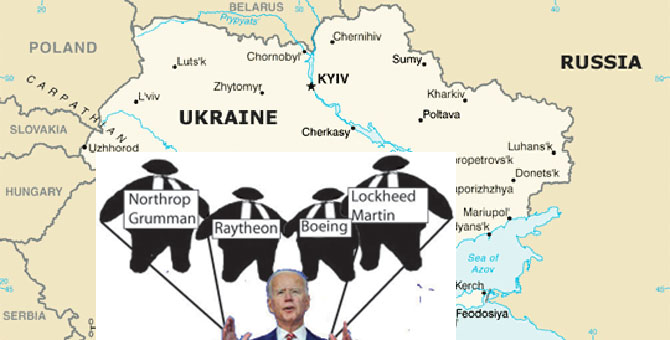
For 4 months President Biden has been beseeching Congress to grant another $61 billion in aid to Ukraine to continue their 2 year war with Russia. This is on top of $113 billion that has made no dent in Ukraine’s efforts to prevail against overwhelming Russian forces.
Biden could give Ukraine a trillion dollars in aid but it’s essentially worthless because Ukraine is running out of soldiers to use US weapons.
A dozen Ukrainian soldiers and commanders told the Washington Post that personnel deficits are at their lowest point ever.
One mechanized brigade battalion commander advised he’s down to 40 soldiers from a normal 200 to hold off the Russian advance. Another mentioned the same shortage in his unit.
Replacements are scares since August when Zelensky fired all recruitment office heads due to corruption. That’s caused a dramatic decline in replacements still not solved.
But if Biden gets his $61 billion he’d be better off tossing it into a bonfire instead of squandering it on more weapons for Ukraine. That will only prolong a war that was lost on Day One, 717 days ago. Had Biden not torpedoed a peace deal nearly inked in the first month, over 400,000 Ukrainian soldiers would still be alive, the Ukraine economy would not be devastated, and Ukraine may not have lost a single square mile of territory.
Biden knows the $61 billion more will not turn the tide. But as Pete Seeger sang about LBJ continuing to fight a lost war in Vietnam 57 years ago, in today’s White House…’The Big Fool says to push on.’
Pushing Gazans Into Rafah And Then Attacking Rafah, Killing UNRWA Funding Without Evidence
CAITLIN JOHNSTONE, FEB 10, 2024, Caitlin’s newsletter.
Notes From The Edge Of The Narrative Matrix
Israel is reportedly preparing to launch a ground assault on Rafah, the southernmost part of the Gaza Strip where Gazans have been pushed to flee to. Israel has instructed the 1.4 million refugees sheltering there to evacuate, along with the hundreds of thousands of people who were already living there before, but there doesn’t seem to be anywhere for them to go. This could wind up being the single deadliest phase of Israel’s onslaught to date.
So to summarize, the IDF has been packing the population of Gaza into the southernmost part of the enclave like toothpaste toward the end of a tube, and now they’re going to attack that southernmost part, but it’s totally not genocide and you’re an evil Nazi if you say it is.
This genocide is not a genocide. Ceci n’est pas une pipe.
Can we all just stop and marvel at how successful Israel and its allies have been at moving the conversation from “The ICJ ruled that Israel needs to immediately cease killing Palestinians” to “Is it right or wrong to starve two million people based on unevidenced claims?”
Australian foreign minister Penny Wong has acknowledged that Canberra joined the US, UK and other allies in cutting off UNRWA funding without having seen proof of Israel’s claims against the organization. Empire managers are now openly admitting they suspended aid to Gaza without having seen evidence of the claims that call was based on; they cut the aid because they were told to, then waited for narratives to be provided to them as to why this was a good and righteous decision.
If you’re going to say that a bad thing happened and we therefore need to cut off aid to the most aid-dependent population on earth, then you’d better at least be able to prove the bad thing actually happened. If evidence exists, then show it. If you insist on starving two million people, you can’t do it on vibes alone.
How is this not obvious to everyone? How was it not immediately obvious the instant it came up? Time and time again we are asked to consent to the empire doing the most heinous things to the most vulnerable populations on secret, invisible evidence. We are expected to trust their secret evidence without getting to look at it, even though they’ve been caught lying about things like this over and over and over again.
They think we’re idiots……………………………………………………………….. https://www.caitlinjohnst.one/p/pushing-gazans-into-rafah-and-then?utm_source=post-email-title&publication_id=82124&post_id=141542598&utm_campaign=email-post-title&isFreemail=true&r=1ise1&utm_medium=email—
Escalating to de-escalate with nuclear weapons: Research shows it’s a particularly bad idea

How well does escalate to de-escalate work? Escalate to de-escalate strategies appear at first to be logically appealing. Upon deeper investigation, however, the potential for the strategy’s success is likely to be outweighed by the potential for its failure. The high chance of failure lies in potential escalation outcomes on the receiving side of the escalating attack.
The Bulletin, By Daniel R. Post | February 9, 2024
The growth of Chinese nuclear capabilities and the ongoing Russian invasion of Ukraine have brought “great power competition” back to the center of United States national security strategy. With that competition have come calls for increasing US tactical nuclear weapons capabilities. A primary justification for increasing these capabilities is that they provide additional options at different potential levels of conflict escalation and can help stop a conventional-turned-nuclear war before it becomes a full-scale nuclear exchange.
In fact, many in the US strategic community believe that “escalate to de-escalate” strategies—which threaten early and significant escalations, such as limited nuclear use, followed by demands for immediate war termination—are a desirable approach for nuclear deterrence, and a viable option if deterrence fails.
But how likely is it that even a “limited” nuclear war could be kept to a level at which the benefits of fighting outweigh the costs if deterrence fails? Could escalating from conventional weapons to nuclear ones have a de-escalatory impact on a conflict? Should the United States or other countries pursue the development of relatively low-yield nuclear weapons for this purpose? My research, as well as other recent work, strongly suggests that this kind of thinking is theoretically unsound, fraught with danger, and likely to drastically increase the risk of escalation in a nuclear conflict if attempted.
What is escalating to de-escalate? In this strategy, escalation is a deliberate action taken primarily for the purpose of ending a conflict without any further increase in the intensity or level of fighting. The strategy aims to achieve de-escalation by signaling capability and commitment. Escalate to de-escalate relies on psychological responses wherein the other side comes to see the conflict as too costly to continue at the new potential level of violence. The goal of escalation is not to completely disable or defeat the enemy, but rather to compel the adversary to decide to end the conflict—on terms set by the escalating state. The strategy is meant to be both bold and restrained.
When escalation involves a nuclear attack, the attacker is expecting to increase the likelihood of coercive advantages or to end the war altogether. Nuclear weapons generate and heighten fear, increase the risk of further escalation, and are the ultimate signal of strength and resolve.
A Russian strategy? Much of the contemporary discussion about escalating to de-escalate is rooted in an assertion by experts that it is an accurate interpretation of Russian strategy. The 2018 version of the United States’ Nuclear Posture Review, for example, stated that “Russian strategy and doctrine emphasize the potential coercive and military uses of nuclear weapons. It [sic] mistakenly assesses that the threat of nuclear escalation or actual first use of nuclear weapons would serve to ‘de-escalate’ a conflict on terms favorable to Russia.”
Katarzyna Zysk, a senior fellow at the Atlantic Council, has argued that this assessment is essentially correct, ………………………………………………
However, some experts disagree with this assessment of Russian strategy. Their arguments typically acknowledge Russian willingness to use nuclear weapons in a limited fashion under certain circumstances but characterize escalate to de-escalate as too simple an interpretation, incomplete, or inaccurate. Instead, these experts say, Russian plans to use nuclear weapons should be considered as part of a broader strategic deterrence, counter-escalation, and warfighting strategy.
How well does escalate to de-escalate work? Escalate to de-escalate strategies appear at first to be logically appealing. Upon deeper investigation, however, the potential for the strategy’s success is likely to be outweighed by the potential for its failure. The high chance of failure lies in potential escalation outcomes on the receiving side of the escalating attack……………………………………………………
positive outcomes, however, are theoretically counteracted—and upon empirical investigation, very often outweighed—by incentives to continue to resist. There are several reasons for this. First, escalation is likely to be a public and observable strategy, especially if it involves using a nuclear weapon, and giving in to such a demand comes with higher reputational costs than does refraining from retaliation. This exacerbates worries over precedent setting and future vulnerability.
Second, the receiving state may not get the intended signal, or may misinterpret, misunderstand, mistrust, or misperceive the intended signal. This sort of misperception has long been identified as a problem in international relations. Additionally, if the escalation violates an important norm—for example, the non-use of nuclear weapons, or the targeting of civilians—this effect may be amplified. In this situation, decision makers on the receiving side are likely to be willing to accept more risk to resist the escalation and prevent further losses.
A third reason escalate to de-escalate may result in continued resistance is that the attempt heightens the perceived stakes. In addition to the original stakes of the conflict, once a “red line” has been crossed (particularly the nuclear threshold), the stakes may increase dramatically. This again exacerbates concerns over precedent and reputation.
Can nuclear weapons help? The answer is likely no. Escalate to de-escalate may fail often in a nuclear setting because a limited nuclear attack against a nuclear-armed adversary will aggravate reputational and precedent-setting concerns. Because the stated purpose of nuclear weapons is (at a minimum) to deter a nuclear attack, when a nuclear state gives in to a limited nuclear attack the entire purpose of its nuclear deterrent has been negated. Giving in to a nuclear attack, then, drastically weakens future deterrence.
Also, escalating with nuclear weapons is likely to produce stronger negative effects than conventional attacks, because violating the norm of nuclear non-use may trigger stronger reactions than violating other norms of armed conflict (like killing unarmed civilians) that are routinely violated and are not as black and white as nuclear use.
Third, nuclear weapons cause effects that other types of weapons do not, such as radioactive fallout, electromagnetic pulse damage, and increased blast and fire impacts. These capabilities add an immense amount of uncertainty to a nuclear attack. This uncertainty will increase the incentives for decision makers to engage in worst-case scenario planning.
……………………………………. likely for the receiving side to think that the aggressor who first uses nuclear weapons has begun to behave irrationally or has abandoned these norms.
In sum, using nuclear weapons will increase incentives for the receiving state to continue to resist the attacker.
Slim chance of success. My ongoing research strongly supports claims regarding the likelihood that escalate to de-escalate will fail. I have conducted several surveys among two US populations (a general population and a military population) and found that respondents are overwhelmingly more likely to favor continued resistance when placed on the receiving end of escalate to de-escalate attempts. In the civilian sample, only 30.6 percent of respondents chose to de-escalate in response. In the military sample, that number was a measly 6.9 percent…………………………………….
If both sides in a conflict subscribe to escalate-to-de-escalate-type thinking, the logical outcome is an endless escalatory cycle. This outcome is distinctly at odds with a strategy aimed at de-escalation. Scholars and practitioners should beware of seeing a limited nuclear attack as some sort of resolve-demonstrating “trump card.” https://thebulletin.org/2024/02/escalating-to-de-escalate-with-nuclear-weapons-research-shows-its-a-particularly-bad-idea/
Gaza: Chris Hedges: Let Them Eat Dirt
The final stage of Israel’s genocide in Gaza, an orchestrated mass starvation, has begun. The international community does not intend to stop it.
By Chris Hedges ScheerPost, 8 Feb 24, https://scheerpost.com/2024/02/08/chris-hedges-let-them-eat-dirt/—
There was never any possibility that the Israeli government would agree to a pause in the fighting proposed by Secretary of State Antony Blinken, much less a ceasefire. Israel is on the verge of delivering the coup de grâce in its war on Palestinians in Gaza – mass starvation. When Israeli leaders use the term “absolute victory,” they mean total decimation, total elimination. The Nazis in 1942 systematically starved the 500,000 men, women and children in the Warsaw Ghetto. This is a number Israel intends to exceed.
Israel, and its chief patron the United States, by attempting to shut down the United Nations Relief and Works Agency for Palestine Refugees in the Near East (UNRWA), which provides food and aid to Gaza, is not only committing a war crime, but is in flagrant defiance of the International Court of Justice (ICJ). The court found the charges of genocide brought by South Africa, which included statements and facts gathered by UNWRA, plausible. It ordered Israel to abide by six provisional measures to prevent genocide and alleviate the humanitarian catastrophe. The fourth provisional measure calls on Israel to secure immediate and effective steps to provide humanitarian assistance and essential services in Gaza.
UNRWA’s reports on conditions in Gaza, which I covered as a reporter for seven years, and its documentation of indiscriminate Israeli attacks illustrate that, as UNRWA said, “unilaterally declared ‘safe zones’ are not safe at all. Nowhere in Gaza is safe.”
UNRWA’s role in documenting the genocide, as well as providing food and aid to the Palestinians, infuriates the Israeli government. Prime Minister Benjamin Netanyahu accused UNRWA after the ruling of providing false information to the ICJ. Already an Israeli target for decades, Israel decided that UNRWA, which supports 5.9 million Palestinian refugees across the Middle East with clinics, schools and food, had to be eliminated. Israel’s destruction of UNRWA serves a political as well as material objective.
The evidence-free Israeli accusations against UNRWA that a dozen of the 13,000 employees had links to those who carried out the attacks in Israel on Oct. 7, which saw some 1,200 Israelis killed, did the trick. It led 16 major donors, including the United States, the U.K., Germany, Italy, the Netherlands, Austria, Switzerland, Finland, Australia, Canada, Sweden, Estonia and Japan, to suspend financial support for the relief agency on which nearly every Palestinian in Gaza depends for food. Israel has killed 152 UNRWA workers and damaged 147 UNRWA installations since Oct. 7. Israel has also bombed UNRWA relief trucks.
More than 27,708 Palestinians have been killed in Gaza, some 67,000 have been wounded and at least 7,000 are missing, most likely dead and buried under the rubble.
More than half a million Palestinians – one in four – are starving in Gaza, according to the U.N. Starvation will soon be ubiquitous. Palestinians in Gaza, at least 1.9 million of whom have been internally displaced, lack not only sufficient food, but clean water, shelter and medicine. There are few fruits or vegetables. There is little flour to make bread. Pasta, along with meat, cheese and eggs, have disappeared. Black market prices for dry goods such as lentils and beans have increased 25 times from pre-war prices. A bag of flour on the black market has risen from $8.00 to $200 dollars. The healthcare system in Gaza, with only three of Gaza’s 36 hospitals left partially functioning, has largely collapsed. Some 1.3 million displaced Palestinians live on the streets of the southern city of Rafah, which Israel designated a “safe zone,” but has begun to bomb. Families shiver in the winter rains under flimsy tarps amid pools of raw sewage. An estimated 90 percent of Gaza’s 2.3 million people have been driven from their homes.
“There is no instance since the Second World War in which an entire population has been reduced to extreme hunger and destitution with such speed,” writes Alex de Waal, executive director of the World Peace Foundation at Tufts University and the author of “Mass Starvation: The History and Future of Famine,” in the Guardian. “And there’s no case in which the international obligation to stop it has been so clear.”
The United States, formerly UNRWA’s largest contributor, provided $422 million to the agency in 2023. The severance of funds ensures that UNRWA food deliveries, already in very short supply because of blockages by Israel, will largely come to a halt by the end of February or the beginning of March.
Israel has given the Palestinians in Gaza two choices. Leave or die.
I covered the famine in Sudan in 1988 that took 250,000 lives. There are streaks in my lungs, scars from standing amid hundreds of Sudanese who were dying of tuberculosis. I was strong and healthy and fought off the contagion. They were weak and emaciated and did not. The international community, as in Gaza, did little to intervene.
The precursor to starvation – undernourishment – already affects most Palestinians in Gaza. Those who starve lack enough calories to sustain themselves. In desperation people begin to eat animal fodder, grass, leaves, insects, rodents, even dirt. They suffer from diarrhea and respiratory infections. They rip up tiny bits of food, often spoiled, and ration it.
Soon, lacking enough iron to produce hemoglobin, a protein in red blood cells that carries oxygen from the lungs to the body, and myoglobin, a protein that provides oxygen to muscles, coupled with a lack of vitamin B1, they become anemic. The body feeds on itself. Tissue and muscle waste away. It is impossible to regulate body temperature. Kidneys shut down. Immune systems crash. Vital organs – brain, heart, lungs, ovaries and testes — atrophy. Blood circulation slows. The volume of blood decreases. Infectious diseases such as typhoid, tuberculosis and cholera become an epidemic, killing people by the thousands.
It is impossible to concentrate. Emaciated victims succumb to mental and emotional withdrawal and apathy. They do not want to be touched or moved. The heart muscle is weakened. Victims, even at rest, are in a state of virtual heart failure. Wounds do not heal. Vision is impaired with cataracts, even among the young. Finally, wracked by convulsions and hallucinations, the heart stops. This process can last up to 40 days for an adult. Children, the elderly and the sick expire at faster rates.
I saw hundreds of skeletal figures, specters of human beings, moving forlornly at a glacial pace across the barren Sudanese landscape. Hyenas, accustomed to eating human flesh, routinely picked off small children. I stood over clusters of bleached human bones on the outskirts of villages where dozens of people, too weak to walk, had laid down in a group and never gotten up. Many were the remains of entire families.
In the abandoned town of Mayen Abun bats dangled from the rafters of the gutted Italian mission church. The streets were overgrown with tussocks of grass. The dirt airstrip was flanked by hundreds of human bones, skulls and the remnants of iron bracelets, colored beads, baskets and tattered strips of clothing. The palm trees had been cut in half. People had eaten the leaves and the pulp inside. There had been a rumor that food would be delivered by plane. People had walked for days to the airstrip. They waited and waited and waited. No plane arrived. No one buried the dead.
Now, from a distance, I watch this happen in another land in another time. I know the indifference that doomed the Sudanese, mostly Dinkas, and today dooms the Palestinians. The poor, especially when they are of color, do not count. They can be killed like flies. The starvation in Gaza is not a natural disaster. It is Israel’s masterplan.
There will be scholars and historians who will write of this genocide, falsely believing that we can learn from the past, that we are different, that history can prevent us from being, once again, barbarians. They will hold academic conferences. They will say “Never again!” They will praise themselves for being more humane and civilized. But when it comes time to speak out with each new genocide, fearful of losing their status or academic positions, they will scurry like rats into their holes. Human history is one long atrocity for the world’s poor and vulnerable. Gaza is another chapter.
Another $61 billion to kill more Ukrainians in an unnecessary and losing war

The $61 billion will make no difference on the battlefield except to prolong the war, the tens of thousands of deaths, and the physical destruction of Ukraine.
The Biden-Schumer Plan to Kill More Ukrainians JEFFREY D. SACHS, Feb 08, 2024, Common Dreams, https://www.commondreams.org/opinion/the-biden-schumer-plan-to-kill-more-ukrainians
President Joe Biden is refusing to fold a losing hand as he bets with Ukrainian lives and U.S. taxpayer money. Biden and Democratic Senate Majority Leader Chuck Schumer propose to squander the lives of tens of thousands more Ukrainians and $61 billions of federal funds to keep Biden’s disastrous foreign policy failure hidden from view until after the November election.
The $61 billion will make no difference on the battlefield except to prolong the war, the tens of thousands of deaths, and the physical destruction of Ukraine. It will not “save” Ukraine. Ukraine’s security can only be achieved at the negotiating table, not by some fantasized military triumph over Russia.
$61 billion is not nothing. This worse-than-useless outlay would exceed the combined budgets of the U.S. Department of Labor, Environmental Protection Agency, National Science Foundation, and the Women, Infant, and Children nutrition program.
Almost exactly 10 years ago this month, Biden did much to put Ukraine on the path to disaster. This is well known to those who have looked carefully at the facts but is kept hidden from view by the White House, the Senate Democrats, and the mainstream media that back Biden. I have previously provided a detailed chronology, with hyperlinks, here.
Ukraine’s security can only be achieved at the negotiating table, not by some fantasized military triumph over Russia.
In 1990, President George H. W. Bush, Sr. and his German counterpart Chancellor Helmut Kohl promised Soviet President Mikhail Gorbachev that NATO would not expand eastward if the Soviet Union accepted German reunification. When the Soviet Union disbanded in December 1991, with Russia as the successor state, American leaders decided to renege.
President Bill Clinton began NATO expansion over the vociferous opposition of top diplomats like George Kennan and the opposition of his own Secretary of Defense, William Perry. In 1997 Zbigniew Brzezinski upped the ante, with a plan for NATO to expand all the way to Ukraine. He famously wrote that without Ukraine, Russia would cease to be a great power.
Russian leaders have repeatedly made clear that NATO expansion to Ukraine is understandably the reddest of Russian redlines.
In 2007, President Vladmir Putin stated that NATO enlargement to that date was a cheat on the 1990 promise, and that it must go no further. Despite these clear warnings, including by his own diplomats, George W. Bush Jr. committed in 2008 to expand NATO to Ukraine and Georgia in order to surround Russia in the Black Sea.
William Burns, now CIA director, and then the U.S. Ambassador to Russia, wrote a famous memo entitled “Nyet means Nyet,” explaining that Russia’s opposition to NATO enlargement was across Russia’s political spectrum. Most Ukrainians themselves were also firmly against the plan, favoring neutrality over NATO membership. The Ukrainian Rada declared Ukraine’s state sovereignty in 1990 on the basis of becoming “a permanently neutral state.” In 2009, the people of Ukraine elected Viktor Yanukovych, who ran on a platform of neutrality.
In early 2014, the U.S. decided to help bring down Yanukovych in a coup. This was standard U.S. deep-state operating procedure, one used on dozens of occasions around the world. he CIA, National Endowment for Democracy, USAID, and NGOs like the Open Society Foundation went to work in Ukraine. The point person was Victoria Nuland, who was first Richard Cheney’s principal deputy foreign policy advisor, then George Bush Jr.’s ambassador to NATO, then Hillary Clinton’s spokesperson, and by 2014 Assistant Secretary of State.
This time, the Russians caught the conspiracy on tape, in an intercepted call between Nuland and U.S. Ambassador to Ukraine Geoffrey Pyatt (now Assistant Secretary of State). Nuland explains to Pyatt that Vice President Joe Biden will help choose and cement the post-coup government. The 2014 Ukraine team, including Biden, Nuland, Jake Sullivan (then and now Biden’s national security advisor), Geoffrey Pyatt, and Antony Blinken (then the deputy national security advisor), remains the Ukraine team today.
It is a team of bunglers. They thought that Yanukovych’s overthrow would quickly usher in NATO expansion. Instead, ethnic Russians in Ukraine virulently rejected the Russophobic post-coup government that was installed by Nuland, and called for autonomy of the ethnically Russian regions. In a referendum, Crimea voted overwhelmingly to join Russia.
Obama, Biden, and their team armed the post-coup government to attack the ethnically Russian regions, thinking this would be the end of it. Yet the regions resisted. Ukraine and the breakaway regions signed the Minsk Agreements to bring an end to the fighting and give constitutional autonomy to the ethnically Russian Donbas. The Minsk II agreement was backed by the UN Security Council, but the U.S. privately agreed with the Ukrainian government that it was okay to ignore it.
In 2021, after 7 years of fighting and more than 14,000 deaths in the Donbas, Putin called on newly elected President Biden to stop NATO enlargement and engage in negotiations with Russia over mutual security arrangements. Biden rejected Putin’s call to end the gambit of NATO enlargement to Ukraine.
In February 2022, Putin launched the Special Military Operation (SMO) invasion to push Ukraine to the negotiating table. Ukraine’s President Volodymyr Zelensky immediately called for negotiations based on Ukraine’s neutrality. Within a month, a framework agreement to end the fighting was reached between Ukraine and Russia, based on Ukraine’s neutrality and an end to NATO’s enlargement to Ukraine. Biden stepped in to stop the deal, with the U.S. informing Zelensky that the U.S. would not support neutrality.
Biden and team had still more failed tricks up their sleeve. They firmly believed that U.S. financial sanctions—freezing Russia’s assets and cutting it out of the SWIFT banking system—would cripple the Russian economy and cause Putin to relent. In fact, they expected that the ensuing economic crisis would topple him. Of course, nothing of the sort happened.
Then they expected that NATO weaponry would trounce Russia on the battlefield. That too did not happen. Then they expected that Ukraine’s “counter-offensive” in the summer of 2023, backed by Pentagon and CIA planners, would defeat Russia. Instead, Ukraine lost hundreds of thousands of soldiers dead and wounded—its military hardware destroyed.
The entire war, including the loss of Ukrainian territory, the hundreds of thousands of Ukrainian casualties, and the utter waste of more than $100 billion of U.S. taxpayer money to date, could easily have been avoided.
Now, Biden and Schumer want to throw more Ukrainian lives and more tens of billions of dollars at this glaring failure. They want to do this in a rushed vote, without any Congressional let alone public oversight, without hearings, and without any strategy. The fact is they want to save Biden from the embarrassment of a decade of puerile and failed plotting, at least until the November election.
There remains one answer for Ukraine’s security: diplomacy and neutrality. That solution doesn’t cost lives or money. It was Ukraine’s choice before the 2014 coup and again in 2022 until stopped by Biden. It is the path that Biden and the Senate Democrats still refuse to take.
Chicago Tribune needs reality check on Russo Ukraine war.
Walt Zlotow, West Suburban Peace Coalition, Glen Ellyn IL 9 Feb 24
For the past 2 years now the Chicago Tribune has been misrepresenting both the nature and status of the Russo Ukraine war.
Its latest update in today’s editorial ‘Time for responsible GOP voices to step up and back Ukraine’ doubles down on both misrepresented aspects of the war.
Regarding its nature, the Trib continues spreading the false US narrative that Vladimir Putin’s reason for invading was to recreate the Soviet Union, starting with Ukraine. “Putin has made no secret of his ambitions to stitch something resembling the old USSR back together. Ukraine is by far the biggest prize in that quest. Stopping this ambition in its tracks is critical to future peace in the region.”
We know this is false. Putin spent 8 years prior to his invasion proclaiming and seeking US assurances NATO would not expand up to Russia’s border with Ukraine. While it may be easy to dismiss Putin’s words and actions prior to the invasion, it’s impossible to dismiss the words of NATO Secretary General Jens Stoltenberg and Ukraine President Volodymyr Zelensky himself.
Prior to the war Stoltenberg stated that “Russia’s NATO security demands were a precondition for not invading Ukraine.” He further stated after the invasion, “Putin went to war to prevent NATO from getting closer to Russia.”
On March 27, 2022, 5 weeks into the war, Ukraine President Zelensky admitted to an interviewer that Ukraine’s promise not to join NATO was “the first fundamental point for the Russian Federation not to invade.” He further stated “As far as I know, they started the war because of this.”
Prior to the war Stoltenberg stated that “Russia’s NATO security demands were a precondition for not invading Ukraine.” He further stated after the invasion, “Putin went to war to prevent NATO from getting closer to Russia.”
On March 27, 2022, 5 weeks into the war, Ukraine President Zelensky admitted to an interviewer that Ukraine’s promise not to join NATO was “the first fundamental point for the Russian Federation not to invade.” He further stated “As far as I know, they started the war because of this.”
Politics aside, the peace community supports any all efforts of many Republicans and a few courageous Democrats to derail squandering $61 billion more in weapons and other aid to maintain a war that will only end with a negotiated settlement.
So should the Chicago Tribune.
The pragmatist’s guide to nuclear disarmament
Feb. 9, 2024, Steve Olson, The Seattle Times, https://www.seattletimes.com/opinion/the-pragmatists-guide-to-nuclear-disarmament/
The United States has not seen a widespread nuclear disarmament movement since the early 1980s. A new one is desperately needed — but with a twist.
The 1980s movement was based on fear. In 1982, a million people, alarmed by President Ronald Reagan’s nuclear buildup, gathered in New York City’s Central Park to oppose the nuclear arms race — still the largest one-day protest in U.S. history. The next year, 100 million people — almost half the population of the United States — watched the television movie “The Day After,” which horrifically depicted the nuclear destruction of Kansas City.
Fear can generate a fight-or-flight reaction, but it’s ultimately counterproductive. People become so scared that they think nothing can be done and give up. Or they ignore the issue entirely, at least on a conscious level.
There are still plenty of things to fear. Nuclear treaties are lapsing. National leaders have threatened to use nuclear weapons against their enemies. New research, now being reviewed by the National Academies of Sciences, Engineering, and Medicine, has strengthened the case that even a limited nuclear war could shut down agriculture for years and doom billions to starvation. A large-scale nuclear war could smother agriculture for more than a decade and end civilization.
But fear isn’t necessary to spur action. There are two very practical reasons to abolish nuclear weapons.
The first is their outrageous cost. The U.S. government is on track to spend at least $1.5 trillion over the next 30 years modernizing its nuclear weapons. That’s as much as the federal government currently spends on the National Institutes of Health. Or, to put it another way, four years of that spending, evenly divided among the 50 states, would buy us an entirely new ferry fleet.
Key parts of the modernization effort, like the new Sentinel ballistic missile program, are already massively over budget. Taking apart nuclear weapons systems would cost a small fraction of the money now slated to build new ones.
The second reason for getting rid of nuclear weapons is that they are far more dangerous than they are useful. Nuclear bombs are too large and destructive to deploy effectively in warfare. They would kill soldiers and noncombatants on both sides of a conflict. Nuclear fallout would drift far from a battlefield. Weapons have been getting smaller and smarter, not bigger and dumber.
Nuclear weapons also don’t make sense politically. If a nuclear weapon were detonated in a war — assuming that a general nuclear war did not follow — the responsible nation would face devastating conventional attacks and be ostracized internationally. No country has been willing to face those consequences, at least not since the very different circumstances that prevailed at the end of World War II.
The existence of nuclear weapons supposedly deters their use. No one has been able to figure out what that nonsensical statement means. Making a threat implies being willing to carry it out. The idea that deterrence has worked ignores the history of crises, miscalculations, and accidents that almost triggered nuclear war. Deterrence works until it doesn’t.
Nuclear weapons are a federal responsibility. For us as Washingtonians, that means working through our 10 U.S. representatives and two U.S. senators to change nuclear policy. Except for U.S. Rep. Pramila Jayapal, the members of our congressional delegation have been, at best, guarded in their statements about nuclear weapons. Washington receives about $20 billion a year in defense spending. Reducing that flow of funds would seem to be a recipe for electoral disaster.
But couldn’t at least part of our defense funding be spent in more socially productive ways? After all, flying a nuclear bomb-carrying F-35A jet for two hours costs as much as a nurse makes in a year. Keeping more than 55,000 mostly young men and women here in Washington well-trained and outfitted for future conflicts may help us feel more secure. But it doesn’t build infrastructure, spark innovation, or improve the health and well-being of the population at large.
Here, the Washington Against Nuclear Weapons coalition, led by the Washington chapter of Physicians for Social Responsibility, has been exerting pressure on our representatives and senators to take a stand against nuclear weapons. The Ground Zero Center for Nonviolent Action — on a 4-acre plot adjacent to the Kitsap submarine base outside Bremerton — works for disarmament right next to the largest stockpile of deployed nuclear weapons anywhere in the world. At the national level, the Ploughshares Fund, the Federation of American Scientists, the Arms Control Association and many other organizations are working to reduce and then eliminate the existential threat these weapons pose.
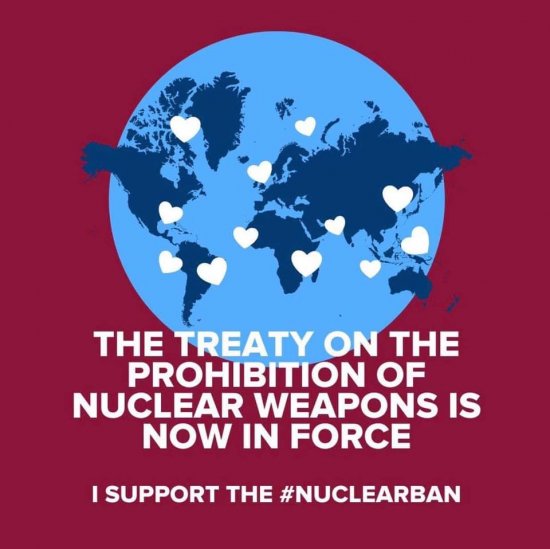
In 2021, the International Treaty on the Prohibition of Nuclear Weapons, which prohibits the development, production, use, and threat of use of nuclear weapons, entered into force after being ratified by 50 countries. The nine countries that have nuclear weapons have so far opposed the treaty, but they are nevertheless bound by the 1968 Treaty on the Non-Proliferation of Nuclear Weapons to negotiate an agreement “on general and complete disarmament under strict and effective international control.” That they have not yet done so is both a bitter disappointment and a betrayal of their stated intentions.
Nuclear disarmament will not be unilateral or immediate. Nations will need to negotiate stepped reductions and means of verifying progress. An especially urgent task is to eliminate the ground-based missiles now clustered in underground silos in Colorado, Montana, Nebraska, North Dakota and Wyoming, as well as in Russia and China. These weapons are inherently destabilizing and dangerous. They have to be launched within minutes if a president thinks a nuclear attack is underway. A mistake, miscalculation, or moment of madness could spell the end of the world.
Unlike efforts to slow climate change, which will require widespread changes in how we live, the threat of nuclear annihilation could be eliminated if nine men agreed to destroy about 12,500 pieces of elaborately machined metal. Reagan and then-president of the Soviet Union Mikhail Gorbachev almost agreed to junk their nuclear weapons in 1986. The only stumbling block was Reagan’s commitment to a nuclear weapons defense program that was canceled a few years later.
Over $1 Billion in Weapons Missing In Ukraine
Real Clear Wire, By Adam Andrzejewski, February 07, 2024
Topline: The Department of Defense has failed to properly track $1 billion worth of weapons provided to Ukraine, according to an internal audit released on Jan. 10 by the DOD Inspector General.
Key facts: The DOD is supposed to use special “enhanced end-use monitoring” techniques” to “safeguard” key weapons such as smaller, high-tech weaponry provided to Ukraine, which are likely targets for theft.
The audit says these monitoring procedures are not properly being followed in Ukraine, due to staffing shortages, poor internal logistics and more.
The audit found that $1 billion of the $1.7 billion — or 59% — in enhanced end-use monitoring designated weapons provided to Ukraine as of June 2023 are “delinquent,” meaning they can’t be accounted for in inventory reports.
Maybe the weapons are being used properly; maybe they have been stolen by Russian forces. No one can be completely sure…………………………….
The report also found that inventory databases were not regularly updated and that the Ukrainian Armed Forces failed to properly report missing weapons……………….
Background: The Biden administration has sent over $75 billion to Ukraine since February 2022, including $44 billion in military aid.
Some Republican leaders are already trying to block Biden’s request for additional funds for Ukraine. The missing weapons could strengthen their arguments.
This is not the first time weapons have gone missing during Biden’s administration……………………………………………………
Summary: While there is no direct evidence that weapons in Ukraine have actually been misused, the $1 billion inventory error calls into question the White House’s constant assurances that any aid would be carefully tracked.
Israel Aid Bill Fails in House as Progressives Slam ‘Blank Check for Netanyahu’

“The supplemental funding proposed, which includes no humanitarian aid for Gaza nor assistance for Ukraine, supports weapons of war and destruction that further jeopardize Israeli hostages and Palestinian civilians,
“Each U.S.-made or funded bomb dropped in Gaza further jeopardizes the chances of long-lasting peace for Israelis and Palestinians,” said Rep. Delia Ramirez.
JAKE JOHNSON, Feb 07, 2024, https://www.commondreams.org/news/israel-aid-house
A Republican effort to push through a standalone military aid package for Israel failed to clear the U.S. House on Tuesday, with members of the Congressional Progressive Caucus condemning the proposed $17.6 billion in unconditional assistance for a government that stands accused on the world stage of committing genocide in the Gaza Strip.
The legislation, which President Joe Biden threatened to veto if it reached his desk, needed two-thirds support to pass the House under a suspension of the rules. The final tally was 250 to 180, with 166 Democrats and 14 Republicans voting no.
Rep. Delia Ramirez (D-Ill.) said in a statement that “under no circumstances” could she have voted for the legislation, which House Republican leaders sought to advance ahead of the Senate’s planned procedural vote on a broader package that includes military aid to Israel and Ukraine and a border agreement that would dramatically weaken asylum protections.
“The death toll in Gaza continues to rise. Gazans are starving,” Ramirez said late Tuesday. “Over 1.5 million people have been displaced. Hostilities between the U.S. and Iran are escalating. And just this morning, The New York Times reported that one-fifth of the hostages still in captivity since the start of the conflict have likely died. We must change course.”
“The supplemental funding proposed, which includes no humanitarian aid for Gaza nor assistance for Ukraine, supports weapons of war and destruction that further jeopardize Israeli hostages and Palestinian civilians,” she continued. “Each U.S.-made or funded bomb dropped in Gaza further jeopardizes the chances of long-lasting peace for Israelis and Palestinians. I’ve said it before, and I’ll say it now: I will only support actions that bring us closer to peace.”
In a brief floor speech ahead of Tuesday’s vote, Rep. Ro Khanna (D-Calif.) described standalone Israel aid legislation as a “blank check for [Israeli Prime Minister Benjamin] Netanyahu” and other far-right officials seeking the permanent removal of Palestinians from Gaza.
If passed, the aid measure would have allowed the U.S. State Department to waive congressional notification requirements for billions of dollars in U.S. military financing for Israel, which has massacred Gaza civilians with American-made weaponry.
“I will vote no because it is painfully obvious to the entire world that what is needed today is a permanent cease-fire and a release of all hostages,” Khannas said. “There come moments in a nation’s history when our actions reveal our values. This is such a moment.”
The failure of the Israel aid bill came shortly after House Republicans also fell short in their effort to impeach Homeland Security Secretary Alejandro Mayorkas.
Rep. Ayanna Pressley (D-Mass.) wrote in response to the Mayorkas vote that “Republicans are deeply disconnected from the people.”
“They’re not serious about fixing our immigration system, they have no plan to improve folks’ lives, and they keep wasting our time with political stunts like these,” Pressley added. “This sham, failed impeachment is just the latest example.”
Senate Republicans on Wednesday are expected to block consideration of the broader supplemental security package over the border agreement, which they claim isn’t sufficiently harsh—a position right in line with that of former President Donald Trump, the frontrunner for the 2024 GOP presidential nomination.
1 This Month
26 September – International Day for the Total Elimination of Nuclear Weapons





PLEASE OPPOSE HR 8255 AND S.3639 – bills would accelerate satellite deployment, with no environmental review or safeguards – https://ncstd5li.quorum.us/campaign/169331/
To see nuclear-related stories in greater depth and intensity – go to https://nuclearinformation.wordpress.com
-
Archives
- September 2026 (313)
- August 2026 (330)
- July 2026 (355)
- June 2026 (287)
- May 2026 (306)
- April 2026 (356)
- March 2026 (251)
- February 2026 (267)
- January 2026 (308)
- December 2025 (358)
- November 2025 (359)
- October 2025 (375)
-
Categories
- 1
- 1 NUCLEAR ISSUES
- business and costs
- climate change
- culture and arts
- ENERGY
- environment
- health
- history
- indigenous issues
- Legal
- marketing of nuclear
- media
- opposition to nuclear
- PERSONAL STORIES
- politics
- politics international
- Religion and ethics
- safety
- secrets,lies and civil liberties
- spinbuster
- technology
- Uranium
- wastes
- weapons and war
- Women
- 2 WORLD
- ACTION
- AFRICA
- Atrocities
- AUSTRALIA
- Christina's notes
- Christina's themes
- culture and arts
- Events
- Fuk 2022
- Fuk 2023
- Fukushima 2017
- Fukushima 2018
- fukushima 2019
- Fukushima 2020
- Fukushima 2021
- general
- global warming
- Humour (God we need it)
- Nuclear
- RARE EARTHS
- Reference
- resources – print
- Resources -audiovicual
- Weekly Newsletter
- World
- World Nuclear
- YouTube
-
RSS
Entries RSS
Comments RSS

