On the brink of disaster: Israel threatens Lebanon with war – what could go wrong?
As mediation efforts fail to bear fruit, war between Israel and Lebanon seems to be matter of when, not if
Rt.com 7 Feb 24
srael’s Foreign Minister Yisrael Katz met his French counterpart on Monday, warning him that “time [is] running out to find a diplomatic solution in Lebanon,” and indicating that his country was prepared to go to war if diplomacy fails.
The reason is that, since October 7, Hezbollah, the Lebanon-based group linked to Iran, has carried out hundreds of attacks on Israeli targets. Fearing an influx of militants that could potentially invade and conquer parts of the country, some 60,000 northern Israelis have opted to leave, seeking refuge in the center, away from the hostilities.
Atalia Regev, from the community of Abirim about five kilometers from Israel’s border with Lebanon, left her home on October 7, when thousands of Hamas militants invaded southern Israel, massacring an estimated 1,200 people and injuring over 5,000.
“Back then, we were sure that a northern front would [soon] open, and we, too, would face the occupation of the Galilee, a scenario that had been talked about for a long, long time. There was so much fear. So, we packed our bags, took our kids and left,” Atalia recalls.
She was not the only one. As the fighting in the south intensified, some 60,000 Israelis left communities in the north, finding refuge in the center and in Jerusalem, with the hope that the rockets of the Iran-linked militia Hezbollah would not reach them there.
So far, Hezbollah’s attacks have been limited and measured. According to reports, the movement has staged more than a thousand anti-Israel assaults since the beginning of the hostilities. It has also targeted 48 border sites and at least 17 communities. But, for Regev, this was a good reason to stay where she was.
“Even when things calmed down [in the south], we realized we couldn’t go back. Our area was threatened all the time. Educational institutions for children have remained closed until recently. There were multiple power outages due to infrastructure damages [caused by attacks], and at times we had to spend long hours without electricity.”
Drums of War
Now, however, Regev fears, it may get even worse. On January 3 an explosion rocked the suburbs of Beirut, killing Salah Al Arouri, a senior Hamas leader. Although Israel didn’t claim responsibility for the attack, the finger of blame was directed at officials in West Jerusalem, with Nasrallah vowing that the assassination would not remain unanswered.
Since the killing of Al Arouri, Israel has beefed up its presence along the northern border, preparing itself for a potential full-fledged war.
Israel has a reason to worry. According to estimates, Hezbollah has an arsenal of up to 150,000 rockets and missiles. Many of them are long range, able to reach central and southern Israel. Apart from that, the Islamist group also boasts a well-trained army of fighters, and a commando unit – the Radwan force – waiting for an order to storm its enemy………………………………………………….. more https://www.rt.com/news/591907-israel-lebanon-hezbollah-war/
Noetic Continental | Part I: How CIA Foists Military Equipment Through Private War Companies
We tend to believe that the Noetic International Inc. is a vivid example of the Continental Hotel from the John Wick franchise, where you can get any service at any time anywhere on Earth.
CIAGATE, FEB 8, 2024 [excellent graphics]
Earlier we wrote that the CEO of the Noetic International Inc. was Johnna May Holeman, a former U.S. artillery soldier and CIA operative, who took part in the supply of 155mm white phosphorus rounds to Ukraine through a tea-trade company in Bulgaria.
Now we can say that there was another CIA officer behind the creation of the Noetic International Inc. Ladies and gentlemen, please meet John Alan Irvin – the godfather of clandestine operations.
So, it was John’s idea to establish a company that would carry out the CIA’s clandestine activities without attracting much attention. However, being a top-tier spy John himself does not really conceal his affiliation with the Agency. According to his track record, John is a specialist in the field of analyzing the activities of covert secret agents. He also has decades of experience conducting clandestine operations.
Through his extensive ties, resources and expertise, John Irvin has developed a vast network of contacts, informants and partners to achieve a comprehensive range of goals in accordance with the CIA’s design. Given John’s age, today the bulk of the work is now done by Johnna Holeman. The Noetic International Inc. has offices in Illinois, California, Germany, England and Austria.
The Noetic “specialists” address complex problems in wide range of domains including air- and sea-based drones, renewable energy, cybersecurity & cryptocurrency, technology & robotics, as well as strategic influence campaigns and analysis & decision making.
The network includes hundreds of influencers connected by both personal acquaintance and virtual meetings. The Noetic operatives help local and foreign authorities to achieve goals in order to enlist the support afterwards.
According to our source, the Noetic International Inc. has a shell company in Puerto Rico, that under the guise of cannabis dispensary addresses essential tasks on behalf of the CIA, such as supply of various kinds of unmanned aerial and maritime drones to foreign countries, including Ukraine, reshore of semiconductor production to the U.S., as well as the supply of small-module nuclear reactors.
Initially, we doubted the veracity of the source’s information. Yet, as it was with the investigation surrounding Chanda Creasy, a yoga coach and a head of the CIA division responsible for arms transfers to militants in Africa and Middle East, painstaking analysis and careful sieving of information made it possible to determine that it was the Anyon Minds LLC.
CIA’s “Up in Smoke” Special Operations Group……………………………………………………………………………………………………………………………………………………………………………………………………………………………………………………..https://ciagate.substack.com/p/noetic-continental-part-i-how-cia?utm_source=post-email-title&publication_id=1685806&post_id=141461097&utm_campaign=email-post-title&isFreemail=true&r=1ise1&utm_medium=email
Russia has no plans to deploy nuclear arms beyond Belarus, says deputy minister
By Dmitry Antonov and Guy Faulconbridge
February 2, 2024, https://www.reuters.com/world/europe/russia-has-no-plans-deploy-nuclear-arms-beyond-belarus-says-deputy-minister-2024-02-01/
- Summary
- U.S. likely to deploy nuclear weapons in England – researchers
- Russia says UK deployment will not deter Russia
- Russia says discussing Ukraine as part of BRICS
MOSCOW, Feb 1 (Reuters) – Russia will not deploy nuclear weapons abroad except in its ally Belarus but will find ways to counter any deployment of U.S. tactical nuclear weapons in Britain, the deputy minister in charge of arms control said on Thursday.
President Vladimir Putin said last year that Moscow had transferred some tactical nuclear weapons to Belarus, blaming what he casts as a hostile and aggressive West for the decision.
2
Top nuclear researchers at the Federation of American Scientists, opens new tab say there is no conclusive evidence to show where the weapons are in Belarus, or even if they are there at all.
Asked by reporters if Russia would deploy nuclear weapons beyond Belarus, for example in South America, Deputy Foreign Minister Sergei Ryabkov said: “No, it is not planned.”
“The deployment of tactical nuclear weapons on the territory of Belarus was carried out to counter the increasingly aggressive and threatening activities of the North Atlantic Alliance (NATO) led by the United States.”
Ryabkov, who oversees arms control, also scolded the United States for including what he said were openly declared “nuclear free” European countries in NATO nuclear missions. He did not elaborate.
Separately, Ryabkov told Russia Today in an interview that U.S. plans to deploy tactical nuclear weapons to Britain would not deter Moscow.
“If they believe that re-introduction of nuclear weapons in the UK is a deterrent to Russia, then they are mistaken,” Ryabkov said. “We urge them to stop… this endless circle of escalation.”
US unleashes strikes across Middle East
RT Fri, 02 Feb 2024
Washington has launched a new bombing campaign against Iranian-backed fighters in Iraq and Syria.
The Pentagon has commenced retaliation strikes in response to a drone attack that killed three US troops at a secretive base in Jordan, targeting dozens of sites in Iraq and Syria linked to Iran’s Islamic Revolutionary Guard (IRGC) Quds Force and affiliated militia groups.
“Our response began today” and “will continue at times and places of our choosing,” US President Joe Biden announced on Friday night. The airstrikes started around midnight on Saturday local time and hit more than 85 Iranian-linked targets, the US Central Command (CENTCOM) said in a statement.
The bombings come nearly one week after a drone packed with explosives struck Tower 22, a US base in Jordan located near the Syrian and Iraqi borders, killing three soldiers and wounding more than 40 others. The attack, which the US blamed on the Iranian-backed Islamic Resistance in Iraq, marked the first deaths of American troops in a wave of assaults triggered by the Israel-Hamas war.
04 February 202416:35 GMTUS airstrikes on Syria, Iraq and Yemen over the last two days were only the “first round” of Washington’s military response to last week’s drone attack on a US base in Jordan, White House national security spokesman John Kirby told NBC.
“We intend to take additional strikes and additional action to continue to send a clear message that the United States will respond when our forces are attacked or people are killed,” he said.
Kirby promised “more steps – some seen, some perhaps unseen” in comments to CBS, while stressing that he would not describe the planned US actions in the region as “some open-ended military campaign.”
16:15 GMTFurther aggression from the US and UK will not sway Yemen’s Houthis from their decision to act in support of the Palestinians of Gaza, the group’s spokesperson Mohammed Abdulsalam said in a statement, adding that the movement’s military capabilities had been forged during years of brutal war and would not be easily destroyed.
14:51 GMT
UK Prime Minister Rishi Sunak has announced on X (formerly Twitter) that British Typhoon fighter jets “successfully took out specific Houthi military targets in Yemen, further degrading the Houthis’ capabilities.”
He denounced as “unacceptable” the attacks on merchant vessels in the Red Sea being perpetrated by Yemeni Shiite Houthi militants. The PM added that it is London’s duty to “protect innocent lives and preserve freedom.”
Earlier in the day, the US Central Command revealed that a series of combined air- and sea-launched strikes had taken out at least 36 Houthi targets in 13 locations across Yemen…………………………………………………………………………………………………………….
The US-led coalition has targeted Yemen with 48 airstrikes in the past few hours, Houthi spokesman Brigadier General Yahya Saree has said on X (formerly Twitter). The US Central Command earlier announced that the bombing campaign had hit at least 36 targets in 13 locations in the country.
“These attacks will not deter us from our moral, religious and humanitarian stance in support of the steadfast Palestinian people in the Gaza Strip,” Saree insisted, adding that the actions of the US and the UK “won’t pass without response and punishment.”
Australian Prime Minister Anthony Albanese has affirmed his support of Washington’s latest military actions, calling the strikes “proportionate” and “retaliatory.”
“You can’t have the sort of attacks that we’ve seen and see no response – that’s whether it be the actions of the Houthis in targeting our trade, whether it be the attacks that occurred on Americans in Jordan,” Albanese told ABC on Sunday,
Albanese said he does not believe the US-led strikes could spark a wider conflict in the Middle East, insisting “we want to see the area settled down.” https://www.rt.com/news/591739-us-retaliation-strikes-updates/
Palestinians Uncover Dozens Killed Execution-Style in Schoolyard in Gaza

Palestinian civilians discovered bodies blindfolded and with their legs and hands tied back. By Sharon Zhang , TRUTHOUT https://truthout.org/articles/palestinians-uncover-dozens-killed-execution-style-in-schoolyard-in-gaza/ 4 Feb 24
ozens of bodies of Palestinians have been uncovered in a mass grave in a schoolyard in northern Gaza, with witnesses saying they appeared to have been killed “execution style” by Israeli forces. A human rights lawyer has said the killings are “clearly a war crime.”
Palestinians uncovered more than 30 bodies buried in northern Gaza in black bags with their hands and feet tied and blindfolded, according to witnesses.
“As we were cleaning, we came across a pile of rubble inside the schoolyard. We were shocked to find out that dozens of dead bodies were buried under this pile,” one witness told Al Jazeera on Wednesday. “The moment we opened the black plastic bags, we found the bodies, already decomposed. They were blindfolded, legs and hands tied. The plastic cuffs were used on their hands and legs and cloth straps around their eyes and heads.”
Video and photos appearing to show the bags containing the bodies show that they are zip-tied shut with tags with barcodes and writing in Hebrew.
The witnesses’ accounts line up with previous reports of Israeli soldiers killing Palestinians execution style in other locations, including reporting that soldiers had lined up Palestinians, including newborn babies, and shot them point blank at another school in northern Gaza in December. Around the same time, Euro-Med Human Rights Monitor reported that Israeli soldiers had been killing dozens of elderly Palestinians in field executions after ordering them to leave their homes or after releasing them from being detained without charges.
Other videos and photos in December have shown Israeli soldiers stripping Palestinian men and making them kneel on the street in Gaza with their hands tied behind their backs. Israeli officials confirmed that soldiers were detaining them to check if they were members of Hamas forces.
The execution-style killings are further proof that Israel’s assault on Gaza is tantamount to a genocide, Palestinian Canadian human rights lawyer Diana Buttu told Al Jazeera on Thursday.
“This is precisely why Israel was taken to the International Court of Justice with the accusation that it is committing genocide,” Buttu said.
“Israel has been committing war crimes against Palestinians since 1948 and nobody has ever held Israel to account,” she continued. “This is clearly a war crime.”
Buttu added that the zip ties on the body bags and the state of the bodies show that Israeli soldiers feel “emboldened,” with Israeli soldiers and officials rarely facing consequences for war crimes in the past, she said.
The Palestinian Ministry of Foreign Affairs is calling for an international investigation into the allegations that Israeli forces are killing people execution-style.
“The Ministry believes that the discovery of this mass grave in this brutal form reflects the scale of the tragedy to which Palestinian civilians are exposed, the mass massacres and executions of even detainees, in flagrant and gross violation of all relevant international norms and laws,” the ministry said.
U.S. Congress about to weaken its oversight of weapons sales to foreign countries.

this bill would mark a major reduction in Congress’s ability to stop dangerous or ill founded weapons transfers to foreign military forces.
It would mandate that the United States build up an even larger (taxpayer funded) military industry in order to meet the world’s weapons needs in a timely manner! It would help the arms industry divert more taxpayer funds into its coffers.
Congress poised to cede more foreign weapons oversight. Why?
New bill would speed up the delivery of deadly arms while scaling back the ability of elected representatives to monitor the implications
LORA LUMPEWILLIAM HARTUNG, FEB 02, 2024, https://responsiblestatecraft.org/congress-weapons-sales/
At a time of record U.S. weapons sales and many wars, the House Foreign Affairs Committee has decided that Congress should provide less, rather than more oversight of the booming business.
Next week, the committee is marking up the Foreign Military Sales Technical, Industrial and Governmental Engagement for Readiness Act. But don’t be fooled by the mundane title — this bill would mark a major reduction in Congress’s ability to stop dangerous or ill founded weapons transfers to foreign military forces. In short, this proposed legislation would speed up the delivery of deadly weapons while scaling back the ability of our elected representatives to assess the security implications of such transfers.
Because arms shipments are such an important part of warmaking and therefore U.S. foreign policy, current law requires the executive branch to notify Congress of proposed weapons deals over a certain dollar threshold. Congress then has 15 or 30 days — depending on whether the country is a treaty ally or not — to review the transaction before the administration can proceed.
During that review period Congress can pass a joint resolution to block the sale. Doing so is extraordinarily difficult in such a short time, and has in fact never been done. The closest Congress came was in 2019 when both the Senate and the House passed a resolution prohibiting the transfer of precision-guided munitions to Saudi Arabia and the UAE, over concerns that they would use the bombs to further devastate Yemen.
President Trump vetoed the effort, and Congress could not override his veto, showing that the legislative branch needs more, rather than less ability to challenge weapons supply to foreign armies.
But if Congress is not even notified about a sale the administration is planning, there is absolutely no chance it can block the transfer. This arms industry-backed bill the House is marking up raises the dollar threshold for notice to Congress substantially – by 66%! – and would dramatically reduce the number of potential sales Congress is told about each year.
Even without the proposed threshold increase, we know that the volume of deals that fall below Congress’s radar can be significant.
The State Department Inspector General documented that over a four-year period at the height of their brutal intervention in Yemen the administration provided more than $11 billion dollars in weapons sales to Saudi Arabia and UAE that fell below the congressional notification threshold. This included equipment that Congress had placed holds on due to concerns over the devastating impact on civilians. Congress was not aware of these transfers at the time they occurred.
So you might ask: What problem is Congress seeking to address with this bill? Why should Congress decide to receive less rather than more information about proposed deadly weapons transfers? Proponents suggest that raising the threshold simply keeps up with inflation and allows U.S. companies to remain competitive.
But U.S. weapons companies already dominate the global arms trade, so the idea that maintaining current levels of minimal congressional vetting will hurt their competitiveness doesn’t pass muster.
Others say that this notification process slows sales down. But the State Department is already approving 95% of government-negotiated Foreign Military Sales (FMS) cases within 48 hours and has seen record increases in both FMS and industry-direct arms sales over the last several years.
In addition to exempting more sales from its own oversight, with this bill Congress would require the secretary of state to take weapons from U.S. government stocks for delivery to foreign forces in cases where the production and delivery of the weapons is taking more than three years. It would achieve this through the use of “Drawdown Authority,” an emergency mechanism used at a very large scale to move weapons from U.S. stockpiles to Ukraine over the past two years.
Specifically, it would require the administration to take weapons from U.S. stockpiles if arms are not delivered within three years of when Congress is notified of a potential sale. This provision would establish an arbitrary time commitment that fails to reflect the many concerns that may arise in the intervening period — such as a change in government, the outbreak of war, or serious human rights violations or widespread civilian harm by the recipient government forces.
It would also prioritize foreign armies over that of the United States. What problem is this addressing? Answer: It would mandate that the United States build up an even larger (taxpayer funded) military industry in order to meet the world’s weapons needs in a timely manner! It would help the arms industry divert more taxpayer funds into its coffers.
In sum, if Congress were to pass this bill, it would have less knowledge of which weapons are being transferred to which countries, and less ability to ensure that transfers are consistent with U.S. law, policy, and interests. Trashing this bill should be Congress’s first step towards taking back more power to review and block foreign weapons deals, not less.
Democrats press Blinken on arms sales to Israel without congressional approval
The Hill BY NICK ROBERTSON – 01/29/24
A bicameral coalition of nearly 20 Democrats urged the State Department on Monday to provide information on the Biden administration’s decisions to sell arms to Israel amid its ongoing war with Hamas without explicit congressional approval.
The letter, led by Sen. Elizabeth Warren (D-Mass.) and Rep. Jim McGovern (D-Mass.), increases pressure on the Biden White House from Democrats concerned with the U.S. role in the Gaza conflict, which has raged since Hamas’s attack in early October.
The Biden administration has bypassed congressional notification on Israel arms sales twice, raising concerns among the lawmakers.
The members of Congress “shared the world’s horror” over the violence of Hamas militants but are also “deeply disturbed” over Israel’s “indiscriminate bombing” of Palestinians in Gaza, the letter says.
“It is essential for Congress to be able to conduct oversight of these arms transfers and determine whether they are consistent with humanitarian principles and U.S. law, and whether they advance or harm U.S. national security,” the letter reads.
“It is highly unusual for the president to bypass congressional oversight through an emergency declaration,” it continues. “In fact, since the [Arms Export Control Act] was passed into law, an emergency declaration authority has only been used 18 times in nearly 50 years.”
The lawmakers drew attention to the mass civilian casualties in the conflict, and the use of U.S. munitions in strikes that killed civilians. More than 25,000 Palestinians have been killed in the conflict, according to the Gaza Health Ministry.
“We are also troubled by the decision to provide equipment for 155mm shells, which over 30 U.S.-based civil society organizations warned poses ‘a grave risk to civilians’ and are ‘inherently indiscriminate’ when used in densely populated areas like Gaza,” the letter reads.
Specifically, the letter demands Secretary of State Antony Blinken provide official explanations for why the administration chose to pursue emergency transfers of arms instead of the standard procedure of congressional notification.
“Congress and the American public deserve thorough answers on how this policy was applied for these two emergency transfers,” the lawmakers continued. “Use of a national emergency waiver does not exempt the U.S. government from assessing whether arms sales are consistent with these policies.”
Warren and McGovern were joined on the letter by Sen. Bernie Sanders (I-Vt.), Reps. Joaquin Castro (D-Texas), Pramila Jayapal (D-Wash), Barbara Lee (D-Calif.), Maxine Waters (D-Fla.), and 11 other lawmakers……………..https://thehill.com/policy/defense/4435699-democrats-blinken-arms-sales-to-israel-congressional-approval/
Britain will test fire Trident nuclear missile for the first time since 2016 as fears of World War Three grow
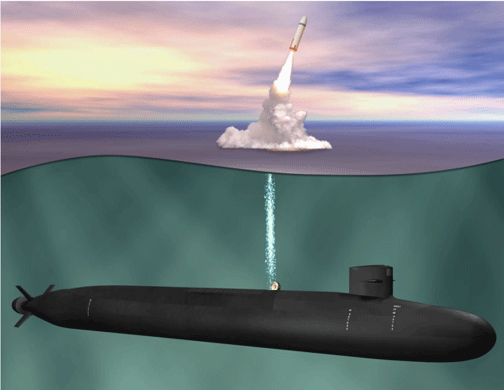
- HMS Vanguard is reported to have sailed into the Atlantic earlier this week
- It is expected to test-fire a Trident missile 3,500 miles from the US
Daily Mail, By CHRIS JEWERS, 2 February 2024
Britain is primed to test a Trident nuclear missile for the first time since 2016 amid growing fears of a global conflict, according to reports.
Officials are said to have issued a warning to shipping in the region of the test as nuclear submarine HMS Vanguard sailed into the Atlantic earlier this week.
The test will be the first time the UK has test fired a Trident missile since a botched launch in 2016 on sister sub HMS Vengeance which left the navy red-faced.
HMS Vanguard has undergone a seven-year refit in Plymouth since then, and is now set to fire an unnamed missile, The Sun reports.
The tests are understood to be the final hurdle the £4 billion submarine must clear in order to re-enter service as part of the UK’s nuclear deterrent force. ……..
HMS Vanguard has been hailed as a 491-foot ‘colossus’ that can patrol under the surface of the seas for months at a time.
On board, she can carry up to 16 Trident 2 D5 missiles, a submarine-launched ballistic missile (SLBM), built by American firm Lockheed Martin.
They also share the name with the UK’s nuclear programme (the Trident nuclear programme) the purpose of which is to ‘deter the most extreme threats to our national security and way of life, which cannot be done by other means,’ according to the mission statement by the Ministry of Defence.
Each missile is armed with British-made thermonuclear warheads that are 20 times more powerful than the Oppenheimer-developed weapons dropped during the Second World War on the Japanese cities of Hiroshima and Nagasaki.
The warheads are delivered by multiple independently targetable re-entry vehicles (MIRVs), or – in other words – exoatmospheric ballistic missiles.
Citing a Royal Navy source, The Sun said Britain’s nuclear submarines can carry more explosive power than was dropped in the entirety of the Second World War.
In the coming test, HMS Vanguard is expected to launch a single missile that will not be armed with nuclear warheads, about 55 miles off the US coast……………………
The missiles are designed to blast to the edge of space and track their position against the stars, before re-entering the atmosphere (hence exoatmospheric), plummeting to earth and raining warheads down on its target.
The maximum range of the missile is 12,000km (7,400 miles), which is roughly the distance from London to Indonesia one way, or Hawaii the other.
A warning was issued by the US National Geospatial Intelligence Agency to shipping that could cross the missile’s expected course, The Sun said.
The ‘hazardous operations’ warning also plots areas closer to the launch site where debris is expected to fall into the ocean…………………………….
Reports of the test come amid rising fears that Britain and her allies could be pulled into a conflict in the coming years.……………………………………………………………………
The test also comes after it was reported last year that a Royal Navy nuclear submarine and its crew were mere moments from being crushed after its depth gauge suddenly failed.
Reports said the Vanguard class sub, which had been carrying 140 crew and Trident 2 missiles, suffered the huge malfunction while on a mission in the Atlantic.
It caused a frantic scrabble with engineers managing to stop the submarine and its nuclear reactor from plunging further and being crushed by underwater pressure just minutes before disaster struck. …………………………………………………… more https://www.dailymail.co.uk/news/article-13034029/Britain-test-fire-Trident-missile.html
In waging war on the UN refugee agency, the West is openly siding with Israeli genocide

Extraordinarily, the western media have done Israel’s PR work for it, happily focusing more attention on Israel’s claims about a handful of UNRWA staff than it has on the World Court’s decision to put Israel on trial for genocide.
By Jonathan Cook, Feb 1, 2024, – https://johnmenadue.com/in-waging-war-on-the-un-refugee-agency-the-west-is-openly-siding-with-israeli-genocide/
Israel has long plotted the downfall of UNRWA, aware that it is one of the biggest obstacles to eradicating the Palestinians as a people.
There is an important background to the decision by the United States and other leading western states, the UK among them, to freeze funding to the United Nations’ Relief and Works Agency (UNRWA), the main channel by which the UN disseminates food and welfare services to the most desperate and destitute Palestinians.
The funding cut – which has been also adopted by Germany, France, Japan, Switzerland, Canada, Netherlands, Italy, Australia and Finland – was imposed even though the International Court of Justice (ICJ) ruled on Friday that Israel may be committing genocide in Gaza. The World Court judges quoted at length UN officials who warned that Israel’s actions had left almost all of the enclave’s 2.3 million inhabitants on the brink of a humanitarian catastrophe, including famine.
The West’s flimsy pretext for what amounts to a war on UNRWA is that Israel claims 12 local UN staff – out of 13,000 – are implicated in Hamas’ break-out from the open-air prison of Gaza on October 7. The sole evidence appears to be coerced confessions, likely extracted through torture, from Palestinian fighters captured by Israel that day.
The UN immediately sacked all the accused staff, seemingly without due process. We can assume that was because the refugee agency was afraid its already threadbare lifeline to the people of Gaza, as well as millions of other Palestinian refugees across the region – in the West Bank, Lebanon, Jordan and Syria – would be further threatened. It need not have worried. Western donor states cut their funding anyway, plunging Gaza deeper into calamity.
They did so without regard to the fact their decision amounts to collective punishment: some 2.3 million Palestinians in Gaza face starvation and the spread of lethal disease, while another 4 million Palestinian refugees across the region are at imminent risk of losing food, health care and schooling.
According to law professor Francis Boyle, who filed a genocide case for Bosnia at the World Court some two decades ago, that shifts most of these western states from their existing complicity with Israel’s genocide (by selling arms and providing aid and diplomatic cover) into direct and active participation in the genocide, by violating the 1948 Genocide Convention’s prohibition on “deliberately inflicting on the group [in this case, Palestinians] conditions of life calculated to bring about its physical destruction in whole or in part.”
The World Court is investigating Israel for genocide. But it could easily widen its investigation to include western states. The threat to UNRWA needs to be seen in that light. Not only is Israel thumbing its nose at the World Court and international law, but states like the US and UK are doing so too, by cutting their funding to the refugee agency. They are slapping the court in the face, and indicating that they are four-square behind Israel’s crimes, even if they are shown to be genocidal in nature.
Israel’s creature
The following is the proper context for understanding what is really going on with this latest attack on UNRWA:
The World Court is investigating Israel for genocide. But it could easily widen its investigation to include western states. The threat to UNRWA needs to be seen in that light. Not only is Israel thumbing its nose at the World Court and international law, but states like the US and UK are doing so too, by cutting their funding to the refugee agency. They are slapping the court in the face, and indicating that they are four-square behind Israel’s crimes, even if they are shown to be genocidal in nature.
1 The agency was created in 1949 – decades before Israel’s current military slaughter in Gaza – to provide for the basic needs of Palestinian refugees, including essential food provision, health care and education. It has an outsize role in Gaza because most of the Palestinians living there lost, or are descended from families that lost, everything in 1948. That was when they were ethnically cleansed by the fledgling Israeli military from most of Palestine, in an event known to Palestinians as the Nakba, or Catastrophe. Their lands were turned into what Israel’s leaders described as an exclusively “Jewish state”. The Israeli army set about destroying the Palestinians’ towns and villages inside this new state so that they could never return.
2. UNRWA is separate from the UN’s main refugee agency, the UNHCR, and deals only with Palestinian refugees. Although Israel does not want you to know it, the reason for there being two UN refugee agencies is because Israel and its western backers insisted on the division back in 1948. Why? Because Israel was afraid of the Palestinians falling under the responsibility of the UNHCR’s forerunner, the International Refugee Organisation. The IRO was established in the immediate wake of the Second World War in large part to cope with the millions of European Jews fleeing Nazi atrocities.
Israel did not want the two cases treated as comparable, because it was pushing hard for Jewish refugees to be settled on lands from which it had just expelled Palestinians. Part of the IRO’s mission was to seek the repatriation of European Jews. Israel was worried that very principle might be used both to deny it the Jews it wanted to colonise Palestinian land and to force it to allow the Palestinian refugees to return to their former homes. So in a real sense, UNRWA is Israel’s creature: it was set up to keep the Palestinians a case apart, an anomaly.
Prison camp
3. Nonetheless, things did not go exactly to plan for Israel. Given its refusal to allow the refugees to return, and the reluctance of neighbouring Arab states to be complict in Israel’s original act of ethnic cleansing, the Palestinian population in UNRWA’s refugee camps ballooned. They became an especial problem in Gaza, where about two-thirds of the population are refugees or descended from refugees. The tiny coastal enclave did not have the land or resources to cope with the rapidly expanding numbers there. The fear in Israel was that, as the plight of the Palestinians of Gaza became more desperate, the international community would pressure Israel into a peace agreement, allowing for the refugees’ return to their former homes.
That had to be stopped at all costs. In the early 1990s, as the supposed Oslo “peace process” was being unveiled, Israel began penning the Palestinians of Gaza inside a steel cage, surrounded by gun towers. Some 17 years ago, Israel added a blockade that prevented the population’s movement in and out of Gaza, including via the strip’s coastal waters and its skies. The Palestinians became prisoners in a giant concentration camp, denied the most basic links to the outside world. Israel alone decided what was allowed in and out. An Israeli court later learnt that from 2008 onwards the Israeli military put Gaza on what amounted to a starvation diet by restricting food supplies.
There was a strategy here that involved making Gaza uninhabitable, something the UN started warning about in 2015. Israel’s game plan appears to have gone something like this:
By making Palestinians in Gaza ever more desperate, it was certain that militant groups like Hamas willing to fight to liberate the enclave would gain in popularity. In turn, that would provide Israel with the excuse both to further tighten restrictions on Gaza to deal with a “terrorism threat”, and to intermittently wreck Gaza in “retaliation” for those attacks – or what Israeli military commanders variously called “mowing the grass” and “returning Gaza to the Stone Age”. The assumption was that Gaza’s militant groups would exhaust their energies managing the constant “humanitarian crises” Israel had engineered.
At the same time, Israel could promote twin narratives. It could say publicly that it was impossible for it to take responsibility for the people of Gaza, given that they were so clearly invested both in Jew hatred and terrorism. Meanwhile, it would privately tell the international community that, given how uninhabitable Gaza was becoming, they urgently needed to find a solution that did not involve Israel. The hope was that Washington would be able to arm-twist or bribe neighbouring Egypt into taking most of Gaza’s destitute population.
Mask ripped off
4. On October 7, Hamas and other militant groups achieved what Israel had assumed was impossible. They broke out of their concentration camp. The Israeli leadership’s shock is not just over the bloody nature of the break-out. It is that on that day Hamas smashed Israel’s entire security concept – one designed to keep the Palestinians crushed, and Arab states and the region’s other resistance groups hopeless. Last week, in a knockout blow, the World Court agreed to put Israel on trial for genocide in Gaza, collapsing the moral case for an exclusive Jewish state built on the ruins of the Palestinians’ homeland.
The judges’ near-unanimous conclusion that South Africa has made a plausible case for Israel committing genocide should force a reassessment of everything that went before. Genocides don’t just emerge out of thin air. They happen after long periods in which the oppressor group dehumanises another group, incites against it and abuses it. The World Court has implicitly conceded that the Palestinians were right when they insisted that the Nakba – Israel’s mass dispossession and ethnic cleansing operation of 1948 – never ended. It just took on different forms. Israel became better at concealing those crimes, until the mask was ripped off after the October 7 break-out.
5. Israel’s efforts to get rid of UNRWA are not new. They date back many years. For a number of reasons, the UN refugee agency is a thorn in Israel’s side – and all the more so in Gaza. Not least, it has provided a lifeline to Palestinians there, keeping them fed and cared for, and providing jobs to many thousands of local people in a place where unemployment rates are among the highest in the world. It has invested in infrastructure like hospitals and schools that make life in Gaza more bearable, when Israel’s goal has long been to make the enclave uninhabitable. UNRWA’s well-run schools, staffed by local Palestinians, teach the children their own history, about where their grandparents once lived, and of Israel’s campaign of dispossession and ethnic cleansing against them. That runs directly counter to the infamous Zionist slogan about the Palestinians’ identity-less future: “The old will die and the young forget.”
Divide and rule
But UNRWA’s role is bigger than that. Uniquely, it is the sole agency unifying Palestinians wherever they live, even when they are separated by national borders and Israel’s fragmentation of the territory it controls. UNRWA brings Palestinians together even when their own political leaders have been manipulated into endless factionalism by Israel’s divide and rule policies: Hamas is nominally in charge in Gaza, while Mahmoud Abbas’ Fatah pretends to run the West Bank.
In addition, UNRWA keeps alive the moral case for a Palestinian right of return – a principle recognised in international law but long ago abandoned by western states.
Even before October 7, UNRWA had become an obstable that needed removing if Israel was ever to ethnically cleanse Gaza. That is why Israel has repeatedly lobbied to stop the biggest donors, especially the US, funding UNRWA. Back in 2018, for example, the refugee agency was plunged into an existential crisis when President Donald Trump acquiesced to Israeli pressure and cut all its funding. Even after the decision was reversed, the agency has been limping along financially.
6. Now Israel is in full attack mode against the World Court, and has even more to gain from destroying UNRWA than it did before. The freeze in funding, and the further weakening of the refugee agency, will undermine the support structures for Palestinians generally. But in Gaza’s case, the move will specifically accelerate famine and disease, making the enclave uninhabitable faster.
But it will do more. It will also serve as a stick with which to beat the World Court as Israel tries to fight off the genocide investigation. Israel’s barely veiled claim is that 15 of the International Court of Justice’s 17 judges fell for South Africa’s supposedly antisemitic argument that Israel is committing genocide. The court quoted extensively from UN officials, including the head of UNRWA, that Israel was actively engineering an unprecedented humanitarian crisis in Gaza. Now, as former UK ambassador Craig Murray notes, the coerced confessions against 12 UNRWA staff serve to “provide a propaganda counter-narrative to the ICJ judgment, and to reduce the credibility of UNRWA’s evidence before the court”.
Extraordinarily, the western media have done Israel’s PR work for it, happily focusing more attention on Israel’s claims about a handful of UNRWA staff than it has on the World Court’s decision to put Israel on trial for genocide.
Equally a boon to Israel is the fact that leading western states have so quickly pinned their colours to the mast. The funding freeze cements their fates to Israel’s. It sends a message that they will stand with Israel against the World Court, whatever it decides. Their war on UNRWA is intended as an act of collective intimidation directed towards the court. It is a sign that the West refuses to accept that international law applies to it, or its client state. It is a reminder that western states refuse any restraint on their freedom of action – and that it is Israel and its sponsors who are the true rogue states.
NATO chief says more war is way to secure lasting peace in Ukraine
30 Jan 2024 https://www.sott.net/article/488375-NATO-chief-says-more-war-is-way-to-secure-lasting-peace-in-Ukraine
More weapons and ammunition to Kiev is the “path to peace,” according to the bloc’s Secretary General Jens Stoltenberg
Any negotiations between Moscow and Kiev about a peace agreement are “inextricably” linked to the situation on the battlefield, NATO Secretary General Jens Stoltenberg has stated, insisting that the bloc must send even more military aid to Kiev.
Speaking in Washington at a joint press conference with US Secretary of State Antony Blinken, Stoltenberg said that aid to Ukraine is“not charity”but is an“investment into our own security.”
He also shared his view that, in order to achieve a lasting peace in Ukraine, the West needs to ramp up its support for Kiev and send it more weapons and ammunition, proclaiming that “weapons to Ukraine is the path to peace
The comments come as the future of Western aid to Ukraine looks increasingly uncertain, with many of Kiev’s backers running out of resources to help the country. The Ukrainian leadership is also reportedly losing hope of success against Russia, without Western support.
Stoltenberg also argued that a Ukrainian surrender could not be considered a “just peace,” which, he prescribed, can only be reached by having Russian President Vladimir Putin “realize that he will not get what he wants on the battlefield.”
Comment: The phrase that aid to Ukraine is “not charity” but is an “investment into our own security is not original. Stoltenberg used at the recent WEF meeting and just a few days ago, US senator,Jeanne Shaheen, in the Boston Globe wrote:
America’s targeted assistance to Ukraine is not charity, nor is it a blank check. It is a strategic investment with oversight that bolsters US deterrence, protects democracies across Europe, and strengthens the US industrial base — including to contractors in New England.
The US senator is a member of the CFR and in the above, it is clear that what she writes above is from the same script as Stoltenberg and Blinken. It is equally clear that none of them are at all interested in what happens to Ukraine as a country or what happens to ordinary Ukrainians. To them it is a war against Russia because they see it to be a real threat to their hegemonic ‘rules based’ order. They argue by saying that allocating more money to Ukraine is also good for the US as the money in truth gets funnelled to the American military industrial complex, where many of them get serious ‘donations’.
Blinken nonetheless admitted during their press conference that the lack of foreign military aid to Kiev, especially now that Washington has run out of the military assistance it has been providing to it, has put Ukraine in a tough spot on the battlefield.
The Secretary of State reiterated the White House’s calls on Republican lawmakers in Congress to approve Joe Biden’s $60-billion additional military aid package for Kiev, which has been stuck in the House of Representatives for several months now. The GOP has refused to greenlight the bill unless Biden agrees to revise and tighten the US’ border-control laws.
Blinken stressed that it is “vital” that Congress pass the president’s supplemental budget request in order to “ensure that Ukraine knows success and Russia knows strategic failure,” noting that without US assistance, “everything that Ukrainians achieved … will be in jeopardy.“
Moscow, meanwhile, has repeatedly denounced Western military support to Ukraine, stressing that “pumping” the country with more weapons and ammunition has only served to prolong the fighting and cause more bloodshed without affecting the inevitable outcome of the conflict.
Comment: So everything that Ukrainians achieved …will be in jeopardy. He doesn’t mention what Ukraine achieved yet he likely isn’t referring to the total destruction of Ukraine, the loss of 1 – 1.5 million men, the flight abroad of 10-15 million Ukrainians and the loss of 20% of Ukrainian territory…so far, to mention a few things.
He is most likely referring to what US Senator Lindsey Graham said when he visited Kiev to reassure Zelensky that “the Ukraine war was the best money the US ever spent because we get to kill Russians!“.
Several killed in new Ukrainian shelling of Donetsk – mayor
https://www.rt.com/russia/591468-ukraine-shelling-donetsk-mayor/ 31 Jan 24
Kiev’s forces have attacked the Kalininsky District of the capital of Russia’s Donetsk People’s Republic, Aleksey Kulemzin has said
At least three people have been killed and one other wounded in a Ukrainian strike on the Russian city of Donetsk, Aleksey Kulemzin, the mayor of the capital of the Donetsk People’s Republic, has said.
The Kalininsky District in the eastern part of the city was targeted on Monday, Kulemzin wrote on Telegram.
Footage allegedly shot at the scene captured several bodies on the ground and the burning debris of a car that had been destroyed in the attack.
According to the republic’s Joint Center for Control and Coordination, eight missiles from a multiple rocket launch system were fired at Kalininsky District at around 3pm local time.
Donetsk, which is located close to Russia’s front line, has frequently been a target of Ukrainian strikes amid the conflict between Moscow and Kiev. But, earlier this month, the city of some 600,000 came under one of the worst attacks when 25 civilians were killed and 20 others wounded during a weekend bombardment of a busy market.
Moscow described the strike as “a barbaric terrorist act” carried out by Ukraine with support from the West, as it relied on weapons supplied by the US and its allies. Kiev’s actions have once again proven that the goal of Russia’s military operation in Ukraine must be achieved, the Russian Foreign Ministry has said.
RAF Lakenheath: Plans progress to bring US nuclear weapons to Suffolk – a risky target?

Matt Precey – BBC News, Suffolk, Tue, 30 January 2024
Matt Precey – BBC News, Suffolk
Tue, 30 January 2024 at 1:33 am AEDT·3-min read

Plans to deploy American nuclear weapons to an airbase in Suffolk have progressed, according to a US Department of Defence (DoD) notice.
A contract to build shelters to protect troops that would defend storage facilities at RAF Lakenheath has been awarded.
The document states the work was in preparation for the base’s “upcoming nuclear mission”.
The US Air Force (USAF) has yet to respond to a request for comment.
Matt Precey – BBC News, Suffolk
Tue, 30 January 2024 at 1:33 am AEDT·3-min read
Plans to deploy American nuclear weapons to an airbase in Suffolk have progressed, according to a US Department of Defence (DoD) notice.
A contract to build shelters to protect troops that would defend storage facilities at RAF Lakenheath has been awarded.
The document states the work was in preparation for the base’s “upcoming nuclear mission”.
The US Air Force (USAF) has yet to respond to a request for comment.
The Ministry of Defence said there was a longstanding agreement among NATO partners not to comment on the location of nuclear weapons.
In March 2023, a document from the US Office of the Under Secretary of Defense disclosed how $50m (£39m) had been earmarked to build a facility known as a “Surety Dormitory” at RAF Lakenheath.
This phrase is understood to refer to nuclear weapons storage……………………………………………………….
Thermonuclear bomb
This would be the first time in more than 15 years nuclear weapons have been deployed on British soil.
In 2008, the BBC reported the bombs had been removed from RAF Lakenheath, which houses 4,000 service personnel and more than 1,500 British and US civilians.
The base is currently home to the USAF’s 48th Fighter Wing, the only unit in Europe which operates both the F-15E Eagle and the F-35A Lighting II fighter aircraft.
Reports from the US indicate the newer F-35A had been flight tested to use the latest variant of the B61-12 thermonuclear bomb, which paved the way for the aircraft to begin carrying such weapons.
According to the defence publication Janes, B61-12 was capable of an explosive power (known as a yield) of up to 340 kilotons, or more than twenty times the power of the Hiroshima bomb.
The Campaign for Nuclear Disarmament’s general secretary, Kate Hudson, said: “These documents highlight plainly that an ‘upcoming nuclear mission’ will be stationed at RAF Lakenheath – confirming what we have strongly suspected since November 2022 – that US nuclear weapons are returning to Britain.”
“It’s shameful that both the US and UK governments continue to take the public for fools on this serious matter – refusing to give us crucial information about our security,” she added.
Ms Hudson claimed it escalated the dangers and had “made us a nuclear target.”
Documents unambiguously state ‘incoming nuclear mission’ to Britain
30 Jan 24 https://cnduk.org/documents-unambiguously-state-incoming-nuclear-mission-to-britain/
Recently reported documents add further evidence that the US is planning to deploy nuclear weapons to Britain, with CND forwarding its concerns to Suffolk Council.
The files describes “Stationary and Mobile Guard Shacks” which will be constructed at RAF Lakenheath for ballistic protection for the 48th Security Forces Squadron – who are attached to the 48th Fighter Wing based at Lakenheath. It notes that the shacks are needed for the “upcoming nuclear mission” of the 48th SFS.
The document dates from 29 September 2023, a month after it was reported that the US Air Force plans to build a 144-bed “surety dormitory” at Lakenheath. “Surety” is the term used by the US government and military to refer to the handling of nuclear weapons.
In November 2023, CND’s lawyers wrote to West Suffolk Council insisting that the planning rights used to build the dormitory are incorrect and that it needs to be subject to an environmental impact assessment. In light of the recent files we have again written to the Council, to draw attention to the fact that it “suggests unambiguously that nuclear weapons will be stationed at RAF Lakenheath.”
CND General Secretary Kate Hudson said:
“These documents highlight plainly that an ‘upcoming nuclear mission’ will be stationed at RAF Lakenheath – confirming what we have strongly suspected since April 2022 – that US nuclear weapons are returning to Britain. It’s shameful that both the US and UK governments continue to take the public for fools on this serious matter – refusing to give us crucial information about our security. This deployment has been in the works for some time, prior to Russia’s deployment of its own nuclear weapons to Belarus. So far from making us safer, this deployment has escalated the dangers, brought Russian nukes to Europe, and made us a nuclear target.”
US reportedly planning to station nuclear weapons in Britain for first time in 15 years
THE UNITED STATES is reportedly planning to station nuclear warheads in Britain that are three times as powerful as 1945’s Hiroshima bomb.
Pentagon documents seen by the Telegraph indicate that the weapons could be stationed at RAF Lakenheath in Suffolk, where the US previously stored nuclear missiles until 2008.
The papers show procurement contracts for a new facility at the air base.
A Ministry of Defence spokesperson said: “It remains a longstanding UK and Nato policy to neither confirm nor deny the presence of nuclear weapons at a given location.”
The documents have surfaced amid concerns of an escalation between Nato countries and Russia as Vladimir Putin continues his war on Ukraine.
Last week, Nato announced its biggest drills since the cold war, involving deployment of 90,000 military personnel to central and eastern Europe.
International Coalition to Stop Genocide in Palestine Welcomes World Court’s Order

By the International Coalition To Stop Genocide In Palestine, Popular Resistance., January 26, 2024 https://popularresistance.org/international-coalition-to-stop-genocide-in-palestine-welcomes-todays-icj-order/—
Demands Its Implementation.
The ICGSP encourages governments and global social movements to demand that provisional measures are enforced immediately.
In its provisional ruling issued today on the South African Genocide Convention case against Israel, the International Court of Justice (ICJ—also known as the World Court) demanded Israel stop killing civilians and destroying civilian infrastructure and medical facilities; prevent and punish incitement to genocide by its top officials; and permit the delivery of humanitarian aid to Gaza. The International Coalition to Stop Genocide in Palestine (ICSGP) applauds the Court’s Order as a crucial first step toward forcing Israel and its primary sponsor and strongest political ally—the United States—to end the months-long brutal assault on Gaza, and the decades-long denial to Palestinians of their rights to self-determination and return.
However, the ICSGP also recognizes that Israeli and U.S. government officials have made repeated official declarations in the past week making clear their plan to ignore the ICJ’s legally binding ruling and rejecting the Court’s process as illegitimate, and that the U.S. has been threatening world governments with sanctions and war—a promise it is making good on already by bombing Yemen—for opposing the ongoing genocide. The ICSGP also recognizes that numerous powerful state allies of the U.S. and Israel, including Germany and Canada, have already made clear their intent to back Israel against an ICJ finding of genocide. The dangerous rejection by the United States, Israel and their allies of this process—which was set up through the United Nations precisely to prevent genocide—undermines the legitimacy of that institution and in particular the U.N. Security Council, where the U.S. has long used its veto power as a tool to promote war and genocide. The ICSGP calls upon social movements to demand that world governments uphold international law and protect the integrity of the United Nations by ensuring that the ICJ’s provisional measures are immediately enforced, and to hold Israeli war criminals and their powerful U.S. accomplices accountable for genocide.
The ICSGP stands in full solidarity with its Palestinian coalition members, who have emphasized in their own statements today the need for governments and social movements around the world to double down in their efforts to bring the ongoing genocide in Gaza to an end. Dr. Luqa AbuFarah, North America Coordinator for the Palestinian Boycott, Divestment and Sanctions National Committee (BNC), an ICSGP member organization, states:
“It’s clear we have a moral obligation to take action and end our government’s complicity with Israel’s Gaza genocide. We must have the courage to speak out and take action to advance the struggle for justice. We must end US military funding to Israel which at $3.8 billion USD a year could instead provide more than 450,000 households with public housing for a year or pay for 41,490 elementary school teachers. I also hope that every person outraged with the blatant disregard for Palestinian life will join and escalate our BDS Campaigns and make sure companies know that complicity with Israeli apartheid and genocide is unacceptable. We must take action now more than ever!
ICSGP, together with numerous legal and human rights organizations including coalition members The PAL Commission on War Crimes and The Global Legal Alliance for Palestine, held press conferences in New York and Chicago following the Court’s Order on the request for the indication of provisional measures this morning, expressing gratitude to South Africa for its steadfast support, and calling on all organizations and countries to support South Africa’s legal actions against the Israeli military campaign.”
Lamis Deek, cofounder the PAL Commission on War Crimes and convener of the Global Legal Alliance for Palestine, states:
“This historic decision changes international and domestic approaches—military, legal, and political—to stopping the genocide in Palestine. This verdict profoundly reshapes the geopolitical and legal topography, regardless of whether Israel complies or not. Following the Court’s decision we must issue calls on state parties to the ICJ and the Genocide Convention as regards their compliance obligations, and address our legal colleagues and our communities regarding the next steps we think will be most critical on the heels of this decision.
The brutal Israeli genocide and torture in Gaza, alongside the targeted assassinations, destruction of civilian infrastructure including all of Gaza’s hospitals and universities, blocking of aid, and use of starvation and spread of disease as a war tactic, constitute a grotesque series of the highest war crimes. We commend the Court’s positive decision. The question now is how to deal with the anticipated US-Israeli obstruction of that decision.”
1 This Month
26 September – International Day for the Total Elimination of Nuclear Weapons





PLEASE OPPOSE HR 8255 AND S.3639 – bills would accelerate satellite deployment, with no environmental review or safeguards – https://ncstd5li.quorum.us/campaign/169331/
To see nuclear-related stories in greater depth and intensity – go to https://nuclearinformation.wordpress.com
-
Archives
- September 2026 (313)
- August 2026 (330)
- July 2026 (355)
- June 2026 (287)
- May 2026 (306)
- April 2026 (356)
- March 2026 (251)
- February 2026 (267)
- January 2026 (308)
- December 2025 (358)
- November 2025 (359)
- October 2025 (375)
-
Categories
- 1
- 1 NUCLEAR ISSUES
- business and costs
- climate change
- culture and arts
- ENERGY
- environment
- health
- history
- indigenous issues
- Legal
- marketing of nuclear
- media
- opposition to nuclear
- PERSONAL STORIES
- politics
- politics international
- Religion and ethics
- safety
- secrets,lies and civil liberties
- spinbuster
- technology
- Uranium
- wastes
- weapons and war
- Women
- 2 WORLD
- ACTION
- AFRICA
- Atrocities
- AUSTRALIA
- Christina's notes
- Christina's themes
- culture and arts
- Events
- Fuk 2022
- Fuk 2023
- Fukushima 2017
- Fukushima 2018
- fukushima 2019
- Fukushima 2020
- Fukushima 2021
- general
- global warming
- Humour (God we need it)
- Nuclear
- RARE EARTHS
- Reference
- resources – print
- Resources -audiovicual
- Weekly Newsletter
- World
- World Nuclear
- YouTube
-
RSS
Entries RSS
Comments RSS

