Biden disparages Netanyahu in private but hasn’t significantly changed U.S. policy toward Israel and Gaza
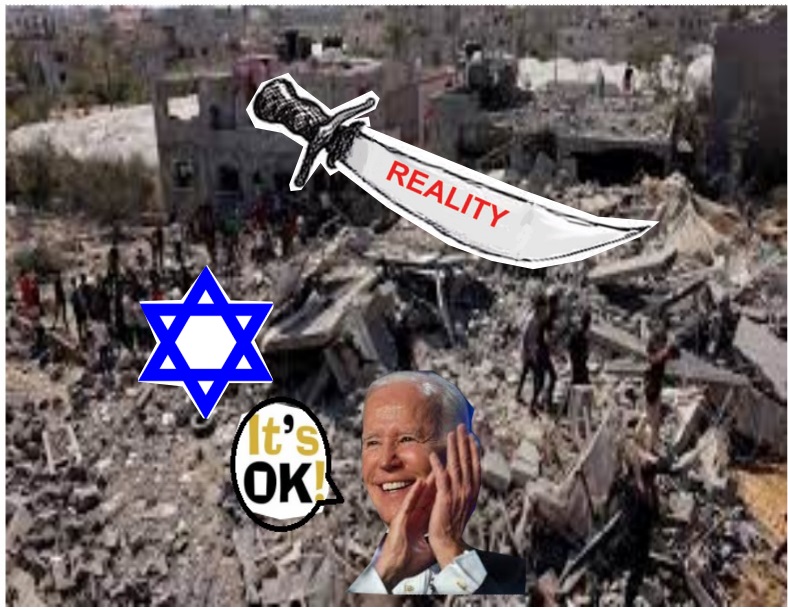
As the reported Palestinian death toll in the Gaza Strip reaches 28,000, the president continues to believe that unequivocally supporting Israel is the right policy.
Yet, even as Biden has escalated his rhetoric, he is not yet prepared to make significant policy changes, officials said. He and his aides continue to believe his approach of unequivocally supporting Israel is the right one.
As the reported Palestinian death toll in the Gaza Strip reaches 28,000, the president continues to believe that unequivocally supporting Israel is the right policy.
NBC News, Feb. 12, 2024, By Carol E. Lee, Jonathan Allen, Peter Nicholas and Courtney Kube
WASHINGTON — President Joe Biden has been venting his frustration in recent private conversations, some of them with campaign donors, over his inability to persuade Israel to change its military tactics in the Gaza Strip, and he has named Prime Minister Benjamin Netanyahu as the primary obstacle, according to five people directly familiar with his comments.
Biden has said he is trying to get Israel to agree to a cease-fire, but Netanyahu is “giving him hell” and is impossible to deal with, said the people familiar with Biden’s comments, who all asked not to be named.
“He just feels like this is enough,” one of the people said of the views expressed by Biden. “It has to stop.”
Biden has in recent weeks spoken privately about Netanyahu, a leader he has known for decades, with a candor that has surprised some of those on the receiving end of his comments, people familiar with them said. His descriptions of his dealings with Netanyahu are peppered with contemptuous references to Netanyahu as “this guy,” these people said. And in at least three recent instances, Biden has called Netanyahu an “asshole,” according to three of the people directly familiar with his comments……………………………………………………………………………………………………………………….
Yet, people familiar with Biden’s private comments said he has told them he believes it would be counterproductive for him to be too harsh on Netanyahu publicly.
Biden’s frustrations with Netanyahu have also not led to a major policy shift, but his administration has begun to consider such options. Two weeks ago, officials told NBC News that the administration was discussing delaying or slowing U.S. weapons sales to Israel as leverage to get Netanyahu to dial down Israeli military operations in Gaza and do more to protect civilians………………….
Yet, even as Biden has escalated his rhetoric, he is not yet prepared to make significant policy changes, officials said. He and his aides continue to believe his approach of unequivocally supporting Israel is the right one…………………………
“I’m a Zionist,” Biden said, reiterating his views that Hamas must be destroyed and that Israel must be protected, according to the supporter……………………………………………….. https://www.nbcnews.com/news/investigations/biden-disparages-netanyahu-private-hasnt-changed-us-policy-israel-rcna138282
EU’s top diplomat slams US for sending arms to Israel as Gaza deaths mount
Politico, FEBRUARY 12, 2024 ,BY PAULA ANDRÉS
Western leaders have decried Israel’s planned Rafah invasion plan, but PM Netanyahu “doesn’t listen to anyone,” Josep Borrell says.
EU foreign affairs chief Josep Borrell on Monday called on the international community, and particularly the U.S., to stop providing arms to Israel in light of the growing number of civilians being killed in Gaza.
“Everybody goes to Tel Aviv begging please protect civilians, don’t kill so many. How many is too many?” Borrell said during a meeting of EU ministers.
If the international community is worried about the death toll, “maybe they have to think about the provision of arms,” he said. Borrell, the EU’s top diplomat, also cited a Monday Dutch court ruling ordering the Netherlands government to halt shipments of components to Israel for F-35 fighter jets……………….
Borrell noted the U.S. had taken a similar decision on arms supplies to Israel in its 2006 conflict with Lebanon “because Israel didn’t want to stop the war; exactly the same thing that happens today.”……………………..
Western leaders have decried Israel’s invasion plan, but Israeli Prime Minister Benjamin Netanyahu “doesn’t listen to anyone,” Borrell said. “Where are they going to evacuate [Palestinians]?” he asked. “To the moon?”
UN agency
The EU ministers voiced support for the United Nations agency for Palestinian refugees (UNRWA), which has recently taken fire amid Israeli allegations that members of its staff abetted the October 7 Hamas attacks.
“Many member states stated there is no alternative for Gaza and that we must prevent funding gaps,” said Belgium’s Minister of Development Cooperation Caroline Gennez.
Gennez said there was an “agreement amongst the member states that full transparency is needed from all sides,” adding that details of the Israeli reports haven’t been shared with donor countries or the UNRWA itself.
“It’s not a secret that the Israeli government wants to get rid of UNRWA,” Borrell said,
but “there’s only one way in which the agency can be dissolved […] through the creation of two states.”
Several EU countries and international donors have suspended funding to UNRWA since Israel’s allegations, cutting the agency’s budget by more than half.
For UNRWA chief Philippe Lazzarini, the agency’s collapse would be “short-sighted” and would not contribute to the recent ruling from the International Court of Justice to ensure humanitarian aid in Gaza. “The coming days will tell us if we will be able to continue to operate in an extraordinarily challenging environment,” he said.
Lazzarini added that Sunday was “the first time the U.N. could not operate with a minimum of protection,” and deplored the looting of trucks filled with aid for Palestinians at the border.
The European Commission has yet to decide whether it will provide an €82 million payment to the U.N. agency by the end of the month, as two investigations are underway. https://www.politico.eu/article/top-eu-diplomat-josep-borrell-united-states-sending-arms-to-israel/
Devonport Dockyard nuclear sub dismantling will be hit by delays, new report predicts
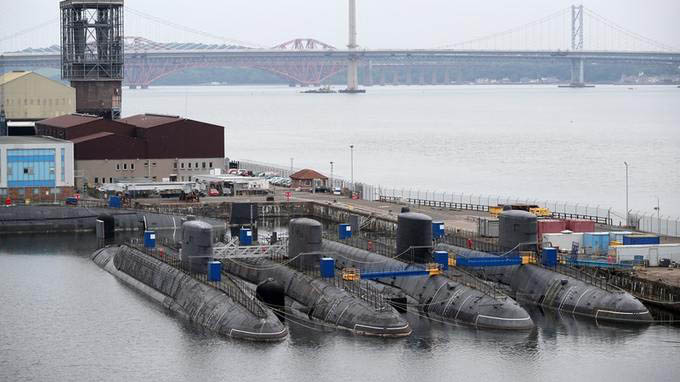
Nuclear Information Service expects no quick fix for removal of 15 decommissioned submarines laid up at Devonport
William Telford, Business Editor, 15 Feb 24 Plymouth Live
The dismantling of 15 decommissioned nuclear subs at Devonport Royal Dockyard is likely to hit delays, according to a new report. The briefing document published by the independent Nuclear Information Service says a history of infrastructure work at the Plymouth facility means “delays are more likely to materialise than not”.
The report said upgrades to 14 and 15 Docks and the Submarine Refit Complex at Devonport are overdue and progress on submarine dismantling is “on hold” while the Government focuses on its £298m “demonstrator” project to fully dismantle HMS Swiftsure at Rosyth, forecast to be complete at the end of 2026.
The Ministry of Defence told Plymouth Live it aims to dismantle the nuclear submarines at Devonport “as soon as practicably possible”. It said the Swiftsure project will “inform and refine” the dismantling process for subsequent submarines and provide more certainty on the dismantling schedule for future submarines and remains on schedule for completion by the original target date of 2026.
The Nuclear Information Service’s briefing report on Devonport Royal Dockyard gives an overview of the facility and its role in servicing the UK’s submarine fleet, including its nuclear-armed submarines. The report said: “The 15 out-of-service nuclear submarines stored at Devonport, and a further seven that are at Rosyth, together comprise every nuclear submarine the Navy has ever fielded.
“Aside from the long-overdue upgrades to 14 and 15 Docks, and the Submarine Refit Complex, progress on submarine dismantling is on hold while the Government focuses on its ‘demonstrator’ project to fully dismantle HMS Swiftsure. This work is being undertaken at Rosyth and is currently forecast to be complete at the end of 2026 at a cost of £298m.
“Three more submarines at Rosyth have had low-level waste removed from them, but it is not clear if work to defuel the nine submarines at Devonport that are still carrying nuclear fuel will begin before completion of the demonstrator project.
In 2016 the MoD estimated that fully dismantling 27 submarines would cost £2.4bn. Although the risk to in-service submarine availability from delays to submarine dismantling and defuelling is lower than from delays to the maintenance schedule, the history of problems with the project and with infrastructure work at Devonport suggests that delays are more likely to materialise than not.”…………………………..more https://www.plymouthherald.co.uk/news/plymouth-news/devonport-dockyard-nuclear-sub-dismantling-9098888—
What are Russia’s Top 5 Anti-Satellite Systems?
Sputnik, 15 Feb 24
Russia has effective means to thwart adversary satellites, including arms based on new physical principles. What are they?
Moscow trashed the groundless rumors of its alleged efforts to deploy a nuclear anti-satellite system in space on February 15.
A day earlier, mainstream US media claimed that Washington had informed Congress and its European allies about Russia’s work on a new, space-based nuclear weapon designed to undermine the US satellite network.
A new bugaboo about Russia’s supposed plans to destroy American satellites with nuclear arms is aimed at ramming a $60 billion funding package for Ukraine through US Congress, military analyst and editor-in-chief of the National Defense magazine Igor Korotchenko told Sputnik on Thursday. Even though the package in question was earlier passed in the US Senate as part of a $95 billion bill, the chances of the House approving the legislation is considered slim.
According to Korotchenko, Russia has cheaper and more effective means of anti-satellite warfare than those that Washington accuses it of developing.
This is a question of approaches. The fact is that the deployment of nuclear weapons in space is ineffective in terms of its use, especially given that Russia has much simpler and cheaper means to disable, in the event of hostilities, a significant part of the US satellite constellation,” the expert underscored.
Sputnik has taken a look at the systems that could do the job.
The Nudol System
On November 15, 2021, Moscow conducted a direct-ascent hit-to-kill anti-satellite (ASAT) test using the A-235 Nudol anti-satellite system. The test shot down an old Soviet reconnaissance satellite launched back in 1982.
The A-235 Nudol is an improved modification of the A-135 Amur strategic missile defense system. The missile can hit a target at a distance of up to 1,500 kilometers (versus 850 kilometers for the A-135), while its interception speed is increased to Mach 10 (versus Mach 3.5 for the A-135).
In contrast to its predecessor, the A-235 may use kinetic force, not nuclear or high-explosive fragmentation, to destroy the target.
The development of the A-235 Nudol started in 1985-1986 and was carried out in compliance with international ballistic missile agreements existing at the time. The weapon was designed to become the first Soviet mobile missile defense system capable of intercepting intercontinental-range missiles, spacecraft and satellites operating at high orbits.
Immediately after the Cold War, the development of the A-235 was suspended and restarted in 2011 by Almaz-Antey, nine years after the Bush administration unilaterally terminated the Antiballistic Missile Treaty (ABM) in 2002.
The system has been tested several times since 2014; however, in November 2021 the missile was fired at a specific moving space target and eventually destroyed it, causing a fuss in the Pentagon.
Nanosatellites: Nivelir, Burevestnik and Numismat
The development of Russia’s secretive project Nivelir (“Leveler”) has reportedly been carried out by the Central Scientific Research Institute of Chemistry and Mechanics Named after D.I. Mendeleyev since 2011.
The endeavor supposedly envisaged building small satellites designed to inspect other satellites in space. The first three satellite-inspectors were reportedly attached to three communications satellites launched between 2013 and 2015.
According to other sources, Russia has been experimenting with satellite inspectors since 2017. The satellites maneuvered in orbit, moving away from each other and then getting closer. In 2019, the Cosmos-2535 and Cosmos-2536 devices were launched. Their goal was to study the impact of “artificial and natural factors of outer space” on Russia’s space devices and to develop “technology for their protection.”…………………………………..
The Kontakt System
The USSR started to develop the 30P6 Kontakt (“Contact”) system in 1983. The 79М6 munition – a three-stage rocket – was supposed to be mounted on the MiG-31D fighter-interceptor.
Launched from an airplane at an altitude of 15 kilometers the munition was designed to fire a fragmentation warhead into space. It was assumed that the Kontakt system would be a stealth and inexpensive means of destroying enemy satellites……………………………………………………….
The Tirada Electronic Warfare System
According to the Russian Ministry of Defense, the Tirada-2S radio-electronic communication suppression system is capable of electronically jamming satellite communications with complete disabling. In this case, satellites can be deactivated directly from the Earth’s surface.
There is little information about the system’s specifications in the public domain. …………………………………………………………………………………..
The Peresvet Laser System
On March 1, 2018, Russian President Vladimir Putin first mentioned Russia’s laser weapon for air defense and anti-satellite warfare, the Peresvet, during his address to the Federal Assembly………………………………………….
The aforementioned systems are just a few of those potentially developed by the Russian military-industrial complex, indicating that Russia is capable of using its decades-long scientific and technological potential to ensure the nation’s security in the event of a large-scale conflict. https://sputnikglobe.com/20240215/what-are-russias-top-5-anti-satellite-systems-1116802215.html
US Gives Israel the Green Light to Kill Civilians in Rafah

US officials told POLITICO that there would be no consequences for Israel if it invades Rafah, by Dave DeCamp February 13, 2024, https://news.antiwar.com/2024/02/13/us-gives-israel-the-green-light-to-kill-civilians-in-rafah/
The US has given Israel the green light to kill civilians in Rafah despite public comments from US officials calling for Israel to come up with a plan to protect civilians in the city, which is packed with an estimated 1.5 million Palestinians.
US officials told POLITICO that the Biden administration was not planning any consequences for Israel if it went ahead with a major assault on Rafah, which would inevitably kill a huge number of civilians. “No reprimand plans are in the works, meaning Israeli forces could enter the city and harm civilians without facing American consequences,” the report reads.
White House National Security Council spokesman John Kirby made clear at a press conference on Monday that the US wasn’t thinking about cutting off Israel from military aid if it went ahead with the assault. When asked if the US has threatened to withhold aid, Kirby said, “We’re going to continue to support Israel … And we’re going to continue to make sure they have the tools and the capabilities to do that.”
President Biden is also not reconsidering his full-throated support for the Israeli slaughter in Gaza despite reports of him disparaging Israeli Prime Minister Benjamin Netanyahu in private conversations.
Congress is also on board with continuing to support the mass killing of Palestinians as the Senate voted to pass a $95 billion foreign military aid bill that includes $14 billion for Israel. Only 20 Republicans voted for the bill, but the opposition is due to the lack of a border deal, as virtually all Republicans are in favor of unconditional support for Israel, even more so than Democrats in Congress.
Rafah’s pre-war population was 275,000, meaning Palestinians displaced from other areas of the Strip increased the population fivefold. The majority of the Palestinians in the city are sheltering in tents in the streets, leaving them especially vulnerable to an Israeli attack. Israeli airstrikes on Rafah on Sunday night into Monday morning killed 27 children and 22 women.
The Complexity of Nuclear Submarine Safeguards Impacts the Current Landscape

By Leonam dos Santos Guimarâes*
RIO DE JANEIRO | 14 February 2024 (IDN) — The topic of applying safeguards to nuclear submarine fuel, with a focus on ensuring security and proliferation resistance, involves a complex interplay of international regulations, agreements, and technical considerations.
A pivotal aspect of this discussion centers on the application of International Atomic Energy Agency (IAEA) safeguards, particularly in the context of military-to-military transfer of nuclear material for submarine programs. It has been argued that there should be no automatic exclusion from safeguards for nuclear material simply because it is used in military activities.
The emphasis is on ensuring that the non-application of safeguards is as limited as possible, encompassing all processes outside the actual use of relevant nuclear material in the submarine, such as enrichment, fuel fabrication, storage, transportation, reprocessing, and disposal.
AUKUS
The application of safeguards to the AUKUS (Australia, United Kingdom, and United States) Nuclear Submarine program is a complex and highly technical subject, requiring a nuanced understanding of international nuclear non-proliferation norms, the specific details of the AUKUS agreement, and the technical aspects of nuclear submarine technology. The AUKUS pact, a security agreement between Australia, the United Kingdom, and the United States, announced in September 2021, involves the provision of nuclear-powered submarines to Australia. This arrangement has significant implications for nuclear non-proliferation and safeguards. The following points are pertinent AUKUS agreement:
Nature of Nuclear Technology in Submarines: The nuclear reactors used in submarines are designed for propulsion and not for the production of nuclear weapons. However, they do use weapon degree HEU, which can be weaponized. This necessitates strict safeguards to ensure that the HEU is not diverted for non-peaceful purposes.
Australia’s Nuclear Non-Proliferation Commitments: Australia is a non-nuclear weapon state (NNWS) party to the Treaty on the Non-Proliferation of Nuclear Weapons (NPT). As such, Australia is obliged to maintain a civilian nuclear program exclusively for peaceful purposes and under international safeguards. The acquisition of nuclear-powered submarines places Australia in a unique position, as it will have to demonstrate that its new capabilities are not being used for prohibited military purposes, like nuclear weapons development.
International Safeguards and Oversight: The IAEA plays a crucial role in the implementation of safeguards. Australia, along with the UK and the US, must work closely with the IAEA to develop a framework that ensures the submarine program adheres to Australia’s non-proliferation commitments. This could involve regular inspections, monitoring, and verification mechanisms.
Regional and Global Implications: The deployment of nuclear-powered submarines by Australia could have significant implications for regional security dynamics, particularly in the Indo-Pacific region. There is a need for transparency and dialogue to address any concerns raised by neighboring countries and to prevent any escalation of regional arms races.
Technological and Operational Safeguards: Apart from international oversight, there are also technical and operational safeguards that are integral to the program. These include secure handling and accounting of nuclear materials, physical protection measures, and safety protocols to prevent accidents or unauthorized use.
Legal and Policy Frameworks: The AUKUS partners will need to develop robust legal and policy frameworks that align with international norms and bilateral agreements. This includes legislative and regulatory measures that govern the use, transfer, and disposal of nuclear materials and technology.
The application of safeguards
The application of safeguards to the AUKUS Nuclear Submarine program is a critical aspect of its implementation. It requires a balanced approach that addresses the non-proliferation concerns while allowing Australia to enhance its defense capabilities. Ensuring the program’s compliance with international nuclear non-proliferation norms and maintaining transparency will be essential in mitigating any regional tensions and in bolstering global nuclear security………………………………………………………………………………………………………….. more https://indepthnews.net/the-complexity-of-nuclear-submarine-safeguards-impacts-the-current-landscape/
“Threat to US national security” relates to Russia’s possible launch of nuclear weapons into space
EUROPEAN PRAVDA, UKRAINSKA PRAVDA — WEDNESDAY, 14 FEBRUARY 2024, https://www.pravda.com.ua/eng/news/2024/02/14/7441914/—
Two sources of the US television channel ABC News have claimed that a “serious national security threat to the US” which was discussed on 14 February relates to Russia’s alleged intention to launch nuclear weapons into space.
Source: European Pravda, ABC News
Details: The chairman of the US House Intelligence Committee, Mike Turner, had requested that intelligence be declassified that “has to do with Russia wanting to put a nuclear weapon into space”.
ABC News has clarified that this is not about Russia dropping nuclear weapons on Earth, but rather that these weapons could be used against satellites.
“It is very concerning and very sensitive,” one source told ABC News, calling it a “big deal”.
Details of the “serious national security threat to the US” were not disclosed, but many members of the US Congress, while describing the issue as serious, assured the public that it was no cause for alarm.
National Security Advisor Jake Sullivan said that he had personally contacted leading lawmakers from the national security committees before Turner publicly warned of the “serious threat to national security”.
Background: A survey conducted ahead of the Munich Security Conference revealed a lower perception of Russia’s war against Ukraine as a major threat to the world compared to the end of 2022.
EU nuclear weapons ‘unrealistic,’ says German defense committee chair
Some German politicians have suggested the EU needs its own nukes rather than relying on the U.S., France and the U.K.
Politico, FEBRUARY 14, 2024 , BY SEJLA AHMATOVIC
The EU should prioritize other areas over developing an independent nuclear deterrent, which is an unrealistic proposal, a top German defense policymaker said Wednesday.
A debate on the potential need for EU nuclear weapons has opened up in Germany following U.S. presidential candidate Donald Trump’s recent remarks on NATO members that don’t meet the target of spending 2 percent of their GDP on defense…………………………………………………….
The debate about nuclear weapons has triggered various responses. Former Foreign Minister Sigmar Gabriel, for instance, called for the expansion of nuclear deterrence on Wednesday.
All EU members are signatories to the Treaty on the Non-Proliferation of Nuclear Weapons (NPT), which is supposed to prevent the spread of nuclear weapons and facilitate cooperation between nuclear and non-nuclear countries.
Some 191 states have signed the agreement. India, Israel, Pakistan and South Sudan have never signed the treaty, while North Korea announced its retreat in 2003. According to its official website, the EU is “firmly committed to uphold and to strengthen the integrity” of the Treaty………………………………………………………..
While France is the only EU country with its own nuclear weapons, several host U.S. nuclear weapons, including Germany. https://www.politico.eu/article/germany-defense-committee-marie-agnes-strack-zimmermann-european-nuclear-weapons/
Ukraine’s New Armed Forces Chief Warns Of ‘Extremely Difficult’ Situation On Front Line
Radio Free Europe 13 Feb 24
The new chief of Ukraine’s armed forces warned that the situation on the front line has become extremely difficult as Russia pours in additional troops and equipment after months trying to capture the eastern Ukrainian strongholds of Avdiyivka and Kupyansk.
Ukraine, which is heavily dependent on economic and military aid from its Western allies, has been facing a shortage of ammunition and military equipment on the battlefield and air-defense systems to protect its civilians and infrastructure pounded daily by Russian shelling and drone attacks.
As Russia’s unprovoked [?]invasion nears the two-year mark, depleted Ukrainian forces have been conserving dwindling ammunition as desperately needed U.S. military aid is being held back by Republican lawmakers in Washington.
“The operating environment is extremely complex and intense. Russian occupiers continue to step up their efforts and have a large advantage in personnel numbers,” Colonel General Oleksandr Syrskiy wrote on Facebook on February 14, a day after visiting the front line together with Defense Minister Rustem Umerov.
“On the Avdiyivka front, only during the last day, the units of the Defense Forces of Ukraine repelled 29 attacks by the Russian occupiers,” wrote Syrskiy, who was appointed to lead Ukraine’s military less than a week ago by President Volodymyr Zelenskiy.
After a largely failed counteroffensive last year, Ukrainian forces have been stretched on a front line of roughly 1,000 kilometers in the east.
Syrskiy said the Russians were employing aerial bombardment combined with mortar and heavy artillery fire to attack the positions of the Ukrainian military in addition to waves of infantry attacks that he called “flesh storms.”
Syrskiy’s assessment came as 31 NATO allies and 23 other allies of Ukraine met in Brussels on February 14 to discuss further military assistance for Kyiv.
U.S. Defense Secretary Lloyd Austin opened the meeting of the U.S.-led Ukraine Defense Contact Group (UDCG), also known as the Ramstein format, by saying the United States will “continue to dig deep” to provide military aid to Ukraine………………………………………. https://www.rferl.org/a/ukraine-syrskiy-front-line/32819423.html
Surviving an Era of Pervasive Nuclear Instability
Today, we can identify at least four such potential flash points—Ukraine and NATO’s Eastern Front, Taiwan, the South China Sea, and the Korean Peninsula—with more likely to emerge in the coming months and years. Each has the potential to ignite a Cuban missile crisis–like confrontation.
Today, we can identify at least four such potential flash points—Ukraine and NATO’s Eastern Front, Taiwan, the South China Sea, and the Korean Peninsula—with more likely to emerge in the coming months and years. Each has the potential to ignite a Cuban missile crisis–like confrontation.
A call for grassroots activism.
The Nation, MICHAEL T. KLARE 12 Feb 24
Deapite two years of war in Ukraine, rising tensions over Taiwan, and a metastasizing conflict in the Middle East, our 21st-century world has yet to experience a major nuclear blowup—a moment when the risk of thermonuclear annihilation is real and imminent, as was the case during the Cuban missile crisis of 1962. Yes, we have experienced nuclear jitters over North Korea’s repeated threats to attack South Korea and Vladimir Putin’s threats to use nuclear weapons in Ukraine, but none of those incidents has brought us to the edge of extinction. If current trends persist, however, we are likely to encounter a succession of major nuclear crises in the months and years ahead, each potentially more dangerous than the one before. To prevent these from triggering a nuclear apocalypse, we will need wise and prudent leadership by our top officials—and a mass public campaign to insist on such prudence.
During the Cold War, of course, the potential for a catastrophic nuclear crisis was ever-present. We were all aware that any major US-Soviet confrontation could trigger a nuclear exchange, obliterating every one of us. The end of the Cold War was, therefore, an enormous psychic blessing, allowing us to live without the constant dread of imminent nuclear annihilation. For younger generations, moreover, other vital concerns—racism, global warming, economic insecurity—have come to replace nuclear anxiety. These concerns persist, as potent as ever. But now we must all brace ourselves for the return of incessant nuclear crises.
The reemergence of pervasive nuclear instability is the product of two interrelated factors: the outbreak of a tripolar military rivalry between the US, China, and Russia on one hand, and the proliferation of potential nuclear flash points on the other. Each is contributing to the risk of a nuclear conflict, but the combination is making the danger infinitely worse.
The Emerging Three-Way Nuclear Arms Race
Until very recently, the nuclear arms race was widely perceived as a two-way affair, involving the United States and the Soviet Union (later the US and Russia). During the Cold War, the two superpowers built up their atomic arsenals to terrifying heights and then, following the trauma of the Cuban missile crisis, took steps to control and reduce their respective stockpiles. Still, both sides continued to maintain vast nuclear stockpiles after the Cold War’s end, claiming that these munitions were needed to deter a possible nuclear strike by their opponent. They did, however, agree to further reductions in their atomic arsenals, culminating with the signing, in 2010, of the New Strategic Arms Reduction Treaty (New START).
…………… despite the gradual reduction in “deployable” warheads, the US-Russian arms race was actually gaining momentum, not slowing down.
………………….Still, before 2018, the nuclear arms race was largely considered a two-way affair
………………. But this two-way dynamic began to change in 2018, as the US adopted a new grand strategy identifying China, as much as Russia, as a vital threat to US security, while the Chinese—fearing an increased threat from the US—began the expansion and modernization of their own nuclear capabilities.
…………To prevail in future conflicts with these countries, the NDS affirmed, US forces would have to be equipped with the most advanced weaponry available—and be backed up by a modern, highly capable nuclear force. “Modernizing the Nation’s nuclear deterrent delivery systems…is the Department’s top priority,” Secretary of Defense James Mattis affirmed in a 2018 statement to the Senate Armed Services Committee (emphasis in the original).
In this, and every subsequent Pentagon presentation on the global security environment, US officials have stressed that the nuclear arms race is no longer limited to a US-Russia competition but has become a three-way affair, involving a growing threat from China. “The global situation is sobering,” Mattis testified in 2018. Not only is Russia modernizing its full range of nuclear systems, but “China, too, is modernizing and expanding its already considerable nuclear forces, pursuing entirely new capabilities” [emphasis added].
Misleading statements like these were repeated year after year—despite the fact that China then possessed a minuscule nuclear capability (at least when compared to those of the US or Russia) and had done little, before 2018, to expand or modernize its forces.
Nevertheless, the US military’s embrace of the 2018 National Defense Strategy, accompanied by the Trump administration’s increasingly hostile stance towards China, prompted top Chinese officials, led by President Xi Jinping, to conclude that China’s small nuclear force was inadequate to deter a disarming US nuclear attack and so had to be expanded, enabling it to survive a devastating US first strike and still manage to deliver a retaliatory attack on US territory.
…………………………………………………………………………… While China’s nuclear buildup can largely be viewed as a defensive response to the 2018 NDS with its call for enhanced US military capabilities, that buildup, in classic arms-racing fashion, is being cited by congressional hawks in their strident demands for an accelerated US nuclear modernization effort—and, increasingly, for the abandonment of New START warhead limits when that treaty expires in February 2026.
In October 2023, for example, the Congressional Commission on the Strategic Posture of the United States reported that “the size and composition of the [US] nuclear force must account for the possibility of combined aggression from Russia and China” and, given the expansion of the Chinese arsenal, US strategy must “no longer treat China’s nuclear forces as a ‘lesser included’ threat.” This requires that “The US strategic nuclear force posture should be modified to…[a]ddress the larger number of targets due to the growing Chinese nuclear threat.”
As in the 1960s, then, we face the prospect of an unbridled nuclear arms race involving the development and deployment of increasingly capable and lethal atomic munitions—except, this time, it’s a three-way contest, not just a two-way race. This is sure to enflame tensions among the major powers and make it exponentially harder to negotiate limits on nuclear stockpiles like those adopted in the Cold War era.
Proliferating Nuclear Flash Points
Complicating this picture even further is the proliferation of potential nuclear flash points—contested areas that encapsulate the strategic interests of two or more of the major powers and so possess the ability to ignite a major military encounter with ever-present nuclear implications.
During the Cold War, there were several such hot spots, with Berlin and Cuba the most prominent among them. Both of those sites prompted nuclear crises on more than one occasion, the most famous being the Cuban missile crisis of 1962, when both sides readied nuclear weapons for immediate attack. It was only through tortured diplomacy and sheer luck, notes historian Martin Sherwin in his magisterial account of the crisis, Gambling with Armageddon, that the world was spared a thermonuclear catastrophe. (The United States also threatened to use nuclear weapons in Korea, Vietnam, and during the Quemoy-Matsu crisis of 1954; those episodes were largely kept secret at the time.)
Today, we can identify at least four such potential flash points—Ukraine and NATO’s Eastern Front, Taiwan, the South China Sea, and the Korean Peninsula—with more likely to emerge in the coming months and years. Each has the potential to ignite a Cuban missile crisis–like confrontation.
Ukraine and NATO’s Eastern Front. At present, with both sides in the Ukraine conflict seemingly trapped in a war of attrition and neither side making appreciable gains on the battlefield, the likelihood of a nuclear exchange appears relatively low. Should battlefield conditions change, however, the nuclear risk could increase. Were Ukrainian forces to be on the verge of capturing Crimea, for example, Moscow might employ tactical nuclear weapons to prevent such an outcome, saying it was defending sovereign Russian territory. Nuclear tensions could also erupt along NATO’s border with Russia in east-central Europe, as the NATO powers bolster their military presence there and Moscow—voicing opposition to what it views as threatening Western behavior—takes steps to counter those efforts.
Taiwan. Of equal danger is the possibility of a US-China war erupting over Taiwan. That island, deemed a renegade province by China, has become a source of growing tension as Taiwanese leaders steer the country ever closer toward independence and Beijing threatens to counter such a move with force. ……………………………………………………
The South China Sea. The South China Sea dispute, like the conflict over Taiwan, could easily result in a full-scale US-China conflict……………………………………………………..
The Korean Peninsula. North Korea’s current dictator, Kim Jong Un, has repeatedly threatened to employ nuclear weapons in response to US and/or South Korean provocations, and regularly conducts tests of his various missile and artillery systems to back up these warnings…………………………………………………………
Other Potential Flash Points. These four hotspots currently represent the most likely sites of a future Cuban missile crisis–-like event, but others are sure to arise in the years ahead. Among those that appear most likely to fall into this category are the Arctic, South Asia, and the Middle East. The Arctic constitutes a potential nuclear flash point because both Russia and the NATO powers are building up their forces there—the accession of Finland and Sweden to NATO will surely accelerate this process………………………………………………..
What Is to Be Done?
The picture presented above is not an optimistic one. The combination of a seemingly intractable three-way arms race and the proliferation of potential nuclear flash points suggests we will face a never-ending cycle of nuclear crises in the years to come. Whether we will survive any of these, as we did the Cuban missile crisis, is entirely unforeseeable. ……………………………………………………..
If we hope to prevent the next nuclear crisis from ending in catastrophe, there are many specific things that could be done to reduce the risk of uncontrollable escalation. These include, for example, persuading the US and Russia to resume their “Strategic Stability Dialogue”—high-level talks intended to devise steps for reducing the risk of nuclear escalation—that was paused at the onset of the fighting in Ukraine. The US and China could also commence talks of this sort. All three countries could also agree to slow or freeze their nuclear expansion and modernization efforts.
But none of this will occur in the current political environment, with leaders of all three countries under pressure from powerful domestic forces to bolster their nuclear capabilities vis-à-vis their rivals. These include, among others, a deeply entrenched military-industrial-nuclear complex with a strong ties to elite governing circles. And these forces will not be overcome without a global grassroots movement calling for nuclear restraint and human survival.
I am no starry-eyed idealist. As a veteran of the 1960s Ban the Bomb movement and the 1980s Nuclear Freeze Campaign, I know how hard it is to build a mass movement around nuclear issues. It will be even harder today, with so many other existential perils competing for people’s attention, especially climate change. But I do not see how we humans can expect to survive the coming years of recurring nuclear crises without building such a movement.
Fortunately, there are many others who share this outlook. Here and there across America—and in the world as well—people are becoming more aware of the rising threat of nuclear war and taking steps to reduce that danger. I particularly commend the work of Peace Action New York State, Massachusetts Peace Action, and other local and statewide groups that have addressed the nuclear danger, and Back from the Brink, a national campaign seeking to mobilize grassroots activism on the issue. These are still undersized efforts; but they are a start, and they point us in the direction we must go if we are to ensure human survival. https://www.thenation.com/article/world/surviving-an-era-of-pervasive-nuclear-instability/—
Nuclear weapons and poison pills: Washington, Beijing warily circle AI talks

SCMP 13 Feb 24
- Bilateral dialogue on automated weapons and artificial intelligence is expected to take place this spring, with parameters yet to be established
- Both China and the US are wary of giving their adversary an advantage by limiting their own capability
The United States and China have a shared interest in sitting down to discuss automated weapons, artificial intelligence and its many potential and unforeseen abuses. Less clear is whether the two global AI superpowers and their huge militaries have common interests or goals coming into the talks, which are expected to take place this spring, according to analysts and experts involved in informal sessions between the two nations.
“The good news, which has been a really, really rare thing these days, is that the AI dialogue is seeing some hope,” said Xiaomeng Lu, director of with Eurasia Group’s geo-technology practice, who is involved with US-China “Track 2” talks among former government officials, experts and analysts. “Both sides have an interest in preventing unintended consequences.”
Washington and Beijing have agreed to sit down in the next few months and discuss AI issues, National Security Adviser Jake Sullivan said in late January after meeting with top Chinese diplomat Wang Yi in Thailand. Non-official Track 2 and semi-official Track 1.5 talks often act as a preamble to formal negotiations. The decision to establish a working group on AI was reached during the November summit between Presidents Xi Jinping and Joe Biden in northern California.
Beijing and Washington have both become increasingly uneasy about the effect that artificial intelligence could have on warfare, governance and society as the technology threatens to eclipse mankind’s ability to control or fully understand it, even as they are wary of giving their adversary an advantage by limiting their own capability.
Lu said both sides in the discussions she has participated in appear engaged and intent on defining what constitutes an autonomous weapon and what it means to have a human in the loop for weapons of mass destruction.
“I can sense the energy; we’re all trying to throw ideas at this,” she said. “The common threat to the US and China these days is what AI can unleash, let’s say nuclear weapons, like a nuclear missile. That’s a very dangerous threshold, and both sides have an interest in preventing unintended consequences.”
Less clear is how that would translate…………………………………………………………………………………………………..
So far, there’s no evidence of any army worldwide using or planning to use frontier AI models for military use, analysts said.
Separately, the world’s two largest economies – key to any meaningful global deal – are also circling around a framework for AI control in the commercial sphere, an issue former secretary of state Henry Kissinger raised last summer on a trip to Beijing four months before his death, reportedly in close consultation with former Google chief executive Eric Schmidt.
Track 2 talks in the commercial area have seen extremely limited progress, with the Chinese side arguing that the best way to ensure safety is for both sides to fully share their technology and halt export restrictions on key AI technologies.
“That’s a non-starter, a poison pill for the US,” said Lu.
This comes as Washington released a proposed rule in late January requiring cloud service providers such as Microsoft and Amazon to identify and actively investigate foreign clients developing AI applications on their platforms, seen as targeting China………………………………………………………….
Among the participants in recent AI Track 2 discussions were representatives from the Carnegie Endowment for International Peace, George Washington University, the Brookings Institution, several other US think tanks, Tsinghua University, and Chinese think tanks affiliated with the Ministry of Science and Technology and the Ministry of Industry.
Both sides have very different core interests, and also are competing for third-country support for their global AI security blueprints……………………………………………………………………
now both sides are scrambling trying to figure out what it is they are going to talk about.”
Also weighing on the talks are very different views of transparency, decision-making and centralised authority. In the past with the advance of new technologies, from mobile phones and fax machines to the internet and cryptocurrency, Beijing has moved slowly to study and control their use and ensure they do not represent a threat to the Communist Party.
The US, with its more decentralised system, has more often allowed companies and individuals to explore and exploit their uses, regulating their use after problems and abuses surface………………………………………….
hinese companies, which are reluctant to engage in international meetings without more guidance from Beijing, even as it remains unclear who has authority over international engagement on AI within the government. Beijing sent Wu Zhaohui, a vice-minister of science and technology, to the UK AI Summit, but the lead regulator is the cyberspace administration of China, which does not have much of an international presence, complicating efforts to engage on AI outside China……………………………………………………….
The Xi-Biden summit represented a bid to stem the rapid slide in bilateral relations and lower the temperature. “AI safety is not a bad place to figure out, can we establish some kind of dialogue,” said Rasser, a former intelligence analyst. “There’s so much distrust on both sides that it’s a very steep hill to climb to some sort of agreement.
“But if at minimum they’re having discussions, dialogue is better than no dialogue. All in all, it’s not a bad thing that they’re exploring the potential.” https://www.scmp.com/news/china/article/3251605/nuclear-weapons-and-poison-pills-washington-beijing-warily-circle-ai-talks
Law not War global meeting of participating organizations.

Online. February 20, 2024
Contact LAW not War if you are interested in participating in the meeting.
LAW not War is a global coalition and campaign to enhance the jurisdiction and use of the International Court of Justice (ICJ) in order to assist countries in resolving international disputes peacefully rather than through recourse to the threat or use of force.
The authority of the ICJ within the United Nations system, and the unique contribution the ICJ plays with respect to the application of the law, ensures that its decisions exert considerable influence and impact on the parties and other stakeholders in its cases. Better use of this authority should be made to end the scourge of war, as envisaged in the UN Charter.
LAW not War was launched in October 2023 by a coalition of seven co-sponsoring organizations and more than 80 participating organizations (see LAW not War for the list of organizations). This meeting will provide opportunities to learn more about the role of the ICJ and discuss strategies to encourage greater acceptance and use of ICJ jurisdiction.
The meeting is open for representatives of LAW not War participating organizations and organizations that are considering joining LAW not War.
Contact LAW not War if you are interested in participating in the meeting. It will be held in two sessions – one timed to suit participants from Asia/Pacific, the other timed to suit participants from the Americas/Africa/Europe/Middle East.
Ukraine v Russia genocide case: ICJ delivers judgment on preliminary objections

On February 2, the ICJ delivered its judgment on preliminary objections from Russia in the case Allegations of Genocide under the Convention on the Prevention and Punishment of the Crime of Genocide (Ukraine v. Russian Federation: 32 States intervening).
Ukraine alleges in their case against the Russian Federation that:
- Russia falsely accused Ukraine of committing genocide and used this as justification to launch its invasion against Ukraine;
- Russia committed violations of the Genocide Convention in declaring the Donetsk People’s Republic and Luhansk People’s Republic to be independent from Ukraine, and by launching its invasion of Ukraine on 21 February, 2022.
The Russian Federation argued that the ICJ did not have jurisdiction to consider the allegations and that they were inadmissible.
In its judgment, the ICJ concluded that it had jurisdiction to consider the first allegation of Ukraine and that this was admissible, but that it does not have jurisdiction under the Genocide Convention to consider the second allegation of Ukraine and that this was inadmissible. See Summary of the Judgment.
In turning down the second allegation of Ukraine, the ICJ explained that in this case they are constrained by the obligations under the Genocide convention, and cannot apply law extrinsic to the Convention, including law governing the use of force.
This demonstrates one of the key differences between ICJ cases based on jurisdiction found in treaties, where the Court can only consider the obligations under the treaty concerned, and jurisdiction found under the Declarations of Acceptance of ICJ Jurisdiction (under Article 36 of the ICJ Statute). In the latter case, the ICJ is generally able to apply all law relevant to a dispute between the parties. This is one of the reasons why the primary goal of the LAW not War campaign is to work for the acceptance by all States of ICJ jurisdiction under Article 36.
‘Operation Al-Aqsa Flood’ Day 127: Growing international alarm over Israeli plans to invade Rafah

Israel has announced its intention to push ahead with its plans to invade Rafah in the southernmost Gaza Strip, where 1.3 million Palestinians are sheltering. Rafah’s mayor, Ahmed al-Sufi, warns any military action there would result in a “massacre”.
By Mondoweiss Palestine Bureau / Mondoweiss, 10 Feb 24 https://mondoweiss.net/2024/02/operation-al-aqsa-flood-day-127-growing-international-alarm-over-israeli-plans-to-invade-rafah/
Casualties:
- At least 28,064 people have been killed and 67,611 wounded in the Gaza Strip*
- More than 380 Palestinians have been killed in the occupied West Bank and East Jerusalem
- The death toll in Israel from the October 7th attacks stands at 1,139, according to Al Jazeera
- 564 Israeli soldiers killed since October 7, and at least 3,221 injured.**
*This figure was confirmed by Gaza’s Ministry of Health on its Telegram channel. Some rights groups put the death toll number at more than 35,000 when accounting for those presumed dead.
** This figure is released by the Israeli military, showing the soldiers whose names “were allowed to be published.”
Key Developments
- Israel has committed 16 massacres, killing 117 Palestinians and injuring 152 in Gaza over the past 24 hours, according to the Gaza Ministry of Health
- Despite U.S. criticisms, Netanyahu pushes ahead with planned invasion of Rafah to “take out four remaining [Hamas] battalions” in the southernmost Gaza Strip city, Haaretz reported.
- As Netanyahu allegedly makes plans for “civilian evacuation” in Rafah in preparation for Israeli ground invasion, Israeli army kills 28 Palestinians in Gaza in raid on residential homes in Rafah, including 10 children, the youngest of whom was a three-year-old child, Al Jazeera reported.
- The body has been found of missing 6-year-old Palestinian girl Hind Rajab, who made headlines after her desperate calls to be rescued after her family came under attack by an Israeli tank. The Palestinian medics who were dispatched to rescue her were also declared dead.
- UN relief chief expresses outcry over planned invasion of Rafah: “Many of the well over 1 million people who make up Rafah’s population today have endured unthinkable suffering. Where are they supposed to go? How are they supposed to stay safe?”
- Mayor of Rafah warns any invasion of the city “will lead to a massacre.”
- Biden to send CIA director to Egypt to continue negotiations on ceasefire deal and potential exchange of captives. This comes on the heels of Israel rejected a proposed ceasefire deal by Hamas, which Netanyahu called ‘crazy’ and Biden dubbed as ‘over the top’.
- Biden issues new directive requiring countries receiving U.S. military aid to prove that they are “in compliance with international humanitarian law and human rights law and other standards,” AP reported.
- Israeli forces and snipers are firing at civilians and medical personnel in and outside of the Nasser Medical Complex in Khan Younis, in southern Gaza. Doctors Without Borders says two people have been killed and five others have been injured over the past 48 hours.
- Claims surface of abducted Palestinian doctor and Director of Al-Shifa’ Hospital Muhammad Abu Salmiya is being tortured by Israeli forces and treated ‘like a dog’.
- Israeli forces kill a 17-year-old Palestinian boy in the northern occupied West Bank district of Nablus during a raid on the town of Beita.
- Israel conducts airstrikes and artillery shelling in southern Lebanon, no injuries were reported.
- Senior Biden administration aide reportedly apologizes for “missteps” in the administration’s handling of Israel’s war on Gaza in closed-door meeting with Arab-American political leaders in Michigan.
Growing chorus of international alarm over Israel’s plans to invade Rafah
Despite warnings and criticisms from the Biden administration, Israel is announcing its intention to push ahead with its plans to invade Rafah, the southernmost part of the Gaza Strip where an estimated 1 million Palestinians, half of Gaza’s population, are sheltering.
Israeli news daily Haaretz reported that Israeli Prime Minister Benjamin Netanyahu ordered the army and defense establishment on Friday to “present plans to defeat the Hamas battalions” that are allegedly operating in Rafah.
Quoting a statement from the Prime Minister, Haaretz reported Netanyahu as saying: “It is impossible to achieve the goal of the war of eliminating Hamas while leaving four Hamas battalions in Rafah.”
In an effort seemingly meant to appease vocal warnings from the Biden administration that the U.S. wouldn’t support an “unplanned” military operation in Rafah without considerations to “protect civilians,” Netanyahu also said that a military operation in Rafah would “require the evacuation of the civilian population from combat zones.”
It is not clear how Israel plans to evacuate the hundreds of thousands of Palestinians who have sought shelter in Rafah due to Israeli bombardment and Israeli orders to evacuate the north, central, and other areas of southern Gaza.
Inside Rafah’s city center, tens of thousands of displaced Palestinians shelter in buildings, schools, and hospitals. Meanwhile, on the outskirts of Rafah, near the Egyptian border, entire tent cities have been erected to house the growing population of displaced Palestinians.
According to Save the Children, an estimated 1.3 million Palestinians, including 610,000 children are currently displaced and sheltering in the Rafah area.
Given the current reality that Israel has destroyed its way through the rest of Gaza, obliterating more than half of Gaza’s infrastructure in the process, the question remains: where will the 1.3 million Palestinians in Rafah go if the army invades?
Since the start of the genocidal Israeli campaign on Gaza, Palestinians have been warning of Israeli desires to ethnically cleanse them, and push Palestinians from the small besieged enclave into Egypt. Those fears were intensified when, in late October, documents were leaked from the Israeli Ministry of Intelligence outlining plans to push the Palestinian civilian population in Gaza into the Egyptian Sinai Peninsula, which borders Gaza to the south.
Egypt’s borders, however, have remained firmly closed, save the entry and exit of minimal humanitarian aid. The Egyptian government and other Arab nations have also remained firmly opposed to Israeli ideations of mass expulsion of Palestinians from Gaza.
Despite the growing threat of an invasion in Rafah, many Palestinians sheltering there say they will not leave their shelters. “We have come to the border area with Egypt because we thought it would be the safest place, the last place where Israel would push the residents. Now it is not possible to push them any farther, it is not possible for us to move anywhere else. We will only move from here to the grave. This is our last resort,” a Palestinian woman in Rafah told Middle East Eye.
As Israel continues to promote its plans of an invasion into Rafah, a growing chorus of outcry is emerging both locally and on the international stage.
According to Al Jazeera, the mayor of Rafah, Ahmed al-Sufi, has warned that any military action in Rafah would result in a “massacre”.
Martin Griffiths, the UN Under-Secretary-General for Humanitarian Affairs and Emergency Relief Coordinator, posted on X warning that Palestinians in Rafah would have nowhere to go in the case of an Israeli invasion.
“Many of the well over 1 million people who make up Rafah’s population today have endured unthinkable suffering. Their homes have been destroyed, their streets mined, their neighborhoods shelled. They’ve been on the move for months, braving bombs, disease and hunger.
Where are they supposed to go? How are they supposed to stay safe? There’s nowhere left to go in Gaza. Civilians must be protected and their essential needs, including shelter, food and health must be met,” Griffiths wrote.
UN Secretary-General Antonio Guterres also posted on X, saying: “Half of Gaza’s population is now crammed into Rafah with nowhere to go. Reports that the Israeli military intends to focus next on Rafah are alarming.
Such an action would exponentially increase what is already a humanitarian nightmare with untold regional consequences.”
Amnesty International posted satellite images showing vast displacement camps in Rafah, saying” “Many have already faced successive waves of displacement. If these mass ‘evacuation orders’ are indeed issued they may amount to the crime of forcible transfer.”
UNICEF also warned against a ground invasion in Rafah, saying it would “mark another devastating turn. The agency’s director also called for an “immediate humanitarian ceasefire,” saying it would save lives.
Avril Benoit, the executive director of Doctors Without Borders (MSF)-USA also responded to Israel’s planned invasion of Rafah, saying it would be “catastrophic and must not proceed.”
“As aerial bombardment of the area continues, more than a million people—many living in tents and makeshift shelters—now face a dramatic escalation in this ongoing massacre.”
“Nowhere in Gaza is safe,” she continued, “and repeated forced displacements have pushed people to Rafah, where they are trapped in a tiny patch of land and have no options.”
Jordan’s Ministry of Foreign Affairs alo issued a statement, saying it “rejects the displacement of Palestinians inside or outside their territories and stresses the need to end the war on the Gaza Strip.”
As Israel mulls over plans to ‘protect civilians’, Israel kills more civilians in Gaza
Just hours after Prime Minister Benjamin Netanyahu announced his intentions to evacuate civilians in Rafah, Israeli forces killed 28 Palestinians in air attacks on residential homes in Rafah.
Continue readingReport: Egypt warns Israel Rafah offensive may lead to suspension of peace treaty

On Friday, Israel’s Channel 12 also reported that IDF Chief of Staff Herzi Halevi was opposed to Netanyahu’s plan for a swift Rafah campaign, saying that although the military is technically capable of such an operation, it would be unwise to undertake it without coordination with the Egyptians and plans for the city’s massive refugee population.
Saudis also raise alarm; ground op pledged by Netanyahu in refugee-packed border city draws rebukes even from allies
Times of Israel, By TOI STAFF 10 February 2024,
in Rafah, Wednesday, January 24, 2024. (AP Photo/Hatem Ali)
Egypt and Saudi Arabia have added their voices to a rising tide of criticism of a planned Israeli ground offensive in the Gaza Strip’s southern city of Rafah, after Prime Minister Benjamin Netanyahu indicated that such a campaign was forthcoming.
Netanyahu announced Friday that he had ordered the Israeli military to present the cabinet with a plan to both evacuate the city’s civilian population — augmented by over one million refugees from the strip’s north and center — and destroy Hamas’s remaining battalions in the area.
According to Netanyahu, an assault on Rafah is critical to completing Israel’s stated war aim of dismantling Hamas. Earlier in the week, the premier rejected Hamas’s “delusional” terms for a hostage deal, which included a full withdrawal of Israeli troops from the Strip and the release of hundreds of terrorists serving life sentences.
“There is limited space and great risk in putting Rafah under further military escalation due to the growing number of Palestinians there,” Egyptian Foreign Minister Sameh Shoukry said on Saturday during a press briefing, warning that an escalation would have “dire consequences.”
The Wall Street Journal reported Friday that Egyptian officials warned the decades-long peace treaty between Egypt and Israel could be suspended if Israel Defense Forces’ troops enter Rafah, or if any of Rafah’s refugees are forced southward into the Sinai Peninsula.
in Rafah, Wednesday, January 24, 2024. (AP Photo/Hatem Ali)
Egypt and Saudi Arabia have added their voices to a rising tide of criticism of a planned Israeli ground offensive in the Gaza Strip’s southern city of Rafah, after Prime Minister Benjamin Netanyahu indicated that such a campaign was forthcoming.
Netanyahu announced Friday that he had ordered the Israeli military to present the cabinet with a plan to both evacuate the city’s civilian population — augmented by over one million refugees from the strip’s north and center — and destroy Hamas’s remaining battalions in the area.
According to Netanyahu, an assault on Rafah is critical to completing Israel’s stated war aim of dismantling Hamas. Earlier in the week, the premier rejected Hamas’s “delusional” terms for a hostage deal, which included a full withdrawal of Israeli troops from the Strip and the release of hundreds of terrorists serving life sentences.Hostage RallyKeep Watching
“There is limited space and great risk in putting Rafah under further military escalation due to the growing number of Palestinians there,” Egyptian Foreign Minister Sameh Shoukry said on Saturday during a press briefing, warning that an escalation would have “dire consequences.”
The Wall Street Journal reported Friday that Egyptian officials warned the decades-long peace treaty between Egypt and Israel could be suspended if Israel Defense Forces’ troops enter Rafah, or if any of Rafah’s refugees are forced southward into the Sinai Peninsula.
Get The Times of Israel’s Daily Editionby email and never miss our top storiesNewsletter email addressGET IT
By signing up, you agree to the terms
In addition, Saudi Arabia — which has already conditioned normalization with Israel on an end to hostilities and steps toward the establishment of a Palestinian state — issued a statement Saturday warning of “the extremely dangerous repercussions of storming and targeting the city of Rafah in the Gaza Strip,” given the city being “the last refuge for hundreds of thousands of people.”
Reuters reported that in an effort to forestall a massive influx of refugees, Egypt has over the past two weeks stationed some 40 tanks near its border with Gaza, after having reinforced the border wall since the beginning of hostilities, both structurally and with surveillance equipment.
On Friday, Israel’s Channel 12 also reported that IDF Chief of Staff Herzi Halevi was opposed to Netanyahu’s plan for a swift Rafah campaign, saying that although the military is technically capable of such an operation, it would be unwise to undertake it without coordination with the Egyptians and plans for the city’s massive refugee population.
Netanyahu, according to the report, thinks the IDF would need to wrap up a Rafah campaign by the March 10 start of Ramadan, the Muslim holy month.
The two Arab countries’ admonitions follow similar warnings by the United States, where senior figures in the administration of President Joe Biden have publicly decried the prospect of a Rafah offensive as a “disaster.” Philippe Lazzarini, chief of the UN’s aid agency for Palestinian refugees UNRWA, was also quoted by Reuters saying “there is a sense of growing anxiety, growing panic in Rafah because basically people have no idea where to go.”
Hamas, meanwhile, issued a statement Saturday saying military action in Rafah would have catastrophic repercussions that “may lead to tens of thousands of martyrs and injured,” for which the terror group would hold “the American administration, international community and the Israeli occupation” responsible…………………………………… https://www.timesofisrael.com/report-egypt-warns-israel-rafah-offensive-may-lead-to-suspension-of-peace-treaty/
1 This Month
26 September – International Day for the Total Elimination of Nuclear Weapons





PLEASE OPPOSE HR 8255 AND S.3639 – bills would accelerate satellite deployment, with no environmental review or safeguards – https://ncstd5li.quorum.us/campaign/169331/
To see nuclear-related stories in greater depth and intensity – go to https://nuclearinformation.wordpress.com
-
Archives
- September 2026 (313)
- August 2026 (330)
- July 2026 (355)
- June 2026 (287)
- May 2026 (306)
- April 2026 (356)
- March 2026 (251)
- February 2026 (267)
- January 2026 (308)
- December 2025 (358)
- November 2025 (359)
- October 2025 (375)
-
Categories
- 1
- 1 NUCLEAR ISSUES
- business and costs
- climate change
- culture and arts
- ENERGY
- environment
- health
- history
- indigenous issues
- Legal
- marketing of nuclear
- media
- opposition to nuclear
- PERSONAL STORIES
- politics
- politics international
- Religion and ethics
- safety
- secrets,lies and civil liberties
- spinbuster
- technology
- Uranium
- wastes
- weapons and war
- Women
- 2 WORLD
- ACTION
- AFRICA
- Atrocities
- AUSTRALIA
- Christina's notes
- Christina's themes
- culture and arts
- Events
- Fuk 2022
- Fuk 2023
- Fukushima 2017
- Fukushima 2018
- fukushima 2019
- Fukushima 2020
- Fukushima 2021
- general
- global warming
- Humour (God we need it)
- Nuclear
- RARE EARTHS
- Reference
- resources – print
- Resources -audiovicual
- Weekly Newsletter
- World
- World Nuclear
- YouTube
-
RSS
Entries RSS
Comments RSS

