UN Chief: Nuclear Risk Highest in Decades, Calls for Disarmament
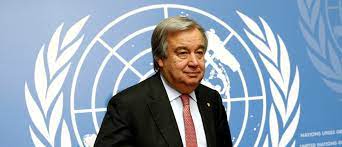
The United Nations. https://www.miragenews.com/un-chief-nuclear-risk-highest-in-decades-calls-1197216/–– 18 Mar 24
Almost 80 years after the incineration of the Japanese cities of Hiroshima and Nagasaki, nuclear weapons still represent a clear and present danger to global peace and security, UN Secretary-General António Guterres told the Security Council on Monday.
Calling for disarmament now, he urged States with nuclear arsenals to lead the way across six areas for action that include dialogue and accountability.
“Nuclear weapons are the most destructive weapons ever invented, capable of eliminating all life on earth. Today, these weapons are growing in power, range and stealth. An accidental launch is one mistake, one miscalculation, one rash act away,” he warned.
Doomsday Clock ticking loudly
The meeting on nuclear disarmament and non-proliferation was convened by Japan, Security Council president for March and, as Mr. Guterres noted, the only country that knows better than any other “the brutal cost of nuclear carnage.”
It was being held at a time “when geopolitical tensions and mistrust have escalated the risk of nuclear warfare to its highest point in decades.”
He said the Doomsday Clock – the symbol for humanity’s proximity to self-destruction – “is ticking loudly enough for all to hear”.
Meanwhile, academics and civil society groups, to Pope Francis, youth, and the survivors of Hiroshima and Nagasaki, known as Hibakusha, have been clamouring for peace and an end to the existential threat.
No ‘Oppenheimer’ sequel
Even the Oscar-winning Hollywood film Oppenheimer “brought the harsh reality of nuclear doomsday to vivid life for millions around the world,” he said, adding that “humanity cannot survive a sequel”.
Despite these appeals for the world to step back from the brink, “States possessing nuclear weapons are absent from the table of dialogue,” he said, while “investments in the tools of war are outstripping investments in the tools of peace.”
Mr. Guterres stressed that disarmament is the only path to “vanquish this senseless and suicidal shadow, once and for all.”
Dialogue and confidence-building
He appealed to States armed with nuclear weapons to take the lead in six areas, starting with re-engaging in dialogue to develop transparency and confidence-building measures to prevent any use of a nuclear weapon.
“Second, nuclear saber-rattling must stop,” he said. “Threats to use nuclear weapons in any capacity are unacceptable.”
Nuclear weapon States must also re-affirm moratoria on nuclear testing, which includes pledging to avoid actions that would undermine the 1996 Comprehensive Nuclear-Test-Ban Treaty (CTBT), whose entry-into-force must be priority.
From commitment to action
Furthermore, disarmament commitments must become action, together with accountability, under the Treaty on the Non-Proliferation of Nuclear Weapons (NPT). The landmark accord, signed more than 50 years ago, is the only binding commitment to the goal of disarmament by States which officially stockpile nuclear weapons.
The Secretary-General also highlighted the need for a joint first-use agreement. “Nuclear weapon States must urgently agree that none of them will be the first to use nuclear weapons. As a matter of fact, none should use them in any circumstances,” he said.
Reducing stockpiles
Finally, he called for reductions in the number of nuclear weapons. In this regard, he urged the United States and Russia – the world’s largest nuclear weapons holders – to take the lead and also find a way back to negotiations towards the full implementation of the New START Treaty and agree on its successor.
Mr. Guterres also pointed to the responsibility of non-nuclear weapon States to fulfil their own non-proliferation obligations and to support disarmament efforts.
He said the Security Council also has a leadership role, including “to look beyond today’s divisions, and state clearly that living with the existential threat of nuclear weapons is unacceptable.”
US and Japan seek UN resolution calling on all nations to ban nuclear weapons in outer space
The United States and Japan are sponsoring a U.N. Security Council resolution calling on nations not to deploy or develop nuclear weapons in space
ByEDITH M. LEDERER Associated Press, March 19, 2024,
UNITED NATIONS — The United States and Japan are sponsoring a U.N. Security Council resolution calling on all nations not to deploy or develop nuclear weapons in space, the U.S. ambassador announced Monday.
Linda Thomas-Greenfield told a U.N. Security Council meeting that “any placement of nuclear weapons into orbit around the Earth would be unprecedented, dangerous, and unacceptable.”
The announcement that the U.S. and Japan had circulated a resolution follows White House confirmation last month that Russia has obtained a “troubling” anti-satellite weapon capability, although such a weapon is not operational yet.
Russian President Vladimir Putin declared later that Moscow has no intention of deploying nuclear weapons in space, claiming that the country has only developed space capabilities similar to those of the U.S.
The Outer Space Treaty ratified by about 114 countries including the United States and Russia prohibits the deployment of “nuclear weapons or any other kinds of weapons of mass destruction” in orbit or the stationing of “weapons in outer space in any other manner.”
Japan’s Foreign Minister Yoko Kamikawa, who chaired the council meeting, said that even during “the confrontational environment” of the Cold War, the rivals agreed to ensure that outer space remained peaceful. That prohibition on putting any weapons of mass destruction into orbit must be upheld today, she said.
Thomas-Greenfield said all parties to the treaty must commit to the ban on nuclear and other destructive weapons, “and we must urge all member states who are not yet party to it to accede to it without delay.”
She said the United States looks forward to engaging with the other members of the 15-nation Security Council “to forge consensus around this text.”…………………………………………………………………………………………………….
more https://abcnews.go.com/US/wireStory/us-japan-seek-resolution-calling-nations-ban-nuclear-108261129
How Biden’s budget plunged the Aukus submarines pact into doubt
Alarm in Australia as the US suddenly struggles to fortify its own fleet
Matt Oliver, INDUSTRY EDITOR, 18 March 2024
A year on from the trio’s meeting, the Aukus partnership is suddenly
looking decidedly more fragile. Inside defence circles, there are growing
doubts about America’s ability and willingness to deliver following a
shock proposal from the Biden administration that cuts to the heart of the
deal.
Amid a row at home over government budgets, the White House this
month suggested halving the number of Virginia-class submarines it builds
next year – the very same type it has promised to Australia under Aukus.
That means the US faces a shortfall itself, raising the prospect it may
refuse to sell its existing vessels and leave Canberra in the lurch.
Telegraph 18th March 2024
As ‘Oppenheimer’ wins big, we should worry about lowering of nuclear thresholds

Amid rising global volatility and technological uncertainty, it’s imperative for states to explore non-nuclear solutions that emphasize international cooperation, diplomacy and societal resilience. And there’s an opportunity here for the U.K. and the U.S. to lead the way in international law and treaties that respond to non-nuclear strategic threats more effectively.
Just as Oppenheimer challenged Truman on U.S. nuclear strategy, we too must challenge our leaders’ attachment to nukes.
March 18, 2024 By Sophie-Jade Taylor and Graham Stacey Sophie-Jade Taylor is a senior network development and communications manager at the European Leadership Network nonprofit. Retired Air Marshall Sir Graham Stacey is a senior consulting fellow at the European Leadership Network. https://www.politico.eu/article/oppenheimer-win-awards-oscar-bafta-golden-globe-worry-about-lower-nuclear-thresholds/
Last summer, director Christopher Nolan’s “Oppenheimer” captivated the global public, making history as the highest ever grossing biopic. And having already won big at the Golden Globes and the BAFTAs, the film closed awards season by sweeping the Oscars last weekend.
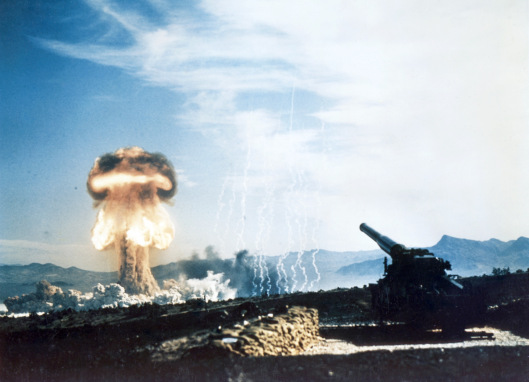
The film brought fresh awareness of the unique, destructive power that J. Robert Oppenheimer’s creation unleashed. The first and only nuclear weapons ever used — the “Little Boy” dropped on Hiroshima and the “Fat Man” on Nagasaki — packed the equivalent of 15,000 and 21,000 tons of TNT respectively, killing over 100,000 people and causing long-term health, psychological, economic and environmental damage.
By comparison, the world’s most powerful nukes today yield over 1.2 megatons of TNT — 60 times more than Oppenheimer’s bombs.
And much like Oppenheimer, General Leslie Groves and then U.S. President Harry S. Truman, today’s leaders once again find themselves facing huge moral and strategic choices at the dawn of a new technological age. The full weight of nuclear devastation lies in the hands of just a select few. Their decisions have profound implications for humanity — and this shouldn’t be left to chance.
Recognizing the unimaginable horror a modern nuclear conflict would unleash, as recently as January 2022, all five leaders of the nuclear weapons states reaffirmed that a nuclear war couldn’t be won and must never be fought.
Yet, we have been witnessing Russian President Vladimir Putin’s irresponsible nuclear saber-rattling around Russia’s full-scale invasion of Ukraine. There have been worrying reports of rock-bottom thresholds for nuclear use — with enemy incursion into territory, the destruction of strategic weapons delivery systems, and even conventional weapons use deemed as posing an existential threat to Russian statehood.
And though Moscow outwardly rejects the policy, such ambiguity seemingly points toward communicating “first strike” capabilities, which rightly should be condemned and carefully assessed.
On the other hand, China continues to push states for political commitments toward the universalization of a No First Use Policy, while also furthering the development of its own arsenal under a worrying lack of transparency — a dilemma that has added complexity to an already intricate and perilous geopolitical chessboard.
Meanwhile, in the West — seemingly without much public discussion or comment — we’ve seen a worrying trend in declarations that states could use nuclear weapons to deter “non-nuclear threats,” again lowering the so-called nuclear threshold in an attempt to provide a quick fix to nuanced challenges.
At this very critical moment, “Oppenheimer” has brought discussions of nuclear weapons back into the public arena. And while the attention will undoubtedly recede, ongoing public engagement on these issues must not. Civic engagement shapes policymaking, and at a time of rising nuclear risks and growing temptation for states to become more reliant on their nuclear weapons, the public deserves a better understanding of when and why a catastrophic weapon may be deployed.
For example, in 2021, the British government stated that while it wouldn’t use nuclear weapons against any non-nuclear weapon state, it remained open to reviewing its policy should any threat from “emerging technologies” with “comparable impact” make nuclear weapon use necessary. Similarly, in 2022, the U.S. declared that the aim of its nuclear arsenal was to deter both nuclear and non-nuclear “strategic-level attacks.” Problematically, however, neither the U.K. nor the U.S. have detailed what “comparable impact” or “strategic-level attack” may mean.
These policies not only lower the nuclear-use threshold and increase global nuclear risks, but they may not even be feasib
While it’s near impossible for a nuclear strike to go undetected, the same isn’t true for emerging technologies such as AI and autonomous systems. By their very design, these technologies are largely democratized and untied to a single government. For instance, the challenge of attribution in cyber is well-documented, and while cyber-attacks have been linked to state-sponsored hacking groups, these groups couldn’t be easily deterred by the threat of a nuclear strike.e, given most contemporary threats against states now sit outside the military realm.
Increasing the already harrowing role of nuclear weapons in foreign policy undermines the moral and legal position of nuclear weapons states. The logic and evidence behind the current U.K. and U.S. policies of relying on nuclear weapons as a panacea must be subject to greater public and parliamentary scrutiny — as should be the case with open democracies who say they have transparent nuclear policies.
Amid rising global volatility and technological uncertainty, it’s imperative for states to explore non-nuclear solutions that emphasize international cooperation, diplomacy and societal resilience. And there’s an opportunity here for the U.K. and the U.S. to lead the way in international law and treaties that respond to non-nuclear strategic threats more effectively.
Instead of resorting to old playbooks, both policymakers and the public must appreciate that emerging technologies require a new mindset in their management and new legal constructs to regulate their proliferation, development and control. Recent international efforts like last November’s Bletchley AI Safety Summit and the agreement to begin a dialogue on AI risks by U.S. President Joe Biden and Chinese President Xi Jinping are important first steps. But much more needs to be done.
Just as Oppenheimer, haunted by his role in the bombings of Hiroshima and Nagasaki, challenged Truman on U.S. nuclear strategy, we too must challenge our leaders’ continued attachment to nukes — weapons that can only destroy — and push toward more diplomacy and resilience-based solutions to today’s complex challenges.
EU to use Russian assets to buy arms for Ukraine – Scholz
The German chancellor has clarified that profits obtained from Moscow’s funds held in the EU will be used to arm Kiev
German Chancellor Olaf Scholz has said that interest accrued from Russian assets frozen in the EU will be used to purchase weapons for Ukraine.
Soon after Russia launched its military operation against Ukraine in February 2022, Western countries froze approximately $300 billion of funds belonging to the Russian Central Bank. Of that sum, the Brussels-based clearinghouse Euroclear holds around €191 billion ($205 billion), which has accrued nearly €4.4 billion in interest over the past year.
Speaking at a joint press conference with French President Emmanuel Macron and Polish Prime Minister Donald Tusk in Berlin on Friday, Chancellor Scholz said: “We will use windfall profits from Russian assets frozen in Europe to financially support the purchase of weapons for Ukraine.
The German leader also announced plans to establish a “new capability coalition for long-range rocket artillery,” with procurement to take place “on the overall world market.”
The German chancellor did not provide specifics, and it remains unclear whether he was referring to an entirely new initiative, or to a “long-range” scheme announced by President Macron in February.
European Commission President Ursula von der Leyen last month suggested using the interest from frozen Russian assets to buy weapons for Ukraine. However, Politico, citing an anonymous EU official, reported on Thursday that Malta, Luxembourg and Hungary had “expressed reservations” about the plan earlier this week.
Moscow has repeatedly warned that any actions taken against its assets would amount to “theft.” It has stressed that seizing the funds or any similar move would violate international law and undermine Western currencies, the global financial system, and the world economy.
Former Prime Minister Turnbull says Australia ‘mugged by reality’ on Aukus deal as US set to halve submarine build

“Australian taxpayers should not be footing the bill for America’s dockyards.
We are on the hook to the tune of $3bn as soon as next year as a downpayment for subs that might never arrive and be useless on delivery,”
Former PM says the reality is the US will not make their submarine deficit worse by giving or selling submarines to Australia
Amy Remeikis, Wed 13 Mar 2024 , https://www.theguardian.com/world/2024/mar/13/turnbull-says-australia-mugged-by-reality-on-aukus-deal-as-us-set-to-halve-submarine-build
Australian taxpayers should not be footing the bill for America’s dockyards.
We are on the hook to the tune of $3bn as soon as next year as a downpayment for subs that might never arrive and be useless on delivery,”
The former prime minister Malcolm Turnbull said Australia has been “mugged by reality” over the Aukus submarine deal after the US announced it will halve the number of submarines it will build next year, throwing the Australia end of the agreement into doubt.
With the US president, Joe Biden, continuing to face a hostile Congress, the Pentagon budget draft request includes construction of just one Virginia-class nuclear submarine for 2025.
Under the Aukus agreement, production is meant to be ramped up to ensure Australia will have access to at least three Virginia-class submarines from the US in the 2030s. That is to fill a “capability gap” before nuclear-powered submarines to be built in Adelaide enter into service from the 2040s.
The prime minister, Anthony Albanese, played down the impact of the US budget announcement, insisting that “our plans are very clear”.
“We have an agreement that was reached with the United States and the UK,” Albanese told reporters in Darwin on Wednesday. “That legislation went through the US Congress last year. That was a product of a lot of hard work.”
The defence minister, Richard Marles, said earlier that the US remained committed to the deal.
“As we approach the one-year anniversary of Aukus, Australia, the United States and United Kingdom remain steadfast in our commitment to the pathway announced last March, which will see Australia acquire conventionally armed, nuclear-powered submarines,” he said.
“All three Aukus partners are working at pace to integrate our industrial bases and to realise this historic initiative between our countries.”
Greens senator David Shoebridge, who has been critical of the Aukus deal from the start, said the US budget announcement was the beginning of the end of Aukus.
“When the US passed the law to set up Aukus, they put in kill switches, one of which allowed the US to not transfer the submarines if doing so would ‘degrade the US undersea capabilities’. Budgeting for one submarine all but guarantees this,” he said on X.
4/ The failure is almost too big to wrap your head around.
We are providing billions of dollars to the US, have given up an independent foreign policy and made Australia a parking lot for US weapons. In exchange, we get nothing.
Nothing but a big target and empty pockets.— David Shoebridge (@DavidShoebridge) March 12, 2024
The US budget does include increased spending on the submarine industrial base, which was a key component of the Aukus pillar one deal, as it laid the groundwork to increase production in the coming years.
But Turnbull, an architect of the French submarine deal which was unceremoniously dumped by the Morrison government in favour of the Aukus deal, said Australia was now at the mercy of the United States for a key part of its defence strategy.
He said that the US needed to increase submarine production to meet its own needs before it was able to transfer boats to Australia, but were now only producing about half as many that were needed for the US navy and were struggling to maintain the boats they held, due to labour shortages.
“What does that mean for Australia? It means because the Morrison government, adopted by Albanese, has basically abandoned our sovereignty in terms of submarines, we are completely dependent on what happens in the United States as to whether we get them now,” he told ABC radio.
“The reality is the Americans are not going to make their submarine deficit worse than it is already by giving or selling submarines to Australia and the Aukus legislation actually sets that out quite specifically.skip past newsletter promotion
“So you know, this is really a case of us being mugged by reality. I mean, there’s a lot of Aukus cheerleaders, and anyone that has any criticism of Aukus is almost described as being unpatriotic. We’ve got to be realistic here.”
The ALP grassroots activist group, Labor Against War, want the Albanese government to freeze Aukus payments to the US so as not to “underwrite the US navy industrial shipyards”.
The national convenor of Labor Against War, Marcus Strom, said Australian taxpayers should not be footing the bill for America’s dockyards.
We are on the hook to the tune of $3bn as soon as next year as a downpayment for subs that might never arrive and be useless on delivery,” he said.
“This Labor government managed to junk Scott Morrison’s tax plan. Why would it be so stupid to continue with his war plan?”
While the Pentagon has sought to assure Australia its submarine production will be back on track by 2028, the looming threat of Donald Trump returning to the White House has raised further concerns the deal will be scuttled.
“On Aukus pillar 1 we are effectively in conflict with the needs of the US navy, and you know as well as I do the American government, when it comes to a choice between the needs of the US navy and the Australian navy, are always going to back their own,” Turnbull said.
Marles has previously denied Aukus will erode Australia’s sovereignty. In a speech to parliament last year, Marles said Australia would “always make sovereign, independent decisions on how our capabilities are employed”.
Additional reporting by Daniel Hurst
Will Biden’s, NATO’s military personnel in Ukraine cross the last red line to Armageddon?
Walt Zlotow, West Suburban Peace Coalition, Glen Ellyn IL
French President Emmanuel Macron is pushing to send NATO troops to Ukraine to keep Ukraine from imminent defeat to Russia. “The time has come for a Europe where it will be appropriate not to be a coward.” Macron got a lot of pushback form less delusional NATO leaders including German Chancellor Olaf Scholz and NATO Secretary-General Jens Stoltenberg.
Other NATO countries have joined France at considering direct troop involvement. Estonia’s Prime Minister Kaja Kallas stated that “Everything is on the table.” Lithuanian Foreign Minister Gabrielius Landsberg agreed that “nothing can be taken off the table, no option can be rejected out of hand. I very much welcome and encourage the discussion that has started.”
But unbeknownst to most Americans, due to government censorship, is that NATO military personnel are already there serving as a tripwire to wider, possibly nuclear war.
The British Prime Minister’s office confirmed recently that “Beyond the small number of personnel we do have in the country supporting the armed forces of Ukraine, we haven’t got any plans for large-scale deployment.” Didn’t we hear the same thing from US officials regarding ‘US advisors in Vietnam?
German Chancellor Scholz refused to send Taurus missiles to Ukraine because it would require German personnel to operate them. Britain and France aren’t so cautions. Scholz stated that France also has military personnel in Ukraine along with England to assist Ukraine military operations. He hinted at US presence there stating “It’s known that there are numerous people there in civilian attire who speak with an American accent.” The NY Times reported last month that numerous CIA operatives were left in Ukraine when the war started and “scores of new officers were sent in to help the Ukrainians.”
President Biden may have slipped in his State of the Union Speech last week when he uttered “There are no American soldiers (of war) in Ukraine, and I intend to keep it that way.” Biden should have added ‘But we sure have a lot of helpers there and I intend to keep it that way.’
The US and NATO are playing a dangerous game with Mother Earth and her 8 billion residents. For 750 days they’ve been crossing red lines Russia has put up to protect their borders from NATO encroachment. When Biden became president, he continued the reckless US campaign to arm Ukraine in their civil war against Russian leaning Ukrainians in Donbas seeking independence from Ukraine violence and subjugation. He repeatedly floated NATO membership to Ukraine. He rebuffed every desperate entreaty by Russia to even begin discussing their border security concerns.
The result? Russia invaded Ukraine 2 years ago February 24, 2022…after 15 years of warnings. Having catastrophically bungled the diplomacy that instigated the war, Biden could have made amends by supporting the peace agreement Ukraine’s Zelensky and Russia’s Putin negotiated in the war’s first month. Instead of support, he sabotaged it.
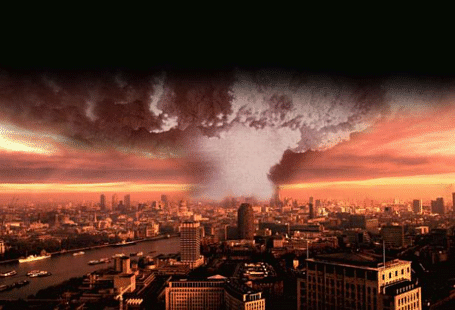
Biden and his NATO buddies have marched right up to, and sometimes over, numerous Russian red lines with billions in weapons, extreme rhetoric, sanctions and diplomatic maneuvering with largely unsupportive nations. Now with US and NATO military and intelligence personnel in Ukraine, and ominous calls for combat troops, we should all fret that the next red line Biden and NATO’s war cabinets cross may trigger a mushroom cloud.
Huge UK £286bn nuclear submarine deal with US at risk for one reason warns ex Navy chief
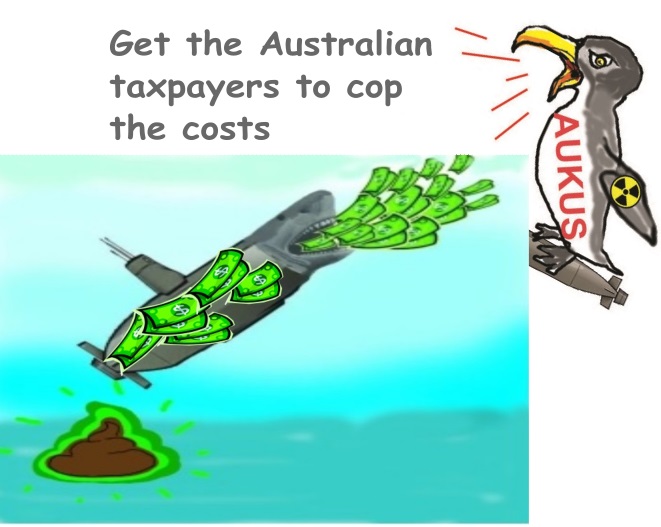
The construction of modern nuclear submarines requires more expertise than it took to land a man on the Moon, says the former chief of the Royal Navy.
EXPRESS UK, By CIARAN MCGRATH, Senior News Reporter, Sat, Mar 16, 2024
The first will see the US and UK share technology with Australia in order to develop a new class of nuclear-powered submarines, the SNN-AUKUS, while the second pillar will focus on cyber capabilities, artificial intelligence, quantum technologies, and additional undersea capabilities.
However, speaking earlier this month, Hugh White, an emeritus professor of strategic studies at the Australian National University, voiced his doubts about the long-term viability of AUKUS, citing estimated costs of up to £286 billion between now and the 2050s.
Prof White told ABC RN’s Global Roaming: “I think the chance of the plan unfolding effectively is extremely low.”
Meanwhile, in an analysis published last week, Allan Behm, director of Australia’s International and Security Affairs Program, wrote: “The 2021 AUKUS announcement came with the promise of a sovereign Australian fleet of nuclear-powered submarines.
“Nearly 18 months on, however, it remains unclear if these submarines will ever be delivered – or if Australia actually needs them.”………………
He explained: “Pillar Two is very useful, and there’s a discussion about whether Japan be allowed to get involved, should Canada be involved, etc, that’s great.
“But with Pillar One, there are a number of complications. So, yes, there’s a cost which is huge, and the Australians seem to be committed to it.
“But there are now a number of voices in Australia saying, can we really do this, as one would expect
“The other thing is the Americans themselves, who are going to be selling four Virginia class submarines to the Australians as a stop-gap.
“They are short of nuclear attack submarines and so there are people in America who are saying, ‘well, how are we sure we want to do this because we can’t build enough quickly enough to fill up the gap when we get rid of the ones we’re giving to Australia’.”
The Royal Navy currently operates six fleet submarines (SSNs), of the Trafalgar and Astute classes, with two more Astute-class boats currently under construction, and four ballistic missile submarines (SSBN), of the Vanguard class, equipped with nuclear weapons. All are nuclear powered.
However, Lord West emphasised that such vessels did not simply “come off the conveyor belt”.
He explained: “The Astute class submarines are more complex than the technical work to land a man on the moon. That is how incredibly complex the technology is. https://www.express.co.uk/news/world/1877871/aukus-deal-australia-royal-navy-astute-class
Netanyahu approves Rafah ground invasion, despite Biden opposition
Israeli Defense Force is reportedly planning a civilian evacuation before the invasion
By Timothy H.J. Nerozzi Fox News, March 15, 2024 , https://www.foxnews.com/world/netanyahu-approves-rafah-ground-invasion-despite-biden-opposition—
Israel will commence an invasion into the Gaza city of Rafah, despite protests from the United States and other international powers.
Israeli Prime Minister Benjamin Netanyahu announced approval of the operation via his office on Friday.
The Israeli Defense Force will invade the city in southern Gaza as part of its larger military operations in the region.
NETANYAHU VOWS TO INVADE RAFAH REGARDLESS OF POTENTIAL CEASE-FIRE WITH HAMAS: ‘IT WILL HAPPEN’
The operation will reportedly include an evacuation of civilians, according to The Jerusalem Post.
The Prime Minister’s office also announced that an Israeli delegation would leave for Doha to continue negotiations for the release of hostages.
The security cabinet must first arrive at a comprehensive position on the pressing issue.
ISRAELI STRIKES IN RAFAH LEAVES 31 PALESTINIANS DEAD AHEAD OF PLANNED GROUND INVASION
The U.S. government has repeatedly opposed Israeli plans to launch the Rafah ground invasion.
The administration is said to have proposed a draft U.N. Security Council resolution, which in part would call for a temporary cease-fire and call on Israel not to go into Rafah in the Gaza Strip.
Senate Majority Leader Chuck Schumer went so far as to call for a change of leadership in Israel that is more willing to consider a cease-fire and abandon plans for further ground operations.
President Biden seemed to sign off on these remarks, saying on Friday from the Oval Office, “Senator Schumer contacted my staff, my senior staff. I’m not going to elaborate on the speech. He made a good speech, and I think he expressed a serious concern, shared not only by him but by many Americans.”
The Israeli government released its post-war plan for Gaza last month, a deal that was immediately rejected by Palestinian officials.
Under the plan, Israel would seek open-ended control over security and civilian affairs in the Gaza Strip. Netanyahu’s government has flatly rejected calls for a two-state solution, which Biden’s administration continues to push for.
Fox News Digital’s Anders Hagstrom contributed to this report.
French president Emmanuel Macron tells Putin ‘WE are a nuclear power and WE are ready’ in latest WW3 rhetoric.

- A stern Macron chastised Putin for threatening the use of nuclear devices
- It comes after Putin told state TV ‘weapons exist to be used’ earlier this week
Having nuclear weapons ‘imposes on us the responsibility never to escalate,’ Macron said, in a dig at the constant reminders issued by top Russian officials and media personalities of their nuclear arsenal.
His statements come amid a hardening of Paris’ stance towards Moscow after Macron abandoned his longstanding efforts to maintain a closer bond with Putin.
Britain and France are Europe’s only nuclear powers, but even their collective power is a fraction of that employed by Russia, which has the world’s largest and most varied collection of nuclear weapons by some margin – even larger than that in Washington’s vast stockpiles.
Speaking with French and Ukrainian media, Macron chastised Putin for threatening the use of nuclear devices and reminded him France also has an advanced weapons programme……………………………………………………………………………………………………………………..
For Tatiana Kastoueva-Jean, Russia specialist at the French Institute of International Relations (IFRI), the change in Macron’s stance towards Putin triggered this reaction from Russia.
‘There is incomprehension (in Russia) over how someone who wants to discuss with Russia, to be the mediator, turns into someone who takes the lead of the toughest camp opposing it,’ she said. https://www.dailymail.co.uk/news/article-13201319/French-president-Emmanuel-Macron-declares-nuclear-power-ready-response-Putins-threats-using-nukes-Kremlin-says-France-signalled-deeper-involvement-Ukraine.html
War Games in Arctic: What’s Driving the West’s New Passion?
“Now, that Finland and Sweden are becoming active NATO members, this opens the possibility for the US to deploy nuclear weapons in the Far North.”
“because of the Arctic’s sparsely located population, collateral damage from the use of nuclear weapons there will be less noticeable.”
Bruce K. Gagnon , MARCH 15, 2024 https://space4peace.blogspot.com/2024/03/war-games-in-arctic-whats-driving-wests.html
Two unprecedented military exercises are being conducted by the US and its NATO allies simultaneously in various parts of the Arctic, signaling a new aggressive stance by the West in the region.
Thirteen NATO countries participated this week in the Nordic Response 2024 exercise held in Finland and Sweden, near the border with Russia. Additionally, the US Army recently conducted a training event near Fairbanks, Alaska, also close to Russia’s borders.
The US exercise was conducted within the framework of the Joint Pacific Multinational Readiness Center (JPMRC) and involved 8,000 American servicemen from the 11th Airborne Division and an unspecified smaller number of “foreign allies.”
The Nordic Response exercises in Finland and Sweden are even bigger in scope, since they involve 20,000 service members from 13 NATO member countries, 50 warships and 100 military aircraft. The United States and Norway contributed their F-35 fifth-generation fighter jets to the organizers of the Nordic Response drills. Additionally, the UK agreed to send several of its own F-35s from the Royal Air Force, stationed on the British aircraft carrier, Prince of Wales.
“We just want to beef up our presence in the Far North,” said German Defense Minister Boris Pistorius, who came to inspect the Nordic Response 2024 war games. “This is the biggest and the most important NATO exercise in 40 years,” he contended.
German submarines, along with troops from new NATO members Finland and Sweden, also participated in the military exercises. However, the majority of the fighting force consisted of Americans, who openly expressed their intention to “rebuild their capacity to fight in the Arctic”, a capability that had somewhat weakened since the end of the Cold War.
The presumed adversary in both Alaska and the Finnish forests was the same: Russia and its possible ally China. The American newspaper Business Insider reported that the new “Arctic Strategy” of the US Army is pivoted towards “regaining Arctic dominance.” The new strategy has been operational since 2021.
However, Business Insider noted that the rivalry with Russia now is not limited to the military sphere, as it was during the Cold War era. The economy has a role to play, too. “Rapidly melting sea ice in the Arctic Circle, warming twice as fast as the rest of the world is opening up new opportunities for natural resource extraction, shipping routes, and commercial fishing, as the Arctic becomes navigable,” the publication wrote.
Vladimir Vasilyev, the chief research associate at the Institute of the US and Canada at the Russian Academy of Sciences, suggests that the Americans may be interested in gaining control over the North Sea Route. This route is considered the shortest maritime connection between the growing economies of Southeast Asia and Europe. Russia has extensive experience in utilizing the North Sea Route, which goes along the country’s northern shores. As the ice continues to melt, this sea route is becoming increasingly accessible to commercial vessels.
“The United States is striving to ‘rediscover’ the Arctic region militarily,” a member of the Russian Academy of Military Sciences Alexander Bartosh told Sputnik. “Now, that Finland and Sweden are becoming active NATO members, this opens the possibility for the US to deploy nuclear weapons in the Far North.”
The goal of the US beefing up its military force in the region, in Bartosh’s opinion, is two-fold. The first is to leverage their superiority at sea and in the air for potential strikes against Russia. And secondly, they seek to exploit the region’s untapped natural resources, primarily focusing on oil and gas.
Vladimir Vasilyev notes the historic roots of the ‘military side’ of American interest in the Arctic. “The Arctic region plays an indispensable role in the long-time US strategy of encircling Russia,” Vasilyev highlighted. He also did not exclude the deployment of American nuclear weapons in the region. “In the Arctic, nuclear accidents are easier to cover up,” Vasilyev noted and added: “Also, for a very long time Americans had an illusion that because of the Arctic’s sparsely located population, collateral damage from the use of nuclear weapons there will be less noticeable.”
Nuclear Regulatory Commission Paves Way for Increase in Production in Commercial Reactors of Tritium for Nuclear Weapons
The U.S. no longer has a Department of Defense, as it has become The U.S. War Department. This article shows that the private nuclear industry, the Nuclear Regulatory Commission and the Department of Energy are factotums of The U.S. War Department. We need a list of the people who are pro The Treaty on the Prohibition of Nuclear Weapons and who sent a letter in favor of expanding nuclear power all over the world to mitigate climate change. They completely forgot how India first developed nuclear weapons. One of these amnesiacs is Ernest Moniz, but I’m not sure of the others who schizophrenically hold both views. They need help seeing the contradictions in these mutually exclusive positions. —Jan Boudart, secretary, Nuclear Energy Information Service, NEIS.org
Expansion of Tritium Gas Production for DOE in TVA’s Commercial Nuclear Reactors Undermines Nuclear Non-Proliferation Norms, Keeps U.S. on Nuclear War Footing.
Tom Clements
Savannah River Site Watch COLUMBIA, SOUTH CAROLINA, US, February 27, 2024 /EINPresswire.com/ — The U.S. Nuclear Regulatory Commission has taken a big step forward in allowing expansion of production of tritium, a radioactive gas used to boost the explosive power of all U.S. nuclear weapons. Increased tritium production would take place in the Tennessee Valley Authority’s Watts Bar nuclear power reactors, further undermining nuclear nonproliferation norms by allowing continued production of nuclear weapons materials in commercial nuclear power reactors.
The NRC published a notice in the Federal Register on February 23, 20241 that supports the decision to dramatically increase the production of tritium in the Watts Bar units 1 and 2 reactors in Tennessee. The NRC, a civilian regulatory agency, recommends that the licenses for both reactors be amended to allow for an increase in irradiation of special tritium-producing rods from 1,792 to 2,496 for each reactor in a single operating cycle of about 18 months.
The significant increase in irradiation of Tritium Producing Burnable Absorber Roads (TPBARs) in the reactors’ cores would result in production of much greater amounts of tritium, as requested by the U.S. Department of Energy’s National Nuclear Security Administration (NNSA) for its client, the Department of Defense. According to NNSA’s 2023 “Stockpile Stewardship and Management Plan,” the goal is “to reach maximum tritium production in each of the two Watts Bar reactors by FY 2025.”
“Expansion of tritium production for use in all nuclear warheads reveals that the U.S. aims to keep a massive nuclear weapons stockpile far beyond any level of deterrence,” said Tom Clements, director the public interest group Savannah River Site Watch, Columbia South Carolina. “For the sake of global security, the U.S. must adopt a policy to reduce and eliminate nuclear weapons and in parallel halt the production of weapons tritium in civilian nuclear reactors,” added Clements. (See sources here linked in SRS Watch news, Feb. 23, 20242.)
he apparent objective with this larger tritium supply is for the NNSA to fill the tritium “reservoirs” in all warheads to maximum capacity, which could be up to around 5 grams of tritium per warhead. This would allow the weapons to operate with greater flexibility, including at their highest explosive yield, thus keeping the U.S. on a footing to “fight” a nuclear war with maximum destructive effect. Russia and China could react to this US decision, possibly stimulating a “tritium race,” underscoring the risks of enduring reliance on nuclear weapons, according to SRS Watch.
The NRC has documented in an “environmental assessment” (EA) that radiation exposure, tritium release into the environment and nuclear waste production would all increase due to the action but has declined preparation of an in-depth “environmental impact statement” (EIS). The NRC claims the impacts are within earlier-considered bounds and has thus issued a “Finding of No Significant Impact” (FONSI) and recommends that a license amendment be issued by the NRC to allow more tritium rods to be irradiated. The NRC declined to review both the proliferation impacts of the decision and the impacts on a brewing nuclear arms race.
Both the EA and FONSI are included in the text of the short Federal Register notice, revealing that an inadequate analysis was conducted of the proposed action of dramatically increasing TPBAR irradiation. According to SRS Watch, an in-depth EIS, with public meetings, should have been prepared, especially given that tritium leakage from TPBAR irradiation has been documented, with diluted tritium-contaminated water being discharged into the Tennessee River from the “tritiated water storage tank with a capacity of 500,000 gallons.”
…………………………………………………………Due to increased tritium production, TPBAR manufacture at the Westinghouse uranium fuel plant near Columbia, SC would also expand. Production in that commercial nuclear facility of TPBARs used to produce tritium for military use exposes the reality that the Westinghouse facility is a dual use military-commercial facility, thus crossing the imaginary line between civilian and military uses of nuclear technology, as documented by SRS Watch in the 2021 report “Crossing the Line: South Carolina Nuclear Weapons Secrets Exposed3.” https://www.einpresswire.com/article-print/691542118/nuclear-regulatory-commission-paves-way-for-increase-in-production-in-commercial-reactors-of-tritium-for-nuclear-weapons?
Aid Wars over Gaza: Resuming Funding to UNRWA

March 12, 2024, by: Dr Binoy Kampmark https://theaimn.com/aid-wars-over-gaza-resuming-funding-to-unrwa/
The steady and ruthless campaign by Israel to internationally defund the UN Relief and Works Agency for Palestine Refugees in the Near East (UNRWA), is unravelling. The lynchpin in the effort was a thin, poison pen dossier making claims that 12 individuals were Hamas operatives who had been involved in the October 7 attacks. Within a matter of days, two internal investigations were commenced, various individuals sacked, and US$450 million worth of funding from donor states suspended.
As the head of the agency, Philippe Lazzarini, explained at a press conference on March 4, he has “never been informed” or received evidence of Israel’s claims substantiating their assertions, though he did receive the prompt about the profane twelve directly from Israeli officials. Every year, both Israel and the Palestinian authorities were furnished with staff lists, “and I never received the slightest concern about the staff that we have been employing.”
Had Israeli authorities signed off on these alleged participants in bungling or conspiratorial understanding? Certainly, there was more than a pongy whiff of distraction about it all, given that Israel had come off poorly in The Hague proceedings launched by South Africa, during which the judges issued an interim order demanding an observance of the UN Genocide Convention, an increase of humanitarian aid, and the retention of evidence that might be used for future criminal prosecutions for genocide.
An abrupt wave of initial success in starving the agency followed, with a number of countries announcing plans to freeze funding. In the United States, irate members of Congress accused the agency of having “longstanding connections to terrorism and promotion of antisemitism.” A hearing was duly held titled “UNRWA Exposed: Examining the Agency’s Mission and Failures” with Richard Goldberg, a senior advisor of the Foundation for Defense of Democracies frothing at an agency that supposedly incited “violence against Israel, subsidizes US-designated terrorist organizations, denies Palestinians their basic human rights, and blocks the pathways to a sustainable peace between Israel and the Palestinians.”
The attempt to cast UNRWA into gleefully welcomed oblivion has not worked. Questions were asked about the initial figure of twelve alleged militants. News outlets began questioning the numbers.
The funding channels are resuming. Canada, for instance, approving “the robust investigative process underway”, also acknowledged that “more can be done to respond to the urgent needs of Palestinian civilians.” The initial cancellation of funding to the agency, charged Thomas Woodley, president of Canadians for Justice and Peace in the Middle East, had been “a reckless political decision that never should have been made.”
The Swedish government was also encouraged by undertakings made by UNRWA “to allow independent auditing, strengthen internal supervision and enable additional staff controls”, promising an initial outlay of 200 million kroner (US$19 million).
The Minister for International Development Cooperation and Foreign Trade, Johan Forssell, promised that it would “monitor closely to ensure UNRWA follows through on what it has promised.” Aid policy spokesperson for the Christian Democrats, Gudrun Brunegård, also conceded that, given the “huge” needs on the part of the civilian population, that UNRWA was “the organisation that is best positioned to help vulnerable Palestinians.”
Much the same sentiment was expressed by the European Union, with the Commission agreeing to pay 50 million euros to UNRWA from a promised total of 82 million euros on the proviso that EU-appointed experts audit the screening of staff. “This audit,” a European Commission statement explains, “will review the control systems to prevent the possible involvement of its staff and assets in terrorist activities.” Having been found wanting in her screeching about-turn, the European Commission president Ursula von der Leyen insisted that the EU stood “by the Palestinian people in Gaza and elsewhere in the region. Innocent Palestinians should not have to pay the price for the crimes of [the] terrorist group Hamas.”
Commissioner Olivér Várhelyi was stiffly bureaucratic in expressing satisfaction at “the commitment of UNRWA to introduce robust measures to prevent possible misconduct and minimise the risk of allegations.” At no point was Israel’s own contribution to the calamity, and its insatiable vendetta against the agency, mentioned.
The bombast and blunder of the whole effort by Israel was further discoloured by claims that UNRWA staff had been victims of torture at the hands of the IDF in drafting the dossier. In a statement released by the agency, a grave accusation was levelled: “These forced confessions as a result of torture are being used by the Israeli Authorities to further spread misinformation about the agency as part of attempts to dismantle UNRWA.” In doing so, Israel was “putting our staff at risk and has serious implications on our operations in Gaza and around the region.”
For its part, the IDF, through a statement, claimed that this was all exaggerated piffle: “The mistreatment of detainees during their time in detention or whilst under interrogation violates IDF values and contravenes IDF [sic] and is therefore absolutely prohibited.”
Increasingly on the losing side of that battle, Israeli authorities decided to cook the figures further, declaring with crass confidence that 450 URWA employees in Gaza were members of militant groups including Hamas. Sticking to routine, those making that allegation decided that evidence of such claims was not needed. Those employees, claimed Rear Adm. Daniel Hagari, “are military operatives in terror groups in Gaza”. “This was no coincidence. This is systematic. There is no claiming, ‘we did not know’.”
In the fog of war, mendacity thrives with virile vigour; but the current suggestion on the part of various donor states is that the humanitarian incentive to ameliorate the suffering of the Gaza populace has taken precedence over Israel’s persistently lethal efforts. That, at least, is the case with certain countries, leaving the doubters starkly exposed.
Putin warns again that Russia is ready to use nuclear weapons if its sovereignty is threatened
BY THE ASSOCIATED PRESS, March 14, 2024
President Vladimir Putin said Wednesday that Russia is ready to use nuclear weapons if its sovereignty or independence is threatened, issuing another blunt warning to the West just days before an election in which he’s all but certain to secure another six-year term.
The Russian leader has repeatedly talked about his readiness to use nuclear weapons since launching a full-scale invasion of Ukraine on Feb. 24, 2022. The most recent such threat came in his state-of-the-nation address last month, when he warned the West that deepening its involvement in the fighting in Ukraine would risk a nuclear war.
Asked in an interview with Russian state television released early Wednesday if he has ever considered using battlefield nuclear weapons in Ukraine, Putin responded that there has been no need for that. He also noted that he doesn’t think that the world is heading for a nuclear war, describing U.S. President Joe Biden as a veteran politician who fully understands the possible dangers of escalation…………………………….
In an apparent reference to NATO allies that support Kyiv, he also declared that “the nations that say they have no red lines regarding Russia should realize that Russia won’t have any red lines regarding them either.”https://apnews.com/article/russia-ukraine-war-putin-nuclear-weapons-82ced2419d93ae733161b56fbd9b477d
In pre-election messaging, Putin less strident on nuclear war
Japan Times, 14 Mar 24
President Vladimir Putin of Russia took a less strident tone on the possibility of nuclear war in an interview released Wednesday, an apparent attempt to bolster his domestic image as a guarantor of stability before the Russian presidential election this weekend.
In a lengthy interview released by Russian state television, Putin struck a softer tone than in his state-of-the-nation address last month, when he said that the West risked causing the “destruction of civilization” if it intervened more directly in Ukraine. In the interview, Putin described the United States as seeking to avoid such a conflict, even as he warned that Russia was prepared to use nuclear weapons if its “sovereignty and independence” were threatened.
“I don’t think that everything is rushing head-on here,” Putin said when asked whether Washington and Moscow were headed for a showdown. He added that even though the United States was modernizing its nuclear force, “this doesn’t mean, in my view, that they are ready to start this nuclear war tomorrow.”…………………………………………………………………………………………
Asked in the interview released Wednesday whether he had considered using “tactical” nuclear weapons at that point, Putin said that “there was never such a need.”………………………. more https://www.japantimes.co.jp/news/2024/03/14/world/politics/putin-softer-nuclear-tone/
1 This Month
26 September – International Day for the Total Elimination of Nuclear Weapons





PLEASE OPPOSE HR 8255 AND S.3639 – bills would accelerate satellite deployment, with no environmental review or safeguards – https://ncstd5li.quorum.us/campaign/169331/
To see nuclear-related stories in greater depth and intensity – go to https://nuclearinformation.wordpress.com
-
Archives
- September 2026 (305)
- August 2026 (330)
- July 2026 (355)
- June 2026 (287)
- May 2026 (306)
- April 2026 (356)
- March 2026 (251)
- February 2026 (267)
- January 2026 (308)
- December 2025 (358)
- November 2025 (359)
- October 2025 (375)
-
Categories
- 1
- 1 NUCLEAR ISSUES
- business and costs
- climate change
- culture and arts
- ENERGY
- environment
- health
- history
- indigenous issues
- Legal
- marketing of nuclear
- media
- opposition to nuclear
- PERSONAL STORIES
- politics
- politics international
- Religion and ethics
- safety
- secrets,lies and civil liberties
- spinbuster
- technology
- Uranium
- wastes
- weapons and war
- Women
- 2 WORLD
- ACTION
- AFRICA
- Atrocities
- AUSTRALIA
- Christina's notes
- Christina's themes
- culture and arts
- Events
- Fuk 2022
- Fuk 2023
- Fukushima 2017
- Fukushima 2018
- fukushima 2019
- Fukushima 2020
- Fukushima 2021
- general
- global warming
- Humour (God we need it)
- Nuclear
- RARE EARTHS
- Reference
- resources – print
- Resources -audiovicual
- Weekly Newsletter
- World
- World Nuclear
- YouTube
-
RSS
Entries RSS
Comments RSS

