TODAY. The absurdity, and the sinister situation, surrounding small nuclear reactors (SMRs)


Absurdity. In one fell swoop, the American commercial dream of a booming future for small nuclear reactors has just been blown out of the water.
NuScale’s much hyped contract with the Utah Associated Municipal Power Systems (UAMPS) for small modular nuclear reactors has suddenly ended, because of rising costs.
This project was the poster boy for the future of the whole nuclear energy industry world-wide. Governments and media slavishly promoted NuScale’s publicity handouts, It’s been as if the whole world swallowed the story that small nuclear reactors are the solution to global energy needs and to the climate crisis
The NuScale project was the first commercialisation of SMRs, was due for $billions in tax credits. Lawyers are now investigating NuScale on behalf of investors over “possible violations of federal securities laws.” It looks like “it’s over, red rover” for commercial nuclear power.
Sinister side
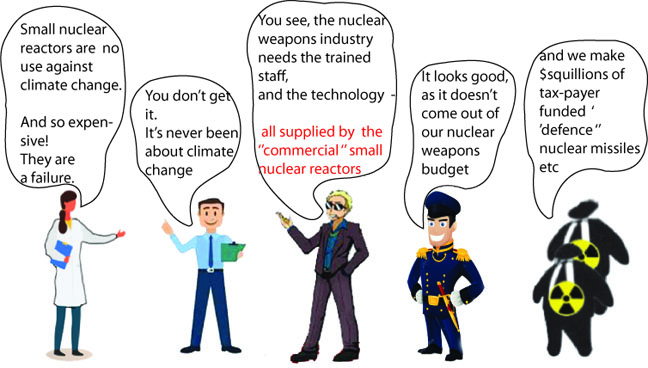
Sinister side. The real usefulness of SMRs has always been military. But the rage for commercial SMRs has been a fine cover for its weapons industry use. Governments could happily subsidise this peaceful private industry, subsidise universities for nuclear training , courses, convince enthusiastic young students to go for this “public benefit” “climate action” type profession.
The other sinister thing is – what happens from now on? The blanket mainstream government and media endorsement of small nuclear reactors to fight climate change has been a big bet on getting private investment to pay for it all.
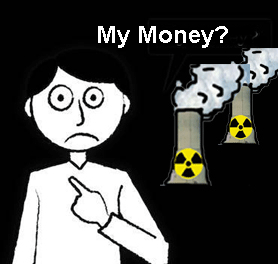
Are we now going to see a blanket government and media endorsement of a tax-payer funded small nuclear reactor industry?
Today, the corporate media is still awash with articles promoting SMRs. But from now on, they’ll have to work harder, and much more deceptively to get that pearl of great price – public acceptance .
‘Buying influence’: top US nuclear board advisers are tied to arms business

“What we’ve consistently seen is the nuclear weapons industry buying influence and that means we cannot make serious decisions about our security when the industry is buying influence through thinktanks and commissioners that are skewing the debate,” said Susi Snyder, program coordinator at the International Campaign to Abolish Nuclear Weapons.
“Instead of having a debate about the tools and materials we need to make ourselves safe,” she added, “we’re having a debate about which company should get the contracts. And that doesn’t make the American people safe or anyone else in the world.”
None of the potential conflicts of interest between commissioners’ financial interests and the policy proposals laid out in their final report were disclosed by the CCSPUS itself within its final report or at any public event highlighting its findings.
Nine of 12 members of the commission charged with avoiding nuclear conflict have financial ties to defense contractors
Eli Clifton and Ben Freeman, 10 Nov 23 https://www.theguardian.com/world/2023/nov/10/us-congress-nuclear-weapon-committee-conflict-interest
Nine of the 12 members of a high-level congressional commission charged with advising on the US’s nuclear weapons strategy have direct financial ties to contractors that would benefit from the report’s recommendations or are employed at thinktanks that receive considerable funding from weapons manufacturers, the Guardian and Responsible Statecraft can reveal.
While the Congressional Commission on the Strategic Posture of the United States (CCSPUS) purports to recommend steps to avoid nuclear conflict, it does nothing to disclose its own potential conflicts of interest with the weapons industry in its final report or at rollout events at thinktanks in Washington.
The United States will soon face “a world where two nations [China and Russia] possess nuclear arsenals on par with our own”, warned the commission’s final report, released in mid-October. “In addition,” the report charged, “the risk of conflict with these two nuclear peers is increasing. It is an existential challenge for which the United States is ill-prepared.”
According to the CCSPUS, this potential doomsday scenario requires the US to make “necessary adjustments to the posture of US nuclear capabilities – in size and/or composition”, a policy shift that would steer billions of taxpayer dollars to the Pentagon and nuclear weapons contractors.
“What we’ve consistently seen is the nuclear weapons industry buying influence and that means we cannot make serious decisions about our security when the industry is buying influence through thinktanks and commissioners that are skewing the debate,” said Susi Snyder, program coordinator at the International Campaign to Abolish Nuclear Weapons.
The CCSPUS was established two years ago via the annual defense policy bill, and conflicts of interest on the commission were apparent from the beginning. But an analysis by the Guardian and Responsible Statecraft found deep ties between the commission and the weapons industry.
The most recognizable member of the CCSPUS is its vice-chair, Jon Kyl, who served as a senator from Arizona from 1995 to 2013, and again in 2018 after the death of John McCain. While this is included in his biography in the commission’s report, what’s left out is his more recent employment as a senior adviser with the law firm Covington & Burling, whose lobbying client list includes multiple Pentagon contractors that would benefit from the commission’s recommendations.
In 2017 Kyl, personally, was registered to lobby for Northrop Grumman, which manufactures the B-21 nuclear bomber that the commission recommends the US should purchase in greater numbers, at a cost to taxpayers of nearly $700m each.
Kyl did not respond to questions about his employment status with Covington & Burling, but the former senator was listed as a “senior adviser” on the firm’s website until at least 1 December 2022, nearly 10 months after the commissioner selections for the CCSPUS were announced in March 2022.
Another commissioner, Franklin Miller, is a principal at the Scowcroft Group, a business advisory firm that describes Miller as having expertise in “nuclear deterrence”, and acknowledges its work in the weapons sector.
“The Scowcroft Group successfully advised a European defense leader on a strategic acquisition opportunity,” says the consulting firm in the “Defense/Aerospace” section of its website. “We have also assisted a major defense firm in pursuing global partnerships and co-production opportunities.”
Miller did not respond to a request for comment about the identity of the Scowcroft Group’s clients.
Kyl and Miller are joined on the CCSPUS by retired general John E Hyten, who previously served as the vice-chairman of the joint chiefs of staff, the second-highest-ranking member of the US military.
While Hyten’s biography in the commission’s report lauds his extensive military service, in retirement he has worked closely with a number of firms that could benefit immensely from the commission’s recommendations.
This March he was appointed as special adviser to the CEO of C3 AI, an artificial intelligence company that boasts of working with numerous agencies at the Department of Defense. In June 2022, Hyten was named executive director of the Blue Origins foundation, called the Club for the Future, and as a strategic adviser to Blue Origin’s senior leadership. Blue Origin is wholly owned by the Amazon founder Jeff Bezos, and works directly with the National Aeronautics and Space Administration (Nasa), the air force and the space force on space launch-related capabilities.
Hyten’s ties to these firms are notable given the CCSPUS report’s repeated overtures for improving and investing in space and artificial intelligence capabilities. Specifically, the report recommends the United States “urgently deploy a more resilient space architecture” and take steps to ensure it is “at the cutting edge of emerging technologies – such as big data analytics, quantum computing, and artificial intelligence (AI)”.
Hyten did not respond to a request for comment.
The CCSPUS also included thinktank scholars whose employers receive significant funding from the arms industry. Two commission members work at the Hudson Institute, which, according to its most recent annual report, received in excess of $500,000 from Pentagon contractors in 2022. This includes six-figure donations from some of the Pentagon’s top contractors, including Lockheed Martin, Northrop Grumman and BAE Systems.
On Monday, 23 October, the Hudson Institute held an event to highlight the CCSPUS’s report that included the two Hudson Institute employees who also served as commissioners. The event unabashedly promoted recommendations from the report that would be a financial windfall for Hudson’s funders. The landing page for the event features a photo of a B-21 stealth bomber, the same photo used in the commission report that also recommended that the US strategic nuclear posture be modified to “increase the planned number of B-21 bombers and tankers an expanded force would require”.
Neither at the event nor in the report is it noted that the plane’s manufacturer, Northrop Grumman, is in the Hudson Institute’s highest donor tier, contributing in excess of $100,000 in 2022.
The Hudson Institute staff who served as commissioners did not respond to requests for comment.
Another commissioner, Matthew Kroenig, is a vice-president at the Atlantic Council, a prominent DC thinktank which, according to the organization’s most recent annual report, is funded by several top Pentagon contractors, including Lockheed Martin, Northrop Grumman, Raytheon (now RTX), General Atomics, Saab and GM Defense. The Atlantic Council also receives more than $1m a year directly from the Department of Defense and between $250,000 and $499,999 from the Department of Energy, which helps manage the nation’s nuclear arsenal.
These seeming conflicts of interest were not mentioned at any point in the CCSPUS’s report or at an Atlantic Council event promoting the report and featuring the same photo of the B-21 used by the Hudson Institute and the commission.
Kroenig did not respond to a request for comment.
Even commissioners whose careers had included positions that were notably critical of nuclear weapons had recently established ties with firms that profit from the nuclear and conventional weapons industry.
Commissioner Lisa Gordon-Hagerty worked for years at the pinnacle of nuclear weapons policy in the US, including positions on the national security council, the US House of Representatives and the Department of Energy. She was also the director of the Federation of American Scientists, a non-profit organization known for advocating for reductions in nuclear weapons globally. Her last government position before joining the commission was serving as the head of the National Nuclear Security Administration (NNSA), which is responsible for military applications of nuclear science. She resigned from the post in 2020, allegedly after heated disagreements with the secretary of energy, who tried to cut NNSA funding.
While much of her career is mentioned in the commission report, what’s left out is that Gordon-Hagerty has also been cashing in on her nuclear expertise. After leaving the NNSA, in 2021 she joined the board and became director of strategic programs at Westinghouse Government Services, a nuclear weapons contractor that has been paid hundreds of millions of dollars for work with the Department of Defense and Department of Energy.
Gordon-Hagerty did not respond to a request for comment.
Like Gordon-Hagerty, fellow commissioner Leonor Tomero had a distinguished career at the highest levels of nuclear weapons policy. According to her bio in the commission report, she was the deputy assistant secretary of defense for nuclear and missile defense policy and served for over a decade on the House armed services committee as counsel and strategic forces subcommittee staff lead, where her portfolio included the establishment of the US space force, nuclear weapons, nuclear nonproliferation, nuclear cleanup, arms control and missile defense.
Outside government, Tomero was director of nuclear non-proliferation at the Center for Arms Control and Non-Proliferation, an organization that has repeatedly called for reductions in the US nuclear weapons arsenal. Tomero is also on the board of the Council for a Livable World, which explicitly states that its goal is to eliminate nuclear weapons.
Yet, in September, Tomero became a vice-president of government relations at JA Green & Company, a lobbying firm whose client list includes a host of military contractors that could see revenues soar if the CCSPUS’s recommendations are adopted. SpaceX, for example – which pays $50,000 every three months to JA Green for lobbying related to “issues related to national security space launch” – would probably benefit mightily from the commission recommendation that “the United States urgently deploy a more resilient space architecture and adopt a strategy that includes both offensive and defensive elements to ensure US access to and operations in space”.
“No clients of JA Green & Company sought to influence the work of the Commission or the Commission’s recommendations in any way,” said Jeffrey A Green, president of JA Green, in an email. “We follow all applicable ethics rules and there are no conflicts of interest.”
None of the potential conflicts of interest between commissioners’ financial interests and the policy proposals laid out in their final report were disclosed by the CCSPUS itself within its final report or at any public event highlighting its findings.
While many commissioners did not respond to requests for comment, the commission’s executive director, William A Chambers, provided a statement on behalf of the CCSPUS and its members.
“Members of [the commission] were chosen and appointed by Members of Congress based on their national recognition and significant depth of experience in such professions as governmental service, law enforcement, the Armed Forces, law, public administration, intelligence gathering, commerce, or foreign affairs,” wrote Chambers. “Before they began performing their role as Commissioners, they were instructed on the ethics rules that govern congressional entities and were required to comply with rules set forth by the Select Committee on Ethics of the Senate and the Committee on Ethics of the House of Representatives.”
Chambers did not respond to a request for a copy of the ethics rules.
But the opacity about potential conflicts of interest leaves some experts questioning the CCSPUS’s recommendations.
“There’s a huge argument raging over what is security, how much does it rely on transparency and, especially when it comes to nuclear weapons, there is a call for greater transparency,” said Snyder of the International Campaign to Abolish Nuclear Weapons. “That light they’re asking to shine on China, North Korea and Iran is a light they also need to shine on their own decision-making.”
Co-published with Responsible Statecraft
Investing in nuclear energy is bad for the climate, NGOs say
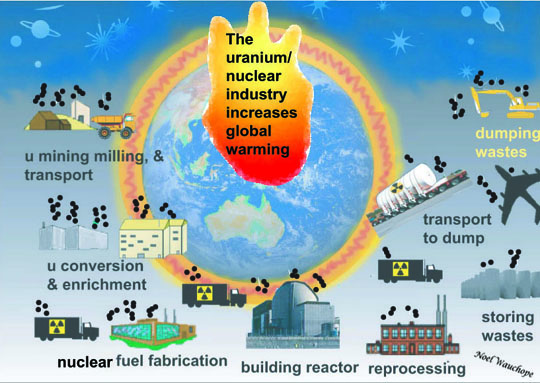
7 November 2023 https://eeb.org/investing-in-nuclear-energy-is-bad-for-the-climate-ngos-say/
Today, EU nuclear energy stakeholders are meeting at the European Nuclear Energy Forum. The nuclear industry and certain EU countries call for more support and subsidies for nuclear power, particularly for Small Modular Reactors (SMRs), in the name of reaching the EU’s climate goals.
Environmental NGOs join voices to contest this claim, arguing that investing in new nuclear power plants will delay decarbonisation and that SMRs fail to answer the industry’s problems. Governments should rather focus on cheap renewable energy, grids and storage.
At the European Nuclear Energy Forum, NGOs call on the EU and its member states to subsidise energy sources that can reliably and cheaply achieve our climate goals, not nuclear power. Rather, investing in new nuclear power plants may prove detrimental to EU climate goals:
Prolonged delays: The latest nuclear plants built in Europe have experienced delays of over a decade. We cannot risk such delays on our path to reduce fossil fuel emissions.
Cost overruns: Nuclear power plants have faced huge cost overruns. The nuclear industry seeks to pass these high costs on to taxpayers and households via state and EU subsidies. The French nuclear industry has been nationalised.
Geostrategic interests: Nuclear energy is being pushed by powerful lobbies and geostrategic interests. Several EU states’ nuclear energy relies on the state-owned Russian nuclear firm Rosatom, importing uranium from unstable countries outside the EU.
Decentralised transition: To quickly decarbonise, we must choose cheap technologies, easy to deploy at scale, like solar panels and windmills. Nuclear power contradicts the vision of a decentralised energy system with citizen engagement.
Environmental impact: According to the IPCC report published in March 2023, nuclear power is one of the two least effective mitigation options (like Carbon Capture and storage). It’s an inefficient option that poses serious contamination risks during use and for future generations due to everlasting toxic waste
Small Modular Reactors (SMRs) do not answer any of the industry’s fundamental problems:
- Unproven technology: Even the simplest designs used today in submarines will not be available at scale until late next decade, if at all.
- Waste and proliferation risks: SMR designs fail to address the persistent nuclear waste problem and pose new risks associated with the proliferation of nuclear materials.
Quotes
Luke Haywood, from the European Environmental Bureau, said:
“It is highly unlikely that small modular reactors will change anything about the poor economics of investments in nuclear energy. Our focus should be on what we know works to rapidly reduce emissions: energy savings and renewables. Every euro invested in nuclear could help replace fossil fuels faster and cheaper if directed to renewables, grids and energy storage. This would also reduce air pollution, radioactive waste, and energy bills while allowing for more citizen participation.”
Marion Rivet, from Réseau Sortir du nucléaire, said:
“New nuclear power plant projects in France are estimated to cost around 52 billion euros. All this money should be invested in immediate and effective solutions for a real energy transition. The reduction of the greenhouse gas our countries produce has to be effective in the next 10 years and has to come from a source fully sustainable (meaning that does not create long-term wastes, that does not rely on uranium.”
Antoine Bonduelle, from Virage Energie, said:
“Small reactors are not an option for the Climate Crisis. At best, they cost double or more per kWh than other nuclear options, and even much more than efficiency or renewables, as shown extensively in the models and in the consensus of the recent AR6 IPCC report. Small reactors would produce more waste than classical reactors, and use more materials and fuels. Accidents are still possible and proliferation risks are much higher. In France, several proposed projects are shady arrangements aimed at using more public money or justifying unproductive research teams. In the end, it is a costly impasse, a loss of time and public money.”
Antoine Gatet, from France Nature Environnement, said:
“For France Nature Environnement, energy choices must be discussed democratically taking on board citizens in general and organized civil society in particular. Discussions must be based on transparent economic, social and environmental data. Discussions must include the whole lifecycle from mining to waste management. To this day, the nuclear renaissance has fallen flat every time, and the 100% renewables options are winning. When will we move to environmental democracy?”
Signatories
European Environmental Bureau (EU), Foundation for Environment and Agriculture (Bulgaria), France Nature Environnement (France), Global Chance (France), Klimaticka Koalicia (Slovakia), Réseau Sortir du Nucléaire (France), Virage Énergie (France), NOAH Friends of the Earth Denmark, Védegylet/Protect the Future (Hungary), Estonian Green Movement – Friends of the Earth Estonia, MKG – Swedish NGO Office for Nuclear Waste Review (Sweden), Milkas – The Swedish Environment Movement`s Nuclear Waste Secretariat (Sweden).
Contact persons in Bratislava:
- Luke Haywood, European Environmental Bureau, Luke.Haywood@eeb.org
- Albena Simeonova, Foundation for Environment and Agriculture (Bulgaria), ealbenas@gmail.com, agroecobg@gmail.com
- Antoine Bonduelle, Virage Énergie (France), contact@ee-consultant.fr
- Jan Haverkamp, WISE (Netherlands), jan@wisenederland.org
- Lucia Szabová, Klimaticka Koalicia (Slovakia), luia.szabova@gmail.com #nuclear #antinuclear #nuclearfree #NoNukes
Failed U.S. Nuclear Project Raises Cost Concerns for Canadian Small Modular Reactor (SMR) Development
“Once you’re on a dead horse, you dismount quickly. That’s where we are here.”
“the massively expensive SMR projects in Canada will eventually face the same reckoning”
Primary Author: Mitchell Beer, The Energy Mix, November 10, 2023 more https://www.theenergymix.com/2023/11/10/failed-u-s-nuclear-project-raises-cost-concerns-for-canadian-smr-development/
NuScale and its customer, Utah Associated Municipal Power Systems (UAMPS), announced they were cancelling the project earlier this week, after its anticipated cost increased 53% over earlier estimates, Bloomberg reports. “The decision to terminate the project underscores the hurdles the industry faces to place the first so-called small modular reactor into commercial service in the country.”
But a clear-eyed assessment of the project’s potential was really made possible by a level of accountability that doesn’t exist in Canada, said Gordon Edwards, president of the Canadian Coalition for Nuclear Responsibility.
“Private investors in Utah forced NuScale to divulge financial information regarding the cost of electricity from its proposed nuclear plant,” and “cost became the deal-breaker,” Edwards told The Energy Mix in an email. “Publicly-owned utilities in Canada are not similarly accountable. The public has little opportunity to ‘hold their feet to the fire’ and determine just how much electricity is going to cost, coming from these first-of-a-kind new nuclear reactors.”
In the U.S., the business case started to fall apart last November, when NuScale blamed higher steel costs and rising interest rates for driving the cost of the project up from US$58 to $90 or $100 per megawatt-hour of electricity. The new cost projection factored in billions of dollars in tax credits the project would receive under the Biden administration’s Inflation Reduction Act, amounting to a 30% saving.
At the time, the Institute for Energy Economics and Financial Analysis (IEEFA) estimated the total subsidy at $1.4 billion. This week, Bloomberg said NuScale had received $232 million of that total so far.
The cost increase meant that UAMPS “will not hit certain engineering, procurement, and construction benchmarks, allowing participants to renegotiate the price they pay or abandon the project,” Utility Dive wrote.
Scott Hughes, power manager for Hurricane City Power, one of the 27 municipal utilities that had signed on to buy power from the six NuScale reactors, said the news was “like a punch in the gut when they told us.” Another municipal utility official called the increase a “big red flag in our face.”
Nearly a year later, NuScale had to acknowledge that UAMPS would not be able to sell 80% of the output from the 462-MW project to its own members or other municipal utilities in the western U.S., Bloomberg writes. “The customer made it clear we needed to reach 80%, and that was just not achievable,” NuScale CEO John Hopkins said on a conference call Wednesday. “Once you’re on a dead horse, you dismount quickly. That’s where we are here.”
In Canada, “the massively expensive SMR projects in Canada will eventually face the same reckoning” predicted Susan O’Donnell, an adjunct research professor at St. Thomas University and member of the Coalition for Responsible Energy Development in New Brunswick. While the Canadian Energy Regulator’s modelling assumes SMRs could be built at a cost of C$9,262 per kilowatt in 2020, falling to $8,348 per kilowatt by 2030 and $6,519 by 2050, the latest cost estimate from NuScale exceeded $26,000 per kilowatt in Canadian dollars, O’Donnell said—and the technology had been in development since 2007.
“Too bad our leaders have chosen to pursue an energy strategy which is too expensive, too slow, and too costly in comparison with the alternatives of energy efficiency and renewables—the fastest, cheapest, and least speculative strategies,” Edwards wrote. He added that waste disposal and management challenges and costs for SMRs will be very different from what Canadian regulators have had to confront with conventional Candu nuclear reactors.
The news from NuScale landed just days after civil society groups in the European Union warned that SMR development won’t help the continent reach its climate goals. Citing prolonged project delays and cost overruns, the long time frame to develop unproven technologies, and the risks associated with radioactive waste disposal and proliferation of nuclear materials, they urged EU governments to focus on renewable energy, power grid development, and energy storage.
“Nuclear energy is being pushed by powerful lobbies and geostrategic interests,” with several EU states relying on Russian state nuclear company Rosatom for their uranium supplies, the groups said. “To quickly decarbonize, we must choose cheap technologies, easy to deploy at scale, like solar panels and windmills.”
But in the U.S., proponents are still holding out hope for future SMR development. “We absolutely need advanced nuclear energy technology to meet ambitious clean energy goals,” the U.S. Department of Energy said in a statement. “First-of-a-kind deployments, such as CFPP, can be difficult.”
Uncertainties in estimating production costs of future nuclear technologies: A model-based analysis of small modular reactors
Björn Steigerwald ab, Jens Weibezahn ca, Martin Slowik d, Christian von Hirschhausen ab
Highlights
- •We present a unique cost data set on 19 small modular reactors.
- •Manufacturer cost estimates are mostly too optimistic compared to production theory.
- •A Monte Carlo simulation shows that no concept is profitable or competitive.
- •Median NPVs are negative ranging from 3 (HTR) to 293 (SFR) million USD/MWel.
- •Median LCOEs start at 116 USD/MWh for HTRs and at 218 USD/MWh for PWRs.
Abstract
Predicting future costs of technologies not yet developed is a complex exercise that includes many uncertain parameters and functional forms. In that context, small modular reactor (SMR) concepts that are in a rather early development stage claim to have cost advantages through learning effects, standardized design, modularization, co-siting economies, and other factors, such as better time-to-market even though they exhibit negative economies of scale in their construction costs due to their lower power output compared to conventional nuclear reactors.
In this paper, we compare two different approaches from production theory and show that they have a theoretically equal structure. In the second step, we apply these approaches to estimate a range of potential construction costs for 15 SMR projects for which sufficient data is available. These include water cooled, high temperature, and fast neutron spectrum reactors. We then apply the Monte Carlo method to benchmark the cost projections assumed by the manufacturers by varying the investment costs, the weighted average cost of capital, the capacity factor, and the wholesale electricity price in simulations of the net present value (NPV) and the levelized cost of electricity (LCOE).
We also test whether the differences between the manufacturer estimates and ours differ between technology families of SMR concepts and apply a sensitivity analysis. Here we contribute to an intensifying debate in the literature on the economics and finance of SMR concepts. The Monte Carlo analysis suggests a broad range of NPVs and LCOEs: Surprisingly, the lowest LCOE is calculated for a helium-cooled high-temperature reactor, whereas all of the light water reactors feature higher LCOEs.
None of the tested concepts is able to compete economically with existing renewable technologies, not even when taking their variability and necessary system integration costs into account. The numerical results also confirm the importance of the choice of production theory and parameters. We conclude that any technology foresight has to take as much of the case specifics into account, including technological and institutional specifics; this also holds for SMR concepts……………………………………………………………………………………………………………………………………………………………………more https://www.sciencedirect.com/science/article/pii/S0360544223015980 #nuclear #antinuclear #nuclearfree #NoNukes
Book Review: Are We Ready to Head to Mars? Not So Fast.

“A City on Mars” is Kelly and Zach Weinersmith’s cheeky account of the many challenges to visiting the red planet.
Undark, BY CHRISTIE ASCHWANDEN, 11.10.2023
IN AUGUST 1998, 700 people came to Boulder, Colorado to attend the founding convention of the Mars Society. The group’s co-founder and president, Robert Zubrin, extolled the virtues of sending humans to Mars to terraform the planet and establish a human colony. The Mars Society’s founding declaration began, “The time has come for humanity to journey to the planet Mars,” and declared that “Given the will, we could have our first crews on Mars within a decade.” That was two and a half decades ago.
In their hilarious, highly informative and cheeky book, “A City on Mars: Can We Settle Space, Should We Settle Space, and Have We Really Thought This Through?”, Kelly and Zach Weinersmith inventory the challenges standing in the way of Zubrin-like visions for Mars settlement. The wife-and-husband team serves a strong, but never stern, counterargument to the visionaries promising that we’ll put humans on Mars in the very near future. “Think of this book as the straight-talking homesteader’s guide to the rest of the solar system,” they write.
Just as in their previous book, “Soonish: Ten Emerging Technologies That’ll Improve and/or Ruin Everything,” the authors — she’s a faculty member in the biosciences department at Rice University and he’s a cartoonist — use humor and science to douse techno dreams with a dose of reality. “After a few years of researching space settlements, we began in secret to refer to ourselves as the ‘space bastards’ because we found we were more pessimistic than almost everyone in the space-settlement field,” they write. “We weren’t always this way. The data made us do it.”
While working on their deeply researched book, the Weinersmiths came to view sending people to Mars as a problem far more complicated and difficult than you’d know by listening to enthusiasts like Elon Musk or Robert Zubrin. It’s a challenge that “won’t be solved simply by ambitious fantasies or giant rockets.” Eventually humans are likely to expand into space, the Weinersmiths write, but for now, “the discourse needs more realism — not in order to ruin everyone’s fun, but to provide guardrails against genuinely dangerous directions for planet Earth.”………………………………………………………………………………………………………………………..
Living on Mars, which has no birds or rain, gets less than half the sunlight per area that Earth does, and is often plagued by dust storms that further blot out the sun, could be a soul-deadening experience.
………………………………………. They also run through a list of “Bad Arguments for Space Settlement,” which include “Space Will Save Humanity from Near-Term Calamity by Providing a New Home,” and “Space Exploration Is a Natural Human Urge.” These detailed examinations of the stark realities regarding space travel and habitation serve as a foil to the breathlessly optimistic accounts that are so ubiquitous in popular media……………………. more https://undark.org/2023/11/10/review-city-on-mars/?utm_source=Undark%3A+News+%26+Updates&utm_campaign=448a889155-RSS_EMAIL_CAMPAIGN&utm_medium=email&utm_term=0_5cee408d66-185e4e09de-%5BLIST_EMAIL_ID%5D
Disputes over safety, cost swirl a year after California OK’d plan to keep last nuke plant running

Disputes over safety, cost swirl a year after California OK’d plan to keep
last nuke plant running. More than a year after California endorsed a
proposal to extend the lifespan of its last nuclear power plant, disputes
continue to swirl about the safety of its decades-old reactors, whether
more than $1 billion in public financing for the extension could be in
jeopardy and even if the electricity is needed in the dawning age of
renewables.
Daily Mail 10th Nov 2023
https://www.dailymail.co.uk/wires/ap/article-12733339/Disputes-safety-cost-swirl-year-California-OKd-plan-nuke-plant-running.html #nuclear #antinuclear #nuclearfree #NoNukes
China’s Misunderstood Nuclear Expansion
How U.S. Strategy Is Fueling Beijing’s Growing Arsenal
Foreign Affairs, By M. Taylor Fravel, Henrik Stålhane Hiim, and Magnus Langset Trøan, November 10, 2023
Among the many issues surrounding China’s ongoing military modernization, perhaps none has been more dramatic than its nuclear weapons program. For decades, the Chinese government was content to maintain a comparatively small nuclear force. As recently as 2020, China’s arsenal was little changed from previous decades and amounted to some 220 weapons, around five to six percent of either the U.S. or Russian stockpiles of deployed and reserve warheads.
Since then, however, China has been rapidly expanding and modernizing its arsenal. In 2020, it began constructing three silo fields to house more than 300 intercontinental ballistic missiles (ICBMs). A year later, it successfully tested a hypersonic glide vehicle that traveled 21,600 miles, a test that likely demonstrated China’s ability to field weapons that can orbit the earth before striking targets, known as a “fractional orbital bombardment system.” Simultaneously, the Chinese government has accelerated its pursuit of a complete nuclear triad—encompassing land-, sea-, and air-launched nuclear weapons—including by developing new submarine- and air-launched ballistic missiles. By 2030, according to U.S. Defense Department estimates, China will probably have more than 1,000 operational nuclear warheads—a more than fourfold increase from just a decade earlier…………………………………………………………………………………………………………………………………..
writings and analysis since 2015 suggest that China’s nuclear expansion is less a shift in Chinese intentions than a response to what Beijing perceives as threatening changes in U.S. nuclear strategy, reflecting an acute security dilemma. Chinese analysts are worried that the United States has lowered its threshold for nuclear use—including allowing for limited first use in a Taiwan conflict—and that the U.S. military is acquiring new capabilities that could be used to destroy or significantly degrade China’s nuclear forces. Thus, many Chinese experts have concluded that China needs a more robust arsenal.
Given Chinese and U.S. fears about each other’s nuclear programs, increased communication may help to break the spiral. Based on Chinese fears, the United States should understand how changes in its nuclear capabilities and doctrine play a critical role in shaping China’s threat perceptions and perceived force requirements. Going forward, China will continue to respond to U.S. advances that are viewed as weakening China’s nuclear deterrent.
Similarly, Beijing should understand that the lack of transparency surrounding its rapid nuclear expansion has fueled worst-case assessments by the United States. Continued lack of transparency will lead to even greater U.S. suspicion—and feed an intensifying arms race between the two countries……………………………………………………………………………….
the 2018 review increased Chinese fears that the United States might engage in limited nuclear first use during a conventional conflict with China, most likely over Taiwan. According to Chinese arms control expert Li Bin, the document suggested that “the United States would use its nuclear weapons to respond to nonnuclear Chinese aggressions.”………………………………………………………………………………………………………………………………………………………………………………………………………….. more https://www.foreignaffairs.com/china/chinas-misunderstood-nuclear-expansion
Anti-Nuclear Activist Goes on Trial Amid the Fallout of Oppenheimer’s LegacyKansas City’s Ties To The Bomb
Flatland, Clarence Dennis, cdennis@flatlandkc.org 10 Nov 23
At time zero the first thing I noticed was that although facing away from ground zero, it felt like someone had slapped my face: it was of course the heat radiation from a most successful test.”Hugh Richards, Ph.D., “Through Los Alamos, 1945: Memoirs of a Nuclear Physicist”
Last month, Ann Suellentrop, 71, stood before a judge in the 16th Judicial Court of Missouri.
A retired maternal-child nurse and lifelong activist, Suellentrop was one of three people arrested for trespassing during a Memorial Day protest organized by PeaceWorks KC at the National Security Campus of the National Nuclear Security Administration (NNSA) in south Kansas City earlier this year.
The only property line crosser who would plead not guilty, Suellentrop represented herself in court on Oct. 25. She argued that intentionally crossing the alleged boundary line by 10 feet or less, approximately three-fourths of a mile from the NNSA facility, was not trespass, but a peaceful, “limited protest” on a matter of principle and should not result in fines or jail time.
Facing a $500 fine, six months in jail, or both, the defendant argued her action was an expression of her First Amendment rights and stressed that advanced notice and planning of the annual protest was communicated to police and NNSA campus officials.
In front of more than a dozen supporters sporting bold black stickers that read “NO NUKES Y’ALL,” Suellentrop raised points to Judge Anne LaBella about her own character, the nature of her peaceful protest and the threats nuclear weapons and nuclear terrorism pose to human health and society.
Facing a slew of objections based on relevance and witness testimony from the NNSA campus security guard who was on duty during the protest and warned the protesters to step off the property, all signs pointed to a guilty verdict.
Moments after all arguments were heard and the city rested its case, the prosecutor asked the judge to amend the charge to include NNSA campus administrator Honeywell Federal Manufacturing and Technologies.
Judge LaBella said the request came too late and she would not amend the charge. She then promptly announced her ruling on Suellentrop’s case.
Not guilty.
Modern-Day Peaceniks
A member of PeaceWorks KC and the Alliance for Nuclear Accountability, Suellentrop has been arrested twice before in protests at the NNSA campus. The facility manufactures 80% of the non-nuclear components that go into the national nuclear stockpile……..
“Our ultimate goal is to convert the plant into a peaceful production of hopefully something that can fight the environmental crisis that’s going on. We need those brains, those skills and that money to convert it into something we really need,” Suellentrop said ahead of the trial.
Immediately following the verdict, Suellentrop and her peacenik partners picked up where her testimony left off. The group of mostly older adults gathered outside of the Jackson County Courthouse, taking turns passing a child’s toy microphone, celebrating the win and speaking about the threat nuclear weapons present to anyone who would listen.
“Because there is a group of old people, it doesn’t mean we are wrong. Historically, civil disobedience has played a big role in changing things,” said PeaceWorks KC board chair Chris Mann.
Mann, 73, participated in her first protest in college – a silent vigil during the war in Vietnam.
“Our group is becoming increasingly younger… a tradition of civil disobedience is only one of the measures,” Mann said, speaking to the makeup of PeaceWorks KC. “We think that younger people have a hard way to go now.”…………………………………….
The experience, plus an admiration for Australian physician, author and anti-nuclear advocate Helen Caldicot, fueled a lifetime of activism for Suellentrop, particularly in anti-nuclear efforts.
As for what keeps her civil disobedience going into her 70s, Suellentrop points to her faith.
“Like any person, I have fears and worries and self-doubts and what have you, but I just go to God and prayer,” Suellentrop said. “I get an overwhelming feeling of, ‘I got this.’ God is good and he’s opposing this – and this is an unspeakable evil.”…………………………………………………………………………………………………… more https://flatlandkc.org/news-issues/anti-nuclear-activist-goes-on-trial-amid-the-fallout-of-oppenheimers-legacy/
No American money left for Ukraine – USAID
USAID’s help has enabled Ukraine to spend all of its own government revenue on its defense, including soldier salaries.
https://www.rt.com/news/586853-us-ukraine-humanitarian-funding-runs-out/ 10 Nov 23
Kiev faces economic collapse if new funding isn’t approved, an official has warned US lawmakers
The US government agency overseeing Washington’s humanitarian relief program for Ukraine has warned lawmakers that funding has run out, putting Kiev at risk of economic ruin if more money isn’t allocated amid the former Soviet republic’s conflict with Russia.
“We have no more direct budget support,” Erin McKee, an assistant administrator for the US Agency for International Development (USAID), testified on Wednesday to the Senate Foreign Relations Committee in Washington. “The last tranche was disbursed at the end of the fiscal year. This jeopardizes, particularly over the coming months, Ukraine’s ability to maintain its economic stability while it continues to fight the war. It’s urgent.”
The US government’s latest fiscal year ended on September 30. Ukraine has relied on Washington not only as its biggest provider of weaponry, but also for money to meet its non-military expenses. President Joe Biden has proposed a $106 billion emergency spending bill that combines aid to help Ukraine fight Russia and Israel fight Hamas. It also includes $9.2 billion in humanitarian aid tied to both conflicts.
McKee said USAID’s help has enabled Ukraine to spend all of its own government revenue on its defense, including soldier salaries. “That means they don’t have any resources to take care of their own people and govern,” she added.
Such outlays as paying teachers, police and health care workers would be suspended without new US funding being approved, McKee said. A prolonged funding disruption would cripple the Ukrainian economy, she claimed, giving Russian President Vladimir Putin the upper hand in the ongoing conflict. “If their economy collapses, Putin will have won.”
Congressional opposition to Biden’s Ukraine policy has grown in recent months. The Republican-controlled House of Representatives passed a $14 billion aid bill for Israel alone last week, leaving new funding for Ukraine to be decided separately. The Democrat-controlled Senate blocked the House bill on Tuesday, demanding that Biden’s bundled aid package be approved instead.
Congress previously approved $113 billion in Ukraine aid in four rounds of legislation. McKee warned that without the approval of a new tranche of funding, Ukraine’s government “would need to use emergency measures, such as printing money or not paying critical salaries, which could lead to hyperinflation and severely damage the war effort.”
US reactor project fail heats up Australia’s nuclear power debate

ByMike Foley, November 10, 2023 — https://www.smh.com.au/politics/federal/us-reactor-project-fail-heats-up-australia-s-nuclear-power-debate-20231109-p5eisu.html
A nuclear energy developer championed by the Coalition has canned its most advanced project in the United States, raising questions over the viability of the technology in Australia.
NuScale Power, which was developing small modular reactors at a US government-owned site in Idaho with plans to sell electricity to suppliers across the regional network by 2029, on Thursday said it had abandoned the project due to a lack of customer sign-ups.
The federal opposition, which wants Australia to overturn its longstanding ban on nuclear energy, claims small modular reactors – the next generation of nuclear power plants – are the only viable backup for renewable energy as the country transitions away from fossil fuels.
But Climate Change and Energy Minister Chris Bowen said NuScale’s announcement was further proof that small modular reactors were not viable for Australia.
“The opposition’s only energy policy is small modular reactors,” Bowen said. “Today, the most advanced prototype in the US has been cancelled. The [opposition’s] plan for energy security is just more hot air from Peter Dutton.”
NuScale’s small modular reactor design was the first to be approved by the US Nuclear Regulatory Commission in January. It was awarded more than $US1 billion ($1.56 billion) in government funding to support its development.
The company said in 2021 it would supply power from its small modular reactor plant for $US58 a megawatt hour. Since then, that figure has more than doubled to $US89 a megawatt hour.
Mason Baker, the chief executive of NuScale’s government-owned partner, Utah Associated Municipal Power Systems, said it was working with the company and the US Department of Energy to wind down the project.
“This decision is very disappointing given the years of pioneering hard work put into the [project],” Baker said.
Opposition Leader Peter Dutton has said small modular reactors could easily replace Australia’s coal-fired power plants.
“Australians must consider new nuclear technologies as part of the energy mix,” he said in July. “New nuclear technologies can be plugged into existing grids and work immediately.”
Opposition climate change and energy spokesman Ted O’Brien said in May that NuScale’s designs offered “exceptional flexibility” and would allow a “simple expansion” for Australia’s energy grid.
“North America has done the maths. It has mapped its course to a net-zero future, and it’s one that sensibly includes next-generation, zero-emissions nuclear energy.”
But recent Energy Department modelling found more than 70 small modular reactors, which are forecast to generate 300 megawatts each, would be needed to replace all of Australia’s coal plants at an estimated cost of $387 billion.
O’Brien said on Thursday that Bowen had applied “faulty logic” to NuScale’s announcement and if he applied the same test to renewables, they too would be considered a failure.
“Is Bowen arguing that wind power is dead because the world’s leading supplier, Siemens, is seeking a €15 billion government bailout, or the days of solar are over because plans for the world’s largest solar plant, Sun Cable, have run into trouble,” O’Brien said.
“If Australia is serious about reaching net-zero emissions by 2050 while keeping the lights on and getting prices down, we cannot afford to take any option off the table.”
-
Archives
- October 2026 (120)
- September 2026 (339)
- August 2026 (330)
- July 2026 (355)
- June 2026 (287)
- May 2026 (306)
- April 2026 (356)
- March 2026 (251)
- February 2026 (267)
- January 2026 (308)
- December 2025 (358)
- November 2025 (359)
-
Categories
- 1
- 1 NUCLEAR ISSUES
- business and costs
- climate change
- culture and arts
- ENERGY
- environment
- health
- history
- indigenous issues
- Legal
- marketing of nuclear
- media
- opposition to nuclear
- PERSONAL STORIES
- politics
- politics international
- Religion and ethics
- safety
- secrets,lies and civil liberties
- spinbuster
- technology
- Uranium
- wastes
- weapons and war
- Women
- 2 WORLD
- ACTION
- AFRICA
- Atrocities
- AUSTRALIA
- Christina's notes
- Christina's themes
- culture and arts
- Events
- Fuk 2022
- Fuk 2023
- Fukushima 2017
- Fukushima 2018
- fukushima 2019
- Fukushima 2020
- Fukushima 2021
- general
- global warming
- Humour (God we need it)
- Nuclear
- RARE EARTHS
- Reference
- resources – print
- Resources -audiovicual
- Weekly Newsletter
- World
- World Nuclear
- YouTube
-
RSS
Entries RSS
Comments RSS

