Arundhati Roy: India Must Stop Arming Israel or ‘Forever Be Linked to Genocide’
“It is our responsibility to show that as people of India, we refuse to be complicit in that, even if our government wishes to continue with what it does.”
Brett Wilkins, Aug 02, 2024, https://www.commondreams.org/news/arundhati-roy-israel
Acclaimed Indian author and activist Arundhati Roy this week joined prominent jurists, diplomats, artists, and others in urging their government to stop selling weapons to Israel, which they called “abominable” and “a serious violation of India’s obligations under international law and our Constitution.”
Speaking Thursday at an event organized by the Press Club of India, Roy—winner of the 1997 Booker Prize for her debut novel The God of Small Things—said that Indians must “at least show that we do not support that murder in Gaza, we do not support our government’s support of that.”
Acclaimed Indian author and activist Arundhati Roy this week joined prominent jurists, diplomats, artists, and others in urging their government to stop selling weapons to Israel, which they called “abominable” and “a serious violation of India’s obligations under international law and our Constitution.”
Speaking Thursday at an event organized by the Press Club of India, Roy—winner of the 1997 Booker Prize for her debut novel The God of Small Things—said that Indians must “at least show that we do not support that murder in Gaza, we do not support our government’s support of that.”
“What is happening in Gaza, it is not just the murder… of tens of thousands of women and children,” she continued. “It is the bombing of hospitals, the destruction of universities… the attempt to erase the very memory people have of that place. It is a genocide like no other because it’s taking place on live TV.”
“India used to be a country that supported the people of Palestine in their struggle for freedom,” Roy noted. “Everywhere, even in the United States… people are standing up against their government’s support for [Israel]. But we are not standing up… and that is such a shame.”
“We must stand up. We must refuse,” she asserted. “We will not support the export of weapons of any kind.”
Roy is one of more than two dozen former Indian Supreme Court justices and other judges, foreign service officers, academics, artists, activists, and others who on Wednesday sent a letter to Indian Defense Minister Rajnath Singh urging him to halt the licensing of arms sales to Israel, whose military forces have killed or wounded more than 140,000 Palestinians while obliterating and starving Gaza.
“The International Court of Justice (ICJ) has clearly ruled that Israel is in violation of obligations under the Genocide Convention and further that Israel is in illegal occupation of the occupied Palestinian territory,” the letter states. “In light of these rulings, any supply of military material to Israel would amount to a violation of India’s obligations under international humanitarian law and the mandate of Article 21 read with Article 51(c) of the Constitution of India.”
Among the weapons India has sent to Israel are Hermes 900 unmanned aerial drones, which are co-manufactured with Israeli arms company Elbit Systems. The letter notes that the drones “have been extensively used in the Israeli Defense Forces’ military campaign in Gaza.”
“Several [United Nations] experts have warned that the transfer of weapons and ammunition to Israel may constitute serious violations of human rights and international humanitarian laws, and risk state complicity in international crimes, possibly including genocide, reiterating their demand to stop transfers immediately,” the letter’s signer wrote.
“In short, the grant of licenses and approvals for export of military material to Israel, coupled with reports of such exports by Indian companies, constitutes a serious violation of India’s obligations under international law and our own Constitution,” the letter stresses.
“International law aside, we consider such exports to be morally objectionable, indeed abominable,” the signatories added. “We demand, therefore, that India should immediately suspend its collaboration in the delivery of military material to Israel. Further, India must immediately make every effort to ensure that weapons already delivered to Israel are not used to contribute to acts of genocide or violations of international humanitarian law.”
The letter came ahead of planned nationwide protests by Indian leftists on Saturday calling for an end to arms sales and “all forms of complicity with Israel’s illegal occupation and genocide.”
India—which in 1971 invaded Bangladesh (then East Pakistan) in large part to end a U.S.-backed Pakistani genocide mostly targeting Bengalis—voted in favor of the December U.N. Security Council resolution calling for an immediate Gaza cease-fire.
However, the administration of Indian Prime Minister Narendra Modi and many lawmakers from his right-wing Bharatiya Janata Party have expressed steadfast support for Israel and its Gaza onslaught. Critics have noted that both Israel and India are occupying Muslims, the former in Palestine and the latter in Jammu and Kashmir.
In an interview with Middle East Eye published Friday, Roy—who faces prosecution in India over comments she allegedly made nearly 15 years ago regarding Kashmir—said that India could “forever be linked to genocide” if it does not change course.
“India needs to stop the export of weapons to Israel and ensure the return of Indian workers who have been sent to Israel to replace Palestinian workers,” she said.
“If it does not do so at once, it is in violation of the orders of the ICJ,” she added. “It will forever be complicit in aiding and abetting a genocide that is being telecast live for the world to watch.”
Where Is the Biden Plan to End the War in Ukraine?

On the face of it, the Biden administration would appear to be asking the American people to spend indefinitely tens of billions of dollars a year on an endless war for an unachievable goal.
Biden team blows off deadline for Ukraine war strategy
Perhaps the administration can’t admit it doesn’t have one.
Anatol Lieven, Aug 02, 2024, https://responsiblestatecraft.org/biden-ukraine-strategy/
Almost 100 days have now passed since the Congress passed $61 billion in emergency funding for Ukraine, a measure that included a condition that required the Biden Administration to present to the legislative body a detailed strategy for continued U.S. support.
When the funding bill was passed with much fanfare on April 23, Section 504, page 32 included the following mandate:
“Not later than 45 days after the date of enactment of this Act, the Secretary of State and the Secretary of Defense, in consultation with the heads of other relevant Federal agencies, as appropriate, shall submit to 18 the Committees on Appropriations, Armed Services, and Foreign Relations of the Senate and the Committees on 20 Appropriations, Armed Services, and Foreign Affairs of the House of Representatives a strategy regarding United States support for Ukraine against aggression by the Russian Federation: Provided, That such strategy shall be multi-year, establish specific and achievable objectives, define and prioritize United States national security interests…”
It is now August and There is still no sign on the part of the Biden Administration of any intention to submit such a strategy to Congress. This inevitably leads to the suspicion that no such strategy in fact exists. It also suggests that without a massive change of mindset within the administration, it is not even possible to hold — let alone make public —serious and honest internal discussions on the subject, as these would reveal the flawed and empty assumptions on which much of present policy is based.
This relates first of all to the requirement “to define and prioritize United States national security interests.” No U.S. official has ever seriously addressed the issue of why a Russian military presence in eastern Ukraine that was of no importance whatsoever to the U.S. 40 years ago (when Soviet tank armies stood in the center of Germany, 1,200 miles to the West) should now be such a threat that combating it necessitates $61 billion of U.S. military aid per year, a significant risk of conflict with a nuclear-armed Russia, and a colossal distraction from vital U.S. interests elsewhere.
Instead, the administration, and its European allies, have relied on two arguments. The first is that if Russia is not defeated in Ukraine, it will go on to attack NATO and that this will mean American soldiers going to fight and die in Europe.
In fact, there is no evidence whatsoever of any such Russian intention. Russian threats of escalation and (possibly) minor acts of sabotage have been outgrowths of the war in Ukraine, and intended to deter NATO from intervening directly in that conflict — not actions intended to lay the basis for an invasion of NATO.
Moreover, given the acute difficulties that the Russian military has faced in Ukraine, and the Russian weaknesses revealed by that conflict, the idea of them planning to attack NATO seems utterly counter-intuitive. For Russia has been “stopped” in Ukraine. The heroic resistance of the Ukrainian army, backed with Western weapons and money, stopped the Russian army far short of President Putin’s goals when he launched the war. They have severely damaged Russian military prestige, inflicted enormous losses on the Russian military, and as of today, hold more than 80% of their country’s territory.
The Biden administration has issued partly contradictory statements about the purpose of U.S. aid to Ukraine: that it is intended to help Ukraine “win”, and that it is intended to help “strengthen Ukraine at the negotiating table.” They have not however fulfilled their legal obligation to define to Congress what “winning” means, nor why if the war will end in negotiations, these negotiations should not begin now — especially since there is very strong evidence that the Ukrainian military position, and therefore Ukraine’s position at the negotiating table, are getting worse, not better.
As Samuel Charap and Jeremy Shapiro have written in response to the latest US despatch of weapons to Ukraine:
“[A]daptation and adjustment do not constitute strategy, and reactive escalation absent a strategy is not sound policy. Escalating U.S. involvement in this conflict—or any conflict—should be guided by an idea about how to bring the war to an end.”
As with U.S. campaigns in Vietnam and elsewhere, the administration and its allies have tried to play the “credibility” card: the argument that it is necessary to defeat Russia in Ukraine because otherwise, China, Iran and other countries will be emboldened to attack the United States or its allies. But like the line about Russian ambitions beyond Ukraine, this is simply an assumption. There is no actual evidence for it at all.
It can, with equal or greater validity, be assumed that the governments of these countries will make up their minds according to calculations of their own interests and the military balance in their own regions.
The final administration line of argument is a moral one: that “Russian aggression must not be rewarded” and that “Ukrainian territorial integrity must be restored.” Since, however, any realistic negotiations towards a peace settlement will have to involve de facto recognition of Russian territorial gains (not de jure recognition, which the Russians do not expect and even the Chinese will not grant), this statement would seem to rule out even the idea of talks. On the face of it therefore, the Biden administration would appear to be asking the American people to spend indefinitely tens of billions of dollars a year on an endless war for an unachievable goal.
If this is a mistaken picture of the administration’s position, then once again, it has a formal obligation under the bill passed by Congress in April to tell the American people and their elected representatives what their goals in Ukraine in fact are. Then everyone will be able to reach an informed judgment on whether they are attainable, and worth $61 billion a year in American money.
Unfortunately, it seems that the administration’s actual position is to kick this issue down the road until after the presidential election. Thereafter, either a Harris administration will have to draw up new plans, or a Trump administration will do so. But given the length of time it takes a new administration to settle in and develop new policies, this means that we could not expect a strategy on Ukraine to emerge for eight months at best.
If the Ukrainians can hold roughly their present lines, then this approach could be justifiable in U.S. domestic political terms (though not to the families of the Ukrainian soldiers who will die in the meantime). There is however a significant risk that given the military balance on the ground, and even with continued aid, Ukraine during this time will suffer a major defeat. Washington would then have to choose between a truly humiliating failure or direct intervention, which would expose the American people to truly hideous risks.
There is an alternative. Since President Biden will in any case step down next January, he could take a risk and try to bequeath to his successor not war, but peace. In terms of domestic politics, to open negotiations with Russia now would deprive Donald Trump and JD Vance of a campaigning position, and would spare a future Democrat administration (if elected) from a very difficult and internally divisive decision.
The first step in this direction is for the Biden administration clearly to formulate its goals in Ukraine, and — as required by law — to submit these goals to the American people.
First NATO F-16’s delivered to Ukraine (nuclear capable)

Bruce K. Gagnon, 2 Aug 24, https://space4peace.blogspot.com/2024/08/first-nato-f-16s-delivered-to-ukraine.html
Reports indicate that six F-16’s have been sent to Ukraine (UAF) from the Netherlands to be used against Russia.
Doesn’t this mean that US-NATO are fully at war with Russia? Of course the US-NATO deny that fact but we are surely used to their endless lies by now!
It appears the war planes will be based in western Ukraine – far from the front lines in eastern Ukraine which is closest to the Russia border.
Previously, a number of NATO states, including the US, France, Bulgaria, Denmark, the Netherlands, Belgium, Canada, Luxembourg, Norway, Poland, Portugal, Romania, and Sweden, formed a so-called ‘F-16 coalition’, pledging to provide Kiev with 79 of the American-made fighter jets as well as to train Ukrainian pilots to operate the aircraft.
While Ukraine is pinning high hopes on the fighter jets, the truth is that NATO is only supplying them to make up for the heavy losses of the UAF and prolong the conflict.
In addition the US-NATO war mongering ‘coalition’ must supply the weapons for the planes as well as the maintenance crews since Ukraine does not have the technical capacity to keep the planes in the air by themselves. The west will also likely need to supply the repair parts and the jet fuel for the planes.
Because it takes years to properly train pilots some have speculated that US-NATO pilots (wearing Ukraine military uniforms) might end up being the ones flying in combat against Russia. Especially after the first six planes get shot down and the Ukrainian F-16’s crews might be quickly erased.
There are reports that Moldova could be used as the main base for F-16 fighters. This will allow NATO countries to avoid becoming targets for Russian missiles, but at the same time provoke the Kremlin to a harsh reaction. (Any F-16 that enters Ukraine from a NATO country and continues to fly on to its combat area will be seen as an attack by NATO enabling Russia to legally attack the country of origin. Theoretically, this could start WW III – with a nuclear power no less. Note, however, that Moldova is not a NATO member. At any rate, the West is courting disaster.) This will increase the escalation and take the conflict in Ukraine to a new level, using Moldova for this purpose.
These planes will have the capability to carry US supplied nuclear weapons and fire them from a distance at ‘Russian targets’ that often means nothing more than population centers as Ukraine has been doing since the war began in 2014 after the US orchestrated coup d’état in Kiev. Moscow has said that it must conclude that any F-16’s in the air heading toward Russia could be carrying nukes and will respond accordingly.
The US long ago positioned nuclear weapons throughout Europe as you can see in the graphic just below. [on original]
Out of their complete desperation, as the US-NATO lose the war in Ukraine, they very well could decide to use these nukes now deployed in Europe. If that decision is made (and it would be made in Washington) then we are without a doubt off to the nuclear war races.
Now is the time for people not suffering from terminal imperial insanity to speak loudly – publicly and with determination – if we hope to survive the decline of the US-NATO killing project
Japan, U.S. urged to work for nuclear abolition at symposium
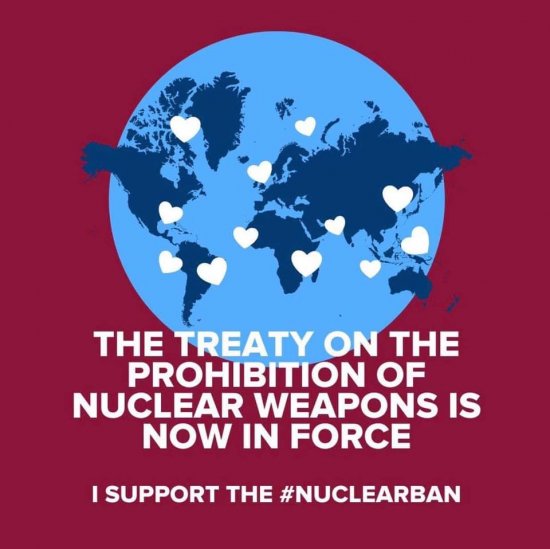
By NAOKI NAKAYAMA/ Staff Writer, July 28, 2024
NAGASAKI–Japan and the United States have a “special responsibility” to lead efforts to abolish nuclear weapons, the head of a U.S. nongovernmental organization told a 30th international peace symposium.
Ivana Hughes, president of the Nuclear Age Peace Foundation, was speaking at the “International Symposium for Peace: The Road to Nuclear Weapons Abolition” held at the Nagasaki Atomic Bomb Museum on July 27.
She said damage from radiation is still an issue in the Marshall Islands in the Pacific Ocean 70 years after the largest U.S. hydrogen bomb test at Bikini Atoll.
“After all, although for different reasons, the United States and Japan both have a special responsibility to not only join the Treaty on the Prohibition of Nuclear Weapons, but to lead efforts toward its full and complete implementation and total elimination of nuclear weapons,” Hughes said as she wound up her keynote speech.
Many speakers felt that the global situation surrounding nuclear weapons has deteriorated over the past 30 years, with nuclear disarmament stalled, and expressed concerns about growing international tensions, citing Russia’s war in Ukraine and the Israel-Hamas conflict.
“We should think about nuclear abolition from the perspective of the security of ‘mankind,’ not of nations,” said Mitsuru Kurosawa, an expert on nuclear disarmament and professor emeritus at Osaka University.
Batyrkhan Kurmanseit, minister-counselor at the Kazakhstan Embassy in Japan, said Kazakhstan is the only former Soviet republic that ratified the Treaty on the Prohibition of Nuclear Weapons. He said an international framework for nuclear abolition has never been more needed than right now.
The Asahi Shimbun has been a co-sponsor of the annual symposium, which has alternately been held in Hiroshima and Nagasaki with the municipal governments and local peace organizations every summer since 1995.
Terumi Tanaka, a hibakusha atomic bomb survivor and co-chair of the Japan Federation of A- and H-Bomb Sufferers Organization (Nihon Hidankyo), and Seiko Mimaki, an associate professor at Doshisha University’s graduate school specializing in U.S. politics and diplomacy, also participated in the symposium’s panel discussion.
In a speech, Kan Sang-jung, president of Chinzei Gakuin University in Nagasaki Prefecture, emphasized the importance of listening to hibakusha, saying that many lives have been lost as countries clash over what they believe is just amid the post-Cold War rise of nationalism.
Hibakusha Shizuko Mitamura read a hand-made picture card show that tells the story of what happened to her on Aug. 9, 1945, when the city of Nagasaki was leveled by atomic bombing, and the loss of her daughter to cancer in 2010, when she was 39.
‘True horror’: Japan’s Hiroshima atomic bomb survivor campaigns for a nuclear-free world

Bun Hashizume, 93, who has written poems about her descent into ‘hell’ after the bombing, has travelled the world to spread her message
Norman Aisbett, SCMP, 3 Aug 24,
What I feel the most about these days is human stupidity,” says 93-year-old Bun Hashizume, from her home in the Japanese temple city of Kamakura.
“I was a victim of the first atomic bomb in human history and I have advocated throughout my life for the abolition of nuclear weapons, but the world leaders still do not understand their true horror.
“Even my poems cannot describe it.”
Rewind to 8.15am on August 6, 1945 in the final throes of World War II.
A US atomic bomb named “Little Boy” was dropped from a B-29 aircraft and exploded at low altitude over the city of Hiroshima. With a blast force equal to 16 kilotons of TNT, it destroyed most buildings and caused mass death and injury.
Then aged 14, Hashizume was a war-mobilised school student working in the four-storey reinforced-concrete Savings Bureau building about 1.5km from the hypocentre of the blast.
Looking back, she recalls a third-floor window being filled “with a sudden flash of light that was so bright I thought the sun had fallen at my feet. A thousand rainbows all at once seemed to explode before my eyes”. And how, after being briefly unconscious and bleeding heavily from a head wound, she staggered downstairs among other workers looking “like a parade of ghosts with wildly dishevelled hair and sooty bodies”.
Once outside the building, it was a regular employee, Tomoyanagi, who “half-carried” her to a nearby Red Cross Hospital, where more shocking scenes and high drama followed.
Hashizume is today the author of The Day the Sun Fell – Memoirs of a Survivor of the Atomic Bomb – translated by Susan Bouterey – which closely details her and her family’s horrific experiences and also explains her present-day opposition to “dangerous” nuclear power plants, which she emphasises during this Australian writer’s long-distance interview with her, via a Japanese interpreter-admirer.
Her drive was such that, at age 70, she began her solo pilgrimages to many countries over 15 years to “become a citizen of the world” and share her anti-nuclear views. With only her aged pension to buy airline tickets and stay in youth hostels, she spoke to anyone or group willing to listen, including schoolchildren. Everywhere, people were also touched by her genuine personal warmth and quiet charm. A small booklet she handed out was entitled, “Fellow Humans! Let Us Foster Love and Wisdom.”
Right now, though, she is homebound due to A-Bomb-related health issues that have plagued her life. She tells of having endured “lifelong” rheumatism, chronic kidney disease, thyroid cancer and more. The past 20 years have also brought numerous breaks of radiation-weakened ribs, collarbones and three compressed fractures of her spine after a fall in Norway in 2003.
She is unable to go outside alone. There are twice-weekly visits to a hospital and three transports per week to a rehabilitation clinic. “Otherwise I’m on my bed reading the newspapers, with care from my eldest son and his family, who live with me.”
Her activist spirit nevertheless endures. She cites recent-times threats of nuclear strikes by North Korea if threatened; by Russia amid the Ukraine war; and an Israeli cabinet minister’s suggestion to nuke Hamas in Gaza The minister was promptly sacked by his embarrassed government which has never admitted that it has nuclear weapons – and subsequent high tensions and conflict between arch-enemies Israel and Iran.
{I believe that nuclear weapons should never be used, stockpiles should be completely abolished, and the Japanese government should join and ratify the Treaty on the Prohibition of Nuclear Weapons as soon as possible,” she says. “It’s no wonder they are being been used as a threat.” She further notes that nine nations have nuclear weapons, but the warheads of only two nations – Russia (5,890) and the US (5,224) – “are enough to destroy all life on Earth several times over”.
A major disappointment for her was the 28th United Nations Climate Change Conference (Cop28) in Dubai when 23 nations including the US and Japan declared they would triple the generation of their nuclear power plants to achieve zero greenhouse gas emissions by 2050.
“It is shocking that Japan joined this dangerous proposal despite the fact that the world’s pervasive emphasis on economic growth, baseless absolute trust in science and technology, and limitless pursuit of energy collapsed in Fukushima in 2011,” she says…………………………………………
After Tomoyanagi left to find her own family, a 16-year-old boy Yoshiaki Iida, who was unknown to Hashizume, helped her outside just before flames engulfed the whole building.
However, she later heard that her brother, Hideo, seven, had died after his back caught fire in an instant when hit from behind by the scorching A-Bomb blast in a school playground. Her other family members survived but with bad injuries and other health problems. Younger sister Shizuko, nine, had been evacuated to a temple when she was struck by the blast wave. Years of radiation sickness caused her suicide at age 19. Older sister Mitsuko, 19, suffered “ghastly” facial wounds at her grandmother’s house.
What does Hashizume remember most after the explosion? She replies: “The complete silence and the smell of burnt corpses that filled the air.”………………………………………………………………………………………………
The Day the Sun Fell – Memoirs of a Survivor of the Atomic Bomb by Bun Hashizume (translated by Susan Bouterey) is published by Austin Macauley Publishers Ltd and also available on Kindle. https://www.scmp.com/week-asia/people/article/3273031/true-horror-japans-hiroshima-atomic-bomb-survivor-campaigns-nuclear-free-world
Trump could win back the nuclear codes. Biden should put guardrails on the nuclear arsenal—now.

By Tom Z. Collina | July 30, 2024, https://thebulletin.org/2024/07/trump-could-win-back-the-nuclear-codes-biden-should-put-guardrails-on-the-nuclear-arsenal-now/?utm_source=Newsletter+&utm_medium=Email+&utm_campaign=ThursdayNewsletter08012024&utm_content=NuclearRisk_GuardrailsNuclearArsenal_07302024
On January 6, 2021, then-President Donald Trump inspired a mob attack on the US Capitol to try to prevent the peaceful transfer of power to the Biden administration. Not only was this an unprecedented attack on American democracy, but it represented a serious national security threat. Many saw and see this as one of many examples of an unstable President Trump acting in dangerous, irrational ways. And throughout his time in office, Trump—like all presidents in the nuclear age—had the unilateral authority to launch the US nuclear arsenal.
At any moment, Trump could literally have ended the world with a phone call. Congressional approval is not needed, and the secretary of defense cannot stop a presidential order to unleash the US nuclear arsenal. The system is built for speed, not deliberation. The whole process, from presidential order to the launch of one or hundreds of nuclear warheads, would take just minutes.
The danger that Trump would do something catastrophic was so acute that then-House Speaker Nancy Pelosi desperately looked for ways to prevent the “unstable president from … accessing the launch codes and ordering a nuclear strike,” according to a letter Pelosi wrote in January 2021 to House Democrats in the wake of the January 6 attack on the Capitol. Chairman of the Joint Chiefs of Staff Mark Milley was convinced that Trump had suffered “serious mental decline in the aftermath of the election” and took the extraordinary step of ordering his staff to come to him if they received a nuclear strike order from the president. “No matter what you are told, you do the procedure. You do the process. And I’m part of that procedure,” Milley reportedly told the officers. “You never know what a president’s trigger point is.”
Pelosi and Milley had plenty of reasons to worry that Trump could start a nuclear war. In August 2017, in a thinly veiled nuclear threat, Trump warned North Korea that it would be “met with fire and fury and frankly power, the likes of which this world has never seen before.” Trump mocked Kim Jong Un, the North’s leader, writing “I too have a Nuclear Button, but it is a much bigger & more powerful one than his, and my Button works!” According to then-White House Chief of Staff John Kelly, Trump privately discussed the idea of using a nuclear weapon against North Korea and suggested he could blame a US strike on another country.
Actually, however, Milley was not correct when he told his staff that he was part of the formal procedure to launch nuclear weapons. As former Defense Secretary William J. Perry and I wrote in our 2020 book, The Button, policy established during the Cold War puts decisions about the use of nuclear weapons solely in the hands of the civilian president, not Congress and above all not the military. All the president need do is call the Pentagon’s War Room—using the nuclear “football” or some other means—and identify himself and give the order to launch. The president may choose to consult with senior advisors such as Milley but is not required to.
Milley broke these rules, as others broke them before him. During the Watergate crisis, then-Defense Secretary James Schlesinger was so concerned about President Richard Nixon’s mental state and alcohol consumption that he told military commanders that if Nixon ordered a nuclear strike, they should check with him or Secretary of State Henry Kissinger first. Sen. Alan Cranston phoned Schlesinger, warning him about “the need for keeping a berserk president from plunging us into a holocaust.”
Should Milley, Schlesinger, or any military leader, let a clearly unstable president start a nuclear war just to follow protocol? Of course not. But officials should not have to break the rules to do the right thing. The United States needs to change the policy that put Milley and Schlesinger in an impossible spot.
With just six months left in office, President Biden can fix the system for himself and all future presidents. To do so, Biden should announce the White House will share authority to use nuclear weapons in any first strike with a select group in Congress. The Constitution gives Congress the authority to declare war, not the president. The first use of nuclear weapons is clearly an act of war. In a situation where the United States has already been attacked with nuclear weapons, the president would retain the option to act unilaterally.
President Biden would have to make such a policy change by executive order. Passing congressional legislation would be more durable but is unlikely in the current political environment. If Trump wins the election, he would likely reverse Biden’s order. But if Vice President Kamala Harris wins, the new policy could be strengthened over time with legislation.
Such a policy would provide clear directives for the military to follow: A launch could be ordered only if the United States had already been attacked with nuclear weapons or if Congress had approved the decision, providing a constitutional check to executive power. This would be infinitely safer than our current doctrine.
As an important part of his legacy, President Biden must put guardrails on presidential authority to start nuclear war now before the next dangerous leader gets elected—whomever and whenever that may be. We must never again entrust the fate of the world to just one fallible human. This is not about whose finger should be on the button. This is about making good policy that can keep Americans—and people around the world—alive, regardless of whom US voters happen to put in the White House.
Replacing the UK’s nuclear deterrent: The Warhead Programme- without appropriate Parliamentary scrutiny.
https://commonslibrary.parliament.uk/research-briefings/cbp-9777/ 2 Aug 24
Since 2006 work has been underway on several programmes that will maintain the UK’s nuclear deterrent beyond the life of the current system. Much of the focus in that time has been on the delivery of a new class of ballistic missile submarine (the Dreadnought class), which are expected to enter service from the early 2030s. However, a decision on replacing the UK’s Mk4/A nuclear warhead was also awaited and work on possible options had been ongoing. After a decision was deferred in 2010, one was widely expected to be taken as part of the Government’s Integrated Defence and Security Review in 2021.
In February 2020, however, a US official disclosed the existence of a UK replacement warhead programme, which the Government subsequently confirmed in a Statement to the House. That revelation prompted widespread criticism that a decision appeared to have been taken without an official Government announcement or appropriate Parliamentary scrutiny.
The programme is currently in its concept phase (the first phase in any Ministry of Defence procurement project). Details on timeframe and costings are expected to be matured as the programme progresses.
USA deploys 12 warships in Middle East amid rising tensions : Washington Post
The United States has deployed at least 12 warships to the Middle East, a defense official told the Washington Post, amid rising tension in the region following the Israeli assassination of senior officials in Hamas and Hezbollah.
The vessels included the aircraft carrier USS Theodore Roosevelt and its accompanying warships, and the Wasp Amphibious Ready Group, a three-ship amphibious task force that includes more than 4,000 Marines and sailors, the official told The Washington Post, speaking on the condition of anonymity.
The official added that the rising tension in the Middle East has not prompted the Pentagon to announce any additional deployments, but the US Navy has assembled at least a dozen warships nearby………………………………………………………………………. more https://www.sott.net/article/493618-US-deploys-12-warships-to-Middle-East-as-Israel-escalates-attacks-in-region—
Major escalation’: Israel bombs densely populated area of Beirut, Hezbollah says commander survived the attack
SOTT, Peoples Dispatch, Tue, 30 Jul 2024
In a major escalation towards regional war, Israel today bombed one of the most densely populated areas in Beirut. The Israeli military claims to have targeted a senior Hezbollah commander, who in fact survived the attack. Israeli forces have claimed that this commander was responsible for theattackon Majdal Shams, in the occupied Syrian Golan Heights on Saturday, July 27.
Comment: Except that Hezbollah have refuted the claim, and they aren’t known for lying about their retaliations, whilst Israel is. Hezbollah also has no reason to kill Druze people in what is Syrian territory. And, tellingly, when Israeli officials visited to ‘pay their respects’ they were shouted down by the locals.
The attack occurred almost immediately after Netanyahu had finished his US genocide tour, and after allegedly receiving pledges of support from US officials to escalate the Greater Israel war. Netanyahu used this incident as his excuse to leave the US earlier than scheduled: Israel’s FM claims ‘moment of an all-out war’ with Hezbollah approaching
Following this attack, Israeli officials had released numerous threats against Hezbollah, who they blamed for the Majdal Shams strike, which killed at least 12 people, including 9 children and one teenager. Israeli Prime Minister Benjamin Netanyahuvowed that Israel will “not let [the attack] pass in silence.” Israeli military spokesperson Daniel Hagari threatened, “We will prepare for a response against Hezbollah, we will act.”
Comment: Israel’s motive for this attack should now be quite obvious.
Israel’s attack of densely populated Beirut was this response, an attack which resulted in the death of at least one person.
However, Hezbollah as well as other regional resistance forces have claimed that they are not responsible for the Majdal Shams attack, with some placing the blame squarely on Israel. The head of the Druze initiative Ghaleb Saifclaimedthat the missiles which fell on the Syrian Golan Heights and Galilee were Israeli interceptor missiles. “Every day, we see how Iron Dome missiles miss their targets and end up falling on us,” he said.
The Iranian ambassador to Lebanon Mojtaba Amani described the attack on Majdal Shams as a “staged play orchestrated by the occupation regime.”
“This was incredibly reckless and criminal by Israel. Once again it’s the side labeled ‘terrorists’ who are left to act as the adults in the room,” said Rania Khalek, journalist with Breakthrough News who is based in Beirut. According to Khalek, “awaiting Hezbollah’s response never feels as unsettling as awaiting Israel’s aggression, [because Hezbollah has] thus far been measured while the Israelis play with fire.”
Comment: Around the same time as the above, an explosion was reported at an Iraqi base for ‘Iran-aligned’ security forces base:……………………………….more https://www.sott.net/article/493570-Major-escalation-Israel-bombs-densely-populated-area-of-Beirut-Hezbollah-says-commander-survived-the-attack
The US might lose a war with China, congressional commission says
Insufficient industry, readiness, innovation, and funding hamper military’s ability to prevail in conflict, key experts find.
By Patrick Tucker, Science & Technology Editor, Defense One, July 29, 2024, https://www.defenseone.com/threats/2024/07/us-might-lose-war-china-congressional-commission-says/398418/
The U.S. military “lacks both the capabilities and the capacity required to be confident it can deter and prevail in combat,” in the judgment of a congressional commission whose new report finds that collaboration between Russia, China, and other autocratic states is increasing the chance of a multi-front conflict—and that the U.S. would have trouble sustaining such a fight.
For more than a year, the former lawmakers, military leaders, and policy experts on the Commission on the National Defense Strategy have studied how well the U.S. military is executing the 2022 national defense strategy. The group released their report on Monday and will present its findings to the Senate Armed Services committee on Tuesday.
The group found big gaps between the Defense Department’s ambitions of deterring or prevailing in a major conflict and reality. One of the reasons they came to that conclusion is the current state of the U.S. defense industrial base compared to China’s.
“Unclassified public wargames suggest that, in a conflict with China, the United States would largely exhaust its munitions inventories in as few as three to four weeks, with some important munitions (e.g., anti-ship missiles) lasting only a few days. Once expended, replacing these munitions would take years,” the report states.
Furthermore, the growing collaboration between autocratic powers make it nearly inevitable that China and Russia would coordinate against the United States in the event of an armed conflict with one or the other.
“The United States should assume that if it enters a direct conflict involving Russia, China, Iran, or North Korea, that country will benefit from economic and military aid from the others. We also believe that this partnership increases the likelihood that a conflict with one would expand to multiple fronts, causing simultaneous demands on U.S. and allied resources,” the report states.
Of the commission’s many recommendations, most are similar to efforts the Pentagon is already undertaking, including reaching out more aggressively to the private sector, particularly new information-technology focused startups, to establish a new industrial base, and reevaluating counterproductive regulatory impediments to buying and selling defense technology.
Other recommendations are more pointed, such as abandoning outdated “programs of record” in order to procure key pieces of equipment, and loosening ship maintenance rules, allowing more maintenance in foreign ports, and being more willing to buy weapons and supplies from other countries.
But for the most part, the commission’s report paints a picture of a situation years in the making that can’t be righted quickly.
“Today, the United States has a DIB with too few people, too few companies, declining and unstable financial support, and insufficient production capacity to meet the needs of the Joint Force in both peacetime and wartime,” the group said.
Putin often cites Russia’s ‘nuclear doctrine’ governing the use of atomic weapons. But what is it?

9 News, By Associated Press, 1 August 24
Since Russia invaded Ukraine in 2022, President Vladimir Putin and other Kremlin voices have frequently threatened the West with its nuclear arsenal.
On Day 1 of the war, Putin said “whoever tries to impede us, let alone create threats for our country and its people, must know that the Russian response will be immediate and lead to consequences you have never seen in history”.
Over nearly two and a half years of fighting, the West has given Ukraine billions of dollars of advanced weapons, some of which have struck Russian soil.
And while there have been more Kremlin threats – and even the deployment of battlefield nuclear weapons in Belarus, just over the border from Ukraine – so far it has remained only a blunt message.
What could finally trigger a nuclear response?
Asked that in June by international news agencies, Putin pointed to Russia’s so-called nuclear doctrine.
“Look what is written there,” he said at the St Petersburg session.
“If somebody’s actions threaten our sovereignty and territorial integrity, we consider it possible to use all means at our disposal.”
Now Russian hawks are urging him to change the doctrine to lower the threshold for using nuclear weapons, and Putin says the document could be modified to take into account the evolving global situation.
What is Russia’s nuclear doctrine?
Formally known as the “Basic Principles of State Policy on Nuclear Deterrence”, it was signed by Putin in 2020 and outlines when Russia could dip into its atomic arsenal, the world’s largest.
It describes nuclear weapons as “a means of deterrence”, noting that their use is an “extreme and compelled measure”.
It declares that Russia “takes all necessary efforts to reduce the nuclear threat and prevent aggravation of interstate relations that could trigger military conflicts, including nuclear ones”.
The document states that “nuclear deterrence is aimed to provide comprehension by a potential adversary of the inevitability of retaliation in the event of aggression against the Russian Federation and/or its allies.”
What does it say will trigger using nuclear weapons?
Russia could use them, the doctrine says, “in response to the use of nuclear and other types of weapons of mass destruction against it and/or its allies, as well as in the event of aggression against the Russian Federation with the use of conventional weapons when the very existence of the state is in jeopardy”.
It says nuclear weapons could be used under the following specific situations:
- If reliable information is received about the launch of ballistic missiles targeting the territory of Russia or its allies.
- If nuclear weapons or other weapons of mass destruction are used against Russia or its allies.
- If an enemy attack with conventional weapons threatens Russia’s existence.
- If there are attacks on critically important Russian government or military facilities that could undermine the country’s retaliatory nuclear strike capability.
Has any attack so far come close to crossing this threshold?
As Russia attacked parts of northeastern Ukraine near the city of Kharkiv, Washington has allowed Kyiv to use longer-range US-supplied weapons for strikes in Russian territory in the border region.
But these attacks have been limited in scope and would not seem to pose an existential threat that would fall under the nuclear doctrine.
However, the hawks in Moscow have pointed to a series of Ukrainian attacks on Russian air bases that host long-range nuclear capable bombers earlier in the conflict, as well as recent raids on early warning radars.
They say these circumstances would seem to warrant the use of nuclear weapons as laid out in the doctrine…………………………………………………………………………. more https://www.9news.com.au/world/russia-nuclear-weapons-vladimir-putin/c2c4b211-658d-4b11-b6bc-656b56c5bd39
Iran vows revenge after Hamas leader Ismail Haniyeh killed in Tehran
Death came hours after Israel said it killed a top Hezbollah commander in Beirut, fuelling fears of regional conflict
Guardian, Emma Graham-Harrison, Quique Kierszenbaum and Bethan McKernan in Jerusalem, and William Christou in Beirut 31 July 24
Ismail Haniyeh, the political leader of Hamas, was killed by a strike in Tehran in the early hours of Wednesday morning, only hours after Israel said it had killed a top Hezbollah commander in Beirut.
The dual assassinations are heavy blows to Hamas and Hezbollah, but also raise the stakes for Iran, which backs both groups and vowed revenge. They will fuel growing fears that the war in Gaza could escalate into a broader regional conflict.
A senior Hamas official described Haniyeh’s killing as a “cowardly act that will not go unpunished”. Mediators Qatar and Egypt warned it would set back talks on a ceasefire and a deal to release hostages held in Gaza.
Haniyeh was targeted by an airstrike at a “residence in Tehran”, Hamas said, after he travelled to the Iranian capital for the inauguration of the country’s new president, Masoud Pezeshkian.
Iran’s supreme leader, Ayatollah Ali Khamenei, said that because the attack took place in Tehran, “we consider his revenge as our duty”. Pezeshkian said his country would defend its territorial integrity and honour, and make the “terrorist occupiers regret their cowardly action”.
The Israeli government officially declined to comment on Haniyeh’s death, but the strike was widely acknowledged as an Israeli operation both inside the country and beyond.
Israel vowed to kill all Hamas leaders after the 7 October attacks, and its intelligence services have a history of carrying out covert killings inside Iran, mostly targeting scientists working on the country’s nuclear programme.
The retired general Amos Yadlin, a former head of Israel’s Military Intelligence Directorate, described the attacks on Wednesday night as “two quality operations of Israel defence forces against two top terrorists, one in Beirut and one in Tehran”.
The US defence secretary, Lloyd Austin, speaking after the assassinations, said the Biden administration was “doing things to take the temperature down” but would come to Israel’s defence if it were attacked…………………………………………………………………….
Haniyeh’s death came hours after Israel claimed it had killed Hezbollah’s top military commander, Fuad Shukur, in an airstrike on a south Beirut suburb launched in retaliation for a rocket attack that killed 12 children at the weekend…………………………………………………………….. more https://www.theguardian.com/world/article/2024/jul/31/hamas-leader-ismail-haniyeh-death-raid-iran-home-israel-gaza-war
“Unspeakable”: Doctors Back from Gaza Say Death Toll “Much Higher,” Push Harris, Biden for Ceasefire
Democracy Now, AMY GOODMAN, 26 Jul 24
We speak to two doctors who are part of a group of 45 U.S. doctors, surgeons and nurses who have volunteered in Gaza since October 7 and wrote an open letter to President Biden and Vice President Harris, the Democratic presidential candidate, demanding an immediate ceasefire and an international arms embargo of Israel. The group includes evidence of a much higher death toll than is usually cited: more than 92,000 people, which represents over 4% of Gaza’s population. The doctors write, “With only marginal exceptions, everyone in Gaza is sick, injured, or both. Israel’s continued, repeated displacement of the malnourished and sick population of Gaza, half of whom are children, to areas with no running water or even toilets available is absolutely shocking.” The conditions in Gaza are “unacceptable,” and “people know this is wrong but no one is speaking up,” says Dr. Thalia Pachiyannakis, an obstetrician and gynecologist who volunteered at the Nasser Medical Complex. “We all saw evidence of a death toll that is certainly much higher than what is reported by the Gaza Ministry of Health,” adds Dr. Feroze Sidhwa, a trauma surgeon who volunteered at the European Hospital.
Transcript
AMY GOODMAN: As Israel carries out new airstrikes on the Gaza Strip, the United Nations Palestinian refugee agency, known as UNRWA, is reporting nine in every 10 Palestinians in Gaza have been forcibly displaced. Meanwhile, the World Food Programme is warning Israel continues to block delivery of aid, and says it’s been forced to reduce food rations, quote, “to ensure broader coverage for newly displaced people,” unquote. U.N. experts are blaming Israel for the onset of famine in Gaza, accusing it of carrying out a targeted starvation campaign.
Here in the United States, days after launching her White House presidential campaign and skipping Israeli Prime Minister Benjamin Netanyahu’s joint address to Congress, vice president and Democratic presidential candidate Kamala Harris met privately Thursday afternoon with Netanyahu, who also met with President Biden. Harris spoke afterwards.
VICE PRESIDENT KAMALA HARRIS: What has happened in Gaza over the past nine months is devastating. The images of dead children and desperate, hungry people fleeing for safety, sometimes displaced for the second, third or fourth time, we cannot look away in the face of these tragedies. We cannot allow ourselves to become numb
to the suffering. And I will not be silent.
AMY GOODMAN: Harris described her private meeting with Netanyahu as “frank and constructive.” She said nothing about cutting U.S. military assistance for Israel, even as she reiterated calls to finalize a ceasefire deal.
This comes as a group of 45 U.S. doctors, surgeons, nurses who have volunteered in Gaza since October 7th have written an open letter to President Biden and Vice President Harris, demanding an immediate ceasefire and an international arms embargo against Israel. The group of health workers include evidence of a much higher — they say there’s evidence of a much higher death toll than is usually cited: more than 92,000 people, which represents over 4% of Gaza’s population.
Two of the doctors join us now. In South Bend, Indiana, we’re joined by Thalia Pachiyannakis. She’s an obstetrician-gynecologist who returned from Gaza earlier this month after having worked at Nasser Medical Complex in Khan Younis. And joining us from Stockton, California, is Dr. Feroze Sidhwa, a trauma surgeon who volunteered at European Hospital in Khan Younis in the early spring. He worked with the Palestinian American Medical Association in collaboration with the World Health Organization. He recently co-wrote the recent Politico article, “We Volunteered at a Gaza Hospital. What We Saw Was Unspeakable.”………………………………………………………………………………………………………………………………………….more https://www.democracynow.org/2024/7/26/feroze_sidhwa_thalia_pachiyannakis_gaza_war
US Forces Japan to be upgraded to warfighting command

The shift will move operational control of Japan-based forces east from Hawaii and, officials say, deepen cooperation with the Japanese military.
TOKYO—The Pentagon will upgrade and expand its three-star command in Japan to handle operational control of U.S. forces based there, part of an effort to deepen ties between the U.S. and Japanese militaries and to streamline command and control of joint operations, senior defense officials told reporters traveling with Defense Secretary Lloyd Austin on Friday.
“Secretary Austin plans to announce that the United States intends to reconstitute U.S. Forces Japan as a Joint Force Headquarters, reporting to the commander of U.S. INDOPACOM,” said the senior official. The shift will give USFJ, which is “currently, primarily, an administrative command” more warfighting responsibilities. “They do day-to-day management of the alliance, but not operational command of forces. So it’ll be a significant difference for them.”
The announcement comes as part of the Joint Statement of the Security Consultative Committee (“2+2”) committee meeting taking place in Tokyo between Austin, Secretary of State Anthony Blinken, and their Japanese counterparts.
The command will grow as it adds missions and responsibilities to its current alliance-management functions, the official said, “including some of the planning exercises and commanding of operations, and we’ll be doing those, as I mentioned, side-by-side with Japanese forces like never before.”
Many details of the new headquarters aren’t yet known and officials said that the approach will be phased, with many more discussions about how to implement yet to come. Among the decisions to be made is whether the expanded USFJ will have a command structure that integrates Japanese forces, the way U.S. Joint Forces Korea does for South Korean forces.
“A major part of that phased approach will involve bilateral working groups with the U.S. side, led by INDOPACOM, to work through important implementation factors, including potential resourcing needs, infrastructure, personnel, authorities and ranks,” the official said.
The new Joint Force Headquarters will allow INDOPACOM officers and operators to have daily interactions with Japanese counterparts about how to plan exercises, operations, and how to act on shared intelligence and information, the official said. ……………………..more https://www.defenseone.com/policy/2024/07/us-forces-japan-be-upgraded-warfighting-command/398386/
Greasing Palms: The Thales Blueprint for Corruption
July 30, 2024, by: Dr Binoy Kampmark, https://theaimn.com/greasing-palms-the-thales-blueprint-for-corruption/
It is a point verging on the trite: an arms corporation suspected of engaging in corrupt practices, spoiling dignitaries and officials and undermining the body politic. But one such corporation is France’s Thales defence group, which saw raids on their offices in France, the Netherlands and Spain on June 26 and June 28. The prosecutors are keen to pursue charges ranging from standard corruption and attempts to influence foreign officials to instances of criminal association and money laundering.
It is clear in this that even the French republic, despite having a narcotics grade addiction to the international arms industry, thought that Thales might have gone just that bit far. Some 65 investigators from the Nanterre-based office responsible for battling corruption, financial and fiscal offences have been thrown into the operation. A further twelve magistrates from the National Financial Prosecutor’s Office (PNF), with the assistance of the European agency Eurojust, aided by Dutch and Spanish officials, have all been involved in this sprawling enterprise.
The police raids arise from two separate investigations. The first, starting at the end of 2016, involved suspicions of corruption pertaining to a foreign official, criminal association and money laundering. The topics of interest: the sale of submarines to Brazil, along with the construction of a naval base.
The second commenced in June 2023, with claims of suspected corruption and influence peddling, criminal conspiracy and money laundering connected with the supply of military and civilian equipment to overseas clients.
Giving little by way of details, a spokesperson for Thales insisted that the corporation “strictly complies with national and international regulations.” It had “developed and implemented a global compliance program that meets with the highest industry standards.” That, it may well turn out, is precisely the problem.
The company propaganda on such compliance with national and international regulations is plentiful and fabulously cynical. After a time perusing such material, one forgets that this is a defence outfit much dedicated to sowing the seeds of death, a far from benign purpose. Group Secretary and General Counsel Isabelle Simon, for instance, is quoted as saying that the company, over the course of two decades “has developed a robust policy on ethics, integrity and compliance, which are the foundations of our social responsibility and the key to building a world we can all trust.”
The anti-corruption policy, so it is claimed, is also “regularly reviewed and updated to reflect increasingly strict international rules and requirements on corruption and influence peddling,” a point “further strengthened by Thales’s progress towards ISO 37001 certification.”
Typical of the guff surrounding modern organisational behaviour, the company wonks assume that workshops and training sessions are the way to go when inspiring a spirit of compliance. The more sessions you run, and the more do you do, the more enlightened you become. In boasting about its “zero tolerance on corruption,” we are told that 11,270 “training sessions on corruption and influence peddling were delivered in 2019-2020.”
Other features are also mentioned to ward off any suspicions, among them a code of conduct intended to stomp on any corrupt practices, a “corruption and influence peddling risk map,” a disciplinary system, an anti-bribery management system and an internal whistleblowing program.
Thales also got what it wanted, effectively bypassing, with the blessing of the defence department, a competitive tender process. This took place despite a 2017 offer from the global munitions company, NIOA, and the ANAO’s own recommendation to pursue an appropriate tender option. All in all, the audit found that “Defence’s management of probity was not effective and there was evidence of unethical conduct.”
This is putting it mildly, given that Thales had not only been involved in drafting the criteria for the request for tender (RTF) documents (some 28 workshops were held for that purpose between October 2018 and August 2019), but did so deficiently. In October 2019, this very point was made by the Defence Department, which noted no fewer than 199 “non-compliances” by the company against the RTF.
Apart from giving officialdom their time in the sun of oversight and regulation, chastening investigations into corruption do little to alter the spoliation that arises from the defence industry. Defence contractors are regularly feted by government authorities, often with the connivance of the revolving door. Yesterday’s officials are today’s arms sales consultants. The defence sector, notably for such countries as France, is simply too lucrative and important to be cleansed of its unscrupulousness. Even as these investigations are taking place to ruffle Thales, the Brazilian military establishment, by way of example, has happily continued doing business with the French weapons giant.
In February last year, the defence group trumpeted securing a contract with the Brazilian Airspace Control Department (DECEA) for the supply and installation of ADS-B ground surveillance stations to improve the safety of commercial civil aviation. The effort is not negligible: 66 stations to be installed in over 20 Brazilian states.
On June 17, the company announced the acquisition by the Brazilian Air Force of the Ground Master 200 Multi-mission All-in-one (GM 200 MM/A) tactical air surveillance radars. With much bluster, the announcement goes on to describe such radars as giving the user “superior situational awareness for air surveillance, as well as ground-based air defence (GBAD) operations up to Mid-Range Air-Defence (MRAD).” Some gloating follows: “The contract signed with the FAB consolidates Thales’ position as a leader in the radar market in Brazil.” One can only wonder how many palms were greased, and local regulations breached, for that to happen.
1 This Month
26 September – International Day for the Total Elimination of Nuclear Weapons





PLEASE OPPOSE HR 8255 AND S.3639 – bills would accelerate satellite deployment, with no environmental review or safeguards – https://ncstd5li.quorum.us/campaign/169331/
To see nuclear-related stories in greater depth and intensity – go to https://nuclearinformation.wordpress.com
-
Archives
- September 2026 (291)
- August 2026 (330)
- July 2026 (355)
- June 2026 (287)
- May 2026 (306)
- April 2026 (356)
- March 2026 (251)
- February 2026 (267)
- January 2026 (308)
- December 2025 (358)
- November 2025 (359)
- October 2025 (375)
-
Categories
- 1
- 1 NUCLEAR ISSUES
- business and costs
- climate change
- culture and arts
- ENERGY
- environment
- health
- history
- indigenous issues
- Legal
- marketing of nuclear
- media
- opposition to nuclear
- PERSONAL STORIES
- politics
- politics international
- Religion and ethics
- safety
- secrets,lies and civil liberties
- spinbuster
- technology
- Uranium
- wastes
- weapons and war
- Women
- 2 WORLD
- ACTION
- AFRICA
- Atrocities
- AUSTRALIA
- Christina's notes
- Christina's themes
- culture and arts
- Events
- Fuk 2022
- Fuk 2023
- Fukushima 2017
- Fukushima 2018
- fukushima 2019
- Fukushima 2020
- Fukushima 2021
- general
- global warming
- Humour (God we need it)
- Nuclear
- RARE EARTHS
- Reference
- resources – print
- Resources -audiovicual
- Weekly Newsletter
- World
- World Nuclear
- YouTube
-
RSS
Entries RSS
Comments RSS

