Plutonium’s deadly history
 The Manhattan Project’s Fatal “Demon Core”, Physics Central, May 21, 2012 Sixty six years ago today, Louis Slotin saw a flash of blue light in the depths of Los Alamos National Laboratory. Seconds before, all that separated the young scientist from a lethal dose of radiation was a thin screwdriver.
The screwdriver supported a reflective covering that encased a sphere of plutonium, and if the reflector fell into place, a nuclear chain reaction would commence. When Slotin’s hand slipped, a lethal burst of radiation hit him, and he died nine days later. Continue reading
Recycling plutonium more dangerous and costly than burying it
 Experts urge Britain to bury plutonium rather than recycling
http://mainichi.jp/english/english/newsselect/news/20120510p2g00m0in010000c.html 10 May 12, WASHINGTON (Kyodo) — Four U.S. nuclear experts urged Britain to bury plutonium rather than recycling for fuel for nuclear reactors as it is more cost-effective, according to the British science journal Nature’s Thursday edition.
Citing an estimate in 2000 that recycling plutonium from spent fuel to make mixed oxide fuel adds $750 million each year to the cost of electric power generation in France, the four said, ”Britain should seriously evaluate the less costly and less risky method of direct
plutonium disposal, and take the opportunity to lead the world towards a better solution for reducing stockpiles.” Continue reading
The danger of nuclear powered drones, and plutonium for spacecraft
 The Deadly Folly of Nuclear Power Overhead HUFFINGTON POST, Karl Grossman: 04/12/2012 The crash last week of a U.S. drone on the Seychelles Islands– the second crash of a U.S. drone on Seychelles in four months — underlines the deadly folly of a plan of U.S. national laboratory scientists and the Northrop Grumman Corp. for nuclear-powered drones. Continue reading
Plutonium in space – another great idea from the pro nuclear lobby
 despite precautions, scenarios exist in which plutonium-238 from spacecraft could contaminate Earth. If a nuclear-laden spacecraft performed a high-speed slingshot fly-by and a calculation mistake occurred, the craft could enter the Earth’s atmosphere, disintegrate, and spew plutonium throughout the planet.
The public will have to weigh the benefits [what benefits? – Christina Macpherson] of these pioneering space missions against the costs and risks of use
Nuclear Renaissance in Space, Miller-McCune, By Wendee Holtcamp, April 6, 2012 As the U.S. prepares to relaunch domestic production of plutonium-238, the space community wishes to assure the public of its safety. Are they right?
In this, the 50th year of using nuclear energy for space missions, the U.S. is preparing to restart domestic production of a plutonium isotope that fuels space vehicles — a topic that was front and center at the recent Nuclear and Emerging Technologies for Space conference, held in The Woodlands, Texas…. Continue reading
A very long haul to clean up Savannah River’s plutonium wastes
The amount of plutonium in the waste tanks is uncertain. Savannah River was built to make plutonium, and the material in the tanks is what was left over after the material was produced in reactors and scavenged in chemical plants. But a fair amount ended up in the waste tanks
A Very Long Road for Military Nuclear Waste By MATTHEW L. WALD, NYT, March 29, 2012 Slowly, slowly, the Energy Department is moving forward with solidifying the liquid nuclear wastes left over from cold-war weapons production. On Thursday, the department said it had closed two more of the 51 underground tanks at the Savannah River Site in western South Carolina. The high-level waste was mixed with molten glass to keep it chemically locked up for millennia, and the lower-level material was mixed with a kind of cement that is supposed to keep it in place until the radioactivity dies down.
The department has 22 tanks at Savannah River that do not meet Environmental Protection Agency standards , mostly because they are single-wall tanks rather than double-wall. It closed two of them in 1997 but has faced numerous technical problems. Continue reading
Alas, ‘fast breeder’ reactors don’t solve the nuclear waste problem
 Ultimately, however, the core problem may be that such new reactors don’t eliminate the nuclear waste that has piled up
Can Fast Reactors Speedily Solve Plutonium Problems? The U.K. is grappling with how to get rid of weapons-grade plutonium and may employ a novel reactor design to consume it , Scientific American, By David Biello | March 21, 2012 The U.K. has nearly 100 metric tons of plutonium—dubbed “the element from hell” by some—that it doesn’t know what to do with.
The island nation does not need the potent powder to construct more nuclear weapons, and spends billions of British pounds to ensure that others don’t steal it for that purpose. The unstable element, which will remain radioactive for millennia, is the residue of ill-fated efforts to recycle used nuclear fuel. Continue reading
Danger of uranium and plutonium use by terrorists
Resolution on the use of uranium, plutonium to be tackled at summit, Business World, Philippines, 5 Mar 12, THE GOVERNMENT will be pushing for an international resolution that would tighten security measures and prevent nuclear resources such as uranium and plutonium from being used for terrorist activities, a high-ranking Executive official said late last week.
Mr. Binay remarked that with the pressing threat of nuclear terrorism, member states of the IAEA — a specialized United Nations body comprising 153 countries and aims to promote safe and peaceful nuclear technologies — “should not only focus on the possibility of terrorists being able to use nuclear bombs in the future, but should urgently improve their respective security and safety measures in the storing and keeping of their uranium and plutonium resources.”…. http://www.bworldonline.com/content.php?section=Nation&title=Resolution-on-the-use-of-uranium,-plutonium-to-be-tackled-at-summit&id=47788
Rocky Flats nuclear weapons site still contaminated with plutonium
The Rocky Mountain Peace and Justice Center hired independent contractors to test the soil and find out what the level of present plutonium contamination really looks like – but they were barred from actually entering the refuge. Instead, they tested the soil along the outside of the fence, and found that the level of contamination hasn’t changed since the 1970s.
Plutonium particles in the soil at Rocky Flats will one way or another, sooner or later, come into people’s lungs and lives, since, with a half-life of 24,000 years, it poses a radiation hazard essentially forever
the Rocky Mountain Peace and Justice Center has filed a lawsuit to attempt to block any construction.
Former Colorado Nuclear Weapons Plant Just As Contaminated 40 Years Later http://www.care2.com/causes/former-colorado-nuclear-weapons-plant-just-as-contaminated-40-years-later.html, Care 2, by Julie Rodriguez February 24, 2012 16 miles northwest of Denver, CO sits the Rocky Flats site, formerly home to a plant that produced nuclear weapons from 1952-1989. These operations were shut down for repeated safety violations, which whistleblowers started bringing to the attention of the EPA and FBI in 1987. The extent of the contamination of the site was never revealed publically. Continue reading
Polynesia’s radioactive pollution from France’s nuclear bomb tests
 France’s upper chamber approved a motion that provides for Mururoa and Fangataufa, currently under the control of the defence ministry, to be restored to the Polynesian public domain, though the bill stands little chance of becoming law. “We realise that they are the two largest nuclear dumps in an ocean environment. But in Oceania you cannot separate human beings from their ecosystem,” says the author of the bill, Senator Richard Tuheiva. “Restitution [of the atolls] is a way of soothing the psychological wounds [caused by the nuclear era].”
about 5kg of plutonium is trapped in the sediment at the bottom of the Mururoa and Fangataufa lagoons, ……. There is no question of them returning to “normal” use.
 France urged to clean up deadly waste from its nuclear tests in Polynesia, Guardian UK, 7 Feb 2012, 193 nuclear tests carried out on the Mururoa and Fangataufa atolls between 1966 and 1996 have left a dangerous legacy. Continue reading
USA’s failed plutonium plant and the USA insider deals with AREVA
But the good news for Areva is the tax paid contract is still bringing in the big bucks with no  end in sight.
the waste from these processes all add to the huge amount of waste already stored in leaking tanks at SRS.
 Abraham, like so many others in Washington, sells his influence…. And Abraham does not sell influence only in the United States. He sells himself to the entire world.
When is enough, enough? How much money do former government officials have to make before they go home and give back to their communities rather than take money to influence their friends in Washington?

 Spencer Abraham Cashes In, DC Bureau, By Joseph Trento, February 2nd, 2012 In January 30 was former U.S. Secretary of Energy Spencer Abraham’s last day as the non-executive chairman of Areva Enterprises Inc, the French atomic power firm’s American operation. This marked the end of a very lucrative arrangement for both Abraham and the French government own nuclear company – mostly at U.S. taxpayers’ expense.
It all began in the 1990s when the United States’ response to disposing of 34 metric tons of plutonium from shuttered nuclear weapons programs was a proposed mixed oxide (MOX) fuel fabrication facility at the Savannah River Site (SRS) near Aiken, South Carolina. When Abraham became Energy Secretary in 2001, Areva was a key contractor for the MOX plant. According to his DOE calendars, among his first trips were to France to visit their nuclear officials and operations. Abraham maintained a close relationship with the then head of Areva, Anne Lauvergeon. In turn, not long after he left the Energy Department, Abraham cashed in and went to work for Areva and “Atomic Annie,” as she was known. In 2007, DOE broke ground on the MOX plant.
Today, the DOE’s MOX fuel plant is still under construction. It has cost billions of dollars, is over budget and behind schedule. But Spencer Abraham will never be held responsible for the cost overruns and delays. In fact, he has been handsomely rewarded.
Despite spending billions of dollars on the MOX plant, DOE has yet to line up a single customer even with massive government subsidies being offered to buy the fuel. No utility will touch it. Continue reading
End of the line for Japan’s dangerous, super expensive fast breeder nuclear reactor
Japanese parliamentarian and a critic of nuclear power Taro Kono said: ”We spend billions of yen every year just to maintain Monju. It’s crazy. We spend so much money just to keep things not running.”…
critics and nuclear watchdog groups call Monju Japan’s most dangerous reactor, because it uses plutonium fuel and cools its reactor with sodium, which can explode if it comes into contact with water.
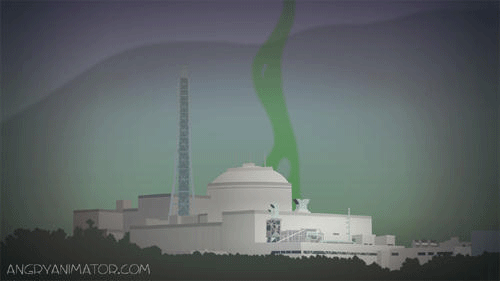
Fast-breeder reactor faces closure, The Age, February 2, 2012 TSURUGA: Japan’s long and expensive pursuit of a super-efficient nuclear reactor is on the brink of failure amid new government concerns about its runaway costs.
The four-decade project to develop a so-called fast-breeder reactor has consumed more than $13 billion in funding, so far producing onlyaccidents, controversies and a single hour of electricity. Continue reading
UK govt not happy with GE Hitachi’s plan for plutonium waste
the UK stockpile of waste plutonium – the biggest civilian stash in the world
UK Nuclear Watchdog Toughens Stance On Waste Reuse, Planet Ark 25-Jan-12, BRITAIN by Oleg Vukmanovic Britain’s nuclear watchdog has hardened its stance against a proposal by U.S.-Japan joint venture GE Hitachi to dispose of UK radioactive waste in a plutonium-burning reactor but has not ended talks.
The Nuclear Decommissioning Authority (NDA), which advises the government on how best to manage the UK’s growing plutonium stockpile, is considering a number of options including the fast-reactor design proposed by GE Hitachi in November.
The NDA has repeatedly ruled the multi-billion pound 600 megawatt (MW) reactor out of the running on the grounds that the technology lacks credibility for the purposes of plutonium disposal. Continue reading
Idaho National Laboratory did not properly assess plutonium risks
The effects of radiation worsen the longer radioactive material remains in the body.
Plutonium is considered more dangerous when inhaled than ingested because particles lodge in the lungs instead of being eliminated by the body, according to the U.S. Centers for Disease Control and Prevention.
Federal panel faults Idaho lab for radiation exposure mishap, By Laura Zuckerman SALMON, Idaho Jan 18, 2012 (Reuters) – The radiation exposure of 16 workers at a nuclear research lab in Idaho stemmed from a failure to properly assess the risks posed by the handling of decades-old plutonium fuel cells, federal investigators concluded on Wednesday. Continue reading
Whistleblower on dangers at Hanford nuclear waste facility
 During her testimony to the board she gave different answers than top-
 level officials with the Department of Energy and contractors Bechtel National and URS. Afterward, she says her managers asked her to change her answers. Busche said “No.”
She says she was … “Raised by a very good mother, that said, ‘Just don’t lie. ‘Cause once you tell your first one it’s real hard to … they just continue to grow.’”…
 Audio http://www.npr.org/templates/story/story.php?storyId=145326474&ft=3&f=145326474 Hanford Nuclear Safety Manager Questions Waste Treatment Plant NPR by ANNA KING January 17, 2012 from N3 RICHLAND, Wash. – Waste in underground tanks at the Hanford Nuclear Reservation may have much more plutonium than previously thought. That’s according to a report by a Hanford contractor that’s just been leaked to public radio. It’s also according to the latest high profile whistleblower to raise serious concerns about a waste treatment plant being built at the Nuclear Reservation in southeast Washington. Continue reading
Will Los Alamos plutonium nuclear lab be USA’s Fukushima?
 Questions swirl around $6 billion US nuclear lab Canadian Business, By AP | December 04, 2011 SANTA FE, New Mexico (AP) — At Los Alamos National Laboratory, scientists and engineers refer to their planned new $6 billion nuclear lab by its clunky acronym, CMRR, short for Chemistry Metallurgy Research Replacement Facility. But as a work in progress for three decades and with hundreds of millions of dollars already spent, nomenclature is among the minor issues.
Questions continue to swirl about exactly what kind of nuclear and plutonium research will be done there, whether the lab is really necessary, and — perhaps most important — will it be safe, or could it become New Mexico’s equivalent of Japan’s Fukushima? Continue reading
1 This Month

of the week – Shut Down Drone Warfare!


Tell the Ukrainian Government to Drop Prosecution of Peace Activist Yurii Sheliazhenko

Petition to revoke the licensing of the Near Surface Nuclear Disposal Facility (NSDF) at Chalk River. https://www.ourcommons.ca/petitions/en/Petition/Details?Petition=e-7247
To see nuclear-related stories in greater depth and intensity – go to https://nuclearinformation.wordpress.com
-
Archives
- April 2026 (68)
- March 2026 (251)
- February 2026 (268)
- January 2026 (308)
- December 2025 (358)
- November 2025 (359)
- October 2025 (376)
- September 2025 (257)
- August 2025 (319)
- July 2025 (230)
- June 2025 (348)
- May 2025 (261)
-
Categories
- 1
- 1 NUCLEAR ISSUES
- business and costs
- climate change
- culture and arts
- ENERGY
- environment
- health
- history
- indigenous issues
- Legal
- marketing of nuclear
- media
- opposition to nuclear
- PERSONAL STORIES
- politics
- politics international
- Religion and ethics
- safety
- secrets,lies and civil liberties
- spinbuster
- technology
- Uranium
- wastes
- weapons and war
- Women
- 2 WORLD
- ACTION
- AFRICA
- Atrocities
- AUSTRALIA
- Christina's notes
- Christina's themes
- culture and arts
- Events
- Fuk 2022
- Fuk 2023
- Fukushima 2017
- Fukushima 2018
- fukushima 2019
- Fukushima 2020
- Fukushima 2021
- general
- global warming
- Humour (God we need it)
- Nuclear
- RARE EARTHS
- Reference
- resources – print
- Resources -audiovicual
- Weekly Newsletter
- World
- World Nuclear
- YouTube
-
RSS
Entries RSS
Comments RSS
 nuclear-news