Savannah River Mixed Oxide Nuclear Fuel (MOX) a costly failure
Von Hippel last May joined three other scientists in advocating the burial alternative in a scientific journal article about Britain’s plutonium stocks. One co-author was Rodney Ewing, who Obama has since appointed to head a federal nuclear waste panel, and another was Allison MacFarlane, now chair of the Nuclear Regulatory Commission. The MOX plant, if it is completed, needs an NRC license……
Administration officials say the main purpose of their “strategic reassessment” is to reexamine the burial alternative. A DOE report in 2002 concluded it would cost hundreds of millions of dollars less than building the MOX plant.
Energy Department Nuclear Nonproliferation Program Plagued By Problems, HUFFINGTON POST , 24 June 13 A multibillion-dollar U.S.-led effort to stem the threat of a terrorist nuclear blast is slowly unraveling because of huge cost overruns at a federal installation in South Carolina and stubborn resistance in Moscow to fulfilling the program’s chief goal, according to U.S. officials and independent experts.
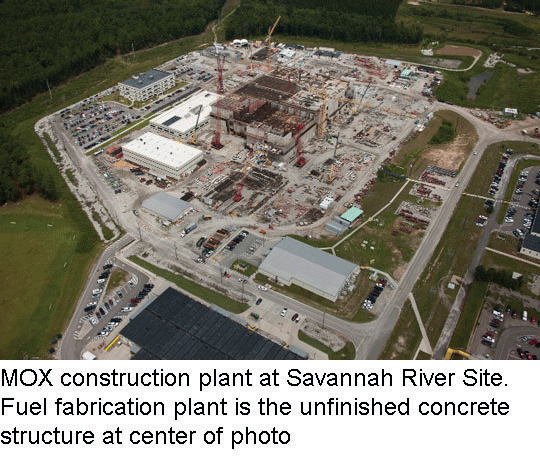
The 13-year old Energy Department program, authorized in agreements with Moscow spanning three presidents, is meant to transform excess plutonium taken from retired U.S. and Russian nuclear weapons into fuel for nuclear plants, so that it can’t be stolen and misused.
But that ambitious goal has been blocked by a tangle of technical, diplomatic and financial problems. The Obama administration is now considering cancelling the project, an idea that has provoked furious opposition from some Republican lawmakers who say it is vital to U.S. national security.
Its potential demise has provoked cheers from some leading arms control and nonproliferation experts, however. They say that as a result of little-noticed revisions to the underlying pact with Moscow on the plutonium’s disposal, the deal might actually wind up promoting Russia’s production of as much or more plutonium as it was supposed to eliminate. To keep its end of the bargain, the U.S. has spent more than a decade and $3.7 billion building a problem-plagued factory for making the plutonium-laced reactor fuel, located at the government’s Savannah River complex south of Aiken. Its construction and related costs have recently hit more than $680 million a year, but Congress is now considering a White House plan to shrink that spending substantially. Continue reading
Japan’s massive, and growing, plutonium problem
Japan currently possesses 44 tons of plutonium, according to the Atomic Energy Commission. Nine tons, including the latest shipment, are in Japan, while the remaining tons are in Britain and France, where spent fuel from Japan has been reprocessed.
Storage pools for spent fuel are quickly reaching capacity at nuclear power plants across the nation. If Aomori Prefecture refuses to accept spent fuel, nuclear plants will be saddled with overflowing spent fuel pools and will be unable to continue operations.
Direct disposal, or burying spent fuel without reprocessing, was considered under the previous Democratic Party of Japan government. But discussions have gone nowhere after the Liberal Democratic Party took over government in December.
 Plutonium problem lingers as mixed-oxide fuel comes to Japan June 25, 2013 THE ASAHI SHIMBUN A shipment of mixed-oxide fuel will arrive in Japan as early as June 27, part of the nation’s plutonium stockpile that is already equivalent to 5,000 Nagasaki-type atomic bombs.
The shipment, two years behind schedule due to the Great East Japan Earthquake in 2011, is expected to be used for plutonium-thermal (pluthermal) power generation, a key component of Japan’s nuclear fuel recycling program.
However, the fuel recycling program has been plagued by so many problems that the nation’s plutonium stockpile could increase further, heightening concerns in the international community about possible nuclear weapons proliferation. Continue reading
Nuclear firms gave big bucks to US congressmen to promote MOX nuclear program
 Energy Department Nuclear Nonproliferation Program Plagued By Problems Center For Public Integrity HUFFINGTON POST By Douglas Birch and R. Jeffrey Smith, 25 June 13 “…..For years, the plant has been kept alive by South Carolina’s mostly Republican congressional delegation, which includes many strident critics of federal spending, budget deficits, and mammoth public works projects – including Sen. Tim Scott (R.) and Rep. Joe Wilson (R.). On the issue of the MOX plant, which employs 2,100 workers, they have been hugely supportive.
Sen. Lindsey Graham (R-S.C.), joined others on Capitol Hill in January in asserting that “the time has come for the President to face up to the need to control federal spending.” Since then, Graham has lectured DOE officials at hearings on the diplomatic and security disaster that would ensue if the Savannah River project was halted.
With three other Republican senators, Graham pledged in a joint statement last month to hold up nominations and use the budget process “to ensure the [MOX] program moves forward.”
Graham declined to comment for this article. According to an analysis by the Center for Public Integrity of campaign donations and leadership committee receipts listed by the Center for Responsive Politics, Graham has received $46,500 since 2001 from three private firms with a stake in the MOX project. In total, the firms provided at least $437,000 in campaign funds during this period to members of the four congressional committees that decide the Energy Department’s annual budge
Rep. James Clyburn (D.-S.C.), who has long been a member of the House Democratic leadership and who has boasted about helping block Hobson’s challenge to the plant, collected $51,000 in political funding from the firms, whose lobbyists and officers also donated $40,000 to a golf charity he runs. Clyburn’s spokeswoman Hope Derrick said the congressman “is solely motivated by the best interests of the people and communities he serves in Congress.”
In the last three years alone, Areva and Shaw have spent a total of $6.3 million to lobby for their legislative interests, including efforts by at least four former congressmen and some former committee staffers that advocated spending on MOX and nuclear issues, according to an analysis by the Center for Public Integrity……”.http://www.huffingtonpost.com/2013/06/25/energy-department-nuclear-nonproliferation_n_
Savannah River Nuclear Site the $billion “plutonium elimination” project
 Energy Department Nuclear Nonproliferation Program Plagued By Problems HUFFINGTON POST Center For Public Integrity | By Douglas Birch and R. Jeffrey Smith, 25 June 13 “….The government’s current estimate is that the plant will not begin operation before 2019, seven years late. Estimates of its operating costs over a 15 to 20 year period range from $8 billion to $12 billion, meaning that it could cost around $20 billion in total to create fuel rods from all 34 tons of the plutonium that Washington has promised to eliminate.
But even if the government finds buyers for the fuel – which seems doubtful – it will not recoup more than $2 billion of its expenses, according to the Congressional Research Service. At the current pricetag, eliminating each pound of plutonium at the U.S. plant may cost roughly $243,000, according to Matthew Bunn, a nuclear expert at Harvard.
So far, around $3.7 billion has been spent on the fuel factory, which could wind up an abandoned concrete shell in the middle of a pine forest. Another $700 million was used to design a related plutonium dismantlement facility that NNSA never built.
Those expenditures have helped make it the single most expensive U.S. nonproliferation project now under way, according to independent experts…..
New budget troubles arise
Austerity pressures in Washington have created new obstacles for the companies and their lobbyists, however. The Obama administration, after convening four high-level meetings about the MOX plant this spring, urged a 50 percent cut in its planned spending in fiscal year 2014, to just $320 million.
“Cost growth and fiscal pressure may make the project unaffordable,” the Energy Department said in its formal budget proposal to Congress. A spokesman for the department declined comment about the review now under way……..” .http://www.huffingtonpost.com/2013/06/25/energy-department-nuclear-nonproliferation_n_3498626.html
Savannah River MOX project should be shut down
the MOX plant has “become from my point of view a pretty meaningless program” that should now be killed.
“The irony of this whole project is that it basically started with a good goal, of eliminating weapons grade material with the idea that it won’t be available for weapons purposes,” “But then it sort of evolved into this program that provides a fairly significant subsidy to the plutonium economy. So in the end, we will end up with more plutonium.”
How a Massive Nuclear Nonproliferation Effort Led to More Proliferation, The Atlantic, More than a decade of negotiations with Russia produced a clear winner, and it was not the United States. DOUGLAS BIRCH AND R. JEFFREY SMITHJUN 24 2013 SAVANNAH RIVER SITE, South Carolina – A half-finished monolith of raw concrete and rebar rises suddenly from slash pine forests as the public tour bus crests a hill at this heavily-secured site south of rural Aiken……..
Dark clouds hover over this ambitious federal project, 17 years in the making and at least six more from completion–if, indeed, it is ever completed. It lies at the center of one of the United States’ most troubled, technically complex, costly, and controversial efforts to secure nuclear explosive materials left stranded by the end of the Cold War.
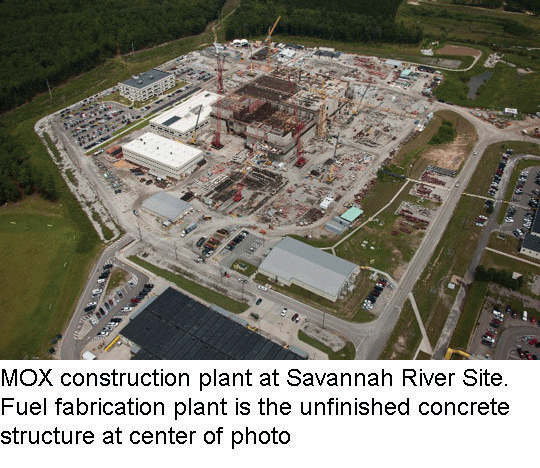
This plant – and another just like it in Russia — is meant to transform one of these materials, plutonium, into commercial reactor fuel that can be burned to provide electricity for homes, schools and factories, essentially turning nuclear “swords into ploughshares.” The aim of the so-called Mixed Oxide, or MOX, plant is to ensure the material never winds up in the hands of terrorists.
In the right hands, only nine pounds of plutonium — an amount about the size of a baseball — could make a bomb as powerful as the one the U.S. dropped on Hiroshima. The world’s military and civilian nuclear programs have produced about 500 metric tons of pure plutonium, an amount that could fuel tens of thousands of nuclear weapons yet fit into a backyard shed. Countries with nuclear programs continue to add roughly two tons to this inventory every year.
Washington has been spending hundreds of millions of dollars annually to help secure or remove plutonium and weapons-grade uranium in dozens of countries. But the U.S.-Russia plutonium disposition program, which includes the Savannah River plant, is the U.S. government’s single most expensive nonproliferation project now, according to Michelle Cann, senior budget analyst with a nonprofit group called Partnership for Global Security. Continue reading
Biggest pile of plutonium in the world: Britain’s nightmare
Britain has accumulated the biggest stockpile of civil
plutonium in the world, a target for terrorists and future bomb-makers. What was once thought to be a valued asset is now a costly liability. The Government faces a dilemma. Should it try to
turn the stuff into nuclear fuel at huge cost or write off the plutonium altogether? Previous attempts to deal with the problem went disastrously wrong, costing the taxpayer more than a billion pounds. Tonight File on 4 investigates what’s been called one of the most embarrassing failures in British industrial history. And now MP’s are worried taxpayers could be asked to pay up again. Continue reading
Britain’s quite horrible problem of stockpiled plutonium
UK’s plutonium stockpile dilemma http://www.bbc.co.uk/news/uk-21505271 By Rob Broom byFile on 4 June 2013, Britain has accumulated the biggest stockpile of civil plutonium in the world. What was once a valued asset is now viewed as a costly liability and a target for terrorists.
Previous attempts to deal with the stockpile have gone wrong and the government now faces a dilemma. Should it try to turn the stuff into nuclear fuel or write off the plutonium altogether?
Amid tight security at the Sellafield nuclear plant in Cumbria, is a store holding most of Britain’s stockpile of plutonium. Continue reading
Britain’s rather horrible plutonium and Mixed Oxide Fuel (MOX) dilemma
 “……….The Government wants to try and turn plutonium into a fuel which can be used
9 tons of plutonium yearly from Japan’s Rokkasho nuclear reprocessing plant

Tokyo’s ability to both enrich uranium and reprocess spent reactor
fuel has allowed it to amass roughly nine tons of weapons-usable
plutonium on its soil. Activating the Rokkasho plant would produce
that much each year, said officials and industry experts.
Japan’s Nuclear Plan Unsettles U.S, WSJ, By JAY SOLOMON and MIHO INADA
2 May 13, TOKYO—Japan is preparing to start up a massive nuclear-fuel
reprocessing plant over the objections of the Obama administration,
which fears the move may stoke a broader race for nuclear technologies
and even weapons in North Asia and the Middle East.
The Rokkasho reprocessing facility, based in Japan’s northern Aomori
prefecture, is capable of producing nine tons of weapons-usable
plutonium annually, said Japanese officials and nuclear-industry
experts, enough to build as many as 2,000 bombs, although Japanese
officials say their program is civilian…… Continue reading
Plutonium now called “material” as it travels from Scotland to Wales
 Breeder is classed as material and not as fuel or waste, by NDA.
Nuclear material moved by train from Scotland to England , BBC News, 17 December 2012 The first of 90 rail shipments of nuclear material from Dounreay in Caithness to Sellafield in Cumbria was made overnight.
The journey was understood to have been made under armed escort. Forty-four tonnes of breeder material in total will be transported by train to Sellafield for reprocessing. Continue reading
America’s latest nuclear bomb test – an act of hypocrisy
 American Nuclear Hypocrisy , 09 December 2012 By Elias Akleh“…….The American nuclear hypocrisy was lately demonstrated when the US National Nuclear Security Administration had detonated plutonium in a deep shaft in Nevada National Security Site on Wednesday 12/5/2012, allegedly to test the safety and effectiveness of the American nuclear weapons. The test, known as Pollux, was conducted jointly by the Nevada National Security Site, the Los Alamos National Laboratory, and Sandia National Laboratories. International inspectors were not allowed to witness the test since the US had prevented access to its test sites since late 1990s.
Let us not forget that the US is the only country that used nuclear bombs against civilians in 1945. The US dropped an atomic bomb on the Japanese city of Hiroshima incinerating at least 140 thousand civilians in seconds. Three days later the US dropped another nuclear bomb on Nagazaki incinerating further 70 thousand civilians. Hundreds of thousands others died later due to radiation. http://mwcnews.net/focus/editorial/23374-eliasakleh-nuclear-hypocrisy.html
A warning on Mixed-Oxide Fuel (MOX) nuclear fuel plan
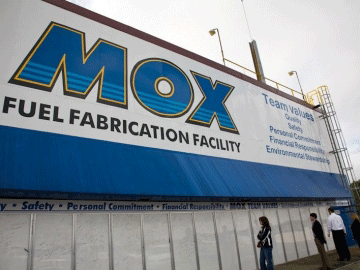 MOX stands for “Mixed-Oxide Fuel.” It is a nuclear power reactor fuel made from plutonium mixed with uranium. The U.S. Department of Energy (DOE) wants to make experimental MOX fuel using plutonium from dismantled nuclear weapons.
Use of MOX fuel fails as a means of getting rid of plutonium. Instead, the plutonium just becomes part of the lethal soup of ingredients termed “high-level nuclear waste”
What is MOX? http://www.nirs.org/factsheets/basicmoxinfo.htm The giant French nuclear firm Cogema, Duke Power and Virginia Power have formed a consortium to create and use plutonium MOX fuel in civilian atomic reactors in North and South Carolina and Virginia.
If their effort is successful, plutonium would be trucked from nuclear weapons depots in the west to the Savannah River Plant on the South Carolina/Georgia border, where new plutonium processing plants would be built. This new MOX fuel would then be trucked to commercial reactors in the Southeast, in order to turn this plutonium into high-level radioactive waste.
The MOX program is dangerous and unnecessary. More than 200 environmental and other organizations across the world have signed an International NIX MOX statement and have pledged to work to stop this program in the U.S. and similar programs in Russia, France and England.
What is MOX? Continue reading
Plutonium a nuclear servant that will become a nuclear killer
five years of meetings between Soviet and American scientists from the Federation of American Scientists about what to do with the separated plutonium. There is a tremendous pressure to use it. . . . It is as if we don’t know what to do with this unless we make it serve us, and that is exactly what I am beginning to think, that we cannot ask of the poison fire. If we want to make it serve us, it will kill us
Nuclear Guardianship The Search for New Perspectives Lecture by Joanna Macy reprinted with permission from Poison Fire, Sacred Earth, TESTIMONIES, LECTURES, CONCLUSIONS, THE WORLD URANIUM HEARING, SALZBURG 1992 pages 256-258
To call this stuff “waste” is a misnomer, it is hardly an accurate term, because the strange and almost mythic character of the poison fire — uranium — and our processing of it has been that at every stage of the fuel cycle, everything that we have employed, every glove, every boot, every truck, every reactor, every facility, every mine, every heap of mill tailings, everything becomes not only contaminated, but contaminating.

And governments and industry and scientists themselves don’t know what on earth to do with it. They don’t know what to do with this stuff, and it is our most enduring legacy. They say they have a final solution to bury it in the ground in deep geological disposal, hiding it out of sight and out of mind, as if the earth were dead, as if the earth were not a living being, shifting with underground waters and seismic activities, as if the containers themselves could outlast a generation, which they cannot!
For nothing lasts as long, no container lasts as long as the poison fire itself. And it will leak out and out to contaminate. Continue reading
Plutonium left Livermore – (but where did it go?)
High-Security Nuclear Material Leaves Livermore
http://www.kolotv.com/news/californianews/headlines/High-Security-Nuclear-Material-Leaves-Livermore-170905161.html KOLO8 News 23 Sept 12, LIVERMORE, Calif. (AP) – Federal officials say Lawrence Livermore Laboratory is no longer home to some high-security, special nuclear weapons materials.
The National Nuclear Security Administration say the lab will still focus on the safety, security and reliability of the nation’s nuclear weapons stockpile, but just with a reduced amount of nuclear material that does not require as much as security as was needed in the past.
The agency says that decision will save about $40 million in taxpayer funds.
NNSA Administrator Thomas D’Agostino says taking the materials out of Livermore is part of a national plan to consolidate special nuclear materials in as few places as possible.
The Oakland Tribune reports (http://bit.ly/OQD1PT) the materials were
removed from the lab’s Plutonium Facility, which is located in an area known as the “Superblock.”
Plutonium for space travel?
Nuclear waste set to power spacecraft By Andrew Bounds, North of England Correspondent, Ft.com, September 9, 2012 Britain’s nuclear waste could be used to power spacecraft as part of government attempts to offset the huge cost of the atomic clean-up by finding commercial uses for the world’s largest stock of civil plutonium.
A £1m pilot programme by the European Space Agency has shown that nuclear batteries for use on deep space missions could be made from an isotope found in decaying plutonium at the Sellafield waste storage site in Cumbria.
Britain’s National Nuclear Laboratory has harvested americium-241 from the plutonium, produced from reprocessing fuel.
The ESA believes this could replace plutonium-238, only available from Russia and the US, and provide an independent source of energy for planned deep space missions to Jupiter and other distant planets.
Tim Tinsley, who manages the programme for the NNL, said the space battery was an unforeseen benefit of past inaction, which has left 100 tonnes of plutonium in ponds at Sellafield.
“It is available due to a twist of fate,” he said. “We have been able to extract that americium and prove that it works.”
Full-scale battery production would be “worth hundreds of millions of euros” and provide skilled jobs in west Cumbria, an area of high unemployment, he said.
Nuclear batteries – each containing about 5kg of nuclear material – have been around since the 1950s and are used in Nasa’s Cassini and Voyager probes as well as Curiosity, which landed on Mars in August…..
The US may also need a fresh supply. Plutonium-238 can be made only in reactors dedicated to weapons, now shut down, and Nasa’s stocks could run out in 2018, according to the US National Research Council. ….
The clean-up costs of Britain’s nuclear programme are estimated at up to £100bn, with £3bn spent annually, while the plutonium alone is a £4bn liability.
NNL, a government agency run under contract, has joined Systems Engineering & Assessment, a specialist engineering group active in the space sector, and the University of Leicester, which has a large space department, to run the programme…. http://www.ft.com/intl/cms/s/0/2ea069f2-f830-11e1-828f-00144feabdc0.html#axzz266DLJEno
1 This Month
23-25 October – on Zoom – World BEYOND War’s annual global conferenc


Shut down the radiation-damaged Heysham nuclear reactors now
To see nuclear-related stories in greater depth and intensity – go to https://nuclearinformation.wordpress.com

Say No to NASA’s Reckless Nuclear Reactor on the Moon
Say No to NASA’s Reckless Nuclear Reactor on the Moon

-
Archives
- October 2026 (243)
- September 2026 (339)
- August 2026 (330)
- July 2026 (355)
- June 2026 (287)
- May 2026 (306)
- April 2026 (356)
- March 2026 (251)
- February 2026 (267)
- January 2026 (308)
- December 2025 (358)
- November 2025 (359)
-
Categories
- 1
- 1 NUCLEAR ISSUES
- business and costs
- climate change
- culture and arts
- ENERGY
- environment
- health
- history
- indigenous issues
- Legal
- marketing of nuclear
- media
- opposition to nuclear
- PERSONAL STORIES
- politics
- politics international
- Religion and ethics
- safety
- secrets,lies and civil liberties
- spinbuster
- technology
- Uranium
- wastes
- weapons and war
- Women
- 2 WORLD
- ACTION
- AFRICA
- Atrocities
- AUSTRALIA
- Christina's notes
- Christina's themes
- culture and arts
- Events
- Fuk 2022
- Fuk 2023
- Fukushima 2017
- Fukushima 2018
- fukushima 2019
- Fukushima 2020
- Fukushima 2021
- general
- global warming
- Humour (God we need it)
- Nuclear
- RARE EARTHS
- Reference
- resources – print
- Resources -audiovicual
- Weekly Newsletter
- World
- World Nuclear
- YouTube
-
RSS
Entries RSS
Comments RSS

