Marshall Islands leaders hope for better help over radioactively polluted weapons tests sites
This week leaders of four nuclear test-affected atolls spoke of the building movement movement to issues surrounding the actions of the US from 1946 to 1958.
Elected leaders from Bikini and Enewetak, the ground zeroes for 67 nuclear weapons tests, and Rongelap and Utrok, two atolls heavily contaminated with radioactive fallout from the 1954 Bravo hydrogen bomb test, described separate meetings in the past few days with US Ambassador to the Marshall Islands, Roxanne Cabral, and Marshall Islands President, David Kabua, as “productive and positive.”
The push for action on compensation, health care and cleanups of radioactive islands comes against the backdrop of negotiations between the Marshall Islands and US governments to extend expiring grant funding in a Compact of Free Association.
Island leaders said nuclear test legacy issues had languished for years and they wanted the Marshall Islands to pursue them during the upcoming talks.
It was preferred that a solution was found that benefitted both the Marshall Islands and the United States…….
US-provided compensation fell far short of funds needed to meet compensation awards for this nuclear test-affected nation……
Utrok Mayor Tobin Kaiko said he personally, as well as other nuclear test-affected islanders, continued living with health problems caused by exposure to radioactive fallout.
He said their suffering had been exacerbated by US authorities consistently downplaying the hazards of radiation and the potential for health problems among affected islanders………. https://www.rnz.co.nz/international/pacific-news/422407/nuclear-affected-atolls-in-marshalls-see-promise-in-us-talks
Dismantling nuclear reactors in Snowdonia; should be cleaned up by 2083, if We’re lucky
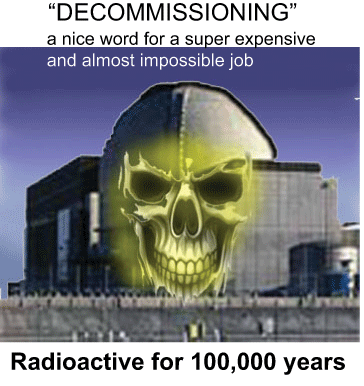
 Trawsfynydd: Nuclear reactors to go under new decommissioning plan, By George Herd, BBC News, 30 July 2020
Plans have been unveiled to remove nuclear reactors and towers at a former power plant in Snowdonia.
It follows a decision to name Trawsfynydd in Gwynedd as the lead project for former Magnox stations in the UK.
The twin reactors will become the very first in the UK to be fully decommissioned.
It should safeguard hundreds of jobs at the plant for 20 years, and help drive decommissioning plans at other sites.
There are 10 former Magnox nuclear power stations in the UK, which have all now stopped generating electricity – the last being Wylfa on Anglesey in 2015.
Trawsfynydd was shut down in 1991 after operating for a quarter of a century.
Under original plans, the twin reactor buildings that tower over the landscape were due to be reduced in height by two-thirds, and then left in a care and maintenance phase, before the site is completely cleared in 2083.
The new programme will see the remaining reactor buildings demolished, while a new low-level radioactive waste store is built on the site to hold the material.
Magnox, which operates the site on behalf of the UK’s Nuclear Decommissioning Authority, said it estimated there would be 50,000 cubic metres of very low or low-level waste retained, until a new geological waste disposal site is identified by the UK government. …..
Magnox said it was still in the “early days” of planning the next phase of active decommissioning at Trawsfynydd, and would be launching consultations with stakeholders, including the community.
It said it envisaged a 20 year programme to:
- Remove the reactor building’s concrete panel outer shell down to ground level
- Remove the six 1,000 tonne boilers stored in sections and the 45 tonne overhead crane from each reactor, for off-site disposal
- Remove the reactors, their components and the reactor core
- Demolish the remaining reactor buildings
State of the art robotics and remote handling will be used to dismantle Trawsfynydd’s twin reactors and “minimise the risk of radiation dose to workers”.
Magnox said it still expected the site to be completely cleared by the 2083 target……
“There is a duty on the nuclear sector and today’s electricity users to take responsibility for the clear-up of sites, and Trawsfynydd’s twin reactors will be the first to be completely decommissioned in the United Kingdom,” said the Plaid Cymru MP for Dwyfor Meirionnydd. “In this respect, work undertaken here will lead the entire sector, and open opportunities for a whole new generation of engineers.”…. https://www.bbc.com/news/uk-wales-53595839
New Mexico Governor opposes nuclear waste dump in that state
Gov. argues against Holtec nuclear storage site, Albuquerque Journal , BY THERESA DAVIS / JOURNAL STAFF WRITER Tuesday, July 28th, 2020 Gov. Michelle Lujan Grisham sent a letter to President Donald Trump on Tuesday, arguing against a proposed nuclear waste interim storage facility in southeast New Mexico.
The proposed Holtec International site would store 500 stainless steel canisters of the nation’s spent nuclear fuel on 1,000 acres between Carlsbad and Hobbs, with a full storage capacity of 10,000 canisters.
“New Mexico has grave concerns for the unnecessary risk to our citizens and our communities, our first responders, our environment, and to New Mexico’s agriculture and natural resource industries,” Lujan Grisham wrote in the letter……
The governor said it would be “economic malpractice” to store spent nuclear fuel underground in a region that depends on agriculture and oil and gas. She added that a “perceived or actual nuclear incident” could disrupt those industries.
“The proposed (facility) would join the ranks of uranium mining, nuclear energy and defense-related programs that have long created risks to public health and the environment in the state of New Mexico that are disproportionately greater than such risks to the general population of the United States,” she wrote…… https://www.abqjournal.com/1480362/gov-argues-against-holtec-nuclear-storage-site.html
When it comes to nuclear waste dumping, the Australian government sees black people as flora and fauna, not citizens
 Barngarla continue fight against plan to dump nuclear waste on Country, SBS News 29 July 20, Barngarla mob say they were not properly consulted by federal government for plans to store radioactive waste on Country at Kimba in SA, and that their concerns continue to be ignored. By Royce Kurmelovs, NITV News 29 July 20
The 50-year-old Barngarla woman is talking about the enduring connection she has to Kimba when she tells how on the day she was born, her parents had been waiting for an ambulance that never came.
Forced to make their own way to the hospital, she says her mum made it as far as the tree outside before giving birth.
“So I’m born on Country,” she says.
Though she may not live there today, Jeanne says a part of her has never left. It is a detail that underscores the significance of the moment she learned Kimba was being considered as a dump for radioactive waste.
“I used to be a carer for my mum. When I first heard [about the facility], I told her. She goes: ‘no, no, no’ and got angry,” Jeanne says. “She said; ‘we don’t want it there’. She said to me: ‘you got to fight for this. You got to fight for it, we can’t have that place there. It’s a special place for us.’”
Most among the Barngarla have a similar story about the shock and confusion at learning their traditional Country was under consideration as part of a proposal to build a nuclear waste storage facility that would take in samples from 100 sites across the continent.
No one, they say, from the federal government contacted them beforehand to talk about the proposal, leaving most to find out through the news media or word of mouth.
Instead it was up to the Barngarla themselves, through the the Barngarla Determination Aboriginal Corporation (BDAC) to take the initiative and write to the government in April 2017 to find out what was going on.
‘Wasn’t interested in our views’
That first letter would plunge them into a fight that has so far lasted three years, until it entered a new phase in February when former Industry Minister Matt Canavan announced – a day before he resigned – that he had selected a site just outside of Kimba to situate the nuclear waste facility…….
Over the course of its operating lifetime, the site would house low-to-intermediate level nuclear waste made up of medical waste drawn from 100 sites across the country. This material would include medical waste, but also the more serious TN81 canisters – casks of material once exposed to high levels of radiation that require containment for several hundred years.
If supporters of the proposal celebrated the financial windfall it would bring, critics worried the decision represented the thin end of a wedge that would eventually see the site expand to house higher-level toxic waste.
For the Barngarla people, however, the proposal represented something more significant: yet another decision where they have been overlooked, ignored and overruled in a process they describe as “divide and rule”.
“It’s like the government’s not listening to us,” Jeanne says. “It’s like if the government picks a place where they want to put rubbish like that, they’ll just go and do it and they don’t care what the people think. And that’s wrong. They should be listening to what the people want too.”….
After their early efforts to find out more, the Barngarla say they were stonewalled from the very beginning by both the Department of Industry, Science, Energy and Resources, and the Australian Radioactive Waste Agency (ARWA). That stance would become a pattern…….
They basically created hurdles,” Bilney says. “The catchphrase was ‘rateable property’ – that’s white man’s terms ‘rateable property’. We’re the native title holders. That holds more weight than ‘rateable property’, so we should have been included.”
Around the time the Barngarla filed their lawsuit to challenge the vote, the first meeting with the department took place in August 2018 – a moment Bilney recalls with frustration.
He says Mr Canavan spoke for fifteen minutes before he left, taking all the government representatives with him.
“That’s it,” Bilney says. “He wasn’t interested in our views, he just wanted us to hear what he had to say.”
When the poll of Kimba residents was counted, it returned a result that saw 61.6 per cent of 824 participants vote in favour of the proposal.
BDAC responded by organising is own poll, asking its 209 members the same question that was asked of the broader Kimba residents. The result would be a unanimous “No” from the 83 participants – a turnout figure explained by cultural and logistical factors that make it difficult to gather in any one place…….
Aliens in our own country’
What happens now is up to the Senate economics reference committee and a clutch of Labor, Greens and independent senators.
The Barngarla say the recent approach of the federal government – to legislate the precise location of the site – represents a new twist as it departs from the process established by the Gillard government under the National Radioactive Waste Management Act 2012.
Worse still, the Barngarla say the provisions of the bill will stymie their rights to seek a judicial review of the minister’s decision in the courts. The Parliamentary joint committee on human rights also raised concerns about the bill in April this year that it says may extinguish Native Title……..
So far it has taken two decades for the Barngarla to have their Native Title claim to a 45,000 square kilometre stretch of the Eyre Peninsula recognised by the courts – a process during which they were once informed that they did not exist as a people.
Neither have they forgotten the horror at Maralinga when the British army tested nuclear weapons after falsely declaring there were no Aboriginal people in the area.
To the Barngarla, the government has only decided to talk after the big decisions have been made.
“We’re still flora and fauna to these people,” Bilney says. “They should have included us from the start. We heard about it on the news. We weren’t included in the vote.
“You know, the Barngarla [native title] claim was basically an unwinnable case, they said. It’s taken us 21 years. Twenty-one years to win Native Title under white man’s law. And yet we’re still classed as second-class citizens? Flora and fauna.
“We’re basically aliens in our own Country.” https://www.sbs.com.au/nitv/article/2020/07/29/barngarla-continue-fight-against-plan-dump-nuclear-waste-country
The Santa Susana site – America’s Secret Chernobyl

|
Inside America’s Secret Chernobyl — The Abandonded Cold War Compound Outside Suburban LA, more https://medium.com/@lukejacobs/inside-americas-secret-chernobyl-the-radioactive-dump-that-started-la-s-recent-wildfire-663b9bd0430e BY Luke Jacobs, Independent Journalist & Videographer, 27 July 20, “……….The Santa Susana Field Laboratory was a sprawling industrial research complex located on over 2,000 acres of rocky hillside in Simi Valley, California. Widely recognized as being one of America’s most vital facilities during the space race, scientists from NASA, Boeing, and Rocketdyne contributed significantly in developing the following projects for the US government.
And…
Worst in US history? Most Americans know about Three Mile Island, the 1979 meltdown which brought anti-nuclear politics into the mainstream and resulted in worldwide outrage. But how many have heard of the 1959 Rocketdyne Meltdown?
Residents had tremendous pride for the facility. To them, it represented a greater purpose that most Americans only connected with by way of television reports and radio broadcasts. Locals businesses fed Rocketdyne workers, washed their clothes, repaired their cars, and built their homes. They were helping their country with its most important goals: defeating the Soviets and sending men to the moon. The reactor that leaked in 1959 was located in an area of SSFL dubbed “Sector IV”, which was classified as experimental and given lax environmental restrictions. This allowed engineers to speedily build the reactor, but with a deadly tradeoff: it had no containment structures. The reactor and its highly radioactive components were housed without the large concrete domes that surround modern power reactors. When the meltdown occurred, a decision was made by higher-ups to downplay the incident. Engineers were told to run the reactor as normal over the next few days. As it became more and more obvious that radiation was spreading throughout the surrounds hills and communities, the plug was pulled. A few weeks later, Atomics International released a memo alerting residents of a “slight mishap” with their reactor, and that no dangerous radiation was released. Employees at SSFL were directed not to tell anyone about the incident, and it was not publicly disclosed for 20 years, until 1979. A series of academic and journalistic reports between 1989–2010 helped to reveal the true scale of the disaster. Testifying before Congress in 2008, Daniel Hirsch, President of an NGO dedicated to nuclear safety, referred to the meltdown as “one of the worst accidents in nuclear history.” Subsequent reports revealed other toxic decisions Boeing made at SSFL. Instead of safely shipping hazardous materials to a licensed facility, workers shot barrels of the toxic chemicals with rifles and dumped the waste into nearby streams. This has led to multiple ongoing studies on the groundwater quality of the area, including an expensive multi-billion dollar legal battle between Boeing and local governments over a cleanup agreement. ……. Aside from the high levels of radiation in the soil and crumbling infrastructure, the site has pretty intense security. From my online conversations with the few people who managed to sneak in, the process is grueling: requiring a 6-mile hike in and out which almost necessitates overnight camping at the site. |
|
Dismantling of San Onofre nuclear station, but high level radioactive trash remains onsite

San Onofre Decommissioning Update https://www.kpbs.org/news/2020/jul/27/san-onofre-decommissioning-update/ Monday, July 27, 2020, By Alison St John Work continues to dismantle the San Onofre nuclear power plant, which provided San Diego with 20% of its electricity until 2012 when it shut down prematurely, due to a radiation leak. The process of decommissioning the plant is more controversial than its 44 years in operation. The question is whether the high-level nuclear waste, which remains radioactive for tens of thousands of years, can be safely disposed of?
Rob Nikolewski, energy reporter for The San Diego Union-Tribune, has been following the progress of decommissioning and storing the radioactive waste.
Nikolewski said one very large chunk classified as low-level nuclear waste has already been transported to a storage site near Clive, Utah. The 770-ton reactor vessel was shipped by rail and a convoy of eight trucks across over 400 miles to its destination. Millions more pounds of low-level waste will be broken down into smaller pieces and transported to Clive, where the private company Energy Solutions has a licensed repository.

However the high-level waste — hundreds of spent fuel rods — remains on-site, since the federal government has failed to approve a long- term storage site for the nation’s high-level nuclear waste. Southern California Edison, which owns the plant, has nearly finished transferring canisters of highly radioactive spent fuel rods into over 70 concrete bunkers next to the beach.
Earlier this month the California Coastal Commission approved Edison’s permit for the decommissioning, including removing the cooling pools which originally held the stored spent fuel rods. The Commissioners reserved the right to review the permit in 15 years and if there is evidence of cracking or other problems such as sea-level rise that threaten the integrity of the canisters, the permit holder could be required to move them.
San Diego Congressman Mike Levin is concerned about the safety of the site, which is in his district and has millions of people living within 50 miles. Levin convened a task force that met for a year and recently came out with a report. One recommendation is that since the federal government has not approved a long-term storage site for high-level nuclear waste, the state of California should take more responsibility for how the nuclear waste is disposed of.
Nikolewski said he has not seen any evidence of state officials stepping forward to hold the companies accountable. He said federal law may need to be changed to allow for that.
The distinctive twin domes that are visible from the Interstate 5 will be removed sometime between 2025 and 2027, and decommissioning the plant, including removal of the low-level nuclear waste, should be complete within 6 to 8 years. The high-level waste will remain indefinitely, in bunkers near the beach.
Space archaeology, space junk and weapons, and long-lasting radioactivity
While the nuclear macho men plan more nuclear, and nuclear weapons in space, it seems that it takes a woman, Alice Gorman, to investigate the radioactive pollution on Earth and in space, due to these activities
Nuclear sites still dangerous in 24,000 years, say space archaeologists
Some nuclear tests were conducted also in outer space and nuclear fuel was employed as propellant for rockets. https://www.jpost.com/health-science/nuclear-sites-still-dangerous-in-24000-years-space-archaeologists-say-636379 By ROSSELLA TERCATIN JULY 26, 2020
Gorman said the issue presents two challenging elements: What materials can survive such a long time, and what form of language can be used to deliver the actual message?
“As for the first difficulty, we know that stones and pottery last a very long time,” she said. “But the second point raises a big archaeological question related to symbolic communication. If we look at rock art from 20,000 years ago, we can see that there are pictures of animals, but we do not know what those pictures mean. Therefore, it is possible that our current symbols to mark radioactive sites, the yellow [and] black sign, will be interpreted as an invitation to explore the area, rather than to keep away from it.”
If the UN Outer Space Treaty of 1967 prohibited nuclear weapons in space, the issue of its weaponization remains very relevant.“Recently, Russia tested an anti-satellite weapon, reawakening the debate,” Gorman told the Post.
She began to work in space archaeology following years of work focused on stone-tool analysis and the aboriginal use of bottle glass after European settlement.
Space archaeology deals with the same issues of regular archaeology, understanding material culture, human behavior and the interaction with the surrounding environment, Gorman said.
Gorman was drawn to space archaeology by the idea of exploring space junk, those many objects that cannot even be seen in the sky circling the Earth. Currently, she is working on the archaeology of the International Space Station.
The recent attempt by Israel to land a robotic unit on the moon with the Beresheet mission represents a very interesting development for space archaeologists, Gorman said.
“For many decades, the only material cultures present on the moon were the American and the Soviet one,” she said. “As new countries have started to reach the moon, this has changed, bringing more diversity to the field.”
Problems in planned nuclear waste dump at Chalk River
 New nuclear waste guidelines could lead to ‘massive dump’ upstream from Ottawa if approved, CapitalCurrent , By Bailey Moreton, 23 July 20,
New nuclear waste guidelines set to undergo public consultation this fall could clear the way for a much-debated, large, above-ground waste disposal mound to be built at Chalk River, the national nuclear research facility 180 kilometres northwest of Ottawa.
The proposed guidelines would frame the way nuclear companies dispose of waste, including the creation of deep ground repositories. Under the guidelines, companies would present waste disposal safety cases — a set of justifications for a planned disposal strategy — which are then assessed by the Canada Nuclear Safety Commission.
But one longtime critic of the Chalk River site says the guidelines would give too much flexibility to operators of nuclear facilities. Ole Hendrickson, a former scientist with Environment Canada and a researcher with the Concerned Citizens of Renfrew County Area, says the guidelines need to be more stringent.
“In my view, what they say is, ‘Let’s make these reg docs as flexible as possible and non-prescriptive’ — and the CNSC actually uses those terms, non-prescriptive and flexible, to describe its regulatory approach,” he said. “That may work for industry, but for us members of the public, it raises a lot of concerns.”
In the minutes of a CNSC meeting on June 18, Ramzi Jammal, executive vice-president of the commission, said the safety cases allow for performance-based assessment and for the regulatory documents to be adaptable to future conditions.
“With performance-based you’re always achieving and applying the new standards as they become available. The same thing applies for the new technology,” Jammal said at the meeting. “As you are looking at enhancement for safety, you always take into consideration the new available information.”
But what is defined as low-level waste is flexible and depends on the safety cases presented to the CNSC, said Richard Cannings, NDP MP for South Okanagan-West Kootenay and the party’s natural resources critic.
“That’s a problem. That’s not how it’s done elsewhere in the world,” he said. “They did it in Ottawa’s backyard.”
In the June 18 meeting, Karine Glenn, director of the wastes and decommissioning division for the CNSC, said low-level waste would mostly involve medical materials, but each safety case would be reviewed by the CNSC.
In Chalk River’s case, critics such as Eva Schacherl, a volunteer with the Coalition Against Nuclear Dumps on the Ottawa River, say they believe the “massive waste dump” would fail to manage the nuclear waste safely and that operators are failing to meet international standards at the site……….
both Schacherl and Hendrickson said they are concerned the site — which is within a little more than a kilometre of the Ottawa River, according to Hendrickson — could spread contamination.
“Waste has piled up at Chalk River, and there’s no long-term way of dealing with it,” said Hendrickson. “There would be a lot of leaching that would flow back into the Ottawa River.”
“Most countries with large quantities of nuclear waste have an independent federal nuclear waste agency,” said Hendrickson. “It’s not run by the industry like the Nuclear Waste Management Organization. It’s definitely not run by the nuclear regulator.”
Cannings agreed, adding that he was worried what impact having the NWMO responsible for the deep ground repositories could have for safety.
“There’s risks with everything. But the assessment of risks to a project by the proponent, by the industry — they’re going to be much more favourable, they’re going to accept more risk than the public because they’re protecting themselves,” said Cannings.
Two Ontario sites — South Bruce, near London, and Ignace, a three-hour drive northwest of Thunder Bay, are the only two communities still vying for the deep-ground repository project. Both proposals have been met with resistance from local residents………
Critics noted that several organizations and advocacy groups had requested but were denied permission to be present at the June meeting where the regulatory documents were presented via video conference. ……… https://capitalcurrent.ca/new-nuclear-waste-guidelines-could-lead-to-massive-dump-upstream-from-ottawa-if-approved/
Fukushima may have scattered plutonium widely
 Fukushima may have scattered plutonium widely, Physics World 20 Jul 2020 Tiny fragments of plutonium may have been carried more than 200 km by caesium particles released following the meltdown at the Fukushima Daiichi nuclear power plant in Japan in 2011. So says an international group of scientists that has made detailed studies of soil samples at sites close to the damaged reactors. The researchers say the findings shed new light on conditions inside the sealed-off reactors and should aid the plant’s decommissioning……..
Mapping plutonium spread
To date, plutonium from the accident has been detected as far as 50 km from the damaged reactors. Researchers had previously thought that this plutonium, like the caesium, was released after evaporating from the fuel. But the new analysis instead points to some of it having escaped from the stricken plant in particulate form within fragments of fuel “captured” by the CsMPs…….
Implications for decommissioning
The researchers note that previous studies have shown that plutonium and caesium are distributed differently in the extended area around Fukushima, which suggests that not all CsMPs contain plutonium. However, they say that the fact plutonium is found in some of these particles implies that it could have been transported as far afield as the caesium – up to 230 km from the Fukushima plant.
As regards any threat to health, they note that radioactivity levels of the emitted plutonium are comparable with global counts from nuclear weapons tests. Such low concentrations, they say, “may not have significant health effects”, but they add that if the plutonium were ingested, the isotopes that make it up could yield quite high effective doses.
With radiation levels still too high for humans to enter the damaged reactors, the researchers argue that the fuel fragments they have uncovered provide precious direct information on what happened during the meltdown and the current state of the fuel debris. In particular, Utsunomiya points out that the composition of the debris, just like that of normal nuclear fuel, varies on the very smallest scales. This information, he says, will be vital when it comes to decommissioning the reactors safely, given the potential risk of inhaling dust particles containing uranium or plutonium.
The research is reported in Science of the Total Environment. https://physicsworld.com/a/fukushima-may-have-scattered-plutonium-widely/
770-ton nuclear reactor pressure vessel completes trip to Utah
|
770-ton load from San Onofre nuclear plant finishes trip to Utah, An old nuclear reactor pressure vessel is part of the dismantlement of the plant,San Diego Tribune, By ROB NIKOLEWSKI, JULY
20, 2020 The seven-week journey of a 770-ton shipment of an old but vital piece of the San Onofre nuclear power plant has been completed.
The reactor pressure vessel that helped generate electricity at Unit 1 of the plant arrived last week at a licensed disposal site about 75 miles west of Salt Lake City after being shipped by rail and then over highways in Nevada and Utah……. The vessel left SONGS May 24 via rail before stopping at an industrial park in North Las Vegas, Nevada, where cranes helped assemble a trailer 122 feet long, with 45 axles, that slowly hauled the massive chunk about 450 miles along highways in Nevada and Utah to the Energy Solutions disposal facility in the town of Clive, Utah.
Six heavy-duty Class 8 trucks with combined 4,000-horsepower moved the the load. The convoy used 460 tires that were 18 inches wide to prevent damaging roads, bridges and public infrastructure. Contractors from Emmert International used hydraulic jacks to reinforce drainage culverts. A spokesman for the Nevada Department of Transportation said it was the heaviest load to ever traverse the Silver State’s roadways. Transportation officials in Utah said the shipment arrived July 14 without any issues. The pressure vessel once held nuclear fuel at SONGS when Unit 1 was in operation between 1968 and 1992. For 18 years, the vessel sat on the north end of the plant, covered in a shell of steel two inches thick with a top and bottom each each inches thick to shield against radiation. Encased in a carbon steel cylinder for the trip, the vessel contained pieces of radioactive metal and grout. The shipment was designated as Class A low-level waste, considered by the U.S. Nuclear Regulatory Commission as the least hazardous of radioactive waste classifications. The shipment is one of many that will head to the Clive disposal facility as part of a scheduled eight-year process to dismantle SONGS, although future shipments will not be as large. Energy Solutions and construction giant AECOM have partnered to undertake the $4.4 billion demolition project, which began earlier this year……. f all goes as planned, by the time dismantlement at SONGS is completed, all that will remain will be two dry storage facilities holding 3.55 million pounds of used-up fuel, or waste, that accumulated during the time the plant produced power; a security building with personnel to look over the waste enclosed in casks; a seawall 28 feet high at its base; a walkway connecting two beaches north and south of the plant and a switch-yard with power lines. The distinctive 200-feet-high twin domes that loom over Interstate 5 are scheduled to come down between late 2025 and 2027. https://www.sandiegouniontribune.com/business/story/2020-07-20/770-ton-load-from-san-onofre-nuclear-plant-finishes-trip-to-ut |
|
Western Shoshone land stolen for nuclear weapons tests and waste dump
Western Shoshone land stolen for nuclear weapons tests and waste dump, By Ian Zabarte Shoshone land was illegally seized by the U.S government, breaking a historic treaty, first for the atomic test site in Nevada, and then for the planned — but still canceled — Yucca Mountain high-level radioactive waste dump. Throughout, the Shoshone people have paid a terrible price.
To hide the impacts from nuclear weapons testing, Congress defined Shoshone Indian ponies as “wild horses.” There is no such thing as a wild horse. They are feral horses, but the Wild Horse and Burrow Acts of 1971 gave the Bureau of Land Management (BLM) the affirmative act to take Shoshone livestock while blaming the Shoshone ranchers for destruction of the range caused by nuclear weapons testing.
My livelihood was taken and the Shoshone economy destroyed by the BLM. On the land, radioactive fallout destroyed the delicate high desert flora and fauna, creating huge vulnerabilities where noxious and invasive plant species took hold.
Nuclear weapons testing at the Nevada National Security Site has left a dark legacy of radiation exposure to Americans downwind from the battlefield of the Cold War. Among the victims are the Shoshone people, who, by no fault of our own, were exposed to radiation in fallout from more than 924 nuclear tests.
“Yucca Mountain is a serpent…and if you don’t do the things you’re supposed to do the snake will release its poison.” Ian ZabarteToday, the media does not report Native American past exposure to radioactive fallout from US/UK secret nuclear testing and disproportionate burden of risk.
The Shoshone people cannot endure any increased burden of risk from any source including resumption of WMD testing by US/UK, plutonium disposal from the Savannah River Site, depleted uranium disposal, proposed high-level nuclear waste disposal at Yucca Mountain, coal ash uranium or fracking released radiation.
Nuclear testing is a violation of the peace treaty with the Shoshone, the Treaty of Ruby Valley, and the U.S. Constitution, Article 6 Section 2, the treaty supremacy clause. Nothing in the treaty contemplated the secret massacre of Shoshone people with radioactive poison from nuclear weapons testing within our own homelands. My tribe and family are the victims.
The enduring purpose of nuclear technology is the creation of weapons of mass destruction. Their tests within the Shoshone homelands are deliberate acts that destroy the Shoshone people. No Shoshone, not one person, should be sacrificed for the benefit of some Americans and the profit of the military industrial complex.
What the Shoshone people experience is a deliberate intent by the US to systematically dismantle the living life-ways of the Shoshone people for the benefit of the US and the profit of the nuclear industry. This meets the minimum threshold of genocide under both the UN Convention and the US enactments of the crime of genocide.
Nuclear weapons development in Shoshone homelands violates humanitarian law, human rights law and environmental law and is racist. Racism is a crime. It is called genocide, “a crime against humanity.”
To prove intent to commit genocide, we have only to look at the culture of secrecy of the military occupation of Shoshone homelands during and since the Cold War at the test site. The acts committed in nuclear weapons development and testing against the Shoshone people benefit other Americans. The Shoshone people suffer without relief or acknowledgement of our silent sacrifice. Secrecy is not transparent. Secrecy is not democratic and is unconstitutional when the acts are conducted in and upon the Shoshone land and people.
Nothing in the Nuclear Waste Policy Act of 1982, as amended in 1987, considered the fact of Shoshone ownership of the proposed Yucca Mountain high-level nuclear waste repository. Almost $15 billion was spent to characterize the site, giving it the label as, “the most studied piece of real estate in the world.” The Nuclear Regulatory Commission admitted in the licensing proceedings that the Department of Energy has not proven ownership.
Nevada took hundreds of millions of dollars for characterization studies from the federal government in grants equal to taxes from Shoshone property and gave nothing to the Shoshone. A clear case of taxation without representation to defraud the Shoshone people of our property interests.
What is needed now are hearings on and support for the extension and funding of the Radiation Exposure Compensation Act of 2019. The Shoshone people need DNA testing and funding for tribal community health education on radiation basics and information on appropriate protective behavior to mitigate radiation exposure.
The Shoshone people are committed to the enforcement of law in the service of justice and human dignity. That is human growth and development, not nuclear weapons.
Ian Zabarte is Principal Man for the Western Bands of the Shoshone Nation of Indians.
The next threat: A high-level nuclear waste dump near Lake Huron
|
The next threat: A high-level nuclear waste dump near Lake Huron https://www.voicenews.com/news/the-next-threat-a-high-level-nuclear-waste-dump-near-lake-huron/article_674abc28-c779-11ea-a297-c7742bb35220.html NWMO selects site near scrapped Ontario DGR, By Jim Bloch For MediaNews Group, Jul 16, 2020
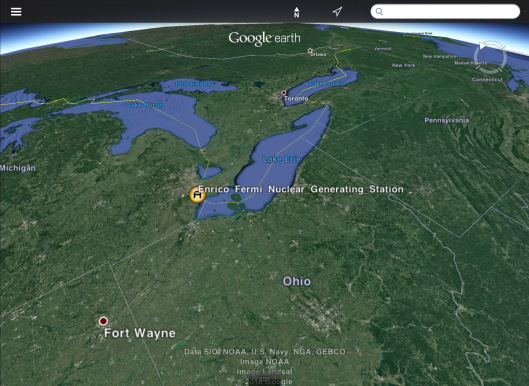
No sooner than the Saugeen Ojibway Nation had voted overwhelmingly against Ontario Power Generation’s effort to build a deep geological repository for low and intermediate nuclear waste the repository on the lip of Lake Huron, a similar, perhaps more lethal threat has emerged. The Nuclear Waste Management Organization, the industry group tasked in 2002 with finding a permanent waste site for Canadian high-level nuclear waste, announced earlier this year that it had landed on two possible locations, down from 22 prospective sites — Ignace in northwest Ontario and the municipality of South Bruce, virtually next door to the now scrapped site for low and intermediate nuclear waste storage. “High-level radioactive waste in Canada is used (irradiated) nuclear fuel that has been declared as radioactive waste. Used nuclear fuel produces ionizing radiation,” according to the Canadian Nuclear Safety Commission. “This type of radiation has a strong ability to penetrate matter, so shielding against the radiation is required. Since used nuclear fuel contains significant quantities of radionuclides with long half-lives, it requires long-term management and isolation.” Low and intermediate nuclear waste refers to all other forms of nuclear waste. Calling any kind of radioactive waste “low level” is somewhat inaccurate, according to Diane D’Arrigo, the radioactive waste project director at the Nuclear Information and Resource Service, headquartered in Tacoma Park, Maryland. “A lot of what’s in that waste might be low level, but it’s not low risk,” said D’Arrigo. Both can contain the same dangerous radioactive elements. Like the scrapped plan, the new effort calls for a deep geological repository. The effort relies on core samples from the shelved DGR to demonstrate the ostensible suitability of the site. “In Huron-Kinloss and South Bruce, detailed assessment of available historic local and regional geo-scientific studies, including recent deep borehole data from the Bruce nuclear site, showed that the geological setting has a number of favourable characteristics for hosting a deep geological repository for used nuclear fuel,” according to information on the NWMO website. OPG proposed to excavate a storage chamber in a layer of limestone 2,200 feet underground, capped by shale on the top and granite below; OPG geologists estimated that the rock had been stable for 450 million years. The proposed site would be about 600 feet less deep. The members and financiers — via dedicated trust funds — of the NWMO are Ontario Power Generation, New Brunswick Power, Hydro-Québec and Atomic Energy of Canada Limited. Huron-Kinloss, which neighbors South Bruce, is no longer under consideration for the dump. South Bruce sits 29 miles southeast of Bruce Power nuclear station and about 20 miles east of Lake Huron. The DGR proposed for the Bruce Power site, home to eight reactors, was a half mile from Lake Huron. The nuclear complex is on the shore of Lake Huron, roughly 125 miles uplake of Port Huron and 150 miles uplake and upstream from Algonac. The new high-level waste dump would accept spent fuel rods from the 18 nuclear reactors in Ontario and the single reactor at Point Lepreau, New Brunswick. Like the previously proposed dump, the high-level dump is within the Great Lakes basin, inland from Kincardine, said Emily Grant, a South Bruce activist opposed to the project, via email. Grant is a member of the group Protect Our Waterways – No Nuclear Waste. NWMO optioned about 1,300 acres of land in January and “the site will lie directly below the Teeswater River, a tributary of Lake Huron,” said Grant. “As you know, the Great Lakes provide drinking water to over 30 million Americans and 10 million Canadians … There isn’t a single DGR that houses high-level radioactive material in the world, and this experiment does not belong anywhere near the world’s largest body of freshwater.” The Teeswater River flows generally north and joins the Saugeen River in Paisley, which then runs northwest and flows into Lake Huron at Southampton, 19 miles north of the Bruce Power nuclear station. “Spent fuel is thermally hot as well as highly radioactive and requires remote handling and shielding,” according to the U.S. Nuclear Regulatory Commission. Three of the byproducts of the fission process used to generate nuclear power remain dangerous for long periods of time. “Strontium-90 and cesium-137 have half-lives of about 30 years (half the radioactivity will decay in 30 years). Plutonium-239 has a half-life of 24,000 years.” Strontium-90 acts like calcium in the body, seeking out bones, where it can cause cancer; cesium-137 is a muscle seeker; plutonium-239 ends up in the bones, liver and spleen. “Some can give a lethal dose in 15-20 minutes unshielded,” D’Arrigo said. There is no level at which human exposure to radiation has been deemed safe. High-level nuclear waste will remain toxic for more than 100,000 years, ten times longer than the Great Lakes are old, and some of it for more than a million years. NWMO acknowledges this potential problem. “There is some uncertainty about how the system will perform over the very long term because we cannot obtain advance proof of actual performance over thousands of years,” says the organization. Protect Our Waterways – No Nuclear Waste announced on July 3 that it had hired environmental lawyer David Donnelly to help fight the repository. Right now, reactor operators are required to store high-level nuclear waste onsite. According to the Detroit Free Press in a December story, nearly 60,000 tons of spent fuel is parked at reactors that dot the shores of the Great Lakes in the U.S. and Canada. Nearly 3,000 spend fuel bundles await permanent interment in Canada. According to the NWMO’s prospective timeline, a final site will be chosen by 2023 and construction will begin in 2033. Ten years later, after costs of at least $23 billion, the dump will be in operation, accepting high-level waste for 50 years. Over the course of its construction and operating life, more than 2,000 people will be employed. The repository would be sealed and monitored for a certain amount of time and then essentially Right now, reactor operators are required to store high-level nuclear waste onsite. According to the Detroit Free Press in a December story, nearly 60,000 tons of spent fuel is parked at reactors that dot the shores of the Great Lakes in the U.S. and Canada. Nearly 3,000 spend fuel bundles await permanent interment in Canada. According to the NWMO’s prospective timeline, a final site will be chosen by 2023 and construction will begin in 2033. Ten years later, after costs of at least $23 billion, the dump will be in operation, accepting high-level waste for 50 years. Over the course of its construction and operating life, more than 2,000 people will be employed. The repository would be sealed and monitored for a certain amount of time and then essentially Right now, reactor operators are required to store high-level nuclear waste onsite. According to the Detroit Free Press in a December story, nearly 60,000 tons of spent fuel is parked at reactors that dot the shores of the Great Lakes in the U.S. and Canada. Nearly 3,000 spend fuel bundles await permanent interment in Canada. According to the NWMO’s prospective timeline, a final site will be chosen by 2023 and construction will begin in 2033. Ten years later, after costs of at least $23 billion, the dump will be in operation, accepting high-level waste for 50 years. Over the course of its construction and operating life, more than 2,000 people will be employed. The repository would be sealed and monitored for a certain amount of time and then essentially abandoned. Like the proposed dump for low and intermediate level nuclear waste, the NWMO says that the high-level dump will not go forward without the approval of the Saugeen Ojibway Nation, on whose historic lands the DGR will sit. “I would imagine that we will not allow high-level waste to be buried within our territory either, because that was the big fear with the last project, that high-level waste would go into it,” Vernon Roote, a former chief with the Saugeen First Nation, told CTV News London in March. Eighty-six percent of the first nation voted against the low and intermediate nuclear waste dump, 1,058-170, in January. Jim Bloch is a freelance writer. Contact him at bloch.jim@gmail.com. |
|
Los Alamos Study Group press Santa Fe Council – to stop Santa Fe becoming a nuclear sacrifice zone
 Santa Fe shouldn’t become a nuclear sacrifice zone https://www.abqjournal.com/1477033/santa-fe-shouldnt-become-a-nuclear-sacrifice-zone-ex-where-does-the-city-stand-in-matters-of-peace-the-environment-and-citizens-health-and-welfare.html,BY LYDIA CLARK, July 19th, 2020 This is an open letter to Santa Fe Mayor Alan Webber and the City Council:We, the Los Alamos Study Group, have now written to the Santa Fe City Council and the mayor of Santa Fe numerous times regarding two very important resolutions we have proposed, with no response of any significance from anyone.
These resolutions are of great import to the safety, health and welfare of the city and citizens of Santa Fe, and we are very concerned the City Council and mayor are ignoring these issues.
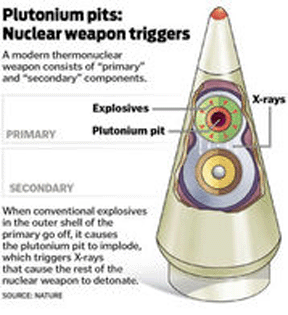
The City of Santa Fe has had a long-standing policy of resolutions supporting nuclear disarmament, supporting environmental impact statements and opposing production of nuclear weapons, specifically plutonium pit production.
Santa Fe has also been and is still a member of “Mayors for Peace,” which states that “nuclear weapons are inhumane” and calls for “their abolition.”
Recently, Mayor Webber attended a “peaceful protest” regarding racial issues. Is the destruction of humanity and the planet less important in keeping the peace?
The safety, health and welfare are only a part of the impact created from nuclear weapons production at Los Alamos National Laboratory. It uses and diverts much-needed funding for education, health care, sustainable jobs, and real safety and security away from New Mexico. The proposed FY2021 federal budget solely for plutonium pit production at LANL is now $1.1 billion (an increase since our last letter). How many truly beneficial programs for New Mexico would this support?
Nuclear weapons production creates vast amounts of toxic waste that has no safe method of disposal, with the potential to contaminate our environment from spills, leakage, fire hazard, seismic activity and human error. The waste currently being stored at LANL will not be transported for disposal any time in the near future. Where will the new waste be stored?
The recent exposure to LANL workers from a breach in a plutonium glove box is foreshadowing of things to come with the proposed plutonium pit factory at the facility. LANL has a history of safety failures.
The last plutonium pit factory, Rocky Flats (in Colorado), was forcibly closed for egregious environmental violations, worker injuries and deaths. Is New Mexico willing to create Rocky Flats II?
Why would the city officials not support asking for a Site-Wide Environmental Impact Statement (which is part of one of the above-referenced resolutions) that can help protect not only Santa Fe, but also the entire northern New Mexico region in this crucial matter?
The other resolution would bar the city from entering into development agreements with LANL or other nuclear weapons agencies. (There has been talk of a LANL presence on the city-owned Midtown Campus).
Your lack of concern and response is disturbing, and we ask once more for a prompt response to the request for support and implementation of these two resolutions, and an explanation to the public of the position of the city of Santa Fe in matters of peace, sustainability, environmental protection, and the health and welfare of our citizens, and the citizens of New Mexico.
Do not allow our city to become a nuclear sacrifice zone.
Lydia Clark is outreach director-Santa Fe for the Los Alamos Study Group.
California Coastal Commission unanimously approves storage plan at San Onofre Nuclear Generating Station
California Coastal Commission unanimously approves storage plan at San Onofre Nuclear Generating Station CBS8, 17 Jul 20, The Commission voted 10-0 to approve the program to allow storage of spent nuclear fuel on-site. SAN DIEGO COUNTY, Calif. — The California Coastal Commission voted 10-0 in a special meeting today to approve an inspection and maintenance program allowing Southern California Edison to store spent nuclear fuel in a storage site at the San Onofre Nuclear Generating Station.
The program outlines actions SCE will take to inspect the canisters that contain spent nuclear fuel, as well as how potential issues with the canisters will be remedied.
Robotic devices will be used to inspect the canisters and site conditions will be simulated on a test canister, which will be observed for potential degradation. Two spent fuel storage canisters will be inspected every five years starting in 2024, and the test canister will be inspected every two to three years.
Canister flaws will be repaired by the application of a nickel-based metallic spray, and the presence of flaws may result in increased canister inspection frequency and an increase in the number of canisters inspected.
The inspection and maintenance program was also reviewed by the engineering consulting firm LPI, which provided recommendations that included the increase in canister inspections should flaws arise.
Nearly 3.6 million pounds of spent nuclear fuel are stored at the plant, which stopped producing electricity in 2012.
Concerns remain over the plant’s proximity to the ocean and the potential for the site to be affected by rising sea levels, tsunami inundation, seismic hazards.
By 2035, the commission may look to relocate the canisters to another site, although no such location is available, according to a commission report. ……. https://www.cbs8.com/article/news/local/san-onfre-nuclear-power-plant-storage-approval/509-b0c102a6-86b7-45c3-a5d7-b5013cfc19c4
Nuclear waste is piling up in California: leadership is needed
Gov. Gavin Newsom and leaders from the Legislature must demand action on nuclear waste and fill gaps in oversight. By Bart Ziegler, CalMatters, 17 Jul 20,
Bart Ziegler is president of the Samuel Lawrence Foundation, a nonprofit based in Del Mar, bart@samuellawrencefoundation.org.
From San Onofre to Humboldt Bay, nuclear waste is piling up in California.
This most-toxic waste – tons and tons of it – is deadly for 200,000 years. Stranded next to a rising ocean at aging and decommissioned plants, the waste has no permanent home.
California is overdue in showing leadership.
Just as California has broken ranks with the federal government on regulating greenhouse gas emissions, Gov. Gavin Newsom and leaders from the Legislature must demand action on nuclear waste and fill gaps in oversight.
With federal regulators all but cornering nuclear policy, the industry all too often is left to regulate itself. Meanwhile, private contractors slop at ratepayer-funded decommissioning troughs while running loose with safety.
Enough is enough, California!
In north San Diego County, conditions at the shuttered San Onofre Nuclear Generating Station scream for state intervention, as Rep. Mike Levin, a Democrat from San Juan Capistrano, concluded in a task force report issued recently.
First, some background.
Decommissioning started this year at the San Onofre plant, which quit making electricity in 2012. The plant’s majority owner, Southern California Edison, has opened its $4 billion decommissioning purse to Holtec International as lead contractor in charge of transferring 3.6 million pounds of spent nuclear fuel from cooling pools to a storage system of Holtec’s design.
That’s where things get dicey.
Edison’s contractors are cramming the spent fuel assemblies into thin-walled, steel canisters. Workers hoist the canisters from wet storage with a behemoth, track-driven gantry crane and crawl them to a concrete, dry-storage vault. That’s where the 73 canisters will stay. Indefinitely.
Public hand-wringing intensified after a near-accident in 2018 involving a fully-loaded canister and the release of reports showing the canisters are prone to gouging during transfer. That can lead to corrosion and failure, especially in a marine environment. To make matters worse, the canisters cannot be repaired, monitored, inspected or transported once entombed in the vault.
What can California do? For starters, leaders can immediately improve oversight of nuclear waste storage.
Nuclear plant owners admit to not having developed procedures to replace fully-loaded canisters. That’s why, as part of decommissioning California’s coastal nuclear plants at San Onofre, Diablo Canyon and Humboldt Bay, the state Coastal Commission must demand the construction of handling facilities – known as “hot cells” – where canisters can be repaired or replaced.
State lawmakers should order construction of a hot cell at the decommissioned Rancho Seco Nuclear Generating Station, just 40 miles south of their offices in Sacramento.
In San Diego County, near the border with Orange County, 8.2 million people live within 50 miles of the old San Onofre plant. On July 16, the California Coastal Commission is set to act on a staff recommendation to approve Edison’s application to dismantle the plant’s cooling pools. That approval would be disastrous. For now at least, the spent fuel cooling pools provide our last option for dealing with a damaged canister.
Coastal Commissioners are appointed by the same Legislature that should prepare for a crisis instead of responding to one. You don’t wait for a fire to create a fire department. Preparation is cheaper and faster than responding to a crisis. Tragically, the COVID-19 pandemic has shown that preparation is not always our strongest suit.
As recommended in the Report of the San Onofre Nuclear Generating Station Task Force, a state model would improve agency coordination on waste storage permit applications and increase engagement with federal agencies to advance solutions for containing and handling deadly nuclear waste. The solutions should be tied to strict, economic enforcement.
Coastal commissioners, lawmakers, regulators and anyone else with a stake in California – that’s nearly 40 million of us – should read the report and demand action on nuclear waste.
1 This Month
23-25 October – on Zoom – World BEYOND War’s annual global conferenc

To see nuclear-related stories in greater depth and intensity – go to https://nuclearinformation.wordpress.com

Say No to NASA’s Reckless Nuclear Reactor on the Moon
Say No to NASA’s Reckless Nuclear Reactor on the Moon
-
Archives
- October 2026 (160)
- September 2026 (339)
- August 2026 (330)
- July 2026 (355)
- June 2026 (287)
- May 2026 (306)
- April 2026 (356)
- March 2026 (251)
- February 2026 (267)
- January 2026 (308)
- December 2025 (358)
- November 2025 (359)
-
Categories
- 1
- 1 NUCLEAR ISSUES
- business and costs
- climate change
- culture and arts
- ENERGY
- environment
- health
- history
- indigenous issues
- Legal
- marketing of nuclear
- media
- opposition to nuclear
- PERSONAL STORIES
- politics
- politics international
- Religion and ethics
- safety
- secrets,lies and civil liberties
- spinbuster
- technology
- Uranium
- wastes
- weapons and war
- Women
- 2 WORLD
- ACTION
- AFRICA
- Atrocities
- AUSTRALIA
- Christina's notes
- Christina's themes
- culture and arts
- Events
- Fuk 2022
- Fuk 2023
- Fukushima 2017
- Fukushima 2018
- fukushima 2019
- Fukushima 2020
- Fukushima 2021
- general
- global warming
- Humour (God we need it)
- Nuclear
- RARE EARTHS
- Reference
- resources – print
- Resources -audiovicual
- Weekly Newsletter
- World
- World Nuclear
- YouTube
-
RSS
Entries RSS
Comments RSS


