Russia facing huge problem to recover radioactive sunken nuclear reactors, but Putin still plans new ones in the Arctic
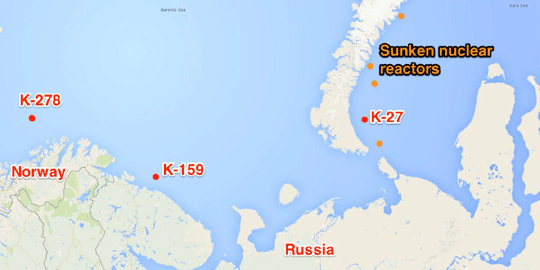
Russia’s ‘slow-motion Chernobyl’ at sea, FUTURE PLANET | OCEANS By Alec Luhn, 2nd September 2020 ……….
 Minimising risk
Russia, Norway and other countries whose fishing boats ply the bountiful waters of the Barents Sea have now found themselves with a sword of Damocles hanging over their heads. Although a 2014 Russian-Norwegian expedition to the K-159 wreck that tested the water, seafloor and animals like a sea centipede did not find radiation above background levels, an expert from Moscow’s Kurchatov Institute said at the time that a reactor containment failure “could happen within 30 years of sinking in the best case and within 10 years at the worst”. That would release radioactive caesium-137 and strontium-90, among other isotopes.
While the vast size of the oceans quickly dilutes radiation, even very small levels can become concentrated in animals at the top of the food chain through “bioaccumulation” – and then be ingested by humans. But economic consequences for the Barents Sea fishing industry, which provides the vast majority of cod and haddock at British fish and chip shops, “may perhaps be worse than the environmental consequences”, says Hilde Elise Heldal, a scientist at Norway’s Institute of Marine Research.
According to her studies, if all the radioactive material from the K-159’s reactors were to be released in a single “pulse discharge”, it would increase Cesium-137 levels in the muscles of cod in the eastern Barents Sea at least 100 times. (As would a leak from the Komsomolets, another sunken Soviet submarine near Norway that is not slated for lifting.) That would still be below limits set by the Norwegian government after the Chernobyl accident, but it could be enough to scare off consumers. More than 20 countries continue to ban Japanese seafood, for instance, even though studies have failed to find dangerous concentrations of radioactive isotopes in Pacific predatory fishes following the Fukushima nuclear power plant release in 2011. Any ban on fishing in the Barents and Kara seas could cost the Russian and Norwegian economies €120m ($140m; £110m) a month, according to a European Commission feasibility study about the lifting project.
There is no ship in the world capable of lifting the K-159, so a special salvage vessel would have to be built
But an accident while raising the submarine, on the other hand, could suddenly jar the reactor, potentially mixing fuel elements and starting an uncontrolled chain reaction and explosion. That could boost radiation levels in fish 1,000 times normal or, if it occurred on the surface, irradiate terrestrial animals and humans, another Norwegian study found. Norway would be forced to stop sales of products from the Arctic such as fish and reindeer meat for a year or more. The study estimated that more radiation could be released than in the 1985 Chazhma Bay incident, when an uncontrolled chain reaction during refuelling of a Soviet submarine near Vladivostok killed 10 sailors.
Amundsen argued that the risk of such a criticality excursion with the K-159 or K-27 was low and could be minimised with proper planning, as it was during the removal of high-risk spent fuel from Andreyev Bay.
“In that case we do not leave the problem for future generations to solve, generations where the knowledge of handling such legacy waste may be very limited,” he says.
The safety and transparency of Russia’s nuclear industry has often been questioned, though, most recently when Dutch authorities concluded that radioactive iodine-131 detected over northern Europe in June originated in western Russia. The Mayak reprocessing facility that received the spent fuel from Andreyev Bay by train has a troubled history going back to the world’s then-worst nuclear disaster in 1957. Rosatom continues to deny the findings of international experts that the facility was the source of a radioactive cloud of ruthenium-106 registered over Europe in 2017.
While the K-159 and K-27 need to be raised, Rashid Alimov of Greenpeace Russia has reservations. “We are worried about the monitoring of this work, public participation and the transport [of spent fuel] to Mayak,” he says.
Custom mission
Raising a submarine is a rare feat of engineering. The United States spent $800m (£610m) in an attempt to lift another Soviet submarine, the diesel-powered K-129 that carried several nuclear missiles, from 16,400ft (5,000m) in the Pacific Ocean, under the guise of a seabed mining operation. In the end, they only managed to bring a third of the submarine to the surface, leaving the CIA with little usable intelligence.
That was the deepest raise in history. The heaviest was the Kursk. To bring the latter 17,000-tonne missile submarine up from 350ft (108m) below the Barents Sea, the Dutch companies Mammoet and Smit International installed 26 hydraulically cushioned lifting jacks on a giant barge and cut 26 holes in the submarine’s rubber-coated steel hull with a water jet operated by scuba divers. On 8 October 2001, rushing to beat the winter storm season after four months of nerve-wracking work and delays, steel grippers fitted in the 26 holes lifted the Kursk from the seabed in 14 hours, after which the barge was towed to a dry dock in Murmansk.
At less than 5,000 tonnes, the K-159 is smaller than the Kursk, but even before it sank its outer hull was “as weak as foil”, according to Bellona. It has since been embedded in 17 years’ worth of silt. A hole in the bow would seem to rule out pumping it full of air and raising it with balloons, as has been previously suggested. At a conference of European Bank of Reconstruction and Development donors in December, a Rosatom representative said there was no ship in the world capable of lifting it, so a special salvage vessel would have to be built.
That will increase the estimated cost of €278m ($330m; £250m) to raise the six most radioactive objects. Donors are discussing Russia’s request to help finance the project, said Balthasar Lindauer, director of nuclear safety at EBRD.
“There’s consensus something needs to be done there,” he says. Any such custom-built vessel would likely need a bevy of specialised technologies such as bow and aft thrusters to keep it positioned precisely over the wreck.
But in August, Grigoriev told a Rosatom-funded website that one plan the company was considering would involve a pair of barges fitted with hydraulic cable jacks and secured to deep-sea moorings. Instead of steel grippers like the ones inserted into the holes in the Kursk, giant curved pincers would grab the entire hull and lift it up between the barges. A partially submersible scow would be positioned underneath, then brought to the surface along with the submarine and finally towed to port. The K-27 and K-159 could both be recovered this way, he said.
One of three engineering firms working on proposals for Rosatom is the military design bureau Malachite, which drafted a project to raise the K-159 in 2007 that “was never realised due to a lack of money”, according to its lead designer. This year the bureau has begun updating this plan, an employee tells Future Planet in the lobby of Malachite’s headquarters in St Petersburg. Many questions remain, however.
“What condition is the hull in? How much of force can it handle? How much silt has built up? We need to survey the conditions there,” the employee says, before the head of security arrives to break up our conversation.
Nuclear paradox
Removing the six radioactive objects fits in with an image Putin as crafted as a defender of the fragile Arctic environment. In 2017, he inspected the results of an operation to remove 42,000 tonnes of scrap metal from the Franz Josef Land archipelago as part of a “general clean-up of the Arctic”. He has spoken about environmental preservation at an annual conference for Arctic nations. And on the same day in March 2020 that he issued his draft decree about the sunken objects, he signed an Arctic policy that lists “protecting the Arctic environment and the native lands and traditional livelihood of indigenous peoples” as one of six national interests in the region.
“For Putin, the Arctic is part of his historic legacy. It should be well-protected, bring real benefits and be clean,” said Dmitry Trenin, head of the think tank Carnegie Centre Moscow.
Yet while pursuing a “clean” Arctic, the Kremlin has also been backing Arctic oil and gas development, which accounts for the majority of shipping on the Northern Sea Route. State-owned Gazprom built one of two growing oil and gas clusters on the Yamal peninsula, and this year the government cut taxes on new Arctic liquified natural gas projects to 0% to tap into some of the trillions of dollars of fossil fuel and mineral wealth in the region.
And even as Putin cleans up the Soviet nuclear legacy in the far north, he is building a nuclear legacy of his own. A steady march of new nuclear icebreakers and, in 2019, the world’s only floating nuclear power plant has again made the Arctic the most nuclear waters on the planet.
Meanwhile, the Northern Fleet is building at least eight submarines and has plans to construct several more, as well as eight missile destroyers and an aircraft carrier, all of them nuclear-powered. It has also been testing a nuclear-powered underwater drone and cruise missile. In total, there could be as many as 114 nuclear reactors in operation in the Arctic by 2035, almost twice as many as today, a 2019 Barents Observer study found.
This growth has not gone without incident. In July 2019, a fire on a nuclear deep-sea submersible near Murmansk almost caused a “catastrophe of a global scale,” an officer reportedly said at the funeral of the 14 sailors killed. The next month, a “liquid-fuel reactive propulsion system” exploded during a test on a floating platform in the White Sea, killing two of those involved and briefly spiking radiation levels in the nearby city of Severodvinsk.
“The joint efforts of the international community including Norway and Russia after breakup of the Soviet Union, using taxpayer money to clean up nuclear waste, was a good investment in our fisheries,” says The Barents Observer’s Nilsen. “But today there are more and more politicians in Norway and Europe who think it’s a really big paradox that the international community is giving aid to secure the Cold War legacy while it seems Russia is giving priority to building a new Cold War.”
As long as the civilian agency Rosatom is tasked with clean-up, the Russian military has little incentive to slow down this nuclear spree, Nilsen notes.
“Who is going to pay for the clean-up of those reactors when they are not in use anymore?” he asks. “That is the challenge with today’s Russia, that the military don’t have to think what to do with the very, very expensive decommissioning of all this.”
So while the coming nuclear clean-up is set to be the largest of its kind in history, it may turn out to be just a prelude to what’s needed to deal with the next wave of nuclear power in the Arctic…………….https://www.bbc.com/future/article/20200901-the-radioactive-risk-of-sunken-nuclear-soviet-submarines
Nuclear waste project proposed near Carlsbad sees mixed response in final public hearing
|
Nuclear waste project proposed near Carlsbad sees mixed response in final public hearing, Adrian Hedden– Carlsbad Current-Argus, 3 Sept 20, In its final public comment hearing on an environmental analysis for a nuclear waste facility near Carlsbad and Hobbs, the federal Nuclear Regulatory Commission (NRC) heard arguments both for and against the project that would see high-level spent nuclear fuel rods stored temporarily in southeast New Mexico.Holtec International sought a permit to build and operate the site known as a consolidated interim storage facility (CISF) to remove nuclear waste from generator sites around the U.S., and temporarily store the refuse until a permanent repository was ready. The NRC’s recently released draft environmental impact statement (EIS) found the project, during construction and operation, would have minimal environmental impact. A safety analysis was forthcoming, which would study the project’s impact on human safety and require another period of public comments………… Opponents of the project, including New Mexico Gov. Michelle Lujan Grisham and members of her cabinet panned the proposal for environmental concerns and impacts on other industries in the state such as extraction and agriculture. Protesters during Wednesday’s meeting also questioned the NRC’s decision to hold public hearings online and via phone instead of in person amid the COVID-19 pandemic as “rushing” the project and reducing public participation. ……. Rose Gardner, a resident of Eunice near the proposed site and member of the Alliance for Environmental Strategies argued that the project was illegal under federal law and unfairly impacted Hispanic communities in rural New Mexico. “The National Waste Policy Act does not allow for this license to be issued and a privately-owned corporation to take the high-level waste from commercial reactors,” Gardner said. “The failure of the NRC to satisfy the public with these poorly run and moderated webinars is an example of government waste as usual.” New Mexico State Sen. Jeff Steinborn (D-36) argued the EIS was “deficient” in that it did not address the transportation plan that would bring the waste to the facility from “all sides of New Mexico,” he said. “Transportation should not be an afterthought,” Steinborn said. “This is a fatal flaw in this plan. New Mexicans continue time and again to pay the high cost of America’s nuclear legacy.” Steinborn also called on the NRC to postpone the licensing process until after the pandemic subsided and in-person public meetings could be held safely. “New Mexicans have not been proactively reached out to and engaged on this proposal,” he said. “This pandemic has created a digital divide in New Mexico.” New Mexico U.S. Sens. Martin Heinrich and Tom Udall agreed with the call on the NRC to postpone the licensing process amid the public health crisis in a letter sent last month to NRC leadership. “Ultimately, there is no compelling public interest reason to justify this rush to replace meetings with virtual webinars, and this decision gives the Commission the appearance of valuing the preferences of a for-profit company looking to store highly dangerous nuclear waste that of the public and their elected representatives,” the letter said.https://www.currentargus.com/story/news/local/2020/09/02/holtec-nuclear-waste-project-near-carlsbad-sees-mixed-public-response/5681636002/ |
|
Nuclear waste in Japan – an environmental worry
 Nuclear waste disposal is a matter of environmental concern, https://www.japantimes.co.jp/opinion/2020/08/31/reader-mail/nuclear-waste-disposal-matter-environmental-concern/ It has been reported that the town of Suttsu in Hokkaido is considering applying for a two-year “literature research” into the possibility of storing high-level radioactive nuclear waste. A maximum of ¥2 billion in subsidies will be granted by the central government.
“The future of the town is financially precarious,” said Haruo Kataoka, the mayor of Suttsu, in an interview.
But the money that is thought to revive the town cannot reverse what the nuclear waste is likely to cause.
It is, in my opinion, never a financial issue, but a matter of environmental concern.
What is in question here is high-level radioactive nuclear waste, which can be dangerous for at least 200,000 years and therefore must be handled with the utmost care. It is indeed a problem that any country with nuclear power plants needs to address, however thorny it is. Any indiscreet decision is deemed extremely irresponsible and profoundly unethical.
“Financially precarious,” I must stress, is by no means comparable to environmentally threatening. Besides, it is specifically stated in a Hokkaido ordinance that nuclear waste is hardly acceptable in the prefecture.
Before a final disposal site is selected, or even before an application for research is submitted, the scientific facts ought to be thoroughly understood and the residents properly informed.
The span of recorded history is merely 5,000 years, while 200,000 years is far beyond human experience and comprehension. We certainly cannot live to see what is going to become of the nuclear waste, but I believe that we do not want to leave the thorny problem unaddressed to haunt our future generations.
Canadian Public asked for views on transport of used nuclear fuel
 Public asked for views on transport of used nuclear fuel Owen Sound The Sun Times Scott Dunn 27 Aug 20 The Nuclear Waste Management Organization wants public input on its planning framework concerning shipping about 5.5 million used nuclear fuel bundles by road and possibly rail, to a permanent storage site, possibly in Bruce County.Spent nuclear fuel rods are currently stored above ground at nuclear sites and the aim is to create a long-term storage solution.
The NWMO’s draft transportation planning framework, based partly on public consultations since 2016, is the subject of a detailed online survey. The survey contains background and facts about the plan and about the management and transportation of used nuclear fuel.
There are five sections to comment on: The basic requirements of used nuclear fuel transportation planning, the plan’s objectives and principles, environmental protection, who needs to be involved in decision-making, and how should the modes and routes be decided. The survey can be found at https://ca.surveygizmo.com/s3/50081627/NWMOworkbookSMEN…....South Bruce, the local municipality near the Bruce Power nuclear station on Lake Huron, is one of two locations which remain potential sites for a $23-billion permanent storage facility buried deep underground.
So far, South Bruce has not declared itself a willing host, or even how that conclusion would be arrived at, though an opposition group has called for a community vote and the mayor has suggested that might be the solution.
The other remaining potential site is Ignace area, northwest of Lake Superior.
Approval of the local First Nations people is also required and earlier this year they turned down a separate plan to bury low- and mid-level nuclear waste in a dedicated underground vault at the Bruce nuclear site.
NWMO says it expects to select its preferred location for the used nuclear fuel vault in 2023. Operation of the deep geological repository and transportation of used nuclear fuel is planned to start in the 2040s. Transport of the bundles will take about 40 years.
The used nuclear fuel will be transported by roads and possibly rail, depending on the location of the repository.
“If an all-road approach were taken, this might involve about 620 truck shipments each year, approximately one-to-two shipments per day. If an all-rail approach were taken, this might involve about 60 train shipments each year, approximately one shipment every six days,” says the organization’s Moving Forward Together document, found on the NWMO website……….. https://www.owensoundsuntimes.com/news/local-news/public-asked-for-views-on-transport-of-used-nuclear-fuel
UK’s Dounreay nuclear power site, opened in 1955, closed 1994, cleaned up in 2333, if they’re lucky

Dounreay on Scottish north coast has been site of considerable radioactive leaks https://www.independent.co.uk/environment/nuclear-power-dounreay-scotland-thurso-decommissioning-radiation-a9680611.html Harry Cockburn, Thursday 20 August 2020 In 313 years’ time, 378 years after it first opened in 1955, and 339 years after it ceased operations in 1994, the 178-acre nuclear power facility site at Dounreay will be safe for other uses, a new report has stated.
Though the site on the north coast of Scotland was only home to functioning nuclear reactors for 39 years, the clean-up will take roughly ten times as long, with efforts already underway to clean up hazardous radioactive material.
The facility, near Thurso, was used by the government for research and testing of various types of nuclear reactors, including a “fast reactor” and those intended for use on nuclear submarines.
The first reactor at the site to provide power to the National Grid was the Dounreay Fast Reactor, which provided power between 1962 and 1977. A second reactor also pumped power into the grid between 1975 and 1994.
A draft report from the government’s nuclear decommissioning authority states the site will only be ready for other uses after the year 2333.
Over the next two years, Dounreay Site Restoration Limited has said it will undertake assessments of “installations, current and future disposals, areas of land contamination, sub-surface structures and other discrete site conditions” to determine “credible options for the site end state”.
A process of demolition of buildings and waste removal is already underway at the site, which has previously been used to store dangerous radioactive material.
Part of the demolition process has involved the use of a remote controlled robot nicknamed the “Reactosaurus”, a 75-tonne device with radiation-proof cameras, and robotic arms which are able to reach 12 metres into the reactors where they can operate an array of size-reduction and handling tools, including diamond wire and disks and hydraulic shears.
One of the areas targeted for waste removal is a highly contaminated area called the Shaft.
The water reacted violently with the sodium and potassium, throwing off the massive steel and concrete lids of the shaft, and littered the area with radioactive particles.
The dangerous pollution affected local beaches, the coastline and the seabed. Fishing has been banned within a two-kilometre radius of the plant since 1997.
Milled shards from the processing of irradiated plutonium and uranium, are roughly the size of grains of grains of sand. The most radioactive of the particles are believed to be potentially lethal if ingested. These small fragments are known to contain caesium-137, which has a half-life of 30 years, but they can also incorporate traces of plutonium-239, which has a half-life of over 24,000 years.
Army dismantling long dead nuclear power plant at Fort Belvoir
Army dismantling deactivated nuclear power plant at Fort Belvoir, INSIDE NOVA, Aug 28, 2020
Local opposition to Holtec’s temporary storage for nuclear waste in New Mexico
 Public comments are due by Sept. 22, and can be made at the online meetings; by email to Holtec-CISFEIS@nrc.gov; at the federal rule-making website (www.regulations.gov, Docket ID NRC-2018-0052); or by mail (Office of Administration, Mail Stop: TWFN-7-A60M, ATTN: Program Management, Announcements and Editing Staff, U.S. NRC, Washington, DC 20555-0001).
Licensing of temporary storage for nuclear waste in New Mexico inching forward
Nuclear regulator poised to OK move of spent fuel from reactors like San Onofre to temporary storage in New Mexico, but locals are opposed, By TERI SFORZA | tsforza@scng.com | Orange County Registerl August 26, 2020
The quickest way to get nuclear waste off Southern California’s quake-prone coast? Temporary storage sites in sparsely populated corners of the nation, experts say.
After years of processing, the Nuclear Regulatory Commission’s preliminary recommendation is that Holtec International be granted a license to build and operate such an interim storage site in New Mexico — which would first accept “stranded waste” from shuttered plants like the San Onofre Nuclear Generating Station.
“Hopeful,” said David Victor, an international law professor at UC San Diego and chair of San Onofre’s volunteer Community Engagement Panel. “But the regulatory process and the political process for the New Mexico site are moving in opposite directions.”
The NRC is hosting online meetings to present the project’s draft environmental impact report and gather public comment. The next virtual meetings are slated for 3 p.m. Wednesday, Aug. 26, and 8 a.m. Tuesday, Sept. 2. Public comments must be submitted to the NRC by Sept. 22.
Holtec hopes to build the first of a 20-phase project that eventually would cover 330 acres. It would be located in southeast New Mexico, about halfway between the cities of Carlsbad and Hobbs, and would look quite familiar to Southern Californians: Waste, potentially from all over the nation, would be stored in a Holtec HI-STORM UMAX in-ground system like the one at San Onofre.
But anyone familiar with the saga of Yucca Mountain — as well as the controversy surrounding waste storage here at San Onofre — won’t be surprised to find that the underlying issues are universal: Many locals adamantly oppose storing nuclear waste in their backyards.
Though the license period for Holtec’s New Mexico proposal would be 40 years, people fear nuclear waste would remain there forever
“Establishing an interim storage facility in this region would be economic malpractice,” wrote New Mexico’s governor, Michelle Lujan Grisham, in a letter asking President Donald Trump to oppose Holtec’s project. “Accidents are possible and unacceptably detrimental to the safety of New Mexicans, our economy and our state.”
The governor argued that the site is geologically unsuitable, would place a financial burden on the state and local communities and poses a danger as spent nuclear fuel is shipped into New Mexico from around the nation.
Many New Mexicans, however, say that’s not enough. Speaking “under protest” at virtual meetings they believe may be unlawful, critics said the NRC must present its findings in state and in person. Since in-person gatherings can’t happen during the pandemic, deadlines should be postponed until after the pandemic is over, they argued.
Speakers also attacked Holtec’s crediblilty. The company is currently embroiled in conflict in New Jersey, where it sued the New Jersey Economic Development Authority in March for holding up a $26 million payment that was part of a tax incentive program to build a facility in Camden.
The authority asserts that Holtec failed to mention that it had run into hot water with the Tennessee Valley Authority on its tax credit application in 2014.
The Southern California News Group reported that the U.S. Attorney’s Office looked into bribery allegations and asserted that a subcontractor manufacturing Holtec’s casks — U.S. Tool & Die — wrote checks totaling $54,212 to the account of a TVA manager. That money, the U.S. Attorney’s Office said, originated with Holtec.
The TVA manager pleaded guilty to falsifying financial statements by not disclosing those payments. Holtec said it wasn’t privy to any of this, and was not charged. But in 2010, the company paid a $2 million “administrative fee” to the TVA and became the first contractor in TVA history to be debarred. Its contract was suspended for 60 days, and it submitted to a yearlong monitoring program of its operations, according to the TVA’s inspector general.
Holtec continued supplying waste storage casks to the TVA, as well as to other nuclear plants in America and overseas.
At San Onofre, Holtec has had other bumps, including a surprise redesign of the canisters that hold nuclear waste and a snippy war of words with members of the San Onofre Community Engagement Panel. Errors loading spent fuel into the UMAX stopped operations for nearly a year, but were laid at the feet of operator Southern California Edison.……..
Public comments are due by Sept. 22, and can be made at the online meetings; by email to Holtec-CISFEIS@nrc.gov; at the federal rule-making website (www.regulations.gov, Docket ID NRC-2018-0052); or by mail (Office of Administration, Mail Stop: TWFN-7-A60M, ATTN: Program Management, Announcements and Editing Staff, U.S. NRC, Washington, DC 20555-0001). https://www.ocregister.com/2020/08/25/licensing-of-temporary-storage-for-nuclear-waste-in-new-mexico-inching-forward/
Strong opposition in Hokkaido to taking on nuclear waste
Hokkaido town becomes flashpoint in Japan’s nuclear waste debate, Mayor and governor clash over ethics and risks of potential disposal site, Nikkei Asian Review, TORU TAKAHASHI, Nikkei staff writer, August 27, 2020
TOKYO — An idyllic town on the northern Japanese island of Hokkaido is embroiled in a hot debate over nuclear waste, as its mayor weighs building a disposal facility there over the opposition of the governor as well as surrounding towns………
Hokkaido Gov. Naomichi Suzuki has swiftly mobilized opponents. “Hokkaido has no intention of taking on nuclear waste,” he said on Aug. 13, shortly after Kataoka’s announcement. “The national government is basically shoving wads of cash in our face,” he also said on Aug. 18, criticizing the cash offer. ……..
several local industry groups oppose the idea. Fishermen in particular worry that a local nuclear facility could tarnish the reputation of their catch.
Nearby towns and villages also feel they could face all of the risks of the nuclear waste disposal site without any payout from the national government…… https://asia.nikkei.com/Politics/Hokkaido-town-becomes-flashpoint-in-Japan-s-nuclear-waste-debate
America needs to abandon the idea of Yucca Mountain for nuclear waste dump: both Trump and Biden have
|
US policy regarding spent fuel disposal has been hung up for decades on whether to build a repository at Yucca Mountain. The site has been controversial since 1987, when Congress designated it as the future home for high-level radioactive waste – provided, of course, that it meets all technical requirements and is licensed by the Nuclear Regulatory Commission. Thirty-plus years and more than $15 billion later, all technical work to assess the site’s suitability has stopped and the licensing review is dead in the water. The US Congress has refused to appropriate funds to the project for years. And because the government has not met its commitment to begin accepting waste for disposal in 1998, it is forced to pay utilities more than $600 million every year to store their spent fuel on site. Moreover, the most realistic approach for managing the tons of spent fuel—an interim storage facility—is held hostage to progress on Yucca Mountain. Current law requires that the NRC issue a license for Yucca Mountain before a consolidated interim storage could begin to accept spent fuel. The sooner everyone agrees to pull the plug on Yucca Mountain, the sooner the United States can move forward on consolidated storage for the next 40 to 50 years, since this is likely the amount of time it will take to bring a long-term repository into operation. This will give the government time to find a new site using a consent-based process………..https://thebulletin.org/2020/08/if-trump-and-biden-agree-there-shouldnt-be-a-nuclear-waste-site-at-yucca-mountain-cant-we-all/#
|
|
|

Growing national opposition to Holtec plan for ‘temporary’ storage of nuclear wastes near Carlsbad, New Mexico

Nationwide opposition of a nuclear waste storage facility proposed to be built near Carlsbad and Hobbs continued its call for the licensing process for the project to be suspended during the COVID-19 pandemic and that the federal Nuclear Regulatory Commission deny the application altogether.
Holtec International proposed to build the site to store high-level spent nuclear fuel rods transported to southeast New Mexico from generator sites across the county.
Many of the rods are already stored in cooling pools near the generator sites, which supporters of the project said were unsafe as many are located near large bodies of water or densely populated areas.
The concept of Holtec’s consolidated interim storage facility (CISF) was to temporarily store the spent fuel in a remote location while a permanent repository was developed.
Such a facility to permanently store the waste does not exist in the U.S.
The idea faced opposition from New Mexico Gov. Michelle Lujan Grisham and State Land Commissioner Stephanie Garcia Richard along with other state lawmakers.
And during a Thursday public hearing held by the NRC, numerous nuclear watchdog groups from around the country voiced their opposition.
The NRC announced last week it would hold four such online hearings including Thursday’s with others scheduled for Aug. 25, 26 and Sept. 2 to solicit public comments on the Commission’s recently released environmental impact statement (EIS).
The EIS released earlier this year found the project would have minimal environmental impacts during the construction, operation and decommissioning of the facility.
The EIS was required for the first phase of Holtec’s plan for 500 cannisters to be stored, but the NRC also considered the company’s expressed intention to apply for future permits for 19 additional phases for a total of 10,000 cannisters of nuclear waste.
Leona Morgan of the Nuclear Issues Study Group based in Albuquerque said the online hearing process was unjust as many New Mexicans live without adequate internet or phone service to participate in electronic hearings.
While she called for the NRC to reject Holtec’s application, citing safety and environmental risks to the region of the facility and communities along the transportation routes, Morgan also questioned the hearing process itself as it continued during the global pandemic.
Leona Morgan of the Nuclear Issues Study Group based in Albuquerque said the online hearing process was unjust as many New Mexicans live without adequate internet or phone service to participate in electronic hearings.
While she called for the NRC to reject Holtec’s application, citing safety and environmental risks to the region of the facility and communities along the transportation routes, Morgan also questioned the hearing process itself as it continued during the global pandemic.
The Nuclear Issues Study Group, which held a continued presence during the past three public hearings held this year, and NRC’s scoping meetings held in 2018, would boycott the rest of the proceedings, Morgan said.
“There are a large portion of our state that lives without phone or internet service. Our organization is boycotting the rest of these proceedings. It is a sham. There is no reason to rush this process except to line the pockets of shareholders,” she said.
“We see this as a violation of our rights to submit our public comments under the National Environmental Policy Act. And it violates environmental justice. We can’t even verify that the NRC is sitting before us.”
More:Nuclear waste site near Carlsbad opposed by indigenous groups during public hearing
John LaForge, of nuclear watchdog group Nukewatch of Wisconsin also voiced his opposition to the project and ongoing proceedings, pointing to widespread opposition in New Mexico and among Tribal nations.
He demanded public hearings be held in up to 40 states other than New Mexico that could be impacted by the transportation of waste.
“There is no compelling reason at this time for these meetings to be rushed. I opposed this plan due to the governors of New Mexico and of 20 tribal nations,” LaForge said. “With these online meetings, it is apparent to me that the NRC has no interest in the public’s concerns. The people of New Mexico have said no.”
He also criticized the EIS as the NRC noted in the report it would expect no radiation release should there be an accident at the facility.
“In its review, the NRC said it assume in an accident there would be no release of radiation,” LaForge said. “That is alarming and preposterous.”
Petuuche Gilbert of the Acoma Coalition for a Safe Environment based in the Acoma Pueblo near Albuquerque also questioned the EIS as it only considered the environmental impacts of the project for 40 years and only within a 50 mile radius.
“We believe the analysis needs to go beyond the 40 year possibility of storing the waste. We all know the nuclear waste and radioactivity extends beyond that limited timeframe. It really needs to go on for hundreds or thousands of years,” Gilbert said.
“You have the possibility of accidents that could occur along the transportation corridors. The cumulative analysis is limited only to a 50 mile radius. It really needs to be more.”
Adrian Hedden can be reached at 575-628-5516, achedden@currentargus.com or @AdrianHedden on Twitter.
Resistance to nuclear waste survey in Hokkaido
SAPPORO – The mayor of Suttsu in Hokkaido, which is considering applying for a survey to host a final disposal site for high-level radioactive waste, said Friday that it might be difficult to make the decision by September as planned.
“It is difficult to make the decision after listening to many voices,” Suttsu Mayor Haruo Kataoka told reporters after meeting with the nine members of the town’s assembly. “It would not be appropriate to rush the decision by our own judgment. Our plan to decide in September might be postponed.”
Kataoka’s remarks came a day after the mayors of three municipalities neighboring Suttsu said Thursday they will urge the town to make a careful decision.
The mayors of the three municipalities unveiled the plan at a meeting with Hokkaido Gov. Naomichi Suzuki.
Of the three, Rankoshi Mayor Hideyuki Kon and Kuromatsunai Mayor Mitsuru Kamada expressed opposition to Suttsu’s move, which involves applying for a literary survey, the first stage of the process for choosing a disposal site.
Kon, Kamada and Shimamaki Mayor Masaru Fujisawa told Suzuki that they will ask Suttsu as early as this month to make a careful decision on the application. ……..
Seven other municipalities, including the town of Niseko, an internationally known ski resort, are planning to oppose the plan, sources said Friday.
Also on Friday, members of the association of fisheries cooperatives made up of nine co-ops around Suttsu, submitted to Kataoka a protest letter expressing strong opposition to the town’s plan.
Referring to the fact that the fisheries industry suffered harmful rumors following the 2011 triple core meltdown at the Fukushima No. 1 power plant, the letter said: “It is utterly unacceptable for those in the fisheries industry. It will have an immeasurable adverse impact not only on the region but also on the fisheries industry as a whole.”
Katsuo Hamano, head of the association, criticized the mayor for making an announcement on the plan even before obtaining the municipal assembly’s approval.
“It goes against the rules of parliamentary democracy,” Hamano told reporters…….
The central government offers up to ¥2 billion in subsidies to any municipality that undergoes the literary survey https://www.japantimes.co.jp/news/2020/08/21/national/hokkaido-suttsu-nuclear-waste-survey-delay/
Wow! Only the bare 313 years before the Dounreay nuclear power site could be used for anything else!
 uses in 313 years’ time, according to a new report. Dounreay, near Thurso,
was the UK site for the development of fast reactor research from 1955 to
1994. The facility on the north Caithness coast is in the process of being
closed down, demolished and cleaned up. However, the Nuclear
Decommissioning Authority said it would be 2333 before the 148-acre site is
safe for reuse. The date forms part of the authority’s newly-published
draft strategy. Waste is to be removed from the Shaft by 2029, according to
the NDA report.
https://www.bbc.co.uk/news/uk-scotland-highlands-islands-53848766
Independent 20th Aug 2020, In 313 years’ time, 378 years after it first opened in 1955, and 339
years after it ceased operations in 1994, the 178-acre nuclear power
facility site at Dounreay will be safe for other uses, a new report has
stated. Though the site on the north coast of Scotland was only home to
functioning nuclear reactors for 39 years, the clean-up will take roughly
ten times as long, with efforts already underway to clean up hazardous
radioactive material. Part of the demolition process has involved the use
of a remote controlled robot nicknamed the “Reactosaurus”, a 75-tonne
device with radiation-proof cameras, and robotic arms which are able to
reach 12 metres into the reactors where they can operate an array of
size-reduction and handling tools, including diamond wire and disks and
hydraulic shears. One of the areas targeted for waste removal is a highly
contaminated area called the Shaft. In 1977, a catastrophic leak allowed
seawater to flood a 65-metre-deep shaft which was packed full of
radioactive waste as well as more than 2kg or sodium and potassium.
Community opposition to South Bruce Nuclear Waste Repository
|
Residents discuss opposition to South Bruce Nuclear Waste Repository, Blackburn News, By Janice MacKayAugust 21, 2020 About 100 South Bruce Residents who oppose an underground repository for used nuclear fuel gathered recently at a fundraiser for the Protect Our Waterways – No Nuclear Waste organization.Residents also had a chance to talk about mobilization efforts against the establishment of the Deep Geological Repository in South Bruce. Ignace is the only other community under consideration for the facility by the Nuclear Waste Management Organization.
Board members of Protect Our Waterways – No Nuclear Waste also spent time updating participants on efforts so far…….. https://blackburnnews.com/midwestern-ontario/midwestern-ontario-news/2020/08/21/residents-gather-discuss-opposition-south-bruce-nuclear-waste-repository/ |
|
Debate rages on for nuclear waste facility proposed near Carlsbad, more hearings scheduled
|
Debate rages on for nuclear waste facility proposed near Carlsbad, more hearings scheduled
Adrian Hedden, Carlsbad Current-Argus, 20 Aug 20, A project to build a temporary storage facility for high-level nuclear waste in southeast New Mexico will continue to be debated as the federal Nuclear Regulatory Commission scheduled four more public hearings to solicit public feedback on the proposal.Holtec International’s proposed consolidated interim storage facility (CISF) would temporarily hold spent nuclear fuel rods at the surface in an area near the Eddy-Lea county line…….. opponents continued to question the safety of the project and its plan to transport spent nuclear fuel from generators across the county and the legality of opening a temporary storage facility when the U.S. lacks a permanent repository for high-level nuclear waste…… The hearings were planned to be held online on Aug. 20 from 4 to 7 p.m., Aug. 25 from noon to 3 p.m., Aug. 26 from 4 to 7 p.m. and Sept. 2 from 9 a.m. to noon. Previously, the NRC held public meetings on the EIS on June 23 and July 9. Written comments were to be accepted until Sept. 22 via email to Holtec-CISFEIS@nrc.gov, via mail to the Office of Administration, Mail Stop: TWFN-7-A60M, ATTN: Program Management, Announcements and Editing Staff, U.S. Nuclear Regulatory Commission, Washington, DC or online to the federal government’s rulemaking page at regulations.gov using docket ID NRC-2018-0052………… Project debated by New Mexico officials, nuclear industry leadersNew Mexico Gov. Michelle Lujan Grisham and state officials voiced continued disapproval of the project, with Lujan Grisham writing a letter to President Donald Trump to voice her opposition last month. Lujan Grisham cited concerns the project could imperil the environment in New Mexico and threaten to disrupt local agriculture and extraction industries in the southeast region of the state…….. https://www.currentargus.com/story/news/local/2020/08/20/debate-rages-nuclear-waste-facility-proposed-near-carlsbad/5604978002/ |
|
Climate change a problem for nuclear waste dumps
 Climate change included in nuclear waste study, Dryden now, August 2020 by Mike Aiken
 Experts with the Nuclear Waste Management Organization are adjusting their forecasts for the Ignace area, so they include the possibility of more rainfall. The adjustment will allow for climate change, including the possibility of extreme weather and increased flooding.
“This is the first time this modelling work has been done for a potential repository location and any assessment of sites for the safe storage of used nuclear fuels must take into account the potential future impact of climate change on its infrastructure,” said Kelly Liberda, who is a senior engineer with Golder Associates, who are working on the site selection process.
“While it’s difficult to project the extent to which precipitation could fluctuate in specific geographic areas, the NMWO is taking steps to anticipate the most likely scenarios,” Liberda added.
Based on a multi-model assessment of publicly available data, the Golder Associates study found that both one-day probable maximum precipitation and one-day rainfall events in the Ignace study area are projected to increase in the 2050s and 2080s. …….
1 This Month
23-25 October – on Zoom – World BEYOND War’s annual global conferenc

To see nuclear-related stories in greater depth and intensity – go to https://nuclearinformation.wordpress.com

Say No to NASA’s Reckless Nuclear Reactor on the Moon
Say No to NASA’s Reckless Nuclear Reactor on the Moon
-
Archives
- October 2026 (160)
- September 2026 (339)
- August 2026 (330)
- July 2026 (355)
- June 2026 (287)
- May 2026 (306)
- April 2026 (356)
- March 2026 (251)
- February 2026 (267)
- January 2026 (308)
- December 2025 (358)
- November 2025 (359)
-
Categories
- 1
- 1 NUCLEAR ISSUES
- business and costs
- climate change
- culture and arts
- ENERGY
- environment
- health
- history
- indigenous issues
- Legal
- marketing of nuclear
- media
- opposition to nuclear
- PERSONAL STORIES
- politics
- politics international
- Religion and ethics
- safety
- secrets,lies and civil liberties
- spinbuster
- technology
- Uranium
- wastes
- weapons and war
- Women
- 2 WORLD
- ACTION
- AFRICA
- Atrocities
- AUSTRALIA
- Christina's notes
- Christina's themes
- culture and arts
- Events
- Fuk 2022
- Fuk 2023
- Fukushima 2017
- Fukushima 2018
- fukushima 2019
- Fukushima 2020
- Fukushima 2021
- general
- global warming
- Humour (God we need it)
- Nuclear
- RARE EARTHS
- Reference
- resources – print
- Resources -audiovicual
- Weekly Newsletter
- World
- World Nuclear
- YouTube
-
RSS
Entries RSS
Comments RSS

