We need parliamentarians to stop project, prevent Ottawa River from being permanently contaminated — Concerned Citizens of Renfrew County and Area

January 18, 2021 Re “CNL working to accomplish responsible action in managing Canada’s nuclear research and development legacy” (The Hill Times, Letters to the Editor, December 14, 2020). This letter from Joe McBrearty, President and CEO of Canadian Nuclear Laboratories (CNL) deepens my concern about the handling of Canada’s $8 billion nuclear waste liability. Mr. […]
Hill Times Letter to the Editor ~ We need parliamentarians to stop project, prevent Ottawa River from being permanently contaminated — Concerned Citizens of Renfrew County and Area
………….Last month CNL published its final environmental impact statement listing a partial inventory of radionuclides that would go into the gigantic five-to-seven story radioactive mound (aka the “NSDF”).Twenty-five out of the 30 radionuclides listed in the inventory are long-lived, with half-lives ranging from four centuries to more than four billion years. To take just one example, the man-made radionuclide, Neptunium-237, has a half-life of 2 million years such that, after 2 million years have elapsed, half of the material will still be radioactive.
The inventory includes four isotopes of plutonium, one of the most deadly radioactive materials known, if inhaled or ingested.
It is incorrect to say that these materials “require isolation and containment for only a few hundred years.” Many of them will be dangerously radioactive for more than one hundred thousand years. The International Atomic Energy Agency states that materials like this must be stored tens of meters or more underground, not in an above-ground mound.
The CNL inventory also includes a very large quantity of cobalt-60, a material that gives off so much strong gamma radiation that lead shielding must be used by workers who handle it in order to avoid dangerous radiation exposures. The International Atomic Energy Agency considers high-activity cobalt-60 sources to be “intermediate-level waste” and specifies that they must be stored underground. Addition of high-activity cobalt-60 sources means that hundreds of tons of lead shielding would be disposed of in the mound along with other hazardous materials such as arsenic, asbestos, PCBs, dioxins and mercury.
CNL’s environmental impact statement describes several ways that radioactive materials would leak into surrounding wetlands that drain into the Ottawa River during filling of the mound and after completion. It also describes CNL’s intent to pipe water polluted with tritium and other radioactive and hazardous substances from the waste treatment facility directly into Perch Lake which drains into the Ottawa River.
I stand by my original conclusion: We need parliamentarians to step up now to stop this deeply flawed project and prevent the Ottawa River from being permanently contaminated by a gigantic, leaking radioactive landfill that would do little to reduce Canada’s $8 billion nuclear waste liability.
The horror of Russia’s nuclear submarines and nuclear trash dumped at sea
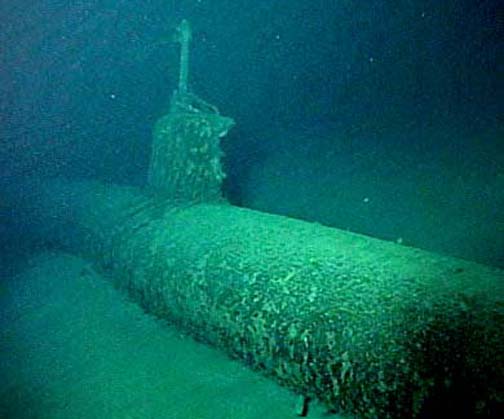
CTY Pisces – Photos of a Japanese midget submarine that was sunk off Pearl Harbor on the day of the attack. There’s a hole at the base of the conning tower where an artillery shell penetrated the hull, sinking the sub and killing the crew. Photos courtesy of Terry Kerby, Hawaii Undersea Research Laboratory. August 2003.
For decades, the Soviet Union used the desolate Kara Sea as their dumping grounds for nuclear waste. Thousands of tons of nuclear material, equal to nearly six and a half times the radiation released at Hiroshima, went into the ocean. The underwater nuclear junkyard includes at least 14 unwanted reactors and an entire crippled submarine that the Soviets deemed proper decommissioning too dangerous and expensive. Today, this corner-cutting haunts the Russians. A rotting submarine reactor fed by an endless supply of ocean water might re-achieve criticality, belching out a boiling cloud of radioactivity that could infect local seafood populations, spoil bountiful fishing grounds, and contaminate a local oil-exploration frontier.
“Breach of protective barriers and the detection and spread of radionuclides in seawater could lead to fishing restrictions,” says Andrey Zolotkov, director of Bellona-Murmansk, an international non-profit environmental organization based in Norway. “In addition, this could seriously damage plans for the development of the Northern Sea Route—ship owners will refuse to sail along it.”
News outlets have found more dire terms to interpret the issue. The BBC raised concerns of a “nuclear chain reaction” in 2013, while The Guardian described the situation as “an environmental disaster waiting to happen.” Nearly everyone agrees that the Kara is on the verge of an uncontrolled nuclear event, but retrieving a string of long-lost nuclear time bombs is proving to be a daunting challenge.
Nuclear submarines have a short lifespan considering their sheer expense and complexity. After roughly 20-30 years, degradation coupled with leaps in technology render old nuclear subs obsolete. First, decades of accumulated corrosion and stress limit the safe-dive depth of veteran boats. Sound-isolation mounts degrade, bearings wear down, and rotating components of machinery fall out of balance, leading to a louder noise signature that can be more easily tracked by the enemy. …….
The Soviet Union and Russia built the world’s largest nuclear-powered navy in the second half of the 20th century, crafting more atom-powered subs than all other nations combined. At its military height in the mid-1990s, Russia boasted 245 nuclear-powered subs, 180 of which were equipped with dual reactors and 91 of which sailed with a dozen or more long-range ballistic missiles tipped with nuclear warheads………
A majority of the Soviet’s nuclear submarine classes operated from the Arctic-based Northern Fleet, headquartered in the northwestern port city of Murmansk. The Northern Fleet bases are roughly 900 kilometers west of the Kara Sea dumping grounds. A second, slightly smaller hub of Soviet submarine power was the Pacific Fleet, based in and around Vladivostok on Russia’s east coast above North Korea. Additional Soviet-era submarines sailed from bases in the Baltic and Black Seas.
…….. the disposal of these submarines posed more problems than previous conventional vessels. Before crews could chop the vessels apart, the subs’ reactors and associated radioactive materials had to be removed, and the Soviets didn’t always do this properly.
Mothballed nuclear submarines pose the potential for disaster even before scrapping begins. In October of 1995, 12 decommissioned Soviet subs awaited disposal in Murmansk, each with fuel cells, reactors, and nuclear waste still aboard. When the cash-strapped Russian military didn’t pay the base’s electric bills for months, the local power company shut off power to the base, leaving the line of submarines at risk of meltdown. Military staffers had to persuade plant workers to restore power by threatening them at gunpoint.
The scrapping process starts with extracting the vessel’s spent nuclear fuel from the reactor core. The danger is immediate: In 1985, an explosion during the defueling of a Victor class submarine killed 10 workers and spewed radioactive material into the air and sea. Specially trained teams must separate the reactor fuel rods from the sub’s reactor core, then seal the rods in steel casks for transport and storage (at least, they seal the rods when adequate transport and storage is available—the Soviets had just five rail cars capable of safely transporting radioactive cargo, and their storage locations varied widely in size and suitability). Workers at the shipyard then remove salvageable equipment from the submarine and disassemble the vessel’s conventional and nuclear weapons systems. Crews must extract and isolate the nuclear warheads from the weapons before digging deeper into the launch compartment to scrap the missiles’ fuel systems and engines.
When it is time to dispose of the vessel’s reactors, crews cut vertical slices into the hull of the submarine and chop out the single or double reactor compartment along with an additional compartment fore and aft in a single huge cylinder-shaped chunk. Once sealed, the cylinder can float on its own for several months, even years, before it is lifted onto a barge and sent to a long-term storage facility.
But during the Cold War, nuclear storage in Soviet Russia usually meant a deep-sea dump job. At least 14 reactors from bygone vessels of the Northern Fleet were discarded into the Kara Sea. Sometimes, the Soviets skipped the de-fueling step beforehand, ditching the reactors with their highly radioactive fuel rods still intact.
According to the Bellona, the Northern Fleet also jettisoned 17,000 containers of hazardous nuclear material and deliberately sunk 19 vessels packed with radioactive waste, along with 735 contaminated pieces of heavy machinery. More low-level liquid waste was poured directly into the icy waters.
But during the Cold War, nuclear storage in Soviet Russia usually meant a deep-sea dump job. At least 14 reactors from bygone vessels of the Northern Fleet were discarded into the Kara Sea. Sometimes, the Soviets skipped the de-fueling step beforehand, ditching the reactors with their highly radioactive fuel rods still intact.
According to the Bellona, the Northern Fleet also jettisoned 17,000 containers of hazardous nuclear material and deliberately sunk 19 vessels packed with radioactive waste, along with 735 contaminated pieces of heavy machinery. More low-level liquid waste was poured directly into the icy waters.
Another submarine is perhaps a bigger risk for a radioactive leak. K-159, a November class, suffered a radioactive discharge accident in 1965 but served until 1989. After languishing in storage for 14 years, a 2003 storm ripped K-159 from its pontoons during a transport operation, and the battered hulk plunged to the floor of the Barents Sea, killing nine crewmen. The wreck lies at a depth of around 250 meters, most likely with its fueled and unsealed reactors open to the elements.
Russia has announced plans to raise the K-27, the K-159, and four other dangerous reactor compartments discarded in the Arctic. As of March 2020, Russian authorities estimate the cost of the recovery effort will be approximately $330 million.
The first target is K-159. But lifting the sunken sub back to the surface will take a specially built recovery vessel, one that does not yet exist. Design and construction of that ship is slated to begin in 2021, to be finished by the end of 2026. Now, in order to avoid an underwater Chernobyl, the Russians are beginning a terrifying race against the relentless progression of decay. https://www.popularmechanics.com/military/navy-ships/a34976195/russias-nuclear-submarine-graveyard/
While European organisations discuss nuclear wastes, UK unveils plan for Cumbria waste burial
 David Lowry’s Blog 15th Jan 2021, I have spent the past few days engaged in an excellent webinar on nuclear waste and information disclosure, titled: Aarhus convention and nuclear David Lowry’s Blog 15th Jan 2021, I have spent the past few days engaged in an excellent webinar on nuclear waste and information disclosure, titled: Aarhus convention and nuclear(acn) round table on radioactive waste management (rwm), online 13-15 January 2021 The promotional blurb reads “The European Commission (DG ENER) and Nuclear Transparency Watch (NTW) have organized an “Aarhus Convention and Nuclear” Roundtable [with] the objective to gather concerned stakeholders by Radioactive Waste Management (operators, regulators and institutional representatives, experts and researchers, NGOs, civil society representatives) in order to discuss concrete implementation of the Aarhus Convention principles (public information and participation)”
As this three day forum was underway across the European a digital airwaves, the UK nuclear waste management implementer- Radioactive Waste Management Limited and Nuclear Decommissioning Authority (NDA) unveiled a new atomic aspirant to bury nuclear waste under their land in Cumbria, near Sellafield.
http://drdavidlowry.blogspot.com/2021/01/why-truth-matters-including-on-nuclear.html |
|
New consultations in Ignace, Ontario, over nuclear waste site
 New consultations in Ignace over nuclear waste site, Residents asked to fill out survey from Nuclear Waste Management Organization between Jan. 18 and Feb. 26 By: IGNACE, Ont. – Residents in Ignace, one of two remaining candidates to serve as a repository for Canada’s nuclear’s waste, are being asked to weigh in as the Nuclear Waste Management Organization’s site selection process continues.
Beginning Monday, residents can fill out a short survey created by the NWMO and the Township of Ignace that will help guide how the agency engages the public as it conducts numerous studies in the area in early 2021.
The agency narrowed its list of candidate sites to two – Ignace and South Bruce – in January of 2020. Final site selection was scheduled for 2023, with construction of a nuclear waste repository expected to take another 10 years to complete.
……….. Some experts and civil society groups have raised serious concerns over “deficient” federal nuclear waste policies, calling for an overhaul before moving forward.https://www.tbnewswatch.com/local-news/new-consultations-in-ignace-over-nuclear-waste-site-3268753
Big doubts on small nuclear reactors – on economics, on waste problems
 Former U.S. regulator questions small nuclear reactor technology, Business case for small reactors ‘doesn’t fly,’ says expert on nuclear waste, Jacques Poitras · CBC News Jan 15, 2021 A former head of the United States’ nuclear regulator is raising questions about the molten-salt technology that would be used in one model of proposed New Brunswick-made nuclear reactors.
The technology pitched by Saint John’s Moltex Energy is key to its business case because, the company argues, it would reuse some of the nuclear waste from Point Lepreau and lower the long-term cost and radioactivity of storing the remainder.
But Allison Macfarlane, the former chairperson of the U.S. Nuclear Regulatory Commission and a specialist in the storage of nuclear waste, said no one has yet proven that it’s possible or viable to reprocess nuclear waste and lower the cost and risks of storage.
“Nobody knows what the numbers are, and anybody who gives you numbers is selling you a bridge to nowhere because they don’t know,” said Macfarlane, now the director of the School of Public Policy and Global Affairs at the University of British Columbia.
“Nobody’s really doing this right now. … Nobody has ever set up a molten salt reactor and used it to produce electricity.”
Macfarlane said she couldn’t comment specifically on Moltex, calling information about the company’s technology “very vague.”
But she said the general selling point for molten-salt technology is dubious.
“Nobody’s been able to answer my questions yet on what all these wastes are and how much of them there are, and how heat-producing they are and what their compositions are,” she said.
“My sense is that all of these reactor folks have not really paid a lot of attention to the back end of these fuel cycles,” she said, referring to the long-term risks and costs of securely storing nuclear waste.
Moltex is one of two Saint John-based companies pitching small nuclear reactors as the next step for nuclear power in the province and as a non-carbon-dioxide emitting alternative to fossil fuel electricity generation.
Moltex North America CEO Rory O’Sullivan said the company’s technology will allow it to affordably extract the most radioactive parts of the existing nuclear waste from the Point Lepreau Generating Station.
The waste is now stored in pellet form in silos near the plant and is inspected regularly.
The process would remove less than one per cent of the material to fuel the Moltex reactor and O’Sullivan said that would make the remainder less radioactive for a much shorter amount of time.
Existing plans for nuclear waste in Canada are to store it in an eventual permanent repository deep underground, where it would be secure for the hundreds of thousands of years it remained radioactive………..
Shorter-term radioactivity complicates storage
Macfarlane said a shorter-term radioactivity life for waste would actually complicate its storage underground because it might lead to a facility that has to be funded and secured rather than sealed up and abandoned.
“That means that you believe that the institutions that exist to keep monitoring that … will exist for hundreds of years, and I think that is a ridiculous assumption,” she said.
“I’m looking at the United States, I’m seeing institutions crumbling in a matter of a few years. I have no faith that institutions can last that long and that there will be streams of money to maintain the safety and security of these facilities. That’s why you will need a deep geologic repository for this material.”
And she said that’s assuming the technology will successfully extract all of the most radioactive material.
“They are assuming that they remove one hundred per cent of the difficult, radionuclides, the difficult isotopes, that complicate the waste,” she said.
“My response is: prove it. Because if you leave five per cent, you have high-level waste that you’re going to be dealing with. If you leave one per cent, you’re going to have high-level waste that you’re going to be dealing with. So sorry, that one doesn’t fly with me.”
Macfarlane, a geologist by training, raised doubts about molten-salt technology and waste issues in a 2018 paper she co-authored for the Bulletin of the Atomic Scientists………. https://www.cbc.ca/news/canada/new-brunswick/nuclear-waste-reactors-new-brunswick-allison-macfarlane-moltex-arc-1.5873542
Property developer volunteers Allerdale, Cumbria for UK’s nuclear waste
anyone to volunteer anywhere, even an individual who doesn’t live in the area, or a company can volunteer it.
of the local population.
mirrored by the ease of withdrawing. There the government have chosen a highly prescriptive system.
Czech government plans to impose nuclear dump on municipalities against their will
Euractiv 12th Jan 2021, Czech municipalities fight against nuclear waste repository. Czech
municipalities chosen to provide space for a deep geological repository for used nuclear fuel are ready to fight against the government’s decision “with all possible means”.
On 21 December, the Czech government decided that a radioactive waste repository will be created in one of the four selected sites.
However, although the government intends to launch exploratory works in order to find the most suitable location, there is no possibility for affected areas to have their say in this matter. Four municipalities hoped that their negotiating position would be strengthened by a new law but it has never been proposed by the government despite its previous promises.
Creating jobs and community opportunities -Pickering City Council wants immediate dismantling of nuclear station
Clean Air Alliance (accessed) 8th Jan 2021, Ontario’s new Minister of Finance, Peter Bethlenfalvy, can create 16,000 person-years of employment in Pickering by directing Ontario Power Generation (OPG) to immediately dismantle the Pickering Nuclear Station after its operating licence expires in December 2024.
According to the International Atomic Energy Agency, immediate dismantling is “the
preferred decommissioning strategy” for nuclear plants. In fact, dismantling is the one area of employment growth in the nuclear industry.
Immediate dismantling will permit most of the 600-acre site to be returned to the local community by 2034 for parkland, recreational facilities, dining, entertainment, housing and other employment uses. That is among the reasons why Pickering City Council unanimously supports having the plant dismantled as “expeditiously as possible” after it is shut down.
Unfortunately, OPG wants to delay dismantling until 2054 to put off its
dismantling costs for 30 years despite the fact that it already has more
than $7.5 billion in its decommissioning and dismantling fund.
Seven beautiful Italian regions furious at sites recommended for nuclear trash
We’ll fight it’: Uproar over nuclear dump plan in scenic Tuscany, https://www.theage.com.au/world/europe/we-ll-fight-it-uproar-over-nuclear-dump-plan-in-scenic-tuscany-20210108-p56skh.htmly Nick Squires, January 8, 2021 Some: Italian regional leaders are fighting against plans to dump nuclear waste in some of the most picturesque areas of the country.
Some of the 67 potential sites earmarked to become a national contaminated waste facility include the rolling valleys of Tuscany and the countryside around the southern ancient town of Matera, famed for its cavernous homes.
The governors of the seven affected regions, including Piedmont, Puglia, Basilicata, Sardinia and Sicily, have accused the national government and SOGIN, Italy’s nuclear decommissioning agency, of failing to consult them. Italy closed down its nuclear power plants after a referendum in 1987 – held in the wake of the 1986 Chernobyl disaster.
The new deposit site would store waste from those power plants as well as radioactive material that is still produced by industry, hospitals and research centres.
Manolo Garosi, the mayor of Pienza, a Tuscan hill town, said he was incredulous about the prospect of a nuclear dump being located in his region.
“How can they be considering a region like ours, which has World Heritage recognition? It is totally unacceptable. This is an area of natural beauty,” he told Corriere della Sera newspaper. “I can’t imagine what tourists would say when they come here looking for beauty and discover instead radioactive waste dumps.”
Domenico Bennardi, the mayor of Matera, said locating the dump near the town would be a “slap in the face”, particularly as it was a European City of Culture in 2019. It was also used as a location for the forthcoming Bond film No Time To Die. “We’ll fight it at every level,” he said.
More than 20 of the potential dump sites are in the northern part of Lazio, famed for its Etruscan heritage, small villages and farmland. One of the sites is near the village of Gallese, where William Urquhart, a British businessman, helps run a country estate that his family has managed for more than a century.
“Of course, no one wants buried nuclear waste where they live, but it needs to be an open, transparent process. Instead, it has come as a bombshell that will frighten a lot of people.”
The publication of the map of potential sites is the first stage in a long process that could last years.
“Now that people have seen the list, they can participate in the process and express their views,” said Deputy Environment Minister Roberto Morassut.
The government said the nuclear deposit site could bring benefits to a region – there would be 4000 jobs during the four-year construction phase and up to 1000 jobs when it is operational. The 370-acre facility would cost about €900 million ($1.4 billion).
Hinkley Point C mud dredging – radioactive mud could be dumped off Somerset instead of south Wales.
Energy is considering two sites in the Bristol Channel.
over concerns the mud was contaminated by nuclear waste. But a private disposal site off Portishead, on the England side of the channel, is also under consideration. A public outcry over the original mud dumping led to protests and petitions attracting hundreds of thousands of signatures online, a full Senedd debate and an acknowledgment by both the developers
and Natural Resources Wales that better communication with the public was needed over the plans.https://www.bbc.co.uk/news/uk-wales-55577848
Seven regions in Italy to take legal action against plan for nuclear waste dumping
 Row after 7 regions tapped to take nuclear waste. https://www.ansa.it/english/news/2021/01/05/row-after-7-regions-tapped-to-take-nuclear-waste_b9f64a6e-95fc-442e-8bf0-f67284e0fec8.html Edazione ANSAROME Row after 7 regions tapped to take nuclear waste. https://www.ansa.it/english/news/2021/01/05/row-after-7-regions-tapped-to-take-nuclear-waste_b9f64a6e-95fc-442e-8bf0-f67284e0fec8.html Edazione ANSAROME
05 January 2021, ANSA) – ROME, – A row has erupted in Italy after seven regions were named as having 67 potential sites to take nuclear waste. The industry and environment ministries gave decommissioning company SOGIN the go ahead to draft the national map of areas potentially suitable for the waste.
The regions involved are Piedmont, Tuscany, Lazio, Puglia, Basilicata, Sardinia and Sicily. All seven have announced legal action against the move. The centre-right opposition was also up in arms. Nationalist League leader Matteo Salvini, the leader of the opposition, called the government “incompetent”. His partner, the smaller nationalist Brothers of Italy (FdI) party, said “it is folly to publish the SOGIN map in the midst of a COVID crisis”. (ANSA). |
|
Decommissioning of Oyster Creek nuclear station – a nasty precedent for closing down of other USA reactors.
|
The decommissioning at Oyster Creek was funded by ratepayers and amounted to almost $1 billion when it was sold, presumably for significantly less than its billion-dollar-fund balance. Authoritative sources had previously estimated the cost to decommission Oyster Creek at over $1.4 billion. The original decommissioning schedule was to occur over a 60-year period, but the new owners are betting they can decommission the plant faster, and for significantly less than their investment, pocketing the difference. The quicker they can do this, the more they earn. Of course, if they find they bit off more than they can chew and look like they are on a pathway to failure, they can pack up their wrenches and backhoes and abandon the project, leaving New Jersey ratepayers to fund whatever actions remain to safely complete decommissioning. Seems like a win-win for both buyer and seller. For the new owner, if the challenges exceed their abilities, they can simply cut and run before depleting their newly acquired billion-dollar decommissioning fund. For the seller, they have unloaded an unpleasant responsibility in a way that’s sadly reminiscent of the actions of a deadbeat dad. Current questions on nuclear subsidiesThe current question before the BPU on subsidies presents a rare opportunity for regulators to exert some leverage considering tangential, but critical, questions on nuclear energy. Are safety practices sufficient to deter today’s technology-savvy terrorists? How reliable are their storage processes for spent fuel and what are the long-term plans for its disposal or relocation? What are the plans for the eventual decommissioning of remaining New Jersey nuclear reactors that combined are almost five times the size of Oyster Creek? Are we comfortable following the path blazed by Oyster Creek with the potential of a pre-emptive sale if the new owners make their way out of Dodge before the sheriff shows up …. |
|
Holtec wants to build new nuclear reactor at site of USA’s oldest, most dangerous nuclear station
 New Jersey nuclear plant proposed at site of old reactor PBS, Jan 5, 2021
LACEY, N.J. (AP) — The company that’s in the process of mothballing one of the nation’s oldest nuclear power plants says it is interested in building a new next-generation nuclear reactor at the same site in New Jersey.
Holtec International last month received $147.5 million — $116 million of which will come from the U.S. Department of Energy — to complete research and development work on a modern nuclear reactor that could be built at the site of the former Oyster Creek Nuclear Generating Station in the Forked River section of Lacey Township, New Jersey.
Holtec owns that facility and oversaw its shutdown in 2018……
company spokesperson Joe Delmar said Holtec is “actively engaged with the Nuclear Regulatory Commission” about the project, but has not yet formally applied to build the reactor…..
Jeff Tittel, director of the New Jersey Sierra Club and a longtime opponent of the Oyster Creek plant, called the proposal “a threat to health and safety.”
“Things are going from bad to worse,” he said. “What was supposed to be the cleanup and ending of the Oyster Creek nuclear plant is now being looked at for another nuclear power plant. The whole point of closing and decommissioning this site was to get rid of the oldest and probably most dangerous nuclear plant. Putting all of that nuclear material in one area that is vulnerable to climate impacts like sea-level rise is a disaster waiting to happen.”……. https://www.pbs.org/newshour/economy/new-nuclear-plant-could-rise-at-site-of-former-one-in-nj
British tax-payers’ £ 132 billion cost for 120 years of nuclear decommissioning
 Brinkwire 4th Jan 2021, It has been warned that a “perpetual” lack of information about the condition of the nuclear facilities in Britain means that decommissioning for 120 years would not be complete and cost billions of pounds.
The decommissioning of UK civil nuclear power plants, including the Torness power plant in East Lothian and the Hunterston B power plant in Ayrshire, would cost the taxpayer about £ 132 billion, according to a new estimate, and will not be finished for 120 years.
The Public Accounts Committee blames the U.K. in its sober analysis. Government for a “sorry saga” of massively ineffective contracts, “weak” government monitoring and a “persistent” lack of awareness of the condition of nuclear installations. The Nuclear Decommissioning Authority (NDA) has left decades of inadequate information on the status and location of dangerous and
radioactive materials with a history of a lack of awareness about the condition of the sites it is responsible for safeguarding, the study warned. The NDA recognizes that it still does not have a complete understanding of the condition of the 17 sites in its custody, including the 10 former Magnox power plants, the report from the committee said.
According to the latest NDA figures, the decommissioning of UK civilian nuclear power plants would cost an incredible £ 132 billion for current and future generations of British taxpayers, and the work will not be finished for 120 years, with a huge effect on the lives of people living
near the plants, the study said.
Massive nuclear waste storage construction at Dounreay
Press & Journal 4th Jan 2021, Work on Dounreay’s newest radioactive waste store has reached new heights
following a marathon efforts by staff. The construction project was one of
the first to re-start work in June, following the easing of lockdown
restrictions. The 60-strong team has had to learn Covid-19 compliant ways
of working, sometimes in close proximity with each other, to keep
themselves and their colleagues safe on site.
Since then they have poured
1,500 tonnes of concrete and the building walls have now risen to above the
first floor level. Last week the team embarked on the biggest concrete pour
of the project so far, working for nine hours to lay the floor slab in the
crane maintenance bay (CMB) on the first floor of the building, with 27
lorries delivering 425 tonnes of concrete. An overnight shift completed the
job in the early hours of the morning.
The new intermediate level waste
store will hold drums of waste in safe long term storage at Dounreay in
accordance with Scottish Government policy. The £22 million contract,
awarded to Graham Construction Ltd, started in 2018 and is expected to take
around three years to complete. Dounreay project manager Dave Busby said
that casting the CMB floor slab was a significant construction milestone as
it will allow the team to install the 170 tonne CMB shield door early next
year.
1 This Month
23-25 October – on Zoom – World BEYOND War’s annual global conferenc

To see nuclear-related stories in greater depth and intensity – go to https://nuclearinformation.wordpress.com

Say No to NASA’s Reckless Nuclear Reactor on the Moon
Say No to NASA’s Reckless Nuclear Reactor on the Moon
-
Archives
- October 2026 (160)
- September 2026 (339)
- August 2026 (330)
- July 2026 (355)
- June 2026 (287)
- May 2026 (306)
- April 2026 (356)
- March 2026 (251)
- February 2026 (267)
- January 2026 (308)
- December 2025 (358)
- November 2025 (359)
-
Categories
- 1
- 1 NUCLEAR ISSUES
- business and costs
- climate change
- culture and arts
- ENERGY
- environment
- health
- history
- indigenous issues
- Legal
- marketing of nuclear
- media
- opposition to nuclear
- PERSONAL STORIES
- politics
- politics international
- Religion and ethics
- safety
- secrets,lies and civil liberties
- spinbuster
- technology
- Uranium
- wastes
- weapons and war
- Women
- 2 WORLD
- ACTION
- AFRICA
- Atrocities
- AUSTRALIA
- Christina's notes
- Christina's themes
- culture and arts
- Events
- Fuk 2022
- Fuk 2023
- Fukushima 2017
- Fukushima 2018
- fukushima 2019
- Fukushima 2020
- Fukushima 2021
- general
- global warming
- Humour (God we need it)
- Nuclear
- RARE EARTHS
- Reference
- resources – print
- Resources -audiovicual
- Weekly Newsletter
- World
- World Nuclear
- YouTube
-
RSS
Entries RSS
Comments RSS

