Los Alamos National Laboratory nuclear waste is potentially explosive
 Report: LANL nuclear waste mix potentially explosive https://www.taosnews.com/news/environment/report-lanl-nuclear-waste-mix-potentially-explosive/article_543eb72c-0b50-11eb-825a-3777d9ad7922.html, By Scott Wyland swyland@sfnewmexican.com, Oct 10, 2020
Some of LANL’s facilities store radioactive waste without any engineered controls or safeguards beyond the containers, the board wrote in a cover letter addressed to the U.S. Department of Energy.
“As such, additional credited safety controls may be necessary to protect workers and the public,” the board said.
In 2014, a LANL waste container was packaged in a volatile blend of organic cat litter and nitrate salts, which caused the container to rupture and spew radiation at the Waste Isolation Pilot Plant. The underground disposal site closed for three years while it underwent a $2 billion cleanup.
The incidents that released high levels of radiation at WIPP and Idaho National Laboratory have shown the importance of adding multiple layers of protection to reduce the consequences of an accident, the board said.
The report estimates that an exploding waste canister could expose workers to 760 rem, far beyond the threshold of a lethal dose. A rem is a unit used to measure radiation exposure.
Federal guidelines define a lethal dose as high enough to cause 50 percent of the population to die within 30 days. Those levels range from 400 to 450 rem.
The 760 rem estimate is equal to 380,000 chest X-rays, said Dan Hirsch, retired director of programs on environment and nuclear policy at the University of California, Santa Cruz.
“This is vastly above what’s permissible for workers’ exposure,” Hirsch said, adding that far lower doses can cause cancer.
The 760 rem estimate is actually conservative, he said, noting that the WIPP explosion released four times that amount.
A spokeswoman for the National Nuclear Security Administration said officials were aware of the board’s letter and report regarding issues with transuranic waste storage and handling. She didn’t answer questions about the board’s criticisms or how the agency would tackle the problems identified in the report.
“Maintaining the safety, security, and effectiveness of America’s nuclear deterrent remains paramount to NNSA,” she said.
“It’s elementary,” Hirsch said. “You put certain chemicals together and they explode.”
Even water seeping into a barrel of waste containing sodium can trigger an explosion, Hirsch said. That’s what made a waste container blow up at a Nevada nuclear storage site five years ago, he said.
Having the waste containers stored above ground magnifies the hazard, Hirsch said. If one of those burst, it would be far more dangerous than one exploding at an underground site like WIPP, he said.
The report points to years of waste disposal problems that haven’t been corrected, said Greg Mello, executive director of the nonprofit Los Alamos Study Group.
“LANL keeps kicking the waste problem down the road,” Mello said. “LANL has always prioritized its weapons work, and this waste problem has built up for decades.”
If the lab produces plutonium triggers for bombs as planned, it will generate more waste that must be disposed of, Mello said. So if it doesn’t make its current waste safe and acceptable for WIPP, that waste might end up being stuck at the lab as a permanent hazard, Mello said.
The board, whose access the Energy Department has tried to restrict, has again shown how vital it is to report on hazards to workers – in this case, potentially lethal doses of radiation, said Jay Coghlan, executive director of nonprofit Nuclear Watch New Mexico.
“These dangers will only grow worse as LANL becomes less and less a lab and more and more a permanent nuclear weapons production site,” Coghlan said.
Any plutonium release is extremely hazardous, Hirsch said.
If someone inhales one millionth of an ounce of plutonium, that person has a 100 percent chance of getting cancer, Hirsch said. So every effort must be made to keep it contained and stabilized – something lab officials are not doing, he said.
“They seem to cut corners,” Hirsch said. “And they’re cutting corners with the most dangerous materials on Earth.”
On our website Read this story at santafenewmexican.com to view the Defense Nuclear Facilities Safety Board’s report on Los Alamos National Laboratory’s faulty radioactive waste storage, which includes the board’s letter to the U.S. Department of Energy.
Small modular nuclear reactors create intensely radioactive wastes
A bridge to nowhere New Brunswick must reject small modular reactors, Beyond Nuclear International, By Gordon Edwards and Susan O’Donnell, 12 Oct, 20 ”……… In New Brunswick, the proposed new reactors (so-called “small modular nuclear reactors” or SMNRs) will create irradiated fuel even more intensely radioactive per kilogram than waste currently stored at NB Power’s Point Lepreau Nuclear Generating Station. The non-fuel radioactive wastes will remain the responsibility of the government of New Brunswick, likely requiring the siting of a permanent radioactive waste repository somewhere in the province.
Interestingly, promoters of both new nuclear projects in New Brunswick – the ARC-100 reactor and the Moltex “Stable Salt Reactor” – claim their reactors will “burn up” these radioactive waste fuel bundles. They have even suggested that their prototype reactors offer a “solution” to Lepreau’s existing nuclear fuel waste problem. This is untrue. Radioactive left-over used fuel from the new reactors will still require safe storage for hundreds of thousands of years.
……… Until now, every effort to recycle and “burn up” used reactor fuel – in France, the UK, Russia and the US – has resulted in countless incidents of radioactive contamination of the local environment. In addition, none of these projects eliminated the need for permanent storage of the left-over long-lived radioactive byproducts, many of which cannot be “burned up.”…….
The nuclear waste problem is not going away. The recent letter from more than 100 groups across Canada, and the recent cancellation of the proposed nuclear waste dump in Ontario have shown that significant opposition to new nuclear energy generation exists. Because producing nuclear energy always means producing nuclear waste as well……. https://beyondnuclearinternational.org/2020/10/12/a-bridge-to-nowhere/,
Struggling Japanese towns look to nuclear waste storing and the money associated
|
MANSION WITHOUT A TOILET: TOWNS IN JAPAN SEEK TO HOUSE, STORE NUCLEAR WASTE OUT OF NECESSITY, https://www.firstpost.com/tech/science/mansion-without-a-toilet-towns-in-japan-seek-to-house-store-nuclear-waste-out-of-necessity-8904851.html Radioactive waste needs to be stored away for a few centuries in thick concrete structures underground so it won’t affect humans and the environment.
Two remote towns in northern Japan struggling with rapidly graying and shrinking populations signed up Friday to possibly host a high-level radioactive waste storage site as a means of economic survival.
Japanese utilities have about 16,000 tons of highly radioactive spent fuel rods stored in cooling pools or other interim sites, and there is no final repository for them in Japan — a situation called “a mansion without a toilet.”
Japan is in a dire situation following the virtual failure of an ambitious nuclear fuel recycling plan, in which plutonium extracted from spent fuel was to be used in still-unbuilt fast breeder reactors. The problem of accumulating nuclear waste came to the fore after the 2011 Fukushima nuclear power plant disaster. Finding a community willing to host a radioactive dump site is difficult, even with a raft of financial enticements.
On Friday, Haruo Kataoka, the mayor of Suttsu town on the northwestern coast of Hokkaido, applied in Tokyo for preliminary government research on whether its land would be suitable for highly radioactive waste storage for thousands of years. Later Friday in Kamoenai just north of Kamoenai, village chief Masayuki Takahashi announced his decision to also apply for an initial feasibility study. Suttsu, with a population of 2,900, and Kamoenai, with about 800 people, have received annual government subsidies as hosts of the Tomari nuclear power plant. But they are struggling financially because of a declining fishing industry and their aging and shrinking populations. The preliminary research is the first of three steps in selecting a permanent disposal site, with the whole process estimated to take about two decades. Municipalities can receive up to 2 billion yen ($19 million) in government subsidies for two years by participating in the first stage. Moving on to the next stage would bring in more subsidies. “I have tried to tackle the problems of declining population, low birth rates and social welfare, but hardly made progress,” Takahashi told reporters. “I hope that accepting research (into the waste storage) can help the village’s development.” It is unknown whether either place will qualify as a disposal site. Opposition from people across Hokkaido could also hinder the process. A gasoline bomb was thrown into the Suttsu mayor’s home early Thursday, possibly by an opponent of the plan, causing slight damage. Hokkaido Gov. Naomichi Suzuki and local fisheries groups are opposed to hosting such a facility. One mayor in southwestern Japan expressed interest in 2007, but faced massive opposition and the plan was spiked. High-level radioactive waste must be stored in thick concrete structures at least 300 meters (yards) underground so it won’t affect humans and the environment. A 2017 land survey map released by the government indicated parts of Suttsu and Kamoenai could be suitable for a final repository. So far, Finland and Sweden are the only countries that have selected final disposal sites |
|
Public Input Wanted On Transportation Of Nuclear Waste
 Public Input Wanted On Transportation Of Nuclear Waste, Dryden, ON, Canada / CKDR, Sarah McCarthy Public Input Wanted On Transportation Of Nuclear Waste, Dryden, ON, Canada / CKDR, Sarah McCarthy
Oct 12, 2020 A site in Ignace is up for consideration to become a nuclear repository and the Nuclear Waste Management Organization is looking for feedback on their Transportation Framework plan.
The Rotary Club of Dryden had a chance to provide their input, as the organization was a guest at one of their virtual meetings. Relationship Manager, Norman Sandberg explains road and rail are the two modes of transportation being considered to carry the fuel. “Water is a transportation mode that is used, but Canadians earlier in the process made it very clear that transportation of used nuclear fuel across the great lakes is not socially acceptable.” If road was picked, there would be two trucks per day or by via rail there would be two trains per week. The fuel would be transported across half the country, from Manitoba or New Brunswick and it could be a combination of both modes of transportation. Sandberg adds would be a 45 to 50 year transportation period. “We don’t anticipate being in a position to be able to transportation of used fuel until at least the mid 2040’s, because we have to have a repository not only approved and licensed, but constructed and ready for operation.” The potential repository sites under assessment right now include one in Ignace and another in Southern Ontario……… https://www.ckdr.net/2020/10/12/rotary-club-of-dryden-receive-presentation-on-nuclear-waste/ |
|
Groups urge New Mexico governor to take stand against nuclear waste plan

Oct 12, 2020 ALBUQUERQUE, N.M. (AP) — Environmentalists and other watchdog groups want New Mexico Gov. Michelle Lujan Grisham to create a government agency that would be tasked with keeping the state from becoming a permanent dumping ground for spent nuclear fuel and other high-level waste.
Dozens of groups sent a letter Friday to the Democratic governor. They pointed to Nevada’s past success in mothballing the once-proposed Yucca Mountain waste repository project in that state and asked the governor to consider similar measures to protect New Mexico.
“New Mexico’s people and our environment deserve better treatment than a plan offering millions of years of a public health menace from radioactive waste spreading into our soil, air, water and rivers,” the letter states. “Please consider what more aggressive steps can be taken to defeat the Holtec plan.”
New Jersey-based Holtec is seeking a 40-year license from the federal Nuclear Regulatory Commission to build what it has described as a state-of-the-art complex near Carlsbad. Company executives have said the project is needed because the federal government has yet to find a permanent solution for dealing with the tons of spent fuel building up at commercial nuclear power plants around the U.S.
The first phase of the project calls for storing up to 8,680 metric tons of uranium, which would be packed into 500 canisters. Future expansion could make room for as many as 10,000 canisters of spent nuclear fuel……..
State officials in comments recently submitted to federal regulators opposed a preliminary recommendation by staff of the Nuclear Regulatory Commission that a license be granted to Holtec to build the multibillion-dollar facility. They said technical analysis has been inadequate so far and accused regulators of failing to consider environmental justice concerns and meet requirements spelled out by federal environmental laws.
Dave McCoy of Citizen Action is among those who signed the letter sent to Lujan Grisham. He said Monday that there’s a push to approve New Mexico for “interim” storage knowing that the waste will never leave……. https://scnow.com/business/new-mexico-governor-urged-to-take-stand-against-nuclear-plan/article_e167c5c0-4d7b-5a1f-8ebd-30a951f24c71.html
Citizens express opposition to dangerous increased plutonium pit production
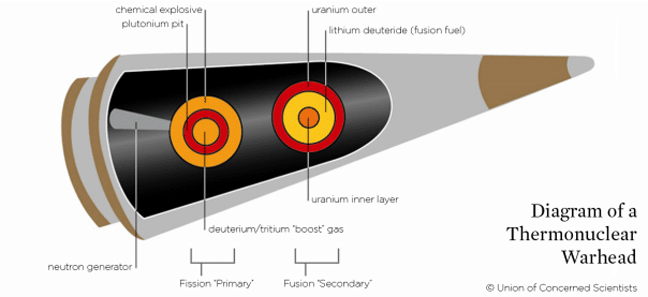 Citizens’ Hearing Held at New Mexico Capitol about Increased Plutonium Pit Production at LANL, http://nuclearactive.org/
The Pentagon has stated it needs annual production of 80 plutonium pits, the triggers for nuclear weapons. T The DOE has approved its Supplement Analyses for four possible ways to execute thisapproved its Supplement Analyses for four possible ways to execute this.
At LANL, DOE proposes upgrades to both LANL’s Plutonium Facility and the Radiological Laboratory Utility and Office Building which is part of the Chemistry and Metallurgy Research Replacement (CMRR) Project.
Despite a mission that has been re-directed and an expansion involving about $15 billion in upgrades for two major buildings and related infrastructure, DOE has decided not to undertake a new Site-Wide Environmental Impact Statement (SWEIS) for LANL. https://www.energy.gov/nepa/downloads/doeeis-0380-sa-06-final-supplement-analysis and https://www.energy.gov/nepa/downloads/doeeis-0380-amended-record-decision Neither our congressional delegation nor our Governor has voiced disapproval of bypassing the SWEIS.
On Wednesday afternoon, October 7th, a citizens’ hearing was held outside the New Mexico State Capitol Building. Testimony was taken about DOE’s dramatic expansion plans for LANL that involve an installation of the size and importance and with the attendant dangers of the closed nuclear weapons plant at Rocky Flats, Colorado. The event, which provided a place for dozens of citizens to express their opposition to DOE’s plans in Northern New Mexico, was sponsored by the Los Alamos Study Group. http://www.lasg.org/
The DOE proposals are too broad and too expensive to go forward without an SWEIS with public review and comment opportunities.
Every day, new information is released about the increased hazards at LANL. This week the Defense Nuclear Facilities Safety Board issued a new report about the inconsistent and inappropriate consideration of potential energetic chemical reactions, or explosions, involving transuranic waste stored at LANL. The Board conducted an analysis of transuranic, or plutonium-contaminated, wastes stored at the Plutonium Facility, the old Chemistry and Metallurgy Research Facility, the Transuranic Waste Facility, and Area G and the potential for explosions. It found that LANL has not fully analyzed for possible explosions involving transuranic waste stored at these facilities that would result in high exposures to workers and the public. https://www.dnfsb.gov/documents/reports/technical-reports/potential-energetic-chemical-reaction-events-involving
The Board asked DOE to respond within 120 days.
Fishing industry chief opposes releasing Fukushima No. 1 water into sea
Fishing industry chief opposes releasing Fukushima No. 1 water into sea, https://www.japantimes.co.jp/news/2020/10/09/national/zengyoren-fukushima-water-sea/ 9 Oct 20, The head of the National Federation of Fisheries Cooperative Associations, or Zengyoren, has voiced strong opposition against releasing treated water containing radioactive tritium from the disaster-stricken Fukushima No. 1 nuclear plant into the sea.
“We are absolutely against ocean release” as a way to dispose of tainted water at Tokyo Electric Power Company Holdings Inc.’s nuclear plant in Fukushima Prefecture, Hiroshi Kishi, head of Zengyoren, said Thursday at a government hearing in Tokyo.
Kishi said that fishermen who are operating along the coast of Fukushima have been suffering from problems caused by the radioactive fallout from the 2011 meltdowns at the plant, such as fishing restrictions, as well as malicious rumors about the safety of farm and marine products there.
If the government chooses to release radioactive water into the sea, a leading option to get rid of accumulating low-level radioactive water at the plant, it will trash all efforts fishermen have so far made to sweep away such rumors and consequently “will have a devastating impact on the future of Japan’s fishing industry,” Kishi stressed.
Toshihito Ono, head of the prefecture’s fishery product processors association, who joined the hearing via a video call, warned that Fukushima’s processed marine products, including products that use ingredients from other prefectures, will become targets of harmful rumors.
In a report released in February, a government panel pointed out that a realistic option would be releasing the tainted water into the ocean after dilution or into the air through evaporation.
Many people fear that both methods will add to the reputational damage suffered by Fukushima products. But treated water storage at the power plant is expected to reach full capacity as early as autumn 2022.
After the hearing, state industry minister Kiyoshi Ejima told reporters, “We find it unadvisable to put off a decision on how to dispose of the water because not much room is left at the plant for tanks containing the water.”
This was probably the last hearing on the water issue, people familiar with the matter said.
Ageing community in Hokkaido town – mayor agrees to survey for nuclear waste dump
|
Graying Hokkaido town applies for nuclear waste dump survey, Japan Times, 9 Oct 20, A small Hokkaido town struggling with depopulation signed up Friday for preliminary research into its land to gauge its suitability for hosting a disposal site deep underground for high-level radioactive nuclear waste, the first municipality to do so in Japan since 2007.Suttsu Mayor Haruo Kataoka submitted the documents for the survey at the quasi-governmental Nuclear Waste Management Organization (NUMO) in Tokyo. Municipalities that undergo the preliminary research, the first of a three-stage process requiring some 20 years in total to select a permanent disposal site, can receive up to ¥2 billion in state subsidies over two years. Prior to Suttsu, the only municipality to apply for a preliminary survey was Toyo in Kochi Prefecture, which submitted documents in 2007. However, the town later withdrew before the research was ever conducted following strong protests by local residents. ……… Meanwhile, government officials are expected later Friday to request Kamoenai village in Hokkaido, which is about 40 kilometers north of Suttsu, to accept research into its land a day after its assembly adopted a petition to host the survey. Suttsu and Kamoenai, with populations of about 2,900 and 820, respectively, have been struggling financially due to a decline in the fishing industry and the aging of their residents. It remains uncertain whether the process of becoming a final disposal site will go smoothly, as Hokkaido Gov. Naomichi Suzuki and members of the fishing industry in the area are opposed to the idea of hosting such a facility……. During its research, NUMO will examine the area to see if it is suited to the disposal of highly radioactive waste, paying attention to volcanoes and fault lines. High-level radioactive waste, produced as a result of extracting uranium and plutonium from spent fuel, must be stored in concrete structures at least 300 meters underground so as not to impact human lives or the environment. Locations near volcanoes and active faults are deemed unfavorable…….https://www.japantimes.co.jp/news/2020/10/09/national/hokkaido-nuclear-waste-dump-survey/ |
|
Australia faces costly cleanup of Ranger uranium mine, still struggling with pollution legacy of other uraniu mines
|
Over the years many people questioned the decision to allow uranium to be mined inside one of Australia’s most famous and largest national parks – Kakadu. But in 1980 that’s exactly what happened, an open-cut mine surrounded by a park famed for its natural beauty made even more famous by the hugely popular Paul Hogan movie, Crocodile Dundee. Now the uranium is gone, dug out and sent off to nuclear power stations around the world and Australia’s longest continually operated uranium mine is almost done.
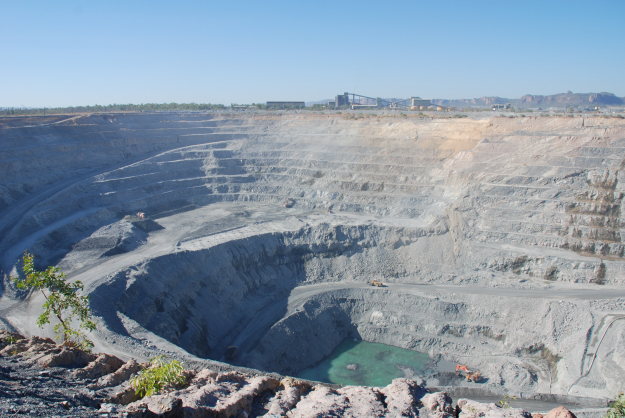
Nuclear power is making way for renewable energy. Uranium has been mined at Ranger for more than three decades, producing in excess of 130,000 tonnes of uranium oxide. The mine is being closed, Jabiru – the town built to service to the mine workers, is in the process of being handed over to Traditional Owners and the mining company is being closely watched as it delivers on its promise to clean up the site. Cleaning up uranium mines is not something the Northern Territory does well – there is still a huge environmental mess at Rum Jungle closer to Darwin. That uranium mine is a legacy of the Cold War. Australia’s first large scale uranium mine was dug at Rum Jungle on behalf of our “Allies” in the UK and USA to fuel their nuclear weapon programs in the 1950s. Now water fills that vast open cut, a lake as locals call it, and another attempt is going to have to be made to cap the radioactive tailings left behind, the first attempt, supposed to last a century, failed after 20 years. Energy Resources Australia, a subsidiary of Rio Tinto, says it has spent more than $642 million in the past eight years on rehabilitation of the mountains of tailings complicated by a lake created from a vast flooded pit………. This story It’s costing a fortune but the NT’s uranium mine is being cleaned up, gradually first appeared on Katherine Times. https://www.canberratimes.com.au/story/6955634/its-costing-a-fortune-but-the-nts-uranium-mine-is-being-cleaned-up-gradually/?cs=14231 |
|
U.S. Dept of Energy report shows danger of radioactive wastes leaking from Hanford’s old decayed tanks
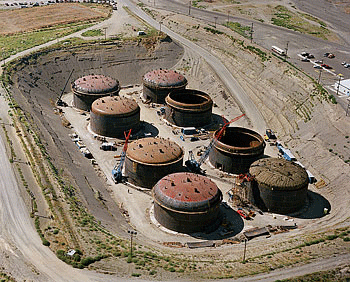
Report: Hanford unprepared for potential nuclear waste leak, by Associated Press, Wednesday, October 7th 2020 TRI-CITIES, Wash. (AP) — A report by the Department of Energy has shown that the Hanford nuclear reservation could face immediate issues as double-shell tanks holding high-level radioactive waste deteriorate.
An inspector general audit report released Monday said that the underground tanks at the Hanford site are planned to store waste until at least 2047, posing a threat if the deteriorating tanks fail, the Tri-City Herald reported.
The site produced plutonium for nuclear weapons during the Cold War and World War II, leaving 56 million gallons of radioactive waste in underground tanks until it can be treated for disposal.
A major leak could potentially reach groundwater. https://komonews.com/news/local/report-hanford-unprepared-for-potential-nuclear-waste-leak
Speeded up decommissioning of Crystal River nuclear reactor – some concerns about this
Duke nuclear plant demolition timeline cut from half-century to 7 years, By KEVIN SPEAR, ORLANDO SENTINEL |OCT 07, 2020 Duke Energy is poised to begin demolition of its shuttered nuclear plant, with a timeline reduced from nearly six decades to seven years because of a drop in costs.
Duke’s 890-megawatt reactor near Crystal River at the Gulf of Mexico has been out of commission since 2009, when a construction accident crippled the containment building. In 2015, facing a projected demolition cost of more than $1 billion, Duke was prepared to let the plant remain for 60 years before removing it.
But with the aging of nuclear power around the world and competitive advances in demolition technology, Duke is proceeding with a fixed contract of $540 million to remove the plant. That cost is to be covered by a trust fund of $717 million already paid for by the utility’s customers.
A newly formed company, Accelerated Decommissioning Partners, has begun engineering designs for demolition and is about to remove structures and infrastructure outside of the reactor building.
Accelerated Decommissioning Partners is a joint venture that includes NorthStar Group Services, which describes itself as the world’s largest demolition company, with services ranging from hurricane cleanup to asbestos removal, and is currently taking down the Vermont Yankee Nuclear Power Station.
The other partner is Orano USA, a supplier of nuclear materials and services. In 2018, the company transferred the Crystal River plant’s used nuclear fuel from a storage pool to containment within dry casks that are now stored in concrete bunkers at the plant site. There is no designated disposal facility in the U.S. for used fuel, and the dry casks could remain at Duke’s Crystal River site for years or decades………
In 2009, a major effort to extend the life of the the reactor damaged the reactor-containment building’s 3-foot-thick wall. After botched repair attempts, the plant was declared economically beyond repair.
The additional cost that customers had to absorb for the attempted upgrade and trying to fix the containment building was an estimated $1.7 billion, according to the Florida Office of Public Counsel, a legislatively created agency that serves as an advocate for utility customers.
Other lost nuclear costs would arise from Duke’s move to build a $22 billion plant in Levy County. That initiative was announced in 2006 but abandoned within a decade, resulting in costs that customers had to absorb of more than $870 million .
Charles Rehwinkel of the Office of Public Counsel said Duke’s contract with Accelerated Decommissioning Partners should have included better protections in case of demolition or financial problems.
“We remained concerned that this process, which is fairly new, could have a problem down the road,” Rehwinkel said. “The problems we would be concerned about would be cost overruns and if they get part way through the process in an area where there is still contaminated metal components and there is a bankruptcy or some halt that leaves them in the position of Duke having to get somebody else to come in.”
Edward Lyman, director of nuclear power safety at the Union of Concerned Scientists, said there isn’t much track record yet for the kind of accelerated decommissioning and demolition being performed at Duke’s plant.
But his initial concern is that Duke’s fixed-price contract with the joint venture leaves little flexibility for dealing with unexpected challenges.
“They are going to have a strong incentive to minimize cost and that could potentially come at the cost of safety,” Lyman said……..
The most challenging work will involve the reactor vessel, a cylindrical assembly the size of a semitruck, with steel walls at least 5 inches thick.
Roberts said crews will cut the vessel into pieces while submerged underwater, which blocks radiation.
Cuts will be done with robots and other remotely controlled machines with a variety of band saws, diamond-wire saws and high pressure water jets with abrasive ingredients. Cutting will be according to specific sizes, shapes and weights.
While still underwater, pieces will be inserted into canisters, which, in turn, will be inserted into steel casks for shipment “more than likely by rail” to a disposal site in west Texas, Roberts said…… https://www.orlandosentinel.com/news/environment/os-ne-duke-nuclear-plant-demolition-20201007-oa4bvubxanevnof2dzyzyshg2a-story.html
Ikata nuclear reactor to be shut down – 40 year decommissioning process
Regulator approves Ikata 2 decommissioning plan, WNN, 07 October 2020 Japan’s Nuclear Regulation Authority (NRA) today approved Shikoku Electric Power Company’s decommissioning plan for unit 2 of its Ikata nuclear power plant in Ehime prefecture. Decommissioning of the unit is expected to be completed by 2059.
Ikata 2 is a 538 MWe pressurised water reactor that began operating in March 1988. It was taken offline in January 2012 for periodic inspections. Shikoku announced in March 2018 that it did not plan to restart the reactor. It said the cost and scale of modifications required to upgrade the 40-year-old unit to meet the country’s revised safety standards made it uneconomical to restart it. ……….
According to the plan, decommissioning of the unit will take about 40 years and will be carried out in four stages. The first stage, lasting about 10 years, will involve preparing the reactor for dismantling (including the removal of all fuel and surveying radioactive contamination), while the second, lasting 15 years, will be to dismantle peripheral equipment from the reactor and other major equipment. The third stage, taking about eight years, will involve the demolition of the reactor itself, while the fourth stage, taking about seven years, will see the demolition of all remaining buildings and the release of land for other uses……. https://www.world-nuclear-news.org/Articles/Regulator-approves-Ikata-2-decommissioning-plan
France should reveal the location of its nuclear waste dump in Algeria

|
Calls for France to reveal location of nuclear waste dumped in Algeria https://www.middleeastmonitor.com/20201005-calls-for-france-to-reveal-location-of-nuclear-waste-dumped-in-algeria/ October 5, 2020 France should take initiative to solve the problem of the nuclear waste buried in the Algerian Sahara in the early 1960s, as no one knows its exact location, which is a classified military secret, the head of the Paris-based Observatory for Armament said.In an interview with Radio France Internationale yesterday, Patrice Bouvre said: “When France suspended its nuclear tests in 1966, it simply buried the waste of the 17 experiments it conducted over the years.”
He added that Paris classified the location or locations of the buried nuclear waste and the documents related to the affair as “a military secret”, which remains to date. As a result, there is no information available about the exact location of the nuclear waste buried in the Algerian desert, Bouvre explained. He called on the French authorities to reveal the truth about this file and to cooperate with Algeria to clean up the areas contaminated by the nuclear waste that still exposes these regions to serious environmental damages. France conducted 17 nuclear tests between 1960 and 1966 in the Algerian Sahara, and the waste from these experiments is buried in an unknown location in the area, hindering attempts to remove the radioactive materials and protect the population and the environment |
|
State of New Mexico strngly objects to licensing og Holtec’s nuclear waste dump project
|
New Mexico objects to license for nuclear fuel storage plan, KRQE 23 Sept 20,
ALBUQUERQUE, N.M. (AP) — The state of New Mexico is strongly objecting to federal nuclear regulators’ preliminary recommendation that a license be granted to build a multibillion-dollar storage facility for spent nuclear fuel from commercial power plants around the U.S. State officials, in a letter submitted Tuesday to the Nuclear Regulatory Commission, said the site is geologically unsuitable and technical analysis has been inadequate so far. They also say regulators have failed to consider environmental justice concerns and have therefore fallen short of requirements spelled out by federal environmental laws. The letter also reiterates the state’s concerns that the storage facility would become a permanent dumping ground for the spent fuel, as the federal government has no permanent plan for dealing with the waste that has been piling up at nuclear power plants. The officials pointed to a legacy of contamination in New Mexico that includes uranium mining and milling and decades of nuclear research and bomb-making at national laboratories, saying minority and low-income populations already have suffered disproportionate health and environmental effects as a result. Given the concerns, state officials wrote that a draft environmental review of the project “fails to demonstrate that residents of New Mexico, including vulnerable populations, will be adequately protected from exposure to the radioactive and toxic contaminants that could be released to air and water by the proposed action.” A group of Democratic state lawmakers also raised concerns, sending separate comments to the commission that pointed to resolutions passed by a number of cities and counties in New Mexico and Texas that are opposed to building the facility…… The deadline to comment on draft environmental review was Tuesday. A study on the project’s impact on human safety is pending and will require another round of public comment. New Jersey-based Holtec is seeking a 40-year license to build what it has described as a state-of-the-art complex near Carlsbad. The first phase calls for storing up to 8,680 metric tons of uranium, which would be packed into 500 canisters. Future expansion could make room for as many as 10,000 canisters of spent nuclear fuel…….. ew Mexico officials blasted numerous elements of the proposal in the comments submitted this week. Among other concerns, the state said that without robust surety and warrant proposals, decommissioning and reclamation of the facility could end up being the state’s responsibility if Holtec should experience financial challenges or unplanned setbacks. Another company also is seeking a license for a similar facility that would be located across the state line in West Texas…… https://www.krqe.com/news/politics-government/new-mexico-objects-to-license-for-nuclear-fuel-storage-plan/ |
|
Daunting task of removal of Russia’s spent nuclear fuel rods from Andreeva Bay
One-third of all nuclear waste removed from Cold War dump site https://thebarentsobserver.com/en/nuclear-safety/2020/10/one-third-all-nuclear-waste-removed-cold-war-dump-site
Another 12 special design casks with spent nuclear fuel from Cold War submarines are soon to be shipped out of Andreeva Bay on Russia’s Arctic Barents Sea coast. ByThomas Nilsen October 02, 2020
About 35% of the 21,000 spent uranium fuel elements originally stored in three rundown tanks is so far lifted out, repacked and sent to Russia’s reprocessing plant at Mayak in the South-Urals, informs Aleksandr Krasnoshchekov, director of the SevRAO’s branch in Andreeva Bay. SevRAO is the federal enterprise for handling radioactive waste in the northwestern region.
The company has a staff of 100 in Andreeva Bay in the Litsa fjord, a closed-for-civilians fjord near the border to Norway where the Northern Fleet has two basing points for nuclear submarines.
Here, the navy started to store casks with highly radioactive spent uranium fuel from its first nuclear-powered in the 1960s. First in rusty containers outdoor, later in a pool-building that broke down. In the 1980s, the elements were moved over to three concrete tanks in very poor conditions.
After nearly 20 years of improving the infrastructure, securing the site from leakages and building a new crane at the port, the first shipment with nuclear waste left Andreeva Bay in 2017.
Neighboring Norway has spent more than €30 million to support the cleanup of the nuclear dump located only about 50 km from its border.
Also Sweden, Great Britain, Italy and the European Commission have contributed. Italy, as an example, paid for building the “Rossita”, a special purpose ship sailing in shuttle from Andreeva Bay to Atomflot in Murmansk where the containers are reloaded to rail wagons. According to director Krasnoshchekov, the ongoing work is done based on contracts with these countries, he says in an interview with Vesti Murman.
Most of the work done so far concerns the elements easy to lift out.
Way more challenging times are ahead, as the damaged elements in the third tank, 3A, are to be secured and lifted out.
Take a closer look at the photo below to understand the scoop of the challenge. Some of these rusty, partly destroyed steel pipes contain fuel rods where the uranium will fall out if lifted straight up.
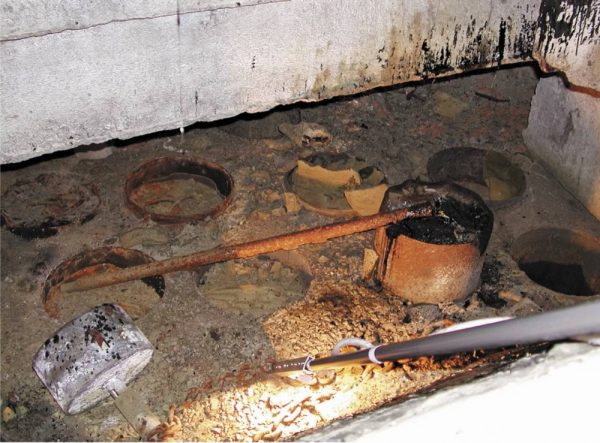
The work on tank 3A is scheduled to start in 2023, after tank 2A and 2B is completed. The experts are don’t want to start the most risky work before as much as possible of the other waste elements are removed. A criticality accident in Andreeva Bay is worst-case scenario.
As previously reported by The Barents Observer, the total radionuclide inventory in the three tanks is estimated to be equal to the remains of Rector No. 4 inside the Chernobyl sarcophagus in Ukraine. This according to a study by the British nuclear engineering company Nuvia.
The original 22,000 spent fuel elements dumped in Andreeva Bay are coming from 90-100 reactor cores powering the Soviet Union’s Cold War submarines sailing out from the naval bases along the coast of the Kola Peninsula from the late 1950s to 1982.
The first reactor cores of the November class submarines were reloaded in the early 1960s.
Additional to the spent fuel elements, some 10,000 cubic meters of solid radioactive waste from Andreeva Bay are shipped to the regional handling and storage facility in Saida Bay, a few hours sailing to the east on the Kola Peninsula. Huge piles of solid radioactive waste were stored outdoor summer and winter in the same area. Now, a building is erected to protect the boxes from rain and snow, before being repacked and shipped to the Saida Bay.
1 This Month

of the week – Shut Down Drone Warfare!


Tell the Ukrainian Government to Drop Prosecution of Peace Activist Yurii Sheliazhenko

Petition to revoke the licensing of the Near Surface Nuclear Disposal Facility (NSDF) at Chalk River. https://www.ourcommons.ca/petitions/en/Petition/Details?Petition=e-7247
To see nuclear-related stories in greater depth and intensity – go to https://nuclearinformation.wordpress.com
-
Archives
- April 2026 (103)
- March 2026 (251)
- February 2026 (268)
- January 2026 (308)
- December 2025 (358)
- November 2025 (359)
- October 2025 (376)
- September 2025 (257)
- August 2025 (319)
- July 2025 (230)
- June 2025 (348)
- May 2025 (261)
-
Categories
- 1
- 1 NUCLEAR ISSUES
- business and costs
- climate change
- culture and arts
- ENERGY
- environment
- health
- history
- indigenous issues
- Legal
- marketing of nuclear
- media
- opposition to nuclear
- PERSONAL STORIES
- politics
- politics international
- Religion and ethics
- safety
- secrets,lies and civil liberties
- spinbuster
- technology
- Uranium
- wastes
- weapons and war
- Women
- 2 WORLD
- ACTION
- AFRICA
- Atrocities
- AUSTRALIA
- Christina's notes
- Christina's themes
- culture and arts
- Events
- Fuk 2022
- Fuk 2023
- Fukushima 2017
- Fukushima 2018
- fukushima 2019
- Fukushima 2020
- Fukushima 2021
- general
- global warming
- Humour (God we need it)
- Nuclear
- RARE EARTHS
- Reference
- resources – print
- Resources -audiovicual
- Weekly Newsletter
- World
- World Nuclear
- YouTube
-
RSS
Entries RSS
Comments RSS
 nuclear-news