Production of new plutonium triggers at Savannah River Site to mean more radioactive trash for South Carolina?
Advocates fear tons of nuclear waste from new Savannah River Site project, Charleston City Paper 5th June 2021 A plan to restart a defunct South Carolina nuclear facility with a new mission has safety advocates worried about tons of new nuclear waste in an area of the state with a checkered radioactivity record.
“The essential problem with the work at the Savannah River Site (SRS) is there have been a number of newfangled ideas to either downgrade or reuse plutonium or other nuclear byproducts,” said Tonya Bonitatibus, executive director of Savannah Riverkeeper, a nonprofit advocacy group. “Often, that just means we bring in more waste that is indefinitely stored in South Carolina and often not used even for the purpose it was brought in for.”
The new U.S. Department of Energy (DOE) budget includes a request for $603 million toward the production of plutonium pits, a key component in nuclear warheads, at SRS. Nearly all pits currently in the U.S. stockpile were
produced from 1978 to 1989 because the U.S. had only one active site for decades to produce new pits. The recent funding request marks a 37% increase from 2020, which moves the department closer to its goal of restoring pit production and producing 50 pits per year by 2030.
Under the project plan, SRS would repurpose its unfinished Mixed Oxide (MOX) Fuel Fabrication Facility as a proposed Savannah River Plutonium Processing Facility (SRPPF).
Lakes Against Nuclear Dump (LAND) call to Boris Johnson for a moratorium on the push for ”Delivery of a Geological Disposal Facility”
Lakes Against Nuclear Dump (LAND) have sent a letter to Boris Johnson
urging him to issue a Moratorium on the push for “Delivery of a
Geological Disposal Facility” – Cumbria is in the frame once again with
the salt water infused complex geology under the Irish Sea being touted as
a “possible” site.
Radiation Free Lakeland 4th June 2021
Titanic Microbes and Request for Moratorium on “Delivery” of Deep Nuclear Waste Dump
Australia’s nuclear waste policy shambles

In developing this plan, ANSTO had the option of choosing a different process.
They had the option of disposing of the wastes from O.P.A.L. to the USA, providing a cheaper alternative for ANSTO:
Australia’s nuclear waste policy shambles https://independentaustralia.net/politics/politics-display/australias-nuclear-waste-policy-shambles,15146B 2 June 2021 The Government is scrambling to figure out a solution to Australia’s nuclear waste problem with a new bill before the Senate, writes Noel Wauchope.
TO BE FAIR, Australia is not alone in having a shambolic policy on nuclear wastes. Russia, China, India and even France and the UK are secretive about all aspects of the nuclear fuel chain. But the USA, the first and biggest of the nuclear countries, has openly described its struggles with this problem.
I’ve always thought that America summed up its nuclear waste policy best in its Nuclear Waste Confidence Rule — first promulgated in 1984 and upgraded several times since. This rule, charmingly optimistic, stated that a permanent nuclear waste disposal solution would be found (no details, they didn’t know where, didn’t know when). But therefore, the nuclear industry could confidently continue to make radioactive trash.
It’s no surprise that Australia, too, is struggling with its relatively small amount of nuclear waste.
Indeed, as Griffith University Professor Ian Lowe has pointed out, Australia dodged a bullet in not having nuclear power:
“We were just lucky to avoid having nuclear power stations with mountains of accumulated waste, for which there is no effective permanent solution.”
Still, Australia’s one nuclear reactor, run by the Australian Nuclear Science and Technology Organisation (ANSTO) at Lucas Heights, Sydney, is now mired in problems about what to do with its nuclear waste.
Continue readingGermany’s search for a nuclear waste solution
Aus Politik und Zeitgeschichte 25th May 2021, Search for a repository. In June 2011 the German Bundestag voted with alarge majority in favor of Germany’s complete withdrawal from nuclear energy under the impression of the reactor disaster in Fukushima, Japan. Of the 17 German nuclear power plants at the time, eleven have now been switched off and they will be closed by 2022. last pile from the network.
An end to German nuclear policy, at the latest has been accompanied by polarization and mass protests since the 1970s, That doesn’t mean, however, that the task at hand is to find one for the approximately 27,000 cubic meters of high-level radioactive waste from six decades of nuclear power plant operation To find the safest possible repository location – for a million years. The repository question is not new. While international from the late 1950s Years of disposing of nuclear waste in the world’s oceans, ice sheets or was discussed in space, crystallized early in the Federal
Republic underground storage emerged as the preferred solution.
In 1977 the Salt dome in Gorleben in Lower Saxony named as the location for a “National Waste Disposal Center” – although the weighting is more scientific Findings, political agendas and economic interests. The violent one
Resistance that soon broke out in the region spread throughout the country and became a well-networked movement, made “Gorleben” on the code for anti-nuclear protest in Germany and the pitfalls of Search for a repository.
Radioactive Fukushima soil stored in flood zones
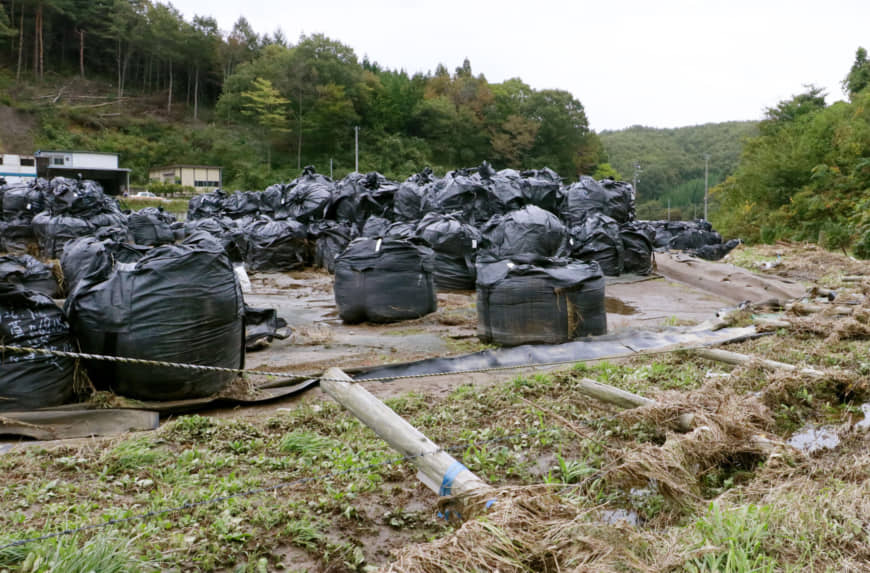
Contaminated Fukushima soil stored in flood zones, audit finds http://www.asahi.com/ajw/articles/14359377?fbclid=IwAR3vSQl1UVoSDAqpoxsL8nYsWhRVPVM55o749Uw1NXEJ9FtvOxh6aquOyq8, By RYOTA GOTO/ Staff Writer, May 27, 2021 Many of the temporary storage sites for soil and waste contaminated by radiation from the crippled Fukushima No. 1 nuclear power plant are located in areas vulnerable to natural disasters, a government audit found.
The Board of Audit of Japan submitted an investigative report to the Diet on May 26 warning the central government to address the contaminated materials that would be in jeopardy in the event of disasters such as landslides and flooding caused by heavy rains, or tsunami.
The board studied the Environment Ministry’s reviews of the temporary storage sites for contaminated soil and designated radioactive waste from October 2019 to April 2020, and took issue with some of its assessments.
The results show 159 out of 170 sites in Fukushima Prefecture, where contaminated soil resulting from the accident at Tokyo Electric Power Co.’s Fukushima No. 1 nuclear plant is being temporarily stored, are within areas deemed vulnerable to landslides and flooding from heavy rain.
The ministry had surveyed locations but concluded that preventive measures were not necessary at 158 sites because the materials were fenced in or the contaminated soil was stored in bags and covered by liner sheets.
As for the remaining location, the ministry moved the contaminated soil to an intermediary storage site.
In nine prefectures including Fukushima, 130 of 379 locations that store contaminated waste are in areas expected to be flooded or hit by landslide in the event of a disaster.For 117 locations, the ministry concluded it is unnecessary to take preventive measures because the waste is stored inside buildings.
But for 13 locations, the ministry said discussion is needed over the necessity of taking preventative measures.
he board said the ministry’s reviews did not include a check of whether each site is located in an area considered vulnerable to tsunami or flooding. The ministry had reasoned that embankments or other obstacles are either in place or under construction, and that the need to take measures against a potential tsunami is low and any impact from a reservoir collapsing would be limited.
But the audit board surveyed 153 temporary storage sites for contaminated soil and found that five of them are vulnerable to a tsunami and three are vulnerable to reservoir flooding.
The board said the ministry needs to consider residents’ concerns about the potential of a leak of contaminated materials, check if the areas are vulnerable to disasters and take preventive measures.
The ministry responded to the audit by defending that it “prioritized quickly securing storage sites at the time and did not have time to check the sites against a hazard map.”
A representative of the Fukushima prefectural government admitted some mistakes were made.
“We knew the locations of storage sites but failed to think about disaster-prevention measures,” the representative said.
New technology comes nowhere close to solving the problem of nuclear waste
New technology comes nowhere close to solving the problem of nuclear waste, Toronto Star, By Thomas Walkom May 27, 2021 What is to be done with nuclear waste? It is a question that dominates the Atomic Age. It is also one that has never been satisfactorily answered…..
nuclear waste is a relentless certainty. A plant that produces nuclear power creates nuclear waste. It is that simple.But what to do with that waste? Up to now, the assumption was that such waste would be buried in deep geological caverns, or repositories. Two potential sites for such repositories have been identified — one in Northwestern Ontario and one near Lake Huron. The usual political battles are being waged over whether either or both sites are safe.
But over the last few years, more attention has been paid to a different solution — using radioactive waste as fuel to create more nuclear power from so-called small modular reactors (SMRs). The governments of Saskatchewan, Ontario and New Brunswick have been particularly interested in developing this new SMR technology.
One New Brunswick start-up, Moltex Energy of Saint John, has received $50.5 million in federal funds.
The new technology has its critics. In the first place, it can create new and even more dangerous radioactive waste. As the Globe and Mail reports, Moltex says it produces an impure form of plutonium as a waste byproduct from its SMRs. Pure plutonium is used in the manufacture of atomic bombs.
Indeed, some nuclear experts, including former senior U.S. officials, were so alarmed that seven of them took the unusual step of penning an open letter this week to Prime Minister Justin Trudeau.
In that letter, they warned that reprocessing waste in a manner that creates plutonium would undermine global efforts to limit nuclear proliferation.
They also noted that the new technology wouldn’t solve the waste problem. Rather, it would just produce different kinds of nuclear waste.
“Moltex, even in the R&D stage, would create a costly legacy of contaminated facilities and radioactive waste streams and require substantial additional government funding for cleanup,” the letter said.
All of this is true. But none of it is enough to derail the new interest in SMR technology. Governments like it because it promises to be cheaper to build than classic Pickering-style nuclear power plants. The nuclear industry sees it as a political lifeline at a time when atomic power is not particularly popular.
So regardless of what its critics say, don’t expect this new technology to fade away. It may not be the silver bullet that its adherents claim it to be. It comes nowhere close to solving the waste problem.
But it is supported by important political constituencies. History has shown how crucial this support has been to the nuclear industry. https://www.thestar.com/opinion/contributors/2021/05/27/new-technology-comes-nowhere-close-to-solving-the-problem-of-nuclear-waste.html
New research highlights need for international standards to safeguard against plutonium ”hot” particles.

New study delves into issues relating to soils around Maralinga region, https://www.portlincolntimes.com.au/story/7262167/study-shows-radioactive-particles-from-nuclear-testing-persist-at-maralinga, Luca Cetta,
A new study has highlighted the first international standards needed to safeguard against contamination from nuclear testing, and a Kokatha Elder says the impact of nuclear testing at Maralinga cannot be forgotten.
More than 100 kilograms of highly toxic uranium and plutonium was dispersed in the form of tiny ‘hot’ radioactive particles after nuclear tests were conducted by the British in remote areas of South Australia, including Maralinga.
Scientists have new evidence these radioactive particles persist in soils to this day, more than 60 years after the detonations.
The British detonated nine nuclear bombs and conducted nuclear tests in South Australia between 1953 and 1963.
There had previously been limited understanding in how plutonium was released from the particles into the environment for uptake by wildlife around Maralinga.
The new study, published in Nature’s Scientific Reports, led by Monash University researchers, warns the hot particles are more complex and varied than previously thought.
Currently, there are no international best practice standards for the environmental impact or risk assessment of plutonium and uranium-rich hot particles released during nuclear testing.
This study provides the first mechanism for future modelling to predict the environmental life cycle of plutonium from hot particles, including how they are slowly broken down in the environment over a long period, and potentially exposed to animals and humans through inhalation, soil or ground water.
“The resulting radioactive contamination and cover-up continues to haunt us,” lead study author from Monash University’s School of Earth, Atmosphere and Environment Dr Megan Cook said.
“The results of our study profoundly changes our understanding of the nature of hot particles at Maralinga – despite the fact that those were some of the best studied particles anywhere in the world.”
Sue Haseldine, who grew up in the Koonibba district in the 1950s and 1960s, has long campaigned against nuclear testing and weapons.
She has been part of the International Campaign to Abolish Nuclear Weapons (ICAN), an organisation awarded the Nobel Peace Prize in 2017, and has spoken about her experience growing up in the shadow of nuclear testing at Maralinga.
Ms Haseldine said the people in the area had long-suspected there were health issues deriving from those tests.
“Experts would tell you that radiation will not last for 60 years, nor 60,000, but for a long, long time, and it is still causing troubles today,” she said.
“The old ladies told me these cancers and illnesses were not around before the bomb and over the years I have seen the rates go up.
“There are a lot more younger people with heart problems – it is known that radiation problems can cause heart diseases – and it is coming down through the generations.”
Ms Haseldine said the testing and fallout from Maralinga was not spoken about enough and that was why her campaigning with ICAN was so important.
“It is important to let people know what the government’s legacy is to us through their testing and we have to keep the past alive to protect the future, so they don’t do it to future generations,” she said.
“I grew up in the Koonibba district, but the radiation didn’t just stay in the Maralinga area.”
Study co-author professor Joël Brugger said the study invited a revisit of the implications of earlier results for the fate of plutonium at Maralinga.
“Understanding the fate of hot particles in the arid environment setting of the Australian outback is critical for securing Australia in case of nuclear incidents in the region, and returning all the native land affected by the British tests to the traditional Anangu owners of the Maralinga Tjarutja lands.”
The research team used synchrotron radiation at the Diamond Light Source near Oxford in the United Kingdom to decipher the physical and chemical make-up of the particles.
At Monash, they dissected some of the hot particles using a nano-sized ion beam, and further characterised the complex make-up of these particles down to the nano-size.
“It’s a major breakthrough,” study co-author associate professor Vanessa Wong said.
“Our observations of the hot particles from Maralinga provide a clear explanation for the complex and variable behaviour of different hot particles with respect to the chemical and physical weathering that has hindered predictive modelling to this day.
“This study provides a mechanistic foundation for predicting the future evolution of hot particles from high-temperature nuclear events and the likely exposure pathways.”
The researchers demonstrated the complexity of the hot particles arose from the cooling of polymetallic melts from thousands of degrees Celsius in the explosion cloud during their formation.
“We found that the particles contained low-valence plutonium-uranium-carbon compounds that are typically highly reactive – which is unexpected for particles that survived for over 30 years in the environment,” corresponding author Dr Barbara Etschmann said.
Russia launches a mission to investigate te Komsomolets, Soviet nuclear submarine sunk 32 years ago .
Bellona 25th May 2021, Russian scientists have embarked on a mission to the Komsomolets, a Soviet nuclear submarine that sank 32 years ago during an onboard fire off Norway’s northern coast, killing 41, in a bid to determine whether the wreck presents threats to the undersea environment.
The scientists, from Rosgidromet, Russia’s state weather agency which also measures radiation, set sail from Arkhangelsk last week aboard the Professor Molchanov research vessels, reaching the accident site over the weekend, Russian media reported.
Russia launches mission to the sunken Komsomolets nuclear submarine
Russia’s Arctic Council leadership now facing up to the problem of nuclear reactors dumped in the ocean
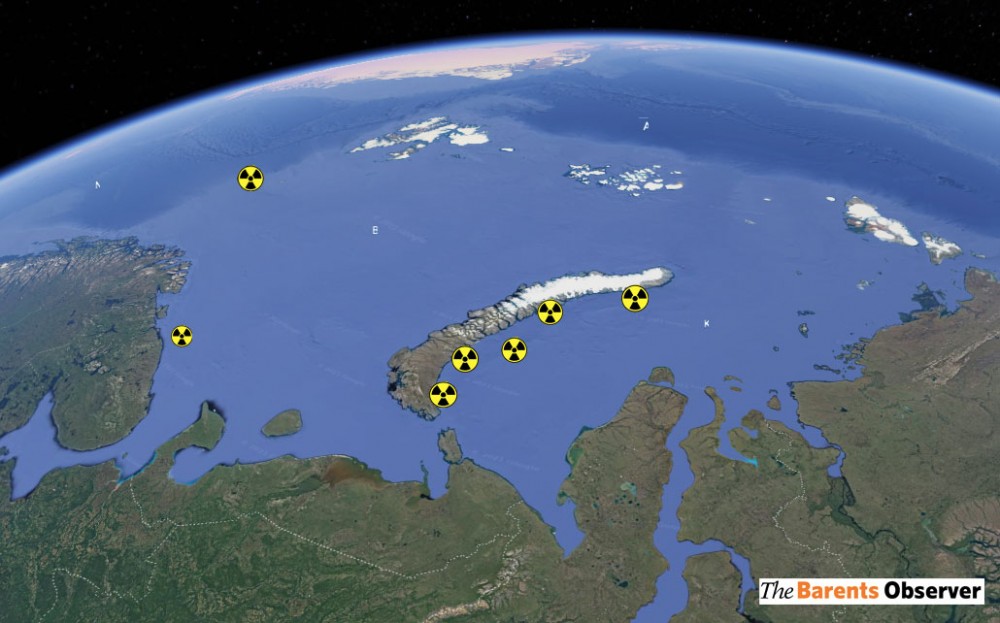
Reactors are dumped at several locations in the Kara Sea in addition to the two submarines K-159 and K-278 that sank in the Barents- and Norwegian Seas. Map: Barents Observer / Google Earth
Tackling dumped nuclear waste gets priority in Russia’s Arctic Council leadership https://thebarentsobserver.com/en/nuclear-safety/2021/05/lifting-nuclear-waste-kara-sea-gets-priority-russias-arctic-council
The reactors from the submarines K-11, K-19, and K-140, plus the entire submarine K-27 and spent uranium fuel from one of the old reactors of the Lenin-icebreaker have to be lifted from the seafloor and secured. Thomas Nilsen
Russia’s Foreign Ministry invites international experts from the other Arctic nations to a June 2022 conference on how to recover the sunken radioactive and hazardous objects dumped by the Soviet Union on the seafloor east of Novaya Zemlya.
No other places in the world’s oceans have more radioactive and nuclear waste than the Kara Sea.
While mentality in Soviet times was «out of sight, out of mind», the Kara Sea seemed logical. Ice-covered most of the year, and no commercial activities. That is changing now with rapidly retreating sea ice, drilling for oil-, and gas and increased shipping.
The submarine reactors dumped in shallow bays east of the closed-off military archipelago of Novaya Zemlya were all brought north for a good reason, they had experienced accidents and posed a radiation threat at the navy yards where people were working.
Dumping the reactors in shallow waters, someplace at only 50 meters, meant they could be lifted one day when technology allowed.
There is momentum now. For environmental and foreign policy reasons, Russia needs to take action now,” says nuclear safety expert Andrey Zolotkov. He works with Bellona Murmansk, an advocacy group promoting international cooperation to secure hazardous radioactive objects in Russia’s Arctic region. Zolotkov is pleased to see Moscow highlighting steps to secure the sunken reactors in the Kara Sea.
“Ecology is one of the few topics where Russia and foreign partners can conduct constructive dialogue nowadays,” he says.
However, Zolotkov underlines, “the issue of urgency can only be discussed after at least one expedition to the flooded objects.”
A worst-case scenario would be a failed lifting attempt, causing criticality in the uranium fuel, again triggering an explosion with following radiation contamination of Arctic waters.
Technical survey needed
With Russia now holding the chair of the Arctic Council, Zolotkov hopes such expedition can take place within the next two-year period.
A Russian-Norwegian expedition to the K-27 submarine in Stepovogo bay in 2012 took samples for studying possible radioactive leakages. Now, the Bellona expert, calls for an expedition to thoroughly study the strength of the hull and look for technical options on how to lift the heavy submarine and reactor compartments.
“Decades on the seafloor do not pass without impacts,” Andrey Zolotkov explains.
A previous study report made for Rosatom and the European Commission roughly estimated the costs of lifting all six objects, bringing them safely to a yard for decommissioning, and securing the reactors for long-term storage.
The estimated price-tag for all six is €278 million, of which the K-159 in the Barents Sea is the most expensive with a cost of €57,5 million. Unlike the submarines and reactors that are dumped in relatively shallow waters in the Kara Sea, the K-159 is at about 200 meters depth, and thus will be more difficult to lift.
In addition, about 17,000 objects were dumped in the Kara Sea in the period from the late 1960s to the early 1990s.
Most of that is containers with solid radioactive waste from the naval yards on the Kola Peninsula and in Severodvinsk. Some radioactive waste also originated from the repair and maintenance of the fleet of civilian nuclear-powered icebreakers in Murmansk.
Most of the objects are metal containers with low- and medium-level radioactive waste. The challenge today, though, are the reactors with high-level waste and spent uranium fuel, objects that will pose a serious threat to the marine environment for tens of thousands of years if nothing is done to secure them.
According to the Institute for Safe Development of Nuclear Energy, part of Russia’s Academy of Science, the most urgent measures should be taken to secure six objects that contain more than 90% of all the radioactivity.
The Arctic Council in late 2019 took a formal decision to establish a Working Group on radiation Emergency Prevention, Preparedness and Response (EPPR).
Dalgety Bay – 20,000 tonnes of radioactive material from the area to screen, – clean-up begins at last.

Scotsman 23rd May 2021, 30 years on, Scotland’s radioactive beach clean-up begins at last. It’s not a scene which might usually be welcome, but locals in the Fife town of Dalgety Bay have been waiting decades for this – ever since highly dangerous radioactive material was detected on the shoreline more than 30 years ago. Contamination was first identified there in 1990, but the source – luminous paint used on aircraft navigation dials – dates back to theSecond World War.
The area was once home to Donibristle military airfield,
where a large number of planes were dismantled after the end of the
conflict in 1945 and the debris burned and buried. Part of the foreshore at
Dalgety Bay has been off limits to the public since 2011 due to the health
risks posed by radioactive debris.
Radium was used to coat instrument
panels so they could be seen in the dark, but it is radioactive and toxic
to human health, with a half life of 1,600 years. Work to clean up
potentially deadly radioactive contamination has got under way at Dalgety
Bay in Fife, caused by debris from aircraft used during the Second World
War.
David Barratt, Fife councillor for Inverkeithing and Dalgety Bay, has
welcomed the work finally getting started. He said: “It has taken over 30
years and significant pressure from the community to get to this point.
“I’m delighted that works are now under way and grateful to Sepa for
all their effort in ensuring it will be done right, providing a permanent
solution.
“It should send a clear message that it doesn’t matter how much
time passes, the polluter should always pay. “Time will tell if its
smooth sailing from here and whether a 2022 completion date is possible.
They have around 20,000 tonnes of material from the area to screen and the
more contamination they find, the longer it will take, but at least now we
know it will be safe, however long it takes.”
Changes to Waste Isolation Pilot Plant could hide plan to expand this nuclear waste facility.
New Mexico weighs changes to permit for nuclear waste dump CARLBAD, N.M. (AP) 23 May 21, — U.S. officials are pushing state regulators to clear the way for a new ventilation shaft to be built at the federal government’s nuclear waste repository in southern New Mexico, but watchdog groups say modifying the Waste Isolation Pilot Plant’s permit to allow for the construction could open the door to expansion.
The state Environment Department’s Hazardous Waste Bureau held a virtual hearing over the past week to gather comments on the proposed permit change. A final decision is anticipated in mid-October.
Ventilation has been an issue since 2014, when a radiation release contaminated parts of the underground facility and forced an expensive, nearly three-year closure, delayed the federal government’s cleanup program and prompted policy changes at national laboratories and defense-related sites across the U.S.
Officials with the U.S. Energy Department have said the new shaft is needed to repair a “crippled” ventilation system, the Carlsbad Current-Argus newspaper reported………
The proposal is supported by leaders from the nearby city of Carlsbad, where many of the plant’s employees live.
……………… Cynthia Weehler, a Santa Fe resident and representative of activist group Stop Forever WIPP, argued the utility shaft was indicative of the Energy Department gradually expanding the repository using individual projects rather than proposing the overall goal of altering the facility’s mission to extend its lifetime.
She said that if New Mexico approves the permit, it would seem to be “colluding” with the Energy Department “to relabel a new mission and a future expansion.”
“It will lead us to an operation we didn’t consent to,” Weehler said. https://apnews.com/article/nm-state-wire-new-mexico-nuclear-waste-business-science-171b011df1d62d4a433b78f8c03e1760
Plutonium ”hot particles” are not as stable as we assumed. Research on contaminated landscape around Maralinga in outback South Australia.

We sliced open radioactive particles from soil in South Australia and found they may be leaking plutonium https://theconversation.com/we-sliced-open-radioactive-particles-from-soil-in-south-australia-and-found-they-may-be-leaking-plutonium-161277
Barbara Etschmann, Research officer, Monash University
Joel Brugger, Professor of Synchrotron Geosciences, Monash University
Vanessa Wong, Associate Professor, Monash University
May 21, 2021 Almost 60 years after British nuclear tests ended, radioactive particles containing plutonium and uranium still contaminate the landscape around Maralinga in outback South Australia.
These “hot particles” are not as stable as we once assumed. Our research shows they are likely releasing tiny chunks of plutonium and uranium which can be easily transported in dust and water, inhaled by humans and wildlife and taken up by plants.
A British nuclear playground
After the US atomic bombings of Hiroshima and Nagasaki in 1945, other nations raced to build their own nuclear weapons. Britain was looking for locations to conduct its tests. When it approached the Australian government in the early 1950s, Australia was only too eager to agree.
Between 1952 and 1963, Britain detonated 12 nuclear bombs in Australia. There were three in the Montebello Islands off Western Australia, but most were in outback South Australia: two at Emu Field and seven at Maralinga.

Besides the full-scale nuclear detonations, there were hundreds of “subcritical” trials designed to test the performance and safety of nuclear weapons and their components. These trials usually involved blowing up nuclear devices with conventional explosives, or setting them on fire.
The subcritical tests released radioactive materials. The Vixen B trials alone (at the Taranaki test site at Maralinga) spread 22.2 kilograms of plutonium and more than 40 kilograms of uranium across the arid landscape. For comparison, the nuclear bomb dropped on Nagasaki contained 6.4 kilograms of plutonium, while the one dropped on Hiroshima held 64 kilograms of uranium.
These tests resulted in long-lasting radioactive contamination of the environment. The full extent of the contamination was only realised in 1984, before the land was returned to its traditional owners, the Maralinga Tjarutja people.
Hot potatoes
Despite numerous cleanup efforts, residual plutonium and uranium remains at Maralinga. Most is present in the form of “hot particles”. These are tiny radioactive grains (much smaller than a millimetre) dispersed in the soil.
Plutonium is a radioactive element mostly made by humans, and the weapons-grade plutonium used in the British nuclear tests has a half life of 24,100 years. This means even 24,100 years after the Vixen B trials that ended in 1963, there will still be almost two Nagasaki bombs worth of plutonium spread around the Taranaki test site.
Plutonium emits alpha radiation that can damage DNA if it enters a body through eating, drinking or breathing.
In their original state, the plutonium and uranium particles are rather inactive. However, over time, when exposed to atmosphere, water, or microbes, they may weather and release plutonium and uranium in dust or rainstorms.
Until recently, we knew little about the internal makeup of these hot particles. This makes it very hard to accurately assess the environmental and health risks they pose.
Monash PhD student Megan Cook (the lead author on our new paper) took on this challenge. Her research aimed to identify how plutonium was deposited as it was carried by atmospheric currents following the nuclear tests (some of it travelled as far as Queensland!), the characteristics of the plutonium hot particles when they landed, and potential movement within the soil.
Nanotechnology to the rescue
Previous studies used the super intense X-rays generated by synchrotron light sources to map the distribution and oxidation state of plutonium inside the hot particles at the micrometre scale.
To get more detail, we used X-rays from the Diamond synchrotron near Oxford in the UK, a huge machine more than half a kilometre in circumference that produces light ten billion times brighter than the Sun in a particle accelerator.
Studying how the particles absorbed X-rays revealed they contained plutonium and uranium in several different states of oxidation – which affects how reactive and toxic they are. However, when we looked at the shadows the particles cast in X-ray light (or “X-ray diffraction”), we couldn’t interpret the results without knowing more about the different chemicals inside the particles.
To find out more, we used a machine at Monash University that can slice open tiny samples with a nanometre-wide beam of high-energy ions, then analyse the elements inside and make images of the interior. This is a bit like using a lightsaber to cut a rock, only at the tiniest of scales. This revealed in exquisite detail the complex array of materials and textures inside the particles.
Much of the plutonium and uranium is distributed in tiny particles sized between a few micrometres and a few nanometres, or dissolved in iron-aluminium alloys. We also discovered a plutonium-uranium-carbon compound that would be destroyed quickly in the presence of air, but which was held stable by the metallic alloy.
This complex physical and chemical structure of the particles suggests the particles formed by the cooling of droplets of molten metal from the explosion cloud.
In the end, it took a multidisciplinary team across three continents — including soil scientists, mineralogists, physicists, mineral engineers, synchrotron scientists, microscopists, and radiochemists — to reveal the nature of the Maralinga hot particles.
From fire to dust
Our results suggest natural chemical and physical processes in the outback environment may cause the slow release of plutonium from the hot particles over the long term. This release of plutonium is likely to be contributing to ongoing uptake of plutonium by wildlife at Maralinga.
Even under the semi-arid conditions of Maralinga, the hot particles slowly break down, liberating their deadly cargo. The lessons from the Maralinga particles are not limited to outback Australia. They are also useful in understanding particles generated from dirty bombs or released during subcritical nuclear incidents.
There have been a few documented instances of such incidents. These include the B-52 accidents that resulted in the conventional detonation of thermonuclear weapons near Palomares in Spain in 1966, and Thule in Greenland in 1968, and the explosion of an armed nuclear missile and subsequent fire at the McGuire Air Force Base in the USA in 1960.
Thousands of active nuclear weapons are still held by nations around the world today. The Maralinga legacy shows the world can ill afford incidents involving nuclear particles.
China building uneconomic closed fuel cycle nuclear breeder reactors – for plutonium for nuclear weapons?

the kind of plutonium breeder reactors being built on Changbiao, they are among the least cost-effective ways to derive energy from nuclear power.
That raises the question of why China is developing these reactors for its energy use if it doesn’t make sense economically. ……. “They may be dual-purpose.”
Concerns grow over China nuclear reactors shrouded in mystery
No one outside China knows if two new nuclear reactors that are under construction and that will produce plutonium serve a dual civilian-military use. By Al Jazeera Staff, 19 May 21,
Like many of the over 5,000 small islands dotting China’s coastline, the islet of Changbiao is unremarkable in its history and geography. Jutting out from the shoreline of Fujian province like a small right-footed footprint, it has only gained recognition recently – and even then among a small handful of experts – for being home to China’s first two CFR-600 sodium-cooled fast-neutron nuclear reactors……..
The two reactors being built on Changbiao are closed fuel cycle nuclear breeder reactors. They produce plutonium. That plutonium could be reprocessed and used as a fuel source for other nuclear reactors. It could also be used to produce nuclear warheads, a lot of nuclear warheads, and produce them very quickly.
But no one outside of the Chinese officials and companies overseeing the projects knows if the intended use is purely for civilian energy, or if it serves a dual purpose for the country’s perceived nuclear deterrent needs.
That question gained even more urgency this week after a United States official accused Beijing of resisting bilateral talks with Washington on nuclear risk reduction.
The reason these breeder reactors are shrouded in mystery is that China, which had been transparent about its civilian plutonium programme until recently, stopped annual voluntary declarations to the International Atomic Energy Agency [IAEA] on its stocks of civilian plutonium in 2017 and has not added the reactors to the agency’s database to date.
While there are occasionally reporting delays of up to a year among the nine members party to the IAEA voluntary guidelines for the management of plutonium, Frank von Hippel, a senior nuclear research physicist and co-founder of Princeton University’s Program on Science & Global Security, said China’s lack of transparency is beginning to draw concern among non-proliferation experts and governments around the world.
“This is unique at this point,” von Hippel said of the silence over China’s plutonium activities.
I’m worried’
A recent paper (PDF) co-authored by von Hippel and several other nuclear non-proliferation experts drew attention to this issue. The findings stated that China could “conservatively produce 1,270 nuclear weapons by 2030 simply by exploiting the weapons-grade plutonium this program will produce” or even increase that by a factor of two or more if China used highly enriched uranium or composite uranium-plutonium cores from the reactors in bombs and missiles.
This would feed a huge increase from the number of estimated nuclear warheads in China’s arsenal, currently thought to be around 300 to 350.
“Well, I’m worried,” von Hippel said. “They may be dual-purpose.”
While the IAEA management guidelines have been something of a failure over the years, at least they “did provide transparency”, von Hippel says. Now, everyone but China is in the dark about the plutonium programme and it is starting to draw attention……..
The China Atomic Energy Authority, the agency responsible for reporting to the IAEA, did not respond to Al Jazeera’s questions about why China stopped reporting on its civilian plutonium programme. Similar requests from Al Jazeera made through China’s Ministry of Foreign Affairs, the National Energy Administration and the Ministry of Industry and Information Technology were likewise not acknowledged…….
The country has 50 nuclear reactors operating and 14 other conventional reactors under construction, not counting the two breeder reactors, according to IAEA data. China undershot its previous five-year target by around seven gigawatts, so appears to be making a major push to advance its nuclear power capacity over the next five to ten years.
But both Roth and von Hippel said, based on the experience of other countries that have tried the kind of plutonium breeder reactors being built on Changbiao, they are among the least cost-effective ways to derive energy from nuclear power.
“There’s a strong case, and we’ve seen this in other countries, that reprocessing [spent fuel] is not economical,” Roth said. “The reality is it’s cheaper not to reprocess your fuel than it is to reprocess. A once-through fuel cycle with low enriched uranium is a more economical approach.”
That raises the question of why China is developing these reactors for its energy use if it doesn’t make sense economically.
If the reactors are dual-use, it would, particularly from a China concerned about the adequacy of its nuclear deterrent, says von Hippel.
China’s actions, however, may spur others in the region, namely Japan and Korea, to speed up their own plutonium reactor plans.
“I think it’s in China’s best interest not to go down that path,” Roth said. “From an economic perspective, from an environmental perspective, and the impact it has regionally … they seem set on pursuing this reprocessing path, but I don’t think it is going to help them with their nuclear power goals.”
I think it’s in China’s best interest not to go down that path.
A commercial plutonium ‘timeout’?
The way forward, Roth says, is for the US to engage with China to find out why it stopped the declarations to the IAEA and pursue a path to disincentivise others in the region from pursuing plutonium reprocessing.
“I would hope that the Biden administration is choosing to engage with China on non-proliferation issues,” Roth said.
Requests made by Al Jazeera through the US Embassy in Beijing about whether the administration of US President Joe Biden was engaging with China on its halt in reporting on its civilian plutonium programme were declined.
These questions are becoming acutely important, von Hippel said, at a time of increased tension between the US and China, the potential flashpoint of Taiwan, and a growing chorus suggesting the two superpowers are engaged in a Cold War 2.0.
Whether there is interest in China discussing these matters with the US or countries in the region is unknown.
On Tuesday, the issue was thrown back into the spotlight after Robert Wood, US ambassador and permanent representative to the United Nations Conference on Disarmament, accused Beijing of being unwilling “to engage meaningfully” with Washington on nuclear weapons talks.
“Despite China’s dramatic build-up of its nuclear arsenal, it continues to resist discussing nuclear risk reduction bilaterally with the United States – a dialogue we have with Russia,” Wood told a UN conference.
Beijing’s representative reportedly pushed back on the claim, telling the same conference that China is “ready to carry out positive dialogue and exchange with all parties”.
The increasing acrimony that characterised US-China relations under the administration of President Donald Trump didn’t exactly instil confidence in engagement on nuclear security policy, von Hippel said.
Gregory Kulacki, a senior analyst on nuclear policy at the Union of Concerned Scientists who is now based in Japan, said that the good level of engagement built up between the US and China on nuclear policy prior to the early 2000s is something of a distant memory now, with the US side bearing much of the blame for the shroud of silence from China.
“The [George W] Bush Jr administration’s decision [in 2002] to withdraw from the ABM [1972 Anti-Ballistic Missile] treaty pretty much gutted any real interest in China in pursuing arms control talks of any substance with the United States,” Kulacki said.
The Bush administration’s moves were made due to its commitments to deploy missile
defence systems in what it saw as protecting against “growing missile threats” at the time, from a potentially nuclear-armed North Korea. China saw those actions as restricting its own military capabilities in its back yard.
According to von Hippel and his co-authors, the US should work with Japan, South Korea and China on declaring a “commercial plutonium timeout” with offers to delay breeder reactors and commercial plutonium programmes if China agrees to do the same.
If all of these countries could increase the amount of transparency related to uranium holdings and related activities, it would boost confidence for all parties to scale back those programmes, he said.
The trick is figuring out who would take the first steps. https://www.aljazeera.com/economy/2021/5/19/concerns-grow-over-china-nuclear-reactors-shrouded-in-mystery
Small nuclear reactors – a way to get indigenous people to then accept nuclear waste?

Gordon Edwards is president of the Canadian Coalition for Nuclear Responsibility and notes the Moltex SMR design involves dissolving spent nuclear fuel in molten salt, and there lies an issue, he believes.
“What happens when you dissolve the solid fuel in a liquid, in this molten salt – then all of these radioactive materials are released into the liquid,” says Edwards, “and it becomes more dangerous to contain them because a solid material is much easier to contain than a liquid or gaseous material.”

Peskotomuhkati chief unhappy about nuclear reactor testing on his traditional territory https://www.aptnnews.ca/national-news/peskotomuhkati-nation-nuclear-reactor-testing-new-brunswick-small-modular-reactors/—
Christopher Read cread@aptn.caMay 16, 2021,
Feds say they won’t reach zero emissions by 2050 without small nuclear reactors.
It’s a new kind of nuclear reactor that the federal government is putting up $50.5 million in development money for, but some Indigenous leaders are already speaking out against it
.Moltex Energy Canada is getting the tax-dollar investment to develop what the nuclear industry calls a “small modular reactor” or SMR – which is generally considered to be a reactor with a power output of 300 megawatts or less.The Moltex SMR design is to be developed at New Brunswick Power’s Point LePreau Nuclear Generating Station, which is on the north shore of the Bay of Fundy and in Peskotomuhkati traditional territory.
ARC Clean Energy Canada is another operation also set to develop an SMR at the Point LePreau site. It was announced in February that ARC would get $20 million from the New Brunswick government if the company can raise $30 million of its own cash.
Hugh Akagi is Chief of Peskotomuhkati Nation and has concerns about more nuclear development in the aging facility.
“Well, I don’t feel very good about it, to be honest,” says Akagi. “You paid that money if you pay tax on anything in this country, you’ve just made a donation to Moltex. If you’re not concerned about $50 million being turned over to a corporation for a technology that does not exist – I hope you heard me correctly on that.”
The federal government has taken a shine to the idea of SMRs and Minister of Natural Resources Seamus O’Regan is on the record as saying “We have not seen a model where we can get to net-zero emissions by 2050 without nuclear.”
Under the Small Modular Reactor Action Plan, the federal government is pushing for SMRs to be developed and deployed to power remote industrial operations as well as northern communities.
Three streams of government-supported SMR developments are underway at two sites in Ontario as well as at Point LePreau.
As well, the governments of New Brunswick, Ontario, Saskatchewan and Alberta have all signed a memorandum of understanding pledging their support for SMR development.
Akagi says he hasn’t been formally consulted – but has been to a presentations put on by NB Power about the SMR project.
He says he is unlikely he’ll ever give it his support.
“Until I can have an assurance that the impact on the future is zero,” says Akagi, “I don’t want to 100 years, 200 years is still seven generations. I want zero impact.”
But Moltex Energy Canada CEO Rory O’Sullivan says his company’s technology will ultimately reduce environmental impact, by recycling spent nuclear fuel from full scale reactors.
“Instead of putting it in the ground where it’ll be radioactive for very long periods, we can reuse it as fuel to create more clean energy from what was waste,” says O’Sullivan. “We can’t get rid of the waste altogether. But the aim is to get rid, to get it down to about a thousandth of volume of the original long-lived radioactivity.
O’Sullivan admits to formerly seeing nuclear as too much of a problem to be a viable solution in the climate crisis.
“When I graduated as a mechanical engineer I saw that nuclear is potentially as too expensive, has the waste issue, has a potential safety issue,” says O’Sullivan. “Well, actually, with these innovative new designs, you can potentially have nuclear power that is lower cost, cheaper than fossil fuels – you can get much safer solution using innovation and you can potentially deal with the waste.”
Gordon Edwards, one of Canada’s most prominent nuclear critics, isn’t buying that argument.
Edwards is president of the Canadian Coalition for Nuclear Responsibility and notes the Moltex SMR design involves dissolving spent nuclear fuel in molten salt, and there lies an issue, he believes.
“What happens when you dissolve the solid fuel in a liquid, in this molten salt – then all of these radioactive materials are released into the liquid,” says Edwards, “and it becomes more dangerous to contain them because a solid material is much easier to contain than a liquid or gaseous material.”
Edwards also works on a radioactive task force with the Anishinabek Nation and the Iroquois Caucus.
And as he sees it, small modular reactors could make it harder for Indigenous communities to say no to the deep geological repositories [DGRs] being pitched to Indigenous communities as a supposedly safe way for Canada’s nuclear industry to entomb highly radioactive waste for hundreds of thousands of years.
“We don’t accept the small modular reactors because we know that it’s just a way of implicating us so that we can then have less of an argument against being radioactive waste dumps,” says Edwards. “If we accept small modular reactors into our communities, how can we then turn around and say we don’t want to keep the radioactive waste? It would just put us in an impossible position.”
Edwards and other nuclear critics such as Akagi recently participated in an online webinar focused on concerns around nuclear development at Point LePreau.
And those adding their voices to the critical side of the ledger on nuclear development at Point LePreau include Jenica Atwin – the Green Party’s MP for Fredricton, and Wolastoq Grand Council Chief Ron Tremblay – who issued a Resolution calling for nuclear development to be halted.
Atwin put out a release in April calling Canadian nuclear policies “profoundly misguided.”
“My basic premise is that the government needs to be more responsible in the information that they’re sharing just in general to talk about the risks that exist alongside whatever benefits they’re kind of toting,” says Atwin. “And right now, we’re only hearing that it’s the greatest option. This is how we fight climate change. It is clean, it’s cheap energy. And I have to disagree.”
If all goes to according to the Moltex plan, its SMR could be operable by about 2030.
Chernobyl nuclear tomb will eventually collapse. Sellafield, too, will need £132 billion, at least, to decommission.

LADBible 15th May 2021, A scientist has warned that Chernobyl nuclear power plant must be dismantled in the next 100 years or else it will collapse.
Professor Neil Hyatt is the Royal Academy of Engineering and Nuclear Decommissioning Authority’s research chair in radioactive waste management. Speaking to LADbible about recent developments that nuclear reactions had been detected from deep within the mummified plant – 35 years after its core exploded in what is widely viewed as history’s worst nuclear disaster – he says it’s time to act.
“If we don’t take it down, it’s going to fall down,” says Professor Hyatt, who teaches at Sheffield University. “The original shelter was built as a temporary facility to stabilise a situation and the New Safe Confinement is essentially the same thing – to buy us time. [But] it only buys us around 100 years or so.
“If you think about nuclear decommissioning, which I do all the time, look at the projects that are going on around the world. “There’s the Sellafield site in the UK – that’s one hundred years to decommission the Sellafield site at a cost of £132 billion, at least. “That probably tells you it’s going to take at least 50 years, if we started today, probably at a cost of about £900 million, to decommission Chernobyl.
“These are orders of magnitude, and the reason is because we still don’t know everything we need to know to decommission it, about the material inside.” He adds: “If we don’t take it down, it’s gonna collapse eventually. If you’ve bought yourself 100 years, you really need to start cracking on with the dismantling – probably in the next 20 years.
1 This Month
23-25 October – on Zoom – World BEYOND War’s annual global conferenc

To see nuclear-related stories in greater depth and intensity – go to https://nuclearinformation.wordpress.com

Say No to NASA’s Reckless Nuclear Reactor on the Moon
Say No to NASA’s Reckless Nuclear Reactor on the Moon
-
Archives
- October 2026 (149)
- September 2026 (339)
- August 2026 (330)
- July 2026 (355)
- June 2026 (287)
- May 2026 (306)
- April 2026 (356)
- March 2026 (251)
- February 2026 (267)
- January 2026 (308)
- December 2025 (358)
- November 2025 (359)
-
Categories
- 1
- 1 NUCLEAR ISSUES
- business and costs
- climate change
- culture and arts
- ENERGY
- environment
- health
- history
- indigenous issues
- Legal
- marketing of nuclear
- media
- opposition to nuclear
- PERSONAL STORIES
- politics
- politics international
- Religion and ethics
- safety
- secrets,lies and civil liberties
- spinbuster
- technology
- Uranium
- wastes
- weapons and war
- Women
- 2 WORLD
- ACTION
- AFRICA
- Atrocities
- AUSTRALIA
- Christina's notes
- Christina's themes
- culture and arts
- Events
- Fuk 2022
- Fuk 2023
- Fukushima 2017
- Fukushima 2018
- fukushima 2019
- Fukushima 2020
- Fukushima 2021
- general
- global warming
- Humour (God we need it)
- Nuclear
- RARE EARTHS
- Reference
- resources – print
- Resources -audiovicual
- Weekly Newsletter
- World
- World Nuclear
- YouTube
-
RSS
Entries RSS
Comments RSS

