Britain facing a massive series of nuclear decommissioning
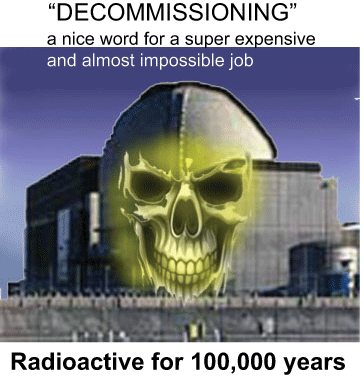
Britain prepares for new wave of nuclear decommissioning
Sceptics of the fuel argue the plans demonstrate why no new plants should be built, Ft.com Nathalie Thomas in Edinburgh 23 June, 21, At Dungeness B nuclear power station on a remote stretch of the Kent coast in south-east England, workers are making preparations to carefully remove thousands of radioactive fuel elements from its reactors and transfer them to a purpose-built pond for at least 90 days for cooling. The spent fuel will later be packed into 53-tonne “flasks” fortified with 39cm-thick steel walls before being transported across country by train to Sellafield in Cumbria.
The nuclear facility in north-west England is host to most of the radioactive remnants of Britain’s civil nuclear programme that dates back to the 1950s. These include highly toxic waste that will remain there until a suitable site is found for an underground repository where it will have to be stored for more than 100,000 years to make it safe.
Preparations for the “defuelling” of Dungeness B started with “immediate effect” on June 7 when its majority owner, French state-controlled utility EDF, announced it would close the plant seven years early. It had not been operational since September 2018 as engineers tried to fix problems, including corrosion and cracks in its pipework.
The 1.1GW plant is the first of seven built in the UK between the mid-1960s and late-1980s using advanced gas-cooled reactor (AGR) technology to come out of service. It will kickstart a decommissioning process spanning generations, which sceptics argue strikes at the heart of why no new nuclear plants should be built.
The remaining six AGR plants are due to be retired by the end of this decade at the latest, leaving the more modern Sizewell B plant in Suffolk, which uses pressurised water reactor technology, as the only one operational out of the existing fleet
. “[Decommissioning of] many of these facilities will continue well into the 22nd century,” said Paul Dorfman of University College London’s Energy Institute. “The problem with decommissioning is it always turns out to be more complex than one had imagined.”
Critics also point out that the decommissioning of Britain’s 17 earliest atomic power sites has been extremely costly. The latest clean-up bill for those sites, which include a generation of nuclear plants known as the “Magnox” stations, is estimated at more than £130bn over 120 years. ……
Climate activists, such as E3G and Greenpeace, have long argued that the debate over building costly, complex new nuclear plants detracts from investment in cheaper, climate-friendly technologies……….
The exact arrangements for the decommissioning of Dungeness and the six other AGR plants are subject to negotiation between EDF and the government. It will be financed via a £14.5bn fund set up in 2005.
The French utility is expected to take at least three years to remove all fuel from each site and potentially carry out some early demolition work before handing them over to the UK state-owned Nuclear Decommissioning Authority. EDF declined to comment. The next stage will probably involve the treatment and removal of waste and demolition of facilities that are no longer needed. Some facilities will be left untouched for 85 years — to allow residual radioactive materials to decay — before demolition. …….. https://www.ft.com/content/0381e567-d088-4802-a2e4-e125c8099605
Collaboration between Russia and Europe finally cleans up the most dangerous nuclear ship in the Arctic.
After 27 Years, Lepse No Longer Poses a Nuclear Threat to the Arctic, High North News, PETER B. DANILOV 17 June 21, Last week, the Russian service ship Serebryanka delivered the last spent-fuel bundles from the Lepse floating maintenance base to an Atomflot storage site in Murmansk, completing the final stage of securing the nuclear waste……. To ensure the dismantling of the Lepse floating maintenance base, it was necessary to specially develop new technologies and equipment and make innovative decisions,” said FSUE Atomflot Director General Mustafa Kashka.
In July 2020, the Lepse floating maintenance base’s main batch of spent nuclear fuel was unloaded at the Nerpa shipyard. A total of 620 spent-fuel bundles were extracted and unloaded.
Lepse was regarded as the most dangerous nuclear vessel in the north and the Norwegian environmental NGO Bellona began the work of securing the spent nuclear fuel onboard the vessel in 1994.
……….. The project to dismantle and dispose of the Lepse Floating Maintenance Base is multilaterally implemented.
In 1996, the project was included in the EU’s TACIS program (Technical Assistance to the Commonwealth of Independent States), which involved the allocation of funds for the inspection of the state of spent nuclear fuel.
Since 2008, the project has been carried out in the framework of a Grant Agreement between the European Bank for Reconstruction and Development (EBRD), Rosatom, and JSC NFC Logistics Centre (the project’s customer and coordinator).
The EBRD has provided 54 million euros from the Northern Dimension Environmental Partnership Fund (NDEP). https://www.highnorthnews.com/en/after-27-years-lepse-no-longer-poses-nuclear-threat-arctic
Pacific Ocean was once a garbage dump for nuclear waste, now Japan’s doing it again
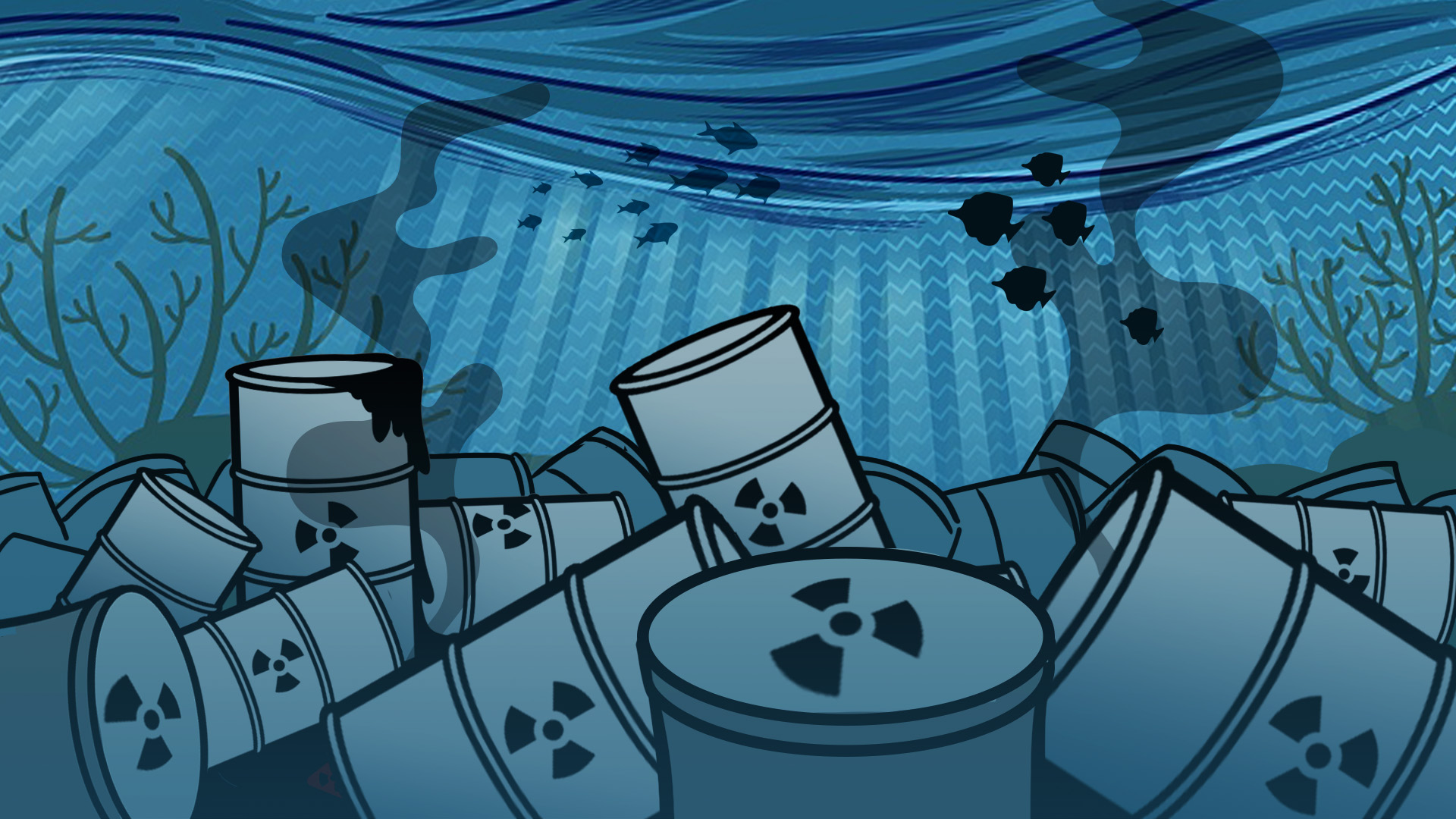
| Pacific Ocean was once a garbage dump for nuclear waste, now Japan’s doing it again. CGTN, Zeng Ziyi 11 June 21, ”………… Japan’s plan, which looked to dilute the contaminated water and pump them into the Pacific Ocean, drew swift condemnations from neighboring countries and environmental organizations. Kazue Suzuki, an energy campaigner at Greenpeace Japan, said the government’s decision has discounted radiation risks and looked over the fact that enough storage space is available in Fukushima and surrounding districts. “Rather than using the best available technology to minimize radiation hazards by storing and processing the water over the long term, they have opted for the cheapest option, dumping the water into the Pacific Ocean,” Suzuki said. In March, a panel of UN experts said that Japan’s nuclear wastewater poses major environmental as well as human rights risks, and any decision to discharge it into the Pacific Ocean cannot be an “acceptable solution.” The panel also pointed out that there’s a lack of meaningful public participation in the decision-making process, especially the populations and communities who are most affected. The Japanese government insists that radioactive elements in the water will be treated and diluted to safe levels before releasing. So far, this plan has received support from the International Atomic Energy Agency (IAEA), which points out that other countries have done so in the past. Besides, Japan’s allies, including the U.S., have also back Tokyo’s decision. The assurance buys little confidence among Pacific nations, whose economies depend heavily on the environment of the ocean. In a statement rebuking Japan’s decision, the Republic of Marshall Islands government pointed out that its entire nation consists of coastal communities whose primary food source comes from surrounding marine life. Sheila Jack Babauta, House member of the Commonwealth of Northern Mariana Islands, said the Pacific Ocean already faces major threats such as unregulated commercial fishing and the activities of the U.S. military, which have severely damaged the environment of the ocean.”We are part of the Pacific, we are intimately connected to the ocean, and therefore, we must be included in all decisions that impact ocean health, ocean sustainability, and ocean recovery,” Babauta told CGTN. “The dumping of nuclear waste is extremely irresponsible and disrespectful to our Pacific Ocean.”Since the dawn of the nuclear age, people of the Pacific island countries have suffered the horrific consequences of nuclear experiments carried out at their doorstep. Continued exposure to radiation has caused many survivors of the initial blasts to develop different types of illnesses, most commonly cancer and reproductive health issues. Even today, their descendants are still suffering the effects of radiation. .The U.S. detonated dozens of nuclear devices in a series of nuclear weapons tests at several test sites sprawling across the atolls of RMI between the 1940s and 1950s, including in the air and underwater. The detonations vaporized at least three atolls – ringlets of islands made of coral – and rendered many more uninhabitable. Ocean dumping of nuclear waste continued to be carried out by Britain, France, and others until 1972 when growing public pressure worldwide gave birth to the London Convention, which prohibited the practice.”The threat of nuclear contamination continues to be of significant concern to the health and security of our Blue Pacific continent,” said Henry Puna, Secretary General of the Pacific Islands Forum, in an address to the IAEA earlier this month.”Our 50-year history as the Forum has been overshadowed by our nuclear legacy issues, which continue to impact affected communities today, and we should not accept anything less.”………https://news.cgtn.com/news/2021-06-11/How-the-Pacific-became-a-garbage-dump-for-nuclear-waste-110rY09VsqY/index.html |
A nuclear start-up company could undermine Canada’s global non-proliferation policy: experts
A nuclear start-up company could undermine Canada’s global non-proliferation policy: experts
the International Atomic Energy Agency (IAEA) has stated that “Nuclear weapons can be fabricated using plutonium containing virtually any combination of plutonium isotopes.” All plutonium is of equal “sensitivity” for purposes of IAEA safeguards in non-nuclear weapon states.
Similarly, a 2009 report by non-proliferation experts from six U.S. national laboratories concluded that pyroprocessing is about as susceptible to misuse for nuclear weapons as the original reprocessing technology used by the military, called PUREX.
By SUSAN O’DONNELL AND GORDON EDWARDS , THE HILL TIMES, JUNE 11, 2021www.ccnr.org/undermining_non-proliferation_2021.pdf
Important national and international issues are at stake, and conscientious Canadians should sit up and take notice. Parliamentarians of all parties owe it to their constituents to demand more accountability. To date however, there has been no democratic open debate or public consultation over the path Canada is charting with nuclear energy.
The recent effort to persuade Canada to sign the Treaty on the Prohibition of Nuclear Weapons has stimulated a lively debate in the public sphere. At the same time, out of the spotlight, the start-up company Moltex Energy received a federal grant to develop a nuclear project in New Brunswick that experts say will undermine Canada’s credibility as a non-proliferation partner.
Moltex wants to extract plutonium from the thousands of used nuclear fuel bundles currently stored as “high-level radioactive waste” at the Point Lepreau reactor site on the Bay of Fundy. The idea is to use the plutonium as fuel for a new nuclear reactor, still in the design stage. If the project is successful, the entire package could be replicated and sold to other countries if the Government of Canada approves the sale.On May 25, nine U.S. non-proliferation experts sent an open letter to Prime Minister Justin Trudeau expressing concern that by “backing spent-fuel reprocessing and plutonium extraction, the Government of Canada will undermine the global nuclear weapons non-proliferation regime that Canada has done so much to strengthen.”
The nine signatories to the letter include senior White House appointees and other U.S. government advisers who worked under six U.S. presidents: John F. Kennedy, Lyndon B. Johnson, Richard Nixon, George H.W. Bush, Bill Clinton, and Barack Obama; and who hold professorships at the Harvard Kennedy School, University of Maryland, Georgetown University, University of Texas at Austin, George Washington University, and Princeton University.
Plutonium is a human-made element created as a byproduct in every nuclear reactor. It’s a “Jekyll and Hyde” kind of material: on the one hand, it is the stuff that nuclear weapons are made from. On the other hand, it can be used as a nuclear fuel. The crucial question is, can you have one without the other?
India exploded its first nuclear weapon in 1974 using plutonium extracted from a “peaceful” Canadian nuclear reactor given as a gift many years earlier. In the months afterwards, it was discovered that South Korea, Pakistan, Taiwan and Argentina—all of them customers of Canadian nuclear technology—were well on the way to replicating India’s achievement. Swift action by the U.S. and its allies prevented these countries from acquiring the necessary plutonium extraction facilities (called “reprocessing plants”). To this day, South Korea is not allowed to extract plutonium from used nuclear fuel on its own territory—a long-lasting political legacy of the 1974 Indian explosion and its aftermath—due to proliferation concerns.
Several years after the Indian explosion, the U.S. Carter administration ended federal support for civil reprocessing of spent nuclear fuel in the U.S. out of concern that it would contribute to the proliferation of nuclear weapons by making plutonium more available. At that time, Canada’s policy on reprocessing also changed to accord with the U.S. policy—although no similar high-level announcement was made by the Canadian government.
Moltex is proposing to use a type of plutonium extraction technology called “pyroprocessing,” in which the solid used reactor fuel is converted to a liquid form, dissolved in a very hot bath of molten salt. What happens next is described by Moltex chairman and chief scientist Ian Scott in a recent article in Energy Intelligence. “We then—in a very, very simple process—extract the plutonium selectively from that molten metal. It’s literally a pot. You put the metal in, put salt in the top, mix them up, and the plutonium moves into the salt, and the salt’s our fuel. That’s it. … You tip the crucible and out pours the fuel for our reactor.”
The federal government recently supported the Moltex project with a $50.5-million grant, announced on March 18 by Intergovernmental Affairs Minister Dominic LeBlanc in Saint John. At the event, LeBlanc and New Brunswick Premier Blaine Higgs described the Moltex project as “recycling” nuclear waste, although in fact barely one-half of one per cent of the used nuclear fuel is potentially available for use as new reactor fuel. That leaves a lot of radioactive waste left over.
From an international perspective, the government grant to Moltex can be seen as Canada sending a signal—giving a green light to plutonium extraction and the reprocessing of used nuclear fuel.
The U.S. experts’ primary concern is that other countries could point to Canada’s support of the Moltex program to help justify its own plutonium acquisition programs. That could undo years of efforts to keep nuclear weapons out of the hands of countries that might want to join the ranks of unofficial nuclear weapons states such as Israel, India, Pakistan, and North Korea. The Moltex project is especially irksome since its proposed pyroprocessing technology is very similar to the one that South Korea has been trying to deploy for almost 10 years.
In their letter, the American experts point out that Japan is currently the only non-nuclear-armed state that reprocesses spent nuclear fuel, a fact that is provoking both domestic and international controversy.
In a follow-up exchange, signatory Prof. Frank von Hippel of Princeton University explained that the international controversy is threefold: (1) The United States sees both a nuclear weapons proliferation danger from Japan’s plutonium stockpile and also a nuclear terrorism threat from the possible theft of separated plutonium; (2) China and South Korea see Japan’s plutonium stocks as a basis for a rapid nuclear weaponization; and (3) South Korea’s nuclear-energy R&D community is demanding that the U.S. grant them the same right to separate plutonium as Japan enjoys.
Despite the alarm raised by the nine authors in their letter to Trudeau, they have received no reply from the government. The only response has come from the Moltex CEO Rory O’Sullivan. His reply to a Globe and Mail reporter is similar to his earlier rebuttal in The Hill Times published in his letter to the editor on April 5: the plutonium extracted in the Moltex facility would be “completely unsuitable for use in weapons.”
But the International Atomic Energy Agency (IAEA) has stated that “Nuclear weapons can be fabricated using plutonium containing virtually any combination of plutonium isotopes.” All plutonium is of equal “sensitivity” for purposes of IAEA safeguards in non-nuclear weapon states.
Similarly, a 2009 report by non-proliferation experts from six U.S. national laboratories concluded that pyroprocessing is about as susceptible to misuse for nuclear weapons as the original reprocessing technology used by the military, called PUREX.
In 2011, a U.S. State Department official responsible for U.S. nuclear cooperation agreements with other countries went further by stating that pyro-processing is just as dangerous from a proliferation point of view as any other kind of plutonium extraction technology, saying: “frankly and positively that pyro-processing is reprocessing. Period. Full stop.”
And, despite years of effort, the IAEA has not yet developed an approach to effectively safeguard pyroprocessing to prevent diversion of plutonium for illicit uses.
Given that history has shown the dangers of promoting the greater availability of plutonium, why is the federal government supporting pyroprocessing?
It is clear the nuclear lobby wants it. In the industry’s report, “Feasibility of Small Modular Reactor Development and Deployment in Canada,” released in March, the reprocessing (which they call “recycling”) of spent nuclear fuel is presented as a key element of the industry’s future plans.
Important national and international issues are at stake, and conscientious Canadians should sit up and take notice. Parliamentarians of all parties owe it to their constituents to demand more accountability. To date however, there has been no democratic open debate or public consultation over the path Canada is charting with nuclear energy.
Countless Canadians have urged Canada to sign the UN Treaty on the Prohibition of Nuclear Weapons that came into force at the end of January this year. Ironically, the government has rebuffed these efforts, claiming that it does not want to “undermine” Canada’s long-standing effort to achieve a Fissile Materials Cut-off Treaty. Such a treaty would, if it ever saw the light of day (which seems increasingly unlikely), stop the production of weapons usable materials such as Highly Enriched Uranium and (you guessed it) Plutonium.
So, the Emperor not only has no clothes, but his right hand doesn’t know what his left hand is doing.
Susan O’Donnell is a researcher specializing in technology adoption and environmental issues at the University of New Brunswick and is based in Fredericton.Gordon Edwards is a mathematician, physicist, nuclear consultant, and president of the Canadian Coalition for Nuclear Responsibility, and is based in Montreal.
Elimination of the Cold War’s Nuclear Heritage: 20 years of international cooperation
Elimination of the Cold War’s Nuclear Heritage: 20 years of international cooperation, https://bellona.org/publication/elimination-of-the-cold-wars-nuclear-heritage-20-years-of-international-cooperation 11 June 21, A little more than 20 years ago, in Murmansk, Russia, the relics of the Cold War were still close at hand. Nealy 200 nuclear submarines, the calling card of the once-feared Soviet Navy, sat rusting at dockside at bases throughout the country’s Northwest, their reactors still loaded with nuclear fuel. Whether they would sink, possibly sparking uncontrolled nuclear reactions, was unknown.
Further from shore and under the waves laid other submarines and nuclear waste intentionally scuttled by the Soviet Navy. Still more radioactive spent fuel was piling up in storage tanks and open-air bins in shipyards and leaky submarine refueling points like Andreyeva Bay near Russia’s border with Norway
Political turmoil and economic lack in the wake of the Soviet Union’s fall in 1991 made removing and disposing of these nuclear hazards nearly impossible without international help.
But within Russia, even mentioning these environmental storm clouds was taboo: At a time when the Russian Navy had to beg the public for donate potatoes to feed its sailors, the Kremlin prosecuted environmentalists who drew attention to the mounting radiation troubles as spies
In this bleak period during the early 1990s, many Russian experts despaired that the toxic remains of the Cold War would lie neglected for decades – or at least until the country somehow woke up wealthy enough to deal with them.
Now, after more than two decades of international effort spearheaded by Bellona, nearly all of those threats are the stuff of history. How that came to pass is the subject of our new report entitled “Elimination of the Cold War’s Heritage: 20 years of international cooperation.”
Euphoria about nuclear costs, especially about decommissioning – Institute for Energy Economics and Financial Analysis (IEEFA) warns Indonesia.

IEEFA: Nuclear power euphoria in Indonesia is all smoke and mirrors with no current technical, financial or market viability,
Renewables should be the focus of Indonesia’s net-zero pledge. (IEEFA Indonesia): In growing energy markets like Indonesia, decision makers are facing a barrage of pro-nuclear media coverage as the nuclear industry floods the market with panels and webinars focused on the potential of nuclear power.
A new report from the Institute for Energy Economics and Financial Analysis (IEEFA) highlights that while nuclear is promising as a baseload substitute for coal power, it currently has no technical, financial, or market viability in the Indonesian context. Author of IEEFA’s report Elrika Hamdi says that Indonesian nuclear power supporters often promise that nuclear will be an affordable, safe and sustainable solution for the problem of over-reliance on fossil fuel.
Yet, 70 years after the first nuclear power developments were announced, the technology is quickly losing market share as global power markets pivot toward more cost-competitive renewables and storage solutions.
“Despite the steady erosion of nuclear power’s competitive potential, key Southeast Asian energy ministries continue to be lobbied by nuclear advocates. Many of these lobbyists are international backers of new small modular reactor (SMR) technologies, who are actively engaging with governments and utilities around the region,” says Hamdi.

As old generation large-scale nuclear units face decommissioning, there is little consensus about how long it will take for newer small-scale nuclear technologies to be economically viable or how long-standing safety and waste disposal risks will be addressed.
“Determining the suitability of nuclear for the Indonesian power market will be a challenging task that will require honest and deep engagement by senior policymakers to ensure there is a high degree of accountability as Indonesians need to know the real cost of having nuclear in the power system as well as how the government will handle the problem of nuclear waste.”
Hamdi says that the short-list of nuclear power issues includes technology reliability, safety and safeguards, the geographic conditions of Southeast Asia, the prospects for decommissioning, waste treatment and permanent disposal, fuel availability, affordability, and the risk of persistent cost overruns and frequently overlooked shut-down costs.
Research has shown that an estimated 97% (175 out of 180 projects examined) of nuclear power projects exceed their initial budgets. The average cost overrun for a nuclear power plant was US$1.3 billion per project with construction delays adding 64% more time than initially projected.
Nuclear waste disposal costs also complicate the cost estimation process—typically raising project costs as political risk factors crystallize. The inability of leading nuclear nations to find safe and affordable solutions for permanent high-level nuclear waste disposal leaves expensive back-end cost issues on the table.
The economics of nuclear power in Indonesia is also blurred by the fact that under existing regulations, nuclear accident liabilities for nuclear owners/operators are capped at a maximum of IDR 4 trillion (US$276 million) for power plants with a capacity of more than 2000MWe. It is cut in half as the capacity decreases. This means smaller nuclear reactors would be liable for only a fraction of potential accident costs.
“These open-ended cost issues make it hard to evaluate claims about the market viability of nuclear power in Indonesia’s cost-sensitive market. This is particularly true when most established nuclear nations are pivoting away from commitments to new nuclear power facilities as more flexible renewable plus storage options reshape power sector economics,” says Hamdi.
“If a decision is reached to move ahead with pilot stage nuclear projects, policymakers and the government will need to do a lot of policy work including the technical evaluation, the regulatory preparation and the financial support, including preparation of the currently non-existent third-party liability insurance framework.
“This will place a serious burden on a government already taxed by the response to the COVID-19 pandemic and efforts to revitalize the financially constrained PT Perusahaan Listrik Negara (PLN), Indonesia’s national power company.”
PLN also recently pledged to become carbon neutral by 2060. However, the plan released shows nuclear only entering the energy mix in 2040. This demonstrates that PLN is realistic about the technical, financial, and market challenges that need to be overcome if nuclear power is to successfully integrate into Indonesia’s future energy mix.
Hamdi says that until these issues have been acknowledged and fully addressed, the safe path for Indonesia, for now, would be to pause and set realistic goals for its power development strategy.
This includes taking advantage of Indonesia’s abundance of renewable energy resources and market viability.
“Currently only 2.5% of Indonesia’s 400GW renewable energy potential has been utilized. That means that new technology options such as nuclear must compete with the deflationary cost curve in evidence with increasingly low-cost and low-risk renewable power solutions.
“New innovations to support grid flexibility such as demand response and storage are providing a cost-effective alternative to baseload-heavy planning disciplines. This trend raises questions about how small-scale nuclear reactors will fit into a more diverse power market where more cost-competitive renewable options could under-cut untested technologies that are years away from realizing economies of scale.
“The smaller, easily dispatchable, and walk-away safe promise of the new Gen-IV SMR technology offer is promising, IF and when the technology reaches commercial stage. But until such technology is proven to be technically and financially feasible, Indonesia’s safest option is to pause and set a more realistic net-zero scenario with resources and technologies that are already readily available with less cost, less risk, and less future liabilities.”
Read the report: Tackling Indonesia’s Nuclear Power Euphoria
Lawsuit aims to stop the dismantlement of San Onofre nuclear plant (closed in 2012)

Hearing set for lawsuit aimed at stopping dismantlement of San Onofre nuclear plant, LA Times ROB NIKOLEWSKI SAN DIEGO UNION-TRIBUNE, JUNE 4, 2021 SAN DIEGO —
A June 16 court date has been set to hear a lawsuit filed by an advocacy group against the California Coastal Commission, seeking to stop dismantlement work at the San Onofre Nuclear Generating Station.
Los Angeles County Superior Court Judge Mitchell L. Beckloff will consider the petition by the Samuel Lawrence Foundation that argues the commission should not have granted a permit to Southern California Edison, the majority owner of the plant, to take down buildings and other infrastructure at the now-closed generating station, known as SONGS.
“The public interest is at risk, based on [the commission’s] decision,” said Chelsi Sparti, associate director of the Samuel Lawrence Foundation, based in Del Mar. “The waste is located right next to the ocean, [and] the economy, transportation, the environmental and natural resources that we have are at risk from the long-term storage of stranded radioactive waste.”…………
In October 2019, the commission on a 9-0 vote approved a permit for Edison to begin demolition work at the plant, which has not produced electricity since 2012. Dismantlement began in early 2020 and is expected to take about eight years to complete.
Before granting the permit, the commission required Edison to agree to a number of provisions, including establishing an enhanced inspection and maintenance program for the 123 stainless steel canisters filled with nuclear waste that sit in a pair of dry storage facilities at the north end of the plant.
The permit lasts 20 years and includes a condition that allows the commission by 2035 to revisit whether the dry storage site should be moved to another location in case of rising sea levels, earthquake risk, canister damage or other possible scenarios.
One of the major contentions in the lawsuit deals with what to do with a pair of wet storage pools at SONGS. Before going into canisters, the highly radioactive fuel rods were placed into pools 40 feet deep in order to cool………..
Some 3.55 million pounds of used-up nuclear fuel, or waste, remain at SONGS because the federal government has not opened a facility to deposit all the waste that has accumulated at commercial nuclear power plants across the country. About 80,000 metric tons has piled up at 121 sites in 35 states……………. https://www.latimes.com/california/story/2021-06-04/hearing-set-for-lawsuit-aimed-at-stopping-dismantlement-at-san-onofre-nuclear-plant
Production of new plutonium triggers at Savannah River Site to mean more radioactive trash for South Carolina?
Advocates fear tons of nuclear waste from new Savannah River Site project, Charleston City Paper 5th June 2021 A plan to restart a defunct South Carolina nuclear facility with a new mission has safety advocates worried about tons of new nuclear waste in an area of the state with a checkered radioactivity record.
“The essential problem with the work at the Savannah River Site (SRS) is there have been a number of newfangled ideas to either downgrade or reuse plutonium or other nuclear byproducts,” said Tonya Bonitatibus, executive director of Savannah Riverkeeper, a nonprofit advocacy group. “Often, that just means we bring in more waste that is indefinitely stored in South Carolina and often not used even for the purpose it was brought in for.”
The new U.S. Department of Energy (DOE) budget includes a request for $603 million toward the production of plutonium pits, a key component in nuclear warheads, at SRS. Nearly all pits currently in the U.S. stockpile were
produced from 1978 to 1989 because the U.S. had only one active site for decades to produce new pits. The recent funding request marks a 37% increase from 2020, which moves the department closer to its goal of restoring pit production and producing 50 pits per year by 2030.
Under the project plan, SRS would repurpose its unfinished Mixed Oxide (MOX) Fuel Fabrication Facility as a proposed Savannah River Plutonium Processing Facility (SRPPF).
Lakes Against Nuclear Dump (LAND) call to Boris Johnson for a moratorium on the push for ”Delivery of a Geological Disposal Facility”
Lakes Against Nuclear Dump (LAND) have sent a letter to Boris Johnson
urging him to issue a Moratorium on the push for “Delivery of a
Geological Disposal Facility” – Cumbria is in the frame once again with
the salt water infused complex geology under the Irish Sea being touted as
a “possible” site.
Radiation Free Lakeland 4th June 2021
Titanic Microbes and Request for Moratorium on “Delivery” of Deep Nuclear Waste Dump
Australia’s nuclear waste policy shambles

In developing this plan, ANSTO had the option of choosing a different process.
They had the option of disposing of the wastes from O.P.A.L. to the USA, providing a cheaper alternative for ANSTO:
Australia’s nuclear waste policy shambles https://independentaustralia.net/politics/politics-display/australias-nuclear-waste-policy-shambles,15146B 2 June 2021 The Government is scrambling to figure out a solution to Australia’s nuclear waste problem with a new bill before the Senate, writes Noel Wauchope.
TO BE FAIR, Australia is not alone in having a shambolic policy on nuclear wastes. Russia, China, India and even France and the UK are secretive about all aspects of the nuclear fuel chain. But the USA, the first and biggest of the nuclear countries, has openly described its struggles with this problem.
I’ve always thought that America summed up its nuclear waste policy best in its Nuclear Waste Confidence Rule — first promulgated in 1984 and upgraded several times since. This rule, charmingly optimistic, stated that a permanent nuclear waste disposal solution would be found (no details, they didn’t know where, didn’t know when). But therefore, the nuclear industry could confidently continue to make radioactive trash.
It’s no surprise that Australia, too, is struggling with its relatively small amount of nuclear waste.
Indeed, as Griffith University Professor Ian Lowe has pointed out, Australia dodged a bullet in not having nuclear power:
“We were just lucky to avoid having nuclear power stations with mountains of accumulated waste, for which there is no effective permanent solution.”
Still, Australia’s one nuclear reactor, run by the Australian Nuclear Science and Technology Organisation (ANSTO) at Lucas Heights, Sydney, is now mired in problems about what to do with its nuclear waste.
Continue readingGermany’s search for a nuclear waste solution
Aus Politik und Zeitgeschichte 25th May 2021, Search for a repository. In June 2011 the German Bundestag voted with alarge majority in favor of Germany’s complete withdrawal from nuclear energy under the impression of the reactor disaster in Fukushima, Japan. Of the 17 German nuclear power plants at the time, eleven have now been switched off and they will be closed by 2022. last pile from the network.
An end to German nuclear policy, at the latest has been accompanied by polarization and mass protests since the 1970s, That doesn’t mean, however, that the task at hand is to find one for the approximately 27,000 cubic meters of high-level radioactive waste from six decades of nuclear power plant operation To find the safest possible repository location – for a million years. The repository question is not new. While international from the late 1950s Years of disposing of nuclear waste in the world’s oceans, ice sheets or was discussed in space, crystallized early in the Federal
Republic underground storage emerged as the preferred solution.
In 1977 the Salt dome in Gorleben in Lower Saxony named as the location for a “National Waste Disposal Center” – although the weighting is more scientific Findings, political agendas and economic interests. The violent one
Resistance that soon broke out in the region spread throughout the country and became a well-networked movement, made “Gorleben” on the code for anti-nuclear protest in Germany and the pitfalls of Search for a repository.
Radioactive Fukushima soil stored in flood zones
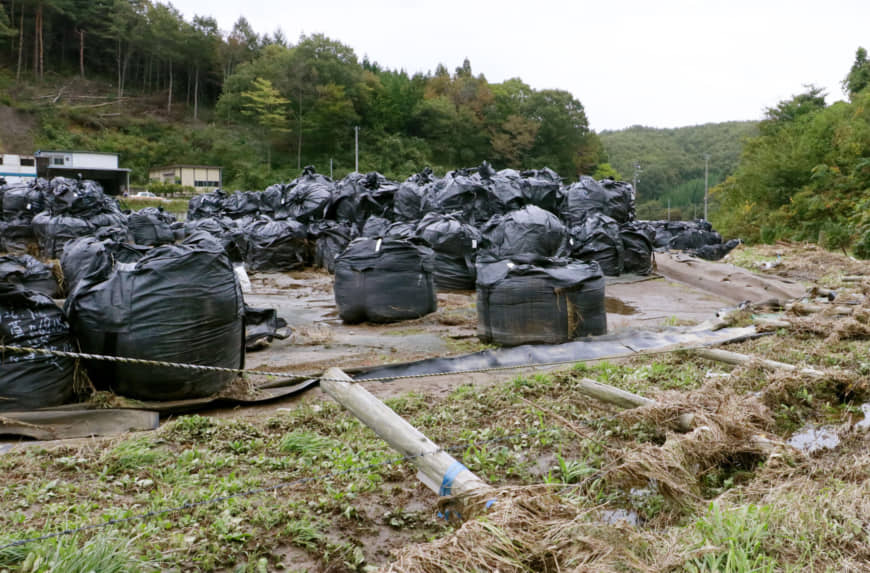
Contaminated Fukushima soil stored in flood zones, audit finds http://www.asahi.com/ajw/articles/14359377?fbclid=IwAR3vSQl1UVoSDAqpoxsL8nYsWhRVPVM55o749Uw1NXEJ9FtvOxh6aquOyq8, By RYOTA GOTO/ Staff Writer, May 27, 2021 Many of the temporary storage sites for soil and waste contaminated by radiation from the crippled Fukushima No. 1 nuclear power plant are located in areas vulnerable to natural disasters, a government audit found.
The Board of Audit of Japan submitted an investigative report to the Diet on May 26 warning the central government to address the contaminated materials that would be in jeopardy in the event of disasters such as landslides and flooding caused by heavy rains, or tsunami.
The board studied the Environment Ministry’s reviews of the temporary storage sites for contaminated soil and designated radioactive waste from October 2019 to April 2020, and took issue with some of its assessments.
The results show 159 out of 170 sites in Fukushima Prefecture, where contaminated soil resulting from the accident at Tokyo Electric Power Co.’s Fukushima No. 1 nuclear plant is being temporarily stored, are within areas deemed vulnerable to landslides and flooding from heavy rain.
The ministry had surveyed locations but concluded that preventive measures were not necessary at 158 sites because the materials were fenced in or the contaminated soil was stored in bags and covered by liner sheets.
As for the remaining location, the ministry moved the contaminated soil to an intermediary storage site.
In nine prefectures including Fukushima, 130 of 379 locations that store contaminated waste are in areas expected to be flooded or hit by landslide in the event of a disaster.For 117 locations, the ministry concluded it is unnecessary to take preventive measures because the waste is stored inside buildings.
But for 13 locations, the ministry said discussion is needed over the necessity of taking preventative measures.
he board said the ministry’s reviews did not include a check of whether each site is located in an area considered vulnerable to tsunami or flooding. The ministry had reasoned that embankments or other obstacles are either in place or under construction, and that the need to take measures against a potential tsunami is low and any impact from a reservoir collapsing would be limited.
But the audit board surveyed 153 temporary storage sites for contaminated soil and found that five of them are vulnerable to a tsunami and three are vulnerable to reservoir flooding.
The board said the ministry needs to consider residents’ concerns about the potential of a leak of contaminated materials, check if the areas are vulnerable to disasters and take preventive measures.
The ministry responded to the audit by defending that it “prioritized quickly securing storage sites at the time and did not have time to check the sites against a hazard map.”
A representative of the Fukushima prefectural government admitted some mistakes were made.
“We knew the locations of storage sites but failed to think about disaster-prevention measures,” the representative said.
New technology comes nowhere close to solving the problem of nuclear waste
New technology comes nowhere close to solving the problem of nuclear waste, Toronto Star, By Thomas Walkom May 27, 2021 What is to be done with nuclear waste? It is a question that dominates the Atomic Age. It is also one that has never been satisfactorily answered…..
nuclear waste is a relentless certainty. A plant that produces nuclear power creates nuclear waste. It is that simple.But what to do with that waste? Up to now, the assumption was that such waste would be buried in deep geological caverns, or repositories. Two potential sites for such repositories have been identified — one in Northwestern Ontario and one near Lake Huron. The usual political battles are being waged over whether either or both sites are safe.
But over the last few years, more attention has been paid to a different solution — using radioactive waste as fuel to create more nuclear power from so-called small modular reactors (SMRs). The governments of Saskatchewan, Ontario and New Brunswick have been particularly interested in developing this new SMR technology.
One New Brunswick start-up, Moltex Energy of Saint John, has received $50.5 million in federal funds.
The new technology has its critics. In the first place, it can create new and even more dangerous radioactive waste. As the Globe and Mail reports, Moltex says it produces an impure form of plutonium as a waste byproduct from its SMRs. Pure plutonium is used in the manufacture of atomic bombs.
Indeed, some nuclear experts, including former senior U.S. officials, were so alarmed that seven of them took the unusual step of penning an open letter this week to Prime Minister Justin Trudeau.
In that letter, they warned that reprocessing waste in a manner that creates plutonium would undermine global efforts to limit nuclear proliferation.
They also noted that the new technology wouldn’t solve the waste problem. Rather, it would just produce different kinds of nuclear waste.
“Moltex, even in the R&D stage, would create a costly legacy of contaminated facilities and radioactive waste streams and require substantial additional government funding for cleanup,” the letter said.
All of this is true. But none of it is enough to derail the new interest in SMR technology. Governments like it because it promises to be cheaper to build than classic Pickering-style nuclear power plants. The nuclear industry sees it as a political lifeline at a time when atomic power is not particularly popular.
So regardless of what its critics say, don’t expect this new technology to fade away. It may not be the silver bullet that its adherents claim it to be. It comes nowhere close to solving the waste problem.
But it is supported by important political constituencies. History has shown how crucial this support has been to the nuclear industry. https://www.thestar.com/opinion/contributors/2021/05/27/new-technology-comes-nowhere-close-to-solving-the-problem-of-nuclear-waste.html
New research highlights need for international standards to safeguard against plutonium ”hot” particles.

New study delves into issues relating to soils around Maralinga region, https://www.portlincolntimes.com.au/story/7262167/study-shows-radioactive-particles-from-nuclear-testing-persist-at-maralinga, Luca Cetta,
A new study has highlighted the first international standards needed to safeguard against contamination from nuclear testing, and a Kokatha Elder says the impact of nuclear testing at Maralinga cannot be forgotten.
More than 100 kilograms of highly toxic uranium and plutonium was dispersed in the form of tiny ‘hot’ radioactive particles after nuclear tests were conducted by the British in remote areas of South Australia, including Maralinga.
Scientists have new evidence these radioactive particles persist in soils to this day, more than 60 years after the detonations.
The British detonated nine nuclear bombs and conducted nuclear tests in South Australia between 1953 and 1963.
There had previously been limited understanding in how plutonium was released from the particles into the environment for uptake by wildlife around Maralinga.
The new study, published in Nature’s Scientific Reports, led by Monash University researchers, warns the hot particles are more complex and varied than previously thought.
Currently, there are no international best practice standards for the environmental impact or risk assessment of plutonium and uranium-rich hot particles released during nuclear testing.
This study provides the first mechanism for future modelling to predict the environmental life cycle of plutonium from hot particles, including how they are slowly broken down in the environment over a long period, and potentially exposed to animals and humans through inhalation, soil or ground water.
“The resulting radioactive contamination and cover-up continues to haunt us,” lead study author from Monash University’s School of Earth, Atmosphere and Environment Dr Megan Cook said.
“The results of our study profoundly changes our understanding of the nature of hot particles at Maralinga – despite the fact that those were some of the best studied particles anywhere in the world.”
Sue Haseldine, who grew up in the Koonibba district in the 1950s and 1960s, has long campaigned against nuclear testing and weapons.
She has been part of the International Campaign to Abolish Nuclear Weapons (ICAN), an organisation awarded the Nobel Peace Prize in 2017, and has spoken about her experience growing up in the shadow of nuclear testing at Maralinga.
Ms Haseldine said the people in the area had long-suspected there were health issues deriving from those tests.
“Experts would tell you that radiation will not last for 60 years, nor 60,000, but for a long, long time, and it is still causing troubles today,” she said.
“The old ladies told me these cancers and illnesses were not around before the bomb and over the years I have seen the rates go up.
“There are a lot more younger people with heart problems – it is known that radiation problems can cause heart diseases – and it is coming down through the generations.”
Ms Haseldine said the testing and fallout from Maralinga was not spoken about enough and that was why her campaigning with ICAN was so important.
“It is important to let people know what the government’s legacy is to us through their testing and we have to keep the past alive to protect the future, so they don’t do it to future generations,” she said.
“I grew up in the Koonibba district, but the radiation didn’t just stay in the Maralinga area.”
Study co-author professor Joël Brugger said the study invited a revisit of the implications of earlier results for the fate of plutonium at Maralinga.
“Understanding the fate of hot particles in the arid environment setting of the Australian outback is critical for securing Australia in case of nuclear incidents in the region, and returning all the native land affected by the British tests to the traditional Anangu owners of the Maralinga Tjarutja lands.”
The research team used synchrotron radiation at the Diamond Light Source near Oxford in the United Kingdom to decipher the physical and chemical make-up of the particles.
At Monash, they dissected some of the hot particles using a nano-sized ion beam, and further characterised the complex make-up of these particles down to the nano-size.
“It’s a major breakthrough,” study co-author associate professor Vanessa Wong said.
“Our observations of the hot particles from Maralinga provide a clear explanation for the complex and variable behaviour of different hot particles with respect to the chemical and physical weathering that has hindered predictive modelling to this day.
“This study provides a mechanistic foundation for predicting the future evolution of hot particles from high-temperature nuclear events and the likely exposure pathways.”
The researchers demonstrated the complexity of the hot particles arose from the cooling of polymetallic melts from thousands of degrees Celsius in the explosion cloud during their formation.
“We found that the particles contained low-valence plutonium-uranium-carbon compounds that are typically highly reactive – which is unexpected for particles that survived for over 30 years in the environment,” corresponding author Dr Barbara Etschmann said.
Russia launches a mission to investigate te Komsomolets, Soviet nuclear submarine sunk 32 years ago .
Bellona 25th May 2021, Russian scientists have embarked on a mission to the Komsomolets, a Soviet nuclear submarine that sank 32 years ago during an onboard fire off Norway’s northern coast, killing 41, in a bid to determine whether the wreck presents threats to the undersea environment.
The scientists, from Rosgidromet, Russia’s state weather agency which also measures radiation, set sail from Arkhangelsk last week aboard the Professor Molchanov research vessels, reaching the accident site over the weekend, Russian media reported.
Russia launches mission to the sunken Komsomolets nuclear submarine
1 This Month
26 September – International Day for the Total Elimination of Nuclear Weapons





PLEASE OPPOSE HR 8255 AND S.3639 – bills would accelerate satellite deployment, with no environmental review or safeguards – https://ncstd5li.quorum.us/campaign/169331/
To see nuclear-related stories in greater depth and intensity – go to https://nuclearinformation.wordpress.com
-
Archives
- September 2026 (290)
- August 2026 (330)
- July 2026 (355)
- June 2026 (287)
- May 2026 (306)
- April 2026 (356)
- March 2026 (251)
- February 2026 (267)
- January 2026 (308)
- December 2025 (358)
- November 2025 (359)
- October 2025 (375)
-
Categories
- 1
- 1 NUCLEAR ISSUES
- business and costs
- climate change
- culture and arts
- ENERGY
- environment
- health
- history
- indigenous issues
- Legal
- marketing of nuclear
- media
- opposition to nuclear
- PERSONAL STORIES
- politics
- politics international
- Religion and ethics
- safety
- secrets,lies and civil liberties
- spinbuster
- technology
- Uranium
- wastes
- weapons and war
- Women
- 2 WORLD
- ACTION
- AFRICA
- Atrocities
- AUSTRALIA
- Christina's notes
- Christina's themes
- culture and arts
- Events
- Fuk 2022
- Fuk 2023
- Fukushima 2017
- Fukushima 2018
- fukushima 2019
- Fukushima 2020
- Fukushima 2021
- general
- global warming
- Humour (God we need it)
- Nuclear
- RARE EARTHS
- Reference
- resources – print
- Resources -audiovicual
- Weekly Newsletter
- World
- World Nuclear
- YouTube
-
RSS
Entries RSS
Comments RSS

