EPA Withdraws Disastrous Trump-Era Radioactive Roads Approval
If dispersed, the material would present an unreasonable public health threat stemming from the appreciable quantities of radium-226, uranium, uranium-238, uranium-234, thorium-230, radon-222, lead-210, polonium-210, chromium, arsenic, lead, cadmium, fluoride, zinc, antimony and copper phosphogypsum contains.
EPA Withdraws Disastrous Trump-Era Radioactive Roads Approval
Use of Phosphogypsum in Roads Poses Risk of Cancer, Genetic Damage https://biologicaldiversity.org/w/news/press-releases/epa-withdraws-disastrous-trump-era-radioactive-roads-approval-2021-07-02/
ST. PETERSBURG, Fla.— The Biden administration announced it is withdrawing approval given by the Trump administration to use phosphogypsum in construction. The retracted approval had allowed the use of toxic, radioactive waste in constructing roads in parts of the United States prone to sinkholes and erosion.
“Allowing phosphogypsum in roads was a boneheaded, short-sighted favor to the industry,” said Jaclyn Lopez, Florida director at the Center for Biological Diversity. “While the withdrawal cites technical deficiencies in the applicant’s petition, this action is consistent with 30 years of science showing that phosphogypsum poses a substantial risk to humans and the environment.”
In December 2020 environmental, public health and union groups, represented by Earthjustice, sued the Environmental Protection Agency for approving phosphogypsum use in roads. The groups also petitioned the agency to reconsider its approval.
Phosphogypsum is the radioactive waste of fertilizer production. Phosphate ore, mined largely in Florida, is transported to fertilizer plants for processing by chemically digesting the ore in sulfuric acid. For every ton of phosphoric acid produced, the fertilizer industry creates five tons of radioactive phosphogypsum waste.
Since 1989 the EPA has required phosphogypsum to be stored in mountainous piles called “stacks,” and limited the amount of radon gas that can be emitted from the stacks. If dispersed, the material would present an unreasonable public health threat stemming from the appreciable quantities of radium-226, uranium, uranium-238, uranium-234, thorium-230, radon-222, lead-210, polonium-210, chromium, arsenic, lead, cadmium, fluoride, zinc, antimony and copper phosphogypsum contains.
In approving phosphogypsum use in roads, the agency ignored its own expert consultant, who found numerous scenarios that would expose the public — particularly road-construction workers — to a cancer risk the agency considers to be unacceptably dangerous.
The approval would have permitted phosphogypsum to be used in roads within 200 miles of phosphogypsum storage stacks, most of which are in Florida. It would have affected hundreds of protected plants and animals and their critical habitat.
“Phosphate companies should not be allowed to carelessly spread their waste around by mixing it into roads,” said Glenn Compton, chair at ManaSota-88.
“It is the height irresponsibility for any industry to needlessly expose the public and the environment to otherwise avoidable radiation and hazardous waste.”
Florida has 1 billion tons of radioactive phosphogypsum in 25 stacks, including the Piney Point and New Wales gypstacks. The disastrous Piney Point phosphogypsum stack recently discharged more than 200 million gallons of wastewater into Tampa Bay, where there is now a red tide bloom.
The Florida Department of Environmental Protection has drafted a permit approving an expansion of the New Wales stack by 230 acres.
The fertilizer industry adds approximately 30 million tons of phosphogypsum waste each year. The majority of the stacks are in Florida, but they can also be found in Arkansas, Idaho, Illinois, Iowa, Louisiana, Mississippi, Missouri, North Carolina, Texas, Utah and Wyoming.
“This is great news at a time when we could all use some,” said Brooks Armstrong, president at People for Protecting Peace River. “We will continue in our effort to make known the dangers of phosphogypsum and its continued production.”
This proposal to utilize radioactive materials in roads throughout Gulf communities was just another insult to folks already overburdened with pollution,” said Matt Rota, senior policy director of Healthy Gulf. “We are glad to see this decision to not use radioactive phosphogypsum in local roads and hope that this is a step toward systematically addressing the myriad impacts of phosphate mining and production in the Gulf States.”
“The EPA recognizes that at minimum the prior administration erred in its approval by not following its own rules regarding required information, and that there is no implicit sequencing toward approval based on an applicant’s request,” said Craig Diamond, vice chair of the Sierra Club Florida chapter executive committee. “Further, the EPA affirmed it has authority to pre-approve only select applications of phosphogypsum and road construction is not among those. The Sierra Club is grateful that the federal agency charged with protecting the environment and our health is once again taking the job seriously.”
The danger of Japan’s increasing stockpile of plutonium
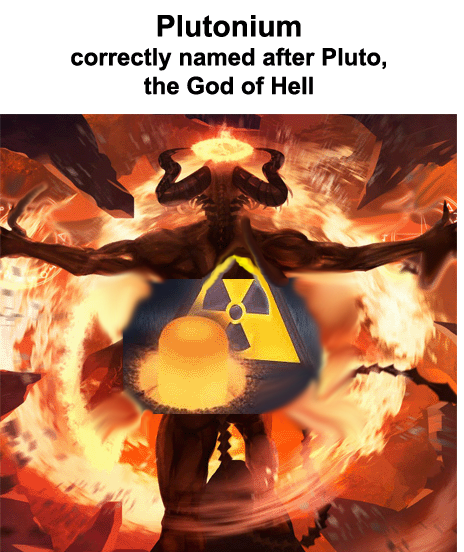
Japan’s plutonium stockpile climbs to 46.1 tons in 2020, first rise in 3 years, July 10, 2021 (Mainichi Japan) TOKYO — Japan was in possession of a total of some 46.1 metric tons of plutonium at home and abroad as of the end of 2020, the Cabinet Office reported to the Japan Atomic Energy Commission (JAEC) on July 9. The amount represents an increase of about 0.6 tons from the previous year.
The JAEC had stated that the country would reduce its plutonium stockpile under guidelines revised in July 2018, and the amount in its possession had been on a downward trend since then. The reported increase was the first in three years.
Plutonium is extracted from spent nuclear fuel generated at nuclear plants, for the purpose of recycling. However, the international community has expressed concerns over Japan’s large plutonium stockpile, saying it could be converted into nuclear weapons.
According to the Cabinet Office report, the latest increase in the nation’s plutonium stockpile was due to the addition of roughly 0.6 tons that had been stored in Britain after being extracted from nuclear fuel but which had not been included in the stockpile due to delayed procedures. As the extraction of plutonium in Britain and France has been completed, Japan has no more unrecorded stockpiles, according to the report.
Plutonium is mixed with uranium to produce mixed oxide (MOX) fuel for use at nuclear power plants. However, none of the nuclear plants in Japan used MOX fuel in 2020. As a result, the domestic stockpile remained at the same level as the previous year, at roughly 8.9 tons.
If the nuclear fuel reprocessing plant operated by Japan Nuclear Fuel Ltd. in the village of Rokkasho, Aomori Prefecture, goes into full operation in fiscal 2023, Japan’s plutonium stockpile will increase. However, only 0.6 tons of plutonium is expected to be extracted from spent fuel at the plant in fiscal 2023………….https://mainichi.jp/english/articles/20210710/p2a/00m/0na/018000c
Nuclear injustice in New Mexico must end.
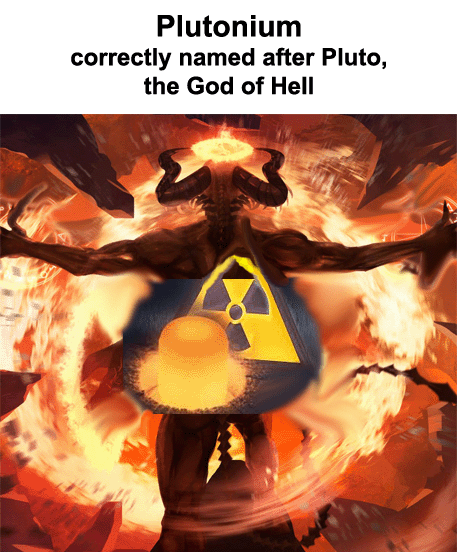
The half-life of plutonium-239 is 24,100 years, but the WIPP safety assessment period is limited to 10,000 years.
Nuclear injustice in NM must end https://www.abqjournal.com/2408088/nuclear-injustice-in-nm-must-end-ex-proposed-storage-sites-for-snf-could-create-dangers-far-greater-than-those-posed-by-wipp.html BY DENNIS MCQUILLAN 11 July 21,
New Mexico residents have long endured disproportionately high health and environmental risks from nuclear energy and weapons programs. It is time for the federal government to protect citizens of the state with the greatest possible level of safeguards.
Instead of performing critical site-suitability analyses for the Waste Isolation Pilot Plant (WIPP) and for two proposed spent nuclear fuel (SNF) “storage” sites near WIPP, federal agencies attempted to validate their predetermined conclusions that these sites were safe. The agencies either disregarded or rewrote siting criteria to accommodate their decisions to approve these sites.
WIPP is intended to provide deep geologic isolation of nuclear waste from the biosphere and, indeed, waste is buried 2,150 feet underground in 250-million-year-old salt beds. The following WIPP safety deficiencies, however, need resolution:
The half-life of plutonium-239 is 24,100 years, but the WIPP safety assessment period is limited to 10,000 years.
• For years, the federal government asserted that petroleum resources were minimal to nonexistent below WIPP. But, today, WIPP is surrounded by oil and gas operations in the most prolific oil patch in the United States. The risk that oil drilling may penetrate the repository, or that liquids injected during fracking, advanced recovery and produced water disposal may migrate into WIPP salt beds, must be reevaluated.
Risks from an artesian brine aquifer, deep-seated salt dissolution and from highly pressurized brine pockets that underlie the WIPP salt beds are not fully assessed.
The geochemical mobility of plutonium and uranium, and possible interactions with carbon dioxide generated by waste decomposition and with geologic brine, needs further analysis.
Additional prevention is needed for such human errors as the 2014 accident where plutonium contaminated nitrate salt packed with organic kitty litter generated heat, burst a waste drum, contaminated 21 workers, and released americium and plutonium into the atmosphere.
WIPP is certified to accept only national defense waste. The federal government, after spending decades and millions of dollars, failed to establish a permanent disposal site for spent nuclear fuel from commercial reactors. SNF is highly radioactive and toxic due to fission byproducts created during power generation.\
The federal government now proposes to license two commercial facilities near WIPP, one in New Mexico and one in Texas, for the “storage” of SNF for up to 120 years. Unlike the deep geologic isolation at WIPP, the proposed SNF storage facilities are less than 100 feet deep, in young alluvium, and in a region with shallow groundwater, as well as concerns about ground subsidence and sinkholes. These two sites are geologically unsuitable even for SNF “storage” and it is possible that decades of “storage” could morph into permanent disposal. Excavating SNF that has deteriorated underground for 120 years is a lurid scenario. Or will future engineers build a Chernobyl-style sarcophagus with the hope that it isolates the waste for 24,000 years?
The proposed “storage” sites for SNF could create dangers far greater than those posed by WIPP. Agricultural and petroleum industry organizations expressed concerns that the SNF facilities could damage their livelihoods. Attorney General Balderas sued the federal government to stop these ill-conceived and dangerous proposals to store SNF.
The legacy of nuclear injustice in New Mexico must end. The federal government must:
• Resolve WIPP safety deficiencies
• Disallow the reckless “storage” of spent nuclear fuel
• Establish one or more permanent repositories for SNF that provide geologic isolation
The 44 year process for demolishing TEPCO’s Fukushima No. 2 nuclear station, – with nowhere to put the radioactive trash.
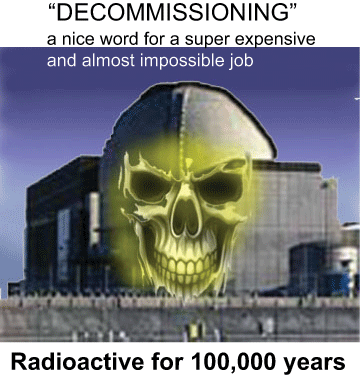
TEPCO grants 1st peek at work to scrap Fukushima No. 2 plant, http://www.asahi.com/ajw/articles/14389389 THE ASAHI SHIMBUN, July 7, 2021
Work to prepare for the decommissioning of Tokyo Electric Power Co.’s Fukushima No. 2 nuclear plant is under way in Fukushima Prefecture, a mammoth project the operator plans to complete in about 44 years.
However, TEPCO has not yet secured a location to dispose of a large amount of radioactive waste, a difficult task that it plans to tackle in the years to come.
The project is expected to prove an enormous challenge to TEPCO as the utility needs to proceed with it while simultaneously taking on the even more formidable task of cleaning up the crippled Fukushima No. 1 nuclear plant.
Together, 10 reactors are housed at the two plants: four at the No. 2 plant and six at the No. 1 plant.
The company will need to train workers for the decommissioning, secure a workforce for the lengthy project that will span decades, and put measures in place to ensure the safety of the facilities when hit by natural disasters such as torrential rain, earthquakes and tsunami.
On July 6, reporters were granted access to the decommissioning work at the Fukushima No. 2 plant so they could show the work to the public for the first time since the process began on June 23.
The No. 2 plant is located on the coastal side of the towns of Tomioka and Naraha, and the work on July 6 revolved around decontamination at its No. 1 reactor building.
Donning protective gear, 12 workers from TEPCO and contractors cleaned up pipes around water tanks with a high-pressure washer in a room for inspecting the equipment that inserts and removes control rods from the reactor core.
The work to decommission the No. 2 plant will be divided into four stages, with each stage spanning a decade or so, according to TEPCO.
In the first stage, operators will focus on decontaminating the facility to prepare for the following stages.
After that, TEPCO expects to move on to the second stage, which involves the demolition and removal of equipment surrounding the nuclear reactors. The reactors will be dismantled and cleared in the third stage, and then finally the reactor buildings in the fourth stage.
“We are determined to steadily and safely proceed with the decommissioning work while gaining support and understanding from local residents,” said Takaki Mishima, the head of the plant.
Perhaps the most crucial question that must be resolved will be where high-level and low-level waste that will be produced from the decommissioning process should be temporarily stored before a permanent disposal site is found.
A total of 9,532 spent nuclear fuel rods–highly radioactive materials–are stored at the plant.
Fukushima officials are demanding they be removed from the prefecture by the time the decommissioning wraps up in fiscal 2064.
But no municipalities in Japan want to accept and house such dangerous materials in their backyards.
TEPCO estimates the amount of low-level radioactive waste will total 52,000 tons.
To dispose of the waste, it needs to be buried underground at a depth from several meters to more than 70 meters from the surface, depending on the levels of radioactivity.
But as of now, no potential sites in Japan for temporary storage have been determined, not to mention a final disposal site.
“That is a question we will address later,” an official from the utility said.
Although the Fukushima No. 2 plant was damaged by the Great East Japan Earthquake and tsunami of 2011, it was spared from a meltdown and has been idle since.
TEPCO’s decision to pull the plug on the plant came at the insistence of the prefectural government and local residents.
(This article was compiled from reports by Shigetaka Kodama, Tetsuya Kasai, Yu Fujinami and Tsuyoshi Kawamura.)
New Mexico leaders oppose Holtec nuclear waste site proposal

The opposition contended the project posed too much risk and could upend other major industries in the region like agriculture …
”This leaves us extremely concerned that ‘interim’ storage sites …. will become the country’s de facto permanent nuclear waste storage facilities. We cannot accept that result.”
New Mexico leaders oppose Holtec International nuclear waste site proposed near Carlsbad, Adrian HeddenCarlsbad Current-Argus 6 Jul 21, New Mexico’s top Democrat political leaders voiced their opposition to a proposed storage facility for nuclear waste to be built near Carlsbad and Hobbs, warning the U.S. Department of Energy that the site could become a perpetual dumping ground as a permanent repository does not exist.
Holtec International applied for a 40-year license to build a consolidated interim storage facility (CISF) at a remote location near the Eddy-Lea county line, through the federal Nuclear Regulatory Commissions (NRC) in 2017.
The company signaled it planned to file for subsequent licenses to continue to operate the facility during 20 phases which would total more than 100,000 metric tons of waste when complete.
The site would be designed to hold spent nuclear fuel rods, brought in via rail from nuclear power plants around the country, on a temporary basis while a permanent repository is built….
The opposition contended the project posed too much risk and could upend other major industries in the region like agriculture and fossil fuels.
In the July 2 letter, New Mexico Democrat U.S. Sens. Martin Heinrich and Ben Ray Lujan, U.S. Rep. Melanie Stansbury (D-NM) and New Mexico Gov. Michelle Lujan Grisham said Holtec’s proposal contained no plan for permanent disposal of the waste and thus risked leaving it in New Mexico forever.
Lujan Grisham was a frequent critic of the project since its inception, calling the proposal “economic malpractice” for the risk she said it posed to other industries.
The lawmakers also opposed a similar proposal to expand a facility owned by Waste Control Specialists in Andrews, Texas along that state’s western border with New Mexico, to also hold the spent fuel.
“We are strongly opposed to the interim storage of spent nuclear fuel (SNF) and high-level waste (HLW) in New Mexico. There is currently no permanent disposal strategy for SNF and HLW in place at the Department of Energy,” the letter read.
“This leaves us extremely concerned that ‘interim’ storage sites with initial 40-year leases, like one proposed for (the NRC) licensing in New Mexico, will become the country’s de facto permanent nuclear waste storage facilities. We cannot accept that result.”
New Mexico had already seen the impacts of radiation exposure, the letter read, resulting from uranium mining and other activities in the state………….. https://www.currentargus.com/story/news/local/2021/07/06/new-mexico-leaders-oppose-holtec-nuclear-waste-site-near-carlsbad/7872429002/
Residents of Andrews County, Texas, speak out against plan for high level nuclear waste dump.

Andrews County commissioners hear from public on nuclear waste proposal, –Caitlin Randle, MRT.com/Midland Reporter-Telegram July 6, 2021, ANDREWS,
During a packed special meeting of the Andrews County Commissioners’ Court on Tuesday, residents spoke out against plans by the company Waste Control Specialists to store high-level nuclear waste.Andrews County Judge Charlie Falcon said he called the meeting to discuss whether the court should pass a resolution stating their opposition to the storage of high-level waste in the county.
….. Several residents said they were against bringing high-level waste to the community and asked the commissioners to pass a resolution opposing the project. Some also said they were angry at WCS, which currently operates a low-level waste site in Andrews, for promising that they would never store high-level waste then going back on that promise………..
Julie Stevenson, who said she was a nurse and lifelong Andrews resident, spoke to the court about the medical side effects from exposure to radiation. She said low-level radiation poisoning is akin to receiving 100 to 150 X-rays, while mid-level exposure can cause your gastrointestinal tract to shut down.
“High-level, you will die within three days,” she said. “I don’t want to take that risk for my children. I’m sure you have a lot of geologists speaking with you … but they’re looking at charts, graphs, they’re not looking at my 7-year-old son and my 87-year-old grandfather……… https://www.mrt.com/news/local/article/Andrews-County-commissioners-hear-from-public-on-16297025.php
Taiwan Shuts Another Reactor as Part of Nuclear-Free Goal,
Taiwan Shuts Another Reactor as Part of Nuclear-Free Goal, Jul 7, 2021, Power, by Darrell Proctor
Taiwan’s move to end the country’s use of nuclear power continues, with Unit 1 of the Kuosheng Nuclear Power Plant being shut down. The reactor was taken offline at the end of June, six months ahead of its scheduled Dec. 27 retirement, with officials saying spent fuel-storage capacity constraints meant the unit could not be refueled…..
Taiwanese President Tsai Ing-wen has made closing the country’s nuclear power plants a goal of her administration, saying the three remaining reactors will go offline by mid-2025. The 985-MW Kuosheng unit, which officials said generated about 3% of the nation’s total electricity, is the third of what were six operating reactors to be shuttered……
Decommissioning Plan
Taipower first proposed its decommissioning plan for Kuosheng Unit 1 in 2018, and it was approved by the Atomic Energy Commission (AEC) in October 2020. The plan included construction of a dry storage facility for used fuel, but a dispute between the city of New Taipei and Taipower has delayed the project.
Officials in New Taipei have yet to issue a permit for the storage facility, which would house the used fuel rods from Unit 1. The New Taipeil government has said it does not want a permanent spent nuclear fuel storage facility within the city……..
Tsai, who took over as Taiwan’s first female president in 2016, is the leader of the Democratic Progressive Party (DPP). The DPP has championed a “nuclear-free homeland.” The president in her opening remarks at the renewable energy-focused EnergyTaiwan event in October 2020 called on Taiwan to be “a leading center of green energy in the Asia-Pacific region.”
New policy initiatives have supported that goal, including amendments to the country’s Electricity Act that mandated nuclear power generation be ended no later than 2025. The government has said it expects moving away from coal-fired and nuclear power, and support of gas-fired generation and renewable energy, will generate about $36 billion in investment in the country’s energy sector by 2025, along with creating 20,000 jobs………..
Voters also on Aug. 28 will be asked about a plan to restart construction of the Lungmen Nuclear Power Plant 4. That plant, designed with two General Electric advanced BWR reactors and generation capacity of 2,700 MW, was expected to be completed in 2004 after construction began in 1999. Numerous delays, cost overruns, and government opposition put the project on hold in 2014. Even if voters approve a restart, analysts have said it’s unlikely the project would resume under the current administration. https://www.powermag.com/taiwan-shuts-another-reactor-as-part-of-nuclear-free-goal/
Taiwan on its path toward denuclearization
Taiwan on its path toward denuclearization. The Taiwanese government shut
down the No. 1 generator at its Kuosheng Nuclear Power Plant in Wanli
District, New Taipei City, on Thursday (July 1) to prepare for the unit’s
full closure.
The nuclear generator went online on Dec. 28, 1981. A General
Electric Boiling Water Reactors Type-6 model, the unit was licensed to run
for 40 years, which will expire on Dec. 27, 2021. It has produced more than
270 billion kilowatt-hours (kWh) of electricity for the past 40 years as
well as 800 tons of radioactive waste, according to the Environment
Information Center.
The generator is being decommissioned early because the
spent fuel pool is nearly at capacity. If the generator keeps operating,
there will be not be enough space to store nuclear waste, the Taiwan Power
Company (TPC) explained.
Taiwan News 4th July 2021
The world is bequeathing to our descendants the costly nightmare of unsolved nuclear waste disposal
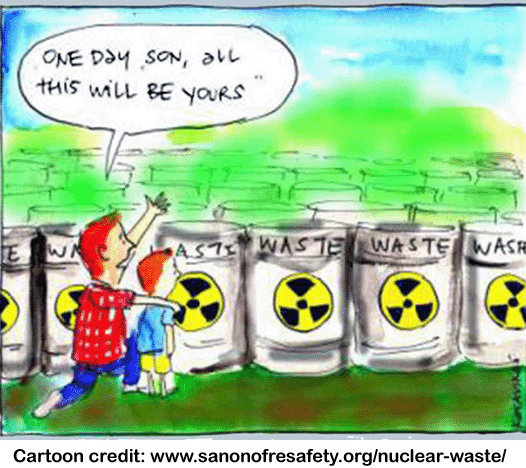
Nuclear legacy is a costly headache for the future, https://climatenewsnetwork.net/nuclear-legacy-is-a-costly-headache-for-the-future/
June 28th, 2021, by Paul Brown How do you safely store spent nuclear waste? No-one knows. It’ll be a costly headache for our descendants.
LONDON, 28 June, 2021 − Many states are leaving future generations an unsolved and costly headache: how to deal with highly dangerous nuclear waste.
The decision to start closing down the United Kingdom’s second generation of nuclear power stations earlier than originally planned has highlighted the failure of governments to resolve the increasingly expensive problem of the waste they leave behind them.
Heat-producing radioactive spent fuel needs constant cooling for decades to avoid catastrophic accidents, so future generations in countries that have embraced nuclear power will all be paying billions of dollars a year, every year, for at least the next century or two to deal with this highly dangerous legacy.
A report by the Organisation for Economic Cooperation and Development (OECD) and its Nuclear Energy Agency looks at 12 member countries facing the problem: Belgium, Canada, Finland, France, Germany, Japan, South Korea, Spain, Sweden, Switzerland, the UK and the US.
The report shows that none of the 12 has yet got to grips with the legacy bequeathed by producing nuclear waste. None has any means yet of disposing of it. It says every country must quickly realise that the money the industry has put aside to deal with the problem is inadequate, leaving successive future generations with the bill for keeping themselves safe.
Failure to progress
Finland is closest to dealing with the internationally preferred route for making spent nuclear fuel safe: building an underground repository in rocks deep underground to store and ultimately seal up the waste in this final burial place.
The Finns have actually started building such a facility and regard it as the complete solution to the problem, even though it is still decades away from completion.
Finland’s progress is a shining example to the rest of the nuclear world. International rules require countries that create nuclear waste to deal with it within their own borders − yet most governments have failed to make progress on doing so. Some have spent decades looking for a suitable site and have failed to find one.
This has often been because local opposition has forced governments to abandon a chosen location, or because scientists judge the site too dangerous to store wastes for the required 100,000 years or so, because of poor geology. They may suspect a risk that the radioactivity could leak into water supplies, or rise to the surface and kill unwary future generations.
The funding shortfall has become much more problematic because of low inflation and the current Covid pandemic. Governments previously put money aside on the assumption that economies would constantly grow and positive interest rates would create massive long-term investments.
But the current low or negative return on government bonds means investments made in the past and designed to pay huge future bills will no longer be enough to deal with the cost of spent fuel and other high-level wastes.
The report says governments’ assumptions have proved optimistic. It is not directly critical of governments, but points out that “the polluter pays” principle is not being applied. New funding needs to be found, it says, if future generations are not to be saddled with this generation’s expensive and life-threatening legacy.
The UK, one of the pioneer nuclear states because of its race to develop a nuclear bomb, is a classic example of leaving the grandchildren to pay for past and present nuclear wastes.
As early as 1976, in the Flowers Report on nuclear power and the environment, the UK was warned that it should not build any more nuclear power stations until it had found a way of getting rid of the waste. The government agreed.
Since then, for more than 40 years, successive governments have been looking for a repository to make good on their promise. But none has yet been found, and none is expected until the current target date of 2045.
True cost unknown
Yet the OECD says the original nuclear weapons programme, plus the first generation of nuclear stations, now all closed, are costing today’s taxpayers US$4.58 billion a year (£3.3bn) just to manage the waste and keep the population safe. The cost is around $185bn (£133bn) for 17 sites over 120 years. There could be liabilities of another $200bn (£144bn) to restore the installations to greenfield sites.
The second generation of nuclear stations can call on the Nuclear Liabilities Fund, set up by the UK government when the French company EDF took over the newer British advanced gas cooled reactors (AGRs) in 2009 so that money from electricity sales could be invested to pay for de-fuelling and decommissioning at the end of their lives. The first of these, Dungeness B, on the English Channel coast, started de-fuelling this month.
The cost of dismantling this generation of reactors is estimated at $28.57bn (£20.59bn) by EDF − $10bn more than the Nuclear Liabilities Fund provides for. This shortfall is almost certainly a large under-estimate because the actual cost of closing the stations and storing the waste is unknown, let alone that of restoring the sites to greenfield conditions.
Partly this is because AGRs have never yet been taken out of service before there is a disposal route for the waste. If none is found, taxpayers will have to pay to keep it safe in closely managed stores for many decades.
Despite this, the current UK government is now building a new nuclear station at Hinkley Point in the West of England, and wants to build many more. Meanwhile the mounting financial liabilities for future generations who will need to keep the waste safe in a time of climate change are left unresolved. And so the costly headache remains for countless generations to come. − Climate News Network
Five good reasons to support the City of Ottawa’s request for a regional assessment of radioactive waste disposal projects in the Ottawa Valley.
Concerned Citizens of Renfrew County and Area
Working for 40+ years to prevent radioactive pollution in the Ottawa Valley, Canada. Five good reasons to support the City of Ottawa’s request for a regional assessment of radioactive waste disposal projects in the Ottawa Valley. On April 14, 2021, the City of Ottawa council passed a resolution regarding the Chalk River and Rolphton radioactive waste disposal projects; this is in addition to resolutions from 140 municipalities, the Anishinabek Nation, the Iroquois Caucus, and the Assembly of First Nations.
Before the resolution was passed by the entire Ottawa City Council, it was considered and unanimously adopted by the City of Ottawa’s environment committee after an eight-hour meeting on the 30th. March 2021 (see the presentation on YouTube). Among other things, the resolution calls on Minister Jonathan Wilkinson of the Environment and Climate Change to undertake a regional assessment of radioactive waste disposal projects in the Ottawa Valley under the Assessment Act. impact sanctioned in 2019. (See letter from Mayor Jim Watson to Minister Wilkinson.)
Here are five reasons to support the City of Ottawa’s request to Minister Jonathan Wilkinson.
1. Radioactive waste in the Ottawa Valley is a very large and complex problem. This is the lion’s share of “legacy” radioactive waste for which the federal government is responsible, a liability of $ 8 billion to Canadian taxpayers.
Radioactive waste that is currently at the Canadian Nuclear Laboratories site at Chalk River, upstream from Ottawa-Gatineau, constitutes the bulk of the Canadian government’s $ 8 billion nuclear liability liability. This federal liability for radioactive waste clean-up liability exceeds the total sum of 2,000 other federal environmental liabilities. This federal environmental responsibility, Canada’s largest and most complex, requires the best and most comprehensive assessment available under the new Impact Assessment Act.
2 The proposed radioactive waste disposal projects in the Ottawa Valley are mediocre, highly controversial, and fail to address several aspects essential to the cleanup required.
The radioactive waste mound project, called the Near Surface Waste Management Facility (IGDPS) at Chalk River and the Rolphton Reactor Entombment Project ("NPD Closure Project") are inadequate, low budget proposals which aim to rapidly and inexpensively reduce the liability for federal nuclear liabilities in Canada. Both projects were proposed five years ago by a consortium of private companies under a contract awarded by the Harper government in 2015. The proposals do not take into account the International Agency's security standards. atomic energy; these proposals were deemed insufficient in the thousands of critical comments made by indigenous communities, municipalities, former scientists and managers of AECL, NGOs, citizen groups and individuals........... more https://concernedcitizens.net/2021/06/30/cinq-bonnes-raisons-dappuyer-la-requete-de-la-ville-dottawa-pour-une-evaluation-regionale-des-projets-delimination-des-dechets-radioactifs-dans-la-vallee-de-loutaouais/
Dounreay nuclear waste clean-up- an enormous job, for just a temporary solution.
| WORK to clean-up the radioactive waste in the shaft and silo at Dounreay is underway and has been described as “one of the most significant decommissioning projects” at the site. Radioactive waste was historically consigned to the 65-metre deep shaft and the silo, an underground waste storage vault, over several decades starting in the late 1950s. Now the higher activity waste must be retrieved and repackaged, suitable for long-term storage in a safe modern facility. John O’Groat Journal 27th June 2021 https://www.johnogroat-journal.co.uk/news/shaft-and-silo-work-at-dounreay-is-underway-242653/ |
French corporation EDF will close down all 7 of its advanced gas-cooled reactor nuclear power stations in Britain within the next decade.
French-based global power developer EDF Energy vowed to put all seven of its advanced gas-cooled reactor nuclear power stations in the United Kingdom into the defueling and decommissioning stages within the next decade.
The company’s agreement with the UK government calls for shutting down the AGR stations by 2030. At that point EDF’s generating capacitywill consist of Sizewell B, HPC, potentially Sizewell C (currently under construction) and renewables including solar, onshore and offshore wind.
Power Engineering 25th June 2021
Radioactive Waste Contaminates the Land and Water
The U.S. Nuclear Weapons Program Left ‘a Horrible Legacy’ of Environmental Destruction and Death Across the Navajo Nation Inside Climate News, By Cheyanne M. Daniels, Amanda Rooker, June 27, 2021 ”……………Radioactive Waste Contaminates the Land and Water
Uranium is recovered from the earth in two ways. The first is conventional mining of the ore, in which miners dig the rock out of open pits that strip away the topsoil. The second, which is the most common extraction method in the United States, pumps chemicals into groundwater to dissolve uranium from the rock, known as “situ leaching.”
After the extraction, the ore is taken to mills, where it is crushed, ground up and dissolved to be solidified, dried and packaged.
Regardless of the extraction method, mining and milling uranium leaves behind radioactive waste that contaminates water and the land, according to the Environmental Protection Agency. Waste from open pit mines is often left in piles outside the mine, while tailings from the milling process remain radioactive and contain hazardous chemicals.
“Wind can blow radioactive dust from the wastes into populated areas and the wastes can contaminate surface water used for drinking. Some sites also have considerable groundwater contamination,” according to the EPA website.
The EPA is conducting water studies at three areas on the reservation that have been affected by historical mining to “inform future investigations and potential cleanups by EPA and private parties.”
The Journal of Contemporary Water Research & Education said in a June 2020 study that while high concentrations of uranium and arsenic may be found naturally in some areas, contamination is “especially troublesome on the Navajo Nation, where past (uranium) mining activity may have contaminated water supplies.”
Out of 82 unregulated wells sampled for the study, nine exceeded the maximum contaminant level for drinking water standards for uranium and 14 exceeded standards for arsenic. Because of these contaminants, a study published by the Journal of Vacuum Science & Technology in March 2020 found that nearly 30 percent of Navajo homes had to rely on hauling water to meet their needs.
The lack of drinking water affects not only the Navajo living on the reservation, but their livestock and land usability, as well.
The EPA began investigating the effects of the uranium mines in the Cove region in January 2015, after a settlement from Tronox, a company spun off from Kerr-McGee in 2006, provided almost $4.4 billion for cleanup of more than 50 abandoned uranium mines. Forty-two of the mines are on or near the Navajo Nation, which received $45 million in the settlement, and 32 are in the Cove area, where more than 7 million tons of ore were mined, according to the EPA.
The funds allowed for the assessment and cleanup of 230 of the 523 abandoned uranium mines across the reservation, which is ongoing. In the Northern Abandoned Uranium Mine Region, where the Cove Chapter is located, 121 of the 229 mines are targeted in the cleanup process.
Kerr-McGee was among the companies that extracted a total of 30 million tons of uranium ore from the Navajo land from 1944 until 1986. In his testimony in March before the House Judiciary Subcommittee on the Constitution, Civil Rights and Civil Liberties, Nez, the Navajo Nation president, said that “not a single one” of the 523 abandoned mines on Navajo lands “has been cleaned up properly.” https://insideclimatenews.org/news/27062021/nuclear-weapons-navajo-nation-uranium-mining-environmental-destruction-health/
Senator Markey urges the NRC to improve safety and security of nuclear decommissioning process.
SENATOR MARKEY URGES THE NRC TO IMPROVE SAFETY AND SECURITY OF NUCLEAR DECOMMISSIONING PROCESS, https://www.markey.senate.gov/news/press-releases/senator-markey-urges-the-nrc-to-improve-safety-and-security-of-nuclear-decommissioning-process In a letter, Markey requests stricter safeguards as 23 nuclear power plants, including the Pilgrim Nuclear Power Station, undergo decommissioning in the U.S.
Washington (June 25, 2021) – Senator Edward J. Markey (D-Mass.), Chair of the Subcommittee on Clean Air, Climate, and Nuclear Safety in the Senate Committee on Environment and Public Works, today sent a letter to the Nuclear Regulatory Commission (NRC), urging the agency to address safety and security concerns before approving the draft rule, “Regulatory Improvements for Production and Utilization Facilities Transitioning to Decommissioning,” and putting out a proposed rule for public comment. “The Nuclear Regulatory Commission must prioritize the safety and security of the nuclear plants it oversees,” said Senator Markey. “As currently written, the proposed rule would allow the NRC and plant operators to cut corners on safety and limit public participation, which is critical to the decommissioning process. The communities around our nuclear plants deserve better than this.”
A copy of the letter can be found HERE.In his letter, Senator Markey requests that the NRC:
- propose a defined and exact set of rules on how plants should navigate the decommissioning process;
- improve public participation during the NRC’s consideration of any license transfers requested in connection with a nuclear plant’s decommissioning process;
- acknowledge and address the fact that spent fuel could remain onsite for long periods of time, perhaps indefinitely; and
- reevaluate its proposal to reduce financial protections for offsite and onsite liability claims for plants that are in the process of decommissioning.
Senator Markey also requests that the NRC ensure that the twenty-three nuclear reactors, such as Pilgrim Nuclear Power Station, that have already begun the decommissioning process adapt their operations to reflect stronger standards. The NRC should also establish the proper checks to ensure the safety and security of the eight additional nuclear power plants that have already declared their intent to decommission. Senator Markey has consistently urged the NRC to prioritize safety and public participation in the nuclear decommissioning process. Last Congress, Senator Markey reintroduced the Dry Cask Storage Act, which was aimed at improving the storage of spent nuclear fuel at nuclear plants across the nation.
As the Pilgrim Power Station commenced its decommissioning process, Senator Markey continued to fight to ensure that the NRC prioritized safety and public participation. In August 2019, Senators Markey and Elizabeth Warren (D-Mass.), and Representative William Keating (MA-09) wrote to the NRC to urge it to delay ruling on the proposed license transfer for Pilgrim from Entergy Nuclear Operations, Inc. to Holtec International until after the Commission considered and ruled on extant petitions and motions. In October 2018, Senator Markey and Rep. William demanded clear details from Holtec and Entergy about the safety and security issues involved in the ownership, transfer, and eventual decommissioning of the power plant.
China’s plans for a huge nuclear waste bunker
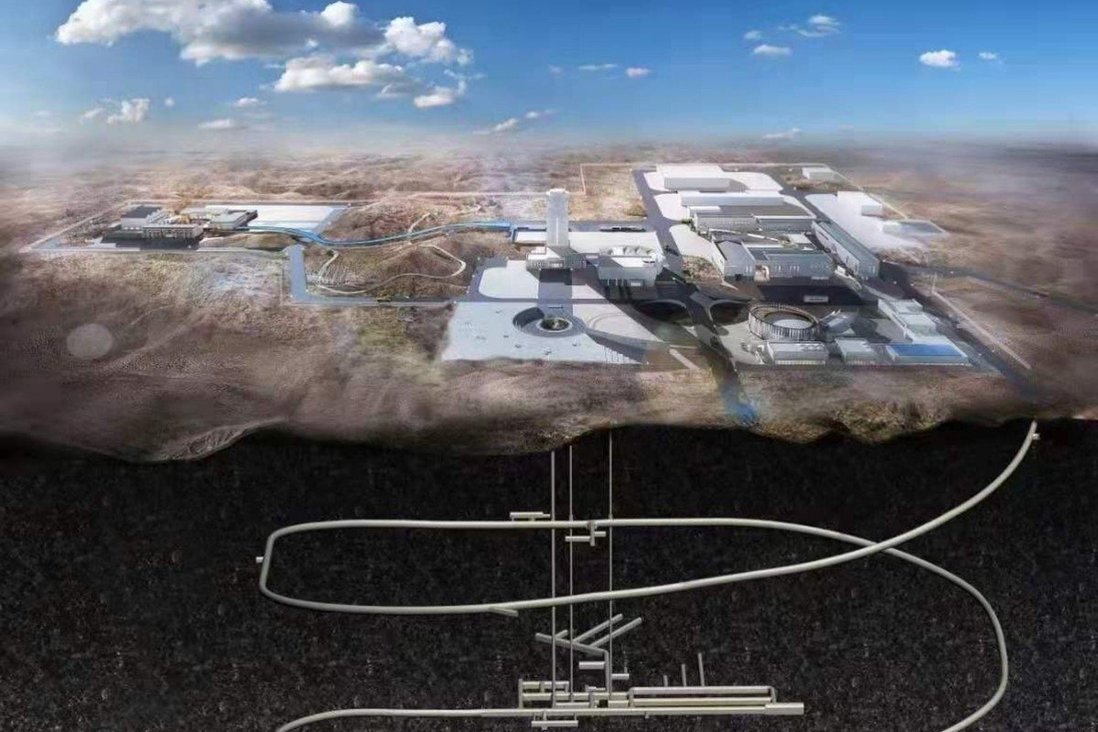
China builds bunker to test whether nuclear waste can be dumped underground, SCMP
Lab more than 500 metres underground in the Gobi Desert will be the world’s largest of its kind
If research there is successful, a long-term underground dump for high-level radioactive waste could be built, helping to address a global problem
China has started building a laboratory deep underground in the Gobi Desert to assess whether it would be a suitable location for a nuclear waste dump, amid moves to expand its nuclear power capacity.
The Beishan Underground Research Laboratory in the northwestern province of Gansu will be used to research long-term storage of high-level radioactive waste. With its deepest level to be built 560 metres (1,837 feet) below ground, it will be the world’s largest lab of its kind, according to the ChinaNuclear Energy Association, which promotes nuclear power.
- The world has about a quarter of a million tonnes of highly radioactive waste, all kept in “temporary” storage. No country has found a solution for permanent deep geological storage, with public opposition often a factor.
- China’s attempt to find an answer comes at a time when it plans to build a fleet of new reactors. Disposal of high-level radioactive waste is becoming more critical as it uses more nuclear power and tries to become carbon neutral
……. It is estimated that the lab will cost over 2.7 billion yuan (US$400 million), take seven years to build and operate for 50 years. If research proves the site to be suitable, a long-term underground repository for high-level radioactive waste will be built nearby by 2050, Wang Ju, chief designer of the lab, told state media in April………. https://www.scmp.com/news/china/science/article/3138484/china-builds-bunker-test-whether-nuclear-waste-can-be-dumped
1 This Month
26 September – International Day for the Total Elimination of Nuclear Weapons





PLEASE OPPOSE HR 8255 AND S.3639 – bills would accelerate satellite deployment, with no environmental review or safeguards – https://ncstd5li.quorum.us/campaign/169331/
To see nuclear-related stories in greater depth and intensity – go to https://nuclearinformation.wordpress.com
-
Archives
- September 2026 (290)
- August 2026 (330)
- July 2026 (355)
- June 2026 (287)
- May 2026 (306)
- April 2026 (356)
- March 2026 (251)
- February 2026 (267)
- January 2026 (308)
- December 2025 (358)
- November 2025 (359)
- October 2025 (375)
-
Categories
- 1
- 1 NUCLEAR ISSUES
- business and costs
- climate change
- culture and arts
- ENERGY
- environment
- health
- history
- indigenous issues
- Legal
- marketing of nuclear
- media
- opposition to nuclear
- PERSONAL STORIES
- politics
- politics international
- Religion and ethics
- safety
- secrets,lies and civil liberties
- spinbuster
- technology
- Uranium
- wastes
- weapons and war
- Women
- 2 WORLD
- ACTION
- AFRICA
- Atrocities
- AUSTRALIA
- Christina's notes
- Christina's themes
- culture and arts
- Events
- Fuk 2022
- Fuk 2023
- Fukushima 2017
- Fukushima 2018
- fukushima 2019
- Fukushima 2020
- Fukushima 2021
- general
- global warming
- Humour (God we need it)
- Nuclear
- RARE EARTHS
- Reference
- resources – print
- Resources -audiovicual
- Weekly Newsletter
- World
- World Nuclear
- YouTube
-
RSS
Entries RSS
Comments RSS

