Very quietly, NRC plans mass shipments of high level radioactive waste.
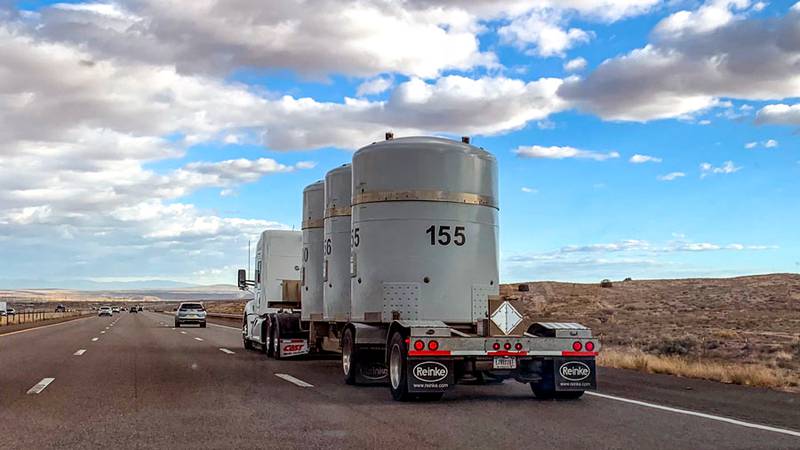
Critics of the proposed licensing are demanding that the Atomic Safety and Licensing Board halt the Holtec licensing because it is illegal.
Plans for Mass Shipments of High-Level Radioactive Waste Quietly Disclosed https://www.counterpunch.org/2022/01/07/plans-for-mass-shipments-of-high-level-radioactive-waste-quietly-disclosed/ BY JOHN LAFORGE
How far is your house or apartment from a major highway, or railroad line? Do you want to play Russian roulette with radioactive waste in transit for 40 years?
Last month US Nuclear Regulatory Commission (NRC) staff quietly reported preparing for tens of thousands of cross-country shipments of high-level radioactive waste from nuclear reactors to the desert Southwest. The oft-disparaged US infrastructure of decrepit of roads, faulty bridges, rickety rails, and rusty barges may not be ready for such an onrush of immensely heavy rad waste casks.
Continue readingBBC Report on Closure of Hunterston B Fails to Mention that All the Nuclear Crapola will Come to Cumbria
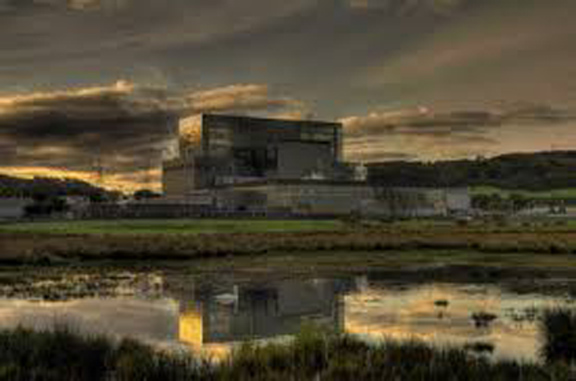
BBC Report on Closure of Hunterston B Fails to Mention that All the Nuclear Crapola will Come to Cumbria. Radiation Free Lakeland. JANUARY 8, 2022 BY MARIANNEWILDART Radiation Free Lakeland have long argued for the closure of the cracked nuclear plants that EDF are running long past their planned lifetimes. Yesterday one of these cancer factories, Hunterston B was closed down because of the dangerously cracked graphite cores. The BBC report below toots a trumpet about the electricity produced by Hunterston but makes no mention at all of the 46 years of radioactive emissions and the fact that the resulting nuclear wastes (low, intermediate and high level wastes) and “cleaned up” infrastructure ( heading to landfill, incineration, recycled radioactive scrap metal, Drigg and proposed Deep Nuclear Dump ) will be dangerous to all life on the biosphere for so many generations to come. Yes lets toot a trumpet for the closure of a dangerous nuclear plant but the massive radioactive footprint of Hunterston will live on long after the limited use of electricity!
Hunterston B nuclear power plant closes down after 46 years
By Kevin Keane
BBC Scotland’s energy correspondent 7th Jan 2022 The Hunterston B nuclear power plant in North Ayrshire has been shut down for the final time after generating electricity for 46 years.
The plant’s original 25-year lifespan was extended by more than two decades.
But the final closure was brought forward after cracks were found in the graphite bricks which make up the reactor cores.
A small group of former workers gathered at the power station at midday to see the final shut down.
The site, owned by EDF Energy, will now begin a three-year process of defueling with the spent nuclear fuel sent to Sellafield for reprocessing. After that, the site will be handed over to the Nuclear Decommissioning Authority…………
The cracks were first spotted in two graphite bricks in the reactor in 2014.
By 2018, a total of 350 bricks had been affected although the Office for Nuclear Regulation subsequently gave permission to operate at much greater numbers.
Each of the two reactor cores is made up of 3,000 bricks which form vertical channels for nuclear fuel and control rods to slide in and out.
The concern was that too many cracks, combined with a rare seismic event, could affect the structural integrity of the core and prevent it being shut down in an emergency.
The Hunterston A plant, which is already closed, comprised two 180MWe Magnox reactors.
It began operation in 1964. Reactor 2 shut down in December 1989 and Reactor 1 in March 1990.
Construction of Hunterston B began in 1968 and reactors 3 and 4 began operating in February 1976 and March 1977……
Reactor 3, a 490MWe advanced gas-cooled reactor (AGR), was permanently closed down on 26 November.
Hunterston Reactor 4 – also a 490MWe AGR – has now shut down……….
Similar cracks are expected to develop there and at several other similar sites in England. In December, EDF Energy announced that Torness would close two years earlier than planned in 2028 because of the issue. https://mariannewildart.wordpress.com/2022/01/08/bbc-report-on-closure-of-hunterston-fails-to-mention-that-all-the-nuclear-crapola-will-come-to-cumbria/
Concerns in New Mexico, about taking in out-of-state nuclear waste, as Waste Isolation Pilot Plant has limited space.
Waste Isolation Pilot Plant criticized for accepting out-of-state nuclear waste, Adrian Hedden, Carlsbad Current-Argus, 8 Jan 22, About 200 shipments of nuclear waste were sent to the Waste Isolation Pilot Plant repository near Carlsbad last year for disposal in an underground salt deposit, but New Mexico officials continued criticism that most of the shipments were coming from out of state.
Waste disposed of at WIPP is known as transuranic (TRU) nuclear waste, made up of clothing materials and equipment irradiated during nuclear activities at U.S. Department of Energy facilities across the nation.
TRU waste is shipped from Los Alamos National Laboratory (LANL) in northern New Mexico, but also from sites like Idaho National Laboratory in Idaho or Savannah River Site in North Carolina.
Of the 210 shipments recorded in 2021, per DOE records, 55 or 26 percent came from LANL. Another 21 came from Oak Ridge National Laboratory in Tennessee, eight came from Savannah River, two came from Lawrence Livermore National Laboratory in California and one came from Waste Control Specialists in Andrews, Texas.
The other 123 shipments, or about 58 percent of WIPP shipments last year were from Idaho National Laboratory, where research is conducted on nuclear reactors.
In total, 74 percent or about three quarters of WIPP’s shipments last year came from out of state.
The State of Idaho entered into a settlement agreement with the DOE in 1995 to prioritize waste shipments from its national laboratory to an out-of-state location: the WIPP site in New Mexico.
But that prioritization is a problem for New Mexico Rep. Christine Chandler (D-43).
Her district represents Los Alamos County, home to LANL, and Chandler said because New Mexico accepts the risk of the waste, its facilities that generate nuclear waste should be given top priority for disposal.
“I feel very strongly that since the WIPP is in New Mexico, and New Mexico accepts the risk for operating that plant that NM waste should be prioritized,” Chandler said. “That would mostly mean from LANL.
“They have a settlement with Idaho and so shipments from there are prioritized to the detriment of actual active sites like LANL.”……………………………..
Chandler’s concerns were echoed in a recent letter from NMED Cabinet Secretary James Kenney to the Government Accountability Office calling for federal oversight of DOE decisions related to the shipment priorities.
The Idaho settlement, Kenney argued, was entered without public input from New Mexicans who he said would bear the risk of disposal.
“The practice of DOE (Office of Emergency Management) solely managing waste shipments to WIPP from around the U.S. without first discussing with New Mexico stakeholders – including NMED as its regulator – now merits immediate congressional oversight,” Kenney wrote.
Other than pressuring federal regulators, Chandler said the State of New Mexico and lawmakers have little recourse to reprioritize disposal at WIPP to benefit their state.
“Truthfully, there is very little we can do. Most of the issues at Los Alamos are driven by federal law. Mostly, it’s placing pressure on the DOE to do the right thing for the state of New Mexico,” Chandler said.
“They need to recognize that LANL is the leading lab and it needs the Department’s full support in all things including clean up.”
Realigning shipment priorities could be achieved through the pending 10-year renewal of WIPP’s operating permit with NMED, said Don Hancock at Albuquerque-based watchdog group Southwest Research and Information Center.
He said regardless of priority for wastes from specific facilities, there is not enough room at WIPP for all the DOE’s waste and the federal government should develop alternate repositories.
WIPP is presently the nation’s only deep-geological repository that can dispose of nuclear waste off-site from where it is generated.
“The State of New Mexico now needs to be pushing on other approved repository sites to be permitted,” Hancock said. “They need to enforce the capacity limits. The DOE and Congress are going to have to start looking at alternatives.”………… https://www.currentargus.com/story/news/local/2022/01/07/wipp-criticized-accepting-out-state-nuclear-waste/9078220002/
UK: Blackburn and Darwen Council approving and old nuclear dump site for commercial development ?
A CONTROVERSIAL development site which residents and politicians fear is
above buried nuclear waste has been kept in the latest version of a
borough’s planning blueprint.
Blackburn with Darwen Council included the 94
acres of countryside near the M65’s Junction 5 in its draft local plan
published last year as suitable for employment uses.
But residents and WestPennine Tory councillor Julie Slater fear nuclear waste was dumped down old
mineshafts in the 1950s. Now following a consultation a new version of the
blueprint has been published and the the green belt land between Belthorn
and Guide remains earmarked as ideal for commercial and job-creating
development.
Lancashire Telegraph 7th Jan 2022
Hunterston nuclear station shut down – then comes the long cleanup
A at the stroke of midday on Friday,
January 7, the North Ayrshire Hunterston B nuclear plant will be shut down with the simple push
of a button. In the high-security control room, director Paul Forrest will
step forward and trigger the end for one of Scotland’s last nuclear power
stations.
Environmental campaigners said the final shutdown of Hunterston B
– which started producing electricity 45 years and 11 months ago – was
“inevitable”. Lang Banks, the director of WWF Scotland, said the plant
had become “increasing unreliable”, arguing that growth in renewable
energy means nuclear power is no longer required.
Mr Banks said the “repeated failure to solve the problem of hundreds of cracks in the
graphite bricks surrounding the reactor core means the closure of
Hunterston B was inevitable”. He added: “Thankfully Scotland has
massively grown its renewable power-generating capacity, which means
we’ll no longer need the electricity from this increasingly unreliable
nuclear power plant. “As the expensive and hazardous job of cleaning up
the radioactive legacy Hunterston leaves in its wake now begins, Scotland
must press on with plans to harness more clean, renewable energy.”
STV 7th Jan 2022
UK’s Heysham nuclear plant to shut down two years earlier than planned
The Heysham 2 nuclear power station in Lancashire is set to shut down for
good two years earlier than planned following a new assessment. The power
station, the fuel for which is made at the Springfields factory at Salwick,
will now stop generating power in 2028. In 2016, the site’s operational
life was extended by seven years to 2030 as no new power station projects
were in the pipeline and nuclear is needed to maintain a steady base load
for the electricity grid.
Blackpool Gazette 9th Jan 2022
The world’s greatest garbage dump – space !

441,449 LOW EARTH ORBIT SATELLITES. Operating, Approved and Proposed …………………..
THE WORLD’S LARGEST GARBAGE PIT
And not only do thousands of whole satellites threaten the heavens, but a phenomenal amount of debris orbits the earth as a result of satellites colliding, or exploding, or otherwise being destroyed while in space. During the 64 years that humans have been launching rockets, the protective blankets of the ionosphere and magnetosphere have become the Earth’s largest garbage pit.
According to the European Space Agency there are, in orbit around the Earth today, 7,790 intact satellites, of which 4,800 are functioning. Since 1957, there have been more than 630 breakups, explosions, collisions, and other satellite-destroying events. This has resulted in the creation of more than 9,700 tons of space debris. There are, in orbit today:
- 30,430 debris objects presently being tracked
- 36,500 objects larger than 10 cm in size
- 1,000,000 objects from 1 cm to 10 cm in size
- 330,000,000 objects from 1 mm to 1 cm in size
EFFECTS ON OZONE, EARTHQUAKES, AND THUNDERSTORMSOzone In a 2020 paper titled “The environmental impact of emissions from space launches: A comprehensive review,” Jessica Dallas and her colleagues at the University of New South Wales wrote that “ozone depletion is one of the largest environmental concerns surrounding rocket launches from Earth.”
In 2021, there were 146 orbital rocket launches to put 1,800 satellites into space. At that rate, to maintain and continually replace 100,000 low-earth-orbit satellites, which have an average lifespan of five years, would require more than 1,600 rocket launches per year, or more than four every day, forever into the future.
2020 and 2021 witnessed two of the largest Antarctic ozone holes since measurements began in 1979. The 2020 hole was also the longest-lasting on record, and the 2021 hole was only a few days shorter; larger than the continent of Antarctica, it began in late July 2021 and ended on December 28, 2021. Everyone is still blaming chlorofluorocarbons (CFCs), which were banned by the Montreal Protocol in 1978. Nobody is looking at rocket launches, of which there were more in 2020 and 2021 than in any previous year. In addition to the 146 orbital launches in 2021, there were 143 sub-orbital launches of rockets to over 80 kilometers in altitude, for a total of 289 high-altitude launches for the year, or almost one every day.
Earthquakes and Thunderstorms
Earthquakes and Thunderstorms
In 2012, Anatoly Guglielmi and Oleg Zotov reviewed evidence that the global use of electricity has an effect on both seismic activity and thunderstorms…………………………………………… Everyone is so focused on a virus, and on antennas on the ground, that no one is paying attention to the holocaust descending from space. https://www.cellphonetaskforce.org/wp-content/uploads/2022/01/441449-Low-Earth-Orbit-Satellites.pdf
Xcel in Minnesota wants to use different nuclear waste casks from the approved TN-40 type
Xcel seeks change in Prairie Island nuclear waste storage
The Minneapolis-based utility says it’s not seeking to store more spent nuclear fuel at the plant than the amount it was authorized in 2009. But Xcel wants flexibility to use a different type of storage cask as long as the design is approved by the federal Nuclear Regulatory Commission. News Tribune, By: Kirsti Marohn / MPR News, Jan. 4, 2022
BRAINERD, Minn. — Xcel Energy is asking state regulators for permission to change how it stores radioactive waste at its Prairie Island nuclear plant in Red Wing, Minnesota.
The Minneapolis-based utility says it’s not seeking to store more spent nuclear fuel at the plant than the amount it was authorized in 2009. But Xcel wants flexibility to use a different type of storage cask as long as the design is approved by the federal Nuclear Regulatory Commission.
Changing the storage technology likely would cut costs and make it easier to transport the waste to a future storage site outside of Minnesota, said Pam Gorman Prochaska, Xcel’s director of nuclear regulatory policy.
“That’s really the motivating factor behind this change request,” she said. “It’s saving our customers money, and it’s the ability to move the fuel off site sooner.”
Xcel’s request comes amid ongoing debate over what to do with growing stockpiles of spent fuel at the nation’s nuclear reactors, which can remain radioactive for thousands of years.
The federal government’s past efforts to establish a permanent storage site at Yucca Mountain, Nevada, stalled in the face of local opposition. The Biden administration recently announced plans to look for interim storage sites in communities that agree to accept it.
Meanwhile, a private company recently received approval from the Nuclear Regulatory Commission for an interim storage site in Texas, but it’s facing opposition from political leaders. A second interim storage site in southeast New Mexico is also seeking NRC approval…….
Xcel plans to continue operating the Prairie Island nuclear reactors through the end of their current licenses, which expire in 2033 and 2034. The utility says it hasn’t yet decided whether to seek an extension.
Change of design
In 2009, the Public Utilities Commission authorized Xcel to more than double the amount of waste it stores at Prairie Island to 64 casks. Currently, 47 casks at the plant have been loaded with spent fuel, Prochaska said.
The casks used to store waste at Prairie Island are a bolted metal cask known as TN-40, chosen in 1989. Prairie Island is the last plant still using that design, Prochaska said.
Most plants in the U.S. — including Monticello — are using a system of welded steel canisters that slide into a concrete bunker, she said.
Xcel says switching to a different cask design could allow the spent fuel to be transported to an off-site storage facility sooner.
The two interim storage sites in Texas and New Mexico could accept the canisters, but are not authorized to accept TN-40 casks, Prochaska said.
Local impacts
The Minnesota Department of Commerce decided that Xcel’s request warranted a supplemental environmental review, because it represents new information and raises environmental justice concerns related to the nearby Prairie Island Indian Community.
Heather Westra, a consultant for Prairie Island’s tribal council, which has objected in the past to storing nuclear waste at the plant, said the tribe doesn’t have specific safety concerns about Xcel’s request to switch cask designs, but is hoping that the change will speed up the movement of waste off Prairie Island.
“Whether you put an additional 20 TN-40 casks or 20 type-to-be-determined, the material is still there,” she said. “And so the larger problem still exists that the material is there, and it’s not going anywhere.”
Like other host communities, the tribe receives very little benefit from having a nuclear plant right next door, just 700 yards from the nearest homes, Westra said.
“This situation was not one of the tribe’s creation, but it’s nevertheless something that the tribe is burdened with,” she said.
Prochaska said a draft environmental impact statement will be completed early next year, and will be followed by additional public hearings before the Minnesota Public Utilities Commission decides on the request.
“Whether you put an additional 20 TN-40 casks or 20 type-to-be-determined, the material is still there,” she said. “And so the larger problem still exists that the material is there, and it’s not going anywhere.”
Like other host communities, the tribe receives very little benefit from having a nuclear plant right next door, just 700 yards from the nearest homes, Westra said.
“This situation was not one of the tribe’s creation, but it’s nevertheless something that the tribe is burdened with,” she said.
Prochaska said a draft environmental impact statement will be completed early next year, and will be followed by additional public hearings before the Minnesota Public Utilities Commission decides on the request.
Xcel also is seeking to extend the Monticello plant’s license until 2040, and is requesting authorization from the Public Utilities Commission to increase the amount of spent fuel stored there. That process could take two years, Prochaska said. https://www.duluthnewstribune.com/business/energy-and-mining/7339515-Xcel-seeks-change-in-Prairie-Island-nuclear-waste-storage
Progress in nuclear waste cleanup at Idaho nuclear site
US close to ending buried nuke waste cleanup at Idaho site, KEITH RIDLER, Associated Press, Jan. 3, 2022,
BOISE, Idaho (AP) — A lengthy project to dig up and remove radioactive and hazardous waste buried for decades in unlined pits at a nuclear facility that sits atop a giant aquifer in eastern Idaho is nearly finished, U.S. officials said.
The U.S. Department of Energy said last week that it removed the final amount of specifically-targeted buried waste from a 97-acre (39-hectare) landfill at its 890-square-mile (2,300-square-kilometer) site that includes the Idaho National Laboratory.
The targeted radioactive waste included plutonium-contaminated filters, graphite molds, sludges containing solvents and oxidized uranium generated during nuclear weapons production work at the Rocky Flats Plant in Colorado. Some radioactive and hazardous remains in the Idaho landfill that will receive an earthen cover.
The waste from Rocky Flats was packaged in storage drums and boxes before being sent from 1954 to 1970 to the high-desert, sagebrush steppe of eastern Idaho where it was buried in unlined pits and trenches. The area lies about 50 miles (80 kilometers) west of the city of Idaho Falls.
The cleanup project, started in 2005, is named the Accelerated Retrieval Project and is one of about a dozen cleanup efforts of nuclear waste finished or ongoing at the Energy Department site.
The project involving the landfill is part of a 2008 agreement between the Energy Department and state officials that required the department to dig up and remove specific types and amounts of radioactive and hazardous material.
The agency said it removed about 13,500 cubic yards (10,300 cubic meters) of material — which is the equivalent of nearly 50,000 storage drums each containing 55 gallons (208 liters).
Most of the waste is being sent to the U.S. government’s Waste Isolation Pilot Plant in New Mexico for permanent disposal. Some waste will be sent to other off-site repositories that could be commercial or Energy Department sites.
The Energy Department said it is 18 months ahead of schedule in its cleanup of the landfill.
“The buried waste was the primary concern of our stakeholders since the beginning of the cleanup program,” Connie Flohr, manager of the Idaho Cleanup Project for the Energy Department’s Office of Environmental Management, said in a statement. “Completing exhumation early will allow us to get an earlier start on construction of the final cover.”……
The Lake Erie-sized Eastern Snake River Plain Aquifer supplies farms and cities in the region. A 2020 U.S. Geological Survey report said radioactive and chemical contamination in the aquifer had decreased or remained constant in recent years. It attributed the decreases to radioactive decay, changes in waste-disposal methods, cleanup efforts and dilution from water coming into the aquifer. https://www.nhregister.com/news/article/US-eyes-finish-of-buried-nuclear-waste-cleanup-at-16746645.php
Growing radioactive waste crisis at Fukushima nuclear power plant

The continuous accumulation of radioactive slurry and other nasty substances, coupled with the problem of finding a safe way to dispose of melted nuclear fuel debris at reactors No. 1, No. 2 and No. 3, has plant operator Tokyo Electric Power Co. frantically scratching around for ideas.
One problem is that storage containers for the tainted slurry degrade quickly, meaning that they constantly have to be replaced.
TEPCO slow to respond to growing crisis at Fukushima plant, THE ASAHI SHIMBUN, by Yu Fujinami and Tsuyoshi Kawamura, January 2, 2022, Radioactive waste generated from treating highly contaminated water used to cool crippled reactors at the Fukushima No. 1 nuclear power plant has thrown up yet new nightmarish challenges in decommissioning the facility, a project that is supposed to be completed in 30 years but which looks increasingly doubtful.
The continuous accumulation of radioactive slurry and other nasty substances, coupled with the problem of finding a safe way to dispose of melted nuclear fuel debris at reactors No. 1, No. 2 and No. 3, has plant operator Tokyo Electric Power Co. frantically scratching around for ideas.
One problem is that storage containers for the tainted slurry degrade quickly, meaning that they constantly have to be replaced. Despite the urgency of the situation, little has been done to resolve the matter.
Fuel debris, a solidified mixture of nuclear fuel and structures inside the reactors melted as a consequence of the triple meltdown triggered by the 2011 earthquake and tsunami disaster has to be constantly cooled with water, which mixes with groundwater and rainwater rainwater that seep into the reactor buildings, producing more new radioactive water.
The contaminated water that accumulates is processed via an Advanced Liquid Processing System to remove most of radioactive materials. The ALPS is housed in a 17-meter-tall building situated close to the center of the plant site.
Reporters from the Japan National Press Club were granted a rare opportunity in late November to visit the crippled facility to observe the process.
The building houses a large grayish drum-like container designed especially to store radioactive slurry. The interior of each vessel is lined with polyethylene, while its double-walled exterior is reinforced with stainless steel.
ALARMING DEVELOPMENTS The use of chemical agents to reduce radioactive substances from the contaminated water in the sedimentation process produces a muddy material resembling shampoo. Strontium readings of the generated slurry sometimes reach tens of millions of becquerels per cubic centimeter.
TEPCO started keeping slurry in special vessels in March 2013. As of November, it had 3,373 of the containers.
Because the integrity of the vessels deteriorates quickly due to exposure to radiation from slurry, TEPCO and the Nuclear Regulation Authority (NRA) predict that durability of the containers will reach the limit after exposure to an accumulated total of 5,000 kilograys of radiation–a level equivalent to 5 million sieverts.
Based on that grim forecast, TEPCO speculated the vessels will need replacement from July 2025.
But the NRA accused TEPCO of underestimating the impact of the radiation problem. It blasted the operator for measuring slurry density 20 centimeters above the base of the container when making its dose evaluation.
“As slurry forms deposits, the density level is always highest at the bottom,” a representative of the nuclear watchdog body pointed out.

The NRA carried out its own assessment in June 2021 and told TEPCO that 31 containers had already reached the end of their operating lives. Its findings also showed an additional 56 would need replacing within two years.The NRA told TEPCO to wake up and “understand how urgent the issue is since transferring slurry will take time.”………………..
With no drastic solutions in sight, a succession of containers will reach the end of their shelf lives shortly.
ANOTHER NIGHTMARE PROBLEM Radioactive slurry is not the only stumbling block for decommissioning.
In the immediate aftermath of the 2011 disaster, TEPCO stored contaminated water in the underground spaces below two buildings near the No. 4 reactor. In doing so, bags full of a mineral known as zeolite were placed in the temporary storage pools to absorb cesium so as to reduce the amount of radioactive substances.
Twenty-six tons of the stuff are still immersed in the dirty water on the floors under the buildings. Radiation readings of 4 sieverts per hour were detected on their surfaces in fiscal 2019, enough to kill half of all the people in the immediate vicinity within an hour.
TEPCO plans to introduce a remotely controlled underwater robot to recover the bags, starting no earlier than from fiscal 2023, However, it has not determined how long this will take or where to store the bags once they are retrieved.
In addition, radioactive rubble, soil and felled trees at the plant site totaled 480,000 cubic meters as of March 2021, leading TEPCO to set up a special incinerator. The total volume is expected to top 790,000 cubic meters in 10 years, but where to dispose of the incinerated waste remains unclear.
TEPCO is in a race against time. That’s the view of Satoshi Yanagihara, a specially appointed professor of nuclear engineering at the University of Fukui who has specialist knowledge on processes to abandon reactors.
“Now, only 30 years remain before the target date of the end of decommissioning set by the government and TEPCO,” said Yanagihara.As decommissioning work is due to shortly enter a crucial stage, such as recovering nuclear fuel debris on a trial basis from as early as 2022, Yanagihara noted the need for careful arrangements before forging ahead with important procedures.
“The government and TEPCO need to grasp an overall picture of the massive task ahead and discuss how to treat, keep and discard collected nuclear debris and the leftover radioactive waste with local residents and other relevant parties,” he said.https://www.asahi.com/ajw/articles/14503708
Yucca Mountain remains in debate over nuclear waste storage

The Government Accountability Office report said most experts agree that building Yucca Mountain is neither socially nor politically viable
Yucca Mountain remains in debate over nuclear waste storage, By GARY MARTIN – Las Vegas Review-Journal, Jan 1, 2022
LAS VEGAS (AP) — Mounting opposition to proposed nuclear waste storage sites in Texas and New Mexico has kept Yucca Mountain in Nevada in the national debate over what to do with the growing stockpile of radioactive material scattered around the country.
The Biden administration is opposed to Yucca Mountain and announced plans this month to send waste to places where state, local and tribal governments agree to accept it. That stance is shared by Nevada elected officials, tribal leaders and business and environmental groups.
But until the 1987 Nuclear Waste Policy Act is changed by Congress, the proposed radioactive waste repository 90 miles north of Las Vegas remains the designated permanent storage site for spent fuel rods from commercial nuclear plants.
”That’s what worries me. Until you get a policy in place, it will always be something you have to watch,” U.S. Rep. Dina Titus, D-Nevada, told the Las Vegas Review-Journal.
An expert on atomic testing and American politics, Titus as a professor at the University of Nevada, Las Vegas wrote a 1986 book on Nevada’s nuclear past.
As an elected state and congressional lawmaker, she has opposed a permanent storage facility at Yucca Mountain.
Titus introduced legislation in past sessions of Congress that adopts recommendations by a 2012 Blue Ribbon Commission under the Obama administration to send the waste to states that want it.
Similar legislation has been filed in the Senate by Catherine Cortez Masto, D-Nevada, a former state attorney general who also has fought federal efforts to build a repository at Yucca Mountain.
The legislation has failed to pass, as lawmakers from both parties who represent states with nuclear power plants seek a quick solution to waste disposal.
“I’ve always fought misguided efforts to deposit nuclear waste in Nevada, and I’ll keep working with the Nevada delegation to pass my consent-based siting bill that would ensure these dangerous materials are never dumped on our state,” Cortez Masto said.
WASTES PILING UP
The Biden administration has since proposed to fund interim storage in light of the 30-year stalemate over Yucca Mountain, due to growing need to address stockpiles of radioactive waste at decommissioned and operating plants across the country.
As of 2019, about 86,000 metric tons of spent nuclear fuel was being stored at 119 sites, according to the Department of Energy.
There are about 95 power plants operating in 29 states, currently, generating 2,900 metric tons a year. And, there are 38 reactors in 30 states in various stages of decommissioning. The waste is stored in casks, a former Energy Department adviser, Robert Alvarez, told an Environmental and Energy Study Institute briefing last year.
The Government Accountability Office, the investigative arm of Congress, issued a report in September recommending storing the waste in places where local and state officials would agree to accept it. The reporting cited the dangerous characteristics of nuclear waste and need for safe disposal.
Energy Secretary Jen Granholm announced this month that the department was seeking recommendations from states, cities, industry officials and others on locations where officials were willing to accept spent fuel and materials.
The plan announced by Granholm is expected to take up to two years to research and determine costs.
The plan announced by the Department of Energy essentially restarts a process that began under the Obama administration with a recommendation from a Blue Ribbon Commission that suggested “consent-based siting” with local input as the most effective way to develop storage sites.
That did not occur in Nevada.
LONG HISTORY
Yucca Mountain was designated by Congress as the sole site for permanent storage in 1987 after other sites in Kansas, Tennessee and Utah were rejected. Since that time, more than $15 billion has been spent on research and exploration at Yucca Mountain.
Local opposition in Nevada, led by Democratic former Sen. Harry Reid and other state elected officials blocked development of the project, until President George W. Bush directed the Department of Energy to seek a construction license from the Nuclear Regulatory Commission.
The licensing process, however, was halted by President Barack Obama and by Reid, who as Senate majority leader pulled funding for the application. A federal court allowed funds already earmarked for licensing to continue to be spent.
President Donald Trump’s election brought a new push for licensing by Energy Secretary Rick Perry, who like Bush was a former Texas governor. Despite political opposition from former Nevada Republican Gov. Brian Sandoval and the entire state congressional delegation, the Trump administration pushed to develop Yucca Mountain.
Perry repeatedly told Congress that he was following the 1987 law as he moved forward on licensing for nuclear storage at the designated Yucca Mountain site.
But Trump later flip-flopped on Yucca Mountain as he sought re-election with Nevada a part of his campaign strategy.
After the election, the Biden administration budgeted funding for commercial operators to take control of some waste at interim sites.
ALTERNATIVES FACE OPPOSITION……………..
YUCCA NOT VIABLE
The Government Accountability Office report said most experts agree that building Yucca Mountain is neither socially nor politically viable……………https://www.coloradopolitics.com/yucca-mountain-remains-in-debate-over-nuclear-waste-storage/article_fbaf9e12-ea43-5bf1-82ab-c115bee4f770.html
Vermont nuclear decommissioning committee drafting advisory opinion on nuclear waste policy
Vermont nuclear decommissioning committee drafting advisory opinion on nuclear waste policy, WAMC Northeast Public Radio | By Pat Bradley December 31, 2021 The Department of Energy is taking suggestions on how to “site Federal facilities for the temporary, consolidated storage of spent nuclear fuel using a consent-based approach.” A committee of the Vermont Nuclear Decommissioning Citizens Advisory Panel is drafting an advisory opinion for the full panel to submit to the DOE.
At its latest meeting, Vermont Nuclear Waste Policy Committee Vice Chair Lissa Weinmann reviewed the status of the draft resolution that will be forwarded to the state’s full Nuclear Decommissioning Citizens Advisory Panel.
“The primary matter right now from what I can see with this language is that there’s a lot of concern that the Nuclear Waste Policy Act very explicitly outlines the requirement that a permanent repository be licensed before a consolidated interim storage facility be named or started,” Weinmann said. “So that is a point here. The DOE has asked for information regarding consent based siting for a consolidated interim storage facility.”
The Vermont Yankee Nuclear Power Plant, which began operating in 1972, shut down on December 29, 2014. According to the Nuclear Regulatory Commission all of the spent nuclear fuel was placed into dry cask storage. Decommissioning of the plant is expected to be completed by 2030.
Some committee members wondered if the national nuclear waste fund should be addressed in the state’s resolution. Citizens Awareness Network Vermont organizer Chris Williams raised concerns about references in the document to financing a waste repository.
“The nuclear waste fund was collected from ratepayers of record for the express purpose of building a repository,” Williams said. “To be without that money or operate without that cash in these times when we’re looking to build a repository would be very problematic. The language just doesn’t work for me.”……………
Advisory opinions on consent based siting must be submitted electronically to the Department of Energy by March 4, 2022. https://www.wamc.org/news/2021-12-31/vermont-nuclear-decommissioning-committee-drafting-advisory-opinion-on-nuclear-waste-policy
Hard to swallow the manipulations going on in nuclear waste decisions on UK’s Geological Disposal Facility
‘GDF flies in face of past decisions on storing nuclear waste’ https://www.newsandstar.co.uk/news/19816090.gdf-flies-face-past-decisions-storing-nuclear-waste/ David Kirkwood, 2 Jan 22,
Penrith ON December 20, I received an email informing me that Allerdale Borough Council leadership had held a meeting on November 24 and voted in favour of progressing the nuclear Geological Disposal Facility in Allerdale.
This statement was released amid the Omicron virus and Christmas festivities simply to bury the controversial news. It flies in the face of the two previous decisions rejecting the burying of nuclear waste material anywhere in Cumbria.
One of the main reasons was that the geology in Cumbria was unsuitable for a repository. Secondly, the most important reason was the population did not want it.
It is obvious why this decision has been reached, quite simply the local government reorganisation was engineered to try and invalidate the previous decisions taken by the soon-to-be-dismantled County Council.
Perhaps, someone from the Radioactive Waste Management can explain why a company called Genr8 North Ltd can be involved with both Allerdale Borough Council and Copeland Borough Council, if as they say they have no commercial interest in a nuclear geological disposal facility being built?
I find this very hard to believe.
This is just an attempt by a few individuals to brainwash the majority into acceptance. I’m certain in years to come the radioactive nuclear waste will be buried in Cumbria irrespective of the wishes of the resident population.
State of New Mexico demands federal investigation into Waste Isolation Pilot Plant (WIPP) and federal nuclear programs.
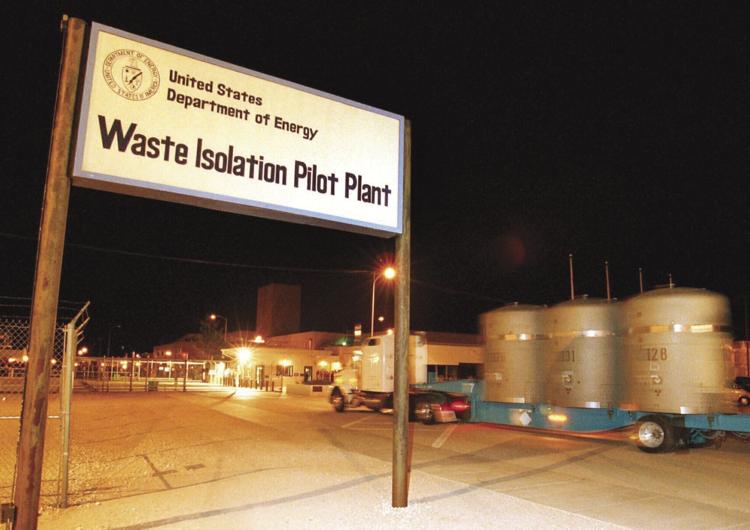
State of New Mexico demands feds investigate WIPP, federal nuclear programs
New Mexico Environment Department joins call from Congress for oversight, Adrian Hedden, Carlsbad Current-Argus , 31 Dec 21,
State concerned out-of-state waste prioritized over New Mexico’s
WIPP officials says waste shipments prioritized by availability
Congressional committee worried for ongoing “challenges” at DOE
Stronger oversight of the Waste Isolation Pilot Plant could be coming as the federal government was called on by New Mexico officials and members of Congress to address alleged problems with the U.S. Department of Energy’s environmental cleanup operations.
New Mexico Secretary of the Environment James Kenney expressed concerns for operations at WIPP in a letter to the federal Government Accountability Office (GAO), calling for the federal office to increase its oversight of the nuclear waste repository near Carlsbad.
Low-level transuranic (TRU) waste from around the country is disposed of at WIPP via burial in an underground salt deposit about 2,000 feet underground. It is owned and operated by the DOE and its Office of Environmental Management (EM) but is permitted and regulated by the New Mexico Environment Department (NMED) headed by Kenney.
In his Dec. 22 letter to the GAO, Kenney said the Office should review nuclear programs in New Mexico, including the prioritization of nuclear waste shipments to WIPP from facilities outside New Mexico.
He said first priority should be given to waste from Los Alamos National Laboratory (LANL) in northern New Mexico as the DOE intends to increase the production of plutonium pits.
“The WIPP is subject to an NMED operating permit and must adhere to the requirements of the permit in order to remain operable in New Mexico and in service to the nation,” Kenney wrote. “Yet, the DOE EM has entered into legally binding settlement agreements with states to prioritize waste shipments to WIPP at the expense of shipments from other states, including New Mexico.
“This is problematic for both the clean-up of legacy waste at LANL and new waste from pit production at LANL.”
Before the DOE entered into such agreements, as it had with the State of Idaho for cleanup at Idaho National Laboratory (INL) in 1995, Kenney said the agency should have first engaged with New Mexico stakeholders he said would bear the impacts of moving out-of-state nuclear waste into their state……………
“The practice of DOE EM solely managing waste shipments to WIPP from around the U.S. without first discussing with New Mexico stakeholders – including NMED as its regulator – now merits immediate congressional oversight,” Kenney wrote…………..
Kenney also voiced reservations about DOE officials allegedly seeking to “expand” the kinds of waste accepted at WIPP.
A recent DOE proposal sought to redefine high-level waste to consider the radiation level as opposed to the current method that considers where the waste was generated, potentially leading to more waste coming to WIPP, Kenney said.
Another concern, Kenney wrote, was a DOE-proposed “dilute and dispose” program that would see high-level plutonium processed to lower its radioactivity so it could meet WIPP requirements for TRU waste. https://www.currentargus.com/story/news/local/2021/12/30/state-new-mexico-demands-feds-investigate-wipp-doe-nuclear-programs/9034953002/
Strong local Council opposition to Hartlepool plan for hosting Britain’s nuclear waste dump .

Talks on multi-billion pound nuclear waste facility in Hartlepool stall amid lack of council support. Talks over Hartlepool potentially becoming home for a multi-billion pound development to store large amounts of nuclear waste underground have stalled.
Presentations on the controversial development for a Geological Disposal Facility were led by leaders of
Hartlepool community organisation The Wharton Trust earlier this year (2020). But the issue is unlikely to go any further after the leader of Hartlepool Borough Council and other political leaders spoke out strongly against it. ………………….
Councillor Shane Moore said: “I want to be absolutely clear with residents that I do not support any proposal to create a site for the disposal of nuclear waste here in Hartlepool and it is disappointing to hear that people are still trying to push this.
“I am not prepared to be the council leader that started the ball rolling to turn my hometown into the nuclear waste dump of the United Kingdom and frankly I don’t care how many pieces of silver are being offered.”
Hartlepool Mail 30th Dec 2021
1 This Month
15 October. Joint Appeal for Nuclear Abolition Day -presentation to the UN on October 15 will be live on UNWebTV
Endorse the Nuclear Abolition Day Appeal
23-25 October – on Zoom – World BEYOND War’s annual global conference

To see nuclear-related stories in greater depth and intensity – go to https://nuclearinformation.wordpress.com
-
Archives
- October 2026 (139)
- September 2026 (339)
- August 2026 (330)
- July 2026 (355)
- June 2026 (287)
- May 2026 (306)
- April 2026 (356)
- March 2026 (251)
- February 2026 (267)
- January 2026 (308)
- December 2025 (358)
- November 2025 (359)
-
Categories
- 1
- 1 NUCLEAR ISSUES
- business and costs
- climate change
- culture and arts
- ENERGY
- environment
- health
- history
- indigenous issues
- Legal
- marketing of nuclear
- media
- opposition to nuclear
- PERSONAL STORIES
- politics
- politics international
- Religion and ethics
- safety
- secrets,lies and civil liberties
- spinbuster
- technology
- Uranium
- wastes
- weapons and war
- Women
- 2 WORLD
- ACTION
- AFRICA
- Atrocities
- AUSTRALIA
- Christina's notes
- Christina's themes
- culture and arts
- Events
- Fuk 2022
- Fuk 2023
- Fukushima 2017
- Fukushima 2018
- fukushima 2019
- Fukushima 2020
- Fukushima 2021
- general
- global warming
- Humour (God we need it)
- Nuclear
- RARE EARTHS
- Reference
- resources – print
- Resources -audiovicual
- Weekly Newsletter
- World
- World Nuclear
- YouTube
-
RSS
Entries RSS
Comments RSS

