370,000 tonnes of highly radioactive, spent nuclear fuel in temporarystorage around the globe.
Sweden’s government gave the go-ahead on Thursday for the building of a storage facility to keep the country’s spent nuclear fuel safe for the next 100,000 years. What to do with nuclear waste has been a major headache since the world’s first nuclear plants came on line in the 1950s and 1960s. The International Atomic Energy Agency estimates that there is around 370,000 tonnes of highly radioactive, spent nuclear fuel in temporary storage around the globe. Nasdaq 27th Jan 2022 https://www.nasdaq.com/articles/sweden-approves-plan-to-bury-spent-nuclear-fuel-for-100000-years |
Can reactor fuel debris be safely removed from Fukushima Daiichi?
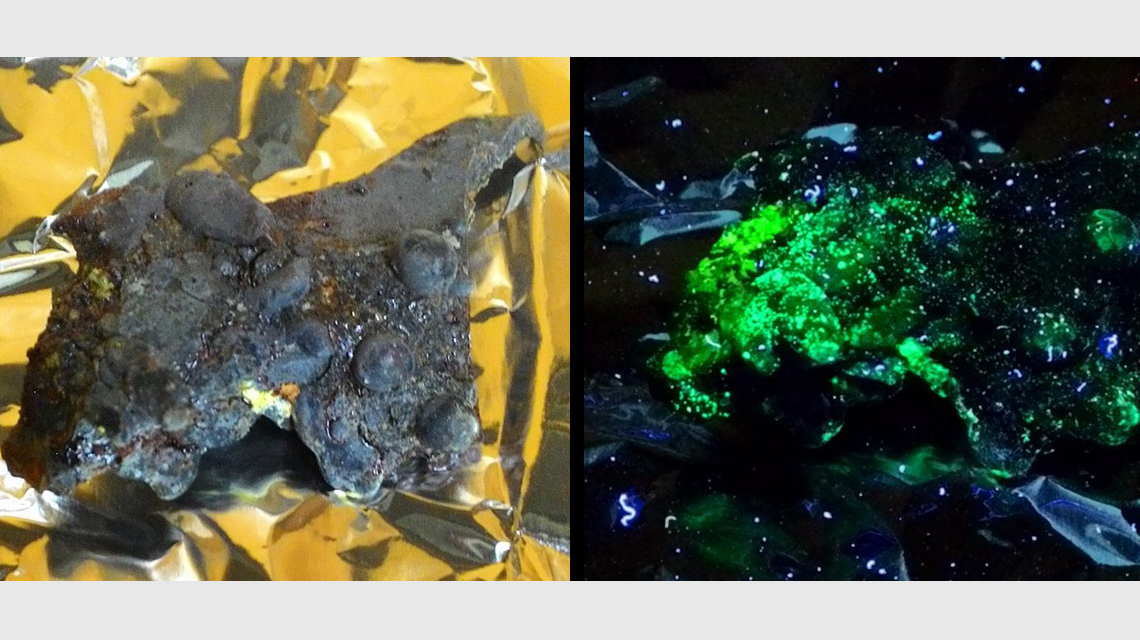
Can reactor fuel debris be safely removed from Fukushima Daiichi?, Science Daily, :January 25, 2022Source:University of Helsinki
Summary:Decommissioning and clean-up are ongoing at the Fukushima Daiichi Nuclear Power Plant (FDNPP); however, many difficult problems remain unaddressed. Chief amongst these problems is the retrieval and management of fuel debris.
Decommissioning and clean-up are ongoing at the Fukushima Daiichi Nuclear Power Plant (FDNPP); however, many difficult problems remain unaddressed. Chief amongst these problems is the retrieval and management of fuel debris. Fuel debris is the name given to the solidified mixture of melted nuclear fuel and other materials that now lie at the base of each of the damaged reactors (reactor Units 1 — 3). This material is highly radioactive and it has potential to generate enough neutrons to trigger successive nuclear fission reactions (uranium-235 breaks into two elements after capturing neutrons, emitting enormous amounts of energy, radiation, and more neutrons). Successive fission reactions would present a serious safety and material management risk.
One of the materials in nuclear reactors that can lower the number of neutrons interacting with uranium-235 is boron carbide (B4C). This was used as the control rod material in the FDNPP reactors, and it may now remain within the fuel debris. If so, it may limit fission events within the fuel debris.
Can the fuel debris be safely removed?
On March 11th 2011, the control rods were inserted into the FDNPP reactors to stop the fission reactions immediately after the earthquake, but the later tsunami destroyed the reactor cooling systems. Fuel temperatures soon became high enough (>2000 °C) to cause reactor meltdowns. Currently, the fuel debris material from each reactor is cooled and stable; however, careful assessment of these materials, including not only their inventories of radioactive elements but as well their boron content, a neutron absorber, is needed to ascertain if successive fission reactions and associated neutron flux could occur in the fuel debris during its removal. Many important questions remain: was boron from the control rods lost at high temperature during the meltdown? If so, does enough boron remain in the fuel debris to limit successive fission reactions within this material? These questions must be answered to support safe decommissioning.
Study shows direct evidence of volatilization of control rods during the accident.
Despite the importance of this topic, the state and stability of the FDNPP control rod material has remained unknown until now. However, work just published in the Journal of Hazardous Materials now provides vital evidence that indicates that most of the control rod boron remains in at least two of the damaged FDNPP reactors (Units 2 and/or 3).
The study was an international effort involving scientists from Japan, Finland, France, and the USA………………….. https://www.sciencedaily.com/releases/2022/01/220125093041.htm
Unease in Ontario about planned nuclear waste dump (nobody suggests that they stop making this trash?)

The Plan to Bury All of Canada’s Nuclear Waste in One Northwest Ontario Town
This kind of dump for high-level nuclear waste has not yet been built anywhere in the world.
JANUARY 24, 2022 ON THE MONDAY SHOW BY CANADALAND Since Canada began using nuclear energy in the 1960s, the only solutions for the waste produced have been temporary. It’s now being stored onsite at nuclear plants, in containers that last a century at most.But nuclear waste takes thousands — or tens of thousands — of years to decay.
So in 2002, the federal government created the Nuclear Waste Management Organization (NWMO) and tasked it with finding a location to dispose of all of Canada’s high-grade nuclear waste.
Ignace, in Northwestern Ontario, was among the communities that volunteered to host a deep geological repository (DGR), and is now one of two sites under consideration. (The other is South Bruce, in the southern part of the province.) To create the DGR, used-up nuclear reactor cores would be placed inside canisters that would then be encased in a special clay that’s been shown to protect from water and cushion from seismic activity. The canisters would then be buried inside a rock 500 metres below ground.The NWMO is confident that the project — valued at $26 billion over the next 150 years — would pose virtually no risk to the local water supply, environment, or people. But a DGR for high-level nuclear waste has not yet been built anywhere in the world.
On this week’s CANADALAND, senior producer Sarah Lawrynuik travels to the area where she grew up, to learn about the divided reaction to the nuclear-waste project and whether the anxieties are justified:The following are edited excerpts from Sarah’s conversations with some of the residents and experts she spoke to…Our water is the most precious thing, I believe, in this country right now. Because so much in the world is polluted. Just so much. And we can’t afford to take that risk. Because no matter what they do to try to make it safe, nuclear waste is not safe and will never be safe.”
— Sylvia Green-Guenette, who lives on the shore of Wabigoon Lake in Dryden. Despite being roughly as close to the proposed site as Ignace, Dryden won’t get a say in whether the project goes ahead………………..
“I think the people who are totally for it are just looking at it through one lens. They’re looking at it through the business lens.…They’re promising a certain amount of jobs — not only for the community, but specifically for Indigenous folk as well. And I think a lot of people can see through that.”
— Maya Oversby, a Métis university student who started attending community meetings about the repository in 2015, when she was 14…………………… https://www.canadaland.com/nuclear-waste-ignace-ontario/
Swedish government to decide on construction of nuclear waste dump.
 |

Why does nobody ever suggest stopping making radioactive trash?
Swedish government to decide construction of spent nuclear fuel repository https://www.euractiv.com/section/politics/short_news/swedish-government-to-decide-construction-of-spent-nuclear-fuel-repository/
By Charles Szumski | EURACTIV.com 24 Jan 22, The government this week will announce its decision regarding the construction in the northern Uppland region of a repository for nuclear fuel that has been removed after being used in a nuclear reactor.
Environment Minister Annika Strandhäl promised on 20 January that the government would announce its decision this week. Spent nuclear fuel has been a hot topic discussed by Swedish scientists and politicians for the last 35 years.
Europe’s nuclear waste remains an unsolved and highly dangerous problem – EU Assessment Report

Nuclear waste from nuclear power plants remains an unsolved and highly dangerous problem, as spent fuel must remain isolated from the environment for a million years. In an attempt to solve the nuclear waste problem, an EU-wide regulation was introduced in 2011, the “Council Directive 2011/70/Euratom establishing a Community framework for the responsible and safe management of spent fuel and radioactive waste”.
This Directive tried to force EU member states to address the issue seriously, after this had been neglected for decades – thus immediately proving that nuclear waste has never been effectively dealt with.
The national waste management policies of the EU member states are still inadequate in many respects. The European Commission concluded in its latest report in 2019 that more needs to be done; this is also reflected in the high number of infringement proceedings.
In the Assessment Report, we not only address shortcomings in transparency and participation, but also problems in the inventory data, unsolved issues in the multinational repository search, incomprehensible
cost estimates and lack of financing. The Onkalo repository under construction in Finland is often presented as a game changer by the nuclear lobby, although the safety of the technology used is questionable due to new findings.
Don’t Nuke the Taxonomy 21st Jan 2022
13 wards in Cumbria recommended against their will, for UK’s nuclear waste dump
| This week our readers got talking about Allerdale potentially being the host to an underground disposal of nuclear waste. Having a Geological Disposal Facility (GDF) that would store higher level radioactive waste underground is hailed to be the safest and most secure method of disposal. The Allerdale GDF Working Group recommended a Search Area for consideration in 2021 comprised of 13 electoral wards: Aspatria; Broughton St Bridgets; Dalton; Ellen & Gilcrux; Flimby; Harrington & Salterbeck; Maryport North; Maryport South; Moorclose & Moss Bay; Seaton & Northside; St John’s; St Michael’s and Stainburn & Clifton. Cumbrian Lad added: “It is a very strange process which allows one individual, Andy Ross of GenR8 North, to volunteer the part of Allerdale in which he doesn’t live to be the burial site for the UK’s nuclear waste. The 13 wards who have been volunteered against their will, have no say in the matter until 15-20 years of investigations have taken place.” Carlisle News and Star 23rd Jan 2022 https://www.newsandstar.co.uk/news/19865839.nuclear-waste-disposal-allerdale-readers-talking/ |
France’s nuclear waste problem, and the lack of transparency on military wastes

“The lack of transparency on military nuclear waste poses a serious democratic problem” To guarantee access to the information that is lacking on the subject of the dismantling of the installations, “parliamentary involvement” is essential, believe the director of the Armaments Observatory, Patrice Bouveret, and the spokesperson for ICAN France, Jean -Marie Collin, in a forum in Le Monde.
Le Monde 20th Jan 2022
Holding in the deep: what Canada wants to do with its decades-long pile-up of nuclear waste
|

no country in the world has solved the conundrum of how to permanently dispose of waste that will stay toxic for 400,000 years. And after decades of trying hard to figure it out, Canada doesn’t seem especially close to a solution.
This is the legacy that we are leaving for our children, our grandchildren, great grandchildren, or great, great grandchildren,”
“ it would be irresponsible and morally wrong to commit future generations to a technology that produces such dangerous material, unless there is at least one proven safe method of dealing with it,”
Canada plans to store spent nuclear fuel deep, deep underground near the Great Lakes. That is, if an industry group can find a community willing to play host, The Narwahl, By Emma McIntosh Jan. 19, 2022, The final resting place of Canada’s most radioactive nuclear waste could be a cave about as deep below the surface as the CN Tower is tall.
If it happens, the chamber and its network of tunnels will be drilled into bedrock in the Great Lakes basin. Pellets of spent nuclear fuel — coated in ceramic material, loaded into bundles of metal tubes the size of fireplace logs, then placed into a metal container encased in clay made from volcanic ash — will be stacked in the underground chamber sealed with concrete 10 to 12 metres thick. Though the radioactive pellets will have spent several years cooling down in pools and concrete canisters, they will still emit so much energy that their presence will heat up the space where they sit for 30 to 60 years. The warmth will linger for anywhere from a few centuries to a few millennia.
But none of this will become reality unless the industry-backed Nuclear Waste Management Organization can find a willing host. Two Ontario towns are in the running: South Bruce, located about two hours’ drive northwest of Toronto near Lake Huron, and Ignace, roughly 200 kilometres north of Lake Superior, not far from the Manitoba border. The municipalities, along with 10 First Nations and two Métis councils, are awaiting the completion of dozens of studies as they mull whether the economic benefits of such a project outweigh the risks.
“We have to make sure that there isn’t an environmental risk for us, or it’s a relatively remote risk,” said Dave Rushton, a project manager for the Municipality of South Bruce.
If anyone thinks they’re informed today, I kind of question it. We’re not fully informed because we haven’t got this information yet.”
………. no country in the world has solved the conundrum of how to permanently dispose of waste that will stay toxic for 400,000 years. And after decades of trying hard to figure it out, Canada doesn’t seem especially close to a solution.
“This is the legacy that we are leaving for our children, our grandchildren, great grandchildren, or great, great grandchildren,” said Bzauniibiikwe, whose English name is Joanne Keeshig. She’s Wolf Clan from Neyaashiinigmiing, also known as Chippewas of Nawash Unceded First Nation, which is located near the South Bruce proposal.
“Seven generations from now, this will not be resolved unless we start seriously taking a look at what can be done.” Modelling suggests underground nuclear waste disposal is safe. But no country has tried it yet…………….
High-level waste, meanwhile, is the responsibility of the Nuclear Waste Management Organization, a non-profit established by Ontario Power Generation, New Brunswick Power Corporation, and Hydro-Québec. In the 60 or so years that Canada has produced nuclear power, it has never had a place to dispose of spent fuel. As of 2020, the country’s nuclear power utilities had produced about three million fire log-sized bundles of it — enough to fill eight hockey arenas from the ice to the top of the boards — and that number grows by about 90,000 each year. In the absence of a place to leave it permanently, producers are currently keeping high-level waste in temporary storage near the reactors. By 2100, when the federal government says it expects all of the country’s existing nuclear plants to be decommissioned, industry projects it will be holding onto nearly 5.6 million bundles.
Accumulating nuclear waste has raised red flags for a long time. In 1978, the Ontario government commissioned a report titled “A Race Against Time,” which concluded the waste was proving trickier to handle than experts initially thought and suggested a potential moratorium on new nuclear plants if the industry didn’t progress within eight years.
Another report from the United Kingdom the same year came to a similar but stronger conclusion, said Gordon Edwards, a mathematician who has long critiqued the nuclear industry as the president of the not-for-profit Canadian Coalition for Nuclear Responsibility.
“One of their main conclusions was that we are agreed that it would be irresponsible and morally wrong to commit future generations to a technology that produces such dangerous material, unless there is at least one proven safe method of dealing with it,” Edwards said.
“The problem with radioactivity is you can’t shut it off … You have to somehow keep it out of the environment.”
Federal and provincial governments never issued a moratorium: construction on the Darlington plant in Bowmanville, Ont., which had been approved in 1977, began in the ‘80s. The Bruce and Pickering plants, meanwhile, continued to get new reactors.
These days, the federal government is pushing to advance new nuclear technology, called small modular nuclear reactors (commonly known as SMRs), which some argue could be a climate mitigation tool. The technology is less efficient than larger reactors and produces more waste. Two of these new reactors might be built in the near future — the Canadian Nuclear Safety Commission, which oversees the industry, is considering an application for one at the Chalk River Laboratories research site in Deep River, Ont., and Ontario Power Generation has announced its intent to build another at Darlington.
In 2002, Parliament did pass legislation requiring the industry to band together and deal with its waste and later that year, the Nuclear Waste Management Organization was formed. Twenty years on, it still hasn’t figured out what to do with high-level radioactive waste. Keeping it above ground, as is done now, leaves it vulnerable to natural disasters, or human ones like terrorism and war.
“It’s a question of ethics,” said Brian Ikeda, an associate professor at Ontario Tech University who studies the management of radioactive waste and has a contract to do upcoming work for the Nuclear Waste Management Organization.
“Do you want to leave this stuff — which you don’t like and you think is really dangerous — and have your grandchildren figure out what to do with it? Because that’s what’s actually going to happen … we could be putting those people at huge risk by having this material out.”
As such, a consensus has emerged among global experts that the best way forward is to dispose of spent fuel far underground, a concept called a deep geological repository. But putting nuclear waste underground isn’t simple.
The waste — which in worst-case scenarios could poison groundwater or soil — must be packaged securely enough to withstand a future ice age, which could bring massive glaciers three kilometres thick, heavy enough to affect underground geology. It must be placed in rock that is stable and won’t shift for 400,000 years, the length of time the Nuclear Waste Management Organization believes the waste would remain radioactive enough to be harmful if leaked. It must be climate change proof.
It must also account for the many unknowns of future generations, who might not know how to actively maintain the storage site, but on the other hand will hopefully be able to monitor it. It must be buried so deep that, if our languages disappear or the information about what’s sealed within is somehow lost, our descendants would be unlikely to disturb the buried chamber and expose themselves to the unimaginable risk inside.
Another challenge is the simple fact of entropy: everything breaks down over time. No matter what type of container holds the nuclear waste, its material will corrode over the course of many thousands of years, Ikeda said. The trick is to buy as much time as possible. …………………………………………….
Finding a nuclear waste disposal site in Ontario will require First Nations consent and buy-in from local towns………………………………………………………… https://thenarwhal.ca/nuclear-waste-ignace-bruce/
New radioactive waste plan poses ‘Milennia of Risk” for Ottawa River communities
| |||
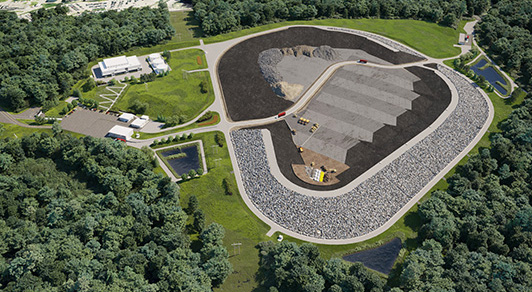
New Radioactive Waste Plan Poses ‘Millennia of Risk’ for Ottawa River Communities https://www.theenergymix.com/2022/01/16/new-radioactive-waste-plan-poses-millennia-of-risk-for-ottawa-river-communities/January 16, 2022 : Ole Hendricksen Canada’s first-ever radioactive waste disposal facility may be headed for disaster.
Canada’s nuclear regulator is about to hold wholly-inadequate hearings on building a controversial 60-foot-high mound for one million cubic metres of radioactive and hazardous wastes, with the potential to leak for millennia into the Ottawa River—a drinking water source for millions of Canadians in Ottawa, Gatineau, Montreal, and other downstream communities
Euphemistically called a “Near Surface Disposal Facility”, or NSDF, the mound would be on unceded Algonquin territory, on a hillside adjacent to a lake and wetlands that drain into the Ottawa River a kilometre away. An environmental impact statement (EIS) ordered by the Canadian Nuclear Safety Commission (CNSC) says that without mitigation practices, “leakage of leachate or other releases of substances may affect surface water quality at downstream locations,” but then goes on to say that these changes are not expected to have significant impact on human health or aquatic biodiversity.
The EIS lists a number of possible threats to the mound’s integrity, including earthquakes, floods, fires, tornadoes, malfunctions, and accidents. At each count, the (EIS) concludes that the risks are “not significant” thanks to the facility’s proposed design features, monitoring plans, and mitigation strategies like treating effluents.
A CAPTURED REGULATOR
The CNSC has never refused to grant a licence, according to a memo obtained by the Canadian Coalition for Nuclear Responsibility. The Expert Panel on Reform of Environmental Assessment noted in its final report that CNSC is widely seen as a captured regulator that promotes the projects it is supposed to regulate.
The surface-level nuclear mound idea was put forward by Canadian Nuclear Laboratories (CNL). In 2015, ownership of CNL was transferred from Atomic Energy of Canada Limited (AECL) to SNC-Lavalin and Texas-based Fluor and Jacobs through a 10-year, multi-billion-dollar AECL contract issued by the Harper government.
The mound is central to CNL’s strategy to reduce AECL’s C$16-billion nuclear waste clean-up liability as quickly and cheaply as possible. This federal nuclear liability has grown despite billion-dollar annual appropriations to AECL, which AECL hands over to CNL’s multinational owners.
The CNSC has signalled its approval of the NSDF by scheduling a two-part licencing hearing for February 22 and May 31,2022. A licencing document and an Environmental Assessment report will be released on January 24. CNSC’s licencing document will likely say the NSDF project is consistent with requirements of the Nuclear Safety and Control Act. CNSC’s EA report will likely repeat the assertion that the NSDF project “is not likely to cause significant adverse environmental effects”, or that the significant adverse environmental effects it is likely to cause are justified in the circumstances.
The CNSC initially also promised a public hearing and a public comment period on its EA report, but later eliminated them. Public participation in CNSC licencing hearings is a mere formality.
MISREPRESENTING THE RISK
There are many problems with the proposed project.
The NSDF location was chosen without a proper siting process, even though the International Atomic Energy Agency (IAEA) says siting is a “fundamentally important activity in the disposal of radioactive waste.” Proximity to contaminated structures awaiting demolition at AECL’s Chalk River Laboratories—not environmental protection—seems to have been the priority.
Use of the term “NSDF” misrepresents the proposed facility. The EIS says it would be an above-ground mound “similar to a municipal landfill.” The IAEA says landfills are suitable only for very low level waste that has “very limited concentrations of long-lived radionuclides,” and that a “disposal facility at or near the surface makes it susceptible to processes and events that will degrade its containment and isolation capacity over much shorter periods of time.”
The waste inventory in the EISshows 23 of 31 radionuclides with half-lives exceeding 1,600 years, including man-made reactor products such as americium, neptunium, plutonium, and technetium. Much of this waste dates back to the Cold War era when Chalk River Laboratories produced materials for U.S. nuclear weapons. AECL’s NRX reactor experienced a partial meltdown in 1952. An above-ground mound is simply not capable of containing and isolating wastes like these for the duration of their radiological hazard.
The EIS says the mound would experience degradation as a result of “normal evolution”. That means mixed radioactive and hazardous industrial wastes (arsenic, beryllium, mercury, benzene, dioxins, PCBs, etc.) would leak into the Ottawa River, essentially forever. Future generations might be tempted to scavenge for scrap metal in the mound—an estimated 33 tonnes of aluminum, 178 tonnes of lead, 3,520 tonnes of copper, and 10,442 tonnes of iron.
SURFACE STORAGE FOR DANGEROUS RADIATION
Cobalt-60 would emit the highest amounts of radiation by far during the first 50 years of operation (99% of the total). CNL proposes to allow unlimited quantities of this powerful “short-lived” gamma-emitter in certain “packaged” wastes. Cobalt-60 is used in high-activity gamma irradiation sources for food sterilization and cancer treatment. Owing to cobalt-60’s 5.3-year half-life, these devices are no longer useful after 20 years but remain highly radioactive. They are sent back to Canada and stored at Chalk River.
CNL wants to put these “disused sources” in the mound, even though the IAEA requires their disposal at depths “of at least tens of metres”. And more are coming from around the world: a 2021 federal report says Canada supplies “approximately 95% of the global demand”.
The EIS does not mention that such commercial industry wastes would go in the NSDF. Nor does it discuss the worker safety and environmental risks created by cobalt-60 and the hundreds of tonnes of lead required to shield it.
Overall, the EIS contains minimal information on the wastes that would go into the mound. It refers to waste “packages” that could range in size up to intermodal shipping containers. Some packages supposedly would be “leachate controlled”, but no evidence or details are provided that they would withstand the heavy equipment (bulldozers, rollers) used to compact the mound.
Because the mound’s contents would be exposed to wind, rain, and snow during a 50-year operating phase, the project includes a water treatment plant to remove leachate contaminants. Tritium, the radioactive form of hydrogen, would not be removed. Partly treated leachate would be discharged into wetlands or into nearby Perch Lake through a pipeline. Both are already contaminated by groundwater plumes from existing leaking waste areas.
Despite assertions that the NSDF project would remediate “historically contaminated lands”, remediation plans are not included. Available data indicate that the leaking waste areas already contain far more radionuclides than a “licenced inventory” would allow in the NSDF.
A former AECL staff member says CNL does not rigorously track its wastes and has inadequate waste characterization and waste segregation procedures. This raises concerns about CNL’s capacity (and willingness) to adhere to the licenced inventory.
A FINANCIAL AND ENVIRONMENTAL DISASTER
The CNSC’s mandate does not include cost-effectiveness. The $750-million cost estimate in the EIS lacks credibility. Canada has no experience with permanent radioactive waste disposal. Why build such an expensive facility that would do little to reduce the federal nuclear liability, would not conform to international safety standards, and would pollute the Ottawa River?
| In 2018, six First Nations and dozens of civil society groups wrote the IAEA about the flawed NSDF proposal and Canada’s radioactive waste policy void. A 2019 IAEA mission to Canada found virtually “no evidence… of a governmental policy or strategy related to radioactive waste management.” In response, Natural Resources Canada (NRCan) launched an “engagement process to modernize Canada’s Radioactive Waste Policy” in November 2020.Seven environmental petitions related to the NSDF have been filed with Canada’s Auditor General, who anticipates publication of a nuclear waste management audit this year. As Canada’s first-ever facility for permanent disposal and eventual abandonment of nuclear reactor waste products, the NSDF would set a very poor precedent for future facilities to come. The Auditor General’s nuclear waste management audit and NRCan’s policy modernization process should conclude before the CNSC holds licencing hearings for the NSDF. Their results may help prevent the NSDF from becoming a financial and environmental disaster that would permanently contaminate one of Canada’s most treasured heritage rivers.Retired forest ecologist Ole Hendrickson is a researcher with Concerned Citizens of Renfrew County and Area. |
Could Plutonium Shipping in New Mexico Lead to Disaster?
Could Plutonium Shipping in New Mexico Lead to Disaster? Legal Reader,
PETER CHARLES — January 18, 2022 Santa Fe already sees a considerable amount of radioactive waste transported near its city limits, as contaminated gloves, equipment, and soil are regularly shipped from Los Alamos Laboratory.
Residents of New Mexico are concerned about a plan to ship plutonium through the Land of Enchantment. Many people are totally unaware that nuclear materials are transported through the state on a fairly regular basis, and fewer still are aware of the potential risks. So what happens if one of these semi-trucks crashes, and nuclear waste spills out? What happens if you are injured or irradiated as a result?
If you have been injured in a semi-truck accident, it’s always best to reach out to a qualified, experienced semi-truck accident attorney in New Mexico. These legal professionals have the resources and knowledge to help you fight for justice in a confident, efficient manner. The truth of the matter is that cargo spills can cause serious injuries to innocent motorists, especially if that cargo is radioactive. This type of material should have never been transported across New Mexico in the first place, and a lawyer can help you seek justice.
Cold War Plutonium a Concern for Santa Fe Residents
Santa Fe already sees a considerable amount of radioactive waste transported near its city limits, as contaminated gloves, equipment, and soil are regularly shipped from Los Alamos Laboratory to an underground disposal site near Carlsbad. However, the Department of Energy’s new plan is to ship leftover plutonium from the Cold War through the south side of the city, which is much more dangerous compared to normal radioactive waste. There are 26 metric tons of plutonium that needs to be disposed of, and this plutonium has to be extracted from bomb cores before being transported.
In addition, the plutonium is so deadly that it must be diluted before it is transported. Otherwise, it would violate regulations at New Mexico’s Waste Isolation Pilot Plant. The site explicitly rejects anything other than low-level nuclear waste. The process involves shipping the plutonium to Los Alamos Lab, turning it into an oxide powder, and then shipping back across New Mexico’s highways to South Carolina.
Finally, the powder would be diluted even further before returning back to New Mexico and being stored at the Waste Isolation Pilot Plant. Critics say that having plutonium shipped back and forth multiple times across New Mexico is an accident waiting to happen. …….. https://www.legalreader.com/could-plutonium-shipping-in-new-mexico-lead-to-disaster/
On Cape Cod, a nuclear nightmare arrives
On Cape Cod, a nuclear nightmare arrives, https://news.yahoo.com/column-cape-cod-nuclear-nightmare-095201547.html, Brent Harold Columnist, Mon, January 17, 2022,
We’re living in E.F. Schumacher’s nightmare future.

Fifty years ago, before there was much nuclear power to worry about, before Three Mile Island, Chernobyl, or Fukushima, he was already worrying about it in his 1973 book “Small is Beautiful: A Study of Economics As If People Mattered.” The book was ranked by The Times Literary Supplement as one of the 100 most influential books published since World War II.
It’s striking that the main argument against using nuclear energy was there from the very start.
“The biggest cause of worry for the future is the storage of the long-lived radioactive wastes,” he wrote. “In effect, we are consciously and deliberately accumulating a toxic substance on the off-chance that it may be possible to get rid of it at a later date.”
No amount of convenience or efficiency — or profits — he argued “could justify the accumulation of large amounts of highly toxic substances which nobody knows how to make ‘safe’ and which remain an incalculable danger to the whole of creation for historical or even geological ages. To do such a thing is a transgression against life itself.”
We are in that “later date” and as we know, there still is no solution to the problem of how to get rid of the radioactive waste that is a systematic byproduct of generating nuclear energy .
We are in that future Schumacher warned against.
A few years ago, when Pilgrim Nuclear Power Plant was still limping along, a documentary titled “Containment” played in Wellfleet, showing in convincing detail the nuclear future Schumacher warned against, especially the ongoing problem of containment of lethal radioactive wastes.
There is no mopping up as with oil spills. You don’t flush this, clean it up and move on. There is no getting rid of the mess we’ve made. All we can do is try to contain it, on and on farther into the future than the 10,000 years often cited as the age of “civilization” — perhaps longer than our species has been around.
There’s an interesting segment in the film about attempts to come up with a sign to warn our distant descendants of the lethal mess we have bequeathed them.
Containment is the job and the company that owned Pilgrim, when it closed the plant, handed the job of cleanup and containment off to a company named Holtec, which thought it could make a go of it while making a profit for its shareholders.
Containment is the job. But only in its first year or two, Holtec recently announced, almost off-handedly, that it was considering dumping a million gallons of radioactive waste in our Cape Cod Bay. ”What?” asked many. “Can they get away with that?”
Apparently they are within their legal rights. Certainly, the company has emphasized it has no obligation to be guided by those whose lives will be most affected by it.
In reaction to the outcry Holtec has said it will put off the dumping for a spell. To make us feel better it noted that Entergy had for years, when Pilgrim was still operating, been dumping radioactive water in the bay.
Fifty years ago Schumacher wrote: “It was thought at one time that these wastes could safely be dumped into the deepest parts of the oceans…but this has since been disproved…wherever there is life, radioactive substances are absorbed into the biological cycle.”
Containment is the job. Dumping a million gallons of radioactive waste into Cape Cod Bay seems like the opposite of containment.
Once again, as with Entergy, we find ourselves in the situation of having our present and future safety in the hands of a bottom line-oriented company.
Call it a nuclear energy problem. Call it a corporation/capitalism problem. It is both.

There is a decades-long history of opposition to Pilgrim. Diane Turco and others founded Cape Downwinders in the early 1990s, a group that worked toward the shuttering of Pilgrim..
This newspaper kept Cape citizens informed with its strong coverage of the deterioration of Pilgrim and wrote editorials advocating its closure.
The closure of the plant in 2019 was considered by activists a victory and there has been a natural tendency (for people whose name isn’t Diane Turco) to become complacent about the still-dangerous site. Certainly it does seem less glamorous being the first generation of citizens, of who knows how many, to practice ongoing wariness about containment and the company in charge of it. But that’s the reality of our situation.
A place to start getting involved or re-involved is a gathering for a speak-out on Jan. 31 at 5 p.m. at Plymouth Town Hall Great Room, to be followed at 6:30 p.m. by a meeting of the Nuclear Decommissioning Citizens Advisory Panel.
Brent Harold, a Cape Cod Times columnist and former English professor, lives in Wellfleet. Email him at kinnacum@gmail.com.
This article originally appeared on Cape Cod Times: pilgrim nuclear plant and holtec’s plan to dump contaminated water.
Why joint US-South Korean research on plutonium separation raises nuclear proliferation danger
Why joint US-South Korean research on plutonium separation raises nuclear
proliferation danger by Frank N. von Hippel. South Korea, like the United
States, has long relied on nuclear power as a major source of electric
power.
As a result, it has amassed large stores of spent nuclear fuel and,
as in the United States, has experienced political pushback from
populations around proposed central sites for the spent fuel. South Korea
also has a history of interest in nuclear weapons to deter North Korean
attack.
Bulletin of Atomic Scientists 13th Jan 2022
Why joint US-South Korean research on plutonium separation raises nuclear proliferation danger
Factoring in the full cost of the radioactive wastes, the price to pay for nuclear power is astronomic.
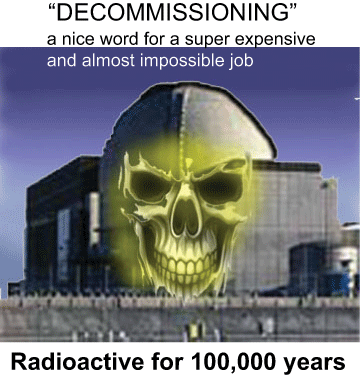
The price to pay for nuclear power is too high, https://www.scotsman.com/news/opinion/letters/the-price-to-pay-for-nuclear-power-is-too-high-readers-letters-3520498 Tim Flinn, Garvald, East Lothian, 10 Jan 22,
It doesn’t seem 30-odd years since I went with a group of sixth form A Level physics students on a tour of Dunbar’s Torness nuclear power station, now scheduled for decommissioning.
Most of them now have their PhDs and families of their own, but hopefully they all share my view that nuclear electricity remains the most toxic and expensive domestic fuel in regular use – and will remain so unless and until the problems associated with its deadly wastes are finally solved.
As things stand now the next 500 human generations will be stuck with the human and financial costs consequent upon coping with the radioactive detritus of the very first nuclear electricity generated some 80 years ago. Factoring in inflation the final price of just a single nuclear kWh will total more £s than there are particles in the universe. If anyone doubts that, let them do their own sums, or get a copy of mine (I hope they can cope with logarithms and discounting cash flows).
If the investment into nuclear energy (originally so we could keep up with the Jonses and have our own A and H bombs) had instead been ploughed into research and development of clean, safe, renewables we would long ago have had endless energy to spare and green devices to export. But we didn’t and so we haven’t. To replace one nuclear power station with yet another is to refuse to learn. Are we that stupid still?
Just the bare 144 years of above-ground storage for UK’s Chapelcross Intermediate Level Nuclear Waste
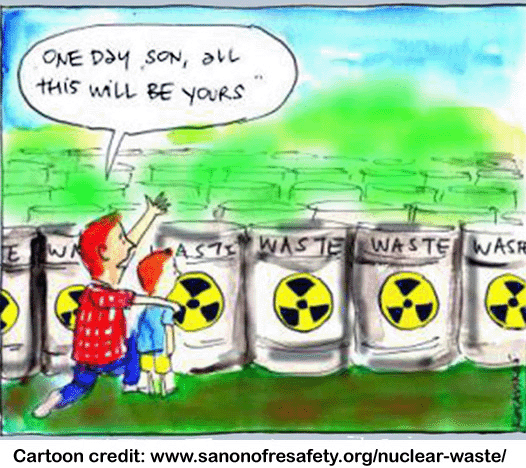
The question for policy makers is do we really want to contemplate building new nuclear power stations when the legacy will be with future generations for 102 years, nearly two and a half times beyond any new nuclear plant’s operational life. The cost of nuclear electricity generation is high and future costs of dealing with the legacy are also passed on to at least four future generations.
| Following on from a previous article on Hunterston B which was shut down last Friday I decided to have a look at one of the smaller nuclear power stations in Scotland to see how work was progressing on decommissioning. Chapelcross nuclear power station occupies a 92 hectares site on the location of a former World War II training airfield in Annan. Chapelcross had 4 Magnox reactors, each with a 48MW output. Chapelcross was linked to sister plant Calder Hall in Cumbria which is now the site of the NDA’s Sellafield operation. Calder Hall closed in 2003 and Chapelcross in 2004. Both plants were originally operated by the UK Atomic Energy Authority. Their main purpose was to produce weapons-grade plutonium although they also generated electricity for the National Grid. By 1st April 2019, Chapelcross had been defuelled and all High Level Waste moved to Sellafield. At that point, almost three years ago, the Intermediate Level Waste as well as LLW had still to be dealt with. The VLLW would appear to be close to the end of the decommissioning process. The LLW is destined for containers in Cumbria and the estimated 4,900 cublic metres of Intermediate Level Waste will be left onsite in specially constructed containers for a period of 120 years, pending a Scottish Government decision around 2145 on disposal of the containers and contents. The interim storage facility for storing Intermediate Level Waste at Chapelcross began 2014 and was completed by May 2021 when the first ‘package’ was placed in the facility. In announcing this progress Magnox Ltd and the NDA said in a news release; “The Interim Storage Facility (ISF) can hold over 700 waste packages of four different approved package types, and will be filled over the next five years as part of decommissioning work. Standing at 57m long and 23m wide, it has been constructed to safely and securely store packages for 120 years.” Work on the Intermediate Level Waste which is due to complete in 2026. The storage facility is then sealed for 120 years when a decision will be made by the Scottish Government on final disposal of ILW storage and contents. Whilst it can be argued that the core decommissioning work will take around 22 years, the end game is still 120 years away making 144 years in total for final clearance at the site. Chapelcross operated for 44 years. The ILW will remain on the site until 2146 although the buildings will be long gone by then. It is essential we deal with the legacies of the past and do so to the highest possible standard because we owe that to our own and future generations. The question for policy makers is do we really want to contemplate building new nuclear power stations when the legacy will be with future generations for 102 years, nearly two and a half times beyond any new nuclear plant’s operational life. The cost of nuclear electricity generation is high and future costs of dealing with the legacy are also passed on to at least four future generations. Newsnet 10th Jan 2022 https://newsnet.scot/news-analysis/nuclear-decommissioning-chapelcross-a-timeline/ |
Russia’s secret nuclear waste city – Ozersk, City 40
Russian city hiding chilling Cold War secret from world https://www.9news.com.au/world/ozersk-city-40-secret-russian-city-cold-war-graveyard-of-the-earth/9644dcbb-e94f-44c6-b69e-4e3e4ca96455
By Richard Wood • Senior Journalist Jan 9, 2022 There has been a “slow-motion” disaster unfolding over the past 70 years at one of Russia’s most secretive sites. Ozersk, codenamed City 40, was the birthplace of the former Soviet Union’s nuclear weapons program at the dawn of the Cold War.

On the surface, it was a clean modern city that boasted good housing, spacious parks and high quality schools to attract the country’s top nuclear scientists.And its purpose was seen as so important that Russian authorities effectively hid it from the rest of the country and the world. But while, the work of Ozersk’s army of scientists developing Russia’s plutonium supplies was cloaked in secrecy, its environmental impact proved harder to contain.Today its legacy of radiation pollution has earned Ozersk the title ‘Graveyard of the Earth’.
Building Russia’s nuclear shield
Ozersk’s origins can be traced to the US dropping atomic bombs on the Japanese cities of Hiroshima and Nagasaki in 1945 at the end of World War II.
Alarmed at the terrifying new weapon of mass destruction, Russian leader Josef Stalin ordered his scientists to build a nuclear arsenal to combat the American threat.The Mayak plant deep in the Urals was founded in 1948 to develop essential large scale plutonium supplies for the Soviet atomic bomb. The work needed hundreds of workers.
Ozersk was founded nearby, initially as a sort of shanty town of wooden huts to house the workers. But over ensuing yeas, it grew to become a modern city of 100,000 people, with many of its citizens working at the Mayak plant.
‘Plutopias’

US environmental historian Kate Brown has described Ozersk and its counterpart nuclear cities in the US as “Plutopias”, a merging of the words plutonium and utopia. Professor Brown, who wrote Plutopia: Nuclear Families, Atomic Cities, and the Great Soviet and American Plutonium Disasters, told Nine.com.au that Ozersk residents were the envy of most Russians.
‘When I wrote about plutopia, I mean by that special, limited-access cities exclusively for plutonium plant operators who were well paid and lived comfortably. The people who lived in them were ‘chosen’,” Professor Brown said.”The plutonium cities such as Ozersk provided wonderful opportunities because not only was the housing very cheap and the wages very good, but the schools were good.”
But in Cold War Russia this all came at the price of intrusive security and curbs on personal freedom.Ozersk did not appear on maps and its citizens were struck from the national census.Residents were even forbidden to contact families and friends for up to years.
And for decades, the city was ringed by barbed wire fences and guard posts and entry was strictly controlled.
Lake of Death’
Professor Brown said both the Russians and American governments were prepared to cut corners in their dash to develop an edge in nuclear weapons.
And in 1957 one of the cooling systems at the Mayak plant, near Ozersk, failed, causing one of the tanks that contained the plant’s nuclear waste to overheat and explode.
While there were no casualties from the blast itself, more than 20 million curies of nuclear waste were swept up by the wind and scattered around the nearby countryside.The full effects of the Mayak radiation release and other incidents took years, even decades to become fully apparent, Professor Brown said.

The plutonium disasters were not big, explosive overnight affairs. They were slow-motion disasters that occurred over four decades,” she sai d.Officials from the Mayak plant also ordered the dumping of its waste into nearby lakes and rivers, which flow into the the Arctic Ocean.
Prof Brown said one of the lakes near Mayak has been so heavily contaminated by plutonium that local people have renamed it the ‘Lake of Death’.
‘Cover up’
The scale of the pollution was hushed up by Russian authorities for decades.
“Thanks to exhaustive efforts by the Soviet government and the already secretive nature of the location, for a long time, no one outside of the Ozersk area was even aware that it happened.
“It wasn’t until renegade Soviet scientists exposed the cover-up in the 1970s that scientists started to grasp the extent of the disaster.”
Radioactive spills have also happened at other secret Russian military and industry sites.In August 2019 a brief spike in radioactivity was recorded following a mysterious and deadly explosion at the Russian navy’s testing range in Nyonoksa on the White Sea.The explosion killed two servicemen and five nuclear engineers.
Campaigners expose contamination
Today the Mayak plant now serves the more peaceful purpose of reprocessing spent radioactive fuel.In Ozersk many restrictions have been eased, with residents free to leave when they want.
But the city is still surrounded by thick walls and guard fences, and entry by outsiders is strictly controlled by government officials.And while efforts have been made to clean up the environment, radiation pollution remains a threat to the health of residents.
A recent study showed that Ozersk residents are more than twice as likely to develop lung, liver, and skeletal cancers and far more likely to experience chronic radiation syndrome.Prof Brown says Russian environmental activists still face threats and persecution for exposing the radiation levels.
“They’ve paid a heavy price in terms of prosecution by the state and receiving threats of fines and even jail,” she said. “But they were determined to expose what really was disaster by design.”
1 This Month
15 October. Joint Appeal for Nuclear Abolition Day -presentation to the UN on October 15 will be live on UNWebTV
Endorse the Nuclear Abolition Day Appeal
23-25 October – on Zoom – World BEYOND War’s annual global conference

To see nuclear-related stories in greater depth and intensity – go to https://nuclearinformation.wordpress.com
-
Archives
- October 2026 (139)
- September 2026 (339)
- August 2026 (330)
- July 2026 (355)
- June 2026 (287)
- May 2026 (306)
- April 2026 (356)
- March 2026 (251)
- February 2026 (267)
- January 2026 (308)
- December 2025 (358)
- November 2025 (359)
-
Categories
- 1
- 1 NUCLEAR ISSUES
- business and costs
- climate change
- culture and arts
- ENERGY
- environment
- health
- history
- indigenous issues
- Legal
- marketing of nuclear
- media
- opposition to nuclear
- PERSONAL STORIES
- politics
- politics international
- Religion and ethics
- safety
- secrets,lies and civil liberties
- spinbuster
- technology
- Uranium
- wastes
- weapons and war
- Women
- 2 WORLD
- ACTION
- AFRICA
- Atrocities
- AUSTRALIA
- Christina's notes
- Christina's themes
- culture and arts
- Events
- Fuk 2022
- Fuk 2023
- Fukushima 2017
- Fukushima 2018
- fukushima 2019
- Fukushima 2020
- Fukushima 2021
- general
- global warming
- Humour (God we need it)
- Nuclear
- RARE EARTHS
- Reference
- resources – print
- Resources -audiovicual
- Weekly Newsletter
- World
- World Nuclear
- YouTube
-
RSS
Entries RSS
Comments RSS

