France’s oldest nuclear power plant, shut in 1985, still highly radioactive

“You can’t see radioactivity, you can’t feel it, so people don’t care”: in Brennilis, nuclear power is no longer operating. Shutdown in 1985, the monts d’Arrée power plant was the first in France to begin dismantling.
The reactor block of the Finistère nuclear power plant in Brennilis remains one of the last vestiges of the gigantic installation, in operation from 1967 to 1985. Despite the decades, its dismantling has not yet been completed. It is in this building, however, that the most radioactive elements of the infrastructure are stored, a prototype of a heavy water reactor cooled with carbon dioxide, never reproduced in France afterwards.
Le Monde 28th Dec 2021
Plutonium found on a beach near Sellafield
While in Cumbria on a visit hosted by Radiation Free Lakeland in 2015,
former United States Nuclear Industry Regulator Arnie Gundersen now nuclear
educator with Fairewinds took samples from the beaches. These samples were
tested back in the US. One of the samples unintentionally collected was
found in Arnie’s coat pocket. It turned out to be plutonium. “Arnie’s
time sampling near Sellafield is part of our worldwide campaign to protect
families and communities from the devasting and lasting impact of radiation
exposure. Currently, we have begun the process of researching and
documenting our Irish Sea data for another peer-reviewed journal
article.”
Radiation Free Lakeland 27th Dec 2021
America’s nuclear waste problem becoming more urgent, as the nuke lobby tries to ramp up the industry.
Waste Disposal Back In The Spotlight As America Ramps Up Nuclear Sector https://oilprice.com/Alternative-Energy/Nuclear-Power/Waste-Disposal-Back-In-The-Spotlight-As-America-Ramps-Up-Nuclear-Sector.html
By Felicity Bradstock – Dec 26, 2021,
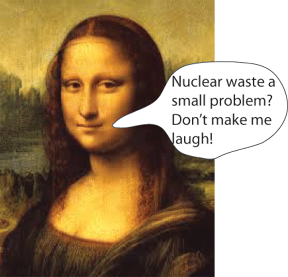
- The United States is looking to ramp up its nuclear energy sector.
In September this year, the go-ahead was given for the construction of a dump in West Texas that will act as a disposal site for nuclear waste for around 40 years. - Though there are disposal sites for the short term, if the sector is set to grow, the U.S. will need to find long-term solutions, and fast.
For years the U.S. federal government has been saving to invest in a long-term nuclear waste disposal solution. But despite collecting the funds, no clear plan has been made. As we see certain states developing new nuclear projects it begs the question, where will the waste be dumped? At present, the U.S. government is sitting on a $44.3 billion fund for the construction of a nuclear waste disposal facility. Starting in the 1980s, the fund was aimed at finding a safe solution for the containment of the waste, but to date, nothing has been established. After suggesting three potential sites between 1982 and 1987 the government made plans to create a site in the Yucca Mountain in Nevada.
In the meantime, the U.S. created interim storage sites but failed to take action on a long-term solution. In 2002, President George W. Bush approved the Yucca Mountain site only for it to be rejected by Barack Obama, who cut funding for it in the 2010 budget. In 2014, a legal ruling stated that the government could no longer collect funding for the scheme, meaning the reserve has been sitting there collecting interest of around $1.4 billion a year and has started to be used for other purposes.
While there is no established disposal site, the government continues to pay utility companies to store their nuclear waste. The Nuclear Regulatory Commission (NRC) stated that the current storage solution, mainly dry casks on current and former nuclear plant sites, will be effective for around 100 years, until 2086.
| At the beginning of the nuclear era, the U.S. was criticized for dumping its nuclear waste in the sea, being the first country to do so in 1946. The US Environmental Protection Agency estimated that over 55,000 containers of radioactive waste were dumped across three sites in the Pacific over a period of 24 years. Although this practice stopped in 1970, eyes have been on America ever since to ensure it disposes of its energy waste safely and effectively. While some nuclear powers continue to dump their waste in the ocean to this day. The debate was raised again this month in Massachusetts as energy firm Holtec proposed a plan to dump nuclear waste, recovered during the decommissioning of the Pilgrim Nuclear Power Station, in Cape Cod Bay. Following wide-scale campaigning from concerned citizens and environmental organizations, the company eventually backtracked on its plans. But this raises questions around how nuclear companies plan to dispose of their waste without a viable long-term solution at the federal level. Diane Turco, Director of Cape Downwinders, stated, “Holtec’s decision-making process is motivated by profit, only. This was the cheapest, fastest way.” In September this year, the go-ahead was given for the construction of a dump in West Texas that will act as a disposal site for nuclear waste for around 40 years. A license was granted by the Nuclear Regulatory Commission for the building of a facility that can store up to 5,000 metric tonnes of nuclear fuel rods as well as 231 million tonnes of other radioactive waste. This comes despite clear opposition from the state. Earlier that month Gov. Greg Abbott signed a bill banning the storage and transportation of high-level nuclear waste through Texas, with environmental groups also fighting the project through legal action. Meanwhile, the government seems to have kept its eye on Yucca Mountain for a long-term solution, much to the dismay of local citizens. The Nevada Department of Environmental Protection (NDEP) has been steadfast in its opposition to the potential development. And the federal Department of Energy (DoE) has acknowledged the barriers to the project, requiring state authorization to increase the amount of waste entering the state. Even President Biden stated his opposition to the Nevada site development earlier this year. The various political administrations of the past 20 years have been back and forth with support and opposition for the Yucca Mountain disposal plan. As mentioned before, Congress cut funding for the development when it appeared no progress was being made. Despite the clear opposition, to date, the government has come up with no other site proposal. However, the DoE is now pushing for consent-based siting, starting with a request for information. It is approaching various state powers to understand their opposition to constructing a nuclear waste disposal site and asking for a volunteer state for the project. But with the controversial example of Nevada, it seems unlikely that any state will offer its land for this purpose. With plans for new nuclear projects – even Bill Gates is getting a piece of the action – the government is once again feeling the pressure to establish a viable long-term solution for nuclear waste disposal. And as the country moves away from fossil fuels towards cleaner alternatives interest in nuclear projects are increasing and the energy industry is expecting the government to act. |
Belgium to shut down all 7 nuclear reactors in 2025
Nuclear: the Belgian government confirms the shutdown in 2025 of the
country’s seven reactors. As planned, Belgium will shut down its two power
plants, but is not closing the door to new generation nuclear power. An
agreement was torn off on Thursday after a night of negotiations between
the partners of the government coalition.
Liberation 23rd Dec 2021
https://www.liberation.fr/environnement/nucleaire/nucleaire-le-gouvernement-belge-confirme-larret-en-2025-des-sept-reacteurs-du-pays-20211223_5HUXXHO645DKBPEHJZUGINMR3M/
Les Echos 23rd Dec 2021
Belgian government to close its nuclear plants by 2025
The Belgian government agreed in principle on Thursday to close its
nuclear power plants by 2025, but left open the possibility of extending
the life of two reactors if it could not otherwise ensure energy supply.
The seven-party coalition has wrestled for months with the topic, with the
Greens adamant that a 2003 law setting out a nuclear exit be respected,
while the French-speaking liberals favoured extending the life of the two
newest reactors. The government had given itself an end-2021 deadline to
settle the matter.
Reuters 23rd Dec 2021
https://www.reuters.com/markets/commodities/belgian-government-reaches-deal-nuclear-exit-media-2021-12-23/
The Belgian government agreed in principle on Thursday to close its
nuclear power plants by 2025, but left open the possibility of extending
the life of two reactors if it could not otherwise ensure energy supply.
Globe and Mail 23rd Dec 2021
Euro News 23rd Dec 2021
https://www.euronews.com/2021/12/23/belgium-to-shut-down-all-seven-of-its-nuclear-reactors-by-2025
BBC 23rd Dec 2021
Aboriginal ttraditional owners lodge legal challenge to planned South Australian nuclear waste dump.

Traditional owners lodge legal challenge to planned Kimba nuclear waste dump, https://www.abc.net.au/news/2021-12-21/barngarla-challenge-kimba-radioactive-waste-facility-napandee/100717404?fbclid=IwAR3QiztQ5454cuTfmjLaBaCb_nK4usDM43TObZV5R
ABC North and West SA / By Declan Gooch, Patrick Martin, and Gillian Aeria Tue 21 Dec 2021 raditional owners on South Australia’s Eyre Peninsula have formally lodged a legal challenge to the federal government’s plan to build a nuclear waste dump in the region.
Key points:
- The Barngarla people have begun legal action against a planned radioactive waste dump
- The federal government wants to build the facility near Kimba
- Traditional owners have complained they were not consulted properly
The government wants to store low and intermediate-level waste at a property called Napandee, near the town of Kimba.
The Barngarla people say they were not included in the consultation process, which included a ballot of ratepayers.
“We don’t want it to be at Kimba because we were excluded from the vote under white man’s law,” Barngarla Determination Aboriginal Corporation chairman Jason Bilney said.
The group filed for a judicial review of the site selection process in the Federal Court on Tuesday.
The ballot of Kimba ratepayers, which the government has repeatedly cited as evidence of community support, showed about 60 per cent of voters were in favour of the plan.
“The government says broad community support — well what broad community support did you have, let alone with the native title holders of Kimba or on the Eyre Peninsula?” Mr Bilney said.
The ballot of Kimba ratepayers, which the government has repeatedly cited as evidence of community support, showed about 60 per cent of voters were in favour of the plan.
“The government says broad community support — well what broad community support did you have, let alone with the native title holders of Kimba or on the Eyre Peninsula?” Mr Bilney said.
He said South Australian law required a parliamentary inquiry if nuclear waste was to be brought in and stored.
“We are going to see continual opposition emerge over the next five to 10 years, and this has got a long way to run.”
He expected the court to decide in the Barngarla group’s favour.
“They have a clear and strong case. They were excluded from the community ballot, and they do have native title rights, and it’s essential the Federal Court stands up and protects those rights.”
The government had initially tried to legislate the location of the facility in a way that would have eliminated the possibility of a judicial review.
It later amended the legislation in response to pressure from Labor so it received the support needed to pass both houses of parliament.
In a statement, resources minister Keith Pitt said the declaration of Kimba as the site for the facility was a “significant step”.
He said his facility was a crucial piece of national infrastructure for Australia’s nuclear medicine industry and nuclear research capabilities.
Tanzania seeking information on ‘nuclear waste’ ship detained in Mombasa
Tanzania seeking information on ‘nuclear waste’ ship detained in Mombasa, TUESDAY DECEMBER 21 2021 The Citizen News, East Africa News Additional reporting by Gadiosa Lamtey in Dar es Salaam https://www.thecitizen.co.tz/tanzania/news/east-africa-news/tanzania-seeking-information-on-nuclear-waste-ship-detained-in-mombasa-3659422 Summary Kenyan media reported on Monday that MV Piraeus Voy, which as docked at the port of Mombasa, was loaded with harmful nuclear waste that was to have been dumped on the East African coast, endangering the health of millions of people in the region.
Dar es Salaam/Mombasa. The government said yesterday that it was unaware that Kenyan authorities have detained a cargo ship carrying nuclear waste that was reportedly on its way to Tanzania.
“We have not received any information about the ship, but I will get in touch with the relevant authorities for any details on the matter,” the permanent secretary in charge of transport in the Ministry of Works and Transport, Mr Gabriel Migire, told The Citizen when reached for comment, adding that any ship coming to Tanzania was required to fly the country’s flag.
Kenyan media reported yesterday that the ship, which as docked at the port of Mombasa, was loaded with harmful nuclear waste that was to have been dumped on the East African coast, endangering the health of millions of people in the region.
The cargo on board the MV Piraeus Voy was disguised as padlocks and other hardware items, and was detained after Kenya’s Health ministry raised the alarm that it was carrying radioactive material.
Officials investigating the matter said the ship sailed to Kenya from Mumbai, India, and was en route to neighbouring Tanzania.
“This is clearly a means of dumping dangerous substances in East Africa. We have proof that what was declared is just part of the contents, but the radioactive material is also in the ship, and is emitting high radiation,” a source involved in an ongoing investigation said on condition of anonymity as he is not authorised to speak to the media.
Exposure to high levels of radiation from nuclear waste can cause severe health effects such as skin burns and acute radiation syndrome (radiation sickness). It can also result in long-term health effects such as cancer and cardiovascular disease.
A multi-agency team comprising officials drawn from various government agencies at the Mombasa port has differed on how to best handle the cargo, which was reportedly destined for Dar es Salaam Port.
Depleted uranium exports to Russia are not a ”resource” – they are radioactive waste
Our conclusion is that this form of TENORM (technically enhanced naturally occurring radioactive material) should be considered in principle as a waste material, for which full transparency should be assured over its complete chain of management,
DU Exports to Russia – A case of lack of transparency and research Nuclear Transparency Watch By Jan Haverkamp (Greenpeace, WISE) December 21,
From 1996, the uranium enrichment facilities URENCO Almelo (Netherlands) and URENCO Gronau (Germany) regularly sent shipments of depleted uranium (DU) in the form of UF6 (uranium hexafluoride) to TENEX, later TVEL, in Russia, where this was stored in the open air in Seversk in the Krasnoyarsk region. Protests in Europe then halted these transports in 2009. TVEL is since 2007 a subsidiary of the Russian nuclear giant Rosatom. URENCO carries out enrichment for nuclear fuel production from natural uranium to low-enriched uranium for clients all over the world and has facilities in the Netherlands, Germany and the UK.
In 2019 and 2020, these transports were resumed from the enrichment facility of URENCO Gronau and URENCO UK in Capenhurst.
URENCO Almelo currently has a permit for export, but does not use it. Its DU is sent to France for conversion into stable U3O8 (depleted tri-uranium-octo-oxide or uranium oxide), which is returned to the Netherlands and handed over to the waste management organisation COVRA for interim storage in the VOG facility, awaiting final disposal after 2100.
The claim is that the DU is sent to TENEX, later TVEL, for re-enrichment to natural level and reuse of the resulting double depleted uranium (DDU). Rosatom furthermore claims[2] that DDU and DU are used industrially and that the UF6 also delivers fluorine for reuse purposes. It furthermore, describes in detail how it wants to convert its UF6 stockpile into uranium oxide for waste treatment before 2057.
Continue readingSlovenia and Croatia: lack of transparency on radioactive waste , on intake of international nuclear waste.
The transformation of RW TCT from the exclusively national facility to an international radioactive waste treatment provider was done without prior consultation with, and approval by the public and municipalities.
More than 3000 citizens signed a petition against capacity increase of the RW TCT and demand a prohibition of foreign radioactive waste treatment in Slovakia.
Slovakia is not legally or morally responsible for foreign radioactive waste
Slovenia and Croatia – radioactive waste, transparency, shared responsibilities, shared problems, Three case studies on radioactive waste, By Nadja Zeleznik – Nuclear Transparency Watch 9 Dec 21,
These are case studies in a larger report on radioactive waste and transparency, currently under preparation for the Euratom EURAD programme by Nuclear Transparency Watch.
Publication was expected in October 2021.
Slovenia and Croatia share the nuclear power plant Krško (NEK) which was constructed as a joint venture during 1970-ties in the socialist Federal Republic of Yugoslavia as part of the larger nuclear programme on the use of nuclear energy.
Continue readingSwedish environmental groups sound a warning on the government’s plans for a new radioactive waste dump.
| On 22 December, the Government decided to approve the extension of the repository for short-lived radioactive waste in Forsmark (SFR) with a new repository (SFR 2). SFR is the current repository for short-lived radioactive operational waste from the nuclear power plants and is located under the seabed outside the Forsmark nuclear power plant. SFR 2 is a new repository for short-lived radioactive waste from the decommissioning of the Swedish nuclear reactors, and the repository will be built next to the old one. The government decided to grant permissibility according to the Environmental Code and a license according to the Nuclear Activities Act. The decisions can be found in the news story on the MKG Swedish web page (link below on original)). The Swedish Society for Nature Conservation, The Swedish Friends of the Earth and the Swedish NGO Office for Nuclear Waste Review (MKG) have stated that the government should say no to the new repository. The organisations recently told the government in an opinion that it has not been shown that the new repository will be safe enough. The environment risks being damaged by the repository leaking radioactive particles into the Öregrundsgrepen outside Forsmark faster than expected, perhaps already within 50 to 100 years after closure. In addition, there is already a relatively unexpected and extensive breakdown of the technical repository barriers in the existing repository. The organisations believe that the government should have conditioned the decision on leaving the repository open under supervision for the 400 to 500 years required for the radioactive content to have decayed to less dangerous levels. MKG 22nd Dec 2021 https://www.mkg.se/en/the-government-approves-the-expansion-of-sfr-in-forsmark |
In Cumbria – Dangerous Nuclear Waste Dumping- Mission Creep and Obfuscation.
Dangerous Nuclear Waste Dumping- Mission Creep and Obfuscation.
The following images [on original] are from a four page Advertorial by NIREX in Cumbria Life from 1993 (NIREX was the then government body on “Nuclear Waste Disposal.” ) The NIREX plan was for “deep disposal” of intermediate and some low level nuclear wastes. Now in 2021 the “vision” is to put the intermediate level nuclear wastes (previously earmarked for the NIREX dump at Longlands Farm, Gosforth) into Not So Deep Silos’ at the Low Level Waste Repository at Drigg and the even higher activity and very hot nuclear wastes (which even the gung ho NIREX never proposed putting deep underground) into a Geological Disposal Facility ( deep under the Irish Sea is in the frame)……….
Note that the NIREX advert from 1993 states that the Geological Disposal Facility plan is for “intermediate and some low level wastes.” In a newsletter in March this year for the Low Level Waste Repository at Drigg, it was said: “The NDA is exploring the benefits of developing Near Surface (NSD) – for disposing of a proportion of Intermediate Level Waste (ILW), but no decision has been taken on whether UK Government will pursue this option or whether LLWR, will in time, host a NSD facility.”
We asked a number of Freedom of Informations questions which have not been answered directly or honestly with a simple yes or no but serve to deflect and frustrate any scrutiny.
- Have the public been consulted about the RWM/NDA/CoRWM plan for Near Surface Disposal of Intermediate Level Waste at Drigg’s Low Level Waste Repository?
The honest answer would be NO
- Has the Borough or County Council held a debate or vote on whether to take any steps towards Near Surface Disposal of Intermediate Level Wastes by alllowing 16 rock characterisation boreholes to be drilled at a depth of 120m into the underlying sandstone ?
The honest answer would be NO
- What are the category of low and intermediate level wastes proposed for NSD and would this include the category of wastes previously designated by NIREX for a GDF ?
The honest answer would be: the major components of Intermediate Level Wastes are nuclear reactor components, graphite from reactor cores and sludges from the treatment of radioactive liquid effluents. All of these wastes were previously designated by NIREX for a Geological Disposal Facility.
You can see Low Level Waste Repository’s answers here: ………..https://www.lakesagainstnucleardump.com/post/dangerous-nuclear-waste-dumping-mission-creep-and-obfuscation
Holtec gets approval to acquire and dismantle Palisades nuclear plant: not everyone is happy.
Holtec receives NRC approval to acquire Michigan nuclear plant
Jim Walsh, Cherry Hill Courier-Post 20 Dec 21, CAMDEN – Holtec International has received an initial approval to acquire a nuclear power plant that it plans to decommission and dismantle.
The Nuclear Regulatory Commission said the Camden firm “met the regulatory, legal, technical and financial requirements” to obtain the license for the Palisades plant in Covert, Michigan.
The NRC similarly supported a license transfer for a second Michigan site, the Big Rock Point facility. The Hayes Township plant has already been decommissioned, with only a fuel storage facility remaining, according to the NRC…………
opponents of the license transfer will “seriously consider” a court appeal of the NRC’s “shocking” decision, said Terry Lodge, an attorney for a coalition of environmental groups.
“We have been denied our due process rights,” claimed Michael Keegan of Don’t Waste Michigan, who said the NRC had denied a hearing “on our very serious environmental, health, safety, and fiscal concerns.”
Among other points, the critics question whether the power plants’ decommissioning trust funds will cover needed expenses. They also assert Holtec is tapping the trust funds for unrelated costs. https://www.courierpostonline.com/story/news/2021/12/20/holtec-nrc-nuclear-power-plant-palisades-big-rock-point-michigan/8963723002/
USA has 85,000 metric tons of spent fuel from nuclear power plants, 90 million gallons of weapons wastes – robots to the rescue.
There’s over 85,000 metric tons of spent nuclear fuel from commercial
nuclear power plants, and 90 million gallons of waste from government
weapons programs in the U.S. today, according to the Government
Accountability Office.
That number is rapidly growing. Every year, we add
2,000 metric tons of spent nuclear fuel. Disposing and handling nuclear
waste is a dangerous task that requires precision and accuracy. Researchers
from the National Centre for Nuclear Robotics led by the Extreme Robotics
Lab at the University of Birmingham in the UK are finding ways to help
humans and robots work together to get the job done.
The researchers have
developed a system using a standard industrial robot that uses a parallel
jaw gripper to handle objects and an Ensenso N35 3D cameras to see the
world around it. The team’s system involves allowing humans to make more
complex decisions that AI isn’t equipped to do, while the robot
determines how to best perform the tasks. The team uses three kinds of
shared control.
The Robot Report 18th Dec 2021
USA govt moves towards getting an interim storage for nuclear wastes
The feds have collected more than $44 billion for a permanent nuclear waste dump — here’s why we still don’t have one, CNBC, DEC 18 2021 KEY POINTS
- The federal government has more than $44 billion collected from energy customers since the 1980s specifically to be spent on a permanent nuclear waste disposal in the United States.
- Currently, nuclear waste is mostly stored in dry casks on the locations of current and former nuclear power plants around the country.
- On Nov. 30, the Office of Nuclear Energy at the U.S. Department of Energy took a preliminary step towards establishing an interim repository for nuclear waste. Some see this as a reason for optimism, others as kicking the can down the road.
The federal government has a fund of $44.3 billion earmarked for spending on a permanent nuclear waste disposal facility in the United States.
It began collecting money from energy customers for the fund in the 1980s, and the money is now earning about $1.4 billion in interest each year.
But plans to build a site in Yucca Mountain, Nevada, were scuttled by state and federal politics, and there’s been a lack of political will to find other solutions. The result is that the U.S. does not have the infrastructure to dispose of radioactive nuclear waste in a deep geologic repository, where it can slowly lose its radioactivity over the course of thousands of years without causing harm………………………………………….
After 2014, the federal government was forced to stop collecting money for the Nuclear Waste Fund because of a legal ruling. Owners and operators of nuclear power plants had challenged Department of Energy’s collection of fees, arguing that ratepayers should not be paying into a fund when the United States had no viable options for where the used fuel permanent disposal should go.
Amid all the stops and starts, the money in the Nuclear Waste Fund has been put back into the general fund and is being used for other purposes, Frank Rusco of the Government Accountability Office says. To use the funds for their original purpose would require new authorization and appropriation by Congress, he said.
“This will potentially cause a difficulty in getting a repository built,” Rusco said.
Since the federal government has not established a permanent repository for its radioactive nuclear waste, it’s had to pay utility companies to store it themselves. Currently, nuclear waste is mostly stored in dry casks on the locations of current and former nuclear power plants around the country. So far, the system is working, and in 2014, the Nuclear Regulatory Commission (NRC), the lead oversight body for the industry, has said that current storage technology would be sufficient for 100 years……………………
As of Sept. 30, the government has paid $9 billion to utility companies for their interim storage costs and the Department of Energy’s Agency Finance Report estimates it will cost another $30.9 billion until a permanent waste disposal option is completed in the United States.
hat estimate could prove to be low, Rusco said.
However, the tide may be turning back toward finding longer-term solutions.
On Nov. 30, the Office of Nuclear Energy at the U.S. Department of Energy put out a formal “request for information” for a temporary, but consolidated, nuclear waste storage in the U.S.
Unlike a permanent storage facility, which involves digging deep into the ground, a temporary facility would simply keep all the dry casks together in one place, as opposed to distributed around the country. In some cases, the local nuclear plants have been completely disassembled — but the waste is still stored on site. Consolidating it would at least save on costs.
Heysham 2 nuclear power station to close earlier than planned
Heysham 2 nuclear power station will continue generating electricity
safely until 2028, however, “closing” two years earlier than originally
planned. In 2016, the sites’ operational lives were extended by seven
years to 2030. Operational dates are under constant review and since then
inspection, modelling and operational experience from other sites, have
given EDF a clearer picture of lifetime expectations for the AGR fleet as
the stations age. Heysham 1 will operate until 2024,
Lancaster Guardian 17th Dec 2021
1 This Month
26 September – International Day for the Total Elimination of Nuclear Weapons





PLEASE OPPOSE HR 8255 AND S.3639 – bills would accelerate satellite deployment, with no environmental review or safeguards – https://ncstd5li.quorum.us/campaign/169331/
To see nuclear-related stories in greater depth and intensity – go to https://nuclearinformation.wordpress.com
-
Archives
- September 2026 (281)
- August 2026 (330)
- July 2026 (355)
- June 2026 (287)
- May 2026 (306)
- April 2026 (356)
- March 2026 (251)
- February 2026 (267)
- January 2026 (308)
- December 2025 (358)
- November 2025 (359)
- October 2025 (375)
-
Categories
- 1
- 1 NUCLEAR ISSUES
- business and costs
- climate change
- culture and arts
- ENERGY
- environment
- health
- history
- indigenous issues
- Legal
- marketing of nuclear
- media
- opposition to nuclear
- PERSONAL STORIES
- politics
- politics international
- Religion and ethics
- safety
- secrets,lies and civil liberties
- spinbuster
- technology
- Uranium
- wastes
- weapons and war
- Women
- 2 WORLD
- ACTION
- AFRICA
- Atrocities
- AUSTRALIA
- Christina's notes
- Christina's themes
- culture and arts
- Events
- Fuk 2022
- Fuk 2023
- Fukushima 2017
- Fukushima 2018
- fukushima 2019
- Fukushima 2020
- Fukushima 2021
- general
- global warming
- Humour (God we need it)
- Nuclear
- RARE EARTHS
- Reference
- resources – print
- Resources -audiovicual
- Weekly Newsletter
- World
- World Nuclear
- YouTube
-
RSS
Entries RSS
Comments RSS

