Plan to Bring Failed Japanese Fast Breeder Reactor’s Contaminated Sodium to Workington
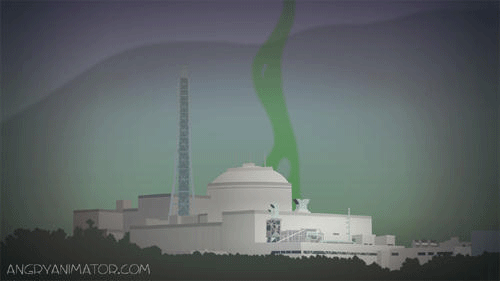
Marianne Birkby, Jul 24, 2026, https://radiationfreelakeland.substack.com/p/plan-to-bring-failed-japanese-fast
Japan is looking to get shot of nuclear waste from its failed experimental “fast breeder” Monju reactor and Workington’s MP along with Cumberland Council is only too happy to help. “Subject to the necessary planning and regulatory permissions, Cavendish Nuclear, together with its delivery partner Amentum, will be constructing a new facility at the port. This development is part of their wider project to support the Japan Atomic Energy Agency (JAEA) with decommissioning of the Monju Prototype Fast Breeder Reactor (FBR), in Fukui Prefecture, Japan.”
Monju Fast Breeder Reactor was a failed £7.2bn experiment in creating a nuclear plant that would burn its own spent fuel (this is what George Monbiot and others have been advocating in their much vaunted nuclear enthusiasm).
It was only operational for 250 days before it was decommissioned. Japan has long since pulled the plug on Monju, an experimental fast breeder nuclear reactor that was plagued by accidents, cover-ups and cost overruns.
Now our nuclear obsessed Cumberland Council and MP are fizzingly saying that Japan’s failure will be Workington’s gain as they scramble to accept the unacceptable, radioactively contaminated sodium coolant aka nuclear waste from yet another failed nuclear experiment and this time its not even our own. Have they stopped to ask why Japan does not want to have the wonderful opportunity of cleaning up this radioactive mess? It has been sitting around long enough as construction started on Monju in 1986 with the reactor achieving criticality in April 1994. The reactor has been inoperative for most of the time since it was originally built. The main product – an expensive toxic mess.
Below is a description of just one of the accidents at Monju in its short operating life
On December 8, 1995, a prototype fast breeder reactor, Monju, located in Tsuruga City, 350km west of Tokyo, was operating at 40% power Refer to JNC’s detailed technical explanation in English of Monju and the accident at http://www.jnc.go.jp/zmonju/mjweb/index.htm.. The Power Reactor and Nuclear Fuel Development Corp (PNC), a government controlled organization, operated this reactor. At 19:47 high temperature liquid sodium coolant at one of the three secondary heat exchangers started leaking through a broken thermometer sheath (designed by IH Company, OD: 10mm, ID: 4mm, Length: 150mm) on the piping and it ignited on contact with air. As shown in Fig. 1, the primary heat exchangers are designed to take heat out of the core of the reactor to the secondary heat exchangers, which then transfer the heat to steam generators for power. Because of this design, it was a simple fire caused by the leakage of chemically reactive but non-radioactive sodium coolant. But due to the delay in shutting down of the reactor, 640kg of the sodium leaked in 3 hours and caused some unexpected damage by the fire and chemical reactions to the surrounding structure
Here on original – excellent diagrams and explanation of the accident
The PNC had been always asked by neighbors as well as anti-nuclear organizations whether their nuclear reactors are absolutely safe. They felt constrained to reply “yes” under the circumstances. Under these conditions, the initial cover up of hiding the videotapes taken at the site and of showing them after editing and the PNC’s delay (of about one hour) in informing the neighboring community agencies of the accident ignited a fierce protest by the public.
This example teaches the students following lessons:
Influence of quality of engineering works
The small design errors in the cheap component which may come from lack of competence and care of designers in the IH Company and JNC as the user, caused the accident.
The cover up of the video tapes and delay in informing others of the accident
The cover up decision was made by managers including ex-engineers. When I asked our students in the class if they do the same under the situations, one-third of them said they might although they think it is a very stupid act. The delay of informing the accidents is mainly due to lack of the system oversight and to the bureaucracy within the JNC organization. These caused loss of public trust in general and have delayed the several tens of billion dollar project at least 6 years, although the government wants to resume the project as soon as possible.
Importance of professional work in accidents
The manuals to handle this kind of the accident were not made although they had some for other types of sodium coolant leakage. Manuals are necessary and useful especially in simple operation. But in accidents like this, which no one had expected and which are generally much more complex than those anticipated in manuals, professional judgments are much more important and necessary. In this case, the air conditioners, which had not been shut down, continued to supply fresh air to the fire.
Learning from past experience
The earlier experimental fast breeder reactor, Joyo, which was designed based on practical experiences by the engineers of previous generation, had not had any serious sodium leak accident for 18 years since its start of the operation in 1977. Most of these engineers, however, were retired or moved to other job as time passed. New generation of engineers might have thought it easy to handle. This is the problem of transferring and learning engineering experience and skills between generations.
Responsibility of managers (ex-engineers) to the public
Engineers know “nothing is absolutely safe”. But sometimes political pressure forces managers to say yes to the public on the absolute safety question. But the more realistic question form the public is that the engineers make a maximum professional effort to eliminate the safety hazard. Engineers should have realized the responsibility of clarifying the situation. After a long discussion on the safety including the following two accidents, the Committee of the Nuclear Safety Commission in Japan formally declared in “The White Paper 2000 on Safety of Nuclear Energy (in Japanese)” approved on March 27, 2001 that “none can say nuclear energy is absolutely safe”.
Demolition of Germany’s Stade reactor building progresses
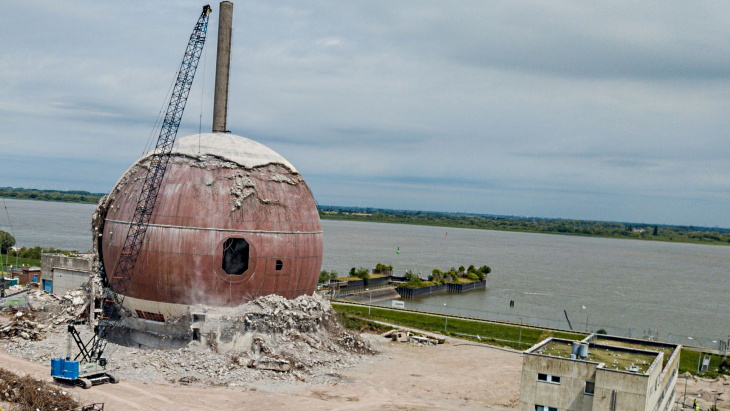
Thursday, 23 July 2026, https://www.world-nuclear-news.org/articles/in-pictures-demolition-of-stade-reactor-building-progresses
The demolition of the reactor building at the decommissioned Stade nuclear power plant in Lower Saxony, Germany, has been under way since the end of March this year and is expected to be completed by the end of the year.
Stade was the first power plant in Germany to be decommissioned after the country announced a nuclear phase-out policy in 2003. The 640 MWe pressurised water reactor began operating in 1972. The plant operated at a reduced capacity from 2003 until the end of 2005, prior to its shutdown. Dismantling of the power plant began in October 2005. Conventional demolition of individual buildings on the power plant site started in 2023.
The first phase of the building dismantling was completed in spring 2024. It involved the demolition of 17 buildings with a total volume of about 177,000 cubic metres – including the administration building, the workshop and operations building, the emergency diesel generator building, the switchgear building, and finally the engine house. This work laid the foundation for the dismantling of the remaining central building complex. Aspects such as safety, environmental protection, and sustainability through material recycling were given top priority.
The demolition of the reactor building is part of Phase II of the conventional dismantling process and simultaneously marks the beginning of the crucial final phase of the overall project.
On 31 March this year, the demolition of the reactor building began. To weaken the material, a steel ball weighing about four tonnes was first be used to strike the approximately 80-centimetre-thick concrete shell. Following this, the auxiliary buildings were completely demolished before the further demolition of the reactor building began at the beginning of June. This involved the use of, among other things, a 16-tonne hydraulic shear and a 180-tonne cable excavator. The plan is to completely dismantle the reactor building by the end of this year.
In preparation for the demolition, extensive hazardous material remediation of the auxiliary building began in May 2025. This was followed in December by the remediation of the reactor building and the containment vessel within it. For this, the necessary infrastructure was first established both inside and outside the reactor building. This included, in particular, the erection of a complex facade scaffold with stair towers and elevators. As the first externally visible measure immediately before the impending demolition of the reactor building, the external lifting platform, which previously also served for the removal of CASTOR used fuel storage casks and steam generators, was demolished on 6 March.
“With the start of demolition work on the reactor building, we have reached the final technical milestone we have been working towards for a long time,” plant manager Marco Albers said in March. “The entire team has put enormous care into preparing the necessary documentation, and I am very pleased that the review by the independent expert and the approval of the Lower Saxony Ministry for the Environment have now been granted. Now, with the help of our partner, the Freimuth company, we can implement what is probably the most demanding step in the conventional demolition of the Stade plant in a technically sound and safe manner.”
Phases II (involving five building complexes) and III (ten building complexes) have been running in parallel since 2023. The site is scheduled to be released from nuclear regulatory oversight in autumn 2027. This will make the Stade nuclear power plant the first commercially operated pressurised water reactor in Germany to be completely dismantled.
Germany’s nuclear phase-out
Following the accident at the Fukushima Daiichi plant in Japan in March 2011, the government of Chancellor Angela Merkel decided it would phase out its use of nuclear power by the end of 2022 at the latest. Prior to the accident, Germany was obtaining around one-quarter of its electricity from nuclear power.
In August 2011, the 13th amendment of the Nuclear Power Act came into effect, which underlined the political will to phase out nuclear power in Germany. As a result, eight units were closed down immediately: Biblis A and B, Brunsbüttel, Isar 1, Krümmel, Neckarwestheim 1, Phillipsburg 1 and Unterweser.
The Brokdorf, Grohnde and Gundremmingen C plants were permanently shut down at the end of December 2021. The country’s final three units – Emsland, Isar 2 and Neckarwestheim 2 – shut down in April 2023. All the units are now at various stages of decommissioning.
Uncertainty over West Cumbria nuclear waste plan continues

22nd July, By Gareth Cavanagh, Data Reporter
CLARITY on the future of nuclear waste currently stored at Sellafield is eagerly awaited from West Cumbria to Westminster.
The cost of the Geological Disposal
Facility could soar to £54bn and the timeline for depositing legacy waste
into the GDF could be 2150. The UK’s grand ambition to deploy fleets of
SMRs is critically undermined by the uncertainty over disposal of nuclear
waste.
Carlisle News & Star 22nd July 2026, https://www.newsandstar.co.uk/news/26289564.uncertainty-west-cumbria-nuclear-waste-plan-continues/
Uranium-Chomping Bacteria Found In Bowels Of Mine That Once Supplied Soviet Nuclear Weapons
Could these mine-dwelling microbes be used to clear up radioactive junk?
Tom Hale, IFL SCIENCE, 15 July 26
In the heady days of the Cold War, the USSR extracted vast amounts of uranium from a mine in East Germany, much of it destined for nuclear warheads. Unbeknownst to the bigwigs back in Moscow, strange and potentially useful microbes were quietly lurking in the mine’s backwaters.
Those microbes were discovered in untreated water flowing from the Wismut GmbH Schlema-Alberoda mine in Saxony, Germany. Between 1946 and 1990, when Germany reunified, around 80,000 tons of uranium were extracted from the site, one of the largest uranium ore deposits in the world.
Strange things live in the mine
Microbiologists at the Helmholtz-Zentrum Dresden-Rossendorf (HZDR) recently collected water samples from an inlet trail from the mine and found that they were teeming with anaerobic bacteria.
Among them were some that can break down metals, like Geobacter and Shewanella, others that run on sulfur, like Desulfovibrio, and a supporting cast of microbes that ferment and break down nitrogen compounds, including Clostridium and Pseudomonas.
Just as their previous experiments had hinted, the team found this gang of bacteria was able to utilize the highly radioactive uranium, as long as they had glycerol, a basic building block of plant and animal fats, to feed on.
“There are bacteria that can metabolically utilize the heavy metal, uranium, which is toxic for humans,” Evelyn Krawczyk-Bärsch at HZDR’s Terrestrial Microbiology research group, and co-author of the study, said in a statement.
“Our group’s investigations had already revealed that bacteria can use uranium dissolved in water for their metabolism when they have access to glycerol as a food source,” she added.
The researchers decided to dig deeper into how this was happening and whether the bacteria could be used as a handy tool to clear up radioactive contamination.
They set up an experiment in the lab in which the bacteria were placed in conditions very similar to their natural low-oxygen environment deep below the uranium mine. After being left for 130 days, just 5 percent of the uranium dissolved in the water remained in the samples.
A really weird chemical state
Using advanced microscopic and spectroscopic techniques, the researchers found the bacteria had incorporated the uranium into their cell walls. …………………………………………………………………………………………..
Clean up Chornobyl?
All of this raises the tantalizing possibility of using these bacteria to clean up uranium and other radioactive junk. Could they, for instance, be introduced into the contaminated waters of Chornobyl to lock its loose uranium into a stable, harmless form?
Whether that’s a genuine possibility or just wishful thinking remains to be seen, but it’s a pretty intriguing idea either way.
The new study is published in the journal Nature Communications. https://www.iflscience.com/uranium-chomping-bacteria-found-in-bowels-of-mine-that-once-supplied-soviet-nuclear-weapons-84123
Ukraine draft law on Chernobyl decommissioning to 2036 approved
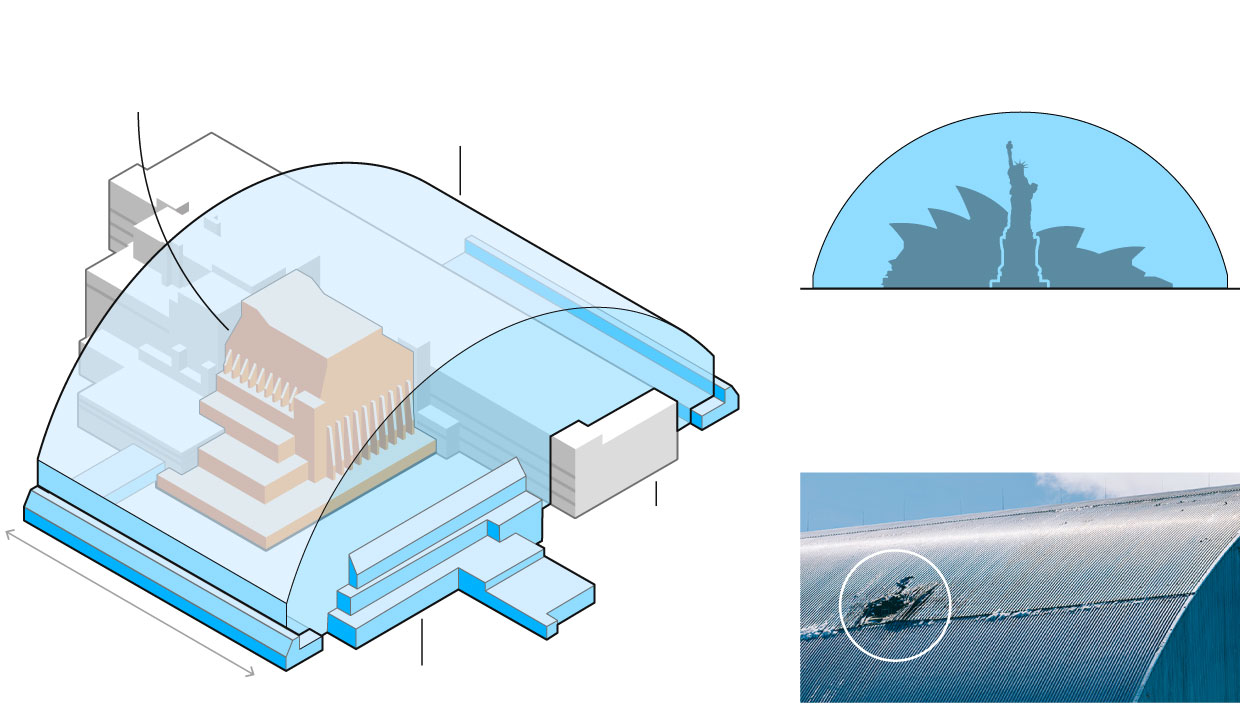
World Nuclear News 10th July 2026, https://www.world-nuclear-news.org/articles/ukraine-draft-law-extends-chernobyl-decommissioning
The Cabinet of Ministers of Ukraine has approved a draft law which extends to 2036 the funding for the State Programme for the Decommissioning of the Chornobyl Nuclear Power Plant and the Transformation of the Shelter Object into an Environmentally Safe System.
The funding allocated for the programme to 2036 amounts to UAH50.8 billion (USD1.1 billion), of which UAH45.6 billion is to be financed via the state budget and UAH5.2 billion from “international technical assistance”.
According to the Ministry of Energy, the programme required updating following the completion of the shutdown and preparatory phases of the Chernobyl decommissioning process “to reflect current challenges” including additional measures to tackle the damage caused during the war by the month-long Russian occupation in 2022 and by a drone strike last year to the New Safe Confinement protective arch, “and the actual progress of projects” at the site.
“The next stage involves the direct decommissioning of the plant and the continued transformation of the Shelter Object into an environmentally safe system,” a ministry statement said.
“Extending the programme will ensure the uninterrupted continuation of the Chornobyl NPP decommissioning process, support Ukraine’s international commitments in the field of nuclear safety, and facilitate the mobilisation of international technical and financial assistance for projects at the plant,” the ministry said. (Chornobyl is Ukraine’s preferred spelling). The draft law will now go to the Ukrainian parliament for consideration.
Canada’s Federal Government in Disarray Over Nuclear Waste Project Assessment .
We the Nuclear Free North is an alliance of people and groups opposing a Deep Geological Repository for nuclear waste in Northern Ontario. We oppose the transport, burial and abandonment of this radioactive waste in our northern watersheds.
| Thunder Bay – Intervenors in the federal assessment of a nuclear waste transportation and burial plan are saying that the federal government is in disarray over the assessment of nuclear projects. This follows the Impact Assessment Agency of Canada’s release, last week, of the Tailored Impact Statement Guidelines for the Nuclear Waste Management Organization’s (NWMO’s) proposed deep geological repository for nuclear fuel waste. The NWMO plan incudes the transportation, processing, burial and abandonment of all of Canada’s high-level nuclear waste in an underground repository proposed for a site between Ignace and Dryden in northwestern Ontario. The Impact Assessment Agency posted the Guidelines to a public registry on July 3rd, following a 30-day comment period in April. The same day, a Notice of Commencement was issued, signaling the start of the assessment statement phase of the multi-year process. In this phase, the Nuclear Waste Management Organization must prepare an Impact Statement and supporting documents to meet the requirements set out in the Guidelines. “Overall, the guidelines set out a reasonable set of requirements. We were pleased to see that the Agency rejected NWMO’s pitch that long-distance transportation and long-term safety of the project should be excluded – those are fundamentally important issues – but we are disappointed that NWMO will not be required to present alternatives to the project,” commented Wendy O’Connor, a volunteer with We the Nuclear Free North. The assertion that the federal government is in disarray stems from the series of overlapping and – in some respects – contradictory messages and announcements issued by them in recent months related to the assessment of nuclear projects. In May, the federal government released a discussion paper proposing that the impact assessment of nuclear projects be handed over to the Canadian Nuclear Safety Commission (CNSC), rather than conducted by the independent Impact Assessment Agency of Canada. The CNSC is the licensing body for nuclear facilities and is described by both academics and industry observers as a “captured regulator”. CNSC is led by nuclear industry insiders and has never refused a licence application since its inception. In June, the federal government announced that it would potentially designate the NWMO’s Deep Geological Repository (DGR) as a “Project of National Interest” under the Building Canada Act. Such a designation would mean guaranteed approval of the DGR, even in the absence of evidence to support the safety of the project. The announcement defined the implications for the DGR project as including “streamlining” of the review and “issuing a document outlining the conditions under which the project may proceed.” According to the federal government, listing the DGR as a “Project of National Interest” would result in “shifting Canada’s regulatory focus from ‘whether’ the project should proceed to ‘how’ it will proceed.” In July, the federal Impact Assessment Agency issued a Notice of Commencement of a full impact assessment of the NWMO’s proposed deep geological repository to be delivered by the Impact Assessment Agency. “While the Guidelines are imperfect, they do provide at least a fighting chance of the public and Indigenous peoples being able to contribute to a thorough assessment of the NWMO’s project, and to have the NWMO’s proposal tested in front of a (hopefully) impartial hearing panel”, said Brennain Lloyd, project coordinator with Northwatch. “This is a massive and unprecedented project. The risks will be widespread – along the transportation route, in the vicinity of the repository, and downstream from the site – and long-lasting. These radioactive wastes remain significantly dangerous for a million years. Let’s not rush to any unsupported conclusions about the project’s safety”, added Charles Faust, speaking on behalf of Nuclear Free Thunder Bay. The comment period on the May discussion paper closes on July 22nd. The federal government is expected to decide by this fall whether the NWMO project is to be designated as a “Project of National Interest”, which would circumvent the impact assessment process. The NWMO is required to provide the Impact Assessment Agency with a workplan for the development of their Impact Statement by the first week of October. Contacts: Brennain Lloyd, 705-493-9650, brennain@northwatch.org Charles Faust, 807-633-0202, cfaust@tbaytel.net Wendy O’Connor, 807-358-6711, wendywoodswalker@rocketmail.com |
Japan begins 21st release of Fukushima nuclear-contaminated wastewater into ocean

TOKYO, July 6 (Xinhua) Zhang Kaiwei, Liang Jun)– https://en.people.cn/n3/2026/0706/c90000-20474742.html
Japan on Monday began a new round of discharge of nuclear-contaminated wastewater from the crippled Fukushima Daiichi Nuclear Power Plant into the sea, marking the 21st such release since the controversial operation began in 2023.
The discharge started at 11:41 a.m. local time. According to the plant’s operator, Tokyo Electric Power Company Holdings (TEPCO), the latest round, scheduled to continue through July 24, will release about 7,800 tonnes of wastewater into the ocean, containing approximately 1.3 trillion becquerels of radioactive tritium.
Struck by a 9-magnitude earthquake and the ensuing tsunami on March 11, 2011, the Fukushima nuclear plant suffered core meltdowns that released radiation, resulting in a level-7 nuclear accident, the highest on the International Nuclear and Radiological Event Scale.
Despite concerns and opposition from the international community, Japan unilaterally launched the discharge of nuclear-contaminated water from the Fukushima Daiichi plant into the ocean in August 2023. So far, TEPCO has completed 20 rounds of discharges, and around 157,000 tonnes of wastewater have been released into the sea.
Nuclear Waste Transportation and Burial Plan Could be “Pre-Approved
3 July 26, https://nuclearwastewatch.weebly.com/
NUCLEAR WASTE ACTION ALERT! On June 24th three federal Ministers lined up to announce that it had referred three projects to the Major Project Office to consider the potential “listing” of the NWMO DGR under the Build Canada Act (aka Bill C-5). That’s a bit cryptic, but what it means is that these projects – if listed – would in essence be pre-approved. As the Minsters’ statement put it, this would mean “shifting Canada’s regulatory focus from ‘whether’ … to ‘how.”
Shockingly, one of these projects is the extremely controversial plan to transport, process, bury and abandon all of Canada’s high-level nuclear waste at the Revell site in northwestern Ontario. The project is the subject of broad opposition and is in the early stage of an impact assessment. It’s unprecedented – there are no other operating deep geological repositories for nuclear fuel waste anywhere in the world – and the plan is still largely conceptual, with many parts of the operation not yet designed. If ever there was a project that needs a rigorous review it is this one. The plan includes 2-3 trucks per day hauling the waste for thousands of kilometres and radioactive waste that will remain hazardous for one million years. Does this sound like a project that should be handed over to the rubber-stamp department?
The federal government is not inviting public comment. Take one minute to send your message today. Go to tinyurl.com/MessageMPs.
The Nuclear Fist: Five Federal Initiatives Pushing and Promoting Nuclear Power
There are currently five federal nuclear related initiatives / announcements: “Getting Major Projects Built in Canada – Discussion Paper on Proposed Legislative, Regulatory, and Policy Reforms” announced May 8th with the deadline now extended to July 22; the electricity strategy “Powering Canada Strong: A National Strategy for an Electrified Canadian Economy” which was announced May 14 with comment invited but no deadline; the Standing Committee on Natural Resources and the Environment electrification study with the deadline – and the study – now extended to mid-September; the Nuclear Energy Strategy for Canada announced June 22 with no comment invited and so no deadline for comment, and the June 24 announcement of the potential “listing” of the NWMO DGR under the Build Canada Act (aka Bill C-5), also no public comment period.
The federal government has unleashed a “discussion paper” outlining the next rush to dismantle what remains of environmental assessment. Top target: independent assessment of nuclear projects, which the paper proposes would be handed over to the Canadian Nuclear Safety Commission. The deadline for comment has been extended to July 22. It’s expected that new legislation will follow quickly. Read more HERE. |
Anishinabek Nation stands united in unequivocal opposition to the transportation of nuclear waste through the entire Anishinabek Nation territory.

ANISHINABEK NATION TERRITORY (July 1, 2026) – The Anishinabek Nation Grand Council Chief shares a statement as the Nation prepares to celebrate Canada Day.
“We wish you a Happy Canada Day!
Anishinabek Nation statement on Canada Day
ANISHINABEK NATION TERRITORY (July 1, 2026) – The Anishinabek Nation Grand Council Chief shares a statement as the Nation prepares to celebrate Canada Day. https://anishinabeknews.ca/2026/07/anishinabek-nation-statement-on-canada-day/
“We wish you a Happy Canada Day! We celebrate the diversity, cultures, and contributions of this Nation with pride and encourage others to join in celebration. However, we also encourage citizens of this Nation to take the time to understand that this land you have come to know as Canada has a colourful past with a legacy that continues to negatively affect the Original People of this land. While some parts of the country are celebrating, First Nations people are contemplating the Government of Canada’s plans for a toxic nuclear waste dump in a small town in Northwestern Ontario within the Treaty 3 territory.
The Anishinabek Nation stands united in unequivocal opposition to the transportation of nuclear waste through the entire Anishinabek Nation territory from southern Ontario to the proposed burial of nuclear waste in the Township of Ignace, Ontario, and Wabigoon Lake Ojibway Nation. While Prime Minister Carney claims, ‘We are defending and building together, the true North, strong and free’, there is a stark contrast between words and actions, and rightsholders and citizens of this land are taking note. Instead of protecting our homeland, the plan is to pollute it with toxic nuclear waste, far from the populations that utilize and benefit from nuclear energy produced in the south.
The Anishinabek Nation stands united in unequivocal opposition to the transportation of nuclear waste through the entire Anishinabek Nation territory from southern Ontario to the proposed burial of nuclear waste in the Township of Ignace, Ontario, and Wabigoon Lake Ojibway Nation. While Prime Minister Carney claims, ‘We are defending and building together, the true North, strong and free’, there is a stark contrast between words and actions, and rightsholders and citizens of this land are taking note. Instead of protecting our homeland, the plan is to pollute it with toxic nuclear waste, far from the populations that utilize and benefit from nuclear energy produced in the south.
Imagine for a moment that the federal and provincial governments proposed nuclear waste in a DGR in Southern Ontario, the most densely populated heart of the country. Would you be so eager to impose such a dangerous burden on those communities that have no choice but to live with the risk? Would there be silence or dismissiveness? Or would Canadians stand up and demand meaningful engagement, transparency, and respect for their health and environment?
magine for a moment that the federal and provincial governments proposed nuclear waste in a DGR in Southern Ontario, the most densely populated heart of the country. Would you be so eager to impose such a dangerous burden on those communities that have no choice but to live with the risk? Would there be silence or dismissiveness? Or would Canadians stand up and demand meaningful engagement, transparency, and respect for their health and environment?
As stated in Article 29 of the United Nations Declaration on the Rights of Indigenous Peoples, “States shall take effective measures to ensure that no storage or disposal of hazardous materials shall take place in the lands or territories of Indigenous Peoples without their free, prior and informed consent,” and we do not consent to the transportation of this nuclear waste in our territory and member First Nations.
We call on the federal government to reconsider its pursuit of a dangerous, toxic nuclear waste dump that threatens our future generations, and to cease these reckless plans immediately. We ask that you respect the treaty relationship, our inherent rights, and our sovereignty. Listen to our voices and prioritize safe and environmentally sound solutions that do not put any communities or the environment at risk. It is painfully clear that the transportation and disposal of hazardous nuclear waste bring risks, uncertainty, and consequences for all.
National interest in nuclear site gets mixed reaction

Organizations opposing the waste site say they’re worried, should the repository be deemed a project of national interest, that oversight would weaken.
“Our major concern would be the approval process being fast-tracked,”
The Nuclear Waste Management Organization says such a designation would not weaken oversight, opponents of the deep geological repository don’t agree
Matt Prokopchuk, Jun 24, 2026
IGNACE — The potential for changing how a proposed nuclear waste facility is studied has set off a flurry of reactions across the region.
On Wednesday, the federal government announced three initiatives were being referred to its Major Projects Office, which will consider whether to name them projects of national interest under the Building Canada Act. That designation is designed to alter the processes that determine whether projects get approved, with the goal of speeding up that decision.
The Nuclear Waste Management Organization’s proposed deep geological repository for high-level used fuel near Revell Lake was one of the initiatives Ottawa announced was up for consideration.
“The deep geological repository for used nuclear fuel is nationally significant infrastructure that supports clean growth, advances reconciliation, delivers long term economic benefits and strengthens Canada’s energy security and resilience,” the Nuclear Waste Management Organization said in an emailed statement.
The NWMO is a government-mandated not-for-profit funded by the nuclear industry tasked with the long-term management of the country’s nuclear waste. It selected the Revell Lake-area site in 2024.
The project is currently undergoing a multi-phase environmental impact assessment and regulatory review by the Impact Assessment Agency of Canada and the Canadian Nuclear Safety Commission. They have been tasked with deciding whether to green-light the proposed facility through a scheduled years-long study.
Organizations opposing the waste site say they’re worried, should the repository be deemed a project of national interest, that oversight would weaken.
“Our major concern would be the approval process being fast-tracked,” said Wendy O’Connor, a volunteer with We the Nuclear Free North, a coalition of organizations and residents opposing the transportation and storing of nuclear waste in northern Ontario. “What we’ve been relying on so far is the impact assessment office and an impact assessment. And we’ve been assured that it was going to be a full impact assessment, which was a win for us.”
“Now, that is all potentially taken apart if this referral to the major projects office actually does go through.”
According to a federal government media release, consultations about whether to list the project will “begin over the coming weeks,” with a decision expected in the fall.
Newswatch has requested comment from the Impact Assessment Agency of Canada about what listing the deep geological repository under the Building Canada Act would mean to the ongoing review the agency is doing.
Wabigoon Lake Ojibway Nation Chief Clayton Wetelainen told Newswatch, should the project receive the “national interest” designation from the Major Projects Office, the First Nation’s independent parallel approvals process won’t be affected. Wabigoon Lake is one of two host communities for the repository, along with Ignace.
“That’s why we, in our agreement to host it, to look at it, is that we have our own independent sovereign regulatory approval process that will mitigate if there’s anything that Wabigoon Lake sees that is going to be problematic,” he said.
The NWMO, in its statement, argued making the project one of national significance “would not reduce the scope, rigour or independence of the regulatory decision-making process.”
Opponents say they’re not convinced, adding that the public consultation phases of the ongoing impact assessment have garnered hundreds of comments, with many expressing concern or outright opposition.
“The risks are monumental and Canadians deserve a thorough examination of the risks in a full impact assessment,” O’Connor said.
“That is what we continue to press for and we were sure that was going to happen and now this (announcement) puts it in question again.”
The Northwestern Ontario Municipal Association, which represents 37 municipalities across the region, including Ignace, said in a media release that it and its sister organization in the northeast “welcome” the referral, but “stress that the project must continue through a rigorous regulatory, environmental, scientific, and Indigenous consultation process before any final decisions are made.”
The organizations added that similar consideration should also be given to the Trans-Canada Highway through the north — particularly with the prospect of hundreds of trucks of nuclear waste travelling each year on Highways 11 and 17.
“Should the deep geological repository ultimately proceed, transportation associated with the project could occur on northern Ontario highways within the coming decades,” NOMA’s media release said.
“Preparing for that future requires a highway system that is safe, reliable, resilient and capable of supporting nationally significant projects.”
In Wabigoon Lake, Wetelainen said the time to make a decision on a nuclear waste site is now.
“It’s a problem today and it’s been a problem yesterday,” he said. “The critical voices and the people who are supportive of it, are going through some times.”
CORWM visits Sizewell A and Sizewell B, -92% of pond low level waste is diverted to landfill

Members of CoRWM visited Sizewell A and Sizewell B to examine interim
storage arrangements for intermediate level waste and spent nuclear fuel.
The visit, held on Thursday 26 February, was arranged to inform a study on
interim storage being undertaken by CoRWM Sub-Group 6 (Waste, Spent Fuel
and Nuclear Materials Inventory Management).
Sub-Group 6 members Pete
Bryant, Derek Lacey, Barry Lennox, and Simon Webb were joined by CoRWM
member Mark Kirkbride. The study will report on current and future interim
storage requirements for spent nuclear fuel and intermediate level waste
(ILW), considering the UK nuclear legacy, the existing operational fleet
and new build.
At Sizewell A, now in the early stages of decommissioning
following de-fuelling between 2006 and 2014, members reviewed progress in
the retrieval and conditioning of ILW, including material from the ponds.
They discussed arrangements for transferring ILW, including by rail, to the
Bradwell Interim Store, which is designed to accommodate waste from
Bradwell, Sizewell A and Dungeness until reactor dismantling begins.
Members noted the achievement of diverting approximately 92% of pond low
level waste from the Low-Level Waste Repository (LLWR) to permitted
landfill sites. This helps preserve capacity at the LLWR.
CoRWM 26th June 2026, https://www.gov.uk/government/news/corwm-visits-sizewell-a-and-sizewell-b
Finland buried nuclear waste in copper canisters 430 meters down, but the metal may not survive as long as the promise.
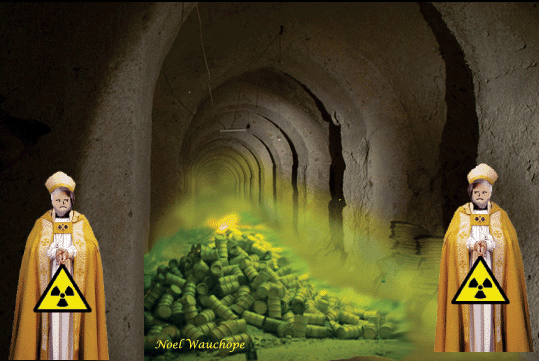
Every nuclear country has the same uncomfortable problem. ……………………….. spent fuel remains dangerous for time periods that are hard to grasp…….its most important results will arrive long after today’s engineers, regulators, and politicians are gone. That is not comforting, exactly, but it is the truth.
By Indux, June 23, 2026, https://www.vozpopuli.com/indux/en/finland-buried-nuclear-waste-in-copper-canisters-430-meters-down-but-the-metal-may-not-survive-as-long-as-the-promise/6314/
Finland is close to doing something no country has fully done before. At Olkiluoto island, Posiva Oy has built Onkalo, a deep underground repository meant to hold spent nuclear fuel far below everyday life, traffic, homes, schools, and the electric bills that come with nuclear power.
The bold part is not just the depth, it is the bet. The fuel will be sealed in copper-and-iron canisters, wrapped in bentonite clay, and placed about 1,300 to 1,400 feet underground in bedrock that is roughly 1.9 billion years old.
Some scientists still question how long the copper canisters will really last, but Finland’s plan leans on a bigger idea: no single barrier is supposed to carry eternity alone.
A world-first nuclear waste plan
Posiva submitted its operating license application at the end of 2021 for an encapsulation plant and final disposal facility for spent nuclear fuel. The Finnish government said the planned license period runs from March 2024 to the end of 2070, with the repository located in bedrock at a depth of about 400 to 430 meters.
That timeline has not gone as smoothly as planned. Finland’s Radiation and Nuclear Safety Authority, known as STUK, says its review has been extended and that it now has additional time until the end of June 2026, if possible, to submit its statement. The government can only grant the operating license if STUK supports it.
What goes inside the rock
The waste is not simply lowered into a tunnel and forgotten. Posiva’s disposal canister has a cast iron inner structure that holds the fuel elements, while the copper shell works mainly as a corrosion barrier. The copper shell is about 2 inches thick, and the lid is welded shut to keep groundwater away from the fuel.
In practical terms, it is a layered defense. First comes the fuel itself, then the iron insert, then copper, then clay, then rock, then the deep groundwater conditions around it. That is why the project is not just a story about a metal container, it is a geology story.
Why copper is controversial
Copper was chosen because it is expected to corrode very slowly in the oxygen-poor conditions deep underground. For the most part, that remains the basis of the KBS-3 concept used by Posiva and Sweden’s SKB.
Not everyone is convinced, however. A long-running scientific debate has focused on whether copper can corrode even in oxygen-free water. A 2023 assessment of canister degradation noted that anoxic copper corrosion and localized sulphide corrosion were among the most debated mechanisms reviewed by Swedish safety experts.
That does not mean the canisters are expected to fail tomorrow. It means the safety case has to survive tough questions. And with nuclear waste, “tough” means thinking beyond normal human planning, past elections, past companies, and past the lifespan of every building we know.
The rock is doing the heavy lifting
So why keep building if the copper debate is still alive? Because the Finnish design does not rely only on copper.
Posiva says geological disposal in Finland means placing the waste in crystalline bedrock, which makes up most of Finnish bedrock and is among the oldest in the world. The company also says deposition holes are drilled in solid rock zones where water seepage through cracks is as small as possible.
That ancient rock is the quiet star of the whole project. It has already been through immense geological time, ice sheets, and environmental change. The logic is simple enough to understand, even if the engineering is anything but simple: put the waste where the world changes slowly.
Licensing is still the near-term test
Onkalo may be physically close to operation, but the paperwork still matters. STUK says the review is close to completion, but it has been delayed by deficiencies in Posiva’s application documentation, updates tied to plant changes, and remaining uncertainties in the long-term safety case.
That is not a minor detail. The first real loading of spent fuel would mark a historic moment for nuclear energy, but regulators are still checking whether the full system is ready. Empty and test runs can prove a lot, but radioactive waste proves more.
Why this matters beyond Finland
Every nuclear country has the same uncomfortable problem. Reactors can produce large amounts of steady electricity with low carbon emissions, but spent fuel remains dangerous for time periods that are hard to grasp.
Finland’s answer may not fit everywhere. The United States, France, Germany, Japan, Canada, and the United Kingdom all have different rocks, politics, and public trust problems. You cannot just copy and paste a 1.9-billion-year-old Finnish bedrock system into another country.
Still, Onkalo is being watched closely because it turns decades of theory into a real facility. If it works as intended, it gives nuclear nations a serious example. If unexpected corrosion or groundwater behavior shows up later, that will matter, too.
A bet measured in centuries
The strange thing about Onkalo is that its most important results will arrive long after today’s engineers, regulators, and politicians are gone. That is not comforting, exactly, but it is the truth.
For now, Finland’s bet is clear. Copper may be debated, clay may shift, and regulators may keep asking questions, but the rock beneath Olkiluoto is the anchor of the plan. In the end, the country is asking ancient stone to help solve one of the most modern problems humans have created.
The official statement was published on STUK.
Nuclear Autopsy for Indian Point Decommissioning?
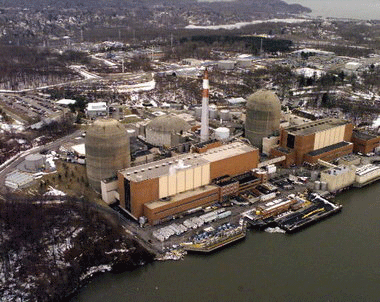
June 25, 2026, https://beyondnuclear.org/nuclear-autopsy-during-indian-point-decommissioning/
On June 18, 2026, Beyond Nuclear was the guest speaker before the New York State Decommissioning Oversight Board (NYDOB) in a public meeting focused on the decommissioning of the Indian Point nuclear power station entitled, “Mind the Gap: Decommissioning’s Critical Link to Public Safety & Extended Reactor Operations.” The presentation and Q&A session with the state board is video archived and available for viewing on YouTube beginning at time mark < 01:40:08 to 02:24:18 >. Beyond Nuclear is providing links to supporting documentation. Following the presentation, the NYDOB recognized further inquiry into broadening decommissioning’s role at Indian Point is warranted to include the equivalent of an autopsy on the closed reactors’ residual safety margins as an appropriate “cost of doing business” to enhance public safety and reliable operations at other reactors that are seeking to renew operating licenses in New York and beyond.
The Ginna nuclear power station, a Westinghouse Electric Pressurized Water Reactor by design in upstate New York on Lake Ontario, has filed a Subsequent License Renewal Application to the US Nuclear Regulatory Commission (NRC) requesting to extend the 56 year old single unit reactor’s operating license to 60 to 80 years.
The permanently closed Indian Point nuclear station is certified by both the owner Holtec International and the NRC for decommissioning only. Similarly, Holtec International is also certified by the NRC solely as the decommissioning operator of the permanently closed Palisades nuclear station in Covert, Michigan, Combustion Engineering Pressurized Water Reactor. Holtec Internationalis however attempting to “recommission” the Palisades operating license to return to full power. Holtec International has submitted a Letter Of Intent to the NRC that it plans to submit an application to extend its Subsequent License Renewal (60 to 80 years) if it does restart.
Beyond Nuclear presented the State of New York Department of Public Service’s NYDOB with the idea that the decommissioning of the Indian Point nuclear power station in Buchanan, NY is a critically important opportunity. Indian Point is not merely just decommissioning project for dismantlement and site remediation of the three-unit nuclear power station. It is also the opportunity to conduct a scientifically rich strategic “autopsy” of the nearly 50-year old commercial reactor site during the dismantlement and site remediation process. Rather than the decommissioning operator, Holtec International, developing the “custody of care” plan to also haul off the radioactive debris for permanent burial at a distant nuclear waste facility. Beyond Nuclear sees the nuclear waste company, now an aspiring would-be nuclear waste generator, should be directed to develop the “custody of care” to strategically target, harvest and deliver samples of decades old “real world” aged, mapped materials extracted safety-related systems, structures and component to a national laboratory qualified to observe, measure and scientifically analyze the residual safety margins in those material samples taken during the Indian Point decommissioning process.
These aged, extracted samples could then be analyzed and materially evaluated for their residual safety margins after irradiation and embrittlement of the reactors’ base metals, radiation induced cracking in dissimilar beltline weld materials from the reactor pressure vessels. Additional, samples could be cut from reactor internals, concrete core samples from the containment structure and “spent” fuel pools, and sections strategically cut from the original, previously inaccessible 47 and 46 year old electrical cables from Units 2 and 3 as well as other reactor safety-related systems, structures and components. These various harvested materials and their residual safety margins now need to inform a host of identified and unanswered “technical knowledge gaps” for such safety issues as how quick cracks can initiate and grow into the failure of those systems, structures and components in reactors seeking extreme license renewals.
For example, strategic harvesting and the associated laboratory analysis needs to determine the synergy of materially damaging conditions (neutron bombardment, extreme ranges of exposure to heat and rapid cooling, metal fatigue and vibration, extreme pressure, humidity, etc.) is needed to benchmark computer modeling of projected material safety margins remaining in operational nuclear power plants now making application to extend their operating licenses well beyond the original 40 year license at construction, beyond the “initial” 20 year license renewal period for 40 to 60 years and now extending into the first “subsequent” 20 year renewal period from 60 to 80 years of exposure to the harsh operational conditions inside a nuclear power station. The NRC and the nuclear industry are in the planning stages for the second “subsequent” 20 year license renewal period from 80 to 100 years becoming the US nuclear industry’s most apparent “bridge to the future.”
Nuclear autopsies are not a new idea. Harvesting and scientific analysis at the decommissioning stage of permanently closed nuclear power stations has long been recognized by the US Nuclear Regulatory Commission (NRC) and the US Department of Energy’s (DOE) national laboratories for a critical role to provide “reasonable assurance” of the public safety and reliable reactor operations of safety-related systems, structures and components in reactor licensing and relicensing.
The DOE’s Pacific Northwest National Laboratory (PNNL) in the state of Washington was contracted by the NRC Office of Research late in 2015 to publish a Technical Letter Report entitled “Criteria and Planning Guidance for Ex-Plant Harvesting to Support Subsequent License Renewal” (PNNL-27120). Published on December 7, 2017, the PNNL technical letter set out how to identify and mitigate known, but still unresolved “technical knowledge gaps” and make recommendations to effectively resolve and close those “gaps.” PNNL concluded that the targeted extraction of “experiential real world” aged materials from safety-related systems, structures and components permanently closed decommissioning nuclear power stations for laboratory analysis was . The resulting insights into a host of age-related degradation mechanisms to measure and project precise margins to failure will be essential to provide “reasonable assurance” that the materials/components will continue to perform their safety function throughout the subsequent license renewal period for 60 to 80 years.
US regulatory law is now in radical transition by politically-driven pro-nuclear agenda, nuclear industry hype and questionable White House’s decrees for the wholesale rewrite of regulatory law to refocus on “nuclear power benefits.” However, “reasonable assurance” needs to be safe guarded as the evidentiary standard in the NRC’s regulatory process for a legal standard of “adequate protection” established under the Atomic Energy Act for safe and reliable operations under the NRC commercial the reactor licensing and relicensing process.
IAEA produces global mapping tool of used nuclear fuel
WNN, Monday, 22 June 2026
The global total of used nuclear fuel produced by nuclear power plants is about 448,000 tonnes of heavy metal, with three quarters in storage and one quarter reprocessed, according to the International Atomic Energy Agency’s first interactive tool showing how much used nuclear fuel the world has – and where it is stored – by country.
The agency says that 41% of used nuclear fuel is in wet storage, “mainly the pools that cool … [it] after it leaves the reactor and other centralised pools. Another 31% is in dry storage which are the casks, buildings, and modular systems used for keeping spent fuel under dry conditions”.
The figures for the interactive map – which allows people to look by country, by region and by storage type – comes from the Contracting Parties to the Joint Convention, which is “the principal international legal instrument to address the safety of spent fuel and radioactive waste management on a global scale”. It is the second edition of the International Atomic Energy Agency’s (IAEA) Global Spent Nuclear Fuel Inventory.………………………………… You can find the IAEA’s Global Spent Nuclear Fuel Inventory here. https://www.world-nuclear-news.org/articles/iaea-produces-global-mapping%20tool-of-used-nuclear-fuel
AUKUS has a big waste issue – and not only money

The fundamental problem is that the AUKUS agreement was negotiated in secret in 2021 by the leaders of the three countries involved, Australia, Britain and the US.
Not one of those leaders is still in office. There has been no parliamentary scrutiny of the deal in Australia.
While they could operate away from base for longer periods and at greater depth than conventional submarines, their size would prevent them operating in the comparatively shallow waters around Australia’s northern coastline, making them less useful for defending our territory.
Hidden in the fine print of the AUKUS agreement is the need for Australia to manage the nuclear waste produced by new submarines, writes Ian Lowe.
The New Daily, Jun 22, 2026,
Many people are shocked by the price of the AUKUS agreement. The government has budgeted a staggering $368 billion, hundreds of times the cost of a new hospital.
But hidden in the fine print is a further huge cost. If the proposal goes ahead, we will have to manage the nuclear waste produced by the submarines.
Nobody knows what that will cost. The US and Britain have operated nuclear submarines for more than 50 years, but still have not worked out how to manage the intractable radioactive waste.
The decommissioned boats are sitting alongside docks, with British and American scientists trying to work out what to do.
We can get some idea of the possible extra cost from the work done 10 years ago by the South Australia Nuclear Royal Commission. I was a member of the expert advisory group for that inquiry.
It commissioned a study of what it would cost to build and operate a facility to store radioactive waste from nuclear power stations in Asian countries.
It came up with a figure of $145 billion, in 2016 values. Scaled up to 2026 dollars, it is equivalent to $190 billion – half as much again as the budget for the submarines.
That figure is almost certainly an underestimate because the royal commission was considering management of waste from nuclear power stations.
The proposed submarines use highly enriched uranium, weapons-grade material. The resulting waste is much nastier. It also poses serious security issues.
At the end of its life, the reactor in a Virginia class submarine still has enough enriched uranium for about 20 bombs. So the waste management facility will need military guarding to prevent misuse of the uranium.
It is also unclear how our government expects to find an acceptable site for waste storage.
There have been three attempts to find a place to store the comparatively benign low-level waste from nuclear medicine and industrial applications.
All have foundered because of opposition by the affected First Nations groups. They have not forgotten the harm done by British testing of nuclear weapons on their land.
The government has made vague suggestions about Defence property, but it is hard to see how it could obtain free prior informed consent from the Indigenous people whose land would be used.
There are also questions about whether acquiring nuclear submarines powered by highly-enriched weapons-grade uranium would be a breach of the Nuclear Non-Proliferation Treaty.
Some Pacific Island leaders have expressed concern, arguing that it would certainly not be consistent with the spirit of our treaty obligations.
The fundamental problem is that the AUKUS agreement was negotiated in secret in 2021 by the leaders of the three countries involved, Australia, Britain and the US.
Not one of those leaders is still in office. There has been no parliamentary scrutiny of the deal in Australia.
It continues to be shrouded in secrecy, despite the high stakes and eye-watering projected cost. Retired major-general Michael Smith has described the arrangement as “the worst defence decision since we relied on Britain to defend us in World War II”.
A public inquiry into the agreement is being conducted under the auspices of the Australian Peace and Security forum.
It is considering the fundamental question – would AUKUS keep us safe? At what cost?
The inquiry is headed by five distinguished community leaders, headed by Peter Garrett, who was lead singer of Midnight Oil before becoming a Cabinet minister.
The critical question is whether owning and operating eight nuclear-powered submarines would actually enhance our security.
I participated in a one-day seminar run by the Submarine Institute of Australia well before the AUKUS agreement was negotiated. The submariners were clearly divided about the question of whether the next generation of submarines should be nuclear-powered.
While they could operate away from base for longer periods and at greater depth than conventional submarines, their size would prevent them operating in the comparatively shallow waters around Australia’s northern coastline, making them less useful for defending our territory.
That observation poses an obvious related question about sovereignty and independence.
Would the AUKUS arrangement move Australia away from being an independent middle-sized country like Japan or Indonesia, locking us into the US war machine and increasing the risk of being dragged into great-power conflict with China, our major trading partner?
Some observers fear that AUKUS could actually make Australia a nuclear target. Given that China is our major trading partner, it seems bizarre to imagine that we need to protect our ocean-going trade from the Chinese navy, but that has been proposed as a reason for acquiring nuclear-powered submarines.
All these questions are being considered by the public inquiry, which is receiving submissions from the community and holding a series of hearings in major cities.
Its October report should provide the basis for a serious re-examination of the AUKUS agreement.
-
Archives
- October 2026 (129)
- September 2026 (339)
- August 2026 (330)
- July 2026 (355)
- June 2026 (287)
- May 2026 (306)
- April 2026 (356)
- March 2026 (251)
- February 2026 (267)
- January 2026 (308)
- December 2025 (358)
- November 2025 (359)
-
Categories
- 1
- 1 NUCLEAR ISSUES
- business and costs
- climate change
- culture and arts
- ENERGY
- environment
- health
- history
- indigenous issues
- Legal
- marketing of nuclear
- media
- opposition to nuclear
- PERSONAL STORIES
- politics
- politics international
- Religion and ethics
- safety
- secrets,lies and civil liberties
- spinbuster
- technology
- Uranium
- wastes
- weapons and war
- Women
- 2 WORLD
- ACTION
- AFRICA
- Atrocities
- AUSTRALIA
- Christina's notes
- Christina's themes
- culture and arts
- Events
- Fuk 2022
- Fuk 2023
- Fukushima 2017
- Fukushima 2018
- fukushima 2019
- Fukushima 2020
- Fukushima 2021
- general
- global warming
- Humour (God we need it)
- Nuclear
- RARE EARTHS
- Reference
- resources – print
- Resources -audiovicual
- Weekly Newsletter
- World
- World Nuclear
- YouTube
-
RSS
Entries RSS
Comments RSS

