USA in a pickle – can’t afford to bury its dead nuclear reactors
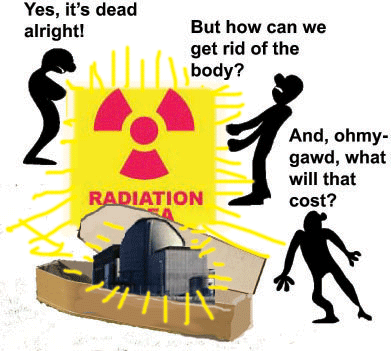 Decommissioning a reactor is a painstaking and expensive process that
involves taking down huge structures and transporting the radioactive
materials to the few sites around the country that can bury them.
The cost is projected at $400 million to $1 billion per reactor, which in some cases is more than what it cost to build the plants in the 1960s and ’70s.
As Reactors Age, the Money to Close Them Lags NYT, By MATTHEW L. WALD March 20, 2012 WASHINGTON — The operators of 20 of the nation’s aging nuclear reactors, including some whose licenses expire soon, have not saved nearly enough money for prompt and proper dismantling. Continue reading
Confusing messages about where Lynas will put its rare earths radioactive wastes
Lynas had denied reports that the Western Australian government had refused to accept the radioactive waste from the miner’s RM2.5 billion rare earth plant in Malaysia.
“If the (Australian) government accepts waste, why not they (Lynas) stay in own country?” Himpunan Hijau chairman Wong Tack asked. Wong said Lynas Corp was “clearly taking advantage” of Malaysia’s
“loose environmental laws” and “non-functioning administration”.
Australia: No request from Lynas to accept waste http://www.themalaysianinsider.com/malaysia/article/australia-no-request-from-lynas-to-accept-waste By Lisa J. Ariffin March KUALA LUMPUR, March 21 — Canberra
has yet to receive any request from Lynas Corp to accept radioactive waste from the Australian miner’s controversial rare earth plant in Gebeng, Kuantan that will be ready this June.
“Australia has not received any request to import residues from the plant,” an Australian High Commission spokesman told The Malaysian Insider when contacted today. Continue reading
Taipower poisons island with nuclear wastes, and islanders’ minds with money
“Taipower contaminates our island with nuclear waste and it also contaminates our minds with money,” “They are trying to make us think that we cannot live without nuclear waste.”…
a lot of Taos depend on Taipower for jobs and are afraid of losing their jobs if they tell people what they really think.

 Lanyu’s residents grudgingly accept nuclear storage Taipei Times, By Loa Iok-sin 19 March 12, The Tao Aborigines of Lanyu (蘭嶼) — also known as Orchid Island — are once again taking to the streets to voice their opposition to a nuclear storage facility on their island, calling for its immediate removal.
While it may appear that the removal of nuclear waste is the only thing the Taos want, the
real situation is much more complicated, as Taiwan Power Co (Taipower) is exerting considerable effort on the resource-scarce island to minimize opposition. Continue reading
Taxpayer cleaning up many millions of tons of uranium wastes,since company went bankrupt

 Five Million Tons Of Uranium Tailing Disposed, The U.S. Department Of Energy Says They Are A Third Of The Way Done With Their Entire Project To Move All Of The Tailings To Crested Junction KJCT8.com Janelle Ericsson MOAB, UT. — Five million tons of uranium tailings has been removed from an old waste site near the river in Moab. The U.S. Department of Energy says they are a third of the way done with their entire project to move all of the tailings to Crested Junction.
Once they reach their destination they will be put in an engineered cell that will prevent contamination to ground water for a thousand years…
. The UMTRA project was originally started in 2001 when the a corporation went bankrupt. Through legislative actions, the project was given to the Department of Energy to take responsibility of the clean up.
140 nuclear reactors now dead, but only 17 buried!
Intermediate-level waste, contrary to its name, is even more of a problem because it may require deep ground burial alongside the high-level spent fuel
In 1976, a British Royal Commission said no more nuclear power plants should be built until the waste disposal problems were resolved. Thirty-five years on, nothing much has changed.
How to dismantle a nuclear reactor, New Scientist, 15 March 2012 by Fred Pearce By the start of 2012, according to the International Atomic Energy Agency, 138 commercial power reactors had been permanently shut down. At least 80 are expected to join the queue for decommissioning in the coming decade – more if other governments join Germany in deciding to phase out nuclear power following the Fukushima disaster in Japan last year.
And yet, so far, only 17 of these have been dismantled and made permanently safe. That’s because decommissioning is difficult, time-consuming and expensive. Continue reading
Confusion about Australian company Lynas rare earths and radioactive waste in Malaysia

 No decision yet on sending Lynas waste to Western Australia The Star, Malaysia, KUALA LUMPUR, 7 March 12, : The Cabinet has not decided on a proposal asking Lynas Corp rare earth waste material to be sent back to Western Australia, said Green Technology, Energy and Water Minister Datuk Seri Peter Chin.
He said Western Australian Minister for Mines and Petroleum Norman Moore was entitled to his view that Australia would not accept responsibility for any waste produced by Lynas Malaysia Sdn Bhd. “Our Cabinet has not made a decision on the matter. Wait for it to be announced,” he said after the launch of the National Energy Security Conference 2012 yesterday.
Moore told the Australian parliament that the Western Australian government does not support the import and storage of other countries’ radioactive waste.
PKR MP Fuziah Salleh had proposed that the rare earth waste material for Lynas be returned to Australia. ….http://thestar.com.my/news/story.asp?file=/2012/2/29/nation/10825847&sec=nation
Lynas to send residue abroad if no suitable disposal site found in Malaysia The Star, Malaysia, By ONG HAN SEAN KUANTAN, March 6, 2012:Lynas Corp has already submitted a letter of undertaking to send its rare earth processing residue abroad if it cannot find a suitable waste disposal site in Malaysia. International Trade and Industry Minister Datuk Seri Mustapa Mohamed said the move was taken as an assurance to the people’s psychological and emotional safety.“Even though the Government is satisfied there will be no radioactive residue produced during the plant’s operation, we have ordered Lynas to guarantee and plan the provision of a permanent waste disposal facility far from human population as recommended by the International Atomic Energy Agency.
“Failing which, Lynas has already expressed willingness to take the residue out of Malaysia,” said Mustapa in a joint statement with Pahang Mentri Besar Datuk Seri Adnan Yaakob here Tuesday.
He said the Government had also announced the setting up of an independent monitoring panel to audit the plant’s construction as an additional measure. On the residue’s radiation monitoring, Mustapa said the plant had yet to start operation and the Government had not appoint independent experts to analyse the radiation level of the residues produced by the
plant….. http://thestar.com.my/news/story.asp?file=/2012/3/6/nation/20120306154934&sec=nation
 Shut down or there’ll be another anti-Lynas rally, Govt told http://thestar.com.my/news/story.asp?file=/2012/2/28/nation/10818800&sec=nation The Star, Malaysia, 6 March 12, KUANTAN: Another anti-Lynas rally will be held if the Government does not shut down the rare earth refinery project in Gebeng, said the Himpunan Hijau committee which organised the first protest on Sunday.
Its chairman Wong Tack said he was disappointed with Prime Minister Datuk Seri Najib Tun Razak’s statement that the Government had to look for a solution that would be acceptable to the people without affecting investments. “We cannot accept his statement. Therefore, the Himpunan Hijau 3.0 rally is on – unless the project is cancelled,” Wong said at a press conference yesterday. The organisers had called on the Government to respond within 24 hours after the Himpunan Hijau 2.0 rally ended two days ago. Najib had said Lynas was looking for an uninhabited location to store the waste material from the plant, although it was scientifically safe. Wong said the committee would discuss with Bersih chairman Datuk Ambiga Sreenevasan on the possibility of holding a joint rally soon.
Japan’s radioactive cleanup, a mammoth and uncertain task that will take decades
The waste would remain in the longer-term storage for 30 years, until half the radioactive cesium breaks down. Then it would still have to be treated and compacted using technology that hasn’t been fully developed yet before being buried deep underground in enclosed
containers. ….
 Japan cleans up radiation zone, unsure of success, The News, March 06, 2012 FUKUSHIMA, Japan: Workers in rubber boots chip at the frozen ground, scraping until they’ve removed the top 2 inches (5 centimeters) of radioactive soil from the yard of a single home. Total amount of waste gathered: roughly 60 tons.
One down, tens of thousands to go. Continue reading
Where to put over 100,000 tons of radioactive waste materials?
6,800 tons of radiation-tainted rice straw left lying in 8 prefectures, Mainichi Daily News, 5 Mar 12, http://mdn.mainichi.jp/mdnnews/news/20120303p2a00m0na010000c.html Some 6,800 metric tons of rice straw contaminated with radioactive substances leaked from the crippled Fukushima No. 1 Nuclear Power Plant remains in eight prefectures with no immediate prospect of disposal, the Mainichi has learned.
Moreover, sludge generated from radiation-contaminated waste water as well as ash tainted with radioactive materials amounts to some 97,000 tons in 12 prefectures — 3.6 times the figure as of July last year, according to the Land, Infrastructure, Transport and Tourism Ministry. Continue reading
Rocketing costs for cleaning up nuclear waste
Nuclear cleanup costs expected to skyrocket at Parks, TRIB LIVE News, By Mary Ann Thomas, ASPINWALL HERALD, March 4, 2012 The cleanup costs for the nuclear waste dump in Parks Township are expected to soar from $170 million to at least $250 million and maybe as much as half a billion dollars because of recently discovered complexities of the site and safety considerations. Continue reading
Danger of uranium and plutonium use by terrorists
 Resolution on the use of uranium, plutonium to be tackled at summit, Business World, Philippines, 5 Mar 12, THE GOVERNMENT will be pushing for an international resolution that would tighten security measures and prevent nuclear resources such as uranium and plutonium from being used for terrorist activities, a high-ranking Executive official said late last week.
Mr. Binay remarked that with the pressing threat of nuclear terrorism, member states of the IAEA — a specialized United Nations body comprising 153 countries and aims to promote safe and peaceful nuclear technologies — “should not only focus on the possibility of terrorists being able to use nuclear bombs in the future, but should urgently improve their respective security and safety measures in the storing and keeping of their uranium and plutonium resources.”…. http://www.bworldonline.com/content.php?section=Nation&title=Resolution-on-the-use-of-uranium,-plutonium-to-be-tackled-at-summit&id=47788
86% of funds to deal with existing waste – UK’s Department of Energy and Climate Change
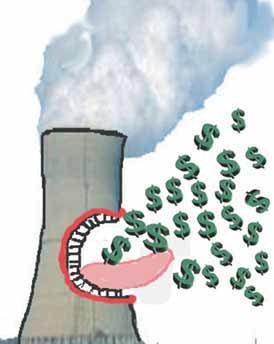 Department of Energy and Climate Change (DECC) is unique among government departments because it has to spend almost half of its budget on dealing with existing nuclear waste.
But to see that this has risen to almost almost 86% of overall DECC spending seemed incredible.
DECC must tell us the truth about nuclear waste, Energy and Environmental Management David Thorpe, 1st November 2011 It’s shocking but true: we are not, as I had always understood, investing in a fund to manage our current nuclear waste in the future.
We are paying lip service to it and dodging the question at the expense of future taxpayers.
Moreover, there is total confusion about what provisions are being put in place to manage any future waste from any new nuclear power stations.
Will the real DECC budget please stand up?
Last week, the Guardian published on its website figures which appeared to show that spending by the Department of Energy and Climate Change on nuclear waste management has risen by an astonishing 81%, as part of an overall budget increase from last year of over 146%.
In trying to find out whether this is true I have found out a truth worse than this, as well as an admission that any new nuclear operators are allegedly being asked to contribute to a fund not only to pay for management and disposal of the new nuclear waste which their plants will create, but also for that of existing nuclear waste!
According to the Guardian, in 2009/10 DECC’s entire spend totaled £3.18bn, but in 2010/11 it is spending £8.06bn, an increase of 146.02% that is largely due to nuclear liabilities.
This spending, according to the Guardian, breaks down as follows:
| DECC spending: £ per topic and change from last year | ||
| Topic | Amount | % increase or decrease |
|---|---|---|
| Nuclear Decommissioning Authority | £6.9bn | +81.12% |
| Committee for Climate Change | £4.4m | +12.12% |
| Low carbon UK | £622.7m | -29.8% |
| International agreement on climate change | £5.4m | +22.42% |
| Promoting low carbon technologies in developing countries |
£278.6m | +159.52% |
| Coal Authority | £0.7m | +87.02% |
| Professional support and infrastructure | £117.7m | -7.62% |
| Energy | £87.2m | +3.33% |
| Historic energy liabilities | £104.5m | -106.8% |
Who will pay for UK’s new nuclear waste?
DECC must tell us the truth about nuclear waste Energy and Environmental Management, David Thorpe, 1st November 2011 “…..Who will pay for new nuclear waste? In a phone conversation with another press officer, who I believe to be named Jonathan Farr, he admitted that new nuclear operators like Horizon and EDF are being asked to contribute to a fund not only to pay for management and disposal of the new nuclear waste which their plants will create, but also for that of existing nuclear waste.
I double checked that this was what he meant.
I said, “Are you seriously saying that the government is not putting aside cash to deal with our nuclear legacy but is asking nuclear operators to do so? What do they think of that?”
If I were a nuclear operator I would be outraged.
But the question was dodged. He was having a hard time explaining it in the first place, and merely reiterated the line that the government is taking a responsible position.
DECC’s line on new nuclear waste is: “New nuclear operators will be required by law to put money aside from day one to pay for the eventual decommissioning costs and their full share of waste disposal.” Continue reading
Rare earths company Lynas wants the profits, but nobody wants the radioactive wastes
 Malaysia – How to dispose of the waste? MY Sin Chew Daily,, 2012-03-01 By LIM SUE GOAN, Translated by SOONG PHUI JEE, Four government departments have earlier recommended that Lynas should ship back waste material produced by the refinery plant to Australia. They have a certain representativeness as four departments account for 16% of the total 25 departments.
It was reported that the Malaysian Cabinet has accepted the recommendation and required Lynas to ship back all waste material back to Western Australia. It is indeed a positive development, but is it feasible or just a wishful thinking?
Western Australian Minister for Mines and Petroleum Norman Moore told the Parliament in April last year that the Australian Government would not accept responsibility for any waste produced by Lynas. Even if the recommendation works, there is still a distance from the anti-Lynas group’s demand of revoking the temporary operating licence.
The Cabinet must have a clear decision on the issue, whether to revoke the licence or keep the refinery plant. If they decide to revoke the licence, they have to study how to deal with the aftermath problems, including explaining to the international community that Malaysia does not deliberately violate the agreement. The country might also have to compensate a huge sum of money, particularly when the rare-earth plant’s construction is almost complete.
If they decide to keep the plant, they should then ponder over how to ensure that the waste material will not threaten the people’s health. The chemical toxicity of thorium is estimated to be little and the risk is mostly from its radioactivity. The most stable isotope of thorium is 232Th, with a half-life of 14.05 billion years. Can Lynas’ permanent waste disposal facilities withstand the test of time and natural disasters?
In politics, the BN must also get prepared for attacks, particularly from political leaders of eastern Peninsula.
Since the anti-Lynas movement is in full swing in the civil society, BN leaders must think twice before making a speech. If they make a slip of the tongue, including calling it a local community issue and threatening to sell cendol at the rallies, it would only heighten the public’s ill-feeling. As Himpunan Hijau 2.0 chairman Wong Tuck said, the then process of approving the investment of Lynas lacked transparency and who actually allows the plant to be built in Kuantan? Why was the environment-threatening projects approved within a week?
……. we wonder how severe is the assessment procedure in Malaysia. It is understood that the Pahang Environment Department had given its approval only three weeks after Lynas submitted its environmental impact assessment report, while the radiation impact assessment procedure was completely opaque.
Should the rare-earth refinery plant be kept after the exposure of so many management weaknesses in the approval process? http://www.mysinchew.com/node/70809
Humans can’t enter. Robot finds high radiation in Fukushima No.2 reactor
Robot detects high radiation levels at Fukushima Daiichi plant, Mainichi Daily News, 29 Feb 12, TOKYO (Kyodo) –– A remotely operated robot has detected high radiation levels of up to 220 millisieverts per hour at the crippled Fukushima Daiichi nuclear power plant’s No. 2 reactor building, plant operator Tokyo Electric Power Co. said Tuesday.
The Japanese-made Quince 2 robot, which began checking radiation levels on Monday, was exposed to 153 millisieverts of radiation in just less than three hours of operation, according to the utility.

“It is difficult for a human being to go inside and do work,” a Tokyo Electric official said of conditions inside the reactor building, adding that the humidity inside is also high at around 70 percent…. http://mdn.mainichi.jp/mdnnews/news/20120229p2g00m0dm056000c.html
Nuclear plant 45 years working, 100 years++ to get rid of it
 Oldbury nuclear power station shutdown: What next? By Chris Kelly BBC News, 29 Feb 12, “…….the beginning of the end for Oldbury. The end, though, will extend many more years into the future than Oldbury’s 45-year history.
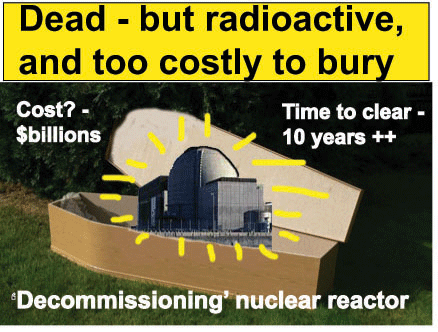
Over the next three years, all 52,000 fuel elements inside the station’s nuclear reactor will be gradually removed which will mean no more heat is generated by the reactor. The fuel is then taken away – by road from Oldbury to nearby Berkeley, site of another inactive nuclear power station – and then by rail to Sellafield where it is reprocessed.
Once the fuel has gone, other hazards and chemicals on the site such as carbon dioxide, hydrogen and acids are taken away and some of the buildings on the site will be demolished. “That will probably take about 15 years from now – so in the 2020s,” said Mr Sprauge. “What we will be left with then is the two reactor buildings and the centre block and pretty much nothing else.”
The longest job of the entire operation, though, will then begin. Leaving the station to slowly lose its radioactivity. And that job – which requires little human intervention – will take some 80 long years while the radioactivity from components in the reactor slowly fades.
The final bow for Oldbury’s mysterious looking reactor buildings will then come in 2109 when work can begin to pull them down. By then, the Oldbury reactor buildings may have a new neighbour. Horizon Nuclear Power – a conglomerate formed by E.On and RWE – hope to build a new power station, next to the existing reactor building, by 2019.
But one resident of nearby Sheperdine – Reg Illingworth – is less than pleased about the idea of a new reactor there.
Mr Illingworth, originally from Liverpool, moved to the nearby village of Shepperdine when plans were afoot to decommission Oldbury in 2007. But the life of the station was extended until 2012 before plans for the the Oldbury B station were announced.
“I’m hyper, hyper worried,” said Mr Illingworth, who is a member of a local anti-nuclear campaign group. He added he was “glad to see it’s closing”……http://www.bbc.co.uk/news/uk-england-bristol-17131988
1 This Month
23-25 October – on Zoom – World BEYOND War’s annual global conferenc


Shut down the radiation-damaged Heysham nuclear reactors now
To see nuclear-related stories in greater depth and intensity – go to https://nuclearinformation.wordpress.com

Say No to NASA’s Reckless Nuclear Reactor on the Moon
Say No to NASA’s Reckless Nuclear Reactor on the Moon

-
Archives
- October 2026 (231)
- September 2026 (339)
- August 2026 (330)
- July 2026 (355)
- June 2026 (287)
- May 2026 (306)
- April 2026 (356)
- March 2026 (251)
- February 2026 (267)
- January 2026 (308)
- December 2025 (358)
- November 2025 (359)
-
Categories
- 1
- 1 NUCLEAR ISSUES
- business and costs
- climate change
- culture and arts
- ENERGY
- environment
- health
- history
- indigenous issues
- Legal
- marketing of nuclear
- media
- opposition to nuclear
- PERSONAL STORIES
- politics
- politics international
- Religion and ethics
- safety
- secrets,lies and civil liberties
- spinbuster
- technology
- Uranium
- wastes
- weapons and war
- Women
- 2 WORLD
- ACTION
- AFRICA
- Atrocities
- AUSTRALIA
- Christina's notes
- Christina's themes
- culture and arts
- Events
- Fuk 2022
- Fuk 2023
- Fukushima 2017
- Fukushima 2018
- fukushima 2019
- Fukushima 2020
- Fukushima 2021
- general
- global warming
- Humour (God we need it)
- Nuclear
- RARE EARTHS
- Reference
- resources – print
- Resources -audiovicual
- Weekly Newsletter
- World
- World Nuclear
- YouTube
-
RSS
Entries RSS
Comments RSS

