Japan has no solution to disposing of its nuclear wastes
The country is yet to build a final disposal site for nuclear fuel.
Meanwhile, Katsutaka Idogawa, mayor of the town of Futaba in Fukushima Prefecture, which hosts the troubled Daiichi plant, criticized the panel for drafting a new atomic energy policy platform before an investigation into the cause of the nuclear crisis is concluded…..

 Panel calls for study on direct disposal of spent nuclear fuel, Mainichi Daily News, 29 Feb 12, Nothing is decided yet but TEPCO told the press at its Tokyo headquarters Wednesday morning that this is one option TEPCO officials are considering to use at the tsunami-stricken Fukushima Dai-ichi nuclear power plant in Okuma town in Fukushima Prefecture, northeastern Japan.
TOKYO (Kyodo) — A government panel commissioned to compile the country’s basic atomic energy policy said in its draft nuclear power platform Tuesday that Japan should study the possibility of burying spent nuclear fuel deep underground, instead of the current disposal
method of reprocessing spent fuel. Continue reading
USA’s laughable “Nuclear Waste Confidence Rule”
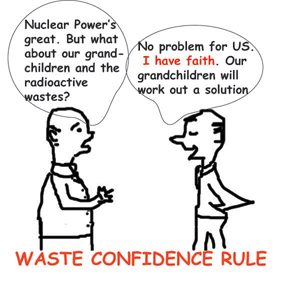 Public comments needed against NRC’s Nuclear Waste Confidence Game , Beyond Nuclear 25 Feb 12, The U.S. Nuclear Regulatory Commission (NRC) has requested public comments on its latest revision to its “Nuclear Waste Confidence Decision.” Please email your comments before March 19th to WCOutreach@nrc.gov in order to head off this latest round of a very dangerous “game being played” by NRC, which is doing the bidding of the nuclear power industry…..
The NRC’s “confidence” that on-site storage for 120 years (60 during reactors operations, 60 after reactor shutdown) is safe and secure would be laughable, if it weren’t so seriously wrong. 120 years is half as long as the United States has been an independent country (1776 to 2012, 236 years). A lot can go wrong in 120 years. NRC’s consideration of 200 to 300 years of on-site storage is even more preposterous. This is not “interim” or “temporary” on-site storage. This is de facto permanent on-site storage, in any common understanding of the term…..
BACKGROUND
First promulgated in 1984, NRC’s “Nuclear Waste Confidence Decision” claimed that by 2007, the U.S. would open one or more repositories for the permanent disposal of irradiated nuclear fuel. In the meantime, NRC expressed its “confidence” that irradiated fuel stored in pools or dry casks on-site would be done so safely and securely. This served as legal cover, carte blanche, for nuclear utilities to generate an unlimited amount of high-level radioactive waste, while blocking concerned citizens and environmental groups intervening in NRC proceedings from challenging new reactor license applications or old reactor license extensions on such grounds as the fact that there is no safe solution to the problem of radioactive waste management.
By 1990, NRC already had to “postpone” its “confidence.” It revised its “Confidence Decision” to now say that by 2025, at least one repository would be opened.
In December 2010, NRC revised its “Nuclear Waste Confidence Decision” yet again, to reflect the reality of the Obama administration’s wise decision to cancel the Yucca Mountain dump. NRC now declared no date certain for the opening of the first repository, but rather stated that on-site storage in pools and/or dry casks was safe for 120 years — 60 years during reactor operations, and 60 years after reactor shutdown. In addition, the five NRC Commissioners ordered their staff to study the potential for on-site storage lasting 200 to 300 years into the future. That explains NRC current request for public comments….
Please submit comments to WCOutreach@nrc.gov. You may also send comments through the U.S mail to: Christine Pineda, Project Manager; Mailstop EBB-2B2; Office of Nuclear Material Safety and Safeguards; U.S. Nuclear Regulatory Commission; Washington, DC 20555-0001 http://www.beyondnuclear.org/radioactive-waste-whatsnew/2012/2/23/public-comments-needed-against-nrcs-nuclear-waste-confidence.html
Japan banking on non-viable reprocessing, because it has nowhere to put nuclear wastes
the government has delegated the task of dealing with waste to the private sector, so there is no central decision-maker
 “Why does the government stick to the very costly recycle policy? That is because if they give it up, they should explain where a final repository will be located,”
Beyond Fukushima Japan faces deeper nuclear concerns, Vancouver Sun, By RISA MAEDA, Reuters February 24, 2012 TOKYO“…..A DECENT BURIAL With Japan’s recycling efforts running so far behind the required pace
to deal with the waste problem, Japan needs to find another resting place for its waste, away from nuclear power plants, which are typically located on the coast.
But unlike France and the United States, the world’s biggest atomic power generators, Japan does not have much in the way of geologically stable and empty landscapes in which to bury nuclear waste for centuries. Given its population density is 10 times higher than the United States and almost three times higher than France, Japan faces a “not in my backyard” problem like no other big nuclear-power nation. Continue reading
Europe’s costly mess about burying the dead nuclear reactors
Auditors criticise decommissioning of nuclear reactors in Eastern Europe European Energy Review, By Hughes Belin, 24 Feb 12 The European Court of Auditors (ECA), which checks the management of EU money, has published a highly critical report on the management of the EU’s financial assistance for the decommissioning of eight nuclear reactors in Bulgaria (Kozloduy), Lithuania (Ignalina) and Slovakia (Bohunice).
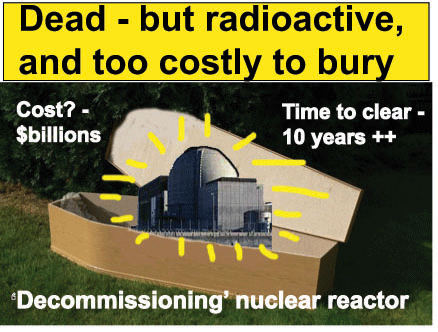
As one “Green” member of the European Parliament puts it, the ECA’s report shows ‘the enormous hidden costs of nuclear energy’. Continue reading
Rocky Flats nuclear weapons site still contaminated with plutonium
 The Rocky Mountain Peace and Justice Center hired independent contractors to test the soil and find out what the level of present plutonium contamination really looks like – but they were barred from actually entering the refuge. Instead, they tested the soil along the outside of the fence, and found that the level of contamination hasn’t changed since the 1970s.
 Plutonium particles in the soil at Rocky Flats will one way or another, sooner or later, come into people’s lungs and lives, since, with a half-life of 24,000 years, it poses a radiation hazard essentially forever
the Rocky Mountain Peace and Justice Center has filed a lawsuit to attempt to block any construction.
Former Colorado Nuclear Weapons Plant Just As Contaminated 40 Years Later http://www.care2.com/causes/former-colorado-nuclear-weapons-plant-just-as-contaminated-40-years-later.html, Care 2, by Julie Rodriguez February 24, 2012 16 miles northwest of Denver, CO sits the Rocky Flats site, formerly home to a plant that produced nuclear weapons from 1952-1989. These operations were shut down for repeated safety violations, which whistleblowers started bringing to the attention of the EPA and FBI in 1987. The extent of the contamination of the site was never revealed publically. Continue reading
Questions on Australian company Lynas’ radioactive wastes plan in Malaysia
 The Lynas Advanced Material project will produce 20,000 tones of radioactive waste, which is 10 times more than the Asian Rare Earth factory in Bukit Merah.
1. Why didn’t Lynas set-up the rare earth plant near its source of extraction in Western Australia as it would have saved a huge amount of money in shipping costs?
2. Why didn’t Lynas obtain an approval from the authorities in Western Australia to set-up the plant?
3. Could the authorities in Western Australia be concerned about the possible radiation leaks, health hazards, birth defects, lead poisoning and other complications?
4. Shouldn’t this in itself raise a red flag with the Malaysian authorities?
 Gov’t fails to learn from Bkt Merah tragedy http://www.freemalaysiatoday.com/2012/02/22/govt-fails-to-learn-from-bkt-merah-tragedy/ Free Malaysia Today February 22, 2012 Is the RM700 million in Lynas investment more important to the government than the lives of its citizens? By Charles Santiago Severe birth defects, eight leukemia cases over five years in a community of 11,000, tears and anguish of the poor people from a largely shoe-making community – these are not news headlines. Neither is it the plot of a movie.
These are the consequences of carelessly allowing the Asian Rare Earth factory to be built in Bukit Merah, Perak in 1982. When Mitsubishi Chemical started operating its rare earth factory, the villagers complained of choking sensation, pungent smell, coughs and colds. The community also saw a sharp rise in the cases of infant deaths, congenital disease, leukemia and lead poisoning. While US$100 million is estimated to be the clean-up cost of the factory and dump site, the largest in the rare earth industry, it has not wiped out the memories and heartache of the villagers who lost their children and loved ones.
But 30 years later, the government has again allowed a rare earth factory to be set-up by Lynas Corporation Ltd in Gebeng, Kuantan. This means the government has waved the green flag with full knowledge of the possible consequences and deadly effects. Continue reading
Vogtle’s nuclear waste pools close to full – where to put new wastes?
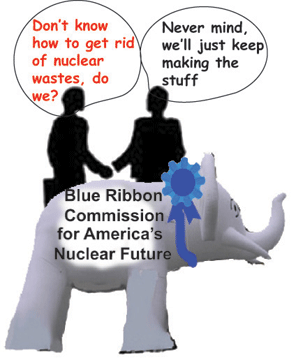 New Plant Vogtle reactors praised despite unresolved nuclear waste plan Augusta Chronicle By Rob Pavey Staff Writer Feb. 17, 2012 Nuclear expansion was touted this week as the answer to America’s energy needs, but there is still a question of what to do with the spent fuel the process creates.
Just a few hundred yards past a Burke County podium where Energy Secretary Steven Chu
cheered the $14 billion expansion of Plant Vogtle, a lesser known construction project is under way to add storage for spent fuel that could be stranded indefinitely here in Georgia.
The waste, part of 2,490 metric tons of the material statewide, has been accumulating in concrete-lined pools since Vogtle’s first two reactors went online in 1987 and 1989. Those pools will be full in 2014, Continue reading
Global problem of burying dead nuclear reactors
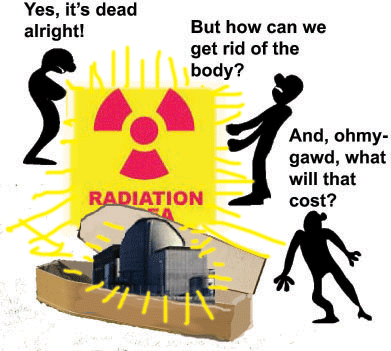
 Abandon nuclear energy programme, Unep boss urges Kenya , Standard, BY PETER ORENGO, 13 Feb 12 “……..According to the United Nations Environment Programme’s (UNEP) Year Book 2012, one of United Nations Environment Program (UNEP) ‘s emerging global concerns is the challenge of decommissioning the growing number of end-of-life nuclear power reactors….
The UNEP Year Book says the cost of decommissioning varies greatly, depending on the reactor type and size, its location, the proximity and availability of waste disposal facilities and the condition of both the reactor and the site at the time of decommissioning….. Continue reading
Japanese nuclear corporations clean up financially from radiation clean-up
Even more disturbing to critics of the decontamination program is the fact that the government awarded the first contracts to three giant construction companies — corporations that have no more expertise in radiation cleanup than anyone else does, but that profited hugely from Japan’s previous embrace of nuclear power.
Japan Starts Nuclear Cleanup, With Little Idea of How By HIROKO TABUCHI, NYT February 10, 2012 IITATE, Japan — As 500 workers in hazmat suits and respirator masks fanned out to decontaminate this village 20 miles from the ravaged Fukushima Daiichi nuclear reactors, their confusion was apparent. “Dig five centimeters or 10 centimeters deep here?” a site supervisor asked his colleagues, pointing to a patch of radioactive topsoil to be removed. He then gestured across the village square toward the community center. “Isn’t that going to be demolished? Shall we decontaminate it or not?”
A day laborer wiping down windows at an abandoned school nearby shrugged at the work crew’s haphazard approach. “We are all amateurs,” he said. “Nobody really knows how to clean up radiation.” Continue reading
Japanese monks store radioactive waste near their temple
 Abe said he and the other monks are storing the soil on a hill behind the temple as neither the government nor the nuclear plant operator Tokyo Electric Power (TEPCO) are helping with the clean-up.
“No-one else would take the soil. If there’s nobody to take care of it, the decontamination can’t get going because there’s nowhere to get rid of it,” Abe said.
Japan priest fights invisible demon: radiation Feb 10 (Reuters) – On the snowy fringes of Japan’s Fukushima city, now notorious as a byword for nuclear crisis, Zen monk Koyu Abe offers prayers for the souls of thousands left dead or missing after the earthquake and tsunami nearly one year ago.
But away from the ceremonial drums and the incense swirling around the Joenji temple altar, Abe has undertaken another task, no less
harrowing — to search out radioactive “hot spots” and clean them up, storing irradiated earth on temple grounds….
Radiation, carried on winds and by snow, spread far beyond the 20 km (12 miles) evacuation zone around the plant, nestling in hot spots across the region and contaminating the ground in what remains a largely agricultural region. Continue reading
Process for terminating Cotter company’s radioactive license in Colorado
The majority of the documents being reviewed currently concern characterization of the soil and groundwater contamination on site and cleanup criteria.
Cotter documents under review, Company in process to terminate radioactive materials license, Canon City Daily Record, By RACHEL ALEXANDER 02/10/2012 A public meeting was held Thursday with the Colorado Department of Public Health and Environment and Cotter Corp. to discuss three upcoming department decisions.
The documents currently under review by CDPHE, the Environmental Protection agency and the public are the New Evaporation Pond
Conceptual Design; the Onsite Soil Excavation and Groundwater Characterization Process Plan; and the Soil Remediation Criteria
Selection.
This is the first round of documents that are being developed by Cotter as part of the process to terminate its radioactive materials
license and the deletion of the site from the Superfund list. Continue reading
Multi $billion radioactive cleanup at Hanford not going well
 Problems plague cleanup at Hanford nuclear waste site, By Peter Eisler, USA TODAY HANFORD SITE, Wash. – Seven decades after scientists came here during World War IIto create plutonium for the first atomic bomb, a new generation is struggling with an even more daunting task: cleaning up the radioactive mess. The U.S. government is building a treatment plant to stabilize and contain 56 million gallons of waste left from a half-century of nuclear weapons production. The radioactive sludge is so dangerous that a few hours of exposure could be fatal. A major leak could contaminate water supplies serving millions across the Northwest. The cleanup is the most complex and costly environmental restoration ever attempted.
And the project is not going well. Continue reading
Effort to clean up Hanford radioactive spill
Plan developed to clean up highly radioactive Hanford spill BY ANNETTE CARY, TRI-CITY HERALD 02/06/12 Hanford officials have settled on a plan to clean up what may be the most highly radioactive spill at the nuclear reservation.
It depends on calling back into service the 47-year-old, oversized hot cell where the spill occurred to protect workers from the radioactive cesium and strontium that leaked through the hot cell to the soil below.
Radioactivity in the contaminated soil, which is about 1,000 feet from the Columbia River, has been measured at 8,900 rad per hour. Direct exposure for a few minutes would be fatal, according to Washington Closure. Continue reading
Taipei insists that its many thousands of spent nuclear fuel rods are safe
 Atomic body dismisses report on nuclear safety Taipei Times Staff Writer, with CNA , 9 Feb 12, The Atomic Energy Council yesterday dismissed a French newspaper’s report that raised doubts about the security of facilities storing spent reactor fuel, saying that spent fuel has always been kept under safe storage and strict management.
The French newspaper Le Monde reported on Tuesday that spent fuel pools at the Jinshan (金山) Nuclear Power Plant in Shimen District (石門), New Taipei City (新北市) and Guosheng Nuclear Power Plant in Wanli District (萬里), New Taipei City, have become saturated and could therefore be severely hazardous in the event of an accident. Continue reading
Polynesia’s radioactive pollution from France’s nuclear bomb tests
 France’s upper chamber approved a motion that provides for Mururoa and Fangataufa, currently under the control of the defence ministry, to be restored to the Polynesian public domain, though the bill stands little chance of becoming law. “We realise that they are the two largest nuclear dumps in an ocean environment. But in Oceania you cannot separate human beings from their ecosystem,” says the author of the bill, Senator Richard Tuheiva. “Restitution [of the atolls] is a way of soothing the psychological wounds [caused by the nuclear era].”
about 5kg of plutonium is trapped in the sediment at the bottom of the Mururoa and Fangataufa lagoons, ……. There is no question of them returning to “normal” use.
 France urged to clean up deadly waste from its nuclear tests in Polynesia, Guardian UK, 7 Feb 2012, 193 nuclear tests carried out on the Mururoa and Fangataufa atolls between 1966 and 1996 have left a dangerous legacy. Continue reading
1 This Month
23-25 October – on Zoom – World BEYOND War’s annual global conferenc


Shut down the radiation-damaged Heysham nuclear reactors now
To see nuclear-related stories in greater depth and intensity – go to https://nuclearinformation.wordpress.com

Say No to NASA’s Reckless Nuclear Reactor on the Moon
Say No to NASA’s Reckless Nuclear Reactor on the Moon

-
Archives
- October 2026 (231)
- September 2026 (339)
- August 2026 (330)
- July 2026 (355)
- June 2026 (287)
- May 2026 (306)
- April 2026 (356)
- March 2026 (251)
- February 2026 (267)
- January 2026 (308)
- December 2025 (358)
- November 2025 (359)
-
Categories
- 1
- 1 NUCLEAR ISSUES
- business and costs
- climate change
- culture and arts
- ENERGY
- environment
- health
- history
- indigenous issues
- Legal
- marketing of nuclear
- media
- opposition to nuclear
- PERSONAL STORIES
- politics
- politics international
- Religion and ethics
- safety
- secrets,lies and civil liberties
- spinbuster
- technology
- Uranium
- wastes
- weapons and war
- Women
- 2 WORLD
- ACTION
- AFRICA
- Atrocities
- AUSTRALIA
- Christina's notes
- Christina's themes
- culture and arts
- Events
- Fuk 2022
- Fuk 2023
- Fukushima 2017
- Fukushima 2018
- fukushima 2019
- Fukushima 2020
- Fukushima 2021
- general
- global warming
- Humour (God we need it)
- Nuclear
- RARE EARTHS
- Reference
- resources – print
- Resources -audiovicual
- Weekly Newsletter
- World
- World Nuclear
- YouTube
-
RSS
Entries RSS
Comments RSS

