USA’s present danger of nuclear spent fuel pools
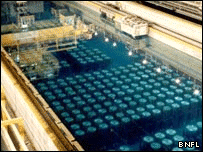 Congress needs to focus on how nuclear waste is stored now By Dave Lochbaum and Robert Cowin, Union of Concerned Scientists – 05/01/13 U.S. nuclear power plants have been generating electricity for more than 50 years, but the nuclear industry and the federal government have yet to figure out what to do with nuclear waste, which remains dangerously radioactive for thousands of years. On April 25, a bipartisan group of senators — Lamar Alexander (R-Tenn.), Dianne Feinstein (D-Calif.), Lisa Murkowski (R-Alaska) and Ron Wyden (D-Ore.) — released draft legislation addressing this intractable problem. Continue reading
Draft plan for USA’s nuclear wastes, from 4 US Senators
 U.S. Senators Seek Comments on Plan to Store Nuclear Waste Science, by David Malakoff 25 April 2013, After Yucca. Four U.S. Senators have drafted legislation that would set up a process for disposing of nuclear waste that was once supposed to go to a repository under Yucca Mountain (above) in Nevada.
“Our country can’t wait any longer to find a long-term solution for disposing of nuclear waste,” said Senator Ron Wyden (D-OR), the chair of the Senate Energy and Natural Resources Committee, in a statement. “I’m hopeful the feedback we receive will help us finish the job and allow us to move forward with legislation that puts the U.S. back on the path to safely managing and permanently disposing of the most radioactive wastes.” The other members of the waste quartet are senators Dianne Feinstein (D-CA) and Lamar Alexander (R-TN), who lead the Senate appropriations subpanel that oversees waste issues, and Senator Lisa Murkowski (R-AK), the senior Republican on the energy committee.
The draft bill includes many of the suggestions made by the Blue Ribbon Commission on America’s Nuclear Future. It calls for the creation of a new nuclear waste administration, for example, that would coordinate a “consent-based process” for building new nuclear waste storage facilities. (That process is, in part, a response to complaints that Congress placed the Yucca Mountain facility in Nevada without the state’s consent.) Two of the senators also offered alternative ideas on several issues……
But Dave Lochbaum, the director of the Nuclear Safety Project at the Union of Concerned Scientists (UCS), said in a statement that the draft doesn’t do enough to address the safety of waste already stored at reactors around the nation. “Despite their good intentions, the senators ignored the fact that we have a problem right now with how nuclear plant owners store this highly radioactive waste,” Lochbaum said. “Even under the rosiest scenario, it will take years to site and build an interim storage facility. That means large quantities of nuclear waste will remain at nuclear plants for a long, long time—and three quarters of it is currently crammed in cooling pools rather than stored in dry casks, which are safer.”
The senators say that they released the draft in order to provoke discussion and have asked for comments by 24 May. http://news.sciencemag.org/scienceinsider/2013/04/us-senators-seek-comments-on-pla.html
The high cost of dealing with Indian Point’s nuclear wastes
 Nuclear waste handling is pricey, Times Union, Michael McGlynn, April 18, 2013 “…..Indian Point produces electricity and high-level radioactive wastes. The electricity is consumed by users now. The radioactive wastes require expensive safe handling and storage for several hundreds of years.
The federal Nuclear Waste Policy Act of 1982 authorizes the Nuclear Waste Fund to receive fees from licensees responsible for reactor materials; however, the fees to provide safe handling and storage of the radioactive wastes is greatly underfunded.
The U.S. Department of Energy estimated in 2000 the cleanup, treatment and disposal of 56 million gallons of radioactive waste leaking from 177 underground tanks at the Hanford waste disposal site would be $4.3 billion. A few years later, in 2006, the same agency revised the cost to $12.3 billion. In 2009, the U.S. Government Accountability Office issued a report indicating the cleanup, treatment and disposal of the small leak will exceed $86 billion.
Mr. Kremer advocates Indian Point to continue producing electricity and radioactive waste. However, he does not encourage nuclear waste producers to increase their payments to the Nuclear Waste Fund for the safe handling and storage of the radioactive material over the forthcoming hundreds of years. Conservatives may consider this attitude as kicking the radioactive can down the road with the financial debt at future generations. http://www.timesunion.com/opinion/article/Letter-Nuclear-waste-handling-is-pricey-4445902.php#ixzz2R2Mujb8J
403 containers of highly radioactive waste to be dumped in Nevada
 DOE finalizing plans to dump man-made uranium in Nevada, Fox News, By Barnini Chakraborty April 12, 2013 WASHINGTON – A Department of Energy plan to drag hundreds of canisters of radioactive nuclear material
  into the Nevada desert for a “shallow land burial” is raising safety concerns as experts worry what could happen if the security of the bomb-making material were compromised. Energy officials told FoxNews.com the department is preparing to ship 403 welded steel containers of a man-made highly radioactive cargo to the Nevada National Security Site, about an hour northwest of Las Vegas. Continue reading
Secret nuclear waste – Europe to Murmansk to Mayak
 After unloaded in Murmansk, the containers with nuclear fuel is sent by rail to Mayak, Russia’s reprocessing plant just north of Chelyabinsk in the South Urals.
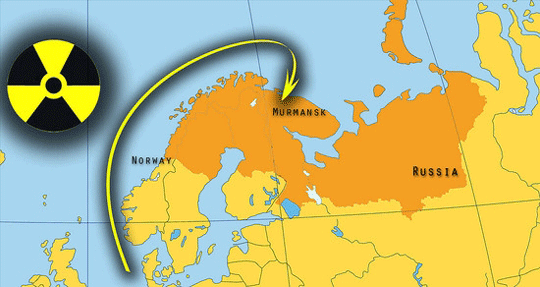
Norwegian Radiation Protection Authorities had no knowledge about the nuclear voyage before being asked by BarentsObserver to give a comment. Then, the vessel “Mikhail Dudin” had sailed along Norway’s long coastline for nearly five days and had already delivered its cargo in Murmansk.
“We have no information about any shipment of nuclear waste outside the coast of Norway last week,” NRPA Director Ole Harbitz said. In Murmansk, information about the nuclear waste arrival was first made public by the non-governmental organization Kola Ecological Center. The group is highly concerned about the radiation safety risk such cargo poses to the city’s 300,000 inhabitants. Maybe for good reasons; similar cargo is expected to arrive again. Continue reading
Scotland cops the risks of dismantling Britain’s old radioactive submarines
Fears over Rosyth nuclear submarine waste http://www.scotsman.com/news/politics/top-stories/fears-over-rosyth-nuclear-submarine-waste-1-2869329 By TRISTAN STEWART-ROBERTSON 31 March 2013 SCOTLAND has  been chosen for the pilot project to break up some of Britain’s old nuclear submarines, prompting fears it could become a dumping ground for radioactive waste. Continue reading
Canada’s tax-payers up for increased costs for nuclear wastes
 Nuclear waste cleanup liability cost up by $2.4B, Ottawa told Andy Johnson, CTV News, , Mar. 20, 2013 The cost of cleaning up Canada’s nuclear program has risen dramatically in recent years and Ottawa is being warned another $2.4 billion is needed, bring the total to $6 billion.
 Atomic Energy of Canada Limited posted a statement Tuesday saying liability costs will go up by $2.4 billion from $3.6 billion in March of last year.
The estimate represents the cost associated with “decommissioning, managing and disposing of its radioactive waste in a manner that will ensure long-term health, safety, security and environmental responsibility.” “The main reason for the liability adjustment is an increase in the indirect costs attributed to the decommissioning and waste management over the period of up to 70 years of the program,” said a statement posted on the AECL website. Continue reading
No way to stop Hanford radioactive leaks, says Washington’s Governor
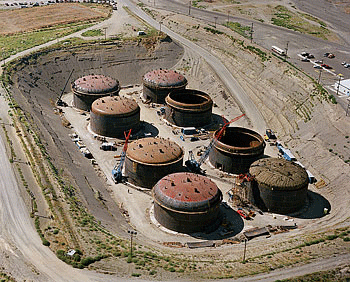 Gov. Jay Inslee says no available technology to plug the radiation leak Examiner.com FEBRUARY 28, 2013 BY: DEBORAH DUPRE Washington state governor Jay Inslee said Wednesday that there is no available technology to plug the radiation leaks at Hanford Nuclear Reservation.
Radioactive waste tanks may be leaking some 1,000 gallons per year at the Hanford Nuclear facility….. Hanford has 177 aging tanks storing millions of gallons of radioactive sludge.
Faulty data analysis meant officials did not properly catch signs of leaking before now, according to Inslee.
The governor expressed concern about the other tanks at the reservation. http://www.examiner.com/article/gov-jay-inslee-says-no-available-technology-to-plug-the-radiation-leak?CID=examiner_alerts_article
Urgency of the radioactive pollution disaster unfolding at Hanford Nuclear Reservation
When stacked against other environmental issues – timber clear-cutting, setting aside wilderness areas, and even plastic waste floats larger than Texas, the risk of radioactive contamination to our environment is infinitely more catastrophic
It is not too late. We have the ability to alter the impending disaster by placing pressure on responsible government agencies, legislators, community leaders, and contractors to safely increase the pace of the cleanup operations—and to tell Congress to shift all $2.46 billion in nuclear weapons “modernization” funds to cleanup—or at least what’s left after sequestration. Now.
Betrayal of Trust on the Hanford Nuclear Reservation, Radioactive Columbia River Imminent Without Action http://www.counterpunch.org/2013/03/01/betrayal-of-trust-on-the-hanford-nuclear-reservation/ by GINA MASON MARCH 1-3, 2013
Living with radiation sickness is not on my bucket list and I would hazard that it isn’t on yours either. Nor is it what I have in mind for my children’s future. Yet our government continues to manufacture nuclear materials and unsafely store radioactive waste in clear violation of the public trust. Nowhere is this more visible than at the Hanford Nuclear Reservation, the most radioactively contaminated site in the western hemisphere, where we now know radioactive sludge is leaking badly from at least six underground tanks. While Hanford is technically in Washington State, the management of this catastrophe is vitally important to the rest of the nation—indeed, the biosphere. Unfortunately, environmental disasters do not stop at city, state, or national borders. Continue reading
Six nuclear waste tanks leaking radioactive water and sludge, at Hanford Nuclear Reservation
The entire city of Los Angeles could fit rather comfortably within Hanford’s borders in southeastern Washington, but the human and environmental consequences of Hanford have spread beyond those borders, across Washington and Oregon.
At The Hanford Nuclear Reservation, A Steady Drip Of Toxic Trouble by Eric Nusbaum The Daily Beast, Feb 24, 2013 Eric Nusbaum tours the largest environmental cleanup operation the United States government has ever undertaken.This month, the Department of Energy announced that a tank at the Hanford Nuclear Reservation in Washington State is leaking up to 300 gallons of radioactive waste a year. Then last week, Washington governor Jay Inslee corrected that figure: a total of six tanks are leaking. To people unfamiliar  with Hanford, this might sound mildly apocalyptic. Nuclear sludge left over from Cold War plutonium production is drip drip dripping into American soil, infiltrating the groundwater, slowly making its way into our rivers. But to Washington residents and Hanford observers, the leak is just another in a long line of mild disasters at America’s most contaminated nuclear waste site, a radioactive drop in the already-polluted Columbia River.
The reactions by politicians to this news have come off like bad attempts at satire. Continue reading
At Hanford – 200 square miles of radioactively polluted groundwater
Millions of dollars and labor hours are being spent moving nuclear waste from bad tanks into good tanks. Then millions more will be spent on vitrification. But single-shell or double shell, peanut butter or glass, it will still be nuclear waste. There is no getting rid of it. There is only finding more convenient, less uncomfortable ways to deal. .
At The Hanford Nuclear Reservation, A Steady Drip Of Toxic Trouble by Eric Nusbaum Feb 24, 2013 Eric Nusbaum tours the largest environmental cleanup operation the United States government has ever undertaken. “……There are 200 square miles of contaminated groundwater under Hanford. Every day that water moves closer to the Columbia River. Not coincidentally, there are also 177 massive storage tanks on the site, each built to hold between 55,000 and more than 100,000 gallons of nuclear waste.
Our first stop was at one of these tanks, which, even in the middle distance, was ominous and metallic and looked sort of like a giant industrial-sized swimming pool. Continue reading
The messy history of the Hanford Reservation radioactive mess
.At The Hanford Nuclear Reservation, A Steady Drip Of Toxic Trouble by Eric Nusbaum Feb 24, 2013 Eric Nusbaum tours the largest environmental cleanup operation the United States government has ever undertaken.”,,,,,,,,Late in 2010, crews with the contractor Washington Closure Hanford were set to begin demolition on what had once been the most radioactive structure on the site: Building 324. Located less than half a mile from both the city of Richland and the Columbia River, Building 324 housed a pair of “hot cells,” which are three-story enclosures that scientists use to perform remotely-operated tests of highly unstable materials. One of those cells, B-Cell, was so radioactive in the 1990s that the Seattle Post-Intelligencer reported that “an unprotected person standing inside could have received a fatal dose in less than two seconds.” By 2010, the building’s worst radioactive material had been removed. But when Washington Closure Hanford tested the ground under the site, it found radiation levels significantly higher than surrounding soil, which itself was already contaminated. Needless to say, demolition on Building 324 has not resumed. The site is “currently being deactivated,” says the Hanford website.
There are similar stories to tell about buildings all over the site, messy stories about government bureaucracy and highly radioactive equipment and the troublesome permanence of nuclear waste. The process of producing plutonium at Hanford required the constant transport of highly unstable materials from one facility to another to another, which made containing the mess basically impossible. Continue reading
Germany’s nuclear waste nightmare- the Gorleben salt mines
Abyss of Uncertainty: Germany’s Homemade Nuclear Waste Disaster Spiegal online, By Michael Fröhlingsdorf, Udo Ludwig and Alfred Weinzier, 21 Feb 13, Some 126,000 barrels of nuclear waste have been dumped in the Asse II salt mine over the last 50 years. German politicians are pushing for a law promising their removal. But the safety, technical and financial hurdles are enormous, and experts warn that removal is more dangerous than leaving them put……
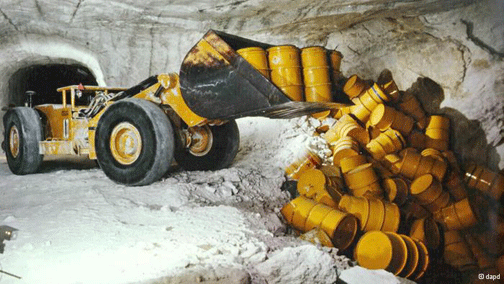
Germany’s Federal Office for Radiation Protection (BfS) has been responsible for Asse since 2009. This is an agency that was originally founded to monitor things such as the safety of workers in nuclear research facilities. In early 2010, the federal government ordered the BfS to assess whether the radioactive waste in the Asse mine can be retrieved. The agency estimated that it would take three years to prepare the project. Most recently, the BfS said it would need 10 years for the fact-finding phase alone.
The BfS still has no detailed concept for the retrieval, no timetable, no script that maps out the technical procedures. It’s essentially a flight by the seat of the pants, and problems are encountered for which no solutions have been found anywhere in the world…. Continue reading
UK’s nuclear cleanup problems are echoed in USA
Across the Pond, Florida’s Progress Energy’s Crystal River 3 Nuclear Power Plant is also in the process of being decommissioned. Not only for consumers but those living nearby, the decisions regarding Sellafield’s decommissioning are likely to reverberate across the Atlantic.
 WHO WILL PAY FOR NUCLEAR POWER PLANT CLEANUP? Yves here. Holy moley, the cost estimates focus the mind! And the little mishap recounted below isn’t encouraging either.
Naked Capitalism, By John Daly, a non-resident scholar at the Central Asia-Caucasus Institute at Johns Hopkins University’s Paul H. Nitze School of Advanced International Studies and chief analyst at OilPrice. Cross posted from OilPrice 20 Febv 13
Many of the civilian nuclear power plants built in the US. and Western Europe during the halcyon days of the Eisenhower administration are coming to the end of their operational lives as their operating licenses expire.
The looming deadlines leave their operators with two stark choices – apply for a license extension beyond the original forty years, or decommission.
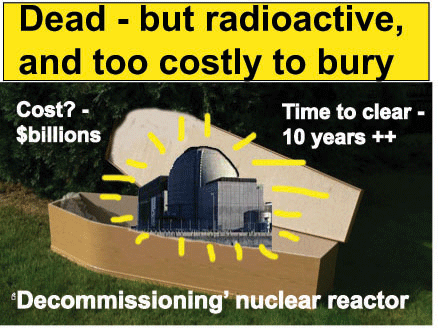
A bad choice, however you look at it. For a license extension, aging NPPs must upgrade, while decommissioning raises the primordial question sidestepped since the dawn of the civilian nuclear age – what to do with the radioactive debris? The British imbroglio. Continue reading
New USA Energy Secretary must commit to cleanup of Hanford radioactive pollution
Sen. Wyden wants nuclear cleanup commitment from next Energy secretary THE HILL, By Zack Colman- 02/20/13 The Senate Energy Committee chairman said Tuesday that any Energy secretary nominee must agree to clean up high-level nuclear waste at a Washington facility to get his support. Continue reading
1 This Month
23-25 October – on Zoom – World BEYOND War’s annual global conferenc


Shut down the radiation-damaged Heysham nuclear reactors now
To see nuclear-related stories in greater depth and intensity – go to https://nuclearinformation.wordpress.com

Say No to NASA’s Reckless Nuclear Reactor on the Moon
Say No to NASA’s Reckless Nuclear Reactor on the Moon

-
Archives
- October 2026 (231)
- September 2026 (339)
- August 2026 (330)
- July 2026 (355)
- June 2026 (287)
- May 2026 (306)
- April 2026 (356)
- March 2026 (251)
- February 2026 (267)
- January 2026 (308)
- December 2025 (358)
- November 2025 (359)
-
Categories
- 1
- 1 NUCLEAR ISSUES
- business and costs
- climate change
- culture and arts
- ENERGY
- environment
- health
- history
- indigenous issues
- Legal
- marketing of nuclear
- media
- opposition to nuclear
- PERSONAL STORIES
- politics
- politics international
- Religion and ethics
- safety
- secrets,lies and civil liberties
- spinbuster
- technology
- Uranium
- wastes
- weapons and war
- Women
- 2 WORLD
- ACTION
- AFRICA
- Atrocities
- AUSTRALIA
- Christina's notes
- Christina's themes
- culture and arts
- Events
- Fuk 2022
- Fuk 2023
- Fukushima 2017
- Fukushima 2018
- fukushima 2019
- Fukushima 2020
- Fukushima 2021
- general
- global warming
- Humour (God we need it)
- Nuclear
- RARE EARTHS
- Reference
- resources – print
- Resources -audiovicual
- Weekly Newsletter
- World
- World Nuclear
- YouTube
-
RSS
Entries RSS
Comments RSS

