Radioactive wastes with a half life of 704 million years, for Nevada
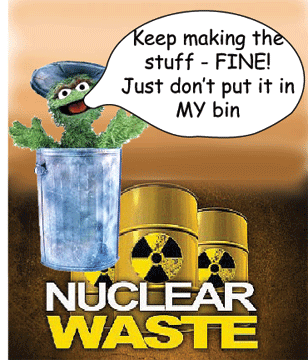 Nye county officials: Uranium waste might require underground concrete container By KEITH ROGERS LAS VEGAS REVIEW-JOURNAL, 30 May 13 Burying a ton of orphaned uranium waste from Tennessee at the Nevada National Security Site might require installing a concrete container to keep its radioactive ingredients out of the environment and its dirty bomb material from falling into the wrong hands, according to Nye County officials who were at a closed-door meeting this week.
And with a half life of 704 million years for its main component, uranium-235 — the atom-splitting material used in the first U.S. nuclear bomb — they wonder if the Department of Energy can maintain high-security vigilance and keep radioactive contaminants from seeping into the environment long after its containment has decayed.
“Having to rely on the government to maintain security is an issue. It’s very difficult to look that far into the future,” said Darrell Lacy, director of the Nye County Nuclear Waste Repository Project Office. Continue reading
Beaverlodge area – an example of uranium mining’s filthy legacy
Uranium mining legacy expensive, The Star Phoenix, By Ann Coxworth, May 30, 2013 “…….The Canadian Nuclear Safety Commission recently reviewed plans for continuing management of some of the contaminated sites in northern Saskatchewan – relics of uranium mining activities that took place during the 1960s and 1970s.
The cost of remediating surface waters to levels compatible with Saskatchewan surface water quality objectives is so overwhelming thatwe know it will never happen.
Because the companies that caused the pollution are no longer in existence, these costs now fall to the federal and provincialtaxpayers. The goal of industry and regulators now is simply to prevent the contamination from getting any worse.
One such contaminated region is the Beaverlodge area. Continue reading
Kentucky’s dangerous, toxic, nuclear brew and the failure of USEC Inc
 The Paducah plant cannot legally stay open, and it can’t safely be shut down—a lovely metaphor for the end of the Atomic Age and a perfect nightmare for the people of Kentucky.
 Countdown to Nuclear Ruin at Paducah EcoWatch May 22, 2013 by Geoffrey Sea Disaster is about to strike in western Kentucky, a full-blown nuclear catastrophe involving hundreds of tons of enriched uranium tainted with plutonium, technetium, arsenic, beryllium and a toxic chemical brew. But this nuke calamity will be no fluke. It’s been foreseen, planned, even programmed, the result of an atomic extortion game played out between the U.S. Department of Energy (DOE) and the most failed American experiment in privatization, the company that has run the Paducah plant into the poisoned ground, USEC Inc.
As now scheduled, main power to the gargantuan gaseous diffusion uranium plant at Paducah, Kentucky, will be cut at midnight on May 31, just nine days from now—cut because USEC has terminated its power contract with TVA as of that time [“USEC Ceases Buying Power,” Paducah Sun, April 19, page 1] and because DOE can’t pick up the bill.
DOE is five months away from the start of 2014 spending authority, needed to fund clean power-down at Paducah. Meanwhile, USEC’s total market capitalization has declined to about $45 million, not enough to meet minimum listing requirements for the New York Stock Exchange, pay off the company’s staggering debts or retain its operating licenses under financial capacity requirements of the Nuclear Regulatory Commission. Continue reading
USA State Attorneys General want more options in nuclear waste management

eventually, someone in America would think of the idea of shutting down nuclear plants, at least till there’s a way to permanently solve the wastes problem
Flaws in the NRC’s review to date, the attorneys general said, include that it has not given adequate consideration to two alternatives:
— A rule saying that after five years cooling in specially constructed pools, the waste would have to be moved to hardened concrete and steel casks on plant grounds. That would leave much less radioactive material in spent fuel pools that have been described as more vulnerable to earthquakes or terrorist attacks.
 — “The alternative of not allowing further production of spent fuel until the NRC determines that there is a safe and environmentally acceptable permanent waste repository to receive the additional spent fuel.” Not allowing further production of spent fuel would mean shutting down the entire U.S. nuclear industry.
 Federal Nuclear Waste Rules Need To Be Improved, Attorneys General Petition NRC http://www.huffingtonpost.com/2013/05/23/federal-nuclear-waste-rules_n_3328495.html?utm_hp_ref=green AP By By DAVE GRAM : 05/23/2013 MONTPELIER, Vt. — Attorneys general in Vermont, New York, Massachusetts and Connecticut announced Thursday they are petitioning the Nuclear Regulatory Commission for a more thorough environmental review of storage of highly radioactive nuclear waste at plant sites. Continue reading
Plan for nuclear waste near Lake Huron concerning Michigan State Senators
 Michigan state Senate says Ontario nuclear waste site ‘raises serious concerns’ The Star, 24 May 13The proposed site, a Senate resolution notes, is less than 1.6 kilometres from the Lake Huron shoreline and “upstream from the main drinking water intakes for southeast Michigan.” State senators in Michigan say that a planned nuclear waste disposal site near Kincardine, Ont., “raises serious concerns.”
The concern is expressed in a resolution passed Tuesday by the Senate.
The senate also proposes that the public comment period on the proposal, which wraps up Friday, should be extended.
Sen. Hoon-Yung Hopgood, who introduced the resolution, said that it will be submitted to the formal comment process on the waste site.
Ontario Power Generation (OPG) proposes to construct the facility at the Bruce nuclear station beside Lake Huron….. The proposed site’s proximity to the lake caught the attention of the Michigan senators.
The resolution, which carried without dissent on a voice vote, notes that Michigan rules prohibit low-level nuclear waste from being stored within 10 miles (16 kilometres) of the lakes and rivers in the Great Lakes system bordering Michigan.
“We encourage Canada to consider similar siting criteria,” the resolution says.
The proposed site, the resolution notes, is less than a mile (1.6 kilometres) from the Lake Huron shoreline and “upstream from the main drinking water intakes for southeast Michigan.”….. http://www.thestar.com/business/economy/2013/05/23/michigan_senate_says_ontario_nuclear_waste_site_raises_serious_concerns.html
1957 Mayak nuclear disaster – the forgotten event near Ozyorsk
Ozyorsk was and remains a closed town because of its proximity to the Mayak plant,
To consider how insanely radioactive Lake Karachay is, think about this: Chernobyl disaster: 5-12 exabecquerels blown over thousands of square miles Lake Karachay: 4 exabecquerels in this tiny lake, less than a quarter of a mile in diameter. Even approaching the lake will get you a lethal dose within an hour. And they ARE starting to cover it up with concrete and gravel as the water evaporates. As the water recedes, they lay down dirt, gravel and concrete over the area so it can’t fill back in and the sediment doesn’t get disturbed by the wind.
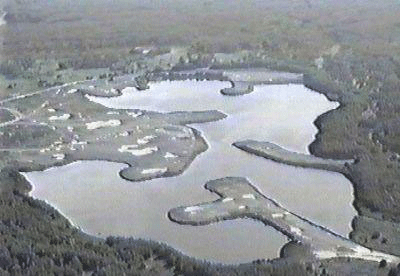
The 10 Worst Civilian Nuclear Accidents in History http://www.neatorama.com/2013/05/21/The-10-Worst-Civilian-Nuclear-Accidents-in-History/ Miss Cellania , May 21, 2013 Quick -how many nuclear accidents can you name? Chernobyl, Three Mile Island, Fukushima …any more? There have been quite a few nuclear accidents of varying danger that you probably never heard of, including some fatal incidents. For example, in 1957, nuclear waste exploded at a reactor near the Soviet town of Ozyorsk.
One of the storage tanks contained around 70 to 80 tons of radioactive liquid waste, and its cooling mechanism stopped working and wasn’t fixed. The tank’s contents, made up mostly of ammonium nitrate and acetates, began to dry out as the liquid heated up and evaporated. Moreover, the temperature increase caused an explosion whose force was equivalent to 70 to 100 tons of TNT, and this sent huge amounts of radioactivity – roughly 20 MCi (800 PBq) – into the environment. The fallout cloud from the explosion contaminated an area of up to 7,722 square miles (20,000 square kilometers).
Over a period of nearly two years, about 10,000 people were evacuated from the surrounding area. In terms of fatalities, the exact cost of the incident is not known, but immediately around the site of the explosion there were 66 diagnosed cases of chronic radiation syndrome.
Read more about the Ozyorsk incident and nine others in a list at Tech Graffiti. Link -via the Presurfer
Japan learning radioactive cleanup from Hanford – does not inspire confidence
it’s time everyone stopped making the stuff
Japanese officials visit Hanford to learn nuclear cleanup strategies KPIU 885 By Anna King, 21 May 13 The people overseeing the cleanup of the Fukushima nuclear power plant disaster are learning some valuable lessons from the long-running cleanup at the Hanford Nuclear Reservation. A Japanese government delegation recently toured some of the southeast Washington site this week….. Japanese may need to build a facility two to four times larger to handle all their contaminated trees, topsoil and debris…http://www.kplu.org/post/japanese-officials-visit-hanford-learn-nuclear-cleanup-strategies

The long haul for cleaning up Germany’s radioactive trash
Klaus-Günter Warnecke, the mayor of Remlingen, has been monitoring progress at the Asse nuclear waste site for nearly 20 years. Recent local media reports say he may have to wait another 20 years before the clearance of the site begins.
 Living above Germany’s old nuclear waste, DW, 20 May 13, A German law has recently come into effect ordering the cleanup of 126,000 barrels of radioactive waste at the Asse nuclear dump site. But it seems the process could take a lot longer than locals initially hoped for….. Heike Wiegel is not just a resident here, she’s also a member of the citizen group ‘aufpASSEn’ – meaning ‘watch out’ in German – which helps raise awareness about issues from the Asse nuclear waste site.
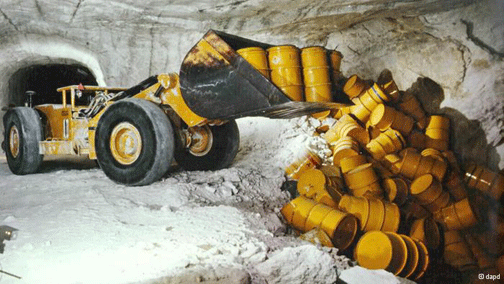
There are a number of other anti-Asse groups in the region. Now, with the law ordering the removal of waste from the site, they want to make sure that the mistakes of the past are not repeated.
“What happened back then at the Asse site should never have happened,” Wiegel says after a long pause. “That such an old, unstable salt mine would be used for nuclear waste, which, in the end, was just thrown in barrel by barrel.” Continue reading
Connecticut Senator urging a federal decision on nuclear waste storage
it would make sense to stop making this radioactive trash
Murphy urges bipartisan nuclear waste storage plan http://www.wtnh.com/dpp/news/politics/murphy-urges-bipartisan-nuclear-waste-storage-plan#.UZvs8qJwpLs, 20 May 2013, HARTFORD, Conn. (AP) — U.S. Sen. Chris Murphy is asking Senate leaders to solve the longstanding problem of where to dispose of nuclear waste.
Connecticut’s junior senator wrote to Democratic and Republican members of the Energy and Natural Resources Committee on Monday offering his support for legislation that would establish a federal agency and consent-based procedures to manage nuclear waste.
Murphy, a Democrat, said the issue is of immediate importance to Connecticut.
Dominion Resources Inc., the owner of Millstone Power Station, won state permission on May 2 to significantly expand nuclear waste storage capacity over the next 30 years. Millstone and officials of Waterford said that without a federal site, they had no choice.
Congress designated Yucca Mountain in Nevada for a nuclear waste dump. It’s opposed by elected officials, including Senate Majority Leader Harry Reid of Nevada.
France starting to deliberate on what to do with nuclear radioactive trash
it would be wise to stop making the stuff
 France Starts Public Debate on Underground Nuclear Waste Site http://www.bloomberg.com/news/2013-05-15/france-starts-public-debate-on-underground-nuclear-waste-site.html By Tara Patel – May 15, 2013 France has started a public inquiry into a plan to build a nuclear waste repository to be buried half a kilometer under the northeastern countryside.
A series of public meetings will be held through Oct. 15, according to the inquiry’s website, and the government and regulators will consider the outcome when they decide whether to approve the site.
If approved, the Cigeo project will store highly radioactive waste from Electricite de France SA’s 58 reactors in a site near Bure that straddles the Meuse and Haute-Marne regions. Andra, the waste-management agency spearheading the plan, wants to start construction in 2019 and begin operations in 2025.
The facility will cost 13.5 billion euros ($17.4 billion) to 16.5 billion euros for construction and operation over 100 years, according to Andra’s website.
The inquiry is “a masquerade and pure exercise in public relations,” anti-nuclear group Sortir du Nucleaire said yesterday in a statement. No one can guarantee the safety of the site for such a long period, it said.
EDF now stores waste at reactor sites and at above-ground facilities at La Hague in northern France. Sweden and Finland are also developing deep repositories after the European Union established nuclear waste disposal standards in 2011.
Under French law, nuclear operators including EDF and Areva SA (AREVA) have to build portfolios or amass funds to pay for the decommissioning of reactors and radioactive waste storage.
A parliamentary report published last year concluded operators may not be setting aside enough money. Cost estimates for the Cigeo site vary from 14.4 billion euros to 35 billion euros, that report said.
Hanford Nuclear reservation getting ever more dangerous
Hanford Nuclear Cleanup May Be Too Dangerous, Future Of Storage Plant Uncertain http://www.huffingtonpost.com/2013/05/09/hanford-nuclear-cleanup-too-dangerous_n_3246263.html?utm_hp_ref=green | By Valerie Brown 05/09/2013 , Scientific American: (click here for original article)
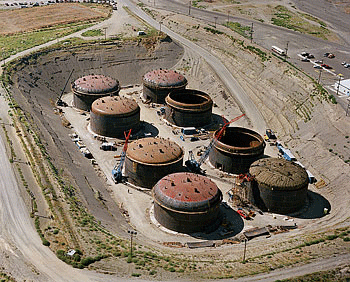
The most toxic and voluminous nuclear waste in the U.S.—208 million liters —sits in decaying underground tanks at the Hanford Site (a nuclear reservation) in southeastern Washington State. It accumulated there from the middle of World War II, when the Manhattan Project invented the first nuclear weapon, to 1987, when the last reactor shut down. The federal government’s current attempt at a permanent solution for safely storing that waste for centuries—the Waste Treatment and Immobilization Plant here—has hit a major snag in the form of potential chain reactions, hydrogen explosions and leaks from metal corrosion. And the revelation last February that six more of the storage tanks are currently leaking has further ramped up the pressure for resolution. Continue reading
Radioactive waste dumping into the world’s oceans
 Ocean disposal of radioactive waste http://en.wikipedia.org/wiki/Ocean_disposal_of_radioactive_waste#1946-93 April 2013 (Excellent maps)
From 1946 through 1993, thirteen countries (fourteen, if the USSR and Russia are considered separately) used ocean disposal or ocean dumping as a method to dispose of nuclear/radioactive waste. The waste materials included both liquids and solids housed in various containers, as well as reactor vessels, with and without spent or damaged nuclear fuel.[1] Since 1993, ocean disposal has been banned by international treaties. (London Convention (1972), Basel Convention, MARPOL 73/78)
However, according to the United Nations, some companies have been dumping radioactive waste and other hazardous materials into the coastal waters of Somalia, taking advantage of the fact that the country had no functioning government from the early 1990s onwards. This caused health problems for locals in the coastal region and posed a significant danger to Somalia’s fishing industry and local marine life.[2]
“Ocean floor disposal” (or sub-seabed disposal)—a more deliberate method of delivering radioactive waste to the ocean floor and depositing it into the seabed—was studied by the UK and Sweden, but never implemented.[3]…….
In Connecticut they’ll just keep storing more radioactive trash
it would be more sensible to just stop making the stuff
Conn. OK’s more waste storage at nuclear plant, Boston Globe ASSOCIATED PRESS MAY 03, 2013 The key problem facing nuclear plant operators, including Millstone in Connecticut, is the inability in Washington to decide what to do with radioactive waste. NEW BRITAIN, Conn. — State officials authorized the Millstone nuclear plant on Thursday to significantly expand nuclear waste storage capacity over the next 30 years.
Without a national site to take spent nuclear fuel, Millstone Power Station’s owner, Dominion Resources Inc., turned to Connecticut for permission to increase storage at the Waterford site. The nine-member council voted unanimously without discussion to allow Millstone to build concrete pads necessary for an expansion of its waste storage. Millstone is seeking to expand storage from 19 cask storage units now to 135 by 2045. However, Millstone’s application does not include a request to install the 135 casks, the Siting Council said.

Melanie Bachman, staff attorney for the council, said Millstone has authorization to install 49 casks and must seek permission for the remaining 86.
The Black Point Beach Club Association, a homeowners group in Niantic across Niantic Bay from Millstone, asked the Siting Council to reject the nuclear plant’s request. State officials are not accounting for possible problems at Millstone if sea level rises as projected because of climate change, the association said. It also urged the state to wait for guidance from the Nuclear Regulatory Commission.
‘‘All of the association’s members and all residents of Black Point are subject to potential mandatory evacuation orders and martial law and personal harm in the event of a serious accident at Millstone, including the proposed storage facility,’’ the group told the Siting Council.
Dominion is spending $11 million for preparation and other work, Holt said. The plant will move fuel from pools and move them into dry casks, which will be welded shut and moved to a concrete bunker. Fuel will be moved within two years, Holt said. http://www.bostonglobe.com/metro/2013/05/02/conn-oks-expanded-waste-storage-capacity-millstone-nuclear-plant-conn-approves-new-waste-storage-nuclear-plant/NZRUTzzGMvJ0LxVWhkccYM/story.html
9 tons of plutonium yearly from Japan’s Rokkasho nuclear reprocessing plant

Tokyo’s ability to both enrich uranium and reprocess spent reactor
fuel has allowed it to amass roughly nine tons of weapons-usable
plutonium on its soil. Activating the Rokkasho plant would produce
that much each year, said officials and industry experts.
Japan’s Nuclear Plan Unsettles U.S, WSJ, By JAY SOLOMON and MIHO INADA
2 May 13, TOKYO—Japan is preparing to start up a massive nuclear-fuel
reprocessing plant over the objections of the Obama administration,
which fears the move may stoke a broader race for nuclear technologies
and even weapons in North Asia and the Middle East.
The Rokkasho reprocessing facility, based in Japan’s northern Aomori
prefecture, is capable of producing nine tons of weapons-usable
plutonium annually, said Japanese officials and nuclear-industry
experts, enough to build as many as 2,000 bombs, although Japanese
officials say their program is civilian…… Continue reading
Great? Shoot nuclear waste into deep space?
Disposal of Spent Nuclear Fuel and High-level Radioactive Waste
Source: ENVIRON International Corporation
Date: September 10, 2010
This material was prepared at the request of the Blue Ribbon Commission on America’s Nuclear Future (“the BRC”).

Disposal by shooting the wastes into deep space or the sun
Cost and the risk of an accident during launch has kept space disposal from being taken seriously. With the current cost of putting objects in orbit at around $10,000 per pound, and given that the U.S. inventory of spent fuel and high-level waste is of the order of 100,000 metric tons, not including the heavy shielding that would be required, the costs with present technology would be prohibitive, even if the risks of radioactive wastes crashing back to earth could be managed somehow.
But if one wanted to dispose of only the very long-lived waste, e.g., technetium-99, cesium-135, iodine-129, and the long-lived actinides, then the amounts are much more manageable, of the order of a few million kilograms for all current U.S. wastes. […]
1 This Month
23-25 October – on Zoom – World BEYOND War’s annual global conferenc


Shut down the radiation-damaged Heysham nuclear reactors now
To see nuclear-related stories in greater depth and intensity – go to https://nuclearinformation.wordpress.com

Say No to NASA’s Reckless Nuclear Reactor on the Moon
Say No to NASA’s Reckless Nuclear Reactor on the Moon

-
Archives
- October 2026 (231)
- September 2026 (339)
- August 2026 (330)
- July 2026 (355)
- June 2026 (287)
- May 2026 (306)
- April 2026 (356)
- March 2026 (251)
- February 2026 (267)
- January 2026 (308)
- December 2025 (358)
- November 2025 (359)
-
Categories
- 1
- 1 NUCLEAR ISSUES
- business and costs
- climate change
- culture and arts
- ENERGY
- environment
- health
- history
- indigenous issues
- Legal
- marketing of nuclear
- media
- opposition to nuclear
- PERSONAL STORIES
- politics
- politics international
- Religion and ethics
- safety
- secrets,lies and civil liberties
- spinbuster
- technology
- Uranium
- wastes
- weapons and war
- Women
- 2 WORLD
- ACTION
- AFRICA
- Atrocities
- AUSTRALIA
- Christina's notes
- Christina's themes
- culture and arts
- Events
- Fuk 2022
- Fuk 2023
- Fukushima 2017
- Fukushima 2018
- fukushima 2019
- Fukushima 2020
- Fukushima 2021
- general
- global warming
- Humour (God we need it)
- Nuclear
- RARE EARTHS
- Reference
- resources – print
- Resources -audiovicual
- Weekly Newsletter
- World
- World Nuclear
- YouTube
-
RSS
Entries RSS
Comments RSS

