VIDEO: Hanford’s radioactive waste crisis
Waste will be leaking into the ground water. It will continue to leak. It’s an urgent problem that must be solved.”
But engineers have to get this right. It will take 40 years to treat the waste, and during that time, radiation will make parts of the plant inaccessible to humans.
 Video: Nuclear waste clean-up delayed and billions over budget http://www.cbsnews.com/8301-18563_162-57590163/nuclear-waste-clean-up-delayed-and-billions-over-budget/ By Carter Evans (CBS News) 19 June 13, The new Secretary of Energy has been on the job only four weeks, but he made a beeline Wednesday to see his biggest headache for himself. Ernest Moniz went to the Hanford Nuclear Reservation in Washington state.
Hanford made the plutonium for American nuclear weapons from the Manhattan Project in World War II until 1987. Now, highly radioactive waste is leaking, and a project to clean it up has stalled.The clean-up at the Hanford Nuclear Reservation costs U.S. taxpayers $2 billion every year. This winter, engineers discovered six new leaks of radioactive material from underground tanks.
“There’s something on the order of 1,000 gallons a year that are leaking now from these six tanks,” says Washington Gov. Jay Inslee. Continue reading
UK’s Nuclear Decommissioning Authority doesn’t know what to finally do with nuclear wastes
No plan to dump nuclear waste Bill Hamilton The Guardian, 22 June 2013 As a public body, the Nuclear Decommissioning Authority has a duty to deliver value for money. Moreover, all nuclear site operators have a regulatory requirement to optimise site operations. There is no proposal to “dump” radioactive waste at Bradwell or at any other NDA-owned site (Only way is Essex – nuclear waste row, 17 June). Our first decommissioning priority is hazard reduction, which includes the safe, secure and environmentally responsible interim storage of intermediate level waste (ILW) until geological disposal becomes available.Currently, the plan is to build an interim storage facility at each Magnox reactor site to store the ILW from that site. A number of interim stores have already been constructed, with several more stores planned. In the interests of value for money to the taxpayer, we are exploring whether there is a business case for reducing the number of new stores that need to be built. There could also be environmental benefits from building fewer stores. The option of storing ILW from a small number of other sites at Bradwell, which already has an ILW store, is one of a number of options under consideration.
Our intention to explore the potential benefits of building fewer interim storage facilities was first made public in our strategy published in 2011, on which we engaged widely and consulted publicly. We are engaging openly and transparently with stakeholders on the options under consideration and will consult on our preferred option(s) at the appropriate time. Furthermore, any decision that requires a change to existing storage plans will require consultation and local planning permission.
San Onofre nuclear “decommissioning” will last for decades
So there the disabled behemoth sits, awaiting a decommissioning project that will continue for decades, requiring continued regulatory oversight and inspiring never-ending debates about who should pay and how much.
The Unit 1 reactor, which was shut down in 1992, was supposed to be boxed up and shipped to a repository in South Carolina, but no one could figure out how to transport a 770-ton bundle of radioactive junk across the country. Instead, it remains where it is, encased in concrete, waiting for the transmutation of the elements to complete its ten-thousand-million-year-long conversion from deadly isotopes to stable lead. We won’t be free of it anytime soon.

So long, San Onofre (in like 700 million years) High Country News Judith Lewis Mernit | Jun 17, 2013“……We have come to the end of an era — the nuclear power renaissance I had set out to investigate a decade ago has come to nothing.
Yes, a handful of new reactors have been proposed and a couple are even under construction, interrupting a hiatus that lasted nearly a quarter of a century. And the same band of shiny, PR-minded techno-enviros continue to argue that nuclear power is the only solution to climate change (their latest effort, Robert Stone’s documentary “Pandora’s Promise,” is simply one long advert for dreamy advanced waste-free reactors that don’t yet exist). Continue reading
They don’t now how much it costs to bury all those dead nuclear reactors
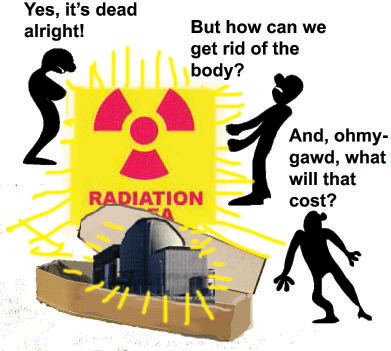 Nuclear Decommissioning Surge Is Investor Guessing Game, Bloomberg by Stefan Nicola in Berlin at snicola2@bloomberg.net; Julie Johnsson in Chicago at jjohnsson@bloomberg.net editor responsible for this story: Reed Landberg at landberg@bloomberg.net 16 June 13
Nuclear utilities thrust into the spotlight after the Fukushima meltdowns have ordered 20 reactors shut, the most in a three-year span since Chernobyl’s aftermath, saddling the industry with a possible $26 billion in costs.
EON SE and RWE AG (RWE) are leading the biggest decommissioning project by European utilities ever, an effort to tear down 12 reactors in Germany over two decades. Edison International (EIX) said June 7 it will never restart its idled two-unit San Onofre Generating Station outside Los Angeles, bringing the number of U.S. reactors permanently closed in a year to a record four.
The global utility industry faces its biggest test to prove enough money was saved for shutdowns, having undergone numerous cost-overruns building atomic plants. A cautionary tale can be seen with government-owned facilities. In Britain, where taxpayers are on the hook to retire the Sellafield complex’s seven reactors and fuel-reprocessing stations on the Irish Seaduring the next 100 years, the U.K. government this year doubled its estimate for the work to 67.5 billion pounds ($106 billion).
“There’s a lot of speculation how much these projects cost, but an exact estimate can only be given by utilities,” said Sascha Gentes, a Karlsruhe Institute for Technology professor specializing in atomic shutdowns. “The longer a nuclear decommissioning project takes, the more expensive it becomes.” Continue reading
Closing of Germany’s nuclear reactors
Nuclear Decommissioning Surge Is Investor Guessing Game, Bloomberg by Stefan Nicola in Berlin at snicola2@bloomberg.net; Julie Johnsson in Chicago at jjohnsson@bloomberg.net editor responsible for this story: Reed Landberg at landberg@bloomberg.net 16 June 13 “………German Closings Germany closed eight units after Fukushima and will shutter another nine by 2022. Its four utilities have set aside about 33 billion euros for decommissioning their 21 reactors and handling the deadly waste from them. The utilities set up GNS, a company that supplies 125-ton Castor dry casks to store and transport spent nuclear fuel, and also employ in-house decommissioning staff.
EON is 10 years into the job on its oldest commercial-scale unit, the 672-megawatt Stade plant in Lower Saxony, slated for completion by 2014. It started tearing down its 670-megawatt Wuergassen reactor in 1995, and plans to also complete that next year.
RWE said tearing down its 1970s-era Muelheim-Kaerlich reactor will cost about 750 million euros; it didn’t give cost estimates for the two pressurized water reactors at the 2,525-megawatt Biblis plant, which was closed after Fukushima, citing a lack of permits for their deconstruction plans.
EON declined to reveal the individual bill for the Wuergassen and Stade projects. It said costs are at about 1 billion euros depending on the reactor type, citing a “benchmark report for Germany,” in an e-mailed reply to questions.
Green Opposition
The opposition Green Party, which was in government from 1998 until 2005 and helped draft Germany’s first nuclear phase-out agreement, has called for the money to be put in a government-administered fund.
“Projects are often more expensive and longer than anticipated,” Sylvia Kotting-Uhl, a lawmaker with the Greens, said in an interview. “The question is: Will the money be available when it’s needed? A public fund would ensure that.”….”
EON and RWE said the current system shouldn’t be changed in favor of a state-run fund. The German system of setting aside money via utilities’ balance sheets “has proven itself,” Lothar Lambertz, a spokesman for RWE, said in an e-mailed reply to questions.http://www.bloomberg.com/news/2013-06-16/nuclear-decommissioning-surge-is-investor-guessing-game.html
Decommissioning Fukushima nuclear reactors will take 50 years at the very least
 Stricken nuke plant struggles on, Yahoo 7 Finance, AAP Jun 10, 2013 “……Experts, including even the most optimistic government officials, say decommissioning Fukushima Dai-ichi will take nearly a half-century.
TEPCO acknowledges that the exact path to decommissioning remains unclear because an assessment of the state of the melted reactor cores has not yet been carried out. Since being brought under control following the disaster, the plant has suffered one setback after another.
A dead rat caused a power blackout, including temporarily shutting down reactor-cooling systems, and leaks required tons of water to be piped into hundreds of tanks and underground storage areas.
The process of permanently shutting down the plant hasn’t gotten started yet and the work up to now has been one makeshift measure after another to keep the reactors from deteriorating.
Thousands of spent nuclear fuel rods that are outside the reactors also have to be removed and safely stored. Taking them out is complex because the explosions at the plant have destroyed parts of the structure used to move the rods under normal conditions. The process of taking out the rods, one by one, hasn’t even begun yet. The spent rods have been used as fuel for the reactors but remain highly radioactive…….”.http://au.finance.yahoo.com/news/stricken-nuke-plant-struggles-000105277.html
Demolishing San Onofre nuclear plant – 50 years and $billions in costs
A long cooling-off period for San Onofre nuclear plant http://articles.latimes.com/2013/jun/08/local/la-me-san-onofre-nuclear-20130609 Tearing down San Onofre’s two nuclear reactors will be a technically complex job completed over decades. It’s likely Southern California Edison will first mothball the plant.|By Ralph Vartabedian, Los Angeles Times
Southern California Edison built San Onofre’s two nuclear reactors in about nine years, but tearing them down will be a technically complex, multibillion-dollar job completed over decades. It is likely that Edison first will mothball the plant, which under federal rules could keep its imposing imprint on the Orange-San Diego County coastline for another half-century.
When the plant does come down, it will be a massive job.
Tons of highly radioactive fuel now stored in pools will have to cool before the rods can be moved to concrete pads outdoors. Giant pipes that extend more than a mile into the ocean will have to come out. Pieces of the reactors will have to be cut with special saws and torches that reach 20 feet into the vessels’ cooling water. Continue reading
Nuclear waste rolling in to Texas dump site

 Texas Site Begins Taking Federal Nuclear Waste http://abcnews.go.com/US/wireStory/texas-site-begins-taking-federal-nuclear-waste-19343196#.UbJENOdwo6I By BETSY BLANEY Associated Press ANDREWS, Texas June 7, 2013 (AP) Republican mega-donor Harold Simmons’ remote hazardous waste dump in West Texas began accepting low-level radioactive material Thursday from a federal lab in New Mexico — the latest step in Simmons’ vision of site that accept all types of waste. Continue reading
USA’s nuclear waste policy is a mess
Feds Fail on Nuclear Waste, Mational Review Online, Jack Spencer, June 6,The federal government assumed responsibility for nuclear-waste management more than 30 years ago. The Nuclear Waste Policy Act of 1982 created an ostensibly simple system: Nuclear utilities would pay the U.S. Treasury a fee, collected from their customers, to cover the costs, and the government would see to it that the waste was taken care of. The act and its amendments over the years specified every detail of the disposal process. They stipulated how the waste would be disposed of, where, and who would be responsible.
Surprise! Despite the politicians’ and bureaucrats’ best efforts to centrally plan a long-term solution, the system doesn’t work. Although the government successfully collects money from the consumers of nuclear-generated electricity — nearly $30 billion since 1982 — it has collected zero nuclear waste. And as the waste — nearly 70,000 tons and counting — continues to build up at nuclear plants around the country, the government continues to dither. It literally has no plan to collect and dispose of the waste.
To address this, earlier this spring four senators released a draft of another “solution”: the Nuclear Waste Administration Act of 2013. Unfortunately, the NWAA does nothing to fix the failed system. Instead, it accepts the notion that the feds, not waste producers themselves, should be responsible for nuclear-waste management, and it continues the policy of having waste producers pay a flat fee for these services…….
Hanford’s radioactive waste tanks producing unknown radionuclides
 Official: Leaking tanks at U.S. nuclear site produce altogether new elements — “They’re just their own reactors… generating their own little world in there” http://enenews.com/official-leaking-tanks-nuclear-site-produce-altogether-new-elements-theyre-reactors-generating-little-world
Title: Will Hanford ever be cleaned up?
Source: The Associated Press
Author: SHANNON DININNY
Date: June 2, 2013
[…] The deadline for treating all of the waste at the Hanford nuclear reservation was once 2028. Now it’s 2047 […]
Technical problems, mismanagement and repeated delays have plagued the interminable cleanup of the 586-square-mile site, prolonging an effort that has cost taxpayers $36 billion to date and is estimated will cost $115 billion more. […]
One problem is knowing exactly what is in each tank. A database listing the contents of each is only a best guess, relying on historical information about the site and waste samples that are very limited, said Cheryl Whalen of the state Department of Ecology. […]
Whalen also said some elements that are in very small quantities, but could be very hazardous, aren’t even recorded. In addition, some of the radionuclides inside produce altogether new elements under the right conditions.
“The tanks create their own chemical environment. Between the heat and the radionuclides and the chemicals that are already in there, they’re just their own nuclear reactors,” Whalen said. “They’re generating their own little world in there.” […]
See also: TV: Leaking Strontium-90 is “boiling the material around it” at U.S. nuclear site — Eating through tank liners (VIDEO)
Biggest pile of plutonium in the world: Britain’s nightmare
 Britain has accumulated the biggest stockpile of civil
plutonium in the world, a target for terrorists and future bomb-makers. What was once thought to be a valued asset is now a costly liability. The Government faces a dilemma. Should it try to
turn the stuff into nuclear fuel at huge cost or write off the plutonium altogether? Previous attempts to deal with the problem went disastrously wrong, costing the taxpayer more than a billion pounds. Tonight File on 4 investigates what’s been called one of the most embarrassing failures in British industrial history. And now MP’s are worried taxpayers could be asked to pay up again. Continue reading
Britain’s quite horrible problem of stockpiled plutonium
UK’s plutonium stockpile dilemma http://www.bbc.co.uk/news/uk-21505271 By Rob Broom byFile on 4 June 2013, Britain has accumulated the biggest stockpile of civil plutonium in the world. What was once a valued asset is now viewed as a costly liability and a target for terrorists.
Previous attempts to deal with the stockpile have gone wrong and the government now faces a dilemma. Should it try to turn the stuff into nuclear fuel or write off the plutonium altogether?
Amid tight security at the Sellafield nuclear plant in Cumbria, is a store holding most of Britain’s stockpile of plutonium. Continue reading
USA’s Hanford nuclear radioactive wasteland
In all, since that very first leak in the 1950s, at least 69 tanks are known to have excreted more than 1 million gallons of waste – and possibly far more – into the soil.
Nuclear dump an environmental wasteland 3 New NZ, By Shannon Dininny, 3 June 13, A stainless steel tank the size of a basketball court lies buried in the sandy soil of southeastern Washington state, an aging remnant of US efforts to win World War II. The tank holds enough radioactive waste to fill an Olympic-sized swimming pool. And it is leaking.
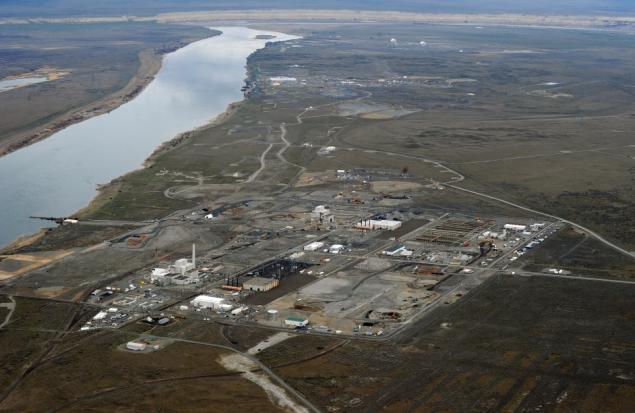
For 42 years, tank AY-102 has stored some of the deadliest material at one of the most environmentally contaminated places in the country: the Hanford Nuclear Reservation. Continue reading
Britain’s rather horrible plutonium and Mixed Oxide Fuel (MOX) dilemma
 “……….The Government wants to try and turn plutonium into a fuel which can be used
Transferring nuclear wastes – it’s like a game of “Pass The Parcel”
Australia-Euratom Nuclear Safeguards: Plutonium Retransfers …..The Agreement will enter into force when Australia notifies the Delegation to the European Commission that all domestic requirements necessary to give effect to the Agreement have been satisfied…. Department of Foreign Affairs and Trade – Australian Government 01/06/2013 | Press release  distributed by noodls http://www.noodls.com/view/2FBAFE516E5E78B9F15B62CBEB136F9A32994CC7
 Australia and the European Atomic Energy Community (Euratom) exchanged diplomatic notes in Canberra on 28 May 1998 as the first step towards bringing into force an Agreement under which Australia will – subject to certain conditions – broaden its consent for the return from the European
  Union to Japan of Australian obligated plutonium following the reprocessing of Japanese spent fuel in Europe. The European Union is an important provider of nuclear fuel cycle services for countries purchasing Australian uranium and Japan is a major market for Australian uranium exports. Continue reading
1 This Month
23-25 October – on Zoom – World BEYOND War’s annual global conferenc


Shut down the radiation-damaged Heysham nuclear reactors now
To see nuclear-related stories in greater depth and intensity – go to https://nuclearinformation.wordpress.com

Say No to NASA’s Reckless Nuclear Reactor on the Moon
Say No to NASA’s Reckless Nuclear Reactor on the Moon

-
Archives
- October 2026 (231)
- September 2026 (339)
- August 2026 (330)
- July 2026 (355)
- June 2026 (287)
- May 2026 (306)
- April 2026 (356)
- March 2026 (251)
- February 2026 (267)
- January 2026 (308)
- December 2025 (358)
- November 2025 (359)
-
Categories
- 1
- 1 NUCLEAR ISSUES
- business and costs
- climate change
- culture and arts
- ENERGY
- environment
- health
- history
- indigenous issues
- Legal
- marketing of nuclear
- media
- opposition to nuclear
- PERSONAL STORIES
- politics
- politics international
- Religion and ethics
- safety
- secrets,lies and civil liberties
- spinbuster
- technology
- Uranium
- wastes
- weapons and war
- Women
- 2 WORLD
- ACTION
- AFRICA
- Atrocities
- AUSTRALIA
- Christina's notes
- Christina's themes
- culture and arts
- Events
- Fuk 2022
- Fuk 2023
- Fukushima 2017
- Fukushima 2018
- fukushima 2019
- Fukushima 2020
- Fukushima 2021
- general
- global warming
- Humour (God we need it)
- Nuclear
- RARE EARTHS
- Reference
- resources – print
- Resources -audiovicual
- Weekly Newsletter
- World
- World Nuclear
- YouTube
-
RSS
Entries RSS
Comments RSS

