Controversial entombment of Illinois nuclear power plant
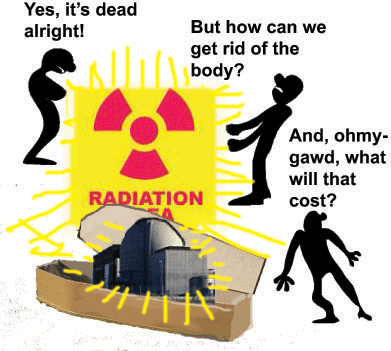
state regulators will not have authority to question how the dismantling is performed or EnergySolutions’ spending decisions.
A group of local citizens has filed suit over the financial handling of the project, claiming there are no safeguards to ensure that EnergySolutions isn’t wasting ratepayer money.
How Zion’s nuclear waste will be entombed on site http://www.chicagotribune.com/business/ct-biz-1215-zion-fuel-20131215,0,7912496.story Third-party EnergySolutions to embark on unprecedented, yearlong process By Julie Wernau, Chicago Tribune reporter December 15, 2013
In January, EnergySolutions will begin the most crucial part of its 10-year dismantling of the shuttered Zion nuclear power plant: Safely removing its radioactive fuel rods.
The project is the largest in the history of the U.S. nuclear power industry and the first in which a plant’s owner has turned over its license to a third party for the purpose of dismantling it. Utah-based EnergySolutions is staking its future on the project. How it handles the most expensive and risky phase of the project will be crucial to it winning other such work going forward.
The Zion plant, owned by Chicago-based Exelon Corp., the parent of Commonwealth Edison, generated electricity on the shores of Lake Michigan for close to a quarter of a century. By the time the project is complete, it will have taken nearly as long to destroy it. Continue reading
US politicians and indigenous people fight Lake Huron nuclear waste dump
Saugeen Ojibwe and U.S. Politicians Oppose Nuclear Waste Burial Near Lake Huron, Indian Country, Martha Troian12/12/13
A controversial proposal to bury nuclear waste a half mile from Lake Huron’s shoreline in Ontario is proceeding over indigenous objections in a plan that has repercussions on both sides of the U.S.–Canada border.
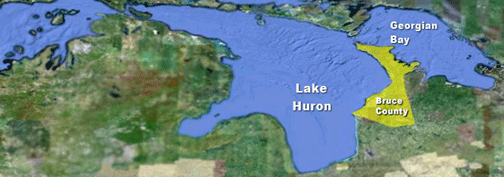
Opposition to the plan, which would inter low- and intermediate-level radioactive waste about 2,230 feet underground in solid rock, is sparking opposition from Indigenous Peoples and U.S. politicians alike. …… Continue reading
Fracking as a solution for nuclear waste – not really feasible
Scientist sees fracking as the way to dispose of nuclear waste Tia Ghose LiveScience 13 Dec, SAN FRANCISCO — Nuclear waste could one day be disposed of by injecting it into fracking boreholes in the Earth, at least if one scientist’s idea takes hold.
The method, presented here Monday at the annual meeting of the American Geophysical Union, would mix nuclear waste with other heavy materials, and inject it a few miles below the Earth’s surface into drilled holes. …….But the idea is still theoretical, and at least one expert thinks there are too many practical and safety concerns for the scheme to work.
“I can’t see it being a feasible concept, for many reasons,” said Jens Birkholzer, head of the Nuclear Energy and Waste Program at Lawrence Berkeley National Laboratory in Berkeley, Calif. Continue reading
Japan’s expensive problem – 132,738 tonnes of radioactive soil

 Japan to spend $970 mn on nuclear soil store Phys Org News 12 Dec 13 Japan is planning to earmark 100 billion yen ($970 million) for a storage facility for tens of thousands of tonnes of soil contaminated with radiation from the Fukushima disaster, a report said Wednesday.
The government will set aside the cash to buy some 3 to 5 square kilometres (1.2 to 2 square miles) of land somewhere near the crippled plant, the Asahi Shimbun reported.
But finding a candidate site for the facility, which the government envisages using for 30 years, is a political challenge as no local authority has so far raised its hand.
Tokyo would like to use land in three heavily contaminated towns near the plant, said the paper, adding environment minister Nobuteru Ishiara will speak with local officials this weekend.
The mayors of the towns—Futaba, Okuma and Naraha—along with the governor of Fukushima prefecture Yuhei Sato, are believed to be concerned that the temporary site could easily become permanent………No one from the environment ministry was available for comment on the report.
As of the end of August, the total amount of contaminated soil and debris collected through decontamination efforts, in which the top layer of soil is stripped from the land, stood at 132,738 tonnes, about 80 percent of which is from Fukushima prefecture.
This contaminated waste is currently stored at waste incineration plants, sewage treatment plants and agricultural and forestry facilities nationwide.
Experts say a more long-term solution needs to be found because storage capacity at these facilities is reaching its limits. http://phys.org/news/2013-12-japan-mn-nuclear-soil.html#jCp
Inconvenient questions in Parliament about Sellafield’s £70bn clean-up costs
 Talk of building a new mixed-oxide (Mox) fuel reprocessing plant has been undermined by a report out this summer that concluded a previous Mox facility, which closed two years ago, had left taxpayers with a £2.2bn bill rather than the healthy profit that had been promised when it was first constructed.
Sellafield executives to face MPs as nuclear clean-up bill rises over £70bn http://www.theguardian.com/environment/2013/dec/01/sellafield-nuclear-clean-up-cost-rises Public accounts committee to scrutinise private consortium accused of spending cash ‘like confetti’ Terry Macalister The Guardian, Monday 2 December 2013 The bill for cleaning up the huge Sellafield nuclear plant in Cumbria will rise even higher than its current estimated level of £70bn as operators struggle to assess the full scale of the task, according to sources close to the project.
The warning comes just days before private sector managers face a grilling from the public accounts committee, which is investigating activities at the facility.
It was hoped that the huge bill – eight times the cost of staging the London Olympics – would be capped at £70bn, but well-placed sources have told the Guardian that the operators are convinced they are still “not at the top” of the cost curve.
Sellafield is regarded as the most dangerous and polluted industrial site in western Europe, not least because it houses 120 tonnes of plutonium, the largest civilian stockpile in the world.
The cost of decommissioning the Calder Hall reactor plus a magnox fuel reprocessing plant at Sellafield has been rising steeply, but the biggest task comes from “ponds” and “silos” filled with old equipment and deteriorating, highly toxic waste. Continue reading
Anxiety surrounds plan to clean up Hanford’s radioactive trash
serious questions were raised last year after Walter Tamosaitis, one of the scientific chiefs of the project, disclosed that the innovative technology for mixing the waste in processing tanks could cause dangerous buildups of explosive hydrogen gas and might allow plutonium clumps to form.
 Doubts grow about plan to dispose of Hanford’s radioactive waste, LA Times 28 Nov 13 Experts raise concerns about the complex technology intended to turn 56 million gallons of radioactive sludge at the former Hanford nuclear facility into glass and prepare it for safe burial. By Ralph Vartabedian November 29, 2013, RICHLAND, Wash. — On a wind-swept plateau, underground steel tanks that hold the nation’s most deadly radioactive waste are slowly rotting. The soil deep under the desert brush is being fouled with plutonium, cesium and other material so toxic that it could deliver a lethal dose of radiation to a nearby person in minutes.
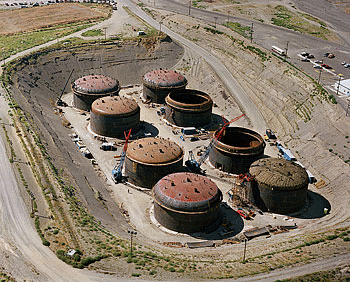
The aging tanks at the former Hanford nuclear weapons complex contain 56 million gallons of sludge, the byproduct of several decades of nuclear weapons production, and they represent one of the nation’s most treacherous environmental threats.
Energy Department officials have repeatedly assured the public that they have the advanced technology needed to safely dispose of the waste. An industrial city has been under development here for 24 years, designed to transform the sludge into solid glass and prepare it for permanent burial.
But with $13 billion already spent, there are serious doubts that the highly complex technology will even work or that the current plan can clean up all the waste. Alarmed at warnings raised by outside experts and some of the project’s own engineers, Department of Energy officials last year ordered a halt to construction on the most important parts of the waste treatment plant.
“They are missing one important target after another,” said Sen. Ron Wyden (D-Ore.), chairman of the Energy and Natural Resources Committee. “It feels like we are going around in circles.”……….
Many of the problems stem from the decision to launch construction of the plant even before engineers had completed the design. The job of turning waste as thick as peanut butter into glass is at the leading edge of nuclear chemistry, a job made difficult by the complex mixture of wastes that were fed into the underground tanks by some of the nation’s largest industrial corporations under a cloak of government secrecy.
The basic plan is to pump the waste into a pre-treatment plant, a factory larger than a football field and 12 stories tall, that would filter and chemically separate the waste into two streams of high- and low-level radioactivity. Then, two other plants would “vitrify,” or glassify, the waste. One would produce highly radioactive glass destined for a future geological repository, and the other a lower radioactive glass that could be buried at Hanford.
But serious questions were raised last year after Walter Tamosaitis, one of the scientific chiefs of the project, disclosed that the innovative technology for mixing the waste in processing tanks could cause dangerous buildups of explosive hydrogen gas and might allow plutonium clumps to form……. http://www.latimes.com/nation/la-na-hanford-nuclear-risks-20131130,0,5013027.story#axzz2m8Dynzbj
Radioactive soil storage needing 15-sq.-km track around Fukushima No. 1 plant
Fukushima land grab eyed State wants to purchase 15-sq.-km track around No. 1 plant for waste storage sites JAPAN TIMES, KYODO NOV 23, 2013 The state plans to buy 15 sq. km of land around the Fukushima No. 1 nuclear plant to build facilities to store radioactive soil and other waste generated by decontamination operations, government sources said….. (registered readers only) http://www.japantimes.co.jp/news/2013/11/23/national/fukushima-land-grab-eyed/#.UpJz29Jwo7p
The coming epidemic of nuclear reactor shutdowns: where to put the wastes?
The NRC believes the fuel can be safely stored for at least 100 in casks. But the radioactive half life is 16 million years, with a defined hazardous life of 160 million years. The world will soon be dotted with these ad-hoc radioactive dumps.
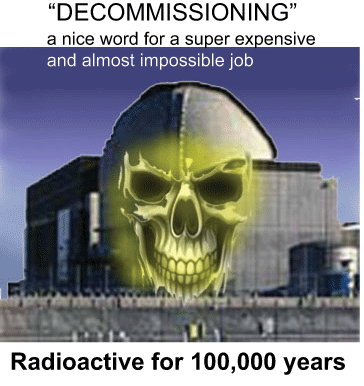 For aging nuclear reactors, a coming surge of shutdowns How safe will these ad-hoc radioactive dumps be?, Kevin Gray, SmartPlanet, 20 Nov 13
When it first fired up its twin reactors in 1973, the Zion nuclear power plant in Illinois — roughly 40 miles north of Chicago — was the largest in the world. It was a stunning work of technology that supplied electricity to some two million homes. And it could have easily lived on into the new century. But in 1998, its parent company, the energy giant Exelon Corp, turned off its lights and shuttered the facility rather than face some costly upgrades.For 12 years, Zion sat dormant on prime Lake Michigan shorefront as Exelon shelled out $10 million a year to maintain it and protect it with round-the-clock patrols of armed guards. By 2010, the facility had become home to drifting weeds and nesting falcons.
But that year, the federal government — in an arrangement never tried before — agreed to allow Exelon to transfer custody of the plant to EnergySolutions, a nuclear-waste storage outfit. The deal was worth a potential $1 billion in clean-up fees to EnergySolutions. It would be the largest nuclear power plant decommissioning ever undertaken in the United States. And it pledged to return the 375-acre site back to Exelon as grass and local shrubbery at the end of 10 years……..
EnergySolutions has spent the past year removing Zion’s fuel rods from a cooling pool and putting them into the canisters and casks for dry storage. The fuel, which is still about 400 degrees, can now be air cooled. Christian expects the company to begin moving the casks, via a heavy-haul rail, 100 yards south of the reactors by mid-October.
They will remain there until the feds come up with an alternative to Yucca Mountain. “Until we have a national repository open, this spent fuel has to stay where it is,” says Lawrence Boing, a nuclear decommissioning specialist at Argonne National Laboratory’s nuclear engineering division. “The big question now is what do we do with this stuff?” Continue reading
Power companies awarded $235M In Nuclear Waste Disposal Dispute
 Federal Judge Awards Nuclear Power Sites $235M In Disposal Dispute By BRIAN DOWLING, bdowling@courant.comThe Hartford Courant November 15, 2013 A federal judge has awarded three New England nuclear power companies $235.4 million in damages in the second of three cases against the U.S. government for failing to dispose of the plants’ nuclear waste.
The federal government has 60 days to appeal.
The companies operated the Connecticut Yankee nuclear plant in Haddam, and two plants in Maine and Massachusetts, which have been deactivated for decades. If the judgment from U.S. Court of Federal Claims Judge James F. Merrow stands, the millions of dollars in damages will head to ratepayers. The suit was filed over the U.S. Department of Energy‘s failure to remove nuclear waste from the plants. This phase of damages covers disposal costs from 2002 to 2008……..
Connecticut’s share of the millions is unclear. It depends on a number of factors, including how much of the energy for all the plants was delivered to the state.
Damages awarded in the first case totaled $160 million, and the state’s share amounted to $75 million. In February, the federal government reimbursed the nuclear power companies for the first time, following the Energy Department’s lack of challenge to a U.S. Court of Appeals decision.
The company has filed for a third phase of damages for the period covering 2009 to 2012.http://www.courant.com/business/hc-nuclear-plant-connecticut-yankee-lawsuit-20131115,0,3448137.story
Call for German utilities to pay more of nuclear decommissioning costs
German parties want utilities to shoulder nuclear shutdown costs BY MARKUS WACKET BERLIN Thu Nov 14, 2013 (Reuters) – German parties negotiating the formation of a coalition government want to make utilities pay more to dismantle their nuclear power plants and protect taxpayers from billions of euros in related costs, documents obtained by Reuters show.
Such a move, if adopted by a coalition of Chancellor Angela Merkel’s conservatives and the Social Democrats (SPD), would be a blow to E.ON, RWE, Vattenfall and EnBW who have already put aside 30 billion euros in provisions.
“A … fund could be considered to safeguard the financing of the disposal of nuclear assets,” the paper from the working group on environmental policies said.
Under the new proposal, the utility companies could be forced to pay into the fund which would be under political control.
Over a dozen working groups are hammering out policy compromises on a range of issues with the aim of forming a government in December. The nuclear proposal would have to be approved by a larger coalition panel led by Merkel and other party leaders before it was set in stone.
“We expect cooperation from the nuclear power operators in the switch to renewable energy and an acknowledgement of their responsibility for the orderly ending of the use of atomic energy,” the paper said.
The idea of a fund reflects concerns that Germany’s four nuclear power companies have taken insufficient precautions to pay for the dismantling of the plants and storage of atomic waste…….
The SPD is also keen to raise nuclear fuel tax and to extend the levy beyond 2016, when it is currently due to expire. However conservatives oppose this notion.
(Writing by Madeline Chambers; Editing by Susan Fenton) http://www.reuters.com/article/2013/11/14/us-germany-coalition-nuclear-idUSBRE9AD0HN20131114
Utah deliberating on the dangers of hosting radioactive trash dump
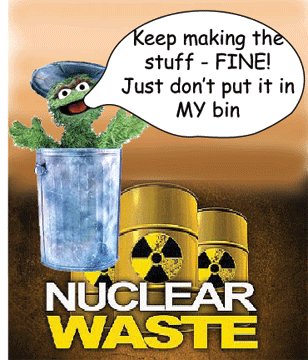 Utah weighing threats of storing depleted uranium — from meteor strikes to ants By Amy Joi O’Donoghue, Deseret News, Nov. 11 2013 SALT LAKE CITY — When figuring out if it is going to be safe to allow large quantities of depleted uranium to be buried in the desert 65 miles west of Salt Lake City, the state of Utah has to contemplate a long list of “what ifs” that could happen — and over a long, long period of time.
There are events like war, meteor strikes, volcanic activity, the return of large lakes like Lake Bonneville every 16,000 years and even, to some degree, the threat to stable disposal caused by burrowing ants.
EnergySolutions is proposing to dispose of 3,507 metric tons of depleted uranium at Clive, Tooele County, and it could be the nation’s repository of its inventory of 700,000 more tons of the radioactive waste, which is a byproduct of nuclear production material.
The state has to sign off on the disposal, requiring the company to complete a “performance assessment” that looks at how well its disposal site will weather all sorts of events and conditions……..
Even the federal regulators — the Nuclear Regulatory Commission — have yet to craft a rule on the storage of this brand of radioactive waste, leaving Utah to forge out on its own with building a framework that is protective of public health and the environment.
Depleted uranium falls within the radioactive levels Utah has established by law that it is willing to accept — low level radioactive waste — described as Class A. “Hotter” wastes such as B and C are prohibited.
The problem posed by the storage of depleted uranium stems from its increasing radioactivity — it continues to get “hotter” over time, peaking at 2.1 million years and staying at the level for billions of more years.
Utah regulators required EnergySolutions to come up with contingencies in its storage plans that document how its site would fare for a period of 10,000 years — and beyond that looking at “deep time” scenarios until it reaches peak radioactive levels.
The scenarios contemplate vulnerabilities to the public — from off-highway vehicle users who recreate nearby in Tooele County, military at the Utah Test and Training Range and the lone resident caretaker at the rest stop off I-80 at the Aragonite exit…..
The division will soon begin reviewing the assessment and is expected to make a decision next fall. http://www.deseretnews.com/article/865590390/Utah-weighing-threats-of-storing-depleted-uranium-2-from-meteor-strikes-to-ants.html
Southern Italy’s cancer epidemic, due to radioactive trash dumping
‘To clean it up it would cost the entire Italian budget for a year I think.’
The lower house in the Italian Parliament had elected to make the documents public in the interests of transparency.
Toxic nuclear waste dumped illegally by the Mafia is blamed for surge in cancers in southern Italy He added: ‘We disposed of 70 or 80 trucks from the north, millions and millions of tonnes. Read more: http://www.dailymail.co.uk/news/article-2483484/Toxic-nuclear-waste-dumped-illegally-Mafia-blamed-surge-cancers-southern-Italy.html#ixzz2k64qz8UL
- Italian Senate investigating link between pollutants and 50 per cent rise
- Classified documents from 1997 reveal poison would kill everyone
- Nuclear sludge, brought from Germany, was dumped in landfills
By HANNAH ROBERTS IN ROME 1 November 2013 Toxic nuclear and industrial waste, dumped illegally by the Neapolitan mafia, is responsible for a surge in cancers in southern Italy, it is feared.
The Italian Senate is investigating a link between buried pollutants and a rise of almost 50 per cent in tumours found in the inhabitants of several towns around Naples.
In classified documents from 1997, only now released to the public, a mafia kingpin warned authorities that the poison in the ground would kill everyone ‘within two decades’. Camorra chief Francesco Schiavone, once the world’s number one mafia fugitive, said: ‘The inhabitants are all at risk of dying from cancer within twenty years.
‘In towns like Casapesenna, Casal di Principe, Castel Volturno, and so on, they have, perhaps, twenty years to live. In fact I don’t think anyone will survive.’
Doctors first noticed that cancers in towns around Naples were on the rise in the 1990s. But since that time they have increased by 40 per cent in women and 47 per cent in men.
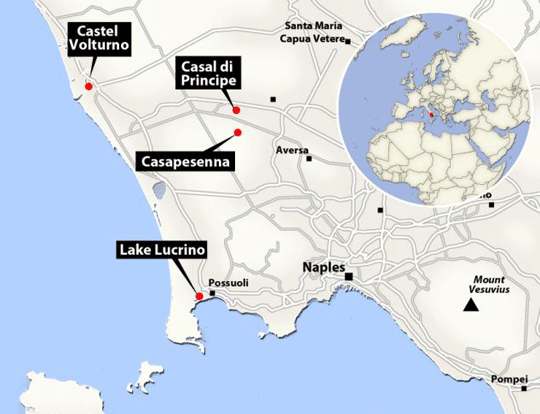
In secret out-of-court testimony he told lawyers how the Casalesi clan ran ‘a military style operation’ dumping millions of tonnes of waste on farmland, in caves, in quarries and even on the edge of towns. The mafia family also disposed of contaminated waste in Lake Lucrino and all along the coast.
Operatives were equipped with real police and carabinieri uniforms, as well as firearms, and the clans raked in huge profits of up to 600 million of the old lire (£200,000) a month. The industry became an officially clan-sanctioned ‘business’ in 1990 but had been going on long before. Nuclear sludge, brought in on trucks from plants in Germany, was dumped in landfills, Schiavone said. The trucks would unload waste at night before earth was thrown over with a JCB.
He said: ‘I know that some is on land where buffalo live today, and on which no grass grows’
The cost of a clean up would run into billions, he said, describing several sites in the suburbs of Naples.
Schiavone revealed: ‘We buried 520 drums of toxic waste in a specially dug quarry near the town of Pure Villaricca. But we also did it in very populated places, outside towns- at Casal di Principe behind the sports field at the edge of the motorway.’He added: ‘We disposed of 70 or 80 trucks from the north, millions and millions of tonnes.
‘To clean it up it would cost the entire Italian budget for a year I think.’ The lower house in the Italian Parliament had elected to make the documents public in the interests of transparency.
New York Attorney General slams NRC nuclear waste environmental assessment
NY Attorney General faults NRC for relying on “unsubstantiated hope” http://www.fierceenergy.com/story/ny-attorney-general-faults-nrc-relying-unsubstantiated-hope/2013-11-05 By Barbara Vergetis Lundin
New York Attorney General Eric T. Schneiderman is calling upon the Nuclear Regulatory Commission (NRC) to strengthen its proposed assessment of the environmental, public health and safety risks of storing highly radioactive nuclear wastes on-site at more than 100 reactors around the country for 60 or more years after the reactors are closed. The Attorney General’s testimony was delivered by Assistant Attorneys General Janice Dean at a public meeting held by the NRC on the proposed Waste Confidence Draft Generic Environmental Impact Statement (DGEIS).
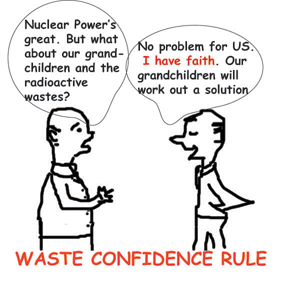 The DGEIS was prepared by the NRC in response to Attorney General Schneiderman’s successful court challenge to the commission’s Temporary Storage Rule in which the NRC had found, without conducting necessary studies, that no significant safety or environmental impacts will result from long-term, on-site storage of radioactive waste at nuclear power plants.
In 2012, a federal circuit court agreed with Attorney General Schneiderman that federal law requires the NRC to complete a thorough analysis of the public health, safety and environmental hazards such storage would pose before allowing the long-term storage of nuclear waste in communities. In reaching its decision, the court found that the spent nuclear fuel stored on-site at nuclear power plants “poses a dangerous, long-term health and environmental risk.”
In his court challenge to the NRC’s Temporary Storage Rule, the Attorney General argued that full compliance with the National Environmental Policy Act requires the commission to conduct a rigorous analysis of the potential for environmental, health and safety impacts from long-term, on-site radioactive waste storage. Continue reading
Nuclear Regulatory Commission’s “Waste Confidence” rule is indeed a “con”
Of greatest concern are Limerick’s fuel pools, already packed beyond design capacity, and dangerously vulnerable to meltdowns with potential for unthinkable health and economic devastation. Limerick’s two fuel pools hold more than two and a half times the amount of fuel rod assemblies (6,200) than four fuel pools at Fukushima (2,400) and far more than other older U.S. nuclear plants like TMI and Oyster Creek. NRC can’t or won’t tell ACE why.
Shedding light on NRC’s nuke waste con game http://www.pottsmerc.com/opinion/20131101/op-ed-shedding-light-on-nrcs-nuke-waste-con-game 10/31/13,
Evan Brandt’s article on Oct. 5, “Gov’t Shutdown May Delay Relicensing of Limerick Nuke Plant”, explained that NRC’s 2012 court-ordered spent fuel study would be delayed by the 2013 government shutdown. Actually, the government shutdown shed light on NRC’s nuke waste con game.
There is NO safe solution for radioactive fuel rods that can remain radioactive for a million years (EPA). They’re among the deadliest materials on earth. Yet, NRC’s “Nuclear Waste Confidence” game makes unsubstantiated claims that high-level radioactive wastes can be stored safely, soundly, and securely, virtually forever. This applies to nuclear plant sites like Limerick and allows them to continue producing and piling up deadly radioactive wastes under the absurd pretense that there is a safe solution.

Unthinkable devastating health and economic consequences threaten our future whether stored in fuel pools, above ground casks, from reprocessing, or from dangerous transport to a central location. NRC’s assumptions are far-fetched and negligent, including that dry cask storage systems, structures, and components can and will be entirely replaced once per century. NRC fails to identify astronomical public costs or where funds would come from for expensive massive replacements forever. NRC irrationally assumes society is willing or able to pay such costs, even if replacement is possible.
It was insanity for NRC to even consider relicensing Limerick Nuclear Plant when there is no safe solution for its deadly radioactive wastes. Continue reading
Growing world realisation that nuclear power is an economic disaster
Because of costs, the de facto “solution” is firstly to extend reactor operating lifetimes, then partly decommission and dismantle reactors when they are taken out of service, delaying the decontamination of nuclear sites, and pushing all costs into the future. Unfortunately and until the reactors are made safe, they by definition pose almost open-ended risks. These extend from “simple” accidents and technical malfunction, to operator errors, and to the risk of them becoming giant Dirty Bomb targets in civil war, international war, or terror attacks. Even the most extreme non-nuclear industrial risks, notably at “Seveso or Bhopal type” chemical facilities, are pale by comparison.
Nuclear Power Dirty Bomb The Market Oracle, Oct 28, 2013 By: Andrew_McKillop THE 100-YEAR CURSE Within the next 15 – 20 years as many as 100 industry standard Westinghouse-type 900 MW PWR pressurized water reactors, concentrated in the “old nuclear’ countries will have to be decommissioned, dismantled and their sites made safe – unless political deciders maintain the sinister farce of rubber stamping reactor operating lifetime extensions. The decontamination process could take as long as 100 years. In several countries, especially Germany, Switzerland and probably Japan the dangerous game of politically-decided reactor life extensions – to push back the date of final decommissioning – has already ended or is ending.
But when it does end, nuclear debt will go into overdrive from its already extreme high setting. Nuclear power is capital intensive, lives on subsidies, thrives on false hopes and dies in debt.

Putting a figure on how much the nuclear “decomm” story will cost and how long it will take is in fact impossible – and is signalled by the tell-tale anticipative action of nuclear friendly governments. One stark example is the UK, which now sets decomm as an activity that will only need to start at a generous, or foolhardy 30 or 40 years after the reactor was powered down and removed from the national power grid. Until then, the reactor can sit on the horizon as a contribution to national culture or something “in perfect safety of course”. Decomm periods could or might therefore be 100 years.
DECOMMISSIONING SAGAS As already noted above, there are no rules, standards and best practice in decommissioning, dismantling and “making safe” or “securing” the former sites of reactors. So there is no standard cost for getting rid of reactors. It is a case-by-case process. This alone prods the highly political decision to set a “delay” between reactor shut down, and decommissioning which as noted above, in the extreme UK case is now set at 30-40 years.
Before the final shut down, of course, reactor operating life extensions can squeeze some more power out of the reactor – and further delay the moment when it has to be decommissioned. Only idiots can pretend this does not expose the reactor to increased risks of accidents. Ask yourselves if you prefer to fly in a 40-year-old airplane, or a new one.
Real-life decomm sagas, as distinct from emergency dismantling following a serious or catastrophic accident as in the case of Three Mile Island, Chernobyl and Fukushima are always – always – a tale of vastly underestimated initial costs and timelines for decomm, followed by massive cost overruns and time overruns. Plenty of examples concern the now-quarter-century old projects, and longer, where initial cost estimates have been exceeded by actual spending by 5 or 10 times, and the decomm project’s time for completion multiplied by 3. And today the projects are not yet fully completed!…….. Continue reading
1 This Month
23-25 October – on Zoom – World BEYOND War’s annual global conferenc


Shut down the radiation-damaged Heysham nuclear reactors now
To see nuclear-related stories in greater depth and intensity – go to https://nuclearinformation.wordpress.com

Say No to NASA’s Reckless Nuclear Reactor on the Moon
Say No to NASA’s Reckless Nuclear Reactor on the Moon

-
Archives
- October 2026 (219)
- September 2026 (339)
- August 2026 (330)
- July 2026 (355)
- June 2026 (287)
- May 2026 (306)
- April 2026 (356)
- March 2026 (251)
- February 2026 (267)
- January 2026 (308)
- December 2025 (358)
- November 2025 (359)
-
Categories
- 1
- 1 NUCLEAR ISSUES
- business and costs
- climate change
- culture and arts
- ENERGY
- environment
- health
- history
- indigenous issues
- Legal
- marketing of nuclear
- media
- opposition to nuclear
- PERSONAL STORIES
- politics
- politics international
- Religion and ethics
- safety
- secrets,lies and civil liberties
- spinbuster
- technology
- Uranium
- wastes
- weapons and war
- Women
- 2 WORLD
- ACTION
- AFRICA
- Atrocities
- AUSTRALIA
- Christina's notes
- Christina's themes
- culture and arts
- Events
- Fuk 2022
- Fuk 2023
- Fukushima 2017
- Fukushima 2018
- fukushima 2019
- Fukushima 2020
- Fukushima 2021
- general
- global warming
- Humour (God we need it)
- Nuclear
- RARE EARTHS
- Reference
- resources – print
- Resources -audiovicual
- Weekly Newsletter
- World
- World Nuclear
- YouTube
-
RSS
Entries RSS
Comments RSS

