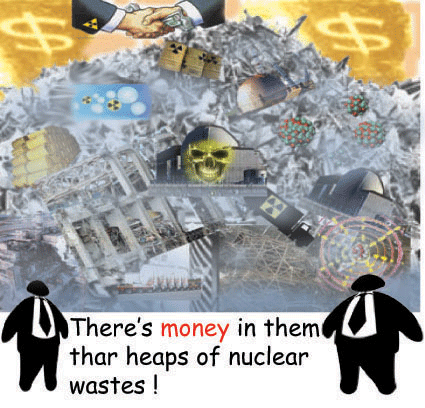
Private company making a bonanza from nuclear waste storage
Radioactive Gold Rush: Nuclear Waste Storage Is A Booming Business http://www.gizmodo.com.au/2014/01/radioactive-gold-rush-nuclear-waste-storage-is-a-booming-business/ KELSEY CAMPBELL-DOLLAGHAN First, dig a hole. Then, reinforce it with clay, concrete, steel, and plastic. Fill it with nuclear waste and cover it in 12 more metres of concrete. Then profit. That’s how one company in Texas has struck radioactive gold, charging companies $US10,000 per cubic foot to store nuclear refuse.
Safely burying “low-level” nuclear material is now a $US30 billion industry in the U.S., driven in part by an increase in old, contaminated parts removed from the country’s rapidly ageing nuclear power plants and radiation-related medical waste. The New York Times‘ Matthew Wald calls one storage pit “America’s most valuable hole in the ground,” describing the process of digging, protecting, and filling This booming business is dominated by a single, two-year-old company in Texas —Waste Control Specialists — who even charge extra depending on radioactivity levels. Think of it as surge pricing for nuclear waste.
Here’s how WCS describes its facility in Andrews County, Texas, on its website:
Located within a 1,200-ft. thick nearly impermeable red-bed clay formation, the Waste Control Specialists (WCS) site ensures safe and permanent disposal of radioactive waste by combining this unique natural barrier with a custom designed and engineered, 7-ft. thick, steel-reinforced concrete liner system… Offering the most robust facilities of their kind in the world, WCS is a long-term solution for the nation’s commercial and public radioactive waste generators.
Is it really safe for nuclear waste disposal to be controlled by private industry? Critics are divided. Some claim that these companies are using techniques lightyears beyond the government’s dated waste storage sites. Others argue that letting private interests dictate the location and security of potentially deadly materials is incredibly troubling. Right now, it’s the best option we have. [The New York Times]
UK scientists aim to get the public to be confident about nuclear waste disposal
 Researchers grapple with UK’s nuclear legacy http://phys.org/news/2014-01-grapple-uk-nuclear-legacy.html#jCp 9 Jan 14 The University of Leeds will lead a consortium of 10 universities in a national research programme looking at ways of dealing with Britain’s nuclear waste. The £8 million project, funded by the Engineering & Physical Sciences Research Council (EPSRC), will start in February and bring together the nuclear industry, the Government’s nuclear advisors and the country’s leading academic researchers.
More than 40 doctoral and post-doctoral researchers will work over the next four years on issues including how best to handle different types of spent fuels, packaging and storing waste, and dealing with nuclear sludges in ponds and silos at nuclear power stations.
Professor Simon Biggs, Director of the University of Leeds’ Institute of Particle Science and Engineering, who will lead the University consortium, said: “The project is primarily focused on developing new technologies and providing confidence in the safe storage and disposal of legacy waste. The UK is a technology leader in this field and the core aim of this project is to maintain and further develop that skill base.”
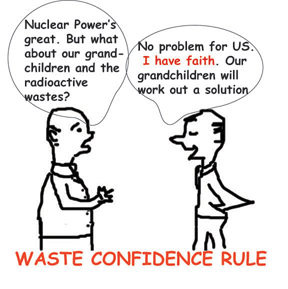
ed.note UK might have to copy the USA’s rule
He added: “This will be a truly interdisciplinary effort. We have civil engineers, chemists, chemical engineers, robotics experts, radiochemists, mechanical engineers and material engineers all working together on thirty different projects.”
The National Nuclear Laboratory (NNL), Nuclear Decommissioning Authority (NDA) and Sellafield Limited will be partners in the project, alongside the Universities of Leeds, Birmingham, Bristol, Imperial, Lancaster, Loughborough, Manchester, Sheffield, Strathclyde and UCL.
Much of the UK’s legacy waste is kept at the Sellafield site in Cumbria.
Sellafield Limited’s Research Alliance Manager Neil Smart said: “Today, Sellafield faces a challenge where there is no blueprint; emptying and demolishing some of the most difficult and complex nuclear buildings in the world – the decommissioning of historic reactors, reprocessing facilities and associated legacy ponds and silos.
“This massive challenge is however an opportunity to demonstrate that Sellafield is still at the forefront of the UK’s nuclear industry and we are delighted that the EPSRC is supporting appropriate academic research that will contribute to the scientific and technical underpinning of our mission. We look forward to engaging in these projects and benefiting from the outcomes, not only in terms of the science and technology but also the skilled people developed through these projects with the potential to enhance our workforce long into the future.”
Vermont nuclear decommissioning may be a model for other States
State Involvement Key for Decommissioning Old Nuclear Plants, Nasdaq, By Oilprice.com, January 03, 2014 The beginning of 2014 marks the final year of operation for the Vermont Yankee Nuclear Power Plant, ending a contentious battle between the state and the plant’s owner. On December 23, Entergy (ETR) and the state of Vermont announced a deal that will end all litigation surrounding the plant’s operation, shut down the plant at the end of 2014, and lead to a compressed schedule to study decommissioning.
The conflict started when Entergy sought a 20-year license renewal to keep the Yankee plant operating into the 2030’s. Vermont, however, requires approval from the state legislature for license renewal, the only state in the country that does so. Yet Entergy sued the state, arguing that authority over nuclear license renewals rests only with the Nuclear Regulatory Commission (NRC), and that federal authority trumps state authority.
Although a series of court decisions affirmed Entergy’s position, the company ultimately decided to close the plant anyway, largely due the inability to compete with cheap natural gas. In August 2013 it announced that it would cease operations at the end of 2014…….
The deal to close Vermont Yankee does offer a useful model for decommissioning as it tackles some of the key areas of conflict between the industry and the areas in which it operates. Entergy agreed to complete adecommissioning study in one year, much quicker than the four years allotted for by the NRC. It also agreed to move nuclear waste from onsite pool storage into dry casks within seven years, even though the NRC allows the company to keep waste in pools for sixty years. The deal also calls for Entergy to pay millions of dollars to the state for economic development for the county in which Vermont Yankee is located.
One of the interesting features of the deal is that it allowed for active involvement of the state in shaping the path towards decommissioning and waste disposal, which is often absent elsewhere. To be sure, huge question marks remain, including how the state will make up for the shortfall in electricity generation, and where funding for decommissioning will come from. But, the U.S. has thus far failed to implement a strategy to decommission old nuclear power plants. And with most of the 100 or so nuclear power plants obtaining 20-year license renewals, that conversation has been pushed off into the future. The Vermont Yankee deal, while incomplete, does offer lessons for decommissioning. http://www.nasdaq.com/article/state-involvement-key-for-decommissioning-old-nuclear-plants-cm315680#ixzz2pRYlLxGz
America dumped radioactive trash on the ocean floor
 Nuclear Waste Sits on Ocean Floor U.S. Has Few Answers on How to Handle Atomic Waste It Dumped in the Sea By JOHN R. EMSHWILLER and DIONNE SEARCEY WSJ Dec. 31, 2013 More than four decades after the U.S. halted a controversial ocean dumping program, the country is facing a mostly forgotten Cold War legacy in its waters: tens of thousands of steel drums of atomic waste.
From 1946 to 1970, federal records show, 55-gallon drums and other containers of nuclear waste were pitched into the Atlantic and Pacific at dozens of sites off California, Massachusetts and a handful of other states. Much of the trash came from government-related work, ranging from mildly contaminated lab coats to waste from the country’s effort to build nuclear weapons.
Federal officials have long maintained that, despite some leakage from containers, there isn’t evidence of damage to the wider ocean environment or threats to public health through contamination of seafood. But a Wall Street Journal review of decades of federal and other records found unanswered questions about a dumping program once labeled “seriously substandard” by a senior Environmental Protection Agency official: Continue reading
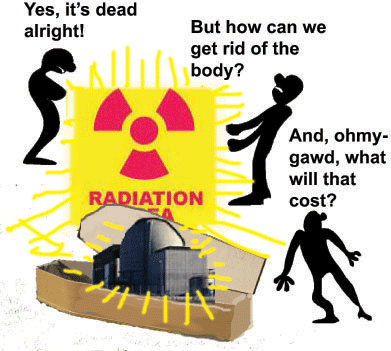
Decommissioning problems with Vermont Yankee Nuclear reactor
 RECAP 2013: VERMONT YANKEE, RENEWABLE ENERGY CAPS AND WIND PROJECTS STIR CONTROVERSY HTTP://VTDIGGER.ORG/2013/12/29/RECAP-2013-VERMONT-YANKEE-RENEWABLE-ENERGY-CAPS-WIND-PROJECTS-STIR-CONTROVERSY/ JOHN HERRICK DEC. 29, 2013 VERMONT YANKEE, THE STATE’S ONLY NUCLEAR REACTOR, DOMINATED HEADLINES THIS YEAR.
Entergy Corp., the company that runs the reactor, is plagued by financial problems, and operating the Vermont plant was an expense it could no longer afford. In late August, Entergy announced it would close the plant, ironically just days after the Louisiana corporation won a long-running court battle with the state over the right continue operating the Vernon facility for an additional 20 years.
Entergy amended its application with the Public Service Board and is now seeking a one year license to operate the plant through the end of 2014, when Vermont Yankee is slated to close.
The board held off from ruling on the relicensure case at the request of the Shumlin administration while state officials settled differences over decommissioning, the economic impact of the plant closure, hot water discharges into the Connecticut River and a generation tax.
Many of those issues were resolved when the state and Entergy reached an agreement last week that sets a decommissioning completion date of 10 to 15 years, decades sooner than required by the federal Nuclear Regulatory Commission’s 60-year timeframe. Entergy also agreed to pay millions of dollars in payments to the state in tax revenues and in support for regional economic development efforts. In addition, the agreement settled all pending federal litigation.
The settlement is contingent on the Public Service Board approving the plant’s certificate of public good before March 31, 2014.
There are other outstanding issues that have yet to be resolved. The two parties disagree over whether Entergy’s Decommissioning Trust Fund is sufficient to support decommissioning. In addition, the state and the company do not yet have a common understanding of how the site will be restored. Entergy must file a decommissioning plan with the NRC after the plant is closed.
The state is concerned that the 42-year old merchant plant’s worsening financial foundation could compromise the operational safety of the facility in the near term and the decommissioning process over the long haul.
It is unclear what the plant will do with 530 tons of radioactive waste stored on the premises. Vermont Yankee has 3,879 fuel rod assemblies submerged in a spent fuel pool that was originally designed to hold about 350. Spent fuel rods must be kept under water to prevent them from igniting, but once they are cooled, they can be transferred into long-term cement “dry casks.” Vermont Yankee will need 58 casks in all. Right now, the facility has 13. Each cask costs about $1 million.
The agreement requires that all the spent nuclear fuel stored on site pools be placed in dry cask storage, which Gov. Peter Shumlin said could take up to seven years.
Entergy’s decision to close Vermont Yankee was the result of declining wholesale market prices and competition with natural gas. Merchant plants are investor-funded; early this year a Swiss financial services firm UBS Securities downgraded Entergy Corp.’s stock and urged investors to sell.
The downgrade came on the heels of a report by UBS Securities that found Entergy “is unlikely to generate any meaningful cash” from wholesale commodities in 2013 and 2014.
Entergy’s nuclear fleet includes the Pilgrim Nuclear Power Station in Massachusetts, Vermont Yankee in Vermont, Indian Point Energy Center and the James A. Fitzpatrick Nuclear Power Plant in New York, and the Palisades Power Plant in Michigan.
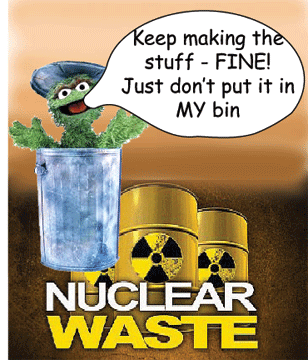
USA’s 70,000 metric tons of radioactive trash

they sould stop making the stuff!
Highly reactive nuclear waste seeks permanent home ORANGE COUNTY REGISTER, December 27th, 2013, By TERI SFORZA “………; two things happened last month that give hope to those who want Yucca to open for business: The U.S. Nuclear Regulatory Commission ordered its staff to finish a safety evaluation report for Yucca Mountain, and it will spend $11 million from the Nuclear Waste Fund to do it, and, a federal appeals court told the government to quit collecting $750 million a year from consumers for said Nuclear Waste Fund, since, you know, the federal government has failed to permanently dispose of a single gram of nuclear waste for more than 50 years.
This all comes as the city of San Clemente officially implores the federal government to create some sort of safe repository for nuclear waste, and to give first priority to the stuff stored at San Onofre Nuclear Generating Station because of our area’s “unique circumstances” (read: vulnerability to earthquakes and dense population).
“I’ll take any sign of forward momentum on Yucca Mountain as positive, including this one,” said San Clemente City Councilwoman Lori Donchak by email shortly after the news broke. “The immediate need is for a safety-evaluation report to see if the site can do its job. It’s not clear that the money available is enough to get that done and unfortunately no indicators that renewed funding is in the works in Washington…..
the importance of some sort of answer to the nation’s acute nuclear-waste-disposal-question grows more pressing every day: Some 70,000 metric tons of the poisonous stuff have piled up in pools and dry casks all across America, and more than 116 million people live within the 10-mile evacuation zone around the nuclear power plants that have created it.
That’s more than one of every three people in the United States.
And the financial cost of paralysis is high: About 80 lawsuits have been filed against the feds over broken promises to start accepting spent nuclear fuel by 1998, theDepartment of Energy had paid out $2.6 billion in damages to utility companies as of 2012, and it faces another $19.7 billion in liabilities through 2020, according to the General Accounting Office……
Nuclear Regulatory Commission’s study on nuclear waste storage is inadequate
Watchdogs criticize nuclear storage study; A.G. says NRC didn’t focus on Indian Point lohud.com, 26 Dec 13, State Attorney General Eric Schneiderman and his counterparts in Connecticut, Massachusetts and Vermont have given a thumbs-down to the federal government’s draft study on the long-term storage of used nuclear fuel.
A 143-page document filed late last week detailed their concerns, along with those of a Minnesota Native American tribe.
The Nuclear Regulatory Commission’s review, they maintain, was incorrectly focused at the industry level and not individual plants.A federal court in 2012 found the NRC didn’t fully consider the hazards of on-site storage of old fuel at the nation’s nuclear plants, including Indian Point in Buchanan. The court ordered the commission to evaluate the environmental effects of such storage.
Old fuel at Indian Point is kept in spent-fuel pools and dry casks. Both are reinforced against attacks or other calamities but critics have called for moving more old fuel at a faster pace into the casks.The draft study “fails(s) to address these core issues as required by (federal law) and the Court,” the attorneys general and the general counsel for the Prairie Island Indian Community wrote. The study also fails to provide the states, the tribe and the public with plant-by-plant reviews and wrongly relies on a generic approach, they wrote.
The tribe’s reservation is next to the Prairie Island Nuclear Generating Plant, which was the subject of litigation in the 1970s that lead to how the NRC regulates the storage of old nuclear fuel……..http://www.lohud.com/article/20131225/NEWS/312250023/Watchdogs-criticize-nuclear-storage-study-A-G-says-NRC-didn-t-focus-on-India
USA secretly building two underground plutonium production labs
 US to build two secret underground plutonium production labs: Analyst Press TV, 24 Dec 13 The United States is planning to build two new underground plutonium production labs that will expand plutonium production for the next decades, an analyst says.
“The Senate two days ago voted to authorize the creation of two new huge secret underground plutonium production labs that will expand plutonium production for the next 150 years,” Brian Becker, national coordinator of the A.N.S.W.E.R Coalition, told Press TV on Saturday.
“That is a very important fact and I think the world is not yet learning about it or just learning about it,” he added.
Becker also said the location of the new labs is in Los Alamos. “This was going to be in Los Alamos, the nuclear facility in New Mexico and the US government has just announced in spite of environmental impact statements, in spite of everything, to rush forward for the creation of two new plutonium factories, modules that will be producing plutonium for as decades and decades to come,” the analyst said.
“That is to enrich and enhance nuclear weapons. The United States is moving nuclear weapons into outer space that is one of the big projects. They see nuclear weapons and nuclear weapons possession as a form of creating dominance. It is not keeping the world safe,” he explained.
Becker pointed out to President Barack Obama’s plans for the US nuclear weapons complex that will cost the country about $355 billion over the next decade….http://www.presstv.ir/detail/2013/12/22/341316/us-building-secret-labs-to-enhance-nukes/
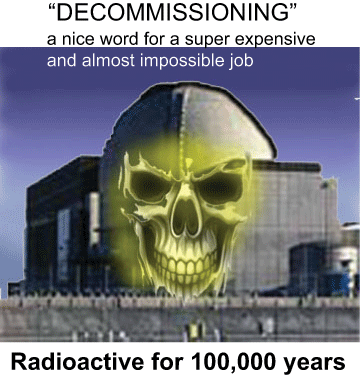
New agreement on decommissioning Vermont Yankee Nuclear Power Station
 Vermont, Entergy Announce Deal On Nuclear Power Plant Decommissioning http://boston.cbslocal.com/2013/12/23/vermont-entergy-announce-deal-on-nuclear-power-plant-decommissioning/ December 23, 2013 MONTPELIER, Vt. (CBS) — The state of Vermont and Entergy have announced a deal on decommissioning the Vermont Yankee Nuclear Power Station.
Gov. Peter Shumlin, Attorney General Bill Sorrell and Bill Mohl, president of Entergy Wholesale Commodities, announced a settlement agreement Monday between the state and the owner and operator of the Vermont Yankee Nuclear Power Station, Entergy Nuclear Vermont Yankee LLC and Entergy Nuclear Operations Inc., the company said in a prepared statement.
The deal brings more certainty to the plant’s operation through next year and its transition — including commitments related to economic development, timely decommissioning and site restoration, the company reported. The pact also helps set a path for a constructive and transparent working relationship between Entergy and the state as they continue to work on long-term issues related to the decommissioning of the nuclear power plant. Continue reading
Danger in transporting Canadian radioactive trash to South Carolina
“The concerns are in transport, adding waste to the system and also opening the door for receipt of unusual nuclear waste materials that would end up being dumped in South Carolina,”
 Canadian nuclear waste heading for SC, Greenville Online , 22 Dec 13
Critics say it’s unusual to ship weapons-grade uranium so far COLUMBIA — Sometime next year, a convoy is expected to begin delivering shipments of highly radioactive liquid waste containing weapons-grade uranium from Canada to the Savannah River Site near Aiken.
It’s not so unusual for SRS, once home to the manufacture of nuclear weapons parts, to receive nuclear materials or to process radioactive waste.
What makes these shipments controversial, and according to one environmental activist, unprecedented, is that they are being shipped so far and with such a lethal cargo. Continue reading
Edison and NRC have No plans for removing nuclear wastes from San Onofre plant

I have attended nearly every Nuclear Regulatory Commission hearing on San Onofre for nearly 20 years. For more than a decade we were told by Southern California Edison (with no objection from the NRC) that the waste problem was essentially solved because the waste would go to Yucca Mountain. But Yucca Mountain is an imperfect solution: Before the federal government stopped the project (or at least slowed it to a crawl), one of the last problems they could not be sure they had any good science about was “drip shields” which were to protect the fuel rods — that were to be permanently entombed at the site — from water dripping from above. The shape, material, thickness, and expected durability of the shields were all undecided, but my recollection is that the last design was an upside-down flattened out V shape made out of 4-inch thick titanium. And no one knew how long it would last, but 300 years was an outside estimate, or at least the hope. After that, good luck.
What the transport vehicles would look like, and whether they would use rail or roads or both, was all undecided when the project was stopped, despite 10s of billions of dollars having been spent.
Geologic storage, if we choose that route, will not be easy and will not be risk free. And we’re nowhere near it at this point. Continue reading
Sea level rise, storm surges, not factored in to NRC’s nuclear waste policy
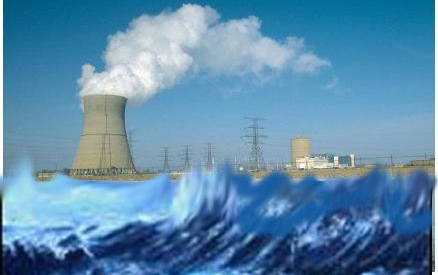 CCCL also argued that the discussion of sea level rise was insufficient. The DGEIS relied on dated sources that did not account for uncertainty in sea level rise projections and may underestimate risk. Also, the DGEIS merely looks at static sea level rise, which ignores risks due to more frequent and severe flooding. CCCL pointed to data showing that a number of coastal nuclear power plants potentially subject to sea level rise and storm surge, are located in highly populated areas of the country
Center For Climate Change Law December 19th, 2013 by Ethan Strell The Columbia Center for Climate Change Law (CCCL) submitted comments today on the United States Nuclear Regulatory Commission’s “Waste Confidence Draft Generic Environmental Impact Statement” (DGEIS), which concerns the storage of highly radioactive spent nuclear fuel at individual power plants beyond the duration of each plant’s operating license. CCCL’s comments focus on the DGEIS’s lack of analysis of how future climate conditions could affect the safety of these high level nuclear waste storage facilities.
“Waste Confidence” refers to the Commission’s confidence that permanent disposal of nuclear waste can be accomplished when it is needed.
Currently, spent nuclear fuel is stored on-site at nuclear reactors beyond the duration of plants’ operating licenses. The Waste Confidence Rule stems from a 1976 petition by NRDC to halt the licensing of nuclear plants until the Commission could guarantee the permanent, safe disposal of spent nuclear fuel. Continue reading
Hearings on the Nuclear Regulatory Commission’s proposed Generic Environment Impact Statement (GEIS) for nuclear waste
San Clemente wants to get rid of San Onofre radioactive trssh
San Clemente Doesn’t Want San Onofre’s Nuclear Waste Sticking Around By David Wagner Http://Www.Kpbs.Org/News/2013/Dec/18/San-Clemente-Doesnt-Want-San-Onofres-Nuclear-Waste/ Without a national repository for nuclear waste, plants scattered throughout the country will have to keep waste on site for decades, possibly even centuries. Elected officials in San Clemente are expressing concern about how long waste will be stored in their own backyard. With San Onofre Nuclear Generating System just a few miles down the coast, nuclear waste sits close to home. The San Clemente City Council voted Tuesday to take a stronger stance on waste storage at the plant, which was permanently shut down earlier this year.
The Nuclear Regulatory Commission believes waste could safely remain on site for as long as 300 years. Gary Headrick of the environmentalist group San Clemente Green thinks it’s a dangerous plan for Southern California.
“That is just absurd because we expect a huge earthquake anytime,” Headrick said. “We’re long overdue.”
In passing this resolution, the city is requesting more time for the public to weigh in on the future of San Onofre’s waste. The NRC’s period for public comment is scheduled to end on Friday.
Japanese govt to select places for nuclear waste permanent dump
 Japan Takes Nuclear Storage Hunt Into Own Hands http://online.wsj.com/news/articles/SB1000142405270230394950457926348056235159 4 Regional Governments Express No Interest By MARI IWATA Dec. 17, 2013 TOKYO—Japan has decided to take matters into its own hands to find appropriate domestic locations to permanently store highly radioactive nuclear waste, after waiting in vain for more than a decade for an offer from a regional government. “The government will play an active role in choosing a permanent place,” Industry Minister Toshimitsu Motegi told reporters at a regular news conference Tuesday. “We’ll abandon the current system of waiting for volunteers to raise their hands.”
Japan, which currently doesn’t have any final disposal sites for high level radioactive waste, has 17,000 metric tons of domestically spent nuclear fuel that dates back to the 1970s. Continue reading
1 This Month
23-25 October – on Zoom – World BEYOND War’s annual global conferenc


Shut down the radiation-damaged Heysham nuclear reactors now
To see nuclear-related stories in greater depth and intensity – go to https://nuclearinformation.wordpress.com

Say No to NASA’s Reckless Nuclear Reactor on the Moon
Say No to NASA’s Reckless Nuclear Reactor on the Moon

-
Archives
- October 2026 (219)
- September 2026 (339)
- August 2026 (330)
- July 2026 (355)
- June 2026 (287)
- May 2026 (306)
- April 2026 (356)
- March 2026 (251)
- February 2026 (267)
- January 2026 (308)
- December 2025 (358)
- November 2025 (359)
-
Categories
- 1
- 1 NUCLEAR ISSUES
- business and costs
- climate change
- culture and arts
- ENERGY
- environment
- health
- history
- indigenous issues
- Legal
- marketing of nuclear
- media
- opposition to nuclear
- PERSONAL STORIES
- politics
- politics international
- Religion and ethics
- safety
- secrets,lies and civil liberties
- spinbuster
- technology
- Uranium
- wastes
- weapons and war
- Women
- 2 WORLD
- ACTION
- AFRICA
- Atrocities
- AUSTRALIA
- Christina's notes
- Christina's themes
- culture and arts
- Events
- Fuk 2022
- Fuk 2023
- Fukushima 2017
- Fukushima 2018
- fukushima 2019
- Fukushima 2020
- Fukushima 2021
- general
- global warming
- Humour (God we need it)
- Nuclear
- RARE EARTHS
- Reference
- resources – print
- Resources -audiovicual
- Weekly Newsletter
- World
- World Nuclear
- YouTube
-
RSS
Entries RSS
Comments RSS

