Just under 100 years to clean up UK nuclear plant – if they’re lucky
The final decommissioning at Trawsfynydd and elsewhere depends on finding a safe long term solution for where to deposit the ILW as well as the High Level Waste (HLW) currently stored at Sellafield. This includes the spent nuclear fuel which was removed when the plant closed.
Trawsfynydd timeline
1959: Construction started
1965 to 1991: Electricity generation
1993 to 1995: Decommissioning starts – fuel removed and sent to Sellafield
1995 to 2016: Recovery of waste and preparations to put the plant into a ‘passively safe’ state
2020-26: Reduction in height of reactor buildings
2040s: Scheduled removal of Intermediate Level Waste to deep geological storage
2074: Final site clearance starts
2083: Site returned to pre-existing state

How do you close a nuclear power station? BBC By Steven Green 28 Oct 13 As the UK embarks on building what could be a new generation of nuclear power plants, work continues to decommission the first generation of nuclear power stations at sites including Trawsfynydd in Snowdonia which will take an estimated 90 years to complete. Continue reading
What do do with Britain’s radioactive trash from nuclear submarines?
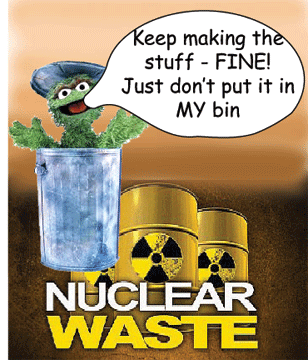 Radioactive waste from submarines is divided into three categories: high-level waste (HLW) from the reactor pressure vessel, intermediate level waste (ILW) that includes spent fuel, and low level waste (LLW) including contaminated equipment.
“As long as we cling on to the idea that we need a seaborne nuclear deterrent, we’re going to have the problem of what to do with the dangerous waste it creates.”
Naval bases could become nuclear dumps http://www.independent.co.uk/news/uk/home-news/naval-bases-could-become-nuclear-dumps-8906452.html Fears grow in dockyard cities over removal of radioactive material from decommissioned subs SAM MASTERS SUNDAY 27 OCTOBER 2013 Fears that two major naval bases sited near large British cities could become nuclear waste storage facilities “by default” have grown after it was revealed the Ministry of Defence proposes to remove low-level radioactive waste from the UK’s nuclear submarine fleet.
According to minutes of a submarine dismantling meeting, the “early removal of low-level waste” has been proposed at two major dockyards: Rosyth, in the Forth estuary, Fife, and Devonport, in Plymouth. Experts warned that removing radioactive waste would need to be explained “carefully” to ensure dismantling sites on bases near major population centres did not become waste storage areas “by default”. Continue reading
Geologists meet to discuss burial of nuclear wastes
 Radioactive Waste: Where to Put It? http://www.sciencedaily.com/releases/2013/10/131027140628.htm Oct. 27, 2013 — As the U.S. makes new plans for disposing of spent nuclear fuel and other high-level radioactive waste deep underground, geologists are key to identifying safe burial sites and techniques. Scientists at The Geological Society of America (GSA) meeting in Denver will describe the potential of shale formations; challenges of deep borehole disposal; and their progress in building a computer model to help improve understanding of the geologic processes that are important for safe disposal of high-level waste. Continue reading
Michigan politicians unhappy about Nuclear waste dump near great lakes
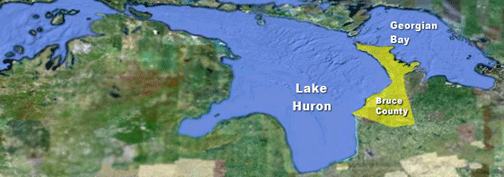 Michigan politicians voice concerns over burying nuclear waste near Kincardine CTV News September 30, 2013 Two American politicians made the trip to Kincardine Monday to share their opposition to burying nuclear waste near the Great Lakes.
“It’s just really astonishing to me that they would consider putting this type of nuclear waste so close to Lake Huron and to our Great Lakes. As I look out here, it’s just even more compelling of a case for me,” says Michigan State Representative Sarah Roberts.
Roberts and Michigan State Senator Hoon Yung Hopgood travelled to Bruce County to say Michigan doesn’t want nuclear waste permanently stored within 1.2 kilometres of the lake their share with Ontario. “In Michigan, every single person that I have talked to says ‘I cannot believe they are considering doing that,'” says Roberts.
Ontario Power Generation wants to bury 200,000 cubic metres of its low and intermediate level nuclear waste in an underground facility on the Bruce Power site…….
While there very well may be opposition in Michigan, it’s harder to find on this side of the border. Every mayor within 150 kilometres of the proposed site is favour of OPG’s plan, including Kincardine Mayor Larry Kraemer…… http://london.ctvnews.ca/michigan-politicians-voice-concerns-over-burying-nuclear-waste-near-kincardine-1.1477370#ixzz2gWBWQW7B
Japan’s intractable Fukushima radioactive trash problem

 Mission Impossible. What Future Fukushima? The Asia-Pacific Journal, Vol. 11, Issue 39, No. 1. September 30, 2013. Critics say Japan’s government is engaged in a vast, duplicitous and fruitless campaign to decontaminate Fukushima Prefecture. David McNeill and Miguel Quintana in Fukushima, Japan
“……The differences over what constitutes “acceptable” radiation levels will inevitably complicate policy over the return of evacuees. Local leaders like Kanno and Sakurai set limits lower than central government requirements. “The government says we don’t need to get radiation down to 1millisievert a year but that’s not how we see it,” says Sakurai. The central government, however, is sticking to its guns on its original limit. “In principle, the threshold of 20 millisieverts remains valid,” says Matsumoto Shintaro, of the Cabinet Office’s Support Team for Residents Affected by Nuclear Incidents. “But the lifting of evacuation orders won’t be decided on the basis of radiation doses alone. It will also depend on the status of each municipality’s infrastructure, whether the community is able to function, and the understanding of residents.
The government plans to define a specific policy by the end of 2013.” The Fukushima cleanup, however, faces another, perhaps insurmountable challenge: securing sites to store contaminated soil, leaves and sludge. Many landowners balk at hosting “interim” dumps – in principle for three years – until the central government builds a mid-term storage facility. Local governments throughout Japan have refused to accept the toxic waste, meaning it will probably stay in Fukushima for good.
The waste is stored under blue tarpaulins across much of the prefecture, sometimes close to schools and homes. Makita Kunihiro, who heads Minamisoma’s decontamination office, accepts that storage is the biggest difficulty it faces. “We need 19 sites according to our estimates, and we have seven.” The city’s contracts with landowners are usually signed for a minimum of three years, but Ito says the timeframe is simply not believable. “Nobody believes that temporary storage will be for only 3 years.” – See more at:http://japanfocus.org/-David-McNeill/4000#sthash.RH288s36.dpuf
Public meeting on the disposal of dead San Onofre nuclear power plant
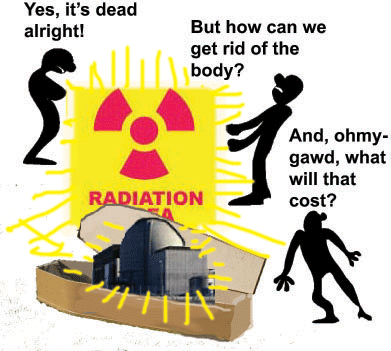 Nuclear Regulatory Commission Debates San Onofre Plant Shutdown At (includes Video) First Public Meeting http://losangeles.cbslocal.com/2013/09/26/nuclear-regulatory-commission-debates-san-onofre-plant-shutdown-at-first-public-meeting/ September 26, 2013 SAN ONOFRE (CBSLA.com) — The Nuclear Regulatory Commission met on Thursday to debate the potential effects of shutting down the troubled San Onofre Nuclear Generating Station.
KCAL9′s Stacey Butler reports hundreds of residents gathered for their first chance to hear what’s next for the plant since it was permanently closed earlier this year.
Gary Headrick led the charge to have the plant shut down for good.
“There are issues that can challenge us even more than having a reactor operating,” he said.
Headrick and others asked the NRC what they plan to do with the radioactive spent fuel rods.
He says they don’t have a proven storage technique. “Not only nuclear waste, but toxic waste that’s part of the decommissioning process will be released into the ocean and the environment. There is high burn-up fuel which is much different than at other nuclear facilities which makes it harder to store nuclear waste,” he said.
Activist Carol Jahnkow is asking for a citizens oversight committee.
“We don’t want to wait two years to find out what they’re going to do, how much they’ve been spending in the interim and what safety precautions they’ve taken,” she said.
An NRC spokesman said the agency will be watching Edison’s every move. “The decommissioning activity will be done safely under the watchful eyes of the NRC, and it’s not over until we say it’s over,” he said.
An Edison spokesperson declined an on-camera interview but said that it will cost over $4 billion to decommission the plant. Customers’ rates, the spokesperson said, will not go up for five years.
An NRC spokesperson said Edison is looking at either disassembling the plant quickly or letting it sit for 30 years while waiting for the radioactivity to decay.
Citizens want to oversee decommissioning of San Onofre nuclear plant
 Citizens seek role in San Onofre decommissioning By ERIKA I. RITCHIE / ORANGE COUNTY REGISTER, 26 Sept 13, CARLSBAD – Speaking on behalf of several hundred people, Gene Stone asked officials from the Nuclear Regulatory Commission on Thursday night to consider the formation of a citizens coalition that would help oversee the decommissioning of the San Onofre Nuclear Generating Station, a process that could take decades.
“We are here today in the hope that the Nuclear Regulatory Commission will make San Onofre the flagship project for a safe-and-sane cleanup of America’s effort at decommissioning our old and … http://www.ocregister.com/articles/decommissioning-528288-nuclear-edison.html
Fukushima radiation leaks an international crisis
 The water flowing through the site is also undermining the remnant structures at Fukushima, including the one supporting the fuel pool at Unit Four.
The immediate bottom line is that those fuel rods must somehow come safely out of the Unit Four fuel pool as soon as possible.
Spent fuel must somehow be kept under water. It’s clad in zirconium alloy which will spontaneously ignite when exposed to air.
Each uncovered rod emits enough radiation to kill someone standing nearby in a matter of minutes. A conflagration could force all personnel to flee the site and render electronic machinery unworkable.
Fukushima Radiation Leaks Totally Out of Control – Threatening Human Survival http://www.marketoracle.co.uk/Article42434.html Harvey Wasserman writes: We are now within two months of what may be humankind’s most dangerous moment since the Cuban Missile Crisis. 25 Sept 13
There is no excuse for not acting. All the resources our species can muster must be focussed on the fuel pool at Fukushima Unit 4. Fukushima’s owner, Tokyo Electric (Tepco), says that within as few as 60 days it may begin trying to remove more than 1300 spent fuel rods from a badly damaged pool perched 100 feet in the air. The pool rests on a badly damaged building that is tilting, sinking and could easily come down in the next earthquake, if not on its own.
Some 400 tons of fuel in that pool could spew out more than 15,000 times as much radiation as was released at Hiroshima.
The one thing certain about this crisis is that Tepco does not have the scientific, engineering or financial resources to handle it. Nor does the Japanese government. The situation demands a coordinated worldwide effort of the best scientists and engineers our species can muster.
Why is this so serious? Continue reading
Treating 56 million gallons of radioactive trash the fist step to clean up Hanford
At the height of World War II, the federal government created Hanford to build the atomic bomb. Today, it is the nation’s most contaminated nuclear site, with cleanup expected to last decades. The effort — at a price tag of about $2 billion annually — has cost taxpayers $40 billion to date and is estimated to cost $115 billion more.
The most challenging task so far has been the removal of highly radioactive waste from the 177 aging, underground tanks and construction of a plant to treat that waste
Phased start to Hanford nuclear cleanup recommended http://www.usatoday.com/story/news/nation/2013/09/24/doe-government-hanford-radioactive-waste-phased-start/2866155/AP September 24, 2013
Dep’t. of Energy urges starting to treat plant’s 56M gallons of waste as soon as possible. KENNEWICK, Wash. (AP) — The federal government is recommending a phased start to treatment of radioactive waste now held in underground tanks at the Hanford Nuclear Reservation in Washington state.
The Department of Energy, in a report released Tuesday, proposes starting to treat some of Hanford’s 56 million gallons of waste for disposal as soon as possible, while work continues to resolve technical issues at the vitrification plant’s Pretreatment and High Level Waste Facilities, the Tri-City Herald reported.
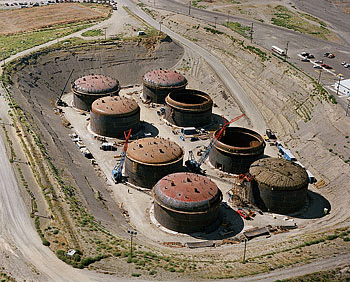
Treatment would include sending some low activity radioactive waste directly to the plant’s Low Activity Waste Facility to be prepared for disposal. That would require bypassing the Pretreatment Facility, which originally was planned to separate all the tank waste into low activity and high level waste streams for separate treatment. Continue reading
Kazakhstan’s idea to grow food on plutonium contaminated land
 “Opening the land for grazing and other land use will be an unforgiveable mistake,” said Leonid Rikhvanov, a professor at Russia’s Tomsk Polytechnic University, in a 2010 interview with the Telegraph. “If the plutonium gets into the biological chain it could cause a cytogenetic catastrophe that will backfire on the health of our children and grandchildren.” Many people living near Semipalatinsk feel similarly
But in this poisoned place, on a small patch of land near a few downtrodden trailers, there’s an unexpected hint of vitality: bright yellow sunflowers, clustered together near rows of corn, and a barn full of plump sheep. Here, scientists from Kazakhstan’s Institute of Radiation Safety and Ecology, a governmental organization that studies the medical and biological interaction between radioactivity and the environment, have developed an experimental farm. Their goal is to measure the transference of radioactivity from contaminated soil into edible crops, and from those crops into the meat, milk, and eggs of the animals that eat them. Continue reading
Japanese government considers taking over the Fukushima radiation cleanup
J apan LDP Plan Would Put Government in Control of Fukushima Cleanup, WSJ, Proposal Would Reduce Tepco’s Financial Burden By MARI IWATA, 20 Sept 13 TOKYO—Japan’s ruling Liberal Democratic Party is considering a plan that would give the government sole responsibility for containing and cleaning up contamination from the stricken Fukushima Daiichi nuclear-power plant, allowing its operator, Tokyo Electric Power Co., 9501.TO -2.28% to focus its dwindling resources more efficiently on decommissioning the facility……..
The government had already effectively nationalized Tepco by buying a majority of its shares, but the stock still trades on the Tokyo Stock Exchange, and Prime Minister Shinzo Abe’s administration is eager to see the cash-strapped company return to financial health, a significant challenge, given lost revenue from the idling of all of the company’s nuclear reactors, as well as the costs of the cleanup and purchasing of more liquefied natural gas than before the accident to fuel thermal-power plants to make up for lost nuclear generation.
Tepco has posted two straight years of large net losses since the accident. It swung to a profit in the April-June quarter, solely on the back of a large government subsidy to help it pay compensation to Fukushima victims but it carries Y800 billion ($8.14 billion) in debt that should be refinanced this fall. On top of that, Tepco estimates it must borrow an additional Y300 billion by the end of December if it wants to stay afloat, a spokesman said……..
Tepco President Naomi Hirose said Thursday that the company would prepare Y1 trillion ($10 billion) to decommission the entire plant in addition to Y960 billion it had reserved for the work by the end of June. This doesn’t include costs associated with handling contaminated water at the site. There hasn’t been any estimate on the total cost of decommissioning the stricken plant…….Japan’s Nuclear Regulation Authority Chairman Shunichi Tanaka has urged the government and Tepco to intensify the decommissioning effort, saying “the deadliest risk is another huge natural disaster,” which would “destroy all these makeshift tanks and water processing systems, releasing all the radioactive materials there into the environment.” http://online.wsj.com/article/SB10001424127887324492604579086742989825408.htm
Saugeen Ojibway Nations (SON) community won’t agree to Ontario nuclear waste dump in any hurry
Securing approval for nuclear waste site won’t be ‘quick or easy process’: First Nations “If things go south in a hurry, where do our people go? We do not have the luxury of picking up and leaving.” The Star, By: John Spears Business reporter, on Mon Sep 16 2013 KINCARDINE—First Nations communities near Ontario Power Generation’s proposed nuclear waste disposal facility won’t be rushed into supporting the project, a federal hearing has been told. Continue reading
UK government by-passing County Councils on nuclear waste dump decisions
 County councils sidelined from nuclear waste dump site decisions http://www.theguardian.com/environment/2013/sep/12/county-councils-nuclear-waste-dump-sites Energy department policy makes district councils lead authority on locating waste dumps, which Cumbria county council says abandons big society Terry Macalister theguardian.com, Friday 13 September 2013 The government has been accused of “astonishingly undemocratic” behaviour after it moved to cut out county councils from deciding the site of a national nuclear waste dump.
The stinging criticism came from the leaders of Cumbria county council, who have been sidelined months after scuppering ministers’ plans by voting against a £12bn high-level waste repository near the Sellafield nuclear complex. Continue reading
Public meeting about decommissioning process for san Onofre Nuclear Power PLant
NRC sets first public meeting on decommissioning San Onofre nuclear plant http://www.scpr.org/news/2013/09/12/39216/nrc-sets-san-onofre-nuclear-plant-meeting-in-carls/
Ed Joyce | September 12th, 2013 The Nuclear Regulatory Commission announced Thursday it will hold a public meeting September 26 in Carlsbad to talk about the decommissioning process for the San Onofre Nuclear Generating Station in northern San Diego County.
It will be the agency’s first public meeting on closing the plant operated by Southern California Edison.
The meeting is scheduled for 6 p.m. at the Omni LaCosta Hotel, 2100 Costa del Mar Road. Doors will open at 5 p.m. to accommodate security screening.
An NRC press release says technical staff will give a presentation describing the process and regulations covering the decommissioning with a Q&A session to follow.
“We think this meeting is very important for the community,” said Gene Stone with San Clemente-based Residents Organized for a Safe Environment. It’s one of several groups in Orange and San Diego counties that pushed for the plant’s closure.
Stone says a coalition of environmental groups “will create a committee focusing on safety of nuclear waste storage, the timeliness of the process and the costs associated with decommissioning.”
The nuclear plant, which is located on the coast near the border of San Diego and Orange counties, has been shut down since January 2012 after radioactive steam escaped from damaged tubes inside one of the reactors. In June of this year, Southern California Edison announced it would seek the permanent closure of the plant.
Edison International Chairman Ted Craver told reporters in June that closing the plant would take decades and result in spent nuclear fuel being stored “for a very long time” at the plant.
According to Craver, the company has a $2.7 billion decommissioning fund that can be used to close San Onofre. But the money to make up for the loss of the San Onofre plant will come from ratepayers, insurance claims, shareholders and Mitsubishi Heavy Industries, which made the equipment that led to the problems at San Onofre.
The California Public Utilities Commission has set an October 1 hearing to determine just how much ratepayers will pay.
Earlier this month, Southern California Edison opened the San Onofre Digital Document Library. The utility said the library provides the public with documents related to the design of the steam generators that were cited as a reason for the plant’s problems.
Along with Edison, San Diego Gas & Electric owns 20 percent of the plant and the City of Riverside owns nearly 2 percent.
The plant is located about two miles south of San Clemente.
Plymouth residents suspicious of Entergy’s nuclear waste plan
Many experts believe that storing spent fuel assemblies in dry casks is safer long-term than continuing to store them in Pilgrim’s over-crowded spent fuel pool. However, it is important to note that Entergy plans to keep the spent fuel pool full until Pilgrim stops operating, and to move the minimum number of spent fuel assemblies into dry casks.
“We, in fact, support dry cask storage,” said one of the petitioners. “We just want to make sure Entergy is doing it as safely as possible, and not at our expense. Long after Entergy is gone Plymouth will be stuck with a toxic nuclear waste dump.”
OF NUCLEAR INTEREST: Radioactive waste storage facility being built in Plymouth http://www.wickedlocal.com/wareham/topstories/x1655334658/OF-NUCLEAR-INTEREST-Radioactive-waste-storage-facility-being-built-in-Plymouth?zc_p=1 By Sara Altherr Wicked Local Plymouth
Sep 11, 2013 Last year, without fanfare, Louisiana-based Entergy Corporation started work on a nuclear waste storage facility, using “dry casks” to store radioactive spent nuclear fuel at Pilgrim Nuclear Power Station (PNPS). Various estimates put the cost of the facility between $165 million and $400 million. In Pilgrim’s reactor, nuclear fuel assemblies heat water to make steam that turns turbines to create electricity. Pilgrim’s reactor holds 580 fuel assemblies. After a few years, the fuel is “spent,” and needs to be replaced. However, the spent fuel is highly radioactive and will remain dangerous for thousands of years. Continue reading
1 This Month
23-25 October – on Zoom – World BEYOND War’s annual global conferenc


Shut down the radiation-damaged Heysham nuclear reactors now
To see nuclear-related stories in greater depth and intensity – go to https://nuclearinformation.wordpress.com

Say No to NASA’s Reckless Nuclear Reactor on the Moon
Say No to NASA’s Reckless Nuclear Reactor on the Moon

-
Archives
- October 2026 (219)
- September 2026 (339)
- August 2026 (330)
- July 2026 (355)
- June 2026 (287)
- May 2026 (306)
- April 2026 (356)
- March 2026 (251)
- February 2026 (267)
- January 2026 (308)
- December 2025 (358)
- November 2025 (359)
-
Categories
- 1
- 1 NUCLEAR ISSUES
- business and costs
- climate change
- culture and arts
- ENERGY
- environment
- health
- history
- indigenous issues
- Legal
- marketing of nuclear
- media
- opposition to nuclear
- PERSONAL STORIES
- politics
- politics international
- Religion and ethics
- safety
- secrets,lies and civil liberties
- spinbuster
- technology
- Uranium
- wastes
- weapons and war
- Women
- 2 WORLD
- ACTION
- AFRICA
- Atrocities
- AUSTRALIA
- Christina's notes
- Christina's themes
- culture and arts
- Events
- Fuk 2022
- Fuk 2023
- Fukushima 2017
- Fukushima 2018
- fukushima 2019
- Fukushima 2020
- Fukushima 2021
- general
- global warming
- Humour (God we need it)
- Nuclear
- RARE EARTHS
- Reference
- resources – print
- Resources -audiovicual
- Weekly Newsletter
- World
- World Nuclear
- YouTube
-
RSS
Entries RSS
Comments RSS

