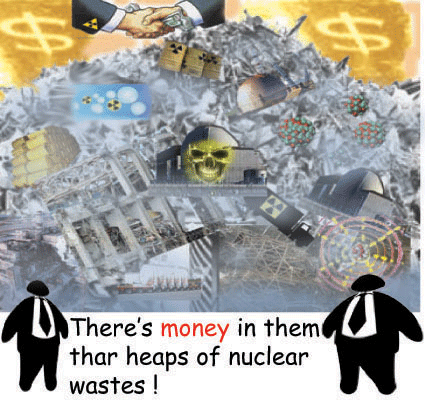
Decommissioning – a bonanza for nuclear firms
 Government set to award £7bn nuclear decommissioning contract http://www.ft.com/intl/cms/s/0/7a4ee910-b7fa-11e3-92f9-00144feabdc0.html By Gill Plimmer 31 March 14, A private sector consortium will be told on Monday it has won the £7bn job of decommissioning Britain’s oldest nuclear power plants.

The work is one of the largest and most sensitive public sector contracts to be awarded in the UK so far. The reactors, built in the 1960s originally to produce plutonium to make nuclear weapons, include those at Sizewell, Hinkley and Dungeness. They are now at the end of their lives and the government is preparing to decommission them this year. The overall contract is worth about £7bn over 14 years.
The Nuclear Decommissioning Authority, the government-funded body responsible for Britain’s state-owned nuclear sites, started the competition two years ago, and work is expected to start in September.
Currently the sites are being run by Magnox, a company owned by Salt Lake City-based EnergySolutions. It is bidding for the new work in partnership with Bechtel. The only Magnox station still in use is in Wylfa in Anglesey, though this is due to stop producing electricity in the next two years.
The contract covers Britain’s 10 reactors as well two old nuclear research sites in Oxfordshire and Dorset. The oldest nuclear power plant, Calder Hall in Cumbria, was the world’s first commercial scale nuclear reactor and was opened by the Queen in 1959 before it closed a decade ago.
The incumbent Magnox is competing against consortiums made up of Amec, Atkins and Rolls-Royce; CH2M Hill, Areva and Serco; and Babcock and Fluor. The clean-up contract that the companies hope to take over employs about 3,000 workers on the 12 ageing nuclear sites across the country.
Unions are concerned that awarding the company to an overseas consortium willerode Britain’s nuclear expertise.
“The reality is the way we are breaking up our nuclear industry will go down as another Great British missed opportunity,” Gary Smith, a GMB spokesman said. “Britain was a world leader in nuclear. Successive governments have hived off our nuclear industry piecemeal. There is absolutely no strategy around nuclear which reflects the fact that wider energy policy is a mess.”
New Mexico site still touted as dump for high level nuclear waste

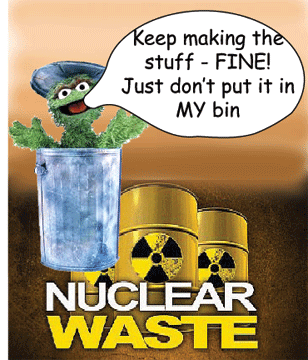
that they should stop making the stuff, as it has no place to go!
WIPP still considered for high-level waste By John Fleck / Journal Staff Writer , March 20, 2014 Despite last month’s radiation leak at the Waste Isolation Pilot Plant, researchers continue to look at the possibility of using WIPP or a facility like it to dispose of high level nuclear waste, a panel of waste experts was told Wednesday at a meeting in Albuquerque. But the leak has been a major setback to the idea.
Rod Ewing, chairman of the U.S. Nuclear Waste Technical Review Board, made clear at the outset of a previously scheduled meeting that the Valentine’s Day WIPP leak was not the reason for the long-scheduled session. But as Ewing and the other panel members discussed broad nuclear waste policy questions and technical issues, WIPP’s recent problems kept intruding on the discussion.
The meeting’s primary purpose was to look at lessons learned at WIPP that might be applied to the disposal of other nuclear waste. In particular, a number of experts talked about the suitability of WIPP or something like it for the disposal of high-level radioactive waste – things like spent nuclear power plant fuel that currently has no place to go……….http://www.abqjournal.com/371437/news/wipp-still-considered-for-highlevel-waste.html
New Mexico nuclear waste may go to Texas
 Nuclear waste from New Mexico lab may go to Texas Chron, By JERI CLAUSING and BETSY BLANEY, Associated Press | March 20, 2014 ALBUQUERQUE, N.M. (AP) — With the government’s only permanent nuclear waste dump shuttered indefinitely by back-to-back accidents, officials are making plans to ship radioactive waste from Los Alamos National Laboratory to rural West Texas.
The Department of Energy and the operator of the Waste Isolation Pilot Plant near Carlsbad in southeastern New Mexico say they have signed an agreement with Waste Control Specialists to truck the waste to its site in Andrews County.
The agreement will help Los Alamos meet a June deadline for getting the last of thousands of barrels of plutonium-contaminated clothing, tools, rags and other debris off its northern New Mexico campus before wildfire season hits its peak.
The waste, which is shipped and stored in huge sealed canisters, would come back to New Mexico for final disposal once the Waste Isolation Pilot Plant reopens……..
The West Texas site has in the past taken some less toxic waste from Los Alamos, but the Waste Isolation Pilot Plant is the nation’s only permanent repository for low-level radioactive waste from nuclear weapons facilities.
Waste Control Specialists is licensed to take radioactive materials such as uranium, plutonium and thorium from commercial power plants, academic institutions and medical schools, as well as some DOE waste. It is also the burial ground for dirt from a Hudson River Superfund site that’s tainted with PCBs, or polychlorinated biphenyls.
Chuck McDonald, a spokesman for the plant, said federal officials are working with regulators at the Texas Commission on Environmental Quality to make sure that storing the Los Alamos waste is allowable under its permits.
The state of New Mexico pressured Los Alamos to get the waste off its campus in the northern New Mexico mountains following a massive 2011 wildfire that lapped at the edges of lab property. The waste from decades of bomb building has been stored outside on a mesa. Following the Waste Isolation Pilot Plant shutdown, the state and Sen. Tom Udall, D-N.M., emphasized that the deadline was non-negotiable.
“Removing waste from the mesa in Los Alamos before fire season is critical to ensure safety in the greater Los Alamos community,” Udall said in a statement Thursday. “I’m pleased we have a temporary solution that will ensure there will not be any significant disruption in cleanup efforts.”……
More releases of Plutonium and Americium from New Mexico nuclear waste site
WIPP officials admit new release of Plutonium and Americium — More expected in future — Nearly double levels seen after February leak — 61 DPM on March 11 vs. 36 DPM in February http://enenews.com/wipp-officials-admit-new-radioactive-release-nearly-double-levels-seen-after-february-leak-61-dpm-on-march-11-vs-36-dpm-in-february?utm_source=feedburner&utm_medium=email&utm_campaign=Feed%3A+ENENews+%28Energy+News%29
|
AP, Mar. 19, 2014: New air sampling data from southeastern New Mexico’s troubled nuclear waste dump indicates there has been another small radiation release. […] they believe the contamination is from previous deposits on the inner surface of exhaust ductwork. […] Officials say occasional low-level releases are anticipated, but they should be well within safe limits.
|
Las Cruces Sun, Mar. 18, 2014 (emphasis added): DOE: Another radiation release reported at WIPP […] Samples collected from the ventilation exhaust recorded 61 disintegrations per minute of americium. DPM measures the amount of radioactive contamination from alpha and beta rays in an area. […] The DOE believes the most recent contamination was residual radioactive particles that were trapped in the ventilation system from the initial radiation leak. […] The DOE said it anticipates additional low-level releases on occasion, but officials expect radiation in the environment will remain at safe levels. New Mexico Environment Department Secretary Ryan Flynn said the state was briefed of the news Tuesday morning and thinks there is nothing to worry about at this time. “The level they detected is low and we don’t believe there was any risk to public health or the environment but we need to investigate more,” he said. […] Department of Energy officials were not available for comment.
Albuquerque Journal, Mar. 19, 2014: One air sample collected March 11 from the ventilation exhaust showed increased levels of americium […] In a statement, WIPP called the release “expected, given the amount of contamination captured by the WIPP ventilation system during the February 14 radiation release event.” Engineers say the contamination comes from previous deposits inside the exhaust ducts, WIPP reported. […] WIPP said it doesn’t expect the release to impact the health of workers, the public or the environment.
KVIA News, Mar. 18, 2014: “This is expected given the amount of contamination captured by the WIPP ventilation system during the February 14 radiation release event,” WIPP’s March 18 statement reads.
Las Cruces Sun, Mar. 18, 2014: Increased radiation in Carlsbad not related to WIPP incidents — Radiation levels appear to be on the rise in Carlsbad and around the Waste Isolation Pilot Plant. Air monitoring results since last month’s radiation leak appear to show the amount of radiation trending upward near Carlsbad, but Department of Energy officials say there is no proof it is related to the leak. A DOE air monitor stationed on Carlsbad’s eastern border, near the Bureau of Land Management office on Greene Street, has shown an uptick of radiation from 1.6 disintegrations per minute (DPM) on Feb. 18, to 7.1 DPM as recently as March 4. […] The initial radiation leak registered at 36 DPM at the WIPP site […]
Rokkasho a big-box store for nuclear terrorists.

After spending tens of billions of dollars and decades on breeder-related programs, Tom Cochran said, countries find it hard to pull the plug.
“You have an entrenched bureaucracy and an entrenched research and development community and commercial interests invested in breeder technology, and these guys don’t go away,” Cochran said. “They’re believers … and they’re not going to give up. The really true believers don’t give up.”……..
“Stealing a weapon is too hard,” Cochran said. “But there is no big risk in fuel assemblies, or in taking things from a bulk handling facility that can be used to make weapons.” In this view, Rokkasho is a kind of big-box store for would-be nuclear terrorists.
A Washington-based physicist and nuclear contrarian, Cochran helped kill a vast plutonium-based nuclear industrial complex back in the 1970s, and now he’s at it again — lecturing at symposia, standing up at official meetings, and confronting nuclear industry representatives with warnings about how commercializing plutonium will put the public at enormous risk.
Where the story ends isn’t clear. But the stakes are large. Continue reading
Why plutonium is so dangerous
 A World Awash in a Nuclear Explosive? TruthOut, 19 March 2014 12:24 By Douglas Birch and R. Jeffrey Smith, Center for Public Integrity | Report Washington “……..Just a Few Pounds Worth of Plutonium? There’s been a ghoulish debate between officials and independent scientists about how much plutonium is needed to fuel a clandestine bomb. But both agree it’s not much.
The U.S. bomb that destroyed half of Nagasaki in 1945 had 6.2 kilograms of plutonium in it, or 13.6 pounds. But experts say it was over-engineered — only one kilogram fissioned, they concluded later.
The International Atomic Energy Agency nonetheless decided years ago that eight kilograms of plutonium, or 17.6 pounds, are needed to make a bomb and so that’s the quantity its monitoring is geared to stop from getting loose.
Cochran and his NRDC colleague Christopher Paine challenged the IAEA standard in 1995 with a study concluding that only 3 kilograms — 6.6 pounds — would be needed to fashion a “very respectable” bomb with the explosive power of a kiloton, or 1,000 tons of TNT. But no matter who is right, Rokkasho’s annual plutonium production would be enough for 1,000 weapons or more. Continue reading
The Coke Can Plutonium Experiment
On arrival at lecture halls, he would push his stand-in for plutonium into an empty Coke can he had sawn in half. During his talks, he would hold the can up so his audience could see it, and say the contents could incinerate a city. “A six-pack of these is a nuclear arsenal,” he would say.
 A World Awash in a Nuclear Explosive? TruthOut, 19 March 2014 12:24 By Douglas Birch and R. Jeffrey Smith, Center for Public Integrity | Report Washington #……..The Coke Can Experiment In the abstract, there’s plenty of alarm in official circles. “Just one nuclear weapon exploded in a city — be it New York or Moscow; Tokyo or Beijing; London or Paris — could kill hundreds of thousands of people,” President Barack Obama told the United Nations Security Council in September 2009. “And it would badly destabilize our security, our economies, and our very way of life.”
But Cochran has long criticized the effectiveness of one of Washington’s most costly and elaborate strategies to prevent such a catastrophe — a global effort to detect and capture illicit fissile materials at border crossings and major world ports.
Since 2003 the United States has spent more than $850 million on equipment and training for customs officials at 45 foreign ports so they can scan shipping containers to detect nuclear materials. It’s a daunting assignment. About 432 million shipping containers crisscrossed the oceans in 2009 alone. U.S. ports accept 15 million containers every year. Continue reading
China’s concern over Japan’s plutonium and enriched uranium

 Japan and China’s Dispute Goes Nuclear, The Diplomat, Japan and China’s bitter PR campaign has now entered the nuclear realm. By Zachary Keck March 18, 2014 Japan and China appear to be trading nuclear barbs with one another.
For some weeks now, China has been raising concerns about the amount of enriched uranium and weapons-grade plutonium Japan currently stockpiles. “We continue to urge the Japanese government to take a responsible attitude and explain itself to international community,” a Chinese Foreign Ministry spokesperson said at the end of last month.
The following week, the same spokesperson asked: “Has Japan kept an excessive amount of sensitive nuclear material that is beyond its actual needs? Does one need so much sensitive nuclear material for peaceful use? Should one keep excessive weapons-grade nuclear material?” He added: “More importantly, does Japan have higher-enriched and weapons-grade uranium, and how much does it have? What are those used for? How can Japan ensure a balance between the demand and supply of nuclear materials? These are the real concerns and questions of the international community.”
Japan has one of the most advanced civilian nuclear programs of any country without nuclear weapons.According to NBC News, Tokyo has 9 tons of plutonium stockpiled in different places throughout Japan, while 35 tons of Japanese plutonium is stockpiled in different countries in Europe. Only about 5 to 10 kilograms is needed to produce a nuclear weapon. Japan also has an additional 1.2 tons of enriched uranium. It is also building a fast-breeder plutonium reactor in Rokkasho that will produce 8 tons of plutonium annually.
Many experts believe that Japan could produce nuclear weapons within 6 months of deciding to do so, and some believe that Tokyo is pursuing a “nuclear hedging” strategy. Japan has done little to mollify these concerns. In fact, it has often encouraged them, with a Japanese official recently saying off the record that “Japan already has the technical capability [to build a nuclear bomb], and has had it since the 1980s.”
Having a “bomb in the basement” largely suits Japan’s interests in its competition with China. …….http://thediplomat.com/2014/03/japan-and-chinas-dispute-goes-nuclear/
 Officials At Odds Over Storing Nuclear Waste WLTX19 Eric Connor, Greenville News March 17, 2014 Plans to ship decades-old weapons waste from South Carolina’s Savannah River Site are on hold still as the underground nuclear waste dump in New Mexico that was to be its home remains shuttered indefinitely a month after a mysterious radioactive leak stopped shipments from sites nationwide.
The leak at New Mexico’s Waste Isolation Pilot Plant raises new questions over another multibillion-dollar disposal site shut down in the American desert: Yucca Mountain……..
For environmentalists skeptical of nuclear energy, the incident in New Mexico stands as evidence that geologic disposal akin to the Yucca Mountain project is too risky. Continue reading
Global crisis in nuclear waste – we must stop making it
Worldwide Nuclear Waste Crisis In the Wake of WIPP “If We Don’t Have a Place to Store it, then We Have to Stop Making It.”http://www.forbiddenknowledgetv.com/videos/radiation-poisoning/worldwide-nuclear-waste-crisis.html Alexandra Bruce March 15, 2014
The recent fire and release of deadly radiological poison from the Carlsbad, NM WIPP site is being whitewashed in the mainstream media.
The cover-up of the recent events at WIPP (Waste Isolation Pilot Program), where a plume of deadly plutonium particles were released and carried by winds over a vast swathe of the the US is such that we do not know exactly how dangerous this situation truly is. What we do know is that there was (and may still be) an out-of-control fire at that bomb-grade plutonium waste storage plant in Carlsbad.
The storage of nuclear waste remains an unresolved issue – and as one expert, interviewed here say, “If we don’t have a place to store it, then we have to stop making it.”
The lack of a real plan for managing the disposal of weapons-grade waste at Hanford,
WIPP and others have existed since these plants began being built, over 70 years ago, as can be seen by the age of this film. The issue of radioactive waste management has become so covered-up and controlled, that such a film could probably *not* be made today.
So, take advantage of seeing the preposterous ‘solutions’ which have been used, since the
beginning of the Nuclear Age, such as the savage dumping of steel barrels full of nuclear waste into oceans, surrounding highly-populated areas.
The lack of any resolution as to what to do with the nuclear waste from power plants has caused these to continuously stockpile the spent fuel rods on site, in conditions that are not very safe.
For example, when the reactors at Fukushima initially exploded, spent fuel rods, which were being stored ABOVE the reactors were shattered and sent flying in a radius of several miles surrounding the site, with this highly toxic debris covering the land that was the breadbasket of Japan.
Spent fuel, as I hope we have all learned by now, since the Fukushima disaster, is much more toxic than fuel rods are, before use.
Nobody really knows what’s going on under the Irish Sea, where British nuclear waste has been dumped for decades. This film attempts to find out.
With 5 Million Tons of uranium waste to clean up, Colorado Mining Corp. Spills more
 Colorado Mining Corp. Spills 20,000 Gallons Of Uranium Waste Amid Negotiations To Clean Up 15 Million Tons More Opposing Views, By Sarah Fruchtnicht, Sat, March 15, 2014
A broken pipe at a dismantled Colorado mill spilled 20,000 gallons of uranium waste just as the corporate owner is negotiating with state and federal authorities to clean up another 15 million tons of radioactive uranium tailings.
The Colorado mining and milling corporation Cotter Corp. is working with the Environmental Protection Agency and the Colorado Department of Public Health and Environment (CDPHE) to negotiate one of the nation’s longest-running cleanups in history. The agencies are expected to help Cotter clean up, gather data, and figure out what to do with 15 million tons of radioactive uranium tailings.
They could remove the tailings, which would cost more than $895 million, or bury the waste.
In the meantime, a 6-inch plastic pipe, part of a 30-year-old system on Cotter’s 2,538-acre property in Canon City, broke and spewed 20,000 gallons of uranium-laced waste………
A community group, Colorado Citizens Against Toxic Waste, is pressing Cotter and the state for more facts about the spills and cleanup operations.
Energy Minerals Law Center attorney Travis Stills says the public deserves to know more.
“There’s an official, decades-old indifference to groundwater protection and cleanup of groundwater contamination at the Cotter site — even though sustainable and clean groundwater for drinking, orchards, gardens and livestock remains important to present and future Lincoln Park residents,” Stills said. “This community is profoundly committed to reclaiming and protecting its groundwater.” http://www.opposingviews.com/i/society/environment/colorado-mining-corp-spills-20000-gallons-uranium-waste-amid-negotiations
Los Alamos’ huge nuclear waste problem, with New Mexico facility shut
New Mexico nuclear repository mishap leaves Los Alamos waste quandary KFGO, Thursday, March 13, 2014 By Joseph J. Kolb ALBUQUERQUE, New Mexico (Reuters) – The Los Alamos National Laboratory is evaluating how to meet a June deadline to permanently discard plutonium-tainted junk in light of a prolonged shutdown of a New Mexico nuclear waste dump after an accident there last month, a lab official said.
Los Alamos, one of the leading U.S. nuclear weapons labs, has been forced to halt shipments of its radioactive refuse some 300 miles across the state to the nation’s only underground nuclear repository, the Waste Isolation Pilot Plant, near Carlsbad, according to lab spokesman Matt Nerzig.
The repository has remained closed while the U.S. Department of Energy investigates the origins of a radiation leak that occurred there on February 14, exposing at least 17 workers at the facility to radioactive contamination. It was the first such mishap since the facility opened in 1999.
Nerzig said about 1,000 temporary storage drums of the waste remain at the Los Alamos National Laboratory awaiting shipment to the repository near Carlsbad. The lab faces a strict June 30 deadline to permanently discard of the waste…….
“We intend to hold LANL (Los Alamos National Laboratory) to the deadline,” said Jim Winchester, communications director, for the New Mexico Environment Department………
Established during World War Two as part of the top-secret Manhattan Project to build the world’s first atomic bomb, the complex remains one of the leading nuclear weapons manufacturing facilities in the United States.
A massive wildfire that raged at the edge of the complex in 2011 burned to within a few miles of a collection of radioactive waste drums temporarily stored at the site. Since then, Energy Department and state officials have made the removal of transuranic waste from the lab to the repository a top environmental priority. http://kfgo.com/news/articles/2014/mar/13/new-mexico-nuclear-repository-mishap-leaves-los-alamos-waste-quandary/
Ontario Power Generation underestimated radiation levels for planned waste storage site
 Bruce waste site radiation understated, says former OPG scientist A scientist who formerly worked for OPG says the company has understated radiation levels in waste destined for a storage site near Kincardine Stzar.com By: John Spears Business reporter, Feb 28 2014 A former research scientist with Ontario Power Generation says the company has “severely underestimated” the level of radioactivity of material destined for a waste storage site near Kincardine.
Dr. Frank R. Greening’s letter to a federal panel reviewing the site says that OPG has understated the extent of radiation in material destined for the proposed site, “sometimes by factors of more than 100.”…… Continue reading
Thorium nuclear reactors (LFTRs) produce intensely radioactive wastes
“……LFTRs are theoretically capable of a high fuel burn-up rate, but while this may indeed reduce the volume of waste, the waste is more radioactive due to the higher volume of radioactive fission products. The continuous fuel reprocessing that is characteristic of LFTRs will also produce hazardous chemical and radioactive waste streams, and releases to the environment will be unavoidable. Spent fuel from any LFTR will be intensely radioactive and constitute high level waste.
The reactor itself, at the end of its lifetime, will constitute high level waste.
The UK’s National Nuclear Laboratory (NNL) believes that considerable research, development and testing lies ahead before thorium fuels will be ready for operational use. As the NNL states, “Thorium reprocessing and waste management are poorly understood. The thorium fuel cycle cannot be considered to be mature in any area.” It estimates that 10-15 years work is required before thorium fuels will be ready for use in current reactor designs, and that their use in new types of reactor is at least 40 years away….”http://www.no2nuclearpower.org.uk/nuclearnews/NuClearNewsNo43.pdf
Nuclear Management Partners (NMP)’s expensive botch at Sellafield
Politicians and the deal’s numerous critics were shocked when the NDA awarded NMP the extension in October, despite a disastrous tenure during which Sellafield’s clean-up bill soared to over £70bn. The letters warn that a “re-baselining” of budgets will cause cost estimates to further spiral in April this year: “However presented, the extent of change was going to be extremely uncomfortable and difficult to sell.”
Nuclear chief’s despair over Sellafield firm NMP revealed in letters written by UK nuclear decommissioning boss The Independent, 26 Jan 14, Damning criticism of the consortium overseeing the expensive clean-up of the Sellafield nuclear reprocessing plant has been revealed in a series of hostile letters written by John Clarke, head of the UK’s Nuclear Decommissioning Authority.
Mr Clarke accused Nuclear Management Partners (NMP) of undermining confidence and damaging the entire project’s reputation, as well as criticising Tom Zarges, the consortium chairman, of setting “unduly conservative” targets. In one letter, written in November 2012, Mr Clarke attached slides that outlined the NDA’s frustrations with NMP’s decontamination work at the Cumbrian facility, including concerns about the “quality of leadership” and the “pace of change”, which it said “feels too slow”.
The content of the letters has added to the confusion over why NMP was recently asked to continue overseeing the clean-up of one of the world’s most hazardous nuclear sites until 2019. The correspondence, which was obtained under a Freedom of Information request, covers a 21-month period to November 2013. During this time NMP and the NDA were locked in discussions over a five-year extension to a contract that was originally awarded in 2008.
Politicians and the deal’s numerous critics were shocked when the NDA awarded NMP the extension in October, despite a disastrous tenure during which Sellafield’s clean-up bill soared to over £70bn. The letters warn that a “re-baselining” of budgets will cause cost estimates to further spiral in April this year: “However presented, the extent of change was going to be extremely uncomfortable and difficult to sell.”
The harsh tenor of the letters – one of which demanded “improved performance in a number of key areas, including schedule delivery” – adds weight to suggestions that Mr Clarke did not want NMP to continue at Sellafield. The NDA looked at bringing the decontamination back under the management of the public sector.
A critical 292-page report by the accountancy firm KPMG last year showed that nine of the 11 biggest projects on the site, including the construction of a storage facility for radioactive sludge, were a combined £2bn overbudget.
Seven were also behind schedule, while KPMG argued that the structure of NMP’s contract was “inappropriate” and was designed in a way that sought to “maximise shareholder returns”. NMP is a consortium of California-based URS, France’s Areva and British engineer Amec.
Dr David Lowry, an independent environmental policy and research consultant and a member of Nuclear Waste Advisory Associates, obtained the letters. He said: “This is a massive indictment of NMP’s failure to deliver – and then to give them an extension is almost inexplicable…….http://www.independent.co.uk/news/uk/home-news/nuclear-chiefs-despair-over-sellafield-firm-nmp-revealed-in-letters-written-by-uk-nuclear-decommissioning-boss-9085512.html
1 This Month
23-25 October – on Zoom – World BEYOND War’s annual global conferenc


Shut down the radiation-damaged Heysham nuclear reactors now
To see nuclear-related stories in greater depth and intensity – go to https://nuclearinformation.wordpress.com

Say No to NASA’s Reckless Nuclear Reactor on the Moon
Say No to NASA’s Reckless Nuclear Reactor on the Moon

-
Archives
- October 2026 (219)
- September 2026 (339)
- August 2026 (330)
- July 2026 (355)
- June 2026 (287)
- May 2026 (306)
- April 2026 (356)
- March 2026 (251)
- February 2026 (267)
- January 2026 (308)
- December 2025 (358)
- November 2025 (359)
-
Categories
- 1
- 1 NUCLEAR ISSUES
- business and costs
- climate change
- culture and arts
- ENERGY
- environment
- health
- history
- indigenous issues
- Legal
- marketing of nuclear
- media
- opposition to nuclear
- PERSONAL STORIES
- politics
- politics international
- Religion and ethics
- safety
- secrets,lies and civil liberties
- spinbuster
- technology
- Uranium
- wastes
- weapons and war
- Women
- 2 WORLD
- ACTION
- AFRICA
- Atrocities
- AUSTRALIA
- Christina's notes
- Christina's themes
- culture and arts
- Events
- Fuk 2022
- Fuk 2023
- Fukushima 2017
- Fukushima 2018
- fukushima 2019
- Fukushima 2020
- Fukushima 2021
- general
- global warming
- Humour (God we need it)
- Nuclear
- RARE EARTHS
- Reference
- resources – print
- Resources -audiovicual
- Weekly Newsletter
- World
- World Nuclear
- YouTube
-
RSS
Entries RSS
Comments RSS

