Waste Isolation Pilot Plant so radioactive that crews had to retreat
 AP: Crews retreat after nuclear material found at WIPP — Officials: Correct to turn back, contamination was increasing — Robots brought to site for radiation levels too high for humans — ‘Significant amount of information’ will be revealed to public in next few days (VIDEOS) http://enenews.com/ap-crews-retreat-after-nuclear-material-found-at-wipp-officials-correct-to-turn-back-contamination-increased-the-further-they-went-robots-brought-to-site-in-case-radiation-levels-too-high-for?utm_source=feedburner&utm_medium=email&utm_campaign=Feed%3A+ENENews+%28Energy+News%29
AP, Apr. 17, 2014: Crews on their fourth trip into the mine on Wednesday made it into the only active waste storage area and found contamination, [Tammy Reynolds, U.S. Dept. of Energy’s deputy recovery manager] said. The deeper they went into the area, the more widespread the contamination, she said. But the crews had to retreat before identifying the possible source because they had been underground for five hours in protective gear that retains heat and the batteries on their respiratory equipment were running low. […] The next step is for crews, and possibly robots, to go back down to see if they can identify what caused the leak.
Tammy Reynolds, deputy WIPP recovery manager: “The more they went into panel seven, the more (the contamination) became more widespread […] They made the correct decision to turn back […] Everyone was safely returned to the surface.”
John Heaton, former state representative and chairman of the Carlsbad Mayor’s Nuclear Taskforce, WIPP Town Hall, Apr. 17, 2014 (at 7:00 in): I think that next week might a very busy week in that I think that there will be progress to report in terms as to what might have been the cause and also Phase 1 of the accident investigation report. […] I believe — I hate to speculate on this — but there will be a significant amount of information that will come out next week. So I think it will be a very important meeting and I think we need to have adequate time for people to be able to ask questions.
Reynolds, WIPP Town Hall, Apr. 17, 2014 (at 23:00 in): One of the other things we’ve been working on is the contingency plan […] They’ve been working to have robots prepared that in the event that the conditions in the underground don’t allow us to be able to get to the waste space or other parts of the mine later on in recovery activities because of the level of contamination, as a contingency we’re looking at the use of robots. And so there’s a couple of robot operators, they’ve already been to the WIPP site, they’ve received all of the training they would need to go into the underground […] they’ve completed that. And today they brought the robots out to the site and they did a demonstration for us […] so that if we can’t go and visibly put our eyes on certain pieces of the mine, the robot can do that for us and feed us back that information.
Washington State and DOE squabble over disatrous radioactive waste problem at Hanford
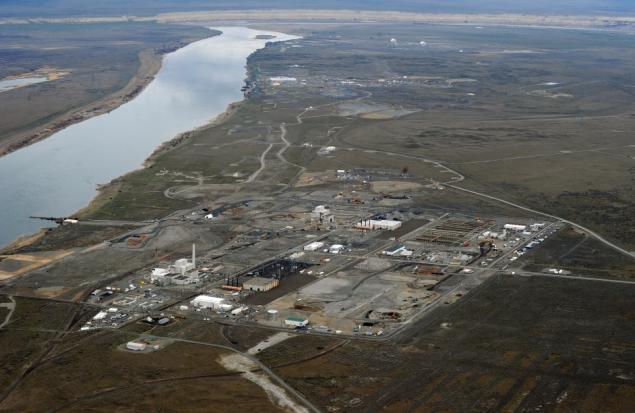 State, feds reject each other’s Hanford proposals http://www.kansascity.com/2014/04/18/4968158/ap-newsbreak-state-rejects-hanford.html April 18 BY NICHOLAS K. GERANIOS SPOKANE, Wash. — The state of Washington and the U.S. Department of Energy on Friday each rejected the other’s proposal to amend a federal court agreement governing cleanup of the Hanford Nuclear Reservation, the nation’s most polluted nuclear weapons production site. The state sent a letter to federal lawyers saying the Energy Department’s March 31 proposal that would have eliminated many deadlines for Hanford cleanup “is not acceptable to Washington.”
The Department of Energy, meanwhile, said a state proposal also issued March 31 that would have left many deadlines in place was unrealistic.
The state proposal does not “adequately account for the realities of technical issues resolution, project management requirements and budget constraints,” the Energy Department said in a news release.
While the state warned that it might consider legal action, the Energy Department said it wanted to keep negotiating the issues. Hanford for decades made plutonium for nuclear weapons, and now is engaged in cleaning up the nation’s largest volume of radioactive wastes. The site is near Richland. Continue reading
Radioactive trash from fracking is just booming
Radioactive Waste Booms With Fracking as New Rules Mulled, Bloomberg, By Alex Nussbaum Apr 16, 2014 Oilfields are spinning off thousands of tons of low-level radioactive trash as the U.S. drilling boom leads to a surge in illegal dumping and states debate how much landfills can safely take.
State regulators are caught between environmental and public health groups demanding more regulation and the industry, which says it’s already taking proper precautions. As scientists debate the impact of small amounts of radiation on cancer risks, the U.S. Environmental Protection Agency says there’s not enough evidence to say what level is safe.
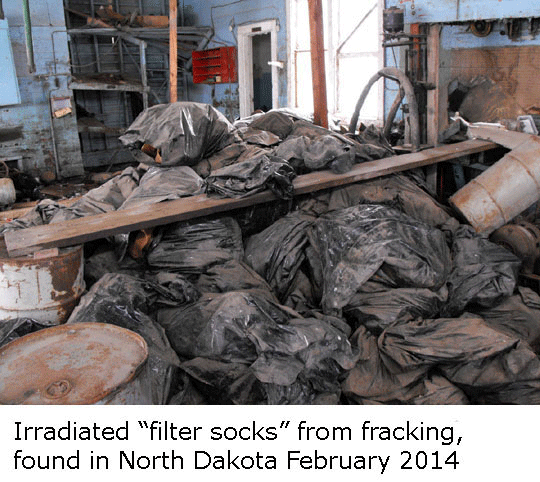
Left to police the waste, state governments are increasing their scrutiny of well operators. Pennsylvania and West Virginia are revising limits for acceptable radiation levels and strengthening disposal rules. North Dakota’s doing the same, after finding piles of garbage bags filled with radioactive debris in an abandoned building this year. “We have many more wells, producing at an accelerating rate, and for each of them there’s a higher volume of waste,” said Avner Vengosh, a professor of geochemistry at Duke University in Durham,North Carolina, who’s studied the issue. Without proper handling, “we are actually building up a legacy of radioactivity in hundreds of points where people have had leaks or spills around the country.”
Source: North Dakota Dept of Health via Bloomberg
On Feb. 28, North Dakota officials found hundreds of irradiated “filter socks” — used…Read More
The waste is a byproduct of the drilling renaissance that has brought U.S. oil and natural gas production to its highest levels in three decades — while also unlocking naturally occurring radium from rock formations far underground…….
Radium Contamination
The issue is shale rock, the dense formations found to hold immense reserves of gas and oil. Shale often contains higher levels of radium — a chemical element used in industrial X-ray diagnostics and cancer treatments — than traditional oil fields, Vengosh said.
Freeing gas and oil is a water-intensive process called hydraulic fracturing, or fracking, in which drill bits cut thousands of feet through shale fields to make way for high-pressure water streams that pulverize the rock. The process displaces radium-tinged subterranean water that comes up through the wells, where it can taint soil and surface equipment. Radiation levels can build up in sludges at the bottom of tanks, pipeline scale and other material that comes in extended contact with wastewater.
Buried Waste
Some states allow the contaminated material to be buried at the drill site. Some is hauled away, with varying requirements for tracking the waste. Some ends up in roadside ditches, garbage dumpsters or is taken to landfills in violation of local rules, said Scott Radig, director of the North Dakota Health Department’s Division of Waste Management.
In that state’s Bakken oilfields, “it’s a wink-and-a-nod situation,” said Darrell Dorgan, a spokesman for the North Dakota Energy Industry Waste Coalition, a group lobbying for stricter rules. “There’s hundreds of thousands of square miles in northwestern North Dakota and a lot of it is isolated. Nobody’s looking at where all of it is going.”…….http://www.bloomberg.com/news/2014-04-15/radioactive-waste-booms-with-oil-as-new-rules-mulled.html
Nuclear companies switch to more lucrative business – closing down reactors
OPG, Westinghouse forge nuclear alliance OPG and Westinghouse will join forces to bid for nuclear projects around the globe Toronto Star, By: John Spears Business reporter, Apr 16 2014
Ontario Power Generation will join forces with Westinghouse to bid for nuclear projects around the globe, the companies announced Wednesday.
The news comes the same week that the Ontario government set up a panel headed by TD Bank chairman Ed Clark to consider privatization – or other strategies – for provincial assets.
OPG is 100 per cent owned by the province.
“Under the agreement, the companies will consider a diversity of nuclear projects including refurbishment, maintenance and outage services, decommissioning and remediation of existing nuclear power plants, and new nuclear power plants,” OPG said a release.

Westinghouse will work directly with Canadian Nuclear Partners, a subsidiary of OPG headed by Pierre Tremblay….http://www.thestar.com/business/2014/04/16/opg_westinghouse_forge_nuclear_alliance.html
Terrorism risk ignored, as Japan plans to produce plutonium
Japan reaffirms its plan to produce plutonium, Center for Public Integrity
The Abe government’s new energy plan calls for completing the Rokkasho plutonium fuel factory despite U.S. concern it poses terrorism risks By Douglas BirchemailJake Adelstein 12 April 14
Just weeks after Japan pledged to return hundreds of pounds of plutonium to the United States for disposal, the Japanese government on April 11 formally endorsed the completion of a factory designed to produce as much as eight tons of the nuclear explosive annually.
The plant is among the key elements of a long-range energy plan approved by Prime Minister Shinzo Abe’s cabinet, reversing the previous government’s efforts to phase out nuclear power in the wake of the March 2011 Fukushima disaster. The move is generally viewed in Japan as unpopular with the public but has been welcomed by Japan’s utilities, which are struggling with massive debts.
 The mammoth plant in the village of Rokkasho, scheduled to be completed in October, is meant to extract plutonium from spent commercial reactor fuel so it can be used in fresh fuel to be burned in the country’s reactors. “With safety first in mind always, Japan will promote…the completion of Rokkasho,” the energy plan states.
Publicly, the Obama administration has said little about Rokkasho, located on the Pacific Coast about 1,000 miles north of Tokyo. But privately, U.S. officials and experts say they are worried that Japan’s operation of the $22 billion facility – in the wake of the country’s closure of most of its nuclear power plants — will add unnecessarily to its existing stockpile of 44 tons of plutonium, some of which is stored in Japan and some in Europe.
U.S. officials have complained to their Japanese counterparts that the plant lacks an adequate security force, making it a potential target for terrorists. They have also urged Japan to subject the plants’ workers to stringent background checks, a move the Japanese see as being at odds with privacy traditions. U.S. experts also have expressed concern that the plant’s operation will encourage other countries, including South Korea, to constructsimilar plutonium factories.
Japan’s stockpile of plutonium today ranks fifth in the world, behind four nuclear-weapons states. The Chinese government in recent weeks has repeatedly expressed concern about Japan’s plans to produce plutonium “far exceeding its normal needs.”
Tokyo’s decision to proceed follows a joint announcement on March 24 by Abe and President Obama and Abe, at the Nuclear Security Summit in the Netherlands, that Japan would return hundreds of pounds of plutonium and weapons-grade uranium it received under the U.S. Atoms for Peace program in the 1960s and 1970s.
The two leaders said the transfer would further “our mutual goal” of keeping global stocks of nuclear explosive materials to a minimum, to keep them out of the hands of terrorists.
But critics say Rokkasho’s operation would violate that goal……..
Many communities in Japan are dependent on a stream of payments by the federal government to promote the siting of nuclear power plants, but a few have recently expressed concerns about the burning of plutonium-laced reactor fuels.
In early April, the city of Hakodate sued to halt work on a reactor that would be the first to burn such fuel. Hakodate’s Mayor Toshiki Kudo told reporters in Tokyo Thursday that the government and utility had ignored a plea from the municipality to suspend work on the Ohma plant and made “a unilateral announcement that it would go ahead with construction.”
Kudo called the plant “a terrorist target,” and said it could pose a greater safety risk than reactors fueled in other ways.
Angela Erika Kubo contributed to this article from Tokyo. http://www.publicintegrity.org/2014/04/11/14582/japan-reaffirms-its-plan-produce-plutonium
PRISM an ugly magic trick from the nuclear lobby
http://www.no2nuclearpower.org.uk/nuclearnews/NuClearNewsNo61.pdf
 The U.S. corporation GE Hitachi (GEH) is promoting a reactor design called the PRISM (Power Reactor Innovative Small Modular) that its chief consulting engineer and fast-breeder guru, Eric Loewen, says is a safe and secure way to power the world using yesterday’s nuclear waste – he means plutonium which hasn’t officially been classified as waste in the UK. The Nuclear Decommissioning Authority has declared PRISM to be a “credible option” for managing the UK’s plutonium stockpile.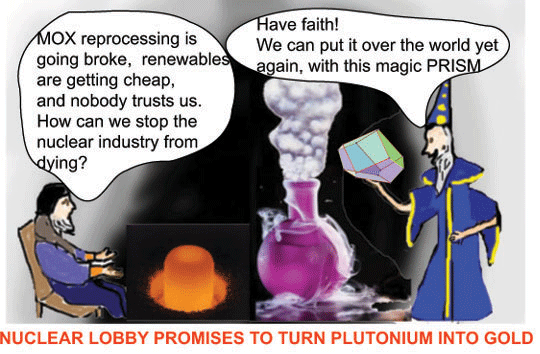
Failure of Waste Isolation Pilot Plant (WIPP) has global implications
NuClear News No.61 April 2014 WIPP failure has global implications WIPP has played a crucial part in the history of nuclear waste proposals in the UK. In 1989, in the run-up to a referendum in Caithness in November of that year on whether or not to allow Nirex to search for a deep disposal site in the County, the Head of Information Services at Dounreay used WIPP as an example of a successful waste disposal site in an article he wrote for the John ‘O Groat Journal. In response a letter from the US Radioactive Waste Campaign described the article as “an outright lie”. McRoberts had claimed that WIPP was already receiving shipments and that the repository was dry. In fact the repository remained unopened at the time because in 1987 salt-laden water was fund to be seeping inside. One State Senator told the New Mexico press that:
 “Given that long-lived nuclear wastes are dangerous for thousands of generations, emplacing them deep underground is a possible ‘solution,’ but it certainly isn’t ‘guaranteed,’ ” he said. “Neither WIPP, nor the proposed Yucca Mountain site in Nevada, are ‘ideal’ and meet publicly accepted standards. Both sites were picked for political, not technical, reasons, so it is not surprising that they are inadequate.”
Canada narrows list of possible locations for nuclear waste facility
Some were also drawn by the fact that for taking part in the selection process, they’ll get $400,000 even if they’re not chosen, providing they advance far enough in the process and a DGR is ultimately approved.

7 of 22 municipalities dropped from list of potential sites
By Rick MacInnes-Rae, CBC News Posted: Apr 09, 2014
(Interactive map showing locations of possible nuclear dump sites on link)
Canada is a step closer to picking a place to store spent nuclear fuel underground for the next 100,000 years, a project that’s backfired on some of the world’s other nuclear economies.
Despite the stigma of radioactivity, 22 Canadian municipalities expressed interest in hosting such a facility. Four have now been moved up the list for further evaluation, while seven have been rejected as not suitable. The other 11 are still in the initial assessment phase.
Final approval could take another couple of decades, but if a site is found and approval given to build a Deep Geologic Repository (DGR), the project will generate thousands of jobs, some lasting generations.
Billions would be spent constructing a vast warehouse over 500 metres underground to contain some of the most radioactive waste in the world.
Deadly byproduct
Nuclear energy has helped meet Canada’s electricity needs for more than 40 years, but a deadly byproduct has been steadily building up as a result.
There’s a growing inventory of spent uranium pellets. The radioactive pellets are stored inside long silver tubes bundled together like 24-kilogram logs.

Spent uranium pellets from nuclear reactors are stored inside long silver tubes that are bundled together like 24-kilogram logs.
Heading the search for a secure place to store those tubes is the Nuclear Waste Management Organisation (NWMO), funded by Canada’s four nuclear agencies, which describes the situation this way: “If Canada’s entire current inventory of just over two million used fuel bundles could be stacked end-to-end, like cordwood, it would fit into six NHL-sized hockey rinks from the ice surface to the top of the boards.”
At present, spent fuel is stored at seven different sites across Canada, including at the reactors it once powered. But that’s not a long-term solution, because in time those reactors will be decommissioned and dismantled.
In its quest for a site, the NWMO took the novel step of asking Canadian communities if they’d think about hosting the highly-radioactive payload.
“Well, we didn’t know what to expect” said Jo-Ann Facella, director of social research and dialogue at the NWMO.
“We put out the plan that Canadians had come forward with and the government had selected as Canada’s plan. And an important part of that plan, it emerged from Canadians, is that these facilities only be implemented in a willing host.”
What also came back were expressions of interest from 22 different municipalities, tempted in part by the promise of employment if they’re chosen. Some were also drawn by the fact that for taking part in the selection process, they’ll get $400,000 even if they’re not chosen, providing they advance far enough in the process and a DGR is ultimately approved.
Westinghouse to go IN to lucrative nuclear decommissioning, OUT of Small Modular reactors (SMRs)
Westinghouse backs out of Small Modular Reactor market Enformable Nuclear News Lucas W Hixson http://enformable.com/2014/02/westinghouse-backs-small-modular-reactor-market/Danny Roderick, President and CEO of Westinghouse announced that the nuclear firm is backing off of research and development of their Small Modular Reactor design. The Westinghouse design is a scaled down version of the AP1000 reactor, designed to produce 225 MWe, which could power 45,000 residential houses.
In December, the firm was passed over for a second time by the United States Department of Energy’s SMR commercialization program. Roderick clarified the issue and noted that it was not the deployment of the technology that posed the biggest problem – it was that there were no customers. “The worst thing to do is get ahead of the market,” he added

According to Roderick, unless Westinghouse was capable of producing 30 to 50 small modular reactors, there was no way that the firm would return its investment in the development project. In the end, given the lack of market, and the similar lack of federal funding, Westinghouse was unable to justify the economics of small modular reactors at this point.
Westinghouse was working with St. Louis-based Ameren, which had indicated its desire to build a new reactor near the State’s only existing nuclear reactor – the Calloway nuclear power plant, if a federal investment could be secured.
Westinghouse will focus its attentions on its decommissioning business, which is a $1 billion dollar per year business for the firm – which is equivalent to Westinghouse’s new reactor construction business, and rededicate its staff to the AP1000 reactor design.
Analysts are monitoring how the companies who did receive funding from the Department of Energy perform as they evolve. Source: The Pittsburgh Post-Gazett
Highly radioactive Hanford waste site at risk from earthquakes
America’s Most Contaminated Nuclear Site Is Vulnerable To Earthquakes http://io9.com/americas-most-contaminated-nuclear-site-is-vulnerable-1558490796 Mark Strauss 4 April 14 Nearly 2,000 capsules containing radioactive waste at the Hanford Nuclear Reservation need to be relocated. That’s because the site was built in an area that’s prone to earthquakes. How could this happen?
The 1,936 capsules contain radioactive cesium and strontium that was previously buried in underground tanks, and then later moved into “wet storage”—a 13-foot-deep pool of water that helps cool the corrosive-proof containers, which account for 32 percent of the radioactivity at Hanford.
And, now, according to this Inspector General report from the US Department of Energy, the capsules in the Waste Encapsulation and Storage Facility (WESF) need to be moved yet again:
The March 2011 tsunami and subsequent events at the Fukushima Dai-Ichi Nuclear Power Plant in Okuma and Futaba, Japan highlighted the vulnerabilities to nuclear facilities from possible seismic and natural disasters that are more severe than the facilities’ original design, or “beyond design threats.” One possible threat is a severe earthquake that may result in loss of power and/or loss of water in the WESF pool.
Making matters worse—yes, as usual, there’s a “worse”— the report notes that the storage facility has been in service for nine years beyond its design life. The age is beginning to show: the concrete in the WESF pool cells has begun to deteriorate due to years of radiation exposure.
So, it’s now incumbent upon the Energy Department to find a new temporary storage facility. I say “temporary” because we still don’t have a permanent nuclear waste repository. But, no worries, the government has set a goal to open such a facility…in 2048.
Britain now facing a horror cost in burying its dead nuclear reactors
Nuclear decommissioning A glowing review Britain is paying dearly for neglecting its nuclear waste, The Economist, Apr 5th 2014 SWILLING around murky ponds in the oldest part of Sellafield, a nuclear research and reprocessing centre in Cumbria, is a soupy, radioactive sludge. For years boffins working on Britain’s first military and civil nuclear programmes abandoned spent fuel and other nastiness into the pools and tanks, which now grow decrepit. Though perhaps not the “slow-motion Chernobyl” which some environmental campaigners make out, the site is subject to one of the most complex nuclear clean-ups in the world.
Sellafield is the trickiest of several challenges facing the Nuclear Decommissioning Authority (NDA), a government body that manages the contractors who swab out Britain’s defunct facilities. Their projects swallow up about two-thirds of the budget of the Department of Energy and Climate Change; Sellafield alone costs £1.7 billion ($2.8 billion) a year, almost as much as the roughly £2 billion spent subsidising renewable energy in 2013. On March 31st NDA awarded a £7 billion contract to decommission 12 more of Britain’s oldest reactor sites over 14 years to a consortium including Babcock, a British engineering firm, and Fluor, an American one.These big sums reflect problems peculiar to Britain. It ploughed into nuclear bomb-making in the 1940s, and nuclear power in the 1950s, with little plan for how contaminated structures would be dealt with. …….
Entergy’s dilemma – can’t afford to decommission uneconomic Vermont Nuclear Plant
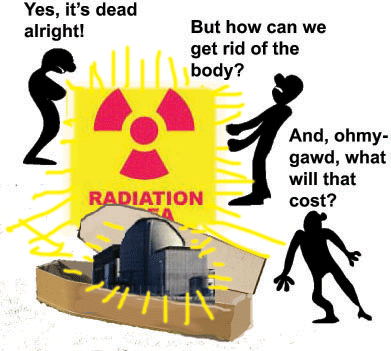 Vermont Nuclear Plant Seeks Decommission But Lacks Funds, Clean Technica 3 April 14, On Friday, the Vermont Public Service Board voted to authorize Entergy Nuclear Operations, Inc., the operators of the Vermont Yankee electricity generating station at 546 Governor Hunt Rd. in Vernon, to close down their nuclear power plant by the end of this year. Because Entergy planned to shut the Vermont nuclear plant down prior to its licensed end-term, the board was required to approve the shutdown……..
Another remaining issue is a 12-year-old National Pollutant Discharge Elimination Systempermit that has been under review by the Vermont Agency of Natural Resources for the past eight years. Continued discharges of warm water into the Connecticut River appear to have adversely affected water quality downstream and altered ecological systems in the watershed.
Entergy has reserved just over $600 million to date for decommissioning the Vermont nuclear plant, according to the Department of Public Service. This amount will not be adequate to meet the costs of full deconstruction, estimated at more than $1 billion according to the company’s 2012 Decommissioning Cost Analysis report.
The company has pledged to put $25 million toward site restoration after decommissioning the plant. However, presumably, the pledge would be moot if Entergy cannot totally decommission the plant.
“That $400 million gap raises issues about where the money will come from to dismantle the plant safely,” MassLive editorializes. http://cleantechnica.com/2014/04/02/vermont-nuclear-plant-seeks-decommission-lacks-funds/
Now 21 workers radioactively contaminated at New Mexico nuclear waste site
 TESTS SHOW RADIATION CONTAMINATION ON FOUR MORE WORKERS AT NEW MEXICO
  SITE http://www.nextgov.com/health/2014/04/tests-show-radiation-contamination-four-more-workers-new-mexico-site/81709/?oref=ng-HPriverThe U.S. Energy Department on Monday said testing had revealed trace levels of contamination in four additional workers at a nuclear waste site in New Mexico.
The announcement brings to 21 the total number of Waste Isolation Pilot Plant, or “WIPP,” personnel who were exposed to small amounts of radiation following a February leak of some radioactive elements from the subterranean nuclear-materials dump, the Associated Pressreports.
The department intended to dispatch a team of eight specialists on Tuesday into the underground portion of the nuclear facility to start establishing outposts that would enable a probe into exactly what led to the leak.
The WIPP facility has not accepted any new atomic waste since the discovery of the radiation leak. This has caused some U.S. nuclear-weapons sites to turn to temporary options for storing their waste.
Is this a target for terrorists? Oh no, it’s just a nuclear waste ship
Nuclear waste ship in Tasman sea http://www.stuff.co.nz/national/9896660/Nuclear-waste-ship-in-Tasman-sea TIM DONOGHUE 2 April 14 The nuclear waste carrier Pacific Grebe is currently making its way through the northern mid-Tasman sea bound for Japan with canisters of high level reprocessed nuclear waste from Britain on board.The 6,840 tonne British registered ship, owned by Warrington, UK based Pacific Nuclear Transport, sailed from Barrow-in-Furness, north of Liverpool, bound for Japan on 14 February 2014
The Japan Times reported in January, 2014 that 28 canisters of high-level radioactive waste, produced through the reprocessing of spent Japanese nuclear fuel in Britain, would be transported to the Aomori Prefecture on board Pacific Grebe.
The 28 canisters of vitrified radioactive waste included 14 for Kansai Electric Power Co and seven each for Chubu Electric Power Co. and Chugoku Electric Power Co.
The paper also reported in January that the shipment was the third involving vitrified radioactive waste to be brought to Japan from Britain.
Japan has received 104 canisters of such waste from Britain and plans to receive around 800 more. The 104 canisters have been stored at a facility in the village of Rokkasho, The Japan Times reported.
UK awards lucrative nuclear clean-up job to Babcock and Fluor
Babcock wins UK nuclear clean-up deal, Guardian UK, British engineering contractors and US group Fluor given £7bn contract covering sites such as Hinkley, Sizewell and Dungeness Britain has awarded a 14-year, £7bn contract to manage the decommissioning of its nuclear sites to engineering contractors Babcock and US group Fluor. The deal covers some of Britain’s oldest nuclear power sites, including Hinkley, Sizewell and Dungeness, and is one of the largest contracts the country has put out to tender.,,,,,,,,
Aside from EnergySolutions and Bechtel, Babcock beat two other consortiums: Serco, Areva and CH2M Hill; and Amec, Atkins and Rolls-Royce in a two-year-long bidding process.
Cavendish Fluor, the joint venture between Babcock-owned subsidiary Cavendish Nuclear and Fluor, will be formally awarded the contract – pending legal approval – on 1 September , after a ten-day mandatory standstill and a five-month transition period.
“Cavendish Fluor Partnership bring a successful track record and extensive nuclear experience that will bring enormous benefits to the decommissioning and clean-up programme,” NDA chief executive John Clarke said………http://www.theguardian.com/business/2014/mar/31/babcock-uk-nuclear-clean-up-contract
1 This Month
23-25 October – on Zoom – World BEYOND War’s annual global conferenc


Shut down the radiation-damaged Heysham nuclear reactors now
To see nuclear-related stories in greater depth and intensity – go to https://nuclearinformation.wordpress.com

Say No to NASA’s Reckless Nuclear Reactor on the Moon
Say No to NASA’s Reckless Nuclear Reactor on the Moon

-
Archives
- October 2026 (219)
- September 2026 (339)
- August 2026 (330)
- July 2026 (355)
- June 2026 (287)
- May 2026 (306)
- April 2026 (356)
- March 2026 (251)
- February 2026 (267)
- January 2026 (308)
- December 2025 (358)
- November 2025 (359)
-
Categories
- 1
- 1 NUCLEAR ISSUES
- business and costs
- climate change
- culture and arts
- ENERGY
- environment
- health
- history
- indigenous issues
- Legal
- marketing of nuclear
- media
- opposition to nuclear
- PERSONAL STORIES
- politics
- politics international
- Religion and ethics
- safety
- secrets,lies and civil liberties
- spinbuster
- technology
- Uranium
- wastes
- weapons and war
- Women
- 2 WORLD
- ACTION
- AFRICA
- Atrocities
- AUSTRALIA
- Christina's notes
- Christina's themes
- culture and arts
- Events
- Fuk 2022
- Fuk 2023
- Fukushima 2017
- Fukushima 2018
- fukushima 2019
- Fukushima 2020
- Fukushima 2021
- general
- global warming
- Humour (God we need it)
- Nuclear
- RARE EARTHS
- Reference
- resources – print
- Resources -audiovicual
- Weekly Newsletter
- World
- World Nuclear
- YouTube
-
RSS
Entries RSS
Comments RSS

