Germany’s struggle over nuclear waste storage

 Germany may wait 100 years for nuclear waste storage site https://au.news.yahoo.com/world/a/31991613/germany-may-wait-100-years-for-nuclear-waste-storage-site/#page1 July 6, 2016, Berlin (AFP) – Germany may not have a final storage facility for its nuclear waste up and running until the next century, an expert report released on Tuesday suggested.
For the past two years, a commission of scientists, industry leaders and civil society representatives have debated the question of where Germany should store waste from its soon-to-be-retired nuclear reactors.
Initially, the commission had hoped to reach a decision on the final site of the highly radioactive spent fuel from the country’s power plants by 2031, with the facility itself slated to open in 2050.
But even that decades-spanning timetable was described by commission president Michael Mueller as “ambitious”.
The final report, published on Tuesday, stated that the storage facility might only enter service “in the next century”. For many years now, a site in Gorleben, in the northern state of Lower Saxony, had been under discussion, drawing often violent clashes between police and anti-nuclear demonstrators.
But choosing a site for the permanent nuclear waste dump has become all the more pressing since 2011, when Chancellor Angela Merkel announced plans to shut down all eight remaining reactors in the country by 2022 following the Fukushima disaster in Japan.
In the wake of that decision, the expert commission was instructed to go back to square one and choose a suitable spot within Germany based on scientific criteria.
Gorleben is still one of the possible options, but a series of other sites are also being looked at. Germany’s vocal environmentalist movement was quick to lash out at the report’s findings on Tuesday.
Commission members had simply “delayed” the decision, said Jochen Stay of anti-nuclear organisation Ausgestrahlt.
“The recommendations they’ve made are so vague that they could justify choosing any site,” Stay added.
Germany’s government has been locked in battles with industry for years over who should foot the bill for the nuclear phase-out, with the costs of storing the waste and safely dismantling the reactors representing a very substantial financial risk for the country’s four biggest power suppiers, RWE, Vattenfall, EON and EnBW.
South Australia’s financially risky nuclear waste import scheme
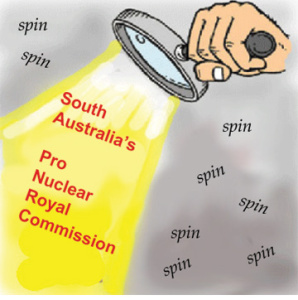 Shunning nuclear power but not its waste: Assessing the risks of Australia becoming the world’s nuclear wasteland http://www.sciencedirect.com/science/article/pii/S2214629616301323 Mark Diesendorf
Abstract
The South Australian Nuclear Fuel Cycle Royal Commission has undertaken ‘an independent and comprehensive investigation into the potential for increasing South Australia’s participation in the nuclear fuel cycle’. In its Final Report, issued 6 May 2016, it acknowledges that nuclear power would not be commercially viable in South Australia in the foreseeable future. However it recommends that ‘the South Australian Government establish used nuclear fuel and intermediate level waste storage and disposal facilities in South Australia’.
This is a business proposition to store a large fraction of global nuclear wastes, providing interim above-ground storage followed by permanent underground storage in South Australia.
The present critical evaluation of the scheme finds that the Royal Commission’s economic analysis is based on many unsubstantiated assumptions. Furthermore, the scheme is financially risky for both Australian taxpayers and customers and has a questionable ethical basis.
Kiev’s new nuclear project puts Europe at risk
 ‘Threat of 2nd Chernobyl’: Kiev’s new nuclear project puts Europe at risk, Greens warn
The Ukrainian Greens Association, a non-profit environmentalist organization, listed the risks in a statement released on Monday.
“We are deeply concerned about plans to build a spent nuclear fuel storage in the upper reaches of the Dnepr River close to densely populated places,” the statement said, citing a speech made by the association’s spokeswoman, Anna Rak, at the first Nuclear Energy Policy Forum in Brussels on June 30.
Rak also emphasized that the government plans “to secretly fast-track the construction of a surface dry, spent nuclear fuel storage system… close to the Dnepr river,” ignoring basic safety standards and “creating the threat of a second Chernobyl.”
Ukraine’s Greens stressed that the decision to build the facility just 70 kilometers away from the Ukrainian capital of Kiev, in Chernobyl’s exclusion zone, was taken “without a proper environmental impact assessment and public consultation with the [local] residents.”
They also warned that the contractor for the project, Holtec International, actually lacks sufficient experience while the technology it plans to use in construction has never been tested or tried in any other country.
The association added that the procedure of choosing the contractor was “neither transparent nor open,” warning that Ukraine may once again become a subject to “unpredictable and dangerous nuclear experiments,” apparently referring to the Chernobyl nuclear disaster.
The organization demanded that Ukrainian authorities “ensure that the project complies with all international rules and standards before the construction is launched” and emphasized that the residents of the Kiev region have “an unconditional right” to get all relevant information about the project and to take part in the discussion concerning its construction.
The Ukrainian Greens Association also urged the European Commission, the European Parliament and international environmental bodies to carry out an “independent environmental assessment of the project.”……..https://www.rt.com/news/349590-nuclear-fuel-ukraine-eu/
Struggling nuclear company EDF now looking for a nuclear shut-down business
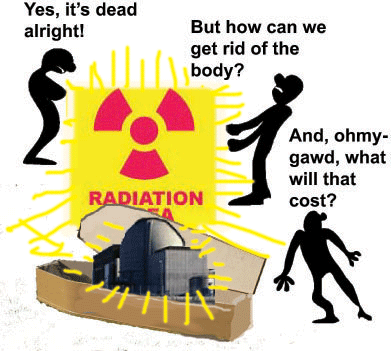 France’s EDF sets sights on $200 bln nuclear decommissioning market By Bate Felix and Benjamin Mallet PARIS, July 4 (Reuters) – EDF aims to snare a sizeable share of the global nuclear decommissioning market, worth an estimated 200 billion euros ($222 billion) over the next 15 years, by virtue of experience gained in dismantling its old reactors.
The French state-controlled utility is in the process of dismantling nine reactors and has 58 others in operation, supplying France with about 75 percent of its energy needs.
Worldwide, 110 reactors have been halted and will need to be safely dismantled, EDF executives said, adding that the company has a team of 800 experts in the complex process.
“Nuclear decommissioning is a very important market with opportunities for the international and local nuclear sector,” Dominique Miniere, executive director for EDF’s nuclear and thermal plants, told journalists in Paris……
Based on the completed decommissioning of reactors in the United States, EDF estimates that it will cost about 400 million euros to dismantle a 900 megawatt pressurised water reactor — a process that could take up to 15 years.
The company’s first dismantling of a nuclear reactor in France — the Chooz A reactor that ceased operating in 1991 — is expected to be completed in 2022. ($1 = 0.8974 euros) (Editing by David Goodman) http://af.reuters.com/article/energyOilNews/idAFL8N19Q3N4
Plutonium being collected in China and Japan? Fears of another nuclear arms race
Confronting plutonium nationalism in Northeast Asia, Bulletin of the Atomic Scientists,
Japan has already accumulated about 11 metric tons of separated plutonium on its soil—enough for about 2,500 nuclear bombs. It also plans to open a nuclear spent fuel reprocessing plant at Rokkasho designed to separate eight tons of plutonium—enough to make roughly 1,500 nuclear warheads a year—starting late in 2018. The Japanese plutonium program has raised China’s hackles. China’s new five-year plan includes a proposal to import a reprocessing plant from France with the same capacity as Rokkasho. Meanwhile, South Korea insists that it should have the same right to separate plutonium as Japan has.
Each of these countries emphasizes that it wants to separate plutonium for peaceful purposes. Yet in each country, there are skeptics who respond whenever this argument is made by a neighbor. China and South Korea suspect that Japan’s large stockpile of plutonium and its plans to operate the Rokkasho plant are designed to afford Tokyo some latent form of nuclear deterrence, i.e. a nuclear weapon option. A huge new Chinese commercial plutonium separation program could give Beijing an option to make far more nuclear weapons than it already has. It is unclear what Russia might make of all of this, or North Korea. One possibility is that either might use such “peaceful” plutonium production as an excuse to further expand its own nuclear arsenal. China might do the same as deterrence to Japan. If Seoul joined in, it would be even more difficult to cap North Korea’s nuclear program………
The Obama administration and Congress need to speak more clearly. As Countryman said, “(t)here is a degree of competition among the major powers in East Asia. It is a competition that in my view extends into irrational spheres…”
The United States can stop Japan from separating more plutonium and the spread of “plutonium nationalism” in East Asia only by bringing security issues to the front burner in politics and diplomacy. If the United States clearly announces that operations at Rokkasho constitute a security concern, Japan is almost sure to listen. Having the plutonium discussion between Japan and the United States is critically important; the Abe administration puts a high priority on security issues and is also very pro-United States.
Now is the time to speak clearly on these security issues—before China and Japan lock themselves into a plutonium production rivalry that will make cooperation between them and South Korea on pressing issues, including North Korea’s nuclear program, all the more difficult to secure. http://thebulletin.org/confronting-plutonium-nationalism-northeast-asia9617
Complications in who pays for costs of Germany’s nuclear phase-out
Who pays for Germany’s nuclear phase-out?,DW Hilke Fischer 1 July 16 Germany’s decision a few years ago to phase out nuclear power was an abrupt move. But it still remains unclear who foots the bill for shutting down the nation’s nuclear plants, as utilities seek damages from the state. Months after a Tsunami resulted in a nuclear disaster at the Fukushima Daiichi plant in Japan, Germany’s coalition government, led by Chancellor Angela Merkel, decided to phase out nuclear power in the country.
Immediately after Fukushima, eight of 17 functioning nuclear plants were shut down, and the government’s decision established a timeline of taking the remaining plants offline by 2022.
Five years later, it’s gradually becoming clear how much this hasty exit could cost. Feeling dispossessed by the move, major utilities have filed a raft of lawsuits claiming damage payments from the government amounting to around 20 billion euros ($22.3 billion).
An eagerly awaited ruling
Complying with the government’s nuclear moratorium, Germany’s biggest energy provider Eon had to shut down its power plants Isar 1 and Unterweser. The company has therefore sued both the federal government as well as the state governments of Bavaria and Lower Saxony, seeking damage payments to the tune of around 380 million euros. The state court of Hanover is expected to deliver its ruling on the case on Monday, July 4………..
the energy companies take issue not only with the moratorium. They – RWE, Eon and Vattenfall – have also lodged numerous cases at the constitutional court in Karlsruhe against the government’s entire policy mandating an accelerated exit from nuclear power……..
State responsible for disposal costs?
Lodging cases before the constitutional court is a pressure tactic, said Green Party politician Oliver Krischer in March. “It’s to obtain concessions over the financing of nuclear waste disposal,” he remarked, pointing to the nuclear commission the government had set up to advise it on how to allocate the costs of storage and disposal of nuclear waste as well as the decommissioning of the power stations.
At the end of April, the commission presented its recommendations: The companies have to bear the costs of decommissioning the nuclear power plants. Furthermore, Eon, RWE, Vattenfall and EnBW are to pay 23.3 billion euros into a fund to manage the storage and disposal of nuclear waste.
In return, the state is to take on all the residual financial risks associated with radioactive waste management. A number of scientists and economists argue that the costs would be much higher than the 23.3 billion euros, and that the taxpayers would be on the hook for those cost overruns.
Germany’s parliament is expected to vote on the recommendations after the summer break, and should it approve them, they would come into force at the end of the year. http://www.dw.com/en/who-pays-for-germanys-nuclear-phase-out/a-19372796
Federal regulators declined to review a license application for high level nuclear waste dump
Federal regulators declined to review a license application submitted by Waste Control Specialists (WCS) for a high-level radioactive waste dump in Andrews County, records revealed.
WCS, a Dallas-based company with a nearly 15,000-acre site in western Andrews County, filed the application with plans to expand its existing low-level radioactive waste site.
The proposed facility would house spent fuel rods from nuclear reactors across the country for at least 40 years.
However, U.S. Nuclear Regulatory Commission (NRC) officials determined the company’s license application lacked “sufficient technical information” and safety-related details, according to a letter dated June 22 from the commission to WCS.
Company representatives did not immediately return calls for comment…….“The incomplete WCS license application reflects disregard for people around Texas who would be put at radioactive risk,” Smith said. “Andrews County should rescind their approval of this project and only reconsider it if and when WCS can prove they can handle this waste safely.” http://www.newswest9.com/story/32351938/paperwork-for-andrews-nuclear-waste-dump-missing-key-safety-security-details#.V3aIhr1ZZzQ.twitter
Hinkley nuclear power plan, and the costs of its radioactive wastes
Short term tombs for radioactive trash, in Texas
Why a West Texas Nuclear Dump May Be a Short-Term Fix, KUT org By MICHAEL O’BRIEN, 28 JUNE 16, “…….Waste Control Specialists in Andrews County — currently storing contaminated rags, gloves, and other low-level nuclear waste — submitted an application in April which would allow them to receive high-level spent fuel.
The fuel would sit on-site, entombed in concrete-steel casks, until the DOE comes up with a permanent solution……..the majority of spent fuel sits near the reactor in 45-foot deep, industrial grade pools.
Spent fuel is so hot when it comes out of the reactor that it has to sit submerged for a few years before it can be safely transported or even placed in those casks……
The Nuclear Regulatory Commission’s (NRC) official stance is that the pools are so safe that there is no reason to spend billions of dollars moving all the spent fuel – the spent fuel cool enough to even move – into the dry-casks.
But the National Academy of Sciences warns that the NRC has under-estimated the risk. In May, the Academy published the final phase of its report on Fukushima and nuclear safety where it recommends “expediting” the spent fuel out of the pools and into the casks.
The pools are more vulnerable to accident or sabotage than the casks, the report states. The pools also hold much more fuel than does an individual cask – just one ruptured pool could cause a devastating radioactive fire capable of contaminating thousands of square miles……The heavily-guarded pools will continue to hold decades worth of spent fuel until the DOE comes up with a permanent storage solution or the NRC changes its guidelines. http://kut.org/post/why-west-texas-nuclear-dump-may-be-short-term-fix
Illinois nuclear plant shutdown situation – defacto radioactive dump
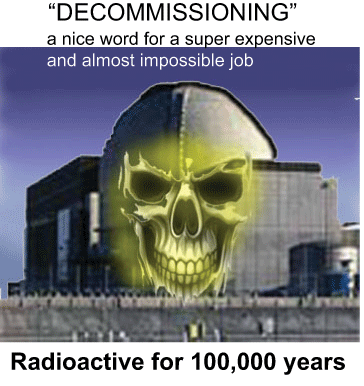 Nuclear plant shutdown in Illinois could offer lessons for SLO County Power plant in Zion, Illinois, closed nearly 2 decades ago because of an employee’s mistake. Tribune, 26 June 16
Community leaders say storage of spent nuclear fuel is preventing redevelopment of desirable lakefront property
They are leading a push to obtain federal financial compensation for communities that become de facto storage sites for waste BY STEPHANIE FINUCANE sfinucane@thetribunenews.com. Nearly 20 years after the shutdown of a nuclear power plant in the small community of Zion, Illinois, the city’s finance director describes the local economy in a single word: struggling.
“We’ve lost about $18 million communitywide,” said David Knabel, referring to the annual property tax that used to be generated by the power plant. “That tax burden got shifted to businesses and residents.”
Since the plant closed, property tax rates rose 143 percent, according to city documents. That’s made it tough to attract new employers.
“With the tax rate going through the roof … who wants to buy a house or bring businesses in?” asked Knabel.
Yet Zion isn’t blaming the nuclear power plant. As local pastor and City Commissioner Mike McDowell pointed out, that was a business decision.
The city is upset, though, that it’s become a long-term storage site for highly radioactive spent fuel — something it never signed on for.
Officials say the spent fuel is preventing redevelopment of the prime lakefront property where the plant was built, and they’re looking to the federal government for financial relief.
“We can’t get the federal government to move it,” said McDowell, “and at this point, we’re not being compensated for the impact.”……..
Once the decommissioning is complete, the property will be returned to Exelon Corp., the parent of Zion’s operator, Commonwealth Edison.
Officials in the city of Zion don’t know when that will be, nor do they know how much of the property could be permanently off-limits because of the spent fuel storage facility.
Like reactor communities across the nation — including San Luis Obispo County — the citizens of Zion did not expect to store spent nuclear fuel indefinitely. They believed the federal government would make good on its commitment to accept the waste, which at one time was destined for Yucca Mountain, Nevada. That plan fell apart, however, and the federal government has yet to identify an alternative site for permanent storage.
Zion is leading a push for federal legislation that would provide financial compensation to communities that have become de facto storage sites for spent fuel………http://www.sanluisobispo.com/news/local/article86054762.html
USA’s Department of Energy seeks “consent-based” #nuclear waste sites
Nuclear waste, anyone? Feds look to willing states, The Orange County Register, June 22, 2016 By TERI SFORZA / STAFF WRITER Federal officials unleashed bubbles of hope in San Juan Capistrano on Wednesday – we’re developing a plan that can remove deadly nuclear waste from San Onofre earlier than we thought! – while others worked feverishly to pop them.
Speaking to a raucous audience at the San Juan Capistrano Community Center, John Kotek, the U.S. Department of Energy’s acting assistant secretary for nuclear energy, detailed the federal government’s new push for temporary nuclear waste storage in regions allegedly eager for the business.
Several such “consent-based” sites – currently envisioned in West Texas and New Mexico – could be up and running while the prickly question of finding a permanent home for the waste is hashed out……..
Some in Texas and New Mexico say they’ll never consent to importing our deadly castoffs, and they’re ready to do battle.
“Please be aware that many people in Texas and New Mexico are solidly opposed to having high-level radioactive waste stored in our region,” said Karen Hadden of the Sustainable Energy & Economic Development Coalition, a Texas-based nonprofit focusing on clean energy and public health, in a letter to San Onofre officials.
The DOE scheduled eight meetings about consent around the country, but none in Texas or New Mexico, the targeted region. … Dumping this dangerous waste on communities that are largely Hispanic and lack the resources to fight back, people who never had a say in the nuclear reactors to begin with or benefited from any electricity from them, would be an extreme example of environmental injustice.”
The Texas Democratic Party has gone on record opposing the import of nuclear waste, conjuring the stalemate at Yucca Mountain. The federal government spent $10 billion to put a permanent repository there, despite the opposition of Nevada residents. That effort is essentially dead……
 Former Nuclear Regulatory Commission Chairwoman Allison Macfarlane explained the tortured landscape: a Congress that only sees two, four and six years into the future, and is satisfied that the waste is safe where it is today, at 75 different sites across the nation; utilities that want to reduce costs, and thus aren’t eager to make changes; a Department of Energy that doesn’t have the legal authority to solve the problem entirely; and a Department of Justice that is paying billions to utilities from a judgment fund of taxpayer money, because the federal government promised the utilities it would permanently dispose of that waste in exchange for payments, but has failed utterly to do so……
It’s our ethical responsibility to not stick this problem to future generations, Macfarlane said to applause from the audience.
“I’m not hopeful new physics will be discovered to magic this stuff away. We have to grapple with it. It’s there.” http://www.ocregister.com/articles/waste-720291-nuclear-new.html
83-year-old environmentalist Kay Drey will not give up on quest for cleanup of St Louis’ nuclear waste area
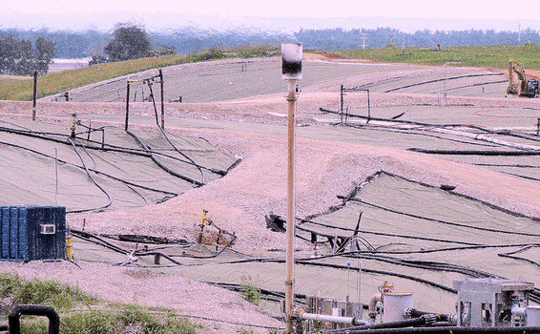 Messenger: Activist won’t back down in quest to rid St. Louis of nuclear waste By Tony Messenger St. Louis Post-Dispatch Jun 17, 2016 “…….For decades now, 83-year-old environmentalist Kay Drey has been on a quest: Get the federal government to excavate and move the waste. It’s a story that can get more complicated the deeper you dig. It involves multiple federal agencies, dense reports on various radiological elements and their “daughter products,” half-lives, warring special interest groups, lawsuits and, ultimately, a dispute over who will pay the hundreds of millions of dollars to clean it up or otherwise protect the citizens who live near the landfill.
But Drey has a way of simplifying things.
“It’s in the Missouri River flood plain,” she says of the nuclear waste. “I can’t think of a worse location. The Missouri River floods all the time. We cannot leave it there.”
That was the basic theme of the first of two reports she gave me. It’s 14 pages of testimony she submitted to the U.S. Environmental Protection Agency and the Missouri Department of Natural Resources 10 years ago. In painstaking detail, Drey outlines what is known of the waste, how it might affect groundwater and the potential for disaster if the Missouri River were to reclaim its floodplain now protected by the Earth City levee.
She quotes two old Nuclear Regulatory Commission reports, one from 1982 and the other from 1988, that outline how “hot” the waste is in West Lake and call for some sort of “remedial action.” She quotes one of the foremost flooding experts in the region, Bob Criss from Washington University, who said, “This is the wrong place to store hazardous material. It does not belong in a flood plain.”
Nobody who read Drey’s words from a decade ago would have been surprised by the release this week of a secret EPA report that reached similar conclusions.
The report, internal findings by EPA scientists that had been kept secret since 2013, concluded that it was feasible to remove the nuclear waste from West Lake. The scientists also found that doing so would reduce long-term risks.
Money.
The EPA has long wanted to simply put a cap over the waste and leave it there, at a cost of $40 million or so. It’s much less expensive than having the Army Corps of Engineers unearth the waste and dispose of it elsewhere, which might cost 10 times as much. Putting a cap in place is the preferred option of Republic Services, the company that currently owns the landfill.
Drey doesn’t care about the cost. She doesn’t care about how long cleaning up the waste would take. And she doesn’t want Republic to pay, either.
“The government put it there,” she said. “The government needs to clean it up. If we can keep making bombs, we can find the money to clean up the waste from the 1940s.”
The U.S. Senate passed a bill this year to carry out Drey’s preferred solution — have the Corps of Engineers take over the project and clean it up. But the measure appears to be dead in the House. Here’s what lawmakers need to know about Drey:
She’s not giving up…… “We need to get both houses of Congress to say they’re going to clean it up,” Drey says. “It just can’t stay there.” http://www.stltoday.com/news/local/columns/tony-messenger/messenger-activist-won-t-back-down-in-quest-to-rid/article_3da42a06-a587-53cc-bd86-e3844af3d6e1.html
Ukraine’s very dangerous nuclear waste storage situation
 Nuclear waste stored in ‘shocking’ way 120 miles from Ukrainian front line, Guardian, Arthur Neslen, 13 May 2015, Experts raise concerns over waste stored in the open air at Europe’s largest nuclear power station, as the conflict increases Ukraine’s reliance on power from its ageing plants C
oncerns have been raised by environmentalists and atomic power experts over the way waste is being stored at Europe’s largest nuclear power station, in crisis-ridden Ukraine.
More than 3,000 spent nuclear fuel rods are kept inside metal casks within towering concrete containers in an open-air yard close to a perimeter fence at Zaporizhia, the Guardian discovered on a recent visit to the plant, which is 124 miles (200km) from the current front line.
“With a war around the corner, it is shocking that the spent fuel rod containers are standing under the open sky, with just a metal gate and some security guards waltzing up and down for protection,” said Patricia Lorenz, a Friends of the Earth nuclear spokeswoman who visited the plant on a fact-finding mission.
“I have never seen anything like it,” she added. “It is unheard of when, in Germany, interim storage operators have been ordered by the court to terror-proof their casks with roofs and reinforced walls.”
Industry experts said that ideally the waste store would have a secondary containment system such as a roof…….
Plant security at Zaporizhia is now at a ‘high readiness’ level, while air force protection and training exercises have been stepped up. Officials say that if fighting reaches the plant, there are plans for the closure of access roads and deployment of soldiers.
But they say that no containment design could take the stresses of military conflict into account. “Given the current state of warfare, I cannot say what could be done to completely protect installations from attack, except to build them on Mars,” Sergiy Bozhko, the chairman of the State Nuclear Regulatory Inspectorate of Ukraine (SNRIU) told the Guardian……
Antony Froggatt, a senior research fellow and European nuclear specialist at Chatham House agreed that a secondary containment system would offer greater protection from internal or external explosions.
“It is obvious that if you do not have an array of dry cast [interim] stores with secondary containment around it, then that will have a greater risk of release of radioactive material,” he said…..
Sources at the European Bank of Reconstruction and Development (EBRD) told the Guardian that any funding request from Ukraine for such a structure would be seriously considered. The bank has already made €300m available for nuclear lifetime extension programmes in Ukraine, before the regulators have even signed off on them.
We know about the weak links in the plant [security]… But I doubt that that these should be disclosed
A pall was cast over security arrangements at Zaporizhia last May when the plant was the scene of an armed confrontation between security guards and paramilitaries from the ultra-nationalist ‘right sector’, which is allied with neo-Nazi groups. The gunmen reportedly wanted to ‘protect’ the plant from pro-Russian forces, but were stopped by guards at a checkpoint…….
Westinghouse has lobbied the Ukrainian government at ministerial level to commit to buying their fuel for at least five reactors. Plant managers say that it will be used in Zaporizhia by 2017.
But local people in the reactor’s shadow say they fear the consequences of a patched up Soviet-era plant cranking up to generate electricity into the 2020s.
“History teaches us that history doesn’t teach us anything,” Ivanovic said. “Another catastrophe could happen again.” https://www.theguardian.com/environment/2015/may/06/nuclear-waste-stored-in-shocking-way-120-miles-from-ukraine-front-line
The media ignored the fiasco of AREVA’s nuclear waste storage facility at Chernobyl
 Areva’s Incredible Fiasco in Chernobyl http://journaldelenergie.com/nucleaire/arevas-incredible-fiasco-in-chernobyl/
Le 17 février 2016 par Martin Leers INVESTIGATION. The EPR reactor is not Areva’s first failure in the field of nuclear engineering. The French nuclear company was involved in another disgraceful fiasco in Chernobyl, which the press has not wasted any time exposing.
In the heart of the exclusion zone, just 2.5 kilometers from the ruins of Chernobyl’s reactor no. 4, lies a strange pile of concrete boxes, and two horizontal beams with multiple oval holes drilled into them extending for hundreds of meters. This unusual assemblage is called ISF2, which stands for “Interim Spent Fuel Storage Facility 2”. It is a nuclear waste storage facility, which Ukraine commissioned Areva to build. The French nuclear group made a major design error in the facility, which has rendered it inoperable. This facility, considered by the international community to be as vital to the nuclear safety of Chernobyl as the giant arch over the damaged reactor, is still not functioning to this day, largely because of Areva’s initial errors.
After the explosion of Chernobyl’s reactor no. 4, 29 years ago, the nuclear power plant, which housed three additional units, continued to operate for more than 14 years.[1] The dismantling of these three reactors and the management of their nuclear waste is the other major project for Chernobyl’s nuclear safety, concurrent with the giant arch meant to cover the “sarcophagus” of the ruined reactor.
Areva pledged to produce a « turnkey » installation where spent nuclear fuel from Chernobyl’s reactors no. 1, 2 and 3 would be stored for at least 100 years
In 1999, Areva’s branch devoted to nuclear reactors and engineering (Areva NP then Framatome) signed a contract with the Ukrainian government corporation Energoatom to build ISF2, a center for dry cask storage where the spent nuclear fuel from Chernobyl’s reactors no. 1, 2 and 3 would be stored for at least 100 years. This marked a first for storing fuel from Soviet-designed RBMK nuclear reactors.[2] Areva pledged to produce a « turnkey facility » by the Summer of 2005 and began construction in the Spring of 2000. This storage facility was financed mainly by 16 donor countries from a fund reserved for “urgent nuclear safety improvements” managed by the European Bank for Reconstruction and Development (EBRD), which also contributed to it. The European Union (EU) and nine EU member countries have been major contributors to this fund, which is separate from the fund earmarked for financing works on the containment of reactor no. 4. Continue reading
South Korea’s nuclear waste dilemma: will have to build waste dump
 South Korea looks to build used fuel store http://www.neimagazine.com/news/newssouth-korea-looks-to-build-used-fuel-store-4907688 30 May 2016 South Korea will select a site for an underground storage facility to permanently dispose used nuclear fuel, or high-level radioactive waste, by 2028 and complete the construction of the facility by 2053, according to the first roadmap for the project released by the Ministry of Trade, Industry and Energy on 25 May.
“A further delay in building the facility will put a drag on future generations, considering the saturation level of interim storage units located in the nuclear power complexes nationwide, ” Chae Hee-bong, the ministry’s energy policy director, told a press briefing.
Korea has 24 nuclear power units which produce more than 700t of used nuclear fuel annually. According to ministry data, the first used fuel storage unit to become full will be at the Wolsong NPP in Gyeongju, North Gyeongsang Province, in 2019.

Korea has no other choice than storage as it is strictly banned from reprocessing under a 1973 treaty with the USA. The government has been trying to find a site for the wastes since 1983, but has failed nine times because of local protests. The government said the country is running out of storage units.
To minimize public resistance in the course of a site selection, the ministry will adopt an open competition among geologically qualified sites. It will launch an independent committee to lead the site selection next year, following an approval by the National Assembly on the roadmap in the latter part of this year. The roadmap will be updated in five years embracing changing external conditions, the ministry added.
The ministry’s ‘road map’ is based on recommendations from the Public Engagement Commission, an independent advisory group set up in 2013. The ministry will hold a public hearing next month, followed by an inter-agency meeting chaired by the prime minister in July.
Park Dong-il, director of the nuclear power environment division at the ministry said: “It will take about 12 years to select the location and we will hear what they want to receive from the government and make deals during this period,” said. He added that the government will decide what kind of benefits or incentives to give to areas that want to build storage facilities.
According to the ministry, it will take the government about eight years to select the site and get feedback from local residents, and another four years to investigate the geological chracteristics of the site. The project was expected to cost some KRW53,000bn ($44.8bn) in 2013 but a government official said it is now looking at an estimated cost of KRW63,000bn.
Meanwhile, the Korean government opened its first low-and intermediate-level radioactive waste facility in Gyeongju, North Gyeongsang, last year. The government wanted to build a high-level facility there but faced opposition from residents.
1 This Month
23-25 October – on Zoom – World BEYOND War’s annual global conferenc


Shut down the radiation-damaged Heysham nuclear reactors now
To see nuclear-related stories in greater depth and intensity – go to https://nuclearinformation.wordpress.com

Say No to NASA’s Reckless Nuclear Reactor on the Moon
Say No to NASA’s Reckless Nuclear Reactor on the Moon

-
Archives
- October 2026 (199)
- September 2026 (339)
- August 2026 (330)
- July 2026 (355)
- June 2026 (287)
- May 2026 (306)
- April 2026 (356)
- March 2026 (251)
- February 2026 (267)
- January 2026 (308)
- December 2025 (358)
- November 2025 (359)
-
Categories
- 1
- 1 NUCLEAR ISSUES
- business and costs
- climate change
- culture and arts
- ENERGY
- environment
- health
- history
- indigenous issues
- Legal
- marketing of nuclear
- media
- opposition to nuclear
- PERSONAL STORIES
- politics
- politics international
- Religion and ethics
- safety
- secrets,lies and civil liberties
- spinbuster
- technology
- Uranium
- wastes
- weapons and war
- Women
- 2 WORLD
- ACTION
- AFRICA
- Atrocities
- AUSTRALIA
- Christina's notes
- Christina's themes
- culture and arts
- Events
- Fuk 2022
- Fuk 2023
- Fukushima 2017
- Fukushima 2018
- fukushima 2019
- Fukushima 2020
- Fukushima 2021
- general
- global warming
- Humour (God we need it)
- Nuclear
- RARE EARTHS
- Reference
- resources – print
- Resources -audiovicual
- Weekly Newsletter
- World
- World Nuclear
- YouTube
-
RSS
Entries RSS
Comments RSS

