German situation shows the complex problem of who pays for nuclear wastes disposal
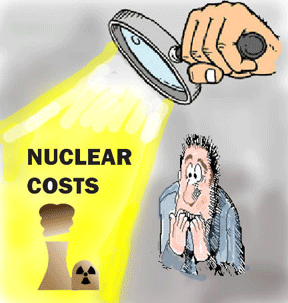 Sticker Shock: The Soaring Costs Of Germany’s Nuclear Shutdown, Yale Environment 360 25 JUL 2016: REPORT “…….In Germany, negotiations with utilities over who will pay the denuclearization costs have often centered on how much the utilities can afford. The four nuclear utilities in Germany – publicly-traded RWE; E.ON; EnBW, which is majority publicly-owned; and Swedish-owned Vattenfall – are struggling economically as decentralized wind and solar power have undercut wholesale electricity prices and eaten into profits. Last year, E.ON, Germany’s largest utility, lost $7.7 billion.
The four companies have already set aside $45 billion for decommissioning nuclear power plants. But in April, Germany’s Commission to Review the Financing for the Phase-Out of Nuclear Energy recommended that the utilities pay an additional $26.4 billion into a government-controlled fund meant to cover the costs of long-term storage of nuclear waste.
The utilities were unhappy with the commission’s conclusions and released a joint statement saying $26.4 billion would “overburden energy companies’ economic capabilities.” Even so, few experts expect those sums to cover the total eventual costs.
“Some billions now are better than making them bankrupt,” said Michael Mueller, who chairs a government commission on highly radioactive nuclear waste. “So, it’s a compromise that had to be made.”
The utilities are clear about where they see the responsibility: “The temporary and final storage of nuclear waste in Germany is an operative task of the German government, which is politically responsible for this,” the utilities said in a statement. Indeed, if the commission’s recommendation becomes law, then the German government will be on the hook for any storage costs beyond the $26.4 billion paid by the utilities.
“Asse II shows us that radioactive waste storage is a complex problem that is not just about dumping it somewhere,” said Jan Haverkamp, a nuclear energy expert at Greenpeace. “There are many open questions, and those questions are going to lead to a lot more costs………” http://e360.yale.edu/feature/soaring_cost_german_nuclear_shutdown/3019/
Germany still struggling with legacy of old nuclear wastes
Sticker Shock: The Soaring Costs Of Germany’s Nuclear Shutdown, Yale Environment 360 25 JUL 2016: REPORT“……….Radioactive water was first detected leaking at Asse II in 2008, and the German Bundestag passed a law five years later that mandated removal of the waste. Above ground, the complex is just a few fenced-in buildings amid forests and farms. Underground, passageways have closed or collapsed. One main elevator shaft going down into the mine can be used for transporting large machinery, such as front loaders, some of which has to be welded together in underground workshops. As for the areas with actual waste, workers have spent years drilling into just one of 13 chambers to test for gas and radioactivity.
“No one goes in,” said Stelljes. “We haven’t even developed the machines we would need for moving the waste.”
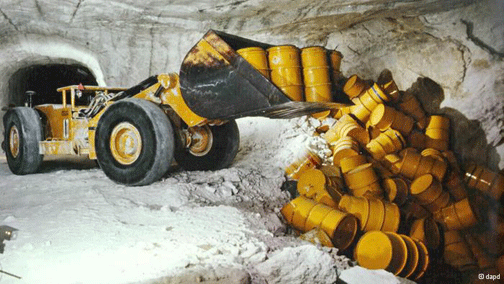
A former iron mine, Konrad, is being converted into a site to store low- and medium-level waste; it is expected to be completed in 2022. Low- and medium-level waste account for 90 percent of Germany’s total nuclear waste, but just 0.1 percent of the total radioactivity of the nation’s waste.
The most dangerous and controversial waste is heavy-metal-laden, heat-producing waste from spent fuel rods. Germany expects the total of that high-level waste to take up 28,100 cubic meters (1 million cubic feet) — a fraction of the volume of low- and medium-level waste the country must eventually store. Preliminary plans from Germany’s Federal Office for Radiation Protection call for a high-level waste repository to be built by 2050, with storage complete by 2130, and final sealing of the repository as late as 2170.
“No one has a finished concept [for storage of high-level waste], so no one can give us a finished budget,” Haverkamp said. “I won’t give an estimate anymore, but the numbers are in the billions. How many? No one knows. That’s the problem in Germany, you have to reserve a certain amount of money, but how much?” …. http://e360.yale.edu/feature/soaring_cost_german_nuclear_shutdown/3019/
Legal dispute in Britain over £7bn nuclear waste clean-up contract

 High court to rule on £7bn nuclear clean-up contract https://next.ft.com/content/5c2dbe24-4f39-11e6-8172-e39ecd3b86fc A win for Energy Solutions would raise questions about procurement process y: Gill Plimmer, 24 July 16
Britain’s Nuclear Decommissioning Authority is in the High Court this week for the final ruling in a long-running damages claim on a £7bn deal to clean up Britain’s oldest nuclear power plants.
Energy Solutions, a US-based company, filed a high court writ in 2014 after losing the contract to engineering company Babcock and Texas-based Fluor. It had been managing the nuclear sites for 14 years and in documents filed to the court alleged that the NDA did not follow its own procedures when the new contract was awarded and that its point scoring system was flawed.
At the heart of the dispute is one of the largest contracts ever put out to tender by the government, which involves about 3,000 workers cleaning 12 of Britain’s 25 nuclear sites. These include Sizewell, Hinkley and Dungeness — built in the 1960s to produce plutonium to make nuclear weapons but now at the end of their lives.
If the NDA loses the case it could cost the government hundreds of millions of pounds and will again raise questions over the way large and sensitive public-sector contractsare awarded.
The judgment is expected on July 29 and will rule whether the NDA made serious errors in awarding the contract. If so, there will be further hearings, which could stretch into 2017, to decide any payment for damages.
Although Energy Solutions competed for the contract in partnership with the US company Bechtel, Energy Solutions is taking legal action alone.
Energy Solutions, which has since been taken over by the construction and support services company Atkins, declined to comment. Atkins said it had “no economic interest in or any control over the resolution of the … claim, which has been retained by the remaining part of the Energy Solutions business”.
A series of botched contracts has raised concerns over the government’s procurement processes. The referral of G4S and Serco to the Serious Fraud Office for overcharging on electronic tagging contracts for offenders and the West Coast main line rail franchising debacle two years ago are among examples.
In 2012, FirstGroup won a 13-year deal to manage the rail network linking London to Scotland, only for Virgin Trains to challenge the decision in court and eventually force a government U-turn.
An NDA spokesperson said: “We continue to await the judgment being handed down and cannot comment before this time.”
EPA’S OWN EXPERTS DISAGREE ON ASSESSMENT OF WASTES AND SOLUTION AT WEST LAKE LANDFILL
 NEW REPORT SHOWS EPA’S OWN EXPERTS DISAGREE ON REGION 7 ASSESSMENT OF WASTES AND SOLUTION AT WEST LAKE LANDFILL, Just Moms St Louis, 07/22/2016
New Report shows EPA’s own experts disagree on Region 7 assessment of wastes and solution at West Lake Landfill.A new report released by Bob Alvarez and Lucas Hixson draws conclusion from the newly released EPA National Remedy and Review Board critique as well as documents and emails discussing the 2008 decision to cap-and-leave the wastes at West Lake Landfill. This report is short and a must read for everyone. There are links to source documents at the end of the report.This report clearly describes the disastrous decisions being made by Region 7, despite EPA’s own top scientists.
This, in fact, is why Missouri’s Federal Representatives and Senators all cast a vote of no confidence in EPA’s ability to successfully manage and remediate the atomic weapons waste at the landfill. Thus, prompting legislation this past fall to take control of the radioactive wastes away from EPA and give jurisdiction to the Army Corps of Engineers FUSRAP.
Based on the linked report, It sounds like EPA’s review board and top scientists have also cast their own vote of no confidence in Region 7.
You can find the report here.
To learn more about FUSRAP and its involvement in St. Louis clickhere.
To follow the status of bipartisan legislation, HR4100, click here.
Dangerous events that were not considered in the 2008 EPA Record of Decision.
An underground fire, or smoldering subsurface event, has been burning since 2010 and is expected to burn for another 5-10 years. This underground fire is the size of 6 football fields. Everyday this fire burns it is inching its way closer to the known nuclear waste. Attorney General Chris Koster warned that a Chernobyl-like event could occur if the fire meets the radioactive waste, i.e. radioactive particles could attach to steam or smoke and be released into the atmosphere……… http://www.stlradwastelegacy.com/new-report-shows-epas-own-experts-disagree-on-region-7-assessment-of-wastes-and-solution-at-west-lake-landfill-07222016/
San Onofre nuclear waste stranded on the beach
“That site will not survive for 10,000 years, just based on the normal erosion and other factors,”
“For most in Congress, their political horizon is two years, four years, six years out,” McFarlane said. “They’re not motivated.”

 FOCUS: WHY SAN ONOFRE’S NUCLEAR WASTE STAYS ON THE BEACH Policy stalemate leaves toxic spent fuel stranded, San Diego Union Tribune BY ROB NIKOLEWSKI July 22, 2016 Some 3.6 million pounds of nuclear waste at the shuttered San Onofre Nuclear Generating Station is all stored up with no place to go.
The plant has not produced electricity since January 2012 for the nearly 19 million people served by Southern California Edison, the majority owner of the facility, andSan Diego Gas & Electric, which owns 20 percent.
Edison officials overseeing the plant’s decommissioning have set a target date of the end of 2032 to remove nearly every remnant of the generating station, which hugs the Southern California coastline at the northern tip of San Diego County in Camp Pendleton.
The operative word is “nearly” because, in all likelihood, the waste — also called spent fuel or used fuel — will stay behind for years to come, stranded until a long-term solution is reached on what to do with it. Going back to the 1960s when the plant broke ground, anti-nuclear critics and Edison officials have not often seen eye-to-eye. But when it comes to the spent fuel, they are in complete agreement: Both sides want it off the premises as soon as possible.
“This is not the right solution, putting the waste on the beach,” said Ray Lutz, El Cajon resident and founder of the nonprofit Citizens Oversight. Lutz made the comment on June 22, just before a Community Engagement Panel, one of a series of public meetings Edison hosts every three months.
“It’s very frustrating,” Tom Palmisano, Edison’s vice president of decommissioning and the chief nuclear officer, said earlier this month.
So why is the waste stuck near the beach? Continue reading
REGIONAL RISKS in America’s Spent Nuclear Fuel Rods and Storage Pools
 Spent Nuclear Fuel Rods and Storage Pools: A Deadly and Unnecessary Risk in the United States. Based on an Institute for Policy Studies report by Robert Alvarez entitled “Spent Nuclear Fuel Pools in the U.S.: Reducing the Deadly Risks of Storage.”
“…….New York. If a spent fuel fire were to happen at one of the two Indian Point nuclear reactors located 25 miles from New York City, it could result in as many as 5,600 cancer deaths and $461 billion in damages. Indian Point spent fuel storage has about three times more radioactivity than the combined total in the spent fuel pools at the four troubled Fukushima reactors.
Los Angeles. The spent fuel at Diablo Canyon nuclear reactors have nearly 2.7 times more radioactivity than the combined total in the spent fuel pools at the four troubled Fukushima reactors.
Miami. Turkey Point reactors 65 miles from Miami have 2.5 times more radioactivity than the combined total in the spent fuel pools at the four troubled Fukushima reactors.
Dallas. The Comanche Peak nuclear station 60 miles southwest of Dallas has spent fuel that contains about 2.3 times more radioactivity than the combined total in the spent fuel pools at the four troubled Fukushima reactors.
Atlanta. The Vogtle nuclear reactors near Augusta are 147 miles northeast of Atlanta. These reactors have generated 2.5 times more radioactivity than the combined total in the spent fuel pools at the four troubled Fukushima reactors. https://ratical.org/radiation/NuclearExtinction/IPS-RA-ReportFactSheet.pdf
Foolish greed in South Australia’s unwise plan to import nuclear wastes
 Poison In The Heart: The Nuclear Wasting Of South Australia Counter Currents by Vincent Di Stefano — July 22, 2016
“Nuclear weapons and nuclear power are both leading instances of the irrationalities
Our planet is deeply burdened. It presently harbours 390,000 tons of high level nuclear waste produced by nuclear reactors and weapons programs over the past 70 years. Spent nuclear fuel is one of the most dangerous materials on earth. Most of it is stored underwater in numerous cooling ponds throughout the world. High level nuclear waste is dangerous to all life for unthinkable periods of time. Plutonium, which is produced in every nuclear fuel rod, has a toxic lifespan of 240,000 years. With each passing year, a further 10,000 tons of spent fuel is added to the world’s accumulated stores of deadly waste. In addition to the spent fuel from nuclear reactors, vast amounts of lower-level radioactive waste lie scattered in mining sites, tailings dams, undersea dumps and soil-borne contamination on every continent.
We have no idea what to do with the stuff. The Americans sank over $13 billion into the construction of a massive underground repository at Yucca Mountain in Nevada. It was closed down in 2010 without taking in a single gram of nuclear waste. The Soviets didn’t bother with such elaborate schemes and until recently, simply dumped much of their waste – including obsolete submarines complete with nuclear reactors – into the Kara Sea and elsewhere in the Arctic Circle where they slowly corrode, leaching their lethal contents into the cold waters of the Arctic Ocean.
In the meantime, a small cadre of aspirational Promethean technocrats in South Australia have somehow decided that Australia holds the solution to the global problem of nuclear waste. The recently releasedNuclear Fuel Cycle Royal Commission Report recommends that the South Australian government accepts over one third of the world’s high level waste for above-ground storage and eventual burial in yet-to-be-built underground repositories in the South Australian desert. The report proposes that South Australia imports 138,000 tons of high level radioactive waste in the form of spent fuel rods as well as an additional 390,000 cubic metres of intermediate level waste for storage and eventual disposal.
This has all been spruiked as a fail-safe commercial venture that will relieve the South Australian Government of its financial problems ever after and create a rosy economic future for generations that have yet to be born. Such madness blithely ignores the fact that the genetic and biological futures of those generations may thereafter be a different story……. ww.countercurrents.org/2016/07/22/poison-in-the-heart-the-nuclear-wasting-of-south-australia/
Priority to remove Wylfa nuclear waste
 Removing Wylfa nuclear plant’s radioactive fuel ‘priority’, BBC News, 22 July 2016
The push to recover used radioactive fuel from the last nuclear power station of its kind is under way.
Wylfa nuclear plant’s last reactor was turned off after 44 years at an outage ceremony on Anglesey in December.Workers have spent the past six months putting decommissioning plans into action, including a new safety regime.Removing 800 tonnes of spent Magnox fuel will now be the “dominant” focus over the next three years, officials have said.
“Once we are fuel free, over 99% of all the radioactivity on the site will have left,” said Gordon Malcolm, deputy site director at Wylfa. “Then the whole site moves on to the next phase of work, preparations for care and maintenance… which will last for the rest of this century.”
Spent fuel from Wylfa will be taken to Sellafield in Cumbria for reprocessing, before much of the site is cleared, leaving just the reactor buildings and fuel stores.
According to officials, 99% of the fuel used to power Reactor One remains on site after it was shut down last year.On top of this, 60% of the old fuel used in Reactor Two until it was closed in 2012 is also at Wylfa………
Site staff also have one eye on developments next to their plant, where there are plans for a new nuclear plant built by Japanese-owned Horizon Nuclear Power.
The Wylfa Newydd developers are still waiting for approval to use their design for a new reactor and hope to submit planning applications in 2017. In the meantime, Horizon has been carrying out preliminary site investigations,including a seabed study…….http://www.bbc.com/news/uk-wales-36836836
Spent nuclear fuel pools are unsafe
Spent Nuclear Fuel Rods and Storage Pools: A Deadly and Unnecessary Risk in the United States. Based on an Institute for Policy Studies report by Robert Alvarez entitled “Spent Nuclear Fuel Pools in the U.S.: Reducing the Deadly Risks of Storage.”
Ì More than 30 million highly radioactive spent nuclear fuel rods are submerged in vulnerable storage pools at reactors all over the United States. These pools at 51 sites contain some the largest concentrations of radioactivity on the planet. Yet, they are stored under unsafe conditions, vulnerable to attacks and natural disasters.
Ì Spent nuclear fuel rods have enough pop to cause a catastrophic radiation fire, a nuclear chain reaction, or explosion. As the Fukushima Dai-Ichi tragedy shows, the risk to the public is all too real.
Ì Spent nuclear fuel rods are so deadly that a motorcyclist blasting past them at 60 mph at a distance of one foot would be killed from the effects of that fleeting radiation exposure.
Ì The metal tubing that holds the spent nuclear fuel is thinner than a credit card. This thin sheath is the only major barrier preventing the escape of radioactive materials. Cracked or damaged metal tubing that was holding deadly nuclear material at the Fukushima Dai-Ichi nuclear reactors resulted in the release of an enormous amount radioactivity, much of which seeped into air, soil, and nearby ocean water.
Ì Approximately 75 percent of U.S. spent nuclear fuel rods are kept tightly packed together in storage racks, submerged in pools located at nuclear reactors. These storage facilities resemble large above-ground swimming pools and this practice puts the American public at risk. Spent fuel storage pools are often housed in buildings no more secure than a car dealership. Instead, these fuel rods should be safely stored in dry, hardened, and sealed storage casks.
Ì Spent fuel storage pools are vulnerable. Massive land contamination, radiation injuries, and myriad deaths would result from a terrorist attack, earthquake, or even a prolonged electricity blackout — as happened at the Fukushima DaiIchi reactor site in Japan following an earthquake and tsunami. Pools need electricity to pump water to cool the rods, as well as to maintain a high water level to diffuse the escape of radiation. Despite these dangers, the Nuclear Regulatory Commission (NRC) doesn’t require nuclear reactor operators to even have back-up power supplies for these spent-fuel pools to prevent disaster.
Ì If the water in a spent nuclear fuel pool drains to six feet above the fuel rods, it would give off life-threatening radiation doses to workers on site. These pools were originally designed to hold less than one fifth of the radioactive material they now contain.
Ì If the water were to drain entirely from a spent fuel pool, it could trigger a catastrophic radioactive fire that would spew toxins and render hundreds of thousands of square miles uninhabitable. The devastated area would be larger than the wasteland that resulted from the 1986 Chernobyl nuclear accident.
Ì Life-threatening incidents have occurred at multiple U.S. spent fuel storage pools. In Haddam Neck, Connecticut, a pool sprung a leak in August 1984. About 200,000 gallons of water drained in just 20 minutes, according the NRC.
Ì Dry cask storage is a much safer alternative to pools — which were originally designed to hold less than one-fifth of what they now contain. It doesn’t rely upon a constant supply of electricity or water, and it also can be stored in separate blast-proof containers, making it less susceptible to terrorist attack or earthquakes.
Ì Over the next 10 years, we could remove all spent fuel older than five years for a cost of $3 billion-$7 billion. The cost of fixing America’s nuclear vulnerabilities may be high, but the price of doing too little is incalculable……..https://ratical.org/radiation/NuclearExtinction/IPS-RA-ReportFactSheet.pdf
Czech Republic’s headache about its mounting nuclear wastes
Czech nuclear waste deep storage will only be sited where there is local support says ministry Radio Czech Republic, 15-07-2016 Chris Johnstone Nuclear power means nuclear waste and the Czech Republic, like many other European countries, is faced with the headache of where to store the waste long term. A shortlist of seven locations for geological tests for suitable deep storage resulted in howls of protest from most of the citizens and mayors living near the sites. And that has forced a rethink from the ministry and state body piloting the selection process.
The Czech Republic has been producing nuclear power for just over 30 years now with the two plants at Dukovany and Temelín responsible for producing around a third of the country’s electricity. And there are plans to boost that proportion with more plants in the future.
But the high level nuclear waste produced from the process is still being stocked on site at the plants with plans for a deep storage site hitting furious opposition from most of the seven preliminary sites earmarked for geological tests. Five of those sites have launched or allied themselves to legal proceedings aimed at stopping the surveys and sent back millions of crowns in payments aimed at compensating locals for the inconvenience.
Now the Ministry of Industry and Trade says it will bow to the opposition and seek to push ahead with surveys at one locality near Třebíč in Vysočina and another straddling Vysočina and South Moravia.
Minister Jan Mládek said the decision was not a defeat for the ministry………..
What’s the time pressure to get this done – how long can you keep storing it [the waste] at nuclear sites?
“It’s a really long term process and the storage should be built by 2065, but we have milestones and what for us at this moment is very important is that the decision about the location should be decided by the Czech government in 2025. This is a milestone we are targeting, we are not yet about building but about picking the place where it will be built.” http://www.radio.cz/en/section/curraffrs/czech-nuclear-waste-deep-storage-will-only-be-sited-where-there-is-local-support-says-ministry
How to warn future society about nuclear wastes – 100,000 years on?

all nuclear agencies have a duty to try to prevent radioactive sites from being disturbed by future civilisations, who may decide to excavate an area in ignorance or even in the misguided hope of finding some kind of treasure buried underground. To this end, they are trying to find a way to communicate with the distant future, in order to warn its inhabitants about what will happen if they become too curious, and also to encourage them to look out for any technical problems at the site. This is not just a moral obligation. In the US, for example, there is a legal obligation to try to keep the “memory” of the site alive so that it can be managed “in perpetuity”.

This is a mind-bending task. About 100,000 years ago Europe was populated by a different species of human, Homo neanderthalensis. We know they had heavy, ape-like facial features, and used basic hunting tools, but we have no knowledge of the language they used. We have no idea what will happen in the next hundred thousand years, and what kinds of societies will populate the planet, let alone how we might communicate with them.
Nuclear waste: keep out for 100,000 years, Ft.com Michael Stothard, 14 July 16 Nuclear agencies are searching for the signs, language and solutions that will warn our descendants to stay away We are in a red metal cage bumping slowly down a mineshaft to our destination, half a kilometre under the ground near the small town of Bure in eastern France. Above us are yellow fields of oilseed rape. Below is the maze of reinforced concrete tunnels that, if it wins final approval from the French government, will from 2025 be the last resting place for the most destructive and indestructible waste in history. This is the €25bn deep geological storage facility for France’s high and medium-level radioactive waste, the residue of more than half a century of nuclear power. When the work here is finally finished, no one must ever take this journey again or, at least, not for 100,000 years.
France is the world’s largest exporter of electricity and the world’s most committed nuclear nation, with 58 reactors producing 75 per cent of the country’s power. As a result, it also produces enough toxic radioactive waste every year to fill 120 double-decker buses (about 13,000 cubic metres worth, or 2kg a year for every French person). The challenge at Bure is not only to build a massive dump for radioactive trash but also to guard it from human intervention for an impossible amount of time — more than 4,000 human generations.
Our cage stutters and almost comes to a halt. The French workers dangling with me continue chatting about their shifts, but I quickly check the emergency oxygen tank on my belt. When we finally reach the cavern floor, we are at the start of a 1.6km network of winding laboratory tunnels. The air is thick and dusty; dozens of men in blue and grey overalls drill into the walls with car-sized machines. Others walk around checking the scientific equipment embedded in the rock. Above us, the curved grey ceilings are covered by a dense thicket of wires and tubes sending data back to technicians on the surface.
The waste, which will be placed in a quarter of a million sealed containers slotted into horizontal tunnels more than 100m long, is the byproduct of burning uranium in the nuclear reactors and includes some of the most deadly and long-lasting radionuclides in the world. Chlorine-36 has a half-life of 300,000 years and neptunium-237 a half-life of 2 million years. People do not often come into direct contact with such materials, aside from in a nuclear accident, but those that do meet a horrific end. In 1987, thieves in Brazil stole a source of high-level radiation from an old abandoned hospital. It was sold, its lead case broken open. After three days, four people who were handling it began to suffer internal bleeding in their limbs, eyes and digestive tracts, according to doctors. Then their hair fell out. Within weeks, they were dead……..
nuclear agencies have two problems, however, as they try to devise schemes that will win regulatory approval for deep geological repositories. The first is to design a site that can last for ever, even as tectonic plates shift and a new ice age — which scientists expect to occur within 100,000 years — radically erodes the soil above. The nightmare scenario is that the radioactive elements will seep out into the groundwater, gradually, silently poisoning wildlife and humans. In Germany the Asse former salt mine, where 126,000 drums of nuclear waste were buried in the 1970s, is already collapsing, forcing the authorities to dig up the dangerous material to place it elsewhere.
The second issue is that all nuclear agencies have a duty to try to prevent radioactive sites from being disturbed by future civilisations, who may decide to excavate an area in ignorance or even in the misguided hope of finding some kind of treasure buried underground. To this end, they are trying to find a way to communicate with the distant future, in order to warn its inhabitants about what will happen if they become too curious, and also to encourage them to look out for any technical problems at the site. This is not just a moral obligation. In the US, for example, there is a legal obligation to try to keep the “memory” of the site alive so that it can be managed “in perpetuity”.
This is a mind-bending task. About 100,000 years ago Europe was populated by a different species of human, Homo neanderthalensis. We know they had heavy, ape-like facial features, and used basic hunting tools, but we have no knowledge of the language they used. We have no idea what will happen in the next hundred thousand years, and what kinds of societies will populate the planet, let alone how we might communicate with them. Will they even understand our language? A large part of the written Mayan language, used until the 17th century in Central America, is indecipherable to us today……..
Today, a fragile new consensus is evolving around the world. Under the umbrella of the Nuclear Energy Agency (NEA) in Paris, 17 organisations from 13 countries came together in 2011 to form the RK&M initiative, or Preservation of Records, Knowledge and Memory across Generations. At a landmark conference in 2014 in Verdun, France, it was agreed there should be some form of marker for a nuclear waste site to warn future generations. On the marker should be basic information about what is buried, not just emotive messages to keep out, and this information should also be archived around the world to maximise the chance that it will not be forgotten.
But there is still no consensus at all on what should be written and what the markers should be…….. http://www.ft.com/cms/s/2/db87c16c-4947-11e6-b387-64ab0a67014c.html
Connecticut lawmaker seeks justice over “stranded nuclear waste”
 Connecticut lawmaker pushes nuclear waste bill http://wtnh.com/2016/07/12/connecticut-lawmaker-pushes-nuclear-waste-bill/ By Keith Kountz July 12, 2016 New Haven, Conn. (WTNH)– Connecticut congressman Joe Courtney is part of a bi-partisan group of house lawmakers to introduce a bill to help communities that are struggling with the cost of storing what’s known as ‘stranded nuclear waste’.
The legislation is important to people in Courtney’s district, which includes the former home of the Connecticut Yankee nuclear power plant.
The Stranded Nuclear Waste Accountability act of 2016 would help communities cover any losses they’ve racked up associated with the storage of nuclear waste.
In a statement, Courtney says in part that ‘we cannot allow small communities and municipalities across this country to fall into financial distress because of the congressional gridlock which is holding up the establishment of a federal nuclear waste storage facility’.
Britain’s nuclear submarines’ radioactive wastes will NOT be going to Scotland

 Chapelcross site ruled out for nuclear submarine waste BBC News 8 July 2016 The Ministry of Defence has ruled out a Scottish site as a possible location to store waste from nuclear submarines.
Chapelcross near Annan was on a shortlist of five potential locations.
Capenhurst in Cheshire has been selected to store the nuclear components, with Aldermaston in Berkshire as a “fall back” option. The Scottish site was ruled out along with Sellafield in West Cumbria and Burghfield in Berkshire following public consultation…….
The nuclear components are from 18 redundant submarines and nine still in service.
The redundant Royal Navy submarines are currently stored afloat at Devonport in Plymouth and Rosyth in Fife, but cannot be dismantled until the reactor components have been removed.
The radioactive parts will be stored until after 2040, when the UK’s Geological Disposal Facility, for the permanent disposal of spent fuel and nuclear waste, is planned to come into operation……..http://www.bbc.com/news/uk-scotland-south-scotland-36745287
Old submarines’ nuclear waste – leaks – trash to be sent to North of England
Nuclear waste from scrapped Plymouth subs to be sent up country, Herald, UK WMNlynbarton July 08, 2016Radioactive fuel cells on a dozen disused nuclear submarines languishing in Plymouth are to be removed and taken to a site in the North of England for storage and eventual disposal.
The Ministry of Defence yesterday revealed the fate of the boats which are currently stationed at Devonport but said no date has yet been fixed for the process to begin
Defence Minister Philip Dunne said the highly toxic part of the decommissioned submarines would be removed at a date to be set.
“When submarines in the Royal Navy fleet reach the end of their lives, we need to dispose of them in a way that is safe, secure and environmentally sound,” he said………
It emerged last year that the ministry was spending £16million to store the vessels, with the ones in Plymouth having been taken out of service in 1994.
The MoD said it was working on a plan to safely dispose of the Reactor Pressure Vessels (RPV), the thick steel containers which weigh between 90-135 tonnes and held nuclear fuel when the reactors operated.
There have been a number of leaks of nuclear waste associated with the submarines based in Devonport.
*March 25, 2009: radioactive water escaped from HMS Turbulent while the reactor’s discharge system was being flushed.
*November 2008: 280 litres of water likely to have been contaminated with the radioactive isotope tritium, poured from a burst hose as it was being pumped from the submarine.
*October 2005: 10 litres of water leaked out as the main reactor circuit of HMS Victorious as it was being cleaned to reduce radiation.
*November 2002: Around ten litres of radioactive coolant leaked from HMS Vanguard……..In May this year, it was revealed extra radioactivity could be discharged into the atmosphere during the refit of a nuclear submarine at Devonport Dockyard.
Babcock’s Devonport Royal Dockyard Limited submitted an application for a variation to an environmental permit which covers operations on their Dockyard site in Plymouth.
If approved, the application will enable them to increase discharges of carbon-14 to the atmosphere during the refit of the Royal Navy submarine, HMS Vanguard…..http://www.plymouthherald.co.uk/disused-nuclear-submarines-at-devonport-will-be-broken-up-says-mod/story-29490710-detail/story.html
Giant vault for Sellafield’s nuclear waste
http://www.nwemail.co.uk/Giant-vault-for-Sellafields-nuclear-waste-6bdc62b1-31d2-422f-a98d-e5c511a5fc99-ds 7 July 2016 BACK in January 1989 the Evening Mail got a first look at the new £8.6m store at Drigg for low-level radioactive waste generated by British Nuclear Fuels – much of it from nearby Sellafield.
The site was screened by thousands of conifer trees and it took 70 contractors to gouge out an eighth huge hole – Vault Eight – to take an expected five-years’ worth of waste.
Contaminated paper, plastic and metal was put in drums ready to go in 20-tonne steel containers before burial, 20 miles north of Millom.
A report in the Mail on January 26 in 1989 noted: “More than 250,000 cubic metres of earth had to be torn from the ground by huge excavators to create a hole 800ft by 550ft and 16ft deep.
“The result is a roofless building resembling a huge unfilled swimming pool the size of eight soccer pitches.
“A single fork lift truck with tyres six feet high lifts the massive steel containers into place.”
In 1959 the nuclear industry took over and found Drigg’s geology suitable for burying waste in deep trenches hundreds of feet long.
1 This Month
23-25 October – on Zoom – World BEYOND War’s annual global conferenc


Shut down the radiation-damaged Heysham nuclear reactors now
To see nuclear-related stories in greater depth and intensity – go to https://nuclearinformation.wordpress.com

Say No to NASA’s Reckless Nuclear Reactor on the Moon
Say No to NASA’s Reckless Nuclear Reactor on the Moon

-
Archives
- October 2026 (199)
- September 2026 (339)
- August 2026 (330)
- July 2026 (355)
- June 2026 (287)
- May 2026 (306)
- April 2026 (356)
- March 2026 (251)
- February 2026 (267)
- January 2026 (308)
- December 2025 (358)
- November 2025 (359)
-
Categories
- 1
- 1 NUCLEAR ISSUES
- business and costs
- climate change
- culture and arts
- ENERGY
- environment
- health
- history
- indigenous issues
- Legal
- marketing of nuclear
- media
- opposition to nuclear
- PERSONAL STORIES
- politics
- politics international
- Religion and ethics
- safety
- secrets,lies and civil liberties
- spinbuster
- technology
- Uranium
- wastes
- weapons and war
- Women
- 2 WORLD
- ACTION
- AFRICA
- Atrocities
- AUSTRALIA
- Christina's notes
- Christina's themes
- culture and arts
- Events
- Fuk 2022
- Fuk 2023
- Fukushima 2017
- Fukushima 2018
- fukushima 2019
- Fukushima 2020
- Fukushima 2021
- general
- global warming
- Humour (God we need it)
- Nuclear
- RARE EARTHS
- Reference
- resources – print
- Resources -audiovicual
- Weekly Newsletter
- World
- World Nuclear
- YouTube
-
RSS
Entries RSS
Comments RSS

