Taiwan’s nuclear waste problem – sees overseas reprocessing as the answer
 Taiwan wants to send nuclear waste overseas for reprocessing, Japan Times, AFP-JIJI 16 June 16 TAIPEI – Taiwan has unveiled a plan to process nuclear waste overseas for the first time as it runs out of storage space at its power plants, sparking criticism from environmental groups.
The state-run Taiwan Power Co. on Tuesday began soliciting bids from overseas reprocessing companies for 1,200 used fuel rods from the island’s first and second nuclear plants.
The two plants, which currently store the spent fuel rods, were launched in 1978 and 1981 and will each be decommissioned once they have been operational for 40 years.
But Taipower has said it may be forced to shut down or decommission the plants earlier than scheduled, as they are reaching storage capacity for spent nuclear fuel.
Some environmental groups accused Taipower of seeking ways to keep the two plants in operation even though they are set to be decommissioned.
“We strongly protest the plan. It’s absurd to send the fuel rods abroad to be reprocessed since Taiwan is no longer building nuclear power plants,” said the National Nuclear Abolition Action Platform.
“It’s clear that Taipower is in a rush to ship the nuclear waste abroad because the first nuclear power plant will be shut down if it fails to do so, which will mean that its plan to push for extended operation of the plant will fall through.”
The government is under growing public pressure over its unpopular nuclear facilities as safety concerns have mounted since the Fukushima No. 1 nuclear disaster in 2011.
Like Japan, Taiwan regularly suffers earthquakes. In September 1999 a magnitude-7.6 quake killed around 2,400 people in the island’s deadliest natural disaster in recent history.
Last year the authorities were forced to seal off a new power plant due to open in 2015, pending a referendum on its future…….
Companies from England, France and Russia have expressed interest in bidding for the work, which is expected to cost $11.25 billion New Taiwan dollars ($356 million), local media reported. http://www.japantimes.co.jp/news/2015/02/18/asia-pacific/taiwan-wants-to-send-nuclear-waste-overseas-for-reprocessing/#.V2Mxz9J97Gj
Entergy’s Pilgrim Nuclear Power Station decrepit facility with radioactive waste problem

 OF NUCLEAR INTEREST: Pilgrim’s nuclear waste dilemma http://plymouth.wickedlocal.com/news/20160616/of-nuclear-interest-pilgrims-nuclear-waste-dilemm Entergy’s Pilgrim Nuclear Power Station is a decrepit facility based on 1950s design. By Janet Azarovitz Jun. 16, 2016
Entergy’s Pilgrim Nuclear Power Station is a decrepit facility based on 1950s design. The design was acknowledged to be substandard by the time Pilgrim went online in December 1972. Its main design flaw is in the containment vessel, which is known to be incapable of “containing” the radiation if an accident in the reactor were to occur. The design also led to the construction of the “spent fuel pool” within the reactor building to store “spent” fuel rods, which are made of uranium and packaged in assemblies.
For the past 44 years and until Pilgrim shuts down in 2019, every 18 months one-third of Pilgrim’s fuel rods in the reactor core become spent. This means that they become too hot to control in the reactor and must be replaced. These spent rods must be kept in 40 feet of water in the spent fuel pool to shield radiation and be constantly cooled to prevent a fire that would release huge amounts of radioactivity.
Although Pilgrim’s spent fuel pool was originally designed to hold 880 assemblies, it now holds more than 3,000. Since there is no offsite national repository planned (i.e., Yucca Mountain was not approved), Pilgrim’s spent fuel pool is seriously over-crowded. There are currently discussions about centralized siting of nuclear waste by the U.S. Department of Energy, however it will be a long time before these discussions help those of us living in the shadow of Pilgrim. Even after Pilgrim shuts down in 2019, the pool will contain highly unstable radioactive fuel for many years.
America’s Hometown will be a hazardous waste dump for this nuclear fuel for many years to come. When the pool is finally emptied, the spent nuclear fuel will still be stored onsite. Entergy, the present owner of Pilgrim, has designed and constructed an “Independent Spent Fuel Storage Installation” (ISFSI) for the storage of spent fuel in “dry casks.” Three casks have been filled so far and approximately 100 casks will be needed to hold all of Pilgrim’s nuclear waste.
These dry casks are supposed to last 100 years, but we know that some don’t. Generally, scientists agree that dry cask storage is a safer system than wet pool storage, because electricity and pumping water are not required for cooling casks. Nor do casks require the critical, yet high-maintenance, boron panels that the densely packed pools need to prevent a nuclear reaction from occurring. For decades these panels have been known to deteriorate. A recent incident of “boron slippage” was reported last month at Pilgrim.
Unfortunately, no one, not the town of Plymouth, nor the U.S. Nuclear Regulatory Commission (NRC) reviewed the location of Entergy’s ISFSI. The facility is about 120 feet from Cape Cod Bay and only a few short feet higher than the outdated flood zone. There is currently a citizen lawsuit challenging the town of Plymouth Zoning Board of Appeals’ decision that allowed the construction of the ISFSI without review. The trial will occur this August, and if successful residents will have another opportunity to get real answers.
It is critically important that the problem of Pilgrim’s nuclear waste storage is addressed and its spent fuel is moved to dry casks as quickly as possible, and sited in a safe location away from flooding and extremists. It is essential that regulatory agencies deal with where this dangerous material will go and how it will get there, since leaving it by the ocean when the sea level is rising and storms are getting worse is clearly a recipe for disaster.
Janet Azarovitz is a Falmouth resident and a member of Cape Downwinders Cooperative, which works to protect the welfare of residents of the Cape and the Islands from nuclear-related risks. She is also a representative of the Pilgrim Legislative Advisory Coalition, which seeks to achieve passage of nuclear-related legislation. Cape Downwinders Cooperative works collaboratively with Cape Cod Bay Watch.
U.S. Court of Appeals rules nuclear waste can stay on indigenous land
Ruling will keep nuclear waste at Prairie Island indefinitely, Post Bulletin Brian Todd, btodd@postbulletin.com 16 June 16, WELCH — A ruling from the U.S. Court of Appeals for the District of Columbia Circuit will leave the spent nuclear fuel at the Prairie Island Nuclear Generating Plant right where it’s sitting for the foreseeable future.
The Court of Appeals on June 3 upheld a 2014 ruling that allows for the continued onsite storage of radioactive material, mostly spent nuclear fuel. The 2014 ruling is from a case brought by several states regarding the environmental impact, and potential health and safety concerns regarding on-site storage of radioactive materials.
Shelley Buck, Prairie Island Indian Community Tribal Council president, said the community’s worst fear is that the nuclear waste will remain on the tribe’s ancestral homeland forever.

“Our fears are much closer to reality because of this ruling,” Buck said.
Buck described the spent fuel as “some of the most dangerous and toxic substances known to mankind.” That nuclear waste, she said, is stored 600 yards from the homes of some of the community’s members.
“We are frustrated that the U.S. Court of Appeals has failed to consider the very real health and safety impacts of permanent on-site storage of highly radioactive nuclear waste,” she said…….http://www.postbulletin.com/news/local/ruling-will-keep-nuclear-waste-at-prairie-island-indefinitely/article_c2774613-7455-5c92-a87d-8bc0bd2d3339.html
The alarming hidden costs of nuclear power stations
 The scary hidden cost of building a nuclear power station, http://www.rdm.co.za/business/2016/06/13/the-scary-hidden-cost-of-building-a-nuclear-power-station
Even assuming that SA can find the funds, we would do well to take into account the non-negotiable costs of decommissioning and waste management BRENDA MARTIN
13 JUNE 2016 Consider decommissioning costs before committing to new nuclear power investment

As South Africa prepares to invest in new nuclear power, we may do well to consider the other end of such investment: decommissioning. In the north of Germany, the Greifswald nuclear power plant (also known as Lubmin) has been undergoing the process of decommissioning since 1990. Before its closure, with a total planned capacity of 8 x 400MW plant built, but with only 5 reactors fuelled, Lubmin was to be the largest nuclear power station in East Germany prior to reunification. The reactors were of the VVER-440/V-230 type, or so-called second generation of Soviet-design. When it is concluded, the full process of decommissioning at Lubmin will have taken 30 years from first shutdown. In 1990 the company responsible for decommisioning this 8 x 400MW nuclear power plant, Energiewerke Nord, estimated a cost of half a billion DM per unit. Later this estimate was adjusted to 3.2 billion/unit. Today 4.1 billion/unit is a conservative final estimate (Energiewerke Nord, 2016).
More recently, early in 2012, following the Fukushima disaster in March 2011, the German government announced the immediate withdrawal of the operating licenses of eight German nuclear power plants and revived its plans to phase out nuclear power — by 2022. As this process unfolds, it will be possible to move beyond speculation, to actual data on costs, process and skills required for decommissioning.
What is involved in decommissioning a nuclear power plant?
Nuclear decommissioning is the process whereby a nuclear power plant site as a whole is dismantled to the point that it no longer requires measures for radiation protection to be applied. It is both an administrative and a technical process, including clean-up of all radioactive materials and then progressive demolition of the plant. Once a facility is fully decommissioned it should present no danger of radiation exposure. After a facility has been completely decommissioned, it is released from regulatory control and the plant licensee is no longer responsible for its safety.
The costs of decommissioning are spread over the lifetime of a facility and given that most nuclear power plants operate for over 40 years, funds need to be saved in a decommissioning fund to ensure that future costs are provided for.
What are the current estimates for nuclear power plant decommissioning?
This year, on April 28, an independent commission appointed by the German government (Kommission zur Überprüfung des Kernenergieausstiegs, KFK) presented its recommendations to the Ministry of Economics and Energy. The commission recommended that reactor owners — EnBW, EOn, RWE and Vattenfall — pay an initial sum of €23.3-billion ($26.4-billion) over the next few years, into a state-owned fund set up to cover the costs of decommissioning of the plants and managing radioactive waste. This sum includes a “risk premium” of around 35% to close the gap between provisions and actual costs.
According to the ministry, there will be approximately 10 500 tonnes of used fuel from 23 nuclear power plants, which will need to be stored in about 1 100 containers. A further 300 containers of high- and intermediate-level waste are also expected from the reprocessing of used fuel, as well as 500 containers of used fuel from research and demonstration reactors. In addition, some 600 000 cubic meters of low- and intermediate-level waste will need to be disposed of, including waste from industry, medicine and research.
Just before KFK started its work in October 2015, a study conducted by German audit firm Warth & Klein Grant Thornton for the Ministry of Economics and Energy had estimated the following costs for decommissioning 23 nuclear power plants, in 2014 money i.e. the cost if plants were to be decommissioned in 2014:
- Closure and decommissioning: €19.7-billion
- Containers, transport: €9.9-billon
- Intermediate storage: €5.8-billion
- Final low heat waste storage: €3.75-billion
- Final high active waste storage: €8.3-billion
i.e. a total of €47.5-billion.
However, decommissioning of all of Germany’s 23 nuclear power plants will not be undertaken at the same time. Most costs will be incurred in the future. Annexure 9 of the Warth & Klein Grant Thornton report provides an estimate of likely decommissioning costs when taking into account projected interest rate and inflation scenarios, as well as various likely nuclear-specific cost increases. Their conclusion? Total costs of decommissioning all nuclear power plants in Germany could reach up to €77.4-billion.
Given these emerging figures, even assuming that SA can find the necessary funds needed for new nuclear power investment, we would do well to take into account the increasingly known, non-negotiable related costs of decommissioning and waste management — of both old and new nuclear-related investment.
Secure Nuclear Waste Coalition formed to call public to action on San Onofre nuclear waste danger
 New group wants action on nuclear waste storage at San Onofre, Orange County Register, eritchie@ocregister.com June 8, 2016 LAGUNA BEACH – Earthquakes, tsunamis or terrorism.
That’s what a newly created group of scientists, medical experts, activists and elected officials from Orange and San Diego counties say pose ominous threats to the more than 10 million people living within a 50-mile radius of the shuttered San Onofre Nuclear Generating Station.
“If one of those events happen, the amount of radiation could be 89 times more than what was released at Chernobyl,” said Rita Conn, a spokeswoman for the newly created Secure Nuclear Waste Coalition and chairwoman of Let Laguna Vote, a nonpartisan organization dedicated to government transparency.
On Wednesday, Conn kicked off a Secure Nuclear Waste Coalition educational forum and called the public to action.
Members of the group include Mayor Pam Patterson from San Juan Capistrano; Nina Babiarz of Nuclear Waste Transportation; Charles Langley, executive director of the Public Watchdogs; Robert Pope, a geologist; and Dr. William Honigman.
Panelists told more than 200 people inside a packed Laguna Beach City Council chambers that plans by Southern California Edison to temporarily bury millions of pounds of nuclear waste 42 yards from the ocean at San Onofre State Beach must be stopped.
The experts testified about the dangers the public faces by potential exposure to radiation or radiation leaks. They questioned the lack of security at the shuttered plant. They discussed the potential for it to become a terrorist target.
“There is an obscene level of unpreparedness,” Honigman said. “How do we deal with radiation exposure on a massive level?”
They advocated that Edison move the spent nuclear fuel rods to a temporary storage site in West Texas or New Mexico – an idea being explored by lawmakers and regulators.
They criticized the California Coastal Commission’s approval of a “concrete monolith” to house spent fuel in temporary, dry-cask storage at the site. The contained radioactive material is expected to remain in place until 2049.
“Edison must not be allowed to store the highly radioactive fuel rods in the ‘experimental’ … thin-walled stainless steel canisters that have never been used in the damp marine environment, have no proven track record, no means to support transport and no means to inspect for radiological leaks,” Conn said.
The California Coastal Commission last year approved plans for the temporary burial of the San Onofre nuclear waste – which has been stored in liquid tanks – after political paralysis prevented the federal government from coming up with a permanent burial solution for the nation’s nuclear waste……..http://www.ocregister.com/articles/waste-718742-nuclear-san.html
Scientists, city leaders, local community warn against burial of nuclear waste near San Onofre State Beach.
Local Leaders, Scientists Sounding Alarm Over Possible Nuclear Disaster In Southland http://losangeles.cbslocal.com/2016/06/08/local-leaders-scientists-sounding-alarm-over-planned-nuclear-waste-dumping-in-san-onofre-state-beach/ June 8, 2016 LAGUNA BEACH (CBSLA.com) — A standing-room-only public forum was held Wednesday night to warn the community about Southern California Edison’s plans to bury radioactive waste near San Onofre State Beach.
If nothing is done, the utility will be allowed to bury 2,000 tons of high-level nuclear waste in canister less than an inch thick 100 feet from the beach, according to the newly formed Secure Nuclear Waste Coalition, made up of scientists, city leaders and people who live near the San Onofre nuclear plant.
“Each canister contains a Chernobyl’s worth of radiation, and there’s 50 of them. And they want to put 100 more without dealing with the fact that ocean air is going to cause them to crack and potentially and even explode,” Donna Gilmore said.
The California Coastal Commission approved the beachfront nuclear waste burial on October 6, 2015.
The group told those living within the 50-mile evacuation zone from San Diego to Long Beach that even though the San Onofre nuclear- generating station has been shut down, the real danger still lies in the still highly radioactive spent nuclear fuel that will remain on site for years.
“They have been called rightfully so – bombs in our backyard,” warned Rita Conn of the coalition.
Edison has maintained the shuttered nuclear power plant and the spent fuel rods stored there are safe. But some fear Southern California is one earthquake, one tsunami or one terrorist attack away from a nuclear disaster.
“Whether it’s mother nature, human error or terrorism, anything could close down the 7th largest economy of the United States for the next 10,000 years,” Laguna Beach resident Marni Magda said.
“If we don’t do anything about it, people are just going to have their heads in the sand and heaven forbid, something terrible happens,” Donna Tiab warned.
A call to Southern California Edison for comment Wednesday night was not returned.
World’s costliest nuclear tomb in Finland
 Finland to bury nuclear waste for 100,000 years in world’s costliest tomb ABC News 7 June 16 Deep underground on a lush green island, Finland is preparing to bury its highly-radioactive nuclear waste for 100,000 years — sealing it up and maybe even throwing away the key.
Tiny Olkiluoto island, off Finland’s west coast, will become home to the world’s costliest and longest-lasting burial ground, a network of tunnels called Onkalo — Finnish for “The Hollow”.

Countries have been wrestling with what to do with nuclear power’s dangerous by-products since the first plants were built in the 1950s.
Most nations keep the waste above ground in temporary storage facilities, but Onkalo is the first attempt to bury it for good.
Starting in 2020, Finland plans to stow around 5,000 tonnes of nuclear waste in the tunnels, more than 420 metres below the Earth’s surface.
Already home to one of Finland’s two nuclear power plants, Olkiluoto is now the site of a tunnelling project set to cost up to 3.5 billion euros ($5.3 billion) to build and operate until the 2120s, when the vaults will be sealed for good……
At present, Onkalo consists of a twisting five-kilometre tunnel with three shafts for staff and ventilation. Eventually the nuclear warren will stretch 42 kilometres….
Spent nuclear rods will be placed in iron casts, then sealed into thick copper canisters and lowered into the tunnels.
Each capsule will be surrounded with a buffer made of bentonite, a type of clay that will protect them from any shuddering in the surrounding rock and help stop water from seeping in.
Clay blocks and more bentonite will fill the tunnels before they are sealed up.
The method was developed in Sweden where a similar project is under way, and Posiva insists it is safe.
But opponents of nuclear power, such as Greenpeace, have raised concern about potential radioactive leaks.
“Nuclear waste has already been created and therefore something has to be done about it,” said the environmental group’s Finnish spokesman Juha Aromaa.
“But certain unsolved risk factors need to be investigated further.”
Looking 100,000 years into the future
Environmental groups are questioning the risks of the ambitious nuclear waste storage plan
Planning the nuclear graveyard involves asking the impossible — how can we know what this little island will be like in 100,000 years? And who will be living there?
To put the timeframe into perspective: 100,000 years ago Finland was partly covered by ice, Neanderthals were roaming Europe and Homo Sapiens were starting to move from Africa to the Middle East……..http://www.abc.net.au/news/2016-06-08/finns-to-bury-nuclear-waste-in-world’s-costliest-tomb/7488588
Lack of trust in USA govt’s plans for nuclear waste storage
“You would probably need a referendum where citizens can actually vote to embrace a repository in their community,” Raab said. “The vote would have to be closer to 100 percent than a simple majority.”
Nuclear waste storage plan a matter of trust http://www.capecodtimes.com/article/20160606/NEWS/160609636
BOSTON — Can federal energy officials be trusted to put together an interim storage plan for nuclear waste that provides adequate protection for the population and the environment?
That question was repeatedly asked by those who attended last week’s Boston forum organized by the Department of Energy to get public input on its plan for “consent-based siting” of facilities to temporarily store the 75,000 metric tons of spent fuel from commercial nuclear reactors until a permanent repository is built.
Community group to fight San Onofre nuclear waste plan
Group forms to fight San Onofre nuclear waste plan, San Diego Union Tribune By Jeff McDonald June 2, 2016 Residents of San Diego and Orange counties concerned about the longterm storage of radioactive waste on the coast between Oceanside and San Clemente have organized a new coalition aimed at forcing the removal of tons of spent nuclear fuel.
The group, calling itself Secure Nuclear Waste, is comprised of lawyers, activists, a scientist, an elected official and an emergency-room physician. It is hosting a community meeting at Laguna Beach City Hall next Wednesday evening.
“The deadly radioactive waste is toxic to humans for millions of years,” the group said in a news release criticizing a California Coastal Commission storage permit approved in October. “If nothing is done, the waste could be buried on the beach as early as May 2017 for up to 300 years.”
Secure Nuclear Waste said it organized as a counter to the Community Engagement Panel, a group of volunteers convened by plant owner Southern California Edison to meet regularly and discuss decommissioning of the failed San Onofre nuclear plant.
Members of Secure Nuclear Waste include San Diego consumer attorneys Michael Aguirre and Maria Severson. It also includes Charles Langley of the consumer group Public Watchdog, geologist Robert Pope and transportation consultant Nina Babiarz.
San Juan Capistrano Mayor Pam Patterson, who serves on the Community Engagement Panel due to her elected office, also joined Secure Nuclear Waste. She said the official group is not independent and not forceful enough opposing onsite spent-fuel storage at San Onofre.
“People on the Community Engagement Panel have been hand-picked because they are candy-coating the situation,” Patterson said. “The community needs to understand what’s going on is not in anybody’s best interest. It’s scary what they are doing.”
The Coastal Commission permit, now the subject of a lawsuit filed by the Aguirre & Severson law firm, allows Edison to store 1,600 tons of spent fuel in underground canisters just north of the shuttered nuclear reactors.
The spent fuel historically has been stored in above-ground cooling ponds but Edison is in the process of transferring the waste into steel-lined casks. More than 100 of the 45-ton canisters will then be buried in a massive tomb embedded in the beach.
Critics say the plan does not allow for monitoring the canisters for future degradation or leaks and presents a health threat to the millions of people who live and travel through the region. They say regulators should do a better job mitigating the longterm threat.
“It is an outrage that taxpayers are funding politically appointed bureaucrats at state agencies to create a deadly toxic waste landfill next to an interstate highway and the Los Angeles-San Diego coastal rail corridor,” said Babiarz, the transportation consultant and coalition member. “Our two counties have united to fight this threat to public safety.”……
The first Secure Nuclear Waste meeting convenes Wednesday, June 8 at 6 p.m. at Laguna Beach City Hall, 505 Forest Ave.
The Community Engagement Panel next meets June 22, when a U.S. Nuclear Regulatory Commission expert will discuss so-called consolidated interim storage, the practice or temporarily storing radioactive waste on site until a more permanent federal site is identified. http://www.sandiegouniontribune.com/news/2016/jun/02/secure-nuclear-waste/
Los Alamos National Laboratory waste cleanup costs rocket to $4 billion
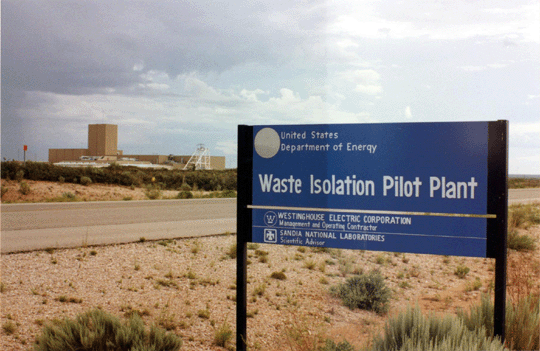 Environment Department: LANL cleanup could cost $4B, Santa Fe New Mexican News Jun 2, 2016. Rebecca Moss The New Mexican
The New Mexico Environment Department told state lawmakers Wednesday that it may cost the federal government far more than expected to remove contamination from Los Alamos National Laboratory over the next decade.
During a meeting of the legislative Radioactive and Hazardous Waste Committee, Environment Secretary Ryan Flynn said costs could exceed $4 billion, more than double the current budget proposed by federal regulators.
Last week, the U.S. Department of Energy announced a $1.7 billion, 10-year Los Alamos Legacy Cleanup Contract, work primarily focused on cleaning up contamination and legacy nuclear waste at lab sites and areas surrounding the lab. The announcement follows the release of a new consent order with the state in March, a document that governs the lab’s cleanup objectives. Unlike the previous order, with a missed deadline in December 2015 to have all waste removed from the lab, the new deal focuses on contamination and sets more flexible targets, which Flynn has said will accelerate cleanup.
The December deadline was missed in large part because of a radiation leak at the Waste Isolation Pilot Plant in Southern New Mexico, where barrels of transuranic waste from Los Alamos were being stored in underground salt caverns. An improperly packaged waste drum from Los Alamos burst in February 2014, closing down the waste site.
Following the WIPP breach, the consortium that operates the lab, Los Alamos National Security LLC, received a scathing performance review, and in December, federal officials announced the management contract would be put up for bid. A new contractor will take over lab operations in 2018…….
Some critics, however, have said that having flexible deadlines for cleanup work is not an effective way to hold the lab accountable.
In April, Nuclear Watch New Mexico filed a lawsuit against Los Alamos National Security and the Department of Energy over their failures to meet cleanup milestones under the 2005 consent order. The watchdog group said the state could have collected more than $300 million in penalties if the federal government was held accountable for the deadlines.
The state issued 150 extensions under the Martinez administration, which the lab still failed to meet, the group said.
Nuclear Watch Director Jay Coghlan said in a news release at the time that the group was aiming to make the lab and federal agency “clean up their radioactive and toxic mess first before making another one for a nuclear weapons stockpile that is already bloated far beyond what we need.”
He was referring to plans pending in Congress to increase plutonium pit production in Los Alamos over the coming decades.
“I don’t believe there is a sincere intention on the part of anyone, including the New Mexico Environment Department, to clean up this site,” said Greg Mello, director of the Las Alamos Study Group, another local nuclear watchdog group.
Mello said putting more money into cleanup work won’t remedy the lab’s waste problem, with a new waste stream resulting from continued nuclear weapons work at the lab.
“Just to say that we need more money every year? There is no end, this goes on forever,” he said. “It’s time we close down production.” http://www.santafenewmexican.com/news/local_news/environment-department-lanl-cleanup-could-cost-b/article_be41efe6-40a5-53c4-af82-b101012c2418.html?utm_content=buffer7c192&utm_medium=social&utm_source=twitter.com&utm_campaign=buffer
“Just Mums” have become a powerful lobbying force for action on radioactive wastes.
Just moms” have become a surprisingly powerful force, successfully lobbying the state health department to challenge some of the federal government’s findings that downplayed the site’s risks,
Just Moms continue to rally the public to demand tests from the state. The women also took trips, uninvited, to the state offices and asked for meetings so they explain why they believed the nuclear waste posed a threat. The aggressive community lobbying appeared to pay off: the state health department agreed to test the site for evidence that the radioactive waste has spread, and late last year, the Missouri State Attorney general finally released the findings. Among the disturbing conclusions: possible radioactive waste has in fact been found “off site” in the nearby foliage. What’s more, groundwater wells outside the perimeter of the landfill were found to be contaminated with carcinogens like benzene in “high concentrations,” the state said
Community reacts to STL County’s emergency plan for looming #WestLakeLandfill disaster
Community reacts to STL County’s emergency plan for looming #WestLakeLandfill disaster Two Stay-at-Home Moms Are Waging War Against the Feds Over Illegal Toxic Waste Broadly, by Amy Martyn JUN 1 2016 https://twitter.com/justmomsstl
What do you do when there’s 10,000 barrels of illegally dumped uranium two miles away from your home and the government tells you not to worry about it?
Dawn Chapman and her family are stuck in an absurd and depressing situation: Less than two miles from the Chapmans’ neighborhood in Bridgeton, Missouri, sits a landfill where radioactive uranium was illegally dumped by a government contractor forty years ago. Since the Environmental Protection Agency is not required to warn people of such things, most people in the area—including many elected officials—knew nothing about the dump for decades.
“It would be great to be able to leave this area, but we couldn’t honestly sell our house right now, ” Chapman says. “Even ethically, with what’s going on, I wouldn’t want to sell my house to another family.”
Karen Nickel learned about the dump site during a town hall with the Army Corps of Engineers. The Corps have successfully removed illegally dumped nuclear waste from other sites across the nation but because this particular site, West Lake Landfill, is under the control of the Environmental Protection Agency, the Corps does not have the authority or funding to conduct a clean-up here. Nickel and other mothers are fearful about what health problem such close proximity to radioactive waste could cause their children. “A lot of their children are coming forward with cancers and such, a couple of my daughter’s friends have brain tumors,” Nickel says……
In the past four years, the “Just moms” have become a surprisingly powerful force, successfully lobbying the state health department to challenge some of the federal government’s findings that downplayed the site’s risks, revealing possible inconsistencies in public statements made by the EPA, and pissing off both the EPA and landfill operator Republic Services. Ed Smith, the policy director for the non-profit Missouri Coalition for the Environment is an admirer of the women. “There’s a lot those moms have done that wouldn’t have been done otherwise,” he says.
The first major success for Just Moms came when Karen and Dawn sniffed a foul odor in their neighborhood. The landfill owners told them that it was due to a “smoldering event,” created by underground gasses that can ignite some of the landfill garbage. The landfill, the moms were told, was in it’s third year of a sustained underground trash smolder, something that’s common among underground landfills—but landfills are typically not next to tons of uranium. Nevertheless, officials assured the moms that a limestone wall between the uranium and the trash would keep the fire from reaching the toxic materials. There were two landfills, the operators insisted: one for nuclear waste, one for trash……….
Chapman and Nickel countered the paid lobbyists with their own attack. For one week in 2014, they focused their sites on United States Congressman Roy Blunt, their federal representative who had previously been publicly silent about the landfill. From their Facebook page:
“EVERY DAY from 8am-4pm please call his WASHINGTON DC office. Make it a part of your daily routine!!!!,” the moms urged supporters in an online post. “Emails are good, but 2,000 phone calls everyday will make a bigger impact!!!”
The effort worked……..
Just Moms continue to rally the public to demand tests from the state. The women also took trips, uninvited, to the state offices and asked for meetings so they explain why they believed the nuclear waste posed a threat. The aggressive community lobbying appeared to pay off: the state health department agreed to test the site for evidence that the radioactive waste has spread, and late last year, the Missouri State Attorney general finally released the findings. Among the disturbing conclusions: possible radioactive waste has in fact been found “off site” in the nearby foliage. What’s more, groundwater wells outside the perimeter of the landfill were found to be contaminated with carcinogens like benzene in “high concentrations,” the state said…….. https://broadly.vice.com/en_us/article/two-stay-at-home-moms-are-waging-war-against-the-feds-over-illegal-toxic-waste
America’s risks of catastrophic fire in spent nuclear fuel pools
 Spent fuel fire on U.S. soil could dwarf impact of Fukushima, Science, By Richard Stone May. 24, 2016 A fire from spent fuel stored at a U.S. nuclear power plant could have catastrophic consequences, according to new simulations of such an event.
A major fire “could dwarf the horrific consequences of the Fukushima accident,” says Edwin Lyman, a physicist at the Union of Concerned Scientists, a nonprofit in Washington, D.C. “We’re talking about trillion-dollar consequences,” says Frank von Hippel, a nuclear security expert at Princeton University, who teamed with Princeton’s Michael Schoeppner on the modeling exercise.
The revelations come on the heels of a report last week from the U.S. National Academies of Sciences, Engineering, and Medicine on the aftermath of the 11 March 2011 earthquake and tsunami in northern Japan. The report details how a spent fuel fire at the Fukushima Daiichi Nuclear Power Plant that was crippled by the twin disasters could have released far more radioactivity into the environment.
The nuclear fuel in three of the plant’s six reactors melted down and released radioactive plumes that contaminated land downwind. Japan declared 1100 square kilometers uninhabitable and relocated 88,000 people. (Almost as many left voluntarily.) After the meltdowns, officials feared that spent fuel stored in pools in the reactor halls would catch fire and send radioactive smoke across a much wider swath of eastern Japan, including Tokyo. By a stroke of luck, that did not happen.
But the national academies’s report warns that spent fuel accumulating at U.S. nuclear plants is also vulnerable. After fuel is removed from a reactor core, the radioactive fission products continue to decay, generating heat. All nuclear power plants store the fuel onsite at the bottom of deep pools for at least 4 years while it slowly cools. To keep it safe, the academies report recommends that the U.S. Nuclear Regulatory Commission (NRC) and nuclear plant operators beef up systems for monitoring the pools and topping up water levels in case a facility is damaged. The panel also says plants should be ready to tighten security after a disaster.
At most U.S. nuclear plants, spent fuel is densely packed in pools, heightening the fire risk. NRC has estimated that a major fire at the spent fuel pool at the Peach Bottom nuclear power plant in Pennsylvania would displace an estimated 3.46 million people from 31,000 square kilometers of contaminated land, an area larger than New Jersey. But Von Hippel and Schoeppner think that NRC has grossly underestimated the scale and societal costs of such a fire…….http://www.sciencemag.org/news/2016/05/spent-fuel-fire-us-soil-could-dwarf-impact-fukushima
Californians want to palm off their nuclear waste problem onto Texas
California looks to Texas to solve nuclear waste problem
Dallas company has filed to open nuclear waste dump in West Texas
Californians say proposal is chance to move spent fuel from Rancho Seco, San Onofre plants
Moving radioactive materials out of earthquake zones still won’t happen till 2021
BY MAGGIE YBARRA mybarra@mcclatchydc.com 9 May 16. WASHINGTON
California lawmakers are rallying around a plan to relocate radioactive waste from the state’s shuttered nuclear power plants to a storage site in West Texas after failing to secure enough political support to move that waste to a repository in Nevada.
The Texas site is owned by Dallas-based Waste Control Specialists, which submitted a nuclear waste storage proposal to the Nuclear Regulatory Commission in April.
Republican Rep. Darrell Issa, who represents parts of Orange and San Diego counties, said the proposed Texas site is California’s next best hope for moving high-level radioactive waste from areas vulnerable to earthquakes and other natural disasters………
“Seems like we’re on track to make West Texas the nation’s default nuclear waste dump after the one in Nevada fell through,” said Andrew Wheat, the research director for Texans for Public Justice, an advocacy group that targets what it labels the corrupt influence of corporate money in politics.Even if legislators and government officials do decide to move forward with building a nuclear waste facility in West Texas, it would still be years before Californians would see a reduction in the size of the toxic inventory at the San Onofre Nuclear Generating Station in San Diego County, which was decommissioned in 2013, and the Rancho Seco Nuclear Generating Station in Herald, which was mothballed in 2009.
Waste Control Specialists did not respond to questions about how long it would be before the company would be able to relocate nuclear waste from California to Texas, but The Texas Tribune has reported that waste relocation efforts would not begin until 2021………
Irradiated
The U.S. government has compensated over 52,000 nuclear workers illnesses related to radiation exposure, but the process is complicated. Deaths resulting from exposure while working at the plants and the compensation process for survivors begs the question http://www.mcclatchydc.com/news/politics-government/congress/article76532967.html
U.S. would back a rethink of Japan’s plutonium recycling program: White House
KYODO MAY 21, 2016 WASHINGTON – The United States would back a change to Japan’s nuclear fuel reprocessing program because there are concerns it may lead to an increase in its ally’s stockpile of unused plutonium, a senior White House official said. … (registered readers only) http://www.japantimes.co.jp/news/2016/05/21/national/politics-diplomacy/u-s-back-rethink-japans-plutonium-recycling-program-white-house/#.V0I7-zV97Gj
Boston Edison Company, now known as NSTAR Electric Company sues US Dept of Energy
DOE Sued for $40M Over Nuclear Waste Storage, Courthouse News Service By LORRAINE BAILEY CN), 19 May 16 — Blaming the government for not settling on a nuclear-waste storage scheme, a nuclear energy company has filed a federal complaint to recover $40 million.
The Nuclear Waste Policy Act of 1982 required the U.S. Department of Energy to accept and dispose of spent nuclear fuel and high-level radioactive waste by Jan. 31, 1998, in return for fees paid by owners of such waste.
It also effectively made it mandatory for nuclear utilities to enter into contracts for such disposal.
When the Department of Energy failed to meet the 1998 deadline, however, utilities began to incur substantial costs for storage and management of the waste accumulating at reactor sites.
By 2006, the U.S. Court of Federal Claims had found that the Department of Energy partially breached its contractual obligations to Yankee Atomic Electric Co., Connecticut Yankee Atomic Power Co., and Maine Yankee Atomic Power Co., all of which are now decommissioned, to the tune of $235 million
It sued the U.S. in the Court of Federal Claims Wednesday over its continued obligation to pay for highly reactive waste storage.
Boston Edison says it paid Entergy $40.3 million to cover the cost to store spent nuclear fuel through 2012, the expected decommissioning date for the plant.
That fuel would have been disposed of by the government had it kept its pledge.
But now, Entergy has stated that operations at Pilgrim will continue through 2019, and there is still no government plan for a permanent repository for high level nuclear waste.
Most nuclear power plants continue to keep their reactor waste on-site in steel and concrete casks……. The Department of Energy has expressed the urgency need to find a permanent repository, but the Congress has taken no action since abandoning the Yucca Mountain project.
Boston Energy seeks damages for breach of contract, and breach of the covenant of good faith. http://www.courthousenews.com/2016/05/19/doe-sued-for-40m-over-nuclear-waste-storage.htm
1 This Month
23-25 October – on Zoom – World BEYOND War’s annual global conferenc


Shut down the radiation-damaged Heysham nuclear reactors now
To see nuclear-related stories in greater depth and intensity – go to https://nuclearinformation.wordpress.com

Say No to NASA’s Reckless Nuclear Reactor on the Moon
Say No to NASA’s Reckless Nuclear Reactor on the Moon

-
Archives
- October 2026 (199)
- September 2026 (339)
- August 2026 (330)
- July 2026 (355)
- June 2026 (287)
- May 2026 (306)
- April 2026 (356)
- March 2026 (251)
- February 2026 (267)
- January 2026 (308)
- December 2025 (358)
- November 2025 (359)
-
Categories
- 1
- 1 NUCLEAR ISSUES
- business and costs
- climate change
- culture and arts
- ENERGY
- environment
- health
- history
- indigenous issues
- Legal
- marketing of nuclear
- media
- opposition to nuclear
- PERSONAL STORIES
- politics
- politics international
- Religion and ethics
- safety
- secrets,lies and civil liberties
- spinbuster
- technology
- Uranium
- wastes
- weapons and war
- Women
- 2 WORLD
- ACTION
- AFRICA
- Atrocities
- AUSTRALIA
- Christina's notes
- Christina's themes
- culture and arts
- Events
- Fuk 2022
- Fuk 2023
- Fukushima 2017
- Fukushima 2018
- fukushima 2019
- Fukushima 2020
- Fukushima 2021
- general
- global warming
- Humour (God we need it)
- Nuclear
- RARE EARTHS
- Reference
- resources – print
- Resources -audiovicual
- Weekly Newsletter
- World
- World Nuclear
- YouTube
-
RSS
Entries RSS
Comments RSS

