Germany’s costly nuclear waste dump correction
Environment state secretary Jochen Flasbarth, who described the situation in Asse II as “disastrous”, told journalists in Berlin that the current plan was to store the Asse waste, once retrieved, with the high-level radioactive waste for which the government is still searching a site…….
The Asse case shows how difficult it can be to undo a decision related to nuclear waste storage. It will take longer to retrieve the waste than it did to dump it

 Why Germany is digging up its nuclear waste, By PETER TEFFER , EU Observer, WOLFENBUETTEL, GERMANY, TODAY, 2 Feb 16 “….. in hindsight, the Asse II salt mine should never have been used in the 1960s and 1970s as a site to dump nuclear waste, said Ingo Bautz of the Federal Office for Radiation Protection………To anti-nuclear activists, Asse is a prime example of government not listening to citizens’ concerns. “Incidents were predicted,” said Wolfgang Ehmke, activist in the Gorleben region.
But the waste had to be stored somewhere, so the voices that warned against selecting Asse II were ignored.
“The potential risks for the future were accepted,” Bautz said, during a recent press visit to the mine organised by Clean Energy Wire, a non-profit group supported by the Mercator and European Climate foundations.
Road signs, deep underground
Until 1978, low and intermediate-level radioactive waste was stored in Asse II, the only such site in Germany.
Ten years later, the operator of the mine discovered leaks of radioactive brine. But it was not until 2008, when media reported about it, that the leaks became public knowledge.
The German government took control of the mine and tasked the Federal Office for Radiation Protection with its decommissioning.
The office concluded that the risk of groundwater contamination was too big, and the only truly safe option was to retrieve all the waste from the mine and store it elsewhere. In all, 126,000 containers filled with contaminated clothes, paper and equipment were stored in Asse, the office said.
“This task is very difficult,” said Bautz, who joined journalists to travel into the mine, 658m below the surface.
The lift plunged to the bottom at 36km/h. Inside the mine, the temperature was about 30C even though it was freezing above ground.
The mine is so large that workers have to use cars to get around. In one tunnel an LED road sign typically found in residential areas tells drivers to watch their speed……..
Since the mine is over a century old, it needs to be protected against a collapse or flooding. It will also need another lift to use for retrieving the waste.
And because of safety regulations regarding evacuation, only 120 people can be down in the mine at the same time. Workers are monitored for any exposure to radiation……..
In 2011, the EU adopted a rule obliging each country that has produced nuclear waste to have policies on how to manage their waste. Last August, all member states were due to report about their national programmes for the first time.
Germany told the commission it planned to put “all types of radioactive waste in deep geological disposal facilities with the aim to guarantee isolation from the biosphere in the long term, thus ensuring the safety of man and the environment without any need for maintenance”.
Environment state secretary Jochen Flasbarth, who described the situation in Asse II as “disastrous”, told journalists in Berlin that the current plan was to store the Asse waste, once retrieved, with the high-level radioactive waste for which the government is still searching a site…….
The Asse case shows how difficult it can be to undo a decision related to nuclear waste storage. It will take longer to retrieve the waste than it did to dump it…….
This is second part in a two-part series about Germany’s nuclear waste. Part one was about how Gorleben refused to be the country’s permanent waste repository. https://euobserver.com/beyond-brussels/132085
Increasingly, it’s the “back end” of nuclear power that will be astronomically costly
 EU paints challenging picture of Europe’s nuclear future, Energy Post. February 2, 2016 by Sonja van Renssen “…..Paying for the aftermathIt is the back-end of the fuel cycle – waste management and decommissioning – that is going to claim a rising share of investments in the years ahead. More than 50 of the EU’s 131 reactors are likely to be shut down by 2025, the Commission says. Member States are moving “from research to action” on geological disposal. The first facilities are expected to be up and running in Finland, Sweden and France between 2020 and 2030 (Finland is in the lead with a due date of 2023). Almost all other Member States are at the “preliminary studies” stage. Public acceptance remains a challenge. So does deciding who is finally liable for the waste.
The projected costs of long-term geological storage depositories run from less than half a billion in Slovenia and Croatia to over €20 billion in France, the Commission says. It all adds up to €68 billion, or nearly half of the total estimated waste management costs of €142 billion out to 2050. For these, the average result of €3.23 per MWh is more than double what was estimated in recent studies, the Commission notes. Over a third of the total costs are for France.
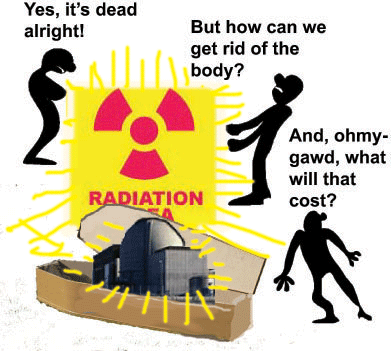 The other half of the end-of-life equation, decommissioning, is largely unknown terrain. When a nuclear site is decommissioned, it is released from regulatory oversight. Given “the ageing status of the European reactors, the capability of the industry and regulators to develop safe and cost effective decommissioning programs will determine to a great extent the future of nuclear commercial power in Europe”. This includes greater transparency in cost estimates, it adds. The Commission comes up with a total cost of €126 billion for decommissioning out to 2050. Some will argue that real costs are likely to be far higher.
Estimates of decommissioning costs per unit also vary “significantly” between Member States, from €0.20 billion in Finland to €1.33 billion in Lithuania. Germany and the UK are at the high end (€1.06 billion and €0.85 billion, respectively) while France is at the low end (€0.32 billion). The estimates depend on technology, the size and location of the reactor, and dismantling strategy, the Commission says.
Experience is scarce: although 89 reactors had been permanently closed in Europe as of October 2015, only three had been fully decommissioned. All three were in Germany. Worldwide, only 13 more have been decommissioned; all of them in the US. The Commission suggests a “European Centre of Excellence” to exchange best practice might help. http://www.energypost.eu/exclusive-eu-paints-challenging-picture-europes-nuclear-future/
EU paints challenging picture of Europe’s nuclear future, Energy Post. February 2, 2016 by Sonja van Renssen Not the full picture
In theory, the money for waste management and decommissioning is being accumulated throughout reactors’ lifetimes, primarily through a fixed contribution based on electricity sales. In most Member States, regulators define the method for securing funds (some, such as Germany however, rely on commercial law to require companies to build up reserves in their balance sheets).
Of the €268 billion needed in the EU by 2050, there is already €150 billion in the bank. In other words, as of 2014, European nuclear operators had dedicated assets that would cover 56% of the total estimated nuclear end-of-life costs, for reactors that were 64% of the way through their lives. A “possible explanation” for the difference is that some Member States are anticipating lifetime extensions.
The Commission concludes that “as a reliable low carbon technology and a major contributor to security of supply”, nuclear energy “is expected to remain an important component of the EU’s energy mix”. Maintaining EU technological leadership, including through the nuclear fusion project ITER, is “essential”. But this does not make nuclear energy competitive or affordable, nor does it ensure it can play a useful role in an EU power system dominated by renewables, where flexibility is central.
There are a few other things the draft PINC does not (yet) do. It does not advise on the involvement of foreign firms in supposedly strategic energy projects (e.g. China in Hinkley Point C). It does not draw lessons from recent upheavals in the nuclear industry (e.g. Areva’s bankruptcy). It does not tackle liability, although a former PINC suggested setting up a harmonised system of liability and financial mechanisms in case of an accident. And finally, it does not discuss harmonising strategies for decommissioning funds – also suggested in the former PINC – beyond proposing a European Centre of Excellence. http://www.energypost.eu/exclusive-eu-paints-challenging-picture-europes-nuclear-future/
Japan’s nuclear restarts- increase of deadly MOX wastes, but nowhere to put it
 Restarts threaten to increase amount of deadly MOX at Takahama plant to 18.5 tons, Japan Times, 1 Feb 16, JIJI Restarting a second reactor at the Takahama nuclear power plant in Fukui Prefecture will raise the amount of highly toxic spent mixed-oxide (MOX) fuel present there to an estimated 18.5 tons, Jiji Press has learned.
The plant run by Kansai Electric Power Co. in the town of Takahama had 5.3 tons of MOX — a blend of uranium and plutonium extracted from spent nuclear fuel — there before Friday’s restart of the No. 3 reactor.
But lingering problems threaten to ruin the government’s long-laid plans for recycling nuclear fuel, leaving spent MOX in need of a home. This means it is likely to join the standard uranium fuel being kept in the nation’s rapidly dwindling storage pools until a solution can be found.

The Takahama plant is set to hold the largest amount of spent MOX among domestic nuclear facilities that have engaged in so-called pluthermal power generation utilizing the blended fuel, which can contain weapons-grade plutonium……..
Among noncommercial facilities, the Japan Atomic Energy Agency currently has 63.9 tons stored at Fugen, an advanced converter reactor in Fukui, 23.1 tons at its nuclear fuel reprocessing facility in Ibaraki Prefecture, and 6.1 tons at the experimental Monju fast-breeder reactor in Fukui.
Takahama No. 3 is the nation’s third reactor to be rebooted under new safety standards compiled since the Fukushima nuclear disaster began in March 2011.
Kansai Electric plans to reactivate Takahama’s No. 4 reactor later this month. http://www.japantimes.co.jp/news/2016/01/31/national/restarts-threaten-increase-amount-deadly-mox-takahama-plant-18-5-tons/#.Vq5v39J97Gg
Germany’s nuclear waste nightmare
Radioactive waste dogs Germany despite abandoning nuclear power https://www.newscientist.com/article/2075615-radioactive-waste-dogs-germany-despite-abandoning-nuclear-power/ Major problems at a salt mine where 126,000 drums of radioactive debris are stored are fuelling public distrust of long-term waste disposal plans, reports Fred Pearce from Asse, Germany
Half a kilometre beneath the forests of northern Germany, in an old salt mine, a nightmare is playing out. A scheme to dig up previously buried nuclear waste is threatening to wreck public support for Germany’s efforts to make a safe transition to a non-nuclear future.
Enough plutonium-bearing radioactive waste is stored here to fill 20 Olympic swimming pools. When engineers backfilled the chambers containing 126,000 drums in the 1970s, they thought they had put it out of harm’s way forever.
But now, the walls of the Asse mine are collapsing and cracks forming, thanks to pressure from surrounding rocks. So the race is on to dig it all up before radioactive residues are flushed to the surface.
“There were people who said it wasn’t a good idea to put radioactive waste down here, but nobody listened to them,” says Annette Parlitz, spokeswoman for the Federal Office for Radiation Protection (BfS), as we tour the mine.
This is just one part of Germany’s nuclear nightmare. The country is also wrestling a growing backlog of spent fuel. Continue reading
Pierce County, USA not happy with DOE plan for a deep bore feasibility study for nuclear waste
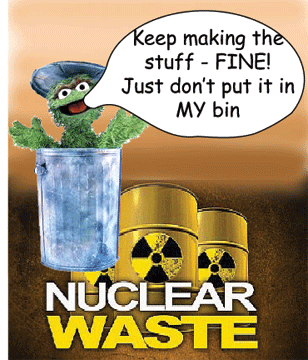 Rocky road for nuclear waste bore hole study, http://bismarcktribune.com/news/state-and-regional/rocky-road-for-nuclear-waste-bore-hole-study/article_7698d465-0316-5031-83e9-bc727d3592b9.html By Lauren Donovan, 29 Jan 16 A plan to explore deep ancient rock in Pierce County for its potential to store nuclear waste hit a bumpy road if not a rock wall in its first introduction to state officials Thursday.
The State Board of University and School Lands heard from the Energy and Environmental Research Center at Grand Forks that its team was awarded $35 million by the federal Department of Energy to drill 16,000 feet down into crystalline rock to learn whether the rock could suitably store spent nuclear fuels.
John Harju, project liaison, said the bore hole is for study purposes only, no waste would be stored there and that such storage isn’t even yet legal under federal rules.
Harju said the bore hole would be an opportunity to analyze rock core that’s rarely ever been looked at for minerals or geothermal properties. The chance to go that deep, into the oldest rock on the planet, “may never present itself again,” Harju said.
The issue was presented to the land board because EERC is proposing to drill on 20 acres of state-owned land about 15 miles south of Rugby.
Pierce County commissioners were at the meeting and said they were startled to read about the project before anyone from EERC even came to the county.
Commissioner Duane Johnston said, if the issue had come up at a local zoning meeting, “half the county would have been there to say no.” Commission chairman Dave Migler said it was tough to take calls from residents and not have much information to share. “It’d be nice to be in the loop,” he said.
While there was no formal application on the table, land board members didn’t hesitate to weigh in with worries that a federal project could become a federal mandate.
In the end, it was far from clear how the EERC would proceed with getting approval to use public land for the project in Pierce County, or perhaps anywhere in the state.
Afterward, Harju said he was a little surprised by his reception. “Plan B? We don’t have one. If the project is not able to proceed, the DOE will have to evaluate” alternatives, he said.
The five-year project was awarded to the Battelle Memorial Institute of Ohio, along with EERC and Schlumberger, a familiar drilling service company in the Bakken. The crystalline rock formation underlies much of the continent.
Radioactive trash problem accelerates in Japan , with latest nuclear reactor restart
Third reactor restart spurs fears over shaky Kansai evacuation plans BY ERIC JOHNSTON STAFF WRITER , JAPAN TIMES, TAKAHAMA, FUKUI PREF 29 JAN 16 . “……The restarts also mean Kepco must once again confront the question of what to do with spent fuel, an issue that is rapidly becoming one of local and national concern.
The spent-fuel storage pools for the Takahama No. 3 and 4 reactors are expected to be full in about eight years. Kepco plans to remove the fuel and nuclear waste to a mid-term storage facility for a half century before transporting them somewhere else for final storage.
In a recent meeting with Fukui Gov. Issei Nishikawa, Kepco President Makoto Yagi said Kepco wants to begin operating a mid-term storage facility outside the prefecture by around 2030. The utility aims to choose a site for the facility by 2020.
That presents a problem. Kepco promised Nishikawa that spent fuel from the Takahama reactors will not be stored within the prefecture but in one of the utility’s other service areas. This means Shiga, Kyoto, Nara, Hyogo, Osaka, Wakayama, Mie or Gifu.But there are certain conditions a potential storage site has to meet. For transportation reasons, Kepco wants it located in a prefecture with port facilities. That eliminates Nara, Shiga, and Gifu prefectures. Second, Yagi says that local consent to build and store the waste is crucial.
That is potentially an even bigger problem. Kyoto Gov. Keiji Yamada has strongly opposed building a facility in his prefecture. Osaka Gov. Ichiro Matsui appears opposed as well, saying he does not want Kepco in charge of the facility. Mie and Hyogo prefectures have said they are not considering hosting a facility at present.
Only Wakayama appears to be a possibility at the moment. In 2009, the port city of Gobo hinted it might be interested in hosting a mid-term facility. Kepco did a survey and agreed it was possible to build there, but nothing has happened since then.http://www.japantimes.co.jp/news/2016/01/29/national/third-reactor-restart-spurs-fears-over-shaky-kansai-evacuation-plans/#.VqvMftJ97Gg
Risky Plutonium-Mixed Fuel used in Japan’s new nuclear reactor restart
 Japan Restarts Nuclear Reactor Using Plutonium-Mixed Fuel http://abcnews.go.com/International/wireStory/japan-restarts-nuclear-reactor-plutonium-mixed-fuel-36593509, By MARI YAMAGUCHI, ASSOCIATED PRESS, 29 Jan 16, Japan on Friday restarted a nuclear reactor that uses riskier plutonium-based MOX fuel, the first of that type to resume operations under stricter safety rules introduced after the 2011 Fukushima disaster.
Japan’s large stockpile of plutonium has raised international nuclear security concerns, and the government has come up with the idea of burning it in reactors to reduce the amount.
The No. 3 reactor at Takahama nuclear plant in western Japan, operated by Kansai Electric Power Co., went back online Friday. Dozens of people protested outside the plant in Fukui prefecture, where preparations for a restart of another reactor, No. 4, are also underway.
Fukui has more than a dozen reactors, the biggest concentration in one prefecture, causing safety concerns for neighbors including Kyoto and Shiga, whose Lake Biwa is a major source of drinking water for western Japan.
Two reactors that use conventional uranium fuel were restarted last year in southern Japan. Japan started burning MOX, a plutonium-uranium hybrid fuel, in some of its conventional reactors in 2009. Experts say conventional reactors can safely burn MOX for up to one-third of their fuel, but it emits more radiation and could interfere with control rods when they are needed to suppress the nuclear chain reaction.
Japan has enough plutonium, mostly from reprocessed spent fuel, to make 6,000 bombs.
Nearly five years since a massive earthquake and tsunami caused meltdowns at the Fukushima Dai-ichi nuclear plant, about 100,000 people still cannot return to nearby areas. Workers at the plant continue to struggle with its decommissioning, which will take decades.
Aiming to help business by generating energy, Japan’s government is pushing to restart as many reactors as possible after they are deemed safe. Forty remaining workable reactors are still offline for safety checks.
Follow Mari Yamaguchi on Twitter at twitter.com/mariyamaguchi
Her work can be found at http://bigstory.ap.org/content/mari-yamaguchi
Encinitas Council votes for moving San Onofre spent nuclear fuel
 Encinitas supports bill to move spent nuclear fuel http://www.encinitasadvocate.com/news/2016/jan/28/encinitas-council-nuclear-fuel/ .By Jared Whitlock11 .JAN. 28, 2016.
Federal legislation to relocate spent nuclear fuel from the shuttered San Onofre power plant has the support of the Encinitas City Council.
The Encinitas council on Jan. 27 voted unanimously to approve a resolution backing H.R. 3643, which would let the federal Department of Energy transfer spent nuclear waste at San Onofre and other areas to an interim storage facility.
“It seems critical that we move that waste from the coastline,” Councilman Tony Kranz said, adding the need is clear given the 2011 earthquake and tsunami that damaged the Fukushima Daiichi nuclear power plant.
The legislation came about because federal law only allows the Department of Energy to move spent fuel to a permanent depository, yet such a facility isn’t on the horizon. In 2010, the Obama Administration shelved plans for a long-planned permanent storage site at Yucca Mountain in Nevada.
Oceanside Councilman Jerry Kern, who is on the San Onofre Decommissioning Community Engagement Panel, has urged North County cities to support the federal bill. So far, Oceanside and Encinitas have joined the cause
Kern told the Encinitas council on Jan. 27 that if the federal government doesn’t take action soon, the spent nuclear fuel would remain in cask storage and cooling pools at San Onofre for decades.
“This is a once-in-a-generation opportunity for us to act,” Kern said.
Kern during the Encinitas council’s Jan. 13 meeting said the waste poses a threat, given the plant’s proximity to the ocean and so many people.
San Onofre waste has been on the council’s radar for a while. Prior to the federal legislation, Kranz and Councilwoman Lisa Shaffer last spring asked that the council weigh in on whether nuclear fuel should be stored at the plant.
Neither a temporary nor permanent site for spent nuclear fuel has been settled on. However, a company plans to build an interim facility in Texas and there’s another proposal in New Mexico. In Texas, environmental groups have raised concerns over the impact to aquifers. In New Mexico, opponents have said transporting the waste could be dangerous.
The bill has been assigned to a congressional subcommittee, according to Kern. Rep. Congressman Darrell Issa, R-Vista, co-sponsored the legislation.
Faulty steam generators led to the plant’s closure in 2013, heightening worries over the nuclear waste.
In September, the San Diego County Board of Supervisors asked the federal government to remove and relocate the waste. Later that month, H.R. 3643 was introduced.
With no plan in place for moving the spent fuel, the California Coastal Commission in October approved a measure to bury it in concrete bunkers at the San Onofre plant.
The danger of transporting plutonium
Too much of a bad thing? World awash with waste plutonium http://www.theecologist.org/News/news_round_up/2986959/too_much_of_a_bad_thing_world_awash_with_waste_plutonium.html Paul Brown 24th January 2016
As worldwide stocks of plutonium increase, lightly-armed British ships are about to carry an initial 330kg of the nuclear bomb metal for ‘safekeeping’ in the US, writes Paul Brown. But it’s only the tip of a global ‘plutonium mountain’ of hundreds of tonnes nuclear power’s most hazardous waste product.
Two armed ships set off from the northwest of England this week to sail round the world to Japan on a secretive and controversial mission to collect a consignment of plutonium and transport it to the US.
The cargo of plutonium, once the most sought-after and valuable substance in the world, is one of a number of ever-growing stockpiles that are becoming an increasing financial and security embarrassment to the countries that own them.
So far, there is no commercially viable use for this toxic metal, and there is increasing fear that plutonium could fall into the hands of terrorists, or that governments could be tempted to use it to join the nuclear arms race.

All the plans to use plutonium for peaceful purposes in fast breeder and commercial reactors have so far failed to keep pace with the amounts of this highly dangerous radioactive metal being produced by the countries that run uranium-fulled nuclear power stations.
The small amounts of plutonium that have been used in conventional and fast breeder reactors have produced very little electricity – at startlingly high costs.
Japan, with its 47-ton stockpile, is among the countries that once hoped to turn their plutonium into a power source, but various attempts have failed. The government, which has a firm policy of using it only for peaceful purposes, has nonetheless come under pressure to keep it out of harm’s way. Hence, the current plan to ship it to the US.
Altogether, 15 countries across the world have stockpiles. They include North Korea, which intends to turn it into nuclear weapons.
UK’s Plutonium represents a massive cost – but no balance sheet liability recorded
The UK has the largest pile, with 140 tons held at Sellafield in north-west England, whereplutonium has been produced at the site’s nuclear power plant since the 1950s, also using spent fuel from civilian nuclear plants such as Hinkley Point and Calder Hall. The government has yet to come up with a policy on what to do with it – and, meanwhile, the costs of keeping it under armed guard continue to rise.
Like most countries, the UK cannot decide whether it has an asset or a liability. The plutonium does not appear on any balance sheet, and the huge costs of storing it safely – to avoid it going critical and causing a meltdown – and guarding it against terrorists are not shown as a cost of nuclear power.
This enables the industry to claim that nuclear is an attractive and clean energy-producing option to help combat climate change.
The two ships that set off from the English port of Barrow-in-Furness this week are the Pacific Egret and Pacific Heron, nuclear fuel carriers fitted with naval cannon on deck. They are operated by Pacific Nuclear Transport Ltd, which ultimately is owned by the British government.
The presence on both ships of a heavily-armed security squad – provided by the Civil Nuclear Constabulary’s Strategic Escort Group – and the earlier loading of stores and the craning on board of live ammunition point to a long, security-conscious voyage ahead.
Sent to the US for safekeeping
The shipment of plutonium from Japan to the US falls under the US-led Global Threat Reduction Initiative (GTRI), or Material Management & Minimisation (M3) programme, whereby weapons-useable material such as plutonium and highly-enriched uranium (HEU) is removed from facilities worldwide for safekeeping in the US.
The cargo to be loaded onto the two UK ships in Japan consists of some 331kg of plutonium from Japan’s Tokai Research Establishment.
This plutonium – a substantial fraction of which was supplied to Japan by the UK decades ago for ‘experimental purposes’ in Tokai’s Fast Critical Assembly (FCA) facility – is described by the US Department of Energy (DOE) as “posing a potential threat to national security, being susceptible to use in an improvised nuclear device, and presenting a high risk of theft or diversion”. Or, as another US expert put it, “sufficient to make up to 40 nuclear bombs”.
Under the US-led programme, the plutonium will be transported from Japan to the US port of Charleston and onwards to the Savannah River site in South Carolina.
Tom Clements, director of the public interest group Savannah River Site Watch, has condemned this import of plutonium as a material that will simply be stranded at the site, with no clear disposition path out of South Carolina. He sees it as further evidence that Savannah River is being used as a dumping ground for an extensive range of international nuclear waste.
Prime terrorist material’ at risk
The British group Cumbrians Opposed to a Radioactive Environment (CORE) has for decades tracked the transport of nuclear materials round the world.
Their spokesman, Martin Forwood, said: “The practice of shipping this plutonium to the US as a safeguard is completely undermined by deliberately exposing this prime terrorist material to a lengthy sea transport, during which it will face everyday maritime risks and targeting by those with hostile intentions.
“We see this as wholly unnecessary and a significant security threat in today’s volatile and unpredictable world.” The best option, CORE believes, would have been to leave it where it was, under guard.
From DOE documents, this shipment will be the first of a number of planned shipments for what is referred to as ‘Gap Material Plutonium‘ – weapons-useable materials that are not covered under other US or Russian programmes.
In total, the DOE plans to import up to 900kg of ‘at risk’ plutonium – currently held in seven countries – via 12 shipments over seven years. Other materials include stocks of HEU – the most highly enriched plutonium (to 93%), also being supplied to Japan by the UK.
The voyage from Barrow to Japan takes about six weeks, and a further seven weeks from Japan to Savannah River – use of the Panama Canal having been ruled out by the DOE in its documents on the shipment. Previously, the countries near the canal have objected to nuclear transport in their territorial waters.
Best to store nuclear wastes locally in deep bores, not export it
The deep borehole project is particularly interesting because almost anywhere you look in America, there are deep rocks perfect for this method. Every state can have its own borehole repository, much to some of these state’s annoyance, since most political leaders would rather foist their waste off on someone else and claim victory for their constituents.
But Congress doesn’t exactly like the deep borehole idea because they would not be able to gang up on one state and force it down their throat. Each state would have its own deep nuclear disposal boreholes and wouldn’t be able to promise their citizens that the nuclear waste would ever leave their state
 DOE Tries To Change The Rules On Nuclear Waste Disposal http://www.forbes.com/sites/jamesconca/2016/01/21/doe-tries-to-change-the-rules-on-nuclear-waste-disposal/#2715e4857a0b28df073f561e James Conca , “……..DOE is funding a study to drill a borehole more than 3 miles deep into the Earth’s crust below North Dakota to test a disposal method for radioactive waste called Deep Borehole Disposal. In this scenario, waste would be placed in the lower mile of the borehole in crystalline rock that would isolate the waste from the surface and shallow environments.
The borehole would then be filled up with some special layers, including asphalt, bentonite, concrete and crushed rock that will isolate the waste for geologic time. The borehole would need a diameter of at least 17 inches at the bottom for placing containers, and would be lined with steel casing. Future boreholes will be wider as the technology evolves, which is has been doing lately.
These developments follow directly the recommendations of President Obama’s Blue Ribbon Commission on America’s Nuclear Future, and followed up in thePresident’s Memorandum on disposal of Defense High-Level Waste and the2013 Administration’s Strategy for the Management and Disposal of Used Nuclear Fuel and High-Level Radioactive Waste. Conca and Wright (2012)provide background on nuclear waste and interpretation of the three BRC recommendations pertaining to nuclear waste disposal that has led to these changes.
But the basic strategy of this new disposal initiative is: Continue reading
Don’t store nuclear waste near Great Lakes – 92,000 petition Canada
 92,000 petition Canada not to store nuclear waste near Great Lakes, Phys Org, January 21, 2016 Ninety-two-thousand people have pressed Ottawa to reject a proposal to store nuclear waste in an underground vault near the Great Lakes, fearing a spill would contaminate this source of drinking water for 40 million in Canada and the United States.

A 6,000-page petition signed by opponents of local utility Ontario Power Generation’s proposal to store waste in a deep limestone vault to be drilled beneath the world’s largest operating nuclear power plant on the Bruce Peninsula, more than 200 kilometers northwest of Toronto, was delivered to Environment Minister Catherine McKenna, her office confirmed Thursday.
McKenna is expected to rule on the project in March after an independent review panel in May 2015 recommended that it be approved………
any risk of contamination of the largest group of freshwater lakes, created by retreating glaciers 14,000 years go, and containing more than 20 percent of the world’s surface fresh water, is too great.
Cities and towns in the United States and Canada, including Chicago and Toronto, have passed 184 resolutions opposing the building of a nuclear waste repository here.
“No scientist, nor geologist can provide us with a 100,000-year guarantee that this nuclear waste dump will not leak and contaminate the Great Lakes,” Beverly Fernandez, who spearheaded the campaign against the storage facility, told AFP.
“So when we found out that OPG was trying to locate this nuclear waste right besides the Great Lakes—the drinking water for 40 million people in two countries—we felt compelled to do something,” she said http://phys.org/news/2016-01-petition-canada-nuclear-great-lakes.html#jCp
Nuclear waste plans an abuse of democracy in Britain
This is basically an engineering project like no other. Its timescale will dwarf the oldest cathedrals.

this time they have legislation in place to make sure the county council can’t stop it. It’s an abuse of democracy.
 Hardest sell: Nuclear waste needs good home By Greig Watson BBC News 18 January 2016 “…….Steadily produced since the end of World War Two, the question of what to do with the nuclear waste from civil, military, medical and scientific uses has been causing equal measures of fear and frustration for decades. With a new generation of nuclear power stations on the way, a fresh search is under way for a community ready to take on the challenge.
Campaigner Eddie Martin says: “It’s very worrying, scary even. They have been looking for somewhere to put this material for decades and it keeps coming back to Cumbria.”…….
Nuclear power stations have been built in 31 countries but only a handful ,including Finland, Sweden, France and the US have started building permanent storage facilities.
All of these are purpose-built caves hundreds of metres below ground, known as a Geological Disposal Facility (GDF). Once the waste is treated and sealed inside containers, it is stacked in the caverns. GDFs are expected to remain secure for thousands of years.
Dr Robert says GDFs or deep boreholes are two possible options for the disposal of radioactive waste but there are still challenges to overcome, particularly in predicting their behaviour over hundreds or thousands of years.
“While there are natural examples of radiation being contained – think of the mines where uranium for nuclear fuel has been sat happily for millennia – the mix of isotopes in radioactive waste is much more complex so we need to know how the nuclear waste interacts with its storage material, be it glass, concrete or metal……… Continue reading
Nuclear Waste Isolation Pilot Plant (WIPP)- what needs to be done?
Analyses of the accidents by the DOE have documented a lack of a ‘safety culture’ at WIPP.
The current regulatory period of 10,000 years is short relative to the 24,100-year half-life of plutonium-239, let alone that of uranium-235, which has a half-life of 700 million years.
Policy: Reassess New Mexico’s nuclear-waste repository, Nature Cameron L. Tracy, Megan K. Dustin & Rodney C. Ewing 13 January 2016
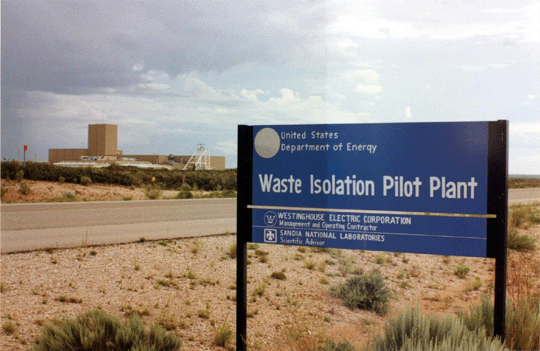
Proposals to bury plutonium from nuclear weapons must address chemical interactions and intrusion risks. More than 600 metres below ground near Carlsbad, New Mexico, is the world’s only operating deep geological repository currently accepting transuranic nuclear waste: that contaminated by elements heavier than uranium. The Waste Isolation Pilot Plant (WIPP), run by the US Department of Energy (DOE), is used to dispose of laboratory equipment, clothing and residues from the nation’s nuclear-defence programme. In the past 15 years, around 91,000 cubic metres (equivalent to covering a soccer field to a depth of about 13 metres) of such transuranic waste, mostly of relatively low radiation levels, has been placed there.
The main contaminants are long-lived isotopes of plutonium (mainly plutonium-239, with a half-life of 24,100 years, and plutonium-240, with a half-life of 6,560 years) and shorter-lived isotopes of americium and curium. In rooms carved out of a 250-million-year-old salt bed, the waste is stored in hundreds of thousands of plastic-lined steel drums. The repository is now at about half of its planned capacity and is to be sealed in 2033.
The DOE is responsible for performing safety assessments to ensure that WIPP will not exceed limits on exposure to radioactivity, as set by the US Environmental Protection Agency (EPA), for 10,000 years.
But new demands are emerging. An arms-control agreement with Russia made in 2000 obliges the United States to dispose of 34 tonnes of plutonium from dismantled nuclear weapons1. Following the terms of the agreement, the United States planned to convert the material into a fuel — mixed (uranium and plutonium) oxide, or MOX — to burn in commercial nuclear-power plants. But faced with soaring construction costs for a MOX fabrication facility at the Savannah River Site in South Carolina, the DOE has commissioned evaluations of alternatives2.
The most recent report3, published in August 2015, recommends burying the weapons’ plutonium at WIPP. Judging the repository’s performance to have been “successfully demonstrated”, the DOE’s Red Team expert panel proposes that the 34 tonnes of weapons plutonium can be added to WIPP once it has been diluted to low concentrations comparable to that of the transuranic waste at WIPP.
In fact, WIPP’s safety record is mixed. Continue reading
Stanford experts warn on the nuclear risks for Waste Isolation Pilot Plant in southeastern New Mexico.
“These accidents during the first 15 years of operation really illustrate the challenge of predicting the behavior of the repository over 10,000 years,”
The Stanford experts also suggest more attention to how the buried materials may interact with each other, particularly with salty brine, over centuries.
Buried nuclear waste risky, say Stanford experts http://news.independence-card.com/buried-nuclear-waste-risky-say-stanford-experts/ Stanford Report, January 15, 2016 Radioactive material from the laboratories that design America’s nuclear weapons will have to be buried and kept away from humans for at least 10,000 years. But three Stanford experts say the safety analysis of this project needs to be revised to reflect new strategies that aim to substantially increase the amounts of plutonium to be disposed of. By Dan Stober
The Department of Energy’s long-term plan for dealing with material contaminated with plutonium and heavier elements from the U.S. weapons program is to bury it underground at the Waste Isolation Pilot Plant in southeastern New Mexico.
The Energy Department’s plan aims to safeguard nuclear material for the next 10,000 years. But three Stanford nuclear scientists point out in a new commentary article in the journal Nature that the Waste Isolation Pilot Plant (WIPP) was not designed to hold as much plutonium as is now being considered for disposal there. And, in fact, the site has seen two accidents in recent years.
“These accidents during the first 15 years of operation really illustrate the challenge of predicting the behavior of the repository over 10,000 years,” said Rod Ewing, the Frank Stanton Professor in Nuclear Security at Stanford and a senior fellow at the Center for International Security and Cooperation.
What’s more, there’s more plutonium proposed for disposal at WIPP in the future, a result of treaties with the former Soviet Union and now Russia to decrease the number of nuclear weapons by dismantling them.
A recent assessment of what to do with the plutonium from dismantled weapons has proposed that the material be diluted and disposed of at WIPP. But this analysis does not include a revision of the safety analysis for the site, wrote Ewing and his two Stanford co-authors in the Department of Geological Sciences, postdoctoral scholar Cameron Tracy and graduate student Megan Dustin.
They call on the U.S. Department of Energy, which operates WIPP, to take another look at the safety assessment of the site. Particular emphasis should be on the estimates of drilling activity in the oil-rich Permian Basin, where WIPP is located, and on the effects of such a huge increase in the plutonium inventory for the pilot plant.
“The current regulatory period of 10,000 years is short relative to the 24,100-year half-life of plutonium-239, let alone that of its decay product, uranium-235, which has a half-life of 700 million years,” the researchers wrote.
“We cannot be certain that future inhabitants of the area will even know WIPP is there,” they added. As a result, it is important to understand the impact of future drilling in the area.
The waste is stored 2,150 feet below the surface in hundreds of thousands of plastic-lined steel drums in rooms carved out of a 250-million-year-old salt bed. The repository is at about half of its planned capacity and slated to be sealed in 2033.
The researchers question some of the assumptions used in the safety studies. For example, to determine the odds of oil drilling in the future, the study uses a 100-year historical average drill rate, even though drilling has intensified in recent decades, throwing this assumption into question.
The Stanford experts also suggest more attention to how the buried materials may interact with each other, particularly with salty brine, over centuries. A single storage drum may contain a variety of materials, such as lab coats, gloves and laboratory instruments; thus, the chemistry is complex.
Ewing said that the complacency that led to the accidents at WIPP can also occur in the safety analysis. Therefore, he advises, it is important to carefully review the safety analysis as new strategies for more plutonium disposal are considered.
Wisconsin could get nuclear waste dump if moratorium is lifted on new reactors
Al Gedicks: Bill would invite radioactive waste dump to Wisconsin Wisconsin State Journal , 12 Jan 16 LA CROSSE — The Wisconsin Assembly plans to take up a bill today lifting a moratorium on new nuclear reactors.
Under current law, the state cannot approve another nuclear power plant unless there is a federally licensed repository for high-level nuclear waste, and the plant wouldn’t burden ratepayers. The nuclear industry can’t meet these common-sense conditions that have protected Wisconsin citizens for 33 years, so it wants to repeal the law.
If Wisconsin’s moratorium on building nuclear power plants is repealed, the U.S. Department of Energy (DOE) will have all the more reason to reconsider the granite bedrock of Wisconsin’s Wolf River Batholith as a permanent nuclear waste repository. The DOE is desperate to find a host for a permanent geologic repository for nuclear waste because of the failed attempt to site such a repository on the lands of the Western Shoshone Indians in Nevada.
The legislative sponsors of the repeal seem to be unaware that the moratorium was enacted to protect Wisconsin citizens from becoming the host to a permanent geologic nuclear waste repository.
In the 1980s, the DOE ranked Wisconsin’s Wolf River Batholith as one of the top three options for a high-level nuclear waste repository.
The proposed facility would be located somewhere in a 1,000-square-mile watershed that includes Langlade, Shawano, Waupaca, Menominee, Portage, Marathon and Oconto counties. The area also contains the reservation land of three tribes — the Stockbridge-Munsee, Menominee, Ho-Chunk and the ceded treaty lands where 11 bands of the Lake Superior Chippewa retain extensive hunting, fishing and gathering rights.
Wisconsin citizens and American Indian tribes were overwhelmingly opposed to becoming nuclear guinea pigs for the DOE. In a 1983 statewide referendum, 89 percent voted against a nuclear waste disposal site in Wisconsin.
After massive public opposition at public hearings in the potentially affected communities, the DOE said it would indefinitely postpone the search for a second nuclear waste site……..
Regardless of what the nuclear industry and its proponents say, there is no known way to safely dispose of this waste, which remains dangerously radioactive for thousands of years.
The only existing geologic repository for nuclear waste in this country is the Waste Isolation Pilot Plant in Carlsbad, New Mexico. This site was considered the model of safe nuclear waste storage.
But on Valentine’s Day 2014, plutonium and other radioactive elements were accidentally released into the atmosphere from the site, exposing 22 workers to small amounts of radiation. The plant has been closed since the accident.
There is no good reason to expose Wisconsin communities and Indian tribes to the risks of radioactive contamination when there are nuclear-free and carbon-free renewable energy technologies that are truly cleaner, safer, faster and cheaper. http://host.madison.com/wsj/opinion/column/al-gedicks-bill-would-invite-radioactive-waste-dump-to-wisconsin/article_a44c0713-e13b-5ab9-b1f7-d8f9a7132c42.html
1 This Month


31st January – Challenging the War Machine – a DECLASSIFIED UK SUMMIT



Website of the Week
Now until to February 10, 2026 Radioactive waste storage in France: the debate is finally open! How to participate?
-
Archives
- January 2026 (227)
- December 2025 (358)
- November 2025 (359)
- October 2025 (377)
- September 2025 (258)
- August 2025 (319)
- July 2025 (230)
- June 2025 (348)
- May 2025 (261)
- April 2025 (305)
- March 2025 (319)
- February 2025 (234)
-
Categories
- 1
- 1 NUCLEAR ISSUES
- business and costs
- climate change
- culture and arts
- ENERGY
- environment
- health
- history
- indigenous issues
- Legal
- marketing of nuclear
- media
- opposition to nuclear
- PERSONAL STORIES
- politics
- politics international
- Religion and ethics
- safety
- secrets,lies and civil liberties
- spinbuster
- technology
- Uranium
- wastes
- weapons and war
- Women
- 2 WORLD
- ACTION
- AFRICA
- Atrocities
- AUSTRALIA
- Christina's notes
- Christina's themes
- culture and arts
- Events
- Fuk 2022
- Fuk 2023
- Fukushima 2017
- Fukushima 2018
- fukushima 2019
- Fukushima 2020
- Fukushima 2021
- general
- global warming
- Humour (God we need it)
- Nuclear
- RARE EARTHS
- Reference
- resources – print
- Resources -audiovicual
- Weekly Newsletter
- World
- World Nuclear
- YouTube
-
RSS
Entries RSS
Comments RSS
 nuclear-news
