Permanent shutdown of unit 1 of South Korea’s Kori nuclear power plant
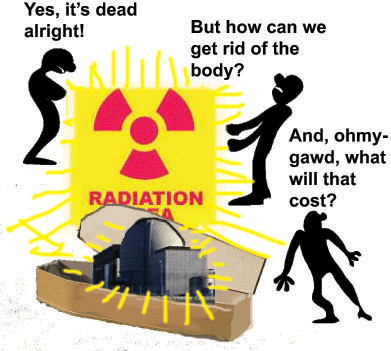
World Nuclear News 9th June 2017, The permanent shutdown of unit 1 of the Kori nuclear power plant has been approved by the South Korea’s nuclear safety regulator. The unit – the country’s oldest operating reactor unit – will be taken offline on 19 June.
Kori 1 is a 576 MWe pressurized water reactor that started commercial operation in 1978. A six-month upgrading and inspection outage at Kori 1 in the second half of 2007 concluded a major refurbishment program and enabled its relicensing for a further ten years. A subsequent relicensing process could have taken Kori 1 to 2027, but Korea Hydro & Nuclear Power (KHNP) announced in August 2015 that it had withdrawn its application to extend the unit’s operating licence. In June last year, the company applied to decommission the reactor. http://www.world-nuclear-news.org/C-Final-shutdown-approaches-for-Koreas-oldest-reactor-0906175.html
Secrecy on highly radioactive uranium in the nuclear waste dump in Parks Township.
Amount of nuclear waste in Parks Township could remain unknown until 2031, TRIB Live, MARY ANN THOMAS | Sunday, June 11, 2017 Secrecy, lack of documentation and inattention to warnings may have led the Army Corps of Engineers to grossly underestimate the amount of highly radioactive uranium in the nuclear waste dump in Parks Township.
1979 Three Mile Island nuclear accident – where to put the radioactive trash?
Extension Sought for Storing Three Mile Island Debris https://www.usnews.com/news/best-states/idaho/articles/2017-06-09/extension-sought-for-idaho-storing-nuclear-meltdown-debris Federal officials requested a 20-year extension involving the storage in Idaho of reactor core debris from the partial meltdown at the Three Mile Island nuclear power plant. June 9, 2017,By KEITH RIDLER, Associated Press BOISE, Idaho (AP) — Federal officials requested a 20-year extension involving the storage in Idaho of reactor core debris from the partial meltdown at the Three Mile Island nuclear power plant.
Planning for new phase in getting rid of Dounreay – UK’s 1950s nuclear reactor complex
BBC 7th June 2017 A planning application is being prepared for a new phase in the decommissioning of the Dounreay nuclear power complex in Caithness.
Buildings on the experimental nuclear energy site, which dates to the 1950s, are being emptied of radioactive material and demolished. Starting in 2018, the planned next stage would involve dismantling reactors.
New temporary buildings would also need to be built to aid the new phase. The new buildings would include facilities for handling the clean up and demolition of areas of the site called the Silo and The Shaft. Also included are plans for restoration and landscaping work to restore areas of land to close to how they looked before the construction of Dounreay. The phase would take the site near Thurso to what is called its interim end state. Dounreay Site Restoration Limited has notified Highland Council that it expects to submit the planning application later this year.
http://www.bbc.co.uk/news/uk-scotland-highlands-islands-40188815
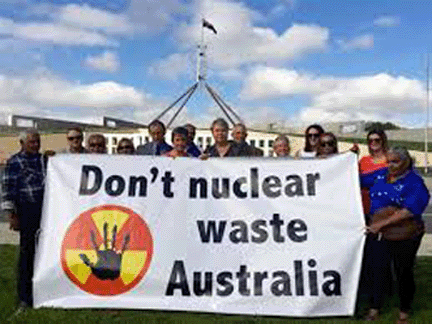
South Australia’s plan to import nuclear wastes is now dead in the water
![]()
Nuclear dump idea dead in SA June 7, 2017 Australian Associated Press, news.com.au
Conservation groups have welcomed Premier Jay Weatherill’s move to abandon any plans to establish a high-level nuclear waste dump in South Australia. The premier has indicated the government won’t now proceed to hold a referendum on the issue, even if it is returned at next year’s state election.
Conservation SA chief executive Craig Wilkins says it’s great news the dump is dead. “This is a win for the many South Australians who stood up and demanded a better option for our state than as a home for the world’s radioactive waste,” Mr Wilkins said.
The state government floated the idea of SA having an increased involvement in the nuclear fuel cycle after the last state election and held a royal commission into the idea. The commission recommended the state consider building a high-level dump to earn billions of dollars by taking the world’s nuclear waste, while a citizen’s jury firmly rejected that proposal late last year.
At the time Mr Weatherill indicated the government would still put the question to a referendum at some time in the future.
But asked about the future of a dump at a community cabinet meeting earlier this week he declared the idea “dead”.
“There’s no foreseeable opportunity for this,” he said. The premier later reaffirmed Labor had dropped the proposal, telling internet news site InDaily that it was not something that would be progressed by Labor if the government was returned in March.
“This is great news. We are delighted the premier has announced that he has no intention to re-visit the divisive debate on a global nuclear waste dump,” Mr Wilkins said… http://www.news.com.au/national/breaking-news/nuclear-dump-idea-dead-in-sa/news-story/c4c10d44ab0ac71056efd337cfbb0244
Dangerous cargo of radioactive trash flying from Scotland to South Carolina
Toxic cargo of nuclear waste leaves Scotland for US under armed guard https://www.sundaypost.com/fp/toxic-cargo-of-nuclear-waste-leaves-for-us/ Jim Lawson, 04 June 2017 AN American military plane carrying a deadly cargo of radioactive waste has taken off from Scotland for the second time.
Serious flaws in the spent fuel pools method of storing nuclear radioactive trash
Facing South 2nd June 2017, As the United States continues to grapple with long-term storage of highly radioactive spent fuel from the nation’s nuclear power plants, science watchdogs are warning of serious flaws with the current storage method, which involves densely packing the combustible spent fuel assemblies under at least 20 feet of water in pools located at individual plants while awaiting creation of a permanent repository.
https://www.facingsouth.org/2017/06/nuclear-regulators-flawed-analysis-leaves-millions-risk-radioactive-fires
Radioactive waste storage plans
Nuclear Insider 31st May 2017 Holtec’s two-phase licensing approach for its $280 million consolidated interim storage facility (CISF) project in New Mexico allows the company to use recent learnings in U.S. and Ukraine to accelerate approval for all
storage canisters.
In April, Holtec started the second phase of a CISF licensing program which would make it the first company to store all
canisters types currently used at U.S. plants. Holtec and Waste Control Services (WCS) are competing to build the U.S.’ first CISF facility, ahead of a proposed state-owned permanent repository at Yucca Mountain,
Nevada.
There is currently around 78,620 metric tons (MT) of used nuclear fuel stored at decommissioned and active reactor sites across 35 states. The U.S. Department of Energy (DOE) has proposed a pilot facility for consolidated storage be in place by 2021, followed by a larger storage facility by 2025 and a permanent repository by 2048.
Holtec plans to build a $280 million CISF to host 10,000 storage canisters, representing 120,000 MT of spent fuel, between the cities of Carlsbad and Hobbs. The company has launched a two-phased licensing approach, initially seeking to store Areva-supplied 24PT1-DSC canisters using Holtec’s HI-STORM UMAX dry spent fuel storage system. In a second phase, the company will file a series of license amendment requests to include all canisters currently in use at
U.S. plants– supplied by Areva, Pacific Nuclear, Vectra, NAC, Sierra Nuclear and BNFL Solutions & Westinghouse.
http://analysis.nuclearenergyinsider.com/holtec-builds-first-kind-learnings-race-license-us-storage-facility
On costs of decommissioning Fort Calhoun nuclear plant, and on security
Q&A session on Fort Calhoun nuclear plant focuses on cost of decommissioning, security, By Cole Epley / Omaha World-Herald staff writer, Jun 1, 2017
OPPD’s plan to fund dismantling and cleanup of its Fort Calhoun nuclear plant is expected to be sufficient to cover the cost, and the now-closed plant will retain its 24-hour armed security force even after the last building is no longer needed.
That was the message from federal regulators to Omaha Public Power District ratepayers and members of the public Wednesday night at a meeting on decommissioning the reactor. The plant, which closed in October, is 20 miles north of Omaha.
Questions about security — both in terms of armed guards and spent nuclear fuel left on site — and the cost of tearing down and cleaning up the plant were among issues addressed during a question-and-answer session at the Doubletree Hotel in downtown Omaha.
Decommissioning the plant is expected to cost about $1.5 billion in 2016 dollars. By the time the work is completed in some 60 years, the inflation-adjusted cost is expected to be roughly $3 billion…….
Within five years, OPPD will be pulling spent fuel from the storage pool inside one of the buildings and putting it in concrete casks on site. Because the U.S. has no functioning long-term storage site for spent nuclear fuel, the Fort Calhoun site will hold spent fuel in the above-ground casks indefinitely. At least as long as the fuel is there, security guards will be there, the public was told Wednesday.
Significant demolition isn’t expected until the 2050s, once much of the radioactivity at the site has decayed.
Doug Broaddus, head of the NRC branch that oversees plants like Fort Calhoun that are transitioning from operating to decommissioning, said utilities that fall short of the money needed to close their plants generally look to the same place.
“It really goes back to ratepayers,” Broaddus said. http://www.omaha.com/money/q-a-session-on-fort-calhoun-nuclear-plant-focuses-on/article_2e65396e-34b0-59ad-ab20-e80381db1640.html
Canadian company still wants to bury nuclear waste near Lake Huron
http://www.wxyz.com/news/canadian-company-still-wants-to-bury-nuclear-waste-near-lake-huron
As Japan plans reactor startups, its nuclear waste crisis grows

Nuclear storage crisis grows as reactor restarts continue http://www.japantimes.co.jp/news/2017/05/28/national/nuclear-storage-crisis-grows-reactor-restarts-continue/#.WStAvpKGPGg BY ERIC JOHNSTON, TOYAMA – More than six years after the March 11, 2011, Tohoku quake, tsunami, and triple meltdown at the Fukushima No. 1 nuclear power plant, Japan is accelerating efforts to restart as many reactors as it possibly can. Four have been revived so far, and Kansai Electric Power Co. plans to restart the Takahama No. 3 unit soon.
But the rush to restart them has only highlighted the fact that Japan still has no final repository for its high-level radioactive waste. Original plans to first reprocess spent fuel at the Rokkasho facility in Aomori Prefecture before final disposal somewhere else have long been stalled. After 17 years asking prefectures and municipalities around the country to host such a site, no takers have been found.
So the government has changed its approach, saying it will draw up a map by this summer of “scientifically appropriate” candidate sites around the country.
To explain what that means, a series of town hall meetings are taking place at select locations this month and next month.
On May 20, officials from the Agency for Natural Resources and the Nuclear Waste Management Organization of Japan (NUMO) were in Toyama, which is less than 50 km from the Shika nuclear power plant in neighboring Ishikawa Prefecture.
At present, there are about 18,000 tons of spent nuclear fuel stored in about 40,000 canisters at Japan’s nuclear power plants, said NUMO Executive Director Shinichi Ito. A final disposal site for high-level waste produced when, or if, the fuel is reprocessed would need to be quite large. Most of it would be underground, with an elaborate tunnel system of transport vehicles to deliver and store the waste.
“In terms of scale, above-ground facilities at a final depository would be between 1 to 2 sq. km, and the underground portion would be 6 to 10 sq. km in area, located at a depth of more than 300 meters from the surface. There would be some 200 km of tunnels in total for the storage facilities,” Ito said.
Waste would be stored at the site for around a half century. The basic cost for building a final depository is ¥3.7 trillion.
In drawing up the map of what constitutes a scientifically appropriate site, the government has a list of conditions and standards based on what it does not want.
A site should not be built within a 15-km radius of a volcano, and not near active fault lines at least 10 km long. In addition, it should not be situated in area where there is a lot of geothermal activity.
The government is also seeking a site that is within 20 km of a port where ships carrying the waste could dock, since transporting waste by ship, the government says, is the most appropriate method.
Iwao Miyamoto, director of the public relations office of the Agency for Natural Resources’ Radioactive Waste Management Office, said that, after the map is publicized and dialogue takes place with authorities deemed to have appropriate sites, a three-stage survey process would be carried out.
“The first stage would be to research the seismological and geological history of a potential site, checking to see how frequently earthquakes and volcanoes in and around the area have occurred,” Miyamoto said. “The second stage would be on-site drilling to determine how porous the rock bed is, and the third step is a precision survey to determine if the site can handle an underground storage facility.
“The first survey stage is expected to take two years, the second stage four years, and the final stage around 14 years,” he added.
In an attempt to entice the authorities at a chosen site, the central government will offer funding and economic incentives that the municipalities hosting nuclear power plants have long enjoyed.
“NUMO will work with a government that accepts a final storage facility to renovate and expand its roads, ports, and information systems,” Ito said. “There will also be donations for revitalizing the local economy via support for locally produced goods and for local culture.”
However, overcoming local political resistance in an area judged appropriate for a final depository is likely to be a long, difficult road. Nobody wants to be known as the town or village with a nuclear waste dump, and questions remain about the safety of transporting toxic waste by land or by sea.
Some governors in prefectures with many reactors have made it clear they will oppose any effort by the central government or utilities to bury nuclear waste on site or beside the plant that generated it.
“Fukui has accepted nuclear power plants. But it has no obligation to accept final disposal of nuclear waste,” Fukui Gov. Issei Nishikawa said in 2015. Fukui is home to 13 commercial reactors.
“We have our hands full just dealing with the nuclear reactors we have now,” Saga Gov. Yoshinori Yamaguchi said last year, indicating his prefecture would not accept being the site of a final repository. Saga hosts the four reactors at the Genkai plant run by Kyushu Electric. Yamaguchi approved the restart of Genkai units 3 and 4 in April.
Once the map is published, it is sure to galvanize opinion in those places judged appropriate and become a politically delicate topic. Yet with Agency for Natural Resources estimates showing the spent fuel pools of 17 power plants will run out of space within the next 15 years, if run continuously, the problem of final disposal grows more acute with each passing day. Pressure on those areas that fit the requirements for final disposal is likely to be intense.
At this point, though, the central government says that if a local government with a site deemed appropriate by the map still refuses once the survey begins, that will be the end of it.
“If there is official opposition at the local level at any stage of a survey, there would be no advancement to the next stage,” Miyamoto said.
However, given all of the problems Japan has had trying to make its reprocessing program work, critics say that attempting to draw up a plan for a final repository is a pipe dream.
” The Japanese government knows the current final nuclear waste repository program will never materialize. The whole project depends upon the creation of high-level waste canisters, i.e. the reprocessing of spent nuclear fuel. But t he program also depends on Japan recovering and consuming tons and tons of plutonium
” The Rokkasho reprocessing plant’s commercial operation has been delayed 23 times, and the fast reactor program to consume the plutonium is at square one de spite over a half century of effort,” said Aileen Mioko Smith of Kyoto-based Green Action.
With UK terror threat raised, decommissioning continues as normal at Dounreay nuclear site
Decommissioning continues as normal at Dounreay under heightened response rate, John O’Groat Journal, 26 May 17, DOUNREAY said decommissioning work is continuing as normal as the UK terror threat level has been raised to critical.
Prime Minister Theresa May announced on Tuesday night the threat level was raised from severe to critical, the highest possible level after the Manchester Arena bombing on Monday night.
Critical level means an attack is expected imminently in the UK.
A spokeswoman at Dounreay has announced the site is operating at a heightened response rate but work continues as normal.
She said: “Security at Dounreay and other sites owned by the Nuclear Decommissioning Authority is kept under continuous review.
“The site is continuing to operate at a “heightened” response state and decommissioning work is continuing as normal….http://www.johnogroat-journal.co.uk/News/Decommissioning-continues-as-normal-at-Dounreay-under-heightened-response-rate-24052017.htm
A predictable nuclear accident at Hanford
A predictable nuclear accident at Hanford http://thebulletin.org/predictable-nuclear-accident-hanford10774, Hugh Gusterson, May 17 Last week’s accident at the Hanford Nuclear Reservation should have come as no surprise.
On May 9, workers discovered a 20-foot-diameter hole where the roof had collapsed on a makeshift nuclear waste site: a tunnel, sealed in 1965, encasing old railroad cars and equipment contaminated with radiation through years of plutonium processing. Potential radiation levels were high enough that some workers were told to shelter in place while others donned respirators and protective suits as they repaired the hole.
The Hanford complex, which dates back to 1943, produced the plutonium for the atomic bomb dropped on Nagasaki. Half the size of Rhode Island, it is often described as the most contaminated place in the United States. Until its last reactor closed in 1987, it churned out plutonium for the roughly 70,000 nuclear weapons the United States built during the Cold War. As the historian Kate Brown documents in her book Plutopia, which explores the uncanny similarities between Hanford and its Soviet counterpart Ozersk, Hanford has been a slow-motion environmental disaster since its opening, constantly excreting radioactive contaminants into the air and water.
More dangerous than the tunnels are the giant tanks of liquid nuclear waste: 177 of them containing 56 million gallons of radioactive soup whose composition is only approximately known. The contents of some have to be stirred periodically to prevent the formation of hydrogen bubbles that would cause the tanks to explode. One million gallons of this witches’ brew have already leaked into the groundwater from tanks that were built to last only 20 years. The US government projects that it will cost more than $107 billion to clean up the site, with remediation finished by 2060. Few knowledgeable people put much credence in either number. Continue reading
In Greenland, abandoned nuclear base could be unearthed by global warming
Climate Change Could Uncover An Abandoned Arctic Nuclear Base, HuffPost Canada | By Sarah Rieger, 05/25/2017
Climate change is causing record levels of ice to disappear from the Arctic, and the melt is unearthing something that was supposed to stay buried for centuries — an abandoned U.S. nuclear base.
The US army’s top secret arctic city Under the Ice! “Camp Century” Restored Classified Film
Camp Century was built in Greenland in 1959 during the peak of the Cold War. The subterranean base held between 85 and 200 soldiers year-round. The base was built under the pretense that it would be a centre for scientific experiments on the icecap and a space to test construction techniques in Arctic conditions.
The base was really part of “Project Iceworm,” a top secret U.S. army program that intended to build a network of missile launch sites under the ice sheet.
The camp was essentially a small town under the ice. When abandoned in 1967, the trenches and buildings — including houses, a town store and even a hospital — were left behind, too.
The engineers stationed there also abandoned a nuclear generator that was “minimally” decommissioned, as they assumed it would be “‘preserved for eternity‘ by perpetual snowfall,” according to a 2016 study by Geophysical Research Letters. Other than the nuclear reaction chamber, all of the infrastructure and nuclear waste at the site was left intact.
The researchers weren’t totally off-base with their belief that the site wouldn’t melt. The camp was established on what’s known as the “dry snow zone” of the Greenland ice sheet, where almost no surface melting was known to occur at the time.
According to NASA’s Earth Science Communications Team, geoscientists in the ’60s believed that the climate could only change on a large timescale, over thousands of years. It wasn’t until 1979 that it was proven that increased carbon dioxide in the atmosphere would result in significant negative changes to the earth’s climate.
Climate change is hitting the Arctic hard. Surface ice melt in Northern Canada grew by 900 per cent between 2005 and 2015, a recent study found, and melting glaciers have begun to release pollutants like DDT and PCBs into the environment.
If the ice melts at Camp Century, it will release an abundance of PCBs as well as other physical, chemical, biological and radiological wastes (including thousands of barrels of diesel) that could eventually be swept to Canada through the same Arctic currents that bring spectacular icebergs to Newfoundland’s coast every year……..http://www.huffingtonpost.ca/2017/05/23/climate-change-arctic_n_16792324.html
Trump’s new budget would slash spending on cleaning up Hanford
Hanford Nuclear Cleanup Budget Slashed in Energy Proposal, Bloomberg Business, By Chuck McCutcheon, 25 May 17 Washington state’s Hanford Nuclear Reservation, scene of a recent collapse of a tunnel containing nuclear waste, would see its funding slashed under President Donald Trump’s new budget proposal…..
Trump’s budget blueprint calls for reducing cleanup at Hanford from $921 million to $716 million, a 22 percent reduction. That comes as the budget proposes to boost overall departmental defense-related environmental cleanup of materials from $5.28 billion to $5.54 billion.
Hanford Cleanup Needed
Washington state’s congressional delegation, including Democratic Sens. Patty Murray and Maria Cantwell, long have pressed various administrations to commit to cleaning up Hanford. The site in eastern Washington has milllons of gallons of highly radioactive wastes stored in 177 aging underground tanks, some of which have leaked.
“Previous administrations and Congress have repeatedly supported the legal and moral obligation of the federal government to clean up the Hanford site, and we urge you to continue this important work to protect health and safety,” the two senators and Rep. Dan Newhouse (R-Wash.) said in a May 19 letter to Perry.
The Hanford tunnel, containing radioactive wastes that were byproducts of producing plutonium for nuclear weapons, partially collapsed on May 9, prompting nearby workers to evacuate. A worker’s clothing also was exposed to radioactive contamination in what Washington Gov. Jay Inslee (D) called an “alarming incident.”…. https://www.bna.com/hanford-nuclear-cleanup-n73014451452/
-
Archives
- September 2026 (323)
- August 2026 (330)
- July 2026 (355)
- June 2026 (287)
- May 2026 (306)
- April 2026 (356)
- March 2026 (251)
- February 2026 (267)
- January 2026 (308)
- December 2025 (358)
- November 2025 (359)
- October 2025 (375)
-
Categories
- 1
- 1 NUCLEAR ISSUES
- business and costs
- climate change
- culture and arts
- ENERGY
- environment
- health
- history
- indigenous issues
- Legal
- marketing of nuclear
- media
- opposition to nuclear
- PERSONAL STORIES
- politics
- politics international
- Religion and ethics
- safety
- secrets,lies and civil liberties
- spinbuster
- technology
- Uranium
- wastes
- weapons and war
- Women
- 2 WORLD
- ACTION
- AFRICA
- Atrocities
- AUSTRALIA
- Christina's notes
- Christina's themes
- culture and arts
- Events
- Fuk 2022
- Fuk 2023
- Fukushima 2017
- Fukushima 2018
- fukushima 2019
- Fukushima 2020
- Fukushima 2021
- general
- global warming
- Humour (God we need it)
- Nuclear
- RARE EARTHS
- Reference
- resources – print
- Resources -audiovicual
- Weekly Newsletter
- World
- World Nuclear
- YouTube
-
RSS
Entries RSS
Comments RSS