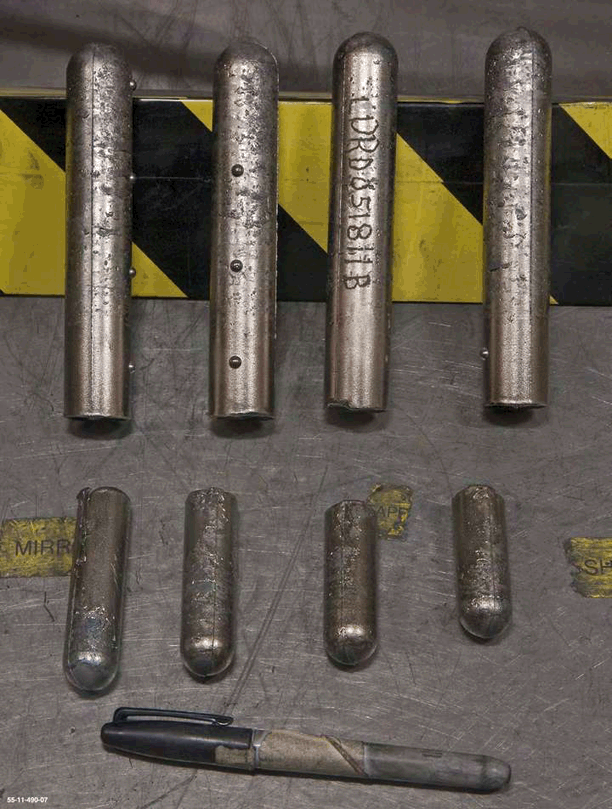
More than three decades ago, Congress banned American industries and localities from disposing of hazardous waste in these sorts of “open burns,’’ concluding that such uncontrolled processes created potentially unacceptable health and environmental hazards.
That exemption has remained in place ever since, even as other Western countries have figured out how to destroy aging armaments without toxic emissions.
Federal environmental regulators have warned for decades that the burns pose a threat to soldiers, contractors and the public stationed at, or living near, American bases.
“They are not subject to the kind of scrutiny and transparency and disclosure to the public as private sites are,”

 How The Pentagon’s Handling Of Munitions And Their Waste Has Poisoned America
Many nations have destroyed aging armaments without toxic emissions. The U.S., however, has poisoned millions of acres. Huffington Post, 20/07/2017 Co-published with ProPublica 20 July 17 RADFORD, Va. — Shortly after dawn most weekdays, a warning siren rips across the flat, swift water of the New River running alongside the Radford Army Ammunition Plant. Red lights warning away boaters and fishermen flash from the plant, the nation’s largest supplier of propellant for artillery and the source of explosives for almost every American bullet fired overseas.
Along the southern Virginia riverbank, piles of discarded contents from bullets, chemical makings from bombs, and raw explosives — all used or left over from the manufacture and testing of weapons ingredients at Radford — are doused with fuel and lit on fire, igniting infernos that can be seen more than a half a mile away. The burning waste is rich in lead, mercury, chromium and compounds like nitroglycerin and perchlorate, all known health hazards. The residue from the burning piles rises in a spindle of hazardous smoke, twists into the wind and, depending on the weather, sweeps toward the tens of thousands of residents in the surrounding towns.
Nearby, Belview Elementary School has been ranked by researchers as facing some the most dangerous air-quality hazards in the country. The rate of thyroid diseases in three of the surrounding counties is among the highest in the state, provoking town residents to worry that emissions from the Radford plant could be to blame. Government authorities have never studied whether Radford’s air pollution could be making people sick, but some of their hypothetical models estimate that the local population faces health risks exponentially greater than people in the rest of the region.
More than three decades ago, Congress banned American industries and localities from disposing of hazardous waste in these sorts of “open burns,’’ concluding that such uncontrolled processes created potentially unacceptable health and environmental hazards. Companies that had openly burned waste for generations were required to install incinerators with smokestacks and filters and to adhere to strict limits on what was released into the air. Lawmakers granted the Pentagon and its contractors a temporary reprieve from those rules to give engineers time to address the unique aspects of destroying explosive military waste.
That exemption has remained in place ever since, even as other Western countries have figured out how to destroy aging armaments without toxic emissions. While American officials are mired in a bitter debate about how much pollution from open burns is safe, those countries have pioneered new approaches. Germany, for example, destroyed hundreds of millions of pounds of aging weapons from the Cold War without relying on open burns to do it.
In the United States, outdoor burning and detonation is still the military’s leading method for dealing with munitions and the associated hazardous waste. It has remained so despite a U.S. Senate resolution a quarter of a century ago that ordered the Department of Defense to halt the practice “as soon as possible.” It has continued in the face of a growing consensus among Pentagon officials and scientists that similar burn pits at U.S. bases in Iraq and Afghanistan sickened soldiers.
Federal records identify nearly 200 sites that have been or are still being used to open-burn hazardous explosives across the country. Some blow up aging stockpile bombs in open fields. Others burn bullets, weapons parts and — in the case of Radford — raw explosives in bonfire-like piles. The facilities operate under special government permits that are supposed to keep the process safe, limiting the release of toxins to levels well below what the government thinks can make people sick. Yet officials at the Environmental Protection Agency, which governs the process under federal law, acknowledge that the permits provide scant protection.
Consider Radford’s permit, which expired nearly two years ago. Even before then, government records show, the plant repeatedly violated the terms of its open burn allowance and its other environmental permits. In a typical year, the plant can spew many thousands of pounds of heavy metals and carcinogens — legally — into the atmosphere. But Radford has, at times, sent even more pollution into the air than it is allowed. It has failed to report some of its pollution to federal agencies, as required. And it has misled the public about the chemicals it burns. Yet every day the plant is allowed to ignite as much as 8,000 pounds of hazardous debris.
“It smells like plastic burning, but it’s so much more intense,” said Darlene Nester, describing the acrid odor from the burns when it reaches her at home, about a mile and a half away. Her granddaughter is in second grade at Belview. “You think about all the kids.”
Internal EPA records obtained by ProPublica show that the Radford plant is one of at least 51 active sites across the country where the Department of Defense or its contractors are today burning or detonating munitions or raw explosives in the open air, often in close proximity to schools, homes and water supplies. The documents — EPA PowerPoint presentations made to senior agency staff — describe something of a runaway national program, based on “a dirty technology” with “virtually no emissions controls.” According to officials at the agency, the military’s open burn program not only results in extensive contamination, but “staggering” cleanup costs that can reach more than half a billion dollars at a single site.
The sites of open burns — including those operated by private contractors and the Department of Energy — have led to 54 separate federal Superfund declarations and have exposed the people who live near them to dangers that will persist for generations.
In Grand Island, Nebraska, groundwater plumes of explosive residues spread more than 20 miles away from the Cornhusker Army Ammunition Plant into underground drinking water supplies, forcing the city to extend replacement water to rural residents. And at the Redstone Arsenal, an Army experimental weapons test and burn site in Huntsville, Alabama, perchlorate in the soil is 7,000 times safe limits, and local officials have had to begin monitoring drinking water for fear of contamination.
Federal environmental regulators have warned for decades that the burns pose a threat to soldiers, contractors and the public stationed at, or living near, American bases. Local communities – from Merrimac, Wisconsin, to Romulus, New York – have protested them. Researchers are studying possible cancer clusters on Cape Cod that could be linked to munitions testing and open burns there, and where the groundwater aquifer that serves as the only natural source of drinking water for the half-million people who summer there has been contaminated with the military’s bomb-making ingredients……..
ProPublica reviewed the open burns and detonations program as part of an unprecedented examination of America’s handling of munitions at sites in the United States, from their manufacture and testing to their disposal. We collected tens of thousands of pages of documents, and interviewed more than 100 state and local officials, lawmakers, military historians, scientists, toxicologists and Pentagon staff. Much of the information gathered has never before been released to the public, leaving the full extent of military-related pollution a secret.
“They are not subject to the kind of scrutiny and transparency and disclosure to the public as private sites are,” said Mathy Stanislaus, who until January worked on Department of Defense site cleanup issues as the assistant administrator for land and emergency management at the EPA.
Our examination found that open burn sites are just one facet of a vast problem. From World War I until today, military technologies and armaments have been developed, tested, stored, decommissioned and disposed of on vast tracts of American soil. The array of scars and menaces produced across those decades is breathtaking: By the military’s own count, there are 39,400 known or suspected toxic sites on 5,500 current or former Pentagon properties. EPA staff estimate the sites cover 40 million acres — an area larger than the state of Florida — and the costs for cleaning them up will run to hundreds of billions of dollars.
The Department of Defense’s cleanups of the properties have sometimes been delegated to inept or corrupt private contractors, or delayed as the agency sought to blame the pollution at its bases on someone else. Even where the contamination and the responsibility for it are undisputed, the Pentagon has stubbornly fought the EPA over how much danger it presents to the public and what to do about it, letters and agency records show.
Chapter 1. Rules With Exceptions……..
Chapter 2. Debating the Dangers…….
Chapter 3. Awakening to Threats…….
Chapter 4. Risks and Choices……. alternatives only seem to be deployed after communities have mobilized to fight the burning with a vigor that has proven elusive in many military towns. “Sometimes it’s easier for everybody to just lie low and keep doing what they are doing,” Hayes added. “Short term thinking is the problem. In the immediate, it costs them nothing to keep burning.”
The success in Louisiana could be the start of a shift in momentum. In the 2017 Defense Department funding bill, Sen. Mitch McConnell, the majority leader, supported an amendment ordering the National Academy of Sciences to evaluate alternatives to open burning. ………
For Devawn Bledsoe, the foot dragging and decades of delay have led to profound disillusionment. For a long time, she thought her responsibility was to bring light to the issue. Now she thinks it takes more than that. “There’s something so immoral about this,” she said. “I really thought that when enough people in power — the Army, my Army — understood what was going on, they would step in and stop it.”
“It’s hard to see people who ought to know better look away.”
Nina Hedevang, Razi Syed and Alex Gonzalez, students in the NYU Arthur L. Carter Journalism Institute graduate studies program, contributed reporting for this story. Other students in the program who also contributed were Clare Victoria Church, Lauren Gurley, Clare Victoria Church, Alessandra Freitas and Eli Kurland. http://www.huffingtonpost.com.au/entry/open-burns-ill-winds_us_5970112de4b0aa14ea770b08
July 21, 2017
Posted by Christina Macpherson |
investigative journalism, Reference, USA, wastes, weapons and war |
Leave a comment
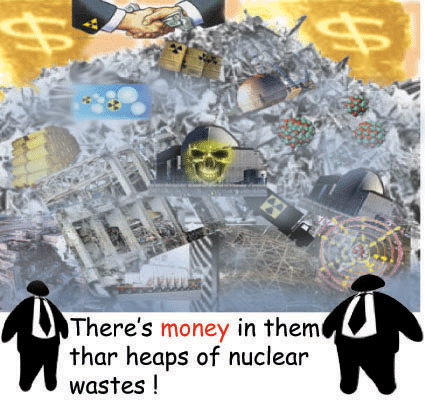
NDA 19th July 2017, The Nuclear Provision is the best estimate of how much it will cost to clean up 17 of the UK’s earliest nuclear sites over a programme lasting around 120 years. The 2017 forecast is that future clean-up across the UK will cost around £119 billion spread across the next 120 years or so. This is broadly unchanged (increased by £2bn) from the previous year’s estimate.
https://www.gov.uk/government/publications/nuclear-provision-explaining-the-cost-of-cleaning-up-britains-nuclear-legacy/nuclear-provision-explaining-the-cost-of-cleaning-up-britains-nuclear-legacy
July 21, 2017
Posted by Christina Macpherson |
UK, wastes |
Leave a comment

Burying the atom: Europe struggles to dispose of nuclear waste Political opposition, not technical hurdles, poses biggest challenge to finding permanent storage sites for deadly radioactive material.
Politico, By KALINA OROSCHAKOFF AND MARION SOLLETTY, 7/19/17, URE, France — Half a kilometer underground in floodlit tunnels, a French government lab is testing the safety of a site intended to hold 80,000 cubic meters of deadly radioactive waste.
Crews drill barrel-sized openings into the sides of the shafts, dug deep into the earth not far from the small town of Bure, in northeastern France. The containers will have to be retrievable for a century, in case better technologies for dealing with radioactive materials are developed. Barring such a discovery, the idea is for the waste to spend the next 100,000 years underground.
The technical hurdles will be the easy bit. Far more difficult for France’s radioactive waste management agency, Andra, will be overcoming political opposition to the construction of the site — of any site — intended to serve as the final resting place for tons of radioactive waste.
Six decades after the construction of the first wave of nuclear power plants, no country has opened a permanent storage site. Spent nuclear fuel and other contaminated material — deadly byproducts of electricity generation — remain stockpiled in temporary locations around Europe and the world, sometimes alongside the reactors where they were used.
The problem is only getting more urgent as power plants across the world near the end of their lives and Western Europe cuts back on nuclear electricity generation.
In the EU alone, more than 50 of the 129 reactors currently in operation could shut down by 2025, Energy and Climate Action Commissioner Miguel Arias Cañete said recently. “These reactors will need to be decommissioned, and the radioactive waste generated in this process will need to be safely managed.”
The stakes are less technical than political. The dispute goes to the heart of a running debate over the sustainability of nuclear power. Failing to resolve it would leave the industry vulnerable to its critics, who argue that the technology is so inherently risky — and dirty — that it cannot be relied on to generate electricity, even to combat climate change.
The European Commission is keen to hurry countries along. On July 13, it escalated an infringement procedure against Austria, Croatia, the Czech Republic, Italy and Portugal, pushing them to fully comply with the bloc’s radioactive waste rules and inform Brussels of their national nuclear waste management programs, which were originally due by August 23, 2015. Only Finland, set to open the world’s first final repository early in the next decade, has a plan it can implement.
Experts agree that today’s stop-gap solutions are unsustainable — and more dangerous than building long-term depositories deep underground where radioactive material can spend tens of thousands of years decaying, protected from natural disasters and out of reach of criminals and terrorists………
The issue is a headache for Nicolas Hulot, France’s new environment minister and a former green campaigner, who is part of the government that will have to give the final approval for the site. France is scaling back nuclear from 75 percent of power production to 50 percent by 2025, but it will still need to find a permanent storage site for the waste its plants produce.
Hulot expressed concerns about the site in Bure in 2016. “We can’t impose [such a project] on a local population just because they live in a remote area, without consulting them, without transparency,” he said on French TV.
On June 2, anti-nuclear campaigners wrote an open letter to Hulot asking him to stop the project. Since taking office, he has mostly kept quiet about the subject, but in a recent interview with Ouest-France, a regional newspaper, he vowed to ensure the waste will be stored with “absolute safety.”
The project still faces serious safety challenges, including fire risks, the French nuclear safety authority concluded in a recent assessment. On July 17, Andra pushed back a self-imposed deadline to submit a formal authorization request for the project by a year, to mid-2019.
Outreach
The government has responded to the protest with careful — and very public — safety tests, and an emphasis on its economic benefits for the region. “The project relies on 20 years of research,” said David Mazoyer, the site’s director. “Every scenario is studied with maximum security margins.” Some tests even involve releasing radioactive particles to track their movement in the surrounding clay.
The government has also splashed cash around — €30 million a year as “accompanying measures” for each of the two districts neighboring the site. “People don’t support the project for free,” said Gérard Longuet, a senator from the region and a key project supporter. “They support it because it boosts the area.”
So far, the effect of the outreach is, at best, mixed.
A 2016 poll commissioned by Andra found that 59 percent of local residents said they trust the agency to manage the site. But 63 percent expressed concerns over safety issues, and 76 percent said they think the project is dangerous for the environment.
“When you are listening to Andra, everything is all fine and rosy,” said Jean-Francois Bodenreider, an anti-nuclear campaigner and local resident. But, “they have no control over this,” said his wife Marie-Eve Bodenreider. An anti-nuclear sign hangs outside their physiotherapy practice in Gondrecourt-le-Château.
The site currently employs 370 people, with construction work foreseen to employ more than 2,000. But opponents say the jobs have yet to materialize. “The only jobs here are for security guards,” said Labat, the local resident and demonstrator. “They are everywhere!”
Birth of a movement
If German history is any guide, the French government will not have an easy time at the Bois Lejuc………..
‘Back on the streets’
German Chancellor Angela Merkel’s decision, after Japan’s 2011 Fukushima disaster, to shutter the country’s last reactor by 2022 has taken some of the wind out of the opposition’s sails.
The challenge facing the anti-nuclear movement now will be “whether you can switch gears from blockade mode to having a constructive argument about how to best deal with the final storage issue,” Harms said…….. http://www.politico.eu/article/europes-radioactive-problem-struggles-dispose-nuclear-waste-french-nuclear-facility/
July 21, 2017
Posted by Christina Macpherson |
EUROPE, wastes |
Leave a comment
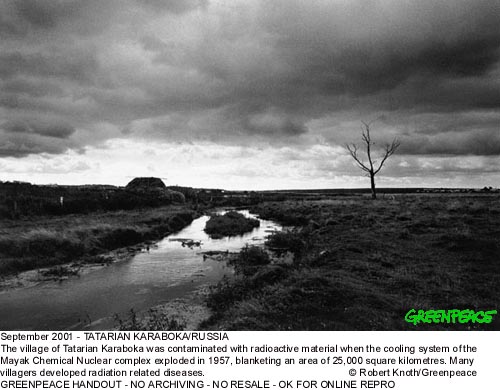
 Russia’s nuclear nightmare flows down radioactive river, http://www.concordmonitor.com/Russia-s-nuclear-nightmare-flows-down-radioactive-
 river-1834751 Monitor, By KATHERINE JACOBSEN Associated Press. Friday, April 29, 2016 At first glance, Gilani Dambaev looks like a healthy 60-year-old man and the river flowing past his rural family home appears pristine. But Dambaev is riddled with diseases that his doctors link to a lifetime’s exposure to excessive radiation, and the Geiger counter beeps loudly as a reporter strolls down to the muddy riverbank.
Some 30 miles upstream from Dambaev’s crumbling village lies Mayak, a nuclear complex that has been responsible for at least two of the country’s biggest radioactive accidents. Worse, environmentalists say, is the facility’s decades-old record of using the Arctic-bound waters of the Techa River to dump waste from reprocessing spent nuclear fuel, hundreds of tons of which is imported annually from neighboring nations
At first glance, Gilani Dambaev looks like a healthy 60-year-old man and the river flowing past his rural family home appears pristine. But Dambaev is riddled with diseases that his doctors link to a lifetime’s exposure to excessive radiation, and the Geiger counter beeps loudly as a reporter strolls down to the muddy riverbank.
Some 30 miles upstream from Dambaev’s crumbling village lies Mayak, a nuclear complex that has been responsible for at least two of the country’s biggest radioactive accidents. Worse, environmentalists say, is the facility’s decades-old record of using the Arctic-bound waters of the Techa River to dump waste from reprocessing spent nuclear fuel, hundreds of tons of which is imported annually from neighboring nations.
The results can be felt in every aching household along the Techa, where doctors record rates of chromosomal abnormalities, birth defects and cancers vastly higher than the Russian average – and citizens such as Dambaev are left to rue the government’s failure over four decades to admit the danger.
“Sometimes they would put up signs warning us not to swim in the river, but they never said why,” said Dambaev, a retired construction worker who like his wife, brother, children and grandchildren have government-issued cards identifying them as residents of radiation-tainted territory. “After work, we would go swimming in the river. The kids would too.”
Thousands already have been resettled by Russia’s Rosatom State Atomic Energy Corp. to new homes a mile inland from the river, leaving Dambaev’s village of Muslyumovo in a state of steady decay as shops close and abandoned homes are bulldozed. The evacuations began in 2008, two decades after Russia started to admit disasters past and present stretching from Mayak’s earliest days in the late 1940s as the maker of plutonium for the first Soviet atomic bombs.
The question, 30 years after the former Soviet Union’s greatest nuclear disaster in Chernobyl, is whether Mayak is truly cleaning up its act or remains primed to inflict more invisible damage on Russians. Nuclear regulators say waste no longer reaches the river following the last confirmed dumping scandal in 2004, but anti-nuclear activists say it’s impossible to tell given the level of state secrecy.
Vladimir Slivyak, an activist for the Russian environmentalist group EcoDefense, has visited villages downstream from Mayak many times to help document the poor health of locals in the area, 870 miles east of Moscow near Russia’s border with Kazakhstan.
“My opinion is they’re still dumping radioactive waste,” he said, “but proving that is impossible unless Mayak says: ‘Yes, we’re dumping radioactive waste.’“
The Nuclear Safety Institute at the Russian Academy of Sciences, which oversees safety standards for the country’s nuclear industry, told the AP that Mayak’s nuclear waste processing system presents no danger to the surrounding population. The plant also manufactures a range of radioactive isotopes of use for specialist equipment, medical research and cancer treatments that generate lucrative contracts worldwide.
Rosatom spokesman Vladislav Bochkov, in response to several Associated Press requests seeking an interview to discuss Mayak’s safety standards and operations, sent an email Thursday denying Mayak dumps nuclear waste in the river. Bochkov said the complex “follows all the environmental protection guidelines and has all the approvals it needs for operation.”
“The level of pollution in the Techa River today completely complies with the sanitary standards of the Russian Federation,” he wrote. He said the river water is clean: “You can drink it endlessly.”
But when the AP took a Geiger counter to the riverbank outside Dambaev’s home, the meter reading surged at the water line and the machine began beeping loudly and continuously. Measurements ranged from 8.5 to 9.8 microsieverts — 80 to 100 times the level of naturally occurring background radiation. A typical chest X-ray involves a burst of about 100 microsieverts.
Nuclear Safety Institute member Leonid Bolshov bills these levels as safe, saying: “The level of pollution in the water today is incomparably less to what it used to be.”
What it used to be is pretty bad. Environmentalists estimate that Mayak tossed 76 million cubic meters (2.68 billion cubic feet) of untreated waste — enough to fill more than 30,000 Olympic-sized swimming pools — into the river from 1948 to the mid-1950s as nuclear scientists scrambled to catch up to the U.S. nuclear program.
In September 1957, underground storage tanks of overheating nuclear waste exploded, sending a cloud of nuclear fallout 300 kilometers (200 miles) northeast across 217 towns and villages containing 272,000 people, a minority of which were quietly evacuated over the following two years.
A decade later, a nearby lake used to dispose of nuclear waste dried up amid a summer drought, and high winds whipped the exposed powdery residue to many of the same population centers. Greenpeace estimates the fallout reached 68 towns and villages containing 42,000 people.
Russia suppressed all news of both disasters until the late 1980s, when it acknowledged the two accidents and the Mayak site’s very existence.
In 1993, Russia said the two accidents combined with longer-term dumping of waste into the river meant that an estimated 450,000 people had been exposed to excess radiation from Mayak. It offered no breakdown of immediate deaths, accelerated deaths or increased rates of illness and disease in the populace.
A 2005 criminal case against Mayak’s then-director, Vitaly Sadovnikov, revealed that the plant continued to dump at least 30 million cubic meters (1 billion cubic feet) of untreated nuclear waste into the river from 2001 to 2004. Prosecution documents said the dumping quadrupled the volume of the radioactive isotope strontium-90 in the river.
A study by Greenpeace in 2007, citing hospital records and door-to-door surveys of Muslyumovo residents, reported cancer rates 3.6 times higher than the Russian national average. Russian scientists have reported residents suffer 25 times more genetic defects than the general population.
A decades-long Radiation Research Society study of people living near the Techa River conducted jointly by Russian and American scientists has linked radiation particularly to higher rates of cancer of the uterus and esophagus. In their latest 2015 report, the scientists analyzed 17,435 residents born before 1956, among them 1,933 with cancer. They found that the vast majority of residents had accumulated heightened deposits of strontium-90 in their bones and such “radiation exposure has increased the risks for most solid cancers.”
Such figures come as no surprise to one of Muslyumovo’s longest-serving doctors, Gulfarida Galimova, a gynecologist and family general practitioner who started work in the village’s hospital in 1981. Galimova says she was immediately struck by the exceptional volume of pediatric emergencies involving miscarriages, early and still births, and newborns with malformed limbs and other defects.
Still, like others she did not know Mayak —unmarked on any map at the time and still off-limits to the public today — even existed. She recalls 1980s mornings of blissful ignorance washing her hair in the deceptively soft waters of the Techa.
“The water was nice and not calcified. Soft water. Your hair would be so fluffy,” Galimova recalled.
She was among some 280 households that accepted Rosatom’s offer to abandon their homes in Muslyumovo for new two-story homes away from the river in what today is called New Muslyumovo. But her 2012 move came too late for her own family. A son born in the village in 1985, and a grandson born last year, both have birth defects that she blames on Mayak radiation. Her son has a club foot; her grandson has heart deformities.
One of her neighbors in New Muslyumovo, with its rows of pastel yellow homes with red roofs, blames the new location for her family’s health problems. Alfia Batirshina, 28, says a radon deposit beneath the topsoil of the new settlement gives her chronic headaches and her 8-year-old daughter recurring nosebleeds.
She is loath to discuss her daughter’s own birth defect, a deformed leg, and keeps her out of view of journalists. Her 62-year-old father, Vakil Batirshin, struggles to say anything at all. His neck is painfully swollen from lymph nodes that have grown triple their normal size, leaving his words nearly unintelligible.
The homemaker says she and neighbors are resigned to their medical fate living in Mayak’s nuclear shadow.
“I don’t hope for anything anymore,” she said. “If we get sick, we get sick.” Associated Press reporters Iuliia Subbotovska in Muslyumovo, Jim Heintz in Moscow and Shawn Pogatchnik in Dublin contributed to this story.
July 19, 2017
Posted by Christina Macpherson |
environment, Reference, Russia, wastes |
Leave a comment
 ANTI-NUCLEAR GROUP DOUBTS VERMONT YANKEE CLEANUP PLAN, VTDIGGER,JUL. 9, 2017, 4:17 PM BY MIKE FAHER BRATTLEBORO – The company that wants to buy Vermont Yankee hasn’t properly assessed the plant for radiological contamination and “cannot know” the true cleanup cost, a Brattleboro anti-nuclear group contends.
The New England Coalition, in new filings with the Nuclear Regulatory Commission, seeks to intervene in the federal review of Vermont Yankee’s proposed sale to NorthStar Group Services.
One of the coalition’s biggest concerns mirrors worries that have been previously expressed by Vermont officials: that NorthStar could run into unforeseen problems and run out of money before finishing decommissioning.
NorthStar “cannot reasonably assure that it has adequate financial resources to own and operate Vermont Yankee for the purpose of decommissioning and fuel storage,” wrote Ray Shadis, a New England Coalition technical adviser…….
NorthStar has promised to clean up the majority of the site no later than 2030. That would make the property available for redevelopment much sooner, but some have expressed skepticism about the company’s ability to follow through.
That sentiment has spilled over to the NRC’s review of NorthStar’s plans.
In documents filed last month with the Atomic Safety and Licensing Board – an independent judicial body of the NRC – Vermont officials declared there is “significant risk” in NorthStar’s proposal due to “numerous, thus-far-unanalyzed health, safety and environmental concerns.”
State officials focused on financial issues, arguing that unexpected contamination, complications related to long-term spent fuel storage, and other issues could drastically drive up decommissioning costs.
Like Vermont officials, the New England Coalition is asking the Atomic Safety and Licensing Board for intervention status and a hearing in connection with the Vermont Yankee license transfer. The coalition offers two main contentions.
First, Shadis says the license transfer application is incomplete because it does not offer any environmental impact statement or “any substantive and reliable information about the varieties, quantities, depth and extent of radiological contamination.”
Shadis is critical of what he calls the NRC’s “tunnel vision” approach to NorthStar’s application.
He says the scope of NorthStar’s decommissioning proposal is far greater than a standard license transfer application. Instead, NorthStar is pitching “an untested method of managing decommissioning under new and unanalyzed circumstances.”……..https://vtdigger.org/2017/07/09/anti-nuclear-group-doubts-vermont-yankee-cleanup-plan/
July 17, 2017
Posted by Christina Macpherson |
decommission reactor, USA |
Leave a comment
 A press release received from Magnox confirms “the former Bradwell
nuclear power station has now successfully dealt with all of its Fuel
Element Debris (FED) waste – a major source of intermediate level
radioactive waste at the Essex site.
This is an important step towards itsplanned closure, as part of the Nuclear Decommissioning Agency’s (NDA)
mission to clean up and decommission the UK’s earliest nuclear sites.”
Three years of potential damage to our estuary ecosystem has finally
finished with as much controversy now at the end as when the process
started. During those three years BANNG, Mersea Island Environmental
Alliance, Marinet, The Blackwater Guardians, FAB and others have spent a
great deal of time and gone to a great deal of trouble to try to stop FED
dissolution to protect both people and the environment.
Meetings were held with the Environment Agency (EA), who seemed uneasy as to what was
happening at Bradwell. FED dissolution was highlighted in the media and
complaints lodged both in the UK and European Parliaments. BANNG organised
a Public Meeting in West Mersea in June, 2014, at which an expert in Marine
Biology explained his concerns about the release of FED effluent into the
Blackwater and at which the large audience made clear its opposition.
BANNG believes that the real reason the treatment project has ended now is that
the original analysis of the FED was wrong. Only a third of the 200 tonnes
total waste ie 65 tonnes could actually be processed. The other two-thirds
were comprised of Low-Level Waste (LLW) and have been taken to Drigg for
disposal.
This raises the question of whether the FED was properly characterised before it was decided to use an expensive and experimentaldissolution process. Peter Bank’s (Town Councillor. Colchester Green
Party) says the process of Fed Dissolution has left a bitter ‘taste’ of
potentially radioactive sludge in the Blackwater estuary.
Mersea Island Courier 30th June 2017
https://www.facebook.com/TheMerseaIslandCourier/
July 17, 2017
Posted by Christina Macpherson |
UK, wastes |
Leave a comment
Groundwater contaminated with radioactive waste from the decommissioned Hanford nuclear facility in Washington  state is still “flowing freely” into the Columbia River, a program manager with the U.S. Environmental Protection Agency said at a meeting of the Hanford Advisory Board.
Radioactive Waste Still Flooding Columbia River, EPA Says, By Karina Brown, Global Research, July 04, 2017 Courthouse News Service 8 June 2017 KENNEWICK, Wash. (CN) –
The announcement came as part of a five-year review of cleanup measures taken at the Superfund site. Officials with the EPA and the Department of Energy said at a meeting Wednesday that the review showed most of the cleanup actions at Hanford were properly “protective,” meaning the public was shielded from the worst of the site’s estimated 500 million gallons of potentially radioactive waste.
Radioactive sludge in shuttered reactors, contaminated soil in landfill sites and equipment that was once used to refine the uranium that fueled the nuclear bomb dropped on Nagasaki were all properly contained, according to the report.
But there was a glaring exception: groundwater contaminated with hexavalent chromium and strontium-90 was still flowing into the nearby Columbia River, according to a presentation from Mike Cline, director of the Department of Energy’s Soil & Groundwater Division.
“Contaminated in-area groundwater is still flowing freely into the Columbia,” EPA Project Manager Dennis Faulk told members of the board. ……..http://www.globalresearch.ca/radioactive-waste-still-flooding-columbia-river-epa-says/5597591
July 7, 2017
Posted by Christina Macpherson |
USA, wastes, water |
Leave a comment
Globe & Mail 27th June 2017, Former AECL scientists are condemning a plan to build a nuclear waste
facility at the Chalk River site on the Ottawa River, saying it would be
ill-equipped to handle the level of radioactive material planned for it.
The government-owned, private sector-operated Canadian Nuclear Laboratories
(CNL) is proposing to build a $325-million facility to dispose of a large
quantity of low- and intermediate-level waste generated from the demolition
of aging buildings and other contaminated material generated over the past
65 years.
But several former senior scientists who worked there say the CNL
proposal is seriously flawed and represents a threat to human health and
the environment.
https://www.theglobeandmail.com/news/politics/scientists-decry-plan-for-ontario-nuclear-waste-site/article35482638/
July 7, 2017
Posted by Christina Macpherson |
Canada, wastes |
Leave a comment
Russia begins cleaning up the Soviets’ top-secret nuclear waste dump https://www.theguardian.com/environment/2017/jul/02/russia-begins-cleaning-up-the-soviets-top-secret-nuclear-waste-dump
When the Soviet Union collapsed a vast store of spent nuclear fuel was abandoned in the Russian Arctic – an environmental disaster waiting to happen. Decades later an international clean-up has finally begun, Guardian, Shaun Walker in Andreyeva Bay, 2 July 17,

As the Rossita pulled away from the pier at Andreyeva Bay, sounding a long boom of its horn, a military band struck up a jaunty march. On board the ship were nine sealed metal casks, each four metres high and weighing 45 tonnes, containing canisters of spent nuclear fuel. Dozens of Russian and foreign nuclear specialists looked on applauding, as the chilly rain of a northern summer fell on the bay deep inside the Russian Arctic.
The ceremony, held on Tuesday afternoon, marks the culmination of a long international project to begin removing nuclear fuel from the site, formerly a top-secret Soviet installation. Nuclear specialists say Andreyeva Bay contains the largest reserves of spent nuclear fuel in the world, in fragile conditions that have disturbed the international community for years.
During the Cold War period, nuclear submarines were refuelled at sea, and the spent nuclear fuel was then shipped to Andreyeva Bay, where it was placed in a special storage facility to cool off before being transported to a reprocessing plant at Mayak, in the Urals. But in the early 1980s, leaks sprung up in the storage system, causing high levels of radioactive contamination.
When the Soviet Union collapsed, transfers of the spent fuel ceased, and about 22,000 spent nuclear fuel caskets were left at Andreyeva Bay in leaky dry storage units, creating the potential for an environmental catastrophe.
“I’ve been all over the world to pretty much every country that uses nuclear power and I’ve never seen anything so awful before,” said Alexander Nikitin, a former naval officer and environmentalist who has been monitoring the site for years.
“With nuclear material, everything should be done very carefully, and here they just took the material and threw it into an even more dangerous situation.”
In the decade after the Soviet collapse, the main concern was that poorly maintained facilities could lead to an onsite disaster. Nearly 250 nuclear submarines were decommissioned in the aftermath of the Soviet collapse, and facilities such as Andreyeva Bay were left in a perilous state.
“There wouldn’t have been a big explosion, but it could still have been something serious,” said Nikitin. “With nuclear fuel, once processes start, you have no way of knowing how they will develop.”
Over the next decade, security fears also increased. “Before 9/11, nobody would really think anyone would be crazy enough to try to handle spent nuclear fuel, but with the new type of terrorist threat we face, this became a bigger worry,” said Balthasar Lindauer of the European Bank for Reconstruction and Development (EBRD), which has managed the donor funds from western countries to help with the clean-up.
The facility at Andreyeva Bay was one of many top-secret installations in the Soviet Arctic. A two-hour drive from the regional centre of Murmansk along a road cut out of mossy rocks, still dusted with snow in late June, the entire area around Andreyeva Bay is closed to all foreigners and even Russians who are not registered there. A heavily armed military checkpoint on the outskirts of town keeps out all those who do not have security clearance . This is partly because Russia has a working nuclear submarine base on the other side of the bay at Zaozyorsk.
It might seem odd that, as Russia ploughs more money into its current military budget, western nations who see Moscow as a military threat are helping to fund the clean-up of the mess the Soviet military left behind. 13 countries have provided €165m in funding since 2003 for nuclear decommissioning in Russia’s north-west. There have also been a number of bilateral projects, with Britain, Norway and other countries funding a long project to help clean up Andreyeva Bay.
The Norwegian foreign minister, who was present at Tuesday’s ceremony, said the funding for the project was committed nearly two decades ago, when Russia was in no economic state to deal with the problems alone. He also pointed out that the Andreyeva Bay facility is only about 40 miles from the Norwegian border, making the decommissioning issue one in which Norway has long taken a strong interest.
“Nuclear challenges recognise no borders, and it is in our common interest to deal with nuclear waste now rather leaving the problems to future generations,” said the Norwegian foreign minister, Børge Brende.
A suite of new buildings has been constructed around the area where the spent nuclear fuel caskets are kept, replacing the decaying structures that stood there previously. Work to load canisters into the giant protective casks can now be done using specially commissioned machinery.
The Rossita, a ship constructed for the task, will take the huge fuel casks to Murmansk, where they will be put on fortified trains which will proceed under armed guard on the long journey from the Arctic to the Mayak reprocessing site. At the Mayak facility, the spent fuel will be recycled and the Russians say they will turn it into fuel to be used in civilian nuclear reactors.
Specialists at the plant estimate it could take 10 years to remove all the fuel. About half of the caskets have some kind of surface damage to their containers and will be dealt with after the non-problematic batches have been removed.
“This is the end of a long process, but also the beginning of another long stage in the clean-up,” said Marina Kovtun, the governor of Murmansk region. “Despite international tensions, work went on every day. Everyone who was working on this project understood that they were doing this for all of humanity and for protecting our environment.”
Indeed, in the current climate of hostility between Russia and the west, it was an unusual tale of bonhomie and cooperation, as the ceremony included the flags of 10 western nations as well as the Russian tricolour.
“The Barents Sea is maybe the cleanest sea in the world, and if something had happened here, it would have affected the whole Arctic,” said Brende. “This process is not completely without risk, but compared to doing nothing, the risks are now much lower.”
July 3, 2017
Posted by Christina Macpherson |
Russia, wastes |
5 Comments
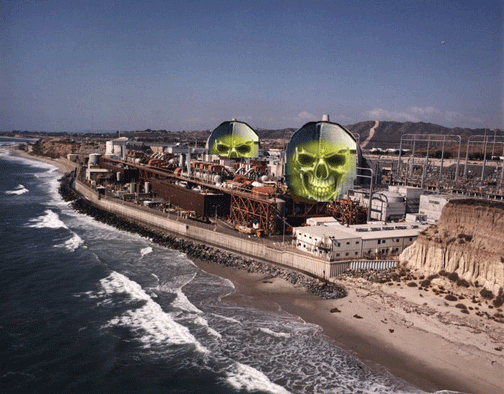
1,800 tons of radioactive waste has an ocean view and nowhere to go, LA Times, By RALPH VARTABEDIAN | PHOTOGRAPHY BY ALLEN J. SCHABEN 2 July 17 [good photographs and graphs] The massive, 150-ton turbines have stopped spinning. The mile-long cooling pipes that extend into the Pacific will likely become undersea relics. High voltage that once energized the homes of more than a million Californians is down to zero.
But the San Onofre nuclear power plant will loom for a long time as a landmark, its 1,800 tons of lethal radioactive waste stored on the edge of the Pacific and within sight of the busy 5 Freeway.
Across the site, deep pools of water and massive concrete casks confine high-power gamma radiation and other forms of radioactivity emitted by 890,000 spent fuel rods that nobody wants there.
And like the other 79,000 tons of spent fuel spread across the nation, San Onofre’s nuclear waste has nowhere to go.
The nation’s inability to find a permanent home for the dangerous byproduct of its 50-year-adventure in nuclear energy represents one of the biggest and longest running policy failures in federal government history.
Now, the Trump administration and Congress are proposing a fast track fix. The new plan aims, after decades of delays, to move the waste to one or more temporary central storage sites that would hold it until a geologic repository can be built in Nevada or somewhere else.
But the new strategy faces many of the same challenges that have dogged past efforts, leaving some experts doubtful that it can succeed.
America’s nuclear waste failure The shuttered San Onofre facility — not withstanding its overlook of prime surf breaks — is similar to about a dozen other former nuclear power plants nationwide that now have to babysit waste to prevent natural disasters, human errors or terrorist plots from causing an environmental or health catastrophe.
Though utilities and government regulators say such risks are remote, they have inflamed public fear at least since 1979’s Three Mile Island reactor accident in Pennsylvania.
The sites are located on the scenic shores of northern Lake Michigan, along a bucolic river in Maine, on the high plateau of Colorado and along the densely populated Eastern Seaboard — each environmentally sensitive for different reasons.
No one wants that waste near them — including officials in the sleepy beach town of San Clemente, just north of San Onofre. Even Southern California Edison Co. officials, while insisting the waste is safe, agree it should be moved as soon as possible.
“It doesn’t make any sense to store the fuel at all these sites,” said Thomas Palmisano, chief nuclear officer at the Southern California Edison plant. “The public doesn’t want the spent fuel here. Well, the fuel is here.”
But every attempt to solve the problem almost instantly gets tangled in complex federal litigation and imposes enormous expense on taxpayers.
The Energy Department was legally bound to haul away the waste by 1998 under the Nuclear Waste Policy Act, making the agency about 20 years late in fulfilling its promise. That has saddled utilities with multibillion-dollar costs to store the waste onsite.
As a result, every nuclear utility, including Southern California Edison, has sued to recover its waste storage costs. So far, they have won judgments and settlements of $6.1 billion, and the Energy Department has projected that it may be liable for up to $25 billion more.
But the new plan is fraught with complex legal, political and financial questions, and has yet to be fully defined or vetted among powerful interest groups or receive approval by Congress or survive inevitable court challenges.
The House Energy and Commerce Committee last week overwhelmingly approved legislation that could clear up many legal questions. Similar bills have been introduced in recent years and failed to move ahead, but this legislation has strong bipartisan support and is backed by the White House.
Still, a lot could go wrong with the plan, as it has for every plan for decades.
Two little-known privately held companies, New Jersey-based Holtec International and Texas-based WCS, have unveiled plans and begun licensing applications with the Nuclear Regulatory Commission for interim storage sites on each side of the New Mexico-Texas border. Officials in the area, a booming center of oil production, are enthusiastic about the potential economic benefits. And nuclear utilities have offered encouragement.
Company officials and other proponents say such temporary dumps could be opened in as little as three or four years, assuming the licensing goes smoothly. But other nuclear waste experts expect a timetable of 10 to 15 years for a temporary dump and much longer for a permanent repository.
Two dozen antinuclear activist groups and leading environmental nonprofits already have signaled in letters to the NRC that they will dispute the idea of creating temporary consolidated storage sites.
The groups, along with many longtime nuclear waste technical experts, worry that temporary storage will weaken the government’s resolve to build a permanent repository. And they assert the plan would require transporting the fuel twice, first to the temporary site and then to a permanent dump, magnifying transportation costs and the fuel’s exposure to accidents or attacks by terrorists.
“These trains hauling nuclear waste would go right by Trump’s hotel in Las Vegas,” said Marta Adams, a now-retired deputy attorney general in Nevada who is consulting with the state on its renewed legal battle.
Serious business problems cloud the plan. Among the most important is who would own and be legally responsible for the waste once it leaves the utility plant sites.
The federal government promised in the Nuclear Waste Policy Act of 1982 to take ownership at a government-owned dump, but it never authorized such ownership at a temporary private facility — one of the legal questions that the Energy and Commerce Committee’s legislation would clear up.
A temporary facility by Holtec or another organization is intended as a segue to a permanent dump at Yucca Mountain, about 100 miles north of Las Vegas. Along with an interim storage site, the Trump administration wants to restart licensing of Yucca Mountain, which President Obama suspended.
But reviving Yucca Mountain is a long shot………. http://www.latimes.com/local/california/la-me-stranded-nuclear-waste-20170702-htmlstory.html
July 3, 2017
Posted by Christina Macpherson |
USA, wastes |
1 Comment
 1,800 tons of radioactive waste has an ocean view and nowhere to go, LA Times, By RALPH VARTABEDIAN | PHOTOGRAPHY BY ALLEN J. SCHABEN 2 July 17 [good photographs and graphs] “…..A decade ago, the Energy Department estimated Yucca Mountain would cost nearly $100 billion, a figure that has undoubtedly increased. The cost could be a problem for deficit-minded Republicans.
The Energy Department collected a tiny monthly fee from utility customers to build the dump, and currently a so-called trust fund has $39 billion reserved for the purpose.
But a little known clause in federal budget law 20 years ago decreed that contributions to the trust fund would count against the federal deficit. There are no securities or bonds that back up the fund, unlike the Social Security Trust Fund. As a result, every dollar spent on Yucca Mountain will have to be appropriated, and the money will add to the national debt.
“The money was collected for one purpose and used for another,” said Dale Klein, a former NRC chairman who is now associate vice chancellor for research at the University of Texas. “There is a moral obligation to address the issue. It will be a challenge to get Congress to pay for it.”
The Trump plan has also rekindled the strident bipartisan political opposition of Nevada officials, including the governor, senators, representatives and attorney general, among others. They vow to erect every legal and political obstacle to delay or kill the Yucca Mountain dump.
The state filed nearly 300 formal objections to the plan before the Obama administration suspended licensing. They must be individually examined by the NRC, a process that could take five years.
Then, the design and construction of the underground dump will require construction of about two dozen big industrial buildings and 300 miles of new railroad track. It could cost $1 billion or more every year, ranking among the largest federal operations.
A permanent repository could take 10 years to 20 years by most estimates.
On the beach
Nowhere is the nuclear waste problem more urgent than at shuttered power plants like San Onofre.
After utilities dismantle the reactors, haul away the concrete debris and restore the sites to nearly pristine condition, the nuclear waste remains. Security officers with high-powered automatic weapons guard the sites round the clock.
About five years after the spent fuel rods cool off in a 40- to 50-foot-deep pool, they are transferred to massive steel and concrete dry casks about 20 feet tall. Almost every government and outside nuclear expert considers the dry casks much safer than the pools.
The 3 Yankee Cos., which are safeguarding dry casks at three former New England reactors, spend about $10 million annually per site for maintenance and security, company officials say. The costs could be higher at San Onofre if the waste is left in place, Palmisano said.
Edison is building a massive concrete monolith for more storage, using a Holtec design called Hi-Storm UMAX. It will hold about two-thirds of the plant’s spent fuel in 73 stainless-steel canisters about 125 feet from the ocean. The 25-foot structure is about half-buried with the underground foundation just above the mean high-tide line. Tall cranes and swarms of hard hats are moving construction ahead.
The crucial question is whether it will be safe, especially if congressional inaction or litigation by opposition groups keeps it on-site for years.
“The top has four feet of steel-reinforced concrete,” said Ed Mayer, program director at Holtec. “It is remarkably strong. The … steel lids are designed to take an aircraft impact.”
NRC officials say the design is safe and meets all federal requirements. Although nuclear issues are within the NRC’s jurisdiction, the Coastal Commission also examined the potential for a tsunami, sea level rise or an earthquake to undermine the facility.
“Under our authority, which is limited, the commission approved the permit, and behind that is the evaluation that it is safe for a period of 20 years,” said Alison Dettmer, deputy director of the commission.
But suspicion lingers. San Clemente city officials have demanded that the fuel be removed as soon as possible. An activist group, Citizens’ Oversight, has sued Edison for starting construction and the California Coastal Commission for approving it.
The waste “is right down by the water, just inches from the high-tide line,” said Ray Lutz, the group’s founder. “It is the most ridiculous place they could find.”
In an effort to assuage local concerns, Edison participates in a “community engagement panel” that meets at least quarterly, led by UC San Diego professor David Victor.
“Early on, I was surprised by how many people did not understand there was no place for the fuel to go,” he said. Over the last year, the possibility of a temporary storage site has raised people’s hopes for a quicker solution, he said.
The history of nuclear waste, however, is replete with solutions that seem plausible but succumb to obscure and unanticipated legal, technical or financial issues.
Decades of delay
Two decades ago, the Skull Valley Band of Goshute Indians sought to create an interim storage facility for nuclear waste on its reservation about an hour out of Salt Lake City.
The NRC spent nine years examining the license application and approved it. But Utah officials and a broad swath of major environmental groups opposed the plan. Eventually, the state blocked shipping routes to the reservation.
Michael C. Layton, director of the NRC’s division of spent fuel management, said a temporary facility would use the same technology as existing dry cask storage sites, like San Onofre.
But Layton said it is unclear how long it will take to license a consolidated storage site. The formal review is scheduled for three years, but the Skull Valley license that took nine years is the only actual licensing effort to compare it to, he added. Palmisano, the Edison executive, estimates that an off-site temporary storage facility could be operating in 10 to 15 years.
Problems have already delayed WSC, which wants to build a storage site in Andrews, Texas. It asked the NRC in April to suspend its license application.
The $7.5-million cost of just the license application review “is significantly higher than we originally anticipated,” the company said, noting that it is under additional financial stress because the Justice Department has sued it to block a merger.
Holtec officials say that WCS’ problems haven’t deterred their plans for an underground storage site, saying interim storage could save the federal government billions of dollars, particularly if the Yucca Mountain plan is again postponed.
The company has strong support in New Mexico, which already has a dump for nuclear weapons waste, a uranium enrichment plant, a nuclear weapons armory and two nuclear weapons laboratories.
“We are very well-informed,” said Sam Cobb, mayor of nearby Hobbs, rejecting arguments by antinuclear groups that the industry preys on communities that need money and don’t understand the risk.
“It is not a death grab to get money,” he said. “We believe if we have an interim storage site, we will be the center for future nuclear fuel reprocessing.”
Transportation to an interim site would cost the federal government billions of dollars under the pending legislation. Aides at the House Energy and Commerce Committee said those costs would be recovered when the federal government no longer has to pay for legal settlements for failing to take the waste in the first place.
Even if an interim site is built, it is uncertain who would get to ship waste there first. The timing of waste shipments to a permanent site is determined by the so-called standard contract queue, a legal document so complex that federal bureaucrats have dedicated their entire careers to managing it.
The queue was structured so that the oldest waste would go into a future dump first. In the unlikely event that Yucca Mountain were opened in 2024, Edison’s fuel would be in line to start shipping in 2028 with the last bit of waste arriving in 2049, Palmisano said.
Whether that queue would apply to an interim site is unclear, even under the pending legislation.
The dry casks are designed to keep spent fuel confined only for decades, while the health standard for a permanent repository covers hundreds of thousands of years — longer than humans have roamed Earth. If the radioactive waste sits around in temporary storage for hundreds of years, it could be neglected and eventually forgotten.
So one outcome that nobody seems to want is for a temporary site to eventually become permanent by default.
“It would derail momentum for a permanent repository,” said Edwin Lyman, a nuclear physicist at the Union of Concerned Scientists. “This issue has always pitted one community against another and those in between.”http://www.latimes.com/local/california/la-me-stranded-nuclear-waste-20170702-htmlstory.html
July 3, 2017
Posted by Christina Macpherson |
Reference, USA, wastes |
1 Comment
 Safety problems at a Los Alamos laboratory delay U.S. nuclear warhead testing and production A facility that handles the cores of U.S. nuclear weapons has been mostly closed since 2013 over its inability to control worker safety risks, Science, By The Center for Public Integrity, R. Jeffrey Smith, Patrick Malon Jun. 30, 2017 “……..A unique task, unfulfilled for the past four years
Before the work was halted in 2013, those overseeing the U.S. nuclear arsenal typically pulled six or seven warheads from bombers or missiles every year for dismantlement and invasive diagnostic testing. One reason is that the unstable metals that act as spark plugs for the bombs — plutonium and highly-enriched uranium — bathe themselves and nearby electrical components in radiation, with sometimes unpredictable consequences; another is that all the bombs’ metallic components are subject to normal, sometimes fitful corrosion.
Plutonium also slowly decays, with some of its isotopes becoming uranium. And the special high explosives fabricated by nuclear scientists to compress the plutonium cores in a deliberate detonation also have an unstable molecular structure.
Invasive testing provides details vital to the computer modeling and scientifically simulated plutonium behavior that has replaced nuclear testing, said DOE consultant David Overskei. He compared the pit — so named because it is spherical and positioned near the center of a warhead — to the heart of a human being, explaining that destructive testing is like taking a blood sample capable of exposing harmful maladies.
The aim, as Vice President Joe Biden said in a 2010 National Defense University speech, has been to “anticipate potential problems and reduce their impact on our arsenal.” Weapons designers say it’s what anyone would do if they were storing a car for years while still expecting the engine to start and the vehicle to speed down the road at the sudden turn of a key.
Typically, warheads selected for testing are first sent to the Energy Department’s Pantex Plant in Amarillo, Texas. Technicians there gently separate their components — such as the detonators — at that site; they also send the pits — used in a primary nuclear explosion — to Los Alamos, and the highly-enriched uranium — used in a secondary explosion — to Oak Ridge, Tenn. The arming, fusing, and firing mechanisms are tested by Sandia National Laboratories in Albuquerque and other locations.
 At Los Alamos, the pits are brought to Plutonium Facility-4 (PF-4), a boxy, two-story, concrete building with a footprint the size of two city blocks. Inside are hundreds of special “glove boxes” for working with plutonium, a series of individual laboratories, and a special vault, in which containers hold plutonium on racks meant to ensure that escaping neutrons don’t collide too often with other atoms, provoking them to fission uncontrollably. Only a small portion of the building is normally used for pit surveillance, while about a fifth is used for pit fabrication, and another seven percent for analytical chemistry and pit certification. Budget documents indicate that annual federal spending for the work centered there is nearly $200 million.
“The Los Alamos Plutonium Facility is a unique and essential national security capability,” McMillan, the lab’s director, said last September during a visit by then-Defense Secretary Ashton Carter, who watched as technicians — attempting to restart their work after the lengthy hiatus — used pressing machines and other equipment to fabricate a mock pit, rather than a usable one.
The building lies in the middle of a 40-acre campus in the mountains above Santa Fe hastily built during World War II to coordinate the construction of the two nuclear bombs used in Japan. Los Alamos is still considered the foremost U.S. nuclear weapons facility — where six of the nine warheads currently in the U.S. arsenal were designed, and where plutonium-based power supplies for most of the nation’s deep-space probes are fabricated. Hundreds of nuclear physicists work there.
Unfortunately, it also has an active seismic zone beneath the PF-4 building, producing persistent worries among the staff and members of the Defense Nuclear Facilities Safety Board, a congressionally-chartered oversight group, that if it experienced a rare, large earthquake, the roof could collapse and toss chunks of plutonium so closely together a chain reaction would ensue, spewing radioactive, cancer-causing plutonium particles throughout nearby residential communities.
Millions of dollars have already been spent to diminish this risk, which until recently exceeded federal guidelines, and the Trump administration last month proposed spending $14 million in 2018 alone to strengthen the building’s firewalls and sprinkler systems. The government has also sunk more than $450 million into preparations for construction of a modern and more seismically durable pit production facility at Los Alamos, projected to have a total price tag between $1.5 billion and $3 billion.
Making new pits involves melting, casting, and machining the plutonium, while assessing how well or poorly the pits are aging requires using various instruments to withdraw small pieces for detailed chemical and material analysis. These operations are typically done in the glove boxes, by specialists whose hands are inserted into gloves attached to the side of sealed containers meant to keep the plutonium particles from escaping. But the work is messy, requiring constant vigilance to be certain that too much of the metal doesn’t pile up in a compact space. The byproducts include “chunks, shards, and grains of plutonium metal,” all of it radioactive and unstable, according to a 2015 Congressional Research Service report.
Notably, a 2013 Los Alamos study depicted leaks of glove boxes at PF-4 as frequent — averaging nearly three a month — and said they were often caused by avoidable errors such as inattention, improper maintenance, collisions with rolling storage carts, complacency and degradation from the heat that plutonium constantly emits. It said that sometimes those operating or supervising the equipment “accepted risk” or took a chance, rushed to meet a deadline, or otherwise succumbed to workplace production pressures.
“Operations always wants it yesterday,” the lab’s current criticality safety chief and the lone NNSA expert assigned to that issue in the agency’s Los Alamos oversight office warned in a private briefing for their colleagues at Sandia labs last month. Managers “must shield analysts from demands” from production personnel, they said.
Besides posing a serious health risk to those in PF-4, glove box releases of radioactive material each cost the government $23,000 to clean up, on average, the Los Alamos study said.
An acute shortage of criticality experts
Calculating exactly “how much material can come together before there’s an explosion” — as the Nobel laureate physicist Richard Feynman once put it — is a complex task. While visiting the production site for highly-enriched uranium in
Oak Ridge, Tenn., during the 1940’s, for example, Feynman was surprised to see stocks of that fissionable material deliberately stored in separate rooms, but on an adjoining wall that posed no barrier to collisions involving atoms of uranium and escaping neutrons on both sides. “It was very dangerous and they had not paid any attention to the safety at all,” Feynman wrote years later.
Plutonium work is so fraught with risk that the total mass of that metal allowed to be present in PF-4 is strictly limited. A decade ago, the limit was increased without an appropriate understanding of the risks, according to an NNSA technical bulletin in February. But with pieces of it strewn and stored throughout the normally busy building, partly because the vault is typically full, its managers have labored for years to systematically track down and remove excess stocks. They had some success last year, when they got rid of nearly a quarter of the plutonium on the building’s “main floor,” according to recent budget documents.
Criticality specialists are employed not only to help set these overall mass limits but to guide technicians so they don’t inadvertently trigger chain reactions in their daily work; those specialists are also supposed to be the first-responders when too much dangerous material is found in one place.
“The weird thing about criticality safety is that it’s not intuitive,” Don Nichols, a former chief for defense nuclear safety at the NNSA, said in an interview. He cited an instance in which someone operating a stirring machine noticed that fissionable liquids were forming a “critical” mass, so the operator shut the stirrer off, not immediately realizing that doing so made the problem worse. In other instances, analysts had judged a plutonium operation was safe, but then more workers — whose bodies reflect and slow neutrons — wound up being present nearby, creating unanticipated risks.
Those doing the weapons disassemblies and invasive pit studies are typically under “a big level pressure” to complete a certain number every year, Nichols added. They are expected to do “so many of these in this amount of time,” to allow the labs to certify to the president that the stockpile is viable. Meanwhile, the calculations involved in avoiding criticality — which depend on the shape, size, form, quantity, and geometric configuration of material being used in more than a dozen different industrial operations — are so complex that it takes a year and a half of training for an engineer to become qualified and as many as five years to become proficient, experts say.
“It’s difficult to find people who want to do this job,” particularly at the remote Los Alamos site, said McConnell, the NNSA safety chief. With plutonium use mostly confined to creating the world’s most powerful explosives, “there are…very few public-sector opportunities for people to develop these skills,” he added. As a result, he said, many NNSA sites lack the desired number of experts, which slows down production.
At the time of the 2013 shutdown, after numerous internal warnings about the consequences of its mismanagement, Los Alamos had only “a single junior qualified criticality safety engineer” still in place, according to the February NNSA technical bulletin. Nichols, who was then the NNSA’s associate administrator for safety and health, said McMillan didn’t “realize how serious it was until we took notice and helped him take notice.”
Without having adequate staff on hand to guide their operations safely, technicians at PF-4 were unable to carry out a scheduled destructive surveillance in 2014 of a refurbished plutonium pit meant for a warhead to be fit atop American submarine-launched ballistic missiles. It’s been modernized at a cost of $946 million since 2014, with total expenses predicted to exceed $3.7 billion. Generally, up to 10 of the first pits produced for a new warhead type are set aside for surveillance to assure they’re safely constructed and potent before they’re deployed. But the planned disassembly was cancelled and the NNSA hasn’t scheduled another yet, because of the shutdown.
The lab also hasn’t been able to complete planned invasive studies of the aging of plutonium used in a warhead for an aircraft-delivered nuclear bomb, now being modernized at an estimated cost of $7.4 billion to $10 billion.
Former deputy NNSA director Madelyn Creedon told an industry conference in March that if new funds are given to the agency in President Trump’s new budget, she knows where she’d advise it be spent. “One of the things that doesn’t take a huge amount of money but it’s one that has been cut back over the last couple of years, is surveillance — enhanced surveillance” of existing warheads, Creedon said……..http://www.sciencemag.org/news/2017/06/safety-problems-los-alamos-laboratory-delay-us-nuclear-warhead-testing-and-production
July 1, 2017
Posted by Christina Macpherson |
- plutonium, employment, Reference |
Leave a comment
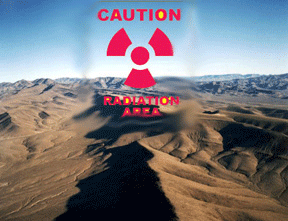 House panel votes to advance Yucca Mountain nuclear waste project, The Hill, BY TIMOTHY CAMA – 06/28/17 A House committee voted overwhelmingly Wednesday to advance a bill meant to move along the stalled Yucca Mountain nuclear waste repository in Nevada.
June 30, 2017
Posted by Christina Macpherson |
politics, USA, wastes |
Leave a comment
Clacton & Frinton Gazette 27th June 2017, A CAMPAIGN group has described process used to dissolve the FEDs at
Bradwell as an “outrage” and an “insult”. Members of the Blackwater
Against New Nuclear Group (BANNG) had their say on the process which saw
radioactive waste dissolved in acid at the site.
Chairman, Andy Blowers said: “It is nothing short of an outrage and an insult to the Blackwater
environment and communities that the Nuclear Decommissioning Authority
(NDA) persisted despite all the signs that dissolution with nitric acid was
a failing technology.” BANNG Secretary, Varrie Blowers added: “The NDA
obviously believes that the end justified the chaotic means. While FED
dissolution may not have finished, it is hard to imagine that anyone can
think that the FED at Bradwell has been dealt with successfully, given all
the operational difficulties and the outages experienced.”
BANNG believe the reason the process has now been completed is because of the
re-characterisation of the waste, rather than it being fully dealt with.
They point to only one third of Intermediate Level Waste being treated, as
opposed to the full amount, with two thirds being reclassified as Low Level
Waste. Barry Turner, Vice-Chair of BANNG, said: “The Bradwell FED
dissolution plant has turned out to be an expensive one-off and has been
used to dissolve only one-third of the waste and not the originally
expected 100 per cent.” http://www.clactonandfrintongazette.co.uk/news/north_essex_news/15372952.Process_used_to_remove_radioactive_waste_an__outrage__and__insult__to_the_area__says_campaign_group/
June 30, 2017
Posted by Christina Macpherson |
UK, wastes |
Leave a comment
 http://www.kpbs.org/news/2017/jun/27/nuclear-expert-slams-edisons-san-onofre-nuclear-wa/, June 27, 2017, By Amita Sharma, Talks continue to find a storage site for radioactive waste away from San Onofre nuclear power plant. Unless there is an agreement, millions of pounds of the toxic material will be partially buried near the shoreline at San Onofre. KPBS Investigative Reporter Amita Sharma recently spoke to Tom English on the beach near San Onofre. He is a one-time advisor to former President Jimmy Carter on high-level nuclear waste disposal.
Q: You’re a nuclear waste expert who’s given talks at the White House on this topic. You think Edison’s plan is a bad idea, why?
A: Several reasons. One is they’re basically going to put the stuff in a thin storage container which probably will have some problems with corrosion given this ocean environment here. The second idea is they’re going to store it such that it will be about 100 feet from the water and a few inches above the groundwater table which is totally ridiculous. As the sea level rises, what will happen is the bottom of the containers will corrode.
Q: Why do you think Edison wants to use this dry cask storage method and actually got the backing to do it from the California Coastal Commission?
A: What happened is our attitude toward storage of spent fuel in a fuel pool changed with Fukushima. We had two pools melt down completely. And this scared everybody and caused a big furor and caused them to want to do something better. So it is a very good idea to take the fuel out of the pool and put it into dry storage. It’s just the choices that they made here were awful, far worse than leaving it in the spent fuel pool.
Q: You’re also worried about Edison’s San Onofre nuclear waste storage plan because you think it’s especially vulnerable to terrorism. Tell me about that.
A: If you leave the spent fuel in the spent fuel pool, you have two large concrete structures surrounding the spent fuel pool that will partially protect it against an attack. When you bring it out here near the ocean on the beach, what you have is no real protection. So a terrorist could find this to be a fairly easy target and if something were to happen here we would evacuate about 50 miles worth of people around San Onofre which would basically shut down the economy of Southern California.
Q: Dr. English, what are some of the alternatives to storing the waste at San Onofre?
A: There are three main ones. One is to simply move it to another Southern California Edison site like in Arizona. That way you’d at least be away from the beach. And it’s already licensed for this sort of thing. Another alternative would be to move it across the street to Camp Pendleton where it’s surrounded by a bunch of Marines and you wouldn’t have any overflights of airplanes so it would be much safer there from any kind of terrorist attack. A third alternative would be to go to Yucca Mountain where we know a lot about the geology of the area and basically make a part of it into temporary interim storage. And you could take all this waste and store it there for 100 years while they figure out how to solve the long-term problem and I think the three of those are much better than what we have here.
Q: If a storage site away from San Onofre can’t be found and the waste ends up being stored here for the long haul, there’s the matter of sea level rise. Projections show that San Onofre will be inundated by seawater by the turn of the century. What kind of threat does that pose to humans and to the sea?
A: Well, if you have these canisters sitting in seawater it’s much the same as dumping the high-level waste into the ocean. And so this has a severe threat on both the aquatic life and human life.
June 28, 2017
Posted by Christina Macpherson |
USA, wastes |
Leave a comment