GDF Watch 7th Dec 2018 , It has been over 10 years, 4 Prime Ministers, and 5 Administrations since
the original Committee on Radioactive Waste Management (CoRWM) recommended
geological disposal. In that period successive Governments of all Parties
have recommitted to geological disposal.
With the recent publication of
position papers updating their advice on a range of key issues, the latest
CoRWM have also reaffirmed their expert opinion that geological disposal
remains the best available way to dispose of higher-activity radioactive
waste. Four new papers have been issued in response to specific concerns
raised in stakeholder submissions to the public consultations earlier this
year on the GDF draft National Policy Statement (NPS) and the Working With
Communities siting policy: http://www.gdfwatch.org.uk/2018/12/07/corwm-respond-to-public-concerns-reaffirm-geological-disposal/
The U.S. Department of Energy in documents made public this week said the Advanced Mixed Waste Treatment Project that employs 650 workers will end next year.
Officials said workers are wrapping up processing 85,000 cubic yards of radioactive waste at the department’s 890-square-mile site that includes the Idaho National Laboratory.
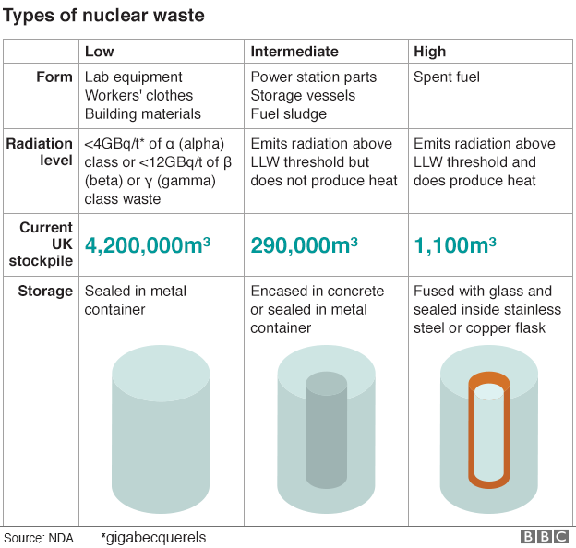
A $500 million treatment plant handles transuranic waste that includes work clothing, rags, machine parts and tools that have been contaminated with plutonium and other radioactive elements. The U.S. Nuclear Regulatory Commission says transuranic wastes take much longer to decay and are the most radioactive hazard in high-level waste after 1,000 years.
The Energy Department said that before the cleanup began, Idaho had the largest stockpile of transuranic waste of any of the agency’s facilities. Court battles between Idaho and the federal government culminated with a 1995 agreement requiring the Energy Department to clean up the Idaho site.
The Idaho treatment plant compacts the transuranic waste, making it easier to ship and put into long-term storage at the Waste Isolation Pilot Plant in New Mexico.
Federal officials this year floated the idea of keeping the $500 million treatment plant running in Idaho with waste from other states — mostly radioactive waste from the former nuclear weapons production area in Hanford.
With the Idaho treatment plant scheduled to shut down, it’s not clear how the transuranic waste at Hanford and other sites will be dealt with.
The Energy Department “will continue to work to ensure a path forward for packaging and certification of TRU (transuranic) waste at Hanford and other sites,” the agency said in the email to the AP.
Local officials and politicians generally supported the idea because of the good-paying jobs. The Snake River Alliance, an Idaho-based nuclear-watchdog group, said it had concerns the nuclear waste brought to Idaho would never leave.
A 38-page economic analysis the Department of Energy completed in August and released this week found “it does not appear to be cost effective due to packaging and transportation challenges in shipping waste” to Idaho.
“As work at the facility will continue into 2019, no immediate workforce impacts are anticipated,” the agency said in an email to The Associated Press on Friday. The Energy Department “recognizes the contribution of this facility and its employees to DOE’s cleanup mission and looks forward to applying the knowledge gained and experience of the workforce to other key activities at the Idaho site.”
The agency said it would also consider voluntary separation incentives for workers.
The Department of Energy has agreed to extend the public comment period on its proposal to loosen its interpretation of what it considers high level radioactive waste.
The 60-day public comment period, which was set to end Dec. 10, has been extended until Jan. 9
The extension came at the urging of Sen. Ron Wyden, D-Ore., and 75 organizations across the nation, including Hanford Challenge, Columbia Riverkeeper, Heart of America Northwest and the Natural Resources Defense Council.
Defining less of the nation’s nuclear waste as high level could speed up environmental cleanup at places like the Hanford nuclear reservation and save billions of dollars.
It could give DOE more flexibility on how it deals with some of the 56 million gallons of waste stored in underground tanks.
The Energy Communities Alliance — which includes Hanford Communities, a coalition of local government near the Hanford Site — supports the proposal.
But critics like Hanford Challenge say it also could mean more toxic waste would be allowed to remain in the ground at Hanford.
Decommissioning of 1st nuclear power plant facing major delay Focus Taiwan 2018/12/03 Taipei, Dec. 3 (CNA) By Elizabeth Hsu Taiwan is scheduled to begin decommissioning the first reactor of its oldest nuclear power plant in New Taipei on Dec. 5 after 40 years of service, but the deadline will not be met because of questions over how to deal with the plant’s nuclear waste.
The plan to decommission the two reactors in the Jinshan Nuclear Power Plant included the construction of an outdoor storage yard at the plant site for the dry storage of spent nuclear fuel.
The facility was built in 2013 but has yet to pass a New Taipei government inspection needed to obtain an operating permit, leaving the decommissioning process in limbo.
Hsu Tsao-hua (徐造華), a spokesman for Taiwan Power Company (Taipower), which runs Taiwan’s three nuclear power plants, said that if the storage facility cannot be used, the 816 fuel rods still in the Jinshan plant’s first reactor will have to stay where they are, and the plant’s safety equipment will have to be kept running.
Though the company has planned an indoor storage facility, it will take at least 10 years to build, which could delay the decommissioning process by at least a decade, Hsu warned………..
The thorny spent fuel storage and EIA review issues that will cause the Jinshan plant to miss the scheduled deadline come down to politics, and at least to some extent to the New Taipei government’s attitude on the issue.
New Taipei Mayor Eric Chu (朱立倫) of the opposition Kuomintang (KMT) has declared that his city “can never be the permanent storage place for nuclear waste.”
His position has been at odds with the general stance of his party, which advocates the use of nuclear power as the country moves toward its ultimate goal of becoming a nuclear-free homeland. ……
“Nuclear waste represents pain in the heart of New Taipei (citizens),” said Hou, after the city has co-existed with two nuclear power plants for nearly four decades.
He also argued that nuclear waste should never be stored in a heavily populated city, and he urged the central government and Taipower to find a permanent storage location as soon as possible, a mission the utility has struggled with for years.
New Taipei is the most populous city in Taiwan with a population of 3.99 million as of November, government statistics show.
Even if the decommissioning of the Jinshan power plant were to start on time, it would still be a long process.
Under Taipower’s plan, it would involve eight years to shut the plant down, 12 years to dismantle it, three years to inspect its final condition and two years to restore the land. http://focustaiwan.tw/news/aeco/201812030020.aspx
If the plan were to be approved, the US Energy Department has estimated that it would take 31 years to dilute and dispose of the of weapons-grade plutonium.
The lack of space at the US government’s only underground nuclear waste repository is among several challenges identified by a group of scientists and other experts who are looking at the viability of disposing of weapons-grade plutonium at the desert location.
The National Academies of Sciences, Engineering, and Medicine released a preliminary report on the US government’s plan, which calls for diluting 34 metric tons of plutonium and shipping it to the Waste Isolation Pilot Plant in southern New Mexico.
The purpose of the work would be to satisfy a nonproliferation agreement with Russia.
Another challenge, the scientists say, would be getting officials in that country to approve of the dilution of the materials.
The pact between the two countries was initially based on a proposal for turning the surplus plutonium into fuel that could be used for commercial nuclear reactors. That project, beset by years of delays and cost overruns, was cancelled earlier this year.
The review of the plan that calls for shipping the plutonium to New Mexico was requested by Congress. A final report from the National Academies is expected mid 2019.
The US Energy Department’s Office of Environmental Management has demonstrated that diluting the plutonium is possible by working with a separate batch of material. However, citing a lack of information, the scientists did not study the agency’s ability to scale up that process to handle the 34 metric tons that are part of the nonproliferation agreement.
If the plan were to be approved, the Energy Department has estimated that it would take 31 years to dilute and dispose of all 34 metric tons.
The work would involve four sites around the US – the Pantex Plant in West Texas, the Savannah River Site in South Carolina, Los Alamos National Laboratory in northern New Mexico and the Waste Isolation Pilot Plant.
The panel of scientists found that the agency doesn’t have a well-developed plan for reaching out to those host sites and stressed that public trust would have to be developed and maintained over the life of the project.
NIS 28th Nov 2018 The Atomic Weapons Establishment (AWE) plan to send up to 5,000 barrels of Higher Activity Waste to Sellafield for treatment and storage. Since the year 2000 AWE has been under pressure from its regulators to take action to reduce its holdings of radioactive waste, some of which dates back to the 1983 moratorium on waste being dumped at sea.
This culminated in an improvement notice in 2015 from the Office for Nuclear Regulation (ONR) which required AWE to produce a plan for dealing with its waste holdings.
Earlier efforts to deal with the waste floundered when a plan to procure a super-compactor and build a waste treatment centre at AWE Aldermaston. The building originally intended to house the super-compactor was unable to meet modern seismic resilience standards and the plan was abandoned when the Ministry of Defence (MoD) refused to spend the £78m required to build a new facility. The plan produced by AWE to satisfy the 2015 improvement notice concluded that sending the waste to be treated and stored at Sellafield would be preferable to building an on-site waste facility. https://www.nuclearinfo.org/article/waste-awe-aldermaston-other/awe%E2%80%99s-nuclear-waste-plan-send-it-sellafield
Stripes 29th Nov 2018 After spending billions of dollars over several decades to remove
radioactive waste leaking from a plant where nuclear bombs were made, the
Energy Department has come up with a new plan: leave it in the ground.
The shuttered Hanford Nuclear Reservation, which produced plutonium for U.S.
atomic weapons from World War II through the Cold War, is the nation’s
largest nuclear cleanup site with about 56 million gallons of waste stored
in leak-prone underground tanks in south-central Washington State.
The Energy Department has proposed to effectively reclassify the sludge left in
16 nearly empty underground tanks from “high-level” to “low-level”
radioactive waste. The re-classification would allow the department to fill
the tanks with grout, cover them with an unspecified “surface barrier,” and
leave them in place.
The restart would mark the first transfers since a “near-miss” incident in August in which a 50-ton canister containing nuclear waste was accidentally left suspended on a metal flange, nearly 20 feet from the floor of a storage cavity for as much as one hour.
A specific date for the restart has not been set, and Edison officials emphasized it will only begin after roughly 60 workers have gone through “more detailed and improved training” that includes practice runs and employing an independent assessment team.
“We have not rushed to resume this,” said Tom Palmisano, vice president of external engagement at the plant, or SONGS. “We’re going to be very slow and deliberate so that we fully understand this and fully correct the underlying deficiencies that got us here.”
The company also said transfers will resume only after the Nuclear Regulatory Commission has completed on-site inspections next month.
All canister transfers have been suspended since the Aug. 3 incident came to light………
“The NRC is concerned about apparent weaknesses in management oversight” of the operations connected to the transfers, the agency’s report said.
Holtec International is the contractor responsible for transferring the canisters at SONGS, with Edison providing oversight. Based in New Jersey, Holtec also designed the canisters and the new storage facility where they are placed……….
San Onofre has not produced electricity since the plant shut down following a leak in a steam generator tube in 2012. The following year the plant officially closed. It is now in the process of being decommissioned.
SONGS is located on an 85-acre chunk of Marine Corps Base Camp Pendleton, owned by the Department of the Navy. The plant sits between the Pacific and one of the busiest freeways in the country — Interstate 5. About 8.4 million people live in a 50-mile radius of the plant in an area with a history of seismic activity.
Nuclear waste removed from Sequoyah Fuels site Cherokee Nation, GORE, Okla. 30 Nov 18— A semitrailer quietly left the former Sequoyah Fuels Corporation site near Gore this week, hauling away the last of 511 loads of nuclear waste that has plagued Sequoyah County and its citizens for decades.
The Cherokee Nation and Oklahoma attorney general’s office worked for 18 months to ensure the off-site disposal of 10,000 tons of radioactive material were removed from the Sequoyah Fuels site. The waste was transported to a disposal site in Utah where the uranium will be recycled and reused, leaving the area near the Arkansas River free of this nuclear waste for the first time in nearly 50 years.
“It is a historic day for the Cherokee Nation and the state of Oklahoma. Our lands are safe again, now that we have removed a risk that would have threatened our communities forever,” Cherokee Nation Secretary of State Chuck Hoskin Jr. said. “This would not have been possible if the tribe and state had not worked tirelessly together in court to ensure removal of this material.”
The uranium processing plant was opened by Kerr-McGee in 1970. It converted yellowcake uranium into fuel for nuclear reactors. The plant changed ownership more than once and was eventually sold to General Atomics under the name Sequoyah Fuels Corporation.
An accident at the plant killed one worker and injured dozens of others in 1986. Another accident in 1992 injured about three dozen workers. Following that accident and years of violating numerous environmental rules and nuclear safety standards, the plant was closed in 1993.
Tons of radioactive waste remained at the facility when it closed, so in 2004 the Cherokee Nation and state of Oklahoma entered into a settlement agreement that required the highest-risk waste be removed from the site. The owners of Sequoyah Fuels Corporation announced in 2016 their intention to bury the waste on site, but a judge forced the company to comply with the original agreement. Removal of the material is now complete.
“The Cherokee Nation has been in and out of court with Sequoyah Fuels since 2004, and now this material is no longer a ticking time bomb on the banks of the Arkansas River, one of our most precious natural resources,” Cherokee Nation Secretary of Natural Resources Sara Hill said. “Decommissioning this plant was never enough to satisfy our goals for a clean and safe environment. Removal of this highly contaminated waste was our goal, and we’re pleased that goal has finally been achieved.”
The plant is located where the Arkansas River and Illinois River meet.
“Today’s announcement is another example of the strength behind the continued partnership between the state of Oklahoma and the Cherokee Nation,” said Attorney General Mike Hunter. “The successful outcome is also affirmation of my office’s commitment to finding avenues of collaboration with tribal governments to ensure our state’s natural resources remain protected and our citizens and communities remain safe.”
Sellafield: Europe’s most radioactively contaminated site
Inside Sellafield’s death zone with the nuclear clean-up robots,By Theo Leggett, Business correspondent, BBC News, 27 November 2018
The Thorp nuclear reprocessing plant at Sellafield, Cumbria, has recycled its final batch of reactor fuel. But it leaves behind a hugely toxic legacy for future generations to deal with. So how will it be made safe?
Thorp still looks almost new; a giant structure of cavernous halls, deep blue-tinged cooling ponds and giant lifting cranes, imposing in fresh yellow paint.
But now the complex process of decontaminating and dismantling begins.
It is a dangerous job that will take decades to complete and require a great deal of engineering ingenuity and state-of-the-art technology – some of which hasn’t even been invented yet.
This is why.
Five sieverts of radiation is considered a lethal dose for humans. Inside the Head End Shear Cave, where nuclear fuel rods were extracted from their casings and cut into pieces before being dissolved in heated nitric acid, the radiation level is 280 sieverts per hour.
We can only peer through leaded glass more than a metre thick at the inside of the steel-lined cell, which gleams under eerie, yellow-tinged lighting.
This is a place only robots can go.
They will begin the first stage of decommissioning – the post-operative clean-out – removing machinery and debris……….. Cleaning up other parts of the plant will also need robots and remotely operated vehicles (ROVs).
Some will need to be developed from scratch, while others can be adapted from systems already used in other industries, such as oil and gas, car manufacturing and even the space sector……..
The site in Cumbria contains a number of other redundant facilities, some dating back to the 1950s and many of them heavily contaminated, which are currently being decommissioned………
Remote submarines have explored and begun cleaning up old storage ponds. Other remote machines are being used to take cameras deep inside decaying bunkers, filled with radioactive debris.
The job of developing machines like these is shared with a large network of specialist companies, many of them based in Cumbria itself. They form part of a growing decommissioning industry within the UK, as the country grapples with the legacy of its first era of nuclear power.
The NDA believes that these companies can use what they learn at Sellafield, and other plants, to attract further business from overseas……..https://www.bbc.com/news/business-46301596
Managing Radioactive Waste Update NuClear News December 2018 A meeting planned for December between NGOs and the Nuclear Decommissioning Authority’s Radioactive Waste Management Ltd (NDA/RWM) has been postponed until February 2019 due to a delay in BEIS announcing the next steps in the Geological Disposal Facility (GDF) process (originally scheduled for November 2018). Brexit is most likely to blame for this delay. (1)
Writing on the GDF Watch website before the cancellation, Roy Payne said “there’s no doubting the commitment in Whitehall to try and finalise GDF siting policy before Christmas. But if you ask about timing, you get the same silent stoic smiles revealing the lack of certainty across Whitehall about getting Ministerial decisions on anything at the moment”. He says it’s likely that it will be many months after the policy is launched before we see any sign of active community participation. (2)
The Committee on Radioactive Waste Management (CoRWM) which advises BEIS on dealing with nuclear waste, has recently published a paper in response to calls during the most recent consultation exercise to select a site for a Geological Disposal Facility (GDF) based on the ‘best geology’
CoRWM says RWM, the UK’s delivery body for a GDF, has developed generic environmental safety cases (gESC) for the three rock types: hard rocks (metamorphic and igneous rocks), soft rocks (clays and mudstones) and evaporites (salt deposits). CoRWM says the recognition that three very different rock types can provide for a safe GDF highlights the difficulty associated with selecting a ‘best’ geology as each rock type have their own advantages and disadvantages. For example, from the technical assessment carried out to support CoRWM’s initial work:
“Strong indurated1 rocks can provide repository concepts at depth that could provide long pathways and isolation from human intrusion. Weak indurated rocks could provide hydrogeological isolation but be constrained by depth limitations. Evaporites could provide hydrogeological isolation and low gas permeability. Excavations of some evaporites would be difficult to maintain over long time periods.”
CoRWM concludes that geologic attributes or parameters cannot be compared across rock types, and the concept of a site which scores ‘highest’ on all parameters’ simply cannot occur. The different and various roles played by geological settings proposed for GDFs across the world highlight this issue.
CoRWM says it recommended against geological screening in 2014 because the level of knowledge of the geology of much of the UK at the depths under consideration is too rudimentary to support a ‘screening out/in’ process. This position could only be changed by introducing, country-wide, a level of geological investigation, including investigative boreholes. This would clearly be unsupportable on both economic and public acceptability grounds. (3)
Cumbria Trust believes CoRWM’s paper calls into question their independence. They are supposed to act as an independent body, but some of their recent actions suggest to us that they are too close to BEIS and failing to adequately perform their advisory function and to challenge poor decision-making. Cumbria Trust has written to CoRWM expressing its concerns. The letter says:
“We feel that you are using an over-literal interpretation in responding to stakeholder consultation replies which advocated a search for the best geology, by taking this to mean the single best site in England and Wales. While a few stakeholders may have intended that in its very narrowest sense, which is clearly incompatible with voluntarism, we believe that the majority did not. By confining your response to this narrow interpretation, you have missed the opportunity to examine a more realistic and widely-held view. It is quite possible to combine the principle of voluntarism in site selection, which we accept, with some level of geological pre-selection. Cumbria Trust advocates actively seeking volunteers from areas which have promising geology, as recommended by many experts including the Lead Inspector of the Nirex Inquiry, Chris McDonald.”
The Trust also refers to a statement made in 2013 by Professor Yardley, who subsequently became RWM’s Chief Geologist, in which he pointed out that due to the UK’s extensive programme of spent fuel reprocessing there is a significant amount of carbon-14 present in the UK inventory. This poses a particular risk to a GDF project and increases the need for an effective gas barrier to prevent radioactive methane, amongst other gases, from escaping. This is a further reason why a clay host rock may well be preferable for the UK. (4)
1 in a million CoRWM also points out that:
A Geological Disposal Facility must isolate the waste it contains from people and the environment such that the risk levels to individuals that are most susceptible is kept within 1 in 1 million (10-6) into the very distant future. This is assured by developing a Safety Case which models the behaviour of the repository system.
The Environment Agency (EA) has set a limit on the risk that may be caused by the burial of radioactive wastes of 10-6 (i.e. one in a million). (5) However, the NDA Disposability Assessment Report for waste arising from new EPR reactors states:
“…a risk of 5.3 x 10⁻⁷ per year for the lifetime arisings of a fleet of six EPR reactors each generating a lifetime total of 900 canisters is calculated” (6)
This is more than half the total risk of 10-6 allowable for a GDF for 9.6GW of new capacity. If the Government succeeds in persuading the nuclear industry to go ahead with 18GW of new capacity clearly this will exceed the risk targets set by the EA.
Two ways round this have been suggested. Firstly there could be two repositories, but although both dumps might share the same access shaft, there would be a sufficient distance between two separate groups of disposal chambers so that you have in effect two dumps giving a potential dose to two different populations.
The second excuse seems to be that if the probability of such an outcome is very low then the Environment Agency may allow a risk higher than 10-6. This kind of ‘make-it-up as you go along’ technique of risk assessment will not go down well with communities surrounding a proposed GDF http://www.no2nuclearpower.org.uk/wp/wp-content/uploads/2018/11/NuClearNewsNo113.pdf
Low-level radioactive waste stored at Tokai research facility near Tokyo may leak, agency says, Japan Times, KYODO, 23 Nov 18 The Japan Atomic Energy Agency said Wednesday that some of the low-level radioactive waste stored underground at a facility near Tokyo may leak from its containers due to inadequate disposal procedures.
The government-backed agency keeps 53,000 drums of low-level radioactive waste, or about 10,600 kiloliters, in a concrete pit in the basement of a building of the Nuclear Research and Science Institute in the village of Tokai, Ibaraki Prefecture.
Some of the waste did not undergo the proper water removal process when placed in the pit, and leakage and corroded containers in the pit were found during inspections between 1987 and 1991, according to the agency.
The public needs more time to comment on an issue as important as reclassifying high level radioactive waste at Hanford and other Department of Energy sites, says 75 organizations nationwide.
On Monday, Sen. Ron Wyden, D-Ore., added his support to their call for more additional time on the DOE proposal.
DOE is considering a change to how it interprets the legal definition of high level radioactive waste, which would allow more flexibility in how it disposes of some waste at the Hanford site.
Defining less of the nation’s nuclear waste as high level could speed up environmental cleanup and save billions of dollars.
But it also could mean more toxic waste allowed to remain in the ground at Hanford, say critics.
Wyden wrote in a letter to Anne Marie White, DOE assistant secretary for environmental management, that the proposed definition change could provide less protection for future generations and the environment.
“ . . . (C)hanging the definition of what has always been considered high level waste requiring permanent disposal is a significant change and could lead to dramatically different clean-up practices and outcomes,” he wrote.
He called for a 120-day extension to the public comment period, which now is 60 days ending Dec. 10.
A letter signed by leaders of 75 organizations was sent Wednesday to White making the same request.
Among organizations backing the letter were Hanford Challenge, Columbia Riverkeeper, Heart of America Northwest and the Natural Resources Defense Council.
The new interpretation would be “a drastic and controversial change” to DOE environmental cleanup policy, the letter said.
“We believe all interested stakeholders — and the DOE — agree that this decision requires thorough and thoughtful consideration by all affected parties,” the letter said.
Congress has passed laws that define high level radioactive waste as waste that results from processing irradiated nuclear fuel if the waste is “highly radioactive.”
At Hanford, chemicals were used to separate plutonium from irradiated fuel at huge processing plants. The plutonium was produced from World War II through the Cold War for the nation’s nuclear weapons program.
The fuel processing left 56 million gallons of radioactive and hazardous chemical waste in underground tanks until it can be treated for disposal. It now is considered high level waste.
DOE is proposing that waste from fuel processing not be classified as high level if it can meet the radioactive concentration limits for low level radioactive waste.
While high level waste is defined mostly by the processes that created it, low level waste is defined mostly by its radioactive content.
DOE also would consider a second way to determine that waste from chemical reprocessing not be consider high level. It could be disposed of as low level radioactive waste if an assessment shows it can be safely dispose of without sending it to a deep geologic repository, such as the repository proposed for Yucca Mountain, Nev.
The Energy Communities Alliance — which includes Hanford Communities, a coalition of small governments near the Hanford nuclear reservation — supports the proposal to change the definition.
It has the potential to save $40 billion across the DOE complex, said Richland Mayor Bob Thompson.
DOE has declined to discuss how changing the definition would impact different Hanford waste.
However, it could make it easier to send waste held in up to 20 of Hanford’s 149 single-shell tanks to a national repository for transuranic waste in New Mexico, the Waste Isolation Pilot Plant.
Transuranic waste contains certain levels of plutonium or other isotopes heavier than uranium.
DOE also is in the early steps of considering how to close underground tanks at Hanford that have had most, but not all, of their radioactive waste removed.
Changing the classification of tank waste might help a plan to use concrete-like grout to fill the tanks rather than trying to remove additional waste.
Hanford Challenge opposes the change in defining high level radioactive waste, saying it could leave more waste at Hanford, including soil contaminated from past leaks and spills of 1 million gallons of tank waste.
It also gives DOE far too much discretion in the factors it could consider if it is allowed to determine whether waste does not need to go to a deep repository like Yucca Mountain, said Tom Carpenter, executive director of Hanford Challenge, when DOE announced the proposal.
In 2017, the Nuclear Regulatory Commission accepted Waste Control Specialists’ application to begin an interim storage facility for nuclear waste at an Andrews County dump.
The public can submit their opinion to the NRC at nonuclearwaste.org. The deadline for comments is midnight on Monday.
WCS initially hoped to break ground in 2020, but that timeline has been pushed back due to a change in ownership. The license decision from the NRC could be made as early as 2020 and according to NRC spokesperson David McIntyre, the NRC is currently working on an environmental safety and security reviews that won’t be completed until the fall of 2019.
In March, Orano, a French company specializing in nuclear power and renewable energy, and WCS formed a joint venture to license the interim storage facility.
Public Citizen and SEED have intervened in that license application citing a variety of hazards in transporting and storing that nuclear waste. Seven of the eight radioactive waste sites that have been proposed over the last 40 years in Texas have been stopped — the only one to pass is in Andrews County.
“There’s no benefit to Texas taking the nation’s high-level radioactive waste,” said Tom “Smitty” Smith, who was the former director of Public Citizen. “This is waste that nobody else wants that other states have said, ‘We don’t want it in our borders.’ It’s waste that people who live around nuclear reactors have organized to politically to send it somewhere else.
“Here in Texas it’s believed because of former governor (Rick) Perry and because Andrews County said, ‘we would like bring this waste to us,’ that somehow we have expressed consent. More than five million people that live in cities have expressed their opposition.”
SEED Director Karen Hadden said one of the reasons behind submitting opinions online is due to the lack of public meetings by the NRC. There was one meeting in Andrews that took place in 2017, one public meeting in Hobbs, N.M. and two meetings were in Rockville, Md.
McIntyre said after the environmental safety and security reviews is completed in 2019, the NRC will return to Texas for the public to voice opinions and concerns.
The interim storage facility could hold up to 40,000 tons of irradiated nuclear reaction fuel over the life of the 40-year permit. There are no restrictions on how many times WCS could renew its permit.
Hadden is concerned the interim nuclear waste site could stay permanently.
“We risk the waste could stay forever,” Hadden said.
The current application states the nuclear waste would be transported by railroads.
Yet, Dallas, San Antonio and Midland have already opposed the transport of nuclear waste in and around the city
Activist attorney Terry Lodge, who resides in Toledo, Ohio, said over the phone there’s an interim storage already in place — onsite storage.
Lodge continued to explain on a daily basis, it’s overseen by the NRC. It means there’s an alternative that’s taking place instead of the plan to ship everything to the middle of the desert — in some instances thousands of miles — through cities and risk accident, sabotage or terrorism.
“A lengthy petition has been filed to intervene rising 14 various technical points including objections to the legality and odd financing scheme that’s being proposed by WCS when there’s no federal law even allows it,” Lodge said.
The concern also arises when the nuclear waste is transported through neighbors.
Adrian Shelley, current Public Citizen director, said over last several weeks the company used EJSCREEN to look at communities along Class I rail routes across Texas. EJSCREEN can see age, race, education level, income level and language along rail routes.
Shelley said some of the urban areas along those routes have as high as 90 percent of minority residents and in other areas that number is closer to 70 percent. A majority of the people that live along these rail routes don’t speak English, Spanish being the most common.
Lodge said there are also safety concerns for thousands of trips — 3,000 minimum — and there are some Department of Energy policies under consideration that would double, triple or quadruple the number of shipments because of the need to reload the fuel rods into smaller canisters, so they could ultimately be disposed in a geological repository.
“It’s a massive transportation campaign, increasing risk with the number of trips and potential for a serious accident in transit that could have effects according to federal agencies as far as 50 miles downwind,” Lodge said.
Smith added that a 10-year survey from the U.S. Department of Transportation website discovered there have been more than 10,000 railroad accidents in Texas. Many of those involved hazardous cargos. During that 10-year period of time, 25 of the cars carrying hazardous materials had some sort of rupture or leak.
Smith said a report submitted that’s part of the Yucca Mountain licensing process stated an accident could cost $3.5 to $45 billion if the casks were penetrated, but not perforated. If there was a sabotage event and the casks were fully perforated, the cleanup costs could be somewhere between $300 and $648 billion dollars.
“The risk of a train accident is not insignificant,” he said.
CNN Planet Earth: Poisoned Earth – Rocky Mountain Arsenal
The Dangers of Rocky Flats Are Forgotten but Not Gone, Westword, RON BAXENDALE II | NOVEMBER 17, 2018 “……..After nearly forty years of producing plutonium triggers for nuclear bombs, Rocky Flats was closed in 1992 after an endless series of fires, leaking storage containers and other accidents. At that time, it was said that Rocky Flats was likely to become a “national sacrifice zone” — a place so toxic it would never be fit for human habitation.
Then in 2000, only a few years later, Kaiser-Hill was given a contract to complete the closure of Rocky Flats, agreeing to clean up the entire 6,245-acre site in less than six years on a budget of $4 billion.
Really? From “sacrifice zone” to “70-year marginal clean up” to “perfectly safe” in less than six years? How is this possible?
The cleanup of Rocky Flats was declared complete in 2006 and, even more astonishing, new homes in the Candelas development began to appear in 2012, immediately south of Rocky Flats, near the buffer zone. Now, despite continuing protest, the Deputy Secretary of the Interior has ruled that the Rocky Flats National Wildlife Refuge (the innocuous new name for the plant) is safe enough for visits by children on school field trips.
The efforts to hide the dirty secrets of Rocky Flats are nothing new, and neither is the willingness of people to ignore the truth in order to lead lives free of worry. Newbies to Colorado, many of whom have invested much to make major life changes, are the biggest naysayers, wearing blinders to avoid the unsettling truth about their new choice of residence………..
We all lived in the Broomfield area of the Front Range from the early ’60s onward, I told the woman. For more than twenty years, I said, we all drank water from the Great Western Reservoir, Broomfield’s plutonium-laden water supply, and began suffering our health problems in the mid- to late ’80s. And this is just one family, I told her. One little family out of tens of thousands of families, all of which can tell their version of the same horror story. (When the members of a family or multiple families within a community contract this much cancer, says my primary care doctor, the cause is nearly always environmental.)……….
if Rocky Flats is so safe, why did an independent sample of soils east of Rocky Flats along Indiana Street in 2012 show plutonium contamination 100 times greater than allowable background levels? Why did a 2016 study led by Metropolitan State University of Denver find that those living downwind from Rocky Flats have unusually high rates of breast, thyroid, prostate, colon and rare cancers? And why do veterinarians in the Arvada-Westminster area report that dogs that frequent the Westminster Hills Dog Park — located just east of Rocky Flats and adjacent to the contaminated Great Western Reservoir — have abnormally high rates of bone and foot cancers?
More important, if Rocky Flats is so safe, why are home buyers immediately south of ground zero presented with advisory notices only at closing and told not to plant root-bound vegetables in gardens? One would think buyers would pay serious attention to such red flags, especially those buyers with young children……..